‘Upskill or Perish’ is the AI Mantra for 2025

With a whopping 85% of professionals planning to invest in upskilling for FY25, India stands at the cusp of what could be its most significant workforce evolution. This surge in upskilling initiatives comes at a critical time when artificial intelligence is reshaping traditional job roles across sectors.

“AI is becoming the new digital skill of the world,” Neeti Sharma, CEO of TeamLease Digital, told AIM, drawing a parallel to Microsoft Suite, which was once the benchmark for digital literacy.

The transformation is particularly evident in the way traditional roles are evolving. “Coding jobs now constitute only 30% of the market compared to 60% earlier,” noted Sharma, highlighting a fundamental shift in skill requirements. However, she emphasises that understanding software development remains crucial.

“You can’t just pick the code from here and put it into your development engine. You will have to understand, correlate, and align to what you want,” she said.

The Challenge of Innovation

One of India’s biggest challenges lies in its approach to innovation. “We haven’t focused on research and innovation as much as the developed nations have,” Sharma pointed out. This gap is particularly evident in AI development, where India has fewer than 2,000 senior software engineers capable of building AI products from scratch.

Vinay Kumar, co-founder of Arya.ai, hit the nail on the head. He noted that India’s engineering culture prioritises applied engineering over core research. “We have always been a user of it rather than a producer,” he said. This reliance on preexisting solutions limits India’s ability to lead in AI innovation, a gap that countries like China have aggressively filled over the past decade.

The statistics paint a compelling picture of urgency. Job retention confidence in India has plummeted to 62%, marking a nine-point decrease from the previous year. This decline is particularly pronounced among entry-level professionals, where only 29% express confidence in job security. The message is clear: adapt or risk obsolescence.

What makes this transformation particularly noteworthy is its scope. India’s installed talent base of 416,000 AI professionals is projected to surge to approximately 1 million by 2026. This growth isn’t merely about numbers – it represents a fundamental shift in how India positions itself in the global tech landscape.

The financial implications are significant. Workers with AI skills are expected to see salary hikes of over 54%, and IT professionals could potentially enjoy an increase of up to 65%.

However, the path to upskilling isn’t without hurdles. A staggering 79% of employers report difficulties in finding the AI talent they need, while 91% are clueless about how to implement an AI workforce training program.

Interestingly, this skills gap represents both a challenge and an opportunity for India’s workforce. The reality on the ground is equally complex. As a software professional shared on Reddit, “I am in the same dilemma. It’s so tough after a 10-hour work day. My eye hurts, and I still have to upskill to stay relevant”.

The Role of Education and Policy

The challenges begin early on, starting with India’s education system, where practical exposure to cutting-edge technologies remains limited. “Even though English has been integrated well into the curriculum throughout India, 30-40% of people still struggle with it. With AI, the number would be even worse,” Sharma explained.

Inadequate access to electricity and the internet in rural areas exacerbates this digital divide, further hindering upskilling efforts.

However, there are signs of progress. The New Education Policy (NEP) aims to integrate internships and apprenticeships into university curricula, providing students with hands-on experience. Advocating for this approach, Sharma said, “We need to implement the NEP effectively and bring industry experts into academia through programs like Professors of Practice.”

By bridging theoretical knowledge with practical application, these initiatives could help address the employability gap—currently estimated at 80-85% for fresh graduates.

How Teamlease Digital Comes into the Picture

TeamLease Digital has taken proactive steps to address these challenges through tailored upskilling programs.

“Every candidate we hire gets access to free programs on AI and generative AI,” said Sharma. These range from short workshops on prompt engineering—a skill described by a trainer as treating “GPT as your lowest denominator assistant”—to comprehensive three-month certification programs developed in collaboration with leading universities.

This focus on customisation extends to sector-specific training. For example, TeamLease Digital works with GCCs in industries like healthcare and BFSI to develop specialised talent pools. In one case, a US-based healthcare GCC sought candidates with experience in animal healthcare—a niche requirement that underscores the importance of domain-specific expertise.

The post ‘Upskill or Perish’ is the AI Mantra for 2025 appeared first on Analytics India Magazine.

Blinkit Launches 10-Minute Ambulance Services in Gurugram

Blinkit Launches 10-Minute Ambulance Services in Gurugram

In a move to address the urgent need for quick and reliable ambulance services in urban areas, Blinkit CEO Albinder Dhindsa has announced on X that the company will pilot its new ambulance services in 10 minutes with five ambulances equipped with life-saving technology that will be on the roads in Gurugram today.

Ambulance in 10 minutes.
We are taking our first step towards solving the problem of providing quick and reliable ambulance service in our cities. The first five ambulances will be on the road in Gurugram starting today. As we expand the service to more areas, you will start… pic.twitter.com/N8i9KJfq4z

— Albinder Dhindsa (@albinder) January 2, 2025

The initiative, spearheaded by Blinkit, allows residents to book a Basic Life Support (BLS) ambulance through the Blinkit app as the service gradually expands to other cities.

The ambulances come equipped with oxygen cylinders, Automated External Defibrillators (AED), stretchers, monitors, suction machines, and essential emergency medicines.

Each ambulance is manned by a trained paramedic, an assistant, and a driver to ensure prompt, high-quality care during emergencies. Prioritising community welfare over profit, the service is designed to be accessible and aims to address the critical gap in emergency medical care for the long term.

The organisation plans a careful expansion to other major cities over the next two years, with the vision of transforming emergency medical response nationwide.

This innovative service marks a significant step toward improving healthcare infrastructure in India, setting a benchmark for timely and affordable emergency response.

The post Blinkit Launches 10-Minute Ambulance Services in Gurugram appeared first on Analytics India Magazine.

Webinar Alert! ‘Building Enterprise Software Solutions at Lightning Speed with AI Agents’

Webinar Alert! ‘Building Enterprise Software Solutions at Lightning Speed with AI Agents’

By almost every measure, 2024 was the year of generative AI, LLMs, and building use cases of AI in various verticals for enterprises. This year, several companies started leveraging small language models and fine-tuning them for their own needs. Taking it one step further, 2025 is expected to be the year of AI agents.

All major big-tech companies, including Oracle, Microsoft, Google, and Salesforce, have launched their agentic suite of products that address verticals such as HR, finance, operations, supply and more. Research firm Gartner has named agentic AI ‘the emerging trend for the year 2025’, indicating that autonomously operating agents would have a significant impact across enterprises.

Observing this trend, Global F&B technology firm SmartQ wants developers to accelerate their software development journey with AI. Join us for an insightful online webinar that explores how developers can revolutionise enterprise software development using AI agents to achieve a 10x acceleration in the development process and prepare for the year of agentic AI.

Register Now

Date: Tuesday, 23rd January 2024
Time: 6:00 PM – 7:00 PM

Webinar Highlights

The webinar, titled ‘Building Enterprise Software Solutions at Lightning Speed with AI Agents’, will cover strategies, use cases, and the transformative potential of AI agents in enterprise software development. It is tailored for developers and tech enthusiasts looking to harness the power of AI to build enterprise software solutions efficiently and effectively.

Abhishek Ashok, co-founder and CTO at SmartQ, will host the session and walk the participants through the entire journey of building AI agents and their importance. He is a seasoned technology entrepreneur with over a decade of expertise in building enterprise-grade full-stack applications.

His skillset spans enterprise cloud computing, mobile and desktop application development, web apps, application and data security, software development life cycle (SDLC), and product and project management. As a former Intel professional, he developed algorithms and tools for design automation of very large-scale integration flows. He is also the creator of Deva.ai, an in-house AI tool (12,000 lines of codes were solely written by him in 2 weeks) that boosts developer productivity by 10x.

Abhishek will be joined by Keshav Meda, Co-founder and Chief Marketing and Growth Officer at SmartQ. Keshav brings a decade of entrepreneurial experience in the food and beverage sector, where he leads SmartQ’s global growth across 19 countries and counting. With a strong background in data analytics and data science, he leverages data to drive revenue and optimize costs for large businesses. Having worked at Citi and Mu Sigma, he has been instrumental in enabling strategic, data-driven decision-making for senior leaders. Keshav is deeply passionate about AI and technological innovations, with a strong focus on product development and data-driven solutions to transform B2B cafeteria experiences worldwide.

Why Attend?

  • Learn how AI agents can streamline software development processes for enterprise solutions.
  • Gain insights from experienced entrepreneurs and tech leaders at SmartQ.
  • Discover practical strategies to integrate AI-driven methods into your development cycle.

This session must be attended by those eager to explore innovative approaches to enterprise software development. Mark your calendar and prepare to unlock the potential of AI agents to transform your workflow!

Register Now

Date: Tuesday, 23rd January 2024
Time: 6:00 PM – 7:00 PM

Save the Date – Don’t Miss Out!

The post Webinar Alert! ‘Building Enterprise Software Solutions at Lightning Speed with AI Agents’ appeared first on Analytics India Magazine.

The Struggles of Building an AI Startup in India

Struggles of Indian AI startups

Ashwin Raguraman’s Bharat Innovation Fund began to invest in AI in 2018, starting with traditional technologies like computer vision, voice recognition, and recommendation systems. It was only in 2021 that GenAI emerged as a game-changer driven by large language models.

This shift helped freshly minted Indian startups like Sarvam AI and Krutrim develop localised solutions. And now, it is layering into middleware (security and observability) and applications leveraging traditional and generative AI.

So, as AI startups stagger into 2025, let’s find out just how difficult it is to build an AI startup in India. If you have a great startup idea, a business plan, and a suitable location, you just need to tap into the funds and get started. Unfortunately, it’s not as simple as it sounds.

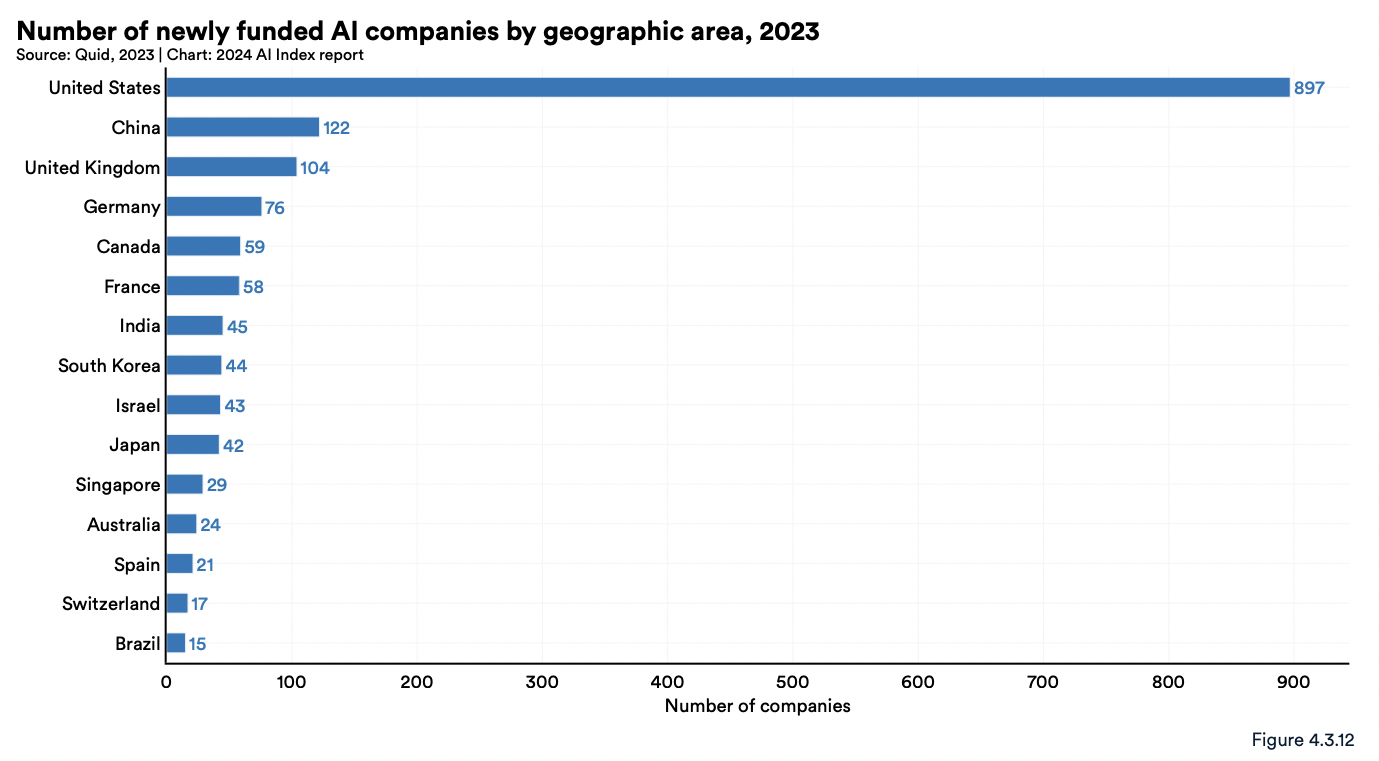
Stanford’s 2024 AI Index Report ranked the nations that have witnessed the most growth in AI startup activity over the last decade. According to the report, the US and China ranked at the top, while India held the seventh position.

Source: Stanford Report

India’s AI Funding Game

AIM earlier reported that it is now a prime time to build an AI startup in India due to funding opportunities and acquisition potential. According to AIM Research, 43 Indian AI startups received $864 million in funding as of August 2024. Among these, Ema, an enterprise AI startup, raised $36 million in Series A funding.

Established players such as Uniphore and Gupshup are leading the pack with late-stage funding rounds, as per Tracxn data. Uniphore raised $400 million in Series E funding (January 2022) and $140 million in Series D (November 2020).

Similarly, Gupshup secured $240 million in Series F funding (July 2021) and multiple $100 million rounds, showcasing sustained investor confidence in AI-driven solutions.

Emerging players like Sarvam AI and Krutrim are also making waves in the industry. Sarvam AI raised $41 million in Series A funding (December 2023), signalling strong early-stage support. Krutrim, a generative AI-focused startup, has attracted $50 million in Series B funding (January 2024) and $24 million in Series A (July 2023), demonstrating consistent growth and innovation in cutting-edge AI applications.

Institutional investors such as Tiger Global Management, Lightspeed Venture Partners, and Alpha Wave Global are leading the funding of Indian AI startups. These global and angel investors are enthusiastically backing AI innovations, highlighting the country’s growing prominence in the global AI landscape.

In terms of valuations, companies receiving higher funding amounts, such as Uniphore and Gupshup, have valuations ranging from $1 billion to $2.5 billion, contributing to India’s expanding unicorn ecosystem. This reflects the increasing confidence in the potential of Indian AI companies to create large-scale global impact.

The diversity of AI applications is another hallmark of the Indian startup ecosystem. While established companies focus on conversational AI solutions, emerging players are diving into generative AI and specialised areas like text-based chatbots. For example, Senseforth is carving a niche in enterprise chatbots, while Krutrim and Sarvam AI are pioneering generative AI platforms.

Funding for AI startups in India totalled $8.2 million in the April-June 2024 quarter. In contrast, AI startups in the US received $27 billion in the same period, representing nearly half of all startup funding in the country.

The upside? Building products in India is far less costly than in the West.

Abhijeet Kumar, CEO of Tablesprint, underscores India’s unique cost advantage. “Building a solution like Salesforce would cost millions in the US, but in India, it’s a fraction. India is no longer just a service provider; we’re creating products that compete globally. For AI startups, now is the time to build in India, with talent, resources, and cost advantages all in place.”

Are Bengaluru’s AI Startups Tempted by the Bay Area?

For some founders, India provides what’s needed to build impactful, cost-effective technology. Amritanshu Jain, co-founder and CEO of SimpliSmart, who returned from Silicon Valley, is even more convinced. “In India, we have a deep pool of tech talent. Many think Indian engineers leave for the US due to a lack of opportunities here, but that’s changing.”

Yet, Vedant Maheshwari, CEO of Vidyo.ai, believes India’s core challenge in AI lies elsewhere. “Foundational AI requires significant capital and patience, which is harder to secure in India. While funding here is substantial, it’s mostly application-focused rather than foundational,” he explained.

“In the US, there’s more support for deep-level work, but in India, targeting specific AI applications allows us to leverage existing models without huge initial investments.”

Vishnu Ramesh of Subtl.ai, who has ties to both the Bay Area and India, sees it as a matter of investor confidence. “The Bay Area draws investors because of its track record. Once India has its ‘Google moment’, confidence here will rise.”

Also, most IITians prefer to move to the US for better opportunities. According to the US-based National Bureau of Economic Research, one-third of those graduating from the country’s engineering schools, particularly the IITs, live abroad.

Brendan Rogers, co-founder of 2am VC, shared on LinkedIn that most of these IITians are unicorn founders.

The Hybrid Model

India excels in application development; however, GenAI demands fresh talent and innovation. While government initiatives like the National AI Mission foster upskilling, startups continue to struggle.

As a result, many look abroad, especially to the US, which offers faster adoption cycles, larger contract sizes, and better ROI on AI products.

As there is an evident pattern of startups moving to the US, the country continues to be a key market for Indian AI startups. It also provides higher annual contract values (ACVs), making it attractive for startups seeking rapid growth.

Many founders adopt a hybrid model – operations and talent in India with customer bases in the US – leveraging India’s cost advantage and the SaaS model to scale globally.

Raguraman said Indian AI startups are mostly focused on enterprises rather than consumers. “The enterprise market here is an excellent testbed due to discerning customers who demand rigorous product evaluations. However, the slower adoption rates and smaller ACVs compared to the US remain a challenge. This disparity often compels startups to focus on international markets for growth while maintaining a foothold in India,” he said.

What’s Next?

What venture capitalists look for while evaluating AI startups is, how much effort they have invested in their technology, what proprietary data they control, and the unique value they’re adding over existing models.

This effort should be substantial, so they are confident it’s not just a surface-level improvement but something with real depth.

Indeed, India offers a more capital-efficient startup environment, whether for AI, or otherwise. However, the question is whether this will remain the case as these businesses scale globally. Once startups expand and start competing internationally, they will need to invest in talent from around the world, which could increase their expenses.

In terms of capital, India requires less funding for startups compared to the US, but there is also significantly less capital available here. While the Indian VC and startup ecosystem has grown substantially, it’s still relatively young and about 60 to 70 years behind the US ecosystem.

The post The Struggles of Building an AI Startup in India appeared first on Analytics India Magazine.

AIIMS Delhi Allocates ₹300 Crore to Push AI-Driven Healthcare in India

AI healthcare

The All India Institute Of Medical Science (AIIMS), Delhi, announced an investment of over ₹300 crore in digital infrastructure aimed at benefiting patients, doctors, and researchers. The premier institute’s director, Dr M Srinivas, noted that AI is revolutionising everything from patient care to health communication. He stressed that this investment will benefit the stakeholders.

Speaking at an event held at AIIMs, Srinivas said, “By integrating AI, we can improve efficiency, reduce delays, and enable world-class research”.

He further mentioned that AI will simplify and disseminate health information, which will empower patients and improve their engagement with healthcare systems.

AI in Healthcare

At the event, several healthcare, technology, and policy domain experts discussed the potential of AI to address challenges in health-related communication.

Dr Kavita Narayan, senior technical advisor at the central government’s ministry of health and family welfare, said, “AI can play a vital role in making healthcare more accurate, compassionate, and equitable. To truly make a difference, we must integrate technology thoughtfully and ensure collaboration between policymakers, technologists, and healthcare providers.”

Humeta, a custom-trained AI model developed by Healthpresso, was presented.

“Healthcare is a sensitive field where credibility is paramount. Humeta is trained on over a million data points from trusted medical sources like The Lancet and PubMed, ensuring that the information it generates is both accurate and up-to-date,” co-founder and CEO Daleep Singh Manhas explained.

Manhas highlighted how Humeta addresses the accessibility gap, as 63% of people reportedly struggle to understand medical content. “With Humeta, we simplify complex medical concepts into digestible and credible formats – text, visuals, and interactive tools – so that patients are empowered with reliable information they can trust.”

As with everything, there is a flip side to the story – dependency and privacy.

“While AI can enhance precision and efficiency, we must preserve the human touch in healthcare. Compassion and technology must work together to create systems that prioritise the well-being of patients,” Dr KP Kochhar, head of the physiology department at AIIMS, said.

The event concluded that AI must be responsibly integrated and that collaboration among policymakers, technologists, and healthcare providers is needed to use it for good.

The post AIIMS Delhi Allocates ₹300 Crore to Push AI-Driven Healthcare in India appeared first on Analytics India Magazine.

Top AI Courses by NVIDIA for Free in 2025

NVIDIA is one of the most influential hardware giants in the world. Apart from its much sought-after GPUs, the company also provides free courses to help you understand more about generative AI, GPU, robotics, chips, and more.

Most importantly, all of these are available free of cost and can be completed in less than a day. Let’s take a look at them.

1. Building RAG Agents for LLMs

Building RAG Agents for LLMs course is available for free for a limited time. It explores the revolutionary impact of large language models (LLMs), particularly retrieval-based systems, which are transforming productivity by enabling informed conversations through interaction with various tools and documents. Designed for individuals keen on harnessing these systems’ potential, the course emphasises practical deployment and efficient implementation to meet the demands of users and deep learning models. Participants will delve into advanced orchestration techniques, including internal reasoning, dialog management, and effective tooling strategies.

In this workshop you will learn to develop an LLM system that interacts predictably with users by utilising internal and external reasoning components.

Course link: https://learn.nvidia.com/courses/course-detail?course_id=course-v1:DLI+S-FX-15+V1

2. Accelerating Data Science Workflows with Zero Code Changes

Efficient data management and analysis are crucial for companies in software, finance, and retail. Traditional CPU-driven workflows are often cumbersome, but GPUs enable faster insights, driving better business decisions.

In this workshop, one will learn to build and execute end-to-end GPU-accelerated data science workflows for rapid data exploration and production deployment. Using RAPIDS™-accelerated libraries, one can apply GPU-accelerated machine learning algorithms, including XGBoost, cuGraph’s single-source shortest path, and cuML’s KNN, DBSCAN, and logistic regression.

More details on the course can be checked here – https://learn.nvidia.com/courses/course-detail?course_id=course-v1:DLI+T-DS-03+V1

3. Generative AI Explained

This self-paced, free online course introduces generative AI fundamentals, which involve creating new content based on different inputs. Through this course, participants will grasp the concepts, applications, challenges, and prospects of generative AI.

Learning objectives include defining generative AI and its functioning, outlining diverse applications, and discussing the associated challenges and opportunities. All you need to participate is a basic understanding of machine learning and deep learning principles.

To learn the course and know more in detail check it out here – https://learn.nvidia.com/courses/course-detail?course_id=course-v1:DLI+S-NP-01+V1

4. Digital Fingerprinting with Morpheus

This one-hour course introduces participants to developing and deploying the NVIDIA digital fingerprinting AI workflow, providing complete data visibility and significantly reducing threat detection time.

Participants will gain hands-on experience with the NVIDIA Morpheus AI Framework, designed to accelerate GPU-based AI applications for filtering, processing, and classifying large volumes of streaming cybersecurity data.

Additionally, they will learn about the NVIDIA Triton Inference Server, an open-source tool that facilitates standardised deployment and execution of AI models across various workloads. No prerequisites are needed for this tutorial, although familiarity with defensive cybersecurity concepts and the Linux command line is beneficial.

To learn the course and know more in detail check it out here – https://courses.nvidia.com/courses/course-v1:DLI+T-DS-02+V2/

5. Building A Brain in 10 Minutes

This course delves into neural networks’ foundations, drawing from biological and psychological insights. Its objectives are to elucidate how neural networks employ data for learning and to grasp the mathematical principles underlying a neuron’s functioning.

While anyone can execute the code provided to observe its operations, a solid grasp of fundamental Python 3 programming concepts—including functions, loops, dictionaries, and arrays—is advised. Additionally, familiarity with computing regression lines is also recommended.

To learn the course and know more in detail check it out here – https://courses.nvidia.com/courses/course-v1:DLI+T-FX-01+V1/

6. An Introduction to CUDA

This course delves into the fundamentals of writing highly parallel CUDA kernels designed to execute on NVIDIA GPUs.

One can gain proficiency in several key areas: launching massively parallel CUDA kernels on NVIDIA GPUs, orchestrating parallel thread execution for large dataset processing, effectively managing memory transfers between the CPU and GPU, and utilising profiling techniques to analyse and optimise the performance of CUDA code.

Here is the link to know more about the course – https://learn.nvidia.com/courses/course-detail?course_id=course-v1:DLI+T-AC-01+V1

7. Augment your LLM Using RAG

Retrieval Augmented Generation (RAG), devised by Facebook AI Research in 2020, offers a method to enhance a LLM output by incorporating real-time, domain-specific data, eliminating the need for model retraining. RAG integrates an information retrieval module with a response generator, forming an end-to-end architecture.

Drawing from NVIDIA’s internal practices, this introduction aims to provide a foundational understanding of RAG, including its retrieval mechanism and the essential components within NVIDIA’s AI Foundations framework. By grasping these fundamentals, you can initiate your exploration into LLM and RAG applications.

To learn the course and know more in detail check it out here – https://courses.nvidia.com/courses/course-v1:NVIDIA+S-FX-16+v1/

8. Getting Started with AI on Jetson Nano

The NVIDIA Jetson Nano Developer Kit empowers makers, self-taught developers, and embedded technology enthusiasts worldwide with the capabilities of AI.

This user-friendly, yet powerful computer facilitates the execution of multiple neural networks simultaneously, enabling various applications such as image classification, object detection, segmentation, and speech processing.

Throughout the course, participants will utilise Jupyter iPython notebooks on Jetson Nano to construct a deep learning classification project employing computer vision models.

By the end of the course, individuals will possess the skills to develop their own deep learning classification and regression models leveraging the capabilities of the Jetson Nano.

Here is the link to know more about the course – https://learn.nvidia.com/courses/course-detail?course_id=course-v1:DLI+S-RX-02+V2

9. Building Video AI Applications at the Edge on Jetson Nano

This self-paced online course aims to equip learners with skills in AI-based video understanding using the NVIDIA Jetson Nano Developer Kit. Through practical exercises and Python application samples in JupyterLab notebooks, participants will explore intelligent video analytics (IVA) applications leveraging the NVIDIA DeepStream SDK.

The course covers setting up the Jetson Nano, constructing end-to-end DeepStream pipelines for video analysis, integrating various input and output sources, configuring multiple video streams, and employing alternate inference engines like YOLO.

Prerequisites include basic Linux command line familiarity and understanding Python 3 programming concepts. The course leverages tools like DeepStream, TensorRT, and requires specific hardware components like the Jetson Nano Developer Kit. Assessment is conducted through multiple-choice questions, and a certificate is provided upon completion.

For this course, you will require hardware including the NVIDIA Jetson Nano Developer Kit or the 2GB version, along with compatible power supply, microSD card, USB data cable, and a USB webcam.

To learn the course and know more in detail check it out here – https://courses.nvidia.com/courses/course-v1:DLI+S-IV-02+V2/

10. Build Custom 3D Scene Manipulator Tools on NVIDIA Omniverse

This course offers practical guidance on extending and enhancing 3D tools using the adaptable Omniverse platform. Taught by the Omniverse developer ecosystem team, participants will gain skills to develop advanced tools for creating physically accurate virtual worlds.

Through self-paced exercises, learners will delve into Python coding to craft custom scene manipulator tools within Omniverse. Key learning objectives include launching Omniverse Code, installing/enabling extensions, navigating the USD stage hierarchy, and creating widget manipulators for scale control.

The course also covers fixing broken manipulators and building specialised scale manipulators. Required tools include Omniverse Code, Visual Studio Code, and the Python Extension. Minimum hardware requirements comprise a desktop or laptop computer equipped with an Intel i7 Gen 5 or AMD Ryzen processor, along with an NVIDIA RTX Enabled GPU with 16GB of memory.

To learn the course and know more in detail check it out here – https://courses.nvidia.com/courses/course-v1:DLI+S-OV-06+V1/

11. Getting Started with USD for Collaborative 3D Workflows

In this self-paced course, participants will delve into the creation of scenes using human-readable Universal Scene Description ASCII (USDA) files.

The programme is divided into two sections: USD Fundamentals, introducing OpenUSD without programming, and Advanced USD, using Python to generate USD files.

Participants will learn OpenUSD scene structures and gain hands-on experience with OpenUSD Composition Arcs, including overriding asset properties with Sublayers, combining assets with References, and creating diverse asset states using Variants.

To learn more about the details of the course, here is the link – https://learn.nvidia.com/courses/course-detail?course_id=course-v1:DLI+S-FX-02+V1

12. Assemble a Simple Robot in Isaac Sim

This course offers a practical tutorial on assembling a basic two-wheel mobile robot using the ‘Assemble a Simple Robot’ guide within the Isaac Sim GPU platform. The tutorial spans around 30 minutes and covers key steps such as connecting a local streaming client to an Omniverse Isaac Sim server, loading a USD mock robot into the simulation environment, and configuring joint drives and properties for the robot’s movement.

Additionally, participants will learn to add articulations to the robot. By the end of the course, attendees will gain familiarity with the Isaac Sim interface and documentation necessary to initiate their own robot simulation projects.

The prerequisites for this course include a Windows or Linux computer capable of installing Omniverse Launcher and applications, along with adequate internet bandwidth for client/server streaming. The course is free of charge, with a duration of 30 minutes, focusing on Omniverse technology.

To learn the course and know more in detail check it out here – https://courses.nvidia.com/courses/course-v1:DLI+T-OV-01+V1/

13. How to Build Open USD Applications for industrial twins

This course introduces the basics of the Omniverse development platform. One will learn how to get started building 3D applications and tools that deliver the functionality needed to support industrial use cases and workflows for aggregating and reviewing large facilities such as factories, warehouses, and more.

The learning objectives include building an application from a kit template, customising the application via settings, creating and modifying extensions, and expanding extension functionality with new features.

To learn the course and know more in detail check it out here – https://learn.nvidia.com/courses/course-detail?course_id=course-v1:DLI+S-OV-13+V1

14. Disaster Risk Monitoring Using Satellite Imagery

Created in collaboration with the United Nations Satellite Centre, the course focuses on disaster risk monitoring using satellite imagery, teaching participants to create and implement deep learning models for automated flood detection. The skills gained aim to reduce costs, enhance efficiency, and improve the effectiveness of disaster management efforts.

Participants will learn to execute a machine learning workflow, process large satellite imagery data using hardware-accelerated tools, and apply transfer-learning for building cost-effective deep learning models.

The course also covers deploying models for near real-time analysis and utilising deep learning-based inference for flood event detection and response. Prerequisites include proficiency in Python 3, a basic understanding of machine learning and deep learning concepts, and an interest in satellite imagery manipulation.

To learn the course and know more in detail check it out here – https://courses.nvidia.com/courses/course-v1:DLI+S-ES-01+V1/

15. Introduction to AI in the Data Center

In this course, you will learn about AI use cases, machine learning, and deep learning workflows, as well as the architecture and history of GPUs. With a beginner-friendly approach, the course also covers deployment considerations for AI workloads in data centres, including infrastructure planning and multi-system clusters.

The course is tailored for IT professionals, system and network administrators, DevOps, and data centre professionals.

To learn the course and know more in detail check it out here – https://www.coursera.org/learn/introduction-ai-data-center

16. Fundamentals of Working with Open USD

In this course, participants will explore the foundational concepts of Universal Scene Description (OpenUSD), an open framework for detailed 3D environment creation and collaboration.

Participants will learn to use USD for non-destructive processes, efficient scene assembly with layers, and data separation for optimised 3D workflows across various industries.

Also, the session will cover Layering and Composition essentials, model hierarchy principles for efficient scene structuring, and Scene Graph Instancing for improved scene performance and organisation.

To know more about the course check it out here – https://learn.nvidia.com/courses/course-detail?course_id=course-v1:DLI+S-OV-15+V1

17. Introduction to Physics-informed Machine Learning with Modulus

High-fidelity simulations in science and engineering are hindered by computational expense and time constraints, limiting their iterative use in design and optimisation.

NVIDIA Modulus, a physics machine learning platform, tackles these challenges by creating deep learning models that outperform traditional methods by up to 100,000 times, providing fast and accurate simulation results.

One will learn how Modulus integrates with the Omniverse Platform and how to use its API for data-driven and physics-driven problems, addressing challenges from deep learning to multi-physics simulations.

To learn the course and know more in detail check it out here – https://learn.nvidia.com/courses/course-detail?course_id=course-v1:DLI+S-OV-04+V1

18. Introduction to DOCA for DPUs

The DOCA Software Framework, in partnership with BlueField DPUs, enables rapid application development, transforming networking, security, and storage performance.

This self-paced course covers DOCA fundamentals for accelerated data centre computing on DPUs, including visualising the framework paradigm, studying BlueField DPU specs, exploring sample applications, and identifying opportunities for DPU-accelerated computation.

One gains introductory knowledge to kickstart application development for enhanced data centre services.

To learn the course and know more in detail check it out here – https://learn.nvidia.com/courses/course-detail?course_id=course-v1:DLI+S-NP-01+V1

The story was updated on 2nd Jan, 25 to reflect the latest courses and correct the URLs to them.

The post Top AI Courses by NVIDIA for Free in 2025 appeared first on Analytics India Magazine.

Did Microsoft Spill the Secrets of OpenAI?

Microsoft suggests that OpenAI’s o1 Mini and GPT 4o Mini consist of 100 billion and 8 billion parameters, respectively.

A new research by Microsoft estimates the size of some of the most powerful AI models that exist today – a feature that is otherwise kept a secret. Microsoft suggests that Claude 3.5 Sonnet consists of 175 billion parameters, and the o1 Preview has 300 billion parameters.

The tech company also suggests that OpenAI’s small models, the o1 Mini and the GPT 4o Mini, consist of 100 billion and 8 billion parameters, respectively.

This has got people excited. GPT-4o Mini is a powerful model from OpenAI that ranks higher than the larger GPT-4o, Claude 3.5 Haiku, and is comparable to the latest Llama 3.3 70B, according to a quality index from Artificial Analysis.

An 8B parameter model has the potential to be embedded into portable devices for local use. In a post on X, Yuchen Jin, CTO of Hyperbolic Labs, asked OpenAI chief Sam Altman, “Would you consider open-sourcing GPT-4o-mini? It could run on our local devices.”

However, some speculate that the GPT-4o mini, like the GPT-4o, is a ‘mixture of experts (MoE) model’ that uses a small and specialised model within itself to solve different parts of a problem.

Oscar Le, CEO of SnapEdit, one of the most popular AI photo editing apps, said, “My bet is 4o-mini is an MoE with a total of around 40B params (parameters) and probably 8B active.”

“I saw that it holds significantly more knowledge (when asking about facts) than an 8B model while being quite fast. Besides, GPT-4o is MoE, so they likely use the same architecture for mini,” he added in a post on X.

Microsoft experimented with the above models in their research to develop a benchmark for medical error detection and correction in clinical notes. However, this isn’t an exact number of the parameter count.

“The exact numbers of parameters of several LLMs have not been publicly disclosed yet. Most numbers of parameters are estimate reported to provide more context for understanding the models’ performance,” Microsoft said in the research.

OpenAI, Anthropic, and Google have not released a detailed technical report outlining the architectural details and techniques used to build their latest models. This is likely due to concerns about revealing proprietary technology. For context, GPT-4, released in 2023, was the last model from OpenAI to carry a technical report.

However, companies like Microsoft and Chinese AI giants Alibaba’s Qwen and DeepSeek have released detailed technical documentation of their models. Recently, Microsoft’s Phi-4 models released all the details of the model.

In an interview with AIM, Harkirat Behl, one of the creators of Microsoft’s Phi-4 models, said that the company is taking a different approach from OpenAI’s or Google’s. “We have actually even given all the secret recipes [of the model] and techniques which are very complicated, and nobody in the world has implemented these techniques.”

“In the paper, we have released all those details. That’s how much we love open source here at Microsoft,” Behl added.

‘Bigger Models are Not All You Need’

Over the last few years, the parameter count of AI models has been trending downward, and the latest revelation substantiates this trend. Last year, EpochAI unveiled the parameters of multiple frontier models, like GPT 4o and Claude 3.5 Sonnet.

After Microsoft, EpochAI also revealed that GPT-4o has 200 billion parameters. EpochAI said that 3.5 Sonnet has around 400 billion parameters, a stark contrast to Microsoft’s estimate of 175 billion parameters. Irrespective, this suggests that AI models are done prioritising the parameter count.

Between GPT-1 and GPT-3, parameter counts were multiplied by 1,000 times, and another 10 times from 175 billion to 1.8 trillion parameters between GPT-3 and GPT-4. The multiplication factor, however, is being reversed.

“Let alone reaching the 10 trillion parameter mark, current frontier models such as the original GPT-4o and Claude 3.5 Sonnet are probably an order of magnitude smaller than GPT-4,” said Ege Erdil, a researcher at EpochAI in December last year.

chart visualization

Initially, increasing the parameter size improved the model’s performance. However, with time, increasing computation and parameter size did not scale the model further. The lack of availability of newer datasets also contributes to these diminishing returns.

“A model with more parameters is not necessarily better. It’s generally more expensive to run and requires more RAM than a single GPU card can have,” said Yann LeCun in a post on X.

Owing to this, engineers have explored efficient techniques on an architecture level to scale models. One such technique is the MoE, which the GPT-4o and the 4o Mini reportedly operate with.

“[MoE is a] neural net consisting of multiple specialised modules, only one of which is run on any particular prompt. So the effective number of parameters used at any one time is smaller than the total number,” LeCun further said.

As 2024 came to an end, the ecosystem witnessed models with innovative techniques that outperformed frontier models. Released in December, Microsoft’s Phi-4 uses small and curated high-quality datasets to train the Phi-4 model. These outperform many leading models, including GPT-4o.

Just a fortnight ago, DeepSeek released an open-source MoE model, the V3. Not only does it outperform GPT-4o in most tests, but it was also trained for just $5.576 million. For instance, GPT-4 was trained for $40 million, and Gemini Ultra took $30 million.

So, in 2025, we are likely to see more optimisation and scaling techniques that boost models to higher levels at significantly lower costs.

“Model size is stagnating or even decreasing, while researchers are now looking at the right problems – either test-time training or neurosymbolic approaches like test-time search, program synthesis, and symbolic tool use,” François Chollet, creator of Keras and the ARC AGI benchmark, wrote on X.

“Bigger models are not all you need. You need better ideas. Now the better ideas are finally coming into play,” he added.

The post Did Microsoft Spill the Secrets of OpenAI? appeared first on Analytics India Magazine.

Maharashtra to Draft New AI Policy with Focus on Datasets

Maharashtra AI Policy

Maharashtra is set to draft its first AI policy, aiming to position the state as a leader in AI advancements. State Information and Technology Minister Ashish Shelar announced this initiative during a meeting with IT Department officials.

The proposed AI policy will include initiatives that will leverage AI to boost industries and create employment opportunities in AI-related fields. They will also work towards enhancing public services and governance through AI-driven solutions. The state aims to prepare its workforce for AI-driven changes in industries such as healthcare, agriculture, education, and logistics through specialised training programs and industry collaborations.

IndiaAI Mission

The new policy will align with the national IndiaAI Mission launched by the central government with a budget of ₹10,372 crore. This national initiative includes programs such as the India AI Datasets Platform, application development, and support for AI startups.

Collecting and aggregating non-personal datasets from January 2025 to build a comprehensive database for the India AI Datasets Platform will be one of Maharashtra’s policy goals.

The draft policy is expected to be unveiled later this year after incorporating stakeholder input and aligning with Maharashtra’s economic and social priorities. Experts and industry leaders will review it before finalisation.

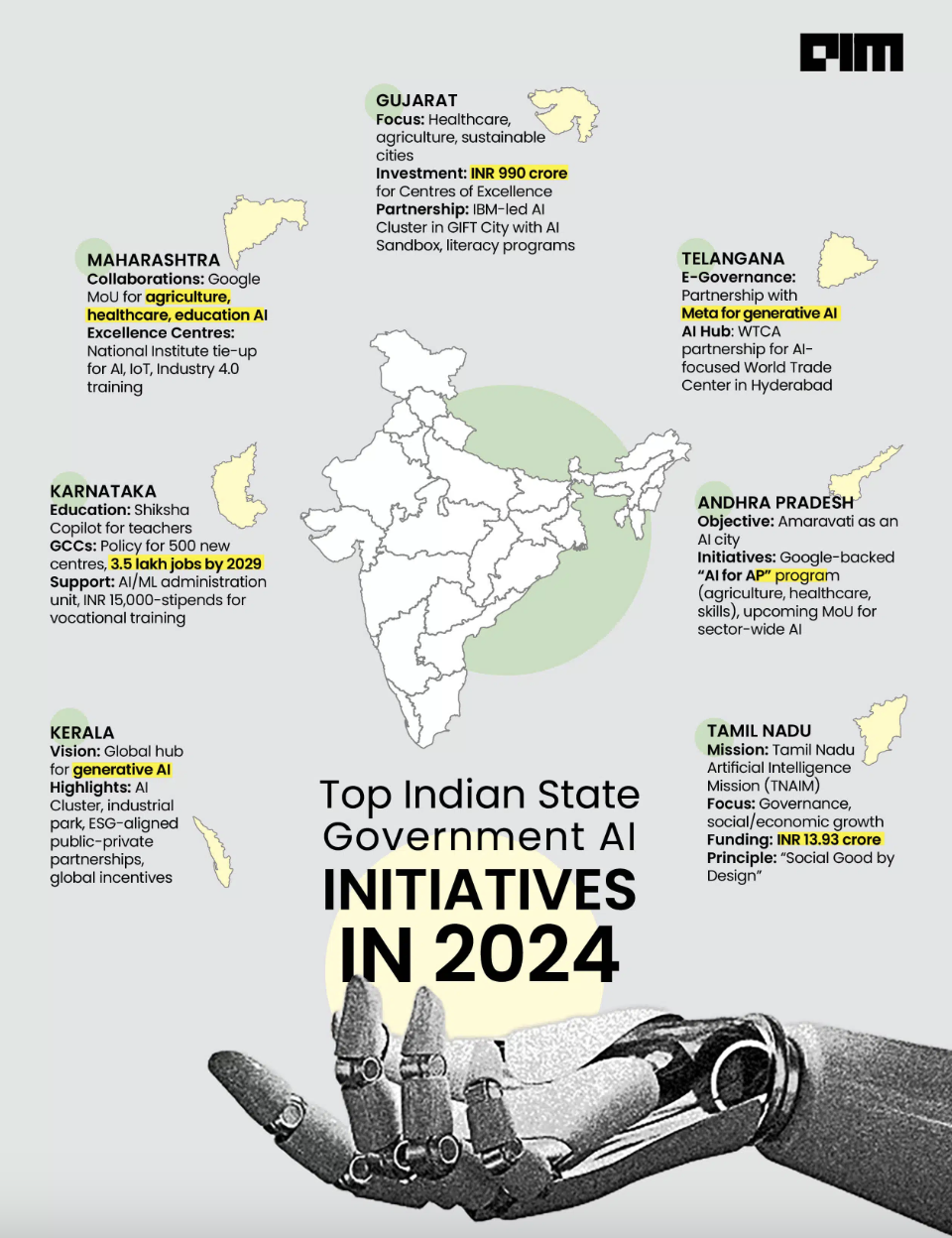
Besides Maharashtra, Karnataka, Telangana, Tamil Nadu, Gujarat, and others are independently progressing on their AI initiatives to boost the economy in their respective states. A few days ago, Microsoft chief Satya Nadella visited the Telangana government, where strategic talks on expanding Microsoft data centres and other initiatives in the state were discussed.

The post Maharashtra to Draft New AI Policy with Focus on Datasets appeared first on Analytics India Magazine.

Top 6 Project Management Trends to Watch in 2025

Fast-paced markets, shrinking budgets, and increasing shareholder scrutiny are just a few of the factors piling pressure onto today’s project managers. Projects are also becoming more complex, thanks to the increasing integration of emerging technologies like AI, heightened regulatory requirements, and the necessity for adaptability in volatile economies.

It is imperative that project managers keep an eye on what is around the corner in the industry so they are prepared to take advantage of new processes or avoid pitfalls. TechRepublic spoke to industry experts to find out the top trends to watch in 2025.

1 Wrike

Wrike Visit Website Company Size Employees per Company Size Micro (0-49), Small (50-249), Medium (250-999), Large (1,000-4,999), Enterprise (5,000+) Medium (250-999 Employees), Large (1,000-4,999 Employees), Enterprise (5,000+ Employees) Medium, Large, Enterprise Features Agile Development, Analytics / Reports, API, and more

2 Nifty

Nifty Visit Website Company Size Employees per Company Size Micro (0-49), Small (50-249), Medium (250-999), Large (1,000-4,999), Enterprise (5,000+) Any Company Size Any Company Size Features Agile Development, Analytics / Reports, API, and more

Trend 1: Increase in hybrid project teams

Alan Zucker, Founding Principal of consulting firm Project Management Essentials

“I see interest in hybrid project management continuing to increase in 2025. Interest in agile is waning, and many agilists say it is dead. Hybrid projects combine elements of one or more project approaches. For decades, project managers have pragmatically blended processes and practices based on context and specific project needs.

Hybrid allows project managers to move away from the binary waterfall-agile world to one where patterns of practice include lean, kanban, and DevOps. Successful project managers must make intentional choices when deciding how to execute their projects.”

SEE: Explore the key features and benefits of hybrid project management.

Trend 2: Squad-based teams reduce bureaucracy

Jack Skeels, CEO of training firm AgencyAgile

“The shift to squad-based teams reflects growing dissatisfaction with traditional approaches and the perceived ineffectiveness of agile as it’s often implemented. Leaders and stakeholders are weary of overly complex management structures and expensive project management software tools that fail to deliver meaningful results.

Instead, leaders are embracing simpler, more effective models: small, self-managed teams—typically small squads of five to 15 people. These small teams embody the original spirit of agile by collaborating and getting things done quickly with innovation.

The model encourages a culture of innovation, collaboration, and responsiveness to change—key traits for businesses competing in fast-paced markets.”

Trend 3: Move to decentralized project management

Molly Beran, founder of project management consultancy Projects By Molly

“I expect to see a lot of organizations re-thinking their approach to creating centralized Project Management Offices. In the past few years, PMOs have been all the rage—companies rush to set them up, build templates and processes, and then usually start to see them slowly wither.

Why? There are many reasons, of course, but I find that one of the most prevalent reasons is that while there is a rush to stand-up tools and processes, there are rarely enough people skilled in project management to actually use the tools and get the work done.

Also, in the rush to set up an office, it’s really typical for companies to lose sight of their larger strategic or organizational priorities. In a sense, they get so caught up in creating a centralized PMO that they forget why it exists in the first place—to get the work done that best aligns with the strategic priorities of an organization.

I predict that in 2025 and beyond, companies will start pulling back on centralized PMOs and go back to more decentralized project management, where each department or area has in place experts who understand the core business processes, and also get asked to manage projects.”

SEE: Read TechRepublic’s guide to the top project management certifications.

Trend 4: Focus on AI literacy among project managers

Cornelius Fichtner, president of Project Management PrepCast and host of The Project Management Podcast

“Project managers should experience a ‘rude awakening’ as they recognize the limitations of their current generative AI interactions. The difference between successful and struggling projects hinges primarily on the project manager’s depth of AI understanding.

Many project managers forget that they not only need to use AI on their projects, but they will also be asked to lead projects intended to bring AI capabilities to various departments in their company. They need a really broad and solid understanding of what AI is and can do in order to serve stakeholders from marketing and finance as these departments are augmented with AI.”

SEE: 9 Best AI Project Management Tools for 2024

Trend 5: Accelerated job training through AI

Justin Tan, IT Project Management Office leader at Thermo Fisher Scientific

“Imagine AI systems that can instantly generate comprehensive project plans based on the context and conditions, predict potential risks with greater accuracy, optimize resource allocation, and provide contextual decision support that historically required years of professional experience.

Junior professionals without extensive traditional experience will leverage such AI-powered platforms to access institutional knowledge and best practices, effectively compressing years of learning into actionable recommendations—accelerating learning and project execution capabilities.

From my experience playing a key role in leading digital transformation initiatives, the most successful organizations will be those that strategically integrate AI not as a replacement for human intelligence, but as a collaborative tool that amplifies human potential.”

SEE: Read more artificial intelligence coverage from TechRepublic.

Trend 6: Resource management software grows in importance

Michele Badie, Professional Development Strategist at Skills Recharged

“We’ll continue skills-centric resource management discussions, and action plans to connect the right skills to the right tasks while ensuring teams thrive and stay on task. Real-time tools—for example, resource planning software, AI-driven allocation, employee well-being, and collaboration and communication tools—will support making resource allocation seamless.

At the same time, project managers, as integral parts of the process, will focus on balancing workloads to prioritize mental health and job satisfaction. In 2025, there will continue to be an amplified focus on not just getting the work done—it’s about ensuring your people avoid decision fatigue or burnout and succeed in their roles, too.”

SEE: TechRepublic Premium’s Mental Health Policy.

Will project managers be replaced by AI?

AI is unlikely to replace project managers entirely, but it is reshaping their roles. Research indicates that while AI can automate administrative tasks like scheduling, data collection, and reporting, it lacks severely in other human elements that are essential for effective project management.

These human elements include making decisions and empathy, which assists with team motivation and conflict resolution—two things project managers do almost daily.

Professor Adam Boddison, the Chief Executive of Association for Project Management, told TechRepublic in an email: “Hybrid work environments demand stronger digital communication and leadership skills, while sustainability and diversity initiatives are becoming integral to organisational strategies. Project management is, in effect, future-state planning.

“With APM research showing that over 50% of businesses anticipate an increase in the number of projects they undertake over the next three years, the importance of the project profession is clear. The role of the skilled project professional will be pivotal across all industries.”

It has been predicted that 25 million new project professionals will be needed by 2030 to keep up with industry demand. Check out TechRepublic’s guide on how to become a project manager to find out whether the role would suit you.