Why This AI VC Firm Loves the Indian Middle Class

Capria Ventures AI VC

Whether they pick AI for India or AI for Bharat, one thing is certain, the VCs betting on India’s AI ecosystem are focusing on the largest segment that will benefit the most from such innovations: The great Indian middle class.

Seattle-based Capria Ventures is one such capital firm that identified this opportunity over a decade ago and has been capitalising on this aspirational segment ever since. The 12-year-old firm invests in early-stage and early-growth tech startups in the global south.

Why Middle India Matters

“We look at the rising middle class of India, often referred to as ‘Middle India’, which aspires to have and do more,” said Will Poole, co-founder and managing partner of Capria Ventures, in an exclusive interaction with AIM.

Poole explains how the aspirational middle class, comprising roughly 600-700 million people, forms a cornerstone of their investment strategy. “This market is largely underserved or less served but represents a very large opportunity,” he said.

With increasing incomes and growing aspirations, Poole believes that this demographic drives demand for innovative solutions across sectors such as healthcare, education, and technology. The firm recognised this trend early. “We started doing this before anybody else was doing it,” he remarked.

With decades of experience as an investor and entrepreneur who founded eShop, which was acquired by Microsoft in 1996 and was part of the ‘Windows’ growth, Poole has witnessed the advent of mobile technology firsthand during his tenure at Microsoft in 2003.

“The power of the mobile revolution happened fast in India,” he noted, drawing parallels to the current wave of digital and AI-driven innovations.

Poole also highlighted the role of generative AI in addressing challenges specific to Middle India, such as language diversity. By leveraging AI for multilingual solutions, businesses can expand their reach and improve operational efficiency.

“Generative AI is an equaliser in the world of language,” he said, adding that it reduces the burden of linguistic diversity for businesses aiming to scale.

With India set to become the world’s third-largest economy within the next five to seven years, the opportunities for VC-backed startups are immense. “We’re very bullish on India,” Poole stated.

Capria began operating in India about five years ago, followed by Southeast Asia, Africa, and North America. Since then, the company has invested in several Indian AI startups. Its core team is located in Bengaluru.

Healthcare, finance, agritech, are some of the verticals Capria has invested in, with prominent customers leveraging their solutions. For instance, 5C Network, a telediagnostics company, leverages AI to analyse radiological images, improving disease diagnosis and radiology efficiency. With over 11 million images analysed and 250 regulator-approved disease detectors, 5C serves clients such as Manipal Hospital.

BetterPlace is an HR management platform that supports frontline workers across India and Southeast Asia. It integrates AI for multilingual training, enhancing employee productivity and reducing training costs. Reliance is among its key customers, managing over a million employees through the platform.

Challenges in the Indian Ecosystem

Despite its promise, investing in India’s startups comes with unique challenges, with cost management being a significant hurdle. Poole shared an anecdote about a founder who implemented GPT-4 for customer service but had to downgrade to GPT-3.5 to manage costs.

“You’d never find a US customer service startup worrying about API costs like this,” he said.

Poole noticed that access to cutting-edge technology is another challenge in our ecosystem. Indian startups often lag behind their counterparts in the US in accessing state-of-the-art tools and developments. “Our role as VCs is to help them sort through the noise and identify the gems they can use to scale their businesses quickly,” Poole explained.

Capria is also clear in its investment philosophy of investing in startups that leverage existing technologies to build scalable businesses rather than those building their own AI models or competing with heavily funded incumbents.

This pragmatic approach extends to identifying startups with proprietary access to data, which Poole sees as a critical competitive advantage. “Data helps them build rapidly and maintain an edge over competitors,” he said.

What About Others?

It’s not just Capria Ventures. According to the recent trend, many VC firms are investing in AI startups that aim to address problems at various levels in the country, especially through language applications. Sarvam AI, backed by Peak XV Partners and Khosla Ventures, for instance, has built Indic language models.

Similarly, Accel is supporting AI startups through its Accel Atoms 4.0 program. This program will offer up to $1 million in funding for startups focusing on AI and Bharat, specifically catering to middle-income households in Tier 2, 3, and rural India.

Capria Ventures is looking to launch a new fund focused on applied generative AI that addresses the unique needs of middle India. “We’ve been doing this for a dozen years now, and we’re excited about the next dozen,” concluded Poole.

The post Why This AI VC Firm Loves the Indian Middle Class appeared first on Analytics India Magazine.

‘People Regulating AI are the Ones Who Struggled with High School Maths’

Naval Ravikant, a renowned entrepreneur and thinker, recently expressed sharp criticism of the efforts to regulate artificial intelligence (AI), equating such attempts to the suppression of mathematical innovation.

“These are the same kids who were scared of maths in high school and are now writing regulations to prevent other kids from doing maths,” he said.

Ravikant believes that restricting AI development stifles one of humanity’s last remaining sources of innovation. His critique underscores a growing divide between those driving technological advancement and policymakers who, according to him, lack technical comprehension.

“These are the people who literally do not know how these things work… They are going to show up and say you can’t run this computation these many times. Are you going to arrest people for doing mathematics?” he added, agitated.

Ravikant’s scepticism stems from his belief in the interconnectedness of knowledge and creativity. “If you limit computers and computation, you have frozen innovation across all domains, not just AI,” he added.

His views reflect a deep concern about the unintended consequences of stifling the private sector’s ability to innovate, particularly in contrast to unregulated advancements by competing nations like China. “What happens when others build drone swarms powered by AI while we’ve shackled ourselves with regulations?” warned Ravikant.

Regulate the Roots

Another thinker and author, Yuval Noah Harari, expressed nuanced views on regulating AI. He said that while AI could bring immense benefits—such as advancing healthcare and education—it also threatens to undermine human agency and democratic processes if left unchecked.
“There is no way to regulate the AI revolution in advance. What we really need are institutions that can understand and react to things as they develop. If democracy means a human conversation, it collapses when robots join the circle and you don’t know who’s who,” said Harari.

So, what’s the solution? Harari believes that “counterfeit humans”, or AI entities impersonating humans, must be banned to preserve trust and transparency in society. He stressed the need for regulations that hold companies accountable for the actions of their algorithms rather than the behaviour of users.

Harari also warned that the speed of progress in AI outpaces humanity’s ability to adapt, and called for international institutions to monitor developments and advise on regulations dynamically.

Regulate with Caution

Anthropic chief Dario Amodei emphasised a pragmatic and collaborative approach to regulate AI. He highlighted the urgency of regulation, stating, “If there’s nothing watching over us as an industry, there’s no guarantee we’ll do the right thing, and the stakes are very high.”

Amodei acknowledged the challenges of poorly designed rules, warning, “The worst enemy of those who want real accountability is badly designed regulation.”

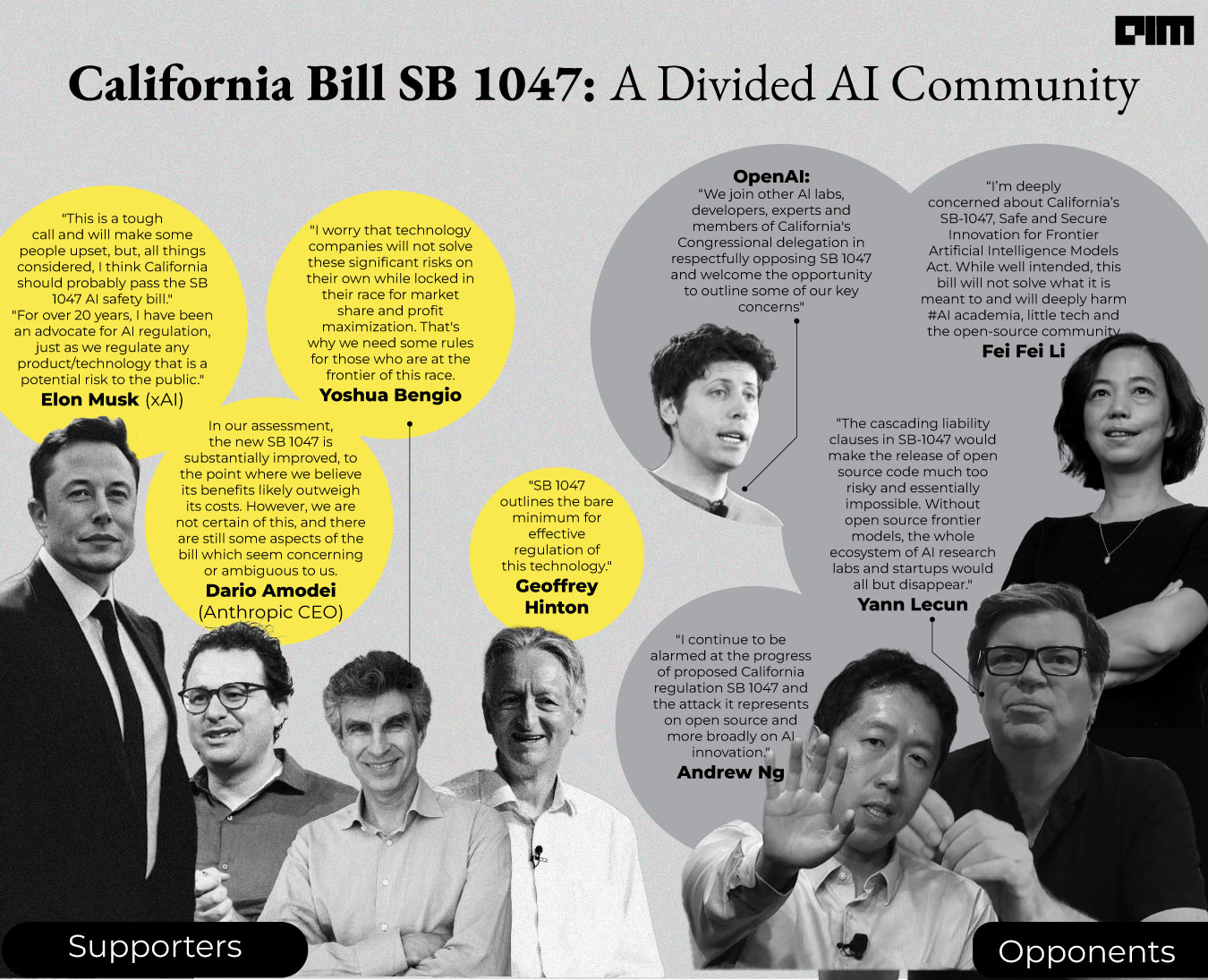
Reflecting on California’s vetoed AI regulation bill SB 1047, he noted the importance of balancing safety and practicality, supporting measures that are “surgical, targeted at serious risks, and something people can actually comply with.”

For Amodei, the focus must shift from polarisation to a shared goal of responsible AI governance, fostering a “race to the top” where companies compete by adopting best practices for safety and ethics.

Meanwhile, OpenAI chief Sam Altman advocated for a balanced and collaborative approach to AI regulation.

He further highlighted the role of governments, companies, and society in setting guardrails, drawing parallels to industries like aviation: “Airplanes are really safe. That happened largely as a result of old-fashioned regulation.”

While cautioning against overregulation which could stifle progress, he stressed the need for iterative governance: “Society should play the role there… a complex negotiation of a lot of different stakeholders.”

Altman envisions AI as a tool to enhance human values and equity through systems that engage users deeply, stating: “The people impacted by it the most deserve the loudest say in its governance.”

“If I had one wish for AI, it would be to love humanity,” he said, sharing his ultimate wish for AI.

The post ‘People Regulating AI are the Ones Who Struggled with High School Maths’ appeared first on Analytics India Magazine.
The upcoming Samsung Galaxy S25 phones may come with this major AI upgrade for free

Samsung Galaxy S24 Ultra Camera

Samsung will almost certainly be revealing its Galaxy S25 lineup in less than a month. While the company's latest phone will reportedly bring a new design, an upgraded camera, and more, it might also bring a surprise perk — a free Gemini Advanced subscription.

While running an APK teardown of the latest version of the Google app, a process that involves diving deep into code to predict upcoming features, Android Authority noticed several indications that Galaxy S25 might include a free subscription to the paid version of Google's AI.

Also: T-Mobile users can try Starlink's satellite service for free — here's how

"Your device gives you access to a {one}-year subscription to Gemini Advanced," the code read, "with access to our most capable AI models, at no cost." There were also lines of code for nine-month, six-month, and three-month subscriptions. At least for the year-long trial, that's a value of more than $200.

Several other mentions of "Samsung" or "Samsung S25" appear throughout the app, tying this offer directly to Samsung's upcoming release. It seems likely that the different tiers are tied to different phone models.

Google previously made a similar offer available to customers who purchased a Pixel 9.

Also: The next big HDMI leap is coming next week — what the 2.2 standard means for you

If you're not familiar, Gemini Advanced is a paid upgrade of Gemini, Google's own AI. The service, which usually costs $20 a month, gives you access to a much more powerful version of the AI that can generate images, understand more complex questions, give better responses, let you build custom AI experts, and give you previews of Google's experimental models.

While Gemini Advanced is currently only available with a Google One subscription — which also includes 2TB of cloud storage, advanced Google Photos editing features, a VPN for multiple devices, and more — there's no indication that the Samsung offer includes Google One.

We'll likely learn more when Galaxy Unpacked happens on Jan. 22.

Featured

CES 2025: What is it, what to expect, and how to tune in

CES signage

With the Consumer Electronic Show (CES) being less than a week away, you have probably seen countless mentions of the conference from any tech news outlet or company you follow. Whether you're a tech enthusiast or consumer, the show is guaranteed to feature something you care about, whether it's the launch of a new tech product or feature or the demo of some visionary technology with the potential to change the future.

Want to keep up with the conference's latest and hottest news? ZDNET will have a team on the ground bringing you the latest announcements during the show, so you don't miss a thing. Here's everything you need to know about CES 2025.

What is CES?

The Consumer Electronics Show, known as CES for short, is a tradeshow that features the biggest tech players from across the globe who will be showcasing their latest consumer technology with daily product launches, keynotes, activations, and demos. The annual event, which has found a permanent home at the Las Vegas Convention Center and other nearby hotels, has been taking place for decades, becoming a staple in the tech community.

When is CES 2025?

The official days of CES 2025 are Tuesday, Jan. 7, to Friday, Jan. 10. However, since Jan. 5 and Jan. 6 are media days, you can expect a lot of news to break before the conference starts. Once the conference kicks off officially on Tuesday and the show floor opens, you will start to see reports related to each exhibitor's booths and demos.

The major tech companies invest a hefty penny to secure CES booths in prime locations and, therefore, make them as elaborate as possible — and quite a sight to behold. To see them for yourself, follow ZDNET's video platforms (YouTube, TikTok, and Instagram).

Where will CES 2025 take place?

CES has been held in Las Vegas, NV, since 1978. While the main show floor is in the Las Vegas Convention Center, the conference is so massive that it expands to neighboring hotels comprised of two campuses: the Venetian campus and the C Space campus. The Venetian campus includes the Venetian, Palazzo, and Wynn, and the C Space Campus includes the Aria, Vdara, Cosmopolitan, and Park MGM. There are a total of 12 official venues, spanning over 2.5 million net square feet, according to the CES website.

Who can attend CES 2025?

Although it is a tradeshow that includes the term "consumer" in the title, it is not open to the general public. Per the CES website, "CES is a trade-only event for individuals 18 years of age or older and affiliated with the consumer technology industry." The three registration types are industry and media attendees and exhibitor personnel and you have to meet a long list of registration requirements for each.

Even if you meet the qualifications, you still have to pay to attend. There are two ticket tiers: the Exhibits Plus Pass, $350, and the Deluxe Conference Pass, $1,700. Full details on exactly who is eligible to attend and how to prove eligibility can be found on the CES registration page. In 2024, there were 135,000 or more attendees.

If you don't qualify, don't worry; most companies will live stream their keynotes, and ZDNET will update its site daily with the latest news.

What companies will be at CES 2025?

The list of companies exhibiting at CES is extensive; CES 2024 featured more than 4,300 exhibitors, including about 1,400 startups, according to CES data. This year, the CES website advertises that exhibitors will include 309 of the Fortune 500 companies. Attendees include big names such as Qualcomm, Intel, Google, Samsung, and Pansonic. The full list is public, and you can review it here.

How can you tune into CES 2025?

The major companies will be holding live streams, so it is worth checking their YouTube pages and socials for the links. Some companies already including links include Nvidia, Samsung, and Sony. ZDNET will have a team covering the event on the ground, as well as one covering the event remotely to ensure you don't miss a thing.

Innovation