NVIDIA to Make AR Glasses Soon

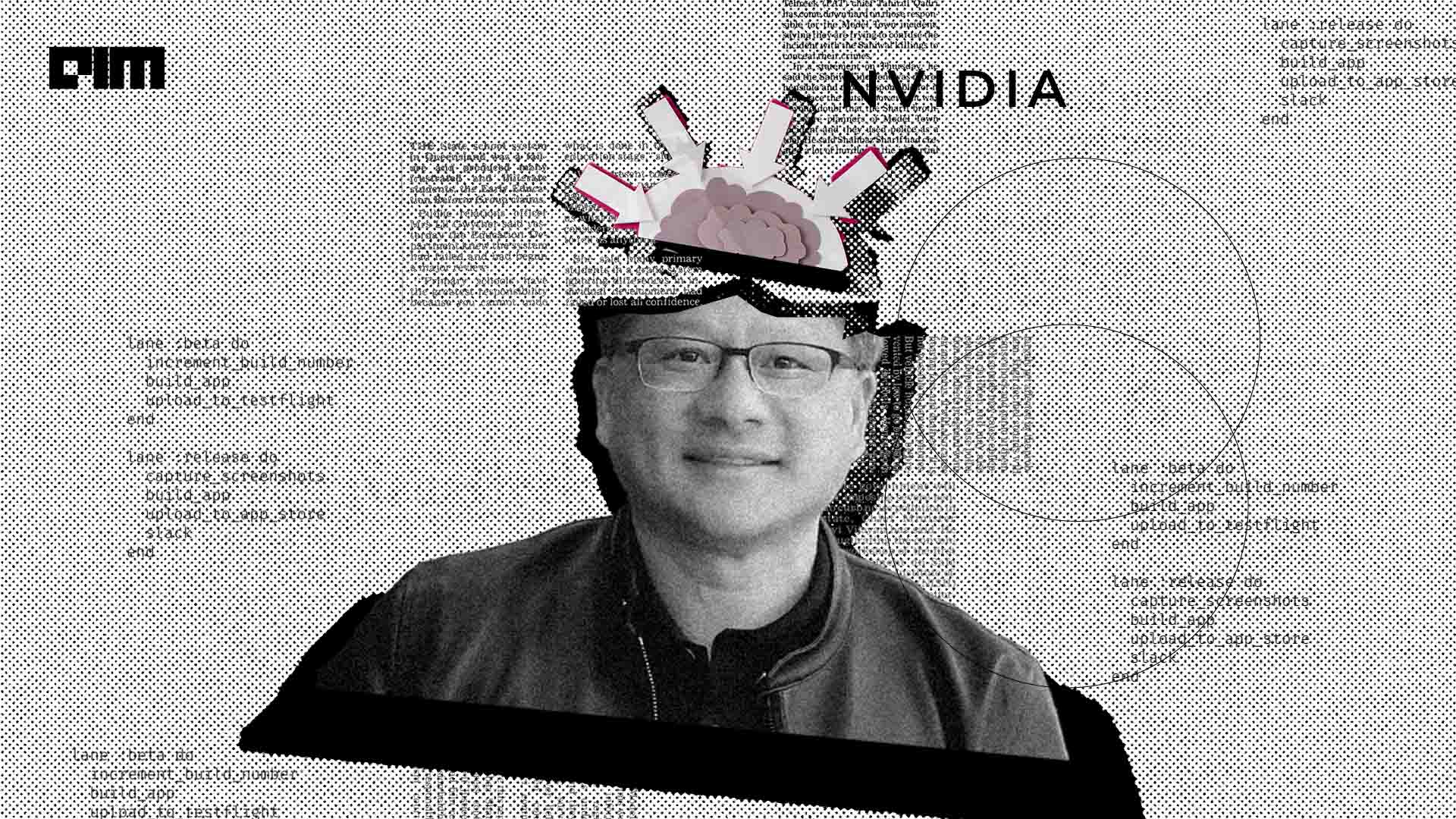
NVIDIA, on Thursday, applied for a patent for new smart glasses with a compact form factor that is going to be visually indistinguishable from a regular pair of glasses. The company has joined the likes of Meta in betting big on this technology.

Through the patent, NVIDIA revealed its plans to build an augmented reality (AR) display with better power efficiency, a more compact form factor, and improved contrast for more realistic visuals.

NVIDIA’s glasses will feature a display on specific, darkened areas of the glass. “Instead of uniformly darkening the entire lens like traditional sunglasses, this system can create precise dark regions only where AR content needs to be displayed,” an independent patent researcher with the username SETI Park wrote on X.

“This selective darkening approach not only saves power but also maintains natural vision everywhere else, similar to how modern car windows can have specific tinted regions while keeping the rest clear,” they added.

NVIDIA also mentioned the possibility of using a neural network to determine the best settings for the spatial light modulator, which is a device that manipulates light in a controlled manner.

The patent is numbered ‘20250004275A1’ and can be found on the United States Patent and Trademark Office (USPTO) website.

With NVIDIA marking their foray into the world of AR/VR, the competition is set to heat up in 2025. Recently, reports suggested that Meta is planning to add a display and a wristband controller to the upcoming model of the Ray-Ban Meta family of glasses.

Last year, in October, Meta unveiled the Orion smart glasses, which the company touts as the “most advanced pair of AR glasses ever made”. Meta also said that in the next two years, up to two billion people who wear regular glasses will transition to smart glasses.

On the other hand, Apple has plans in store to build an affordable Vision Pro variant, and the company expects to double its sales. A second generation of Vision Pro, with a faster chip, is set to be released in 2026.

The post NVIDIA to Make AR Glasses Soon appeared first on Analytics India Magazine.

LLMs that Failed Miserably in 2024

Run LLM locally on computer

In 2024, the AI community witnessed the launch of several new large language models (LLMs), such as OpenAI’s o3 and Google Gemini 2, which promised to push the boundaries of what’s possible with AI. However, not all of them could live up to the hype. Despite their impressive features, some models struggled to gain traction, with disappointing adoption rates and limited interest.

Here are some LLMs that failed to make a lasting impact in 2024, even after bold announcements and ambitious claims.

1. Databricks DBRX

Databricks launched DBRX, an open-source LLM with 132 billion parameters, in March 2024. It uses a fine-grained MoE architecture that activates four of 16 experts per input, with 36 billion active parameters. The company claimed that the model outperformed closed-source counterparts like GPT-3.5 and Gemini 1.5 Pro.

However, since its launch, there has been little discussion about its adoption or whether enterprises find it suitable for building applications. The Mosaic team, acquired by Databricks in 2023 for $1.3 billion, led its development, and the company spent $10 million to build DBRX. But sadly, the model saw an abysmal 23 downloads on Hugging Face last month.

2. Falcon 2

In May, the Technology Innovation Institute (TII), Abu Dhabi, released its next series of Falcon language models in two variants: Falcon-2-11B and Falcon-2-11B-VLM. The Falcon 2 models showed impressive benchmark performance, with Falcon-2-11B outperforming Meta’s Llama 3 8B and matching Google’s Gemma 7B, as independently verified by the Hugging Face leaderboard.

However, later in the year, Meta released Llama 3.2 and Llama 3.3, leaving Falcon 2 behind. According to Hugging Face, Falcon-2-11B-VLM recorded just around 1,000 downloads last month.

3. Snowflake Artic

In April, Snowflake launched Arctic LLM, a model with 480B parameters and a dense MoE hybrid Transformer architecture using 128 experts. The company proudly stated that it spent just $2 million to train the model, outperforming DBRX in tasks like SQL generation.

The company’s attention on DBRX suggested an effort to challenge Databricks. Meanwhile, Snowflake acknowledged that models like Llama 3 outperformed it on some benchmarks.

4. Stable LM 2

Stability AI launched the Stable LM 2 series in January last year, featuring two variants: Stable LM 2 1.6B and Stable LM 2 12B. The 1.6B model, trained on 2 trillion tokens, supports seven languages, including Spanish, German, Italian, French, and Portuguese, and outperforms models like Microsoft’s Phi-1.5 and TinyLlama 1.1B in most tasks.

Stable LM 2 12B, launched in May, offers 12 billion parameters and is trained on 2 trillion tokens in seven languages. The company claimed that the model competes with larger ones like Mixtral, Llama 2, and Qwen 1.5, excelling in tool usage for RAG systems. However, the latest user statistics tell a different story, with just 444 downloads last month.

5. Nemotron-4 340B

Nemotron-4-340B-Instruct is an LLM developed by NVIDIA for synthetic data generation and chat applications. Released in June 2024, it is part of the Nemotron-4 340B series, which also includes the Base and Reward variants. Despite its features, the model has seen minimal uptake, recording just around 101 downloads on Hugging Face in December, 2024.

6. Jamba

AI21 Labs introduced Jamba in March 2024, an LLM that combines Mamba-based structured state space models (SSM) with traditional Transformer layers. The Jamba family includes multiple versions, such as Jamba-v0.1, Jamba 1.5 Mini, and Jamba 1.5 Large.

With its 256K token context window, Jamba can process much larger chunks of text than many competing models, sparking initial excitement. However, the model failed to capture much attention, garnering only around 7K downloads on Hugging Face last month.

7. AMD OLMo

AMD entered the open-source AI arena in late 2024 with its OLMo series of Transformer-based, decoder-only language models. The OLMo series includes the base OLMo 1B, OLMo 1B SFT (Supervised Fine-Tuned), and OLMo 1B SFT DPO (aligned with human preferences via Direct Preference Optimisation).

Trained on 16 AMD Instinct MI250 GPU-powered nodes, the models achieved a throughput of 12,200 tokens/sec/gpu.

The flagship OLMo 1B model features 1.2 billion parameters, 16 layers, 16 heads, a hidden size of 2048, a context length of 2048 tokens, and a vocabulary size of 50,280, targeting developers, data scientists, and businesses. Despite this, the model failed to gain any traction in the community.

The post LLMs that Failed Miserably in 2024 appeared first on Analytics India Magazine.

The MNC Work Culture Crisis in India

Ask any tech graduate in India about their career goals, and chances are they’ll mention landing a job at Microsoft, Google, or a similar multinational company (MNC) – if not in the West, then at least in one of their Indian offices. This is because MNCs in India have built a reputation for offering better work environments, higher salaries, and more global exposure compared to their domestic counterparts.

Companies like Microsoft or Google are known to extend the same policies they have in the US to India. However, a closer look reveals significant differences in how employees in India are treated compared to their peers in Western offices.

Many express concerns about being ill-treated, facing longer hours, and being excluded from decision-making processes. One Reddit user shared that while their company claimed to follow global policies, the implementation in India felt “selective and unfair”.

What’s the Issue?

One of the primary draws of working for an MNC in India is the promise of higher compensation. Research indicates that US-based MNCs operating in India pay up to 70% more than Indian companies for equivalent roles.

However, Indian GCCs are often called the “cost centres” of the MNCs, as the focus is simply on maximising the ROI. While the salaries may seem high here, they remain relatively low compared to similar roles in Western countries.

While speaking with AIM, an employee of Microsoft India who wanted to maintain anonymity said that though they work on many global projects for the company, there is definitely a pay disparity compared to their US colleagues. The person says the company allows them to work remotely for several weeks if needed, while their Indian managers often frown upon this.

This was also reflected in a Reddit discussion where an MNC employee said that their bosses here are usually Indians, whose decisions are naturally tainted by the general work culture in the country. “It’s the same mindset we see in many Indian parents, too – that of micromanaging and having tight control over their juniors,” said the employee.

Microsoft India declined to comment on the matter when contacted by AIM.

Unlike countries that propose the “right to disconnect” to ensure employees can switch off after work, India lacks even basic discussions around such safeguards. The Microsoft India employee also said that though officially there are enough remote work opportunities in their job, unofficially, everything largely hinges on the manager’s permission.

“In Indian branches, even when remote work is permissible globally, employees are expected to report to the office, often without a justified reason,” said a user on Reddit. This was also confirmed by the MNC employee who spoke with AIM.

Another techie, who has worked for an MNC both in India and abroad, spoke about the stark differences in the work culture at both places. When he was in India, he was added to five different work groups. People who responded after work hours were applauded, and the managers questioned those who didn’t.

“The country head told everyone that our work doesn’t end at 5 pm or on weekends, and if need be, we must work through the weekend,” he added. On the other hand, he said that now that he works outside India for the same company, his colleagues do not even have his personal number—something that was unimaginable in India.
“My [current] manager pushes back on unrealistic timelines. Yes, there are expectations to deliver high-quality work, but doing some great work in a preplanned timeline with enough time for improvement is all that is expected,” he added.

Indian IT Affects the MNC Culture in India

Back here in Bengaluru, while everyone talks about the pleasant weather, the city’s corporate culture is somewhat affected by the work culture of the Indian IT industry, which often involves an expectation of long working hours.

Narayana Murthy, the co-founder of Infosys, who stirred public debate by suggesting that young Indians should embrace a 70-hour workweek to help drive the nation’s economic growth, stood his ground despite criticism.

The abysmal salaries at these companies are also a huge problem. Mohandas Pai, the former CFO of Infosys, recently pointed out that entry-level salaries for Indian IT have stagnated for the last decade and more. In 2011, a fresher’s salary was INR 3.25 lakh per annum, and it has only marginally increased to INR 3.75 lakh per annum on average.

“How is it justified?” Pai asked, calling it an exploitation of the workforce. While salaries for freshers might increase in 2025, the jump would be no more than 10%. This increase is also expected due to the increasing number of GCCs in India.

This fuels the perception that Indian companies fail to foster a positive work culture. The same sentiment extends to MNCs setting up bases in India. Sanjay Sreedhar, staff engineer at Lenovo, said on Quora that for many MNCs in India, a resource is just a number. “Indian MNCs don’t care about your career growth unless there is a pressing need for them to upskill their employees,” he said, adding that mid-level managers think that everyone just works for them.

Will Things Change?

In response to the tragic death of the 26-year-old audit executive at EY earlier this year, states like Maharashtra, Telangana, and Karnataka are drafting new workplace rules and increasing inspections to ensure employee well-being.

The expectation among MNC employees in India contrasts sharply with norms in Western countries. Employees expect that their managers will treat them the same way as their colleagues in the West. However, several employees have repeatedly said that it all comes down to the manager in charge.

Now that most companies are planning to open new offices in Bengaluru, which is emerging as the country’s GCC hub, it becomes important for MNCs to focus on local issues. This includes several work culture issues that the city’s workforce has highlighted for several years.

While Murthy and Pai’s remarks sparked conversations about productivity and competitiveness, they also reignited concerns about work-life balance in India’s demanding professional environment.

The post The MNC Work Culture Crisis in India appeared first on Analytics India Magazine.

Where AI educators are replacing teachers — and how that’ll work

gettyimages-471386587

As we're seeing across all kinds of industries, artificial intelligence (AI) is the next frontier in education. Now one charter school network is experimenting with using AI to teach students — and it's expanding its reach across the US.

Just before the holidays, the Arizona State Board for Charter Schools became the latest to approve an all-virtual, AI-driven school pitched by Unbound Academic Institute. Unbound Academy, set to open in August, will use personalized AI to teach fourth- to eighth-grade students via online platforms like Khan Academy and IXL.

Also: 5 free AI tools for school that students, teachers, and parents can use, too

For two hours each morning, students will take science, literature, and math lessons while AI tracks their progress, adapting elements such as difficulty level and style based on each student's needs.

"The AI system will analyze their responses, time spent on tasks, and even emotional cues [via webcam] to optimize the difficulty and presentation of content," Unbound's charter application states. "This ensures that each student is consistently challenged at their optimal level, preventing boredom or frustration."

Unbound claims this approach "leads to mastery up to 2.4 times faster than in traditional educational settings," among other success metrics listed in its application. The model's goal is to empower what Unbound says is a disengaged generation of students, preparing them to succeed in a "rapidly changing modern world."

Also: Adobe offers students an AI study buddy for just $2 a month — but at what cost?

The charter school will pilot the same "2hr Learning model" already operating in Alpha, a network of private schools run by Unbound Academic Institute. Alpha has several locations in Texas and Florida, with forthcoming locations in Santa Barbara, CA, and Phoenix (Unbound Academy will virtually serve the Tucson area).

ZDNET has contacted Unbound representatives for clarification on how its models are trained, and will update this story once we have that information.

Like Alpha schools, Unbound Academy won't have teachers. Instead, AI lessons are monitored by what the school calls "Guides" who intervene when needed using a Social and Emotional Learning (SEL) approach. In a section of the application titled "No teachers, just guidance," Unbound says that "this human-in-the-loop approach, aligning with US Department of Education best practices, ensures that AI enhances, rather than replaces, human judgment" — a common method of framing AI implementation.

Unbound notes that large class sizes in traditional schools can hamper individual student attention, stating its guides will provide more hands-on, personalized encouragement — though its proposal budgets only eight guides for 250 students.

Alpha's website explains that guides are selected based on "their ability to motivate and know students," as well as plan effective workshops. "We select guides from top universities across the country with competitive backgrounds in fields like tech and start-ups," the site adds.

Also: How to use ChatGPT to summarize a book, article, or research paper

After AI lessons in the morning, students will attend several hours of virtual "life skills workshops" on topics like financial literacy, public speaking, resilience, and critical thinking led by what Unbound calls "community mentors," who range "from local entrepreneurs to civic leaders."

The company notes in its charter application that Alpha schools are relatively expensive. Unbound Academy aims to make the program more accessible to lower-income and underserved demographics, providing enrolled families with laptops.

Many academic institutions have embraced AI as a teaching enhancement and educator tool. Many parents see knowledge of AI as essential to children's education. But classes taught entirely by AI models are a new step.

AI is especially good at personalization — applying that to education could yield results for students at different learning stages who aren't served by current one-size-fits-all structures or don't get the attention they need in a busy classroom. "Students can advance based on competency rather than age or time spent, beneficial for both struggling and gifted students," Unbound says.

Also: AI isn't the next big thing — here's what is

But the efficacy of online learning, which exploded during the COVID-19 pandemic lockdown, is inconclusive at best, and that's when taught by credited teachers. A majority of educators themselves are skeptical of online learning. AI tutors, like the rest of the field, are proliferating, but nascent — their full impact may remain unclear until we have longer-term data from student use.

Artificial Intelligence

The best robot mowers of 2025: Expert tested and reviewed

Though I mostly enjoy mowing my lawn, I can't say I always look forward to it. After getting a robot mower, what used to be quiet time with my mower has turned into quality active time with my kids, and I'll never complain about that. A robot mower functions like a robot vacuum and mop, with sensors to navigate obstacles and stay within boundaries while cutting grass and a companion app for control.

Also: This futuristic portable battery kept my home running during an outage. Here's how

Unlike a robot vacuum, a robot mower uses a physical boundary, such as a buried wire along a perimeter, or a combination of GPS and LiDAR navigation aided by a satellite antenna to autonomously mow within a specified area. Because robot mowers are battery-powered, they're also a sustainable alternative to traditional gas-powered mowers. But all these features and differences can make choosing the right one for your yard difficult.

What is the best robot mower right now?

After testing some of the top robot mowers on the market, ZDNET's pick for the best robot mower overall is the Mammotion Luba 2. This all-wheel-drive robot lawn mower uses a virtual, GPS-powered boundary and can handle up to 80-degree slopes and mow up to 0.25 acres in one go, with options going up to 2.5 acres. Luba 2's GPS navigation system is so accurate that I fully trust it to mow my unfenced property line without burying boundary wires. But this isn't the only option or the best for all buyers. Read on to find ZDNET's top robot mower picks.

Sort by All

The best robot mowers of 2025

I've been testing the Mammotion Luba 2 3000 for about two months and have loved the freedom it's given me. It's not only the best GPS-powered mower I've tested, so accurate to its map that it mows precisely along my property line in my front, back, and side yards each time, but it's also the one I've found to deliver the most features in the app.

The Mammotion Luba 2 has proven so accurate and reliable that I can easily send it out to mow my uneven, 0.3-acre yard and return to see a beautifully checkered yard upon my return. The Mammotion app lets you adjust mowing height and pattern, map out perimeters, and set up separate coverage areas. The robot mower's wide cutting width of 15.7 inches makes it more efficient than other models.

Review: This robot mower looks like a racecar, but it mows a gorgeous lawn

Other Luba 2 users agree, with one buyer remarking, "What sets this mower apart is not just its ease of setup, but also its outstanding performance and features. The intuitive interface made configuring zones a straightforward task, and I was impressed by its cutting precision and battery life. Additionally, the smart connectivity options add another layer of convenience to its functionality."

The coolest thing about the Luba 2 is that there's a model for everyone. Ranging from a 0.25-acre capacity variant available for $2100 to a 2.5-acre model for $4100, you're not stuck paying a high-end price to mow a small yard.

Mammotion Luba 2 Features: Price: $2,100-$4,100, depending on acreage | Cutting width: 15.7 inches | Maximum cutting area: .25- to 2.5-acre models | Maximum slope: 38 degrees | Connectivity: Bluetooth, Wi-Fi, 4G | Anti-theft: Alarm, 4G, GPS theft tracking

Read More Show Expert Take Show less

Robot mowers are usually meant for small- and medium-sized lawns, but the Husqvarna 430X can handle lots up to almost a full acre. The 9.5-inch cutting deck features three blades that mulch clippings into ultra-fine pieces to re-feed your lawn between fertilizer applications.

The large rear wheels enable the mower to handle up to 24-degree inclines. The spot-mow feature lets you quickly tackle small areas the 430X may have missed or may be growing faster than other sections of your lawn, while the spiral-mow mode provides a consistent cutting pattern. The Husqvarna 430X has a built-in alarm to alert you to would-be thieves that can only be disabled with a personalized PIN, with GPS theft tracking to boot.

Review: This $2,500 robot lawn mower is so impressive my neighbors come to watch it mow

Husqvarna also offers interchangeable top covers to make it easier to see where your 430X is in your yard or to match the rest of your lawn and garden equipment.

ZDNET's Beth Mauder tested the Husqvarna 430X for a year on her one-acre yard and said in her review that she was "thoroughly impressed… We never once had to manually mow our lawn this past year."

Husqvarna 430X Features: Price: $2500 | Cutting width: 9.45 inches | Maximum cutting area: 0.8 acres | Maximum slope: 24 degrees | Connectivity: Bluetooth, cellular | Anti-theft: Alarm, PIN code, GPS theft tracking

Read More Show Expert Take Show less

Since robot mowers are a relatively new technology, they can be quite expensive. Fortunately, the Mowro RM24 is one of the more affordable options on the market, with a price tag that sits comfortably under $450.

The 9.5-inch cutting deck and 28V battery allow the RM24A to mow yards up to a quarter acre, while the large rear wheels help it tackle steeper hills and inclines. The brushless motor is quieter than gas mowers and many other battery-powered mowers, so you can enjoy your deck, patio, or backyard while the RM24A mows your lawn.

This MowRo automatically mows every two days to keep a consistent cut across your lawn, programmed through a built-in timer. It even has rain sensors to let the mower know it's time to return to the docking station when storms roll in.

Also: I pitted an AI-powered BBQ grill against a traditional $1,600 smoker. The winner was not so obvious

The RM24 robot mower includes 330 feet of perimeter wire and 150 boundary wire stakes, with extension kits available. It mows the lawn in random cutting patterns until it covers the intended area.

One buyer says, "I was super excited to see a robotic lawn mower for such a low price — at that price, I was willing to give it a go even if it didn't exactly operate perfectly. My expectations have been exceeded. The mower is random in its pattern but it seems to cover its area pretty well. I'm using all of the spec 1/4 acre and needed to purchase additional wire to cover the perimeter, but I'm glad to see the mower seems to keep up."

MowRo RM24 Features: Price: $350 | Cutting width: 9.5 inches | Maximum cutting area: 0.25 acres | Maximum slope: 26 degrees | Connectivity: Built-in programming | Anti-theft: None

Read More Show Expert Take Show less

The Husqvarna Automower EPOS offers satellite connectivity, straying from traditional boundary wire installations. Using a reference station like the Mammotion Luba 2, the EPOS machine doesn't need wires laid to know where to mow and where its charging station is located. Instead, it uses an Exact Positioning Operating System (EPOS) to do all of that.

The map is adjustable and easily adapted to include landscaping changes as your lawn evolves.

Review: I tested a $6,000 automower for four months. Here's why I'm fully invested

Featuring an almost 10-inch cutting width, the Automower EPOS can mow in various patterns, including neat rows or a crisscross design. With this machine, you don't have to give up your lawn style for simplicity. Everything is controlled through an app, delivering a hands-free experience.

You'll often forget it even exists once you set a schedule for your robot mower. At night, you can rest assured that the Automower comes equipped with an anti-theft alarm that is only disabled with the personal PIN you create.

ZDNET's Beth Mauder tested the 2.5-acre model, saying "The cost might seem steep up front, but it will pay off in the end. As someone who invests heavily in items and services that buy back my time, this automower is no exception. My husband and I both have gotten our weekends back — another hour or two every week we can spend making memories rather than being stuck working."

Husqvarna Automower EPOS features: Price: $3,300-$5,900 | Cutting width: 9.5 inches | Maximum cutting area: 1.25-2.5 acre models | Maximum slope: 45 degrees | Connectivity: Bluetooth, cellular, Wi-Fi | Anti-theft: Alarm, PIN code, GPS theft tracking

Read More Show Expert Take Show less

Other robot lawn mowers worth considering

Best robot mower alternative with a long runtime

Worx Landroid WR155

The Worx Landroid WR155 is capable of handling up to 0.5 acres and features a floating blade disk to lift the blades when going over uneven terrain.

View at Amazon

Best robot mower alternative for narrow spaces

Gardena Automatic Robotic Lawn Mower

With AI-precise cutting patterns, tight corners and passages as narrow as 24 inches are cut reliably.

View at Amazon Smartphones Smartwatches Tablets Laptops TVs Other Tech Resources

ZDNET Recommends

ZDNET joins CNET Group to award the Best of CES, and you can submit your entry now

"As Ethan Mollick, professor at the Wharton School of the University of Pennsylvania and AI expert, this quick adjustment can give users a glimpse at the future of voice assistants."

The world's largest consumer tech conference, Consumer Electronics Shows (CES), is just a few days away. At the show, you can expect to see the most innovative technology from leading companies and startups worldwide, and this year, ZDNET will help the Consumer Technology Association (CTA) identify and award the most breakthrough tech.

Also: CES 2025: What is it, what to expect, and how to tune in

The CTA recognizes the best technology at the trade show every year with a Best of CES designation across all consumer tech categories. This year, the CNET Group, which consists of ZDNET, CNET, PCMag, Mashable, and Lifehacker, all owned by Ziff Davis, is teaming up with the CTA to select the winners as the official media partner of the Best of CES Awards.

The top products and services will be determined exclusively by the CNET Group's editors and experts on the ground, including ZDNET's on-site team, and awarded the official distinction of Best of CES.

The designation goes to CES 2025 exhibitors whose product offers a compelling new concept or idea, solves a major consumer problem, or sets a new bar in performance or quality. There will be one winner in each of the following categories:

  • AI
  • Transportation and mobility
  • PC/laptop
  • TV/home theater
  • Smart home/home tech
  • Sustainability
  • Gaming
  • Wellness/fitness tech
  • Mobile
  • Privacy and security
  • Weirdest/most unexpected
  • Best overall

If you are interested in having your product considered for the award and meet the criteria above, you can fill out this submission form. Although there is no guarantee that each submission will be reviewed, we would love to hear about your product. Ultimately, the winners will be decided by the experts and editors' on-site demos, experiences, and findings, informed by their subject-area expertise.

The Best of CES Awards winners, presented by CNET Group, will be announced on Thursday, Jan. 9, on all CNET Group sites and social media platforms. You can stay updated on all things CES on ZDNET's site, LinkedIn, Instagram, TikTok, and YouTube.

IBM’s Acquisition of HashiCorp Investigated by UK Competition Authority

The U.K. government is investigating whether IBM’s acquisition of cloud infrastructure firm HashiCorp will result in a “substantial lessening of competition” within markets in the country.

IBM announced its intention to buy HashiCorp for $6.4 billion in April 2024 to help it support its customers’ growing AI-related demands. HashiCorp provides hybrid and multi-cloud lifecycle management products, such as infrastructure as code tool Terraform, which facilitate building and running AI applications.

HashiCorp will operate as a division of IBM Software rather than being brought into Red Hat, IBM’s open-source subsidiary. It said that the deal would help its products reach a larger audience.

The Competition and Markets Authority notified the two companies of an upcoming Phase 1 probe on Aug. 1, 2024, and formally launched it on Dec. 30. It will have to make a preliminary decision on whether to carry out a full-scale investigation by Feb. 25 and relevant third-parties can submit comments up to Jan. 16.

IBM declined to provide additional comment. TechRepublic has reached out to HashiCorp for a response.

IBM-HashiCorp deal has inspired criticism

IBM has faced challenges since announcing the acquisition, with the U.S. Federal Trade Commission reviewing it for potential antitrust concerns.

SEE: Ansible vs Kubernetes | DevOps Tools Comparison

IBM’s stock tanked by about 9% shortly after the announcement due to simultaneously posting a total first-quarter revenue of $90 million below London Stock Exchange estimates.

Conversely, HashiCorp’s stock rose by 4% after suffering considerable declines in 2023 brought on by relicensing Terraform from open-source Apache 2.0 to the more restrictive Business Source License. This alienated parts of the open-source community, and they forked the original Terraform code into the open-source OpenTofu and placed it under the oversight of The Linux Foundation.

Additionally, in June, a HashiCorp investor sued the company, claiming that the acquisition by IBM disproportionately benefited its board members over the shareholders. The executives allegedly stood to gain substantial personal benefits from the deal, such as certain “golden parachutes” and converting their large, illiquid stock holdings into cash.

Such incentives created conflicts of interest, according to the plaintiff, leading the board to favor the IBM acquisition over potentially more lucrative opportunities for shareholders and potentially diminishing the value of their investments. However, the suit was mysteriously withdrawn two days later.

U.K. cloud market does not present a level playing field

In October 2023, telecoms regulator Ofcom identified various issues in the U.K. cloud market that present challenges for businesses and consumers, including Amazon and Microsoft’s dominance. Microsoft’s Azure and AWS have between 70% and 80% of the U.K.’s cloud service market share compared to Google Cloud’s 10%.

One of the most pressing concerns is the cost of migrating data from cloud platforms. This cost barrier discourages customers from switching between cloud providers, stifling competition in the sector.

SEE: Microsoft, OpenAI Partnership Draws UK Antitrust Regulators’ Eyes

Shortly after these results were published, the CMA began investigating the issues raised. These results — and any potential remedies to anti-competitive practices — are expected to be announced later this month.

Synopsys and Ansys merger likely to be approved

On Dec. 20, the CMA completed its Phase 1 investigation into the $35 billion acquisition of simulation software company Ansys by chip design software provider Synopsys. It represents the biggest tech deal since Broadcom acquired VMware for $69 billion in 2023.

The CMA found that the merger has the potential to substantially lessen competition in the chip design and light simulation market but may still approve it if the two companies submit acceptable mitigations.

Synopsys and Ansys compete in three key sectors. The first is register transfer level power consumption analysis, which assesses a chip’s power demands and usage. The other two are optics and photonics software, both used to design and model light-related products like camera lenses, TV displays, car headlights, and lasers.

Merging these companies could reduce the choice of products in the three areas, as they would become a market leader, and smaller companies would struggle to compete. “This could lead to a loss of innovation, lower quality software, and/or higher prices, which may then be passed onto UK businesses and consumers,” the CMA said in its press release.

SEE: UK Regulator Probes Apple’s Mobile Browser Dominance

The CMA also suspected the deal would allow Synopsys and Ansys to limit their products’ interoperability to maintain dominance. However, the investigation found that this element is so important to their customers that they would switch providers if it was compromised, so they don’t have the incentive to do so.

Synopsys announced the deal in January 2024, claiming it wanted to expand its reach across silicon-to-systems designs, combining its expertise in electronic design automation with Ansys’ in simulation. Ansys accepted the deal to accelerate its growth and offer more integrated solutions to its customers. The two had already been working together for several years up to this point.

If the companies did not propose suitable mitigations by Dec. 31, 2024, the competition authority would conduct a more in-depth Phase 2 investigation. However, Synopsys said it had “already taken steps to address all concerns raised by the CMA” in a published response. One such step is its promise to sell its optical solutions business to another company once the Ansys acquisition has closed.

The merger is expected to be approved by the European Commission, according to Reuters. Sources added that Synopsys will offer the same remedies to the CMA that it did to address competition concerns in the E.U.

“Together, Synopsys and Ansys can help drive innovation across industries by addressing the rapidly increasing customer need for system design solutions that provide a deeper integration of EDA and Simulation and Analysis (S&A) software,” a Synopsys spokesperson said.

How I easily added AI to my favorite Microsoft Office alternative

OnlyOffice Desktop Editors on a green background.

The OnlyOffice Desktop Editors make for an outstanding MS Office alternative. With this application, you can either work locally or connect it to a cloud instance (self-hosted or hosted by a third party) and work with documents, spreadsheets, presentations, or PDF forms. OnlyOffice Document Editors is also compatible with MS Office documents and Open Document Format files (such as those from LibreOffice).

Also: How to edit a PDF file: 3 ways

With the latest release of OnlyOffice, the team has added the ability to integrate AI for queries, summaries, and translations. The feature works seamlessly, but you have to manually configure the AI model of your choice. OnlyOffice Desktop Editors support the following AI models:

  • OpenAI
  • Together AI
  • Mistral
  • GPT4ALL

I want to walk you through the process of adding AI to the OnlyOffice Desktop Editors.

How to add an AI model to OnlyOffice Desktop Editors

What you'll need: For this, you'll need two things: a running instance of the new version of OnlyOffice Desktop Editors (at least version 8.2.2.22, which can be installed on Linux, MacOS, and Windows), a valid account for one of the above AI models, and an API key from the AI model you've chosen.

Also: How to use ChatGPT to write Excel formulas

How you access your API key will depend on the model you've chosen. For example, with Mistral, you generate an API key from the API key section on the left sidebar. With the free account of Mistral, you can create up to 10 API keys. You only need one.

Let's get this added.

You can add as many plugins as you need, but you'll at least need.

Viola! The AI tab has appeared.

You can add as many AI models as neccessary.

Before you add the model, you'll need to generate an API key from your AI account.

Once you've taken care of that, restart the app again. When you create a new document this time, you'll see new icons for the AI feature (such as Ask AI, Summarization, and Translation). You can now start using AI within the OnlyOffice Desktop Editors app. The AI addition is straightforward, so you shouldn't have any problems getting up to speed with its usage.

Featured

Quantum computing’s status and near-term prospects

Part I: Background and some indicators of how AI is helping

Quantum computing’s status and near-term prospects

IBM’s Quantum System 2 on display at the Q2B 2024 Silicon Valley conference in December (author’s photo)

I had the opportunity to attend the Quantum to Business (Q2B) 2024 Silicon Valley event in December 2024, courtesy of Allie Kuopus, one of the organizers. It was their eighth year organizing this event, consisting of three full days of information flow and interaction on a topic I had never explored at length.

I was hoping to soak up enough of the fundamentals at the event, but when beginning to write, I realized I still didn’t understand the basics well enough. Physicist Richard Feynman famously said, “If you can’t explain something in simple terms, you don’t understand it.”

Thus the reason for creating this summary explainer to begin with. I just needed more clarity, and figured clarity is generally in short supply when it comes to such topics.

What is quantum computing?

Quantum mechanics is the study of natural phenomena at the atomic and subatomic particle levels. A quantum is a discrete unit which refers to the minimum amount of any physical property, such as light. A photon, for instance, is a quantum of light, as a primer in TechTarget points out. (Data Science Central is a unit of Informa TechTarget.)

Quantum computers process digital qubits instead of binary bits. A binary bit represents either 1 or 0. “A qubit, however, can represent a 0, a 1, or any proportion of 0 and 1 in superposition of both states, with a certain probability of being a 0 and a certain probability of being a 1,” according to Microsoft’s primer on the topic.

When Einstein referred to “spooky action at a distance” in 1947, he was alluding to the nature of particle entanglement and thus the physical influence particles can have on one another in a quantum system.

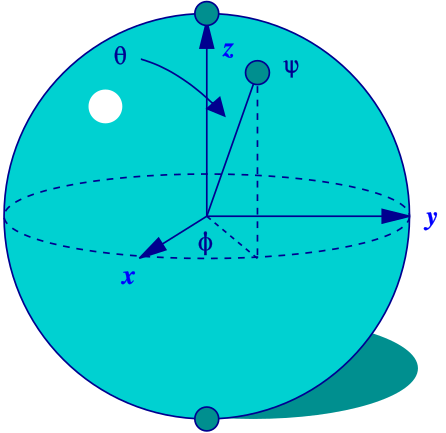
The “superposition” of particles in a quantum system refers to how they can exist in multiple states at once. Physicists use a Bloch sphere (named after Felix Bloch, a 1952 Nobel laureate who came up with this method of representation) to visualize superposition within a qubit. This method uses vectors to represent individual quantum states.

Quantum computing’s status and near-term prospects

Bloch-sphere-diagram.svg from Wikimedia Commons

Superposition is behind why QC can use interconnected qubits to process data in what proponents claim is an even more massively parallelized, exponentially accelerated method of computing than classical supercomputing.

As opposed to quantum mechanics, which has been around now for 100 years, the quantum computing field began in earnest nearly thirty years ago, as Google points out. Feynman, who envisioned the field, died in 1988.

But the big question to this day is still unanswered: Can QC really do things that classical computing can’t? Supercomputing, after all, hasn’t exactly stood still.

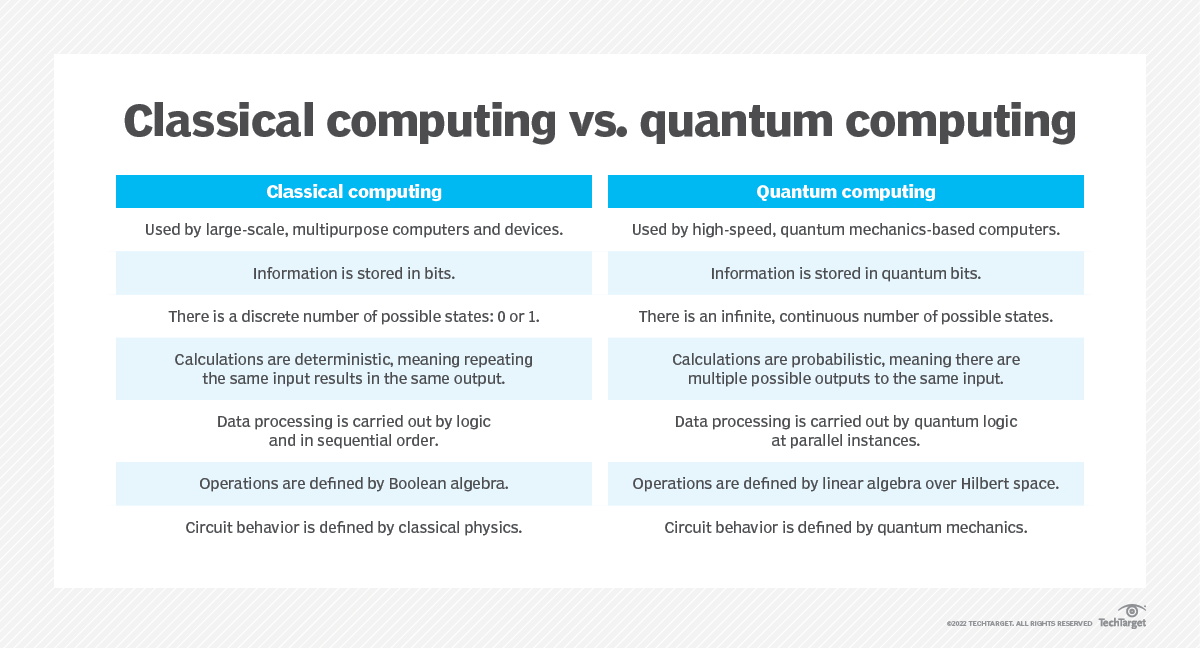
TechTarget boils down the main distinctions between classical computing and QC this way:

Quantum computing’s status and near-term prospects

See https://www.techtarget.com/searchdatacenter/tip/Classical-vs-quantum-computing-What-are-the-differences for more information.

The current QC challenge: Scaling error correction

What’s particularly tricky about QC is how to trigger and then accurately measure superposition behavior. To date, QCs have been error prone. Qubits can be quite sensitive to noise.

In fact, one of the reasons the launch of Google Quantum AI group’s Willow chip in December 2024 (timed for the Q2B event) received so much media attention was the group’s error correction claim: “Willow can reduce errors exponentially as we scale up using more qubits. This cracks a key challenge in quantum error correction that the field has pursued for almost 30 years.”

Other major QC R&D and product teams at the Q2B event echoed the Google group’s desire to scale up the number of qubits in QC systems. There was much discussion of the need for thousands or ideally millions of qubits per system for QC to be able to tackle a wide range of use cases. Google’s Willow chip has 105 qubits.

Much discussion at Q2B focused on logical qubits. A logical qubit abstracts the behavior exhibited by physical qubits to enable fault tolerance. Yuval Borger, chief commercial officer at QuEra, a QC provider with a 256-qubit processor available on the Amazon Braket QC service, alluded to Algorithmic Fault Tolerance as a promising error impact mitigation technique featured in a 2024 Harvard Quantum Optics Lab paper.

QuEra describes the rule of thumb that’s commonly agreed upon in an explainer on its website: “Each logical qubit will require 1,000 physical qubits.” That ratio will be subject to change as QC methods evolve.

AI’s use in quantum computing: An error correction example

Elica Kyoseva, Director Quantum Algorithm Engineering at NVIDIA, elaborated during her Q2B talk on the company’s pivotal role in quantum computing.

NVIDIA does not itself build quantum processing units (QPUs) or other quantum hardware. Instead it provides the surrounding classical infrastructure, assuming a hybrid classical/quantum approach to accelerated supercomputing.The company is thus QPU agnostic and has many QC partners.

One of the key uses of AI Kyoseva mentioned was in classical computing enabled error correction. AI can discover error-correcting code for specific types of quantum hardware, for one example. Kyoseva made clear that the near-term use cases for hybrid classical/quantum computing involve small data, but highly complex parameters.

The commercialization challenge over the near term, therefore, is in identifying and then exploiting the small number of use cases that can effectively harness the technology within its current limits. Much of the revenue of QC providers at present is due to large public and private R&D units who want to familiarize themselves with QC and get a development flow going. NVIDIA is well positioned in this respect with its CUDA-Q for hybrid quantum-classical computing platform.

I’ll be able to expand more on how AI methods can help to make quantum computing more generally useful in Part II of this series.