Acer’s refreshed laptops may be the most versatile devices I’ve seen at CES 2025

Acer Aspire Vero 16

The Acer Aspire Vero 16 (2024) was one of our favorite laptops last year.

Today at CES, Acer announced a handful of updated laptops across its flagship Swift, Swift Go, and Vero lines, including new all-in-one desktop computers and additional Copilot+ PCs.

Also: This Thunderbolt 4 cable alternative offers the same speed and longer sizes for 40% less

It's broadening its offering of Copilot+ PCs, introducing an Intel device (the Acer Aspire 14 AI) and an AMD device (the Acer Swift Go 16 and 14 AI). Both feature updated external designs and come with sleeker, more lightweight form factors and additional OLED display options — all in the mid-range price point to round out Acer's accessible product portfolio. Here's a summary of what was announced.

Acer Swift Go 14 and 16

The Swift Go 14- and 16-inch with Intel's Series 2 Core Ultra 9 processor brings a new level of performance to the lineup, matched with an Intel Arc GPU and the improved battery performance we've seen from the processor family. Additionally, Acer upped the ante with 3K OLED displays and support for Wi-Fi 7.

The Swift Go 14 will be available in North America in May, starting at $899, while the Swift Go 16 won't be coming until April, and will start at $1,299.

Acer Aspire Vero 16

Acer's Vero line remains one of the most outwardly eco-conscious laptops on the market, and I was impressed with its commitment to sustainability when I went hands on with last year's version. The materials used in the laptop's construction (70% post-consumer recycled plastic and oyster shell material) are unique in the industry, and it's more than a start.

Also: How I turned the Starlink Mini into an almost perfect off-grid internet solution

This year, it's powered by an Intel Core Ultra 200H series processor and a modest suite of hardware, yielding an accessible device for the everyday user interested in the sustainability message. It will support Wi-Fi 7, and feature two Thunderbolt 4 ports as new additions.

Acer Swift Go 14 and 16 AI

Acer's AI-ready Copilot+ versions of the Swift Go 14 and 16 will be imbued with AMD's Ryzen AI 300 Series (Ryzen 7 350 or Ryzen 7 340) processors for up to 50 NPU TOPS. On the GPU side, they'll come with AMD's latest Radeon 800M graphics card, opening up workflows for creatives such as photo and video editing.

Also: The best laptops of 2025: Expert tested and reviewed

These models have also been upgraded with 3K OLED displays and a slim-and-sleek form factor featuring some geometric designs on the lid that I can't help but compare to Asus' Zenbook products. They do look good, however, and the brilliant displays with AMD's chips make a versatile mid-range device.
The 16-inch version will be available in April, starting at $949, while the 14-inch version will come out in May, starting at $899.

Acer Aspire 14 AI laptop

Acer's second new Copilot+ PC comes as a more affordable option, with Intel's Series 2 Core Ultra processor and either a 14-inch 16:10 OLED option or WUXGA touch-enabled panel. Under the hood, it's running up to 32GB of RAM, Thunderbolt 4 ports, and an HDMI 2.1 port, which can support up to an 8K monitor.

Also: McAfee's new AI tool detects email and text scams before you fall for them

Weighing 3.09 pounds, this is Acer's lightweight mid-range laptop for the AI-ready student or professional user. Its form factor also comes with a 180-degree hinge so it can lay completely flat. It will be available in North America in February, starting at $799.

Acer Wave D7 Wi-Fi Dongle

This cool gadget provides Wi-Fi 7 speeds of up to 2,880 Mbps (6 GHz) with throughput across all bands (2.4, 5, and 6 GHz) and both USB Type-A and Type-C connectors for a plug-and-play installation.
We'll have to go hands-on to test out its functionality further but it looks like a very cool idea that could have some useful applications. Acer says it will be available in North America starting in Q1 2025 for $79.

Acer Aspire S24 AI All-in-One

Acer's new all-in-one offerings include the Aspire S AI AiO lineup, a minimalist, all-white device that comes in a variety of configurations, including one with a 26-inch display available in both Full HD and QHD resolutions.

Also: Intel's next-gen Core Ultra chips could set a new high standard for mobile computing in 2025
What's notable about these is that it's powered by the Intel Core Ultra Series 2 processors with up to 48 NPU TOPS and an integrated Intel Arc GPU. Availability and pricing for these models are not yet available.

Acer Aspire C24/C27 AI AIO

On the other side of the aisle, Acer's C24 AI all-in-one features a 23.8-inch or 27-inch display with up to QHD (2560×1440) resolution and 180Hz refresh rate. Under the hood, the C24 lineup is powered by AMD's Ryzen AI 300 Series processor with an NPU providing up to 50 TOPS and up to 64GB of RAM.
It also comes with an AMD Radeon 800M graphics card to bring a gaming and entertainment dimension to the device. No availability or pricing details yet for these products.

CES 2025

Google Unveils Whitepaper on Generative AI Agents

Google AI Overviews Rolling out in 100 Countries

Google has published a comprehensive whitepaper that explores the development and functionality of Generative AI agents. This document outlines how these agents operate by utilising external tools to enhance their capabilities beyond traditional language models.

The whitepaper defines a Generative AI agent as an application designed to achieve specific goals by observing its environment and acting upon it using available tools. These agents are characterised by their autonomy, allowing them to operate independently of human intervention when provided with clear objectives.

“Agents extend the capabilities of language models by leveraging tools to access real-time information, suggest real-world actions, and plan and execute complex tasks autonomously,” the authors stated.

According to the paper, the key components of the agent’s architecture include a cognitive framework that structures reasoning, planning, and decision-making processes. The orchestration layer is crucial as it guides agents through a cyclical process of information intake and action execution.

The document also discusses the importance of tools, such as Extensions and Functions, which allow agents to interact with external systems. These tools enable agents to perform tasks like updating databases or fetching real-time data.

“Tools bridge the gap between the agent’s internal capabilities and the external world,” according to the authors. They provide examples of how agents can utilize various APIs to enhance their functionality.

Moreover, the whitepaper highlights the role of Data Stores in providing agents with access to dynamic information, ensuring that responses remain relevant and factually accurate. This capability is particularly important as it allows agents to adapt to changing information landscapes.

The whitepaper presents various use cases where Generative AI agents can be applied effectively. For instance, an agent could assist users in booking flights by interacting with multiple APIs to gather necessary information dynamically.

In addition, Google described how developers can leverage these agents within applications like Vertex AI. The platform provides a managed environment where developers can define goals, task instructions, and examples to efficiently construct desired system behaviors.

On the other hand, OpenAI chief Sam Altman recently published a blog titled Reflections, in which he stated that AI agents could enter the workforce by 2025. “We believe that, in 2025, we may see the first AI agents join the workforce and materially change the output of companies,” Altman wrote.

The post Google Unveils Whitepaper on Generative AI Agents appeared first on Analytics India Magazine.

India’s First Space Robotic Arm is in Action

The Indian Space Research Organisation (ISRO) recently shared the live working video of its Relocatable Robotic Manipulator-Technology Demonstrator (RRM-TD), also known as the ‘walking robotic arm’.

This robotic arm, developed by ISRO Inertial Systems Unit (IISU), was part of ISRO’s recent SpaDeX (Space Docking Experiment) mission, successfully carried out on December 30, 2024, from the Satish Dhawan Space Centre in Andhra Pradesh’s Sriharikota.

ISRO announced this development as a proud milestone in India’s space robotics in its post on X.

🇮🇳 #RRM_TD, India's first space robotic arm, is in action onboard #POEM4! A proud #MakeInIndia milestone in space robotics. 🚀✨ #ISRO #SpaceTech pic.twitter.com/sy3BxrtRN1

— ISRO (@isro) January 4, 2025

In addition, the organisation has also announced two other achievements, including VSSC’s Compact Research Module for Orbital Plant Studies (CROPS) experiment that successfully sprouted cowpea seeds in four days. “Life sprouts in space! Leaves expected soon,” ISRO said, which was followed by the emergence of leaves on Monday.

The SpaDeX mission successfully demonstrated the technology for rendezvous, docking, and undocking between two small spacecraft, SDX01 (the Chaser) and SDX02 (the Target), in a low-Earth circular orbit, marking a significant leap in India’s space capabilities.

With this accomplishment, India joins the elite group of nations, including the US, Russia, and China, that have mastered this advanced technology. Adding to the excitement, ISRO released a stunning in-orbit space selfie video captured by the Chaser spacecraft, offering a glimpse into this significant achievement.

SPADEX chaser captures an in-orbit space selfie video!
#ISRO #SpaceTech pic.twitter.com/5oCdmRLtTi

— ISRO (@isro) January 4, 2025

The Walking Robotic Arm

The 7 Degree of Freedom (DoF) robotic arm is an innovative technology demonstrator with the capability to perform inch-worm walking to relocate itself to defined targets on the PS4-Orbital Experiment Module (POEM)-4 platform.

The RRM-TD experiment highlights India’s progress in developing advanced in-orbit servicing technologies, such as robotic manipulators with large workspace capabilities. A high-performance computing processor powers this advanced system.

Source: ISRO

The system integrates indigenous robotic joints, arms controllers, a grappling mechanism, standardised adaptors for power and data transfer, cameras for ‘eye-in-hand’ operation, and sophisticated software featuring obstacle-aware motion planning and multiple safety layers.

The RRM-TD serves as a precursor to robotic technologies for the Bharatiya Antariksh Station (BAS). Key features under demonstration include microgravity operations, vision-based pose estimation, visual inspection, robotic manipulation through visual servoing, end-on-end walking, compliance control, and harness-free operations using power and data grappling fixtures.

In addition, its cutting-edge capabilities, such as teleoperation and digital twin technology, demonstrate India’s commitment to self-reliance in space exploration.

Another significant robotic experiment that was part of the mission was the ‘Debris Capture Robotic Manipulator’. Developed by ISRO’s Vikram Sarabhai Space Centre (VSSC), the experiment focuses on demonstrating the capability to capture tethered debris in space using visual servoing and object motion prediction.

The robotic manipulator also features a parallel end-effector designed for object capture and manipulation, adding versatility to its operational capabilities.

Following the successful demonstration of this experiment, the manipulator will be further refined to capture free-floating debris and perform critical tasks such as refuelling both tethered and free-floating spacecraft in upcoming Platform for Orbital Experiments in Space (POEM) missions.

This is a major step toward addressing one of the most pressing challenges in space exploration – space debris management.

Other Payloads in the Mission

This mission not only provided an opportunity to conduct robotics experiments but also included 14 other payloads from ISRO/DOS centres, such as the Reaction Wheel Assembly (RWA), Multi-Sensor Inertial Reference System (MIRS), Electron Temperature Analyser (ETA), etc.

Moreover, the mission also provided a chance for scientific exploration by various non-government entities (NGEs), comprising academia and startups.

This included 10 experiments from these entities, namely Mumbai’s Amity University and Manastu Space Technologies Private Limited, Bengaluru’s RV College of Engineering, Bellatrix Aerospace Pvt Ltd and GalaxEye Space Solutions Private Limited, Andhra Pradesh’s N Space Tech, Hyderabad’s TakeMe2Space, Pune’s MIT WPU, Ahmedabad’s PierSight Space, and Karnataka’s SJC Institute of Technology.

With 24 payloads flown in this POEM-4 mission, India has provided the ground for precursor experiments to validate various proof-of-concept and enabling technologies for future missions.

The post India’s First Space Robotic Arm is in Action appeared first on Analytics India Magazine.

McAfee’s new AI tool detects email and text scams before you fall for them

Close up image of the McAfee logo on a smartphone with "AI" blurred in the background

As the number of scam messages and videos continues to rise, McAfee is introducing a new way to catch scams before you fall for them. The company's AI scam detector, debuting at CES 2025, will provide McAfee customers with comprehensive protection against text, email, and video scams.

Also: Did you get a fake McAfee or Norton invoice? How the scam works (and what not to do)

"Scammers are getting smarter every day, using technology like artificial intelligence to make their tricks more convincing and harder to spot," said Steve Grobman, McAfee's chief technology officer, in a press release.

"They play on people's emotions – like fear, urgency, or trust – to get what they want. That's why we created McAfee Scam Detector, powered by AI. It warns you about scams before they can cause harm, helps you stay in control of your personal information, and helps you build the skills needed to outsmart scammers for good."

The new scam detector will be available to current McAfee customers at no extra charge. McAfee Smart AI powers the technology to monitor your inbox for suspicious emails and flag risky messages, detect and flag risky text messages that trick you into giving money or clicking bad links, and spot AI-made deepfake videos across phones, tablets, laptops, and desktops. The AI also gives you clear explanations of why the scams are dangerous and what to look out for.

Also: Gmail users, beware of a new AI scam that looks very authentic

Users with the McAfee app won't have to do anything to utilize the new feature since the detector will detect scams automatically. You may have to link your Gmail or Outlook accounts to use the email detector.

Customers with McAfee+, McAfee Total Protection, and McAfee LiveSafe plan will have the AI-scam detector feature at no extra cost when it debuts this spring.

CES 2025

Samsung Brings On-Device AI to TVs 

Samsung Electronics unveiled Samsung Vision AI at the Consumer Electronics Show (CES) in Las Vegas, United States. Vision AI offers instant information about what is on the screen, live translation, and a ‘Generative Wallpaper’ that transforms the screen into a dynamic art canvas.

Moreover, AI can upscale lower-resolution content up to 8K quality, separate and optimise sound components, and enhance the display’s colours.

The company also said that Vision AI features are now integrated across Neo QLED, OLED, QLED and The Frame models. The Neo QLED 8K QN990F television leverages the NQ8 AI Gen3 Processor to run AI features locally.

Samsung has collaborated with Microsoft, among other AI partners, to deliver these experiences.The new Smart TVs and Smart Monitors will feature Microsoft Copilot. “This partnership will enable users to explore a wide range of Copilot services, including personalised content recommendations,” read the announcement.

Samsung also said that it plans to work closely with other leading AI companies, including Google, to ‘expand what Vision AI can do’.

Furthermore, Vision AI also positions screens as the ‘central hub’ for the SmartThings, home automation ecosystem. This provides real-time updates about your household environment, keeps an eye on loved ones, and monitors ‘unusual behaviour’ in family members and pets.

“With Samsung Vision AI, we’re reimagining what screens can do, connecting entertainment, personalisation and lifestyle solutions into one seamless experience to simplify your life,” said SW Yong, President and Head of Visual Display Business at Samsung Electronics.

Besides televisions, Samsung also unveiled an array of new display technologies at CES. The company unveiled Premiere 5, an industry’s first ‘triple-laster ultra short-throw’ projector, essentially a high-quality projector that uses three lasers to project large displays from a short distance. Samsung also announced a ‘MICRO LED Beauty Mirror’, which uses advanced display and sensor technology to reflect your image while analysing your skin.

Samsung isn’t the only company in this game. LG also announced its lineup of AI TVs at CES 2025. The company unveiled the 2025 OLED EVO lineup, which includes the evo M5 and evo G5 models and features the second-generation Alpha 11 AI processor.

“The 2025 OLED evo models provide enhanced picture and sound quality. Deep learning algorithms meticulously analyse and refine low-resolution and low-quality images, enhancing them to a higher definition with pixel-level precision for natural and sharper visuals,” said LG in the announcement.

Like Samsung, LG has also collaborated with Microsoft and provides access to Copilot. AI in LG TVs will also help recognise individual voices, automatically switch profiles, drive more relevant suggestions, and use a large language model to help converse with the interface.

The post Samsung Brings On-Device AI to TVs appeared first on Analytics India Magazine.

Envisioning the AI Value-creation Maturity Curve – Lessons from the Internet

AI Growth lessons from Internet v2

2025 will be the year when Artificial Intelligence (AI) must prove itself beyond driving mundane, easily replicated productivity improvements. To be successful, AI must fuel organizations’ imagination and creativity in creating new sources of customer, product, service, operational, environmental, and societal value.

I struggle to visualize how Artificial Intelligence (AI) will change the world. Yes, I know it is the most significant development since electricity, the printing press, and Cap’n Crunch, but I’ll still have difficulty seeing how AI “changes everything.” So, I sought to compare AI’s potential economic and societal trajectory to what we learned from the Internet’s economic and societal journey.

The Internet’s transformative power was its ability to eliminate time and distance barriers, enabling real-time communication, providing global market access, empowering process reengineering, and spurring new business models and industries.

The Internet fundamentally broke down the physical barriers of time and distance, transforming how we communicated, worked, and conducted business. Because it addressed these limitations, the Internet’s economic and societal impact was easier to visualize and exploit.

However, AI’s economic and societal potential is based on dramatic human cognitive improvements that are harder to envision than the physical impact of the Internet.

AI’s transformative power lies in its ability to amplify human cognitive capabilities and drive intelligence-driven ingenuity and innovation that can personalize experiences and treatments, create autonomous operational processes, fuel new intelligence-driven business models, and accelerate industries’ value creation initiatives.

This blog will draw parallels between the Internet’s value-creation evolution and AI’s current trajectory. We’ll explore how the lessons learned from the Internet digitalization revolution can help us harness AI’s cognitive transformative potential. We’ll delve into the cultural shifts required to unlock AI’s full benefits and examine real-world scenarios in which AI reshapes industries and society, creating new opportunities for growth, efficiency, and innovation.

The Internet Maturation Journey

When the Internet first emerged, many organizations saw it as a tool to optimize existing processes. Email replaced traditional mail, and websites became digital brochures. However, as the Internet matured, companies realized that it was not just about digitally replicating analog processes but about reengineering their business models, reaching out to new customers and markets, and creating entirely new business models and industries, such as:

  • Social media transformed personal and professional networking, allowing billions to connect, share, and build online communities.
  • E-commerce redefined retail, empowering customers to shop worldwide with a click.
  • Telemedicine bridged gaps in healthcare access, enabling remote consultations and care.
  • Streaming services revolutionized entertainment, providing viewers with an on-demand content library.
  • Cloud computing reshaped IT infrastructure, providing scalable, on-demand resources that power everything from startups to large enterprises.
  • The Internet of Things (IoT) connected everyday devices to enable real-time data exchange and automation, leading to more efficient industrial processes.
  • Online Education democratized learning by offering courses from various disciplines to a global audience, often for free or at a low cost.
  • Digital Payments facilitated instant online financial transactions, streamlining e-commerce and peer-to-peer payments.

The Internet sparked a wave of economic transformation, creating new sources of value creation across every industry. However, organizations needed time and experience to understand, explore, and harness the Internet’s transformative potential (see Table 1).

Stages Description Real-World Examples
Stage 1: Productivity Driven Organizations initially implemented internet capabilities to enhance existing processes and communication but without changing their core operations. Early email adoption and intranet platforms. For instance, companies used email to replace internal memos and mail, improving communication speed but keeping the underlying processes the same.
Stage 2: Process Optimization Leveraging the internet’s speed and reach, businesses optimized existing processes, improving efficiency and reducing costs. Supply chain optimization, where internet connectivity enabled real-time updates across global operations, enhancing inventory management and production processes.
Stage 3: Process Re-engineering Companies began to rethink their entire operational approach, using the internet to fundamentally change how they deliver products and services. Netflix transitioning from DVD rentals to streaming content, redesigning its business model around the internet’s ability to instantly deliver entertainment to homes worldwide.
Stage 4: Market Expansion The internet enabled businesses to enter new markets and reach new customer segments. This phase marked the rise of e-commerce to broaden market access and drive global sales. Amazon evolved from an online bookstore into a vast global marketplace, leveraging the internet to serve customers worldwide with an expansive range of products. Airbnb used the internet to disrupt the hospitality industry, allowing homeowners to rent out properties, creating new market access for both hosts and travelers.
Stage 5: New Business Models Completely new business models emerged that transformed traditional markets and gave rise to digital-only businesses that exploited global connectivity, Big Data, and user-generated content. eBay pioneered online auctions, allowing individuals to buy and sell goods directly. Facebook introduced social networking at a global scale, building an advertising-driven model around user-generated content. Uber and Lyft disrupted the transportation industry with ride-sharing, leveraging mobile internet to connect drivers and passengers.
Stage 6: Ecosystem Maturation Organizations began building ecosystems and platforms that allowed third parties to create new business opportunities. This phase fostered communities of developers, entrepreneurs, and partners, leading to a self-sustaining ecosystem that amplified the value of the core platform. Apple’s iOS and Google’s Android platforms allowed developers to create apps that enrich the mobile experience, generating value for users, developers, and platform owners alike. Amazon Web Services (AWS) provides cloud infrastructure for startups and enterprises, extending Amazon’s reach into multiple industries. Shopify established a platform for e-commerce businesses, enabling entrepreneurs to build online stores while expanding Shopify’s ecosystem.

Table 1: Internet Value-creation Maturation Stages

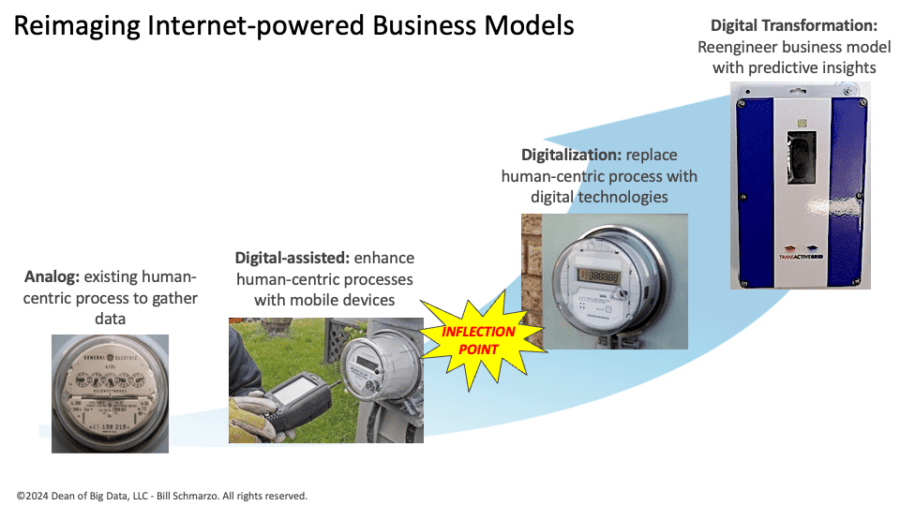
The key to the Internet’s success was shifting from a productivity-focused mindset (focusing on speed and reducing costs) to an effectiveness-driven mindset (focusing on doing better, being more impactful, and fostering creativity). This transition enabled organizations to move beyond merely digitally replicating existing processes to reengineering innovative solutions that provide more profound value and transformative outcomes (Figure 1).

Slide2

Figure 1: Reimagining Internet-powered Business Models

The Potential AI Maturation Journey

AI is poised to drive a new revolution that amplifies human cognitive capabilities and creativity. By reengineering workflows, enabling real-time decisions, and enabling autonomous products and services that require minimum human intervention, AI empowers organizations to be more efficient, creative, and strategic while preserving the essential human touch.

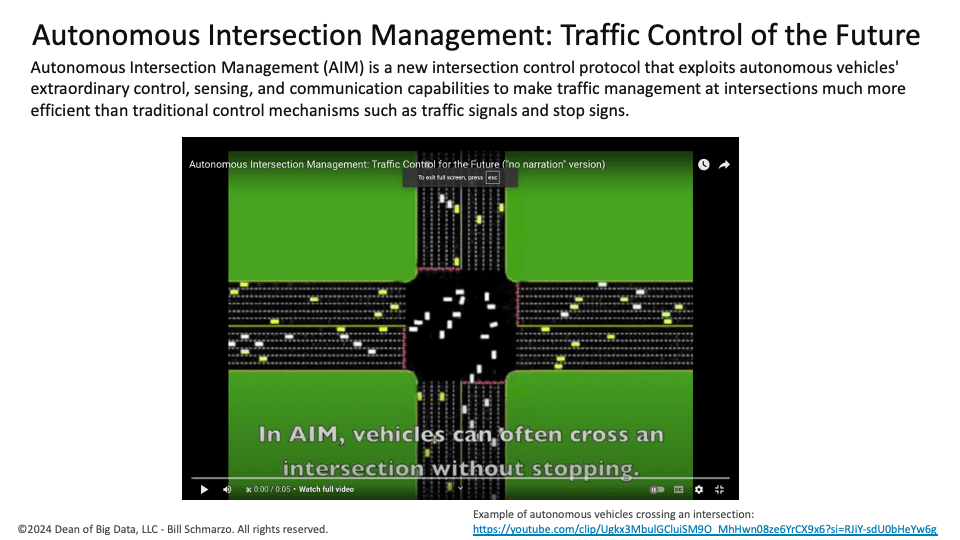
For example, intelligent, autonomous vehicles can dramatically impact transportation and logistics by replacing human cognitive inefficiencies (Figure 2).

Slide3

Figure 2: Example of autonomous vehicles crossing an intersection

If AI adoption follows a similar trajectory as Internet adoption, we might see the following AI maturation journey (see Table 2).

Stage Description Real-World AI Examples
Stage 1: Productivity Driven AI is used to enhance existing processes by automating routine tasks, making operations faster and more efficient. At this stage, AI tools are implemented to perform specific tasks without altering the underlying processes. ChatGPT for automating customer service responses, Robotic Process Automation (RPA) in finance to handle data entry, and AI-driven email sorting to prioritize inbox management. In healthcare, AI-assisted medical transcription speeds up documentation for practitioners.
Stage 2: Process Optimization AI is leveraged to optimize key business operations, assisting in decision-making, reducing errors, and optimizing resource allocation. AI systems now begin to actively assist human roles without fully replacing them. Predictive maintenance in manufacturing, where AI analyzes equipment data to forecast failures. In retail, AI-driven inventory management optimizes stock levels based on demand predictions. In finance, fraud detection algorithms identify unusual patterns to reduce risks.
Stage 3: Process Re-engineering Organizations redesign their operations, fully integrating AI into decision-making and operational processes, which leads to new approaches in core business functions. Autonomous vehicles re-engineer logistics and delivery transportation. In healthcare, AI-driven diagnostics assist with analyzing patient data for early detection of diseases. Algorithmic trading in finance restructures investment strategies through high-frequency, data-driven decision-making.
Stage 4: Market Expansion AI enables businesses to reach new markets and offer more personalized, scalable solutions. Through advanced machine learning, organizations transcend previous operational limits and deliver customized offerings to broader audiences. Personalized retail recommendations on platforms like Amazon or Netflix create tailored shopping or viewing experiences. AI in fintech enables tailored investment advice and financial services for underserved populations. Language translation AI breaks language barriers, enabling businesses to connect with global markets.
Stage 5: New Business Models AI drives new business models, fundamentally redefining how value is created and delivered. These models rely on intelligence as a core operational component and can adapt in real time. Autonomous drone delivery from companies like Zipline and Amazon, AI-powered content creation platforms for image and text generation. New customer service models like virtual personal assistants redefine customer interaction and engagement.
Stage 6: Ecosystem Maturation AI expands towards building AI-accelerator ecosystems that emphasize responsible, ethical AI use and collaborative governance frameworks. These ecosystems include multi-stakeholder platforms focusing on transparency, inclusivity, and data governance. AI governance frameworks developed by organizations like Google and Microsoft ensure responsible deployment. AI ethics councils and initiatives like the Partnership on AI promote ethical standards. AI-powered data marketplaces allow businesses to access and share data responsibly, fostering innovation while upholding data privacy standards.

Table 2: AI Value-creation Maturation Stages

AI Maturation Projection Summary

AI is a powerful force multiplier for human cognitive expansion. It can fundamentally reimagine established processes and reshape entire industries in innovative and unforeseen ways. AI sparks creative exploration, provides valuable insights, and encourages innovation and new ideas to flourish. Most notably, it offers a previously unattainable level of personalization, tailoring experiences to meet users’ unique preferences and needs in real time.

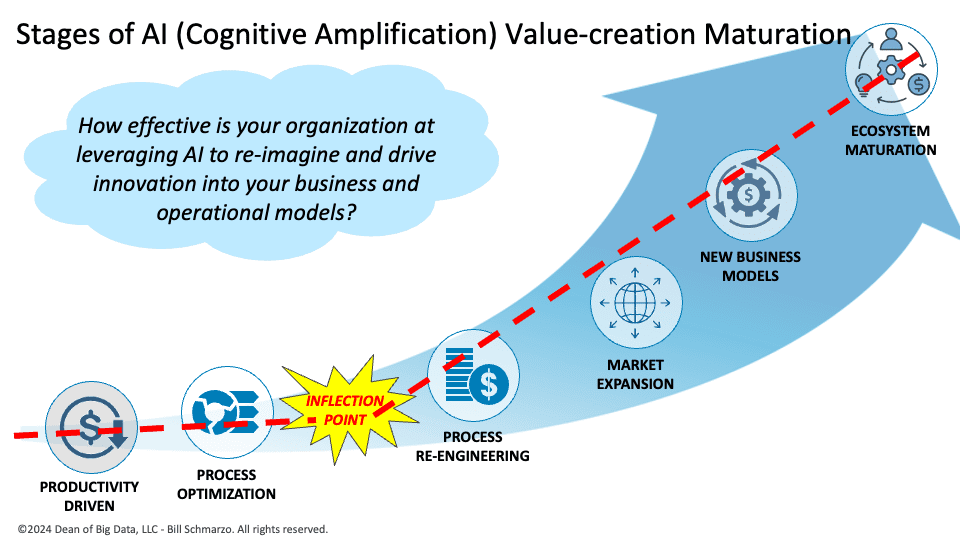
The key to fully harnessing AI’s vast cognitive potential lies in transitioning from a traditional productivity-focused mindset to an innovation-driven mindset. This more transformative approach involves reimagining, reengineering, and fundamentally transforming organizational value creation. Ultimately, embracing this shift will pave the way for enhanced efficiency and unleashing individual creativity and innovation (Figure 3).

Slide4

Figure 3: Stages of AI (Cognitive Amplification) Maturation

Chip Pe Charcha Resumes in Bengaluru

With the US diversifying its chip strategy and containing China’s dominance by imposing trade restrictions, the geopolitical shift could be pivotal for driving India’s semiconductor aspirations, author Chris Miller said. He is noted for his book ‘Chip War: The Fight for the World’s Most Critical Technology’.

Miller spoke at the ‘Chip Pe Charcha’ event, a semiconductor industry discourse held at the VLSID International Conference 2025 in Bengaluru on Monday. He further highlighted the critical role of AI processors in driving innovation, describing AI as the “killer app of this century”, even as its potential is yet to be explored.

Geopolitical tensions have fragmented the semiconductor industry, creating separate spheres of influence led by China and the rest of the world and impacting supply chains and market dynamics. Today, not a single country in the world is self-sufficient in semiconductors across the supply chain. Everyone is reliant on somebody else.

Praising India’s focus on fostering design, manufacturing capabilities and strengthening partnerships with global leaders, Miller said, “India’s proactive semiconductor policies and investments position it as a significant player…The broader electronics ecosystem here in Bengaluru and Tamil Nadu is exploding, I think.”

In a previous discussion with Satya Gupta, president of the VLSI Society of India and Epic Foundation CEO, Miller noted that the explosion of AI technologies has driven demand for specialised semiconductors like GPUs while also advancing chip design and manufacturing efficiency through AI-powered innovations.

The global rush to build fabrication facilities may lead to overcapacity in traditional semiconductors, although advanced chips for AI and electric vehicles remain in high demand with persistent shortages.

Global Semiconductor Rivalry

The global semiconductor industry is witnessing fierce competition between the United States and China, with tensions escalating over technology dominance.

Semiconductor production requires contributions from multiple global players, such as lithography machines from the Netherlands-based semiconductor company ASML, advanced fabrication in Taiwan, and design expertise from the US.

This reliance on partnerships has led to a deepening technological collaboration between the US and India. In recent years, India has aligned its policies to boost domestic semiconductor manufacturing and integration, making it an attractive partner for global supply chains.

While China races to close the gap in advanced technology, challenges like dependency on imported equipment and a five-year lag behind Taiwan’s Taiwan Semiconductor Manufacturing Company (TSMC) persist.

Advising prioritising talent development, Miller said, “If you’re investing in talent, you’re taking very distributed bets.”

While acknowledging India’s foundational work in manufacturing and packaging, he encouraged the exploration of niche areas like 3D packaging and compound semiconductors for the energy transition. These, he argued, could offer India a competitive edge without requiring the massive capital investment of traditional manufacturing.

“Just to take an example, the way AI is growing, it will need more computers and more memory. So our best solution is with two virtual engineers, 3D representation,” he added.

India’s Vision

India’s semiconductor sector is poised for transformative growth, as highlighted by Satya Gupta during the VLSID inauguration. With the country’s electronics consumption projected to grow from $200 billion today to $3 trillion by 2047, semiconductors are expected to account for a staggering $810 billion of this market.

Strengthening Global Semiconductor Ecosystem!🤝🌍
India is forging robust international partnerships to create a trusted, resilient & diversified global semiconductor ecosystem to drive innovation, ensure sustainable growth, and unlock new opportunities.🚀✨#ISM #SemiconIndia pic.twitter.com/a3fmeEdQbb

— India Semiconductor Mission (@Semicon_India) January 4, 2025

Gupta described this as an opportunity, positioning India to become a major global player. Gupta emphasised initiatives like regional semiconductor chapters across India to decentralise development and foster localised innovation.

Efforts such as the VSIP internship programme aim to bridge gaps between academia and industry, ensuring students are industry-ready. Additionally, partnerships with global foundries will grant academic institutions access to cutting-edge 55nm nodes, which will enable hands-on experience for aspiring engineers.

Hitesh Garg, VP and India MD at NXP Semiconductors, also emphasised, “The semiconductor industry’s future growth and innovation rely heavily on a robust talent

pipeline and a thriving startup ecosystem.”

India’s ambition extends beyond global markets, with untapped opportunities in infrastructure and logistics sectors. Gupta called for leveraging advanced technologies to modernise domestic industries and further boost the country’s economic footprint.

Energy Challenges and AI

As AI continues to evolve, its energy demands are becoming a critical concern. The event showcased the critical role of VLSI and embedded systems in driving transformative advancements across AI/ML, 5G, internet of things (IoT), quantum computing, and electric vehicles.

With AI applications being tested at both the network core and the edge, experts warn that the technology’s rapid growth could result in a 40-fold increase in usage. Projections suggest that by 2030, AI might consume 20% of the world’s electricity.

This raises pressing questions about sustainability and the cost of powering AI-driven data centres and devices. Currently, the cost of energy for AI queries is often overlooked. However, as AI use expands, it will give way to significant financial and environmental challenges.

Miller highlighted this growing crisis during the discussion and said that some economies are already experiencing an increase in electricity consumption directly linked to AI. Despite these concerns, Miller expressed optimism and stressed the history of computing as a model for achieving greater efficiencies.

He emphasised the importance of continuing this trend by focusing on innovations in hardware, software, and energy-efficient system design. As market demand grows, so will the pressure to find sustainable solutions.

The rise of AI presents both challenges and opportunities. Balancing its energy needs with environmental sustainability will be a key focus for the next decade. This shift demands collaboration across industries and regions to ensure that AI’s growth remains efficient and accessible.

“I think there’s two things that I’m always struck by in talent development. One is the technical talent, and two is the business talent,” said Miller, with a call for sustained investment in India’s talent pipeline, encompassing both technical and business acumen.

The post Chip Pe Charcha Resumes in Bengaluru appeared first on Analytics India Magazine.

LG drops 5 new AI features for 2025 TVs (and older ones, too)

lg-oled

LG has unveiled a slew of new AI enhancements to this year's TV models at CES 2025.

With artificial intelligence (AI) taking the tech industry by storm these last few years, you can expect to see a lot of AI-powered TV technology (as well as the biggest and brightest TVs ever). CES traditionally showcases some of the buzziest, most innovative, and biggest TVs from major brands like LG, Samsung, and Google.

Also: CES 2025: What to expect and how to watch

Here's a roundup of all the new AI features coming to LG TVs in 2025 that you need to know about.

1. AI-powered recommendations with Voice ID integration

AI personalization features have been extremely popular in consumer tech. This feature provides users with personalized home screens tailored to their individual profiles.

By linking AI-powered recommendations to Voice ID, your TV can recognize the voice of the person speaking into the remote control and establish unique user profiles — ultimately allowing users to enjoy a curated experience based on their unique preferences and interactions.

2. LG AI Concierge

Also using voice recognition, LG AI Concierge tracks your preferences alongside search history to provide contextual insights based on what's playing on your screen, prompting greater user engagement. This feature can also generate custom screensaver art or images that users can share with friends and family.

Also: Is your live TV streaming service still worth it? I reassessed the options for us both

Each user starts with 100 free credits for art generation, with additional credits available for purchase.

3: AI Search

With the abundance of streaming platforms available, keeping track of them can be difficult. AI Search lets users find the most relevant content across various streaming and digital services, enabling faster and more efficient navigation. Unlike Google TV or Fire TV, which prioritize in-house services like YouTube and Prime Video, AI Search provides results from multiple streaming services.

4: AI chatbot

With the success of ChatGPT and other AI assistants, TV brands were bound to adopt an AI chatbot feature. LG's feature offers robust support services, including troubleshooting assistance and personalized picture and sound setting recommendations.

Also: Roku vs Fire Stick: Which one is best for your streaming needs?

For example, users can ask, "Make the image sharper," and the chatbot will adjust the settings accordingly.

5: Enhanced WebOS with Extended Support

LG WebOS is one of the more user-friendly operating systems out there. Now, WebOS offers up to five years of software and platform updates, which helps ensure users will get the best long-term value from the technology. Some of these new AI features, including Voice ID, have also been made available for older TVs via an October WebOS update for 2022 and 2023 models.

Additionally, UHD TVs now feature the AI Processor 7 (upgraded from version 5), enhancing compatibility with the latest software features.

Also: Hisense's new laser projector is so sharp and color-accurate, it may just replace your 4K TV

We should find out more about LG's 2025 TV lineup at CES this week, happening Jan. 7 to Jan. 10. ZDNET has reporters on the ground at the event tracking all the new AI developments in TV technology.

CES 2025

Satya Nadella Meets Prime Minister Narendra Modi, Vows to Make India AI-First Nation 

Microsoft CEO Satya Nadella met with Indian Prime Minister Narendra Modi on Monday, commending his leadership and reiterating the company’s commitment to AI-driven growth in India.

“Thank you, PM Narendra Modi ji for your leadership. Excited to build on our commitment to making India AI-first and work together on our continued expansion in the country to ensure every Indian benefit from this AI platform shift,” Nadella said in a post on X.

In response, Modi said, “It was indeed a delight to meet you, Satya Nadella! Glad to know about Microsoft’s ambitious expansion and investment plans in India. It was also wonderful discussing various aspects of tech, innovation and AI in our meeting.”

Nadella is currently touring India as part of the Microsoft AI Tour, where he will be speaking in Bengaluru on January 7, 2025, and in New Delhi on January 8, 2025. Last week, Nadella met with Telangana Chief Minister K Chandrashekar Rao in Hyderabad to discuss the state’s technology priorities, including AI, generative AI, and cloud development.

During his visit to India last year in February 2024, Nadella announced ambitious plans to train 2 million people in AI skills by 2025. This initiative, known as ADVANTA(I)GE INDIA, aims to address the AI skills gap and create new opportunities across the nation.

Nadella’s tour included meetings with top business leaders and government officials. In Mumbai, he highlighted the potential of AI to drive GDP growth, citing that out of India’s targeted $5 trillion GDP by 2025, approximately $500 billion could be driven by AI.

Microsoft India employs over 20,000 people across 10 cities, including Ahmedabad, Bengaluru, Chennai, Gurugram, Delhi, Noida, Kolkata, Mumbai, and Pune, with Hyderabad alone accounting for half the workforce at 10,000 employees.

For the fiscal year ending March 30, Microsoft’s India business posted a 38.44% increase in net profit year-on-year, driven by the steady growth in cloud adoption and AI.

The post Satya Nadella Meets Prime Minister Narendra Modi, Vows to Make India AI-First Nation appeared first on Analytics India Magazine.