Getty Images is known for its robust library of stock images that news outlets, marketers, and other content creators leverage for their media content. Now, Getty is incorporating that robust library into its AI image generator.
On Monday, Getty Images unveiled Generative AI by Getty Images. This generative AI tool will generate images with content solely from Getty Images' vast creative library with full indemnification for commercial use, according to the release.
The generated images will have Getty Images' standard royalty-free license, assuring customers that their content is fair to use without fearing legal repercussions.
Another major differentiator for the Getty Images generator is that contributors whose content was used to train the models will be compensated for their inclusion in the training set.
"We're excited to launch a tool that harnesses the power of generative AI to address our customers' commercial needs while respecting the intellectual property of creators," said Craig Peters, CEO at Getty Images.
The tool was trained by leveraging part of Nvidia Picasso, a foundry for custom generative AI for visual design, the Edify model architecture, according to the release.
Getty Images customers can now enable Generative AI by Getty Images on the Getty website by requesting a demo.
The tool's release follows Getty Images' recent lawsuit against Stability AI, the creator of Stable Diffusion, one of the most popular text-to-image foundational models, for using its images to train the models without Getty Images's permission.
This tool addresses one of the challenging issues of AI-generated images, which is that models like DALL-E train their generators on content from the entirety of the internet, which means that aspects of creators' art are being used in new pieces without compensation.
Adobe tried addressing this issue, too, within its AI image generator, Adobe Firefly.
The Firefly model is trained on Adobe Stock Images and public domain content where the copyright has expired, and the contributors will receive royalty payments for any of their content used to train the commercial Firefly AI model.
The 21st century has seen progress in technology with artificial intelligence (AI) making an impact across various industries, including finance. The potential benefits of AI such as efficiency, better decision making, and cost reduction have generated interest in its adoption within the financial sector. Despite these advantages, there are challenges that hinder the seamless integration of AI into financial services. In this article, we will explore five obstacles that impede the implementation of AI in finance and provide valuable insights and practical tips to overcome them.
1. Balancing Innovation and Compliance; Navigating Regulatory Complexities
One of the hurdles faced by the financial services industry when embracing AI is navigating through regulatory landscapes. Financial institutions operate within a regulated environment to ensure consumer protection, data privacy and fair practices. Integrating AI into this framework requires a delicate balance between embracing innovation and ensuring compliance with stringent regulations.
Actionable Insights:
Stay Informed: Stay updated on evolving regulations specific to AI and finance, such as GDPR, CCPA, and sector-specific guidelines. Collaborate with legal experts to navigate the regulatory landscape effectively.
Transparency: Implement AI solutions that offer transparency into decision-making processes. This not only aids in building trust with regulators but also helps explain AI-driven decisions to customers.
2. Data Security and Privacy Concerns: Safeguarding Sensitive Information
AI heavily relies on data to generate insights and predictions. In a sector where safeguarding customer information’s critical concerns about data security and privacy pose significant barriers to AI adoption. The potential risks associated with data breaches, unauthorized access to information or misuse of customer data can have consequences.
Actionable Insights:
Robust Encryption: Employ strong encryption methods to secure data both in transit and at rest. This ensures that even if data is compromised, it remains indecipherable without proper authorization.
Access Controls: Implement stringent access controls to limit data access to authorized personnel only. Multi-factor authentication and role-based access can bolster data protection.
Anonymization: When possible, work with anonymized or pseudonymized data for AI model training. This reduces the risk of exposing personally identifiable information.
3. Lack of Quality Data: The Foundation of Effective AI
AI algorithms thrive on high-quality, diverse, and representative data. In the financial realm, acquiring such data can be challenging due to its complex and dynamic nature. Inaccuracies and biases in the data can lead to flawed AI models, hindering accurate predictions and decisions.
Actionable Insights:
Data Preprocessing: Invest in robust data preprocessing techniques to cleanse, normalize, and transform raw data. This enhances the quality and reliability of the data used for AI training.
Data Augmentation: Augment existing datasets with simulated data to fill gaps and improve the diversity of training data.
Continuous Monitoring: Establish processes to continuously monitor data quality and update models as new, accurate data becomes available.
4. Resistance to Change: Overcoming Organizational Inertia
Implementing AI in finance often necessitates a cultural shift within organizations. Resistance to change, fear of job displacement, and lack of understanding about AI’s potential benefits can hinder adoption efforts.
Actionable Insights:
Education and Training: Offer comprehensive training programs to familiarize employees with AI concepts, its advantages, and its limitations. This empowers them to embrace AI as a tool rather than a threat.
Clear Communication: Transparently communicate the objectives and benefits of AI adoption. Address concerns and provide a clear roadmap for how AI will complement existing roles.
Incentives: Introduce incentives to encourage employees to engage with AI initiatives actively. Recognize and reward contributions toward successful AI integration.
5. Cost and Resource Constraints: Making AI Investment Feasible
While the potential long-term benefits of AI adoption in financial services are substantial, the initial investment can be a deterrent. AI implementation requires significant financial resources, including infrastructure, talent acquisition, and ongoing maintenance.
Actionable Insights:
Pilot Projects: Start with small-scale pilot projects to demonstrate AI’s value without committing to large expenditures upfront.
Cloud Services: Consider leveraging cloud-based AI services and platforms to reduce the need for extensive hardware investments.
Collaboration: Explore partnerships with fintech startups or AI service providers to share costs and access specialized expertise.
Conclusion
AI’s transformative potential in financial services is undeniable, but its widespread adoption faces several obstacles. Navigating regulatory challenges, prioritizing data security, ensuring data quality, overcoming resistance to change, and managing costs are critical steps for successful integration. By addressing these obstacles with the actionable insights provided, financial institutions can pave the way for a future where AI-driven advancements reshape the landscape of financial services.
FAQs:
Q1: How is AI currently used in the financial industry?
AI is used in the financial industry for a range of applications, including fraud detection, credit risk assessment, algorithmic trading, customer service chatbots, and personalized financial advice. These applications leverage AI’s ability to analyze vast amounts of data and make predictions or decisions in real-time.
Q2: What are the potential benefits of AI adoption in financial services?
AI adoption in financial services can lead to enhanced efficiency, improved decision-making accuracy, cost reduction, and the ability to offer more personalized services to customers. AI can also automate time-consuming tasks, allowing employees to focus on higher-value strategic activities. Additionally, it can help identify patterns and trends in financial data that may not be apparent through traditional analysis methods, enabling better risk management and investment strategies.
Q3: Are there any ethical concerns associated with AI in finance?
Yes, there are ethical concerns related to AI in finance. These include issues like biased algorithms that may discriminate against certain groups, lack of transparency in AI decision-making processes, and concerns about data privacy and security. Regulators and industry stakeholders are actively working to address these ethical challenges in the use of AI in finance.
Q4: How can professionals develop AI skills for a career in finance?
Professionals interested in AI in finance can start by taking online courses and certifications in machine learning, data analytics in investment banking, and AI technologies. Additionally, they can engage in projects or internships that involve AI applications in financial services to gain practical experience. Staying updated with industry trends and networking with professionals in the field can also be valuable for skill development and career advancement.
Amazon is pledging to invest up to $4 billion in artificial intelligence (AI) startup Anthropic. Under the partnership, Amazon Web Services (AWS) will be the primary cloud platform for Anthropic's mission-critical workloads, which include foundation model development, with further plans for the startup to run the majority of its workloads on AWS.
It has been a customer of the cloud vendor since 2021 and made its flagship Claude foundation model available on AWS in April.
Anthropic also will tap AWS' Trainium and Inferentia chips to train and deploy its future foundation models as well as be involved in the future development of the chip technology.
In addition, future iterations of the AI startup's foundation models will be made available to AWS' global customers via Amazon Bedrock, a managed service through which AI models can be accessed with an API.
AWS customers will be given early access to tools that allow them to customize and finetune Anthropic's AI models, including Claude, using their own data to create private AI models.
Amazon developers and engineers, through Bedrock, can also build Anthropic models to integrate generative AI capabilities into their work.
Also: How to use Claude AI (and how it's different from ChatGPT)
According to Anthropic, Claude 2 can be used to power a range of tasks, including complex reasoning and creative content production. It added that the AI platform can process vast volumes of data, such as technical and industry-specific documents, for use cases in finance, legal, and coding among others.
Dario Amodei, co-founder and CEO of Anthropic, said in a statement Monday that Claude had seen "significant organic adoption" among AWS customers since the AI model was added to Amazon Bedrock. The expansion of its collaboration will drive new opportunities to further drive deployment, Amodei said.
He noted that LexisNexis Legal & Professional currently uses a customized Claude 2 model to power its Lexis+ AI application, which facilitates conversational search, summarization, and legal drafting. Lonely Planet is also a Claude 2 customer, tapping the AI model to deliver travel recommendations.
Also: 4 things Claude AI can do that ChatGPT can't
With the investment of up to $4 billion, Amazon said it would assume minority ownership of Anthropic but gave no specifics on what exactly that entailed.
Commenting on the announcement, Nigel Green, CEO of financial advisory deVere Group, said the move highlighted growing tech investment and investor interest in AI, with Amazon stepping up its rivalry against other giants such as Microsoft, Google, and Nvidia in the AI space.
"The AI race is on, with the big tech firms racing to lead in the development, deployment, and utilization of AI technologies," Green said in a statement. "AI is going to reshape whole industries and fuel innovation. This makes it crucial for investors to pay attention and why almost all investors need exposure to AI investments in their portfolios."
A podcast with Weimo Liu and Sam Magnus of PuppyGraph
Image by Laurette Chapuis from Pixabay
Open source Apache Iceberg, Hudi and Delta Lake have made it possible to dispense with the complexities and duplication of data warehousing. Instead of requiring time-consuming extract, transform and load (ETL) procedures, these large table formats make it simple to tap S3 and other repositories directly for analytics purposes.
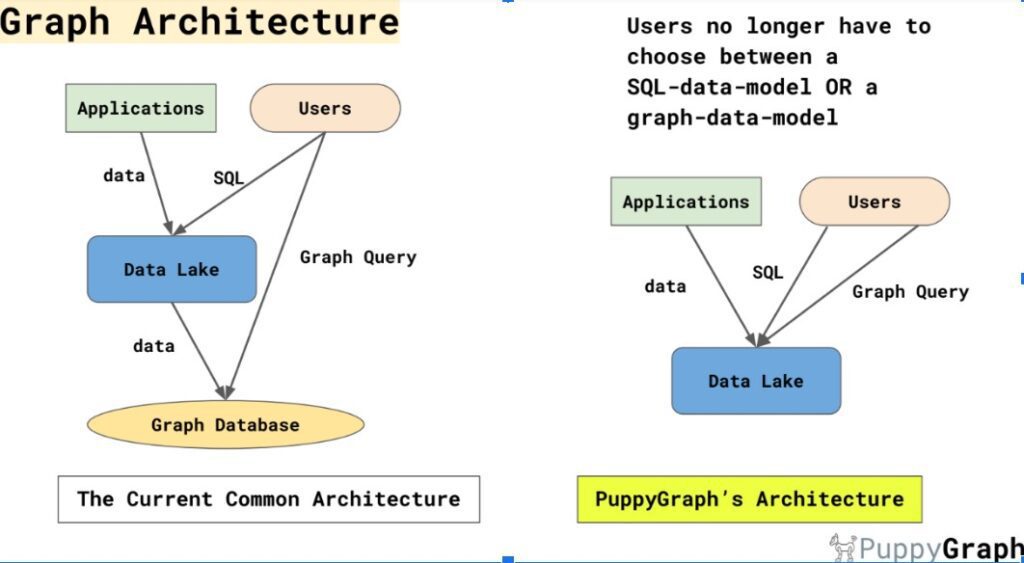
PuppyGraph takes this modern data lake capability a step further, making it possible to create and query graphs in a with the help of one of these large analytic table formats. After creating a subgraph with a SQL group by statement, for example, a user can do graph traversal via Gremlin or declarative graph querying using Cypher via these tables, or use a prompt interface on the data via LlamaIndex. Here’s how the PuppyGraph architecture eliminates the need for a graph database.
PuppyGraph, 2023
With a single logical schema, you can tap multiple heterogeneous repositories such as one that’s MySQL and an S3 bucket both via an Iceberg-enabled table, says PuppyGraph CEO Weimo Liu.
Let’s say a user has a table with transaction records. The sender, receiver and amount fields already suggest a graph of sorts. The user can just use SQL and a “group by” query to create a subgraph of selected records, then create a logical schema and do graph queries. That’s how you can leverage both SQL and graph querying with a tool such as Gremlin in the same use case.
With a SQL query engine side by side with a graph engine, users can feed the retrieved outputs into machine learning algorithms and reporting tools, says PuppyGraph founding member Sam Magnus.
A video Weimo posted on YouTube called “PuppyGraph – Query the Data in Your Data Lake as a Graph in One Minute” walks users through how to create a simple schema to query their data via a modern data lake enabled by Iceberg as a graph by following these steps (paraphrased here):
Create a schema JSON file to tell PuppyGraph these specifics:
The URL of your data lake
Which tables are nodes
Which tables are edges.
Post the file to the server. The server will confirm the schema creation.
Connect the console of a graph query tool such as Gremlin or Cypher to the server
Run your query to retrieve the results.
Note that PuppyGraph is not a database, but a graph analytics engine designed to work with all the seemingly limitless information modern data lakes can store.
“Single copy” analytics is a phrase Sam Magnus uses to underscore that multiple PuppyGraph users can all use the same copy of the data, rather than having to copy over and over again.
By using PuppyGraph, Sam estimates that consultants hired for graph analytics projects can be up and running within an hour at client sites, assuming the necessary data is accessible. That’s a big deal, considering that graph database proofs of concept (PoCs) have historically required extensive up-front work to begin delivering results.
Sam and Weimo encourage everyone to try out PuppyGraph–they’ve got a free Docker in the user manual and haven’t been charging for consulting. Hope you enjoy the podcast.
Podcast recording with Weimo Liu and Sam Magnus of PuppyGraph
When OpenAI released GPT-4 back in March, one of its biggest advantages was its multimodal capabilities, which would allow ChatGPT to accept image inputs. However, the multimodal capability wasn't ready to be deployed — until now.
On Monday, OpenAI announced that ChatGPT could now "see, hear and speak," alluding to the popular chatbot's new abilities to receive both image and voice inputs and talk back in voice conversations.
The image input feature can be helpful in getting assistance with things you can see, such as solving a math problem on a worksheet, identifying the name of a plant, or looking at the items in your pantry and providing recipes.
In all of the above instances, all a user would have to do is snap a picture of what they are looking at and add the question they'd like an answer to. OpenAI discloses that the image understanding capability is powered by GPT-3.5 and GPT-4.
The voice input and output feature gives ChatGPT the same functionality as a voice assistant. Now, to ask ChatGPT for a task, all users have to do is use their voice, and once it has processed your request, it will verbally say its response back to you.
In the demo shared by OpenAI, a user verbally asks ChatGPT to tell a bedtime story about a hedgehog. ChatGPT responds by telling a story, similar to how voice assistants like Amazon's Alexa function.
The race for AI-supported AI assistants is on, as just last week, Amazon announced it was supercharging Alexa with a new LLM that would give her ChatGPT-like capabilities, essentially making her a hands-free AI assistant. ChatGPT's voice integration into its platform accomplishes the same end result.
To support the voice feature, OpenAI uses Whisper, its speech recognition system, to transcribe a user's spoken words into text and a new text-to-speech model that can generate human-like audio from text with just a few seconds of speech.
To create all five of ChatGPT's voices that users can select from, the company collaborated with professional voice actors.
Both the voice and image features will be available for only ChatGPT Plus and Enterprise in the next two weeks. However, OpenAI says it will expand access to the feature for other users, such as developers, soon after.
Also: My two favorite ChatGPT Plus plugins and the remarkable things I can do with them
If you are a Plus or Enterprise user, to access the image input feature, all you have to do is tap the photo button in the chat interface and upload an image. To access the voice feature, head to Settings < New Features and opt into voice conversations.
Bing Chat, which is supported by GPT-4, supports image and voice inputs and is entirely free to use. So, if you want to test these features out but don't have access to them yet, Bing Chat is a good alternative.
Getty Images, one of the largest suppliers of stock images, editorial photos, videos and music, today announced the launch of a generative AI art tool that it claims is “commercially safer” than other, rival solutions on the market.
Called Generative AI by Getty Images, the tool — powered by an AI model provided by Nvidia, with whom Getty has a close technical partnership — was trained on a portion of Getty’s vast library (~477 million assets) of stock content. Along the lines of popular text-to-image platforms like OpenAI’s DALL-E 3 and Midjourney, Getty’s tool renders images from text descriptions of the images, or prompts — e.g. “photo of a sandy tropical island filled with palm trees.”
Customers creating and downloading visuals using the tool will receive Getty’s standard royalty-free license, Getty says, which includes indemnification — i.e., protection against copyright lawsuits — and the right to “perpetual, worldwide, nonexclusive” use across all media.
The tool isn’t completely unfettered, however.
While Getty’s content library includes depictions of public figures, Getty says that it’s imposed safeguards to prevent its generative tool from being used for disinformation or misinformation — or from replicating the style of a living artist. For example, the tool won’t let a customer create a photo of Joe Biden in front of the White House or a cat in the style of Andy Warhol, reports The Verge, which had access to the tool ahead of its release. And all images created by the tool contain a watermark identifying them as AI-generated.
“We’ve worked hard to develop a responsible tool that gives customers confidence in visuals produced by generative AI for commercial purposes,” Craig Peters, CEO at Getty Images, said in a press release.
Getty Images AI art generation tool, available soon, was trained on stock images from the massive and growing Getty library.
Getty says that content generated by its tool won’t be added to its content library for others to license (but reserves the right to retrain its model using those images) and that Getty contributors whose works are used to train the underlying model will be compensated. Getty will also share revenues generated from the tool, it says, allocating both a per-file proportional share and a share based on traditional licensing revenue.
“On an annual recurring basis, we will share in the revenues generated from the tool with contributors whose content was used to train the AI generator,” a Getty spokesperson told TechCrunch via email. “There will be a set formula based on a number of different factors, and accordingly each contributor will receive different payments in connection with the tool.”
The tool can be enabled on Getty’s website or integrated into apps and websites through an API, and soon, customers will be able to customize it with proprietary data to create images consistent with a particular brand style or design language. Pricing will be separate from a standard Getty Images subscription and based on prompt volume, Getty says.
“We’ve created a service that allows brands and marketers to safely embrace AI and stretch their creative possibilities, while compensating creators for inclusion of their visuals in the underlying training sets,” Grant Farhall, chief product officer at Getty, said in a canned statement.
Prior to the launch of its own tool, Getty had been a vocal critic of generative AI products like Stable Diffusion, which was trained on a subset of its image content library. Earlier this year, Getty sued AI startup Stability AI, which was involved with the creation of Stable Diffusion, for allegedly copying and processing millions of images and associated metadata owned by Getty without informing or compensating Getty contributors.
Peters has previously compared the current legal landscape in the generative AI scene to the early days of digital music, where companies like Napster offered popular but illegal services before new deals were struck with license holders like music labels. “We think similarly these generative models need to address the intellectual property rights of others, that’s the crux of it,” he told The Verge in an interview in January. “And we’re taking [legal] action to get clarity.”
Some companies developing generative AI tools, including Stability AI, argue that their content scraping practices are protected by fair use doctrine — at least in the U.S. But it’s a matter that’s unlikely to be settled anytime soon.
Getty isn’t the only company exploring “safer,” more ethical approaches (in the commercial sense) to generative AI, it’s worth noting.
AI startup Bria offers a generative AI art tool trained on content that Bria licenses from partners, including individual photographers and artists, as well as media companies and stock image repositories, which receive a portion of the company’s revenue. Recently launched avatar creator Ascendant Art, meanwhile, is promising to pay royalties to the artists who voluntarily submit their artwork to train its models.
It’s not just startups. Getty Images rival Shutterstock reimburses creators whose work is used to train AI art models. Adobe, meanwhile, says that it’s developing a compensation model for contributors to Adobe Stock, its stock content library, that’ll allow them to “monetize their talents” and benefit from any revenue its generative AI technology, Firefly, brings in.
AI-generated art image, public domain art CC0 photo. Source: Rawpixel
A major aspect of ongoing data center redesign is due to AI’s massive, complex workloads and the need to add many more graphic processing units (GPUs), tensor processing units (TPUs) or accelerators to the mix.
The power these units require and the heat the units generate have forced designers to rethink what constitutes a feasible and optimal layout design. And the redesign cost is ratcheting up.
As a result, according to Tirias Research, owners could be spending $76 billion annually by 2028 on new AI data center infrastructure.
Current challenge for data centers: Today’s dense, GPU-based clusters
Anton Shilov in Tom’s Hardware recently sized up the considerable AI workload demand for GPUs:
“Market research firm Omdia says that Nvidia literally sold 900 tons of H100 processors in the second quarter of calendar 2023.
“Omdia estimates that Nvidia shipped over 900 tons (1.8 million pounds) of H100 compute GPUs for artificial intelligence (AI) and high-performance computing (HPC) applications in the second quarter. Omdia believes that the average weight of one Nvidia H100 compute GPU with the heatsink is over 3 kilograms (6.6 pounds), so Nvidia shipped over 300 thousand H100s in the second quarter.”
So a single Nvidia H100 graphics processing unit (GPU) is about the weight of a light bowling ball. The weight that Omdia calculated above doesn’t include the associated cabling or the liquid cooling.
Steven Carlini, VP of data center innovation for power management equipment provider Schneider Electric, told me recently that racks for AI purposes have had to be redesigned to accommodate the extra weight and heat. He contrasted today’s dense AI server clusters with the “nicely spread out” rows of ordinary server racks that were common before current-generation AI began to ramp up in earnest, turning the nice rows into dense, hot-running clusters.
These AI clusters, Carlini said, are drawing up to 100 kilowatts per rack, compared with up to 20 kW per rack for a conventional, non-AI data center rack. Each Nvidia H100, Carlini’s colleague Victor Avelar, a senior research analyst at Schneider Electric’s Energy Management Research Center, noted, draws 700 watts of power, up from 400 watts for the older A100, which is also still in high demand. Both GPU types require liquid cooling.
The dense, 80 billion transistor silicon area in each GPU generates most of the heat. One AI server of the type that companies like Amazon and Google are installing includes eight of these GPUs. Properly designed, AI server clusters are continually 100 percent in operation, by contrast with much lower server utilization for non-AI applications.
The long view of data center energy management
The owners of the major data centers carrying today’s AI workloads have long been focused on mitigating environmental impact, and they tend to take the long view when it comes to energy management. Yes, energy consumption is higher than ever, but much of the top-tier data center capacity is now powered by renewable energy, and owners are seeking out other zero emission alternatives. Microsoft, for example, signed a contract in May to buy a minimum of 50 megawatts of power from fusion energy startup Helion starting in 2028.
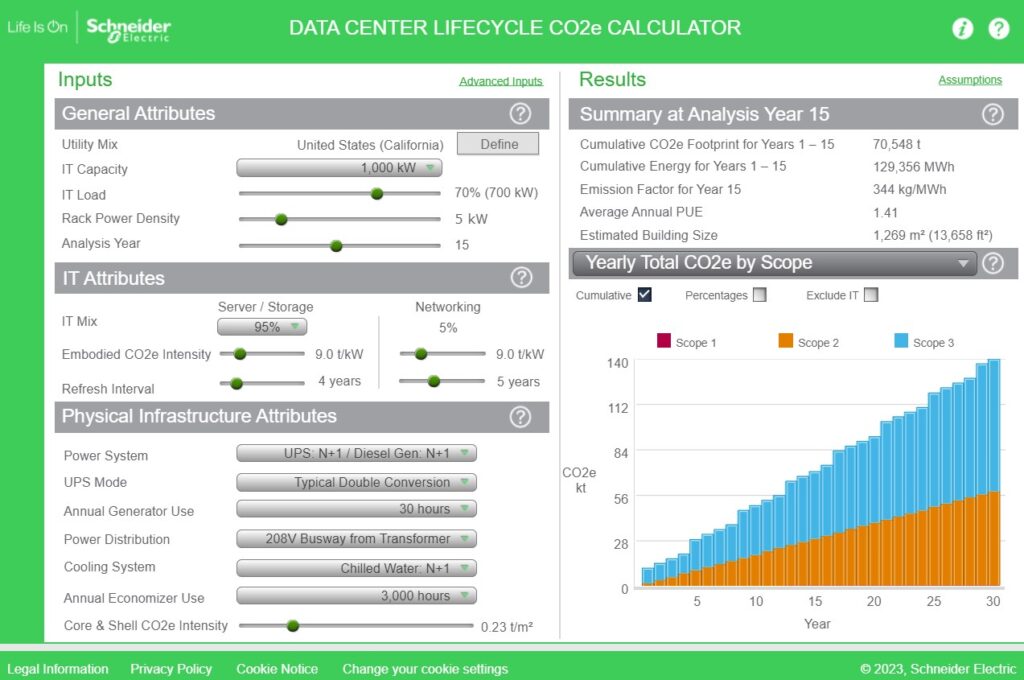
Schneider’s Victor Avelar is behind the company’s effort to quantify the carbon footprint of today’s data centers over their lifecycle and help optimize future data center layout and design. Avelar demoed at their free Data Center Lifecycle CO2e Calculator, which looks at both embodied carbon (such as the carbon emitted in the process of resourcing, making and pouring of concrete used in data center construction) and carbon generated during data center operations.
Schneider Electric, 2023. Used with permission.
The Cost Calculator helps planners consider alternatives and choose optimal design criteria. We looked at the power sources, for example. Avelar contrasted a West Virginia location (mostly coal-fired power plants) with one in France (with more nuclear power in the mix).
By looking at the Yearly Total CO2e by Scope, we saw the Scope 2 (power purchased from local utilities) emissions for the West Virginia option to be a much larger percentage of the mix. The option in France, by contrast, showed a larger percentage of Scope 3 (indirect energy, such as embodied carbon in the new data center’s concrete). Scope 1 and 2 emissions are more within the control of the planners.
Shifts in data center ownership
Historically, Carlini pointed out, data centers tended to follow a shopping center-like model of anchor tenants and boutiques, with owners focused solely on the business of building to match the local need and managing the space leases.
But lately the large cloud, media and SaaS providers have been even more dominant in terms of the percentage of new data centers being built. For those owner/operators, there is no standard data center design. “Every Microsoft data center is different,” Carlini said. “It’s amazing.” The main challenge in the current environment is simply keeping pace with all the changes afoot.
E-commerce has improved technology and convenience for consumers globally. Fraud is a problem in e-commerce. Merchants and platforms fight fraud to protect their businesses and customers. Anomaly detection is a powerful tool for identifying irregular patterns and potential fraud. This article explores how anomaly detection is used in fraud detection for e-commerce and discusses different approaches to implementing this technology.
E-commerce companies have a responsibility to protect their customers from fraudulent activity by securing their platforms. Cybercriminals exploit online vulnerabilities, posing a threat to businesses and customers.
What is e-commerce fraud?
E-commerce fraud is online deception involving the theft of information, unauthorized purchases, or false claims. The perpetrators focus their efforts on online retailers, payment systems, and customers, leading to financial losses, reputational harm, and an erosion of trust in the affected businesses.
Types of e-commerce fraud
Fraud in online commerce can happen in a variety of forms, depending on the strategy that the perpetrators of the fraud use to target businesses and customers.
The following are the most common varieties:
Identity theft: Theft of identities occurs when criminals obtain personal information in order to make unauthorized online purchases and cause victims to suffer monetary loss.
Credit card fraud: Credit card fraud occurs when con artists obtain cardholder information and then use it to conduct unauthorized transactions, resulting in monetary losses for both the cardholders and the businesses that they target.
Chargeback fraud: Fraudulent chargebacks occur when customers question the legitimacy of their transactions, resulting in monetary harm to businesses.
Phishing and social engineering: Cybercriminals use to trick customers to reveal sensitive information or commit fraud.
Account takeover fraud: Fraud committed by taking over a victim’s account is known as account takeover fraud. Unauthorized users access a victim’s account and commit fraud or steal personal information.
Refund fraud: People commit refund fraud by making false claims regarding the non-receipt of goods or the damage of goods in order to obtain refunds or replacements that are not deserved.
Affiliate fraud: Fraud committed by affiliates occurs when dishonest affiliates attempt to manipulate commission structures by fabricating leads, sales, or clicks in order to receive unauthorized payouts.
Counterfeit products: Sellers deceive customers with low-quality or fake items, harming brands.
Dropshipping fraud: Deceptive dropshippers take payments but don’t send items or use stolen credit cards to buy and ship items to victims.
When it comes to digital transactions and online shopping, one of the most pressing concerns is e-commerce fraud. Businesses have a responsibility to their customers and themselves to protect themselves and their customers from the risk of fraud by making investments in security precautions, fraud detection systems, and employee training. Business tactics vary as much as e-commerce fraud types.
Understanding anomaly detection
Anomaly detection is about finding patterns or data points that deviate from the majority. E-commerce anomalies can include unusual transaction amounts, irregular purchasing behaviors, or suspicious account activities. Detecting anomalies is important as they could indicate fraud, like identity theft or credit card fraud.
Integration of anomaly detection in e-commerce fraud detection
Anomaly detection is important for fraud detection in e-commerce. Integration improves detection and response to suspicious activities. Anomaly detection is used in fraud detection for e-commerce.
Real-time monitoring and alerts
Anomaly detection monitors e-commerce transactions and user behavior in real time. Unusual patterns trigger alerts for investigation. This approach prevents fraud before it causes harm. Abnormality detection systems can immediately detect suspicious transactions, allowing businesses to prevent fraud and optimize digital marketing strategies.
Identification of unknown threats
Anomaly detection finds new patterns or fraud missed by rule-based systems. Anomaly detection models analyze data to learn and adapt to new fraudulent tactics, improving fraud detection.
Reduced false positives
Anomaly detection reduces false positives in fraud detection. By identifying anomalies, the system can differentiate between customer behavior and suspicious activities, minimizing disruptions to transactions.
Behavioral analysis
Anomaly detection analyzes user behavior by creating profiles and understanding normal patterns. Any deviation can be investigated. This approach is good for detecting account takeovers when the user’s behavior changes a lot.
E-commerce fraud prevention and detection
Businesses use methods for e-commerce fraud prevention, detection, and response to protect themselves and customers from threats. Some methods include:
1. Multi-factor authentication (MFA)
Multi-factor authentication, also known as 2FA or two-step verification, is a security process that requires users to provide two forms of identification to verify their identity when logging in or completing a sensitive transaction. Even if an intruder manages to steal one form of identification, multi-factor authentication (MFA) makes it much more difficult for them to access accounts or systems and thereby increases security.
The following are the three primary classifications that authentication factors can be placed in:
Something you know: Includes passwords, PINs, or security questions for identity verification.
Something you have: Smart cards, hardware tokens, and smartphones with authentication apps are examples.
Quality you have: This includes unique human identifiers like fingerprints, facial recognition, and voice patterns.
Two factors are needed for MFA. Users enter a password and a one-time code from a mobile authenticator app. Attackers must compromise more authentication factors to gain unauthorized access, making it harder.
2. Machine learning and artificial intelligence
ML and AI are used to prevent and detect e-commerce fraud by analyzing data, identifying patterns, and adapting to trends. These technologies reduce manual review and rule-based systems by improving fraud detection accuracy and efficiency.
Here are some ways that ML and AI can be applied to e-commerce fraud prevention and detection:
Anomaly detection: ML algorithms detect anomalies in transactional data. Flag anomalies for investigation.
Scoring risks: Artificial intelligence (AI) systems assign risk scores to transactions based on factors such as transaction history, user behavior, geolocation, and device information. Transactions that involve a high level of risk may be subject to a manual review or additional authentication.
Predictive analytics: Predictive analytics uses historical data to predict fraud and help businesses reduce risks.
Behavior analysis: AI systems are able to analyze user behavior in order to identify fraudulent activity or attempts to take over an existing account.
Monitoring in real time: Machine learning and artificial intelligence make real-time monitoring possible, allowing for immediate threat detection and response.
Adaptive learning: Learning that is adaptable means that machine learning and artificial intelligence are able to adapt to new trends and strategies used by fraudsters. The effectiveness of fraud detection systems can be maintained through continuous learning.
Reducing false positives: Reducing the number of false positives Traditional methods of fraud detection produce a high number of false positives, which leads to dissatisfied customers and missed sales opportunities. The accuracy of fraud detection is improved by ML and AI because they take into account more factors and can adjust to new information.
Online stores and transaction fraud
Analyzing large transaction data is challenging. Machine learning is used by fraud managers to investigate the reasons why certain transactions were not flagged as potentially fraudulent. Juniper Research predicts online retailers will lose $50.5B to fraud by 2024.
After running your ML system, you can learn which items are targeted by fraudsters, risky shipping information, and which card payments to block to avoid high chargeback rates.
Key approaches to anomaly detection
Effective anomaly detection requires robust approaches. Common fraud detection approaches for e-commerce:
Statistical methods
Statistical methods use math and stats to model behavior and find deviations. Methods include Z-score, Gaussian distribution, and clustering algorithms.
Machine learning
Machine learning techniques are powerful tools in anomaly detection. Algorithms learn from data to detect patterns and anomalies.
Unsupervised learning
Unsupervised learning algorithms detect anomalies without labeled data. They learn from normal data to identify outliers.
Hybrid approaches
Hybrid approaches combine multiple methods, often using statistics and machine learning. This method combines different approaches to improve anomaly detection accuracy.
Conclusion
In the ever-evolving landscape of e-commerce worth trillions, and the dynamic world of digital marketing, staying one step ahead of fraudsters is a constant challenge. Anomaly detection is crucial for e-commerce fraud detection. Its adaptability and real-time insights make it essential for fraud detection. E-commerce platforms can improve fraud prevention and safety by using anomaly detection and key approaches.
AI fraud detection is useful for e-commerce businesses to prevent fraud. AI algorithms analyze data to detect fraud, benefiting businesses by reducing losses, improving efficiency, and enhancing customer trust. Implementing these systems can be challenging due to data quality issues, false positives, model bias, technical expertise, and adversarial attacks. Businesses can implement AI-based fraud detection and prevention systems by addressing challenges and partnering with experienced professionals.
Thanks to the internet, you can now easily expand your reach and engage with diverse audiences wherever they are.
However, this opportunity raises an important question: how can you localize your web content and maintain the security and privacy of sensitive data?
This article comprehensively explores the best practices that will help you maintain data security and privacy while localizing website content.
What is web localization?
Web localization refers to the process of adapting a website or website content to align with the cultural, linguistic, and regional preferences of a target audience or market.
This process is not limited to just translation. It also involves ensuring that a website communicates with local users, thereby making it more relatable, accessible, and engaging.
The main components of website localization include:
Language adaptation
This requires translating web content while considering idiomatic expressions, cultural preferences, and regional dialects. A successful language adaptation helps users better understand and relate to the website’s content.
Cultural sensitivity
It is crucial to adapt content to reflect the target audience’s cultural norms and beliefs. This may require modifying images, symbols, colors, or even the overall tone and messaging to avoid cultural misunderstandings or insensitivity.
Geographical relevance
Another component of web localization is adapting information to certain geographic regions. For instance, you can enhance the user experience on your website by displaying local addresses, phone numbers, or relevant local news.
Legal and regulatory compliance
It is important to consider local rules and regulations during web localization. In other words, you need to comply with data protection and privacy regulations while localizing your website content.
Compliance with data privacy regulations
Source: iStock
As you use web localization to expand your online footprint, you need to navigate the complex terrain of data privacy standards and regulations to protect your brand and customers.
Highlighted below is the importance of complying with data privacy and other regulations during web localization.
Importance of complying with data privacy regulations during web localization
During the web localization process, personal information acquired from users, such as names, addresses, or payment information, is regularly handled. Violation of data privacy regulations during web localization may result in serious consequences such as fines, a tarnished brand image, and a loss of customer confidence.
Compliance is not only a legal requirement. It also shows that you’re committed to protecting the privacy of the people whose data you handle. Respecting their privacy rights not only ensures that you obey the law but also contributes to user loyalty.
Furthermore, adhering to data privacy regulations might give you a competitive advantage by emphasizing your commitment to ethical data processing.
Relevant regulations and their impact on web localization
Numerous data privacy regulations may have a significant impact on web localization. Here are the most notable ones:
General Data Protection Regulation (GDPR)
The GDPR establishes strict regulations for handling and protecting personal data. It applies to all EU member states. Businesses that handle the data of EU citizens must follow the GDPR, which requires user notification, express consent, and secure data handling, regardless of where they are located.
California Consumer Privacy Act (CCPA)
The California Consumer Privacy Act (CCPA) requires businesses that collect personal information from California residents to disclose their data practices, allow customers not to share their data, and erase any personal data that has been submitted upon request.
Brazil’s General Data Protection Law (LGPD)
LGPD, like GDPR, governs how personal data is processed in Brazil. It requires user consent, open data processing, and data security measures.
Other local regulations
In addition to the regulations above, several countries have their own data privacy policies and requirements. Japan, for example, has the Act on the Protection of Personal Information (APPI), while Canada has the Personal Information Protection and Electronic Documents Act (PIPEDA).
These data privacy regulations impact the web localization process by requiring region-specific consent mechanisms, transparent data handling, and adherence to user rights.
To streamline your localization process and ensure regulatory compliance, use the web localization solution from Centus. The solution features access controls, encryption, compliance checks, and data minimization. Their use will help you build trust with users and reduce the risks of handling sensitive data during the website localization process.
Best Practices for Data Security in Web Localization
Here are some practices you can adopt to secure sensitive data during the website localization process:
Encryption and data transmission
This is the basis for data security during website localization. All data, whether at rest or in transit, should be encrypted using robust encryption algorithms. This ensures that unauthorized parties cannot read sensitive data, even if it is intercepted during transmission.
Use Transport Layer Security (TLS) to securely deliver data over the internet. TLS encrypts data as it moves between the user’s browser and the web server, thereby preventing tampering.
You can also use strong encryption methods such as AES (Advanced Encryption Standard) to further secure data stored on servers.
Access control and authentication
Data security depends on restricting who can access and change data. Set up a strict access control system to restrict access to sensitive data. Use strong authentication measures, such as MFA (Multi-Factor Authentication), to ensure that only authorized individuals have access to localized data.
Give users role-based permissions so that they only see what is necessary for their tasks. Ensure that you review and change these permissions regularly to reflect evolving business needs. This reduces data breaches caused by insider threats or unauthorized access.
Data minimization
An important part of ensuring data privacy during web localization is collecting and storing only the data required for business operations. Maintain the data reduction concept during website localization by reviewing and deciding the specific data that is required for translation or adaptation.
Avoid providing personally identifying information (PII) unless it is necessary for localization. Also, ensure you remove unnecessary information from databases and files before you embark on the localization process. Processing as little data as possible helps you reduce the potential consequences of a breach.
Regular security audits and updates
Data security is an ongoing task. Routine security audits and updates are required to detect vulnerabilities and maintain the integrity of your website localization environment.
Routine security audits can help you detect and fix system vulnerabilities before they become serious issues. Keep all software and systems up to date with security patches and upgrades to limit the risk of exploitation.
Also, conduct penetration testing to proactively identify and fix potential security flaws.
Data backup
Additionally, if you are a small business owner, it’s crucial to implement an SMB solution (Small Business Backup Solution) as part of your data security practices. Regularly backing up your data ensures that you have a secure copy of your information in case of data loss or security breaches, providing an added layer of protection for your sensitive data.
Conclusion
Although website localization creates new horizons for businesses, it also exposes them to risks at the same time. However, by implementing data security best practices and understanding data privacy regulations, you can ensure data privacy and security in web localization.
Data privacy and security regulations are not enacted to hinder your web localization success. Instead, they are created to help you achieve your global expansion goals while earning the trust and loyalty of your audience.
Microsoft's SwiftKey keyboard has been spruced up with another round of AI-enabled features. Now rolling out for the iPhone, iPad, and Android devices, the latest version kicks in several options to help you use AI to compose and spice up the text and images you create from your keyboard. The new features are all described in a Bing blog post from Divya Kumar, Microsoft GM for Global Search & AI.
SwiftKey is one of several third-party keyboards designed to replace your device's built-in virtual keyboard with one that often provides more functionality. If you're not already using SwiftKey and would like to give it a whirl, download it from the App Store or Google Play.
Also: Can Microsoft recover from the collapse of its Surface business?
On your iPhone or iPad, go to Settings after installing SwiftKey, select SwiftKey, tap Keyboards, and then turn on the switches for SwiftKey and Allow Full Access. Open a text-based app such as Messages or Mail and start a new message. Press down the globe icon at the bottom of the current keyboard and change it to SwiftKey.
On an Android device, open the SwiftKey app after installation. Tap the button on the welcome screen for Enable SwiftKey and turn on the switch for Microsoft SwiftKey keyboard. Next, tap the button for Select SwiftKey and then select Microsoft SwiftKey Keyboard as the input method. Tap the next button for Finish up and then sign in with your Microsoft account.
Among the new AI features, first on the list is access to Microsoft's Bing AI image generator. Already available as its own app and website, the image generator has found a new spot in SwiftKey. However, this option only seems to be available in Android, at least for now.
From the Bing toolbar, tap the Emoji icon to open its panel and then tap the Create icon. In the text field, describe the type of image you want created. Tap the arrow to submit your request. You can then select one of the generated images and send it to your recipient.
Next up are AI camera lenses through which you can concoct photos, videos, and GIFs with different effects. Courtesy of Microsoft's collaboration with Snap, more than 250 tools and filters are available to help you express specific ideas, moods, and more in a message.
Again, open a text-based app on your iPhone, iPad, or Android device. Tap the icon with the four squares or the three dots to view all the available options and then select Camera. Tap the area indicated to record GIFs and photos with Microsoft SwiftKey.
After the camera app opens, tap the shutter button to take a photo; hold it down to create a GIF. When done, stop the recording. You can then add text and effects. When done, tap Save. Copy and paste your photo or GIF into the message and then send it.
Next, the AI stickers feature lets you create and send personalized stickers generated from your own photos. But this is another one that works only on Android at this point.
To try it, tap the icon with the four squares or the three dots and select Stickers. If the new feature is accessible, you should see a button to Personalize Stickers. After you tap that button, the camera app opens where you can take a picture that is then turned into a sticker. Select the sticker to send it to someone.
Finally, a new Editor feature in SwiftKey acts as a type of virtual proofreader to check your grammar, spelling, and punctuation. To use this, highlight any sentence you've typed. Tap the Bing icon and choose the option for Editor. In response, the AI will offer feedback and suggestions to correct any mistakes or improve your writing style.
The new features are still rolling out, so you may not yet be able to access them on your phone or tablet. But they're all part of Microsoft's ongoing efforts to infuse AI into its products, both major and minor. This past April, the company added the Bing AI chatbot to the SwiftKey keyboard for iOS/iPadOS and Android. Using the same functionality as the Bing AI website and app, the chatbot can assist with searches, rewrite text, and respond to requests via SwiftKey.