The Data Maturity Pyramid: From Reporting to a Proactive Intelligent Data Platform

Today more than ever, organizations rely on data to make informed decisions and gain a competitive edge. The journey to becoming a data-driven organization involves a number of steps, including progressively improving data capabilities, leveraging AI and ML technologies, and adopting robust data governance practices.

This article explores these steps in detail — from reporting and data governance, to data products as a foundation for AI/ML and a proactive intelligent data platform (PIDP). We also delve into the role of Data Engineers in this journey.

Data Maturity in a Corporate Setting

In a corporate environment, multiple tiers of data maturity can be distinguished, signifying varying degrees of a company's advancement in utilizing its data assets. Within this context, the concept of a Data Maturity Model naturally emerges as a hierarchical pyramid composed of different layers. Moreover, the journey toward greater data maturity is an ongoing cycle of enhancements, aimed not only at reaching increasingly advanced levels but also at refining and optimizing the capabilities already attained.
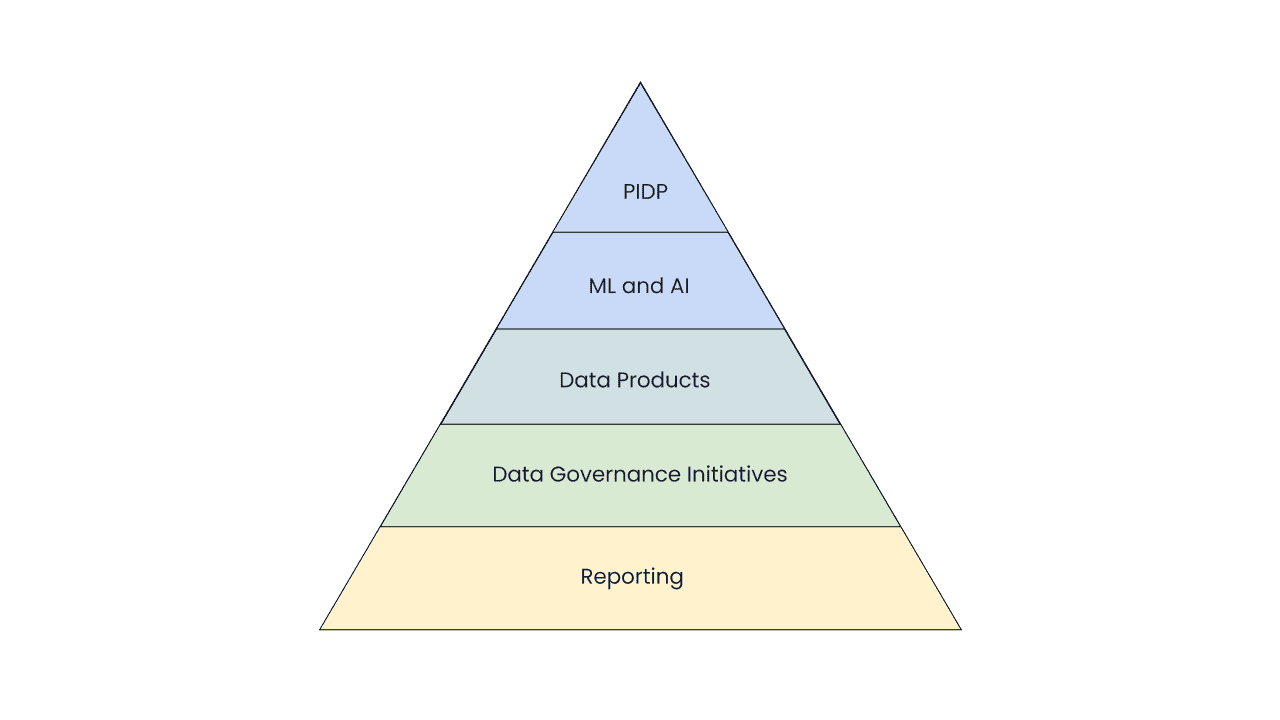
The Data Maturity Pyramid: From Reporting to a Proactive Intelligent Data Platform

A pyramid lets us demonstrate two features at once:

  1. Every subsequent level is located above the previous one;
  2. The expansion of the next level inevitably leads to the expansion of the level below it.

This means that as data products evolve in an organization, the approaches and technologies in data management are also improved. Trust, discoverability, security, consistency, and other characteristics of data are likely to improve, step by step, which leads to improvements at every level.

Let us describe a scenario of a company in the process of adopting and implementing AI and ML.

We have a telecommunications company that:

  • Has a deep understanding of its corporate data from various sources;
  • Maintains reliable and consistent corporate-level reporting;
  • Uses marketing campaign management systems that rely on real-time data.

The company decides to implement an advanced AI/ML-driven system, to offer its customers the best next plan. This move unlocks a new level of data utilization, and also improves all preceding levels of the pyramid: it brings in fresh data for reporting, introduces novel challenges regarding data security and compliance, and provides valuable insights into marketing.

Consider that any data initiative does not necessarily need to start from the bottom up – once your organization has become proficient enough at one level, you can move on to the next. However, some levels of the pyramid may be in completely different data transformation stages. For example, your organization may decide to begin data transformation in the AI space because that appears to be the greatest opportunity from a business perspective.

Suppose your organization wants to use AI and ML to quickly find the least expensive plane tickets, taking into account train and bus transfers, and other trip details. Solving this case requires a fairly specific and limited set of data. However, the level of reporting or data management in the organization may not have evolved enough to support this feature with existing data. In this case, you are not dealing with a data pyramid because the first two levels cannot be used as a foundation for AI/ML — your AI/ML level is afloat. Building analytical systems that “float” is extremely difficult, but possible, as a means to accelerate time-to-market, and to quickly test specific AI use cases in production. Advanced development of the foundational pyramid levels will most likely be delayed, but the system will eventually attain its final and sustainable pyramid form.

Data-Driven Capabilities and Competitive Advantage

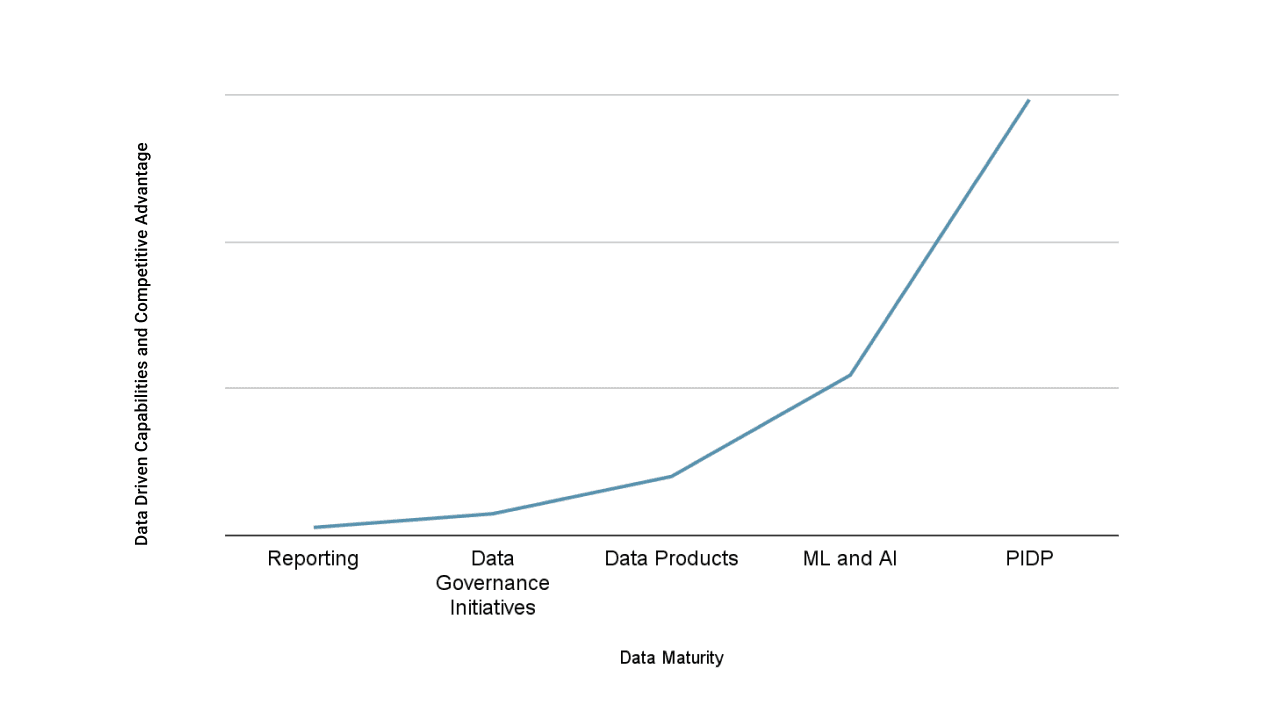
When talking about the advantages of improving your data maturity, it's important to note that the more you enhance it, the bigger the rewards. In simple terms, the higher your current data maturity level, the more value you'll get from making even next small improvements. This kind of rapid growth in benefits is similar to what's described as an "exponential function", where the rate of growth is tied to the current state of what you're measuring.

This relationship is easy to notice in analytical systems. Each successive level can and should build upon the previous one, simultaneously unlocking entirely new benefits and features that were not accessible at earlier stages.
The Data Maturity Pyramid: From Reporting to a Proactive Intelligent Data Platform
Picture 2. Correlation between data-driven capabilities and competitive advantage across levels of data maturity

To demonstrate how this works, let’s assume your organization has developed a new data product — a customer recommendation engine for an e-commerce platform. The engine processes historical customer behavior data to suggest personalized product recommendations to users. Initially, the system is rule-based and relies on predefined heuristics to make recommendations.

In the transition to the AI/ML level, the team decides to implement a machine learning model. For example, a collaborative filtering model, or a deep learning-based recommendation system. The model can analyze vast amounts of data, identify complex patterns in data, and make accurate and personalized product recommendations for every user.

As the recommendation system is deployed, it continues to collect even more data from user interactions. The more users engage with the platform and receive recommendations, the more data the system accumulates. This data growth allows ML models to continually learn and refine their recommendations, leading to ever-increasing accuracy and effectiveness of the recommendation engine.

Note: Each of these transitions will be discussed in more detail later. At this stage, let’s keep in mind that every transition to a new maturity level is associated with overall growth in the complexity of the system. Such growth means using new tools, acquiring new team skills, building additional connections between systems and teams (while avoiding silos), and, most importantly, gaining a competitive advantage. Your organization gains more benefits at every level while your competitors lag behind.

Complex systems are inherently more challenging to develop than simple ones. Moreover, not all companies have the resources to manage the development process, from ideation to implementation, to at-scale adoption, to support.

Imagine a supply chain management company that has implemented several machine learning models to forecast demand, optimize inventory, and identify inefficiencies in its logistics. Having such a data- and AI/ML-driven solution that leverages advanced analytics and predictive insights is a substantial competitive advantage.

Now, let’s consider that the company wants to take another step forward towards a Proactive Intelligent Data Platform (PIDP) with Geneverative AI capabilities. Such a system would evolve from identifying risks and opportunities from data, to proactively generating actionable plans based on this data, using Large Language Models (LLMs). Now, instead of simply notifying stakeholders about potential issues or providing insights, the system provides them with an intelligent, well-crafted action plan. Generative AI can be harnessed to initiate processes, call internal or third-party APIs, and even execute generated plans autonomously.

In the case of our supply chain management system, this transition could enable it to not only predict potential stock shortages, but also to actively engage with suppliers, place orders, and coordinate logistics, all in real time, without human intervention. Such a system could evaluate results, learn from them, and refine its next action. Human feedback would remain crucial, ensuring alignment with strategic goals, and ensuring continuous improvement.

The incorporation of Generative AI into a Proactive Intelligent Data Platform is not just a technological leap – it is a strategic transformation. In the supply chain domain, this could mean reduced lead times, minimal stockouts, and maximized asset utilization, all of which translate into real business value.

While competitors grapple with rules-based systems or traditional machine learning algorithms, a company operating at the PIDP level is navigating the complexity of modern supply chains with a nimbleness and foresight that sets it apart.

Let’s explore each level of the data pyramid in more detail, to understand its role in the journey from reporting to PIDP.

Level 1 — Reporting The Data Maturity Pyramid: From Reporting to a Proactive Intelligent Data Platform
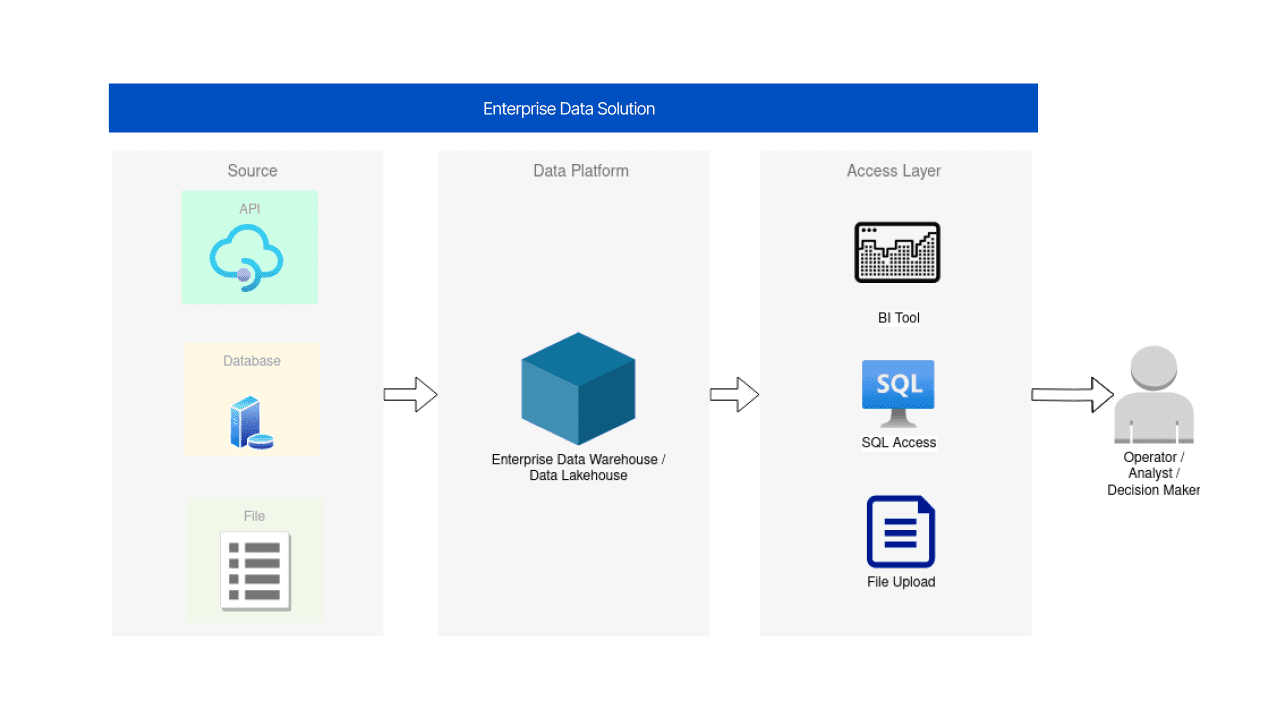
Reporting is an essential domain for data engineers. It involves designing and building fundamental data platforms that can serve as a foundation for analytics and other data-driven subsystems and solutions. Data engineers are responsible for establishing robust data pipelines and infrastructure that can collect, store, and process data efficiently and securely. These foundational data platforms enable data engineers to ensure businesses that their data is easily accessible, well-organized, and prepared for further analysis and reporting.

To add some historical context, consider that only five years ago, the use of real-time tools indicated a more mature data platform, compared to a batch platform. Today, with some exceptions, the boundaries are more blurred. The complexity of batch and streaming processing is not much different; the only exceptions are data lineage, security and discovery – and in general in what we call data governance. In those domains, many changes have occurred due to real-time processing, with expectations of more enhancements in the near future.

Having said that, it's possible to achieve near real-time data integration from almost all sources, and the Event Gateway is a suitable choice for consistent data ingestion. For a few data sources with significantly larger data volumes than others in an organization, batch ingestion might be preferred. For example, raw data from Google Analytics for a medium-sized online company might account for half of all processed data. Whether it's worthwhile to ingest this data at the same speed as transactional system data, potentially at a high cost, is debatable. However, as technology progresses, the need to choose between batch and real-time may decrease.

With real-time data products, there is still a significant gap in data governance capabilities and maintenance overhead of real-time data processing, compared to batch processing. For that reason, it is recommended to only rely on real-time data processing in a limited range of use cases, like ad bidding or fraud detection, where data freshness is more important than data quality.

A number of products benefit more from higher levels of transparency and quality than from speed. They can rely on data processing in micro batches, or in a traditional batch mode (e.g finance reporting). For more details, please read Dan Taylor's post on LinkedIn.

Level 2 — Data Governance Initiatives The Data Maturity Pyramid: From Reporting to a Proactive Intelligent Data Platform
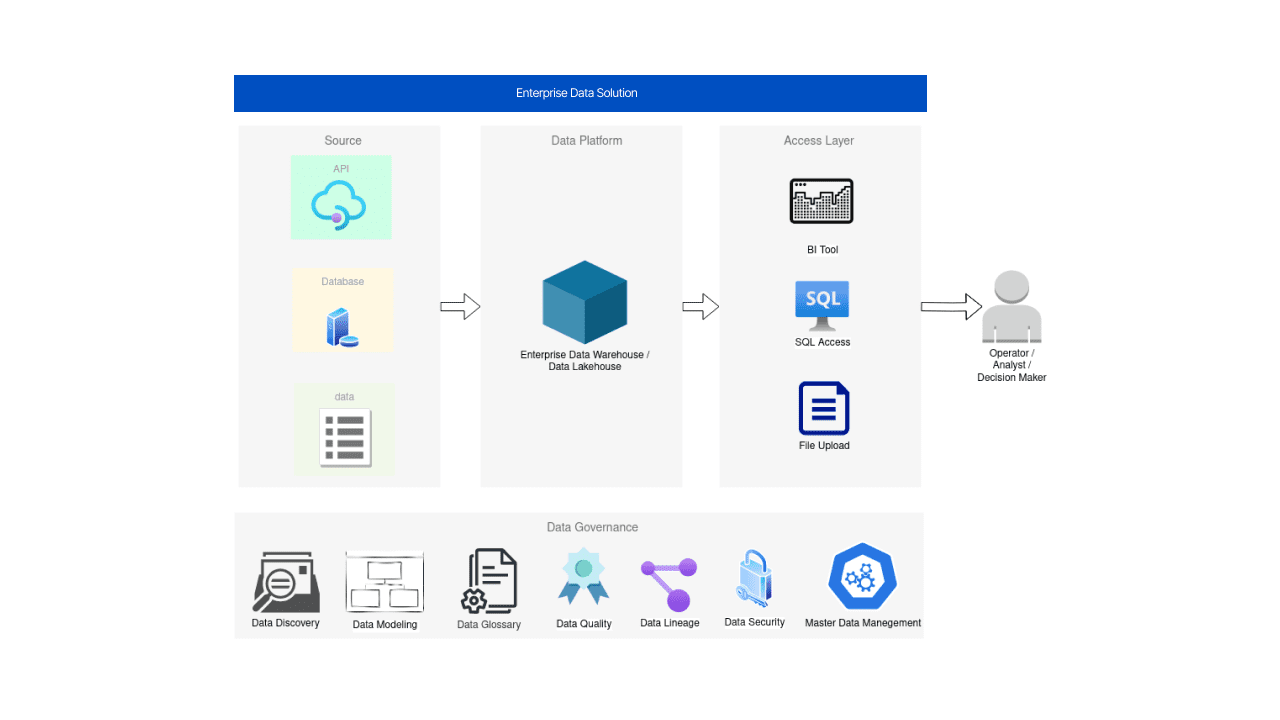
Data governance is a broad term, with varying definitions. But if we try to roughly describe what data governance initiatives are, we will eventually end up referring to its components, features, and practices, such as: data discovery, data modeling, data glossary, data quality, data lineage, data security, and master data management (MDM).

The transition to conscious and systematic practices in data governance can result in a staggering boost in data literacy, speed, reliability, and security. These are only a fraction of benefits that are realized when moving away from simple reporting toward corporate data management systems.

Demand for data democratization inevitably increases the requirement for more efficient data access management. Unification of metrics at the company level leads to the need to create glossaries, unified reports, manage data fragmentation and duplication, and so on — all of which help save time on handling and using data in specific use cases. Such data solutions and products drive the demand for data discoverability, and more detailed cataloging and data usage.

At the data governance level, data engineers usually work in close collaboration with software development teams to build and maintain systems like reference data management tools. The same goes for data observability instrumentation like OpenLineage. Ideally it would be a unified platform for all types of data governance initiatives that, as an example, Open Data Discovery platform aims to become.

Level 3 — Data Products The Data Maturity Pyramid: From Reporting to a Proactive Intelligent Data Platform
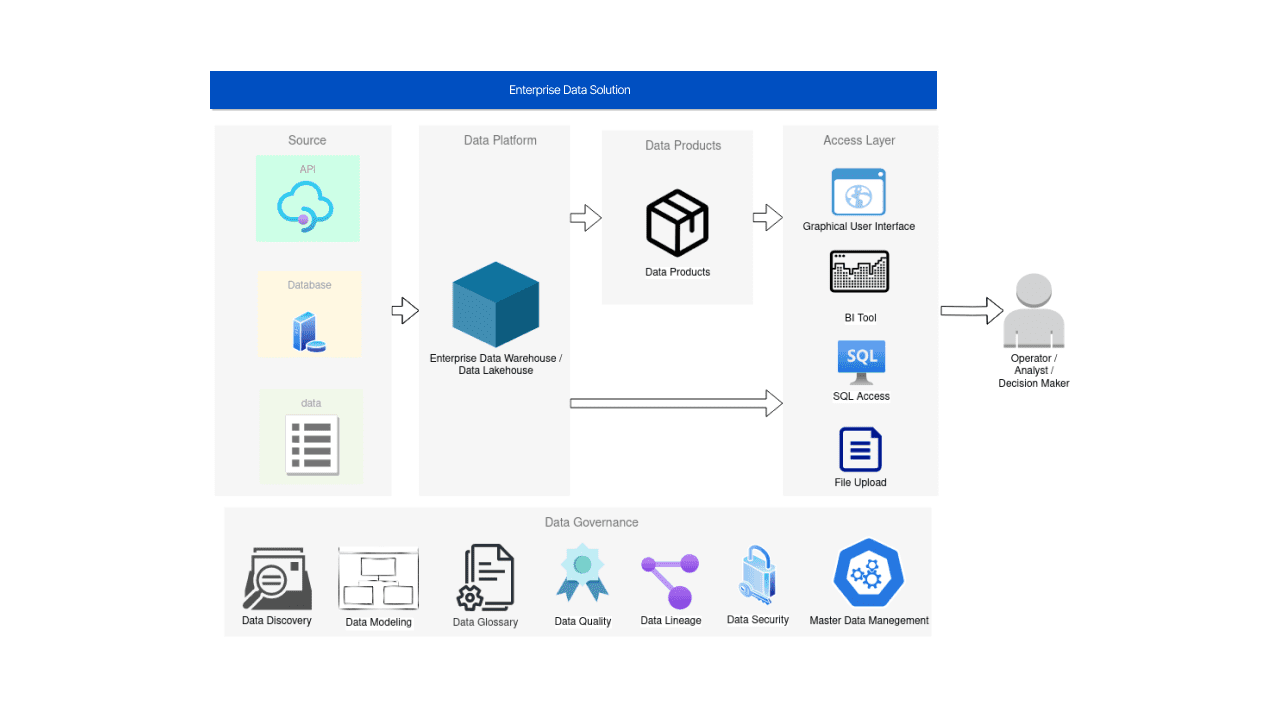
The basic data products are not associated with any AI/ML technologies and use cases. They generally do not require advanced analytics, either. Because a wide range of issues and tasks can be solved just by using consolidated data that is stored in corporate data platforms. These are:

  • Almost all operations with historical data;
  • Transaction systems support that is achieved by removing data load;
  • High-speed, at-scale calculations on large amounts of data.

To name some more specific examples, these are systems and tools that are used in sales & marketing systems, A/B testing, billing systems, and so on.

At the data product stage, software and application development teams also play a vital role. Communicating with them on technology aspects of the data product, while bearing business goals in mind is key to successful use of data for any use case.

Note that the development of APIs or end-to-end solutions should always be part of the general approach to development in corporations. Cross-functional development teams can bring the most benefits to the table and, in relation to data, it makes sense to talk about the concept of Data Mesh.

Data Mesh revolutionizes the way organizations can manage data. Instead of seeing data as a monolithic entity, Data Mesh encourages organizations to treat data as a product. By doing this, it decentralizes data ownership and helps teams develop and maintain their own data products, thus reducing bottlenecks and dependencies on centralized data teams.

Level 4 — AI and ML Solutions The Data Maturity Pyramid: From Reporting to a Proactive Intelligent Data Platform
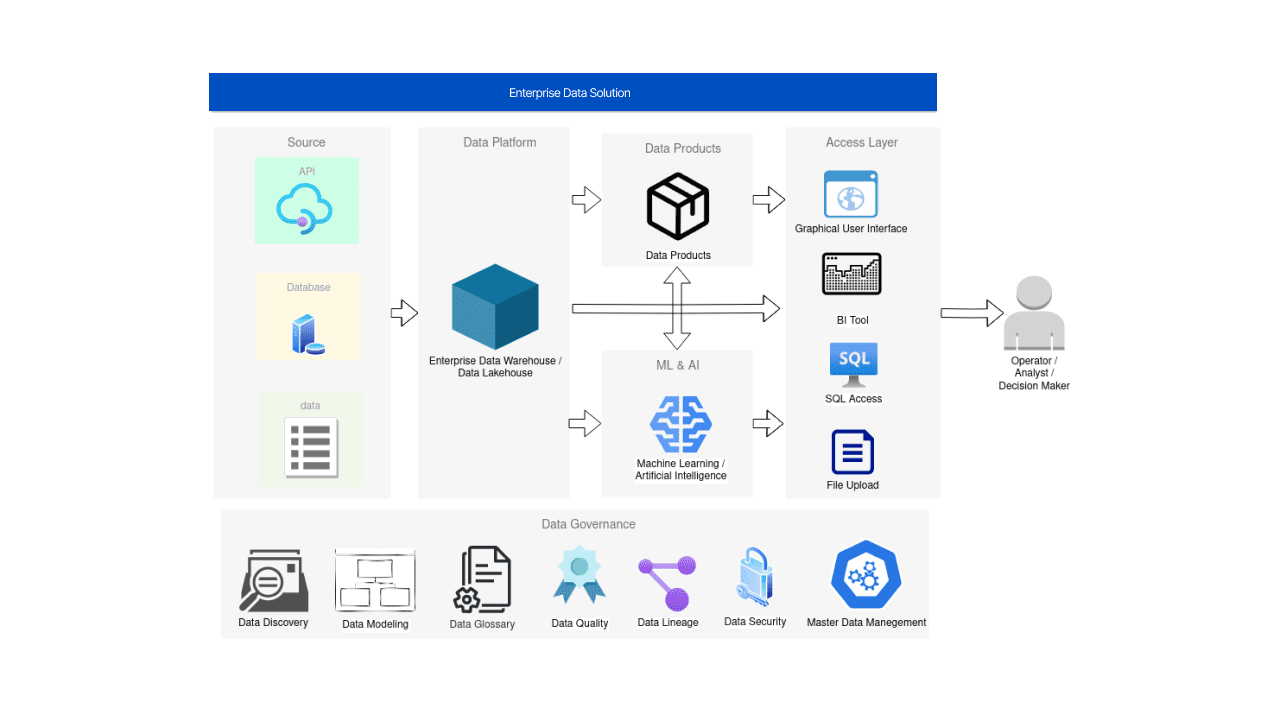
AI is the new electricity. But we are still in the in-between time: the potential of AI is clear, but not that many companies have overhauled their business models enough to take advantage of AI, end-to-end and at scale.

As perfectly said in the speech by Stephen Brobst, the main value of and from AI will be realized when AI is ubiquitous. So far, the final beneficiaries do not pay attention to the ubiquity factor, oftentimes trying to work on use cases that cannot be brought into the real world.

From a data engineering perspective, AI is fueled by data. That is why, we should always remember about feature stores and ML model operationalization — components that help to continuously and repeatedly transform data into AI/ML solutions in production. In more detail, these components and associated roles are described in Databricks’s “The Big Book of MLOps”. This comprehensive guide delineates the specific functions of five key roles – Data Engineer, Data Scientist, ML Engineer, Business Stakeholder, Data Governance Officer – and their interplay across seven pivotal processes – Data Preparation, Exploratory Data Analysis (EDA), Feature Engineering, Model Training, Model Validation, Deployment, and Monitoring.

It’s also worth remembering that AI’s full potential is truly realized only when its modules are integrated into the corporation's overall infrastructure, processes, and even culture. When various systems and individuals seamlessly collaborate as one cohesive unit, that is when the transition to the Proactive Intelligent Data Platform starts to make sense organization-wide.

Level 5 — Proactive Intelligent Data Platform (PIDP) The Data Maturity Pyramid: From Reporting to a Proactive Intelligent Data Platform
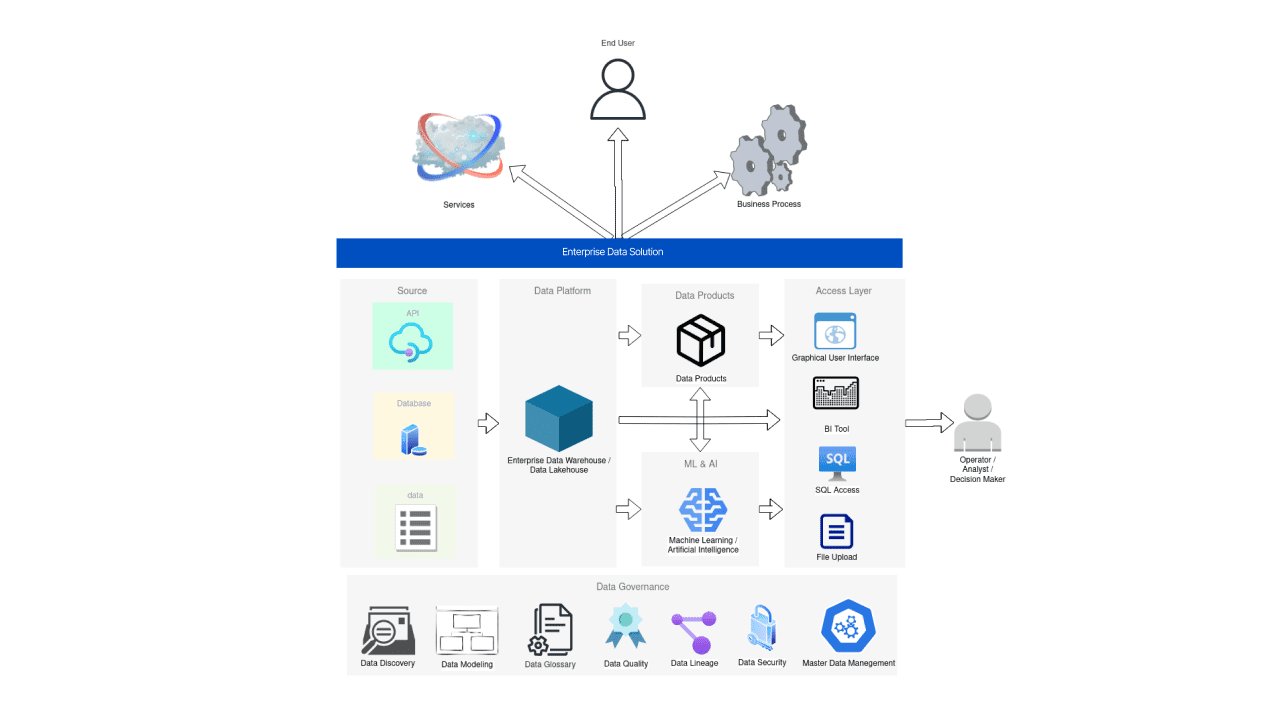
The Proactive Intelligent Data Platform (PIDP) is the top level of the data maturity pyramid. In its core, it involves seamless integration of AI/ML technologies and advanced analytics into business as usual (BAU) processes, organization-wide.

Let’s take a closer look at the PIDP in the context of one of the recently emerged AI niches — Generative AI. Specifically, we will explore three domains – digital twins, control towers, and command centers – in which the transformative potential of Generative AI is most evident.

Consider large factories developing digital twins of their facilities for enhanced operational efficiency. In such an advanced setup, the operator, despite having all essential controls, faces the immense challenge of continuous decision-making. Introducing a Generative AI agent that can help communicate with digital twins in natural language streamlines and automates routine tasks, risk evaluation, opportunity analysis, and assists in informed decision-making.

In a similar fashion, in the telecommunications industry control towers are fitness to the rising trend of operators globally investing in optimization, timely problem detection, and accident prevention. These centers receive vast amounts of data from different authority levels. The human operators are burdened with the responsibility of being highly skilled and informed for effective task management. Incorporating Generative AI could alleviate the routine and intricate aspects of their operations.

Now, consider the command centers, especially within the supply chain sector. Operational decisions here often require multi-departmental collaboration, such as the supply chain unit, and financial and legal departments, among many others. These teams, with different expertise and partial insights, should decide on their actions collaboratively. In this context, the utility of Generative AI as a part of a unified corporate management platform becomes clear. These Gen AI models can identify risks and opportunities, gauge their enterprise-wide impact, analyze potential resolutions, and much more.

Data plays a key role in each of these domains. It is the crown that winds the entire organization, enabling it to operate smoothly, like a clockwork.

The PIDP is a powerful tool that enables organizations to proactively respond to challenges, make data-driven decisions, and stay ahead of the competition.

The role of data engineers at this stage is the most important and, at the same time, probably not so noticeable. Since the corporation already receives main benefits from data-driven products, the seamless integration of AI into the decision-making process, from simple analytics dashboards to well-coordinated interaction of various departments of the corporation, is the key. The organization evolves from raw utility applications powered by data, to ease-of-use apps that can drive business value smoothly in a non-specialized, non-technical environment.

However, it is important to understand that the link in almost every node at this stage is data, its management and its processing.This, of course, is the main merit of the work of data engineers.

Conclusion

The journey to a proactive intelligent data platform is challenging but essential for modern organizations seeking to thrive in a data- and AI-driven world. By progressing through various data maturity levels, embracing data-driven capabilities, establishing robust data governance initiatives, and harnessing the potential of AI and ML, organizations can unlock a whole range of critical competitive advantages, to stay ahead of the curve.

The Proactive Intelligent Data Platform represents the culmination of this journey and the final level of the data maturity pyramid. It can empower organizations to lead, innovate, and succeed in a rapidly evolving business landscape.
Raman Damayeu is proficient in both traditional data warehousing and the latest cloud solutions. A fervent advocate of top-notch data governance, Raman has a special affinity for platforms akin to Open Data Discovery. Within Provectus, he consistently propels data-driven initiatives forward, helping to take the industry to the next level of data processing.

More On This Topic

  • Making Intelligent Document Processing Smarter: Part 1
  • The Ethics of AI: Navigating the Future of Intelligent Machines
  • KDnuggets News, May 18: 5 Free Hosting Platform For Machine Learning…
  • Charticulator: Microsoft Research open-sourced a game-changing Data…
  • 5 Key Components of a Data Sharing Platform
  • Deploy a Dockerized FastAPI App to Google Cloud Platform

Third-party AI tools are responsible for 55% of AI failures in business

Digitally generated image of multi coloured vertical bars. Concept of fintech technology, new banking, investment, cloud technology and AI.

Imagine pulling up an AI-powered weather app and seeing clear skies in the forecast for a company picnic that afternoon, only to end up standing in the pouring rain holding a soggy hot dog. Or having your company implement an AI tool for customer support, but which integrates poorly with your CRM and loses valuable customer data.

According to new research, third-party AI tools are responsible for over 55% of AI-related failures in organizations. These failures could result in reputational damage, financial losses, loss of consumer trust, and even litigation. The survey was conducted by MIT Sloan Management Review and Boston Consulting Group and focused on how organizations are addressing responsible AI by highlighting the real-world consequences of not doing so.

Also: How to write better ChatGPT prompts for the best generative AI results

"Enterprises have not fully adapted their third-party risk management programs to the AI context or challenges of safely deploying complex systems like generative AI products," Philip Dawson, head of AI policy at Armilla AI, told MIT researchers. "Many do not subject AI vendors or their products to the kinds of assessment undertaken for cybersecurity, leaving them blind to the risks of deploying third-party AI solutions."

The release of ChatGPT almost a year ago triggered a generative AI boom in technology. It wasn't long before other companies followed OpenAI and released their own AI chatbots, including Microsoft Bing and Google Bard. The popularity and capabilities of these bots also gave way to ethical challenges and questions.

As ChatGPT's popularity soared as both a standalone application and as an API, third-party companies began leveraging its power and developing similar AI chatbots to produce generative AI solutions for customer support, content creation, IT help, and checking grammar.

Out of 1,240 respondents to the survey across 87 countries, 78% reported their companies use third-party AI tools by accessing, buying, or licensing them. Of these organizations, 53% use third-party tools exclusively, without any in-house AI tech. While over three-quarters of the surveyed companies use third-party AI tools, 55% of AI-related failures stem from using these tools.

Also: You can have voice chats with ChatGPT now. Here's how

Despite 78% of those surveyed relying on third-party AI tools, 20% failed to evaluate the substantial risks they pose. The study concluded that responsible AI (RAI) is harder to achieve when teams engage vendors without oversight, and a more thorough evaluation of third-party tools is necessary.

"With clients in regulated industries such as financial services, we see strong links between model risk management practices predicated on some sort of external regulation and what we suggest people do from an RAI standpoint," according to Triveni Gandhi, responsible AI lead for AI company Dataiku.

Also: Why IT growth is only leading to more burnout, and what should be done about it

Third-party AI can be an integral part of organizational AI strategies, so the problem can't be wiped away by removing the technology. Instead, the researchers recommend thorough risk assessment strategies, such as vendor audits, internal reviews, and compliance with industry standards.

With how fast the RAI regulatory environment is evolving, the researchers believe organizations should prioritize responsible AI, from regulatory departments up to the CEO. Organizations with a CEO who is hands-on in RAI reported 58% more business benefits than those with a CEO who is not directly involved in RAI.

Also: Why open source is the cradle of artificial intelligence

The research also found that organizations with a CEO who is involved in RAI are almost twice as likely to invest in RAI than those with a hands-off CEO.

Artificial Intelligence

How Oracle is Fuelling Musk’s Ambitions

Ellison and Musk

People online are definitely divided between liking and hating what the Tesla and Twitter chief Elon Musk does. But there is definitely one person who is on Musk’s side and fuelling his ambitions throughout these years – Larry Ellison, the CTO of Oracle, and Musk’s longtime friend. Taking flights to meet each other in Hawaii.

At Oracle CloudWorld 2023, during his keynote speech, Ellison introduced OpenAI as a company founded by Musk 10 years back, not just as the creator of ChatGPT. Moreover, he also highlighted his love for Tesla cars, also announcing that Oracle is powering xAI and Tesla. Added to that is the Tesla police car and possibly a drone as well. It is clear that Ellison is fuelling Musk’s ambition in every field.

Larry Ellison has unveiled Oracle's next-gen Police car will be a @Tesla Cybertruck. He showed a rendering of it at his CloudWorld talk.
"It's my favorite car; It's @elonmusk favorite car. It's incredible. I know too much about it. Some of it is still to be disclosed." pic.twitter.com/c9gnUwgisw

— Sawyer Merritt (@SawyerMerritt) September 20, 2023

Long running friendship

In the world of high-stakes investments, sometimes even billionaires like Ellison and Musk can find themselves on a rollercoaster ride of financial ups and downs. Ellison is a known car collector, embarked on an intriguing journey when he invested in Tesla, the electric car maker led by the enigmatic Musk in 2018.

While this investment may not have panned out as expected, Ellison’s foray into Tesla was bold, to say the least. He disclosed the purchase of 3 million shares in the electric car company at the end of December, only to witness Tesla’s stock tumble by a staggering 42%. Yet, despite the financial setback, Ellison remained steadfast in his support for Tesla. His investment was not solely about monetary gains; it was a testament to his belief in Tesla’s mission to revolutionise the automotive industry.

In a surprising twist, Ellison joined Tesla’s board in 2018, becoming an integral part of the company. This move was a result of a settlement with the SEC, which had challenged Musk’s tweet claiming he had “secured” funding to take Tesla private at $420 a share. Ellison’s presence on the board signified his commitment to Tesla’s vision and signalled his alignment with Musk’s ambitions.

Ellison’s unwavering support for Tesla was evident when he proudly proclaimed his friendship with Musk and his significant investment in the company. At an analyst meeting, he remarked, “And so Tesla had a good day. And I think Tesla has a lot of upside.” This statement was made when Tesla was trading at about $315 per share. While the stock’s price has faced turbulence since then, Ellison’s dedication to the cause has not wavered.

The partnership between Ellison and Musk goes beyond Tesla’s electric cars. Musk’s ventures extend into space exploration with SpaceX, and Ellison has not been shy about voicing his admiration for Musk’s rocket-landing feats. He exclaimed, “This guy is landing rockets on robot drones. Who else is landing rockets? Who are you?” Ellison’s fascination with Musk’s achievements in space exemplifies the mutual respect and admiration shared between these two tech titans.

Musk reportedly also got $1 billion from Ellison during his Twitter acquisition.

Let’s go xAI X Oracle

Cut to 2023, Musk is the richest billionaire in the world, while Ellison is on the fifth spot.

Now, Ellison and Musk are collaborating once again. This time in the realm of cloud computing and AI. Musk’s new AI venture, xAI Corp, seeks to create a “maximum truth-seeking” AI chatbot, a project that demands colossal computing power and storage capacity.Ellison’s Oracle Corporation provides the necessary cloud computing infrastructure for training xAI models.

Oracle, known for its cloud hosting and database management services, has found itself facing stiff competition from industry giants like Amazon Web Services and Microsoft Azure. In this context, Ellison’s decision to collaborate with Musk not only brings significant financial gains but also reinforces Oracle’s position in the cloud computing market.

Musk’s vision for xAI Corp aligns with his relentless pursuit of advancing technology for the betterment of humanity. He envisions a global network of smart cities powered by Oracle’s technology, self-driving cars, taking people to mars, and a lot more.

Moreover, Ellison’s willingness to invest in Musk’s ventures, despite market fluctuations and financial uncertainties, showcases the power of visionaries. Both Ellison and Musk share a passion for pushing the boundaries of technology and innovation, and dislike Bill Gates, making them a formidable team in the pursuit of solutions.

The post How Oracle is Fuelling Musk’s Ambitions appeared first on Analytics India Magazine.

Can Stability AI and Meta Meet OpenAI’s Multimodal Challenge?

OpenAI just revealed that ChatGPT can now see, speak, and hear, making it a true multimodal system. Furthermore, it plans to add Dall-E 3 to ChatGPT and ChatGPT Enterprise. Meanwhile, Google is doing something similar with Gemini, their own multimodal system, coming this fall.

While we expect to have two multimodal products by October, it would be interesting to witness contributions from open-source players in the multimodal market. Presently, Stability AI and Meta seem to be strong contenders capable of achieving this.

Stability AI has Means

Stability AI possesses all the necessary resources to craft an open-source multimodal model. They have Stable Diffusion for text-to-image, Stable LM for text-to-text, and their latest addition, Stable Audio, for text-to-music generation. By merging these three models, Stability AI could potentially create one of a kind multimodal model much like OpenAI.

Though Stable Audio is not open source, Stability AI has revealed their upcoming plans to introduce an open-source model based on the Stable Audio architecture, with different training data.

Furthermore, earlier this year, Stability AI and its multimodal AI research lab DeepFloyd announced the research release of DeepFloyd IF, a powerful text-to-image cascaded pixel diffusion model. It wouldn’t be a surprise if we see a multimodal coming from Stability AI soon in the future.

Meta has Plans

In a surprise turn of events, recently, at a social event, OpenAI engineer Jason Wei overheard a conversation suggesting that Meta has amassed sufficient computing power to train both Llama 3 and Llama 4. While Llama 3 aims to achieve performance on par with GPT-4, but will remain free of cost. Moreover, Llama 3 is anticipated to introduce open-source multimodal capabilities as well.

ImageBind is part of Meta’s efforts to create multimodal AI systems that learn from all possible types of data around them. ImageBind is the first AI model capable of binding information from six modalities. The model learns a single embedding, or shared representation space, not just for text, image/video, and audio, but also for sensors that record depth (3D), thermal (infrared radiation), and inertial measurement units (IMU), which calculate motion and position.

Furthermore, Meta released a multimodal model “CM3leon”, that does both text-to-image and image-to-text generation. Additionally Meta’s Seamless M4T can perform tasks across speech-to-text, speech-to-speech, text-to-text translation & speech recognition for up to 100 languages depending on the task.

Multimodal is Future

Open source LLMs can be customised to meet the specific needs of an organization. This can help to reduce the cost of developing and maintaining AI applications. The lack of a true multimodal in the open source market has led to developers trying their own hand at attempting a multimodal. Some of them worked and some did not. However, this is the nature of the open source community where they employ the method of trial and error.

Earlier this year a group of scientists at the University of Wisconsin-Madison, Microsoft Research, and Columbia University created a multimodal called LLaVA. It is a multimodal LLM which can deal with both text and image inputs. It uses Vicuna as the large language model (LLM) and CLIP ViT-L/14 as a visual encoder.

Similarly, another group of researchers at King Abdullah University of Science and Technology created MiniGPT-4-an open-sourced model performing complex vision-language tasks like GPT-4. To build MiniGPT-4, the researchers used Vicuna, which is built on LLaMA, as a language decoder and the BLIP-2 Vision Language Model, as a visual decoder. Moreover, to simplify the multimodal model creation process, open-source communities have also introduced models like BLIP-2 and mPLUG-Owl.

While the open source community is experimenting to create a viable multimodal system, it’s essential for Meta and Stability AI to step up their game and develop a multimodal solution soon. Otherwise, Google and OpenAI might pull ahead, further widening the gap between open source and closed source players.

The post Can Stability AI and Meta Meet OpenAI’s Multimodal Challenge? appeared first on Analytics India Magazine.

AI chip company Kneron raises $49M to scale up its commercial efforts

AI chip company Kneron raises $49M to scale up its commercial efforts Kyle Wiggers 7 hours

Kneron, which is developing AI chips to power self-driving cars, among other autonomous machines, today announced that it raised $49 million in an extension to its Series B round from investors including Foxconn, Alltek, Horizon Ventures, Liteon Technology Corp, Adata and Palpilot.

Kneron’s CEO, Albert Liu, says that the new tranche, which brings Kneron’s total raised to $190 million, will be put toward bolstering Kneron’s go-to-market efforts in the automotive industry and expanding the size of its team, with an emphasis on the R&D division.

“The need for chips in the automotive market is robust, and the rapid growth of AI in generative applications is driving the need for AI chips,” Liu told TechCrunch in an email interview. “Kneron is strategically positioned with unique advantages in these areas.”

As the demand for AI explodes, so too is the demand for chips designed to execute AI workloads. Gartner forecasts that it’ll be a $53.4 billion revenue opportunity for the semiconductor industry, a 20.9% uptick from 2022.

Unsurprisingly, investors are chasing after the opportunity. VC funding for chip startups doubled from 2017 to 2022, according to PitchBook data.

That’s obviously to the benefit of companies like Kneron.

Kneron was co-founded in 2015 by Liu and Frank Chang. Prior to starting the company, Liu spent time in R&D and management positions at Qualcomm and Samsung. Chang was an assistant director at Rockwell before being elected to the nonprofit National Academy of Engineering, which operates engineering, education and research engineering programs.

With Kneron, Liu and Chang set out to develop hardware for AI applications — specifically ASICs (Application-Specific Integrated Circuits), or chips custom-tailored for a particular use. Today, Kneron supplies low-powered, reconfigurable AI chips that are designed to interface with existing systems, such as the sensors on driverless vehicles, and that can run algorithms ranging from face and body detection models to models to generate text.

Kneron

Image Credits: Kneron

Kneron has a number of competitors in the space, including NeuReality, which is building similar AI inferencing accelerator technology. There’s also Hailo, Mythic and Flex Logix, to name other upstarts. And in terms of incumbents, Google’s competing for AI inferencing dominance with its tensor processing units while Amazon’s betting on Inferentia, not to mention the elephant in the room, Nvidia’s GPU hardware.

But Kneron’s done well for itself. Revenue is in the order of “double digit millions,” Liu claims, with a customer base that spans ~30 brands including Garmin, Naver and Quanta. Through Otus, an imaging tech provider Kneron acquired in April, Kneron has partnerships with automotive customer like JVC Kenwood.

In the short term, Liu says that Kneron will focus on “strategic directions” in AI, like autonomous cars, that avoid direction competition with “existing dominant players.” Down the line, it’ll mount a bigger challenge to incumbents — potentially through collaborations with third-party vendors. Or at least, that’s the plan.

“Kneron is poised to become a significant player in this industry,” Liu said. “Kneron’s lightweight reconfigurable solutions resolve three major problems faced by AI use cases — latency, security and cost– — thereby enabling AI everywhere.”

Focusing on Future AI Regulations While Deepfake Crimes Persist

A few days ago, Spain was rattled with nude images of over 20 teenagers circulating in a town called Almendralejo. Faces of school children were morphed onto naked bodies. An app was used to facilitate it, and at the forefront of this appalling incident was AI deepfakes. With AI-generated deepfake crimes persisting over years, and no solid regulations to protect people from it, the latest focus of formulating AI regulations, fueled by LLMs, is all about future use-cases where machines can go rogue. However, the present laws that are supposed to deal with deepfakes are too weak, so, why isn’t anyone acting on it?

Forget the Present, Future is Here

The countless AI Senate hearings and summits that have been happening this year to mitigate future AI regulations had created immense buzz. The last one convened all the tech honchos to discuss behind closed doors about probably formulating a legislation bill on AI regulations. The irony being the aggressive precautionary measures by the government and tech leaders for a situation that may or may not occur, while grave issues such as deepfake criminals continue to go scot-free.

From surfacing first in 2017 to being ranked as one of the most serious AI crime threats, laws around deepfakes are still not solid. In the US, crimes related to deepfakes jumped from 0.2% to 2.6% in Q1 2023, with more than 90% being deepfake porn. Till date, there is no federal law that criminalises the creation or sharing of non-consensual deepfake porn in the country.

Currently, only a few states in the US – Hawaii, Texas, Virginia, and Wyoming, have made non consensual deepfakes a criminal violation. Whereas, in states such as New York and California, victims are allowed to file civil lawsuits. A couple of other states are in the process of proposing a law, as well.

Source: Bloomberg

Furthermore, if the creator of deepfake content operates beyond the jurisdiction of the relevant state, the legislation becomes inadmissible. With only a meagre number of states adopting the bill, the enforcement of it as a common law across the US seems unlikely.

Considering how deepfake tech is evolving, proving the legitimacy of such cases becomes crucial if any form of law is implemented. Rebecca Delfino, a law professor at Loyola Law School, said that with technology getting better, it becomes difficult to identify if something is fake or not unless one is a digital forensic expert.

If we think that enforcing regulations governing deepfakes is a problem with only the US, think again.

Not So Stringent After All

The EU AI Act or rather EU that treats privacy with utmost importance, has surprisingly not sorted the whole issue surrounding deepfakes. The EU Act focuses on categorising AI systems on various levels of risk, and steering development of AI systems amongst member states. However, the issue of deepfakes has been touched upon differently.

The Act does not outright ban the use of deepfakes, but aims to regulate them by imposing transparency requirements on creators. It also states that the creator will need to disclose the content to indicate if it is artificially generated or not, something that the US government has also been discussing with big tech companies to tackle through watermarking. It remains an ambitious project still in process. Even in the recent Spain incident, the obscurity and lack of laws that criminalise such crimes, leans in favour of the perpetrators.

Furthermore, similar to the issue in the US, content creators of malicious content outside the jurisdiction of the EU, remains an issue. However, in the far east, things are quite different.

Asian Countries Speed Runs

Earlier this year, the Cyberspace Administration of China (CAC) released a comprehensive legislation that will govern deepfake content. It prohibits deepfakes without user content and mandates specific identification for content generated using AI. In Singapore, POFMAN (Protection from Online Falsehoods and Manipulation Act) prevents the use of deepfake videos.

In India, though there are no specific laws or regulations that ban the use of deepfake technology, existing laws under Sections 67 (punishment for publishing or transmitting obscene material in electronic form) and 67A of the IT Act (2000) have elements that can be applied in similar scenarios. Defamation and publishing explicit content that falls under the Act, can be used in favour of deepfake victims.

Though Asian countries are speeding up the process regarding cybercrimes that also spill to AI-related ones, the inter-country challenge can prohibit the full implementation of the same. For instance, in spite of stringent laws within the country, deep fake apps from China-based developers are downloaded over a million times from users in the US. Until EU countries and the US, which are considered the forerunners for formulating any kind of AI laws, implements stringent rules around deepfakes, the situation will never be fully addressed.

While the US will actively debate and discuss whether AI will bring about the doom of humanity in the future, present AI-related crimes such as deepfakes will continue to have grave consequences.

The post Focusing on Future AI Regulations While Deepfake Crimes Persist appeared first on Analytics India Magazine.

Meet the Researcher Curing the Healthcare System with ML

Modern technology is omnipresent in our lives yet its applications remain long-delayed in healthcare. Among the global healthcare research community is Ziad Obermeyer, a professor at the University of California, Berkeley, who has been focused on the intersection of machine learning and health since 2017.

There are a number of moonshots – large–scale government or conglomerates–backed initiatives – promising to revolutionise the sector but haven’t been able to come up with a pocket friendly solution. Obermeyer, who made it to the TIME AI 100 list, has managed to chart a different course.

He is working on a research project with MIT researchers to build AI based diagnostics that can run on wearable devices.

“Given how cheap and reliable technology is for acquiring data for laymen through a smartphone or a wearable device, it opens up a whole new way to access healthcare, outside the traditional medical system,” he told AIM in an exclusive interview.

For countries like India, that have technological talent and a crippling healthcare system, Obermeyer believes there’s the potential to leapfrog cumbersome electronic health records and clumsy data problems as observed in the case of the US. Through the ongoing project along with his team Obermeyer is training algorithms for smartphones to diagnose things like heart attack, Alzheimer’s dementia and other cognitive problems. They are also testing whether the diagnostic tools can be deployed using community health workers in people’s homes outside of government, hospitals or other established firms to deliver health care at much lower cost, he explained.

Tech-ing it Personally

During certain instances as a researcher, Obermeyer has found it increasingly difficult to access health data. “The data lives inside of silos that are controlled by hospitals, government and agencies akin. It’s hard to collaborate for research, build healthcare-based AI products and evaluate how they work,” he pointed out the case of growing dominance of a handful of big tech companies who have access to a huge amount of medical data.

“Ultimately, it shouldn’t be the case that AI in healthcare or anywhere else. That’s not really how we want markets to work or deliver value,” he stated.

To solve the case in point, the healthcare practitioner launched a nonprofit Nightingale Open Science project in 2021 with $6 million philanthropic funding from Eric Schmidt’s Foundation. “We used that to build up datasets in collaboration with health systems and governments around the world making sure it is ethical and secure. We put that data on our cloud platform where any researcher in the world can access it for free. That is Nightingale’s open science mentality,” he explained.

While there’s no way to reduce the risk to zero, the team at Nightingale have multiple layers of process to protect patients’ privacy and make sure the data is ethically used.

First the data is de-identify before it’s taken out of the health system, in compliance with US as well as European Union laws. Secondly, the data is maintained on their own cloud platform, to monitor how it is being put to use. Obermeyer highlighted that this doesn’t compromise the client’s IP. “Everything is logged and stored so if there’s any allegations of malfeasance we can always go back to the record to figure out exactly what happened,” he said.

Beyond these, there are two additional layers of ethical oversight — internal and external.

Internally, Nightingale evaluates proposals to ascertain alignment with its own ethical standards. Externally, the health systems that serve as data sources wield a veto power, ensuring that nothing transpires that might not be in the best interest of the patients whose data is being used, he explained.

The Hallucination Issue

One cannot talk about AI models without discussing hallucinations—a concern not lost on Obermeyer.

There’s no way for you to check the output as a layperson and it’s incredibly dangerous for people to use chatbots without resources to evaluate the output. The broader problem is how these AI models are currently evaluated. “We need meaningful benchmarks that can’t be gamed or memorised, but give us a real view of how things work,” Obermeyer suggested.

In 2020, he co-founded Dandelion Health, a free public service platform for evaluating algorithms, starting with electrocardiograms, moving on to other data modalities, including notes. “Soon we’ll be able to evaluate large language models,” he revealed.

“Anyone can upload an algorithm to the environment where their intellectual property is protected. We will run that algorithm on our data and give them feedback on the performance of their algorithm on any chosen metric,” he elaborated.

“But this is not possible because they don’t have access to our data. Third-party independent evaluation is also important, to know what these models are good at and where they can be really dangerous,” he added.

The startup has agreements with a hedge fund, and US health systems through which the team can access their clinically generated data — electronic health records, images, waveforms, sleep monitoring, studies, everything.

We identify the data and make curated subsets available to AI product developers, startups and companies that want to build products for better health care. A company can come to us and say they need a specific dataset and we can create it for them to build AI algorithms and then develop them for clinics.

The two separate projects are working towards the same goal; to get more people building and using and validating AI products, Obermeyer said in conclusion.

The post Meet the Researcher Curing the Healthcare System with ML appeared first on Analytics India Magazine.

YouTube is All You Need

YouTube is All You Need

Whether it’s watching DIY tutorials, whipping up delicious recipes, or just cute cat videos to lighten up the mood – YouTube has become a go-to place for everything. Jensen Huang, the NVIDIA chief, said YouTube is his favourite medium of learning, besides using ChatGPT to dissolve plastic.

Just yesterday, OpenAI released its most awaited multimodal ChatGPT. But, what this flamboyant chatbot lacks is limited access to information, now cut-off up to January 2022.

This is where Google wins. After pioneering Transformer with the Attention is all you need paper – all it needs now is YouTube.

Imagine having a multimodal chatbot solely trained on YouTube data. According to leaks and reports, Google DeepMind is training Gemini, its next iteration of generative AI model, which it touts is going to be multimodal. Moreover, it is also training the model based on video transcripts of YouTube, not just the audio. This would make the model rich and heavily informed. No one has done it before.

🚨 Rumour: Gemini (Google's upcoming ChatGPT competitor) is being trained on YouTube video transcripts.

This is genuinely fascinating— the amount of knowledge/data on YouTube is massive.
Can't wait to try it. pic.twitter.com/7uJnAvPAUn

— Rowan Cheung (@rowancheung) September 18, 2023

All the information

Think about it. YouTube isn’t just about watching videos; it’s about descriptions, deciphering comments, and understanding the context of those comments through textual content. If you need help with resetting your phone, there is some guy speaking a foreign language who has got you covered. From cooking tutorials to quantum physics lectures, from cute puppy compilations to historic speeches, YouTube has it all.

Quite clearly, the multimodal race is on. OpenAI’s GPT-4V(ision), where text meets images on ChatGPT is also just a hint of that. People say that OpenAI has actually beat Google in the multimodal race with this release, but it isn’t actually all true. Arguably, the same capabilities that ChatGPT offers now, were already there within Bard for months now.

For Google DeepMind, getting data from YouTube is actually the best thing it could have asked for – multimodal, multilingual, and multiregional.

While Elon Musk’s X was filled with textual data, YouTube is a gold mine for visual, audio, and textual data in almost every single language on earth. Looking at this, Musk has also decided to heavily invest in video content. Same is the case with all the Meta platforms.

The recent announcement of OpenAI’s GPT-4V(ision) into ChatGPT highlights the capabilities of multimodality. According to the demonstrations, if someone puts up a photo of a cycle and asks it how to repair its seat, the chatbot will tell step by step how it can be done. It can even speak now.

Imagine asking ChatGPT a question like, “How does photosynthesis work?” With its multimodal capabilities, ChatGPT can seamlessly pull up relevant videos from YouTube, analyse the visual content, and provide a detailed explanation. It can break down the complex process, point out the key components within the videos, and even answer follow-up questions about the topic.

But OpenAI does not have YouTube, Google does. The search giant has all the information in the world by crawling through all the websites in the world, and YouTube makes it even better.

For a multimodal LLM built on YouTube, it’s about recognising objects, people, and actions within videos using visual cues. It’s about comprehending the audio content, from spoken language to background music. In essence, YouTube encapsulates the essence of multimodality in a single platform. Musk’s Optimus that is able to sort objects based on colours and sizes can possibly learn a lot from YouTube tutorials as well.

But, it is easier said than done. That is why Google is taking its own sweet time to release it. When they do, the gap between information and creation is almost NIL.

Google’s Multimodal Masterpiece

YouTube isn’t just about information though; it’s a platform for human expression in its rawest form. It’s where people share their thoughts, emotions, and stories through videos. The comments section, for better or worse, is a goldmine of language diversity, slang, and sentiment. AI models need exposure to these nuances to engage effectively in human-like conversations.

Interestingly, the multimodal LLM that OpenAI has been working on, codenamed Gobi, is not yet here. The recent announcement of uploading photos and getting back replies in audio format can be just looked at like a plugin for the chatbot. It is just an amalgamation of GPT, the company’s speech-to-text Whisper, and possibly Microsoft’s VALL-E. But not an all round GPT-5.

So, the next time you have a question or need assistance, remember that YouTube is not just a source of answers; it’s a source of insight, emotion, and demonstration. And if you need information from YouTube videos, soon you might not even have to log on to the website. Just type in your prompt in the upcoming Google DeepMind bot, and it will drop the responses for you.

Wonder what it would do to the views on YouTube videos.

The post YouTube is All You Need appeared first on Analytics India Magazine.

New Finetuning Method LongLoRA Paves the Way for Budget-Friendly Super-sized LLMs

A Striking Relevance of Data Sketching in LLMs

MIT and the Chinese University of Hong Kong have come up with LongLoRA – a fine-tuning method that increases the context capacity of large pre-trained language models without requiring excessive computational resources. Training LLMs with extended context sizes is typically costly in terms of time and GPU usage. For example, training a model with an 8192-length context demands 16 times the computational resources compared to a 2048-length context. Context length refers to the ability of a Large Language Model (LLM) to respond effectively to a given prompt, as it requires a clear understanding of the entire context in which the question is posed.

Read the full paper here.

Training Method

Researchers accelerated the broadening of the LLM context through two significant approaches. First, they employed sparse local attention, specifically the shift short attention (S2-Attn) approach, during fine-tuning, facilitating context extension efficiently, resulting in substantial computational savings while maintaining performance similar to fine-tuning with standard attention.

Second, the researchers re-examined the parameter-efficient fine-tuning strategy for context expansion. Their findings suggested that LoRA was effective for context extension when combined with trainable embeddings and normalization. LongLoRA delivered robust empirical results across a range of tasks using LLaMA2 models, spanning from 7B/13B to 70B. LongLoRA could extend a model’s context from 4k to 100k for LLaMA2 7B or from 32k for LLaMA2 70B, all achievable on a single 8× A100 machine. Importantly, LongLoRA maintained the original model architectures and was compatible with various existing techniques, such as FlashAttention-2.

To enhance the practicality of LongLoRA, the team created the LongQA dataset for supervised fine-tuning, consisting of over 3,000 question-answer pairs with lengthy contexts.

Key Findings

Long-sequence Language Modeling: The study evaluated different models on Proof-pile and PG19 datasets. It found that, with longer context sizes during training, the models performed better, showing the effectiveness of their fine-tuning method. In simpler terms, training with more information led to better results. For example, when the context window size increased from 8192 to 32768, one model’s performance improved from 2.72 to 2.50 in terms of perplexity.

Maximum Context Length: The study also explored how much context these models could handle on a single machine. They extended the models to handle extremely long contexts and found that the models still performed well, although there was some drop in performance with smaller context sizes.

Retrieval-based Evaluation: In addition to language modeling, the study tested the models on a task where they had to find specific topics in very long conversations. Their models performed similarly to the state-of-the-art model in this task, even outperforming it in some cases. Notably, their models were adapted more efficiently to open-source data compared to the competition.

How does Context Length Matter?

In recent discussions about language models like LLaMA and Falcon, which can perform similarly to larger models such as GPT-4 or PaLM in specific cases, the focus has shifted from increasing the number of model parameters to considering the number of context tokens or context length.

AIM reported earlier that contrary to the misconception that longer input text leads to better output, in reality, when inputting a lengthy article (e.g., 2000 words) into models like ChatGPT, they tend to make sense of the content up to around 700-800 words before starting to generate less coherent responses. This phenomenon is similar to how human memory works, with the beginning and end of information being better retained than the middle.

Read more: Busting the Myth of Context Length

The post New Finetuning Method LongLoRA Paves the Way for Budget-Friendly Super-sized LLMs appeared first on Analytics India Magazine.

Alexa’s new Emergency Assist could save your life and protect your peace of mind

Echo Show 8

Alexa Emergency Assist will be supported on every Echo device, from the oldest Echo speaker to the newest Echo Show 8 (pictured).

If you tell Alexa, "I'm scared," several times in a row, the virtual assistant will respond empathetically and tell you to call 911 in an emergency. But what if you or someone else at home needs help and you're not close to a phone? What about people who don't have a phone or kids who are too young to know your address?

Alexa's new feature named Emergency Assist can help.

Also: Amazon's new Echo Hub may be its most important smart home product yet

This feature works similarly to Alexa Guard, which is being discontinued, though it's not a direct replacement. Emergency Assist is a 24/7 emergency response service that works for anyone with an Echo device at home, and it's compatible with all Echo speakers and Echo Shows. Saying "Alexa, call for help" will prompt the voice assistant to start a call with an agent who is capable of dispatching first responders to the caller's home.

As a mom who's currently teaching young kids what to do in an emergency, after having to call 911 twice within six months due to medical issues, this feature immediately had my attention. The potential benefit of having a system that can call first responders and direct them to your home — and even tell them what room the emergency might be in if your device is named after its location in the home — is immeasurable for us.

Also: Everything Amazon just announced

It could also be a game-changer for older people living alone who fall or otherwise have a medical event when their phone is out of reach.

Right now, when you ask Alexa to call for help without the Emergency Assist program, the virtual assistant notifies your emergency contact that you might need help. With Emergency Assist, Alexa will start a call to an agent from the device and will notify up to 25 predetermined emergency contacts that you've reached out to the Urgent Response team, and then again when you're done.

The emergency response team will see any identifiable information you've entered into the Alexa app for these purposes, including your address and any applicable gate codes necessary to access your home. The emergency response team will then relay that information to first responders. Users can also enter any allergies to food or medication in the Alexa app, current medical concerns and diagnoses, and medication currently being taken.

Also: Amazon says new Eero Max 7 Wi-Fi device will let you download a 4K movie in seconds

Amazon is eliminating Alexa Guard and instead folding some of its features into the general Alexa experience, like Away Lighting, which turns smart lights on and off intermittently while you're away to make it look like you're home. Other Guard features, like Smoke and CO alarm detection, will be part of the Emergency Assist service, which will work as a subscription separate from Prime and Ring Protect Pro.

Emergency Assist starts out on a limited-time offer of $5.99 a month or $59 a year when it becomes available in the coming months. After the limited-time offer ends in January, the price will increase for anyone without a Prime membership — although Amazon hasn't stated how much.

Also: Amazon is turning Alexa into a hands-free ChatGPT right before our eyes

Since Amazon is discontinuing Alexa Guard, it's giving a year of Alexa Emergency Assist to Ring Protect Pro and Ring Protect Plus customers who linked their Ring account to their Amazon account before September 20, 2023. These customers will be automatically enrolled into Emergency Assist at no extra cost until October 31, 2024.

It's common for parents to avoid thinking of worst-case scenarios — it's why we put off making a will and other end-of-life decisions when our children are young. But it's also important to consider what would happen to your kids if the only parent in the home at any given time became incapacitated.

Also: The best tablets for kids, according to parents

This is one of those parenting fears instilled in me (thanks, Steel Magnolias), and the reason I am teaching my kids to call 911. But putting in place a system like Alexa Emergency Assist could literally be a life-saving decision.

Amazon