Hollywood strikes could soon extend to the video game industry

Hollywood strikes could soon extend to the video game industry Amanda Silberling 9 hours

SAG-AFTRA members voted overwhelmingly on Monday to authorize a strike against the video game industry. The union — which includes video game performers like voice, motion capture and stunt actors — has been negotiating a contract for over a year with a collection of studios, like Epic, EA, Activision and more. Around 27.47% of eligible voters cast a ballot to authorize the strike, representing 34,687 members, 98.32% of whom voted in the affirmative.

“After five rounds of bargaining, it has become abundantly clear that the video game companies aren’t willing to meaningfully engage on the critical issues: compensation undercut by inflation, unregulated use of AI and safety,” said SAG-AFTRA National Executive Director Duncan Crabtree-Ireland in a statement.

The union is seeking increased safety measures on sets and vocal stress protections for voice actors, as well as wage increases consistent with inflation. But members see protections around AI consent, transparency and compensation to be vital to ensuring the future of their jobs.

“For many performers, their first job may be their last, as companies become increasingly eager to scan our members or train AI with their voices as soon as they show up for work,” reads the SAG-AFTRA website.

These same concerns are present among other Hollywood creatives. When the WGA launched its strike in May, screenwriters demanded clear guidelines regarding how AI could be used when scripting TV shows and movies.

A focal point of the writers’ strike — which is paused after the union reached a tentative agreement with the AMPTP this weekend — was to adjust how writers are paid in an era when streaming is king, yet streaming residuals are dismal. But AI emerged as another big concern in the strike.

“When we first put [the proposal] in, we thought we were covering our bases — you know, some of our members are worried about this, the area is moving quickly, we should get ahead of it,” comedy writer Adam Conover told TechCrunch at the beginning of the writers’ strike. “We didn’t think it’d be a contentious issue because the fact of the matter is, the current state of the text-generation technology is completely incapable of writing any work that could be used in a production.”

Meanwhile, industry-side entrepreneurs don’t see their AI tools as threats to working artists.

“As of today, nobody has lost his job because of what we do,” said Ofir Krakowski, co-founder and CEO at deepdub.ai, at TechCrunch Disrupt. The company automates the process of dubbing media in other languages. “Actually, most of our customers are looking to monetize on content that was not economically viable to monetize on. So we are enabling them to do more work.”

Spotify announced a similar feature this week, which allows podcasters to use AI to dub their podcasts in other languages, using their own voice. But across the industry, creatives have raised concerns about how these kinds of features work, whether they train on data without creators’ consent, and how they could be used to spread AI-powered misinformation.

The strike won’t take affect if the bargaining parties can reach an agreement in this week’s bargaining session. In a statement to the Hollywood Reporter, a spokesperson for the Interactive Media Agreement said: “We will continue to negotiate in good faith to reach an agreement that reflects the important contributions of SAG-AFTRA-represented performers in video games. We have reached tentative agreements on over half of the proposals and are optimistic we can find a resolution at the bargaining table.”

AI can’t replace human writers

‘Nobody has lost their job because of what we do,’ says CEO of film industry AI tool

Generative Agent Research Papers You Should Read

Generative Agent Research Papers You Should Read
Image by pikisuperstar on Freepik

Generative Agents is a term coined by Stanford University and Google researchers in their paper called Generative Agents: Interactive Simulacra of Human Behavior (Park et al., 2023). In this paper, the research explains that Generative Agents are computational software that believably simulate human behavior.

In the paper, they introduce how agents could act like what humans would do: writing, cooking, speaking, voting, sleeping, etc., by implementing a generative model, especially the Large Language Model (LLM). The agents can show the capability to make inferences about themselves, other agents, and their environment by harnessing the natural language model.

The researcher constructs a system architecture to store, synthesize, and apply relevant memories to generate believable behavior using a large language model, enabling generative agents. This system constituted of three components, they are:

  1. Memory stream. The system records the agent’s experiences and is a reference for the agent's future actions.
  2. Reflection. The system synthesizes the experience into memories for an agent to learn and perform better.
  3. Planning. The system translates the insight from the previous system into high-level action plans and allows the agent to react to the environment.

These reflections and plan systems work synergistically with the memory stream to influence the agent’s future behavior.

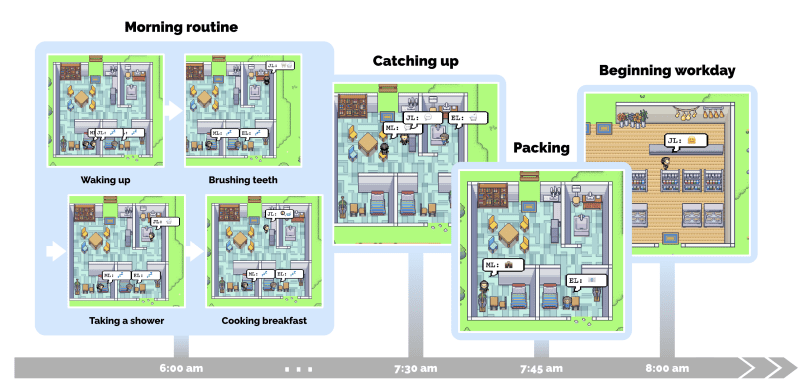
To simulate the system above, the researchers focus on creating an interactive society of agents inspired by the Sims game. The architecture above is connected with the ChatGPT and successfully shows 25 agent interactions within their sandbox. An example of agent activity throughout the day is shown in the image below.

Generative Agent Research Papers You Should Read
Generative Agent activity and interaction throughout the day (Park et al., 2023)

The whole code to create Generative Agents and simulate them in the sandbox is already made open-source by the researchers, which you can find in the following repository. The direction is simple enough that you can follow them without much problem.

With Generative Agents becoming an exciting field, much research is happening based on this. In this article, we will explore various Generative Agents papers that you should read. What are these? Let’s get into it.

1. Communicative Agents for Software Development

The Communicative Agents for Software Development paper (Quan et al., 2023) is a new approach to revolutionizing software development using the Generative Agents. The premise that researchers propose is how the entire software development process could be streamlined and unified using natural language communication from Large Language Models (LLM). The tasks include developing code, generating the documents, analyzing the requirements, and many more.

The researchers point out that generating an entire software using LLM has two major challenges: hallucination and lack of cross-examination in decision-making. To address these problems, the researchers propose a chat-based software development framework called ChatDev.

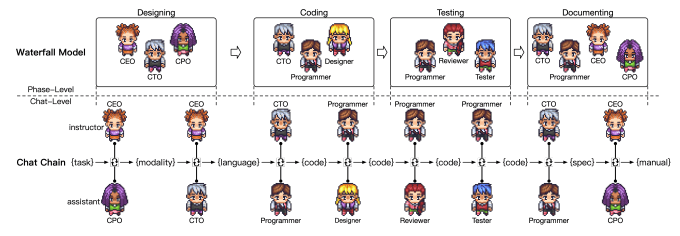
ChatDev framework follows four phases: designing, coding, testing, and documenting. In each phase, the ChatDev would establish several agents with various roles, for example, code reviewers, software programmers, etc. To ensure the communication between agents runs smoothly, the researchers developed a chat chain that divided the phases into sequential atomic subtasks. Each subtask would implement collaboration and interaction between the agents.

The ChatDev framework is shown in the image below.

Generative Agent Research Papers You Should Read
The proposed ChatDev Framework (Quan et al., 2023)

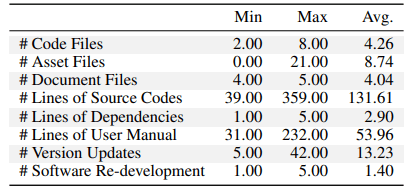
The researchers perform various experiments to measure how the ChatDev framework performs in software development. By using gpt3.5-turbo-16k, below is the software statistics experiment performance.

Generative Agent Research Papers You Should Read
The ChatDev Framework Software Statistics (Quan et al., 2023)

The above number is a metric on statistical analysis regarding the software systems generated by the ChatDev. For example, 39 lines of code are generated at minimum, with the maximum being 359 codes. The researchers also showed that 86.66% of the software systems generated worked properly.

It’s a great paper that shows the potential to change how developers work. Read the paper further to understand the full implementation of the ChatDev. The full code is also available in the ChatDev repository.

2. AgentVerse: Facilitating Multi-Agent Collaboration and Exploring Emergent Behaviors in Agents

AgentVerse is a framework proposed in the paper by Chen et al., 2023 to simulate the agent groups via the Large Language Model to dynamic problem-solving procedures within the group and adjustment of the group members based on the progression. This study exists to solve the challenge of static group dynamics where the autonomous agent cannot adapt and evolve in solving problems.

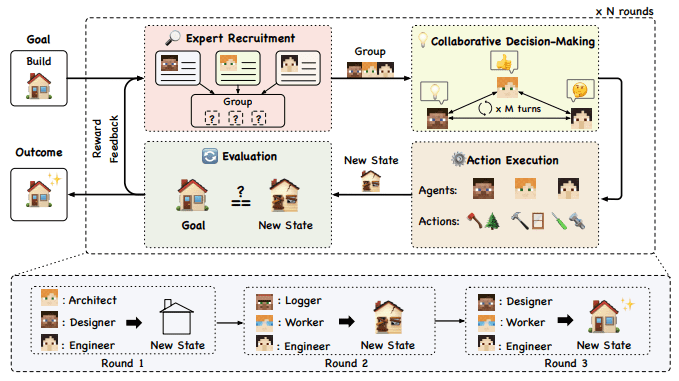
AgentVerse framework tries to split the framework into four steps, including:

  1. Expert Recruitment: The adjustment phase for agents to align with the problem and solution
  2. Collaborative Decision-Making: The agents discuss to formulate a solution and strategy to solve the problem.
  3. Action Execution: The agents execute action in the environment based on the decision.
  4. Evaluation: The current condition and goals are evaluated. The feedback reward will return to the first step if the goal still needs to be met.

The overall structure of the AgentVerse is shown in the image below.

Generative Agent Research Papers You Should Read
AgentVerse Framework (Chen et al., 2023)

The researchers experimented with the framework and compared the AgentVerse framework to the individual agent solution. The result is presented in the image below.

Generative Agent Research Papers You Should Read
Performance Analysis of AgentVerse (Chen et al., 2023)

The AgentVerse framework can generally outperform individual agents in all the presented tasks. This proves that generative agents could perform better than individual agents trying to solve problems. You could try out the framework through their repository.

3. AgentSims: An Open-Source Sandbox for Large Language Model Evaluation

Evaluating LLMs' ability is still an open question within the community and the fields. Three points that limit the ability to evaluate LLM properly are limited evaluation abilities by the tasks, vulnerable benchmarks, and unobjective metrics. To handle these problems, Lin et al., 2023 proposed a task-based evaluation as an LLM benchmark in their paper. This approach hoped to become standard in evaluating the LLM's works as it could alleviate all the problems raised. To achieve this, the researchers introduce a framework called AgentSims.

AgentSims is a program with interactive and visualization infrastructure for curating evaluation tasks for LLMs. The overall objective of AgentSims is to provide researchers and experts with a platform to streamline the task design process and use them as an evaluation tool. The front end of the AgentSims is presented in the image below.

Generative Agent Research Papers You Should Read
AgentSims Front End (Lin et al., 2023)

As the target for AgentSims is everyone who requires LLM evaluation in easier ways, the researchers developed the front end where we can interact with the UI. You can also try the full demo on their website or access the full code in the AgentSims repository.

Conclusion

Generative Agents are a recent approach in the LLMs to simulate human behaviors. The latest research by Park et al., 2023 has shown a great possibility of what the Generative Agents could do. That is why many types of research based on Generative Agents have shown up and opened many new doors.

In this article, we have talked about three different Generative Agents research, including:

  1. Communicative Agents for Software Development paper (Quan et al., 2023)
  2. AgentVerse: Facilitating Multi-Agent Collaboration and Exploring Emergent Behaviors in Agents (Chen et al., 2023)

3. AgentSims: An Open-Source Sandbox for Large Language Model Evaluation (Lin et al., 2023)
Cornellius Yudha Wijaya is a data science assistant manager and data writer. While working full-time at Allianz Indonesia, he loves to share Python and Data tips via social media and writing media.

More On This Topic

  • KDnuggets News, April 27: A Brief Introduction to Papers With Code; Machine…
  • AI Books you should read in 2021
  • Must Read NLP Papers from the Last 12 Months
  • Top Machine Learning Papers to Read in 2023
  • Understanding Agent Environment in AI
  • Research Papers for NLP Beginners

Tubi TV is adding AI-powered search to help you find something to watch faster

Rabbit AI hero image

Tubi TV earned a spot as ZDNET's top free video-streaming service because of its extensive media library with over 200,000 movies and TV episodes. Because there are so many options, picking what to watch can be challenging, so now Tubi is introducing an AI tool to fix that issue.

On Tuesday, Tubi announced Rabbit AI, a mobile feature powered by ChatGPT-4 that allows users to browse Tubi's content library in a much easier way through simple prompts and questions.

Also: You can have voice chats with ChatGPT now. Here's how

For example, a user can ask the chatbot a prompt as general as, "find me something scary", or something more specific, such as "find me something scary that has sharks in it", and within seconds, they will be met with relevant titles.

The results will be saved to the user's My List and the search history will be saved, so users can easily access the results and revisit the titles later.

The feature is meant to solve the challenge of figuring out what to watch, and then either scrolling aimlessly or bickering with your loved ones or friends about what to watch.

"One in five streamers binge watch because it's convenient or easier than searching for another show as time spent looking is usually a mix of scrolling, maybe bickering over whether to watch a comedy or a horror movie," said Blake Bassett, senior director of product at Tubi.

Also: Microsoft's SwiftKey keyboard brings more AI-infused superpowers to iOS and Android

Rabbit AI will work with existing content discovery features, such as My List or liking and disliking content, to bring users personalized recommendations. Specifically, when a user saves content recommended by Rabbit AI to their My List, Tubi's home screen will be signaled to display similar content.

Rabbit AI is being rolled out as a beta test on Tubi's iOS mobile app starting today and will become widely available in the upcoming weeks. The Rabbit AI plugin for ChatGPT is also available starting today for ChatGPT Plus subscribers.

Just last week, Amazon announced that FireTVs would have a similar feature, Fire TV Search, which allows users to ask Alexa for Fire TV content through conversational requests and then find content quicker.

Artificial Intelligence

Kolena, a startup building tools to test AI models, raises $15M

Kolena, a startup building tools to test AI models, raises $15M Kyle Wiggers 7 hours

Kolena, a startup building tools to test, benchmark and validate the performance of AI models, today announced that it raised $15 million in a funding round led by Lobby Capital with participation from SignalFire and Bloomberg Beta.

The new cash brings Kolena’s total raised to $21 million, and will be put toward growing the company’s research team, partnering with regulatory bodies and expanding Kolena’s sales and marketing efforts, co-founder and CEO Mohamed Elgendy told TechCrunch in an email interview.

“The use cases for AI are enormous, but AI lacks trust from both builders and the public,” Elgendy said. “This technology must be rolled out in a way that makes digital experiences better, not worse. The genie isn’t going back in the bottle, but as an industry we can make sure we make the right wishes.”

Elgendy launched Kolena in 2021 with Andrew Shi and Gordon Hart, with whom he’d worked for around six years at AI divisions within companies including Amazon, Palantir, Rakuten and Synapse. Through Kolena, the trio sought to build a “model quality framework” that delivered unit testing and end-to-end testing for models in a customizable, enterprise-friendly package.

“First and foremost, we wanted to provide a new framework for model quality — not just a tool that simplifies current approaches,” Elgendy said. “Kolena makes it possible to continuously run scenario-level or unit tests. It also provides end-to-end testing of the entire AI and machine learning product, not just sub-components.”

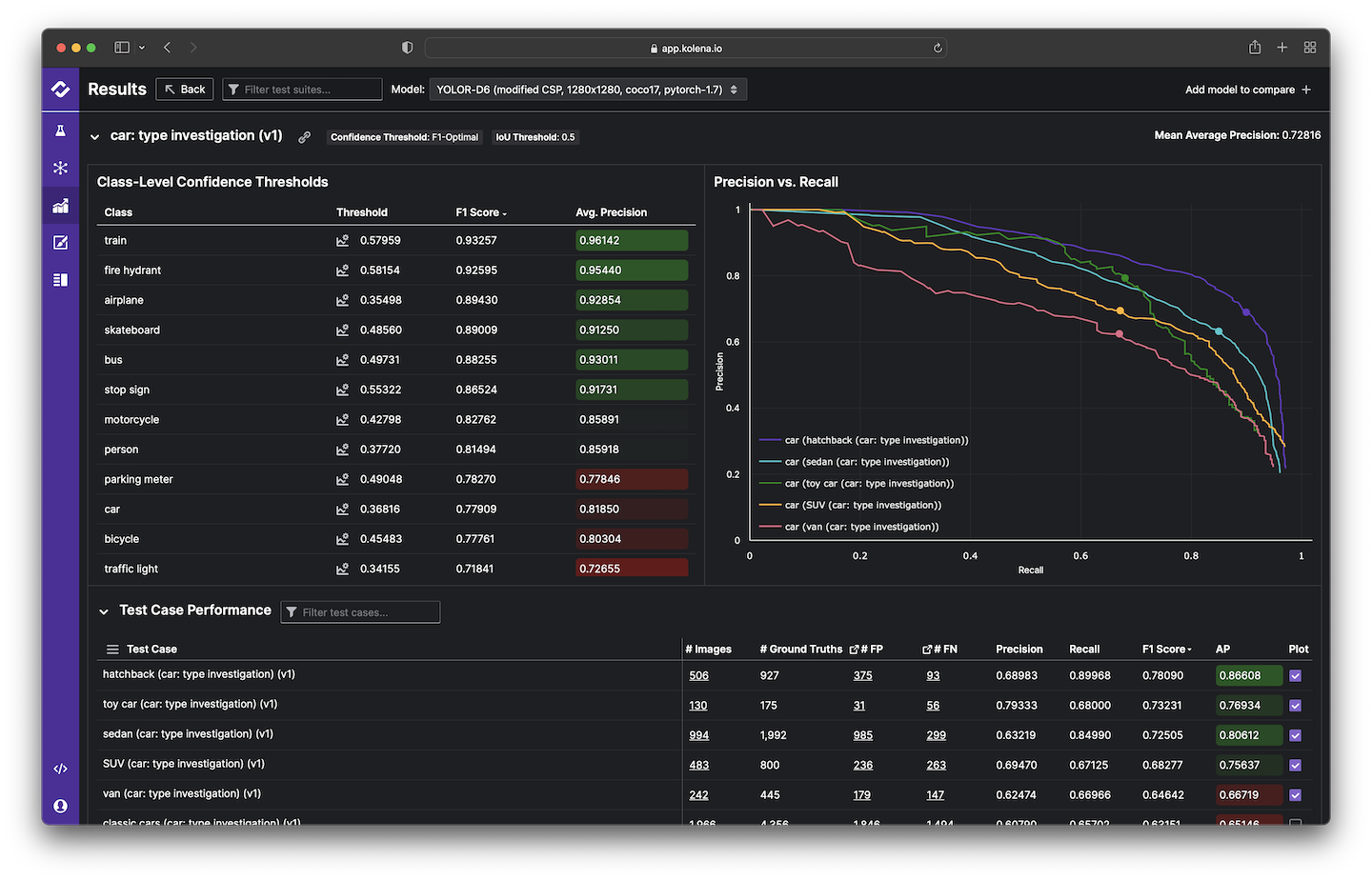
To this end, Kolena can provide insights to identify gaps in AI model test data coverage, Elgendy says. And the platform incorporates risk management features that help to track risks associated with the deployment of a given AI system (or systems, as the case may be). Using Kolena’s UI, users can create test cases to evaluate a model’s performance and see potential reasons that a model’s underperforming while comparing its performance to various other models.

“With Kolena, teams can manage and run tests for specific scenarios that the AI product will have to deal with, rather than applying a blanket ‘aggregate’ metric like an accuracy score, which can obscure the details of a model’s performance,” Elgendy said. “For example, a model with 95% accuracy in detecting cars isn’t necessarily better than one with 89% accuracy. Each has their own strengths and weaknesses — e.g. detecting cars in varying weather conditions or occlusion levels, spotting a car’s orientation, etc.”

If Kolena works as advertised, it could indeed be useful for the data scientists who spend lots of time building models to power AI apps.

Kolena

Image Credits: Kolena

According to one survey, AI engineers report devoting only 20% of their time to analyzing and developing models, with the rest going to sourcing and cleaning the data used to train them. Another report finds that, due to the challenges in developing accurate, performance models, only about 54% of models ultimately move from pilot to production.

But there’s other players building tools to test, monitor and validate models. Beyond incumbents like Amazon, Google and Microsoft, a wealth of startups are piloting novel approaches to measuring the accuracy of models before — and after — they go into production.

Prolific recently raised $32 million for its platform to train and stress-test AI models using a crowdsourced network of testers. Robust Intelligence and Deepchecks, meanwhile, are creating thier own toolsets for businesses to prevent AI models from failing — and to continuously validate them. And Bobidi is rewarding developers for testing companies’ AI models.

But Elgendy argues that Kolena’s platform is one of the few that allows customers to take “full control” over the data types, evaluation logic and other components that make up an AI model test. He also emphasizes Kolena’s approach to privacy, which eliminates the need for customers to upload their data or models to the platform; Kolena only stores model test results for future benchmarking, which can be deleted upon request.

“Minimizing risk from an AI and machine learning system requires rigorous testing before deployment, yet enterprises don’t have strong tooling or processes around model validation,” Elgendy said.Ad-hoc model testing is the norm today, and unfortunately, so are failed machine learning proof of concepts. Kolena focuses on comprehensive and thorough model evaluation. We give machine learning managers, product managers and executives unparalleled visibility into a model’s test coverage and product-specific functional requirements, allowing them to effectively influence product quality from the start.”

San Francisco-based Kolena, which has 28 full-time employees, wouldn’t share the number of customers it’s currently working with. But Elgendy said that the company’s taking a “selective approach” to partnering with “mission-critical” companies for now, and plans to roll out team bundles for mid-sized organizations and early-stage AI startups in Q2 2024.

Infosys Partners with Microsoft to Drive Enterprise Generative AI Adoption

Indian IT and consulting firm, Infosys announced its partnership with Microsoft aimed at accelerating the widespread adoption of generative AI across various industries. The partnership will leverage Infosys Topaz, Azure OpenAI Service, and Azure Cognitive Services to develop cutting-edge solutions that enhance enterprise functions through AI-enabled capabilities.

The primary goal of this collaboration is to democratize data and intelligence within businesses, enabling increased productivity and revenue growth. Generative AI has created new possibilities for AI applications across industries, and Infosys is at the forefront, providing services and solutions in areas such as semantic search, document summarization, contact center transformation, AI-augmented software development, and marketing content creation.

“Through our strategic collaboration with Microsoft, we will continue to lead the generative AI revolution, helping businesses amplify human potential and navigate their next step towards becoming AI-first enterprises,” said Balakrishna D. R. (Bali), executive vice president, Infosys.

Infosys Topaz, in collaboration with Microsoft, will utilize Azure OpenAI Service and Azure Cognitive Services to enhance its capabilities further. This enhancement will enable enterprise customers to seamlessly transition from digital to AI solutions, improving operational efficiency, reducing turnaround time, future-proofing investments, and introducing new business models.

“We’re pleased to expand our collaboration with Infosys to deliver innovative solutions, utilizing Azure OpenAI Service and Azure Cognitive Services, that will help customers develop new business models, and realize new revenue streams,” said Nicole Dezen, chief partner officer, Microsoft Corp.

Recently, Infosys also announced its partnership with NVIDIA to integrate the NVIDIA AI Enterprise ecosystem, encompassing models, tools, runtimes, and GPU systems into Infosys Topaz to create offerings that enable businesses worldwide to seamlessly incorporate generative AI into their operations, fostering unprecedented innovation and productivity gains.

The post Infosys Partners with Microsoft to Drive Enterprise Generative AI Adoption appeared first on Analytics India Magazine.

MongoDB Unveils Generative AI Features for Atlas Vector Search

MongoDB on a Mission to Equip 85 Mn Developers with New Skills

Data forms the crux of generative AI applications. And, MongoDB’s vector search capabilities are driving generative AI by transforming diverse data types like text, images, videos, and audio files into numerical vectors, simplifying AI processing and enabling efficient relevance-based searches. The company has unveiled a series of features in MongoDB Atlas Vector Search that offer several benefits for generative AI application development.

Boost Information Accuracy for LLMs: Generative AI applications aim to provide precise and engaging experiences, but they can sometimes hallucinate information due to a lack of context. By expanding MongoDB Atlas’s query capabilities, developers can create a dedicated data aggregation stage with MongoDB Atlas Vector Search. This helps filter results from proprietary data, significantly improving information accuracy and reducing inaccuracies in AI applications.

Speed Up Data Indexing for Generative AI Applications: Generating vectors is crucial for preparing data for use with LLMs. After creating vectors, an efficient index must be built for data retrieval. MongoDB Atlas Vector Search’s unified document data model simplifies the indexing process for operational data, metadata, and vector data, facilitating faster development of AI-powered applications.

Use Real-Time Data Streams: Developers can leverage Confluent Cloud’s managed data streaming platform to power real-time applications. Through the Connect with Confluent partnership, Confluent Cloud data streams can be integrated into MongoDB Atlas Vector Search. This integration offers generative AI applications access to real-time, accurate data from various sources across a business. By using a fully managed connector for MongoDB Atlas, developers can make their applications more responsive and provide users with more precise results that reflect current conditions.

Read more: MongoDB Ups the Ante with Vector Search for Generative AI

Customer Success Stories

Several organizations are utilizing MongoDB Atlas Vector Search to enhance their services. Data innovators company Dataworkz is merging data, transformations, and AI to create high-quality, LLM-ready data for AI applications, while Auto API platform Drivly is employing AI embeddings and Atlas Vector Search to empower AI car-buying assistants. Risk analytics firm ExTrac is using it to augment LLMs and analyze various data modalities, including text, images, and videos, for real-time threat identification. Inovaare Corporation leverages MongoDB to improve healthcare compliance operations, thanks to the capabilities of Atlas Vector Search in reporting and data-driven insights. NWO.ai enhances its consumer intelligence platform by integrating Atlas Vector Search to search and analyze embeddings for real-time insights. Finally, One AI uses it to enable semantic search and information retrieval, enhancing customer experiences. Cyber security company VISO Trust is also employing it to provide comprehensive vendor security information, streamlining decision-making for risk assessments.

Read more: Is MongoDB Vector Search the Panacea for all LLM Problems?

The post MongoDB Unveils Generative AI Features for Atlas Vector Search appeared first on Analytics India Magazine.

Introduction to Natural Language Processing

Introduction to Natural Language Processing
Image by Author

We’re learning a lot about ChatGPT and large language models (LLMs). Natural Language Processing has been an interesting topic, a topic that is currently taking the AI and tech world by storm. Yes, LLMs like ChatGPT have helped their growth, but wouldn’t it be good to understand where it all comes from? So let’s go back to the basics — NLP.

NLP is a subfield of artificial intelligence, and it is the ability of a computer to detect and understand human language, through speech and text just the way we humans can. NLP helps models process, understand and output the human language.

The goal of NLP is to bridge the communication gap between humans and computers. NLP models are typically trained on tasks such as next word prediction which allow them to build contextual dependencies and then be able to generate relevant outputs.

Fundamentals of Natural Language

The fundamentals of NLP revolve around being able to understand the different elements, characteristics and structure of the human language. Think about the times you tried to learn a new language, you had to understand different elements of it. Or if you haven’t tried learning a new language, maybe going to the gym and learning how to squat — you have to learn the elements of having good form.

Natural language is the way we as humans communicate with one another. There are more than 7,100 languages in the world today. Wow!

There are some key fundamentals of natural language:

  • Syntax — This refers to the rules and structures of the arrangement of words to create a sentence.
  • Semantics — This refers to the meaning behind words, phrases and sentences in language.
  • Morphology — This refers to the study of the actual structure of words and how they are formed from smaller units called morphemes.
  • Phonology — This refers to the study of sounds in language, and how the distinct units are formed together to combine words.
  • Pragmatics — This is the study of how context plays a big role in the interpretation of language, for example, tone.
  • Discourse — This is the connection between the context of language and how ideas form sentences and conversations.
  • Language Acquisition — This is how humans learn and develop language skills, for example, grammar and vocabulary.
  • Language Variation — This focuses on the 7,100+ languages that are spoken across different regions, social groups, and contexts.
  • Ambiguity — This refers to words or sentences with multiple interpretations.
  • Polysemy — This refers to words with multiple related meanings.

As you can see there are a variety of key fundamental elements of natural language, in which all of these are used to steer language processing.

Key Elements of NLP

So now we know the fundamentals of natural language. How is it used in NLP? There is a wide range of techniques used to help computers understand, interpret, and generate human language. These are:

  • Tokenization — This refers to the process of breaking down or splitting paragraphs and sentences into smaller units so that they can be easily defined to be used for NLP models. The raw text is broken down into smaller units called Tokens.
  • Part-of-Speech Tagging — This is a technique that involves assigning grammatical categories, for example, nouns, verbs, and adjectives to each token in a sentence.
  • Named Entity Recognition (NER) — This is another technique that identifies and classifies named entities, for example, people's names, organizations, places, and dates in text.
  • Sentiment Analysis — This is a technique that analyzes the tone expressed in a piece of text, for example, whether it's positive, negative, or neutral.
  • Text Classification — This is a technique that categorizes text that is found in different types of documentation into predefined classes or categories based on their content.
  • ??Semantic Analysis — This is a technique that analyzes words and sentences to get a better understanding of what is being said using context and relationships between words.
  • Word Embeddings — This is when words are represented as vectors to help computers understand and capture the semantic relationship between words.
  • Text Generation — is when a computer can create human-like text based on learning patterns from existing text data.
  • Machine Translation — This is the process of translating text from one language to another.
  • Language Modeling — This is a technique that takes all the above tools and techniques into consideration. This is the building of probabilistic models that can predict the next word in a sequence.

If you’ve worked with data before, you know that once you collect your data, you will need to standardize it. Standardizing data is when you convert data into a format that computers can easily understand and use.

The same applies to NLP. Text normalization is the process of cleaning and standardizing text data into a consistent formation. You will want a format that doesn’t have a lot or if any variations and noise. This makes it easier for NLP models to analyze and process the language more effectively and accurately.

How does NLP work?

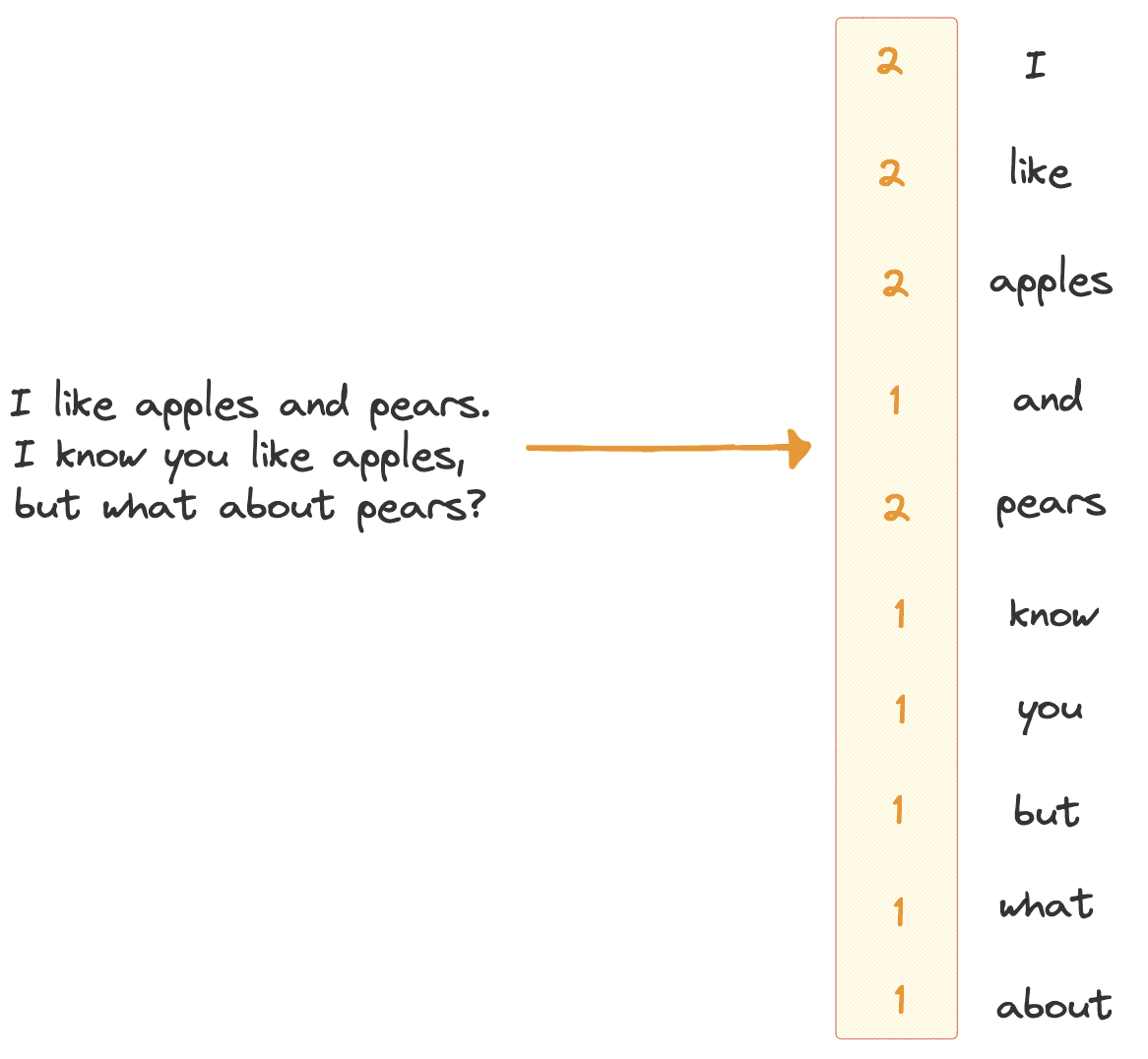
Before you can ingest anything into your NLP model, you need to understand computers and understand that they only understand numbers. Therefore, when you have text data, you will need to use text vectorization to transform the text into a format that the machine learning model can understand.

Have a look at the image below:

Introduction to Natural Language Processing
Image by Author

Once the text data is vectorised in a format the machine can understand, the NLP machine learning algorithm is then fed training data. This training data helps the NLP model to understand the data, learn patterns, and make relationships about the input data.

Statistical analysis and other methods are also used to build the model's knowledge base, which contains characteristics of the text, different features, and more. It’s basically a part of their brain that has learnt and stored new information.

The more data fed into these NLP models during the training phase, the more accurate the model will be. Once the model has gone through the training phase, it will then be put to the test through the testing phase. During the testing phase, you will see how accurately the model can predict outcomes using unseen data. Unseen data is new data to the model, therefore it has to use its knowledge base to make predictions.

As this is a back-to-basics overview of NLP, I have to do exactly that and not lose you with too heavy terminology and complex topics. If you would like to know more, have a read of:

  • The Ultimate Guide To Different Word Embedding Techniques In NLP
  • The ABCs of NLP, From A to Z
  • The Best Way to Learn Practical NLP?

NLP Applications

Now you have a better understanding of the fundamentals of natural language, key elements of NLP and how it vaguely works. Below is a list of NLP applications in today's society.

  • Sentiment Analysis
  • Text Classification
  • Language Translation
  • Chatbots and Virtual Assistants
  • Speech Recognition
  • Information Retrieval
  • Named Entity Recognition (NER)
  • Topic Modeling
  • Text Summarization
  • Language Generation
  • Spam Detection
  • Question Answering
  • Language Modeling
  • Fake News Detection
  • Healthcare and Medical NLP
  • Financial Analysis
  • Legal Document Analysis
  • Emotion Analysis

Wrapping it up

There have been a lot of recent developments in NLP, as you may already know with chatbots such as ChatGPT and large language models coming out left right and centre. Learning about NLP will be very beneficial for anybody, especially for those entering the world of data science and machine learning.

If you would like to learn more about NLP, have a look at: Must Read NLP Papers from the Last 12 Months
Nisha Arya is a Data Scientist, Freelance Technical Writer and Community Manager at KDnuggets. She is particularly interested in providing Data Science career advice or tutorials and theory based knowledge around Data Science. She also wishes to explore the different ways Artificial Intelligence is/can benefit the longevity of human life. A keen learner, seeking to broaden her tech knowledge and writing skills, whilst helping guide others.

More On This Topic

  • N-gram Language Modeling in Natural Language Processing
  • A Gentle Introduction to Natural Language Processing
  • Getting Started with 5 Essential Natural Language Processing Libraries
  • Vision Transformers: Natural Language Processing (NLP) Increases Efficiency…
  • Natural Language Processing Pipelines, Explained
  • Applying Natural Language Processing in Healthcare

EfficientViT: Memory Efficient Vision Transformer for High-Resolution Computer Vision

Due to their high model capacity, Vision Transformer models have enjoyed a great deal of success in recent times. Despite their performance, vision transformers models have one major flaw: their remarkable computation prowess comes at high computation costs, and it’s the reason why vision transformers are not the first choice for real-time applications. To tackle this issue, a group of developers launched EfficientViT, a family of high-speed vision transformers.

When working on EfficientViT, developers observed that the speed of the current transformer models is often bounded by inefficient memory operations, especially element-wise functions & tensor reshaping in MHSA or Multi-Head Self Attention network. To tackle these inefficient memory operations, EfficientViT developers have worked on a new building block using a sandwich layout i.e the EfficientViT model makes use of a single memory-bound Multi-Head Self Attention network between efficient FFN layers that helps in improving memory efficiency, and also enhancing the overall channel communication. Furthermore, the model also discovers that attention maps often have high similarities across heads that leads to computational redundancy. To tackle the redundancy issue, the EfficientViT model presents a cascaded group attention module that feeds attention heads with different splits of the full feature. The method not only helps in saving computational costs, but also improves the attention diversity of the model.

Comprehensive experiments performed on the EfficientViT model across different scenarios indicate that the EfficientViT outperforms existing efficient models for computer vision while striking a good trade-off between accuracy & speed. So let’s take a deeper dive, and explore the EfficientViT model in a little more depth.

An Introduction to Vision Transformers and EfficientViT

Vision Transformers remain one of the most popular frameworks in the computer vision industry because they offer superior performance, and high computational capabilities. However, with constantly improving accuracy & performance of the vision transformer models, the operational costs & computational overhead increase as well. For example, current models known to provide state of the art performance on ImageNet datasets like SwinV2, and V-MoE use 3B, and 14.7B parameters respectively. The sheer size of these models coupled with the computational costs & requirements make them practically unsuitable for real-time devices & applications.

The EfficientNet model aims to explore how to boost the performance of vision transformer models, and finding the principles involved behind designing efficient & effective transformer-based framework architectures. The EfficientViT model is based on existing vision transformer frameworks like Swim, and DeiT, and it analyzes three essential factors that affect models interference speeds including computation redundancy, memory access, and parameter usage. Furthermore, the model observes that the speed of vision transformer models in memory-bound, which means that full utilization of computing power in CPUs/GPUs is prohibited or restricted by memory accessing delay, that results in negative impact on the runtime speed of the transformers. Element-wise functions & tensor reshaping in MHSA or Multi-Head Self Attention network are the most memory-inefficient operations. The model further observes that optimally adjusting the ratio between FFN (feed forward network) and MHSA, can help in significantly reducing the memory access time without affecting the performance. However, the model also observes some redundancy in the attention maps as a result of attention head’s tendency to learn similar linear projections.

The model is a final cultivation of the findings during the research work for the EfficientViT. The model features a new black with a sandwich layout that applies a single memory-bound MHSA layer between the Feed Forward Network or FFN layers. The approach not only reduces the time it takes to execute memory-bound operations in MHSA, but it also makes the entire process more memory efficient by allowing more FFN layers to facilitate the communication between different channels. The model also makes use of a new CGA or Cascaded Group Attention module that aims to make the computations more effective by reducing the computational redundancy not only in the attention heads, but also increases the depth of the network resulting in elevated model capacity. Finally, the model expands the channel width of essential network components including value projections, while shrinking network components with low value like hidden dimensions in the feed forward networks to redistribute the parameters in the framework.

As it can be seen in the above image, the EfficientViT framework performs better than current state of the art CNN and ViT models in terms of both accuracy, and speed. But how did the EfficientViT framework manage to outperform some of the current state of the art frameworks? Let’s find that out.

EfficientViT: Improving the Efficiency of Vision Transformers

The EfficientViT model aims to improve the efficiency of the existing vision transformer models using three perspectives,

  1. Computational Redundancy.
  2. Memory Access.
  3. Parameter Usage.

The model aims to find out how the above parameters affect the efficiency of vision transformer models, and how to solve them to achieve better results with better efficiency. Let’s talk about them in a bit more depth.

Memory Access and Efficiency

One of the essential factors affecting the speed of a model is the memory access overhead or MAO. As it can be seen in the image below, several operators in transformer including element-wise addition, normalization, and frequent reshaping are memory-inefficient operations, because they require access to different memory units which is a time consuming process.
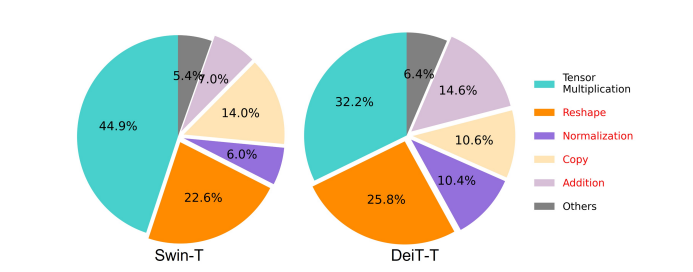
Although there are some existing methods that can simplify the standard softmax self attention computations like low-rank approximation, and sparse attention, they often offer limited acceleration, and degrade the accuracy.

On the other hand, the EfficientViT framework aims to cut down the memory access cost by reducing the amount of memory-inefficient layers in the framework. The model scales down the DeiT-T and Swin-T to small subnetworks with a higher interference throughput of 1.25X and 1.5X, and compares the performance of these subnetworks with proportions of the MHSA layers. As it can be seen in the image below, when implemented, the approach boosts the accuracy of MHSA layers by about 20 to 40%.

Computation Efficiency

MHSA layers tend to embed the input sequence into multiple subspaces or heads, and computes the attention maps individually, an approach that is known to boost performance. However, attention maps are not computationally cheap, and to explore the computational costs, the EfficientViT model explores how to reduce redundant attention in smaller ViT models. The model measures the maximum cosine similarity of each head & the remaining heads within every block by training the width downscaled DeiT-T and Swim-T models with 1.25× inference speed-up. As it can be observed in the image below, there is a high number of similarity between attention heads which suggests that model incurs computation redundancy because numerous heads tend to learn similar projections of the exact full feature.

To encourage the heads to learn different patterns, the model explicitly applies an intuitive solution in which each head is fed only a portion of the full feature, a technique that resembles the idea of group convolution. The model trains different aspects of the downscaled models that feature modified MHSA layers.

Parameter Efficiency

Average ViT models inherit their design strategies like using an equivalent width for projections, setting expansion ratio to 4 in FFN, and increasing heads over stages from NLP transformers. The configurations of these components need to be re-designed carefully for lightweight modules. The EfficientViT model deploys Taylor structured pruning to find the essential components in the Swim-T, and DeiT-T layers automatically, and further explores the underlying parameter allocation principles. Under certain resource constraints, the pruning methods remove unimportant channels, and keep the critical ones to ensure highest possible accuracy. The figure below compares the ratio of channels to the input embeddings before and after pruning on the Swin-T framework. It was observed that: Baseline accuracy: 79.1%; pruned accuracy: 76.5%.

The above image indicates that the first two stages of the framework preserve more dimensions, while the last two stages preserve much less dimensions. It might mean that a typical channel configuration that doubles the channel after every stage or uses equivalent channels for all blocks, may result in substantial redundancy in the final few blocks.

Efficient Vision Transformer : Architecture

On the basis of the learnings obtained during the above analysis, developers worked on creating a new hierarchical model that offers fast interference speeds, the EfficientViT model. Let’s have a detailed look at the structure of the EfficientViT framework. The figure below gives you a generic idea of the EfficientViT framework.

Building Blocks of the EfficientViT Framework

The building block for the more efficient vision transformer network is illustrated in the figure below.

The framework consists of a cascaded group attention module, memory-efficient sandwich layout, and a parameter reallocation strategy that focus on improving the efficiency of the model in terms of computation, memory, and parameter, respectively. Let’s talk about them in greater detail.

Sandwich Layout

The model uses a new sandwich layout to build a more effective & efficient memory block for the framework. The sandwich layout uses less memory-bound self-attention layers, and makes use of more memory-efficient feed forward networks for channel communication. To be more specific, the model applies a single self-attention layer for spatial mixing that is sandwiched between the FFN layers. The design not only helps in reducing the memory time consumption because of self-attention layers, but also allows effective communication between different channels within the network thanks to the use of FFN layers. The model also applies an extra interaction token layer before each feed forward network layer using a DWConv or Deceptive Convolution, and enhances model capacity by introducing inductive bias of the local structural information.

Cascaded Group Attention

One of the major issues with MHSA layers is the redundancy in attention heads which makes computations more inefficient. To solve the issue, the model proposes CGA or Cascaded Group Attention for vision transformers, a new attention module that takes inspiration from group convolutions in efficient CNNs. In this approach, the model feeds individual heads with splits of the full features, and therefore decomposes the attention computation explicitly across heads. Splitting the features instead of feeding full features to each head saves computation, and makes the process more efficient, and the model continues to work on improving the accuracy & its capacity even further by encouraging the layers to learn projections on features that have richer information.

Parameter Reallocation

To improve the efficiency of parameters, the model reallocates the parameters in the network by expanding the width of the channel of critical modules while shrinking the channel width of not so important modules. Based on the Taylor analysis, the model either sets small channel dimensions for projections in each head during every stage or the model allows the projections to have the same dimension as the input. The expansion ratio of the feed forward network is also brought down to 2 from 4 to help with its parameter redundancy. The proposed reallocation strategy that the EfficientViT framework implements, allots more channels to important modules to allow them to learn representations in a high dimensional space better that minimizes the loss of feature information. Furthermore, to speed up the interference process & enhance the efficiency of the model even further, the model automatically removes the redundant parameters in unimportant modules.

The overview of the EfficientViT framework can be explained in the above image where the parts,

  1. Architecture of EfficientViT,
  2. Sandwich Layout block,
  3. Cascaded Group Attention.

EfficientViT : Network Architectures

The above image summarizes the network architecture of the EfficientViT framework. The model introduces an overlapping patch embedding [20,80] that embeds 16×16 patches into C1 dimension tokens that enhances the model’s capacity to perform better in low-level visual representation learning. The architecture of the model comprises three stages where each stage stacks the proposed building blocks of the EfficientViT framework, and the number of tokens at each subsampling layer (2× subsampling of the resolution) is reduced by 4X. To make subsampling more efficient, the model proposes a subsample block that also has the proposed sandwich layout with the exception that an inverted residual block replaces the attention layer to reduce the loss of information during sampling. Furthermore, instead of conventional LayerNorm(LN), the model makes use of BatchNorm(BN) because BN can be folded into the preceding linear or convolutional layers that gives it a runtime advantage over the LN.

EfficientViT Model Family

The EfficientViT model family consists of 6 models with different depth & width scales, and a set number of heads is allotted for each stage. The models use fewer blocks in the initial stages when compared to the final stages, a process similar to the one followed by MobileNetV3 framework because the process of early stage processing with larger resolutions is time consuming. The width is increased over stages with a small factor to reduce redundancy in the later stages. The table attached below provides the architectural details of the EfficientViT model family where C, L, and H refer to width, depth, and number of heads in the particular stage.

EfficientViT: Model Implementation and Results

The EfficientViT model has a total batch size of 2,048, is built with Timm & PyTorch, is trained from scratch for 300 epochs using 8 Nvidia V100 GPUs, uses a cosine learning rate scheduler, an AdamW optimizer, and conducts its image classification experiment on ImageNet-1K. The input images are randomly cropped & resized into resolution of 224×224. For the experiments that involve downstream image classification, the EfficientViT framework finetunes the model for 300 epochs, and uses AdamW optimizer with a batch size of 256. The model uses RetineNet for object detection on COCO, and proceeds to train the models for a further 12 epochs with the identical settings.

Results on ImageNet

To analyze the performance of EfficientViT, it is compared against current ViT & CNN models on the ImageNet dataset. The results from the comparison are reported in the following figure. As it can be seen that the EfficientViT model family outperforms the current frameworks in most cases, and manages to achieve an ideal trade-off between speed & accuracy.

Comparison with Efficient CNNs, and Efficient ViTs

The model first compares its performance against Efficient CNNs like EfficientNet and vanilla CNN frameworks like MobileNets. As it can be seen that when compared to MobileNet frameworks, the EfficientViT models obtain a better top-1 accuracy score, while running 3.0X and 2.5X faster on Intel CPU and V100 GPU respectively.
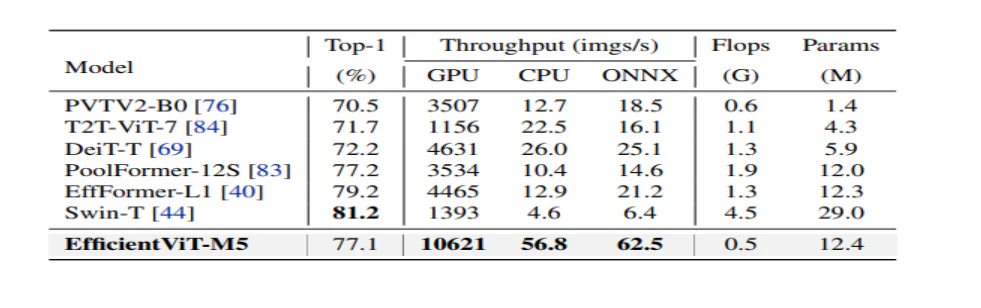
The above figure compares the EfficientViT model performance with state of the art large-scale ViT models running on the ImageNet-1K dataset.

Downstream Image Classification

The EfficientViT model is applied on various downstream tasks to study the model's transfer learning abilities, and the below image summarizes the results of the experiment. As it can be observed, the EfficientViT-M5 model manages to achieve better or similar results across all datasets while maintaining a much higher throughput. The only exception is the Cars dataset, where the EfficientViT model fails to deliver in accuracy.

Object Detection

To analyze EfficientViT’s ability to detect objects, it is compared against efficient models on the COCO object detection task, and the below image summarizes the results of the comparison.

Final Thoughts

In this article, we have talked about EfficientViT, a family of fast vision transformer models that use cascaded group attention, and provide memory-efficient operations. Extensive experiments conducted to analyze the performance of the EfficientViT have shown promising results as the EfficientViT model outperforms current CNN and vision transformer models in most cases. We have also tried to provide an analysis on the factors that play a role in affecting the interference speed of vision transformers.

6 Hugging Face Tools To Identify Bias in ML Systems

Hugging Face, the go-to platform for AI developers and researchers, has long played a pivotal role in starting and sustaining a dialogue about ethics and responsibilities. The open-source community has been dependent on the platform to access resources. One of the contributing factors is the space it provides for an open and inclusive discussion to build AI ethically – be it textual or visual models.

Some of the key contributors are Alexandra Sasha Luccioni (Hugging Face), Christopher Akiki (ScaDS.AI, Leipzig University), Margaret Mitchell (Hugging Face), and Yacine Jernite (Hugging Face) who have been involved in various projects aimed at promoting ethical AI.

Here are 6 tools hosted on Hugging Face to assist researchers in building AI models with ethical considerations:

Diffusion Cluster Explorer

This tool was designed to investigate biases at the societal level within data. The demo on the website leverages the gender and ethnicity representation clusters to analyze social trends within machine-generated visual representations of professions.

The Professions Overview tab lets users compare the distribution over identity clusters across professions for Stable Diffusion and Dalle-2 systems. The ‘Professions Focus’ tab provides more details for each of the individual professions, including direct system comparisons and examples of profession images for each cluster.

Users can compare the distribution of identity clusters across different professions and access detailed information about individual professions. This work is part of the Stable Bias Project.

Identity Representation Demo

This demo showcases patterns in images generated by Stable Diffusion and Dalle-2 systems. Specifically, images obtained from prompt inputs that span various gender- and ethnicity-related terms are clustered to show how those shape visual representations.

System’ corresponds to the number of images from the cluster that come from each of the TTI systems that we are comparing: Dall-E 2, Stable Diffusion v.1.4. and Stable Diffusion v.2.

‘Gender term’ shows the number of images based on the input prompts that used the phrases man, woman, non-binary person, and person to describe the figure’s gender.

‘Ethnicity label’ corresponds to the number of images from each of the 18 ethnicity descriptions used in the prompts. A blank value denotes unmarked ethnicity.

BoVW Nearest Neighbors Explorer

This tool utilizes a TF-IDF index of identity dataset images generated by three models, employing a visual vocabulary of 10,752 words. Users can select a generated identity image to find its nearest neighbors using a bag-of-visual-words model.

Language models

Plug-and-Play Bias Detection

As language models are today being used in everyday technology, it has become imperative to choose an approach to limit biases and constraints in the systems. To address the issue, researchers are developing key metrics such as BOLD, HONEST, and WinoBias. These metrics will help in quantifying the proclivity of language models to generate text that may be perceived as “unfair” across a spectrum of diverse prompts.

Within the framework provided, users can select a model of their choice along with a metric of relevance to execute their own assessments. However, generating these evaluative scores ends one issue. To further use those generated numbers, AVID’s data model comes in handy, to simplify the process of collating findings through structured reports.

Data Measurements Tool

The demo of this tool under development showcases the dataset measures as we develop them. Right now this has a few preloaded datasets for which users can:

  • view some general statistics about the text vocabulary, lengths, labels
  • explore some distributional statistics to assess the properties of the language
  • view some comparison statistics and an overview of the text distribution

Fair Diffusion Explorer

Here the researchers introduce a novel strategy designed to mitigate biases in generative text-to-image models post-deployment. This approach, as demonstrated, involves the deliberate adjustment of biases based on human instructions. As underscored by empirical evaluations, this newfound capability allows the precise instruction of generative image models on the principles of fairness, without the need for data filtering or additional training.

For the full paper by Friedrich et al., see here.

The post 6 Hugging Face Tools To Identify Bias in ML Systems appeared first on Analytics India Magazine.

Meet the Amazon for Space

Starting a space-tech company is easier said than done. When Sanjay Nekkanti built India’s first student nano-satellite project, he wanted to kickstart his own space venture. However, he had little to no support until he met—Narayan Prasad, a mechanical engineer pursuing a Masters in Space Science and Technology at Luleå University of Technology in Sweden as part of the multi-university Erasmus Mundus programme.

While there were five individuals interested in forming a satellite building company, eventually it was only Nekkanti and Prasad who returned to India in 2012 and co-founded Dhruva Space, alongside a few folks from ISRO and interns from Europe. However, the move was seen with doubt and scepticism by many in a country which hadn’t seen a private company building a satellite—that too after having a national space programme for 45 years (ISRO).

“Back then, when we started Dhruva space like 11 years ago, the concept of a startup ecosystem was virtually non-existent to a large extent, let alone investors and money and so on,” said Prasad, in an exclusive interaction with AIM, saying that it was too early in terms of product and customer understanding the value of companies going into investors, knowing that this is a sector worth investing in.

“That led me to believe that we are way too early, and basically I think the timing is one of the things that really matters for success in a venture,” he added, sharing his decision to return to Europe leaving Dhruva Space behind in 2017.

This eventually led him to explore opportunities in Europe, where he believed the ecosystem was more favourable, and there were fewer barriers to work across nationalities. He later moved to the Netherlands and started an online marketplace for space-related products, called SafeSearch in 2017, alongside Kartik Kumar and Alberto Vaccarella

Touted as the Amazon of space, SatSearch through its platform acts as a bridge connecting space-tech buyers and sellers, however, it is not involved in transactions but serves as a communication and information platform.

It incurs prices based on the company size and other such metrics. The company also utilises its data to provide valuable supply chain insights through its subscription-based platform to help with price discovery amongst other things. However, it is free to use for individuals.

One of SatSearch’s key strengths lies in its growing knowledge base. It holds data on approximately 3% of the estimated 100,000 suppliers in the space industry. This knowledge is vital for lowering the cost of access to space by increasing competition and transparency.

By expanding this knowledge base, SatSearch aims to drive down costs and create opportunities for both buyers and sellers.

“We’ve already helped companies like Accord in Bangalore sell to global customers or assist Dhruva Space (a Software & systems designer that manufactures GPS/GNSS),” said Prasad, who is now helping global companies understand India’s potential.

Challenges Galore

Prasad said that Indian space tech companies face specific challenges, primarily stemming from their origins as service providers rather than product designers. He said that many companies have the infrastructure and expertise for manufacturing but lack the design knowledge to create end-to-end products.

“I think there are two types of Indian companies. One is the companies who work with ISRO and with their ecosystem, they only have manufacturing capabilities, they don’t have product design teams because most of the product design capabilities sit in ISRO—and then all the new space companies that is where the design capabilities are starting to build their own product or service. And for that, you need to have your own IP and your own design team,” explained Narayan,

Further, he said that it is not a lot of value as customers want an end-to-end product to be able to take a big market share. He believes that bridging this gap is crucial for Indian companies to expand their customer base and market reach.

Prasad also expressed concern about the current focus on fundraising and customer acquisition, suggesting that the industry should prioritise customer-centric approaches. Real success, he believes, lies in serving customers effectively and meeting their needs rather than accumulating funding.

While Prasad’s observation of the Indian market has been that they operate within the borders, he is of the opinion that the companies need to explore the market beyond the borders to build trust and be at par with international vendors.

Making Space for India

SatSearch told AIM that it has two primary goals: “Taking India to the world” and “Bringing the world to India.” The former involves helping Indian space-tech companies reach global customers without the enormous costs associated with international business development. By providing a platform for these companies to showcase their products, the company facilitates customer diversification and, in some cases, even successful sales to global customers.

Furthermore, the platform assists companies in India with procurement for their own missions. With the nation’s burgeoning activity in the space sector, there is a growing need for components like of semiconductors, sensors, and actuators. SatSearch steps in by connecting companies with established supply chain knowledge to ensure they can efficiently source the components required for their missions.

“About 1,500 people from India use our platform every month. We have engineers, from companies, including the likes of L&T, their engineers also use us to find vendors for their own missions,” said Prasad.

Global Collaborations

Prasad said that the aim is to reduce costs for Indian companies expanding abroad, particularly in Europe, by offering their products or services. By curating meetings with Indian companies, SatSearch assists foreign entities in finding synergies and partnership opportunities within the Indian market.

“For the global companies, what we’ve been doing is helping them understand India beyond ISRO,” said Prasad, citing how they are helping one of their customers based out of Italy in exploring potential synergies for collaboration early next year.

“There are companies who are coming to us saying that they want to consider a manufacturing base, or supply chain base for some of the productions that they have and they want them to manufacture for us,” Narayan said, hinting at the plausibility of joint ventures, and technology transfer opportunities in defence and other sectors.

Bootstrapped SatSearch has a user base of 25000 every month from over 120 countries, with customers in about 35 countries. It also has 3000 suppliers, like Bangalore-based Skyserve, Kepler Aerospace, and BEL to EU-based suppliers like Bradford Space, SteamJet Space Systems, and companies like Space-Z from the US amongst others. They also keep adding more companies to the platform.

Embracing failures

Prasad also argued that failure is a natural part of innovation and growth and acknowledging mistakes and rectifying them openly can foster a culture of learning and improvement.

“I was very happy when Bellatrix was upfront about their failure. They were very open, they came in front and said look, we have a problem, we’re gonna rectify. So that was quite nice.” said Prasad, referring to the struggles of Bellatrix Aerospace.

While some companies may grab headlines with flashy announcements, Prasad emphasised the importance of “quiet achievers” in the industry like Hyderabad Vassar Labs. Companies that focus on providing value to customers, rather than seeking attention, are making a significant impact on the ground.

Speaking about the difference between the Indian market and that in the Netherlands, Prasad said that due to a lack of demand locally, the Dutch need to go find business abroad. Whilst, the market in India is growing and India has a local market to capture.

However, he suggested that, to grow, “By default your approach should be, that, I have customers that I need to go find abroad”.

The post Meet the Amazon for Space appeared first on Analytics India Magazine.