82% of Indians Expect Personal Gains from AI in the Next 5 Years

QX Lab AI Releases Multilingual Platform

According to a recent report by Google and IPSOS, Indians are more optimistic about the positive impact of AI than the global average. Approximately 82% of surveyed Indians believe they will personally benefit from AI within the next five years, surpassing the global average of 54%. They expect favorable outcomes in various sectors, such as health, jobs, and comprehension of complex subjects.

Indians express confidence in AI’s long-term impact, with majority of them expecting it to address diverse developmental aspects over the next 25 years. 20% prioritise economic development as a key government focus in AI, distinguishing them from counterparts in other countries. Indians also emphasize the importance of AI in health, security, climate, education, accessibility, and space exploration.

Regarding the impact of AI on employment, 80% of Indian respondents believe it will be beneficial for them individually, and 95% have discussed AI in their workplaces. Indians have a more positive outlook on ecosystem-wide job and industry changes driven by AI in the next five years compared to the global average.

Despite their optimism, Indians prioritise safety over innovation in AI development, with almost half identifying it as the top priority for integration into society. This contrasts with the global emphasis on innovation. The former express confidence in both tech companies and the government to ensure safe AI development, with 82% suggesting collaboration between the two entities.

The global report, titled “Our life with AI: The reality of today and the promise of tomorrow,” conducted by Ipsos on behalf of Google, gathered insights from approximately 17,000 adults across 17 countries.

The post 82% of Indians Expect Personal Gains from AI in the Next 5 Years appeared first on Analytics India Magazine.

Apple Acquired 32 AI Startups by 2023

Apple AI

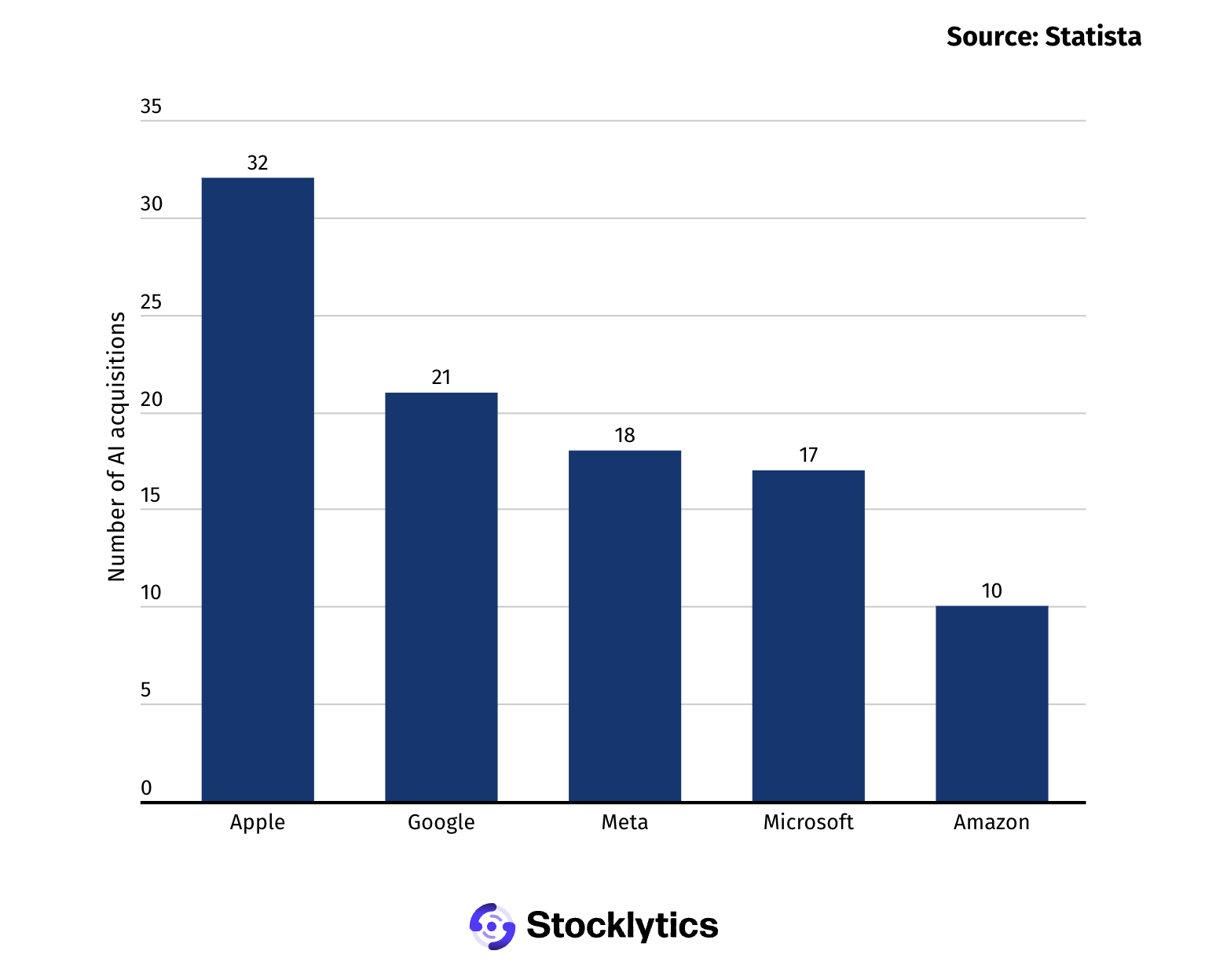
Apple surged ahead with an unprecedented acquisition spree in 2023, securing up to 32 AI companies throughout the year. This aggressive maneuver places the tech giant significantly ahead of its major rivals in the AI arena, including Google, Meta, and Microsoft.

Insights from Stocklytics, referencing a Statista report, highlight Apple’s commitment to fortifying its AI capabilities across a diverse product portfolio. The acquisitions signal Apple’s strategic positioning for forthcoming tech innovations, amidst substantial investments by competitors in established AI enterprises.

In the overall AI startup acquisition, Google trails Apple with 21, Meta with 18, and Microsoft lags with 17.

In recent years, Apple has completed notable acquisitions of AI startups such as Voysis, WaveOne, Emotient, and Laserlike. These acquisitions span various domains including voice assistant capabilities, video compression technology, expression recognition, app recommendations, and music AI.

Read: Apple Has AI Plans, Without the Marketing Noise

Apple’s emphasis on early-stage startups underscores a strategic effort to identify and invest in emerging AI trends ahead of competitors, positioning the company at the forefront of AI innovation. The innovations in the tech field are clearly highlighted by the Apple Vision Pro release this year.

While Apple’s plans for implementing these technologies into consumer products remain undisclosed, competitors like Samsung and Google have showcased advanced AI features in their smartphones, such as the Galaxy S24 Ultra.

Despite Apple’s secretive nature, analysts estimate a rapid pace of startup acquisitions, averaging 2-3 per week in recent years. This relentless pursuit underscores Apple’s ambition to lead the AI race in the coming years, even as competitors vie for dominance through acquisitions of established AI companies and technologies.

The post Apple Acquired 32 AI Startups by 2023 appeared first on Analytics India Magazine.

Top 10 AI Animation Platforms in 2024

Top 10 AI Animation Platforms in 2024

Forget getting a big studio for animation. Today, AI platforms let us create animations easily. From simple text-to-animation features to complex character movements, these platforms offer diverse functions for all types of creators.

AI has advanced to the point where it can understand complex human movements and artistic intentions, transforming simple inputs into rich, detailed animations.

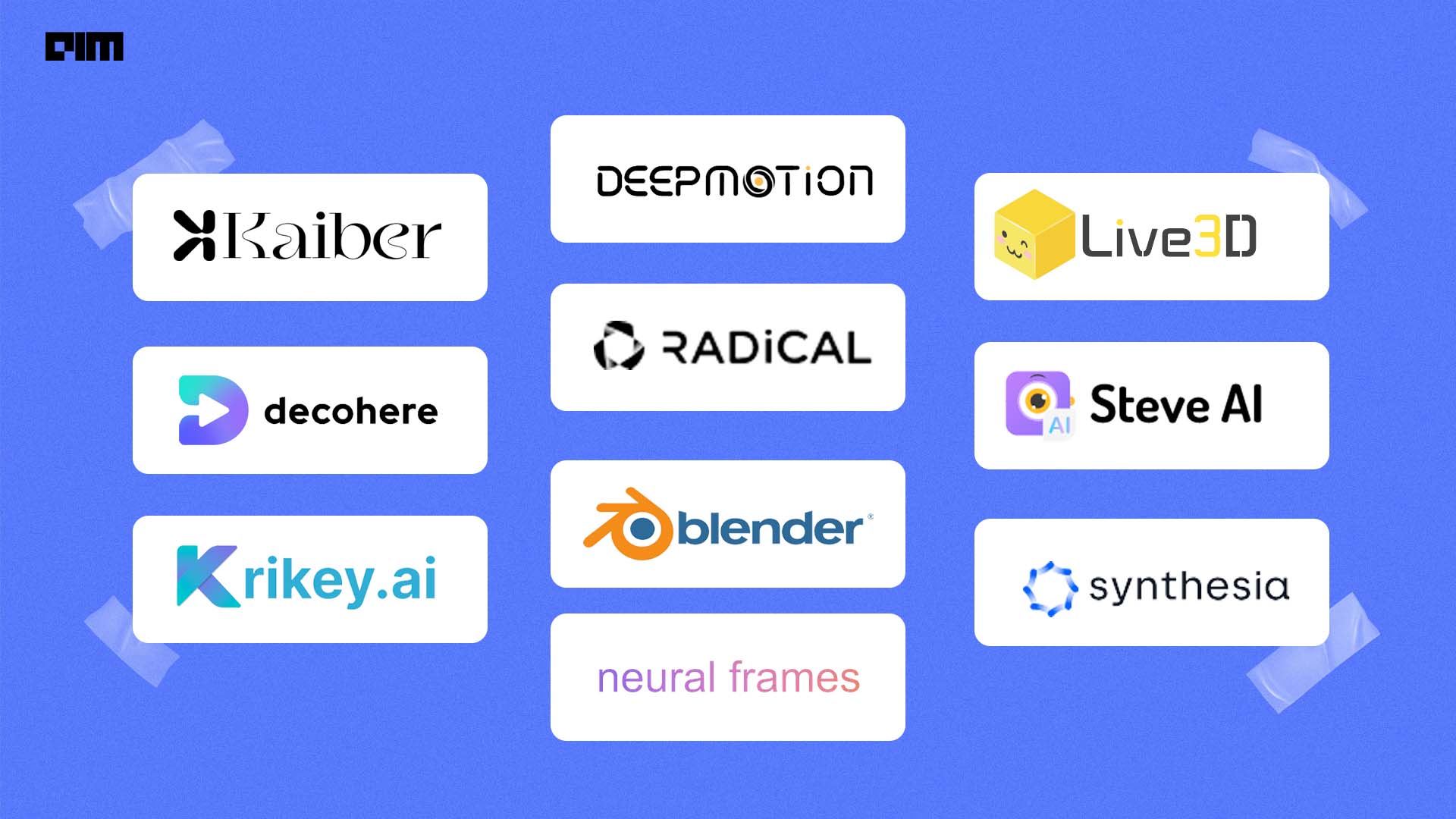
Let’s dive into these 10 innovative platforms that are constantly improving their animation game.

Kaiber AI

Kaiber AI is a video generation tool that uses AI to turn ideas into animation videos. It’s built for artists, content creators, and anyone looking to create videos from images or text. It offers features like camera movement controls and adjustable video lengths, catering to different storytelling needs.

Kaiber AI includes a Spotify Canvas generator for musicians to create looping videos for their tracks on Spotify, enhancing listener engagement. For animation, Kaiber offers Flipbook Animation for creating frame-by-frame animations and motion animation for generating animations from text prompts.

These features are powered by proprietary AI models, enabling the generation of unique and creative visuals. It’s free for basic use, with a starting price of $10/month for additional features. Within six months of its launch, Kaiber has attracted over 25,000 users.

Neural frames

Neural Frames is an AI-powered animation generator, designed specifically for creating animations and music videos from text prompts. It employs advanced AI models like Stable Diffusion, capable of understanding and transforming text descriptions to fluid motion videos.

Users can refine their animations by adjusting the text prompts, allowing for precise control over the final output. Neural Frames offers real-time previews, customizable AI models, audio reactivity for syncing animations with music, flexible camera controls for dynamic perspectives, and an AI upscaler for high-resolution videos.

Its fast performance is powered by the latest AI technology, making video generation quicker than traditional methods. Neural Frames offers a free plan with basic features and several paid subscriptions for more extensive use, including options for HD and 4K video exports and access to custom AI models.

Users retain full ownership of the videos they create, with the platform leveraging Nvidia A100 GPUs for top-notch video quality and generation speed.

Live 3D

Live3D is a platform dedicated to VTubing, offering a suite of tools designed for creating VTuber avatars and animations. It provides software for making VTuber avatars, editing them, and creating engaging animations with VTuber Maker, catering to over a million VTubers, streamers, YouTubers, and artists worldwide.

The platform operates on a subscription model, offering several packages including free options. The free package includes basic VTuber functions sufficient for starting as a VTuber.

For those looking to design their own avatar, Live3D recommends using VRoid Studio to create a 3D VRM model, which can then be imported into VTuber Maker. Users can also commission a custom 3D model through Live3D’s team of artists.

Decohere

Decohere offers AI-powered video creation tools that allow users to customise prompts and apply various effects. The platform is designed to be user-friendly, enabling creators to navigate easily and produce content without the need for extensive technical knowledge. Features like real-time rendering and multiple output formats enhance the creative process, allowing for the efficient production of high-quality videos.

It supports uploading of .vrm models and uses custom avatars in their projects.

Integrations with major video editing software like Adobe Premiere Pro, Final Cut Pro, and Filmora, enable creators to incorporate AI insights into their editing process, streamlining production and enhancing creativity. Decohere has three plans, basic at $9 per month, creator at $29 per month and director at $89 per month.

Krikey

Krikey AI Animation Maker, is an AI animation generator that transforms text prompts or videos into 3D character animations quickly, alongside a 3D animation editor for refining animations with facial expressions, gestures, and more. The platform supports AI text-to-animation and video-to-animation conversions, integrates with Ready Player Me for avatars, and offers its own 3D avatar creator.

Key features include a large library of animations, customizable facial expressions and hand gestures, 3D background choices, and control over animation speed and camera angles.

Support is available through a knowledge base, community forum, email, and live chat. Krikey also integrates with Adobe Creative Cloud, Unity, Unreal Engine, Dropbox, and Google Drive, and offers SDKs and APIs for further customisation and integration into other apps and solutions. Krikey AI animation software costs around $13.33 per month.

Blender

Blender is an open-source software for 3D modeling, animation, video editing, and more, widely used by VFX professionals and in feature film production. It’s known for its comprehensive toolset that supports the entire 3D pipeline, including rigging, animation, simulation, rendering, compositing, and motion tracking, as well as video editing and 2D animation pipeline. Blender’s Cycles engine offers high-end, ultra-realistic rendering capabilities. The software also provides extensive modeling tools, advanced sculpting capabilities, and a robust animation and rigging toolkit. It supports real-time viewport preview, CPU & GPU rendering, PBR shaders, HDR lighting, and even VR rendering. Moreover, Blender includes features for VFX, such as camera and object tracking which allows the integration of 3D elements with raw footage.

Blender is entirely free to use for any purpose, including commercial projects, under the GNU General Public License. It’s continually updated and supported by its community and the Blender Foundation.

Steve.AI

Steve.AI is an AI video generator that transforms text, scripts, or audio into videos, including animations and GenAI videos. It features over 400 prebuilt AI avatars, a custom image generation technology, and supports a wide range of video styles. Users can benefit from its advanced AI video editor with 40+ tools and access to a large library of human-created and AI-generated assets. It’s designed for L&D teams, HR, marketers, educational professionals, and more, offering an intuitive platform for creating engaging video content.

DeepMotion

DeepMotion offers AI-powered solutions like Animate 3D for motion capture from videos and SayMotion for converting text to dynamic animations. It’s designed for various users, including educators and digital artists, enhancing animation pipelines with markerless motion capture and 3D body tracking.

DeepMotion AI uses motion capture to analyse and replicate physics in real-world situations. This allows for animations that are both visually appealing and grounded in reality. DeepMotion’s Animate 3D feature can turn 2D videos into 3D animations.

RADiCAL

With RADiCAL’s technology, users have to just point a regular 2D camera at a person and their AI does the rest in the cloud, in real-time: we output 3D animation data in the form of skeletal joint rotations that you can stream or export into any 3D software client and any content creation pipeline.

It analyzes video content to recreate human motion in three dimensions, enabling users to generate detailed 3D animations. The subscription costs $24 per month for advanced features.

Synthesia

Synthesia utilizes AI to animate avatars and generate voiceovers in multiple languages from text input. Users can select an AI avatar, type or upload a script, and the platform transforms this into a video where the avatar speaks the input text.

It offers a range of features including 60+ video templates, the ability to create custom AI avatars, and upload images and videos. Synthesia provides different plans based on the number of minutes the videos are, from $29 to $89 per month. It also includes different numbers of avatars the subscription provides.

The post Top 10 AI Animation Platforms in 2024 appeared first on Analytics India Magazine.

Emerging Technology Trends for 2024: Mastercard’s Report Unveils the Impact of Generative AI on Commerce

Mastercard's “Emerging Technology Trends for 2024” report offers an insightful glimpse into the future of commerce, with a special focus on the transformative impact of generative AI in the retail and travel sectors. This comprehensive study reveals how the convergence of artificial intelligence, computational power, and data technology is not just revolutionizing shopping experiences but is also poised to reshape the travel industry.

A New Era in Retail with AI-Powered Shopping Assistants

In the retail domain, generative AI is significantly enhancing the shopping experience. Mastercard's report highlights the advent of AI-driven personal shopping assistants, exemplified by Shopping Muse from Dynamic Yield, a Mastercard company. These assistants, equipped with advanced conversational abilities and personalization techniques, are streamlining the journey from product discovery to purchase.

Big players like Shopify, Instacart, Mercari, Carrefour, and Walmart are experimenting with generative AI chatbots, which are expected to become widely available in the coming year. These AI assistants promise a more personalized, efficient, and user-friendly shopping experience, with capabilities far beyond traditional digital assistance.

Transforming the Travel Industry with Generative AI

The travel sector is also on the cusp of a major overhaul thanks to generative AI. The report delves into how this technology is reviving the concept of travel agents in a virtual format. For instance, a business traveler could use a bot on platforms like TripAdvisor or Kayak to arrange a trip. The generative AI then takes over, seamlessly integrating various elements of the trip – flights, lodging, dining, sightseeing – across different time zones and currencies, to create a comprehensive itinerary in minutes instead of hours.

Wearable Technology and AI Pins: The Next Frontier

The report also touches on the emergence of wearable technology that incorporates generative AI. For example, the latest iteration of the Meta Ray-Ban smart glasses released in late 2023 represents this trend. Moreover, innovative interfaces like the AI Pin, developed by startup Humane, are highlighted. This wearable device, which can be affixed to clothing, offers voice access to ChatGPT and functions such as instant translation and nutritional information scanning, further integrating AI into everyday life.

Revolutionizing Software Engineering with Generative AI

One of the standout tools mentioned in the report is GitHub Copilot. This AI-powered tool represents just the tip of the iceberg in terms of how generative AI is transforming the software development process. GitHub Copilot assists developers by providing suggestions for code completion, effectively streamlining the coding process. This tool one of many AI code generators is particularly adept at understanding natural language requests, allowing developers to describe their coding needs in simple terms and letting the AI generate the required code in the desired programming language.

Boosting Productivity and Efficiency

The report anticipates a substantial increase in engineering productivity thanks to the integration of generative AI. By automating a range of tasks, from supporting and maintaining legacy code to assisting in the creation of user interface and user experience (UI/UX) designs, generative AI is set to significantly reduce the time and effort traditionally required in software development. This automation extends to more complex tasks as well, such as debugging, testing, and even in the conceptual stages of software design.

Generative AI and Legacy Code

One of the most time-consuming aspects of software maintenance is dealing with legacy code. Generative AI is poised to automate the handling of such code, making it easier for developers to update and improve older systems. This capability is particularly crucial for industries that rely on legacy systems but need to keep pace with modern technological advancements.

Enhancing Creative Tasks

Beyond the more routine tasks, generative AI is also enhancing the more creative aspects of software development. In UI/UX design, for example, AI can help generate layouts and design elements based on specified parameters, freeing designers to focus on more innovative aspects of their work. This blend of AI assistance in both the technical and creative processes represents a significant shift in how software development projects are approached and executed.

The Future of Software Development with Generative AI

Looking ahead, the report suggests that the role of generative AI in software development is only set to grow. Its ability to understand and process natural language inputs and its versatility in handling a wide range of tasks will make it an indispensable tool for developers. This will not only speed up the development process but also open up new possibilities for innovation in software design and functionality.

Conclusion

“Emerging Technology Trends for 2024” by Mastercard underscores the critical role of generative AI in shaping the future of commerce, travel, and technology. As we advance, the integration of this AI into various sectors promises not only enhanced efficiency and personalization but also poses challenges that need responsible management, especially concerning privacy and ethical use. This report serves as a crucial guide for businesses and consumers to navigate and harness the potential of generative AI in the evolving digital landscape.

Watch out, Google — Microsoft is working on its own Circle to Search

Circle to Search with Google - Samsung Galaxy S24

Last month, Google unveiled Circle to Search on select Android phones, allowing users to perform Google searches by simply long-pressing the home button and circling or tapping a subject on their screen. Sounds pretty neat, right? Microsoft thought so, too, and is working on its version of the feature.

Also: Microsoft's big bet on AI seems to be paying off

As spotted by WindowsReport, Microsoft added a new mouse gesture feature titled "Circle to Copilot" feature to the Canary version of the Edge browser, a preview channel updated daily that allows users to be the first to preview Edge updates.

As the title implies, the feature would likely work similarly to Google's version, with users using their mouse to circle anything from their browser to have Copilot, Microsoft's AI assistant, look up the highlighted subject and provide relevant information.

The biggest difference is that Microsoft's version is meant for browsers, while Google's is aimed at mobile devices. However, the naming and functionality are quite similar.

Also: How to use Circle to Search on Android (and what models support it)

Even in Canary, the feature is not working yet, and the company has yet to announce the feature. However, the spotting of the setting suggests that Microsoft is currently working on the feature, and it may be something you see soon. To be the first to preview the feature when it does become available, you can download Edge Canary and make sure to check the latest version continuously.

Even though Microsoft's version is not yet available, you can take advantage of Google's version on mobile if you own a phone from the Samsung Galaxy S24 series, including the S24, S24 Plus, and S24 Ultra or the Pixel 8 and Pixel 8 Pro.

More Microsoft

What is Google One and is it worth it?

Google One

Also: The top cloud storage services you can buy to protect your files

These features include increased cloud storage spread across Drive, Gmail, and Google Photos; a VPN for multiple devices; dark web monitoring; access to Google Photos editing features, like Magic Eraser; and, in some plans, 10% back in the Google Store, access to premium Google Workspace features, and access to AI offerings.

Google One is available on web and on mobile for both Android and iOS.

The Google One AI Premium plan is only available with monthly billing and will set you back $20 a month, but you can sign up now and take advantage of a free two-month trial, a limited-time offer from Google.

Google is currently offering discounted pricing for the Basic, Standard, and Premium plans as well, at $0.49, $0.75, and $2.49 a month for the first three months, respectively.

Google

How the Australian Government Sees AI Accelerating Productivity

Australia has a problem with slowing productivity growth. As the group tasked with addressing this, the Australian Government’s Productivity Commission is looking at AI as a potential part of the problem. Recently, the Commission released a three-paper report, Making The Most Of The AI Opportunity: Productivity, Regulation And Data Access, to further analyse this opportunity.

To maximise productivity gains from AI, the paper advocates for a soft-touch approach to regulation. Additionally, the Commission recommends that the government departments at all levels (federal, state and local) “lead by example” and contribute their own data and resources to further the development of quality AI models.

Breaking the research down

The research report is broken down into three separate papers.

Paper 1: AI uptake, productivity and the role of government

The first paper notes that because AI is already becoming ubiquitous in some areas online and is being baked into everyday tools, it is a technology that is already delivering productivity benefits to every business and individual. They’re small for now but will grow in time.

While those productivity gains are exciting, the report also acknowledges that AI poses risks, particularly around consumer trust. The Commission recommends that governments can be part of the solution to this trust challenge by contributing their own, high-quality data to support the development of quality models. “The Government’s interim data and digital strategy notes that the Australian Public Service manages a vast amount of data that is not used to its full extent, and access remains restricted despite the clear benefits derived from safely sharing data across public and private sectors,” the report notes.

Paper 2: The challenges of regulating AI

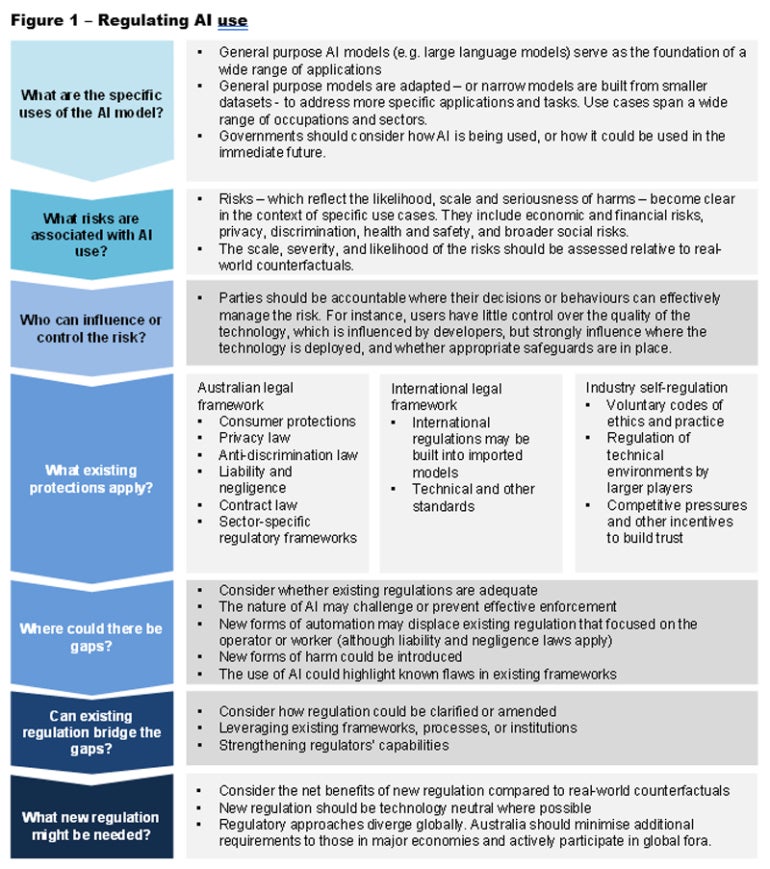
The second paper discusses the benefits and risks of AI and how the Australian government should regulate it. It cites the interim response of the Australian Government to the Safe and Responsible AI in Australia Consultation as a useful starting point and the Productivity Commission’s paper as a systematic and implementable approach to AI regulation (Figure A).

Infographic showing regulating AI use.
Figure A: Regulating AI use. Image: Productivity Commission

It is worth noting that currently, Australia has very soft regulations on AI, and industry and the public are, for the most part, looking at the soon-to-be-introduced European AI laws for guidance on the matter.

Rather than risk regulation undermining productivity, however, the paper argues that safe, ethical AI use comes down to a range of factors such as social norms, market pressures, coding architecture and public trust. In other words, the report argues that a rigid approach to AI regulation is unlikely to address the risks, and regulators need a more holistic approach.

Paper 3: AI raises the stakes for data policy

The third paper points out that data has been a resource for both the private and public sectors for decades. AI has accelerated the potential gains while also elevating the risk.

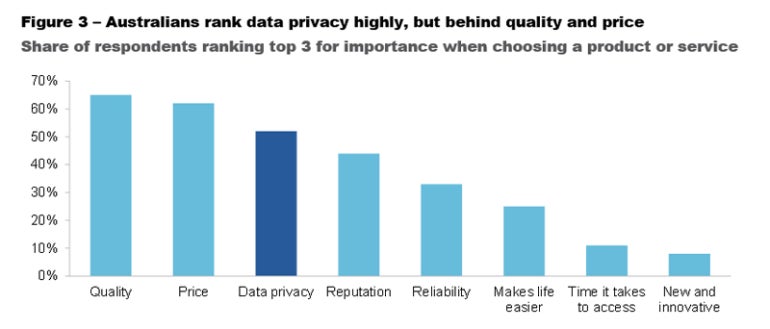
Australians know it, too. As the Commission research shows, privacy, along with quality and price, is a top three concern among Australians when it comes to data (Figure B). To allay these concerns, the Commission recommends a national data strategy as being preferable to bludgeoning regulation.

Chart showing Australians rank data privacy highly but behind quality and price.
Figure B: Australians rank data privacy highly but behind quality and price. Image: Productivity Commission

“Once developed, all future regulations and guidelines around data use and data analytics could refer to the agreed principals of the national data strategy,” the report notes. “In this way, the data strategy could provide a secure and consistent basis for the development and use of AI and other data‑intensive technologies.”

Collaboration with government on the cards

The overall thrust of the research is that the government should look to be an active participant in the shaping of AI. The researchers argue that the government should resist playing into the fear mongering in some corners regarding AI and embrace the opportunity it has to be an active part of the development of best-practice AI.

For the industry, this may mean a proliferation of opportunities for the private and public sectors to come together collaboratively. Some potential opportunities include:

Industry self-regulation initiatives

Data professionals and the private sector can voluntarily adopt ethical principles, best practices and guidelines for responsible AI development and use and demonstrate their commitment to social values and trustworthiness. This can help reduce the need for government intervention and ensure the Australian government can have that soft-touch approach recommended to it.

Co-design of AI policies with stakeholders

Data professionals and the private sector can actively participate in the development of AI policies and regulations and provide their expertise, insights and feedback to government agencies. This can help ensure that the policies are informed by the latest technological developments, reflect the needs and interests of various stakeholders and strike a balance between innovation and regulation.

AI ethics advisory boards

The government can be guided by AI ethics advisory boards, which can then be used as the framework for the development of any regulations. These boards can act to inform the government of risks and harms, propose mitigation strategies and promote public awareness and engagement on AI ethics.

Public sector adoption of AI technologies

Building AI solutions that enhance public service delivery, efficiency and transparency can result in a government that is more familiar with the capabilities and challenges of AI. Organisations that do a lot of work with government agencies should look at adding accreditations related to AI to assist with the tendering and strategic support that the company can then provide to the government.

Boosting analytical capabilities using BigQuery

Big Query

Each day, your business applications and digital footprint actively compile Analytical Capabilities data – endless streams of information detailing customer interactions, advertising effectiveness, cyber threats, and more. Yet this data overabundance enables insight paralysis. Most organizations can’t effectively harness data to derive real business value. Why? Traditional analytics platforms buckle under massive datasets, leaving questions unanswered and decisions ill-informed.

Traditional data warehousing and analytics systems strain against swelling volumes, leaving pivotal questions unexplored and innovation untapped. Information glut overwhelms, progress stalls, and value creation wanes.

What if you could smash through these bottlenecks to unlock deeper data insights? Welcome to the age of BigQuery.

Built for speed, scaled for the future

BigQuery sits at the vanguard of cloud data warehousing, combining sheer query speed with massive scalability. It brings enterprise-grade analytical capabilities to organizations of all sizes. BigQuery’s computational power actively analyzes high-volume query sets encompassing millions of terabytes in under 30 seconds. Your analysts invest less time waiting on queries and more time unlocking transformational discoveries to drive business value.

BigQuery’s pioneering architecture shows the power of Google Cloud solutions, combining serverless speed with intelligent caching and compression. BigQuery utilizes a serverless processing engine, intelligent caching, columnar data compression, and a materialized data tier to turbocharge performance beyond what legacy solutions can offer.

The integrated BigQuery BI Engine leverages Google’s state-of-the-art infrastructure to massively parallel process hefty workloads blazing-fast against current and historical datasets alike. By leveraging field-programmable gate arrays and application-specific integrated circuits, BigQuery achieves exponential gains in computational speed and efficiency.

Equally importantly, BigQuery offers seamless scalability to grow in step with your soaring data volumes over time. The serverless architecture automatically provisions additional computing capacity to match your evolving analytical loads. As query complexity intensifies and dataset sizes balloon over months, years, or decades, BigQuery readily handles escalating demands without costly migrations or platform limitations.

The innovative multi-tiered storage backbone auto-scales from hot data needing high throughput to cooler historical data queried less frequently. This optimized storage model is fully-managed so your teams focus on high-value analysis rather than data infrastructure. Combined, these capabilities enable cloud cost efficiencies today while ready to tackle your future needs at scale.

Democratizing data science with ML

Sophisticated analytics teams leverage BigQuery’s native machine learning capabilities to uncover trends and deliver predictive insights that boost KPIs across the business, as demonstrated by several successful business case studies. Data scientists no longer waste precious time extracting information from the data warehouse only to shift context and rebuild models in separate ML tools. BigQuery eliminates these disjointed steps, allowing users to build and execute ML models directly against live production data. This unlocks efficiencies while ensuring consistency and single sources of truth.

Equally transformational, SQL-focused analysts can bypass coding barriers through easy-to-use tools that embed directly into familiar BigQuery workflows. Using simple declarative statements, these users can manage and deploy ML models enhanced by Google’s state-of-the-art algorithms and TensorFlow, democratizing access to advanced techniques.

The use cases stretch as wide as your data itself – limited only by imagination. Retail teams could create BigQuery ML time series models forecasting customer demand to optimize supply chain capacity amid volatile global events. Merchandisers may combine regression analysis of past sales trends with natural language sentiment signals from social media to improve product mix. Concurrently, marketing analysts identify high-lifetime-value customer segments via k-means clustering, informing personalized retention initiatives. Executives gain perspective into macroeconomic trends shaping long-term strategy.

Beyond standard SQL users, data scientists also gain efficiencies by leveraging BigQuery ML. They can iterate models faster by reducing time spent on data extraction and infrastructure. Instead, focus cycles on high-value statistical and machine learning techniques tailored to your unique data.

Unified analytics and visualization

BigQuery further empowers organizations by unifying self-service analytics capabilities within one end-to-end platform. Users can progress seamlessly across the insight pipeline all while avoiding disruptive tool swapping.

Ingest expanding data volumes from databases, SaaS apps, and other sources using extensive connectors and simplified loading tools. Process billions of records via standard or federated SQL queries, pre-built machine learning models, and customizable JavaScript UDFs. Visualize results through simple drag-and-drop dashboards, pixel-perfect reports, or dynamically linked charts and graphs in Google Data Studio.

Data teams spend more time deriving unique business intelligence tailored to cross-functional goals rather than wrestling with disjointed systems. Analysts have fewer context-switching barriers exploring new questions as insights emerge. Executives gain clear, comprehensive views into operational and financial performance trends through interactive reporting. Individual functions can accelerate their pursuits whether it be supply chain optimizations, digital marketing personalization, predictive maintenance, or infinite other use cases.

By unifying capabilities within one best-in-class cloud platform, BigQuery transforms fragmented skillsets, data, and questions into Insights for All. Break down internal data silos to fuel innovation and collaboration powered by shared trusted information. BigQuery lets you analyze first, then optimize – moving your organization from reactive to insight-driven strategic leaders.

Enterprise-grade security and compliance

As an enterprise-ready platform, BigQuery enables analytics over sensitive data while meeting the most exhaustive security certifications and compliance standards. Many businesses may find value in leveraging Google Cloud consulting services to optimize BigQuery’s security features, ensuring robust data protection and compliance with industry standards such as SOC, ISO, HITRUST, FedRAMP, and regional regulations like GDPR, CCPA, and HIPAA.

Safeguard data with encryption both at rest and in transit, while managing keys through integrated Google Cloud KMS. Utilize granular IAM access controls, activity audit logging, and data access policies to restrict exposure risk to authorized users only. Integrated classification tools can discover and tag sensitive data, ensuring it receives additional protections aligned with your governance policies.

BigQuery also provides mature tooling for common privacy techniques when handling personal data, including de-identification, data masking, data obfuscation, and differential privacy methods. Together these capabilities allow organizations to maintain compliance with internal governance policies as well as evolving regional regulations such as GDPR, CCPA, and HIPAA. Control use ruthlessly; trust Google for industry-leading security.

Wrapping up: The future is data.

Every business seeks unique insights to propel strategic objectives. BigQuery grants you the versatility to pursue custom analytical outcomes using the world’s most capable cloud data platform.

With its combination of performance, scalability, flexibility, and ease of use, BigQuery serves as a foundational analytics engine on Google Cloud. It allows organizations to store expansive datasets while empowering business users to analyze information and unlock impactful insights through intuitive SQL, machine learning, and visualization capabilities.

By leveraging solutions like BigQuery, companies can boost analytical capabilities to drive more data-informed strategies that create business value. Intelligent use of cloud data platforms serves as a key competitive advantage for digitally driven organizations.

The Battle of Open Source vs Closed Source Language Models: A Technical Analysis

open source vs close source LLM

Large language models (LLMs) have captivated the AI community in recent years, spearheading breakthroughs in natural language processing. Behind the hype lies a complex debate – should these powerful models be open source or closed source?

In this post, we’ll analyze the technical differentiation between these approaches to understand the opportunities and limitations each presents. We’ll cover the following key aspects:

  • Defining open source vs closed source LLMs
  • Architectural transparency and customizability
  • Performance benchmarking
  • Computational requirements
  • Application versatility
  • Accessibility and licensing
  • Data privacy and confidentiality
  • Commercial backing and support

By the end, you’ll have an informed perspective on the technical trade-offs between open source and closed source LLMs to guide your own AI strategy. Let’s dive in!

Defining Open Source vs Closed Source LLMs

Open source LLMs have publicly accessible model architectures, source code, and weight parameters. This allows researchers to inspect internals, evaluate quality, reproduce results, and build custom variants. Leading examples include Anthropic’s ConstitutionalAI, Meta's LLaMA, and EleutherAI's GPT-NeoX.

In contrast, closed source LLMs treat model architecture and weights as proprietary assets. Commercial entities like Anthropic, DeepMind, and OpenAI develop them internally. Without accessible code or design details, reproducibility and customization face limitations.

Architectural Transparency and Customizability

Access to open source LLM internals unlocks customization opportunities simply not possible with closed source alternatives.

By adjusting model architecture, researchers can explore techniques like introducing sparse connectivity between layers or adding dedicated classification tokens to enhance performance on niche tasks. With access to weight parameters, developers can transfer learn existing representations or initialize variants with pre-trained building blocks like T5 and BERT embeddings.

This customizability allows open source LLMs to better serve specialized domains like biomedical research, code generation, and education. However, the expertise required can raise the barrier to delivering production-quality implementations.

Closed source LLMs offer limited customization as their technical details remain proprietary. However, their backers commit extensive resources to internal research and development. The resulting systems push the envelope on what’s possible with a generalized LLM architecture.

So while less flexible, closed source LLMs excel at broadly applicable natural language tasks. They also simplify integration by conforming to established interfaces like the OpenAPI standard.

Performance Benchmarking

Despite architectural transparency, measuring open source LLM performance introduces challenges. Their flexibility enables countless possible configurations and tuning strategies. It also allows models prefixed as “open source” to actually include proprietary techniques that distort comparisons.

Closed source LLMs boast more clearly defined performance targets as their backers benchmark and advertise specific metric thresholds. For example, Anthropic publicizes ConstitutionalAI’s accuracy on curated NLU problem sets. Microsoft highlights how GPT-4 surpasses human baselines on the SuperGLUE language understanding toolkit.

That said, these narrowly-defined benchmarks faced criticism for overstating performance on real-world tasks and underrepresenting failures. Truly unbiased LLM evaluation remains an open research question – for both open and closed source approaches.

Computational Requirements

Training large language models demands extensive computational resources. OpenAI spent millions training GPT-3 on cloud infrastructure, while Anthropic consumed upwards of $10 million worth of GPUs for ConstitutionalAI.

The bill for such models excludes most individuals and small teams from the open source community. In fact, EleutherAI had to remove the GPT-J model from public access due to exploding hosting costs.

Without deep pockets, open source LLM success stories leverage donated computing resources. LAION curated their tech-focused LAION-5B model using crowdsourced data. The non-profit Anthropic ConstitutionalAI project utilized volunteer computing.

The big tech backing of companies like Google, Meta, and Baidu provides closed source efforts the financial fuel needed to industrialize LLM development. This enables scaling to lengths unfathomable for grassroots initiatives – just see DeepMind’s 280 billion parameter Gopher model.

Application Versatility

The customizability of open source LLMs empowers tackling highly specialized use cases. Researchers can aggressively modify model internals to boost performance on niche tasks like protein structure prediction, code documentation generation, and mathematical proof verification.

That said, the ability to access and edit code does not guarantee an effective domain-specific solution without the right data. Comprehensive training datasets for narrow applications take significant effort to curate and keep updated.

Here closed source LLMs benefit from the resources to source training data from internal repositories and commercial partners. For example, DeepMind licenses databases like ChEMBL for chemistry and UniProt for proteins to expand application reach. Industrial-scale data access allows models like Gopher to achieve remarkable versatility despite architectural opacity.

Accessibility and Licensing

The permissive licensing of open source LLMs promotes free access and collaboration. Models like GPT-NeoX, LLaMA, and Jurassic-1 Jumbo use agreements like Creative Commons and Apache 2.0 to enable non-commercial research and fair commercialization.

In contrast, closed source LLMs carry restrictive licenses that limit model availability. Commercial entities tightly control access to safeguard potential revenue streams from prediction APIs and enterprise partnerships.

Understandably, organizations like Anthropic and Cohere charge for access to ConstitutionalAI and Cohere-512 interfaces. However, this risks pricing out important research domains, skewing development towards well-funded industries.

Open licensing poses challenges too, notably around attribution and liability. For research use cases though, the freedoms granted by open source accessibility offer clear advantages.

Data Privacy and Confidentiality

Training datasets for LLMs typically aggregate content from various online sources like web pages, scientific articles, and discussion forums. This risks surfacing personally identifiable or otherwise sensitive information in model outputs.

For open source LLMs, scrutinizing dataset composition provides the best guardrail against confidentiality issues. Evaluating data sources, filtering procedures, and documenting concerning examples found during testing can help identify vulnerabilities.

Unfortunately, closed source LLMs preclude such public auditing. Instead, consumers must rely on the rigor of internal review processes based on announced policies. For context, Azure Cognitive Services promises to filter personal data while Google specifies formal privacy reviews and data labeling.

Overall, open source LLMs empower more proactive identification of confidentiality risks in AI systems before those flaws manifest at scale. Closed counterparts offer relatively limited transparency into data handling practices.

Commercial Backing and Support

The potential to monetize closed source LLMs incentivizes significant commercial investment for development and maintenance. For example, anticipating lucrative returns from its Azure AI portfolio, Microsoft agreed to multibillion dollar partnerships with OpenAI around GPT models.

In contrast, open source LLMs rely on volunteers allocating personal time for upkeep or grants providing limited-term funding. This resource asymmetry risks the continuity and longevity of open source projects.

However, the barriers to commercialization also free open source communities to focus on scientific progress over profit. And the decentralized nature of open ecosystems mitigates over-reliance on the sustained interest of any single backer.

Ultimately each approach carries trade-offs around resources and incentives. Closed source LLMs enjoy greater funding security but concentrate influence. Open ecosystems promote diversity but suffer heightened uncertainty.

Navigating the Open Source vs Closed Source LLM Landscape

Deciding between open or closed source LLMs calls for matching organizational priorities like customizability, accessibility, and scalability with model capabilities.

For researchers and startups, open source grants more control to tune models to specific tasks. The licensing also facilitates free sharing of insights across collaborators. However, the burden of sourcing training data and infrastructure can undermine real-world viability.

Conversely, closed source LLMs promise sizable quality improvements courtesy of ample funding and data. However, restrictions around access and modifications limit scientific transparency while binding deployments to vendor roadmaps.

In practice, open standards around architecture specifications, model checkpoints, and evaluation data can help offset drawbacks of both approaches. Shared foundations like Google's Transformer or Oxford's REALTO benchmarks improve reproducibility. Interoperability standards like ONNX allow mixing components from open and closed sources.

Ultimately what matters is picking the right tool – open or closed source – for the job at hand. The commercial entities backing closed source LLMs carry undeniable influence. But the passion and principles of open science communities will continue playing a crucial role driving AI progress.

How edge computing is transforming data management

Edge-computing-scaled

In today’s digital landscape, where data is often hailed as the new oil, the rise of edge computing stands as a transformative force reshaping the way we manage and utilize data. Edge computing marks a significant shift from the traditional centralized data processing model to a decentralized approach, bringing computation and data storage closer to the source of data generation. As this technology gains momentum, exploring how it will impact data management strategies is imperative.

Understanding edge computing

In simple terms, edge computing involves processing data near the network’s edge, where it is generated, instead of relying on a centralized data processing warehouse or cloud. This approach significantly reduces latency, enhances real-time processing capabilities, and alleviates bandwidth constraints. It is ideal for applications requiring rapid response times, such as IoT devices, autonomous vehicles, and smart sensors.

Some key features of edge computing are as follows:

1. Proximity to data generation: Edge computing consists of deploying computing resources, such as servers, storage, and networking equipment, closer to where data is generated. 

2. Decentralized architecture: Edge computing follows a decentralized architecture, unlike traditional cloud computing. Edge devices, including routers, gateways, and IoT devices, perform computation and data storage tasks locally without relying heavily on connectivity to a centralized server. 

3. Scalability and flexibility: Edge computing offers greater scalability and flexibility than traditional cloud computing models. Organizations can quickly scale their edge infrastructure by adding or removing edge devices as needed.

4. Edge intelligence and analytics: Edge computing empowers edge devices to perform intelligent processing and analytics tasks locally without constant communication with a centralized server.

5. Hybrid edge-cloud architectures: While edge computing offers many benefits, it does not entirely replace the need for centralized cloud infrastructure. Instead, organizations increasingly adopt hybrid edge-cloud architectures, combining edge computing and cloud computing strengths.

6. Security and privacy considerations: Edge computing introduces unique security and privacy challenges that organizations must address. These challenges involve the integrity and confidentiality of their data. Because edge devices are often deployed in physically vulnerable or uncontrolled environments, they are more susceptible to physical tampering, unauthorized access, or cybersecurity threats.

Let’s look at how these features affect data management strategies.

Impact on data management

1. Reduced latency and improved responsiveness

Edge computing brings computing resources closer to end-users and devices, minimizing the distance data needs to travel. As a result, latency is drastically reduced, enabling faster response times for critical applications. Data integration tools must adapt to this shift by prioritizing real-time analytics and decision-making capabilities at the edge, allowing organizations to capitalize on time-sensitive insights without depending solely on centralized data processing.

2. Scalability and flexibility

Edge computing empowers organizations to scale their infrastructure dynamically, distributing computational workloads across edge devices. This scalability and flexibility necessitate agile data management frameworks seamlessly integrating edge data with centralized repositories. Combining edge and cloud resources, hybrid data management approaches will become increasingly prevalent, enabling organizations to effectively balance performance, cost, and data governance requirements.

3. Data governance and compliance

With data being processed and stored across a distributed edge infrastructure, ensuring compliance with regulatory requirements and maintaining data governance becomes more complex. Data management strategies must encompass robust security measures to safeguard sensitive information at the edge. Additionally, organizations must implement comprehensive data lineage tracking mechanisms to maintain data integrity and traceability across the entire edge-to-cloud continuum.

4. Edge-to-cloud data orchestration

Effective data management in an edge computing environment necessitates seamless orchestration of data movement between edge devices and centralized cloud repositories. This entails developing sophisticated data synchronization mechanisms, edge caching strategies, and data replication protocols to ensure consistency and coherence across distributed data stores. Automated data lifecycle management solutions will be crucial in optimizing data placement, retention, and archival processes across the edge-cloud spectrum.

5. Edge-native data processing and analytics

Edge computing unlocks new possibilities for performing data processing and analytics directly at the edge, minimizing reliance on centralized cloud resources for insights generation. Data management frameworks must embrace edge-native processing technologies, including lightweight machine learning models, edge databases, and stream processing engines, to leverage the full potential of edge-generated data. Organizations can achieve greater operational efficiency and innovation agility by empowering edge devices to analyze and act on data autonomously.

Edge computing in action: Smart traffic management system

In a traditional centralized data processing model, an intelligent traffic management system might rely on sending data from numerous sensors deployed across the city to a centralized cloud server for analysis. This process involves transmitting large volumes of data over the network, leading to latency issues and delayed responses to traffic incidents or congestion.

However, edge computing brings processing power closer to the source of data generation, such as traffic cameras, sensors embedded in roads, and traffic lights. In this scenario:

  1. Real-time data processing: Edge devices installed at intersections analyze streaming video feeds from traffic cameras and data from sensors in real-time. This immediate analysis allows the system to detect anomalies, such as accidents or congestion, as they occur.
  1. Localized decision-making: Edge devices can autonomously make localized decisions based on the data they collect. For instance, a traffic light with edge computing can adjust its signal timing dynamically. This optimizes traffic flow in response to changing conditions.
  1. Reduced latency: By processing data locally at the edge. The system significantly reduces the time it takes to detect and respond to traffic events. This low-latency approach improves overall responsiveness, leading to smoother traffic flow and reduced congestion.
  1. Bandwidth optimization: Edge computing minimizes the need to transmit large volumes of raw data to a centralized server for processing. Instead, only relevant insights or aggregated data are sent to the cloud for further analysis. This optimizes bandwidth usage and reduces network congestion.

Consequently, edge computing revolutionizes intelligent traffic management by allowing real-time data processing and local decision-making at the network edge. By leveraging the proximity of edge devices to the data source, the system achieves lower latency and improved responsiveness. This results in more efficient use of network resources, ultimately enhancing smart city infrastructure effectiveness.

Conclusion

The rise of edge computing heralds a transformative era for data management. It challenges organizations to rethink their data processing, storage, and governance approaches by embracing the decentralized nature of edge computing and adopting agile data management strategies. Organizations can harness the full potential of edge-generated data to improve their data management strategies in the digital economy.