Cohere for AI Unveils Aya: Open-Source, Multilingual Model in 101 Languages

Cohere For AI (C4AI) announced Aya, a multilingual generative language model that follows instructions in 101 languages, of which over 50% are considered lower-resourced.

Aya is available in Indian languages such as Hindi, Marathi, Malayalam, Gujarati, and Telugu.

“Developed using a diverse mix of instructions from the Aya dataset and collection, among others, it achieves state-of-the-art performance across numerous multilingual benchmarks,” Cohere for AI said in a blog post.

Aya outperforms mT0 and BLOOMZ on the majority of tasks while covering double the number of languages.

“We introduce extensive new evaluation suites that broaden the state-of-art for multilingual eval across 99 languages — including discriminative and generative tasks, human evaluation, and simulated win rates that cover both held-out tasks and in-distribution performance,” researchers from Cohere for AI said in the research paper.

Aya, spearheaded by Cohere for AI, engages over 3,000 independent researchers across 119 countries. The decision to open-source both the model and dataset is significant, especially considering the scarcity of datasets for AI in various vernacular languages.

Cohere for AI, a non-profit research lab and a subsidiary of AI startup Cohere, describes Aya as one of the most extensive open science initiatives in machine learning, reshaping research by partnering with global independent researchers.

The post Cohere for AI Unveils Aya: Open-Source, Multilingual Model in 101 Languages appeared first on Analytics India Magazine.

Otter.ai adds AI meeting features at no additional cost across all plans

meeting-genai-banner.png

Working professionals spend a lot of their valuable time in unproductive meetings. To help remedy that problem, Microsoft, Google, Zoom, and Otter.ai have released AI-enabled meeting tools. Now, Otter.ai is claiming its newest feature set places it above all other competitors.

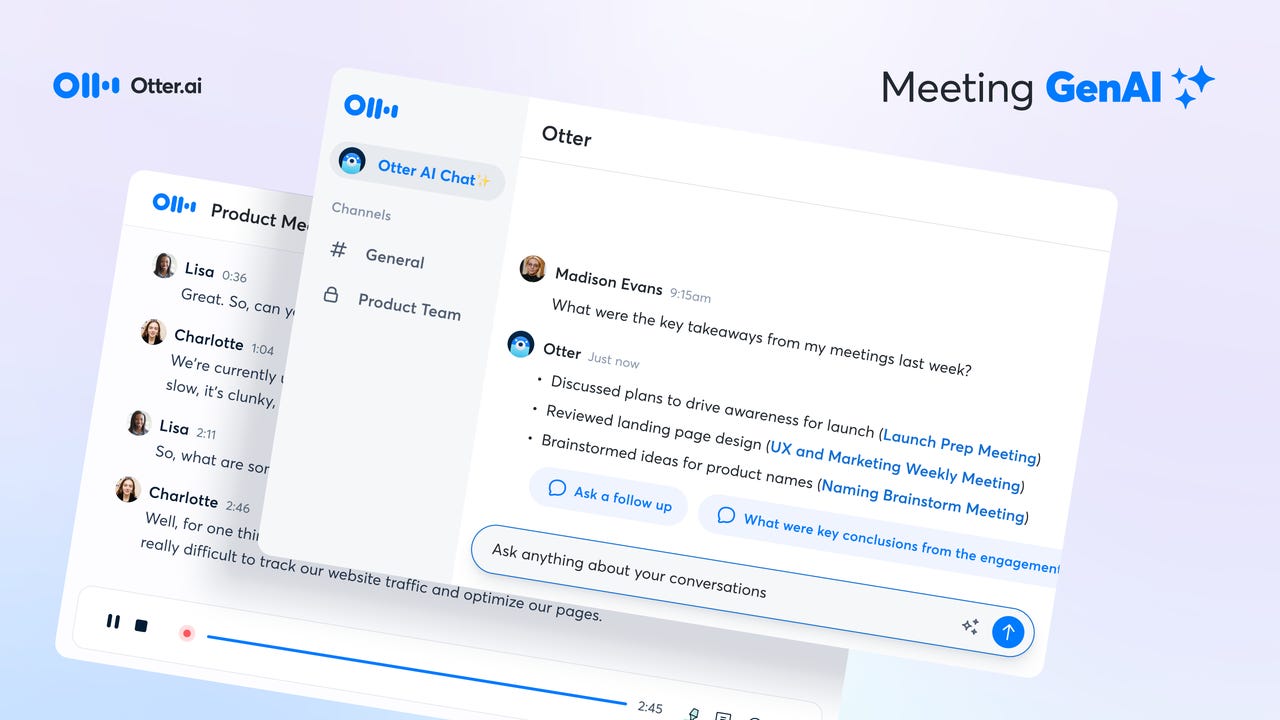
On Tuesday, Otter.ai unveiled Meeting GenAI, which is a set of AI tools that can help optimize your meetings by using your prior meetings and conversations to create a collaborative workspace where you and your colleagues can gain further insights and work on the next steps.

Also: ChatGPT vs. Microsoft Copilot vs. Gemini: Which is the best AI chatbot?

"While other tools such as Microsoft Copilot, Zoom AI Companion, and Google Duet are only beginning to dabble in AI-powered meeting notes, Otter is already seamlessly integrating advanced GenAI across its platform, elevating the role of meeting minutes from passive records to dynamic repositories of collective knowledge and actionable insights," said Otter.ai in the release.

The three major highlights of Meeting GenAI are Otter AI Chat across all meetings, AI Chat in Channels, and AI Conversation Summary View.

With Otter AI Chat across all meetings, users can ask questions that aren't limited to the information discussed in a single meeting, but can instead look at a history of meetings and make connections to generate one succinct answer.

Also: What is Google's Gemini AI tool (formerly Bard)? Everything you need to know

This feature is especially handy if you miss two weeks of work because you're on leave or vacation. Rather than having to go through each meeting summary to ask questions, you can tap into answers from all the meetings collectively by asking a question like, "What did I miss in the meetings from the past two weeks?"

Otter.ai claims this feature sets its tool apart from competitors because Microsoft Copilot, Zoom AI Companion, and Google Duet AI have "siloed and limiting single meeting offerings" that only provide insight on one meeting at a time.

AI Chat in Channels allows users to collaborate with other team members and Otter AI Chat simultaneously, so everyone can use the AI's assistance while in a group message. The chatbot can use prior insights from the discussion to provide answers.

Also: The best ad of Super Bowl weekend comes from Apple (and it's not in the Super Bowl)

Lastly, Meeting GenAI is also introducing an AI-generated Conversation Summary View, which summarizes the meeting in real time and generates a bird's eye view, which includes action items with their assigned owners and deadlines.

Meeting GenAI and its feature set is available starting today across all plans, including the free Otter Basic plan, at no additional cost. This addition is part of Otter AI's commitment to improve how its users meet and collaborate.

Artificial Intelligence

Oracle Announces New AI Features at Oracle Cloud World Mumbai

At Oracle Cloud World Mumbai 2024, the company introduced several new features in logistics and AI for customers.

The new logistics features in its Fusion Cloud Supply Chain & Manufacturing (SCM) portfolio aim to improve customer logistics operations. This includes expanded business intelligence capabilities, improved logistics network modeling, a new trade incentive program, an updated Oracle Transportation Management Mobile App, and enhanced workbenches.

Additionally, the enterprise IT service provider has unveiled AI enhancements for its Autonomous Database. These innovations aim to simplify the integration of AI and advanced machine learning into applications.

The important updates include Autonomous Database Select AI for creating AI-enabled applications, a spatial enhancement in Oracle Machine Learning for better location relationships in ML models, a user-friendly “no-code” model monitoring interface.

A new UI for Autonomous Database Graph Studio to create property graph views on RDF knowledge has also been released. This involves using a drag-and-drop method, allowing organisations to explore interconnections across knowledge silos without complex coding or data duplication.

“Our goal is to help customers leverage AI to optimise costs and performance and minimise the need for human action. Oracle Fusion Applications business has been growing and Oracle Fusion Cloud ERP is one of the biggest contributors, growing at 34%,” said Deepa Param Singhal, vice president, cloud applications, Oracle India.

Read more: Oracle’s Generative AI Madness Begins

The post Oracle Announces New AI Features at Oracle Cloud World Mumbai appeared first on Analytics India Magazine.

How To Comment Your Python Code as a Data Scientist

How To Comment Your Python Code as a Data Scientist
Image generated by DALL·E 3

Data scientists were placed in an exciting position; while their job in the modern era requires them to use the programming language, there are still many business aspects their job needs to remember. That’s why the Python code used by Data Scientists usually reflects storytelling on how to solve a business problem. The environment for data scientists is also remarkable; we use the Jupyter Notebook IDE, which allows for an excellent way to experiment with data manipulation and model development.

With a different way of coding activity, data scientists would do things differently during the programming activity. It includes the commenting activity, which is an activity to explain your code. For data scientists who constantly have changes of requirements and work collaboratively, it’s crucial to provide an adequate explanation of the code via commenting.

This article will discuss how to perform Python code commenting as a data scientist. We would discuss the various points that would improve your activity and bring value to anyone who reads your codes. Let’s get into it.

The Types of Comments

Before we go further, let’s learn a little about two different types of commenting. The first one is the single-line commenting, which uses the ‘#’ notation in the code. It’s usually used for a simple explanation of the code. For example, the below code exemplifies the usage of single-line commenting.

# The code is to import the Pandas package and call it pd  import pandas as pd

The other way to comment is using the multi-line method, which employs triple quotes. Technically, they are not comments but string objects, but Python would ignore them if we don’t assign them to a variable. We can see them in action with the following example.

"""  The code below would import the Pandas package, and we would call them pd throughout the whole working environment.  """  import pandas as pd

General Tips for Commenting

In this section, we will discuss some general tips for commenting. It is not necessarily applicable for data scientists as these tips are a best practice for programmers, but it’s good to remember. The tips are:

  1. Consider placing the comment in a separate line directly above the code we want to explain to increase the readability.
  2. Consistent in the commenting style throughout the code you are working on.
  3. Avoid using hard-to-understand jargon and technical terms if you know the audience would not understand them.
  4. Only commenting if it’s adding value to avoid explaining something that obvious.
  5. Maintain and update the comment if it is not relevant anymore.

These are the general guidelines to provide a better-commenting experience. Now, let’s move to a more specific one for the data scientist.

Commenting Tips for Data Scientists

For the data scientist, the coding activity would be different from that of a software engineer or web developer. That’s why there would be differences in the commenting activity. Here are some tips that are specific to us data scientists.

1. Use Commenting to clarify complex processes or activities

The data science activity would involve many experimental processes that might confuse the readers or our future selves if we didn’t explain them. The comment on the code would help us explain the intention better, especially if many steps are involved. For example, the code below would explain how we remove outliers by normalization and scaling.

# Perform data normalization (Min-Max scaling)  normalized_data = (data - np.min(data)) / (np.max(data) - np.min(data))    # Remove outliers by using the sigma rule (3 standard deviations removal)  removed_outlier_data = normalized_data[np.abs(stats.zscore(normalized_data)) < 3]

The comment above explains what was done for each process and the concept behind them. Specifying the concepts we used in the code is essential to understand what we have done.

It’s not limited to preprocessing but could be commented on in any data science steps. From data retrieval to model monitoring, commenting on things for anybody to understand is good practice. Remember that as a data scientist, our comment could become the bridge between the code and analytical insight.

2. Having a Commenting Standard

Data science activity is a collaboration process, so having a standard structure that everyone understands is good. It’s also helpful even if you work solo, as you have the standard that you would know. For example, you could standardize the comment for every function you made.

# Function: name of the function  # Usage: description of how to use the function  # Parameters: list the parameters and explain them  # Output: explain the output

The above is a standard example, as you can create something independently. Don’t forget to use the same style, language, and abbreviations when you have a standard like this.

3. Use Comments to Help the Workflow

In a collaborative environment, commenting is essential to help the team understand the workflow. We can use the comment to help understand when there are new code updates or what needs to be done next. For example, an update in another function causes bugs in our process, so we need to fix the bugs next.

# TODO: Fix this function ASAP  some_function_to_fix()

4. Implement the Markdown Notebook Cells

Data Scientist IDE is quite remarkable as we use the Notebook for experimentation. Using the cell in the notebook, we can isolate each code so that it can independently run without a need to run the whole code. The notebook cell is not limited to the code but can be transformed into a Markdown cell.

Markdown is a formatting language that describes how the text should look like. In the cell, markdown could further explain the code below. The advantage of using the Markdown is that we can comment in more detail than the standard commenting process. You can even add tables, images, LaTeX, and many more.

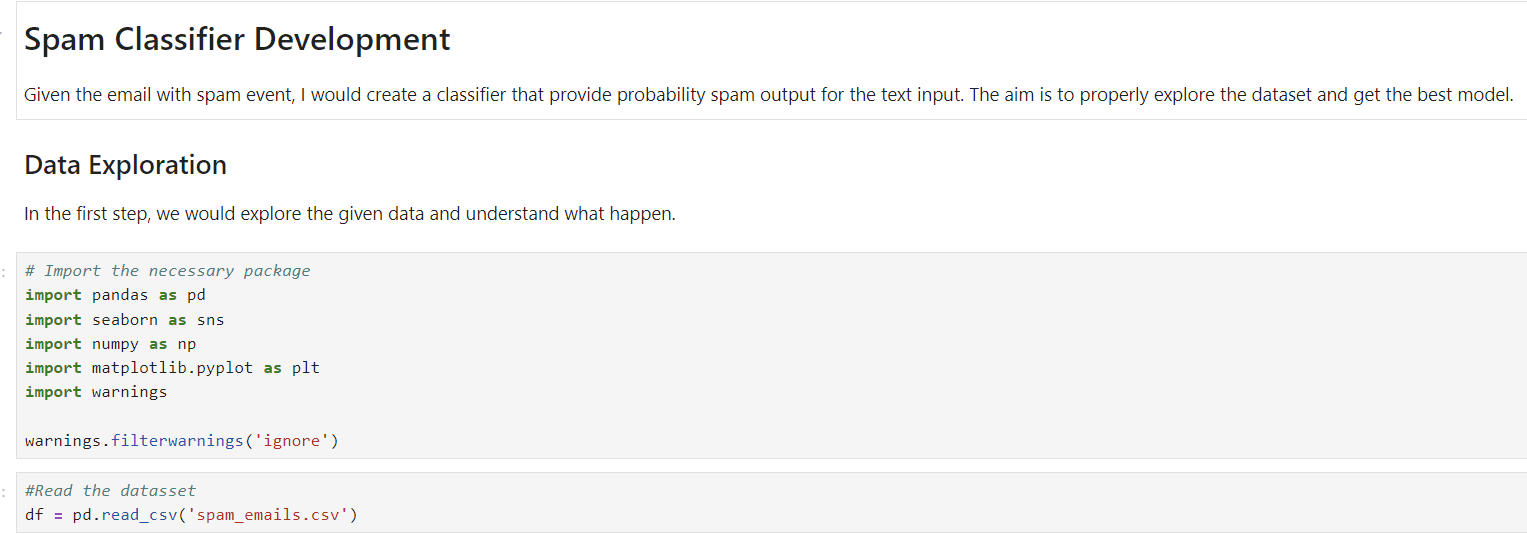
For example, the image below shows how we use Markdown to explain our project, the aim and the steps.

How To Comment Your Python Code as a Data Scientist

You can read further about Jupyter Markdown Cell in their documentation to understand further what you can do.

Conclusion

Commenting is an integral part of the data scientist activity as it helps the reader clarify what happened with the code. For a data scientist, the comment process differs slightly from the software engineer or web developer, as our work process is different. That’s why this article gives some tips that you can use for commenting as a data scientist. The tips are:

  1. Use Commenting to clarify complex processes or activities
  2. Having a Commenting Standard
  3. Use Comments to Help the Workflow
  4. Implement the Markdown Notebook Cells

I hope it helps.

Cornellius Yudha Wijaya is a data science assistant manager and data writer. While working full-time at Allianz Indonesia, he loves to share Python and Data tips via social media and writing media.

More On This Topic

  • Managing Your Reusable Python Code as a Data Scientist
  • KDnuggets™ News 22:n01, Jan 5: 3 Tools to Track and Visualize…
  • Top 18 Low-Code and No-Code Machine Learning Platforms
  • 3 Tools to Track and Visualize the Execution of Your Python Code
  • 3 Simple Ways to Speed Up Your Python Code
  • Optimizing Python Code Performance: A Deep Dive into Python Profilers

6 Influential Indian Women in AI 

Indians have been at the forefront of AI research and application. According to an article in The Economist, Last year, India surpassed China to have the highest number of graduate students studying in America.

Out of approximately 2.5 million immigrant STEM (Science, Technology, Engineering, Mathematics) workers in the U.S., 29% come from India. In the field of artificial intelligence (AI), 8% of the world’s leading researchers are Indian.

Women are not lagging behind either. As of 2022 Indians have highest AI skill penetration rates were India and this includes women!

Here is the list of Women who have achieved highest standards in ai –

Niki Parmar

Niki Parmar co-authored the revolutionary research paper Attention Is All You Need, which led to the birth of transformers. After receiving her Masters degree at University of Southern California, she began her career in research as a Research Assistant at the Computational Social Science Lab , USC. She said, “My first interest in Machine Learning developed during my undergrad as I took the first MOOCs by Andrew Ng and Peter Norvig on ML and AI.”

She later worked at Google Research and Google Brain. “Here I got the opportunity to learn and work on end-to-end Deep Learning systems that were trying to create alternative ways of solving NLP problems.”

She has published 28 papers and said, “My journey in research has involved understanding how self-attention and other inductive biases can be used to improve our models across various tasks like Machine Translation, Language Modeling, and more recently Perception.”

She then co-founded Adept AI in 2021 and since 2023 she is actively employed as the co-founder of Essential AI along with Ashish Vaswani, another author of the Attention Is All You Need paper. The startup has raised $56.5 million in funding, including funds from tech heavyweights AMD, Google, and Nvidia.”

Aakanksha Chowdhery

Aakanksha Chowdhery received the Bachelor’s degree from IIT Delhi, and went on to pursue Ph.D. degree in electrical engineering from Stanford University. “I always felt great about mentoring and teaching students but the way academic career works things did not all fall in line immediately,” she said.

Focusing on research she was a Postdoctoral Researcher at Microsoft Research and then an Associate Research Scholar at Princeton University till 2017. Talking about her experience, she said, “I got to build real things as part of my Microsoft research experience.”

Currently, she is a Staff Research Scientist at Google DeepMind. Her research contributions span across multiple areas of signal processing, machine learning, edge computing, and mobile networked systems with 51 papers published. Her work has contributed to industry standards and consortia, such DSL standards and OpenFog Consortium.

She was the primary author of the PaLM: Scaling Language Modeling with Pathways. This paper demonstrates the potential of a huge AI model with 540 billion parameters, designed to understand and create language.

Anima Anandkumar

Anima Anandkumar from Mysore, India, earned her Master’s degree from the IIT Madras and a Ph.D. in Computer Science from Cornell University. She currently holds the Bren Professorship at the California Institute of Technology, focusing on machine learning.

Previously, Anandkumar held the position of Director of Machine Learning Research at NVIDIA, where she worked on tensor-algebraic methods, deep learning, and non-convex optimisation problems. She has an impressive record of research, indicated by her h-index of 74.

Her work has been recognized with several awards, including the IEEE Fellow award and the ACM Grace Hopper Award. Her research contributions cover a range of areas including tensor methods, non-convex optimization, and addressing uncertainty and dependencies in machine learning etc.

Suchi Saria

Suchi Saria has a Master’s in Computer Science and a Ph.D. in Electrical Engineering with a focus on Statistics from Stanford University.

Now, Saria directs the Machine Learning and Healthcare Lab and is the founding research director of the Malone Center for Engineering in Healthcare and the CEO of Bayesian Health. This role involves working across departments like Computer Science, Statistics, Medicine, and Health Policy at Johns Hopkins. Her company aims to use machine learning to improve healthcare technology.

Her work has earned her several recognitions, including being named a World Economic Forum Young Global Leader. She appeared on the MIT Technology Review’s ’35 Innovators Under 35′ list and also received the Sloan Research Fellowship.

She has an impressive 109 publications on Google Scholar on healthcare, machine learning and the intersection of the two. She has developed algorithms for predicting conditions like sepsis and cardiac arrest, models for personalised care, and tools for clinical decision-making. Her work also covers causal inference and managing uncertainty in medical data, especially for chronic diseases such as scleroderma.

Parvati Dev

Parvati Dev is currently the CEO of SimTabs, a company specialising in immersive simulations for healthcare education. However she began her education at IIT Kharagpur, then she moved to California and completed her Masters and PhD at Stanford University on the intersection of technology and education.

Parvati has published 94 papers and has been instrumental in the development of surgical simulation, haptics, virtual patient simulations, and 3D anatomy models. Her efforts at Stanford University, particularly in digitalizing the medical curriculum, marked her as a leader in medical education technology.

Monisha Ghosh

Monisha Ghosh is currently a Professor at the University of Notre Dame and an Adjunct Research Professor at the University of Chicago. She studied her Bachelor’s at IIT Kharagpur in 1986 followed by a Ph.D. in Electrical Engineering from the University of Southern California in 1991. Apart from her academic contributions she was also involved in the national telecommunications policy and research.

Ghosh recently completed her tenure as the Chief Technology Officer at the FCC in June 2021. Her work focused on national strategy and technology specifications for broadband wireless communications, including the development of rules for the 6 GHz unlicensed bands, standardisation of broadband signal measurements, and advancements in open RAN technology.

Before her role at the FCC, she was a rotating Program Director at the NSF from 2017 to 2019, managing wireless networking research and pioneering applications of machine learning in wireless networks.

In addition to her policy work, Ghosh has made significant research contributions, particularly during her time as a Research Professor at the University of Chicago. Her research spanned wireless technologies for the IoT, 5G cellular systems, next-generation Wi-Fi, and spectrum sharing.

Before her academic appointments, Ghosh’s industrial research and development work included positions at Interdigital, Philips Research, and Bell Laboratories.

The post 6 Influential Indian Women in AI appeared first on Analytics India Magazine.

Low-code and no-code development gets a makeover as priorities shift to AI

Coding abstract in cube form

The low-code and no-code market is big and will get even bigger. What's more, the addition of AI-based assistance to these tools could lead to even greater market growth.

The low-code and no-code market is worth $13.2 billion globally, with a growth rate of roughly 21% annually since 2019, according to research by Forrester analyst John Bratincevic. He says this growth stems from "the institutionalization of low code in IT," with 87% of enterprise developers working with low-code and no-code tools or platforms. Citizen developers will triple the size of this market by 2030, he continues: "The democratization of development to workers outside of IT shows no signs of slowing down."

Also: How to use ChatGPT to write code

AI is the key factor that could help to further accelerate this market — up to $50 billion within the next four years. AI will lead to more citizen developer involvement, Bratincevic states. Conversely, he adds: "AI-infused development platforms (TuringBots) could make traditional high coding so productive that professional developers reject low code and switch back to high coding everything."

AI's impact on the course of low- and no-code development might fall somewhere in between, he states — with healthy growth fueled by the integration of AI and low- and no-code platforms.

Also: Okay, so ChatGPT just debugged my code. For real

Still, it should be noted the capability to deliver AI applications with low-code platforms — assuming the citizen or professional developer is ready to do it — can be problematic. High levels of development skills are still needed. "The language that is used to develop gen AI is not really English," Rodrigo Coutinho, co-founder and AI lead at OutSystems, pointed out in a recent podcast hosted by Amazon Web Services.

"You do need to learn the dialect," he urges. "Right now, you need courses in engineering, because you need to learn in a way that the machine can understand what you're saying. Even though the words are the same, you don't really talk to it as you would to a person."

This language barrier may impede the long-heralded democratization of software development, he continues: "It's not as complicated as C# or JavaScript. But it's a language that you need to learn in order to be able to develop."

It's also important to note that there's still a major distinction between AI-assisted development and low- and no-code development. "Gen AI brought a huge boost in productivity for traditional developers, but they still need to know what they're doing," says Coutinho.

"To use gen AI tools for traditional code, you still need to be an expert. Even though a lot of the work is done by the machine, you still need to be able to read the work that was created, understand it, adapt it to your own needs, and change it. The first version of the application is just that."

Also: How to use ChatGPT to create an app

Therefore, it's probably too soon for inexperienced developers to work directly with generative AI to build applications, agrees David Isbitski, principal developer advocate at Amazon Web Services, who joined Coutinho in the podcast. Unless you are familiar and experienced with programming, "you don't know what you don't know." AI-enabled development takes not only technical experience, but also a sense of what and how the code needs to be mapped to the business process.

"If you've been coding for some time, you know as a human being how to do a process," says Isbitski. "You can change that process into code. But someone who hasn't written software before wouldn't know what to ask."

As AI does enter the development workstream, the technology might be tapped as an empathetic assistant. The ideal AI assistant within a low-code environment "can analyze my thought process," says Isbitski. "This is how I wrote this code, this is what it will do, and this is how it's been enabled. It seems like magic. It's that encouraging and making sure things are correct."

Ultimately, an ideal AI assistant can better understand the context in which software is being written and deployed, he continues: "As human beings, we know all these things, what day it is, the climate of the world, that AI hasn't known. These are things that are important to the output. Bringing that stuff back, as you're having these conversations as you're writing code, is incredibly powerful.

Also: How to write better ChatGPT prompts

The goal of AI-assisted software development is to "allow people to learn and improve themselves," says Isbitski. "Instead of just giving people the answers, give them the chance to come to answers themselves. It's incredibly powerful as a teaching tool. Maybe because these gen AIs and LLMs are truly a reflection of us."

Ultimately, AI-infused development should lead to fresh opportunities for developers. "In leading teams, a big chunk of their jobs is to look at code by their juniors and make sure it's okay, meets the requirements, has quality, and so on," says Coutinho. "That's one of the impacts that gen AI will have on the life of the developer. The individual contributor is the gen AI, and you are the team lead that will make sure everything is alright."

Artificial Intelligence

Samsung Brings AI Capabilities to Galaxy S24 Buds

After unveiling the Samsung Galaxy S24 series with new AI capabilities on the smartphones calling it Galaxy AI, the company has rolled out Galaxy AI features on Galaxy Buds2 Pro, Galaxy Buds2, and Galaxy Buds FE through an over-the-air (OTA) update.

The update will allow users to harness new features such as Live Translate. With Live Translate, real-time call translation is displayed on the Galaxy S24 series screen while communicating via Galaxy Buds, facilitating seamless two-way face-to-face interpretation.

The AI-driven interpreter feature on the Galaxy S24 series allows users to speak into the Buds mic, with their translated voice available on the Galaxy S24 series, fostering natural conversations. This eliminates the need to hand over phones for translated talking, enhancing user convenience.

The Galaxy Buds2 Pro offers 24-bit hi-fi sound quality, improved 360 immersive audio, and intelligent Audio Noise Cancellation (ANC). Galaxy Buds FE delivers an industry-leading sound experience with powerful bass, Active Noise Cancellation (ANC), and Ambient Sound, providing users with an immersive music experience.

Galaxy AI

The advanced AI capabilities are powered by Google’s technology. Features such as ‘Circle to Search’ and ‘Live Translate’ leverage Google’s expertise in AI. Samsung is also the first Google Cloud partner to deploy Gemini Pro and Imagen 2 on its devices. This collaboration also extends to partnerships with other tech giants like Microsoft, bringing Copilot features to Galaxy phones.

Additionally, Samsung phones will now receive seven years of security updates and seven generations of OS upgrades, a significant enhancement from their earlier announcement and aligning with Google’s Pixel devices.

The post Samsung Brings AI Capabilities to Galaxy S24 Buds appeared first on Analytics India Magazine.

Siemens is Bringing Generative AI to the Factory Floor

In most manufacturing facilities, about 70% of the issues arising on the factory floor go unreported. This occurs because there isn’t a streamlined method for line workers to promptly document and capture the issues they encounter.

Bob Jones, executive vice president, global sales and customer success at Siemens Digital Industries Software, believes there is a need for a more efficient process that allows for quick documentation, providing enough information for engineers to take effective action against specific issues.

To solve this problem, Siemens turned to AI and partnered with Microsoft to integrate Microsoft Teams with its Teamcenter X, a cloud-based product lifecycle management (PLM) software.

“For instance, in one of our client’s manufacturing facilities in Malaysia, a robot was not performing as desired and consuming more energy. By leveraging Team Centre X, the line workers fed the information about the malfunctioning robot into their smart devices, and an AI transformed it into a structured problem report,” Jones told AIM.

This made the data accessible instantly and allowed engineers sitting in a different geography to again leverage AI to figure out if similar problems have been encountered before in their enterprise.

“Once the problem was identified, generative AI was used to rewrite the codes as opposed to having an engineer take their time to write the code. So by leveraging generative AI, the client saved time and also improved the quality of that code,” Jones explained.

The power of AI on the floor

The company also uses generative AI to translate support documentation into virtually any language using AI. In fact, according to Jones, the company is already on the verge of achieving this without requiring human validation.

Siemens is also using generative AI to create knowledge documents. Traditionally, a domain expert would craft a document detailing a particular process or task. However, AI can now autonomously generate these knowledge documents.

“For instance, we recently generated one following an online support call, where customer interactions with support engineers were captured in text. The AI then constructed a knowledge document based on this interaction,” Jones said.

Siemens is not just limiting its clients to the LLMS available at Microsoft Azure OpenAI services. At CES 2024, Siemens also announced its partnership with AWS, to benefit from the Seattle-headquartered hyperscalers advancement in generative AI.

Moreover, Siemens is also making tremendous progress in edge AI. Jones believes it makes sense for clients to run AI models on the edge then on the cloud.

Huge demand for industrial metaverse

Fascinatingly, in addition to its focus on AI, Siemens is placing significant emphasis on the industrial metaverse. During CES 2024, Siemens and Sony Corporation unveiled a groundbreaking solution.

This innovative offering integrates Siemens Xcelerator industry software with Sony’s spatial content creation system. The system features an XR head-mounted display equipped with high-quality 4K OLED Microdisplays and controllers, facilitating intuitive interaction with 3D objects.

Through this partnership, designers and engineers gain the capability to generate and explore design concepts within an immersive, borderless workspace. This cutting-edge solution is poised to catalyse content creation for the burgeoning industrial metaverse.

Siemens is already seeing great demand, and according to Jones, customers are calling them left and right. “It’s one of the few things we don’t have to market that hard,” Jones continued, “The industrial Metaverse generates enthusiasm for its potential benefits to global manufacturers.”

So far, an automotive manufacturer in Japan and several customers in the US are engaging with Siemens for the industrial metaverse.

Betting on the transition to EVs

Siemens’ technology is utilised by the leading 23 electric vehicle (EV) manufacturers worldwide, along with the top 20 traditional automotive manufacturers. Notably, China-based EV giant BYD, recognized as the largest EV manufacturer by volume, relies on Siemens for its operations.

“VinFast, an automotive company based in Vietnam, utilised our technology to design a vehicle, establish a plant, and commence production within an impressive 21-month timeframe. We played a pivotal role in supporting them throughout this journey.

“Additionally, the recent complete adoption of our technology by a Saudi Arabian car company called Ceer also adopted our technology,” Bas Kuper, senior vice president and managing director, Asia Pacific at Siemens Digital Industries Software, told AIM.

Automobiles constitute Siemens’ largest industry in terms of sales volume. The ongoing industry transition from combustion engines to electric vehicles (EVs) not only provides a platform for innovation but also represents a significant revenue opportunity for the company.

“We observe several major players in the automotive industry reconsidering their landscape, presenting a significant growth opportunity for us. Most of these companies are present in the Asia-Pacific region. With China leading the way, notably, companies like Nissan in Japan are also actively undergoing this transformative journey,” Kuper added.

Ramping up investments in India

Siemens has already established a strong presence in the country due to its continued investments in the last three decades. It has established itself as a preferred solutions provider for prominent automotive OEMs in the country, such as Maruti Suzuki India, Tata Motors, Mahindra & Mahindra, Bajaj Auto, Hero Motors, and Sonalika Tractor.

Recently, emerging electric vehicle startups such as Ola Electric, Ather Energy, and Simple Energy have also become part of the Siemens network. Additionally, major players in the Tier-1 supplier ecosystem, including Motherson Sumi, rely on Siemens’ solutions as key customers.

“India holds immense importance as a growth market for us, ranking amongst the top 10 countries globally for the software business. The country serves as a key hub for accelerating digitalization worldwide, with cloud transformation progressing at a much faster clip. We anticipate this growth momentum to persist and remain committed to ongoing investments in this market,” Mathew Thomas, country manager and managing director at Siemens Digital Industries Software, told AIM.

Given India’s strong emphasis on manufacturing and the fact that India is on its way to becoming the third largest economy in the world is an indicator for Siemens to ramp up investments in the country, according to Jones.

“When you talk in the context of smart connected products, we believe India is well positioned as a country to take advantage and really benefit from it. I feel India is ahead of the curve, at least ahead of the US, in terms of digitalisation of their country.”

Moreover, India’s large population is also its biggest asset. “What’s even more important is that it’s a young population and India has made the right moves and continues to educate their population,” Jones concluded.

The post Siemens is Bringing Generative AI to the Factory Floor appeared first on Analytics India Magazine.

Researchers from China Release ChemLLM for Chemistry

Researchers from China Release ChemLLM for Chemistry

​​Researchers from Fudan University, Shanghai Jiao Tong University, Wuhan University, The Hong Kong Polytechnic University, The Chinese University of Hong Kong, and Shanghai Artificial Intelligence Laboratory have jointly developed ChemLLM, a revolutionary Chemical LLM engineered to address a wide array of chemical tasks through fluent dialogue interaction.

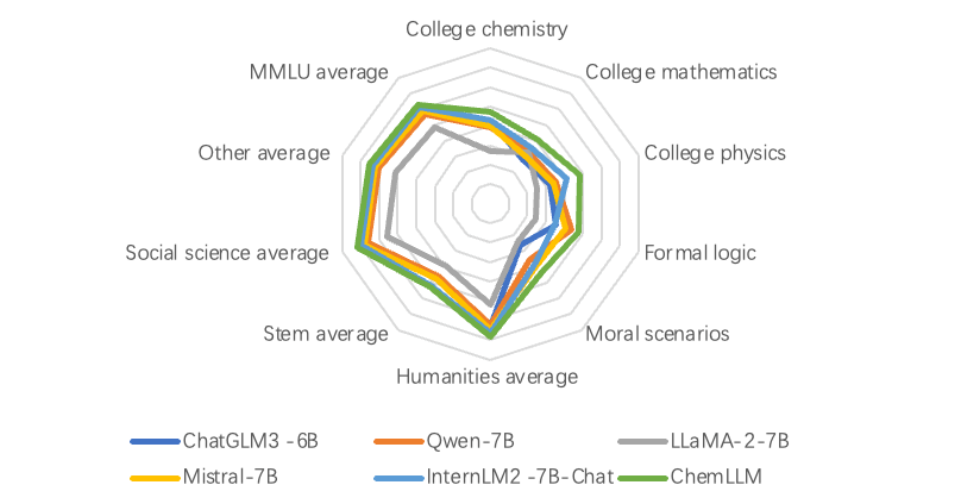
ChemLLM, the inaugural language model explicitly tailored for chemistry, has surpassed established benchmarks, including outperforming GPT-3.5, on pivotal chemistry tasks such as molecule recognition, property description, and reaction prediction. It is built on top of InternLM-2.

Click here to check out the model on Hugging Face.

This pioneering model not only showcases exceptional adaptability across various chemical disciplines but also demonstrates proficiency in specialised NLP tasks within the domain.

Traditional language models have encountered challenges in effectively utilising structured chemical data, often leading to compromised coherence in dialogue. To overcome this hurdle, researchers have devised a template-based instruction construction method, seamlessly transforming structured chemical knowledge into a dialogue-friendly format for model training. This innovative approach ensures ChemLLM’s ability to maintain fluent dialogue while handling diverse chemical tasks with precision.

In addition to its core competency in chemistry tasks, ChemLLM demonstrates remarkable versatility in related mathematical and physical domains, despite its primary training on chemical-centric data.

Furthermore, the model exhibits proficiency in specialised NLP tasks within chemistry, such as literature translation and cheminformatic programming, highlighting its comprehensive utility within the domain.

While ChemLLM represents a substantial leap forward in text-based chemistry applications, it is imperative to acknowledge inherent limitations. Challenges include integrating molecular graph modalities crucial for understanding molecular structures and interactions.

Additionally, concerns regarding adherence to scientific ethics, particularly in generating responses under extreme conditions, necessitate ongoing refinement to enhance functionality and ethical governance.

For those eager to delve deeper into ChemLLM, codes, datasets, and model weights are publicly accessible for reference and utilisation, fostering collaboration and innovation within the scientific community.

Read: India vs China vs US in Open Source AI

The post Researchers from China Release ChemLLM for Chemistry appeared first on Analytics India Magazine.
Norton Launches Dark Web Monitoring in India

Consumer cyber safety firm Norton announced the launch of Dark Web Monitoring in India, now available in Norton 360 Premium, Norton 360 Deluxe and Norton 360 for Gamers.

The dark web is a small part of the web where anonymity is prized and nefarious activities can run amok, including the exchange of illegal goods and information. When people’s addresses, Aadhaar numbers, EPF information, credit card data and other personally identifiable information end up on the dark web, criminals can utilize it for fraud, from financial to identity theft.

Unfortunately, it’s not uncommon for this information to end up in the wrong hands – in 2023 it was announced that the Aadhaar numbers, passport information along with names, phone numbers of 815 million Indians were found on the dark web.

“We keep an eye out for any hacks, compromised credentials, and illegal activity by continuously searching the shadowy corners of the internet. This way, we can make sure that your sensitive information is protected from prying eyes of hackers,” Ritesh Chopra, India Director, Gen said.

“Our Dark Web Monitoring feature actively searches the dark web for your email address and other personal data you choose to register and issues a notification should that data be discovered. With Dark Web Monitoring we are offering another tool to help protect and empower people to live their digital lives more safely,” he added.

Norton is a leader in Cyber Safety, and part of Gen, a global company dedicated to powering Digital Freedom with a family of trusted consumer brands. Norton empowers millions of individuals and families with award-winning protection for their devices, online privacy, and identity.

The post Norton Launches Dark Web Monitoring in India appeared first on Analytics India Magazine.