Perplexity AI was voted the startup “most likely to fail” at the Cerebral Valley AI Conference in San Francisco last week.
More than 300 founders, investors and operators ranked the fast-growing answer-engine company at the top of a list of high-valuation AI firms facing the highest perceived risk. The company was followed by OpenAI.
The survey was led by organiser and independent journalist Eric Newcomer. The poll, conducted during a closed-door session, immediately became the most discussed outcome of the event.
Attendees said the scepticism is driven by Perplexity’s soaring valuation and its rapid push into new markets without demonstrating a clear, defensible business model.
Perplexity AI’s most recent valuation stands at $20 billion, achieved after its latest funding round in September 2025, where it raised $200 million from top-tier investors.
Despite positioning itself as a challenger to traditional search, several investors argued the company has yet to show sustainable monetisation or meaningful differentiation from larger AI players.
The company recently rolled out upgrades to its Comet Assistant to deliver faster and more accurate answers, along with enhanced privacy controls such as a new Snapshot feature.
Notably, Amazon recently accused Perplexity and issued a legal threat to prevent users from using its AI assistant, Comet, to make purchases on Amazon’s platform.
Meanwhile, the vote also reflected broader concerns about a potential AI investment bubble. Many participants warned that valuations across the sector have outpaced financial fundamentals, leaving companies that scale aggressively like Perplexity increasingly vulnerable to market correction.
Some founders described the sentiment as a “reality check” for startups relying on hype rather than proven revenue paths.
While the result is not a forecast of immediate collapse, it signals a shift in investor expectations as the industry moves from experimentation to financial accountability.
For now, Perplexity maintains strong brand visibility and significant funding, but insiders say the next year will determine whether the company becomes a breakout success or an early casualty of the overheated AI race.
The post Perplexity AI Rated ‘Most Likely to Fail’ by Investors at Major SF Summit appeared first on Analytics India Magazine.
NVIDIA recently became the first publicly listed company to cross a $5 trillion market capitalisation. India, however, is yet to see a homegrown company touch the trillion-dollar mark. Reliance Industries Limited currently holds the highest valuation.
India’s own NVIDIA moment will arrive via industrial AI and robotics, according to Amey Mashelkar, head of JioGenNext. Fusion of data, automation, and real-time intelligence will drive major breakthroughs, he told AIM.
However, that process will take its time. “NVIDIA wasn’t built in a moment,” he said, adding that the company spent decades pushing through ups and downs.
Mashelkar believes India must take a long-term view. “It’s a multi-decade marathon. We have to keep building, keep pushing—and one day we’ll look back and say this was the moment everything changed,” he said, adding that India is firmly “on the right path.”
Building on that optimism, Reliance JioGenNext has evolved from a startup accelerator to being a national deep tech engine aiding early founders across AI, retail, industrial systems, and infrastructure turn ideas into real, scalable solutions.
Mashelkar said that JioGenNext has moved beyond being a regular accelerator. It has evolved into a market-access engine, one where startups earn what Mashelkar calls “the one credential money can’t buy.”
“If your technology works at Reliance scale, it works anywhere in the world.”
The flagship program is the Market Access Program (MAP), which annually onboards startups, offering guided access to Reliance and Jio ecosystem resources, mentors, investors, and opportunities to develop proofs of concept (PoCs). This year’s MAP 2025 cohort features 21 deep tech startups building new tools such as robot-training world models, smart grid security systems, blockchain-based finance platforms, and drone-powered digital twins for infrastructure.
Among startups backed by JioGenNext, Asteria Aerospace is a notable example, actively pursuing international expansion, focusing on scaling drone technology and data analytics solutions across key global industries. In early 2025, Asteria Aerospace signed a memorandum of understanding (MoU) with Drone Destination to expand its drone-based services into international markets.
What is so special about Reliance?
Mashelkar said that while most accelerator programs groom founders. JioGenNext validates technology inside real production environments.
“Earlier, founders needed mentorship on how to build or scale. Today, there’s enough advice in the ecosystem. What startups lack is enterprise-scale validation—and Reliance has a massive appetite for integrating new technology.”
Mashelkar explained that JioGenNext’s POC runs as a structured four-phase program over roughly 90 days, though timelines can vary depending on complexity. Once a solution proves itself and enters the commercial phase, “sky’s the limit,” he said.
On what it takes for a startup to actually scale inside Reliance, the first non-negotiable is building trust, Mashelkar said with clarity. A founder must convince the stakeholders about their value proposition and establish a strong working relationship internally, something that requires time, follow-ups, and consistent engagement, he added.
For the POC itself, the success criteria are even more specific. Mashelkar said the outcome must be measurable and must show clear improvement over the baseline, ideally exponential impact rather than incremental gains. Integration readiness is another must-have, especially given Reliance’s many legacy systems.
Bridging Innovation and Industrial Scale
Speaking about India’s ₹1 lakh crore RDI mission, Mashelkar said the initiative sends a clear signal that the country wants to shift from importing innovation to owning it across AI, semiconductors, clean energy, and advanced manufacturing.
He explained that JioGenNext sits at the intersection of research, startups, and large-scale deployment, operating as a bridge between ideas in the lab and technologies that work in the real world.
“When a technology is in the lab, it is only a promise, but when it is deployed at scale, it becomes proof.”
JioGenNext works to fill this “missing middle” between research and commercial rollout by de-risking innovation, speeding up the lab-to-market cycle, and strengthening business confidence for scale.
The post When Will ‘NVIDIA Moment’ in India Arrive? appeared first on Analytics India Magazine.
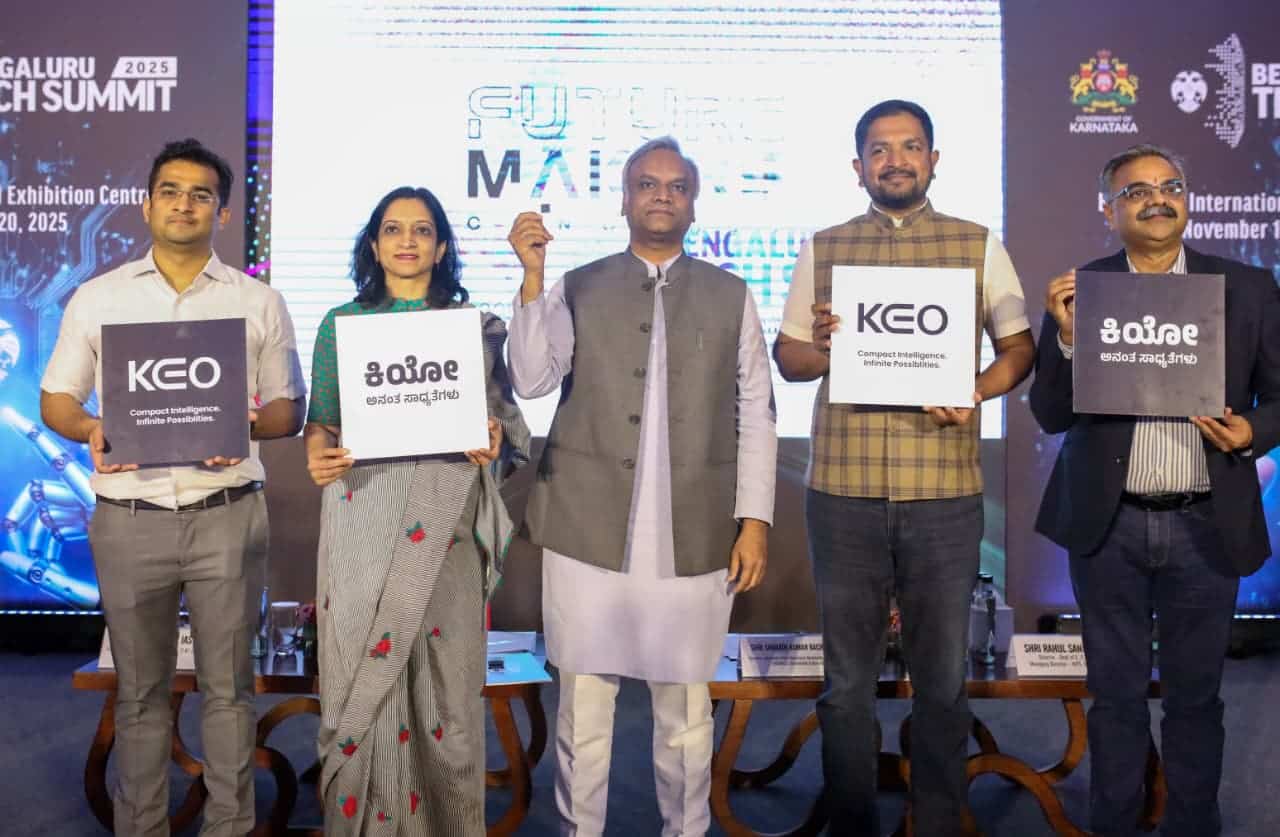
Karnataka on Monday unveiled KEO, an AI-powered, fully open-source personal computer developed under the state’s electronics, IT & BT department in partnership with the Karnataka State Electronics Development Corporation Ltd (KEONICS).
The device, India’s most affordable PC with an onboard AI core, marks what the government is calling a milestone in democratising access to computing and artificial intelligence.
Ahead of the official launch on November 18 by chief minister Siddaramaiah and deputy CM DK Shivakumar at the Bengaluru Tech Summit, Karnataka IT minister Priyank Kharge called KEO “world’s first (such) initiative taken up by a state.” Explaining the rationale behind it, Kharge said accessibility to smartphone, internet is more than 90% but when it comes to serious online learning or computing, there is not enough affordable hardware in urban, tier-2 towns or rural areas. This gap leaves students from these areas out of the learning bracket, though India’s digital economy is growing at a fast pace, he added. “The idea is to take computing to the grassroots and make it more affordable, not just learning,” he said. Kharge said KEO stands for Knowledge-driven, Economical and Open Source. “It is not a luxury device, it is an inclusive device,” he said, adding that it took just a year for the government to unveil KEO. Kharge said KEONICS is doing what it is supposed to do after getting deviated in the past, when it “missed the previous electronic revolution”.
“The department of IT and BT and KEONICS will be accelerating the future of electronics and AI for India from Karnataka,” he stressed. Stating that the government wants to make Karnataka the RISC-V capital of India, Kharge shared the vision to turn Karnataka into a hub of processor designing and architecture testing, where new AI hardware solutions are built for the world.
Inside KEO
KEONICS chairman Sharath Bachegowda said the project represents “inclusion, innovation and access to computing at the grassroots.”
The KEO has been engineered entirely in Bengaluru, from chip design to device architecture. Its RISC-V based processor and Linux-Ubuntu operating system make it one of the country’s first end-to-end open-source personal computers.
“The ethos of KEO is open source,” Bachegowda said.
He added: “We asked ourselves: How can we get out of the proprietary ecosystem? How can we build a new ecosystem where students, rural innovators and young creators can build technology instead of just consuming it?”
Every component and tool, from the OS to AI models, programming environments, and productivity suites, is open-source and licence-free.
A defining feature of KEO is its 4-TOPS (Trillions of Operations Per Second) edge AI engine, enabling local AI computation without relying on the cloud.
“This is India’s first AI PC capable of four trillion operations per second,” Bachegowda said. “We’ve created a solution where AI is deployed on the edge, programming, inference, and even LLM computation can happen offline, on a compact device.”
KEO also includes an AI chatbot called Buddh trained exclusively on the state DSERT curriculum, offering instant academic assistance for students from Classes 8 to 12. “Students can ask questions in science, maths or social science and get answers within a fraction of a second,” he said.
KEO’s development took nearly a year, with repeated hardware iterations and field tests aimed at ensuring ruggedness and reliability in rural environments.
Connectivity options include 4G, Wi-Fi, Ethernet, USB-A and C ports, HDMI, and audio jacks.
Cost was treated as a core engineering priority. “We’ve kept affordability as a high mark,” he said. “This is a mass computing solution, every feature of a modern computer in a compact, low-cost form factor.”
Broad applicability
The initiative has already secured early buy-in: Shikshana Foundation, an education-focused organisation, has pre-booked 500 units for deployment across schools.
While early use cases centre around education, the state envisions broad applicability across public and private sectors.
“The potential and opportunities are multiple,” Bachegowda explained. “We can deploy KEOs in hospitals, pharmacies, police stations, government offices, SMEs, startups and homes. We’ve built a purpose-designed device for every application.”
When asked if the government is planning to replace the existing computers in the government departments with KEO, Kharge said the use case in the government is currently in the education sector. He added that once KEO is competent there, it will see heavy deployments across the departments. On whether the government has acknowledged or made contributions to the open source community maintaining these tools, Kharge said that they have not reached out. “They don’t know yet. Once they know, they will reach out,” he said. Kharge said that over the past year, the government closely examined earlier public-technology efforts like the Aakash tablet and the Simputer, projects that were ambitious but ultimately stumbled due to execution gaps, quality issues and the lack of a supporting ecosystem. He said that the success of KEO will depend entirely on how well we design the blueprint and avoid those pitfalls.
“We are determined not to repeat the same mistakes,” Kharge said.
The post Karnataka Unveils India’s First Open-Source AI PC for the Masses appeared first on Analytics India Magazine.
Sarla Aviation announced that it will invest ₹1,300 crore to set up a 500-acre aerospace manufacturing facility in Andhra Pradesh. The project will develop electric vertical take-off and landing (eVTOL) aircraft, aiming to accelerate India’s transition to aerial mobility.
The facility will function as an integrated Urban Air Mobility (UAM) campus, encompassing manufacturing, flight testing, certification, training, and maintenance all under one roof. According to reports, the company said that it aims to position India as a global contender in future aviation technologies, with an initial investment of ₹1,300 crore and significantly adding more in the future.
The complex will be India’s first end-to-end ecosystem for eVTOL manufacturing and operations. Built to international aerospace standards, it will have the capacity to produce up to 1,000 aircraft a year, placing it among the world’s largest eVTOL manufacturing hubs. The company also said, “This giga facility will shape the aircraft of the future, create thousands of high-skill jobs, and establish India as a global force in sustainable aerial mobility.”
The site will include manufacturing lines for composites, powertrains, wire harnesses, landing-gear systems, flight-control computers and embedded systems. It will also house India’s largest wind tunnel, a two-kilometre runway, VTOL testing pads, R&D labs, simulation environments, pilot training centres, and MRO units.
Sustainability features will include renewable energy systems, water recycling, and zero-liquid-discharge processes, along with biodiversity zones. Sarla Aviation is collaborating with the Andhra Pradesh government on certification infrastructure, R&D support, and UAM corridors, including planned vertiports.
The company expects these systems to enable commercial air-taxi operations across major South Indian cities by 2029. Commercial routes such as Bengaluru, Hyderabad, Chennai and Kochi are among the early geographies under consideration for UAM services.
Previously this year, Sarla has raised$10 million in a Series A1 round led by Accel, with participation from the founders of leading Indian tech companies. The company’s early partnership discussions began with Bengaluru International Airport for future air-mobility trials.
The post Sarla Aviation to Invest ₹1,300 Cr & Set up Aerospace Facility in Andhra Pradesh appeared first on Analytics India Magazine.
HCLTech and NVIDIA have announced the launch of a new Physical AI Innovation Lab in Santa Clara, California, aimed at accelerating enterprise adoption of physical AI and cognitive robotics.
The facility is integrated into HCLTech’s global AI Lab network and is designed to help global enterprises experiment with, incubate and scale advanced physical AI applications.
The lab will leverage the full NVIDIA technology stack, including NVIDIA Omniverse, NVIDIA Metropolis, NVIDIA Isaac Sim, NVIDIA Jetson and NVIDIA Holoscan, in combination with HCLTech’s portfolio of physical AI solutions such as VisionX, Kinetic AI, IEdgeX and SmartTwin.
The goal is to enable Global 2000 organisations to simulate, test and deploy robotics, automation and edge intelligence systems that improve competitiveness and real-world operational efficiency.
“Generative physical AI is set to revolutionize industrial automation, but bridging the gap from digital simulation to real-world deployment remains a critical challenge,” said Deepu Talla, VP of robotics and rdge AI at NVIDIA.
“HCLTech’s innovation lab will help enterprises develop, test and validate the complex autonomous systems needed to turn AI ambitions into operational reality.”
Vijay Guntur, CTO and head of ecosystems at HCLTech, said the collaboration strengthens the companies’ joint focus on industrial AI.
“By combining HCLTech’s global AI Engineering capabilities with NVIDIA’s cutting-edge platforms, this new collaboration marks a pivotal step in strengthening our synergy in the Physical AI space,” Guntur said.
“It empowers enterprises to reimagine physical operations, driving breakthroughs in robotics, automation, safety and operational intelligence, reinforcing our commitment to scaling AI-led transformation across industries and further deepening our strategic collaboration with NVIDIA.”
HCLTech’s physical AI solutions integrate robotics, autonomous systems, intelligent edge technologies, simulation and digital twins to help enterprises enhance productivity, resilience and sustainability in live operational environments.
The company said it is already working with several Global 2000 clients in the physical AI domain, including a major port operator, a global hi-tech leader and a Europe-based mining company.
The post HCLTech, NVIDIA Launch Physical AI Innovation Lab in Santa Clara appeared first on Analytics India Magazine.
Years ago, a teenager preparing for the IIT entrance exam moved into co-founder Anand Prakash’s home for a few months. What happened next became folklore inside Vedantu. The child’s rank shot up dramatically, not because the syllabus changed, but because someone watched his journey every day, caught his dips in confidence, and helped him course-correct in real time.
But this story goes even deeper, it’s the founding spark that built Vedantu itself. Founded in 2014 by Vamsi Krishna, Prakash and Pulkit Jain, Vedantu was born from a simple but radical belief: great teaching is deeply personal, not industrial. Their first mission wasn’t to scale content, it was to scale true mentorship, the kind Anand provided to that one student. This founding philosophy eventually shaped every product decision, every model, and finally, Ved, India’s first AI mentor, designed to behave like a real human guide.
“If one Anand can change one life so profoundly… what would it take to give that level of mentorship to every child in India?” Jain told AIM, emotionally sharing the origin of Ved, India’s first AI mentor designed to deliver human-like academic guidance to every student, which the company launched a few days ago.
The timing couldn’t have been better. Vedantu recently turned profitable in Q4 FY25, raised new capital, expanded its hybrid learning footprint, and is now preparing for an IPO in 2027.
The launch signals a major shift for India’s edtech sector, from distributing content to scaling mentorship, from generic doubt-solving to understanding each student’s complete learning journey.
“Content was never the problem in Indian education. The real gap was knowing exactly what a student needs next, not once a week, but every single day,” shared Jain, in an exclusive interview on Front Page by AIM Network.
Why AI Mentorship
For over a decade, Vedantu solved the access problem: millions of students could finally attend high-quality Master Teacher classes from anywhere in the country. But one element remained stubbornly unscalable—continuous and deeply personalised mentorship.
Jain told AIM that this became obvious early on. “Students don’t drop out because they can’t understand a topic. They drop out because somewhere in the middle, they lose confidence and no one catches it in time.”
In high-pressure exams like JEE and NEET, this “confidence collapse” is where ranks fall off a cliff. Beyond the first few lakh ranks, marks often drop to near zero, not for lack of knowledge, but because students mentally disengage midway.
Ved is built exactly for this forgotten zone. It tracks how a student learns, where they drift, what patterns signal fatigue, and when they need a nudge. Instead of simply answering questions, it anticipates gaps and guides students back onto a structured path.
“A great teacher changes what you understand. A great mentor changes your journey. Ved is our attempt to give every child that journey, consistently, patiently, every single day,” Jain said.
Inside Ved
Ved is a multi-layered mentoring intelligence built on top of millions of hours of Vedantu’s proprietary learning data.
Years of Master Teacher interactions, classroom dialogues, student attempt patterns, lecture transcripts, handwritten solutions, behavioural signals, and test histories form the backbone of the system. This gives Ved what Jain calls a “context memory that finally lets AI behave like a mentor, not a machine.”
When a student asks a doubt, Ved identifies the root concept behind the confusion and instantly generates a LearnList with videos, SmartNotes and practice problems. During test analysis, it breaks down time usage, confidence levels and attempt style, translating it into an actionable improvement plan rather than just a correctness report.
“Different large models give us language understanding. But the mentoring behaviour, like the empathy, the direction, and the clarity, comes from years of how our teachers have guided students. That’s our real moat,” Jain said.
“The goal,” he added, “is that a child never feels alone in their learning. Ved should be the senior who’s always sitting next to you, quietly guiding you through the tough parts.”
The AI Layer Powering Vedantu’s 2027 IPO Ambition
The launch of Ved also marks a strategic milestone in Vedantu’s comeback story after the pandemic boom and subsequent edtech winter. Instead of scaling blindly offline like many competitors, Vedantu paused, experimented, and then built a hybrid model where technology standardises quality across its 65+ centres.
Regional content strategies lowered acquisition costs; local YouTube channels now reach nearly two crore students monthly. Most importantly, profitability returned in FY25, giving Vedantu the operating discipline it needed to prepare for public markets.
Ved is now the centrepiece of that vision. “AI will not only improve outcomes,” Jain said, “it will make our entire service delivery more predictable. When you want to build a public company, predictability matters more than hyper growth.”
For paid users, Ved deepens the personalisation layer using class history and test data. For free users, Ved democratises high-quality guidance through conversational mentoring and structured content paths. This dual structure expands reach while keeping premium offerings outcome-driven, a key advantage as Vedantu positions itself for a listing in 2027.
“Our job over the next two years is simple: build trust, build outcomes, and build systems that scale. Ved is at the heart of all three,” Jain said, sharing Vedantu’s roadmap for the next phase of growth.
The post What If Every Kid in India Had an Anand? appeared first on Analytics India Magazine.
Disseqt AI has teamed up with HCLTech and Microsoft to push agentic AI deeper into the banking stack. The Ireland-based startup is positioning its lean agent tools as a simpler way for banks to handle critical IT and DevOps work. The pitch is to bring faster testing, cleaner monitoring, tighter governance.
“Our partnership with HCLTech and Microsoft validates our mission of bringing intelligent, agent-based automation to the heart of enterprise IT,” Apoorva Kumar, founder of Ireland-based Disseqt, said. “By embedding trustworthy AI into core ITOps and FinOps processes, we’re enabling organisations to break free from tedious cycles of testing and monitoring, and instead embrace secure, scalable AI transformation.”
At a roundtable in Ireland, the three companies walked financial institutions through live demos that showed how agentic tools can strengthen processes when paired with proper oversight. Leaders from banks, tech firms, and regulatory circles discussed what real adoption looks like inside large systems.
Disseqt says its platform uses simulations, red teaming, and live observability to flag risks early, stop system drift, and stay aligned with Responsible AI rules. The firm claims up to 80% cost cuts, up to 70% faster production cycles, and a 40% jump in testing output.
HCLTech has been expanding its agentic AI work this year. In March, it rolled out a suite of tools built with Google Cloud’s Agentspace to give enterprises a common layer where agents can work directly with data and applications.
The post Disseqt AI Joins HCLTech and Microsoft to Pull Banks Into the Agentic AI Era appeared first on Analytics India Magazine.
Azimuth AI and Cyient Semiconductors launched India’s first-generation IP-powered silicon chip, ARKA GKT-1, in New Delhi on November 17. The companies introduced the chip to support edge AI, smart energy, and industrial systems.
The launch took place at an event where Ashwini Vaishnaw, union minister for electronics and IT, unveiled the chip. The firms developed the platform to address high-efficiency computing needs and real-time intelligence at the edge.
Cyient said the collaboration supports India’s semiconductor mission. Krishna Bodanapu, executive vice-chairman and MD, said that the programme shows “true custom ASIC turnkey solution” and covers work from design to fab, OSAT management, and final chip delivery.
ARKA GKT-1 will serve sectors such as smart utilities, battery systems, industrial automation, and smart city infrastructure. The chip also integrates multi-core computing, analogue sensing, memory, and power management.
The companies built the device using Azimuth AI’s Software-Defined Silicon framework and Cyient’s expertise in mixed-signal and low-energy ASIC design. The goal is to enable domestic and global clients to deploy intelligent edge hardware.
“The ARKA GKT-1 showcases India’s capability to design and develop world-class semiconductor technologies for critical global industries. This milestone reflects our nation’s accelerating progress toward self-reliance, advanced manufacturing, and leadership in next-generation chip innovation,” Vaishnaw said during the launch.
Praveen Yasarapu, founder and CEO of Azimuth AI, stated that ARKA GKT-1 meets the growing demand in fast-expanding sectors. He said it is the “realisation of our vision to bring intelligent, low-power silicon to the edge. This milestone validates our technology roadmap and sets the stage for large-scale deployment and commercialisation.”
This year, Cyient has also partnered with MIPS and Vodafone. The partnership with MIPS focused on developing specialised chips for power management, industrial robotics, and automotive applications. Meanwhile, with Vodafone, Cyient launched VISMON, a new AI-driven network configuration management platform designed to streamline network operations.
The post Azimuth AI, Cyient Partner to Produce New Edge Computing Chip for India appeared first on Analytics India Magazine.