Microsoft CEO Satya Nadella revealed at the Microsoft AI Tour in Bengaluru that OpenAI’s ChatGPT is the largest user of Cosmos DB, Microsoft’s database service, designed to build scalable and AI-ready apps.
“If you look at ChatGPT, they are some of the biggest users of Cosmos because [it] serves as a stateful application,” Nadella said. This underscores Cosmos DB’s role in managing extensive real-time interactions and session data required by ChatGPT, a chatbot that handles millions of simultaneous conversations.
Nadella emphasised cloud-native databases such as Cosmos DB, SQL Hyperscale, and Fabric for modern AI workloads. He said that AI doesn’t sit on its own and, instead, relies on a comprehensive compute stack to function effectively.
Cosmos DB’s scalable architecture supports high-throughput, low-latency demands during both AI training and inference, thereby ensuring responsive and stateful interactions for applications like ChatGPT.
Linking AI’s progress to Moore’s Law, Nadella noted that scaling laws remain strong for both training and inference and highlighted the significance of test-time compute”, where databases like Cosmos DB must handle high-throughput and low-latency demands post-training.
He pointed out that merging operational and analytical data in the cloud enables AI-driven apps to access high-volume data reliably and in real time.
Nadella attributed ChatGPT’s success to the foundational role of databases in AI and said that Cosmos DB integrates operational and analytical data to provide reliable, high-volume access in real time.
According to the company, this focus on robust data infrastructure aligns with its broader strategy, including a $3 billion investment in Azure data centres across India, where the aim is to expand global capacity to meet rising AI demands.
These investments reinforce Cosmos DB’s position as a backbone for next-generation AI applications.
At last year’s Microsoft Build, the company introduced Microsoft Fabric, real-time intelligence to its AI analytics platform. This update integrated SQL Server into Fabric databases and merged operational and analytical data within a single unified platform.Moreover, the data API builder for Azure Cosmos DB was released to the public. This open-source tool requires no coding to set up secure GraphQL endpoints.
The post ‘ChatGPT is Microsoft Cosmos DB’s Largest User’ appeared first on Analytics India Magazine.
Apple on Monday said it plans to release an update to Apple Intelligence that will prevent inaccurate summaries of alerts and notifications. This follows the BBC’s complaint last month about an incorrect summary of a BBC news alert.
Apple Intelligence notified its readers saying Luigi Mangione, the lead suspect in the murder of UnitedHealthcare’s CEO, shot himself, while it was not actually true.
“A software update in the coming weeks will further clarify when the text being displayed is summarisation provided by Apple Intelligence. We encourage users to report a concern if they view an unexpected notification summary,” the company added. “Apple Intelligence features are in beta, and we are continuously making improvements with the help of user feedback.”
Apple Intelligence is a suite of AI features available for iPhone 15 Pro and newer devices, running the latest version of iOS 18. One feature summarises the contents in a notification or alert to help users quickly understand information.
Since its launch, widespread criticism has been observed regarding the inaccuracies of the feature. Here’s a clearer version:
False headlines circulated through screenshots, including several pieces of misinformation, such as Benjamin Netanyahu’s arrest, a premature announcement of Luke Littler winning the PDC World Darts Championship before the tournament ended, and one that wrongly said Rafael Nadal had come out as gay.
Moreover, there is also an entire subreddit called r/AppleIntelligenceFail, where users share some of the most confusing and out-of-context results derived from Apple Intelligence.
What is concerning is that the AI models inside iPhones with Apple Intelligence are struggling to understand context, slang, and nuances from text written conversationally.
Furthermore, a recent survey conducted by Sellcell included 1,000 users who owned iPhones with Apple Intelligence. About 73% of the respondents said that they were not satisfied with the AI features and failed to find enough value. However, 47% of iPhone users said that its AI features were ‘somewhat an important deciding factor’ while buying one.
Quinn Nelson, a popular YouTuber, reacted to the survey results and said, “Perhaps that’s because Apple Intelligence does very little to nothing in value so far.
The post Apple Plans to Fix Inaccurate Apple Intelligence Notification Summaries appeared first on Analytics India Magazine.
Enterprise use of AI agents is on the rise, with 25% of enterprises using generative AI forecast to deploy AI agents in 2025, growing to 50% by 2027, according to Deloitte.
The rise of agents means we need to adopt a new mindset. Being prepared for reinvention is crucial in an AI-first future led by agents. Business leaders must operate like chefs, not cooks in a world of hyper-automation, connections, and real-time knowledge sharing.
Also: 15 ways AI saved me time at work in 2024 — and how I plan to use it in 2025
A cook uses recipes to create — learning by analogy. A chef does not need a recipe. A chef learns the taste of each ingredient and can combine the right ingredients to prepare a delicious plate — learning by first principles. A good chef also understands relationships between ingredients, dishes, the kitchen, staff, customers, and more.
Companies will invest heavily in AI agents as the world of work changes forever. According to tech analyst Gartner, agentic AI is the most important strategic technology for 2025 and beyond.
Agentic AI systems autonomously plan and take actions to meet user-defined goals. The technology offers a virtual workforce that can offload and augment human work. Gartner predicts that, by 2028, at least 15% of day-to-day work decisions will be taken autonomously through agentic AI, up from 0% in 2024.
So, how can businesses manage relationships between a human and AI digital workforce, collaborating to deliver value at the speed of need to all stakeholders? In a machine-led economy, how do we define healthy relationships between people and machines? The level of transformation ahead of us, including innovation velocity (speed and direction), will force business leaders to challenge legacy assumptions and orthodoxies.
The business world is full of orthodoxies, beliefs that no one questions because they are thought to be "just the way things are". One such orthodoxy is the phrase: "Our people are the difference". A simple Google search can attest to its popularity.
Some companies use this orthodoxy as their official or unofficial tagline, a tribute to their employees that they hope sends the right message internally and externally. They hope their employees feel special and customers take this orthodoxy as proof of their human goodness.
Also: Why ethics is becoming AI's biggest challenge
Other firms use this orthodoxy as part of their explanation of what makes their company different. It's part of their corporate story. It sounds nice, caring, and positive. The only problem is that this orthodoxy is not true.
The most obvious reason is that most employees of nearly all companies have worked somewhere else before joining their current firm. And most have worked at one or more competitors. We know this fact because perhaps the most common phrase in recruiting history is the one in job postings that says, "Relevant industry experience mandatory."
Human resource managers appear to think prior experience in their industry is an essential quality for a prospective employee, even a deal breaker. It's another orthodoxy that should, by the way, be closely scrutinized for its value. The outcome is that everyone moves within their industry. So, it would be better to assert that "our people are reassuringly familiar".
However, there is another, less obvious, way this orthodoxy isn't true. This way might even be a more significant blocker to innovative thinking. It's the fact that what makes the difference is not the individual employee but the conditions set for them by the company culture and the relationships they are encouraged and allowed to make with each other, their customers, their bosses, and so on.
The truth is that individuals can thrive in one environment and struggle in another. We see this most clearly in professional sports teams where trades can result in surprising performance changes.
Some players flourish in new surroundings and become highly valued team members after failing to differentiate themselves at their former club, while others fail to live up to expectations. In either case, the player is not the difference, though they can bloom or wilt. The determining factor is the conditions the players are placed in and the relationships they make, or do not make, that enable them to do so.
Another way to put this is that individual employees are not fixed assets. They do not behave the same way in all conditions. In most cases, employees are adaptable and can absorb and respond to change. The environment, conditions, and potential for relationships cause this capacity to express itself.
So, on the one hand, one company's employees are the same as any other company's employees in the same industry. They move from company to company, read the same magazines, attend similar conventions, and learn the same strategies and processes.
But at the same time, one employee can perform in one way at one company and very differently at another. They can be stars at one and struggle to shine at another. They can love working at one company and hate the same job at a different firm.
Also: Your AI transformation depends on these 5 business tactics
Business leadership author Simon Sinek provides a clear example in one of his favorite true stories about a barista named Noah. He describes being at the Four Seasons Hotel in Las Vegas, ordering a coffee from Noah, and asking whether he enjoyed his job. Noah responded immediately: "I love it!" When asked why, he said it was because managers would check up on him frequently and ask him what they could do to help him.
Noah then said that he does the same job at a different hotel and the managers always check up on him but only to see what he's doing wrong. As a direct consequence his attitude to work there is entirely transactional. He puts in the hours, keeps his head down, and takes the paycheck.
Sinek is right to make the point that the experience Noah's customers get will be wildly different depending on which hotel he's serving them at. The same barista with the same job but two hotels with entirely different management philosophies and the employee's and his customers' experience of his service are night and day.
Sinek draws from this story the lesson that different leadership approaches can create different work conditions for their employees and elicit different experiences and performances. The lesson is that performance, the "difference" that companies seek from their people, is not an attribute that is owned or embodied solely by the individual employees themselves.
Also: 4 ways to turn generative AI experiments into real business value
Instead, performance is a shared attribute that emerges from the coming together of the employee and the conditions, the culture, and the other people with whom they interact, including but not limited to their managers. Performance is emergent and it is relational. As companies deploy agent AIs, creating a boundless digital workforce, where humans and agents work together to deliver customer success, business leaders must focus on designing healthy and sustainable relationships.
Relational intelligence, a practice we believe encompasses a framework for how people and machines can co-create real value for each other and all stakeholders, will determine who wins in a machine-led economy.
Companies that leave it up to their people to be the difference or to make the difference because, well, that's what the orthodoxy tells us, are at risk of missing a bigger truth — the relationships between people are more important to business success than the people themselves. Our relationships make the difference.
This article was co-authored by Henry King, business innovation and transformation strategy leader and co-author of Boundless: A New Mindset for Unlimited Business Success.
AMD has announced a comprehensive lineup of new Ryzen processors at CES 2025. The company also announced multiple upgrades and additions for gaming and AI PCs.
First up are the new Ryzen AI Max and Max PRO series processors, which the company claims “exceed the demands for high-performance computing in premium thin and light notebooks”.
AMD also announced a new series of Ryzen 300 and Ryzen 200 processors to enable premium AI experiences across notebooks.
“With incredible power, performance and compatibility, these news systems exceed expectations for next-generation Copilot+ PCs,” the tech firm said.
Systems powered by this new lineup of Ryzen AI Max, the Max PRO series and the Ryzen AI 300 processors will be available from Q1 2025. Meanwhile, systems featuring the Ryzen AI 200 processors will be available from Q2 2025.
“With the next generation of AI-enabled processors, we are proliferating AI to devices everywhere and bringing the power of a workstation to thin and light laptops,” said Jack Huynh, senior VP and general manager of computing and graphics at AMD.
But what’s the deal with a capitalised PRO, one may ask? According to AMD, its PRO lineup of technologies provides enterprise-grade manageability and multi-layer security features.
This features tools like AMD’s Memory Guard, which protects sensitive data through encryption, and tools to help IT administrators manage and troubleshoot systems.
One of the more notable announcements is its first partnership with Dell, which will integrate their AMD Ryzen AI PRO processors into AI PCs. Dell joins Acer, ASUS, HP, Lenovo, and MSI, which are also planning to integrate AMD’s new processors into AI PCs.
AI PCs are integrated with the Microsoft Copilot+ feature suite, which enables them to run AI workloads locally without relying on the cloud.
In order to integrate Microsoft Copilot features in an AI PC, Microsoft requires a minimum of 16 GB of memory, a 256 GB SSD and an NPU capable of processing over 40 trillion operations per second (TOPS) while running its world-class SLMs.
That said, AMD is competing with Qualcomm and Intel to provide processors for AI PCs featuring Microsoft Copliot+. AMD is marginally leading the race with 50 TOPS of AI computing power, while Qualcomm’s Snapdragon X Elite Plus and Intel’s Lunar Lake processors offer 45 TOPS.
While the three of them battle it out, Microsoft is the winner at the end of the day.
“It’s been incredible to see AMD and Microsoft’s longstanding partnership move into the next wave of technology, bringing AI innovation to our original equipment manufacturer (OEM) partners,” said Pavan Davuluri, corporate vice president of Microsoft’s Windows + Devices.
You can read AIM’s detailed coverage of what an NPU is, what TOPS means for AI PCs and the current market landscape.
AMD is bullish on AI PCs. “Everyone should have their own AI PC that allows you to run your model locally and operate on your data locally,” AMD CEO Lisa Su said at a fireside chat in IISc Bengaluru a month ago.
Ideally, AMD will end CES 2025 with a smile, given that all market forecasts are favouring the sales of AI PCs. “We’re projecting AI-enabled PC shipments to grow with a CAGR of 42.1% from 2023 to 2028,” read an IDC report in September of last year.
Another report from Markets and Markets in October said that the market is projected to grow from $50.61 billion in 2024 to $231.30 billion by 2030 at a CAGR of 28.82%.
Where is NVIDIA, though? The company has stuck to its tradition and is mostly focusing on newer GPUs at CES 2025. NVIDIA announced a new lineup of Blackwell RTX GPUs, with the 5070 series costing as low as $549.
They aren’t in the game of running AI workloads on CPUs and an NPU. Funny enough, the company also criticised the same and reportedly said that an NPU’s capability of processing 40 TOPS is enough for the basic tasks alone. GPUs and NPUs were never meant to be in the same conversation in the first place.
The post AMD Expands Ryzen’s Portfolio at CES 2025 appeared first on Analytics India Magazine.
Netherlands-based location data and technology platform HERE Technologies and Amazon Web Services (AWS) have announced a decade-long collaboration to transform the development of software-defined vehicles (SDVs) and advance automotive innovation.
The partnership, valued at $1 billion, will leverage AWS’s cloud infrastructure to power HERE’s AI-driven mapping solutions, enabling automakers and mobility companies to enhance electric, automated, and connected vehicle technologies, as announced by the company on Monday.
Matt Garman, CEO of AWS, and Mike Nefkens, CEO of HERE, also took the initiative to make this announcement on LinkedIn at the CES 2025 event.
SceneXtract Tool for Better ADAS
Under the agreement, HERE will integrate AWS’s high-performance cloud capabilities with its proprietary AI and ML models to offer automakers cutting-edge location-aware software.
These advancements are expected to accelerate the development of advanced driver assistance systems (ADAS) through HERE’s new SceneXtract tool, automated driving features, and dynamic in-vehicle digital experiences.
This tool combines HERE’s HD Live Map data with AWS’s generative AI services. It enables automakers to quickly create simulation-ready environments, drastically reducing the time and costs associated with testing.
HERE’s New AI Assistant
Along with the partnership, HERE also unveiled its AI Assistant, a solution designed to revolutionise navigation and logistics for software-defined vehicles and transportation companies.
By leveraging multiple GenAI LLMs, the AI assistant delivers location-aware guidance and natural language-driven insights. The assistant enhances personalised travel planning, enabling users to receive tailored route suggestions based on driving habits, real-time conditions, and specific preferences.
Key features include complex travel planning, intelligent electric vehicle (EV) routing, and improved vehicle safety through precise map data integration. For instance, EV users can easily locate charging stations with specific amenities, while advanced safety systems provide real-time alerts on speed limits and hazardous conditions.
The solution, set for integration into HERE Navigation and the HERE SDK, will also be available in the HERE WeGo Pro mobile app for logistics companies by 2025. The app aims to optimise fleet management with natural language controls and ensure safety and efficiency on the road.
Hyper-Accurate Vehicle Navigation
Detailed and live location information is becoming essential for ADAS and automated driving, which ensures vehicles know their exact position in real time.
This precision allows cars not only to react to their surroundings but also to anticipate and adapt, smoothing onboard decision-making and optimising routes, even for multi-stop EV charging.
“Location technology is at the heart of the automotive industry’s software-defined vehicle revolution. This partnership enables our customers to leverage our state-of-the-art location technology for faster software development and real-time data analytics throughout the entire SDV lifecycle,” Nefkens said.
HERE’s live mapping solutions aim to improve navigation, EV efficiency, and route optimisation. The new tools promise to reduce software development time, enabling faster deployment of innovations while addressing complex data processing requirements.
They also empower developers with advanced location-based tools and geospatial data capabilities. These include dynamic and static maps, route planning, place search, geocoding, and device tracking, enabling businesses to enhance navigation, asset monitoring, and operational efficiency.
Transforming Logistics with AI-Driven Solutions
The companies also formed a strategic collaboration agreement (SCA) beyond the automotive industry, which introduced innovative transportation and logistics solutions.
Built on HERE’s location intelligence and AWS’s cloud infrastructure, these tools optimise supply chains, enhance real-time asset tracking and shipment visibility, and support sustainable delivery goals for enterprises and independent software vendors.
The collaboration solidifies HERE’s role as a key player in location intelligence and provides tools for developers to create essential geospatial services and reimagine mobility solutions.
In 2020, HERE Technologies also partnered with Deduce Technologies to enhance real-time traffic solutions in India by integrating Deduce’s extensive GPS probe data from commercial vehicle fleets.
Last month, General Motors (GM) abandoned its robotaxi business to focus on personal autonomous vehicles. This restructuring aimed to cut annual spending by over $1 billion, with completion targeted for the first half of 2025.
In the last year, AWS partnered with HCLTech to help enterprises explore GenAI use cases, PoC, and solutions, as well as Anthropic, by becoming its primary cloud partner with a $4 billion investment.
Following partnerships and developments in the AI and cloud services sectors, Pinecone, a leading knowledge platform for building accurate and scalable AI applications, announced the integration of industry-first inference capabilities into its vector database, raising a total of $138 million in funding.
The post HERE, AWS Enter $1 Billion Partnership for New AI Mapping Solutions appeared first on Analytics India Magazine.
Nvidia CEO Jensen Huang shows off the company's Thor AGX chip during his keynote at the 2025 Consumer Electronics Show.
Chip giant Nvidia has inked a deal for Toyota, the world's largest car manufacturer, to use the company's autonomous driving chips and software in multiple different models of car, the company's co-founder and CEO, Jensen Huang, announced during the opening keynote of the Consumer Electronics Show in Las Vegas on Monday.
"The AV revolution has arrived," said Huang, meaning "autonomous vehicles."
"Today, Toyota and Nvidia are going to partner together to create their next-generation AVs." Self-driving cars will be the "first trillion-dollar robotics market," Huang predicted.
Huang announced the Toyota deal as a highlight of the company's unveiling of what it calls "Cosmos," a set of AI technologies. Cosmos includes "state-of-the-art generative world foundation models," AI models attuned to devices that have to move in the physical world, including robots and automobiles.
(An "AI model" is the part of an AI program that contains numerous neural net parameters and activation functions that are the key elements for how an AI program functions.)
Cosmos works in conjunction with Nvidia's physics simulation tool, Omniverse. Omniverse generates simulations and Cosmos then turns that into photo-realistic video imagery to train robots and automobiles. "Take thousands of drives and turn them into billions of miles," is how Huang characterized the interplay between Omniverse and Cosmos.
Huang called Cosmos "The world's first world foundation model," noting it is trained on 20 million hours of video. "It's really about teaching the AI to understand the physical world."
Huang compared the Cosmos project to Meta Platforms's wildly popular Llama large language model, saying, "We really hope will do for the world of robotics and AI what Llama has done for enterprise AI."
Cosmos with Omniverse can be used for such applications as to train a robot for a warehouse by having the robot perform hours of training in a simulation of the warehouse environment.
The Cosmos code is available under an open-source license on GitHub, said Huang.
Huang Emphasized Nvidia's automotive partners in his CES 2025 keynote.
Nvidia has had a relationship with Toyota for several years now. The company's DGX computers have been used by Toyota for training artificial intelligence models for self-driving vehicles. Monday's announcement is an expansion of that relationship, said Nvidia's head of automotive products, Ali Kani, in a briefing with reporters, where the car maker will also use the company's "AGX" onboard AI computer. The latest version of that chip, Huang announced, is called the "Thor AGX." It is twenty times more powerful than its predecessor Orin model.
For robots, Huang proposed humans will perform demonstration of tasks while wearing Apple's Vision Pro headset. The Vision Pro headset captures video of the person's movements, and that is then sent to Cosmos and Omniverse and turned into hours of synthetic training data for the robot.
Huang was surrounded onstage by a number of existing models of general-purpose humanoid robots.
Huang was surrounded onstage by a number of existing models of general-purpose humanoid robots.
"The ChatGPT moment for robotics is just around the corner, said Huang.
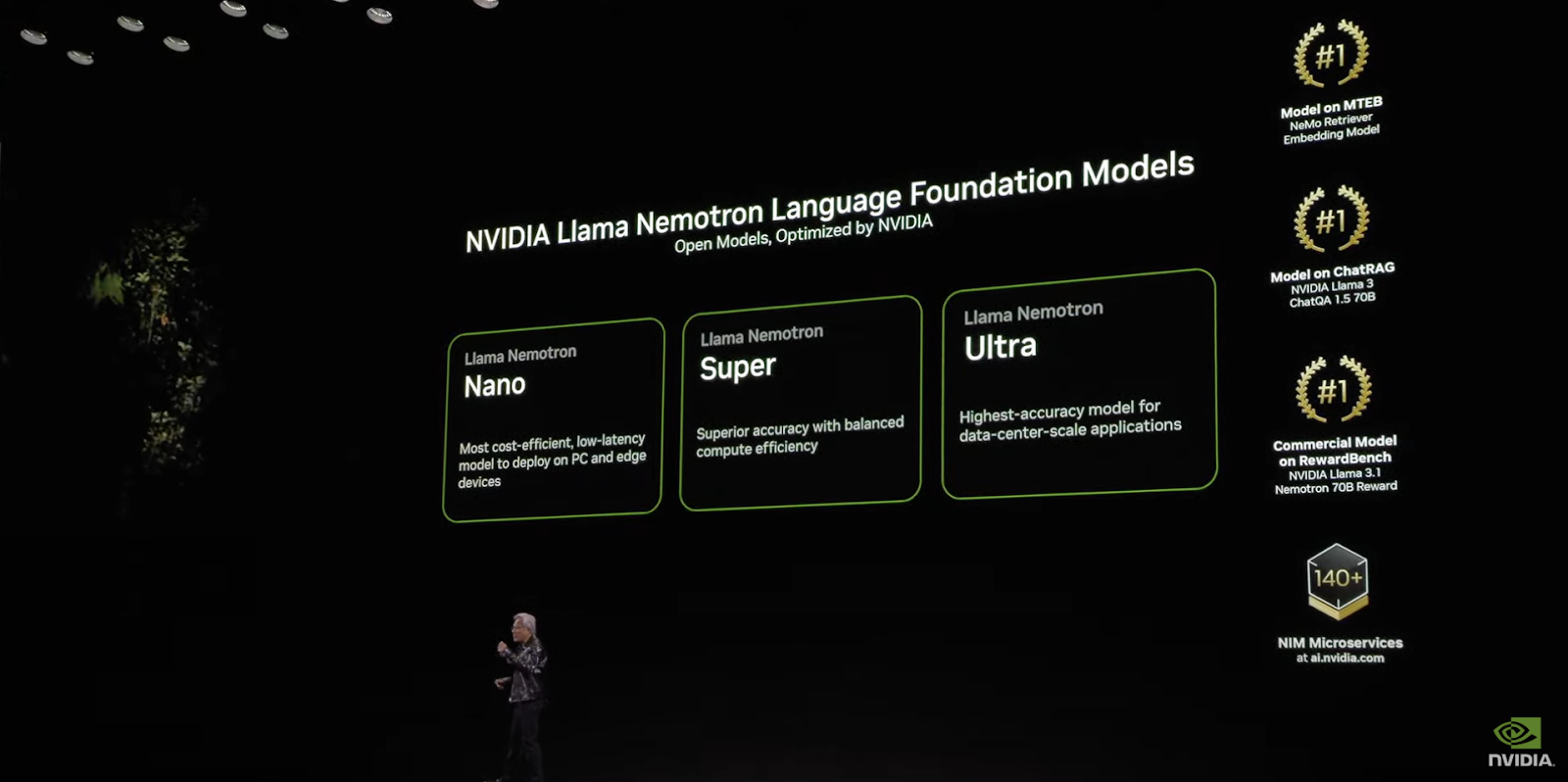
Huang also unveiled additions to its suite of AI software. The updates include a group of AI models based on Meta Platforms's Llama model, called Llama Nemotron. Huang told the audience that Llama is "the reason every organization has been activated to work on AI." The Nvidia versions are meant to "fine-tune" Llama for enterprise use.
Huang also talked at length about the rising prominence of "agentic AI," where large language models, or multi-modal AI models, can call upon outside programs to carry out tasks.
"There's this whole world of agentic AI, all these amazing new startups building frameworks like LangGraph, Llama Index, and Crew AI," said Justin Boitano, president of enterprise AI software products at Nvidia, in a briefing we had.
Those startups are "changing the programming model of how do you write applications: you write an AI, you give it a role, which is like a persona, you give it a goal, you can create it with just a prompt." Nvidia works extensively with the startups, said Boitano.
Huang said that agentic Ai, combined with self-driving cars and robots, are "three types of robots we are working on."
A new version of the Grace-Blackwell combined CPU and GPU chip, called GB10, is the brains of the new DIGITS desktop computer.
Other announcements in th keynote included GEFORCE "Blackwell," the latest version of the company's gaming GPU, which is slashed in price from its predecessor 4090 to $549 from $1,599, available starting this month, with laptop versions coming in March; and Project DIGITS, a compact personal computer optimized for AI development, running a new version of the Grace-Blackwell combined CPU and GPU chip, called GB10.
Leading chipmaker NVIDIA unveiled Project DIGITS, a new small supercomputer, at the Consumer Electronics Show (CES) 2025. It is aimed at AI researchers, data scientists, and students across the world. The supercomputer provides access to the GB10 Grace Blackwell Superchip, which Jensen Huang, CEO of NVIDIA, calls a ‘super secret chip’.
The GB10 features a 20-core NVIDIA Blackwell GPU, one of the most powerful AI hardware systems available today. The CPU was built in collaboration with MediaTek.
Project DIGITS features 128 GB of unified memory and offers storage options of up to 4TB. Similar to a typical computer, DIGITS requires only a standard electrical outlet to operate. It operates on a Linux-based NVIDIA DGX operating system.
The supercomputer can also run up to 200 billion parameter LLMs locally, and if you have two of them, NVIDIA says you can link them up to run AI models double the size.
what?? NVIDIA just dropped Project DIGITS, a $3,000 personal AI supercomputer that’s small enough to look like a Mac Mini but packs 1,000x the power of your average laptop. Handles AI models with up to 200 BILLION parameters. This is incredible.. pic.twitter.com/z4JOeFD2JI
— el.cine (@EHuanglu) January 7, 2025
Project DIGITS allows users to deploy AI models on the NVIDIA DGX cloud and leverage all the tools present inside NVIDIA’s AI Enterprise software platform. For instance, you can fine-tune models on the NeMo framework and build agents on NVIDIA Blueprints and NIM microservices.
The higher performance and portability increase the cost. Project DIGTIS will be available in May of this year and will cost a whopping $3000.
“AI will be mainstream in every application for every industry. With Project DIGITS, the Grace Blackwell Superchip comes to millions of developers,” said Jensen Huang, founder and CEO of NVIDIA.
“Placing an AI supercomputer on the desks of every data scientist, AI researcher, and student empowers them to engage and shape the age of AI,” he added.
At first glance, there’s no doubt that Project DIGITS is entering the Mac Mini territory, at least in terms of the form factor. “I must have the Nvidia Project Digits for my home lab. 128GB pooled RAM, 4TB storage, the size of a Mac mini, Running DGX OS, a Linux-based OS. The coming years are going to be wild in the world of AI and robotics,” said Jamie Madden, a machine learning developer on X.
In December of last year, NVIDIA introduced the Jetson Orin Nano Super Developer Kit, a compact generative AI supercomputer now priced at $249, down from $499. According to the company, it offers enhanced performance with 67 INT8 TOPS, marking a 70% improvement over its predecessor, alongside a memory bandwidth of 102GB/s, which is a 50% increase.
The post NVIDIA’s Announces $3000 Supercomputer appeared first on Analytics India Magazine.
OpenAI has announced that its primary focus for the coming year will be on developing “superintelligence,” according to a blog post from Sam Altman. This has been described as AI with greater-than-human capabilities.
While OpenAI’s current suite of products has a vast array of capabilities, Altman said that superintelligence will enable users to perform “anything else.” He highlights accelerating scientific discovery as the primary example, which, he believes, will lead to the betterment of society.
“This sounds like science fiction right now, and somewhat crazy to even talk about it. That’s alright—we’ve been there before and we’re OK with being there again,” he wrote.
The change of direction has been spurred by Altman’s confidence in his company now knowing “how to build AGI as we have traditionally understood it.” AGI, or artificial general intelligence, is typically defined as a system that matches human capabilities, whereas superintelligence exceeds them.
SEE: OpenAI’s Sora: Everything You Need to Know
Altman has eyed superintelligence for years — but concerns exist
OpenAI has been referring to superintelligence for several years when discussing the risks of AI systems and aligning them with human values. In July 2023, OpenAI announced it was hiring researchers to work on containing superintelligent AI.
The team would reportedly devote 20% of OpenAI’s total computing power to training what they call a human-level automated alignment researcher to keep future AI products in line. Concerns around superintelligent AI stem from how such a system could prove impossible to control and may not share human values.
“We need scientific and technical breakthroughs to steer and control AI systems much smarter than us,” wrote OpenAI Head of Alignment Jan Leike and co-founder and Chief Scientist Ilya Sutskever in a blog post at the time.
SEE: OpenAI and Anthropic Sign Deals With U.S. AI Safety Institute
But, four months after creating the team, another company post revealed they “still (did) not know how to reliably steer and control superhuman AI systems” and didn’t have a way of “preventing (a superintelligent AI) from going rogue.”
In May, OpenAI’s superintelligence safety team was disbanded and several senior personnel left due to the concern that “safety culture and processes have taken a backseat to shiny products,” including Jan Leike and the team’s co-lead Ilya Sutskever. The team’s work was absorbed by OpenAI’s other research efforts, according to Wired.
Despite this, Altman highlighted the importance of safety to OpenAI in his blog post. “We continue to believe that the best way to make an AI system safe is by iteratively and gradually releasing it into the world, giving society time to adapt and co-evolve with the technology, learning from experience, and continuing to make the technology safer,” he wrote.
“We believe in the importance of being world leaders on safety and alignment research, and in guiding that research with feedback from real world applications.”
The path to superintelligence may still be years away
There is disagreement about how long it will be until superintelligence is achieved. The November 2023 blog post said it could develop within a decade. But nearly a year later, Altman said it could be “a few thousand days away.”
However, Brent Smolinski, IBM VP and global head of Technology and Data Strategy, said this was “totally exaggerated,” in a company post from September 2024. “I don’t think we’re even in the right zip code for getting to superintelligence,” he said.
AI still requires much more data than humans to learn a new capability, is limited in the scope of capabilities, and does not possess consciousness or self-awareness, which Smolinski views as a key indicator of superintelligence.
He also claims that quantum computing could be the only way we might unlock AI that surpasses human intelligence. At the start of the decade, IBM predicted that quantum would begin to solve real business problems before 2030.
SEE: Breakthrough in Quantum Cloud Computing Ensures its Security and Privacy
Altman predicts AI agents will join the workforce in 2025
AI agents are semi-autonomous generative AI that can chain together or interact with applications to carry out instructions or make decisions in an unstructured environment. For example, Salesforce uses AI agents to call sales leads.
TechRepublic predicted at the end of the year that the use of AI agents will surge in 2025. Altman echoes this in his blog post, saying “we may see the first AI agents ‘join the workforce’ and materially change the output of companies.”
SEE: IBM: Enterprise IT Facing Imminent AI Agent Revolution
According to a research paper by Gartner, the first industry agents to dominate will be software development. “Existing AI coding assistants gain maturity, and AI agents provide the next set of incremental benefits,” the authors wrote.
By 2028, 33% of enterprise software applications will include agentic AI, up from less than 1% in 2024, according to the Gartner paper. A fifth of online store interactions and at least 15% of day-to-day work decisions will be conducted by agents by that year.
“We are beginning to turn our aim beyond that, to superintelligence in the true sense of the word,” Altman wrote. “We’re pretty confident that in the next few years, everyone will see what we see, and that the need to act with great care, while still maximizing broad benefit and empowerment, is so important.”
At CES 2025, NVIDIA CEO Jensen Huang launched new Nemotron models, including the Llama Nemotron large language models (LLMs) and Cosmos Nemotron vision language models (VLMs), to improve agentic AI and boost enterprise productivity.
The Llama Nemotron models, built on Llama foundation models, allow developers to create AI agents for applications like customer support, fraud detection, and supply chain optimisation.
“Llama 3.1 is a complete phenomenon, with the downloads reaching 650,000 times. It has been derived and turned into other models, about 60,000 different models. It is singularly the reason why every single enterprise and every single industry has been activated to start working on AI,” said Huang.
“We realized that the Llama models could really be better fine-tuned for enterprise use, so we fine-tuned them using our expertise and capabilities and turned them into the Llama Nemotron suite of open models,” he added.
The Nemotron families will be offered in Nano, Super, and Ultra sizes to suit deployment needs, from low-latency real-time applications to high-accuracy data center use cases. Optimised for computing efficiency and accuracy, these models support agentic AI tasks like instructions for following, coding, and math.
“Agentic AI is the next frontier of AI development, and delivering on this opportunity requires full-stack optimization across a system of LLMs to deliver efficient, accurate AI agents,” said Ahmad Al-Dahle, vice president and head of GenAI at Meta.
NVIDIA announced that the models will be available as downloadable resources or as microservices for deployment across various computing platforms, including data centers and edge devices. Llama Nemotron and Cosmos Nemotron models will be available soon on build.nvidia.com, Hugging Face, and through the NVIDIA Developer Program.
Enterprise-grade deployments will be supported via the NVIDIA AI Enterprise platform on accelerated cloud and data center infrastructure.
NVIDIA’s Cosmos Nemotron models extend AI capabilities to vision and video tasks, allowing agents to analyse and respond to images and videos. These tools aim to support industries like autonomous systems, healthcare, retail, and media.
NVIDIA also unveiled Cosmos world foundation models for physics-aware video generation in robotics and autonomous vehicle applications.
NVIDIA NeMo microservices allow enterprises to customise these models for specific domains and workflows.
Leading AI platform providers, such as SAP and ServiceNow, have backed the Nemotron models. SAP plans to incorporate them into its Joule platform to improve enterprise user productivity, while ServiceNow seeks to utilise the models for AI agent services across various industries.
The models are built using NVIDIA’s NeMo platform for distillation, pruning, and alignment, ensuring high accuracy and throughput across various hardware configurations. NVIDIA NeMo Retriever allows integration with enterprise data, boosting model functionality through retrieval-augmented generation capabilities.
The post NVIDIA Unveils New Llama Nemotron Models to Build AI Agents appeared first on Analytics India Magazine.
The Eureka J15 Max Ultra is a new flagship robot vacuum with 22,000Pa of suction power, nearly the highest suction power on the market. Unveiled at CES 2025, it features reliable object avoidance technology to avoid pet waste and a razor to prevent hair tangles. It is a clear contender for becoming the best robot vacuum for pet hair.
Plus, the J15 Max Ultra can detect wet messes and automatically rotate its body to tackle the mess with the mop. When this happens, the robot also lifts the roller brush to avoid suctioning liquid into the dustbin. This technology was available in the J15 Pro Ultra, but Eureka improved it with the J15 Max Ultra.
Also: The best robot vacuums for 2025: Expert tested and reviewed
The new flagship robot vacuum uses IntelliView AI 2.0, infrared (IR), and FHD vision to overcome the previous model's limitations. The new J15 Max Ultra uses artificial intelligence to process images captured by the robot's sensors to detect clear liquids, which the previous robot could've missed.
The robot uses extendable side brushes and a mop extension, automatically extending the mop and side brush when detecting corners and edges. The J15 Max also features Eureka's FlexiRazor technology, which cuts through hair tangles to prevent interrupted cleaning sessions due to a tangled brush roller.
Also: Roborock's new 'mechanical arm' robot vacuum is unlike anything I've ever seen
Eureka gave the J15 Max Ultra what it calls a 'DragonClaw Side Brush.' Unlike traditional brushes that feature straight bristles, the DragonClaw brush has a V-shaped design that uses centrifugal force to untangle hair and effectively direct debris to the vacuum's nozzle.
The new Eureka J15 Max Ultra will be available in June 2025 for $1,299. In March, Eureka will also launch a J15 Ultra with 19,000Pa of suction power for $799.