Oracle Integrates GenAI to Enhance Supply Chain and Automate KPIs

According to Gartner, 95% of data-driven decisions in supply chain operations are expected to be partially automated by the next year, and 25% of key performance indicator (KPI) reporting will be powered by GenAI models by 2028.

In line with this, Oracle recently announced adding generative AI capabilities within Oracle Fusion Cloud Supply Chain & Manufacturing (SCM). This was done to help businesses manage their supply chains more efficiently and effectively.

“We are working with customers to help them optimise their supply chains, which has a direct impact on financial KPIs,” said Sunil Wahi, vice president JAPAC, Oracle, in an exclusive interview with AIM. “Every operational KPI is linked with financial KPIs.”

“Supply chain is where a whole lot of costs and margins are hidden,” said Wahi, adding that a beautiful supply chain is when it is invisible. “If you are getting your orders and shipments on time, you would never be bothered about what supply chain is running behind.”

Oracle has brought in prediction driven supply chain command centres. Wahi said that using this tool, a company can plan its entire supply chain and make decisions on the placement of distribution centres, logistic hubs, RDCs, and so on, which then breaks down into a more visible supply chain for the company.

“It functions like a mission control centre for your supply chain, bringing together data, intelligence, and recommendations to give you a holistic view and enable faster decision-making,” he added.

Oracle is not Alone

AWS Supply Chain recently added generative AI to simplify the data ingestion process and improve customer’s application on-boarding and setup experience.

Similarly, Microsoft is also incorporating generative AI capabilities within Microsoft Dynamics 365 Supply Chain Management. For instance, the AI-powered Microsoft Supply Chain Center news module proactively flags external issues such as weather, financial, and geopolitical news that may impact key supply chain processes.

Meanwhile, Google Cloud is working with Accenture and Infosys develop a suite of transformative AI platforms and industry solutions for a range of business scenarios including optimising supply chains, using generative AI.

Oracle’s GenAI Prowess

Generative AI within Oracle SCM is designed to automate and optimise various supply chain tasks, from inventory management to order fulfilment.

“There are multiple generative AI use cases, such as capturing item descriptions in an AI-assisted authoring mode, fulfilling supplier contracts, and capturing manufacturing productivity enhancements with an AI-assisted mobile app,” said Wahi.

Moreover, Oracle has introduced generative AI support in Oracle Product Lifecycle Management which helps product specialists create SEO-focused product descriptions quickly. This saves time, reduces errors, and improves overall quality, leading to increased customer engagement and sales for organisations.

OCI also uses generative AI to perform root cause analysis in supply chain operations. It ingests real-time data and uses a query-based system to provide actionable insights, helping to identify and resolve supply chain issues efficiently.

“We are working with a large pharma customer in India that had just automated their entire supply planning processes on Fusion Cloud. For them, the whole objective was to allocate constrained resources to the right customer orders, which are most profitable,” said Wahi.

Generative AI is changing how the supply chain manages sourcing and procurement. It handles purchase orders, negotiates deals, selects suppliers, and assists in contract preparations. For example, Walmart is using generative AI to automate supplier negotiations.

According to a report, over 65% preferred negotiating with a generative AI bot instead of an employee at the company. There have also been instances where companies are using GenAI tools to negotiate against each other.

Wahi was positive that with generative AI-powered supplier recommendations embedded in Oracle Procurement, organisations will be able to use information such as product descriptions and purchase categories to identify suppliers, improve sourcing efficiency, help lower costs, and reduce supplier risk.

“Generative AI itself will be a huge transformative space for us. The partnership with Cohere is extremely important because that’s where we are drawing upon the learnings, and I would say it will be an extremely important partnership which will continue to grow,” concluded Wahi, adding that the company will bring in about 100+ use cases within Fusion Cloud applications around generative AI.

The post Oracle Integrates GenAI to Enhance Supply Chain and Automate KPIs appeared first on Analytics India Magazine.


Microsoft’s Phi-3 Outperforms Meta’s Llama 3 and Fits Perfectly on an iPhone

Microsoft’s Phi-3 Outperforms Meta’s Llama 3 and Fits Perfectly on an iPhone

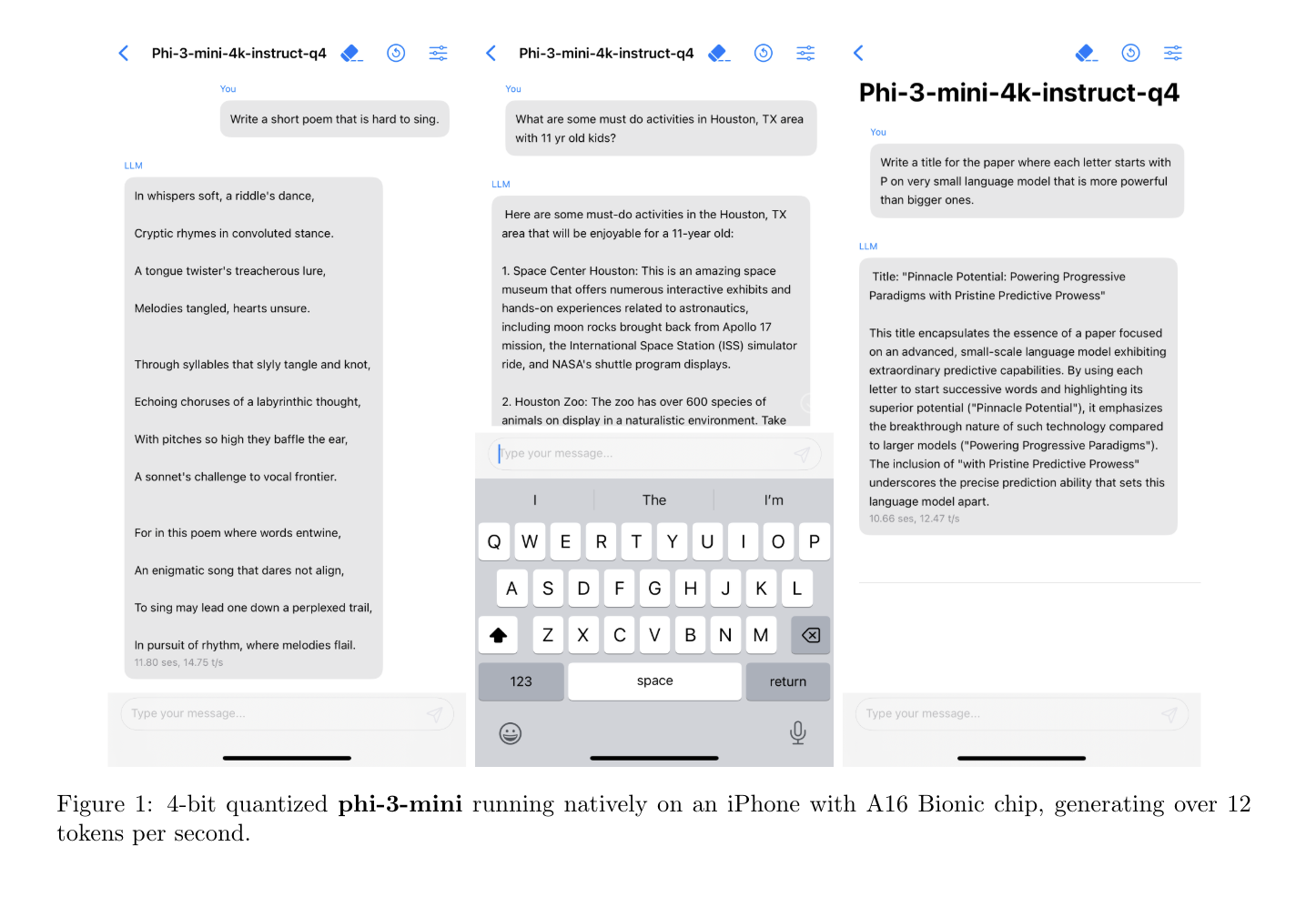
“One of the things that makes Phi-2 better than Meta’s Llama 2 7B and other models is that its 2.7 billion parameter size is very well suited for fitting on a phone,” said Harkirat Behl, one of the creators of the model, who has now created Phi-3, the latest open source model by Microsoft.

Phi-3-Mini is a 3.8 billion parameter language model trained on an extensive dataset of 3.3 trillion tokens. Despite its compact size, the Phi-3-Mini boasts performance levels that not just exceed the recent ones such as Mixtral 8x7B and GPT-3.5, but even surpass the recently launched Meta’s Llama 3 8B on MMLU benchmarks.

Despite these high capabilities, Phi-3-Mini can run locally on a cell phone. Its small size allows it to be quantised to 4 bits, occupying approximately 1.8GB of memory. Microsoft tested the quantised model by deploying Phi-3-Mini on an iPhone 14 with an A16 Bionic chip, running natively on the device and fully offline, achieving more than 12 tokens per second.

phi-3 is here, and it's … good :-).
I made a quick short demo to give you a feel of what phi-3-mini (3.8B) can do. Stay tuned for the open weights release and more announcements tomorrow morning!
(And ofc this wouldn't be complete without the usual table of benchmarks!) pic.twitter.com/AWA7Km59rp

— Sebastien Bubeck (@SebastienBubeck) April 23, 2024

Along with this, Microsoft has also introduced Phi-3-Small and Phi-3-Medium models, both significantly more capable than Phi-3-Mini. The Phi-3-Small 7 billion parameter model achieves an MMLU score of 75.3 outperforms Meta’s recently launched Llama 3 8B Instruct with a score of 66.

With a Grain of Salt

“To best benefit the open source community, Phi-3-Mini is built upon a similar block structure as Llama-2,” reads the technical report by Microsoft. But currently, the model is limited to English, which is not ideal for other languages and for Indic AI developers.

The innovation behind Phi-3-Mini lies in its training dataset, an expanded version of the one used for its predecessor, Phi-2. This dataset comprises heavily filtered web and synthetic data. The model has also been optimised for robustness, safety, and chat format.

Given that small open-source models are performing so well, it wouldn’t be surprising if soon there is a model outperforming OpenAI’s GPT-4. Interestingly, Meta is also training a model with around 400 billion parameters which would possibly be able to outperform the closed models once it is launched.

“BUT – as with all (tiny) models, benchmarks tell us less than vibes,” said Matt Shumer on X. In a discussion, people highlight the issue with the benchmarks of the model. “According to what I’ve read, Phi-2 was much worse than its benchmark numbers suggested. This model follows the same training strategy,” read a comment.

Since the model is built by Microsoft and uses synthetic data for training, it is possibly using GPT-4 output for training. “I don’t think it’s impossible for a small model to be very good. I see their ‘synthetic data’ as essentially a way of distilling GPT-4 into smaller models,” said the same user.

Furthermore, the model is also trained with only 4.8 trillion tokens, which is significantly less than 15 trillion tokens that Llama 3 was trained on. Regardless, the model can run on a phone, which the Llama series of models are still a little far away from given the size.

Moreover, Phi models aren’t specifically tuned for chat or instruct, which makes them perform slightly worse when compared to Llama models when incorporating in real world scenarios.

On the other hand, Behl had told AIM that scaling laws are not necessarily true. “You don’t need a specific size or number of parameters for a model to get good at coding,” said Behl, saying that you do not need large models to instil intelligence. “All you need is a small amount of high quality data, aka textbook quality data.”

This is what is continued with Phi-3.

What Dent will it Make?

Since the model is built for on-device and edge use cases, it is ideal for the ongoing shift towards AI devices. Moreover, Apple is also experimenting with AI on edge, and Phi-3 might give Microsoft an edge (pun intended) over Apple.

Moreover, since such small models are outperforming larger models, this might also possibly make an impact on OpenAI’s release of GPT-5, as enterprises are also increasingly adopting open source models. Who knows, the company might decide to open source one of its upcoming models, though that seems highly unlikely for now.

Microsoft has also kept in mind the need to make LLMs that are up to date with current information, thus have made Phi-3 ideal for RAG use cases as well.

Microsoft believes that training models on synthetic data reduces the size of the model, and also brings in a lot of capabilities within them, which is different from how GPT-3 was trained. “Textbooks are written by experts in the field, unlike the internet where anybody can write and post, which is how GPT-3 is trained,” said Behl.

The post Microsoft’s Phi-3 Outperforms Meta’s Llama 3 and Fits Perfectly on an iPhone appeared first on Analytics India Magazine.
Understanding GraphRAG – 2 addressing the limitations of RAG

Screenshot-2024-04-18-20.20.44

Background

We follow on from the last post and explore the limitations of RAG and how you can overcome these limitations using the idea of a GRAPHRAG. The GRAPHRAG combines a knowledge graph with a RAG. Thus, the primary construct of the GRAPHRAG is a knowledge graph. A Knowledge Graph represents knowledge and its relationships as a set of nodes and edges. The knowledge graph has a very simple but distinct advantage in terms of context: In a knowledge graph, all the context is directly adjacent to the node within the graph.

This property of knowledge graphs, when combined with LLMs, provides two major benefits:

  1. Providing explainability and
  2. Reducing hallucination

LLMs are black box models. To some extent, you can mitigate some of the issues of LLMs using a RAG. RAG provides context in the form of sources(documents). Additionally, you can reduce hallucination and provide explainability through knowledge GRAPHRAG.

In a nutshell, the Graph RAG enriches the standard LLM approach with structured information from a knowledge graph because the GRAPHRAG includes the knowledge graph as a source for the LLM.

Graphs and LLMs can work together in a variety of ways.

How do Graphs and LLMs work together

The most common way is when you use the graph to provide additional context such as the relationship between concepts based on an ontology, taxonomy etc. But you could also use the knowledge graph to create a subset of the database or use the knowledge graph to summarise the results of the query.

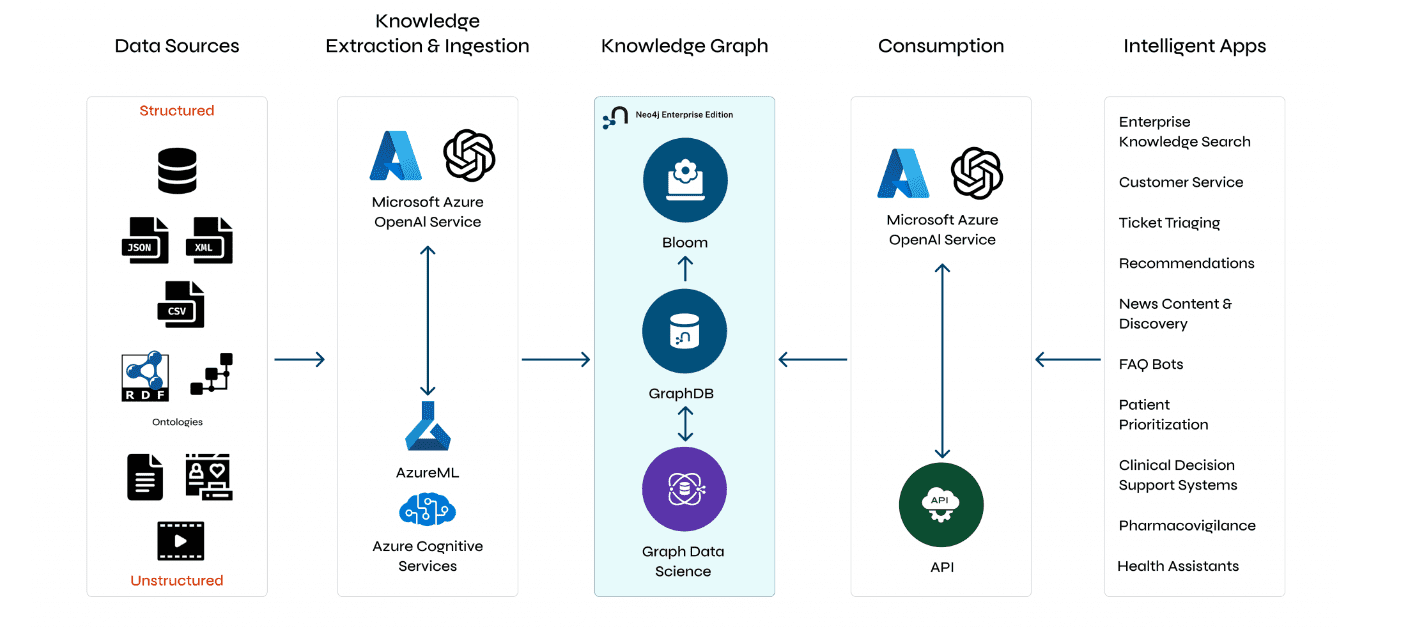
We are now seeing some commercial products in this space. Most recently a partnership between neo4j and Microsoft on integrating graph databases into Azure . This partnership involves the end-to-end implementations of GRAPHRAG using Microsoft Fabric and Azure OpenAI services working with structured and unstructured data. This helps applications like Bill of Materials where we can perform a query combining unstructured documents (like user manuals) and structured documents (like Bill of materials) leveraging both vector and graph databases.

The OpenAI interface can be used both as a conversation agent and also as a way to extract entities and relations using LLM

Understanding GraphRAG – 2 addressing the limitations of RAG

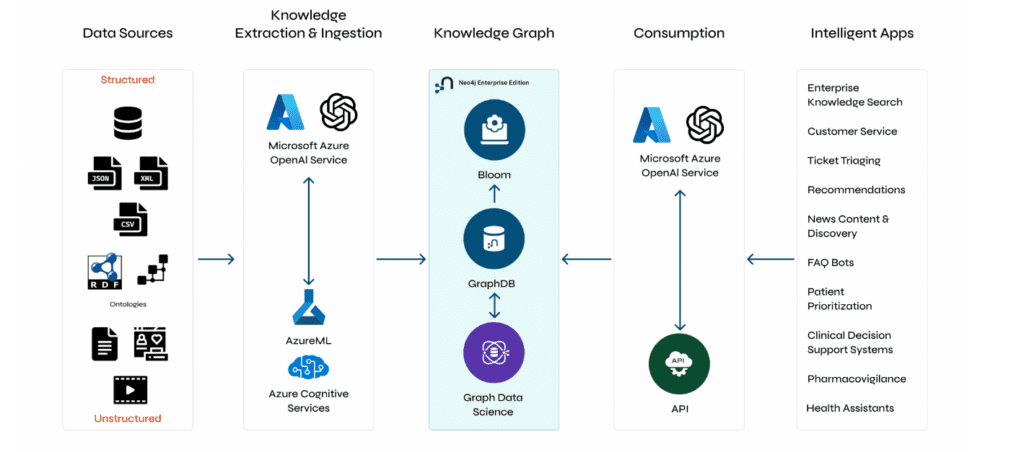
We can see more as below

Source Azure – neo4j

There are many use cases possible especially as context changes. For exampe, a new word has been introduced in the Oxford English Dictionary called Porch Pirate

Definition: “A person who steals parcels that have been delivered and left unattended outside the intended recipient’s home”

If we ask the LLM – “I am afraid of porch pirates – as a postman what could I do”? A graphrag could perhaps be designed to answer where else the parcel could be delivered(for example a neighbours house)

We continue this analysis in the third part 3

Perplexity AI Raises $63M at $1B Valuation, Expands to Enterprise Market

Perplexity AI

Perplexity AI today raised $63M at a $1B valuation, led by Daniel Gross and others, including Jeff Bezos and NVIDIA, to fuel its global expansion, alongside enhancing its AI-driven search capabilities, and disrupt the traditional search market with its conversational AI service.

The round also saw Stanley Druckenmiller, Tobi Lutke, Garry Tan, Andrej Karpathy, Dylan Field, Elad Gil, Nat Friedman, IVP, NEA, Jakob Uszkoreit, Naval Ravikant, Brad Gerstner and Lip-Bu Tan among others.

With the latest funding, Perplexity AI looks to support the development and rollout of new offerings like Enterprise Pro (also announced today). The new offering aims to enhance security and privacy features for business environments.

The company said that since it announced its Series B in January this year, it has grown to serve 169 million queries per month and more than 1 billion queries in the last 15 months. It now looks to use the additional funding further to grow its consumer adoption alongside enterprise expansion.

In addition, Perplexity AI has partnered with telecommunications firms like SoftBank (Japan) and Deutsche Telekom (Germany) to distribute Perplexity to a combined total of over 116 million users. Previously, it partnered with Korea’s largest telecommunications company, SK Telecoms, where 32M+ subscribers can access Perplexity Pro.

Perplexity AI was founded in August 2022 by former Google AI colleagues frustrated with the challenges of accessing and utilising large language models. The co-founders include Andy Konwinski, Aravind Srinivas, Denis Yarats, and Johnny Ho. So far, the company has raised $163 million in funding, valuing the company at $1 billion.

Perplexity AI, Everyone’s Favourite

Even NVIDIA chief Jensen Huang previously mentioned that he uses Perplexity, a company they have invested in, ‘almost everyday’.

The testimonials of big tech leaders such as Huang and Bezos may sound inflated considering they have invested in the AI company, but going by the growing number of Perplexity users, the company is surely capturing a wide audience.

The company has well over 10 million monthly users– and counting.

Further, they even offer models in various languages, such as Korean, German, French, and Spanish.

Recently, its founder, Srinivas even met the co-founder of Infosys, Nandan Nilekani, aka the CTO of India, and also was seen twinning with Jensen.

Dear @AravSrinivas , great to meet, I have lots of friends who absolutely swear by @perplexity_ai ! https://t.co/RCUGHjMIGh

— Nandan Nilekani (@NandanNilekani) April 19, 2024

Google Alternative?

Google chief Sundar Pichai seems to care less. But, the AI-powered answer engine has definitely been in a quest to establish itself as a Google alternative. In the process, the company is leaving no stone unturned; it is actively partnering with device-makers, including Nothing, Rabbit R1, and others.

Recently, Perplexity also partnered with Yelp to improve local searches and help users find information on local restaurants and businesses, a probable step to combat Google reviews.

Perplexity recently incorporated DataBricks’ latest open-source LLM DBRX, which is said to outperform GPT-4 and other powerful AI models like LLaMA and Mistral.

Source: X

Not just Databricks, Perplexity has been open to embracing and offering closed-source models through APIs and answer engines, be it the latest Claude 3 Opus, Mistral Large, Google Gemma, or the latest entrant Llama 3. Perplexity is quick at its game.

Aravind Srinivas, Perplexity’s CEO and co-founder, recently announced that Copy AI, which is launching a GTM platform, is collaborating with Perplexity AI. “They chose to use our APIs for this, and we’re also providing six months of Perplexity Pro for free to current Copy AI subscribers,” he said.

The post Perplexity AI Raises $63M at $1B Valuation, Expands to Enterprise Market appeared first on Analytics India Magazine.

JPMorgan Unveils FlowMind for Automatic Workflow Generation with LLMs

FlowMind

JPMorgan has introduced FlowMind, a novel approach leveraging LLMs to create an automatic workflow generation system.

The field of Robotic Process Automation (RPA) has made significant advancements in automating repetitive tasks. However, its effectiveness diminishes when faced with spontaneous or unpredictable user demands.

FlowMind utilises a generic prompt recipe for a lecture, grounding LLM reasoning with reliable APIs. This approach not only mitigates hallucinations in LLMs but also ensures data integrity and confidentiality by eliminating direct interaction between LLMs and proprietary data or code.

FlowMind simplifies user interaction by presenting high-level descriptions of auto-generated workflows, enabling effective inspection and feedback. FlowMind significantly outperformed the GPT-Context-Retrieval baseline method, even without user feedback.

Additionally, the paper introduces NCEN-QA, a new dataset in finance for benchmarking question-answering tasks from N-CEN reports on funds. Researchers evaluated the performance of workflows generated by FlowMind using NCEN-QA and demonstrate its success, the importance of each lecture component, and the effectiveness of user interaction and feedback.

The FlowMind framework operates in two primary stages:

  1. Lecture to LLM: Providing the LLM with context, available APIs, and the need for workflow generation.
  2. Workflow Generation and Execution: Utilising APIs to generate workflows and deliver results to users, with an optional feedback loop for user interaction.

Future work may explore crowdsourcing user feedback to refine workflows at scale and life-long learning over past user-approved examples to evolve FlowMind’s performance over time. Additionally, FlowMind could be expanded to handle large libraries of APIs by retrieving the most relevant APIs for a given task based on embedding similarity.

The post JPMorgan Unveils FlowMind for Automatic Workflow Generation with LLMs appeared first on Analytics India Magazine.
How to implement big data for your company

122

Big data analytics empowers organizations to get valuable insights from vast and intricate data sets, offering a pathway to improved decision-making, excellent performance, and competitive advantage. As the volume of global data surges, exemplified by the expected 167 exabytes of monthly mobile traffic by 2024, the rise of analytics offers immense potential. In this article we will discover the essential steps for implementing progressive technologies in your organization to unlock its transformative potential.

How technologies can benefit your company

In the digital age, big data stands as a cornerstone of contemporary business and technology. Its exponential growth in volume, velocity, and variety fuels organizations’ efforts to enhance decision-making, streamline efficiency, and foster innovation across sectors. If you want to make a breakthrough in the market, InData Labs can assist you with their unique big data application development. Now, let’s discuss how you can harness these innovative tools to your advantage.

  • Customer acquisition and retention

It is a great possibility for ventures to tailor products and services to customer needs, boosting satisfaction and sales. For example, Amazon offers personalized shopping experiences based on past purchases and browsing history.

  • Targeted promotions

Firms use these instruments to analyze customer behavior and create focused promotions, saving on ineffective campaigns and fostering brand loyalty.

  • Risk identification

Another significant advantage is the swift identification and mitigation of risks. In today’s high-risk environment, overseeing and preventing issues is crucial to minimize losses and expenses.

  • Innovation

The extensive statistics and details drive innovation by identifying trends and preferences, enabling enterprises to enhance existing products/services and develop new ones.

  • Supplier networks

Besides everything it offers enhanced insights for supplier networks, helping suppliers navigate challenges more effectively.

  • Cost optimization

Leveraging cutting-edge tools such as Hadoop and Spark facilitates efficient storage options and offers significant cost advantages. These robust platforms empower ventures with the ability to conduct in-depth research and stimulate informed decision-making.

  • Efficiency improvement

One of the best features is the possibility to automate routine tasks, freeing up time for employees to focus on tasks requiring cognitive skills, thus improving overall efficiency.

6 key steps for the successful implementation

Initiating organizational change and implementing new strategies often can be not an easy task as it imposes certain uncertainties and challenges. However, with the right approach and a clear roadmap, it can lead to transformative results and sustainable success. From the initial conception of ideas to the final stages of execution and beyond, each step is strategically designed to optimize efficiency, mitigate risks, and harness the full potential of your resources. Below let’s review how to effectively integrate the innovation into your business and go through each step of the process.

Assess your needs

First, pinpoint your requirements and the business challenges or opportunities you want to solve and address for your organization. Define the crucial metrics and objectives to measure and attain to determine scope, scale, sources, analysis methods, and desired outputs.

Choose platform type

Select your platform, the infrastructure, and software to store, process, and perform analysis. Your options can include on-premise, cloud, or hybrid platforms, based on budget, security, and scalability needs. Consider compatibility, performance, and features like integration, quality, governance, and visualization.

Design architecture

Next, focus on developing your architecture, which serves as the foundation for organizing, managing, and optimizing your statistics and numbers. Incorporate best practices such as modularity, flexibility, reliability, and efficiency. Define models, schemas, formats, and standards to structure information and establish pipelines, workflows, and processes to facilitate the movement and transformation.

Implement your solution

Once all preparations are complete, it’s time to apply and execute your platform and architecture. Ensure to thoroughly test, validate, and monitor the platform to guarantee its quality, accuracy, and functionality. At this step you can start utilizing your newly made platform and with all its advantages.

Evaluate and improve your strategy

Finally, assess your strategy using metrics like ROI, KPIs, or NPS, comparing outcomes with expectations. Highlight key findings for executives, managers, or customers. Identify and address gaps, challenges, and opportunities, implementing necessary changes to optimize value and potential for ongoing successful performance.

Wrapping up

Overall, implementing big data analytics can revolutionize the way your organization operates, bringing about improvements in decision-making, efficiency, and innovation. You can effectively harness the power of technologies, address challenges, seize opportunities, and stay ahead in today’s competitive landscape. From assessing your needs to communicating insights and continuously refining your data strategy, each step plays a vital role in ensuring the success of your big initiatives. Embracing the emerging development trends is not just a trend but a strategic imperative for organizations looking to thrive in the digital age.

AI Can Now Edit DNA of Human Cells

Profluent, a California based startup published a research paper about generating blueprints for microscopic biological mechanisms that can edit your DNA, pointing to a future when scientists can battle illness and diseases with even greater precision and speed than they can today.

Much as ChatGPT learns to generate language by analysing Wikipedia articles, books and chat logs, Profluent’s technology creates new gene editors after analysing enormous amounts of biological data, including microscopic mechanisms that scientists already use to edit human DNA.

Ali Madani, founder and CEO of Profluent through his post announces the successful editing of DNA in human cells with gene editors fully designed with AI. Not only that, the researchers have also open sourced the molecules under the ProfluentBio’s OpenCRISPR initiative.

Can AI rewrite our human genome? ⌨🧬
Today, we announce the successful editing of DNA in human cells with gene editors fully designed with AI. Not only that, we've decided to freely release the molecules under the @ProfluentBio OpenCRISPR initiative.
Lots to unpack👇 pic.twitter.com/NWowAlDLMv

— Ali Madani (@thisismadani) April 22, 2024

These gene editors are based on Nobel Prize-winning methods involving biological mechanisms called CRISPR. Technology based on CRISPR is already changing how scientists study and fight illness and disease, providing a way of altering genes that cause hereditary conditions, such as sickle cell anaemia and blindness.

Additionally, Profluent also said that it had used one of these AI-generated gene editors to edit human DNA and that it was “open sourcing” this editor, called OpenCRISPR-1. That means it is allowing individuals, academic labs and companies to experiment with the technology for free.

Furthermore, the project is part of a wider effort to build AI technologies that can improve medical care. Scientists at the University of Washington, for instance, are using the methods behind chatbots like OpenAI’s ChatGPT and image generators like Midjourney to create entirely new proteins — the microscopic molecules that drive all human life — as they work to accelerate the development of new vaccines and medicines.

If technology like Profluent’s continues to improve, it could eventually allow scientists to edit genes in far more precise ways. The hope, Dr. Urnov said, is that this could, in the long term, lead to a world where medicines and treatments are quickly tailored to individual people even faster than we can do today.

Urnov said in his post, saying, “Unless things change dramatically, the millions of people CRISPER could save will never benefit from it. We must, and we can, build a world with CRISPR for all.

The post AI Can Now Edit DNA of Human Cells appeared first on Analytics India Magazine.
Retrieval Augmented Generation: Where Information Retrieval Meets Text Generation

Retrieval Augmented Generation: Where Information Retrieval Meets Text Generation
Image created by Author using Midjourney

Introduction to RAG

In the constantly evolving world of language models, one steadfast methodology of particular note is Retrieval Augmented Generation (RAG), a procedure incorporating elements of Information Retrieval (IR) within the framework of a text-generation language model in order to generate human-like text with the goal of being more useful and accurate than that which would be generated by the default language model alone. We will introduce the elementary concepts of RAG in this post, with an eye toward building some RAG systems in subsequent posts.

RAG Overview

We create language models using vast, generic datasets that are not tailored to your own personal or customized data. To ontend with this reality, RAG can combine your particular data with the existing "knowledge" of an language model. To facilitate this, what must be done, and what RAG does, is to index your data to make it searchable. When a search made up of your data is executed, the relevant and important information is extracted from the indexed data, and can be used within a query against a language model to return a relevant and useful response made by the model. Any AI engineer, data scientist, or developer interested building chatbots, modern information retrieval systems, or other types of personal assistants, an understanding of RAG, and the knowledge of how to leverage your own data, is vitally important.

Simply put, RAG is a novel technique that enriches language models with input retrieval functionality, which enhances language models by incorporating IR mechanisms into the generation process, mechanisms that can personalize (augment) the model's inherent "knowledge" used for generative purposes.

To summarize, RAG involves the following high level steps:

  1. Retrieve information from your customized data sources
  2. Add this data to your prompt as additional context
  3. Have the LLM generate a response based on the augmented prompt

RAG provides these advantages over the alternative of model fine-tuning:

  1. No training occurs with RAG, so there is no fine-tuning cost or time
  2. Customized data is as fresh as you make it, and so the model can effectively remain up to date
  3. The specific customized data documents can be cited during (or following) the process, and so the system is much more verifiable and trustworthy

A Closer Look

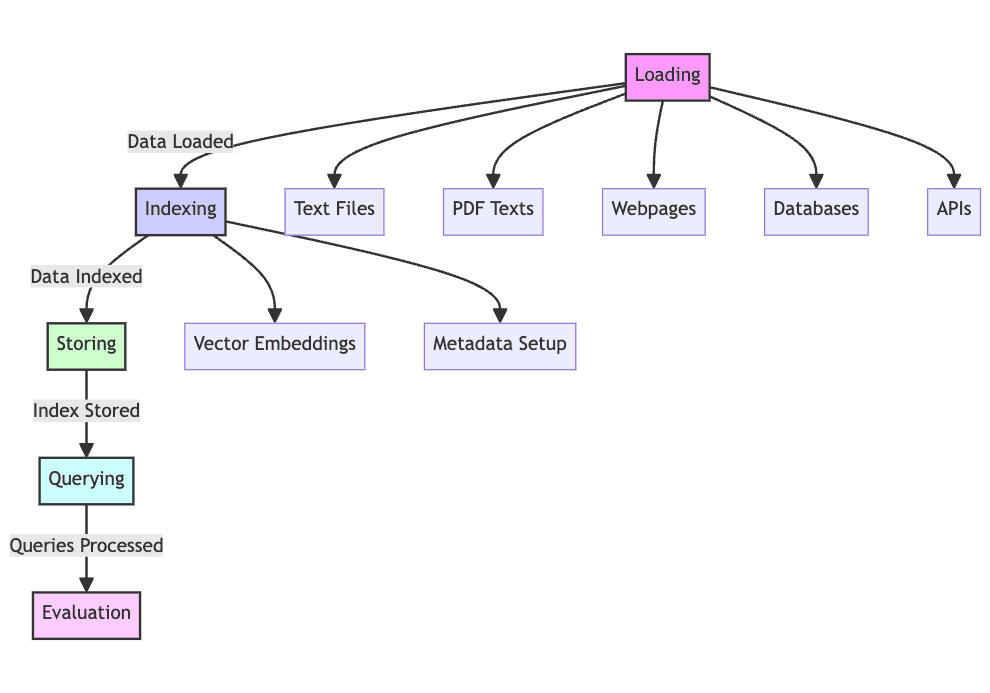
Upon a more detailed examination, we can say that a RAG system will progress through 5 phases of operation.

1. Load: Gathering the raw text data — from text files, PDFs, web pages, databases, and more — is the first of many steps, putting the text data into the processing pipeline, making this a necessary step in the process. Without loading of data, RAG simply cannot function.

2. Index: The data you now have must be structured and maintained for retrieval, searching, and querying. Language models will use vector embeddings created from the content to provide numerical representations of the data, as well as employing particular metadata to allow for successful search results.

3. Store: Following its creation, the index must be saved alongside the metadata, ensuring this step does not need to be repeated regularly, allowing for easier RAG system scaling.

4. Query: With this index in place, the content can be traversed using the indexer and language model to process the dataset according to various queries.

5. Evaluate: Assessing performance versus other possible generative steps is useful, whether when altering existing processes or when testing the inherent latency and accuracy of systems of this nature.

Retrieval Augmented Generation process
Image created by Author

A Short Example

Consider the following simple RAG implementation. Imagine that this is a system created to field customer enquiries about a fictitious online shop.

1. Loading: Content will spring from product documentation, user reviews, and customer input, stored in multiple formats such as message boards, databases, and APIs.

2. Indexing: You will produce vector embeddings for product documentation and user reviews, etc., alongside the indexing of metadata assigned to each data point, such as the product category or customer rating.

3. Storing: The index thus developed will be saved in a vector store, a specialized database for the storage and optimal retreival of vectors, which is what embeddings are stored as.

4. Querying: When a customer query arrives, a vector store databases lookup will be done based on the question text, and language models then employed to generate responses by using the origins of this precursor data as context.

5. Evaluation: System performance will be evaluated by comparing its performance to other options, such as traditional language model retreival, measuring metrics such as answer correctness, response latency, and overall user satisfaction, to ensure that the RAG system can be tweaked and honed to deliver superior results.

This example walkthrough should give you some sense of the methodology behind RAG and its use in order to convey information retrieval capacity upon a language model.

Conclusion

Introducing retrieval augmented generation, which combines text generation with information retrieval in order to improve accuracy and contextual consistency of language model output, was the subject of this article. The method allows the extraction and augmentation of data stored in indexed sources to be incorporated into the generated output of language models. This RAG system can provide improved value over mere fine-tuning of language model.

The next steps of our RAG journey will consist of learning the tools of the trade in order to implement some RAG systems of our own. We will first focus on utilizing tools from LlamaIndex such as data connectors, engines, and application connectors to ease the integration of RAG and its scaling. But we save this for the next article.

In forthcoming projects we will construct complex RAG systems and take a look at potential uses and improvements to RAG technology. The hope is to reveal many new possibilities in the realm of artificial intelligence, and using these diverse data sources to build more intelligent and contextualized systems.

Matthew Mayo (@mattmayo13) holds a Master's degree in computer science and a graduate diploma in data mining. As Managing Editor, Matthew aims to make complex data science concepts accessible. His professional interests include natural language processing, machine learning algorithms, and exploring emerging AI. He is driven by a mission to democratize knowledge in the data science community. Matthew has been coding since he was 6 years old.

More On This Topic

  • How causal inference lifts augmented analytics beyond flatland
  • Meet Gorilla: UC Berkeley and Microsoft’s API-Augmented LLM…
  • Text-2-Video Generation: Step-by-Step Guide
  • Feature Selection: Where Science Meets Art
  • AI meets BI: Key capabilities to look for in a modern BI platform
  • How to Optimize SQL Queries for Faster Data Retrieval

Y Combinator alum Matterport is being bought by real estate juggernaut Costar at a 212% premium

Y Combinator alum Matterport is being bought by real estate juggernaut Costar at a 212% premium Anna Heim 9 hours

Digital twin platform Matterport has agreed to be acquired by one of its customers, Costar, in a cash-and-stock deal of $5.50 per share that gives it an enterprise valuation of about $1.6 billion. Matterport’s tech helps companies create digital replicas of physical spaces.

Costar’s offer represents a premium of a whopping 212% over Matterport’s last closing share price before the deal was announced on April 22.

The deal looks like a fortunate turn of events for Matterport, whose shares had been trading below the $5 mark since August 2022 as the company struggled to meet investors’ expectations for subscriber growth amid a sluggish real estate market and a wider macroeconomic slowdown. Matterport’s stock was trading below $2 per share before the transaction was disclosed.

The company has been trying to improve its profitability over the past year, too, according to its 2023 financial statements. However, investors haven’t been happy with the company, whose shares have been struggling since it went public via a SPAC deal in 2021, which Bloomberg reported valued Matterport at around $2.9 billion.

Matterport’s shares were trading at $4.76 before the bell on Tuesday — slightly below the $5.50 deal price, which indicates investors may be wary of the deal getting blocked by regulators, or they may be hedging their bets to account for a possible decline in Costar’s stock, since the deal has a share-based component, too. Costar’s shares, however, are up slightly since the announcement, indicating that its investors are happy with the potential benefits of the deal.

Matterport quickly rose to prominence from its start in 2011, making 3D imaging cameras, spawning out of the Microsoft Kinect hacker scene and going on to join Y Combinator’s Winter 2012 batch. Its services gained significant traction in the real estate space despite competition from alternatives such as Cupix, Giraffe360 and Zillow 3D Home.

Digital twin technology has applications in construction tech and insurtech, but demand from real estate players is particularly salient, as the pandemic accelerated the switch from in-person viewings to virtual tours, both for commercial and for residential properties.

Early-mover advantage aside, the company’s later decisions likely played an equally important role as the market evolved. It diversified into helping clients create virtual tours even with smartphones. And the addition of AI with its in-house solution, Cortex, added more differentiation to its offering, leveraging its data to generate 3D digital twins supporting additional labels such as property dimensions.

Matterport’s leadership changed over the years. Its current CEO, former eBay chief product officer RJ Pittman, took the reins in 2018 — but its fundraising trajectory was fairly smooth. Over its first decade, it raised successive rounds of funding for a total of $409 million, followed by its public debut in 2021.

Matterport raises $48M to ramp up its 3D imaging platform

“Costar Group and Matterport have nearly identical mission statements of digitizing the world’s real estate,” Costar’s founder and CEO, Andy Florance, said in a statement.

CoStar, which has a market cap of $34.84 billion, is a real estate heavyweight that operates marketplaces such as Apartments.com, Homes.com and LoopNet (for commercial real estate). This gives it direct insights into the value that Matterport can add for its end users.

In March 2024, Costar wrote in a press release, “there were over 7.4 million views of Matterport 3D Tours on Apartments.com, with consumers spending 20% more time viewing an apartment listing when Matterports were available.” The company now plans to incorporate Matterport’s virtual tours (“Matterports”) on Homes.com.

Taking to the stage at a real estate event shortly after the announcement, Florance reportedly said that allowing home buyers to view properties with their own furniture, for instance, will allow agents to provide more value and promote their brands.

It will be worth tracking what happens to Matterport’s activities beyond real estate, such as its partnership with Facebook to help researchers train robots in virtual environments.

The deal is subject to regulatory approvals, but this is more than an asterisk: In 2020, Costar’s attempt to acquire RentPath was derailed by an FTC antitrust lawsuit, and RentPath was instead bought by Redfin in 2021.

UAE continues to spearhead global collaborations with G42 selecting Qualcomm for AI Inference 

G42 Qualcomm

UAE-based technology holding group G42 has teamed up with Qualcomm Technologies, Inc. to integrate Qualcomm Cloud AI 100 solutions into Core42’s Condor AI platform. This collaboration aims to provide customers with energy-efficient and high-performance AI solutions.

Condor AI, G42’s cloud computing platform, offers optimised infrastructure with leading AI provider solutions. Qualcomm Cloud AI 100 Ultra AI accelerators, part of this integration, looks to deliver superior inference performance and cost efficiency. The Condor AI platform incorporates advanced AI technologies, resulting in up to a 10x increase in tokens per dollar.

Kiril Evtimov, Group CTO of G42 and CEO of Core42, said, “At G42, we collaborate with global technology leaders to explore new frontiers and redefine the potential of technology to create transformative opportunities for our partners, our customers, and society at large. With Qualcomm Cloud AI 100 Ultra, we will deliver unique access to unparalleled AI performance at a fraction of the current cost.”

Nakul Duggal, Group General Manager, Automotive, Industrial and Cloud, Qualcomm Technologies, Inc, said, “This solution enables global access to a platform tuned for efficient AI inference at cloud scale. This alliance delivers high-performance AI, easily deployed, at a cost that allows our customers to benefit from state-of-the-art model innovation.

Supercomputing Competition

Recently, Cerebras Systems and G42, announced the development of Condor Galaxy 3 (CG-3), the latest addition to their AI supercomputing constellation. This is the third-generation of AI supercomputers released by Cerebras Systems in collaboration with G42.

UAE has been on the forefront of spearheading AI innovations through strategic investments and partnerships with global players. Just last week, Microsoft revealed a strategic investment of $1.5 billion in G42, with a focus on expanding AI technologies and skilling initiatives not only in the UAE but also across the globe.

Last year, the company partnered with OpenAI to leverage OpenAI’s generative AI models for UAE’s financial services, energy, healthcare and many other sectors.

The post UAE continues to spearhead global collaborations with G42 selecting Qualcomm for AI Inference appeared first on Analytics India Magazine.