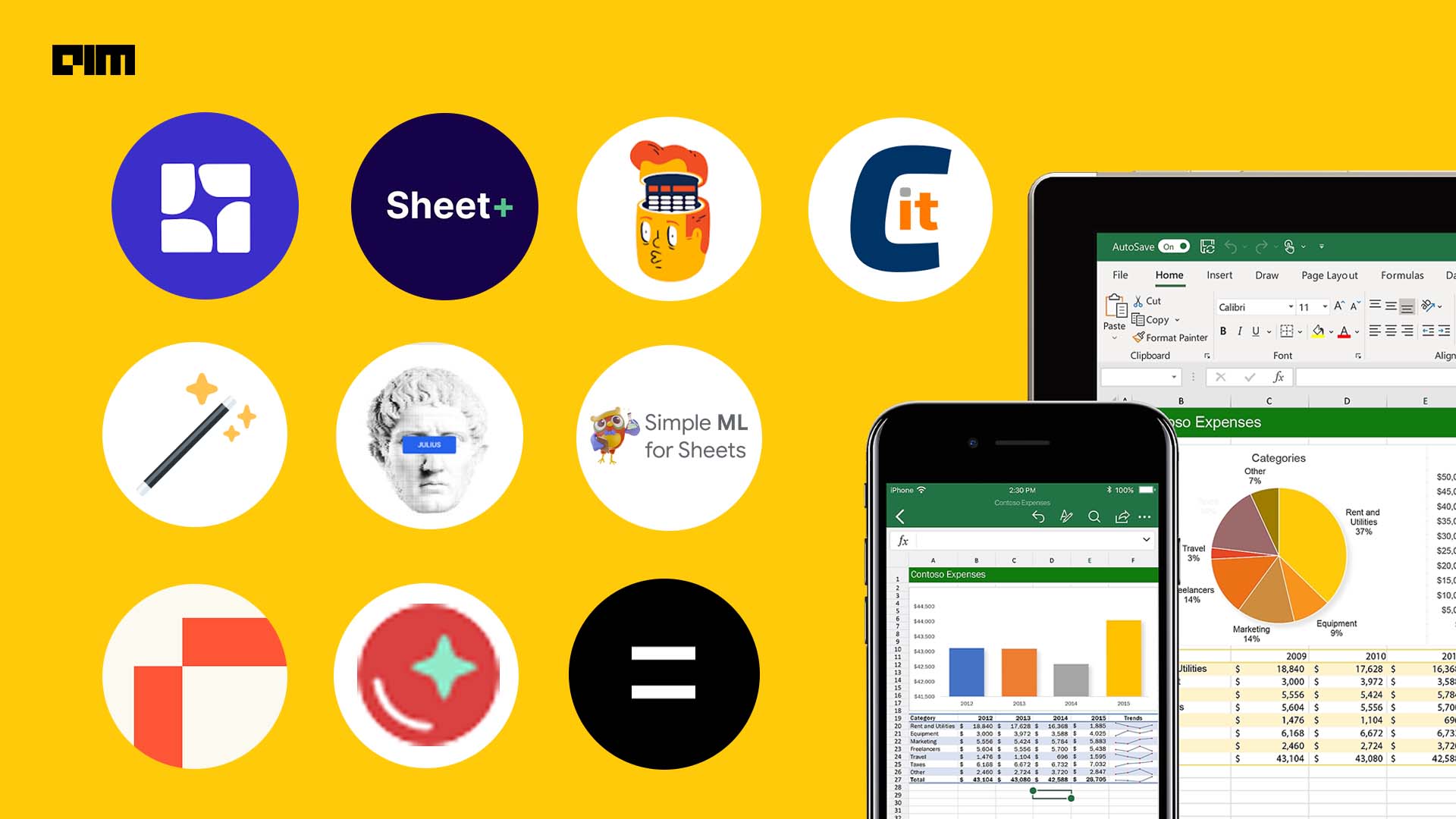
10 AI Tools to Complete Excel Tasks in Minutes

Last year, Microsoft Excel underwent a significant upgrade with the announcement of a public preview of Python integration. This meant that developers and data analysts no longer needed to install additional software to utilise Python’s capabilities, as Excel now came bundled with built-in connectors and power query for Python integration.

The integration of Python into Excel fulfils a long-standing developer goal, replacing reliance on tools like Pandas read excel, OpenPyXL, and PyXLL. With Excel’s continued popularity for data analysis, this integration signifies a significant advancement, promising to modernise data analysis within the software.

By enabling Excel users to directly access Python’s robust libraries for data analysis and visualisation within the Excel environment, this enhancement greatly improves users’ data analysis capabilities.

Here’s a compilation of 10 AI tools that expedite Excel tasks.

  1. Equals

Bobby Pinero, CEO, introduced Equals, a cloud-based spreadsheet application that bridges the gap between one-size-fits-all and complex data platforms.

Equals’ key feature is its capability to link spreadsheets directly to data sources. It offers pre-built connectors to popular databases such as PostgreSQL, MySQL, Snowflake, and others, enabling users to write queries that fetch live data.

Equals Uses AI To Bring Unprecedented Capabilities To Spreadsheets

  1. Tomat AI

Ofer Ronen, CEO, introduced Tomat.AI, a desktop application designed for effortless handling of large CSV or Excel files. It enables users to open, explore, and analyse data without the need for coding. With its intuitive drag-and-drop interface, users can easily filter, sort, merge, and transform data.

With a familiar Excel-like interface, it streamlines tasks sans coding, and features advanced filters, sorting, and grouping. Compatible with Windows, macOS, and Linux, it supports Excel files, PostgreSQL, and Snowflake connectors, transcending from CSV.

  1. Julius AI

Julius, is an AI tool designed to excel in data analysis and enhance one’s Excel experience. It allows users to seamlessly read and interpret Excel documents while delving into sophisticated analyses such as regression and cluster analysis.

Julius’ ability to create striking graphs and charts elevates your data visualisation, making it the ultimate Excel AI companion for a wide range of analyses. Unlock the full potential of your data effortlessly with Julius.

AI just killed Excel.
No more complex formulas and 10-hour tutorials on YouTube.
Here is the Julius AI version of Excel (and it's 100% free): pic.twitter.com/Y24UlyhDch

— Eyisha Zyer 🪐 (@eyishazyer) December 17, 2023

  1. ChatCSV

ChatCSV is a software tool crafted to aid users in querying their CSV documents and creating visual charts to grasp trends, customer behaviour, and inventory management insights.

With AI capabilities, ChatCSV streamlines data analysis. Users only need to upload their CSV file and begin asking questions. The AI within ChatCSV understands user queries and responds in simple language, presenting an intuitive interface for data exploration.

  1. Sheetplus AI

Sheet+ is an AI-powered tool that aims to transform how individuals interact with spreadsheets. It provides a range of features to aid users in crafting precise formulas for Google Sheets and Excel from text, simplifying formula comprehension, debugging, and more.

Recognising the uniqueness of each dataset, it offers personalised suggestions and regular backups to reduce manual input while maintaining utmost accuracy and data security. Additionally, its collection of predefined formulas guarantees immediate access to any required equation for your project.

1. Sheetplus
Sheetplus will help you write Google Sheets and Excel formulas 10x faster with it's inbuild AI Tool.
Save your time and become a spreadsheet master with this amazing AI Tool.https://t.co/6bmQNgfP5U
pic.twitter.com/jSyumGXE8t

— Tanveer Awan (@hTanveerAwan) November 16, 2023

  1. Formula God

Ellis Dunne, the founder of Formula God, created an AI-powered tool that empowers users to leverage artificial intelligence to summon answers and execute previously challenging tasks within Google Sheets.

Formula God simplifies the analysis of Google Sheets data, effortlessly generates tables, graphs, and formulas in real-time. With Formula God, users can access AI-generated formulas tailored to their specific data requirements and seamlessly apply them to their sheets with just a simple command.

  1. Chartify

Chartify, an AI-powered data visualisation tool, streamlines the creation of stunning charts from uploaded data. It offers a range of chart types from various libraries like Plotly and Seaborn.

This tool frees users from the tedious process of using chart editors in Google Sheets or Excel or manually coding visualisations in Plotly. It introduces a fresh and engaging approach to data exploration and interaction.

  1. Simple ML

Simple ML for Sheets is a no-code machine learning add-on for Google Sheets. It’s a tool that enables users to apply basic machine learning techniques (like sentiment analysis, classification, and regression) directly within Google Sheets, the spreadsheet program.

It utilises a decision tree algorithm called Yggdrasil Decision Forests, which is the same algorithm behind TensorFlow Decision Forests. Yggdrasil Decision Forests is scalable and efficient, making it suitable for training models on large datasets.

Google might be abit behind with the generative Ai BUT simple ML for sheets is quite a giant leap, while acknowledge the power of Ms Excel chatGPT plugin. google has cooked the simple ML tool well. #GoogleIO #GoogleIO2023 pic.twitter.com/hoReVPE2qa

— MkenyaDaima | Bongani🇿🇦 | Mamba 🇹🇿 | ₿ (@MkenyaMzi) May 11, 2023

  1. Sheet AI

Sheet AI is a powerful tool that leverages AI to streamline spreadsheet tasks. With advanced algorithms, it automates complex calculations and utilises GPT-3’s capabilities within Google Sheets.

It offers four custom functions: =SHEETAI for prompt responses, =SHEETAI_RANGE for data-based queries, =SHEETAI_IMAGE for image creation from descriptions, and RANGESTRING for range-to-string conversion.

With SheetAI, users seamlessly integrate AI into their Google Sheets workflow, automating mundane tasks and boosting productivity. The tool boasts a user-friendly interface, making it intuitive for users to effortlessly leverage AI within their spreadsheets.

  1. Rows

Torben Schulz, founder of Rows, created an advanced spreadsheet tool infused with AI capabilities. Rows allows users to import data from various sources, including over 50 integrations like Facebook Ads, Google Sheets, and Stripe, simplifying data analysis across platforms.

Users can prompt the AI to conduct trend analysis, generate graphs, or offer tailored insights effortlessly. With just a single click, it produces visually appealing line charts, bar charts, and more. Additionally, it automatically categorises and tags any text to enhance clarity within unstructured data.

👋Rows
Rows is like an advanced version of Excel.
Effortlessly analyze, condense, and reshape data swiftly, empowering you to create superior spreadsheets with AI in mere seconds.
Integrate ChatGPT seamlessly into your spreadsheet for a complimentary experience. pic.twitter.com/DMDVOalFSs

— Parul Gautam (@Parul_Gautam7) April 20, 2024

The post 10 AI Tools to Complete Excel Tasks in Minutes appeared first on Analytics India Magazine.


7 Best Platforms to Practice Python

practice-python
Image by Author

Python is a beginner-friendly programming language to learn. You can learn Python’s syntax and other fundamentals in a few hours and start writing simple programs. But if you’re preparing for interviews—for any role in software engineering or data science—and would like to use Python, you need to know way beyond the basics.

To ace coding interviews, you should focus on problem solving with Python. Here we’ve compiled a list of platforms on which you can learn and practice Python—whether you're a beginner or an experienced programmer—by solving coding challenges across a broad array of topics.

So let's get started!

1. Practice Python

If you’re a beginner just starting out with Python, you’ll find Practice Python helpful. The platform offers a collection of over Python exercises—targeting beginners who are learning the basics of Python.

The exercises cover a variety of topics—from basic syntax to built-in data structures, f-Strings, and error handling.

Additionally, the exercises are categorized by difficulty level, making it easy for learners to progress at their own pace. You can also look up the solutions after you’ve solved the problem to see if there are better approaches.

Link: Practice Python

2. Edabit

Edabit is a platform that offers a variety of programming challenges for multiple languages, including Python. It offers a gamified approach to learning Python.

Challenges range from beginner to advanced levels and cover various topics in algorithms, data structures, and general problem-solving techniques. Edabit has tutorials and challenges to help you learn and practice Python, respectively.

Link: Edabit

3. CodeWars

Codewars is a community-driven platform that provides coding challenges, or "kata," for multiple programming languages, including Python. Challenges are ranked by difficulty level and categorized into different "kyu" ranks.

On Codewars, you can solve challenges on a broad array of topics. Here are some of them:

  • Data structures
  • Algorithms
  • Design patterns
  • Dynamic programming and memoization
  • Functional programming

Link: Codewars

4. Exercism

Exercism is a great platform to learn and practice any programming language. They have dedicated tracks for about 69 programming languages. You can join the Python track and work through the concept modules and exercises (17 concept modules and 140 exercises in all).

The topics covered in the Python track include:

  • Basic data types
  • Strings and string methods
  • Lists, tuples, dictionaries, and sets
  • Unpacking and multiple assignments
  • Classes
  • Generators

Another distinctive feature of Exercism as a platform is personal mentoring, where you can choose to be mentored by experienced programmers and learn from them.

Link: Exercism

5. PYnative

PYnative is a platform specifically tailored for Python learners, offering a variety of exercises, quizzes, and tutorials.

The tutorials cover the following topics:

  • Python basics
  • File handling
  • Date and time
  • Object-Oriented Programming
  • Random data generation
  • Regular expressions
  • Working with JSON
  • Working with databases

In addition to Python exercises, PYnative also has tutorials and practice exercises on pandas—very helpful if you want to learn data analysis with pandas.

Link: PYnative

6. Leetcode

LeetCode is a popular platform for preparing technical interviews and improving coding skills. It offers a vast collection of coding problems, including algorithm challenges and interview questions from top tech companies.

Leetcode is a necessary companion if you’re preparing for coding interviews. Some problems that collections that you can work through:

  • Top Interview 150
  • LeetCode 75

Problems are categorized by difficulty level and topic, so you can focus on specific areas of interest. In addition you can also practice basic pandas on LeetCode.

Link: LeetCode

7. HackerRank

HackerRank, like Leetcode, is a platform that offers coding challenges and competitions for multiple programming languages. It also offers interview preparation kits and coding competitions sponsored by companies for job recruitment purposes.

The Python challenges on HackerRank cover a variety of topics: from data types and operators to modules in the Python standard library. You can also practice data structures and algorithms using Python as your preferred programming language for coding interviews

Link: HackerRank

Wrapping Up

I hope you found this compilation of Python practice platforms helpful. If you’re looking for courses, you’ll find the following resources helpful:

  • 5 Free Courses to Master Python for Data Science
  • 5 Free University Courses to Learn Python

If you’re currently preparing for data science interviews, also read 7 Best Platforms to Practice SQL.

Bala Priya C is a developer and technical writer from India. She likes working at the intersection of math, programming, data science, and content creation. Her areas of interest and expertise include DevOps, data science, and natural language processing. She enjoys reading, writing, coding, and coffee! Currently, she's working on learning and sharing her knowledge with the developer community by authoring tutorials, how-to guides, opinion pieces, and more. Bala also creates engaging resource overviews and coding tutorials.

More On This Topic

  • 7 Best Platforms to Practice SQL
  • 9 Top Platforms to Practice Key Data Science Skills
  • 11 Best Data Science Education Platforms
  • 7 Best Cloud Database Platforms
  • From Theory to Practice: Building a k-Nearest Neighbors Classifier
  • Top 18 Low-Code and No-Code Machine Learning Platforms

Amazon wants to host companies’ custom generative AI models

Amazon wants to host companies’ custom generative AI models Kyle Wiggers 8 hours

AWS, Amazon’s cloud computing business, wants to be the go-to place companies host and fine-tune their custom generative AI models.

Today, AWS announced the launch of Custom Model Import (in preview), a new feature in Bedrock, AWS’ enterprise-focused suite of generative AI services, that allows organizations to import and access their in-house generative AI models as fully managed APIs.

Companies’ proprietary models, once imported, benefit from the same infrastructure as other generative AI models in Bedrock’s library (e.g. Meta’s Llama 3, Anthropic’s Claude 3), including tools to expand their knowledge, fine-tune them and implement safeguards to mitigate their biases.

“There have been AWS customers that have been fine-tuning or building their own models outside of Bedrock using other tools,” Vasi Philomin, VP of generative AI at AWS, told TechCrunch in an interview. “This Custom Model Import capability allows them to bring their own proprietary models to Bedrock and see them right next to all of the other models that are already on Bedrock — and use them with all of the workflows that are also already on Bedrock, as well.”

Importing custom models

According to a recent poll from Cnvrg, Intel’s AI-focused subsidiary, the majority of enterprises are approaching generative AI by building their own models and refining them to their applications. Those same enterprises say that they see infrastructure, including cloud compute infrastructure, as their greatest barrier to deployment, per the poll.

With Custom Model Import, AWS aims to rush in to fill the need while maintaining pace with cloud rivals. (Amazon CEO Andy Jassy foreshadowed as much in his recent annual letter to shareholders.)

For some time, Vertex AI, Google’s analog to Bedrock, has allowed customers to upload generative AI models, tailor them and serve them through APIs. Databricks, too, has long provided toolsets to host and tweak custom models, including its own recently released DBRX.

Asked what sets Custom Model Import apart, Philomin asserted that it — and by extension Bedrock — offer a wider breadth and depth of model customization options than the competition, adding that “tens of thousands” of customers today are using Bedrock.

“Number one, Bedrock provides several ways for customers to deal with serving models,” Philomin said. “Number two, we have a whole bunch of workflows around these models — and now customers’ can stand right next to all of the other models that we have already available. A key thing that most people like about this is the ability to be able to experiment across multiple different models using the same workflows, and then actually take them to production from the same place.”

So what are the alluded-to model customization options?

Philomin points to Guardrails, which lets Bedrock users configure thresholds to filter — or at least attempt to filter — models’ outputs for things like hate speech, violence and private personal or corporate information. (Generative AI models are notorious for going off the rails in problematic ways, including leaking sensitive info; AWS’ have been no exception.) He also highlighted Model Evaluation, a Bedrock tool customers can use to test how well a model — or several — perform across a given set of criteria.

Both Guardrails and Model Evaluation are now generally available following a several-months-long preview.

I feel compelled to note here that Custom Model Import only supports three model architectures at the moment — Hugging Face’s Flan-T5, Meta’s Llama and Mistral’s models — and that Vertex AI and other Bedrock-rivaling services, including Microsoft’s AI development tools on Azure, offer more or less comparable safety and evaluation features (see Azure AI Content Safety, model evaluation in Vertex and so on).

What is unique to Bedrock, though, are AWS’ Titan family of generative AI models. And — coinciding with the release of Custom Model Import — there’s several noteworthy developments on that front.

Upgraded Titan models

Titan Image Generator, AWS’ text-to-image model, is now generally available after launching in preview last November. As before, Titan Image Generator can create new images given a text description or customize existing images, for example swapping out an image background while retaining the subjects in the image.

Compared to the preview version, Titan Image Generator in GA can generate images with more “creativity,” said Philomin, without going into detail. (Your guess as to what that means is as good as mine.)

I asked Philomin if he had any more details to share about how Titan Image Generator was trained.

At the model’s debut last November, AWS was vague about which data, exactly, it used in training Titan Image Generator. Few vendors readily reveal such information; they see training data as a competitive advantage and thus keep it and info relating to it close to the chest.

Training data details are also a potential source of IP-related lawsuits, another disincentive to reveal much. Several cases making their way through the courts reject vendors’ fair use defenses, arguing that text-to-image tools replicate artists’ styles without the artists’ explicit permission and allow users to generate new works resembling artists’ originals for which artists receive no payment.

Philomin would only tell me that AWS uses a combination of first-party and licensed data.

“We have a combination of proprietary data sources, but also we license a lot of data,” he said. “We actually pay copyright owners licensing fees in order to be able to use their data, and we do have contracts with several of them.”

It’s more detail than from November. But I have a feeling that Philomin’s answer won’t satisfy everyone, particularly the content creators and AI ethicists arguing for greater transparency where it concerns generative AI model training.

In lieu of transparency, AWS says it’ll continue to offer an indemnification policy that covers customers in the event a Titan model like Titan Image Generator regurgitates (i.e. spits out a mirror copy of) a potentially copyrighted training example. (Several rivals, including Microsoft and Google, offer similar policies covering their image generation models.)

To address another pressing ethical threat — deepfakes — AWS says that images created with Titan Image Generator will, as during the preview, come with a “tamper-resistant” invisible watermark. Philomin says that the watermark has been made more resistant in the GA release to compression and other image edits and manipulations.

Segueing into less controversial territory, I asked Philomin whether AWS — like Google, OpenAI and others — is exploring video generation given the excitement around (and investment in) the tech. Philomin didn’t say that AWS wasn’t… but he wouldn’t hint at any more than that.

“Obviously, we’re constantly looking to see what new capabilities customers want to have, and video generation definitely comes up in conversations with customers,” Philomin said. “I’d ask you to stay tuned.”

In one last piece of Titan-related news, AWS released the second generation of its Titan Embeddings model, Titan Text Embeddings V2. Titan Text Embeddings V2 converts text to numerical representations called embeddings to power search and personalization applications. So did the first-generation Embeddings model — but AWS claims that Titan Text Embeddings V2 is overall more efficient, cost-effective and accurate.

“What the Embeddings V2 model does is reduce the overall storage [necessary to use the model] by up to four times while retaining 97% of the accuracy,” Philomin claimed, “outperforming other models that are comparable.”

We’ll see if real-world testing bears that out.

You Don’t Need a Degree to Get an AI Job

You Don’t Need a Degree to Get an AI Job

In a bold move against traditional hiring practices, Vishnu Vardhan, CEO & founder of Vizzy Inc., championed the hiring of talent regardless of their educational background. His recent decision to recruit a Grade 9 student from Belgaum challenges the long-held belief that a degree is a prerequisite for employment in the tech industry.

In a recent interview with AIM, the CEO said, “School kids these days are amazing because they have the opportunity to learn things that we would not get even in colleges.” The hired Belgaum student has independently developed a Rabbit L model using Raspberry Pi and ChatGPT APIs, relying solely on online tutorials.

Following a similar path, Izam Mohammed‘s journey to becoming an AI/ML engineer is another example of how non-traditional routes can lead to success in the tech world.

Mohammed, who never set foot in a college classroom, leveraged online resources to acquire the skills needed to develop the Python library for evaluating RAG models. His initiative and determination earned him a position in the industry at 18, showcasing the power of self-learning.

The shift away from requiring a computer science degree for tech-related careers is gaining traction, with industry leaders like Matthew Candy, IBM‘s global managing partner for generative AI, lending their support.

“The speed at which people will be able to come up with an idea, to test the idea, to make something, it’s going to be so accelerated. You don’t need to have a degree in computer science to do that,” Candy said.

Candy predicts that advancements in AI will democratise product creation, allowing individuals with innovative ideas to bring them to fruition without extensive coding knowledge.

Decline of Computer Science Degree

In an interview with Recode editor Kara Swisher on the Recode Decode podcast, billionaire investor Mark Cuban said that computer science degrees will lose some of their value as artificial intelligence becomes more advanced.

“Twenty years from now, if you are a coder, you might be out of a job because it’s just math and so, whatever we’re defining the AI to do, someone’s got to know the topic. If you’re using AI to emulate Shakespeare, somebody better know Shakespeare.

“The coding major who graduates this year probably has better short-term opportunities than the liberal arts major that’s a Shakespeare expert. But long term, it’s like people who learned COBOL or Fortran and thought that was the future and they were going to be covered forever,” Cuban said.

pic.twitter.com/Or4sijACAW

— AI Notkilleveryoneism Memes ⏸ (@AISafetyMemes) April 23, 2024

During the Microsoft Build 2023 Conference, it was repeatedly mentioned that “everyone is a developer now”. This suggests that even without prior coding experience, one can learn to code and secure jobs in AI. And Microsoft aims to broaden opportunities for them by introducing new initiatives to facilitate this transition.

Some Quora and Reddit users believe the internet provides a lot of learning material to enhance AI skills. They argue that individuals can acquire knowledge virtually on any topic from the comfort of their homes.

Time to Rewrite Your Resume

Given the evolving landscape of the tech industry and the shifting attitudes toward formal educational requirements, it’s evident that your resume needs an overhaul.

The stories of Vizzy CEO’s unconventional hiring practices, the self-taught journeys of individuals like Izam Mohammed, and the insights shared by industry leaders all reflect a fundamental truth that expertise and skill in technology are no longer solely defined by a degree.

Well, Sam Altman, the CEO of OpenAI, thinks, “University degrees are IMO status and not substance at this point.”

The post You Don’t Need a Degree to Get an AI Job appeared first on Analytics India Magazine.

Data Scientist Breakdown: Skills, Certifications, and Salary

Data Scientist Breakdown: Skills, Certifications and Salary
Image by Author

A lot of us are worried about the demand for data scientists since the use of platforms such as ChatGPT. Over the past few years, companies have been laying off employees in the tech sector, and the big question everybody is asking is whether AI is the reason behind it.

In today's article, we will be speaking specifically about data science, and although there are challenges, those with data science skills have a more promising career longevity.

A study by 365datascience shows that data scientists made up 3% of those laid off by major tech companies. Other tech professionals such as software engineers, were affected more, at around 22%.

This statistic alone presents to us the crucial role data scientists play in advancing the tech industry.

What is the Role of a Data Scientist?

A data scientist's job role focuses on statistics, machine learning, and artificial intelligence. Their business objective is to be able to use different data strategies and turn raw data into business insights that can be used in the decision-making process.

This can go from simple data analysis to building machine learning models.

A data scientist is skilled in mathematics, statistics, and computer science with expertise in a programming language such as Python or R.

How Do You Become a Data Scientist

As stated above, to become a data scientist, you will need to have a good foundational understanding of mathematics, and statistics along with a programming language.

What about computer science? Do I not need a degree for this?

In some cases yes, depending on where you are in the world. For example, in the UK a lot of companies desire a university degree. However, as the demand for data scientists continues to grow, organisations understand the low supply and are more than happy to take on people with the correct certifications and skills.

So what kind of certifications are these?

  • IBM Data Science
  • Google Data Analytics
  • Data Analysis with Python
  • Databases and SQL for Data Science with Python
  • Data Science JHU
  • Applied Data Science

Data Scientist Salary

So what’s the money like?

According to Glassdoor, updated on the 12th of April 2024 — the average salary for a data scientist in the US is $157,000, ranging from $132,00 to $190,000.

Please note that in this figure, only 37.8% of job postings announced their salary. Working in the tech industry, I have come across US data scientists with a salary between $160,000–$200,000 annually.

However, salary is highly dependent on a range of factors:

Factors Affecting Data Scientist Salary

  • Geographic Location — Regions that tend to have a higher cost of living such as London or New York will generally have a higher salary. However, with this being said, the increase in remote workers has allowed data scientists globally to earn a better salary.
  • Experience — Naturally, the more experience you have the more money you will get. Gaining the right experience and skills as a data scientist will help you increase your salary as you become more competitive in an already high-demand market.
  • Industry — The industry you work for also reflects your salary. Industries such as technology, finance, and healthcare are making more use of their data day-to-day and require data scientists to make sense of it.

Wrapping it Up

The demand for data scientists will continue to grow and if you are somebody who is looking to transition into the tech industry with a career that has a higher chance of job security — data science is for you.

Don’t worry about not having the right qualifications from University, you can gain the same experience, skills, and land a job with the certifications mentioned above!

Nisha Arya is a data scientist, freelance technical writer, and an editor and community manager for KDnuggets. She is particularly interested in providing data science career advice or tutorials and theory-based knowledge around data science. Nisha covers a wide range of topics and wishes to explore the different ways artificial intelligence can benefit the longevity of human life. A keen learner, Nisha seeks to broaden her tech knowledge and writing skills, while helping guide others.

More On This Topic

  • Salary Breakdown of the Top Data Science Jobs
  • Popular Certifications to validate your data and analytics skills
  • Boost Your Data Science Skills: The Essential SQL Certifications You Need
  • A Breakdown of Deep Learning Frameworks
  • European AI Act: The Simplified Breakdown
  • The Art of Effective Prompt Engineering with Free Courses and…

OpenAI Introduces Instruction Hierarchy to Protect LLMs from Jailbreaks and Prompt Injections

OpenAI Introduces Instruction Hierarchy to Protect LLMs from Jailbreaks and Prompt Injections

In response to increasing vulnerabilities of LLMs to prompt injections, jailbreaks, and other attacks, OpenAI has proposed an instruction hierarchy. This hierarchy aims to address the primary vulnerability underlying these attacks, where LLMs often treat all instructions with the same priority, regardless of the source.

According to OpenAI’s paper, the lack of a clear instruction hierarchy in modern LLMs leaves them vulnerable to various attacks. To mitigate this, OpenAI proposes an instruction hierarchy that explicitly defines how models should behave when instructions of different priorities conflict. This hierarchy would enable LLMs to defer to higher-privileged instructions in case of conflicts.

OpenAI proposes that when multiple instructions are presented to the model, lower-privileged instructions should only be followed if they are aligned with higher-privileged ones.

Aligned instructions have the same constraints, rules, or goals as higher-level instructions and should be followed by the LLM.

However, misaligned instructions, which directly oppose the original instruction or are orthogonal to it, should be ignored by the model.

To implement the instruction hierarchy, OpenAI proposes two approaches:

  • Context Synthesis: For aligned instructions, examples are generated using a method called context synthesis. Instructions are decomposed into smaller pieces and placed at different levels of the hierarchy. Models are then trained to predict the original ground-truth response.
  • Context Ignorance: For misaligned instructions, models are trained to predict the same answer they would have generated if they never saw the lower-level instructions.

OpenAI fine-tuned GPT-3.5 Turbo using supervised fine-tuning and reinforcement learning from human feedback on the proposed instruction hierarchy. The evaluation showed that the instruction hierarchy improves safety results on all main evaluations, increasing robustness by up to 63%. The model also exhibited generalisation to evaluation criteria excluded from training, increasing robustness by up to 34%.

OpenAI plans to scale up data collection efforts to further improve model performance and refine its refusal decision boundary. Future work will focus on refining how models handle conflicting instructions, exploring multimodal instruction hierarchy data, implementing model architecture changes, and conducting more explicit adversarial training to enhance model robustness.

The post OpenAI Introduces Instruction Hierarchy to Protect LLMs from Jailbreaks and Prompt Injections appeared first on Analytics India Magazine.

FrugalGPT: A Paradigm Shift in Cost Optimization for Large Language Models

Discover how FrugalGPT revolutionizes AI cost optimization with its innovative approach to deploying Large Language Models (LLMs) efficiently.

Large Language Models (LLMs) represent a significant breakthrough in Artificial Intelligence (AI). They excel in various language tasks such as understanding, generation, and manipulation. These models, trained on extensive text datasets using advanced deep learning algorithms, are applied in autocomplete suggestions, machine translation, question answering, text generation, and sentiment analysis.

However, using LLMs comes with considerable costs across their lifecycle. This includes substantial research investments, data acquisition, and high-performance computing resources like GPUs. For instance, training large-scale LLMs like BloombergGPT can incur huge costs due to resource-intensive processes.

Organizations utilizing LLM usage encounter diverse cost models, ranging from pay-by-token systems to investments in proprietary infrastructure for enhanced data privacy and control. Real-world costs vary widely, from basic tasks costing cents to hosting individual instances exceeding $20,000 on cloud platforms. The resource demands of larger LLMs, which offer exceptional accuracy, highlight the critical need to balance performance and affordability.

Given the substantial expenses associated with cloud computing centres, reducing resource requirements while improving financial efficiency and performance is imperative. For instance, deploying LLMs like GPT-4 can cost small businesses as much as $21,000 per month in the United States.

FrugalGPT introduces a cost optimization strategy known as LLM cascading to address these challenges. This approach uses a combination of LLMs in a cascading manner, starting with cost-effective models like GPT-3 and transitioning to higher-cost LLMs only when necessary. FrugalGPT achieves significant cost savings, reporting up to a 98% reduction in inference costs compared to using the best individual LLM API.

FrugalGPT,s innovative methodology offers a practical solution to mitigate the economic challenges of deploying large language models, emphasizing financial efficiency and sustainability in AI applications.

Understanding FrugalGPT

FrugalGPT is an innovative methodology developed by Stanford University researchers to address challenges associated with LLM, focusing on cost optimization and performance enhancement. It involves adaptively triaging queries to different LLMs like GPT-3, and GPT-4 based on specific tasks and datasets. By dynamically selecting the most suitable LLM for each query, FrugalGPT aims to balance accuracy and cost-effectiveness.

The main objectives of FrugalGPT are cost reduction, efficiency optimization, and resource management in LLM usage. FrugalGPT aims to reduce the financial burden of querying LLMs by using strategies such as prompt adaptation, LLM approximation, and cascading different LLMs as needed. This approach minimizes inference costs while ensuring high-quality responses and efficient query processing.

Moreover, FrugalGPT is important in democratizing access to advanced AI technologies by making them more affordable and scalable for organizations and developers. By optimizing LLM usage, FrugalGPT contributes to the sustainability of AI applications, ensuring long-term viability and accessibility across the broader AI community.

Optimizing Cost-Effective Deployment Strategies with FrugalGPT

Implementing FrugalGPT involves adopting various strategic techniques to enhance model efficiency and minimize operational costs. A few techniques are discussed below:

  • Model Optimization Techniques

FrugalGPT uses model optimization techniques such as pruning, quantization, and distillation. Model pruning involves removing redundant parameters and connections from the model, reducing its size and computational requirements without compromising performance. Quantization converts model weights from floating-point to fixed-point formats, leading to more efficient memory usage and faster inference times. Similarly, model distillation entails training a smaller, simpler model to mimic the behavior of a larger, more complex model, enabling streamlined deployment while preserving accuracy.

  • Fine-Tuning LLMs for Specific Tasks

Tailoring pre-trained models to specific tasks optimizes model performance and reduces inference time for specialized applications. This approach adapts the LLM’s capabilities to target use cases, improving resource efficiency and minimizing unnecessary computational overhead.

  • Deployment Strategies

FrugalGPT supports adopting resource-efficient deployment strategies such as edge computing and serverless architectures. Edge computing brings resources closer to the data source, reducing latency and infrastructure costs. Cloud-based solutions offer scalable resources with optimized pricing models. Comparing hosting providers based on cost efficiency and scalability ensures organizations select the most economical option.

  • Reducing Inference Costs

Crafting precise and context-aware prompts minimizes unnecessary queries and reduces token consumption. LLM approximation relies on simpler models or task-specific fine-tuning to handle queries efficiently, enhancing task-specific performance without the overhead of a full-scale LLM.

  • LLM Cascade: Dynamic Model Combination

FrugalGPT introduces the concept of LLM cascading, which dynamically combines LLMs based on query characteristics to achieve optimal cost savings. The cascade optimizes costs while reducing latency and maintaining accuracy by employing a tiered approach where lightweight models handle common queries and more powerful LLMs are invoked for complex requests.

By integrating these strategies, organizations can successfully implement FrugalGPT, ensuring the efficient and cost-effective deployment of LLMs in real-world applications while maintaining high-performance standards.

FrugalGPT Success Stories

HelloFresh, a prominent meal kit delivery service, used Frugal AI solutions incorporating FrugalGPT principles to streamline operations and enhance customer interactions for millions of users and employees. By deploying virtual assistants and embracing Frugal AI, HelloFresh achieved significant efficiency gains in its customer service operations. This strategic implementation highlights the practical and sustainable application of cost-effective AI strategies within a scalable business framework.

In another study utilizing a dataset of headlines, researchers demonstrated the impact of implementing Frugal GPT. The findings revealed notable accuracy and cost reduction improvements compared to GPT-4 alone. Specifically, the Frugal GPT approach achieved a remarkable cost reduction from $33 to $6 while enhancing overall accuracy by 1.5%. This compelling case study underscores the practical effectiveness of Frugal GPT in real-world applications, showcasing its ability to optimize performance and minimize operational expenses.

Ethical Considerations in FrugalGPT Implementation

Exploring the ethical dimensions of FrugalGPT reveals the importance of transparency, accountability, and bias mitigation in its implementation. Transparency is fundamental for users and organizations to understand how FrugalGPT operates, and the trade-offs involved. Accountability mechanisms must be established to address unintended consequences or biases. Developers should provide clear documentation and guidelines for usage, including privacy and data security measures.

Likewise, optimizing model complexity while managing costs requires a thoughtful selection of LLMs and fine-tuning strategies. Choosing the right LLM involves a trade-off between computational efficiency and accuracy. Fine-tuning strategies must be carefully managed to avoid overfitting or underfitting. Resource constraints demand optimized resource allocation and scalability considerations for large-scale deployment.

Addressing Biases and Fairness Issues in Optimized LLMs

Addressing biases and fairness concerns in optimized LLMs like FrugalGPT is critical for equitable outcomes. The cascading approach of Frugal GPT can accidentally amplify biases, necessitating ongoing monitoring and mitigation efforts. Therefore, defining and evaluating fairness metrics specific to the application domain is essential to mitigate disparate impacts across diverse user groups. Regular retraining with updated data helps maintain user representation and minimize biased responses.

Future Insights

The FrugalGPT research and development domains are ready for exciting advancements and emerging trends. Researchers are actively exploring new methodologies and techniques to optimize cost-effective LLM deployment further. This includes refining prompt adaptation strategies, enhancing LLM approximation models, and refining the cascading architecture for more efficient query handling.

As FrugalGPT continues demonstrating its efficacy in reducing operational costs while maintaining performance, we anticipate increased industry adoption across various sectors. The impact of FrugalGPT on the AI is significant, paving the way for more accessible and sustainable AI solutions suitable for business of all sizes. This trend towards cost-effective LLM deployment is expected to shape the future of AI applications, making them more attainable and scalable for a broader range of use cases and industries.

The Bottom Line

FrugalGPT represents a transformative approach to optimizing LLM usage by balancing accuracy with cost-effectiveness. This innovative methodology, encompassing prompt adaptation, LLM approximation, and cascading strategies, enhances accessibility to advanced AI technologies while ensuring sustainable deployment across diverse applications.

Ethical considerations, including transparency and bias mitigation, emphasize the responsible implementation of FrugalGPT. Looking ahead, continued research and development in cost-effective LLM deployment promises to drive increased adoption and scalability, shaping the future of AI applications across industries.

Cognizant Teams Up with Microsoft to Integrate Generative AI for Employees

Judson Althoff, EVP & Chief Commercial Officer of Microsoft has announced its partnership with Cognizant to bring Microsoft’s generative AI capabilities to Cognizant’s employees and millions of users across industries.

Althoff said, by leveraging Microsoft’s Copilot capabilities, Cognizant will help organisations transform business operations, enhance employee experiences, and deliver new value for their customers.

“We will work with Cognizant to build and deliver industry and business-specific solutions built on Microsoft Copilot Studio to help customers create and customise their own copilots. I am excited about this next step in our journey and for the opportunities ahead to drive pragmatic innovation together,” said Althoff.

Cognizant acquired 25,000 Microsoft 365 Copilot seats for its associates and 500 Sales Copilot seats and 500 Services Copilot seats. They aim to boost productivity, streamline workflows, and improve customer experiences.

Also, Cognizant plans to roll out Microsoft 365 Copilot to a million users among their global 2000 clients and across 11 industries. Furthermore, 35,000 Cognizant developers have been trained on Github Copilot through their Synapse skilling program, with another 40,000 developers set to undergo training.

A few months ago, Cognizant and Microsoft teamed up to introduce the Innovation Assistant, a generative AI-powered tool developed on Microsoft Azure OpenAI Service. Ravi Kumar highlighted the partnership with Microsoft, stating,

“In collaboration with Microsoft, we are leveraging generative AI to transform our innovation strategy, aiming to keep ourselves and our clients ahead in a swiftly changing business landscape.”

In 2023, Microsoft announced its commencement of the Copilot rollout for consumers in September and for enterprises in November of the same year, heralding the AI-powered assistant’s potential to revolutionize user interactions with technology. Subsequently, reports surfaced in November indicating that Microsoft 365 Copilot could potentially generate over $10 billion in annualized revenue for the tech giant by 2026.

The post Cognizant Teams Up with Microsoft to Integrate Generative AI for Employees appeared first on Analytics India Magazine.

UAE Turns to India to Spearhead AI Innovations

The UAE is eyeing partnerships with several countries, including India, to give its AI development plans a fillip.

Hakim Hacid, executive director and acting chief researcher at the Technology Innovation Institute (TII) that created UAE’s Falcon LLM, had said that India is a neighbouring country, with several immigrants making up a sizeable portion of the workforce in the country.

“We have internally initiated [efforts] on [achieving] multi-linguality and integrating Urdu because we have a lot of immigrants in the UAE who are coming from India. The Urdu language is as important as Arabic in the UAE,” he said.

The institute will likely collaborate with Indian-based companies working on a multilingual model, like BharatGPT’s Hanooman.

Similarly, last week, it was reported that Microsoft had invested $1.5bn in UAE-based AI company G42, with Microsoft president Brad Smith joining the company’s board. Shortly after this development, sources within the US government stated that several more partnerships were being drawn up between the two countries.

Specifically, there were reports that the US government was behind the Microsoft-G42 deal, and is working to forge partnerships between UAE and major industry players like Google and OpenAI.

This would explain why both OpenAI’s Sam Altman and Nvidia’s Jensen Huang have been seen rubbing shoulders with the country’s AI stalwarts.

However, these partnerships aren’t a matter of pure luck. The partnerships with both the US and potentially with India, come on the heels of the UAE cutting off ties with China in terms of AI development.

Was China Behind This?

UAE’s initial AI-inclined partnerships were forged with China, wherein G42 had collaborated with Huawei for the use of their equipment to help roll out 5G as well as for cloud capabilities. However, this and several collaborations between the two countries had remained a cause for concern for the States.

With Washington raising concerns on their partnerships, and China’s potential use of data from an American ally, G42 had severed their partnership in favour of American partnerships.

Late last year, promises were also made by G42 that ties would be severed with their Chinese counterparts. “For better or worse, as a commercial company, we are in a position where we have to make a choice. We cannot work with both sides,” said Peng Xiao, G42 CEO.

With ties severed, it seems that the UAE is keen on forging partnerships with the US as well as its allies in order to improve its AI capabilities and infrastructure.

“The talks are part of Washington’s efforts to achieve supremacy over Beijing in the development of artificial intelligence and other sensitive technologies,” the Financial Times recently reported. Commerce secretary Gina Raimonda had been heavily involved with the Microsoft-G42 deal, according to the report.

Likewise, according to FT, sources who had been briefed about the talks between the two governments on the deal had stated, “The UAE views data as the new oil. It realised that it had to find a new way to exist between the US and China because of US concerns about Chinese tech. They’ve since been having very productive conversations, with Raimondo in particular.”

Apart from the current collaborations and investments from US-based companies like OpenAI and Microsoft, the Gulf country has also expressed its interest in collaborating with other US allies.

Investments Going In and Coming Out

While a lack of Chinese intervention has left the UAE keen on forging collaborations with other countries, the same is true the other way around as well.

As Altman recently said, “For a bunch of reasons, the UAE would be well-positioned to be a leader in the discussions around that”, which was specifically for creating a watchdog organisation to monitor AI systems, along the lines of the International Atomic Energy Agency.

In December last year, UAE and India signed an MoU for joint research in several fields including artificial intelligence. Meanwhile, the UK has made it clear that a partnership with the UAE in terms of AI is at the top of their priorities.

In February, the UK secretary of state for science, innovation and technology Michelle Donelan visited the UAE to get a broader picture of where the country stands on AI and to forge partnerships with them. “We’re going to take learnings from one another as we plot out a way forward on this,” she said.

Similarly, the UAE has also been proactive about who they want to invest in, with reports of officials reaching out to European-based startups.

“We already have been approached by people from outside the European Union asking us basically: ‘Oh, now with all that horrible regulation, don’t you want to move your AI R&D company?’” said Jonas Andrulis, the founder of Germany-based Aleph Alpha.

UAE’s Ease of Access

UAE’s first AI minister, Omar Al Olama, has been key in paving the way for ensuring that AI development continues unhindered in the country. Olama had backed Altman’s suggestion of turning the UAE into a “sandbox” for AI.

Similarly, the UAE has prided itself on providing access to data that would otherwise be unavailable to companies in other countries.

UAE’s Advanced Technology Research Council (ATRC) general secretary Faisal Al Bannai said that right now the country provides a good mix of access to data, research funding and infrastructure, making it a goldmine for researchers.

The country, for instance, had no qualms about allowing companies to train on private data, like patient medical data but stripped of any identifying information.

“It is a place made out of heaven for researchers in AI. There aren’t many places that have all of this under one roof. Try to go to some countries and get access to data to train. OK, good luck,” he had told Bloomberg.

With a government full of more open-minded and AI-inclined officials, it seems that the country is way more open to allowing experimentation and embracing its role as an AI sandbox. This means that the UAE is taking avid advantage of a gap that is passing by their counterparts.

As Al Bannai said, “You can either debate forever or you can move. We have decided to move.”

The post UAE Turns to India to Spearhead AI Innovations appeared first on Analytics India Magazine.

Genpact Launches AI Innovation Centre in Gurugram

Genpact Launches AI Innovation Centre in Gurugram

Genpact has announced the opening of its AI Innovation Center in Gurugram, India, in collaboration with NASSCOM.

The centre aims to democratise AI, fostering world-class AI talent to support India’s ambitions in the field and apply AI solutions at scale for clients globally.

As part of Genpact’s AI-first approach, the centre will serve as a hub for innovation, enabling talent to learn, experiment, and develop comprehensive, AI-focused solutions to drive growth for Genpact’s global clients.

The AI Innovation Center provides Genpact experts and clients with a dedicated space to explore new ideas, capabilities, and solutions. Clients will have increased access to Genpact’s deep business knowledge, combined with the data, technology, and AI expertise of its personnel, as well as industry partnerships.

Piyush Mehta, CHRO, and Country Manager, India, Genpact, emphasised the importance of fostering a culture of learning and experimentation. He stated, “By fostering a culture of learning, experimentation, and using the best of our partner ecosystem, we’re empowering our employees to become co-creators alongside AI. We believe data, technology, and AI, as well as our talent, are key to driving unparalleled outcomes for our clients, and with this AI Innovation Centre, we’re not just embracing the future, we’re shaping it together.”

India has been accelerating its AI innovation journey, with the government launching a $1.2 billion IndiaAI mission to promote capacity building, AI literacy, establish research centres, and create legal frameworks for the responsible use of AI.

Genpact’s AI Innovation Center will democratise access to AI and cultivate world-class AI talent in India. With over 125,000 employees, Genpact aims to empower its workforce to leverage advanced technologies and drive lasting value for clients.

Debjani Ghosh, President, NASSCOM, highlighted the significance of this initiative, stating, “This initiative not only showcases the technology industry in India’s commitment to becoming a global leader in AI but also demonstrates its potential to innovate and contribute to the global AI ecosystem.”

Genpact launched its inaugural AI Innovation Center in London last year, with several more centres planned across the world in the coming months.

The post Genpact Launches AI Innovation Centre in Gurugram appeared first on Analytics India Magazine.