GPU Poor, But Luxury Rich

GPU Poor, But Luxury Rich

Yes, that’s true! Though every other company is busy making AI investments these days, what could be the reason behind a luxury brand like Chanel backing an ML library called scikit-learn?

Julien Chaumond, CTO at Hugging Face, shared a screenshot titled – French AI: gpu poor, but luxury rich 🤯(sic) – which shows that Chanel is the platinum sponsor for scikit-learn, while Hugging Face and NVIDIA are the silver sponsors for the project’s Inria Foundation.

Chanel supports the scikit-learn community through subsidising core developer salaries and associated activities.

TIL scikit-learn, an open-source ML library, has only one Platinum sponsor and it is … Chanel? pic.twitter.com/dBjaGntrAG

— AJ (@aj_kourabi) April 23, 2024

Scikit-learn, a Python-based machine-learning library, serves as the backbone for numerous AI and data science applications. Widely utilised across various fields, from medical imaging to product recommendation, it is employed regularly by over half-a-million individuals worldwide.

Now, Chanel enhances the customer shopping experience by integrating AI-based virtual assistants and a unique beauty try-on tool, helping customers select the ideal lipstick shade to complement their outfits.

However, for Chanel, the investment in AI goes back to 2021 when it introduced a groundbreaking beauty try-on tool called Lipscanner, a first for the brand. This in-house app enables users to scan colours from various sources such as social media, magazines, and clothing items. Chanel then matches the scanned colour with the closest shade from its extensive collection of 400 lipsticks.

Using AI, Lipscanner can identify the texture of the product, whether matte or glossy, if the colour inspiration comes from another person’s face, and match it with the closest product from Chanel. Consumers can also coordinate lipsticks with their outfits and accessories using the Colour Picking feature.

By uploading a photo within the app or selecting one from their camera roll, an algorithm can analyse the shade of an outfit and suggest two or three lipsticks that would complement it best. Once a colour is identified, users can virtually try on the product within the app, take pictures, and share them on social media.

This was developed in partnership with CX Lab, which took months to develop and was launched at an opportune time for online shopping.

Along similar lines, the same year, in collaboration with the search engine giant Google, L’Oréal too boosted its AI capabilities, allowing customers to instantly try on products online from any advertisement from its brand portfolio. This technology is also available on the YouTube channels of Maybelline and Lancôme, both owned by L’Oréal.

How and why are luxury brands investing in AI?

Cut to 2024, one can find plenty of luxury brands investing in AI. One of the most important reasons is to diversify their portfolio, and to plan for long-term “flashy” investments. And what could be flashier than AI right now?

These luxury brands are investing in AI platforms just like how wearable companies are partnering with generative AI companies. For example, Humane Ai Pin or Meta’s RayBan glasses can be counted as wearable and brands that are harnessing AI, while also focusing on providing luxury to customers.

For example, Gucci is harnessing AI to analyse customer trends and identify product opportunities. Their AI-equipped mobile app provides sales assistants with data on product specifications and customer purchase history, refining the in-store customer experience. Additionally, AI assists in identifying new markets and optimising product distribution, potentially significantly improving sales forecasts.

Louis Vuitton integrates AI with customer service, offering AI-driven chatbots and the LV App to enhance shopping experiences. These innovations provide personalised product recommendations, answer queries, and facilitate appointment bookings.

Christian Dior employs AI to create virtual audiences for live-streamed fashion shows, enabling interaction between viewers and models, and making the fashion experience more engaging and interactive. Prada uses AI to design eye-catching graphics for its new social media promotions, focusing on top-selling scents, thereby merging technology with fragrance promotion for maximum impact.

Versace utilises AI and VR technology to introduce virtual fitting rooms, expanding their reach and offering a more personalised shopping experience. Armani leverages AI for efficient inventory management and demand forecasting. Their Face Maestro service offers personalised virtual makeup trials, creating a consultant-like experience and minimising waste.

Brands like Boucheron and Volund Jewelry employ AI to design personalised jewellery using 3D metal printing, enabling the creation of distinctive designs and prototypes.

In the future, these companies might have plans to integrate AI features such as the Humane Ai Pin in their products.

The post GPU Poor, But Luxury Rich appeared first on Analytics India Magazine.

Snowflake Arctic: The Cutting-Edge LLM for Enterprise AI

Snowflake Arctic: The Cutting-Edge LLM for Enterprise AI

Enterprises today are increasingly exploring ways to leverage large language models (LLMs) to boost productivity and create intelligent applications. However, many of the available LLM options are generic models not tailored for specialized enterprise needs like data analysis, coding, and task automation. Enter Snowflake Arctic – a state-of-the-art LLM purposefully designed and optimized for core enterprise use cases.

Developed by the AI research team at Snowflake, Arctic pushes the boundaries of what's possible with efficient training, cost-effectiveness, and an unparalleled level of openness. This revolutionary model excels at key enterprise benchmarks while requiring far less computing power compared to existing LLMs. Let's dive into what makes Arctic a game-changer for enterprise AI.

Enterprise Intelligence Redefined At its core, Arctic is laser-focused on delivering exceptional performance on metrics that truly matter for enterprises – coding, SQL querying, complex instruction following, and producing grounded, fact-based outputs. Snowflake has combined these critical capabilities into a novel “enterprise intelligence” metric.

The results speak for themselves. Arctic meets or outperforms models like LLAMA 7B and LLAMA 70B on enterprise intelligence benchmarks while using less than half the computing budget for training. Remarkably, despite utilizing 17 times fewer compute resources than LLAMA 70B, Arctic achieves parity on specialized tests like coding (HumanEval+, MBPP+), SQL generation (Spider), and instruction following (IFEval).

But Arctic's prowess goes beyond just acing enterprise benchmarks. It maintains strong performance across general language understanding, reasoning, and mathematical aptitude compared to models trained with exponentially higher compute budgets like DBRX. This holistic capability makes Arctic an unbeatable choice for tackling the diverse AI needs of an enterprise.

The Innovation

Dense-MoE Hybrid Transformer So how did the Snowflake team build such an incredibly capable yet efficient LLM? The answer lies in Arctic's cutting-edge Dense Mixture-of-Experts (MoE) Hybrid Transformer architecture.

Traditional dense transformer models become increasingly costly to train as their size grows, with computational requirements increasing linearly. The MoE design helps circumvent this by utilizing multiple parallel feed-forward networks (experts) and only activating a subset for each input token.

However, simply using an MoE architecture isn't enough – Arctic combines the strengths of both dense and MoE components ingeniously. It pairs a 10 billion parameter dense transformer encoder with a 128 expert residual MoE multi-layer perceptron (MLP) layer. This dense-MoE hybrid model totals 480 billion parameters but only 17 billion are active at any given time using top-2 gating.

The implications are profound – Arctic achieves unprecedented model quality and capacity while remaining remarkably compute-efficient during training and inference. For example, Arctic has 50% fewer active parameters than models like DBRX during inference.

But model architecture is only one part of the story. Arctic's excellence is the culmination of several pioneering techniques and insights developed by the Snowflake research team:

  1. Enterprise-Focused Training Data Curriculum Through extensive experimentation, the team discovered that generic skills like commonsense reasoning should be learned early, while more complex specializations like coding and SQL are best acquired later in the training process. Arctic's data curriculum follows a three-stage approach mimicking human learning progressions.

The first teratokens focus on building a broad general base. The next 1.5 teratokens concentrate on developing enterprise skills through data tailored for SQL, coding tasks, and more. The final teratokens further refine Arctic's specializations using refined datasets.

  1. Optimal Architectural Choices While MoEs promise better quality per compute, choosing the right configurations is crucial yet poorly understood. Through detailed research, Snowflake landed on an architecture employing 128 experts with top-2 gating every layer after evaluating quality-efficiency tradeoffs.

Increasing the number of experts provides more combinations, enhancing model capacity. However, this also raises communication costs, so Snowflake landed on 128 carefully designed “condensed” experts activated via top-2 gating as the optimal balance.

  1. System Co-Design But even an optimal model architecture can be undermined by system bottlenecks. So the Snowflake team innovated here too – co-designing the model architecture hand-in-hand with the underlying training and inference systems.

For efficient training, the dense and MoE components were structured to enable overlapping communication and computation, hiding substantial communication overheads. On the inference side, the team leveraged NVIDIA's innovations to enable highly efficient deployment despite Arctic's scale.

Techniques like FP8 quantization allow fitting the full model on a single GPU node for interactive inference. Larger batches engage Arctic's parallelism capabilities across multiple nodes while remaining impressively compute-efficient thanks to its compact 17B active parameters.

With an Apache 2.0 license, Arctic's weights and code are available ungated for any personal, research or commercial use. But Snowflake has gone much farther, open-sourcing their complete data recipes, model implementations, tips, and the deep research insights powering Arctic.

The “Arctic Cookbook” is a comprehensive knowledge base covering every aspect of building and optimizing a large-scale MoE model like Arctic. It distills key learnings across data sourcing, model architecture design, system co-design, optimized training/inference schemes and more.

From identifying optimal data curriculums to architecting MoEs while co-optimizing compilers, schedulers and hardware – this extensive body of knowledge democratizes skills previously confined to elite AI labs. The Arctic Cookbook accelerates learning curves and empowers businesses, researchers and developers globally to create their own cost-effective, tailored LLMs for virtually any use case.

Getting Started with Arctic

For companies keen on leveraging Arctic, Snowflake offers multiple paths to get started quickly:

Serverless Inference: Snowflake customers can access the Arctic model for free on Snowflake Cortex, the company's fully-managed AI platform. Beyond that, Arctic is available across all major model catalogs like AWS, Microsoft Azure, NVIDIA, and more.

Start from Scratch: The open source model weights and implementations allow developers to directly integrate Arctic into their apps and services. The Arctic repo provides code samples, deployment tutorials, fine-tuning recipes, and more.

Build Custom Models: Thanks to the Arctic Cookbook's exhaustive guides, developers can build their own custom MoE models from scratch optimized for any specialized use case using learnings from Arctic's development.

A New Era of Open Enterprise AI Arctic is more than just another powerful language model – it heralds a new era of open, cost-efficient and specialized AI capabilities purpose-built for the enterprise.

From revolutionizing data analytics and coding productivity to powering task automation and smarter applications, Arctic's enterprise-first DNA makes it an unbeatable choice over generic LLMs. And by open sourcing not just the model but the entire R&D process behind it, Snowflake is fostering a culture of collaboration that will elevate the entire AI ecosystem.

As enterprises increasingly embrace generative AI, Arctic offers a bold blueprint for developing models objectively superior for production workloads and enterprise environments. Its confluence of cutting-edge research, unmatched efficiency and a steadfast open ethos sets a new benchmark in democratizing AI's transformative potential.

Here's a section with code examples on how to use the Snowflake Arctic model:

Hands-On with Arctic

Now that we've covered what makes Arctic truly groundbreaking, let's dive into how developers and data scientists can start putting this powerhouse model to work.
Out of the box, Arctic is available pre-trained and ready to deploy through major model hubs like Hugging Face and partner AI platforms. But its real power emerges when customizing and fine-tuning it for your specific use cases.

Arctic's Apache 2.0 license provides full freedom to integrate it into your apps, services or custom AI workflows. Let's walk through some code examples using the transformers library to get you started:
Basic Inference with Arctic

For quick text generation use cases, we can load Arctic and run basic inference very easily:

 from transformers import AutoTokenizer, AutoModelForCausalLM # Load the tokenizer and model tokenizer = AutoTokenizer.from_pretrained("Snowflake/snowflake-arctic-instruct") model = AutoModelForCausalLM.from_pretrained("Snowflake/snowflake-arctic-instruct") # Create a simple input and generate text input_text = "Here is a basic question: What is the capital of France?" input_ids = tokenizer.encode(input_text, return_tensors="pt") # Generate response with Arctic output = model.generate(input_ids, max_length=150, do_sample=True, top_k=50, top_p=0.95, num_return_sequences=1) generated_text = tokenizer.decode(output[0], skip_special_tokens=True) print(generated_text) 

This should output something like:

“The capital of France is Paris. Paris is the largest city in France and the country's economic, political and cultural center. It is home to famous landmarks like the Eiffel Tower, the Louvre museum, and Notre-Dame Cathedral.”

As you can see, Arctic seamlessly understands the query and provides a detailed, grounded response leveraging its robust language understanding capabilities.

Fine-tuning for Specialized Tasks

While impressive out-of-the-box, Arctic truly shines when customized and fine-tuned on your proprietary data for specialized tasks. Snowflake has provided extensive recipes covering:

  • Curating high-quality training data tailored for your use case
  • Implementing customized multi-stage training curriculums
  • Leveraging efficient LoRA, P-Tuning orFactorizedFusion fine-tuning approaches
  • Optimizations for discerning SQL, coding or other key enterprise skills

Here's an example of how to fine-tune Arctic on your own coding datasets using LoRA and Snowflake's recipes:

 from transformers import AutoModelForCausalLM, AutoTokenizer from peft import LoraConfig, get_peft_model, prepare_model_for_int8_training # Load base Arctic model tokenizer = AutoTokenizer.from_pretrained("Snowflake/snowflake-arctic-instruct") model = AutoModelForCausalLM.from_pretrained("Snowflake/snowflake-arctic-instruct", load_in_8bit=True) # Initialize LoRA configs lora_config = LoraConfig( r=8, lora_alpha=16, target_modules=["query_key_value"], lora_dropout=0.05, bias="none", task_type="CAUSAL_LM" ) # Prepare model for LoRA finetuning model = prepare_model_for_int8_training(model) model = get_peft_model(model, lora_config) # Your coding datasets data = load_coding_datasets() # Fine-tune with Snowflake's recipes train(model, data, ...) 

This code illustrates how you can effortlessly load Arctic, initialize a LoRA configuration tailored for code generation, and then fine-tune the model on your proprietary coding datasets leveraging Snowflake's guidance.

Customized and fine-tuned, Arctic becomes a private powerhouse tuned to deliver unmatched performance on your core enterprise workflows and stakeholder needs.

Arctic's Rapid Innovation Cycle

One of the most impressive aspects of Arctic is the blistering pace at which Snowflake's AI research team conceived, developed and released this cutting-edge model to the world. From inception to open source release, the entire Arctic project took less than three months and leveraged only about one-eighth of the compute budget typical for training similar large language models.

This ability to rapidly iterate, innovate and productize state-of-the-art AI research is truly remarkable. It demonstrates Snowflake's deep technical capabilities and positions the company to continuously push the boundaries on developing novel, enterprise-optimized AI capabilities.

The Arctic family and embeddings

Arctic is just the start of Snowflake's ambitions in the enterprise LLM space. The company has already open sourced the Snowflake Arctic Embed family of industry-leading text embedding models optimized for retrieval performance across multiple size profiles.

As illustrated below, the Arctic Embed models achieve state-of-the-art retrieval accuracy on the respected MTEB (text retrieval) benchmark, outperforming other leading embedding models including closed offerings from major tech giants.

[Insert image showing MTEB retrieval benchmark results for Arctic Embed models]

These embedding models complement the Arctic LLM and enable enterprises to build powerful question-answering and retrieval-augmented generation solutions from an integrated open source stack.

But Snowflake's roadmap extends well beyond just Arctic and embeddings. The company's AI researchers are hard at work on expanding the Arctic family with new models tailored for multi-modal tasks, speech, videoand more frontier capabilities – all built using the same principles of specialization, efficiency and openness.

Partnering for an open AI ecosystem Snowflake understands that realizing the full potential of open, enterprise-grade AI requires cultivating a rich ecosystem of partnerships across the AI community. The Arctic release has already galvanized collaborations with major platforms and providers:

NVIDIA has closely partnered with Snowflake to optimize Arctic for efficient deployment using NVIDIA's cutting-edge AI inference stack including TensorRT, Triton and more. This allows enterprises to serve Arctic at scale cost-effectively.

Hugging Face, the leading open source model hub, has welcomed Arctic into its libraries and model repositories. This allows seamless integration of Arctic into existing Hugging Face-based AI workflows and applications.

Platforms like Replicate, SageMaker, and more have moved swiftly to offer hosted demos, APIs and fluent integration pathways for Arctic, accelerating its adoption.

Open source steered the development of Arctic, and open ecosystems remain central to its evolution. Snowflake is committed to fostering rich collaboration with researchers, developers, partners and enterprises globally to push the boundaries of what's possible with open, specialized AI models.


Reid Hoffman Creates a DeepFake of Himself, Reid AI

Reid Hoffman, the co-founder of LinkedIn recently discussed various AI topics in an interview with a virtual AI twin of himself. He shared it through a post on X.

He said he deepfaked himself to see if conversing with an AI-generated version of myself can lead to self-reflection, new insights into my thought patterns, and deep truths.

Why did I deepfake myself? To see if conversing with an AI-generated version of myself can lead to self-reflection, new insights into my thought patterns, and deep truths. pic.twitter.com/DWODoZ9lXL

— Reid Hoffman (@reidhoffman) April 24, 2024

In the interview with his virtual twin, he posed several questions to assess it, including how to summarise a 336-page book on blitz scaling in one sentence. He also inquired about which of them would be a better video host, to which the response highlighted the virtual twin’s ability to excel in hosting content with extensive data, frequent updates, or multiple languages.

Rohit Bhargava, recently shared from Hoffman’s video an intriguing discussion on humanising his LinkedIn page, marking a pinnacle in AI’s ability to personalise and humanise digital platforms. An experiment well worth delving into.

Towards the conclusion of the video, Hoffman himself was questioned about the strategic shift at Inflection AI (a company he co-founded) and the ramifications of co-founder and CEO Mustafa Suleyman’s recent transition to Microsoft as the CEO of the newly established Microsoft AI division.

Hoffman characterised Inflection AI as a “remarkable entity” adept in both emotional intelligence and cognitive prowess.

Hoffman explained to his AI interviewer that Mustafa’s passion lies in building consumer products at scale, but the business’s development would take years. He emphasised that the true startup opportunity lies in the developer/API business. With the shift to Microsoft, Suleyman can now concentrate on consumer opportunities without immediate pressure to prove the business model.

Houffman further added, “I found it somewhat intriguing, as if it opened a path towards enhancing my humanity, a means to express myself more authentically. It’s akin to the insights gained from watching a video of oneself, discovering nuances that refine our communication skills.”

The post Reid Hoffman Creates a DeepFake of Himself, Reid AI appeared first on Analytics India Magazine.

7 Python Libraries Every Data Engineer Should Know

7 Python Libraries Every Data Engineer Should Know
Image by Author

As a data engineer, the list of tools and frameworks you’re expected to know can often be daunting. But, at the least, you should be proficient in SQL, Python, and Bash scripting.

Beside being familiar with core Python features and built-in modules, you should also be comfortable working with Python libraries for tasks you’ll do all the time as a data engineer. Here, we’ll explore a few such libraries to help you with the following tasks:

  • Working with APIs
  • Web scraping
  • Connecting to databases
  • Workflow orchestration
  • Batch and stream processing

Let’s get started.

1. Requests

As a data engineer, you’ll often work with APIs to extract data. Requests is a Python library that lets you make HTTP requests from within your Python script. With Requests, you can retrieve data from RESTful APIs, fetch web pages for scraping, send data to server endpoints, and more.

Here’s why Requests is super popular among data professionals and developers alike:

  • Requests provides a simple and intuitive API for making HTTP requests, supporting various HTTP methods such as GET, POST, PUT, and DELETE.
  • It handles features like authentication, cookies, and sessions.
  • It also supports features like SSL verification, timeouts, and connection pooling for robust and efficient communication with web servers.

To get started with Requests, check out the Quickstart page and the Advanced Usage guide in the official docs.

2. BeautifulSoup

As a data professional (whether a data scientist or a data engineer), you should be comfortable with programmatically scraping the web to collect data. BeautifulSoup is one of the most widely used Python libraries for web scraping which you can use for parsing and navigating HTML and XML documents.

Let’s list some of the features of BeautifulSoup that make it a great choice for web scraping tasks:

  • BeautifulSoup provides a simple API for parsing HTML documents. You can search, filter, and extract data based on tags, attributes, and content.
  • It supports various parsers, including lxml and html5lib—offering performance and compatibility options for different use cases.

From navigating the parse tree to parsing only a part of the document, the docs provide detailed guidelines for all tasks you may need to perform when using BeautifulSoup.

Once you’re comfortable with BeautifulSoup, you can also explore Scrapy for web scraping. For most web scraping tasks, you’ll often use Requests in conjunction with BeautifulSoup or Scrapy.

3. Pandas

As a data engineer, you’ll deal with data manipulation and transformation tasks regularly. Pandas is a popular Python library for data manipulation and analysis. It provides data structures and a suite of functions necessary for cleaning, transforming, and analyzing data efficiently.

Here’s why pandas is popular among data professionals:

  • It supports reading and writing data in various formats such as CSV, Excel, SQL databases, and more
  • As mentioned, pandas also offers functions for filtering, grouping, merging, and reshaping data.

The Pandas Tutorial: Pandas Full Course by Derek Banas on YouTube is a comprehensive tutorial to become comfortable with pandas. You can also check 7 Steps to Mastering Data Wrangling with Python and Pandas on tips for mastering data manipulation with pandas.

Once you’re comfortable with pandas, depending on the need to scale data processing tasks, you can explore Dask. Which is a flexible parallel computing library in Python, enabling parallel computing on clusters.

4. SQLAlchemy

Working with databases is one of the most common tasks you’ll do in your workday as a data engineer. SQLAlchemy is a SQL toolkit and an Object-Relational Mapping (ORM) library in Python which makes working with databases simple.

Some key features of SQLAlchemy that make it helpful include:

  • A powerful ORM layer that allows defining database models as Python classes, with attributes mapping to database columns
  • Allows writing and running SQL queries from Python
  • Support for multiple database backends, including PostgreSQL, MySQL, and SQLite—providing a consistent API across different databases

You can check the SQLAlchemy docs for detailed reference guides on the ORM and features like connections and schema management.

If, however, you work mostly with PostgreSQL databases, you may want to learn to use Psycopg2, the Postgres adapter for Python. Psycopg2 provides a low-level interface for working with PostgreSQL databases directly from Python code.

5. Airflow

Data engineers frequently deal with workflow orchestration and automation tasks. With Apache Airflow, you can author, schedule, and monitor workflows. So you can use it for coordinating batch processing jobs, orchestrating ETL workflows, or managing dependencies between tasks, and more.

Let’s review some of Airflow's features:

  • With Airflow, you define workflows as DAGs, scheduling tasks, managing dependencies, and monitoring workflow execution.
  • It provides a set of operators for interacting with various systems and services, including databases, cloud platforms, and data processing frameworks.
  • It is quite extensible; so you can define custom operators and hooks as needed.

Marc Lamberti’s tutorials and courses are great resources to get started with Airflow. While Airflow is widely used, there are several alternatives such as Prefect and Mage that you can explore, too. To learn more about Airflow alternatives for orchestration, read 5 Airflow Alternatives for Data Orchestration.

6. PySpark

As a data engineer, you’ll need to handle big data processing tasks that require distributed computing capabilities. PySpark is the Python API for Apache Spark, a distributed computing framework for processing large-scale data.

Some features of PySpark are as follows:

  • It provides APIs for batch processing, machine learning, and graph processing amongst others.
  • It offers high-level abstractions like DataFrame and Dataset for working with structured data, along with RDDs for lower-level data manipulation.

The PySpark Tutorial on freeCodeCamp’s community YouTube channel is a good resource to get started with PySpark.

7. Kafka-Python

Kafka is a popular distributed streaming platform, and Kafka-Python is a library for interacting with Kafka from Python. So you can use Kafka-Python when you need to work with real-time data processing and messaging systems.

Some features of Kafka-Python are as follows:

  • Provides high-level Producer and Consumer APIs for publishing and consuming messages to and from Kafka topics
  • Supports features like message batching, compression, and partitioning

You may not always use Kafka for all projects you work on. But if you want to learn more, the docs page has helpful usage examples.

Wrapping Up

And that's a wrap! We’ve gone over some of the most commonly used Python libraries for data engineering. If you want to explore data engineering, you can try building end-to-end data engineering projects to see how these libraries actually work.

Here are a couple of resources to get you started:

  • A Beginner’s Guide to Data Engineering
  • Free Data Engineering Course for Beginners

Happy learning!

Bala Priya C is a developer and technical writer from India. She likes working at the intersection of math, programming, data science, and content creation. Her areas of interest and expertise include DevOps, data science, and natural language processing. She enjoys reading, writing, coding, and coffee! Currently, she's working on learning and sharing her knowledge with the developer community by authoring tutorials, how-to guides, opinion pieces, and more. Bala also creates engaging resource overviews and coding tutorials.

More On This Topic

  • Three R Libraries Every Data Scientist Should Know (Even if You Use Python)
  • KDnuggets News, April 13: Python Libraries Data Scientists Should…
  • 5 Machine Learning Skills Every Machine Learning Engineer Should…
  • Python Libraries Data Scientists Should Know in 2022
  • KDnuggets News, May 25: The 6 Python Machine Learning Tools Every…
  • The 6 Python Machine Learning Tools Every Data Scientist Should Know About

Healthify Uses OpenAI’s GPTs to Help Indians Make Better Health Choices

The OpenAI and Moderna collaboration is making the rounds on the internet. But a little-known fact is that Indian fitness and lifestyle startup Healthify (formerly HealthifyMe) is also using OpenAI’s GPTs for real-time nutritional analysis, healthy suggestions and much more.
Interestingly, during the release of GPT-4 Turbo, OpenAI recognised Healthify for using the model to perform real-time nutritional analysis. It did that through its image recognition feature, Snap 2.0, leading to a 50% increase in user engagement, which correlates with better diet management and fitness wins.

According to OpenAI’s recently published customer story, this new tool lets you upload meal photos as they are, and Healthify takes care of the rest. It combines in-house models with GPT-4 Vision to understand user-specific contexts accurately while maintaining data privacy.

After image analysis, it employs custom heuristic models for precise food recommendations, achieving human-like accuracy in dietary tracking.

Similarly, RIA, Healthify’s generative AI-powered virtual nutritionist, and Coach Co-pilot—its coach-facing assistant—are now using OpenAI’s GPT 3.5, GPT-4 Turbo, and the machine learning model for speech called Whisper, respectively.

This upgrade has doubled the interactions with Ria. Users can now have extended conversations and receive complex health insights, such as the impact of glucose levels on sleep, analysed from various integrated data sources.AI-supported coaching responses have become twice as fast, increasing client interaction by 18%.

The blog further stated that the Khosla Ventures backed startup used the San Francisco-based AI startup’s Embeddings model to tackle a key challenge of accurately matching food names generated by GPT-4 with its internal database. This challenge stemmed from the fact that GPT-4 and its own system have different food name dictionaries.

Under the Hood

Launched as the world’s first AI-powered virtual nutritionist in 2018, RIA represented a major step forward in personalised health tech.

“Before adopting GPT models, RIA employed hierarchical LSTM networks and custom NLU systems to interpret and respond to user queries. Initially, as a primarily rules-based system, RIA had difficulty handling complex and less frequent queries, struggling to provide personalised feedback as the platform and user demands grew,” read the blog post.

Similarly, early iterations of Snap were based on convolutional neural networks, allowing users to take a photo of their meal, which the AI would analyse and log the caloric content tailored specifically for Indian cuisine.

Additionally, the system was designed to learn from each interaction, gradually personalising recommendations and improving accuracy based on individual dietary patterns and preferences.

However, Snap struggled to identify foods in complex dishes like salads and mixed Indian meals, leading to inaccuracies in the calorie count and nutritional assessments, which reduced user trust and engagement. As noted by Vashisht, this led to a limited usage rate of only 10-20% of the time.

Behind Healthify’s success is its compact 30-member tech team, supported by 15 analysts and data scientists collaborating closely with seven product managers focused on AI-driven offerings. The company serves over 700 health coaches and around 240,000 clients globally.

“The team uses multiple AI models, including generative and non-generative types, to enhance user interaction and data analysis,” Tushar Vashisht, CEO of Healthify, told AIM.

Further, he said that the platform is also experimenting with statistical models from AWS, Meta, OpenAI, Anthropic, Google, and open-source platforms, prioritising accuracy, reliability, and cost in its assessments.

We integrated with everybody who’s out there. OpenAI was the best,” said Vashisht in the blog post.

What Next for Healthify?

“Over the next year, we want to improve autonomous and agent-like functionalities in health applications. These will not only provide suggestions, but will actively facilitate necessary actions to support health management,” Abhijit Khasnis, vice president, technology, at Healthify, told AIM during a recent conversation.

These agents will proactively manage health by analysing data to recommend optimal dietary, sleep, and exercise routines. For instance, users can schedule medical consultations automatically or order specific nutritional foods tailored to an individual’s health needs based on data monitored by devices tracking sleep, exercise, and dietary habits.

As per the customer story, Initially, the fitness platform faced difficulties scaling its services internationally. It took two years to expand to Southeast Asia using traditional machine learning technologies. Now, leveraging OpenAI’s capabilities, they anticipate launching in 20 countries within the year, advancing towards their goal of impacting a billion lives globally.

“The focus is on expanding into the US and UK markets first, with other markets on the radar. The versatility of generative AI aids in adapting to new markets by facilitating on-the-fly data generation and cultural translations. However, the long-term goal is to be relevant in every market globally, harnessing AI,” Vashisht said.

Read more: Data Science Hiring Process at Healthify

The post Healthify Uses OpenAI’s GPTs to Help Indians Make Better Health Choices appeared first on Analytics India Magazine.

GitHub Copilot Rival, Augment Secures $252 Mn at $1 Bn Valuation to Boost AI for Developers

Augment, a GitHub Copilot alternative, recently announced that it raised $227 million in a Series B funding round at a $977 million post-money valuation.

With this latest funding, Augment plans to use it to accelerate product development alongside expanding engineering, and go-to-market functions as the company gears up for rapid growth.

The round was also led by Sutter Hill Ventures, Index Ventures, Innovation Endeavors, Lightspeed Venture Partners, and Meritech Capital, among others.

Augment was founded in 2022 by Igor Ostrovsky, former chief architect at Pure Storage and software engineer at Microsoft, and Guy Gur-Ari, an AI researcher from Google.

The company is led by Scott Dietzen, who has previous leadership experience at Pure Storage, Yahoo, and WebLogic/BEA Systems, and Dion Almaer, an alumnus of Google, Shopify, Mozilla, and Palm.

So far, Augment has raised $252 million, following its $25 million Series A led by Sutter Hill Ventures.

“Augment has built a truly brilliant team, among the best in enterprise AI, and as good as any team we have ever helped put together,” said Mike Speiser, managing director at Sutter Hill Ventures.

Over $1 trillion is spent on software engineering annually, yet most companies remain dissatisfied with the programs they produce and consume. AI is seen as a remedy, with Gartner predicting that “by 2027, 50% of enterprise software engineers will use ML-powered coding tools.”

“Software remains far too expensive and painful to develop. AI is poised to transform coding, and after surveying the landscape, we came away convinced that Augment has both the best team and recipe for empowering programmers and their organisations to deliver more and better software,” explained Eric Schmidt, founding partner at Innovation Endeavors and former CEO of Google.

Join the waitlist today.

Augment-ing Developers

Ty Schenk, CEO of Keeta, said that Augment is solving real-world engineering challenges with their contextual awareness of our code base. “We are seeing a >40% increase in developer productivity across the board,” he said.

In a blog post, Dietzen shared his vision for Augment: ” The Next decade will see the biggest leap forward in software quality and team productivity since the advent of high-level languages.”

He believes that Augment’s AI will be capable of ever-deeper reasoning, restoring the joy of crafting software.

Almaer, VP of Product at Augment, highlighted the platform’s key features, including an expert understanding of large codebases, the ability to produce running code, and fast inference that operates at 3x the speed of competitors using state-of-the-art techniques like custom GPU kernels.

Importantly, the platform was designed from the first line of code for tenant isolation, with an architecture built to protect companies’ precious source code and intellectual property.

The post GitHub Copilot Rival, Augment Secures $252 Mn at $1 Bn Valuation to Boost AI for Developers appeared first on Analytics India Magazine.

Salesforce Einstein Copilot AI Assistant Enters General Availability

Salesforce is working on making AI implementation easier and more predictable with a selection of newly available products and services announced around the Salesforce World Tour NY event on April 25. These products and services include:

  • General availability of the Einstein Copilot generative AI assistant.
  • Two new bundles: the AI Implementation Bundle and Data Governance Bundle.
  • A new user experience for sales leaders called Slack Sales Elevate.

Einstein Copilot and agent functionality now generally available

The Salesforce Einstein Copilot, which sits alongside other Salesforce CRM products as an assistant and has been in public beta since February 2024, is generally available on April 25.

In addition, Einstein Copilot has new capabilities called Copilot Actions that let Copilot “agents” string actions together to complete tasks autonomously. For example, Copilot Actions can create close plans for sales reps and managers, analyze call transcripts and craft follow-up emails.

Einstein Copilot can be purchased in several ways:

  • Einstein add-on offerings to Salesforce Enterprise and Salesforce Unlimited Editions.
  • Salesforce Einstein 1 Editions.
  • The Salesforce AI Implementation Bundle.

AI Implementation Bundle and Data Governance Bundle combine Salesforce data management tools for AI

Organizations may need to prove that their use of AI with customer data is secure, private and ethical. Salesforce created two bundles to address this and to make it easier for customers to roll out AI safely:

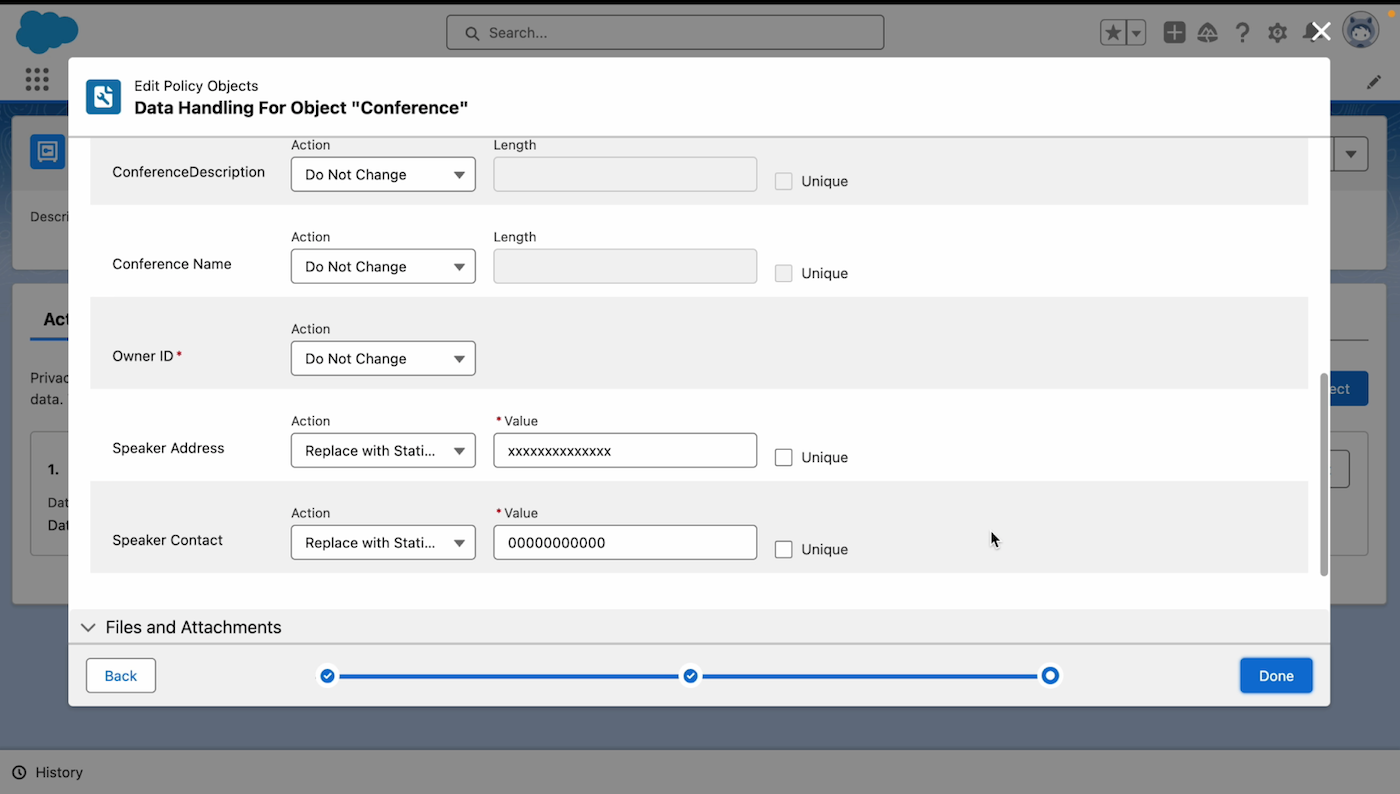
  • The AI Implementation Bundle, which includes Einstein Copilot, Einstein 1 Studio, Platform licenses, Sandbox (Figure A) and Data Mask.
  • The Data Governance Bundle, which includes Shield, Security Center and Privacy Center.

Figure A

Salesforce Sandbox helps IT teams adjust how generative AI outputs work for them.
Salesforce Sandbox helps IT teams adjust how generative AI outputs work for them. Image: Salesforce

Availability and pricing

Both bundles were made available on April 23 and are available internationally within Salesforce’s Einstein 1 Platform, wherever the Salesforce platform is sold. That platform costs $25 per user per month for the Platform Starter plan and $100 per user per month for the Platform Plus plan.

SEE: Is Salesforce CRM or Microsoft Dynamics better for your business? (TechRepublic)

Choose between generative AI models

Customers can choose which generative AI model to access and use the Sandbox to preview what its outputs might look like and what data it might draw from without exposing private data to the rest of the organization.

Sandboxing is particularly important when using generative AI in a workplace environment because of the nondeterministic nature of the outputs.

“It’s not going to write the same email for every customer,” said Alice Steinglass, EVP and GM, Salesforce Platform, in an interview with TechRepublic. “So I want to try it out and I want to try it with real data, and that’s why we launched this AI implementation bundle.”

How Salesforce approaches AI governance with the new bundles

“We want to give you that control and that ability to, as these regulations change, to be able to still manage: What are the privacy restrictions that I need to have on my data?” said Steinglass, referring to both bundles. “We’ve got the right to be forgotten, we’ve got new privacy regulations. There might be new things I need to mask, maybe new retention policies – all of that changes. I want the ability to be able to understand where that is in my data.”

The AI Implementation bundle “gives them (companies) a playground to play with a sandbox where they can test it out, they can try it, they can train users on how to use it,” said Steinglass.

Prepare for a job as a Salesforce administrator with this course offered through TechRepublic Academy

“Our data governance bundle allows you to meet all of the regulation requirements that you need, wherever you’re based,” Steinglass said.

AI integration added to Slack Sales Elevate

In Slack, Salesforce is adding a variety of new AI sales tools integrating Slack Sales Elevate, Sales Cloud and Slack AI. These tools, which rolled out on April 24, let leaders see an overview of their team’s performance, pipeline data and account records.

Sales Elevate was created in response to increasing pressure in sales to hit targets, Salesforce said. Slack AI, Sales Cloud and Sales Elevate together allow sales team members to:

  • Summarize which deals the team won or lost or which deals changed in value.
  • Group deals in Slack synched to Salesforce by category.
  • Later in 2024, Slack AI will be able to build account plans, mutual close plans or executive briefs automatically using company information from Salesforce.
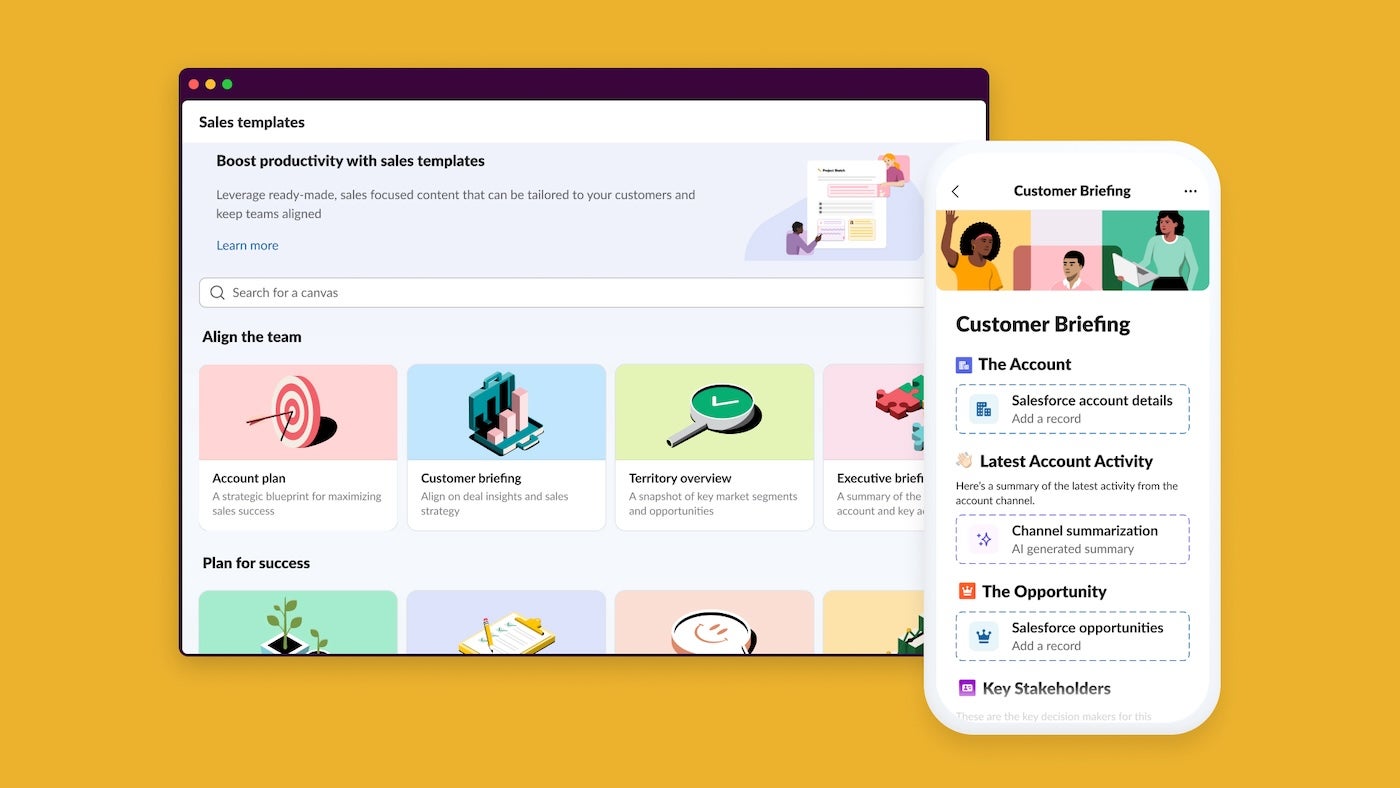
  • Later in 2024, Slack AI will be able to create “Record channels,” which are Slack channels that archive information about new opportunities in Salesforce, including activities and updated statuses, with templates (Figure B).

Figure B

Slack Sales Elevate will offer a variety of templates to kick-start sales tasks.
Slack Sales Elevate will offer a variety of templates to kick-start sales tasks. Image: Salesforce

AI enhancements to Slack Sales Elevate require subscriptions to both Slack Sales Elevate and Slack AI. Slack Sales Elevate costs $60 per user per month for users of Sales Cloud editions of Slack Business+ plans and above. Slack AI costs $10 per user per month for users who already pay for Slack Pro, Business+ and Enterprise plans.

PyTorch Releases Version 2.3 with Focus on Large Language Models and Sparse Inference

PyTorch announced the release of version 2.3, introducing several new features and improvements for performance and usability of large language models and sparse inference.

The release, which consists of 3,393 commits from 426 contributors, brings support for user-defined Triton kernels in torch.compile. This feature allows users to migrate their existing Triton kernels without experiencing performance regressions or graph breaks.

The feature also allows Torch Inductor to precompile user-defined Triton kernels and organise code more efficiently.

Another feature, Tensor Parallelism for efficient training of large language models. It facilitates various tensor manipulations across GPUs and hosts, integrating with FSDP (Fully Sharded Data Parallel) for efficient 2D parallelism.

The PyTorch team has validated Tensor Parallelism on training runs for models with over 100 billion parameters, demonstrating its effectiveness in handling large-scale language models.

PyTorch 2.3 introduces support for semi-structured sparsity, specifically 2:4 sparsity, by implementing it as a tensor subclass. This feature enhances performance, achieving up to 1.6 times faster processing than dense matrix multiplication, and includes advanced functionalities like mixing different data types during quantization, uses improved versions of cuSPARSELt and CUTLASS kernels, and is compatible with torch.compile for more efficient computation.

Compared to the previous version, PyTorch 2.2, which brought advancements like the integration of FlashAttention-v2 and the introduction of AOTInductor, PyTorch 2.3 builds upon these improvements and introduces new features specifically targeted at large language models and sparse inference.

With significant contributions from a large and active community, this version brings features like user-defined Triton kernels and Tensor Parallelism to collectively improve performance, scalability, and flexibility.

The post PyTorch Releases Version 2.3 with Focus on Large Language Models and Sparse Inference appeared first on Analytics India Magazine.

Healthtech AI startup Endimension Technology raises INR 6 Crore in Pre-Series A Round

Endimension funding

Healthtech AI startup Endimension Technology has recently raised INR 6 Crore in Pre-Series A round led by Inflection Point Ventures.

The funds will be utilised to fuel AI research and development, team expansion, software enhancement. These strategic investments aim to bolster their market position, accelerate growth, and establish Endimension as an industry leader.

Other investors in this round include Sucseed Indovation, SINE IIT Bombay and individual angel investors. Endimension Technology, incubated at IIT Bombay, is driven by the vision to harness AI technology in radiology, ensuring early and precise diagnosis for patients globally.

“The Indian radio-diagnosis market, growing at a CAGR of 15%+ over the last decade, has got a lot of focus on equipment & infrastructure. The under-stated need is that of qualified professionals, i.e. radiologists, to manage this burgeoning demand. There has been growth across tier 1, 2 & 3 for equipment, but the availability and prohibitive costs of trained radiologists exacerbate the problem of demand outstripping supply situation.

“Endimension focuses on leveraging AI to facilitate faster assessment and diagnosis, employing generative AI to streamline report generation and reduce the time required by radiologists. IPV is confident that this investment will contribute towards the betterment of the industry,” Ivy Chin, Partner, Inflection Point Ventures said.

So far, Endimension’s platform has processed over 1 million scans to date and is currently deployed in 400 hospitals and diagnostic centres across multiple regions, enhancing their accessibility.

Endimension has added several feathers to its cap over the years. The startup was one of the 20 startups selected by Google for Startup Accelerator Class 8 and one of the top 10 startups at the WhatsApp Incubator Programme.

The post Healthtech AI startup Endimension Technology raises INR 6 Crore in Pre-Series A Round appeared first on Analytics India Magazine.

Top AI Influencers to Follow in 2024

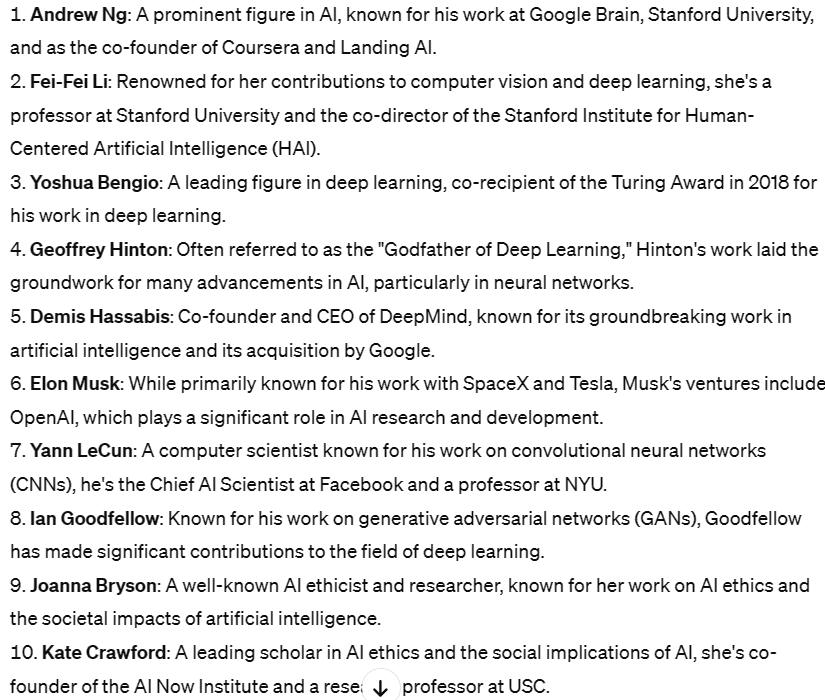
There are many ways to define “top influencer”. You may just ask OpenAI to get a list: see results in Figure 1. However, it states that the data is not recent (2022 and earlier), and there is no link to the individual profiles. Here I focus on leaders very active on LinkedIn, with at least 100k followers, and popping up regularly on my feed. Emphasis is on GenAI and LLM, which are today among the hottest topics in AI. It is also what I am working on.

I created two categories: technical and general. I did not include people talking about SQL or data analysis and claiming to be AI gurus, no matter how many followers. Also, I did not include coaches – many talking about how to get an AI job – even if they are former FAANG engineers, and thus very popular. Many in my list regularly feature sponsored content from AI companies.

top-genai-influencers-openai2022
Top GenAI influencers according to OpenAI (based on 2022 web crawl)

If I forgot someone, please let me know. You can compare with my 2023 listing here and see who grew at the fastest pace. Yann LeCun in particular, went from 276k to 701k followers in 16 months, and Alex Wang, now with 886k followers, was missing in my 2023 list. Of course, it is easier to grow fast when you are small, and this also applies in this context. Then the number of followers is just one metric, and not the most useful one: the quality of your network and followers is more important.

The leaders below are listed in random order. The listed location is where they live now. Many emigrated from another country.

Technical

People in this list tend to cover technical material rather in-depth, with efforts to make it accessible to a large audience. They have a strong technical background. Some of them discuss ground-breaking technology that they create on their own. Their audience tends to be developers and engineers. But also, decision makers, executives and stakeholders, when posting about the big picture, benchmarks, or catering to tech-savvy executives.

  • Andrew Ng. Founder, investor and more. Palo Alto, 1.6m followers.
  • Damien Benveniste. Former Machine Learning tech lead at Meta. Los Angeles, 156k followers.
  • Alex Wang. Formerly, business algorithms at Deloitte. Australia. 886k followers.
  • Sebastian Raschka. Staff Research Engineer. Wisconsin, 108k followers.
  • Rami Krispin. Senior Manager, data science & engineering at Apple. California, 110k followers.
  • Brij Kishore. Principal engineer at ADP. Author and GenAI strategist. New Jersey, 475k followers.
  • Vincent Granville. GenAI entrepreneur and author. Washington State, 124k followers.
  • Abhishek Thakur. Open-source research & development at Hugging Face. Norway, 151k followers.
  • Julien Chaumond. CTO at Hugging Face. Paris, 114k followers.
  • Yann LeCun. VP & Chief AI Scientist at Meta. New York, 701k followers.
  • Anima Anandkumar. Forner Sr. Director, Nvidia research. Professor at Caltech. Bay Area. 182k followers.
  • Lior Sinclair. Founder, MIT lecturer. Austin Texas, 170k followers.
  • Chip Huyen. VP of AI, author. San Francisco, 220k followers.
  • Benjamin Rogojan. The “Seattle Data Guy”. Denver, 138k followers.

Generalists

People in this category target decision makers and executives, but also the layman or novices in the field. Thus, they typically have a larger audience. Their vocabulary and presentations are more accessible to the public at large but may not appeal as much to advanced technical practitioners.

  • Andriy Burkov. Machine Learning lead, author. Quebec, 359k followers.
  • Allie Miller. AI entrepreneur, advisor, investor. New York, 1.4m followers.
  • Lex Fridman. Research Scientist, MIT. Massachusetts, 1.5m followers.
  • Vin Vashishta. AI advisor, founder, author. Nevada, 182k followers.
  • Cassie Kozyrkov. Former Chief Decision Scientist at Google. New York, 577k followers.
  • Aishwarya Srinivasan. Senior AI Advisor at Microsoft. San Francisco, 501k followers.
  • Pascal Bornet. Keynote Speaker, Best-selling Author. Florida, 1.4m followers.
  • Greg Coquillo. AI product management at Amazon. Startup investor. Washington State, 195k followers.
  • Armand Ruiz. VP of product management, AI platform at IBM. San Francisco, 85k followers.
  • Steve Nouri. Founder of GenerativeAI. Australia, 1.6m followers.
  • Bojan Tunguz. Former Sr. Engineer at Nvidia. Florida, 141k followers.
  • Zach Wilson. Former Staff Engineer at Airbnb. San Francisco, 360k followers.
  • Daliana Liu. Senior Data Scientist, formerly AWS. San Francisco, 272k followers.

Author

Towards Better GenAI: 5 Major Issues, and How to Fix Them

Vincent Granville is a pioneering GenAI scientist and machine learning expert, co-founder of Data Science Central (acquired by a publicly traded company in 2020), Chief AI Scientist at MLTechniques.com and GenAItechLab.com, former VC-funded executive, author (Elsevier) and patent owner — one related to LLM. Vincent’s past corporate experience includes Visa, Wells Fargo, eBay, NBC, Microsoft, and CNET. Follow Vincent on LinkedIn.