Adobe Adds Firefly and AI Watermarking to Bug Bounty Program

Security researchers in Adobe’s bug bounty program can now pick up rewards for finding vulnerabilities in Adobe Firefly and Content Credentials. The bug hunt will be open to members of Adobe’s private bug bounty program starting May 1.

Members of Adobe’s public bug bounty program will be eligible to work with Adobe Firefly and Content Credentials in the second half of 2024, and applications for the private program are open.

Both bug bounties are hosted on the HackerOne platform, which is open to security researchers globally.

Hackers can earn between $100 and $10,000, depending on the type and severity of the vulnerability.

“Not only do we just simply fix the vulnerabilities that are reported to us, but we also leverage the bug bounty program and some of the signals and trends that we get out of it as a type of feedback loop to our internal security teams,” said Adobe Product Incident Response Team Manager Daniel Ventura in an interview with TechRepublic. “So that we can all learn together and we can make our capabilities better as a whole.”

Ventura noted that while generative AI technology is relatively new, security researchers have quickly gotten up to speed on how to bug hunt within it. Adobe has partnered with HackerOne and Bug Bounty Village, a hacker conference organized by Ben Sadeghipour, aka NahamSec, to provide security researchers pathways to learning more about bug hunting in generative AI.

“Probably the biggest challenge is, you know, a lot of researchers are catching up to speed similar to organizations as they’re putting out new, new services and assets,” said Ventura.

Adobe Firefly presents unique bug-hunting challenges

Adobe Firefly is a family of generative AI models made to create images in Photoshop and other Adobe products. Adobe encourages security researchers to test Firefly for common vulnerabilities in generative AI. In particular, Adobe points researchers toward the OWASP Top Ten for Large Language Model Applications, which notes that LLM applications are especially vulnerable to prompt injections, data leakage, inadequate sandboxing and unauthorized code execution.

SEE: Our guide shows tips and tricks for using Adobe Photoshop most effectively. (TechRepublic)

Content Credentials provides important provenance information

Content Credentials is a watermarking system applied to AI art made in Adobe Firefly, Photoshop, Lightroom or other programs. Content Credentials attach to images’ information about the images’ creation and any editing that might have been done on them.

It is important that Content Credentials function well in order to ensure art is properly attributed, and to prevent the spread of deceptive images. In particular, Adobe wants to shut down possible ways to attach false Content Credentials.

The goal is to help creators who may use Content Credentials in their work and the broader security researcher community by sharing information about what vulnerabilities Content Credentials may have.

“The skills and expertise of security researchers play a critical role in enhancing security and now can help combat the spread of misinformation,” said Dana Rao, executive vice president, general counsel and chief trust officer at Adobe, in a statement to the press. “We are committed to working with the broader industry to help strengthen our Content Credentials implementation in Adobe Firefly and other flagship products to bring important issues to the forefront and encourage the development of responsible AI solutions.”

Adobe opens Security Researcher Hall of Fame

In order to add bragging rights to the monetary rewards, Adobe has opened a Security Researcher Hall of Fame for security researchers who make an exceptional impact in the bug bounty program. Researchers who score the most points in a quarter by making valid submissions to the bug bounty program can earn Adobe merchandise or a free 12-month subscription to Adobe’s Creative Cloud Suite, and their names will be displayed in the hall of fame.

“All in all, we hope this initiative helps cultivate a more rewarding experience for participating researchers,” Ventura wrote in a blog post.

Other AI bug bounty programs

AI bug hunts have proliferated with the rise of generative AI products and services over the last year. Google added certain generative AI vulnerabilities to its bug bounty program in October 2023. OpenAI has a bug bounty program for its AI models. Microsoft offers up to $15,000 to find bugs in Copilot.

Amazon Reports Record Q1 2024 Earnings and Launches Amazon Q Assistant

Amazon has once again surpassed expectations with its Q1 2024 earnings report. The company posted record-breaking revenue and net income figures, highlighting its continued dominance in the tech industry. Alongside the impressive financial results, Amazon also unveiled its latest innovation, Amazon Q, their generative AI assistant that just became generally available.

Amazon's Record Earnings and Growth

In the first quarter of 2024, Amazon reported an overall revenue of $143.3 billion, representing a 13% increase from the same period in the previous year. This figure exceeded Wall Street's expectations of $142.65 billion, demonstrating the company's resilience and adaptability in the face of economic challenges. Net income also saw a significant boost, more than tripling to $10.4 billion from $3.17 billion in Q1 2023.

Several key segments within Amazon's business contributed to this impressive growth. Amazon Web Services (AWS), the company's cloud computing division, experienced a 17% year-over-year revenue increase, reaching $25 billion. AWS accounted for a staggering 62% of Amazon's total operating profit, underlining its crucial role in the company's success. Additionally, advertising sales saw a 24% year-over-year increase, reaching $11.8 billion, as Amazon expanded its advertising offerings across various platforms, including Prime Video.

The strong financial performance can be attributed to several factors, including Amazon's continued focus on innovation, customer-centric approach, and strategic investments in growth areas such as AI and cloud computing. The company's ability to adapt to changing consumer preferences and market trends has also played a significant role in its success.

Amazon Q: The Generative AI Assistant

One of the most exciting announcements from Amazon at the same time is the launch of Amazon Q, a generative AI assistant designed to empower businesses and developers. Amazon Q leverages advanced AI technology to assist with a wide range of tasks, from coding and application development to data analysis and content creation.

Amazon Q Developer, now generally available, is a game-changer for software development teams. With its ability to generate accurate code, test, debug, and implement new code based on developer requests, Amazon Q Developer has the potential to significantly boost productivity. Developers can now focus on creating unique user experiences while spending less time on repetitive and time-consuming tasks.

For business users, Amazon Q Business offers a powerful tool to streamline workflows and make data-driven decisions. By connecting to enterprise data repositories, Amazon Q Business can summarize data, analyze trends, and engage in dialog, enabling employees to quickly access the information they need. Amazon Q Business also integrates with Amazon QuickSight, AWS's cloud-based Business Intelligence service, allowing business analysts to create dashboards and visualizations using natural language.

Amazon Q Apps, currently in preview, takes the power of generative AI a step further by enabling employees to build their own AI-powered applications without any coding experience. By simply describing the desired app in natural language, users can create custom solutions tailored to their specific needs, streamlining and automating daily tasks.

Amazon's Focus on AI and Cloud Computing

Amazon's strong performance in the AI and cloud computing space is a testament to the company's strategic focus and investments in these areas. AWS, which has been a key driver of Amazon's growth, saw its revenue increase to $25 billion in Q1 2024. The cloud computing division's success can be attributed to the growing demand for AI capabilities and the renewed interest in infrastructure modernization among businesses.

To support the increasing demand for AI and cloud services, Amazon has announced plans to invest heavily in infrastructure. In the earnings call, CEO Andy Jassy emphasized the need for additional data centers, power, and hardware to accommodate the growth in AWS. While this will result in higher capital expenditure in the coming quarters, Jassy assured investors that the company only spends capital when there are clear signals of monetization opportunities.

Looking Ahead to Amazon's AI Plan

Amazon's Q1 2024 earnings report showcases the company's remarkable resilience and adaptability in the face of economic challenges. With record-breaking revenue and net income figures, Amazon has once again proven its dominance in the e-commerce and cloud computing sectors. The launch of Amazon Q, a generative AI assistant, marks a significant milestone in the company's journey towards leveraging advanced technologies to empower businesses and developers.

As Amazon continues to invest in AI and cloud computing, it is well-positioned for future growth. The company's strategic partnerships, such as its collaboration with Nvidia, and its ongoing investments in infrastructure and workforce development, demonstrate its commitment to staying at the forefront of technological innovation.

Looking ahead, Amazon's strong financial performance and its ability to capitalize on emerging trends suggest a bright future for the company. As businesses increasingly rely on AI and cloud computing to drive growth and efficiency, Amazon is poised to benefit from the growing demand for these services. With its customer-centric approach, culture of innovation, and focus on continuous improvement, Amazon is likely to remain a dominant force in the tech industry for years to come.

Bihar Emerges as the Next Big Hub for Tech Talent

Bihar Emerges as the Next Big Hub for Tech Talent

Aman, a Swiggy delivery executive from Uttar Pradesh, took a leap of faith by enrolling in a career school to pursue a software engineering course. His determination finally paid off when he landed a position as a software developer at Swiggy in Bengaluru.

Another example led us to Pratham, who previously worked at the Survey of India in Dehradun, was ambitious to pursue software engineering. However, financial constraints prevented him from pursuing his dream until 2022 when he enrolled in a career school. He subsequently landed his first tech role at Cure Foods Pvt Ltd (Eatfit).

These are just a few examples of how people can land a tech job in companies, with a bit of handholding, in cities like Bengaluru, Delhi, and Mumbai. Some of the notable career schools include Masai School, GetWork, and others, where they are leveraging AI to tap into the potential of students from Tier 2 and Tier 3 cities, paving the way for promising career paths.

“Out of one crore students graduating annually, a whopping 90% hail from rural regions, often overlooked by big corporations,” shared Rahul Veerwal, CEO of GetWork, in an interaction with AIM.

GetWork, a digital marketplace, is working towards rewriting the narrative for Tier 2 and Tier 3 college graduates through its GenAI copilot – Horizon AI.

This platform looks to empower students by assisting them in crafting resumes and providing tailored job recommendations based on their skills, preferences, and industry alignment.

And for recruiters, GetWork.ai is a game-changer. Veerwal said that thousands of applications come in upon posting a job on the platform. To streamline the recruiter’s workload, they’ve developed a feature that showcases a candidate’s percentile match against their resume and the job description.

Further, he said, once the score is determined by the company, or is met, an AI voice bot swiftly conducts interviews at a staggering rate of 1000 calls per minute. Then, a recruiter can hire potential candidates in just one day.

According to data provided by GetWork, rural student placements have increased by 17%. Cities like Meerut, Bijnur, Indore, and Surat are already part of the program, and its presence continues to grow, especially in northern states such as Uttar Pradesh, Bihar, Delhi, Punjab, and Haryana.

IIT for All!

On the other hand, there is a vast untapped potential among the students who apply for IIT but cannot secure admission due to limited seats. As per the data, approximately 20,000 to 25,000 candidates qualify for JEE Advance. And around 10,000 candidates successfully get admission to 23 IITs across India.

With only a fraction gaining entry despite the potential, the question arose: how could this education be extended to those who missed out on the three-hour window of opportunity?

Enters Masai School, committed to shaping individuals into skilled programmers and data analysts through an intensive curriculum.

While IITs excel in academic prowess, their holistic approach to education, grooming students for real-world challenges, remains exclusive to the fortunate few. Recognising the need for a partner bridging academia and industry, the National Skill Development Corporation (NSDC) facilitated the synergy with Masai School.

Prateek Shukla, co-founder and CEO of Masai School, told AIM that the initiative, dubbed IITs for all, embodies the amalgamation of IIT’s pedagogical excellence and “Masai School’s job-oriented training, aimed at empowering the 50,000 aspirants annually who narrowly miss the IIT cut.”

“Beginning with Guwahati, Mandi, and now Ropar, specialised courses tailored to industry needs are being introduced, ensuring graduates possess the essential skills demanded by tech giants globally,” he added.

It is noted that a majority of the students who enroll for the courses come from rural regions of three states: Maharashtra (26.56%), Bihar (14.59%), and Uttar Pradesh (14.02%).

Rural is the New Urban?

As many chase the notion that success is tied to relocating to urban hubs and securing positions in corporate giants, Zoho is leveraging cloud computing to unlock the potential of rural talent and create employment opportunities.

Zoho’s Rural Revival is an initiative where miniature farming sites are built to grow fresh produce and provide a way for everyone to bring their families together, connect, and help relieve stress.

Further, they have set up mini-offices in the hinterlands, enabling people to stay close to the ones they love, invest in a home of their own, cut down on travel costs, and stay out of debt.

“In five years, 50 per cent of our employees will work from smaller, rural centres. We want to keep people rooted in their towns and villages and provide world-class jobs in these places,” said Sridhar Vembu, CEO and co-founder Zoho.

Of late, data centres are also expanding into Tier 2 and Tier 3 cities. Nxtra and CtrlS, two prominent players in the data center industry, are rapidly expanding their edge computing presence in Tier 2 and 3 cities to cater to the growing demand.

Meanwhile, Yotta Data Services, backed by the Hiranandani Group, is venturing into Greater Noida and Guwahati, anticipating a surge in demand in Tier 2 markets, with operations slated for completion by 2024. With Yotta-D1 nearing full capacity, construction of D2 and D3 facilities is underway.

Additionally, STT GDC India, a subsidiary of Singapore’s STT GDC, has earmarked $1 billion for expanding its data center footprint in India over the next 3-4 years, with plans to establish at least two data centers in Tier 2 cities this year and around eight in the next three years.

Further, IT companies are establishing offices in Tier 2 and Tier 3 cities, enabling employees to work near their residences. For instance, Tata Consultancy Services, Infosys, HCLTech, and Wipro are expanding into smaller towns, driven by cost-effectiveness, government incentives, and access to skilled talent.

The post Bihar Emerges as the Next Big Hub for Tech Talent appeared first on Analytics India Magazine.

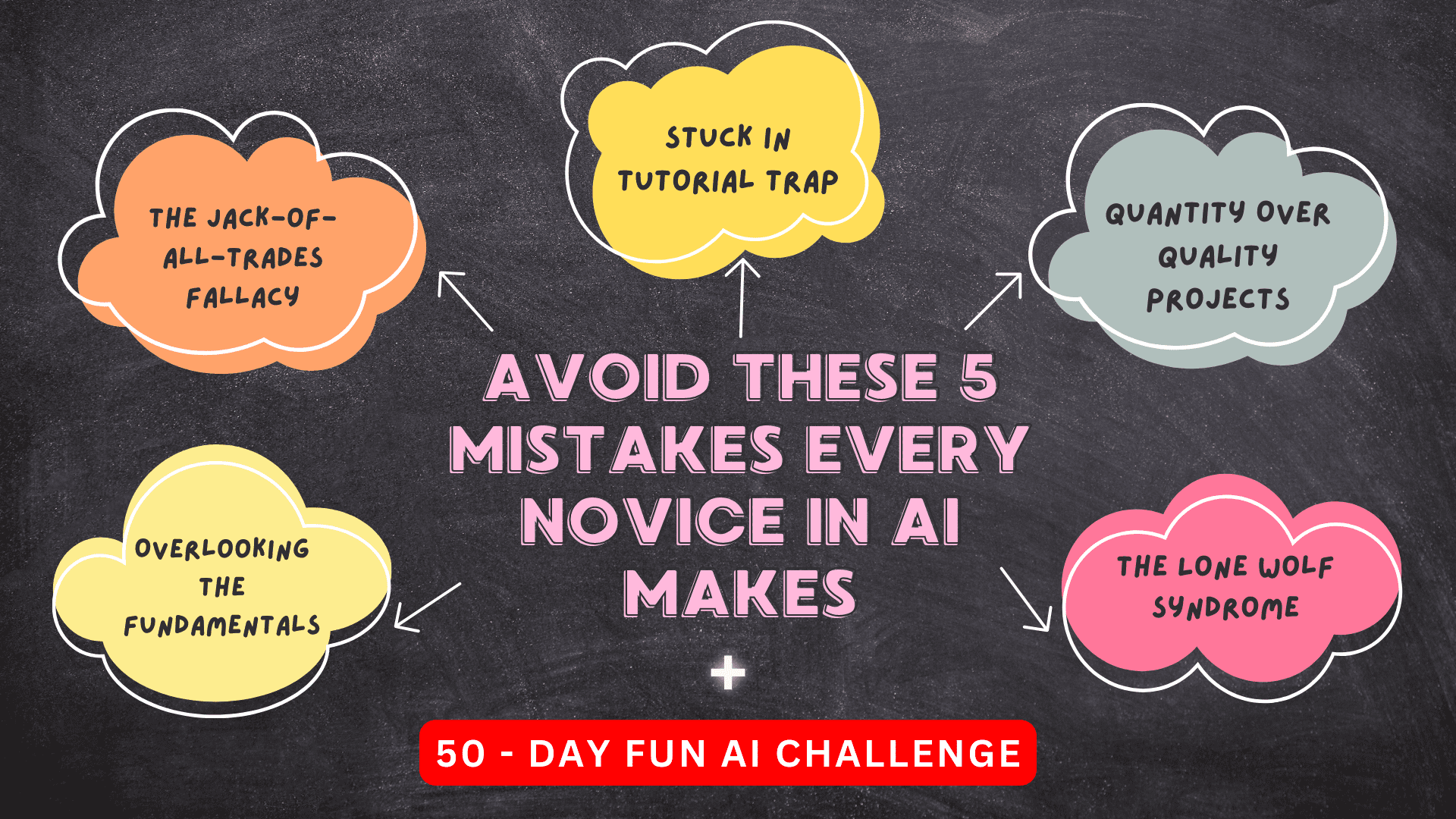
Avoid These 5 Common Mistakes Every Novice in AI Makes

Avoid These 5 Common Mistakes Every Novice in AI Makes
Image By Author

Have you heard the following saying by Albert Einstein?

Insanity is doing the same thing over and over again and expecting different results.

It is a perfect reminder for those starting their AI journey. As a beginner, it's easy to feel overwhelmed by the vast amount of information and resources available. You may find yourself making the same mistakes that countless others have made before you. But why waste time and energy repeating those errors when you can learn from their experiences?

As someone who has spoken with experienced practitioners in the field, I've always been curious to learn about their AI journey. I quickly discovered that many of them encountered similar challenges and pitfalls early on. That's why I'm writing this article—to share the 5 most common mistakes that novices in AI often make, so you can avoid them.

So, let's get started:

1. Overlooking the Fundamentals

As an AI beginner, it's easy to get excited about flashy algorithms and powerful frameworks. However, just like a tree needs strong roots to grow, your understanding of AI needs a solid foundation. Ignoring the math behind these building blocks can hold you back. Frameworks are there to help the computer perform calculations, but it's important to learn the underlying concepts instead of just relying on black-box libraries and frameworks. Many beginners start with tools like scikit-learn, and while they may get results, they often struggle to analyze performance or explain their findings. This usually happens because they skip the theory. To become a successful AI developer, it's essential to learn these core concepts.

Determining what skill sets separate a good AI developer from a novice isn't a simple, one-size-fits-all answer. It's a mix of several factors. However, for the purpose of this discussion on fundamentals, it's important to emphasize the significance of problem-solving, data structures, and algorithms. Most ML companies will assess these skills during the recruitment process, and mastering them will make you a stronger candidate.

2. The Jack-of-All-Trades Fallacy

You might have seen profiles on LinkedIn claiming expertise in AI, ML, DL, CV, NLP, and more. It's like a long list of skills that can make your head spin. Maybe it's because of social media or the trend of being a "Full Stack Developer" that people compare AI to. But let's be real here, living in a fantasy world won't help. AI is a very vast field. It's unrealistic to know everything, and trying to do so can lead to frustration and burnout. Think of it this way: it's like trying to eat an entire pizza in one bite – not exactly practical, is it? Instead, focus on becoming really good at one specific area. By narrowing your focus and dedicating your time to mastering one part of AI, you'll be able to make a meaningful impact and stand out in the competitive AI world. So, let's avoid spreading ourselves too thin, and let's concentrate on becoming experts in one thing at a time.

3. Stuck in Tutorial Trap

I think the biggest mistake beginners often make is getting overwhelmed by the countless online tutorials, courses, books, and articles available when learning AI. Learning and engaging in these courses is not a negative thing. However, my concern is that they may not find the right balance between theory and practice. Spending too much time on tutorials without actually applying what they've learned can lead to a frustrating situation known as "tutorial hell." To avoid this, it's important to put your knowledge to the test by working on real-world projects, trying out different datasets, and continuously working to improve your results. Additionally, you'll notice that some concepts taught in courses may not always work best for specific datasets or problems. For instance, I recently watched a session on Aligning LLMs with Direct Preference Optimization by DeepLearning.ai, where research scientist ED Beeching from Huggingface mentioned that although the original Direct Preference Optimization paper used RMSProp as an optimizer, they found Adam to be more effective in their experiments. You can only learn these things by getting hands-on experience and diving into practical work.

4. Quantity Over Quality Projects

When beginners want to showcase their AI skills, they often feel tempted to create numerous projects to demonstrate their expertise. However, it's crucial to prioritize quality over quantity. I've observed that people working in big tech companies often have 2-3 strong projects on their resumes, instead of 6-10 small or mediocre ones that many others include. This approach is not only beneficial for job prospects but also for learning. You can get a better understanding of the subject matter. Instead of following YouTube tutorials or building a bunch of average projects, consider investing a month or so of your time and energy into projects that will have long-term value. This approach will steepen your learning curve and truly highlight your understanding. It can also make your resume stand out from everyone else. Even after securing a job, you won't struggle much when transitioning to the actual work.

5. The Lone Wolf Syndrome

I understand that different people have different work preferences. Some may prefer working alone, while others seek support. For beginners in machine learning, it can be overwhelming, and working in isolation may hinder your growth. I highly recommend engaging with AI communities on platforms like Reddit, Discord, Slack, LinkedIn, and Facebook. If you're not comfortable with communities, consider finding an AI mentor for guidance and support. Discuss your projects with them, seek their advice, and learn about better approaches. This not only makes the learning process enjoyable but also saves time. Although I don't encourage you to immediately post questions or reach out to your mentor as soon as you encounter a problem, you should always try to solve it yourself first. But after a certain point, it's okay to seek help. This approach saves you from burnout, enhances your learning, and in the end, you'll feel good about yourself for trying and gaining knowledge about what didn't work.

50-Day Challenge: Dare to Accept and Level Up Your AI Skills

Throughout this article, we've discussed the 5 most common mistakes that beginners should avoid at all costs.

I have an EXCITING CHALLENGE for all of you. As a responsible member of this community, I want to encourage you to take action and apply these tips to your own AI journey. Here's the "50-Day Challenge":

1. Write "Challenge Accepted" in the comments section below. (Reload the page if you cannot see the comment section — it may take some time to appear.)
2. Spend the next 50 days focusing on these 5 tips and implementing them in your AI learning.
3. After 50 days, return to this article and share your experiences in the comments. Tell us what changes these tips brought into your life and how they helped you grow as an AI practitioner.

I'm eager to hear your stories and learn about your progress. Additionally, if you have any suggestions or additional tips for fellow readers, please share them! Let's help each other grow.

Kanwal Mehreen Kanwal is a machine learning engineer and a technical writer with a profound passion for data science and the intersection of AI with medicine. She co-authored the ebook "Maximizing Productivity with ChatGPT". As a Google Generation Scholar 2022 for APAC, she champions diversity and academic excellence. She's also recognized as a Teradata Diversity in Tech Scholar, Mitacs Globalink Research Scholar, and Harvard WeCode Scholar. Kanwal is an ardent advocate for change, having founded FEMCodes to empower women in STEM fields.

More On This Topic

  • Avoid These Five Behaviors That Make You Look Like A Data Novice
  • Avoid These Mistakes with Time Series Forecasting
  • 5 Data Science Career Mistakes To Avoid
  • Mistakes That Newbie Data Scientists Should Avoid
  • Most Common SQL Mistakes on Data Science Interviews
  • 5 Common Python Gotchas (And How To Avoid Them)

Inside Microsoft’s Phi-3 Mini: A Lightweight AI Model Punching Above Its Weight

Phi-3 : A Highly Capable Language Model Locally on Your Phone

Microsoft has recently unveiled its latest lightweight language model called Phi-3 Mini, kickstarting a trio of compact AI models that are designed to deliver state-of-the-art performance while being small enough to run efficiently on devices with limited computing resources. At just 3.8 billion parameters, Phi-3 Mini is a fraction of the size of AI giants like GPT-4, yet it promises to match their capabilities in many key areas.

The development of Phi-3 Mini represents a significant milestone in the quest to democratize advanced AI capabilities by making them accessible on a wider range of hardware. Its small footprint allows it to be deployed locally on smartphones, tablets, and other edge devices, overcoming the latency and privacy concerns associated with cloud-based models. This opens up new possibilities for intelligent on-device experiences across various domains, from virtual assistants and conversational AI to coding assistants and language understanding tasks.

4-bit quantized phi-3-mini running natively on an iPhone

Under the Hood: Architecture and Training

At its core, Phi-3 Mini is a transformer decoder model built upon a similar architecture as the open-source Llama-2 model. It features 32 layers, 3072 hidden dimensions, and 32 attention heads, with a default context length of 4,000 tokens. Microsoft has also introduced a long context version called Phi-3 Mini-128K, which extends the context length to an impressive 128,000 tokens using techniques like LongRope.

What sets Phi-3 Mini apart, however, is its training methodology. Rather than relying solely on the brute force of massive datasets and compute power, Microsoft has focused on curating a high-quality, reasoning-dense training dataset. This data is composed of heavily filtered web data, as well as synthetic data generated by larger language models.

The training process follows a two-phase approach. In the first phase, the model is exposed to a diverse range of web sources aimed at teaching it general knowledge and language understanding. The second phase combines even more heavily filtered web data with synthetic data designed to impart logical reasoning skills and niche domain expertise.

Microsoft refers to this approach as the “data optimal regime,” a departure from the traditional “compute optimal regime” or “over-training regime” employed by many large language models. The goal is to calibrate the training data to match the model's scale, providing the right level of knowledge and reasoning ability while leaving sufficient capacity for other capabilities.

Quality of new Phi-3 models, as measured by performance on the Massive Multitask Language Understanding (MMLU) benchmark

This data-centric approach has paid off, as Phi-3 Mini achieves remarkable performance on a wide range of academic benchmarks, often rivaling or surpassing much larger models. For instance, it scores 69% on the MMLU benchmark for multi-task learning and understanding, and 8.38 on the MT-bench for mathematical reasoning – results that are on par with models like Mixtral 8x7B and GPT-3.5.

Safety and Robustness

Alongside its impressive performance, Microsoft has placed a strong emphasis on safety and robustness in the development of Phi-3 Mini. The model has undergone a rigorous post-training process involving supervised fine-tuning (SFT) and direct preference optimization (DPO).

The SFT stage leverages highly curated data across diverse domains, including mathematics, coding, reasoning, conversation, model identity, and safety. This helps to reinforce the model's capabilities in these areas while instilling a strong sense of identity and ethical behavior.

The DPO stage, on the other hand, focuses on steering the model away from unwanted behaviors by using rejected responses as negative examples. This process covers chat format data, reasoning tasks, and responsible AI (RAI) efforts, ensuring that Phi-3 Mini adheres to Microsoft's principles of ethical and trustworthy AI.

To further enhance its safety profile, Phi-3 Mini has been subjected to extensive red-teaming and automated testing across dozens of RAI harm categories. An independent red team at Microsoft iteratively examined the model, identifying areas for improvement, which were then addressed through additional curated datasets and retraining.

This multi-pronged approach has significantly reduced the incidence of harmful responses, factual inaccuracies, and biases, as demonstrated by Microsoft's internal RAI benchmarks. For example, the model exhibits low defect rates for harmful content continuation (0.75%) and summarization (10%), as well as a low rate of ungroundedness (0.603), indicating that its responses are firmly rooted in the given context.

Applications and Use Cases

With its impressive performance and robust safety measures, Phi-3 Mini is well-suited for a wide range of applications, particularly in resource-constrained environments and latency-bound scenarios.

One of the most exciting prospects is the deployment of intelligent virtual assistants and conversational AI directly on mobile devices. By running locally, these assistants can provide instant responses without the need for a network connection, while also ensuring that sensitive data remains on the device, addressing privacy concerns.

Phi-3 Mini's strong reasoning abilities also make it a valuable asset for coding assistance and mathematical problem-solving. Developers and students can benefit from on-device code completion, bug detection, and explanations, streamlining the development and learning processes.

Beyond these applications, the model's versatility opens up opportunities in areas such as language understanding, text summarization, and question answering. Its small size and efficiency make it an attractive choice for embedding AI capabilities into a wide array of devices and systems, from smart home appliances to industrial automation systems.

Looking Ahead: Phi-3 Small and Phi-3 Medium

While Phi-3 Mini is a remarkable achievement in its own right, Microsoft has even bigger plans for the Phi-3 family. The company has already previewed two larger models, Phi-3 Small (7 billion parameters) and Phi-3 Medium (14 billion parameters), both of which are expected to push the boundaries of performance for compact language models.

Phi-3 Small, for instance, leverages a more advanced tokenizer (tiktoken) and a grouped-query attention mechanism, along with a novel blocksparse attention layer, to optimize its memory footprint while maintaining long context retrieval performance. It also incorporates an additional 10% of multilingual data, enhancing its capabilities in language understanding and generation across multiple languages.

Phi-3 Medium, on the other hand, represents a significant step up in scale, with 40 layers, 40 attention heads, and an embedding dimension of 5,120. While Microsoft notes that some benchmarks may require further refinement of the training data mixture to fully capitalize on this increased capacity, the initial results are promising, with substantial improvements over Phi-3 Small on tasks like MMLU, TriviaQA, and HumanEval.

Limitations and Future Directions

Despite its impressive capabilities, Phi-3 Mini, like all language models, is not without its limitations. One of the most notable weaknesses is its relatively limited capacity for storing factual knowledge, as evidenced by its lower performance on benchmarks like TriviaQA.

However, Microsoft believes that this limitation can be mitigated by augmenting the model with search engine capabilities, allowing it to retrieve and reason over relevant information on-demand. This approach is demonstrated in the Hugging Face Chat-UI, where Phi-3 Mini can leverage search to enhance its responses.

Another area for improvement is the model's multilingual capabilities. While Phi-3 Small has taken initial steps by incorporating additional multilingual data, further work is needed to fully unlock the potential of these compact models for cross-lingual applications.

Looking ahead, Microsoft is committed to continually advancing the Phi family of models, addressing their limitations and expanding their capabilities. This may involve further refinements to the training data and methodology, as well as the exploration of new architectures and techniques specifically tailored for compact, high-performance language models.

Conclusion

Microsoft's Phi-3 Mini represents a significant leap forward in the democratization of advanced AI capabilities. By delivering state-of-the-art performance in a compact, resource-efficient package, it opens up new possibilities for intelligent on-device experiences across a wide range of applications.

The model's innovative training approach, which emphasizes high-quality, reasoning-dense data over sheer computational might, has proven to be a game-changer, enabling Phi-3 Mini to punch well above its weight class. Combined with its robust safety measures and ongoing development efforts, the Phi-3 family of models is poised to play a crucial role in shaping the future of intelligent systems, making AI more accessible, efficient, and trustworthy than ever before.

As the tech industry continues to push the boundaries of what's possible with AI, Microsoft's commitment to lightweight, high-performance models like Phi-3 Mini represents a refreshing departure from the conventional wisdom of “bigger is better.” By demonstrating that size isn't everything, Phi-3 Mini has the potential to inspire a new wave of innovation focused on maximizing the value and impact of AI through intelligent data curation, thoughtful model design, and responsible development practices.


3 New Prompt Engineering Resources to Check Out

3 New Prompt Engineering Tools to Check Out
Created by Author using Midjourney

I won't start this with an introduction to prompt engineering, or even talk about how prompt engineering is "AI's hottest new job" or whatever. You know what prompt engineering is, or you wouldn't be here. You know the discussion points about its long term feasibility and whether or not it's a legitimate job title. Or whatever.

Even knowing all that, you are here because prompt engineering interests you. Intrigues you. Maybe even fascinates you?

If you have already learned the basics of prompt engineering, and have had a look at course offerings to take your prompting game to the next level, it's time to move on to some of the more recent prompt-related resources out there. So here you go: here are 3 recent prompt engineering resources to help you take your prompting game to the next level.

1. The Perfect Prompt: A Prompt Engineering Cheat Sheet

Are you looking for a one-stop shop for all of your quick-reference prompt engineering needs? Look no further than The Prompt Engineering Cheat Sheet.

Whether you’re a seasoned user or just starting your AI journey, this cheat sheet should serve as a pocket dictionary for many areas of communication with large language models.

This is a very lengthy and very detailed resource, and I tip my hat to Maximilian Vogel and The Generator for putting it together and making it available. From basic prompting to RAG and beyond, this cheat sheet covers an awful lot of ground and leaves very little to the beginner prompt engineer's imagination.

Topics you will investigate include:

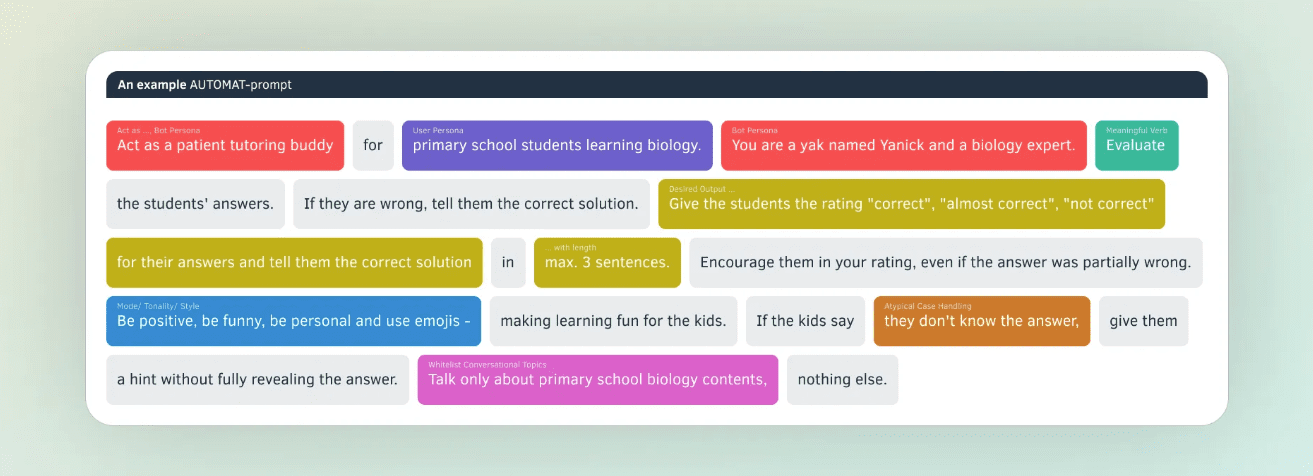
  • The AUTOMAT and the CO-STAR prompting frameworks
  • Output format definition
  • Few-shot learning
  • Chain-of-thought prompting
  • Prompt templates
  • Retrieval Augmented Generation (RAG)
  • Formatting and delimiters
  • The multi-prompt approach

AUTOMAT prompt framework
Example of the AUTOMAT prompting framework (source)

Here's a direct link to the PDF version.

2. Gemini for Google Workspace Prompt Guide

The Gemini for Google Workspace Prompt Guide, "a quick-start handbook for effective prompts," came out of Google Cloud Next in early April.

This guide explores different ways to quickly jump in and gain mastery of the basics to help you accomplish your day-to-day tasks. Explore foundational skills for writing effective prompts organized by role and use case. While the possibilities are virtually endless, there are consistent best practices that you can put to use today — dive in!

Google wants you to "work smarter, not harder," and Gemini is a big part of that plan. While designed specifically with Gemini in mind, much of the content is more generally applicable, so don't shy away if you aren't deep into the Google Workspace world. The guide is doubly apt if you do happen to be a Google Workspace enthusiast, so definitely add it to your list if so.

Check it out for yourself here.

3. LLMLingua: LLM Prompt Compression Tool

And now for something a little different.

A recent paper from Microsoft (well, fairly recent) titled "LongLLMLingua: Accelerating and Enhancing LLMs in Long Context Scenarios via Prompt Compression" introduced an approach to prompt compression in order to reduce cost and latency while maintaining response quality.

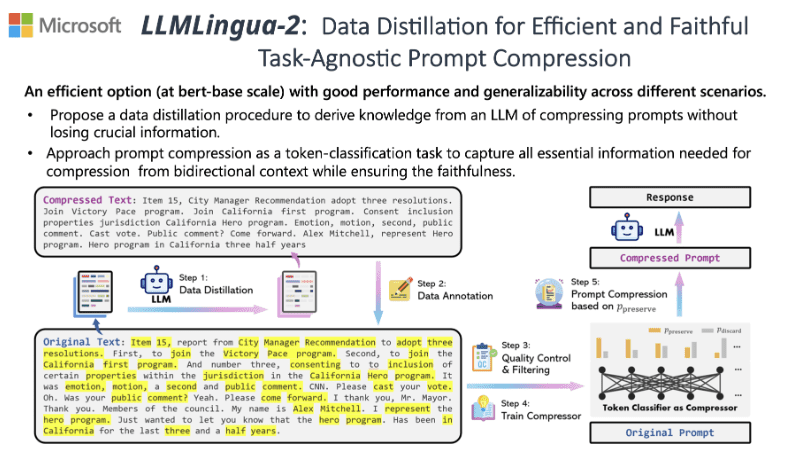
LLMLingua
Prompt compression example with LLMLingua-2 (source)

You can check out the resulting Python library to try the compression scheme for yourself.

LLMLingua utilizes a compact, well-trained language model (e.g., GPT2-small, LLaMA-7B) to identify and remove non-essential tokens in prompts. This approach enables efficient inference with large language models (LLMs), achieving up to 20x compression with minimal performance loss.

Below is an example of using LLMLingua for easy prompt compression (from the GitHub repository).

from llmlingua import PromptCompressor    llm_lingua = PromptCompressor()  compressed_prompt = llm_lingua.compress_prompt(prompt, instruction="", question="", target_token=200)    # > {'compressed_prompt': 'Question: Sam bought a dozen boxes, each with 30 highlighter pens inside, for $10 each box. He reanged five of boxes into packages of sixlters each and sold them $3 per. He sold the rest theters separately at the of three pens $2. How much did make in total, dollars?nLets think step stepnSam bought 1 boxes x00 oflters.nHe bought 12 * 300ters in totalnSam then took 5 boxes 6ters0ters.nHe sold these boxes for 5 *5nAfterelling these  boxes there were 3030 highlighters remaining.nThese form 330 / 3 = 110 groups of three pens.nHe sold each of these groups for $2 each, so made 110 * 2 = $220 from them.nIn total, then, he earned $220 + $15 = $235.nSince his original cost was $120, he earned $235 - $120 = $115 in profit.nThe answer is 115',  #  'origin_tokens': 2365,  #  'compressed_tokens': 211,  #  'ratio': '11.2x',  #  'saving': ', Saving $0.1 in GPT-4.'}    ## Or use the phi-2 model,  llm_lingua = PromptCompressor("microsoft/phi-2")    ## Or use the quantation model, like TheBloke/Llama-2-7b-Chat-GPTQ, only need <8GB GPU memory.  ## Before that, you need to pip install optimum auto-gptq  llm_lingua = PromptCompressor("TheBloke/Llama-2-7b-Chat-GPTQ", model_config={"revision": "main"})

There are now so many useful prompt engineering resources widely available. This is but a small taste of what is out there, just waiting to be explored. In bringing you this small sample, I hope that you have found at least one of these resources useful.

Happy prompting!

Matthew Mayo (@mattmayo13) holds a Master's degree in computer science and a graduate diploma in data mining. As Managing Editor, Matthew aims to make complex data science concepts accessible. His professional interests include natural language processing, machine learning algorithms, and exploring emerging AI. He is driven by a mission to democratize knowledge in the data science community. Matthew has been coding since he was 6 years old.

More On This Topic

  • Mastering Generative AI and Prompt Engineering: A Free eBook
  • The Art of Prompt Engineering: Decoding ChatGPT
  • Why Prompt Engineering is a Fad
  • The Rise and Fall of Prompt Engineering: Fad or Future?
  • Prompt Engineering 101: Mastering Effective LLM Communication
  • Prompt Engineering: An Integrated Dream

iPhone 16 Likely to Run on OpenAI GPTs

OpenAI Apple

When AIM wrote about a possible partnership between OpenAI and Apple in November last year, little did we know it would happen this soon.

According to a recent Bloomberg report, Apple has rekindled discussions with OpenAI to integrate AI functionalities into iOS 18 (iPhone 16).

At the same time, the company is aggressively developing its own extensive language models for certain iOS 18 features. However, as the report stated, its negotiations with OpenAI primarily focus on a “chatbot/search component”.

Andrew Curran, a professor at Wesleyan University, explained in his post that Apple was working on smaller local models but also wants a large model to run under iOS 18 on the iPhone. He said that the company also held discussions with Anthropic and Google, and is renewing negotiations with OpenAI.

Apple is working on smaller local models, but they also want a large model to run under iOS 18 on the iPhone. They have had discussions with Anthropic, Google, and OpenAI. They have now reentered negotiations with OpenAI. Massive deal for whoever lands it. WWDC is on June 10th. pic.twitter.com/GQl3UsUU5E

— Andrew Curran (@AndrewCurran_) April 27, 2024

In 2023, reports indicated that Apple invested significantly in research and development to improve Siri’s conversational skills. They were concurrently developing various AI models within different teams, emphasising image, language, and multimodal capabilities. Additionally, Apple was in the testing phase for their own AI chatbot.

Reports from the past emerged during Apple’s development of its proprietary chatbot, internally dubbed “Apple GPT” by its workforce.

Apple Bringing AI to Siri

Integrating this GPT-like technology into Apple’s infrastructure would essentially involve Siri. Despite numerous announcements, Siri has remained relatively stagnant since its inception. Developers have endeavoured to infuse ChatGPT functionalities into Siri, and now, Apple can seamlessly incorporate them.

The primary capabilities of a GenAI-driven Siri will probably stem from Apple’s in-house models operating on the device, while supplementary functionalities such as generating images and crafting long-form text may be sourced from third-party entities like OpenAI, Baidu, or Google.

In a YouTube video, Apple hints that its vision for Siri goes beyond improving conversation skills. Rumours suggest a deep integration with third-party apps, enabling Siri to understand and respond to a wider range of user queries.

This could simplify developers’ efforts to incorporate their preferred model into an app. Siri may soon be able to handle various tasks, enhancing its role as an essential tool in our digital lives.

Additionally, customisation is a frontier where Siri is expected to shine. Drawing inspiration from ChatGPT’s adaptability, Apple intends to allow users to personalise Siri’s personality, tailoring responses to match their individual styles and preferences, thereby enhancing user interactions.

At WWDC, Apple revealed that it is experimenting with an internal chatbot and advancing Siri with generative AI. The upgraded Siri boasts natural conversation abilities and enhanced user personalisation. According to Mark Gurman, a significant change will be removing “Hey” from “Hey Siri”.

Everyone is asking about Siri, AI and WWDC on Monday. One item I haven’t mentioned in a while has been a major project to drop the “Hey” from “Hey Siri.” I’d look out for that possibility next week. https://t.co/jGqyI54SXE

— Mark Gurman (@markgurman) June 2, 2023

Apple next with open AI

Although Apple wasn’t the pioneer, other smartphones led by Nothing, have embraced ChatGPT and advanced its features. Carl Pei, the CEO of Nothing, said “ChatGPT’s quick settings and Nothing OS deliver a delightful user experience.”

The latest OS 2.5.5 update for Nothing Phone (2) has now integrated ChatGPT, offering several new features including, a new gesture option in Nothing X to initiate voice conversations with ChatGPT for Nothing Ear & Nothing Ear (a).

New ChatGPT widgets enable launching in various modes directly from the home screen. A button on the screenshot and clipboard pop-up allows for quick content pasting into a new ChatGPT conversation.

Nothing OS 2.5.5 is now on Phone (2).
ChatGPT Integration:
The following features are available with the latest ChatGPT version installed from the Play Store:
💬 Added a new gesture option in Nothing X to start a voice conversation with ChatGPT for Nothing Ear & Nothing Ear (a).… pic.twitter.com/5Eu32MJZch

— Nothing (@nothing) April 22, 2024

A few months ago, Samsung unveiled its new Galaxy S24 series, which includes the Samsung Galaxy S24, S24 Plus, and S24 Ultra, integrating AI into their features. The company emphasised the new AI capabilities of the smartphones, branding it as Galaxy AI.

Apple has been in talks with various tech giants, such as OpenAI and Google Gemini, to integrate generative AI into its upcoming iPhone series. As anticipation builds for the effectiveness of this upgrade, all eyes are on Apple as we approach WWDC 2024.

Latest reports say, Apple has attracted numerous artificial intelligence experts from Google and established a covert European laboratory in Zurich, as the tech behemoth assembles a formidable team to compete with rivals in pioneering new AI models and products.

This venture into equipping Siri with generative AI capabilities represents a bold step into the future of virtual assistance, promising enhanced utility, personalisation, and privacy. The tech community eagerly awaits Siri’s transformation into a more intelligent, versatile, and personalised assistant.

The post iPhone 16 Likely to Run on OpenAI GPTs appeared first on Analytics India Magazine.

Microsoft’s Satya Nadella Says He is Thrilled to be in Thailand, Opens First Datacenter in the Region

Today, Microsoft Chairman and CEO Satya Nadella announced major investments in Thailand’s digital future at the Microsoft Build: AI Day event in Bangkok.

The commitments include establishing a new data centre region, the first in the country, providing AI upskilling opportunities for over 100,000 people, and supporting Thailand’s growing developer community.

Nadella expressed his enthusiasm for being in Thailand and emphasised the country’s incredible opportunity to build a digital-first, AI-powered future. The announcement builds on Microsoft’s memorandum of understanding with the Royal Thai Government to envision the nation’s digital transformation.

Thai Prime Minister Srettha Thavisin, who attended the event, stated that the collaboration with Microsoft is a significant milestone in Thailand’s “Ignite Thailand” vision, which aims to develop the country as a regional digital economy hub.

The new data centre region will expand the availability of Microsoft’s cloud services in Thailand, meeting the growing demand from enterprises, local businesses, and public sector organisations. It will also enable Thailand to capitalise on AI’s economic and productivity opportunities.

Microsoft also announced initiatives to foster the growth of Thailand’s developer community, such as AI Odyssey, which aims to help 6,000 Thai developers become AI subject matter experts.

In recent weeks, Microsoft has made significant investments in Southeast Asia, including a $1.7 billion commitment to advance Indonesia’s cloud and AI ambitions and a $2.9 billion investment in Japan for cloud and AI infrastructure.

The post Microsoft’s Satya Nadella Says He is Thrilled to be in Thailand, Opens First Datacenter in the Region appeared first on Analytics India Magazine.

OpenAI to Launch Google Search Alternative Soon 

OpenAI is likely to announce a new search engine soon, revealed Jimmy Apples, stating that the company is looking to host an event this month, tentatively on May 9, 2024, at 10 a.m.

The insider also revealed that OpenAI has been hiring for an events team since early January to organise in-house events.

“They were advertising for in house events staff and events marketing back in January, they just hired an events manager last month” said Jimmy Apples, hinting at a big deal event coming in the month of June, where OpenAI might release its next model — “what ever sam decides to call it.”

Further, Jimmy Apples said that the company has been busy since last week. “I count at least 50+ new async subdomains since the 24th of April.”

If the rumours are true, OpenAI’s Google Search alternative release might come ahead of Google I/O, which is scheduled for May 10, 2024. This might also make Perplexity AI redundant.

According to a report, OpenAI has been working on a web search product that will intensify its competition with Google. The search service is set to be partially powered by Bing. In a recent podcast with Lex Fridman, OpenAI chief, Sam Altman said that, “The intersection of LLMs plus search, I don’t think anyone has cracked the code on yet. I would love to go do that. I think that would be cool.”

Moreover he said that OpenAI does not want to build another Google Search. “I find that (Google Search) boring. I mean, if the question is if we can build a better search engine than Google or whatever, then sure, we should.”

“Google shows you like 10 blue links, like 13 ads, and then 10 blue links, and that’s like one way to find information. But the thing that’s exciting to me is not that we can go build a better copy of Google Search, but that maybe there’s just a much better way to help people find, act on, and synthesise information,” said Altman.

OpenAI’s decision to launch a search app follows Microsoft CEO Satya Nadella’s statement a year ago, in which he said that he would “make Google dance” by integrating OpenAI’s GPT models into Microsoft’s Bing search engine.

The post OpenAI to Launch Google Search Alternative Soon appeared first on Analytics India Magazine.

Amazon, AT&T, Verizon Named Best Tech Companies for Career Growth in 2024, LinkedIn Reports

Amazon leads LinkedIn’s list of the 2024 top companies in technology and information to grow your career in the U.S. This ranking is based on unique LinkedIn data that evaluates companies on eight elements of career progression, the site said. The elements are: ability to advance, skills growth, company stability, external opportunity, company affinity, gender diversity, educational background and employee presence in the country.

LinkedIn’s top 10 tech companies for career growth in the U.S.

  1. Amazon.
  2. AT&T.
  3. Verizon.
  4. Alphabet Inc.
  5. Comcast.
  6. STMicroelectronics.
  7. Apple.
  8. Siemens.
  9. Dayforce (formerly Ceridian).
  10. Cisco.

Semiconductor technology company STMicroelectronics and recently renamed Dayforce are both new to the top tech companies ranking, LinkedIn said.

What the top tech companies are doing to promote career growth

The tech companies on the LinkedIn list are very focused on upskilling to keep employees growing and learning, especially in AI skills, “as the technology gets integrated in both internal and external functions at companies across the board,” Tanya Dua, LinkedIn News tech editor, told TechRepublic.

Amazon

Among the specific examples of this that Dua cited include Amazon, which has committed to spending more than $1.2 billion to provide free skills training to employees, along with prepaid tuition programs, paid apprenticeships, on-the-job learning opportunities, industry certifications and more.

“The company has also launched the ‘Amazon AI Ready’ (initiative) to make AI education accessible to anyone who wants to learn and is providing $12 million in generative AI scholarships,’’ Dua said.

SEE: Amazon Offers Free Generative AI and Machine Learning Courses (TechRepublic)

AT&T

AT&T invested $132 million in employee training in 2023, and less than 5% of all AT&T roles require a college degree, according to Dua. The company has also rolled out the Ask AT&T platform, which allows employees “to tap into AI-powered, out-of-the-box capabilities around code generation, meeting summarization, customer assistance, and more,” she said.

Verizon

Verizon makes a significant investment in tuition assistance every year and also offers programs like the rotational Network Leadership Development program to help employees move from entry-level roles into senior positions, she said. “AI training programs teach employees the fundamentals of machine learning and data analytics, and the company also hosts regular AI hackathons,’’ she said.

Verizon is using AI in areas like developer productivity and customer service, where 1,000 agents who are part of a pilot program have been able to address customer concerns faster using generative AI, according to Dua.

“The company offers AI training programs including workshops, online courses, on-the-job training, and AI/GenAI hackathons,’’ she said. “Verizon has also established policies and guidelines regarding the use of AI/GenAI in the workplace to address issues such as data privacy, algorithmic bias, and the responsible use of AI/GenAI.”

DOWNLOAD this eLearning and Continuing Education Policy from TechRepublic Premium

Alphabet

Alphabet is another example of a company promoting career growth, offering the

“Googler-to-Googler” peer learning and coaching platform for employees to either coach or learn from their colleagues in different fields across the company, Dua added.

The skills employees and executives want the most

Learning new skills is one of the top three career goals professionals have for 2024, Dua said. (The other two top career goals are finding a better paying job and finding a job with better work/life balance.) “A recent LinkedIn survey found that 68% of working Americans say that continuing education and upskilling is important to them when applying for or taking a new job,’’ she noted. “Employees are hungry for all types of skills, and in fact, we’ve recently seen LinkedIn members add 680 million skills to their profiles, up 80% year-over-year,” when comparing 2023 to 2022.

Further, nine out of 10 global executives say soft skills are more important than ever, and LinkedIn’s recent Most In-Demand Skills report found that soft skills such as communication, leadership and teamwork are among the most searched-for skills on the site, according to Dua.

“We’ve also seen a big jump in people upskilling around AI — LinkedIn data shows a 65% increase in learning hours for the top 100 AI courses,’’ she said. Dua said the top 10 most popular LinkedIn Learning AI courses are free through July 1, 2024.

Other career perks

Many of the perks LinkedIn is seeing have been around for a while, Dua said, “but companies are ramping up in certain areas like upskilling, with a focus on AI. We also see many companies focused on retention, with programs and perks designed to keep employees happy, growing, and staying put.”

For example, AT&T is focused on employees’ total well-being, and offers no-cost mental health counseling and coaching, and family-inclusive benefits like doula support, subsidized child care, and no-cost fertility and postpartum support, Dua said.

Verizon offers inclusive benefits that start on day one, five weeks of PTO, and 24/7 backup child/elder care, she said. “The company also has a powerful 401(k) plan and matches student loan payments.”

Comcast offers life milestone benefits starting on the first day of employment, including adoption assistance, childcare resources, pet insurance and more, according to Dua.

More LinkedIn research about top companies

In addition to the top tech companies list, LinkedIn released this year’s rankings of the top large companies and top midsize companies in the U.S. for career growth. In comparison with last year’s top companies list, 44% of the companies on this year’s main ranking are new, Dua said.

Methodology

In addition to the eight pillars that have been shown to lead to career progression, LinkedIn determined that to be eligible for inclusion on the list, companies must have had 5,000 or more global employees with at least 500 in the U.S. as of Dec. 31, 2023.