Doctors in India Use Apple Vision Pro to Perform 30+ Surgeries 

Apple Vision Pro India

Ahead of the Apple Vision Pro launch in India, doctors from Chennai performed 30+ surgeries using the mixed-reality device.

Surgeons in #chennai #TamilNadu #India are using #Apple Vision Pro headset to perform key-hole surgeries..Vision Pro shows a wall-size virtual screen, both-eye 4K view of internal organs, shows multiple tabs etc.
Dr. Parthasarathi GEM Hosp has done 30+ surgeries using AVP pic.twitter.com/ZtwkDyhdjB

— Sidharth.M.P (@sdhrthmp) May 8, 2024

Several sources revealed that the doctors were from GEM Hospital in Chennai, India, where they used Apple Vision Pro to perform keyhole surgeries.

This is not the first time. Recently, Brazilian surgeons used the Apple Vision Pro headset to enhance shoulder arthroscopy, projecting high-resolution images and real-time data during surgery.

In another instance, the headset has also helped surgeons in a spine operation in the UK. Used alongside an app developed by eXeX, Apple Vision Pro facilitated real-time data streaming, surgical preparation, and instrument selection, potentially eliminating human errors and boosting surgical confidence.

Apple Vision Pro: Transforming Healthcare Like Never Before

Undoubtedly, Apple Vision Pro has made VR headsets cool again. Compared to other headsets like Meta’s Quest 3, Vision Pro offers many advanced features.

The Vision Pro headset has two micro-OLED displays packing 4k screens for each eye. It comes with 12 cameras in various positions all over the headset, five sensors to track other details, which include a LiDAR Scanner, and two TrueDepth sensors.

These sensors use two infrared flood illuminators to paint a 3D image of the surroundings. To process all of this data quickly and on the device, Apple even created the R1 chip, which reduces the latency to around 12 ms.

However, it’s only for those who can afford the price. Clearly, the $3,500 price tag doesn’t sit well with many users who think it’s too much for a headset, even with all these features.

Reportedly, Apple is also cutting down on Vision Pro production due to low demand.

Transforming its features into healthcare solutions, Vision Pro shows that the future of healthcare is bright, innovative, and digital—and Apple can lead the way in making such a future possible.

However, the company may want to improve the headset’s features further and be more bearish on the product’s pricing strategy.

Currently, Apple Vision Pro is only available for sale in the US. Other countries, including India, which houses the largest developer ecosystem, are waiting patiently for its release. But with the reports of production cuts coming in, it seems like the waiting period will be a little longer.

The post Doctors in India Use Apple Vision Pro to Perform 30+ Surgeries appeared first on Analytics India Magazine.

‘Winners in AI will be those who meet customers where they are,’ says Nandan Nilekani

In a keynote address at the “Making an Adbhut India” event hosted by People+AI, Nandan Nilekani, the co-founder and chairman of Infosys, said that India’s approach to AI will be different from the global trend of building LLMs. Instead, India will focus on building AI use-cases that will reach every citizen.

“Indian path in AI is different. We are not in the arms race to build the next LLM, let people with capital, let people who want to pedal ships do all that stuff… We are here to make a difference and our aim is to give this technology in the hands of people,” he said.

Nilekani added that India’s advantage lies in its population and aspirations, and that the country should not wait for the next $10-trillion model but should rather use the technology available today to solve the challenges of its billion-people resources.

“Our advantage is our population and their aspiration. This is why we have to bring down the cost of inference from Rs 100 to 1 Rupee” he said, adding thatwinners in AI in India will be those who meet customers where they are.

He also took a jab at AI enthusiasts and companies that talk about AI and its extinction effect, saying that “a lot of these doomsday prophets are essentially protectionists, who don’t want to allow other people to build models, they want to make all the money for themselves.”

The event, hosted by People+AI, an initiative of the not-for-profit EkStep Foundation, also saw the launch of the Open Cloud Compute (OCC) project, which aims to establish an open network for compute resources, addressing the growing demand for AI infrastructure.

Other highlights of the event included the launch of Sesame, India’s first LLM specifically designed for the banking, financial services, and insurance sector, developed in collaboration with indigenous AI research firm Sarvam AI.

The fintech company Setu also showcased its chat-based personal finance product, which uses AI to provide personalised financial services to customers.

The event also saw the launch of BharatDiffusion v2, a diffusion-based AI model designed to create images that reflect India’s culture. The model has been trained on a large collection of Indian photos to produce high-quality and realistic pictures.

In addition, the event featured the launch of JOHNAIC, a personal AI server built by Von Neumann AI. The one-time investment “cloud in a box” solution claims to slash AI costs by 85 percent and comes with in-built SaaS and AI tools to run SMEs and startups.

People+AI is the first customer of JOHNAIC and is using it for its own AI requirements while keeping its data private.

The event also saw the launch of STAGE, an entertainment platform for India’s regional cultures serving the Haryanvi and Rajasthani cultures, which recently turned profitable with over 1.2 million paying subscribers. The platform features India’s first Haryanvi-dialect based AI voice agent.

The post ‘Winners in AI will be those who meet customers where they are,’ says Nandan Nilekani appeared first on Analytics India Magazine.

Google DeepMind Unveils AlphaFold 3, Achieves 50% Better Prediction Accuracy

Google DeepMind, in collaboration with its subsidiary Isomorphic Labs, has introduced AlphaFold 3, a new AI model capable of predicting the structure and interactions of all biological molecules, including proteins, DNA, RNA, and ligands. AlphaFold 3 becomes the first AI system to surpass physics-based tools for biomolecular structure prediction.

Thrilled to announce AlphaFold 3 which can predict the structures and interactions of nearly all of life’s molecules with state-of-the-art accuracy including proteins, DNA and RNA. Biology is a complex dynamical system so modeling interactions is crucial https://t.co/Gs4GoOB3fD pic.twitter.com/QWVI71daNe

— Demis Hassabis (@demishassabis) May 8, 2024

This new version extends its capabilities to include proteins, DNA, RNA, and small molecules like ligands. Its new features include an updated version of the Evoformer module, critical in AlphaFold 2’s success, and a diffusion network mechanism similar to those used in AI image generators. These improvements collectively enable the model to predict the interactions of biomolecules with at least 50% greater accuracy than existing methods. The accuracy has even doubled for some molecules, marking a substantial advancement in the field.

The research company has also released the AlphaFold Server, a free, highly accurate tool for predicting protein and other molecule interactions within cells. This platform is accessible to scientists globally for non-commercial purposes and simplifies modelling proteins, DNA, RNA, and other molecular structures.

It boosts the research process, enabling scientists to generate hypotheses and conduct experiments quickly, irrespective of their computational resources or machine learning expertise.

Traditionally, predicting protein structures could take years and be extremely costly, but with AlphaFold 2, millions of these predictions have been made, saving an immense amount of time and resources. The AlphaFold Server builds on this success, facilitating even greater scientific innovation and efficiency.

Boosting Drug Discovery Process

One of AlphaFold 3’s most important applications is drug discovery. The model’s ability to predict how small molecules—often used as drugs—interact with proteins and other targets can drastically reduce the time and cost of developing new medications.

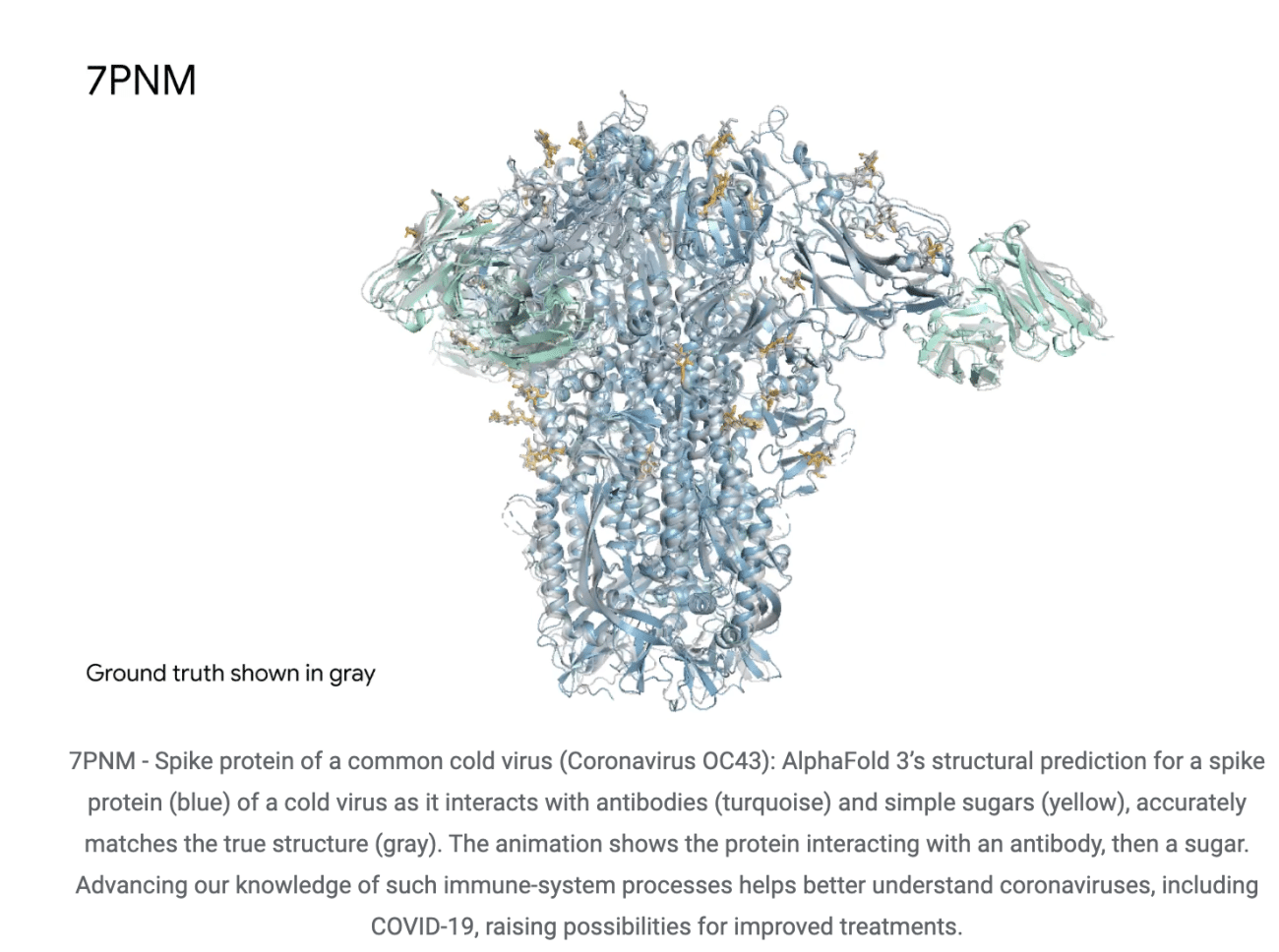
For example, AlphaFold can accurately predict the interaction between a cold virus spike protein and various antibodies, a critical factor in understanding viral mechanisms and designing treatments.

Another example includes accurately modelling a DNA-binding protein’s interaction with the DNA double helix, showcasing the model’s potential to understand genetic functions and mutations.

Previously…

AlphaFold 3 builds on the success of its previous iteration, AlphaFold 2, released in 2020. When first released, AlphaFold revolutionised computational biology by accurately predicting 3D protein structures from amino acid sequences, transforming research and drug discovery.

However, it also released another version of AlphaFold 2 in October 2023 that can predict structures for most molecules in the Protein Data Bank (PDB) with high accuracy, often reaching atomic precision, in various important biomolecule categories, including small molecules (ligands), proteins, DNA, RNA, and molecules with post-translational modifications (PTMs).

Additionally, it developed AlphaMissense, an extension of AlphaFold, designed to assess the impact of missense variants—mutations that alter a single nucleotide and consequently change the amino acid in proteins—using databases on human and primate genetic variations.

AlphaFold has found diverse applications in life sciences like advancing malaria vaccine development, delivering gene therapy using modified bacterium for targeted protein delivery in cancer treatments, improving drug discovery for liver cancer with rapid design of new treatment pathways, targeting antibiotic resistance by understanding enzyme structures, and combating neglected diseases like sleeping sickness through drug development.

What’s Next?

Isomorphic Labs is leveraging AlphaFold 3 to collaborate with pharmaceutical companies, aiming to create innovative treatments for complex diseases.

Google DeepMind is in talks with over 50 domain experts and multiple third-party organisations to evaluate the model’s capabilities and potential risks. It plans to expand its educational offerings around AlphaFold through collaborations with entities like EMBL-EBI and initiatives targeting scientists in developing regions.

The post Google DeepMind Unveils AlphaFold 3, Achieves 50% Better Prediction Accuracy appeared first on Analytics India Magazine.

Setu and Sarvam AI Unveils Sesame, India’s First Domain Specific LLM for BFSI Sector 

Pine Labs Group’s Setu, a leading Indian fintech company, has unveiled Sesame, India’s first Large Language Model (LLM) specifically designed for the BFSI sector.

Developed in collaboration with indigenous AI research firm Sarvam AI, the company said Sesame is a breakthrough that marks a “ChatGPT Moment” in the financial services space.

The unveiling took place at Adbhut India, an event organized by the non-profit People+ai, in the presence of Mr. Nandan Nilekani (Co-founder & Director – EkStep Foundation), Mr. Shankar Maruwada (Co-founder & CEO – EkStep Foundation), Mr. Tanuj Bhojwani (Head – People+ai), and other prominent figures in the world of fintech, AI, and digital public infrastructure.

Sesame leverages India’s digital infrastructure to power features such as improved credit underwriting, fraud detection, loan monitoring, upsell/cross-sell, and personal finance advisory. The model is trained on custom data highly relevant to India’s BFSI sector, making it domain and region-specific.

Setu’s Co-founder, Nikhil Kumar, said, “At Setu, our mission is to democratise financial services. We believe that the powerful combination of the Account Aggregator framework and transformative technologies like Large Language Models (LLMs) is the key to making this a reality.”

Pratyush Kumar, Co-founder of Sarvam AI, added, “Generative AI represents a significant step change in the nature of computation. What can be done with one rupee of compute is now dramatically more valuable. Our collaboration with Setu is an example of bringing this technology to create value in the BFSI space.”

The unveiling of Sesame marks a significant milestone in the development of AI-powered financial services in India. With Sesame, Setu aims to empower BFSI customers to make smarter, faster credit decisions and provide hyper-personalised financial services to their customers across their entire lifecycle.

Sarvam AI is currently also working on a voice-based Indic LLM, which it plans to release in the upcoming months.

The post Setu and Sarvam AI Unveils Sesame, India’s First Domain Specific LLM for BFSI Sector appeared first on Analytics India Magazine.

Infosys & ServiceNow Boost Collaboration for Gen AI-Powered Solutions

Infosys and ServiceNow today announced a strengthened collaboration to transform customer experiences with generative AI‑powered industry solutions, at ServiceNow’s annual customer and partner event Knowledge 2024.

The collaboration aims to increase productivity, enhance efficiency, and improve user experience for organisations by combining ServiceNow’s Now Assist generative AI capabilities and Infosys Cobalt, a set of services, solutions, and platforms designed to accelerate cloud‑powered enterprise transformation.

As part of this broader AI‑first, industry‑first strategy, Infosys will also double its investment in training by certifying more than 3,500 employees with ServiceNow GenAI skills.

“The combination of ServiceNow GenAI capabilities with Infosys’ industry expertise is a prime example of how our partners are integral to driving digital transformation forward for more organizations,” said Erica Volini, senior vice president, global partnerships and channels at ServiceNow.

“Our longstanding collaboration with Infosys demonstrates the potential for our ecosystem to yield real, impactful results for customers. We are helping shape the future of GenAI’s impact on enterprise productivity, with skills training GenAI,” Volini added.

In collaboration with ServiceNow, Infosys will develop new industry applications into the Infosys Enterprise Service Management (ESM) Café, the AI‑powered plug‑and‑play solution which is already helping ServiceNow customers accelerate time to value.

Infosys is also investing in the creation of a Pro Plus BOT factory, which can offer more than 100,000 Now Assist‑powered chatbots so customers can realize value in their AI journey.

Through this expanded collaboration, ServiceNow and Infosys will address critical business process challenges for enterprises across telecom, financial services, manufacturing, and retail.

The new offerings will aim to deliver significant benefits to customers, including up to 20% improvement in operational efficiency, 5‑time faster increase in response time, and 30% reduction in implementation timelines.

At the same time, the applications will deliver insights on large transformation engagements using GenAI. The collaboration is currently enabling customers such as Carrier, a world leader in high‑technology heating, air‑conditioning, and refrigeration solutions, to address key business problems, including experience, underutilized AI‑based platform capabilities, and isolated processes.

Through more than 10 years of collaboration, Infosys and ServiceNow have made substantial investments in R&D, infrastructure, and talent development, resulting in improved product capabilities and market expansion.

The post Infosys & ServiceNow Boost Collaboration for Gen AI-Powered Solutions appeared first on Analytics India Magazine.

Free AI Courses from NVIDIA: For All Levels

nvidia-courses
Image by Author

Generative AI has become mainstream over the last several months, and it’s only going to get better. So how do you upskill and stay current on all the recent advances?

But here’s the good news: with all the recent advances there’s also been an uptick in the number of high-quality free learning resources available. This is a compilation of free AI courses from NVIDIA—the NVIDIA Deep Learning Institute—to get you up to speed on AI topics and start building impactful solutions.

So let’s go over the courses and what they cover!

Generative AI Explained

Generative AI Explained is a beginner-friendly introduction to generative AI fundamentals to get your feet wet. This course will introduce you to the following topics:

  • Generative AI and how Generative AI works
  • Generative AI applications
  • Challenges and opportunities in Generative AI

By the end of this course, you’ll have gained a good understanding of what generative AI is, how it works, and how you can use it.

Link: Generative AI Explained

Building a Brain in 10 Minutes

Large language models are currently super popular and super helpful. However, before you dive into LLMs, a basic understanding of how neural networks work is necessary.

Building a Brain in 10 Minutes is an introduction to building a neural network with references to biological inspirations that guide the neural network architecture.

To make the most out of this course, you have to be comfortable with programming in Python and regression models. This short course will help you learn the following:

  • How neural networks learn from data
  • The math behind the neuron and the working of a neural network

Link: Building a Brain in 10 Minutes

Augment Your LLMs Using Retrieval Augmented Generation

Whenever you want to build applications that use LLMs, you’d also use Retrieval Augmented Generation (RAG). With RAG, you can build LLM apps on domain-specific data, mitigate LLM hallucinations, and much more.

The Augment Your LLMs Using Retrieval Augmented Generation course will teach you how to build a RAG pipeline that uses information retrieval and response generation. It’ll help get a good grasp of the basics of RAG and the RAG retrieval process.

Link: Augment Your LLMs Using Retrieval Augmented Generation

Building RAG Agents with LLMs

Once you're familiar with how RAG works from the previous course, you can take the Building RAG Agents with LLMs course to explore RAG in much greater detail by building end-to-end LLM systems.

To ace this course, it’ll be helpful to have intermediate programming experience with Python and some programming experience with PyTorch. In this course, you’ll explore designing LLM pipelines and use tools like Gradio, LangChain, and LangServe. You’ll also get to experiment with embeddings, models, and vector stores for retrieval.

Link: Building RAG Agents with LLMs

Wrapping Up

I hope you found this comprehensive list of free AI courses from the NVIDIA Deep Learning Institute helpful.

But if you are interested in exploring LLMs and Generative AI further, here are a couple of articles you may find useful:

  • 7 Steps to Mastering Large Language Models
  • 5 Free Courses to Master Generative AI

So happy learning and coding!

Bala Priya C is a developer and technical writer from India. She likes working at the intersection of math, programming, data science, and content creation. Her areas of interest and expertise include DevOps, data science, and natural language processing. She enjoys reading, writing, coding, and coffee! Currently, she's working on learning and sharing her knowledge with the developer community by authoring tutorials, how-to guides, opinion pieces, and more. Bala also creates engaging resource overviews and coding tutorials.

More On This Topic

  • Free Amazon Courses to Learn Generative AI: For All Levels
  • A Free Data Science Learning Roadmap: For All Levels with IBM
  • Large Language Models Explained in 3 Levels of Difficulty
  • 311 Call Centre Performance: Rating Service Levels
  • Boost Your AI and ML Skills for Free at NVIDIA Conference
  • Online Training and Workshops with Nvidia

Supercharging Graph Neural Networks with Large Language Models: The Ultimate Guide

graph neural network large language model

Graphs are data structures that represent complex relationships across a wide range of domains, including social networks, knowledge bases, biological systems, and many more. In these graphs, entities are represented as nodes, and their relationships are depicted as edges.

The ability to effectively represent and reason about these intricate relational structures is crucial for enabling advancements in fields like network science, cheminformatics, and recommender systems.

Graph Neural Networks (GNNs) have emerged as a powerful deep learning framework for graph machine learning tasks. By incorporating the graph topology into the neural network architecture through neighborhood aggregation or graph convolutions, GNNs can learn low-dimensional vector representations that encode both the node features and their structural roles. This allows GNNs to achieve state-of-the-art performance on tasks such as node classification, link prediction, and graph classification across diverse application areas.

While GNNs have driven substantial progress, some key challenges remain. Obtaining high-quality labeled data for training supervised GNN models can be expensive and time-consuming. Additionally, GNNs can struggle with heterogeneous graph structures and situations where the graph distribution at test time differs significantly from the training data (out-of-distribution generalization).

In parallel, Large Language Models (LLMs) like GPT-4, and LLaMA have taken the world by storm with their incredible natural language understanding and generation capabilities. Trained on massive text corpora with billions of parameters, LLMs exhibit remarkable few-shot learning abilities, generalization across tasks, and commonsense reasoning skills that were once thought to be extremely challenging for AI systems.

The tremendous success of LLMs has catalyzed explorations into leveraging their power for graph machine learning tasks. On one hand, the knowledge and reasoning capabilities of LLMs present opportunities to enhance traditional GNN models. Conversely, the structured representations and factual knowledge inherent in graphs could be instrumental in addressing some key limitations of LLMs, such as hallucinations and lack of interpretability.

In this article, we will delve into the latest research at the intersection of graph machine learning and large language models. We will explore how LLMs can be used to enhance various aspects of graph ML, review approaches to incorporate graph knowledge into LLMs, and discuss emerging applications and future directions for this exciting field.

Graph Neural Networks and Self-Supervised Learning

To provide the necessary context, we will first briefly review the core concepts and methods in graph neural networks and self-supervised graph representation learning.

Graph Neural Network Architectures

Graph Neural Network Architecture – source

The key distinction between traditional deep neural networks and GNNs lies in their ability to operate directly on graph-structured data. GNNs follow a neighborhood aggregation scheme, where each node aggregates feature vectors from its neighbors to compute its own representation.

Numerous GNN architectures have been proposed with different instantiations of the message and update functions, such as Graph Convolutional Networks (GCNs), GraphSAGE, Graph Attention Networks (GATs), and Graph Isomorphism Networks (GINs) among others.

More recently, graph transformers have gained popularity by adapting the self-attention mechanism from natural language transformers to operate on graph-structured data. Some examples include GraphormerTransformer, and GraphFormers. These models are able to capture long-range dependencies across the graph better than purely neighborhood-based GNNs.

Self-Supervised Learning on Graphs

While GNNs are powerful representational models, their performance is often bottlenecked by the lack of large labeled datasets required for supervised training. Self-supervised learning has emerged as a promising paradigm to pre-train GNNs on unlabeled graph data by leveraging pretext tasks that only require the intrinsic graph structure and node features.

Self-Supervised Graph

Some common pretext tasks used for self-supervised GNN pre-training include:

  1. Node Property Prediction: Randomly masking or corrupting a portion of the node attributes/features and tasking the GNN to reconstruct them.
  2. Edge/Link Prediction: Learning to predict whether an edge exists between a pair of nodes, often based on random edge masking.
  3. Contrastive Learning: Maximizing similarities between graph views of the same graph sample while pushing apart views from different graphs.
  4. Mutual Information Maximization: Maximizing the mutual information between local node representations and a target representation like the global graph embedding.

Pretext tasks like these allow the GNN to extract meaningful structural and semantic patterns from the unlabeled graph data during pre-training. The pre-trained GNN can then be fine-tuned on relatively small labeled subsets to excel at various downstream tasks like node classification, link prediction, and graph classification.

By leveraging self-supervision, GNNs pre-trained on large unlabeled datasets exhibit better generalization, robustness to distribution shifts, and efficiency compared to training from scratch. However, some key limitations of traditional GNN-based self-supervised methods remain, which we will explore leveraging LLMs to address next.

Enhancing Graph ML with Large Language Models
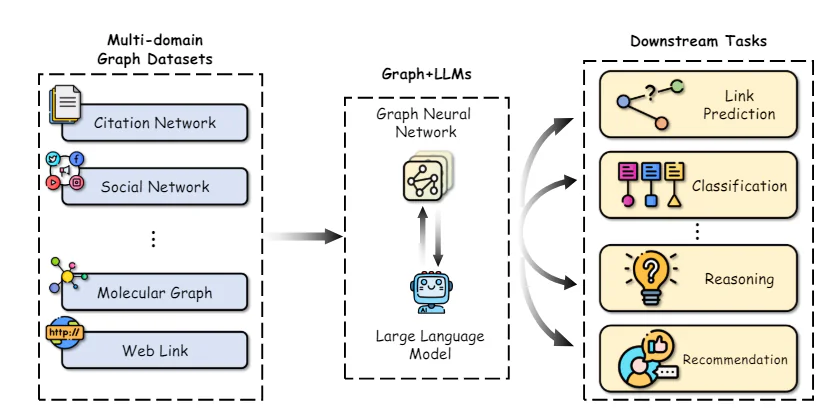
Integration of Graphs and LLM – source

The remarkable capabilities of LLMs in understanding natural language, reasoning, and few-shot learning present opportunities to enhance multiple aspects of graph machine learning pipelines. We explore some key research directions in this space:

A key challenge in applying GNNs is obtaining high-quality feature representations for nodes and edges, especially when they contain rich textual attributes like descriptions, titles, or abstracts. Traditionally, simple bag-of-words or pre-trained word embedding models have been used, which often fail to capture the nuanced semantics.

Recent works have demonstrated the power of leveraging large language models as text encoders to construct better node/edge feature representations before passing them to the GNN. For example, Chen et al. utilize LLMs like GPT-3 to encode textual node attributes, showing significant performance gains over traditional word embeddings on node classification tasks.

Beyond better text encoders, LLMs can be used to generate augmented information from the original text attributes in a semi-supervised manner. TAPE generates potential labels/explanations for nodes using an LLM and uses these as additional augmented features. KEA extracts terms from text attributes using an LLM and obtains detailed descriptions for these terms to augment features.

By improving the quality and expressiveness of input features, LLMs can impart their superior natural language understanding capabilities to GNNs, boosting performance on downstream tasks.

Alleviating Reliance on Labeled Data

A key advantage of LLMs is their ability to perform reasonably well on new tasks with little to no labeled data, thanks to their pre-training on vast text corpora. This few-shot learning capability can be leveraged to alleviate the reliance of GNNs on large labeled datasets.

One approach is to use LLMs to directly make predictions on graph tasks by describing the graph structure and node information in natural language prompts. Methods like InstructGLM and GPT4Graph fine-tune LLMs like LLaMA and GPT-4 using carefully designed prompts that incorporate graph topology details like node connections, neighborhoods etc. The tuned LLMs can then generate predictions for tasks like node classification and link prediction in a zero-shot manner during inference.

While using LLMs as black-box predictors has shown promise, their performance degrades for more complex graph tasks where explicit modeling of the structure is beneficial. Some approaches thus use LLMs in conjunction with GNNs – the GNN encodes the graph structure while the LLM provides enhanced semantic understanding of nodes from their text descriptions.

Graph Understanding with LLM Framework – Source

GraphLLM explores two strategies: 1) LLMs-as-Enhancers where LLMs encode text node attributes before passing to the GNN, and 2) LLMs-as-Predictors where the LLM takes the GNN's intermediate representations as input to make final predictions.

GLEM goes further by proposing a variational EM algorithm that alternates between updating the LLM and GNN components for mutual enhancement.

By reducing reliance on labeled data through few-shot capabilities and semi-supervised augmentation, LLM-enhanced graph learning methods can unlock new applications and improve data efficiency.

Enhancing LLMs with Graphs

While LLMs have been tremendously successful, they still suffer from key limitations like hallucinations (generating non-factual statements), lack of interpretability in their reasoning process, and inability to maintain consistent factual knowledge.

Graphs, especially knowledge graphs which represent structured factual information from reliable sources, present promising avenues to address these shortcomings. We explore some emerging approaches in this direction:

Knowledge Graph Enhanced LLM Pre-training

Similar to how LLMs are pre-trained on large text corpora, recent works have explored pre-training them on knowledge graphs to imbue better factual awareness and reasoning capabilities.

Some approaches modify the input data by simply concatenating or aligning factual KG triples with natural language text during pre-training. E-BERT aligns KG entity vectors with BERT's wordpiece embeddings, while K-BERT constructs trees containing the original sentence and relevant KG triples.

The Role of LLMs in Graph Machine Learning:

Researchers have explored several ways to integrate LLMs into the graph learning pipeline, each with its unique advantages and applications. Here are some of the prominent roles LLMs can play:

  1. LLM as an Enhancer: In this approach, LLMs are used to enrich the textual attributes associated with the nodes in a TAG. The LLM's ability to generate explanations, knowledge entities, or pseudo-labels can augment the semantic information available to the GNN, leading to improved node representations and downstream task performance.

For example, the TAPE (Text Augmented Pre-trained Encoders) model leverages ChatGPT to generate explanations and pseudo-labels for citation network papers, which are then used to fine-tune a language model. The resulting embeddings are fed into a GNN for node classification and link prediction tasks, achieving state-of-the-art results.

  1. LLM as a Predictor: Rather than enhancing the input features, some approaches directly employ LLMs as the predictor component for graph-related tasks. This involves converting the graph structure into a textual representation that can be processed by the LLM, which then generates the desired output, such as node labels or graph-level predictions.

One notable example is the GPT4Graph model, which represents graphs using the Graph Modelling Language (GML) and leverages the powerful GPT-4 LLM for zero-shot graph reasoning tasks.

  1. GNN-LLM Alignment: Another line of research focuses on aligning the embedding spaces of GNNs and LLMs, allowing for a seamless integration of structural and semantic information. These approaches treat the GNN and LLM as separate modalities and employ techniques like contrastive learning or distillation to align their representations.

The MoleculeSTM model, for instance, uses a contrastive objective to align the embeddings of a GNN and an LLM, enabling the LLM to incorporate structural information from the GNN while the GNN benefits from the LLM's semantic knowledge.

Challenges and Solutions

While the integration of LLMs and graph learning holds immense promise, several challenges need to be addressed:

  1. Efficiency and Scalability: LLMs are notoriously resource-intensive, often requiring billions of parameters and immense computational power for training and inference. This can be a significant bottleneck for deploying LLM-enhanced graph learning models in real-world applications, especially on resource-constrained devices.

One promising solution is knowledge distillation, where the knowledge from a large LLM (teacher model) is transferred to a smaller, more efficient GNN (student model).

  1. Data Leakage and Evaluation: LLMs are pre-trained on vast amounts of publicly available data, which may include test sets from common benchmark datasets, leading to potential data leakage and overestimated performance. Researchers have started collecting new datasets or sampling test data from time periods after the LLM's training cut-off to mitigate this issue.

Additionally, establishing fair and comprehensive evaluation benchmarks for LLM-enhanced graph learning models is crucial to measure their true capabilities and enable meaningful comparisons.

  1. Transferability and Explainability: While LLMs excel at zero-shot and few-shot learning, their ability to transfer knowledge across diverse graph domains and structures remains an open challenge. Improving the transferability of these models is a critical research direction.

Furthermore, enhancing the explainability of LLM-based graph learning models is essential for building trust and enabling their adoption in high-stakes applications. Leveraging the inherent reasoning capabilities of LLMs through techniques like chain-of-thought prompting can contribute to improved explainability.

  1. Multimodal Integration: Graphs often contain more than just textual information, with nodes and edges potentially associated with various modalities, such as images, audio, or numeric data. Extending the integration of LLMs to these multimodal graph settings presents an exciting opportunity for future research.

Real-world Applications and Case Studies

The integration of LLMs and graph machine learning has already shown promising results in various real-world applications:

  1. Molecular Property Prediction: In the field of computational chemistry and drug discovery, LLMs have been employed to enhance the prediction of molecular properties by incorporating structural information from molecular graphs. The LLM4Mol model, for instance, leverages ChatGPT to generate explanations for SMILES (Simplified Molecular-Input Line-Entry System) representations of molecules, which are then used to improve the accuracy of property prediction tasks.
  2. Knowledge Graph Completion and Reasoning: Knowledge graphs are a special type of graph structure that represents real-world entities and their relationships. LLMs have been explored for tasks like knowledge graph completion and reasoning, where the graph structure and textual information (e.g., entity descriptions) need to be considered jointly.
  3. Recommender Systems: In the domain of recommender systems, graph structures are often used to represent user-item interactions, with nodes representing users and items, and edges denoting interactions or similarities. LLMs can be leveraged to enhance these graphs by generating user/item side information or reinforcing interaction edges.

Conclusion

The synergy between Large Language Models and Graph Machine Learning presents an exciting frontier in artificial intelligence research. By combining the structural inductive bias of GNNs with the powerful semantic understanding capabilities of LLMs, we can unlock new possibilities in graph learning tasks, particularly for text-attributed graphs.

While significant progress has been made, challenges remain in areas such as efficiency, scalability, transferability, and explainability. Techniques like knowledge distillation, fair evaluation benchmarks, and multimodal integration are paving the way for practical deployment of LLM-enhanced graph learning models in real-world applications.


Microsoft and OpenAI Announce $2 Million for Societal Resilience Fund

Tech giants Microsoft and OpenAI have announced the launch of a $2 million Societal Resilience Fund. This marks a significant move to counter the growing threat of AI-generated misinformation during several global elections in 2024, including the upcoming US presidential elections.

The fund aims to promote AI education and literacy among voters and vulnerable communities, empowering them to navigate the increasingly complex digital landscape and identify authoritative resources.

The initiative comes at a critical time, with approximately two billion people expected to participate in democratic elections worldwide this year. The fund will support several organisations, including Older Adults Technology Services (OATS) from AARP, the Coalition for Content Provenance and Authenticity (C2PA), the International Institute for Democracy and Electoral Assistance (International IDEA), and Partnership on AI (PAI).

OATS executive director Tom Kamber said, “As AI tools become part of everyday life, it is essential that older adults learn more about the risks and opportunities that are emerging. We are pleased to work with Microsoft and OpenAI on this vital project to make sure that older adults 50+ have access to training, information, and support—both to enhance their lives with new technology and to protect themselves against its misuse.”

The Societal Resilience Fund is a joint effort that follows through on public commitments made by Microsoft and OpenAI via the White House Voluntary Commitments and the Tech Accord to Combat Deceptive Use of AI in the 2024 elections.

The companies have committed to engaging with a diverse set of global civil society organisations and academics to support efforts that promote public awareness and societal resilience against the use of deceptive AI content.

Microsoft and OpenAI’s shared goals are to combat the growing risk of bad faith actors using AI and deep fakes to deceive voters and undermine democracy. The fund’s launch underscores the companies’ dedication to tackling AI literacy and education challenges, ensuring that the power of AI is broadly beneficial and that vulnerable communities are armed with the knowledge to navigate the intricate world of artificial intelligence.

The post Microsoft and OpenAI Announce $2 Million for Societal Resilience Fund appeared first on Analytics India Magazine.

US is Two to Three Years Ahead of China in AI

Ex-Google CEO Eric Schmidt said that China is focused on dominating several industries, but as of now, the US still maintains a significant lead in AI.

Speaking at the AI Expo for National Competitiveness, Schmidt said, “In the case of AI, we are well ahead two or three years, probably, of China, which in my world is an eternity.”

However, he did mention that the next roughly twenty years will be focused on national competitiveness as a whole, thanks to China’s focus on dominating certain industries.

Meanwhile, his concern about competing with Europe wasn’t as big, as he believes that they’re more focused on regulating. “There is always a risk of premature regulation. My simplest example there is Europe. You can see that Europe is highly unlikely to be relevant. And the rest of the world is not focused enough on this,” he said.

He said that the biggest obstacle right now for China is the shortage of chips, which makes sense. The country has been slapped with several sanctions like NVIDIA’s H100, A100 and then A800, specifically to prevent the flow of semiconductor chips into its industries.

But whether this has actually worked or not, is another story altogether. Meanwhile China has still managed to remain a priority in other areas as well, as evidenced by Elon Musk recently skipping over his visit to India.

Schmidt remains optimistic, however, saying, “We’re the likely winner if we don’t screw it up.” In what could affect this balance, Schmidt maintains that pre-mature regulation would be likely.

However, with most American companies voluntarily committing themselves to AI safety, Schmidt says, the need for regulations is not as necessary. “I would expect in the next ten years, you’ll see regulations in some of these spaces because of potential harm. So we’re okay at the moment,” he concluded.

The post US is Two to Three Years Ahead of China in AI appeared first on Analytics India Magazine.

A Roadmap to Machine Learning Algorithm Selection

A Roadmap to Machine Learning Algorithm Selection
Image created by Author

Introduction

An important step in generating predictive models is selecting the correct machine learning algorithm to use, a choice which can have a seemingly out-sized effect on model performance and efficiency. This selection can even determine the success of the most basic of predictive tasks: whether a model is able to sufficiently learn from training data and generalize to new sets of data. This is especially important for data science practitioners and students, who face an overwhelming number of potential choices as to which algorithm to run with. The goal of this article is to help demystify the process of selecting the proper machine learning algorithm, concentrating on "traditional" algorithms and offering some guidelines for choosing the best one for your application.

The Importance of Algorithm Selection

The choice of a best, correct, or even sufficient algorithm can dramatically improve a model's ability to predict accurately. The wrong choice of algorithm, as you might be able to guess, can lead to suboptimal model performance, perhaps not even reaching the threshold of being useful. This results in a substantial potential advantage: selecting the "right" algorithm which matches the statistics of the data and problem will allow a model to learn well and provide outputs more accurately, possibly in less time. Conversely, picking the incorrect algorithm can have a wide range of negative consequences: training times might be longer; training might be more computationally expensive; and, worst of all, the model could be less reliable. This could mean a less accurate model, poor results when given new data, or no actual insights into what the data can tell you. Doing poorly on any or all of these metrics can ultimately be a waste of resources and can limit the success of the entire project.

tl;dr Correctly choosing the right algorithm for the task directly influences machine learning model efficiency and accuracy.

Algorithm Selection Considerations

Choosing the right machine learning algorithm for a task involves a variety of factors, each of which is able to have a significant impact on the eventual decision. What follows are several facets to keep in mind during the decision-making process.

Dataset Characteristics

The characteristics of the dataset are of the utmost importance to algorithm selection. Factors such as the size of the dataset, the type of data elements contained, whether the data is structured or unstructured, are all top-level factors. Imagine employing an algorithm for structured data to an unstructured data problem. You probably won't get very far! Large datasets would need scalable algorithms, while smaller ones may do fine with simpler models. And don't forget the quality of the data — is it clean, or noisy, or maybe incomplete — owing to the fact that different algorithms have different capabilities and robustness when it comes to missing data and noise.

Problem Type

The type of problem you are trying to solve, whether classification, regression, clustering, or something else, obviously impacts the selection of an algorithm. There are particular algorithms that are best suited for each class of problem, and there are many algorithms that simply do not work for other problem types whatsoever. If you were working on a classification problem, for example, you might be choosing between logistic regression and support vector machines, while a clustering problem might lead you to using k-means. You likely would not start with a decision tree classification algorithm in an attempt to solve a regression problem.

Performance Metrics

What are the ways you intend to capture for measuring your model's performance? If you are set on particular metrics — for instance, precision or recall for your classification problem, or mean squared error for your regression problem — you must ensure that the selected algorithm can accommodate. And don't overlook additional non-traditional metrics such as training time and model interpretability. Though some models might train more quickly, they may do so at the cost of accuracy or interpretability.

Resource Availability

Finally, the resources you have available at your disposal may greatly influence your algorithm decision. For example, deep learning models might require a good deal of computational power (e.g., GPUs) and memory, making them less than ideal in some resource-constrained environments. Knowing what resources are available to you can help you make a decision that can help make tradeoffs between what you need, what you have, and getting the job done.

By thoughtfully considering these factors, a good choice of algorithm can be made which not only performs well, but aligns well with the objectives and restrictions of the project.

Beginner's Guide to Algorithm Selection

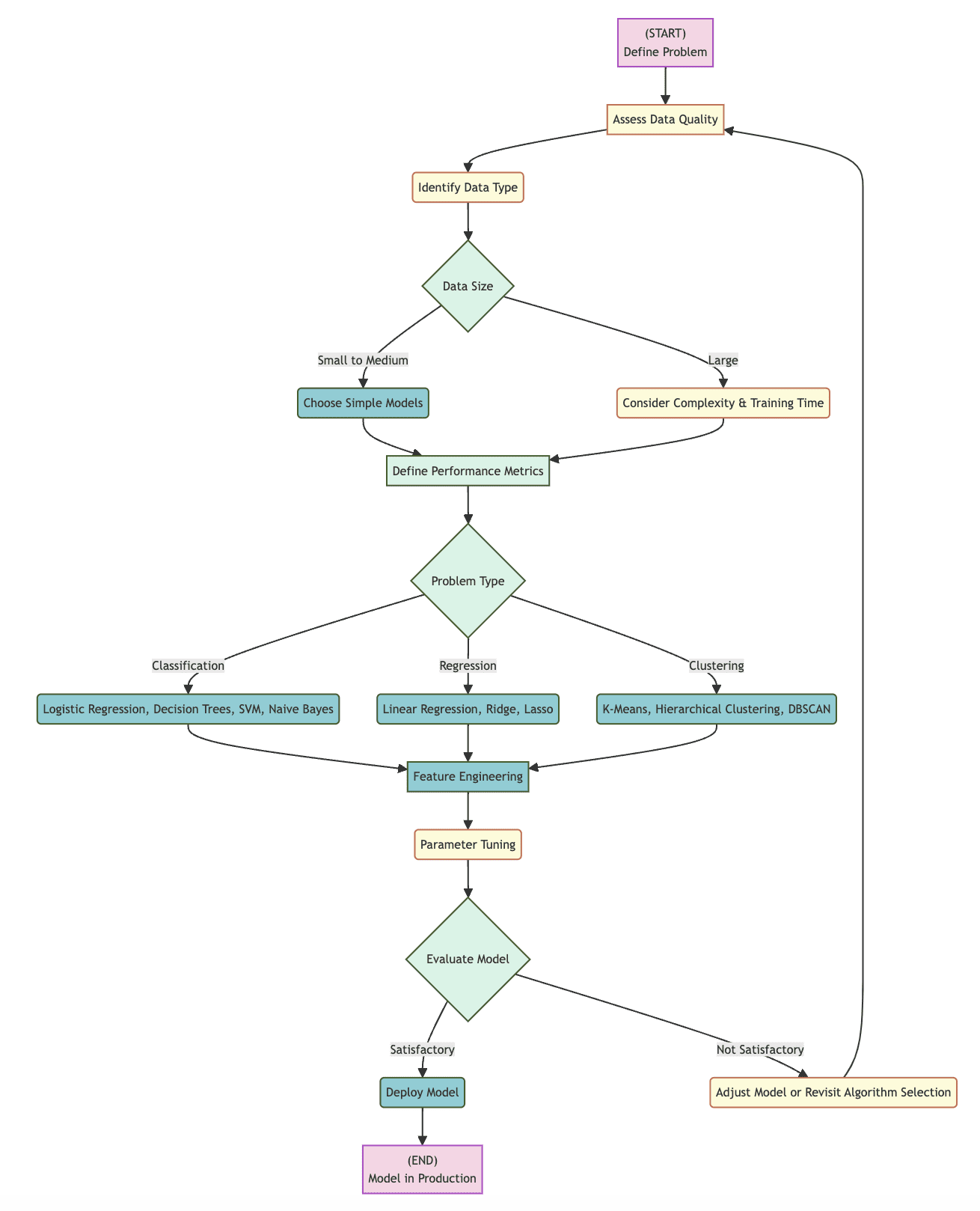
Below is a flowchart that can be used as a practical tool in guiding the selection of a machine learning algorithm, detailing the steps that need to be taken from the problem definition stage through to the completed deployment of a model. By adhering to this structured sequence of choice points and considerations, a user can successfully evaluate factors that will play a part in selecting the correct algorithm for their needs.

Decision Points to Consider

The flowchart identifies a number of specific decision points, much of which has been covered above:

  • Determine Data Type: Understanding whether data is in structured or unstructured form can help direct the starting point for choosing an algorithm, as can identifying the individual data element types (integer, Boolean, text, floating point decimal, etc.)
  • Data Size: The size of a dataset plays a significant role in deciding whether a more straightforward or more complex model is relevant, depending on factors like data size, computational efficiency, and training time
  • Type of Problem: Precisely what kind of machine learning problem is being tackled — classification, regression, clustering, or other — will dictate what set of algorithms might be relevant for consideration, with each group offering an algorithm or algorithms that would be suited to the choices made about the problem thus far
  • Refinement and Evaluation: The model which results form the selected algorithm will generally proceed from choice, through to parameter finetuning, and then finish in evaluation, with each step being required to determine algorithm effectiveness, and which, at any point, may lead to the decision to select another algorithm

Algorithm selection flowchart
Flowchart visualization created by Author (click to enlarge)

Taking it Step by Step

From start to finish, the above flowchart outlines an evolution from problem definition, through data type identification, data size assessment, problem categorization, to model choice, refinement, and subsequent evaluation. If the evaluation indicates that the model is satisfactory, deployment might proceed; if not, an alteration to the model or a new attempt with a different algorithm may be necessary. By rendering the algorithm selection steps more straightforward, it is more likely that the most effective algorithm will be selected for a given set of data and project specifications.

Step 1: Define the Problem and Assess Data Characteristics

The foundations of selecting an algorithm reside in the precise definition of your problem: what you want to model and which challenges you’re trying to overcome. Concurrently, assess the properties of your data, such as the data’s type (structured/unstructured), quantity, quality (absence of noise and missing values), and variety. These collectively have a strong influence on both the level of complexity of the models you’ll be able to apply and the kinds of models you must employ.

Step 2: Choose Appropriate Algorithm Based on Data and Problem Type

The following step, once your problem and data characteristics are laid bare beforehand, is to select an algorithm or group of algorithms most suitable for your data and problem types. For example, algorithms such as Logistic Regression, Decision Trees, and SVM might prove useful for binary classification of structured data. Regression may indicate the use of Linear Regression or ensemble methods. Cluster analysis of unstructured data may warrant the use of K-Means, DBSCAN, or other algorithms of the type. The algorithm you select must be able to tackle your data effectively, while satisfying the requirements of your project.

Step 3: Consider Model Performance Requirements

The performance demands of differing projects require different strategies. This round involves the identification of the performance metrics most important to your enterprise: accuracy, precision, recall, execution speed, interpretability, and others. For instance, in vocations when understanding the model’s inner workings is crucial, such as finance or medicine, interpretability becomes a critical point. This data on what characteristics are important to your project must in turn be broadsided with the known strengths of varying algorithms to ensure they are met. Ultimately, this alignment ensures that the needs of both data and business are met.

Step 4: Put Together a Baseline Model

Instead of striking out for the bleeding edge of algorithmic complexity, begin your modeling with a straightforward initial model. It should be easy to install and fast to run, presented the estimation of performance of more complex models. This step is significant for establishing an early-model estimate of potential performance, and may point out large-scale issues with the preparation of data, or naïve assumptions that were made at the outset.

Step 5: Refine and Iterate Based on Model Evaluation

Once the baseline has been reached, refine your model based on performance criteria. This involves tweaking model’s hyperparameters and feature engineering, or considering a different baseline if the previous model doesn’t fit the performance metrics specified by the project. Iteration through these refinements can happen multiple times, and each tweak in the model can bring with it increased understanding and better performance. Refinement and evaluating the model in this way is the key to optimizing its performance at meeting the standards set.

This level of planning not only cuts down on the complex process of selecting the appropriate algorithm, but will also increase the likelihood that a durable, well-placed machine learning model can be brought to bear.

The Result: Common Machine Learning Algorithms

This section offers an overview of some commonly used algorithms for classification, regression, and clustering tasks. Knowing these algorithms, and when to use them as guided, can help individuals make decisions associated with their projects.

Common Classification Algorithms

  • Logistic Regression: Best used for binary classification tasks, logistic regression is a an effective but simple algorithm when the relationship between dependent and independent variables is linear
  • Decision Trees: Suitable for multi-class and binary classification, decision tree models are straightforward to understand and use, are useful in cases where transparency is important, and can work on both categorical and numerical data
  • Support Vector Machine (SVM): Great for classifying complex problems with a clear boundary between classes in high-dimensional spaces
  • Naive Bayes: Based upon Bayes’ Theorem, works well with large data sets and is often fast relative to more complex models, especially when data is independent

Common Regression Algorithms

  • Linear Regression: The most basic regression model in use, most effective when dealing with data that can be linearly separated with minimal multicollinearity
  • Ridge Regression: Adds regularization to linear regression, designed to reduce complexity and prevent overfitting when dealing with highly correlated data
  • Lasso Regression: Like Ridge, also includes regularization, but enforces model simplicity by zeroing out the coefficients of less influential variables

Common Clustering Algorithms

  • k-means Clustering: When the number of clusters and their clear, non-hierarchical separation are apparent, use this simple clustering algorithm
  • Hierarchical Clustering: Let Hierarchical Clustering facilitate the process of discovering and accessing deeper clusters along the way, if your model requires hierarchy
  • DBSCAN: Consider implementing DBSCAN alongside your dataset if the goal is to find variable-shaped clusters, flag off visible and far-from clusters in your dataset, or work with highly noisy data as a general rule

Keeping performance objectives in mind, your choice of algorithm can be suited to the characteristics and goals of your dataset as outlined:

  • In situations where the data are on the smaller side and the geography of classes are well understood such that they may easily be distinguished, the implementation of simple models — such as Logistic Regression for classification and Linear Regression for regression — is a good idea
  • To operate on large datasets or prevent overfitting in modeling your data, you'll want to consider focusing on more complicated models such as Ridge and Lasso regression for regression problems, and SVM for classification tasks
  • For clustering purposes, if you are faced with a variety of concerns such as recovering basic mouse-click clusters, identifying more intricate top-down or bottom-up hierarchies, or working with especially noisy data, k-means, Hierarchical Clustering, and DBSCAN should be looked into for these considerations as well, dependent on the dataset particulars

Summary

The selection of a machine learning algorithm is integral to the success of any data science project, and an art itself. The logical progression of many steps in this algorithm selection process are discussed throughout this article, concluding with a final integration and the possible furthering of the model. Every step is just as important as the previous, as each step has an impact on the model that it guides. One resource developed in this article is a simple flow chart to help guide the choice. The idea is to use this as a template for determining models, at least at the outset. This will serve as a foundation to build upon in the future, and offer a roadmap to future attempts at building machine learning models.

This basic point holds true: the more that you learn and explore different methods, the better you will become at using these methods to solve problems and model data. This requires you to continue questioning the internals of the algorithms themselves, as well as to stay open and receptive to new trends and even algorithms in the field. In order to be a great data scientist, you need to keep learning and remain flexible.

Remember that it can be a fun and rewarding experience to get your hands dirty with a variety of algorithms and test them out. By following the guidelines introduced in this discussion you can come to comprehend the aspects of machine learning and data analysis that are covered here, and be prepared to address issues that present themselves in the future. Machine learning and data science will undoubtedly present numerous challenges, but at some point these challenges become experience points that will help propel you to success.

Matthew Mayo (@mattmayo13) holds a Master's degree in computer science and a graduate diploma in data mining. As Managing Editor, Matthew aims to make complex data science concepts accessible. His professional interests include natural language processing, machine learning algorithms, and exploring emerging AI. He is driven by a mission to democratize knowledge in the data science community. Matthew has been coding since he was 6 years old.

More On This Topic

  • KDnuggets News, December 14: 3 Free Machine Learning Courses for…
  • Alternative Feature Selection Methods in Machine Learning
  • Advanced Feature Selection Techniques for Machine Learning Models
  • Learning Data Science and Machine Learning: First Steps After The Roadmap
  • MLOps And Machine Learning Roadmap
  • The Complete Machine Learning Study Roadmap