Zoom to Protect Zoom Meetings with post-quantum E2EE solution for security

Zoom bolsters security offering with post-quantum end-to-end encryption for Zoom Meetings

Zoom Video Communications announced today that post-quantum end-to-end encryption (E2EE) is now globally available for Zoom Meetings, making it the first UCaaS provider to offer this advanced security feature. The new capability uses the Kyber 768 algorithm to protect against future quantum computing threats like “harvest now, decrypt later” attacks.

With post-quantum E2EE enabled, only meeting participants have access to the encryption keys used to secure the meeting data, preventing Zoom’s servers or outside parties from decrypting the content. This proactive move aims to safeguard user data as adversarial threats become more sophisticated and quantum computing advances.

“We are doubling down on security and providing leading-edge features for users to help protect their data,” said Michael Adams, Zoom’s chief information security officer. “At Zoom, we continuously adapt as the security threat landscape evolves, with the goal of keeping our users protected.”

The launch covers Zoom Meetings initially, with Zoom Phone and Zoom Rooms integration coming soon. Zoom has prioritized encryption since introducing standard E2EE for meetings in 2020 and phone in 2022, as customers increasingly utilize the privacy-enhancing feature.

Zoom is constantly aiming to safeguard user data and maintain its position as a secure communications platform. The launch of post-quantum E2EE demonstrates the company’s proactive stance in adapting to the evolving security landscape.

Earlier this year, Apple unveiled PQ3, a cutting-edge post-quantum cryptographic protocol that ensures end-to-end encryption, making it highly resistant to sophisticated quantum attacks. This provides a major upgrade for iMessage security, making iMessage the first to achieve Level 3 security, offering superior protection compared to other messaging apps.

The post Zoom to Protect Zoom Meetings with post-quantum E2EE solution for security appeared first on AIM.

Indian Techies Dream of Big Paychecks, But Face Reality Checks

Indian Software Engineers Dream Big Paychecks, but Face Tech Reality Check

The world is upskilling itself with generative AI in the quest for higher-paying jobs. The Indian IT, however, is upskilling its employees in a rather weird fashion, by simply ‘clicking next’ on the training module to be part of the so-called ‘generative AI ready’ workforce. This could unravel the mystery behind the phenomenal speed at which legions of employees are being trained in generative AI.

The skyrocketing salaries at Silicon Valley startups such as OpenAI and Anthropic, coupled with the confidence of having ‘upskilled’ in GenAI is pushing Indian software engineers to expect exorbitant salaries. But the truth is that many of them are actually not technically skilled enough to demand such high salaries.

In a post, Ratnakar Sadasyula narrated the story of candidates demanding extremely high salaries. “Now that would not be an issue, if these people were extraordinarily brilliant, or IIT, NIT passout,” said Sadasyula. “Most of them are from ordinary engineering colleges, and forget about being extraordinary, they are not even of decent ability (sic),” he said, adding that most did not even possess proper communication skills.

Interviewing candidates for our firm, most of them demanding very high salaries. Now that is not an issue, if these people were extraordinarily brilliant, or some IIT, NIT passout. Most of them are from ordinary engineering college, and forget about being extraordinary, they are…

— Ratnakar Sadasyula (@SadaaShree) May 20, 2024

Where does this stem from?

The truth is, though the qualification from a premier institute is not exactly an ideal criteria, technical knowledge is definitely necessary. That is a mistake that several Indian companies make. “A couple of freshers were recruited from CS streams of Tier 3 colleges… 9/10 didn’t know how to code at all,” said a user.

Much of this demand for higher salaries among the new generation stems from the startup boom in 2020 when people were recruited for lofty salaries, at times even without the required skill set or ability. “And now we have an entire generation that acts so entitled, demanding high pay, for just about decent skills,” said Sadasyula.

This, coupled with the fact that most of the students during the pandemic were actually marked leniently, giving them less credibility in the market.

According to several reports, there are only around 2000 senior software engineers in India and the salary of a senior AI engineer ranges between INR 9-21 lakh ($11,000 – $25,000), whereas in the USA, they can easily bag an offer for an average of $121,000. AI is booming like never before, which means big tech companies are looking for experienced engineers to improve their products.

Meanwhile, the problem has been accepted by many. A user on X pointed out that many Indian IT tech graduates are unemployable for any real time projects and responsibilities. “India IT talent is going down and Vietnam, Indonesia, Malaysia, and Philippines are taking up jobs as they have the hunger to succeed with hard work which India’s NCGs don’t,” the user added.

“Three years of experience and demanding 30 LPA, without knowing their ability or worth (sic),” noted Narayani Gurunathan, adding that the icing on the cake is the influencers who encourage the young talent to demand higher salaries.

The fact that the youth are demanding such salaries also indicates that there is actually someone out there hiring for such salaries.

You get what you pay for

The demand for generative AI jobs in India is definitely on the rise. A recent report revealed that senior developers working in generative AI draw over INR 1 crore per annum, while an entrant’s salary could easily be around INR 18 lakh. Another report indicates that mid-career software professionals in the GCC segment, with about three to eight years of experience, typically earned salaries ranging from INR 15 lakh to INR 35 lakh per annum.

To be fair, salaries go hand-in-hand with the cost of living at the place. A user on X explains that Gen Z standing up and asking for money is actually a good thing. But that discussion is not about the youth asking for money, but about mediocre people demanding higher salaries.

One solution is to move businesses to Tier-3 cities, where the cost of living is less, hence the youth might be more accepting of the lower salaries. Moreover, putting a cap and a budget on the salary while posting jobs or interviewing can help in setting realistic expectations for the candidates.

Deedy Das puts it out very simply, giving two options to the employers: “Hire them cause you can’t find cheaper” or “Don’t hire them and find cheaper and better talent,” adding that the candidates cannot be blamed for asking. Moreover, 30 LPA after three years of experience does sound reasonable.

This points to the basic supply and demand issue, which the market would eventually correct on its own. Some say that more awareness of the global salaries have made Indians realise that they were being exploited all this while.

The post Indian Techies Dream of Big Paychecks, But Face Reality Checks appeared first on AIM.

Digital Connexion & DE-CIX Partner to Establish PoP at MAA10 Data Centre in Chennai

Digital Realty's latest data center, MAA10 in Chennai, India

Digital Connexion, a full-spectrum provider of the data centre, colocation, and interconnection solutions, and DE-CIX India, the largest carrier and data centre neutral internet exchange (IX) operator in the Indian market, have announced a strategic partnership to provide internet peering and interconnection services to Indian enterprises. As part of the collaboration, DE-CIX has established a new point-of-presence (PoP) at Digital Connexion’s MAA10 data centre in Chennai.

Enhanced Network Performance and Simplified Interconnections

The partnership brings significant benefits to enterprises, cloud and content providers, and internet service providers (ISPs) in the southern India region. Companies hosted at MAA10 can now take advantage of expanded high-speed interconnection capabilities with enhanced network performance, cloud connectivity, and internet peering services.

DE-CIX’s presence at MAA10 will address low-latency edge requirements and ensure seamless content delivery to the last mile through a robust footprint of networks. This will empower enterprises to accelerate their digital transformation and elevate the customer experience.

Access to Global Cloud Providers and Data Centre Platform

With DE-CIX’s multi-service interconnection platforms, customers can access a range of services, including connectivity to hundreds of local carriers, ISPs, and content and application providers, without having to establish direct, separate connections with each network. DE-CIX DirectCLOUD enables Digital Connexion customers to reach global cloud providers, such as Microsoft Azure, AWS, and Google Cloud, through a single point, eliminating direct connection costs. Additionally, MAA10 customers will have access to a global data centre platform through Digital Realty’s PlatformDIGITAL.

CB Velayuthan, CEO of Digital Connexion, stated, “Through our partnership with DE-CIX, we enable this digital transformation in a way that is efficient, dynamic, and well-positioned for future growth. Aligning to our vision of creating a data meeting place for digital communities, this collaboration offers our customers a variety of interconnection services and single-hop direct connectivity to multiple cloud providers, fostering a connected ecosystem.”

Sudhir Kunder, CBO of DE-CIX India, expressed excitement about the partnership, noting that it offers the market a new and ideal diverse solution, as well as a great place for both enterprises and ISPs to leverage connections to a leading carrier-neutral global data centre platform with the most cost-effective and efficient interconnection options available.

The partnership marks the fourth PoP for DE-CIX Chennai, bringing the total to 20 PoPs across India.

The post Digital Connexion & DE-CIX Partner to Establish PoP at MAA10 Data Centre in Chennai appeared first on AIM.

SpaceX Launches Classified Spy Satellite Network for US Intelligence Agency

SpaceX successfully launched a classified mission for the National Reconnaissance Office (NRO) early Wednesday morning, marking a significant milestone in the company’s deepening ties with US intelligence agencies. The Falcon 9 rocket lifted off from Vandenberg Space Force Base in California at 4 a.m. ET, carrying multiple small satellites as part of the NROL-146 mission.

Sources familiar with the project revealed that SpaceX is building a network of hundreds of spy satellites under a $1.8 billion contract signed with the NRO in 2021. The network, developed by SpaceX’s Starshield business unit, aims to provide the US government and military with enhanced Earth-imaging capabilities and near-constant coverage of activities on the ground.

The launch of NROL-146 is the first in the NRO’s new “proliferated architecture” strategy, which involves deploying numerous smaller satellites for improved capability and resilience. While details about the satellites’ specific activities and capabilities remain classified, the network is expected to significantly advance the US government’s ability to locate potential targets anywhere in the world quickly.

SpaceX’s Falcon 9 rockets have been used to launch nearly a dozen prototypes for the Starshield network since 2020, with several missions deploying unacknowledged satellites, according to a US government database of objects in orbit.

The Starshield network is separate from SpaceX’s Starlink constellation, which provides broadband internet services to consumers, companies, and government agencies. The classified spy satellite network is designed to be more resilient to attacks from major space powers and will consist of large satellites with imaging sensors and numerous satellite relays for data transmission.

The $1.8 billion contract highlights the growing trust between SpaceX and the intelligence community, despite past controversies involving the company’s founder, Elon Musk. As the US competes with rivals like China and Russia to become the dominant military power in space, the Starshield network represents a significant step forward in expanding the country’s remote-sensing capabilities.

The post SpaceX Launches Classified Spy Satellite Network for US Intelligence Agency appeared first on AIM.

Microsoft Fabric Introduces Real-Time Intelligence for Faster Decision-Making

Yesterday, at Microsoft Build, the tech giant launched real-time intelligence in its AI-powered analytics platform, Microsoft Fabric. The new feature offers a comprehensive SaaS solution, enabling customers to quickly analyse and act on large-scale, time-sensitive data for improved business decision-making. It integrates synapse real-time analytics and data activator.

Traditionally, constructing real-time solutions has been complex and resource-intensive. However, according to Microsoft CEO Satya Nadella, this new feature claims to simplify this process by offering a “unified platform” that leverages Microsoft’s Azure streaming and big data technologies. This ensures scalability, reliability, and ease of use, catering to users of all skill levels.

Real-Time Intelligence, now in preview, capitalises on the power of AI, enabling users to pose complex queries and receive alerts on anomalies. This functionality is helpful across industries, improving processes such as quality control in manufacturing, logistics optimisation, sales strategies in retail, and fraud detection in finance and insurance.

A key component of real-time intelligence is the Real-Time Hub, a centralised repository for managing streaming data sources. With various connectors, users can effortlessly connect to various data streams and take action while data is in motion, transforming Microsoft Fabric into an event-driven platform, facilitating workflow orchestration based on system events.

Customer Success Stories

Microsoft has over 11,000 customers using Microsoft Fabric.

For example, Dener Motorsport, for instance, has significantly reduced response times in analysing vehicle data, leading to enhanced performance and cost savings using the real-time intelligence feature. Similarly, companies like Elcome and Grasim Industries Limited have benefited from accelerated defect identification and improved operational efficiency.

SeAir Exim Solutions and Petrobras have also leveraged real-time insights to optimise operations, enhance cybersecurity, and drive innovation.

.

The post Microsoft Fabric Introduces Real-Time Intelligence for Faster Decision-Making appeared first on AIM.

Microsoft GitHub Copilot Now Lets You Code in Hindi

Microsoft GitHub Copilot Now Let's You Code in Hindi

Coding in natural language is becoming a reality — and not just English. CEO Satya Nadella announced at the Microsoft Build 2024 that developers can now do programming in their native language, including Hindi.

“Think about that — every person can now start programming, whether it’s in Hindi, Brazilian or Portuguese, and bring back the joy of coding in their native language,” said Nadella, emphasising that this would be available in Copilot Workspace.

Nadella added that with Copilot coding features in native languages, we are an order of magnitude closer to a world where any person can go from idea to code in an instant. This is further enabled by Copilot Workspace having the knowledge of existing code and naturally integrating with the workflow.

He presented at the conference the way users can start with an issue and how the Copilot understands the existing codebase and generates a plan to execute the code. Users can edit and control it at every point of deployment. “It is fundamentally a new way of building software,” added Nadella.

The discussion about English being the hottest programming language is slowly shifting to coding in every language. Similar to Nadella, in the latest podcast with Lex Fridman, when asked how much programming people would do in the next 5-10 years, OpenAI CEO Sam Altman said, “A lot, but I think it’ll be in a very different shape.”

Altman said that many have already started programming entirely in natural language. “No one programs by writing code…some people do. No one programs the pun cards anymore,” he quipped, adding that it would change the nature and the skillset, not so much the predisposition for who we call programmers in the future.

The post Microsoft GitHub Copilot Now Lets You Code in Hindi appeared first on AIM.

How to Build Sustainable AI Startups

With the advancements brought in by GPT models, GPT-4o being the latest, creating sustainable AI startups that leverage artificial intelligence and can last and grow over time has become increasingly important.

In a recent podcast, OpenAI chief Sam Altman spoke about how to either create a business that thrives even if the next AI model isn’t significantly better, or develop a system that gets more useful as AI models improve or advance.

Additionally, he favoured not building an “AI business” in most cases, but rather a business that uses AI as a technology. Giving an example, he drew parallels to the early days of the App Store, where many people built simple apps like Flashlight which became obsolete with an iOS upgrade.

Meanwhile companies like Uber established sustainable businesses as smartphones improved, leveraging phones as the key technology that significantly enabled their operations.

How OpenAI Plans to Monetise

Recently, OpenAI made GPT-4o available to everyone for free (with usage limits), offering features like browsing, data analysis, and memory.

Additionally, Plus users will receive up to 5x higher limits and earliest access to features like the new macOS desktop app and next-generation voice and video capabilities. The move highlights OpenAI’s efforts to encourage upgrades to their monetisation plans, as discussed in the podcast.

Altman said that they are yet to figure out ways to make an expensive technology like GPT-4 available to users for free. He emphasised that while they aim to provide advanced AI tools for free or at a minimal cost as part of their mission, the high expenses currently pose a significant barrier.

Meanwhile, OpenAI recently became a Reddit advertising partner, which likely indicates that the company can leverage Reddit’s large user base to advertise its own products and services, potentially driving more customers and revenue.

OpenAI’s revenue for this year has surpassed the $2-billion mark, according to reports from the Financial Times. Therefore, like OpenAI showcasing its continuous revenue generation, startups must also ensure they can sustain their business models in the long run.

Do startups need to follow big companies

A few days ago, Cred founder Kunal Shah cast a wide net asking people on X this direct question: “Who is building an AI application in India”, receiving nearly 300-400 responses.

Dharmesh BA, who is working on a stealth startup, noted that many products were simply wrappers around existing models in various modalities. He categorised these apps as CRUD (Create, Read, Update, Delete) and warned that building apps based on the assumption that OpenAI or current LLMs can’t perform specific tasks could lead to a disaster.

Each time OpenAI updates or releases a new version, many startups find themselves rendered obsolete because the enhanced capabilities of OpenAI often solve the problems these startups were aiming to address.

When OpenAI introduced ChatGPT Enterprise, it sent shockwaves across several SaaS startups that had developed products around ChatGPT or offered wrappers based on ChatGPT APIs for business clients.

Additionally, Dharmesh’s post highlighted a perspective that attempts to confine an extremely powerful technology, like LLMs—which can be compared to a genie capable of doing anything—into a limited space such as mobile apps or websites.

These technologies are capable of much more complicated and valuable work, and by limiting their potential, we are not utilising them in the medium they are meant to reside in.

What about Indian Startups

In yet another post on X, the Cred founder said that early-stage startups should be easy to iterate and late-stage startups should be hard to distract. This highlights the mentality of Indian startups that are not iterating and not innovating enough.

In India, researchers and enterprises should prioritise building large models, technical benchmarking, and AI industrial standardisation over developing specific use case apps, which are easily replicated and improved upon.

Most envision LLMs as operating systems where users choose their own apps, but these apps’ longevity depends on the base provider, like OpenAI’s architecture.

But as AIM wrote, the question remains as to why such research isn’t being conducted domestically, especially as tech giants like OpenAI and Google focus more on Indic languages, posing a threat to those developing for the Indian ecosystem.

The post How to Build Sustainable AI Startups appeared first on AIM.

How to Fine-Tune BERT for Sentiment Analysis with Hugging Face Transformers

How to Fine-Tune BERT for Sentiment Analysis with Hugging Face Transformers
Image created by Author using Midjourney

Introduction

Sentiment analysis refers to natural language processing (NLP) techniques that are used to judge the sentiment expressed within a body of text and is an essential technology behind modern applications of customer feedback assessment, social media sentiment tracking, and market research. Sentiment helps businesses and other organizations assess public opinion, offer improved customer service, and augment their products or services.

BERT, which is short for Bidirectional Encoder Representations from Transformers, is a language processing model that, when initially released, improved the state of the art of NLP by having an important understanding of words in context, surpassing prior models by a considerable margin. BERT's bidirectionality — reading both the left and right context of a given word — proved especially valuable in use cases such as sentiment analysis.

Throughout this comprehensive walk-through, you will learn how to fine-tune BERT for your own sentiment analysis projects, using the Hugging Face Transformers library. Whether you are a newcomer or an existing NLP practitioner, we are going to cover a lot of practical strategies and considerations in the course of this step-by-step tutorial to ensure that you are well equipped to fine-tune BERT properly for your own purposes.

Setting Up the Environment

There are some necessary prerequisites that need to be done prior to fine-tuning our model. Specifically, this will require Hugging Face Transformers, in addition to both PyTorch and Hugging Face's datasets library at a minimum. You might do so as follows.

pip install transformers torch datasets

And that's it.

Preprocessing the Data

You will need to choose some data to be using to train up the text classifier. Here, we'll be working with the IMDb movie review dataset, this being one of the places used to demonstrate sentiment analysis. Let's go ahead and load the dataset using the datasets library.

from datasets import load_dataset    dataset = load_dataset("imdb")  print(dataset)

We will need to tokenize our data to prepare it for natural language processing algorithms. BERT has a special tokenization step which ensures that when a sentence fragment is transformed, it will stay as coherent for humans as it can. Let’s see how we can tokenize our data by using BertTokenizer from Transformers.

from transformers import BertTokenizer    tokenizer = BertTokenizer.from_pretrained('bert-base-uncased')    def tokenize_function(examples):      return tokenizer(examples['text'], padding="max_length", truncation=True)    tokenized_datasets = dataset.map(tokenize_function, batched=True)

Preparing the Dataset

Let's split the dataset into training and validation sets to evaluate the model's performance. Here’s how we will do so.

from datasets import train_test_split    train_testvalid = tokenized_datasets['train'].train_test_split(test_size=0.2)  train_dataset = train_testvalid['train']  valid_dataset = train_testvalid['test']

DataLoaders help manage batches of data efficiently during the training process. Here is how we will create DataLoaders for our training and validation datasets.

from torch.utils.data import DataLoader    train_dataloader = DataLoader(train_dataset, shuffle=True, batch_size=8)  valid_dataloader = DataLoader(valid_dataset, batch_size=8)

Setting Up the BERT Model for Fine-Tuning

We will use the BertForSequenceClassification class for loading our model, which has been pre-trained for sequence classification tasks. This is how we will do so.

from transformers import BertForSequenceClassification, AdamW    model = BertForSequenceClassification.from_pretrained('bert-base-uncased', num_labels=2)  

Training the Model

Training our model involves defining the training loop, specifying a loss function, an optimizer, and additional training arguments. Here is how we can set up and run the training loop.

from transformers import Trainer, TrainingArguments    training_args = TrainingArguments(      output_dir='./results',      evaluation_strategy="epoch",      learning_rate=2e-5,      per_device_train_batch_size=8,      per_device_eval_batch_size=8,      num_train_epochs=3,      weight_decay=0.01,  )    trainer = Trainer(      model=model,      args=training_args,      train_dataset=train_dataset,      eval_dataset=valid_dataset,  )    trainer.train()

Evaluating the Model

Evaluating the model involves checking its performance using metrics such as accuracy, precision, recall, and F1-score. Here is how we can evaluate our model.

metrics = trainer.evaluate()  print(metrics)

Making Predictions

After fine-tuning, we are now able to use the model for making predictions on new data. This is how we can perform inference with our model on our validation set.

predictions = trainer.predict(valid_dataset)  print(predictions)

Summary

This tutorial has covered fine-tuning BERT for sentiment analysis with Hugging Face Transformers, and included setting up the environment, dataset preparation and tokenization, DataLoader creation, model loading, and training, as well as model evaluation and real-time model prediction.

Fine-tuning BERT for sentiment analysis can be valuable in many real-world situations, such as analyzing customer feedback, tracking social media tone, and much more. By using different datasets and models, you can expand upon this for your own natural language processing projects.

For additional information on these topics, check out the following resources:

  • Hugging Face Transformers Documentation
  • PyTorch Documentation
  • Hugging Face Datasets Documentation

These resources are worth investigating in order to dive more deeply into these issues and advance your natural language processing and sentiment analysis abilities.

Matthew Mayo (@mattmayo13) holds a Master's degree in computer science and a graduate diploma in data mining. As Managing Editor, Matthew aims to make complex data science concepts accessible. His professional interests include natural language processing, machine learning algorithms, and exploring emerging AI. He is driven by a mission to democratize knowledge in the data science community. Matthew has been coding since he was 6 years old.

More On This Topic

  • How to Use Hugging Face AutoTrain to Fine-tune LLMs
  • Mistral 7B-V0.2: Fine-Tuning Mistral’s New Open-Source LLM with…
  • Comparing Natural Language Processing Techniques: RNNs, Transformers, BERT
  • How To Fine-Tune ChatGPT 3.5 Turbo
  • Fine-Tuning BERT for Tweets Classification with HuggingFace
  • Training BPE, WordPiece, and Unigram Tokenizers from Scratch using…

Microsoft Builds Copilot For Schools Using Phi-3 

At Microsoft Build 2024, Microsoft announced its partnership with Khan Academy to provide time-saving and lesson-enhancing AI tools to millions of teachers. Last year, Khan Academy introduced an AI-powered teaching assistant called ‘Khanmigo for Teachers’.

By donating access to Azure AI-optimised infrastructure, Microsoft will enable Khan Academy to offer all K-12 educators in the U.S. free access to the pilot program of Khanmigo for Teachers, now powered by Azure OpenAI Service.

Moreover, Khan Academy will use Phi-3 to enhance math tutoring. The Edtech giant will provide Microsoft with access to educational content such as math problem questions and step-by-step solutions. This will help develop AI-powered math tutoring using Phi-3.

Khan Academy will also offer continuous feedback and benchmarking data to assess performance. Notably, none of Khan Academy’s user data will be used to train the model.

“These state-of-the-art teacher tools we are going to be able to give for free to every teacher in the United States, so they can get productivity improvements,” said Salman Khan, Khan Academy chief, adding that teaching will be the first mainstream profession to really benefit from generative AI.

Apart from Khan Academy other developers are also leveraging Phi-3 for innovative applications. For instance, ITC is using it to built a copilot for Indian farmers.

Epic is employing Phi-3 to summarise complex patient histories, address clinician burnout and staffing shortages. Digital Green’s AI assistant, Farmer.Chat, integrates video to aid over 6 million farmers.

Phi-3 Family of Models

Microsoft announced the expansion of its Phi-3 family of small, open models with the introduction of Phi-3-vision, a multimodal model combining language and vision capabilities.

Phi-3-vision is a 4.2B parameter model capable of reasoning over real-world images and text, optimized for chart and diagram understanding.

The model enhances text and image reasoning, setting new benchmarks in visual reasoning tasks, OCR, and chart understanding. It outperforms larger models like Claude-3 Haiku and Gemini 1.0 Pro V, maintaining Phi-3’s reputation for delivering high performance in a compact size

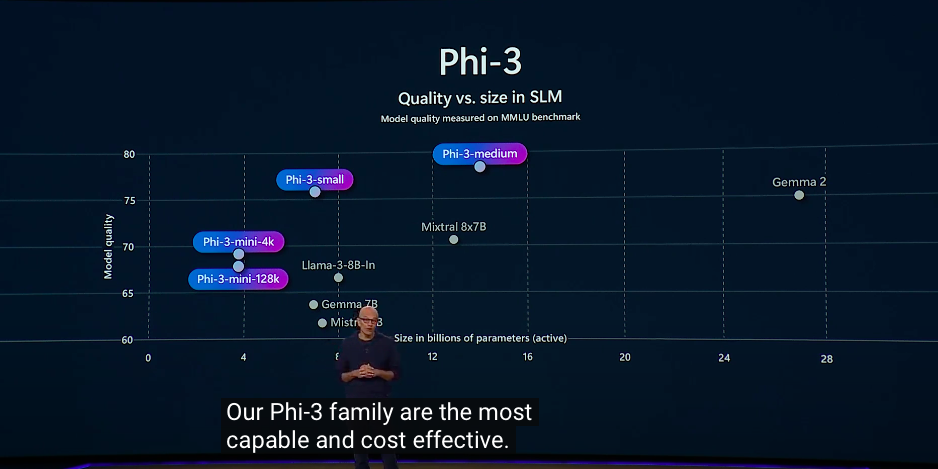
Earlier models, Phi-3-small and Phi-3-medium, are now available on Microsoft Azure, catering to generative AI applications with strong reasoning, limited compute, and latency constraints. These models join Phi-3-mini and Phi-3-medium on Azure AI’s models as a service, providing developers with quick and easy access.

Small Models Are Improving Exponentially – Phi-3 14B Is Phenomenal
The new Phi-3 14B model scores phenomenally on all benchmarks. On key numbers, it seems to be pretty close to Llama-3-Instruct 🤯🤯
As small models become more and more powerful, we will see 7b-sized GPT-4 class… pic.twitter.com/Xd1XR5ob4v

— Bindu Reddy (@bindureddy) May 21, 2024

Phi-3 models, known for their capability and cost-effectiveness, outperform similarly sized models across language, reasoning, coding, and math benchmarks. They are developed with high-quality training data, adhering to Microsoft’s responsible AI standards.

The Phi-3 family includes:

  • Phi-3-vision: A 4.2B parameter multimodal model.
  • Phi-3-mini: A 3.8B parameter language model.
  • Phi-3-small: A 7B parameter language model.
  • Phi-3-medium: A 14B parameter language model.

These models are optimised for various hardware, supporting mobile and web deployments through ONNX Runtime and DirectML. They are also available as NVIDIA NIM inference microservices, optimized for NVIDIA GPUs and Intel accelerators.

Takes on Google Gemma 2

Earlier, at Google I/O 2024, Google introduced PaliGemma, an open vision-language model designed for leading performance across a wide range of vision-language tasks. These tasks include image and short video captioning, visual question answering, text recognition in images, object detection, and object segmentation.

Google also introduced Gemma 2, the next generation of its Gemma models. The new 27 billion parameter model offers performance comparable to Llama 3’s 70B model at less than half the size, setting a new standard in the open model landscape.

The post Microsoft Builds Copilot For Schools Using Phi-3 appeared first on AIM.