Connected companies are better positioned to win in the AI-powered economy

freeway at night

Tesla is a boundless company. We believe the Boundless Company is the logical evolution of the Connected Company for the digital-first, decentralized-everything world. In this new world, successful companies must continuously scale their capabilities and reach in multiple dimensions to survive and thrive.

I have written before about how — based on my interviews with analyst firm, ARK Invest — Tesla is three to four years ahead of its autonomous vehicle competitors. One of the main reasons for Tesla's dominance is that the company has the most data about its customers. Tesla can provide better insights to insurance companies and also deliver its own services.

Also: When's the right time to invest in AI? 4 ways to help you decide

A boundless company has a different business operating model — the boundless operating model. Businesses need a new operating model to compete in an AI-powered economy. The traditional operating model is based on the idea that a company is a thing, an entity, or a structure. Boundless organizations are differentiated in their responsiveness to current and future customer needs, market conditions, and associated decision-making and action-taking processes.

In our book, Boundless, we introduce the Boundless Operating Model, our update to other contemporary sense-and-respond or situational awareness models, as a guide to help organizations design and develop the necessary processes and capabilities for amplifying and accelerating their responsiveness.

Our model places action and reaction in its context, local or global, and it works at the individual, team, and company levels. The outcome of these considerations is the Boundless Operating Model. The boundless company operates differently, so it requires a new approach to designing its operating model — and here's why.

First, boundless companies operate as a part of markets, ecosystems, and communities, not apart from them. The idea of a company going it alone is no longer tenable. Identity is not defined in terms of isolation and exclusion but in terms of connectedness and inclusion. From an operating model perspective, we want to show that a boundless company is connected to a larger ecosystem and that everything it does happens within the context of that ecosystem.

Also: Generative AI is the technology that IT feels the most pressure to exploit

Second, the traditional sense and respond models focus on sensing immediate and/or local conditions, what is sometimes described as situational awareness. This awareness is critical to effective decision-making processes, but situational awareness alone isn't enough today. Companies must be horizonally aware as well. Horizonal awareness means being connected to the larger world beyond the immediate here and now. Companies need to be able to see 'further down the road' in the same way that an autonomous car can be aware of conditions anywhere along its journey and can take active steps to anticipate and avoid problems, all because of its global as well as local connectedness.

Third, the boundless systems are self-similar at various levels (also known as fractal). Individual resources within a boundless company are themselves boundless and have the same responsibility as the company to be responsive to customer requirements and market conditions. Responses must also be attuned to requirements and conditions and prepared for future changes. And just like the company, when individual employees and teams take action, they do so in the world, not in a vacuum.

AI is the new electricity for the 21st century; businesses will be in the dark without it.

The Boundless Operating Model, or SUDA, is an evolution of other situational awareness or sense-and-respond models designed to reflect dynamically changing conditions, unlike, for instance, the PDCA or Deming Cycle which was designed for continuous improvement in stable conditions or relatively controlled environments. So, how does Tesla represent this SUDA operating model? It's all about movement — the movement of data that leads to information, insights, knowledge, wisdom, and ultimately better outcomes and experiences.

Tesla (the company), the car (Tesla's hardware product), the FSD (Tesla's software product), and the driver (Tesla's customer) are all connected. They all share data and that data goes both ways — from the 'car+driver' to the 'company+training system' and back in the form of improvements to the hardware and software. The AI is not developed solely by the company in isolation from its customers. The technology is developed, tested, improved, updated, and distributed in real time, thanks to the constant flow of data.

Also: Generative AI can transform customer experiences. But only if you focus on other areas first

FSD is not about AI being used to improve business processes (although we assume Tesla does use AI internally to do that task). FSD is AI being used to transform the customer experience and the entire industry-experience complex of transportation. This is system-level innovation, not task- or activity-level innovation, like automating email generation.

So what can other companies learn from this example? The learning is that companies need to think of their products and their customers in the same way.

Traditional companies must ask themselves, 'What is my hardware product, and what is my software product?' They must use software in all interactions between themselves, their products/services, and their customers, regardless of their industry. They need to push themselves hard to do this work to reimagine their products/services as software. And they need to 'datafy' everything, so that every interaction is software and generates data, and all this information goes back to the company for continuous improvement, upgrades, and distribution back to the customer.

Also: 5 ways CIOs can manage the business demand for generative AI

Trust must be the core value for all companies competing in an AI-powered economy. Customer data is not your product. All use of customer data must be based on consent and a full understanding of how data is used to improve the overall customer experience.

Companies also need to ask, 'What is my intelligence?' They need to build the ability to sense and respond to all the data coming in. They must use AI-based platforms, acting like decentralized nervous or fly-by-wire systems that provide SUDA capabilities, our operating loop. The platforms must sense every direct and indirect customer interaction. CRM platforms that connect marketing, sales, service, and commerce functions are part of this approach. But the products and services also need to be part of this cycle as they are key touchpoints and portals for the relationship to grow and be fostered.

Now, obviously, this approach means different things from industry to industry. But 15 years ago, this approach would have been considered science fiction in the auto industry — and in some parts of that industry, it still is.

Another way to ask these questions — especially but not exclusively in B2C — is from the customer's perspective first. What does my customer have to do now that they shouldn't have to? In what ways is my customer forced into being a machine operator (like a car driver)? How can I give my customer their freedom? How can I give them superpowers? And how can I extend accessibility to these powers to more people? The most successful product of all time globally, the smartphone, has been the one that gives more individuals more freedom or more powers, which is arguably the same thing.

Also: Agile development can unlock the power of generative AI — here's how

From a Boundless perspective, companies must ask what they can do to give their customers more autonomy, mobility, and connectedness (exactly what the smartphone provides). In our book, we draw a direct link between these three boundless principles and the three universal psychological needs of autonomy, connectedness, and competence (which we relate to Mobility + Autonomy).

Ultimately, the most important business capability in an AI-powered economy is to deliver value at the speed of need. To deliver personalized, intelligent, and relevant value as fast as needed, the company, its products and services, and its customers must have access to shared data in a trusted and value-driven model, guided by core values of trust and shared success.

This article was co-authored by Henry King, business innovation and transformation strategy leader and co-author of Boundless: A New Mindset for Unlimited Business Success.

Artificial Intelligence

Nvidia, Microsoft, OpenAI Face Antitrust Investigations as AI Race Heats Up

Federal regulators have reached an agreement to initiate antitrust investigations into the dominant roles of Nvidia, Microsoft, and OpenAI in the rapidly evolving artificial intelligence (AI) industry, according to two sources familiar with the matter, as reported by The New York Times on Tuesday.

Under the deal, which is expected to be finalised in the coming days, the U.S. Department of Justice will lead the probe into whether Nvidia, the leading manufacturer of AI chips, violated antitrust laws. The Federal Trade Commission (FTC) will examine the conduct of Microsoft and OpenAI, the creator of the popular ChatGPT chatbot.

Microsoft has invested $13 billion in OpenAI for a reported 49% stake in the AI firm’s for-profit subsidiary, despite its parent organization being a non-profit. This partnership is also under informal review in other jurisdictions.

The investigations mark the most significant regulatory scrutiny yet into the AI sector, which has seen explosive growth and potential for disruption. Both the Justice Department and FTC have been at the forefront of the Biden administration’s efforts to rein in the power of big tech.

In a similar arrangement in 2019, the government launched antitrust probes into Google, Apple, Amazon, and Meta, eventually filing lawsuits alleging violations of antimonopoly laws.

The FTC is also separately investigating Microsoft’s $650 million acquisition of AI startup Inflection AI, as part of a broader inquiry into the tech giant’s business practices in the AI industry, according to The Wall Street Journal.

FTC Chair Lina Khan emphasized the importance of identifying potential AI-related issues early on, stating in a February interview, “When it comes to Artificial Intelligence, our goal is to spot potential problems at their inception rather than years and years and years later, when problems are deeply baked in and much more difficult to rectify.”

The outcome of these investigations could have far-reaching implications for the future of the AI industry and the business models of the companies involved. Regulators worldwide are grappling with how to oversee the transformative technology’s development and deployment.

The post Nvidia, Microsoft, OpenAI Face Antitrust Investigations as AI Race Heats Up appeared first on AIM.

Raspberry Pi Embraces AI With Hailo Collaboration

Single-board PC maker Raspberry Pi Ltd will list its commercial branch on the London Stock Exchange starting on an undisclosed date in June, a major change for the company, which operates partially as an educational nonprofit. Shortly after the confirmation of the IPO — though unrelated — Raspberry Pi unveiled its latest product, an AI board for vision capabilities, in collaboration with Hailo.

The London Stock Exchange will receive a boost from the IPO, which has fallen to its lowest share of IPO funds in decades, according to research by Bloomberg.

Although Raspberry Pi computers are often known as educational tools, they are also used in industrial automation, smart homes, testing of other computers and other professional applications.

“The proposed IPO is all about securing the next stage of growth and impact for both the Foundation and the commercial company,” wrote Raspberry Pi Foundation Chief Executive Philip Colligan in a blog post on May 28. The foundation and commercial branch will remain independent entities.

Raspberry Pi Ltd IPO Will Benefit Educational Foundation, Company Says

Raspberry Pi has been long rumored to be going public. Now, it has officially stated its intent to list Raspberry Pi Ltd. on the Main Market of the London Stock Exchange and to raise £157 million (USD $200 million). With the money from the IPO, Raspberry Pi plans to expand its product line and hire more engineers.

When the company’s intent to make an IPO was confirmed in January, some computing enthusiasts worried that Raspberry Pi would shift to more commercial products and initiatives at the behest of shareholders.

SEE: How should business leaders decide when it is time to IPO?

The Foundation will remain a beneficiary of some of the commercial company’s profits.

“From the Foundation’s perspective, an IPO provides us with the ability to sell some of our shares to raise money to finance a sustainable expansion of our educational activities,” Colligan wrote in May.

Hailo kit brings AI to Raspberry Pi

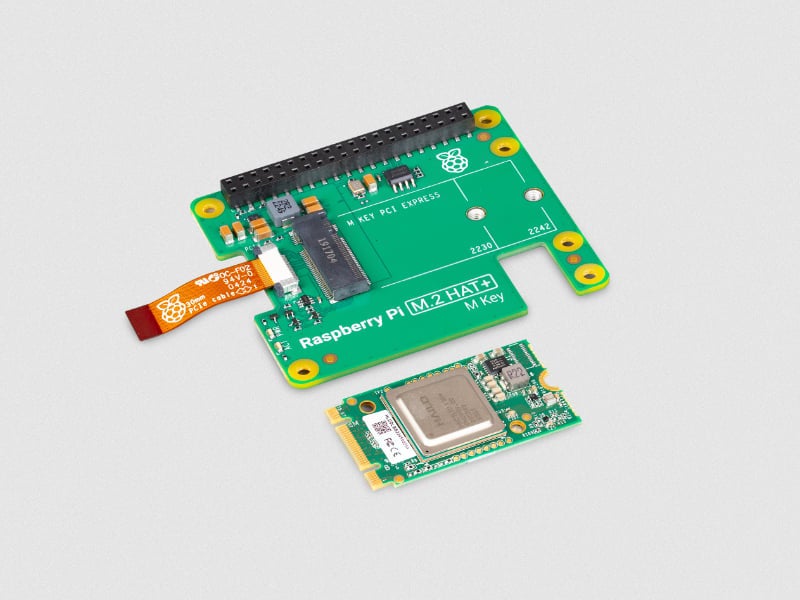
In related news, Raspberry Pi announced on June 4 its first computer for AI inference in a partnership with edge AI processor company Hailo. The Raspberry Pi AI kit is a $70 Raspberry Pi 5 computer with a M.2 HAT+ connector to a Hailo-8L AI accelerator module.

Disassembling the Raspberry Pi AI kit shows the constituent parts, including the Hailo processor.
Disassembling the Raspberry Pi AI kit shows the constituent parts, including the Hailo processor. Image: Raspberry Pi

“Our collaboration with Hailo enables Raspberry Pi’s industrial customers to integrate AI into high-performance solutions that are extremely cost-effective and power-efficient. For enthusiasts, the AI Kit provides an accessible way to enhance their creative projects with AI,” Eben Upton, Raspberry Pi CEO, said in a press release.

The Raspberry Pi AI kit can run neural networks capable of detecting objects, recognizing faces and performing other vision-related tasks. It can run inference on video files, interpreting pre-recorded images; this might enable greater customization for smart home setups or manufacturing. Plus, it’s compatible with first- or third-party cameras.

“A significant hurdle in creating real-world AI-based vision applications is the software complexity of integrating the camera subsystem with the AI framework,” wrote Raspberry Pi Senior Principal Engineer Naush Patuck in a press release. “We have worked hard to simplify this as much as possible.”

The result is “advanced AI-based applications in only a few hundred lines of C++ code,” Raspberry Pi wrote.

The Raspberry Pi AI kit is available at Raspberry Pi Approved Resellers internationally.

TechRepublic has reached out to Raspberry Pi for more information about both the AI kit and the IPO.

AI phone scams sound scary real. Do these 5 things to protect yourself and your family

gettyimages-1798627099

You may have heard stories of families picking up their phones to hear the voices of their sobbing, terrified loved ones, followed by those of their kidnappers demanding an instant transfer of money.

But there are no kidnappings in these scenarios. Those voices are real — they've just been manipulated by scammers using AI models to generate deepfakes (just like when someone altered Joe Biden's voice in the New Hampshire primaries to deter voters from casting a ballot). People often just need to make a quick call to prove that no children, spouses, or parents have been abducted, despite how eerily authentic these voices are.

Also: How to find and remove spyware from your phone

The problem is, by the time the truth comes out, panic-stricken families may have already coughed up large amounts of money to these fake kidnappers. What's worse is that as these technologies become more cheap and ubiquitous — and our data becomes easier to access — more people could become increasingly susceptible to these scams.

So how do you protect yourself from these scams?

How AI phone scams work

First, some background: how do scammers replicate individual voices?

While video deepfakes are much more complex to generate, audio deepfakes are easy to create, especially for a quick hit-and-run scam. If you or your loved one has posted videos on YouTube or TikTok video, for example, a scammer needs as little as three seconds of that recording to clone your voice. Once they have that clone, scammers can manipulate it to say just about anything.

Also: This AI-generated crypto invoice scam almost got me, and I'm a security pro

OpenAI created a voice cloning service called Voice Engine, but paused public access to it in March, ostensibly due to demonstrated potential for misuse. Even so, there are already several free voice cloning tools of various qualities available on GitHub.

However, there are guardrailed versions of this technology, too. Using your own voice or one you have legal access to, Voice AI company ElevenLabs lets you create 30 minutes of cloned audio from a one-minute sample. Subscription tiers enable users to add multiple voices, clone a voice in a different language, and get more minutes of cloned audio — plus, the company has several security checks in place to prevent fraudulent cloning.

Also: Travelling? Take this $50 anti-spy camera and bug finder with you

In the right circumstances, AI voice cloning is useful. ElevenLabs offers an impressively wide range of synthetic voices from all over the world and in different languages that you can use with just text prompts, which could help many industries reach a variety of audiences more easily.

As voice AI improves, fewer irregular pauses or latency issues may make it harder to spot fakes, especially when scammers can make their calls appear as if they're coming from a legitimate number. Here's what you can do to protect yourself now and in the future.

1. Ignore suspicious calls

It may sound obvious, but the first step to avoiding AI phone scams is to ignore calls from unknown numbers. Sure, it may be simple enough to answer, determine a call is spam, and hang up — but you're risking leaking your voice data.

Also: The NSA advises you to turn your phone off and back on once a week — here's why

Scammers can use these calls for voice phishing, or fake calling you specifically to gather those few seconds of audio needed to successfully clone your voice. Especially if the number is unrecognizable, decline it without saying anything and look up the number online. This could determine the legitimacy of the caller. If you do feel like answering to check, say as little as possible.

You probably know anyone calling you for personal or bank-related information should not be trusted. You can always verify a call's authenticity by contacting the institution directly, either via phone or other verified lines of communication like text, support chat, or email.

Thankfully, most cell services will now pre-screen unknown numbers and label them as potential spam, doing some of the work for you.

2. Call your relatives

If you get an alarming call that sounds like someone you know, the quickest and easiest way to debunk an AI kidnapping scam is to verify that your loved one is safe via a text or phone call. That may be difficult to do if you're panicked or you don't have another phone handy but remember that you can send a text while you remain on the phone with the likely scammer.

3. Establish a code word

With loved ones, especially children, decide on a shared secret word to use if they're in trouble but can't talk. You'll know it could be a scam if you get a suspicious call and your alleged loved one can't produce your code word.

4. Ask questions

You can also ask the scammer posing as your loved one a specific detail, like what they had for dinner last night, while you try to reach your loved one separately. Don't budge: Chances are the scammer will throw in the towel and hang up.

5. Be conscious of what you post

Minimize your digital footprint on social media and publicly available sites. You can also use digital watermarks to ensure your content can't be tampered with. This isn't foolproof, but it's the next best thing until we find a way to protect metadata from being altered.

If you plan on uploading any audio or video clip to the internet, consider putting it through Antifake, a free software developed by researchers from Washington University in St. Louis.

Also: How to find out if an AirTag is tracking you

The software — the source code for which is available on GitHub — infuses the audio with additional sounds and disruptions. While these won't disrupt what the original speaker sounds like to humans, they will make the audio sound completely different to an AI cloning system, thus thwarting efforts to alter it.

6. Don't rely on deepfake detectors

Several services, including Pindrop Security, AI or Not, and AI Voice Detector, claim to be able to detect AI-manipulated audio. However, most require a subscription fee, and some experts don't think they're even worth your while. V.S. Subrahmanian, a Northwestern University computer science professor, tested 14 publicly available detection tools. "You cannot rely on audio deepfake detectors today, and I cannot recommend one for use," he told Poynter.

"I would say no single tool is considered fully reliable yet for the general public to detect deepfake audio," added Manjeet Rege, director of the Center for Applied Artificial Intelligence at the University of St. Thomas. "A combined approach using multiple detection methods is what I will advise at this stage."

Also: 80% of people think deepfakes will impact elections. 3 ways you can prepare

In the meantime, computer scientists have been working on better deepfake detection systems, like the University at Buffalo Media Forensic Lab's DeepFake-O-Meter, set to launch soon. Till then, in the absence of a reliable, publicly available service, trust your judgment and follow the above steps to protect yourself and your loved ones.

Artificial Intelligence

New Feature Allows Enterprises to Bring Project and Task Management into Slack

Slack announced Lists last year ahead of parent companies’ flagship event, Salesforce’s Dreamforce. Now, the company is making the feature generally available for all users.

Lists bring structure to conversations in Slack and enable teams to manage projects, inbound requests, and top priorities right where they are already working without having to jump between multiple applications.

According to Slack, only 34% of projects meet deadlines and budgets due to fragmented communication, app silos, and time-consuming updates.

With Lists, Slack wants to solve this problem. Slack Lists eliminates context switching between apps so teams can collaborate and stay aligned on cross-functional projects, requests, approvals and more, right in the flow of work.

“The reason we hear about this from businesses is because a lot of employees are collaborating and working in different places. In the average enterprise, multiple different apps are used, causing silos. This leads to inefficiencies, as employees spend excessive time navigating discrepancies between systems, hindering collaboration and productivity across the organisation,” Olivia Grace, senior director of product management at Slack, told AIM in a discussion before the announcement.

So far, Slack has allowed a handful of customers early access to Lists, and Grace revealed that around 77% of them came back to Slack, saying the new feature is improving their ability to accomplish work.

Bringing Project and Task Management into Slack

Slack Lists begins its rollout today and will be available to Slack users in the coming months and will be included in all paid plans.

The company said sales teams can leverage Slack Lists to stay organised on their day-to-day work, coordinate and collaborate on tasks with the whole account team, and plan customer meetings and engagements. Service teams can keep tabs on all outstanding issues in a list or empower new agents with a curated onboarding plan.

Likewise, IT teams can enhance response efficiency and streamline workflows. They can oversee help desk requests gathered from workflow form submissions, allocating task owners, prioritising tasks, and promptly resolving requests.

However, the features are not unique to Slack. Grace believes Slack’s competitors have similar features built-in; however, “I think that the things Lists can do, which none of them can do, is really bringing that collaboration and tracking into a place where communication is already happening. It’s much more difficult to do the opposite.

“We see Monday, Air table, there’s a bunch of great competitors out there doing similar things and we love the appetite in the market for this kind of implementation,” Grace said.

The post New Feature Allows Enterprises to Bring Project and Task Management into Slack appeared first on AIM.

From data hoard to action hero: Mastering data activation

In today’s data-driven world, organizations collect information at an unprecedented rate. Customer behavior, website interactions, social media engagement – the list goes on. But here’s the catch data itself isn’t inherently valuable. It’s what you do with it that unlocks its true potential. This is where data activation comes in.

Data activation: Transforming insights into action

Data activation is the process of taking raw data, transforming it into actionable insights, and then using those insights to drive real-world results. It’s the bridge between information and action, the missing link that allows businesses to leverage the power of data for strategic decision-making and improved customer experiences.

image-10

Why is data activation important?

Imagine a vast library filled with books on every subject imaginable. This library represents your data – a treasure trove of knowledge. But without a librarian to help you find the right book and understand its contents, the library remains a collection of unused resources. Data activation acts as your librarian, organizing information, uncovering patterns, and presenting insights in a way that empowers business decisions.

Here’s how data activation benefits organizations:

  • Personalized customer experiences: Data activation allows you to understand your customers on a deeper level. Imagine tailoring marketing campaigns to specific customer segments based on their preferences and purchase history. This personalized approach leads to higher engagement and conversion rates.
  • Data-driven decision making: Stop relying on gut feeling! Data activation provides factual evidence to support strategic decisions. From product development to marketing campaigns, data-driven insights minimize risk and improve outcomes.
  • Increased operational efficiency: Data activation can streamline internal processes. By identifying bottlenecks and areas for improvement, businesses can optimize workflows and boost productivity across departments.
  • Improved ROI: Data activation helps you make the most of your marketing budget. By targeting the right audience with the right message at the right time, you can maximize the return on your marketing investments.

The data activation lifecycle

Data activation isn’t a one-time event; it’s a continuous lifecycle. Here are the key stages involved:

  • Data collection: This is the foundation. Data can come from various sources like customer relationship management (CRM) systems, website analytics platforms, and social media interactions.
  • Data cleaning and integration: Raw data is often messy and inconsistent. Data cleaning ensures accuracy and completeness, while data integration combines information from different sources to create a unified view.
  • Data analysis and transformation: Data needs to be transformed into a format that’s easy to understand and analyze. Business intelligence (BI) tools and data visualization techniques help identify patterns and trends.
  • Actionable insights: Data analysis reveals valuable insights that inform business decisions.
  • Data activation: This is where the magic happens. Insights are translated into concrete actions – targeted marketing campaigns, personalized product recommendations, or improved customer service experiences.
  • Measurement and optimization: The impact of data-driven actions is constantly monitored and measured. This feedback loop allows for continuous improvement and refinement of the data activation process.
From data hoard to action hero: Mastering data activation

Data activation in action: Real-world examples

Let’s look at some practical examples of how data activation is used across different industries:

  • Retail: An e-commerce platform uses data activation to personalize product recommendations based on a customer’s browsing history and past purchases. This results in increased sales and customer satisfaction.
  • Finance: A bank analyzes customer data to identify potential fraud risks. By proactively identifying suspicious activity, they can take steps to protect customers and their assets.
  • Media & entertainment: A streaming service leverages data activation to recommend movies and TV shows based on a user’s viewing habits. This keeps users engaged and increases platform loyalty.

By integrating data activation within the enterprise architecture, organizations can break down departmental silos and unlock the true power of data, transforming insights into tangible business benefits.

Getting started with data activation

So, are you ready to unlock the power of data activation for your business? Here are some initial steps:

  • Identify your business goals: What do you hope to achieve through data activation? Increased sales, improved customer retention, or streamlined operations? Having a clear objective will guide your data strategy.
  • Invest in the right tools: There are various data activation platforms available that can help you collect, clean, analyze, and activate your data.
  • Build a data-driven culture: Encourage a company-wide understanding of the importance of data and its role in decision-making. Foster collaboration between data analysts and business teams to ensure insights are translated into actionable strategies.
  • Start small and scale: Don’t try to boil the ocean! Begin with a pilot project focusing on a specific business goal. Once you’ve established success, you can scale your data activation efforts across the organization.
  • Define your goals and objectives:
    • What specific problems are you trying to solve, or what opportunities are you aiming to capitalize on?Are you looking to increase customer engagement, boost sales, or streamline operations?
    • Clearly defined goals will help you identify the most relevant data points and guide your data collection efforts.
  • Identify the data you need:
    • What data sources will provide the information needed to achieve your goals? This could include customer demographics, website traffic data, social media interactions, or sales data.
    • Consider both internal and external data sources to get a holistic view of your customer and market landscape.
  • Invest in data governance:
    • Establish clear guidelines for data collection, storage, access, and security. This ensures data integrity and compliance with relevant regulations (e.g., GDPR, CCPA).
    • Define roles and responsibilities for data management to avoid confusion and ensure proper data stewardship.
  • Data collection and integration:
    • Implement tools and processes to collect data from your identified sources. Ensure data is captured consistently and accurately.
    • Utilize data integration platforms to streamline the process of cleansing, transforming, and loading data into your data warehouse or lake.
  • Data analysis and transformation:
    • Explore your data using BI tools to identify patterns, trends, and correlations.Segment your data into relevant groups (e.g., customer demographics, purchase history) to gain deeper insights.
    • Use data visualization techniques like charts and graphs to communicate complex information in a clear and concise manner.
  • Derive actionable insights:
    • Translate your data analysis into concrete recommendations for business actions.Focus on insights that address your initial goals and objectives.
    • Prioritize insights with the potential for the greatest impact.
  • Data activation and implementation:
    • Based on your insights, develop strategies and tactics to activate your data.This could involve personalized marketing campaigns, targeted product recommendations, or improved customer service experiences.
    • Integrate your data insights with relevant marketing automation platforms or CRMs to automate actions.
  • Measurement and optimization:
    • Track the impact of your data-driven actions through key performance indicators (KPIs) aligned with your goals.Monitor results and continuously measure the effectiveness of your data activation efforts.
    • Use this feedback loop to refine your data strategy, optimize your actions, and ensure continuous improvement.
image-12

Building your data activation arsenal: Tools and techniques

Data activation doesn’t happen in a vacuum. Here are some key tools and techniques to consider:

  • Data warehouses and data lakes: These act as central repositories for storing large volumes of data from various sources. Data warehouses are typically structured for efficient analysis, while data lakes offer more flexibility for storing unstructured and raw data.
  • Data integration platforms (DIPs): These tools streamline the process of collecting data from diverse sources, cleansing it for consistency, and integrating it into your data warehouse or lake.
  • Business intelligence (BI) tools: BI platforms help you analyze data, identify trends, and generate reports and visualizations that translate complex information into easily digestible insights. Popular BI tools include Tableau, Power BI, and QlikView.
  • Customer data platforms (CDPs): CDPs create a unified customer profile by consolidating data from various customer touchpoints. This allows for highly personalized marketing campaigns and improved customer experiences.
  • Marketing automation platforms (MAPs): MAPs automate marketing tasks like email marketing, social media engagement, and lead nurturing. By integrating data insights into your MAP, you can personalize communication and trigger targeted campaigns based on customer behavior.

Developing a data activation strategy: A step-by-step guide

Embrace a data-driven culture

Data activation is more than just technology and tools. It’s about fostering a data-driven culture within your organization. Here are some tips:

  • Promote data literacy: Encourage all employees to understand the importance of data and its role in decision-making.
  • Break down silos: Facilitate collaboration between data analysts, marketing teams, sales teams, and other departments to ensure insights are effectively translated into action.
  • Empower data champions: Identify individuals across departments who are passionate about data and can champion its use

Hyundai Elantra Becomes Autonomous Using OnePlus 7T

Bengaluru-based developer Mankaran Singh recently posted a video showing a person in the US converting his Hyundai Elantra into an autonomous vehicle using a OnePlus 7T. “So soothing to watch. Flowpilot running on a One Plus 7T, by paper @ flowpilot discord,” he posted on X.

So soothing to watch.
Flowpilot running on a One Plus 7T, by paper @ flowpilot discord.
cc @comma_ai pic.twitter.com/hu47XRu8QB

— mansin (@Mankaran32) June 6, 2024

Last year, Singh converted his modified Maruti Alto K10 into an autonomous vehicle using a second-hand Redmi Note 9 Pro. This was made possible with the help of Flowpilot, an open-source driver assistance system he created as part of his passion project, Flow Drive.

Flowpilot is an open-source fork of Comma.ai’s OpenPilot that can run on most Windows/Linux and Android-powered machines.

In an exclusive interview with AIM, Singh said that he didn’t train driving models on his own; instead, he used learning models from Comma.ai because one needs tonnes of data to train models and require millions of dollars for compute clusters to train them.

The idea to start this initiative stems from George Hotz, the founder of Comma.ai, which is also into enabling autonomous vehicles with the help of smartphones and other proprietary devices.

Flowpilot performs the functions of Adaptive Cruise Control (ACC), Automated Lane Centering (ALC), Forward Collision Warning (FCW), Lane Departure Warning (LDW), and Driver Monitoring (DM) for a growing variety of supported car makes, models, and model years maintained by the community.

It records data from road-facing cameras, CAN, GPS, IMU, magnetometer, thermal sensors, crashes, and operating system logs. “All you need is basically actuators, the controller steering and gas brakes to control the car. And if you have that, Flowpilot can essentially run on anything,” said Singh.

“It supports all the phones (Android) that have OpenCL supporting them. That’s basically the GPU drivers, which are used for image processing, like neural networks, exhibiting neural networks,” he added.

Singh said that the quality of the experience definitely depends on the phone you use. “Mostly, if you’re using a phone that costs around 20-25K, that’s enough to run Flowpilot for reasonable performance, but anything less powerful, it’s going to lag, and the system will just show a warning; it just won’t engage,” he explained.

Flowpilot supports over 200 cars, including brands such as Honda, Toyota, Hyundai, Nissan, Kia, Chrysler, Lexus, Acura, Audi, VW, and more. Even if a car is not supported but has adaptive cruise control and lane-keeping assist, it will likely be able to run Flowpilot.

However, Singh said that it does not support cars in India as of now. “In India, none of the cars are supported in a plug-and-play fashion. The only reason people use Flowpilot is because it’s far better than the stock system of the car,” he said.

The post Hyundai Elantra Becomes Autonomous Using OnePlus 7T appeared first on AIM.

ChatGPT privacy tips: Two important ways to limit the data you share with OpenAI

A ChatGPT temporary chat

How private are your conversations with ChatGPT? That's a tricky question to answer.

OpenAI says that no one can view your chats unless you specifically choose to share them. However, the company does store and maintain a history of your conversations and acknowledges that their content can be used for training.

Also: The best AI chatbots of 2024: ChatGPT, Copilot and worthy alternatives

If you're concerned about your privacy when using ChatGPT, there are a few measures you can take. Both options are available to free and paid users alike — here's how they work.

1. Use a temporary chat

First, you can start a temporary chat for one-and-done conversations. These chats won't be saved as part of your history or used for model training. Further, ChatGPT won't remember anything you discussed. However, OpenAI may still store copies of your temporary chats for up to 30 days to monitor for any abuse.

You can start a temporary chat in ChatGPT for web or the mobile app for iOS or Android. In a new chat window, tap the ChatGPT heading at the top and select the Temporary Chat option.

Also: ChatGPT vs. Copilot: Which AI chatbot is better for you?

The temporary chat screen appears and explains how the option works. You'll see the left sidebar is grayed out, indicating the chat won't be saved to your history list.

To leave Temporary chat mode, click the ChatGPT heading at the top and turn off its switch. In the mobile app, just start a new chat and you'll no longer be in Temporary chat mode.

2. Disable model training

You can also protect your privacy by opting out of OpenAI model training. Because you'll still be able to access your chat history, this is a handy option if you want to view and pick up previous conversations while maintaining some degree of privacy over what you say.

Also: How to get ChatGPT to browse the web for free

Turning off model training is fairly quick and easy. On ChatGPT's site, click your profile icon in the upper right and select Settings. In the mobile app, click the hamburger menu icon in the upper left and then select your profile icon at the bottom.

In the Settings window, select Data Controls, and toggle the "Improve the model for everyone" option off.

Close the Setting screen to return to your chat. You can now resume your conversations with ChatGPT — Open AI will no longer use your content for training purposes, and your chats will still be accessible in your history list.

Artificial Intelligence

10 AI Courses from Andrew Ng You Must Take

Andrew Ng, the founder of Deep Learning.AI and co-founder of Coursera, is a prominent figure in the fields of machine learning and deep learning. His courses on AI are highly regarded by people because they are well-structured and provide insights into the latest developments in the field.

Ng’s courses often include practical assignments and projects that allow one to gain real-world experience in implementing deep learning algorithms and models. These courses are regularly updated to reflect the most recent developments in deep learning.

Register for this Free AI Workshop >

Here are the latest Andrew Ng courses that will help you gain knowledge and develop skills in AI.

AI Agents in LangGraph

In this short course, you will learn how to integrate agentic search to enhance an agent’s knowledge with query-focused answers in predictable formats. You will also learn about implementing agentic memory to save state for reasoning and debugging and see how human-in-the-loop input can guide agents at key junctures.

One can build an agent from scratch and then reconstruct it with LangGraph to thoroughly understand the framework. Finally, one will develop a sophisticated essay-writing agent that incorporates all the lessons from the course.

Enroll and get more details on the course here.

AI Agentic Design Patterns with AutoGen

In this course, you will learn how to use AutoGen to implement agentic design patterns such as multi-agent collaboration, sequential and nested chat, reflection, tool use, and planning.

You will also learn to build and combine specialised agents—like researchers, planners, coders, writers, and critics—that interact to execute complex workflows, such as generating detailed financial reports, which would otherwise require extensive manual effort.

The course includes key agentic design principles with fun demonstrations. For instance, one can build a conversational chess game with two player agents that validate moves, update the board state, and engage in lively banter about the game.

Get to know more about the course and enroll here.

Introduction to On-device AI

In this course, you will deploy a real-time image segmentation model on device, learning essential steps for on-device deployment: neural Network graph capture, on-device compilation, hardware acceleration, and validation of numerical correctness.

Additionally, you will learn how quantisation can make the model 4x faster and 4x smaller, improving performance on resource-constrained edge devices. These techniques are used to deploy models on various devices, including smartphones, drones, and robots, enabling many new and creative applications.

Get more details on the course here.

Multi AI Agent Systems with Crew AI

In this course, one will learn to break down complex tasks into subtasks for multiple AI agents, each with a specialised role.

For example, creating a research report might involve researchers, writers, and quality assurance agents working together. One can define their roles, expectations, and interactions, similar to managing a team.

Additionally, explore key AI techniques such as role-playing, tool use, memory, guardrails, and cross-agent collaboration. Also, build multi-agent systems to tackle complex tasks, finding it both productive and enjoyable to design and watch these agents collaborate.

Enroll and get more details on the course here.

Building Multimodal Search and RAG

In this course, one will learn how contrastive learning works and how to add multimodality to RAG, allowing models to use diverse, relevant contexts to answer questions.

For instance, a query about a financial report might integrate text snippets, graphs, tables, and slides. Also one will learn how visual instruction tuning integrates image understanding into language models and how to build a multi-vector recommender system using Weaviate’s open-source vector database.

Get more details on the course here.

Building Agentic RAG with LlamaIndex

This covers an important shift in RAG, where instead of having the developer write explicit routines to retrieve information for the LLM context, one can build a RAG agent with access to various tools for retrieving information.

One will learn in detail about routing, where the agent uses decision-making to direct requests to multiple tools; tool use, where one can create an interface for agents to select the appropriate tool (function call) and generate the right arguments; and multi-step reasoning with tool use.

Get more details on the course here.

Quantisation In Depth

In this course, you will learn to implement various linear quantisation techniques from scratch, including asymmetric and symmetric modes. Additionally, it will quantise at different granularities (per-tensor, per-channel, per-group) to maintain performance.

You will be able to construct a quantizer to compress the dense layers of any open-source deep learning model to 8-bit precision. Finally, you will practice quantising weights into 2 bits by packing four 2-bit weights into a single 8-bit integer.

Get more details on the course here.

In Prompt Engineering for Vision Models

Here, one will learn how to prompt and fine-tune vision models for personalised image generation, editing, object detection, and segmentation. Depending on the model, prompts can be text, coordinates, or bounding boxes. Additionally one will adjust hyperparameters to shape the output.

One will learn how to work with models like Segment-Anything Model (SAM), OWL-ViT, and Stable Diffusion. Also, to fine-tune Stable Diffusion using a few images to generate personalised results, such as images of a specific person.

Learn more and enrol for the course here.

Getting Started with Mistral

In this course, you will explore Mistral’s open-source models (Mistral 7B, Mixtral 8x7B) and commercial models via API calls and Mistral AI’s Le Chat website.

Implement JSON mode to generate structured outputs for direct integration into larger software systems. Also, you can use function calling for tool use, such as calling custom Python code that queries tabular data.

Ground the LLM’s responses with external knowledge sources using RAG. Build a Mistral-powered chat interface that can reference external documents. This course will help deepen one’s prompt engineering skills.

Get more details and enrol for the course here.

Preprocessing Unstructured Data for LLM

To expand LLM’s knowledge, it’s essential to extract and normalise content from diverse formats such as PDF, PowerPoint, and HTML. This involves enriching the data with metadata to enable more powerful retrieval and reasoning.

In this course, one will learn to preprocess data for LLM applications, focusing on various document types. Also, discover how to extract and normalise documents into a common JSON format enriched with metadata for better search results.

The course covers techniques for document image analysis, including layout detection and vision transformers, to handle PDFs, images, and tables. Additionally, one will learn to build a RAG bot capable of ingesting diverse documents like PDFs, PowerPoints, and Markdown files.

Enrol and get more details on the course here.

The post 10 AI Courses from Andrew Ng You Must Take appeared first on AIM.

Blockchain solutions for intelligent transportation system

3d low poly illustration of moving high-speed train on rail bridge. Transport, travelling, logistics, tourism concept isolated in black. Abstract vector mesh with lines, dots and blue particles

The transportation system is the most important system that connects worlds and is also very crucial in the transfers of goods, products, logistics, etc. Many aspects of transportation play their role to transport different things and carry people from one place to another. Aspects such as paperwork, fleet management, traffic management, supply chain, database management, etc have made a big impact on the transportation system. If these aspects have bad management then surely transportation gets interrupted and inconveniences the passengers, businesses, etc. To solve this problem, there is a need for new and powerful tools that can solve all these problems. Top technology solutions providers have the required abilities to cure these problems. This is not the first time that a person is talking about blockchain technology in transportation as blockchain technology has been used in this sector for many days and has established a good market size in transportation.

The blockchain technology market in the transportation and logistics industry is estimated to grow at a CAGR of 39.78% between 2022 and 2027. The size of the market is forecast to increase by USD 2,230.89 million. These stats cover market segmentation by mode of transportation (land, sea, and others), end-user (SMEs and large enterprises), and geography (North America, Europe, APAC, South America, and Middle East and Africa).

In this article, we have to study the detailed role of blockchain technology in enhancing the transportation system. We will also see many aspects of blockchain technology and in the end, will conclude it.

Role of blockchain solutions for intelligent transportation systems

Generally, Blockchain technology employs a sophisticated database management and data storage system. Even still, information transparency is maintained because the data is shared within a very secure corporate network. It helps organizations that use these services to pay their bills, utilities, parking, and other obligations electronically. So it provides a secure platform for any industry to store sensitive data.

If we talk about blockchain solutions in transportation then transport firms may be better by the implementation of this technology as they can manage their fleets, routes, and general operations. It can even keep an eye on traffic accidents and other issues that can prevent travelers from having a hassle-free journey. It also offers enhanced security and transparency, greatly reducing the likelihood of fraud or other dangers.

Importance of blockchain solutions for transportation Systems

Blockchain solutions in working in transportation systems are very handful as they enable corporations to improve operations, governments to put better traffic management plans into place, and communities to construct safer roadways. These procedures can be greatly enhanced with blockchain enablement, resulting in a safe and effective infrastructure that people can rely on much more. This overall enhanced the transportation system and maintained faster connectivity of the world together.

Top features of blockchain solutions

Blockchain technology has a lot of features that can be useful for many industries. Here are a few key characteristics mentioned below.

Transparency

Blockchain solutions have the ability of transparency as a transaction cannot be changed or removed from the blockchain once it has been recorded there. This makes transactions recorded permanently. Where conventional systems can change or remove records, which makes it difficult to determine the source of a transaction or spot any fraudulent behavior but blockchain solutions haven’t that increased the transparency.

Decentralization

Decentralization refers to the process of moving authority and decision-making from a centralized entity, a person, an organization, or a collection of people to a distributed network. This ability is very crucial as this gives access to only official authority and saves data breaches or mishandling.

Speed

Speed is another characteristic of blockchain solutions technology as it makes transactions and processes much faster by doing away with middlemen and many of the manual processes involved in them. This increases productivity as in less time, more work could be able to completed.

Benefits of blockchain solutions for intelligent transportation systems

Blockchain solutions have some incredible abilities that other technologies do not possess. That feature offers a lot of benefits for the transportation system. Here are a few benefits mentioned below.

Allow cities to build a safer road

Blockchain solutions help to build a safer road for the cities as they provide data related to the maps of cities. That helps to analyze where and how roads should make overall safer roads for the cities and rural areas too.

Better traffic management

Blockchain technology helps authorities to implement a better traffic management system that benefits the road. Better traffic systems reduce the jam counts which makes a faster transportation system. This increases productivity too.

Businesses to enhance transportation operations

Businesses mostly depend on the transportation system as they transport their goods and products from one place to another. Any small delays in transportation operations can cost them a lot of loss. Business operations are mostly dependent on paperwork works that often delays transportation operations. But with blockchain solutions, document verification and other operations occur as quickly as possible and enhance transportation operations.

Challenges with blockchain technology in the aspect of transportation systems

There is good, there is bad too. So blockchain technology also possesses some challenges as there are a few challenges mentioned below.

  • Integration can be a challenge for blockchain solutions in transportation as it is a little bit difficult and delays in integrating blockchain solutions to other with other technologies.
  • Blockchain technology-based solutions have complexity in implementation as they need a lot of analysis and calculation to implement them.
  • Energy consumption is too high while using blockchain solutions so it also can be a challenging thing.

Final words

Blockchain technology offers a data format with built-in security features, such as consensus, decentralization, and cryptography, which guarantee the integrity of transactions. These all things can be very beneficial in the transportation system. Overall, the transportation sector stands to gain greatly from the potential advantages of blockchain technology. With the potential for increased revenue, more effective operations, and improved fleet management, the future is extremely promising.