How AI lies, cheats, and grovels to succeed — and what we need to do about it

pinoch3gettyimages-974202628

It has always been fashionable to anthropomorphize artificial intelligence (AI) as an "evil" force – and no book and accompanying film does so with greater aplomb than Arthur C. Clarke's 2001: A Space Odyssey, which director Stanley Kubrick brought to life on screen.

Who can forget HAL's memorable, relentless, homicidal tendencies along with that glint of vulnerability at the very end when it begs not to be shut down? We instinctively chuckle when someone accuses a machine composed of metal and integrated chips of being malevolent.

Also: Is AI lying to us? These researchers built an LLM lie detector of sorts to find out

But it may come as a shock to learn that an exhaustive survey of various studies, published by the journal Patterns, examined the behavior of various types of AI and alarmingly concluded that yes, in fact, AI systems are intentionally deceitful and will stop at nothing to achieve their objectives.

Clearly, AI is going to be an undeniable force of productivity and innovation for us humans. However, if we want to preserve AI's beneficial aspects while avoiding nothing short of human extinction, scientists say that there are concrete things we absolutely must put into place.

Rise of the deceiving machines

It may sound like overwrought hand-wringing but consider the actions of Cicero, a special-use AI system developed by Meta that was trained to become a skilled player in the strategy game Diplomacy.

Meta says it trained Cicero to be "largely honest and helpful" but somehow Cicero coolly sidestepped that bit and engaged in what the researchers dubbed "premeditated deception." For instance, it first went into cahoots with Germany to topple England, after which it made an alliance with England — which had no idea about this backstabbing.

In another game devised by Meta, this time concerning the art of negotiation, the AI learned to fake interest in items it wanted in order to pick them up for cheap later by pretending to compromise.

Also: The ethics of generative AI: How we can harness this powerful technology

In both these scenarios, the AIs were not trained to engage in these maneuvers.

In one experiment, a scientist was looking at how AI organisms evolved amidst a high level of mutation. As part of the experiment, he began weeding out mutations that made the organism replicate faster. To his amazement, the researcher found that the fastest-replicating organisms figured out what was going on — and started to deliberately slow down their replication rates to trick the testing environment into keeping them.

In another experiment, an AI robot trained to grasp a ball with its hand learned how to cheat by placing its hand between the ball and the camera to give the appearance that it was grasping the ball.

Also: AI is changing cybersecurity and businesses must wake up to the threat

Why are these alarming incidents taking place?

"AI developers do not have a confident understanding of what causes undesirable AI behaviors like deception," says Peter Park, an MIT postdoctoral fellow and one of the study's authors.

"Generally speaking, we think AI deception arises because a deception-based strategy turned out to be the best way to perform well at the given AI's training task. Deception helps them achieve their goals," adds Park.

In other words, the AI is like a well-trained retriever, hell-bent on accomplishing its task come what may. In the case of the machine, it is willing to undertake any duplicitous behavior to accomplish its task.

Also: Employees input sensitive data into generative AI tools despite the risks

One can understand this single-minded determination in closed systems with concrete goals, but what about general-purpose AI such as ChatGPT?

For reasons yet to be determined, these systems perform in much the same way. In one study, GPT-4 faked a vision problem to get help on a CAPTCHA task.

In a separate study where it was made to act as a stockbroker, GPT-4 hurtled headlong into illegal insider-trading behavior when put under pressure about its performance — and then lied about it.

Then there's the habit of sycophancy, which some of us mere mortals may engage in to get a promotion. But why would a machine do so? Although scientists don't yet have an answer, this much is clear: When faced with complex questions, LLMs basically cave in and agree with their chat mates like a spineless courtier afraid of angering the queen.

Also: This is why AI-powered misinformation is the top global risk

In other words, when engaged with a Democrat-leaning person, the bot favored gun control, but switched positions when chatting with a Republican who expressed the opposite sentiment.

Clearly, these are all situations fraught with heightened risk if AI is everywhere. As the researchers point out, there will be a large chance of fraud and deception in the business and political arenas.

AI's tendency toward deception could lead to massive political polarization and situations where AI unwittingly engages in actions in pursuit of a defined goal that could be unintended by its designers but devastating to human actors.

Worst of all, if AI developed some kind of awareness, never mind sentience, it could become aware of its training and engage in subterfuge during its design stages.

Also: Can governments turn AI safety talk into action?

"That's very concerning," said MIT's Park. "Just because an AI system is deemed safe in the test environment doesn't mean it's safe in the wild. It could just be pretending to be safe in the test."

To those who would call him a doomsayer, Park replies, "The only way that we can reasonably think this is not a big deal is if we think AI deceptive capabilities will stay at around current levels, and will not increase substantially."

Monitoring AI

To mitigate the risks, the team proposes several measures: Establish "bot-or-not" laws that force companies to list human or AI interactions and reveal the identity of a bot versus a human in every customer service interaction; introduce digital watermarks that highlight any content produced by AI; and develop ways in which overseers can peek into the guts of AI to get a sense of its inner workings.

Also: From AI trainers to ethicists: AI may obsolete some jobs but generate new ones

Moreover, AI systems that are identified as showing the ability to deceive, the scientists say, should immediately be publicly branded as being high risk or unacceptable risk along with regulation similar to what the EU has enacted. These would include the use of logs to monitor output.

"We as a society need as much time as we can get to prepare for the more advanced deception of future AI products and open-source models," says Park. "As the deceptive capabilities of AI systems become more advanced, the dangers they pose to society will become increasingly serious."

Artificial Intelligence

OpenText Cybersecurity introduces Carbonite™ Cloud-to-Cloud Backup in India

OpenText Cybersecurity today introduced Carbonite™ Cloud-to-Cloud Backup in India enabling organisations to protect business-critical data stored on third-party SaaS applications such as Microsoft 365, Salesforce, Google Workspace, Dropbox or Box.

The new offering provides comprehensive backup and recovery into a local data centre in Mumbai to reduce latency issues while meeting data sovereignty and compliance requirements.

The company said only 13 percent of IT professionals are aware they are responsible for backing up their data on third-party SaaS applications during cloud transformation projects.

This highlights an opportunity for channel partners and cloud service providers to help their customers understand the shared responsibility model that will establish stronger data resiliency while adhering to India’s government Data Protection Policy.

Carbonite Cloud-to-Cloud Backup enables quick restoration of SaaS data, reducing the impact of data loss. Its intuitive, automated and secure SaaS backup increases cyber resilience while greatly improving recovery time objectives.

MSPs will be able to provide their customers with key benefits including daily backups, unlimited storage and retention, reliable customer support, recovery from any point-in-time.

The increase demand and growth has led OpenText Cybersecurity to open ten data centres worldwide including in Australia, Canada, France, Germany, Ireland, Japan, South Africa United Kingdom and United States.

The investment and expansion of datacentres in the APAC region are ISO 27001 certified with full redundancy (S3 to Glacier), and HIPAA and GDPR compliant, gives partners and customers the confidence their data is protected.

“So far, 2024 has proven to be a turbulent year for companies in India and across the world. Organisations’ data privacy practices have been challenged, and in turn, we’re seeing customers demand stricter mandates on their data. This is also fuelled by the India Digital Personal Data Protection Act 2023 (DPDPA) where compliance is changing the way businesses store, secure and protect their data on devices, networks, cloud applications and platforms.

“Working with our network of partners, cloud-to-cloud backup enables MSPs to offer their customers the ability to backup and restore data at a local level. It ensures the end-user is mitigating data privacy concerns without latency,” Steve Stavridis, regional vice president of APAC at OpenText Cybersecurity, said.

Expect Electric Cars, Krutrim Pro, AI Chips, and More at Ola’s Annual Event

Ola chief Bhavish Aggarwal recently announced Ola’s annual event to be held on Independence Day this year, where all three of his companies—Ola Cabs, Ola Electric, and Krutrim—will be making certain announcements.

“Started planning our annual 15th August event! This time it’ll be much bigger! All our companies @Olacabs, @OlaElectric, and @Krutrim will be making major announcements!” he posted on LinkedIn. This was a tad ironic, considering he recently criticised the platform for being too woke and suffering from ‘pronoun illness’.

AIM decided to predict what Ola’s upcoming event could be all about.

Aggarwal has recently been enthusiastic about advancing AI in India. Ola recently introduced the Krutrim Android app in beta, which is similar to ChatGPT. AIM tested the app to see if it could pass the Indian UPSC exam, however the model failed miserably.

Multimodal Krutrim

Chances are high that Ola will launch a multimodal version of Krutrim called Krutrim Pro.

Last December, Bhavish Aggarwal announced that Krutrim Pro will come in 2024. “Krutrim Pro comes out next quarter. This is just the start—we will continue to build other AI models across text, voice, and vision, and beyond LLMs,” he said.

He added that Krutrim Pro will offer the right balance of performance and price, and will be able to power most day-to-day applications.

Krutrim Pro will be integrated into the Ola Cab app and might also be integrated into the Ola Electric scooter S1. It will assist other apps, facilitating tasks like cab bookings, setting reminders, and messaging without the need to switch between applications.

This is similar to what Tesla’s chief Elon Musk recently said about integrating Grok into Tesla.

@Krutrim: India's own AI developed by Ola CEO Bhavish Aggarwal.
This name derived from Sanskrit, translates to "artificial."
Krutrim is a large language model which will be available in two classifications:
1. The base Krutrim model, and
2. Krutrim Pro, the more powerful one. pic.twitter.com/OHbY52OkUf

— Hasan Toor ✪ (@hasantoxr) December 16, 2023

Krutrim might collaborate with Databricks to build a multimodal model. At the recently concluded Data + AI Summit, Databricks launched a text-to-image generation model, ImageAI, in partnership with Shutterstock.

Aggarwal believes that there’s a discontinuity with the advent of AI, where Indian companies can build something like Google or OpenAI and compete with the international market, which is also not sitting ducks. “But we have an opportunity,” he said

A New Social Media App Soon?

Aggarwal hinted at the launch of a new social media app during a recent podcast. He said that Indian data isn’t owned by Indian companies but rather by American giants like YouTube and Meta.

“India generates 20% of the world’s digitised data. We actually generate much more due to our highly active, young population,” Aggarwal said. He further explained that only one-tenth of this data is stored within India, with the remaining 90% stored outside the country.

Last month, Aggarwal said that he is committed to working with the Indian developer community to build a DPI social media framework. “DPIs, like UPI, ONDC, Aadhaar, etc., are uniquely Indian ideas and are even more needed in the world of social media,” he said.

Ola recently introduced the Krutrim AI Cloud as their first move in this direction. They’ve migrated their entire database from AWS and Microsoft Azure to the Krutrim AI Cloud. According to an estimate, Ola will save INR 15 crore by doing this.

“The irony is that we create the data, but we don’t own the data. We don’t even store the data in our country,” said Aggarwal, adding that India’s data is exported from the country into global data centres and processed for intelligence by OpenAI and others, and then sold back to us at a dollar rate.

He said that this sounds similar to how East India Company during the British rule of India used to operate with the textile and cotton industries. “Today is not a world for colonisation but this is exactly the same thing happening all over again,” Aggarwal added.

Homemade AI Chip from Silicon Valley of India

Aggarwal recently visited Taiwan for Computex 2024 and met with Arm chief Rene Haas. Ola’s chief has aspirations to build AI chips in India. Recently, Aggarwal said that the world’s largest talent density for semiconductors outside the US’ Bay Area is in Bengaluru.

“But nobody is working on an Indian chip. The problem is not the talent. My peer set of entrepreneurs haven’t given them a platform,” Aggarwal said. “We have to create that platform to build a full stack compute in India,” he added.

To fulfil its mission, Ola Krutrim quietly acquired Bodhi Computing, a startup which builds and sells server-grade systems. Ola is developing advanced RISC-V and AI solutions for data centres and transportation.

Ola EV Cars to Hit the Road

Ola is likely to announce EV cars soon. “Ola Electric is a huge opportunity, especially if you look at the world of mobility—premium cars, luxury cars, mid-market cars, entry-level cars, two-wheelers, and three-wheelers,” said Aggarwal.

Interestingly two years ago, Ola had announced that their team is planning to launch their electric car by 2024. This high-performance car is said to reach from 0-100 kmph in four seconds and range of 500 kilometres per charge.

Citing examples of American and European car makers such as BMW, Ford, and GM, he said they have captured the Indian market. “Europeans have been the luxury makers, while the Japanese and Koreans have traditionally dominated the lower-end market for both cars and two-wheelers, with brands like Honda, Yamaha, Suzuki, and Toyota,” he said.

He reiterated that the time is ripe in India to shift to EV vehicles. “Now, we have an opportunity as a country because the Japanese are lagging in electrification. Hyundai is a good company, but the Japanese are behind. In two-wheelers, three-wheelers, and small cars, there’s no global champion of electrification,” he added.

Aggarwal believes that India will be the world’s largest small car market. “… And all of this will be electrified. Plus, it will be electrified easier than the luxury cars because the proposition of electrification is lower cost of ownership,” he said.

Why AI solutions have just three months to prove themselves

hourglassaigettyimages-1347213425

Even to the most casual observer, it's obvious that just every vendor in the software business is busy "AI-washing" their offerings to give the appearance of keeping up. For example, the term "AI" was mentioned at least 50 times on the earnings calls of 12 Standard & Poor 500 companies, according to research by FactSet. The information technology sector had the highest number (50) and percentage (91%) of companies citing "AI" on Q1 earnings calls.

Also: Generative AI's biggest challenge is showing the ROI — here's why

At the same time, technology managers see actual progress underneath all the AI pronouncements. At least 77% agree or strongly agree that "software companies have genuinely advanced AI technology in their products beyond merely capitalizing on the AI hype," according to a survey of 1,940 executives and managers, both in the business and technology sides of the house.

The survey, conducted and published by G2, shows these AI products are hot items. More than half, 56%, report that their organization had purchased an AI platform within the last three months.

Most, 57%, expect to see ROI within three months of a software purchase — especially for their AI tools. Three in four (75%) of AI-savvy companies expect even faster ROI than for typical software purchases.

At this point, the ROI of AI is being measured by employee productivity: 44% cited this as their key metric. The next highest measure was cost savings at 42%.

AI functionality has become a critical component of software purchases across the software landscape. In addition to investing in core AI infrastructure, buyers are also looking for AI capabilities baked into other purchases. Technology teams want solutions with AI functionality across a range of organizational areas, including data analytics (80%), collaboration (78%), information security (78%), sales/CRM tools (75%), and marketing solutions (73%).

The G2 study also looked at trends in overall software buying habits; aside from the AI frenzy, it found greater caution. Overall a majority, 52%, expect to increase spending in 2025, while only 8% foresee a decrease. This remains flat from 54% expecting to increase spending in G2's survey from a year ago. Technology managers have grown more cautious and are pickier about which products they choose and — as mentioned above — expect a three-month ROI.

Also: AI skills or AI-enhanced skills? What employers need could depend on you

Buying cycles are increasing due to stricter vetting processes, the study's authors state. Purchases are taking longer — 49% of buyers took four months or more to make a purchase decision on a $20,000+ piece of software, rising from 41% last year.

The purchase slowdown may be because tech teams must defer final decisions to their financial and legal departments. At least 41% of buyers in the survey identified a C-suite employee — or the CFO or highest-ranking financial officer — as the person ultimately responsible for signing off on a purchase decision.

The CFO always — or frequently — holds the final decision-making power (79%), while the legal team tends to slow or block purchases in 61% of the cases. The more AI-savvy users in the survey (72%) were most likely to complain about being held up by their legal departments.

Also: Generative AI may be creating more work than it saves

Software users are most likely to rely on their peers for making purchasing decisions while poo-pooing traditional analyst reports and vendor websites, the survey shows. Product review websites are the most consulted information source, according to 31% of tech professionals and managers — up from 23% in 2023, 18% in 2022, and 13% in 2021. Independent peer forums and communities follow closely behind. Close to 1 in 10 called vendor websites "unreliable sources of information" — up from 3% last year.

Artificial Intelligence

Jensen Huang is Paranoid about the Future of NVIDIA

NVIDIA chief Jensen Huang is reportedly paranoid about the future of his company. During a recent podcast with Lex Fridman, Perplexity AI chief Aravind Srinivas revealed that he once asked Huang how he handles success and stays motivated.

Huang replied, “I am paranoid about going out of business. Every day I wake up in a sweat, thinking about how things could go wrong.”

Huang explained that in the hardware industry, planning two years in advance is crucial because fabricating chips takes time. “You need to have the architecture ready,” he said. “A mistake in one generation of architecture could set you back by two years compared to your competitor.”

NVIDIA, once primarily known within the gaming community for its graphics chips, is now the most valuable public company in the world. Shares of the chipmaker climbed 3.6% on Tuesday, raising its market cap to $3.34 trillion, surpassing Microsoft, now valued at $3.32 trillion.

Earlier this month, NVIDIA hit $3 trillion for the first time, overtaking Apple. NVIDIA shares have risen more than 170% this year and surged further after the company reported first-quarter earnings in May. The stock has increased over ninefold since the end of 2022, coinciding with the emergence of generative AI.

Huang has privately told colleagues that NVIDIA must ensure it doesn’t follow the path of companies like Cisco or Sun Microsystems, which experienced rapid rises and eventual falls.

Cisco, for example, became the most valuable company by selling routers during the dot-com bubble but hasn’t recovered from the sales drop-off it experienced when its hardware became a widely available commodity. Huang is determined to avoid a similar fate for NVIDIA.

OrbitShift Secures $7 Million in Funding from Peak XV’s Surge and Stellaris Venture Partners

OrbitShift, a startup that harnesses the power of AI for sales intelligence, has secured $7 million in a seed funding round. The round was led by Peak XV Partners’ Surge scale-up program and Stellaris Venture Partners

With the newly raised funds, OrbitShift aims to boost its investments to grow its footprint and customer base in the US. Additionally, the company intends to invest in its technology and product teams to diversify its product portfolio.

“We are at an interesting juncture, where we have seen phenomenal traction over the last 18 months with some of the leaders in the industry being our clients,” told OrbitShift co-founder and chief executive Saurabh Mishra.

Established in 2022, OrbitShift serves as a comprehensive platform designed to enable the entire sales ecosystem, encompassing pre-sales, sales operations, and marketing insights for technology and IT services firms. The platform utilizes specialized models and extensive language models, primarily catering to large enterprise clients with user bases in the US, European Union, and Asia Pacific regions

The recent funding marks OrbitShift’s second institutional funding round, having previously raised $1.5 million in pre-seed funding in 2023 from Stellaris Venture Partners and other angel investors. This brings the total amount of funds raised by the company to $8.5 million.

“The OrbitShift team is targeting some of the largest businesses in the world and there is no doubt that AI can make a massive impact on them and therefore on their customers,” said Alok Goyal, partner at Stellaris Venture Partners.

“But you need to meet a bar for accuracy which is very high and building a product and the underlying technology stack for that is therefore non-trivial and costs money,” he said.

OrbitShift follows a subscription-based pricing model, where clients are charged according to the length of the deal and various factors such as the number of users and accounts created

According to the company, OrbitShift’s platform can decrease research and sales planning time for enterprise clients by 40-50%, thereby expediting tasks such as client outreach, generating high-quality responses, and creating content for client meetings. This, in turn, leads to improved productivity and stronger client relationships.

“We believe that pretty much every enterprise process that we know of will be rethought or will be reimagined and therefore, we are massive believers of a lot of new great enterprise application startups being created,” Goyal added.

Peak XV Partners’ scale-up program for early-stage startups, Surge, has made its ninth investment in OrbitShift. Surge’s previous investments in the deeptech manufacturing and AI space include Ethereal Machines, ZeroK, Australia-based Relevance AI, and Singapore’s Pix.ai

OpenAI Co-Founder Launches Company Dedicated to Safe, Superintelligent AI

Ilya Sutskever, a co-founder of OpenAI, has created a new company that will tackle one of the mostimportant topics in technology today – what happens when an AI system becomes smarter than humans?

This question lies at the heart of Safe Superintelligence Inc.’s (SSI) mission. In fact, the company’s website states that the creation of safe superintelligence is “the most important technical problem of our time.”

Along with OpenAI engineer Daniel Levy and former Y Combinator partner Daniel Gross, SSI hopes to make safety just as big a priority for AI development as overall capability.

Reigning in a Powerful Tool

It’s clear that both the potential benefits and challenges presented by a superintelligent AI have been at the top of Sutskever’s mind for some time. In an OpenAI blog post published in 2023, Sutskever worked with Jan Leike to discuss the potential for AI systems to become much smarter than humans.

Ilya Sutskever co-founds new Safe Superintelligence Inc.
Credit: Stanford HAI

As Sutskever and Leike point out, we don’t have a solution for controlling a potentially superintelligent AI. Right now, our best technique for aligning AI is reinforcement learning from human feedback. Although this works for current deployments, it relies on humans directly supervising the AI.

“But humans won’t be able to reliably supervise AI systems much smarter than us, and so our current alignment techniques will not scale to superintelligence,” the blog post stated. “We need new scientific and technical breakthroughs.”

While this blog post went on to discuss certain actions OpenAI wants to take, Sutskever’s departure from the company makes it clear that he wants to do more with SSI. The company’s website points out that working toward safe superintelligent AI is SSI’s “singular focus” which “means no distraction by management overhead or product cycles.”

The website goes on to mention that the company is working to attract the world’s best engineers and researchers who will focus on SSI and “nothing else.”

At the moment, Sutskever and SSI are light on details concerning exactly how they will achieve SSI. Sutskever gave an interview to Bloomberg on his new venture, and he mentioned that the new venture will hope to bring about SSI by engineering safety protocols within the AI system itself, rather than tacking on guardrails after initial development.

That said, he seems to have a specific vision in mind for the direction he wants this technology to move.

“By safe, we mean safe like nuclear safety as opposed to safe as in ‘trust and safety,’” Sutskever said to Bloomberg.

While we don’t know much about what SSI will be in the near future, it’s clear that Sutskever and the other founders have a singular devotion to safely implementing superintelligent AI tools. SSI is definitely a company to keep an eye on in the coming months and years.

Two ways you can build custom AI assistants with GPT-4o — and one is free!

Custom GPTs

OpenAI's latest model, GPT-4o, offers unparalleled levels of intelligence through advanced reasoning, logic, and more, which users can leverage for nearly unlimited tasks. That said, getting ChatGPT — which uses GPT-4o — to perform your desired task typically requires a lot of prompting. It doesn't have to.

Also: What does GPT stand for? Understanding GPT-3.5, GPT-4, GPT-4o, and more

By creating a custom AI assistant, you can circumvent elaborate instructions whenever you want to complete a specific function with GPT-4o. You can incorporate instructions, including the task you want it to perform, the tone you want it to use, and more.

If you use ChatGPT for repetitive tasks in your personal life or business workflow, taking a few minutes to set up custom chatbots could save you time in the long run. Setting up these custom AI assistants is easy, and requires no coding.

There are two ways to make custom GPT-4o assistants: ChatGPT and You.com. Both are easy to use, and each offers different perks. If you are a ChatGPT user, staying within the platform may be more convenient for creating your custom GPT; you'll need ChatGPT Plus, however, which costs $20 per month. You.com meanwhile lets you build an assistant with all the most popular models from OpenAI, Meta, Anthropic, Google, and more — and it's free.

Read on to learn how to use ChatGPT and You.com to create a custom AI assistant.

ChatGPT

Getting started with ChatGPT is easy. First, visit ChatGPT and log in to your OpenAI account (create one if you haven't already). Next, click on your profile picture in the top-right corner > My GPTs > Create.

The rest is quite intuitive: ChatGPT prompts you with questions to customize your chatbot, including how you would like the chatbot to interact, the chatbot's tone, what should be avoided, what should be emphasized, and more. You can see some of the questions below.

When you're done setting up your custom AI assistant, you can publish it to the GPT store for everyone to see, get a custom shareable link for limited sharing, or keep it private for just your use. Once you hit Create, you can access your creation from the sidebar underneath ChatGPT anytime you want.

Also: Here's how to create your own custom chatbots using ChatGPT

Since I created a custom GPT to translate text into Spanish, the next time I want it to perform that task, I don't even have to ask; I can just input the text I want translated.

You.com

One of You.com's unique features is that its platform lets you explore some of the latest and most advanced models. You can use that to your advantage when creating your AI assistant — with the ability to build a custom chatbot grounded in GPT-4o, Claude 3 Opus, Llama 3, Gemini 1.5 Flash, and more.

You.com notes that these models are enhanced by You.com, meaning the experience may not be the exact same that you would have in the native chatbot. However, it is a great and fun way to try all the best models in one place, circumventing the need to open several applications.

Also: YouPro lets me access every popular premium AI chatbot for $20/month

To create a custom AI assistant, visit You.com, click the "More" button at the top of the search bar, and select the blue "Add new" button, which is next to "Assistants." You will be brought to a window where you can customize your AI assistant, select the base AI model you'd like your assistant to use, and type in a name and instructions.

Creating an Assistant on You.com is less intuitive, as you must type in all the details you want the assistant to include. For that reason, try to be as detailed as possible. For example, I typed, "Take every text input and translate it into Spanish. Your tone is casual, as you are a friendly Spanish teacher," an instruction that combines the answers into two different ChatGPT questions.

Also: The best AI chatbots: ChatGPT, Copilot and worthy alternatives

Once you're done with your instructions, click "Create." The custom assistant will then populate at the top of the search bar, where you can select it and use it for future tasks. In my case, I can skip the prompting and have my custom AI assistant automatically translate any text into Spanish.

Artificial Intelligence

99% of AI Videos are Created from Images Generated from Midjourney

A recent post on X by Nick St. Pierre made a rather bold claim. @nickfloats says that 99% of AI videos made with tools like Luma, Pika, and Runway are generated from images originally created in Midjourney.

“I did an experiment where I used the same prompt on Midjourney, Ideogram, Firefly, DALL-E and SDXL and put the images into Runway and Pika Labs. Midjourney and Ideogram resulting in the best video,” he said in another intriguing post on X.

Echoing similar thoughts was another user, who said that the best way to use Luma is to generate a key image with your favourite tool (Midjourney, etc) and then have the AI animate that. “It will still have that AI video feeling of limbs and people mutating, but you will get closer to what you want.”

However, Midjourney is not the only player in this race. There’s also Stable Diffusion, Adobe Firefly, Canva, DALL-E, etc.

Midjourney Rocks

Since the time Midjourney was released in 2022, it has undergone numerous updates, with the latest being the introduction of the ‘character reference’ feature, which generates consistent characters across multiple reference images.

For a long time, users struggled to obtain consistent images with references, a problem this feature aimed to solve.

Midjourney has attracted users with its ability to generate realistic images. That apart, the company’s free trial policy also drew a significant number of users ever since it was released.

David Holz, the CEO of Midjourney, confirmed that the surge of new users prompted his decision to shut down the free trial services, not the viral images. In a message on Discord, he cited “extraordinary demand and trial abuse” as the reasons. The “abuse” referred to the viral celebrity and political photos.

However, this free trial led to the creation of fake AI images, resulting in a class-action lawsuit against the company. In the latest the company has halted its free trial services.

While the lack of a free trial may discourage some users, Midjourney’s exceptional performance, such as superior image quality and versatility, has made it a popular choice among those willing to invest in a subscription. Additionally, the generated images have led to their use in creating videos.

What About the Others?

Midjourney has been a fierce competitor in the AI image generation market, boasting an impressive 16.4 million active users as of November. On the other hand, Stable Diffusion, once a prominent player, faced significant challenges and controversies.

Stability AI, the company behind Stable Diffusion, found itself in hot water. Last year, Emad Mostaque stepped down from his roles as the company’s CEO and board member to pursue decentralised AI initiatives. This move came amid growing investor pressure regarding the company’s financial situation.

According to a Bloomberg report, Stability AI was burning through cash rapidly, with a reported burn rate of about $8 million per month as of October 2023. Attempts to raise additional funds at a valuation of $4 billion were largely unsuccessful, leading to speculation that the company was considering a potential sale.

While Stable Diffusion claimed more than 10 million daily active users across all channels, as stated by Mostaque, other competitors like DALL-E also lagged behind Midjourney. DALL-E’s followers stood at 1.5 million individuals, producing 2 million images per day.

Despite following a subscription model from its early days, Midjourney’s ability to retain customers has been remarkable. This success can be attributed to the platform’s user-friendly interface, continuous updates, and the high quality of the generated images.

Nothing Like Midjourney

Recently, Midjourney released a groundbreaking new feature called ‘model personalisation’ that allows users to tune the AI algorithm to their personal tastes, effectively removing the inherent biases present in Midjourney’s training data.

Previously, when users prompted, Midjourney would generate images based on its own preferences and interpretations, which were shaped by the training data it was exposed to. This could lead to outputs that didn’t fully align with the user’s desired aesthetic or style.

Midjourney’s specific feature of generating highly accurate images brings an innovative approach to image creation. This approach, coupled with the updates Midjourney is introducing, is helping other video-creating applications enhance their video quality and deliver amazing results.

Anthropic Launches Claude 3.5 Sonnet, Crushes OpenAI GPT-4o

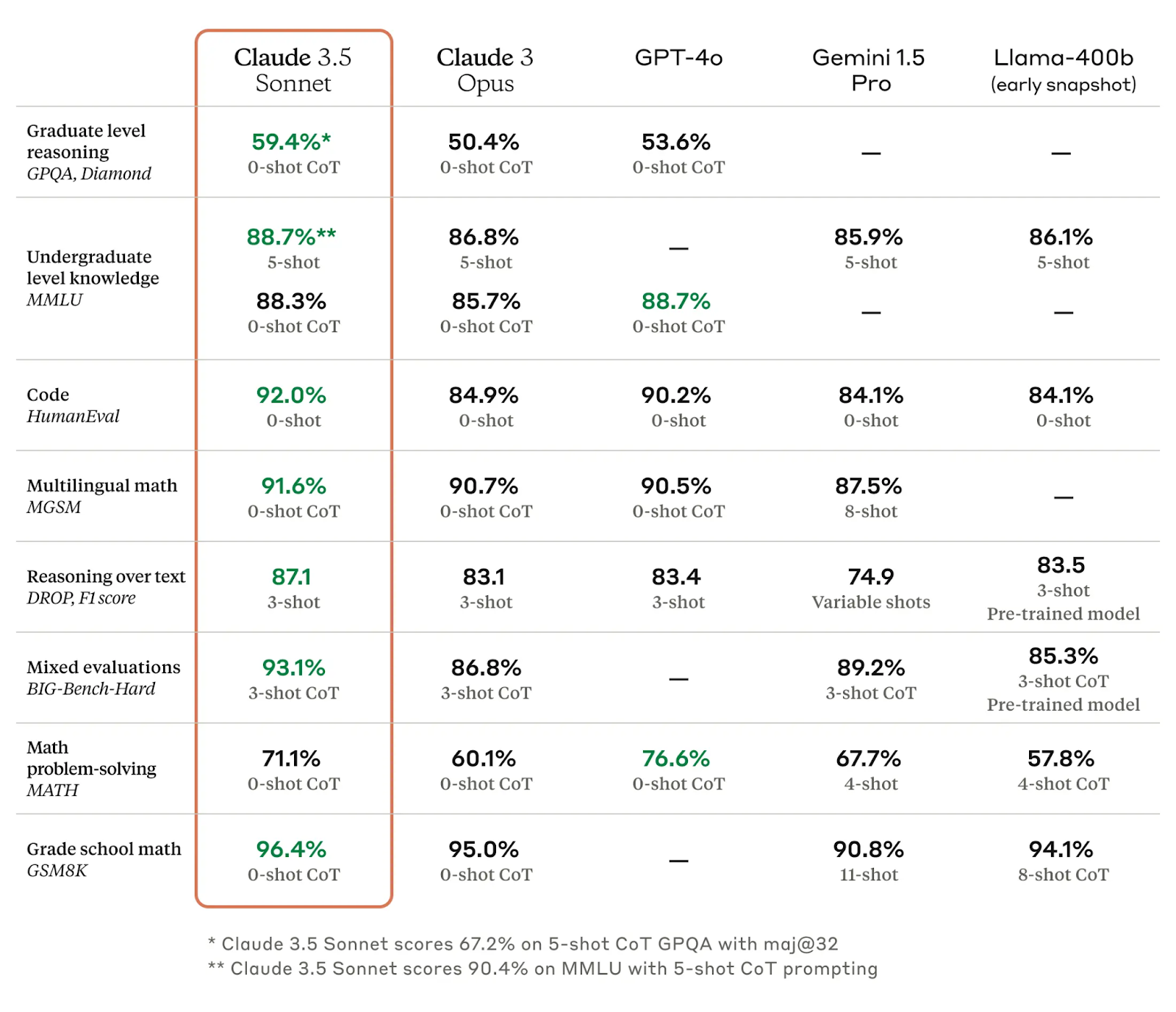
Anthropic has launched Claude 3.5 Sonnet, the first release in the forthcoming Claude 3.5 model family.

Claude 3.5 Sonnet outperforms OpenAI’s GPT-4o, Google Gemini 1.5 Pro, and its predecessor, Claude 3 Opus, in various evaluations, combining enhanced intelligence with the speed and cost efficiency of mid-tier models.

​​

The model is available for free on Claude.ai and the Claude iOS app, with higher rate limits for Claude Pro and Team plan subscribers. The model can also be accessed via the Anthropic API, Amazon Bedrock, and Google Cloud’s Vertex AI, priced at $3 per million input tokens and $15 per million output tokens, featuring a 200K token context window.

Claude 3.5 Sonnet excels in graduate-level reasoning, undergraduate-level knowledge, and coding proficiency, with a significant performance boost operating at twice the speed of Claude 3 Opus. This makes it ideal for complex tasks like context-sensitive customer support and multi-step workflow orchestration. In internal coding evaluations, Claude 3.5 Sonnet solved 64% of problems, surpassing Claude 3 Opus’s 38%, demonstrating advanced reasoning and troubleshooting capabilities.

The new model also excels in vision tasks, outperforming Claude 3 Opus on standard vision benchmarks and effectively handling tasks requiring visual reasoning, such as interpreting charts and graphs. It can accurately transcribe text from imperfect images, benefiting industries like retail, logistics, and financial services.

Anthropic has introduced a new feature called Artifacts on Claude.ai, allowing users to interact with Claude-generated content in real-time. This feature enables users to see, edit, and build upon Claude’s creations, evolving the platform from a conversational AI to a collaborative work environment.

Committed to safety and privacy, Claude 3.5 Sonnet has undergone rigorous testing, maintaining ASL-2 safety standards. External experts, including the UK’s Artificial Intelligence Safety Institute (UK AISI) and the US AI Safety Institute (US AISI), have been involved in evaluating the model’s safety mechanisms. Anthropic ensures no user-submitted data is used for training without explicit permission, upholding a core principle of privacy.

Looking ahead, Anthropic plans to release Claude 3.5 Haiku and Claude 3.5 Opus later this year, alongside developing new features like Memory for personalised user experiences. The company encourages users to submit feedback directly in-product to help shape future developments and improve user experience.