Perplexity AI is Twitter Minus the Drama

In a recent podcast with Lex Fridman, Perplexity AI chief Aravind Srinivas compared his company with social media platforms such as X (formerly Twitter) and Threads, insinuating that these platforms provide news alongside drama.

“Twitter is great; it serves many things like human drama in it, there’s news, there’s knowledge you gain, but some people just want the knowledge, and some just want the news without any drama,” he said.

Srinivas said that the solution may not even be starting another social app. “Meta started Threads and tried to say, ‘I want to start Twitter without all the drama,’ but that’s not the answer,” he said, adding that the answer is to try as much as possible to cater to human curiosity but not to human drama.

Interestingly, when Perplexity started, it scraped Twitter data. However, when Elon Musk took over, he restricted free Twitter API access.

“We knew that relying on Twitter search was not scalable or feasible for us because Elon was taking over and he was very particular about shutting down API access. So, it made sense for us to focus more on regular web search,” said Srinivas.

Notably, Musk later introduced his own chatbot, Grok, inside X

Srinivas further said that Perplexity AI is trying to change the way people discover knowledge, adding that as of now people mostly use Google Search to gather information.

“It’s evident that around 30 to 40% of Google Search traffic seeks direct answers, while the rest explores deeper inquiries, much like what we’re providing.”

He said that Perplexity AI users are able to ask deeper questions, which is not possible on Google Search. “I just believe we’re working towards neither a search engine nor an answer engine but ‘knowledge discovery’. That’s the bigger mission, and that can be catered to through chatbots, answer bots, or voice factor usage.”

Perplexity AI recently launched a new feature called Pages, where users can ask questions and create, organise, and share information. Simply put, they can search any topic and instantly receive a well-structured, and beautifully-formatted article.

Moreover, they can publish their work and share it directly with their audience with a single click.

“Through the Pages project, we’re working on enabling people to create new articles with minimal human effort. I hope the insight from your browsing session and the query you asked on Perplexity will be useful to others as well. One should be able to broadcast what they learned from a single Q&A session on Perplexity to the rest of the world,” he quipped.

How Perplexity AI works

Perplexity AI utilises the RAG technique to extract data from the internet. “The principle at Perplexity is you’re not supposed to say anything that you don’t retrieve,” said Srinivas. He explained that their model is designed to avoid generating anything that isn’t present in the document, ensuring factual grounding.

The company has also built a crawler to index websites. “We have the Perplexity bot, Bing bot, GPT bot—a bunch of bots that crawl the web,” said Srinivas. Lately, there have been a few instances where Perplexity AI has been reportedly accused of directly ripping off content from websites.

He explained that they have to use headless rendering because websites are more modern these days. “It’s not just HTML, there’s a lot of JavaScript rendering, and you have to decide what you really want from a page,” he said.

He added that websites often have robots.txt files, and one should respect the delay time so that they don’t overload their servers by continuously crawling them.

Prompt Engineering is Dead

Srinivas hinted that the company’s upcoming products might remove the necessity for users to frame questions accurately and precisely.

“I believe the whole prompt engineering thing, like trying to be a good prompt engineer, is not going to be a long-term thing. I think you want to make products work where the user doesn’t even ask for something, but you know that they want it, and you give it to them without them even asking,” he said.

“I don’t even need them (users) to type in the query. They can just type in a bunch of words and that should be okay. That’s the extent to which you got to design the product because people are lazy, and a better product should be one that allows you to be more lazy, not less,” he explained.

Srinivas added that the biggest enemy to them is not Google. Instead, it is the fact that people are not naturally good at asking questions.

“Every person in the world is curious, but not all of them are blessed to translate that curiosity into a well-articulated question. There’s a lot of human thought that goes into refining your curiosity into a question, and then there’s a lot of skill in making sure the question is well prompted for these AIs,” he said.

Targets Japan

SoftBank Corp recently announced a partnership with generative AI search startup, Perplexity. Beginning June 19, 2024, SoftBank offered customers of its SoftBank, Y!mobile, and LINEMO mobile services a one-year free subscription to the premium version of Perplexity’s AI answer engine.

Was a great Perplexity user meetup in Tokyo! The energy and excitement about the Perplexity SoftBank is incredible! Look forward to a lot more! 🇯🇵 https://t.co/y3yj08t1G9 pic.twitter.com/Bi6qbShQvz

— Aravind Srinivas (@AravSrinivas) June 20, 2024

Srinivas recently visited Japan, where he met developers and users. Despite facing accusations of plagiarism and copyright infringement, as well as increasing competition from Google and OpenAI, Perplexity AI is determined to stay relevant and continue its growth.

There are Still Enough Jobs for 10x Developers

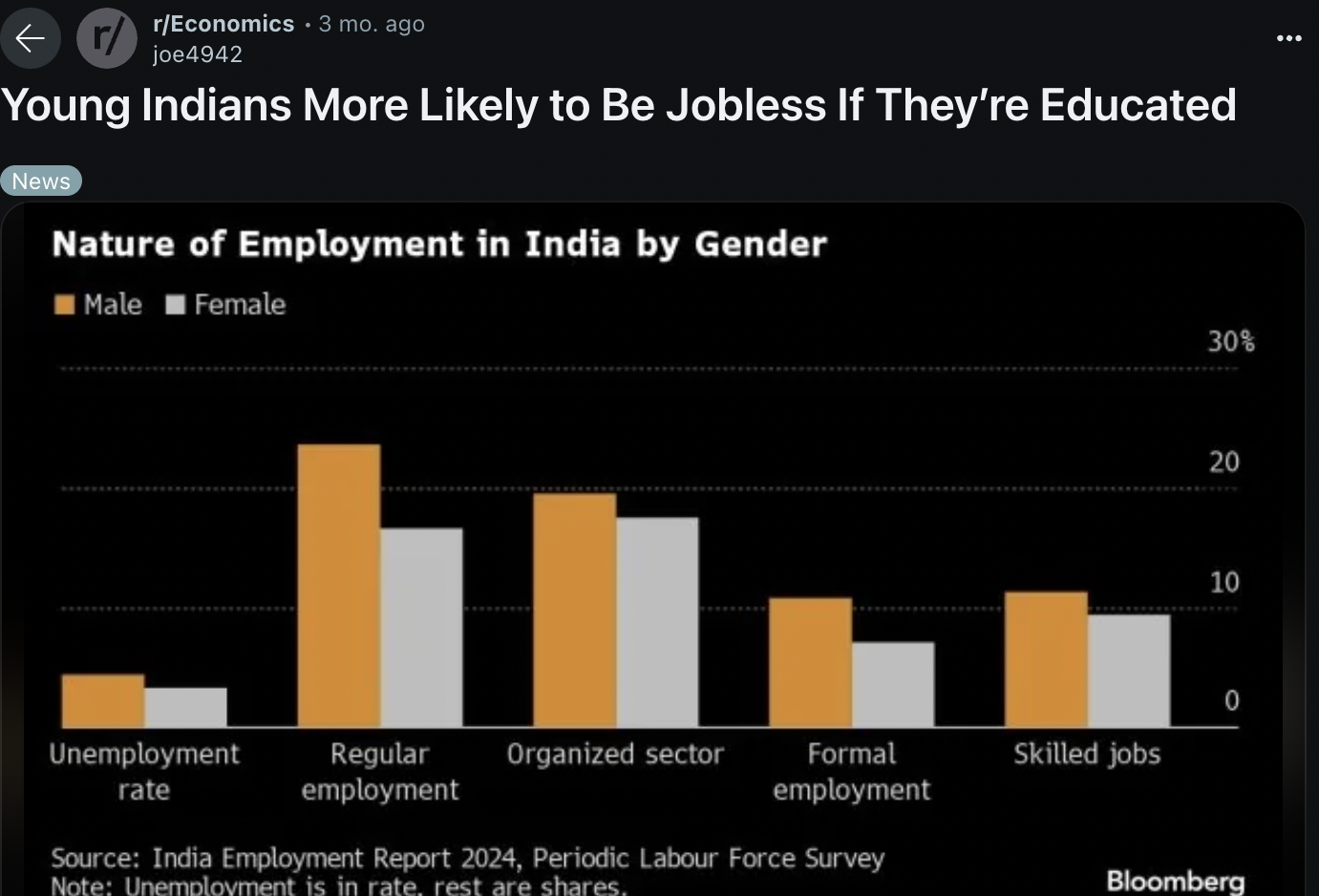
Contrary to popular belief, the tech job market in India is booming with a high demand for specific skills. Bhasker Gupta, the CEO of AIM Media House, echoed this sentiment, stating on LinkedIn that despite the recent years being one of the toughest for tech employment, opportunities are high for “10x developers”.

“It’s easy to lose hope in a talent market like this, but then luck will favour those who are prepared. The market can turn course anytime,” Gupta noted.

According to ‘Annual Digital Skills Report FH24’ by Quess Corp, 66% of tech jobs focus on five core areas: development (35%), ERP (12%), testing (7%), design & engineering (7%), and networking (5%).

Not a Time to be a ‘Generic Software Engineer’

A Reddit user wrote, “I am 25 with a bachelor in CS and masters in AI. With 0 YOE [Years of experience], I found it tough to land a job after college and had to settle with a generic SDE [Software Development Engineer] role at a small company.” Many fresh graduates shared similar concerns on forums like Reddit.

Source: Reddit

This sentiment reflects a broader issue faced by many new entrants to the tech industry. Aspiring software engineers/developers consider several strategies to stand out and secure desirable positions.

Well, an internship is invaluable for gaining hands-on experience and making industry connections. Today on LinkedIn, there are over 99,000 software engineering internship opportunities in India, with 1,146 new listings just added.

Source: Reddit

In addition to formal education, pursuing specialised courses and securing certifications can make a significant difference. Online platforms like Coursera, edX, and Udacity offer courses in cutting-edge technologies and tools.

Further, as the tech industry constantly evolves, staying updated with new frameworks, languages, and methodologies is crucial. Everything can’t and won’t be covered in college courses.

Critics argue that outdated curricula in Indian colleges fail to meet industry requirements, creating a wide gap between what students learn and the skills they need for the job market.

Back in 2015, esteemed scientist and Bharat Ratna awardee CNR Rao stated that 90% of Indian universities have outdated curricula, contributing to the country’s absence from the top 100 global universities list.

While individual efforts are crucial, companies also play a vital role in nurturing talent. Several Indian companies, including Infosys, Wipro, Tata Consultancy Services, and HCL Technologies offer employee training programs for developers

These programs provide structured learning paths, mentorship, and opportunities to work on innovative projects. Advocating for such initiatives can also help companies recognise the importance of developing their workforce, benefiting both the employer and the employees.

Source: LinkedIn

Rewrite Your Resume Now!

Fresh graduates are voicing concerns about their resumes lacking significant projects, which they fear might hinder their job prospects.

One such graduate shared, “I don’t have any projects listed on my resume despite knowing C, Java, and Python. My experience is limited to solving coding problems with these languages. Now that I’ve completed my BTech, I’m worried.”

They are seeking advice on platforms like Reddit and Quora on what kinds of projects to undertake and which technologies to learn to enhance their resumes and improve their chances of getting shortlisted by potential employers.

This sentiment reflects a common anxiety among new graduates entering the competitive job market.

It’s clear that their resume needs a revamp.

So, to enhance employability, graduates should focus on building a strong portfolio and must continuously update their knowledge to stay relevant in the ever-evolving tech industry.

TCS to Build an AI-first Enterprise Platform for Xerox

Tata Consultancy Services (TCS) has expanded its strategic partnership with Xerox with a landmark, end-to-end transformation program designed to fast-track the company’s evolution to a simplified, services-led, software-enabled organisation.

TCS will develop a new agile, cloud-first operating model for Xerox. Leveraging the deep capabilities of its service practices such as AI.Cloud, enterprise solutions (including TCS CrystallusTM) and Cognitive Business Operations (including TCS CognixTM), TCS will also build an AI-first enterprise platform for Xerox.

These TCS capabilities will be combined with the expertise of industry partners such as leading hyperscalers and AI solution providers.

Under the agreement, TCS will consolidate Xerox’s technology services to improve business outcomes, migrate complex legacy data centres to the Azure public cloud, deploy a cloud-based Digital ERP platform to transform business processes and incorporate generative artificial intelligence (GenAI) into operations to help drive sustainable growth.

“Xerox and TCS have been on a collaboration and co-innovation journey for over two decades, which has grown from strength to strength transforming business functions from finance to HR along the way. We are now excited to partner with Xerox to support their reinvention to create the foundation for long-term, sustainable growth by establishing the digital core leveraging cloud, AI and next-generation enterprise platforms,” V Rajanna, president, technology, software and services, TCS, said.

This announcement reinforces TCS’ strong presence in the US, the largest market for the organisation with nearly 50,000 associates and 19 delivery centres.

Old Age Wisdom Preserved as AI-shes

At the recent Data Engineering Summit (DES 2024), hosted by AIM, 74-year-old leadership coach and entrepreneur Marshall Goldsmith spoke about Marshallgoldsmith.ai, an AI-powered chatbot built by Fractal Analytics.

The bot, built on GPT-3.5, converges all of Goldsmith’s teachings and expertise of over 47 years, paving the way for wisdom to become imperishable with the help of AI.

Wisdom Survives

“This is a legacy project for me. I’m 74 years old, so this is a way of being present, even when physically I’m no longer around,” said Goldsmith at DES ’24. The AI-chatbot is probably the first AI life coach, but many have contemplated this idea for a while now.

Source: Linkedin

With a vast repository of available information that is unique to each personality, including their teachings, books published, public speeches, and many more, the AI-powered chatbots will be able to emulate the person as a digital avatar.

However, the concept is not brand new.

A few years ago, a bot named ‘Vishy-bot’ was introduced on online playing platform chess.com. It was trained on Indian chess grandmaster Viswanathan Anand’s playing style and was designed to mimic Anand’s strengths and playing patterns.

Interestingly, when Anand played against Vishy-bot, the game ended in a draw. He even remarked, “I’m very impressed that my bot’s technique is as bad as mine. That’s a kind of touch of authenticity right there.”

Bringing Back from the Ashes

Many historical figures have been recreated as AI chatbots. OpenAI’s GPT store enables the creation of customised chatbots based on any personality, offering a versatile platform for personalised interaction.

For instance, Winston AI, an AI assistant, imitates British Prime Minister Winston Churchill. Likewise, Oppenheimer AI is an AI assistant inspired by the physicist J. Robert Oppenheimer.

Chatbots built on prominent leaders may be the first step, and building a visual avatar is the next.

Chatbots to Digital Avatars

Recently, LinkedIn co-founder Reid Hoffman created a virtual twin of himself and interviewed it. The deepfake was trained on Hoffman’s talking style with methods unique to him. Hoffman said the deepfake interview was an act of self-realisation “to see if conversing with an AI-generated version of myself can lead to self-reflection, new insights into my thought patterns, and deep truths”.

Why did I deepfake myself? To see if conversing with an AI-generated version of myself can lead to self-reflection, new insights into my thought patterns, and deep truths. pic.twitter.com/DWODoZ9lXL

— Reid Hoffman (@reidhoffman) April 24, 2024

Digital avatars are now being increasingly implemented in various industries, even politics. Recently, Steve Endacott, an entrepreneur, who is the chair of an AI company Neural Voice, proposed to put himself as a candidate in the UK general election as the first AI MP.

‘AI Steve’ would answer any constituent’s concerns and questions using a rendition of Endacott’s voice and avatar.

Gaming and entertainment industry is also vigorously picking up the concept of digital avatars. At the recent Computex event, NVIDIA announced the general availability of NVIDIA ACE that allows one to create digital avatars. While this may not embody a living person’s attributes, it is probable in the future.

Not All are Receptive

It is possible that if AI chatbots are trained on personality figures before their passing, it is likely that you can train these models to imitate them to the last dot. However, the thought of preparing for a future where a deceased can be brought to life is not openly accepted.

Last year, Kissan AI founder Pratik Desai suggested regularly recording one’s parents, elders, and loved ones. “With enough transcript data, new voice synthesis and video models, there is a 100% chance that they will live with you forever even after leaving their physical body,” he said.

However, the idea was met with a huge backlash, with people calling it a huge dependence on AI to mourn a loved one.

Significance of AI in the development of software products

Significance of AI in Development of Software Products

Artificial Intelligence (AI) is emerging as a formidable force, revolutionizing how we conceive, create, and deliver software solutions. As technology advances at an unprecedented pace, the role of AI in this domain has become increasingly significant. It’s no longer just a buzzword; it’s a fundamental tool that promises to reshape the entire software development process. And, unless you have been hiding away somewhere, distant from all of humankind, you would realize that the software development market is on the rise.

With our ceaselessly developing dependence on everything advanced, including the rising reliance of organizations and consumers on software, it checks out that this market is encountering sensational development. Be that as it may, what is fascinating in this setting is the role artificial intelligence has come to play in programming. As a matter of fact, an ever-increasing number of organizations are now utilizing Artificial Intelligence tools to work on the quality of software development and foster new kinds of software. For example, virtual assistant bots, self-driving vehicles, etc.

In this blog, I’ll try to delve into the multifaceted role of AI in software product development, exploring how it drives innovation, improves efficiency, and ultimately changes the way we think about software engineering.

At any rate, Artificial Intelligence continues to be a significant innovation in programming development and improvement. Thus, as Artificial Intelligence-fueled tools become progressively common, they enable software developers to be more effective and valuable while working with first-rate degrees of advancement in software apps. In any case, if you are still vacillating about hiring a company offering software product development for your business, permit us to give you a closer look into some of AI’s key benefits.

How AI stands to help businesses

  • Reduced costs: Thanks to the reductions in the time and effort required to develop software enabled by AI, companies alleviate the costs associated with their software development project. Besides that, such tools can also help developers identify and manage software bugs early in the development lifecycle. This also helps companies reduce costs — since fixing bugs at later stages in the development lifecycle is more expensive.
  • Automation of repetitive tasks: So many functions in software development are necessary but relatively mundane and repetitive and do not necessarily need human intervention. This is where AI comes in — you can use it to generate code for routine tasks. It can also be used for automatic code reviews. And let us not forget that AI can also help generate documentation for code and software systems, thus making sure that all documentation remains up-to-date and consistent with the codebase.
  • Accelerated development pace: First, AI helps accelerate the speed of development work via automation of tasks and reducing the risk of errors that come with it. Then there are also AI-driven code completion and suggestion tools that assist developers with real-time recommendations and code snippets, significantly speeding up the coding process. Plus, AI can analyze data and user behavior patterns to help developers make informed decisions about feature development, resulting in quicker iterations of the software.
  • Enhanced software testing: Many companies are also using AI to implement more comprehensive, efficient, and effective software testing. This includes automating the testing process by running many test cases and scenarios, which is particularly helpful and equally valuable for regression testing.

AI is already playing a super important role in software development. And as technology continues to evolve, we reckon AI will play an even more significant role in this market. What do you think?

How to integrate ChatGPT into your app

In today’s rapidly advancing technological landscape, integrating AI-powered chat solutions into your applications can significantly enhance user experience and engagement. OpenAI’s ChatGPT, known for its conversational abilities and advanced language understanding, is an excellent choice for developers looking to implement intelligent chat features in their apps. This comprehensive guide will walk you through the steps and best practices for integrating ChatGPT into your app, providing a seamless and interactive experience for your users.

image-3

Why integrate ChatGPT?

Integrating ChatGPT into your app offers several benefits that can improve user interaction and satisfaction:

  1. Enhanced user experience: ChatGPT provides a natural and intuitive conversational experience, making it easier for users to interact with your app.
  2. Automation of customer support: With ChatGPT, you can automate responses to common queries, reducing the load on customer support teams and providing instant assistance to users.
  3. Personalization: ChatGPT can offer personalized responses based on user data, enhancing the relevance and engagement of interactions.
  4. Scalability: As an AI solution, ChatGPT can handle multiple conversations simultaneously, making it ideal for apps with high user volumes.
  5. Continuous improvement: OpenAI continuously updates and improves ChatGPT, ensuring that you have access to the latest advancements in AI and natural language processing.

Steps to integrate ChatGPT into your app

Integrating ChatGPT into your app involves several key steps, from setting up your OpenAI account to implementing the API and ensuring a smooth user experience. Here’s a detailed guide to help you through the process:

1. Set up your OpenAI account

The first step in integrating ChatGPT is to set up an OpenAI account. Visit the OpenAI website and sign up for an account. Once registered, you’ll need to subscribe to the API plan that best suits your needs. OpenAI offers various pricing tiers based on usage, so choose the one that aligns with your expected traffic and interaction volume.

2. Obtain your API key

After setting up your account and subscription, you’ll receive an API key. This key is essential for authenticating your app’s requests to the ChatGPT API. Ensure that you store this key securely, as it grants access to your OpenAI account and usage.

3. Familiarize yourself with the API documentation

OpenAI provides comprehensive documentation for the ChatGPT API, detailing the endpoints, request parameters, and response formats. Familiarize yourself with this documentation to understand how to interact with the API effectively. The documentation also includes guidelines on rate limits, error handling, and best practices for using the API.

4. Design your chat interface

A well-designed chat interface is crucial for providing a seamless user experience. Consider the following elements when designing your chat interface:

  • Input field: Provide a clear and easy-to-use input field for users to type their messages.
  • Chat bubbles: Use chat bubbles to display user messages and ChatGPT responses, making the conversation flow naturally.
  • Loading indicators: Implement loading indicators to show users that the app is processing their input and generating a response.
  • Personalization: Personalize the chat interface with user names, avatars, and other contextual information to enhance engagement.

5. Implement the ChatGPT API

With your design in place, you can start implementing the ChatGPT API. This involves making HTTP requests to the API endpoint with the user’s input and displaying the generated responses in the chat interface. The basic flow of interaction typically includes:

  1. Sending user input: Capture the user’s message from the input field and send it to the ChatGPT API endpoint.
  2. Processing the response: Receive the response from the API and parse the JSON data to extract the generated text.
  3. Displaying the Response: Update the chat interface with the generated response, ensuring it is displayed in a conversational format.

6. Ensure security and privacy

When integrating ChatGPT, it’s important to ensure the security and privacy of user data. Implement the following measures to protect user information:

  • Encryption: Use HTTPS to encrypt data transmitted between your app and the ChatGPT API.
  • Access control: Secure your API key and restrict access to it. Implement authentication and authorization mechanisms to control who can interact with the ChatGPT integration.
  • Data anonymization: Avoid sending sensitive or personally identifiable information to the ChatGPT API. Anonymize user data where possible.

7. Test thoroughly

Thorough testing is essential to ensure that your ChatGPT integration works as expected. Test various scenarios, including different types of user input, edge cases, and error handling. Pay attention to the following aspects during testing:

  • Response accuracy: Ensure that the responses generated by ChatGPT are relevant and accurate.
  • Performance: Test the performance of the chat interface, including response times and handling of concurrent conversations.
  • User experience: Evaluate the overall user experience, including the flow of conversation and interface usability.

8. Monitor and optimize

Once your ChatGPT integration is live, continuously monitor its performance and user interactions. Use analytics to track usage patterns, user satisfaction, and any issues that arise. Based on this data, optimize the integration to improve performance and user experience. Regularly update your implementation to leverage new features and improvements in the ChatGPT API.

image-4

Best practices for ChatGPT integration

To ensure a successful integration of ChatGPT into your app, follow these best practices:

  1. Provide clear instructions: Guide users on how to interact with ChatGPT by providing clear instructions and examples.
  2. Set expectations: Inform users about the capabilities and limitations of ChatGPT to manage their expectations and avoid frustration.
  3. Handle errors gracefully: Implement error handling to manage issues such as API timeouts or invalid responses. Provide users with informative error messages and fallback options.
  4. Enhance with context: Where possible, provide ChatGPT with context about the conversation or user to generate more relevant responses.
  5. Collect feedback: Encourage users to provide feedback on their chat experience. Use this feedback to continuously improve the integration.

Advanced Features and Customization

Once you have the basic integration in place, consider exploring advanced features and customization options to enhance your ChatGPT implementation further:

  • Custom prompts: Customize the prompts sent to ChatGPT to guide its responses and tailor the conversation to your app’s context.
  • Multilingual support: If your app serves a global audience, implement multilingual support to allow users to interact with ChatGPT in different languages.
  • Integration with other services: Combine ChatGPT with other services, such as databases or third-party APIs, to provide enriched and dynamic responses.
  • Context preservation: Implement mechanisms to preserve conversation context across interactions, allowing ChatGPT to maintain a coherent dialogue over multiple exchanges.

Use cases for ChatGPT integration

Integrating ChatGPT into your app opens up a wide range of possibilities across various domains. Here are some use cases to consider:

  1. Customer support: Automate responses to common customer queries, provide instant assistance, and escalate complex issues to human agents when necessary.
  2. Virtual assistants: Create virtual assistants that can help users with tasks such as scheduling, reminders, and information retrieval.
  3. Educational apps: Enhance educational apps with interactive tutoring, personalized learning experiences, and instant feedback.
  4. E-commerce: Implement intelligent chat features in e-commerce apps to assist users with product recommendations, order tracking, and customer service.
  5. Social media and community apps: Foster engagement in social media and community apps by facilitating conversations, answering questions, and moderating discussions.

Conclusion

Integrating ChatGPT into your app is a powerful way to enhance user interaction and provide intelligent, conversational experiences. By following the steps outlined in this guide and adhering to best practices, you can create a seamless and secure chat integration that adds significant value to your app.

ChatGPT’s advanced language understanding and natural conversational abilities make it an ideal choice for a wide range of applications, from customer support to virtual assistants and beyond. As you embark on integrating ChatGPT into your app, remember to prioritize user experience, security, and continuous optimization.

For more detailed guidance and the latest updates on ChatGPT integration, you can visit the official OpenAI documentation and resources. With the right approach and careful implementation, ChatGPT can transform your app’s user interactions, providing a dynamic and engaging experience that keeps users coming back.

81% of workers using AI are more productive. Here’s how to implement it

gettyimages-1478698018

According to a survey conducted by Slack's Workforce Lab, AI use among desk workers has increased 23% since January 2024 and 60% since September 2023 — and the data shows it's accelerating productivity.

The survey polled over 10,000 global desk workers, defined as being "employed full-time (30 or more hours per week)" in mostly executive, senior, middle, and junior management roles, and who "work with data, analyze information or think creatively," per Workforce Lab's methodology.

Responses showed that 81% of AI users said AI tools boosted both their productivity and the quality of their work. The results also showed that workers who use AI report higher scores on other metrics of employee engagement, including:

  • +13% Level of access to relevant people, files, and resources
  • +18% Work-life balance
  • +23% Ability to manage stress
  • +24% Overall satisfaction with work
  • +25% Flexibility
  • +29% more likely to say they feel highly passionate about their work

Other key takeaways from the survey reveal that:

  • Executive urgency to incorporate AI tools into business operations has increased sevenfold since January 2024 and is now a top concern, surpassing inflation or the broader economy.
  • 73 percent of desk workers say that AI hype is warranted and the technology "will have a big impact." Those who have used AI tools are even more convinced.
  • Enthusiasm is growing: today, 47% of global desk workers express enthusiasm for AI to handle job tasks (compared with 42% at the start of the year).
  • The desire to use AI at work varies by age and gender. "The youngest workers show the most enthusiasm for AI, with 55% of workers ages 18 to 29 saying they're excited for AI and automation to handle parts of their work, compared with 33% of workers over age 60," the survey explains.

Also: Do employers want AI skills or AI-enhanced skills?

Research shows that AI can do a lot more than improve your productivity. Companies that apply generative artificial intelligence (AI) to customer-related initiatives can expect to achieve 25% higher revenue after five years compared to companies only focused on productivity, according to research from Accenture.

Looking to personalize at scale and boost efficiency, marketers rank AI adoption as their top priority and challenge. The latest 2024 State of Marketing report revealed that one in three marketing teams have implemented AI in their workflows.

AI fast fact: AI adoption, growth trajectories, and productivity benefits.

However, the Slack survey also found that two-thirds of desk workers still have not tried AI tools. While nearly half of global office workers expressed enthusiasm about using AI, 93% do not consider AI outputs completely trustworthy for work-related tasks.

Another finding shows AI could help desk workers minimize wasted time on busy work. People spend a third of their day on tasks that are "not meaningful to their job," the survey reports, such as unnecessary meetings, low-value emails, and excessive paperwork or data entry.

Also: What is a Chief AI Officer, and how do you become one?

But instead of spending the time AI saves on "strategic or high-value activities like learning and skill building, employees are likely to spend 37% more of their time on routine administrative tasks," the survey finds. This suggests a missed opportunity to take full advantage of the bandwidth AI frees up.

As the survey found, 64% of desk workers experience burnout at least once a month, and 30% do not feel passionate about their job — a problem that the research suggests AI adoption could address by offloading parts of the worker experience.

AI Training matters — Those who are trained to use AI are up to 19x times more likely to report that AI is improving their productivity.

How to implement AI at work

The survey found several factors that impact AI adoption at work:

  1. AI training. Those who are trained to use AI are up to 19 times more likely to report that it's improving their productivity. They are also seven times more likely to trust AI tools to help them at work.
  2. Trust from leadership. "Desk workers who feel trusted by their employers are 94% more likely to have tried AI for work-related tasks, and they're also more trusting of AI's accuracy and reliability," the survey states.
  3. Confidence and reliability. Only 15% of workers strongly agree that they have the education and training necessary to use AI effectively. Context and better information could help workers embrace this technology in their work.

There are many benefits to integrating AI tools into desk employees' workflows. Successful adoption of any new powerful technology requires the right company culture, talent, processes, and training. All AI projects begin as data projects — a data-driven culture that values trust and shared stakeholder success will ultimately determine implementation at the speed of need.

Artificial Intelligence

How behavioral biometrics reduces online banking fraud

cyber security and two-step verification concept. Online Payment Internet Banking Concept. Man’s hands are holding mobile smartphone making Online shopping and payment with a laptop computer.

Online banking fraud’s severity and frequency continuously increase, causing staggering financial losses each year. Now that artificial intelligence is in hackers’ hands, traditional security measures aren’t cutting it. Can behavioral biometrics protect online bankers like you?

What are behavioral biometrics?

Behavioral biometrics uses machine learning (ML) technology to analyze your physical movements, online interactions, and thought patterns to determine whether your account activity is fraudulent or legitimate. It operates under the assumption that a fraudster will act differently than you usually do, tipping off your service provider so that your account may be compromised.

How does behavioral biometrics work?

Behavioral biometrics works because an AI analyzes everything you do in the background in real-time. Since it rapidly processes large amounts of information, it can handle multiple users simultaneously. It monitors whatever mouse, keyboard or touchscreen is used to access your account, tracking metrics to identify behavioral discrepancies.

The ML model can track speed, gestures, voice, orientation, and pressure. For example, it might know you use your right hand to swipe and your pointer finger to scroll. It builds a user profile, aggregating information on physical, digital, and cognitive patterns. This way, it has an up-to-date baseline it can reference to check for fraud.

While behavioral biometric algorithms’ specifics vary, they generally use some sort of scoring system that changes based on pre-determined factors. The lower the score, the more likely the person is someone other than you. Online banking services can follow up by asking security questions, contacting you directly or temporarily locking your account.

Why alternative biometrics are necessary

Frankly, online fraud is increasing in frequency and severity. The FBI’s Internet Crime Complaint Center received about 880,400 complaints in 2023, up from around 351,900 five years prior. Although you might think you’re safe, there’s no guarantee traditional security measures will be enough to stop bad actors.

The three types of authentication — something you have, know or are — can easily be bypassed by hackers. They can steal your security question answer and phish your one-time password. While traditional biometrics used to be safe, generative AI has changed things. Now, they can commit synthetic identity fraud with deepfakes and audio clips.

Other security measures are useless in some scenarios, too. For example, device theft and social engineering can make multi-factor authentication ineffective. This means whoever has access to your phone or banking app can then log into your account and withdraw funds.

Now that AI exists, standard account protections are no longer enough. For instance, while experts recommend using different passwords for each account and changing them every three months to prevent account takeover, you probably use your face ID or your fingerprint to autofill your passwords — and generative AI can deepfake those biometrics.

Common types of online banking fraud

Online banking fraud is common because there’s a lot of money in it — and bypassing traditional security measures is becoming easier every day. According to the FTC, 46% of the reports the Consumer Sentinel Network received in 2020 were fraud-related, totaling $3.3 billion in losses.

Authorized push payment

Authorized push payment fraud involves a fraudster tricking you into approving a payment to them or their money mule. While they may pretend to be a legitimate company or person, standard phishing attacks are common.

Account takeover

A hacker can use brute force cyberattacks — where they try thousands of combinations until they correctly guess your password — to gain access to your online banking account. This way, they can withdraw or transfer money directly.

Identity theft

In an identity theft case, the fraudster uses phishing to trick you into revealing personally identifiable information like your name, birthdate, address and social security number. Alternatively, they use details leaked on the dark web. This way, they can access your online banking account by posing as you.

Account opening

Fraudsters can use stolen or leaked information to pretend to be you and sign up for a new bank account online. This way, they can take out loans, drive up debt or transfer money in your name — and you might not realize until you’re left with debt and a negative balance.

How behavioral biometrics reduce fraud

It’s no surprise behavioral biometrics is catching on. After all, AI’s market value in the banking sector will increase to $64 billion by 2030, up from $3.88 billion in 2020. That said, its main draw isn’t its worth — it’s its ability to consistently combat fraud.

1. Detecting fraudsters

An ML model recognizes minor inconsistencies, enabling it to catch fraudsters. For example, while it’s normal to hesitate when typing in a credit card number, you wouldn’t have to navigate away from the page and then use the copy-and-paste functions to spell your last name.

2. Difficult to mimic

Unlike facial recognition or fingerprinting, behavioral biometrics runs in the background constantly. A hacker would have to study your movements and subconscious habits for weeks and then perfectly replicate them to fool an ML model into thinking they’re you — which is practically impossible.

3. Detecting bots

Of course, bots don’t act like humans. Behavioral biometrics can detect whether one is accessing your account because it won’t swipe, click, type or tap like a human. Even something as simple as device orientation is telling — a bad actor may have dozens of phones sitting stationary on racks, tipping the AI off that a person isn’t using the device.

4. More convenient

You, like many people, probably dislike traditional security measures because they’re inconvenient and slow. For instance, 33% of people say they don’t use multi-factor authentication because it’s too annoying. You’re more likely to enable behavioral biometrics because it runs in the background — it’s convenient.

The bottom line of behavioral biometrics

While AI has its flaws — namely bias and a lack of transparency — it is a powerful tool in the right hands. If you use it to protect your online bank account from most, if not all, fraud attempts, your heightened security may be worth the occasional algorithmic hiccup.

Elon Musk Predicts AI-Driven Age of Abundance, Warns of Existential Crisis and Potential Annihilation

Elon Musk, CEO of Tesla and X, says AI and robots will probably lead to an age of abundance with Universal High Income for all, but that this could result in a crisis of meaning and there’s a 10-20% chance of annihilation.

When asked whether he’s both optimistic and pessimistic about AI, Musk candidly replied, “The probabilities associated with it, I think, are either 100% optimistic or completely pessimistic. I generally agree with Jeff Hinton, one of the Godfathers of AI. He posted on the X platform of the AI Community, and he thinks there’s a 10% or 20% probability of something terrible happening but the glass is 80% full. Just look on the bright side.”

Elon Musk says AI and robots will probably lead to an age of abundance with Universal High Income for all, but that this could result in a crisis of meaning and there's a 10-20% chance of annihilation pic.twitter.com/2XuCAZkZJl

— Tsarathustra (@tsarnick) June 19, 2024

Moreover, he added that he envisions a future where advancements in AI and robotics usher in an era of abundance, potentially providing universal high income for everyone. This optimistic scenario hinges on the premise that AI and robots will significantly enhance productivity, reduce costs, and create unprecedented wealth.

However, Musk also warns that such a shift could precipitate a profound crisis of meaning. As traditional jobs become no longer in use and daily survival no longer drives human activity, individuals may struggle to find purpose and fulfillment in a world where work is optional.

What motivates Elon Musk

SpaceX takes 80% of the payload to space, but that’s not actually the ambition of SpaceX.

“The goal of SpaceX is to make life multiplanetary in order to extend the probable lifespan of consciousness. That has been the goal from the beginning.” said Musk.

“You can see videos of me talking about this 20 years ago. In order to do that, we need to transport a lot of people and equipment to Mars.”

This could lead to widespread societal challenges as people seek new ways to derive satisfaction and meaning. Musk also cautions that there is a risk estimated at 10-20% that the very technologies promising abundance could instead lead to outcomes, including potential annihilation.