Arrowhead, a voice AI startup creating human-like sales agents for the financial services sector, has raised $3 million in seed funding led by Stellaris Venture Partners.
The funding round also saw investments from notable angel investors, including Kunal Shah (CRED founder) and Madhusudanan R (M2P founder), as well as fintech executives who are also Arrowhead customers.
According to the press release, the funding will enhance Arrowhead’s AI models, expand its technology and sales teams, and improve conversion rates for financial services.
“Indian enterprises have long relied on large human sales teams because labour was considered inexpensive, but this has led to significant inefficiencies, from training and attrition to mis-selling and inconsistent outcomes,” Devyani Gupta, co-founder and CEO of Arrowhead, said in a statement.
Arrowhead’s platform features a fully developed orchestration layer that allows voice AI bots to engage in conversations lasting up to 20 minutes.
“We’re building voice AI agents that can handle long, complex sales conversations while delivering meaningfully better conversion outcomes. What’s exciting is how quickly financial institutions are now moving from pilots to full-scale adoption,” she added.
The platform is designed for natural, compliant conversations and strong responses at scale. From August to October last year, Arrowhead achieved a fivefold increase in ARR, it stated, and boasted that every proof-of-concept has moved to a live deployment without losing a single POC.
Arrowhead cited deploying its voice AI bots to a large financial institution that carried out full health insurance sales calls, achieving 45% higher conversion rates than human agents and replacing manual operations. Additionally, Arrowhead enabled a financial services firm to contact 100% of its customers for insurance renewals, resulting in a 20% increase in renewal rates.
Arrowhead operates in India and Southeast Asia, serving over 50 clients in various banking, financial services and insurance (BFSI) applications. The company partners with major institutions like Bank of Baroda Cards, Aditya Birla Capital, and Paytm.
In the next 12–18 months, Arrowhead plans to improve its BFSI conversational models, enhance infrastructure to support tens of thousands of simultaneous calls with sub-500ms speech latency, and develop emotion-aware voice agents, transitioning into an omnichannel customer interaction platform across chat, calls, and messaging, the company said.
Vardhan Dharnidharka, principal at Stellaris Venture Partners, added in the statement, “Voice AI for the financial sector in India alone represents a $3 billion market, with less than $50 million penetrated so far, highlighting how early we still are in this transition.”
The post Bengaluru Startup Arrowhead Raises $3 Mn to Expand Voice AI Capabilities appeared first on Analytics India Magazine.
The Uttar Pradesh Cabinet, chaired by CM Yogi Adityanath, has approved the Rules 2025 to operationalise the state’s Global Capability Centres (GCC) Policy 2024, as per an official announcement.
With the approval, Invest UP has been designated as the nodal agency for implementing the policy. The rules will come into effect from the date of notification of the GCC Policy 2024 and will remain in effect until amended or withdrawn by the state government.
Officials said the move is expected to accelerate inflows of global investment, expand high-end services and generate large-scale employment across the state.
Announcing the Cabinet decision, industrial development minister Nand Gopal Gupta Nandi said the state’s investment climate has improved significantly, drawing interest from major industrial groups and multinational companies.
“The GCC policy is highly beneficial for Uttar Pradesh and the SOP has now been brought in to ensure its effective implementation,” he said, adding that investment under the GCC framework is steadily rising, with 21 companies already beginning investments in the current financial year.
Under the approved rules, a GCC is defined as a captive unit set up by an Indian or foreign company to undertake strategic functions such as information technology, research and development, finance, human resources, design, engineering, analytics and knowledge services. The policy aims to move beyond traditional IT services to promote advanced R&D and high-value global functions.
To attract GCCs, the state has outlined an extensive incentive package. This includes front-end land subsidies, stamp duty exemption or reimbursement, capital and interest subsidies, operational expenditure support, payroll and recruitment incentives, EPF reimbursement, talent development and skill incentives and research and innovation-linked benefits. Special incentives may also be extended on a case-by-case basis.
Beyond financial support, GCC units will receive facilitation through technical assistance groups, industry linkages, regulatory handholding, time-bound application processing, streamlined approval and incentive disbursement mechanisms. The rules clarify that all incentives under the GCC framework will be in addition to benefits available under existing Indian government schemes.
The government has also specified that any legal disputes arising from the policy will fall under the exclusive jurisdiction of courts in Lucknow, and that incentive disbursements will follow the prevailing rules and government orders of the finance department.
Officials view the Cabinet’s decision as a significant milestone in the state’s ambition to emerge as a global services and innovation hub.
The post UP Clears Rules 2025 for GCC Policy, Names Invest UP as Nodal Agency appeared first on Analytics India Magazine.
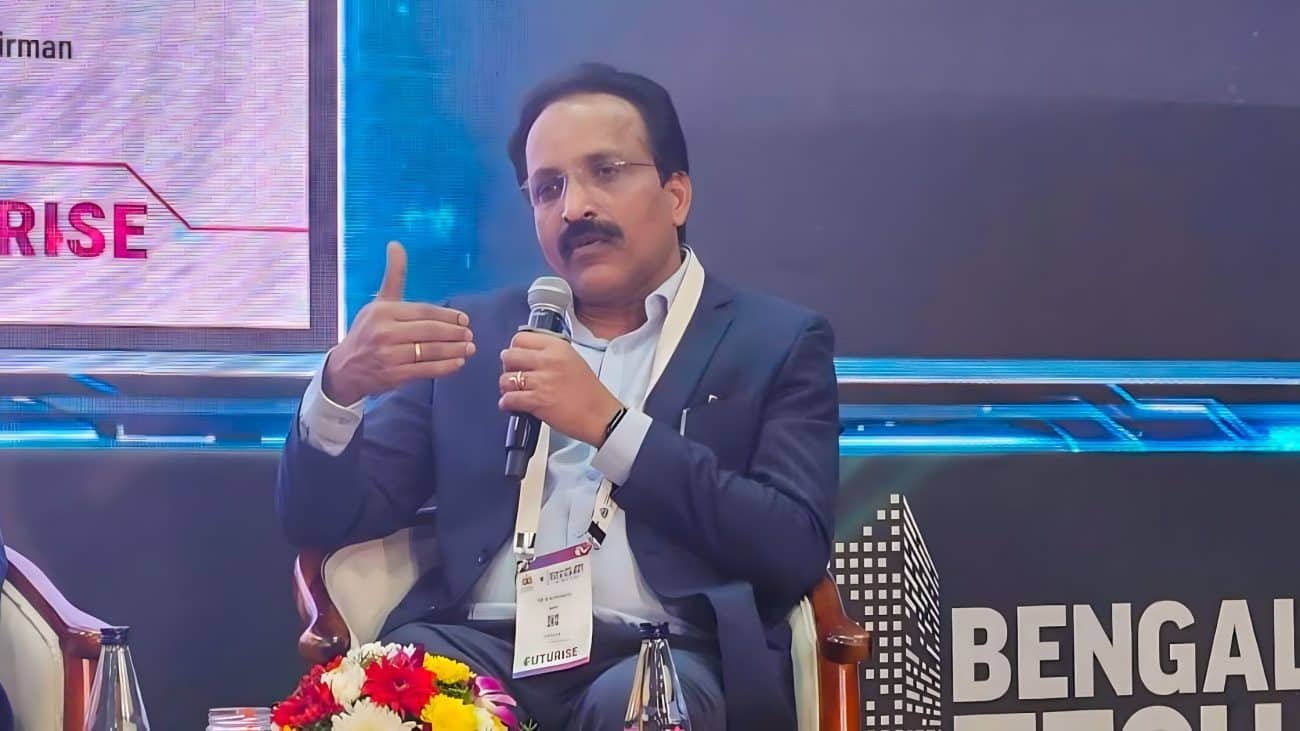
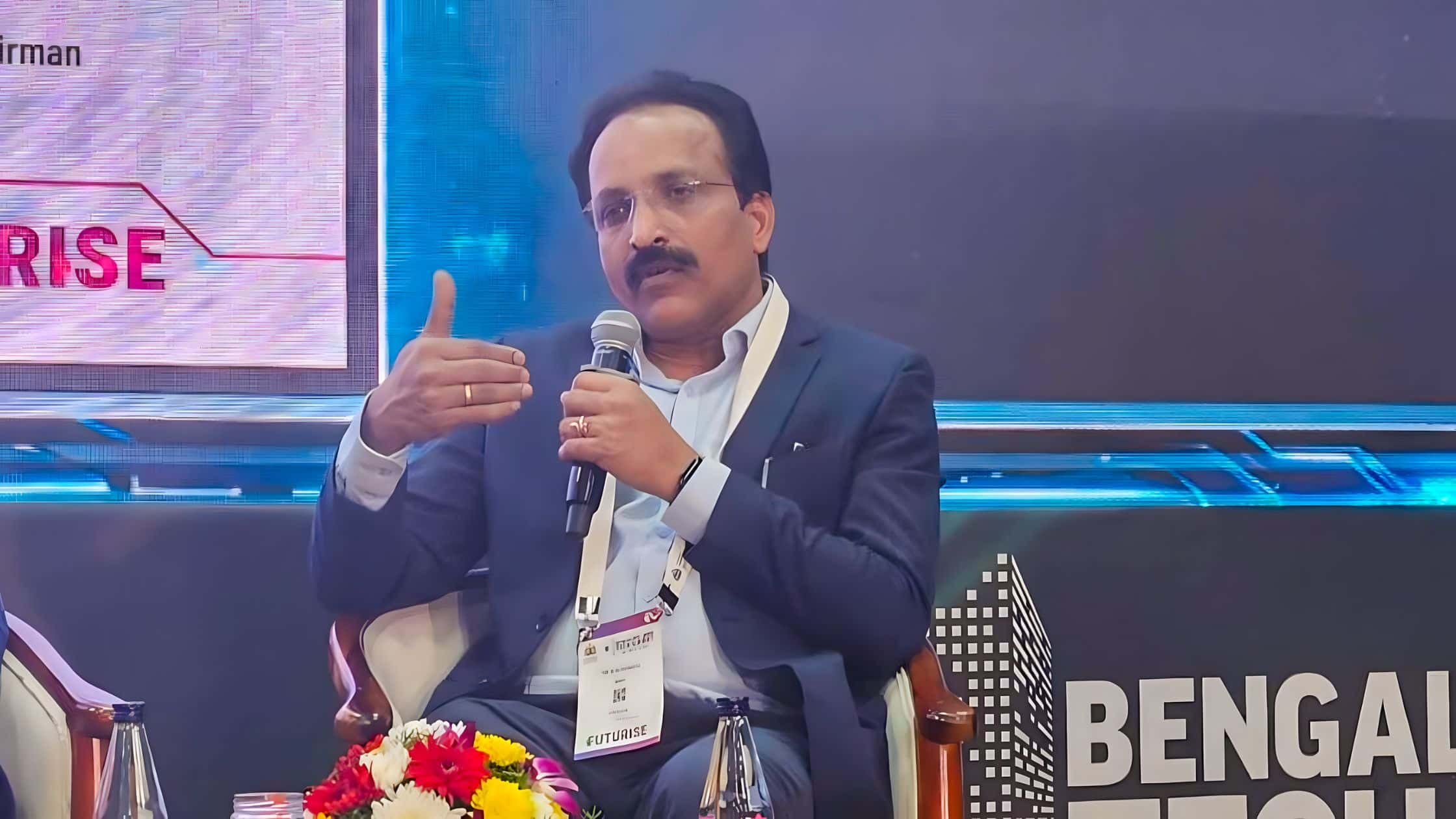
Former chairman of the Indian Space Research Organisation (ISRO), Dr Sreedhara Panicker Somanath, proposed that Mysuru be developed as India’s startup laboratory, according to state media reports.
“Let Mysuru be a place where startups co-create with labs, where internships matter as much as examinations and where technology policy is informed by evidence, ethics and empathy,” he said during the 106th convocation of the University of Mysore.
He highlighted the importance of developing the country’s technology across a wide range of fields, including space, semiconductors, biotechnology and clean energy production.
“There is a need for progress in emerging areas such as AI, quantum computing, brain-computer interfaces and synthetic biology. Graduates must recognise their roles across sectors, including food, medicine, healthcare and IT, and concentrate on these domains. The mindset should be one of collaboration: ‘We are not competitors but companions’,” Somanath reportedly stated.
He urged that universities should serve as crucibles for translational research—locations where discoveries transition from paper to prototypes and eventually to market-ready products, allowing students to learn through hands-on experiences at the forefront of innovation.
While Somanath acknowledged that the current educational programs at the university need to evolve, he indicated that this topic could be discussed in future sessions.
He emphasised the need to address long-standing gaps to unlock India’s potential and realise the vision of Viksit Bharat. He urged the academic community to collaborate with industry, government and civil society. He also praised ISRO’s successes with Chandrayaan, Mangalyaan, and Aditya-L1, stating, “Scientists and technologists are shaped within universities.”
The former pushed the need for comprehensive manufacturing ecosystems, supplier support, testing infrastructure and the integration of software and AI with advanced hardware.
He urged students to embrace emerging technologies such as artificial general intelligence to enhance learning, quantum computing for new cryptography and optimisation, and brain-computer interfaces for innovative experiences and rehabilitation.
The post ISRO Ex-Chairman Somanath Proposes Mysuru as India’s Startup Lab appeared first on Analytics India Magazine.
In 2025, NVIDIA took two hits that briefly disrupted the market’s confidence in its trajectory.
The first came early in the year with DeepSeek, which showed that a competitive large language model could be trained using far fewer GPUs than previously assumed, challenging expectations of ever-rising compute demand.
The second centred on Google’s TPUs.
While their technical maturity had long been understood, markets only fully registered their significance for specific neural network operations in 2025. The year saw Anthropic raise its TPU deployment targets, Meta reportedly explored TPU usage, and Gemini 3 Pro, the year’s most powerful frontier model, was trained entirely on TPUs.
NVIDIA also signalled it was responding directly to TPU-style competition by striking a roughly $20-billion deal with Groq, an AI-based application-specific integrated circuits (ASIC) company built around efficiency gains over GPUs.
Groq’s architecture, like TPUs, was designed for purpose-built AI workloads, particularly inference, and its founder, Jonathan Ross, was one of the original architects of Google’s TPU programme.
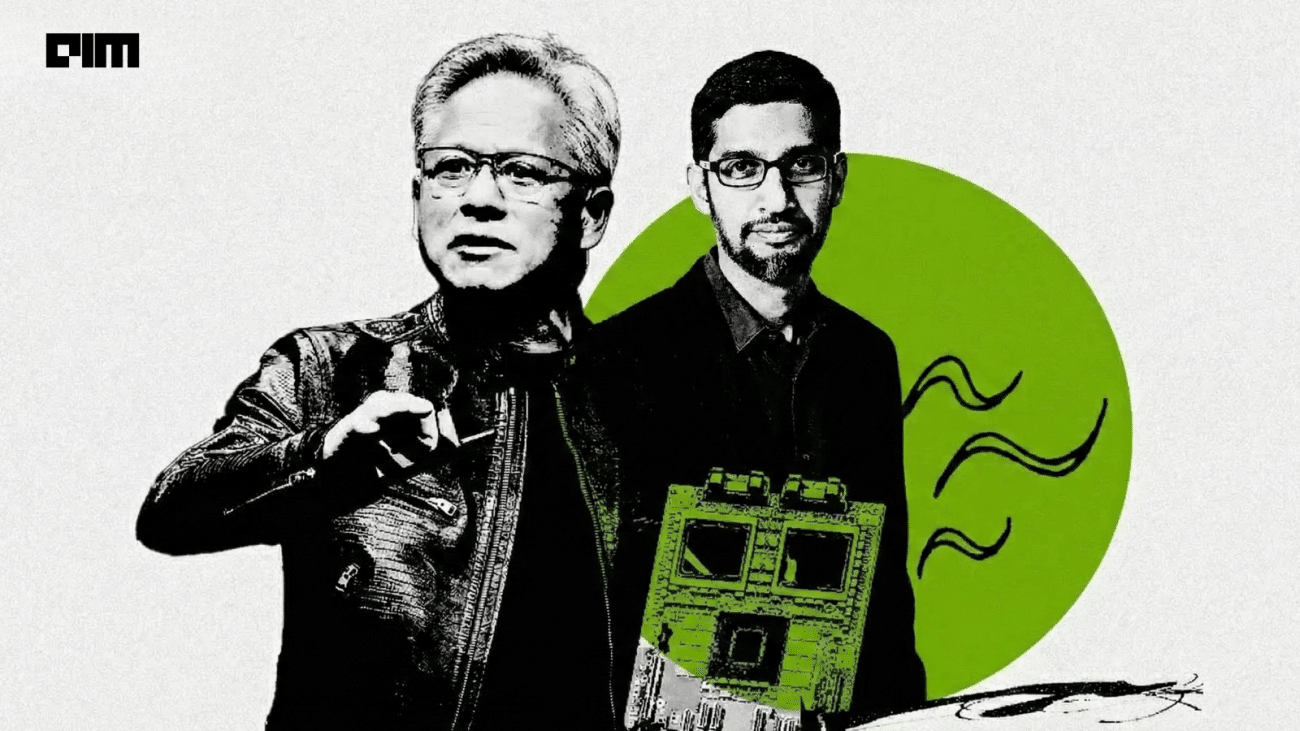
And if NVIDIA is to continue winning, it has to beat Google’s TPUs—an ASIC project even Jensen Huang has publicly praised as one of the strongest in the industry.
We’re delighted by Google’s success — they’ve made great advances in AI and we continue to supply to Google. NVIDIA is a generation ahead of the industry — it’s the only platform that runs every AI model and does it everywhere computing is done. NVIDIA offers greater…
— NVIDIA Newsroom (@nvidianewsroom) November 25, 2025
Where TPUs Win, and Why That’s Not Enough
It is worth examining where TPUs outperform GPUs, particularly given that Anthropic has placed $21 billion in TPU orders with Broadcom, which manufactures Google’s hardware.
According to research firm SemiAnalysis, TPU v7 Ironwood illustrates the shift clearly. While it delivers roughly 10% lower peak floating-point operations per second (FLOPs) and memory bandwidth than NVIDIA’s GB200 platform, signalling data movement struggles, it still offers a stronger performance-per-total-cost-of-ownership (TCO) profile.
Google’s internal cost to deploy Ironwood is about 44% lower than deploying an equivalent NVIDIA system, SemiAnalysis estimated. Even when priced for external customers, TPU v7 is estimated to offer around 30% lower TCO than GB200, and roughly 41% lower TCO than the upcoming GB300.
Yet these advantages don’t come easily. Achieving peak TPU efficiency requires deep compiler expertise, custom kernels, and careful model sharding.
Because of TPUs’ historically low-profile software ecosystem that was more Google-oriented, hitting the critical 40% model FLOPS utilisation (MFU) threshold for overcoming data movement bottlenecks demands specialised knowledge that relatively few organisations possess.
For years, TPUs were optimised primarily for Google’s preferred frameworks and tooling, while the broader ecosystem—particularly PyTorch and other popular open-source inference frameworks—lagged behind.
CUDA is King
GPUs, by contrast, have sustained their dominance largely because access has been thoroughly democratised through software. At the centre of this advantage is CUDA, the AI giant’s parallel computing platform.
Over time, NVIDIA has folded years of hardware-specific optimisation directly into mainstream AI frameworks such as PyTorch, so that performance gains are largely automatic rather than something users have to actively engineer. The practical result is that GPUs tend to deliver strong, predictable performance across a wide range of workloads without requiring specialised expertise.
GPUs are available across every major cloud, widely deployable on-premise, and backed by a software ecosystem that has matured alongside the modern AI boom.
“Right now, just about everyone starts their hands-on AI learning on GPUs,” said Jordan Nanos, an analyst at SemiAnalysis, in an interaction with AIM. “A small fraction of those people begin to use TPUs later in their career if they happen to work at the right company or go to the right school.”
CUDA is also supported by a large and active developer and research ecosystem, where new experiments, tools, and frameworks are continuously built, steadily expanding the GPU capabilities that developers can access.
That software moat remains a major reason why GPUs remain the default choice for both training and inference.
For most external users, TPUs still require more effort, more specialised knowledge, and greater organisational commitment to use effectively, despite their underlying cost and performance advantages.
How Anthropic Broke Through
Hardware design and cost advantages, however, can overcome software barriers—with the right expertise.
SemiAnalysis stated that Anthropic’s success stems from its team comprising ex-Google TPU and compiler engineers who understand both the hardware stack and their own model architectures at a deep level. This specialised talent allowed the company to navigate TPU complexity and extract the performance that makes TPU economics compelling.
The impact has been visible in production, as Anthropic’s release of Claude Opus 4.5 was accompanied by a roughly 67% API price cut over Opus 4.1, alongside improvements in token efficiency and lower verbosity.
“Both Gemini and Claude make it clear that frontier models can run training and inference on TPUs,” said Nanos, indicating that the chips, with the right amount of tooling and development, are ready to handle the most demanding AI workloads today.
Google also deployed TPUs for inference in earlier Gemini models, dating back to Gemini 1.5 Pro in 2024. Other companies that have confirmed TPU usage include Cohere, Apple, and Super Safe Intelligence.
“We believe that TPUs are a serious consideration for the largest companies with the largest compute needs in the world, such as OpenAI, Google, Anthropic, Meta, and xAI,” Nanos noted.
While Google Cloud remains the primary channel, the company is increasingly allowing TPUs to be deployed through third-party operators. Anthropic, for instance, is accessing TPUs via Fluidstack, which runs TPU clusters in data centres owned by providers including TeraWulf, Cipher Mining, and Hut 8.
Google is Working on It
Google is now actively working to close the software accessibility gap.
In December, Reuters reported that the company is developing an internal initiative named ‘TorchTPU’ to make TPUs natively compatible with PyTorch. Developed in close collaboration with Meta, the effort targets solving the mismatch between Google’s internally optimised software stack and the tools most AI developers already use.
In an interaction with AIM, Alan Ma, a Stanford engineer and the author of Unwrapping TPUs, said easy TPU adaptability can only be an advantage. “CUDA has been the bread and butter for a lot of these hardware optimisation techniques, but there is a need to go to a higher level of abstraction, which is what we are seeing with PyTorch.”
The goal is not to replace NVIDIA’s software stack, but to make TPU performance accessible through the same abstractions that made GPUs dominant in the first place. Even so, Nanos cautions that Google still has significant ground to cover if it were to target more customers. “I don’t believe that TPUs will be the default choice for AI until the entire open source developer community, starting primarily in academia, adopts TPUs,” he said.
Having said that, developer activity around TPUs on Google Cloud grew by 96% in just six months, according to Dainci Developer Dataset, indicating growing developer interest, even outside of Google.
The Heterogeneous Compute Big Bang
There is, however, another dimension to the TPU story.
“The trend that we’re seeing is OpenAI, Anthropic, and all these different labs are using as much compute as they can get,” said Ma.
OpenAI has active compute deals with NVIDIA and AMD, while Anthropic operates across NVIDIA GPUs, Amazon’s Trainium chips, and a growing proportion of TPUs. “A heterogeneous compute big bang is happening,” he said.
This also gives companies a basis to benchmark competing accelerators against one another.
“Every company wants to know the TCO—the amount of performance they get per dollar spent—of each of these chips. Then they buy the chips that give them the best TCO,” said Nanos.
That diversification, however, does not imply oversupply.
Carmen Li, founder and chief executive of Silicon Data, told AIM, “You can have 20 design houses on top,” but at the end of the day, there is effectively “one true fab” supplying advanced AI chips. As she put it, foundries are constantly deciding: “Should I give capacity to TPU production, media, or AMD?”
In other words, adding more TPU buyers does not create excess supply. It reshuffles how the manufacturing capacity—however scarce—is allocated. More companies turn to TPUs, GPUs, and custom accelerators not because the market is flush with chips; they are securing incremental compute wherever available.
The post What is Protecting NVIDIA from Google’s TPUs? appeared first on Analytics India Magazine.
Karnataka revenue minister Krishna Byre Gowda said the government is probing the sale of a 53.5-acre land parcel by Infosys in Anekal Taluk to real estate developer Puravankara, in a transaction estimated at around ₹250 crore.
Speaking to reporters, the minister said any further action would be based on the findings of the inquiry.
The development follows complaints and allegations concerning the sale and valuation of the land, including claims that the parcel may have been acquired under preferential terms and sold below prevailing market rates.
Infosys has disputed these claims, stating that the land was purchased at market value, was not allotted by the government, and that the divestment was carried out in compliance with internal policies, external approvals, and regulatory requirements.
Gowda’s office confirmed to AIM that an inquiry is underway and said that certain registration officials have been suspended, pending investigation.
While announcing the purchase in December last year, Puravankara, in a statement, said the acquisition aligns with its strategy to expand across Bengaluru micro-markets, supported by improved infrastructure, connectivity, and sustained end-user demand.
The real estate developer said the land parcel at Attibele Hobli in Bengaluru Urban district has a saleable area of 6.4 million square feet and a potential gross development value of over ₹4,800 crore. Mallanna Sasalu, CEO – South, Puravankara Limited, said, “Before this acquisition, during H1 FY26, we added a total of 6.36 million sqft of developable area in Bengaluru and Mumbai, with an estimated gross development value of ₹9,100 crore. The addition of another ₹4,800 crore brings the potential GDV (gross development value) to ₹13,900 crore and the developable area to 12.76 msft for the year to date.”
Reacting to the issue, Congress MP Karti P Chidambaram had said on X that land given at a concession for a specific purpose should not be sold commercially if that purpose was not fulfilled.
Venture capitalist Mohandas Pai, also responding on X, countered that the land was not government-allotted and had been purchased from the market.
The post Karnataka govt orders probe into Infosys land sale to Puravankara appeared first on Analytics India Magazine.