Infosys, AWS Partner to Speed Up Enterprise Use of Generative AI

Infosys announced a collaboration with Amazon Web Services (AWS) to accelerate enterprise adoption of generative AI. The partnership brings together Infosys Topaz and Amazon Q Developer to improve software delivery and internal operations across industries, the companies said in a statement.

The collaboration focuses on how Infosys will use AWS generative AI tools to enhance functions such as software development, human resources, recruitment, sales, and vendor management.

Sandeep Dutta, president for AWS India and South Asia, said the collaboration reflects a broader shift in enterprise technology adoption. “The combined strengths of Amazon Q and Infosys Topaz will help organisations innovate, achieve operational agility, and unlock differentiated value for their clients,” he said.

The initiative targets sectors including manufacturing, telecom, financial services, and consumer goods, with a global scope.

The Infosys Topaz integration with Amazon Q Developer includes automated documentation and support for code generation, debugging, testing, and modernisation of legacy systems. Infosys said the integration aims to streamline workflows, reduce timelines, and improve accuracy for development teams.

Balakrishna D. R., executive VP and global services head for AI and industry verticals at Infosys, said the partnership is changing how enterprises create value. “We are transforming our development cycles and enabling clients to rethink critical functions like HR, recruitment, and vendor management,” he said.

Beyond internal use, Infosys plans to deploy AWS generative AI services to build industry solutions. These include end-user engagement tools for sports and entertainment to deliver real-time, personalised experiences for large audiences.

The post Infosys, AWS Partner to Speed Up Enterprise Use of Generative AI appeared first on Analytics India Magazine.

GCCs are Automating in Plain Sight

Karnataka-as-the-Manufacturing-Hub-for-the-World_ShaliniKarnataka-as-the-Manufacturing-Hub-for-the-World_Shalini

The arrival of robotics in India is not being heralded by humanoids strolling through office corridors or high-profile innovation showcases. Instead, it is unfolding quietly—embedded in everyday operations, from cafeteria kitchens and utility rooms to facility floors—subtly reshaping how modern workplaces run, often without drawing attention to itself.

The Draft National Strategy for Robotics seeks to position the country as a global robotics leader by 2030, recognising its potential to transform productivity and operations at scale.

Robotics has also been identified as a priority sub-sector under Make in India 2.0, reinforcing its role in strengthening India’s integration into global value chains.

At the same time, global capability centres (GCCs) are undergoing a fundamental transformation. They are increasingly evolving into global hubs for AI, product engineering, cybersecurity and R&D. As the nature of work changes, expectations of workplaces are shifting too. Robotics is emerging as a quiet but powerful enabler of that transition.

“Earlier, everything was functional. Today, it’s about engagement and experience,” said Manish Mamtani, CIO at Compass Group India, which manages food and facilities services across hundreds of GCC campuses.

Compass Group is a world-leading B2B food and support services company. It has built deep traction in India’s GCC ecosystem, partnering with over 120 GCCs across 300 client sites and operating more than 270 dedicated GCC cafés.

This scale has translated into strong momentum, with the corporate segment recording a 51% CAGR between FY22 and FY25. Backed by over 200 curated food programmes tailored to enterprise workplaces, this segment is emerging as a key growth catalyst for the business over the next three to five years.

Why Robotics Found Its Way In

The case for robotics in GCC workplaces is not driven by novelty, but by necessity. Facilities management in India has long been vulnerable to workforce volatility—especially during harvest seasons, festivals or regional disruptions.

“There’s always a 10-15% gap,” Mamtani said. “That’s not something we can control.”

Robotics, however, offers predictability. Over the past year, Compass Group India has deployed 25 to 30 cleaning robots across client sites, with plans to scale this to nearly 250 robots. These machines handle repetitive, time-bound tasks, ensuring service continuity even when manpower availability fluctuates.

“We don’t say, buy a robot. We say, cleaning as a service,” Mamtani explained.

The distinction matters. Robotics is not sold as hardware but delivered as a managed outcome—where uptime, performance and integration into daily operations matter more than the machine itself.

Invisible Tech, Visible Impact

Across most GCC campuses, employees may not even notice robots at work—and that is entirely by design. Robotics is being deployed in ways that minimise disruption while maximising consistency—operating during off-hours, navigating predefined zones and working alongside human staff rather than replacing them.

Behind this seamless experience sits a complex orchestration layer. Compass has developed in-house capabilities to monitor robots remotely, manage maintenance and ensure they integrate smoothly into existing workflows.

The intelligence, Mamtani believes, lies in knowing when machines should take over and when people add more value.

Robotics is just one layer of a broader technology stack that is reshaping GCC workplaces. Sensors across HVAC systems, pumps, generators and utilities continuously feed data into AI models that learn, adapt and automate decisions.

“Just by observing data for six months, we’ve been able to auto-regulate systems and achieve 5-8% energy savings,” Mamtani noted.

These systems adjust comfort levels, energy usage and maintenance schedules without human intervention—creating workplaces that respond intelligently to usage patterns rather than fixed rules.

Over time, this automation reduces operational risk, improves sustainability and frees human teams to focus on higher-value work.

Cafeterias Were the First Signal

Notably, the earliest sign that GCC workplaces needed rethinking did not come from facilities or IT teams—but from cafeterias.

“Our biggest problem is that the café is becoming our choke point,” clients once told Compass, as GCC headcounts ballooned.

Rather than expanding real estate, Compass redesigned food services through digital platforms that optimised ordering, throughput and transparency. That thinking led to the creation of Foodbook, which addressed scale challenges without increasing physical footprint.

“What started as a food solution became an experience platform,” Mamtani said.

That same logic now underpins the adoption of robotics: solve constraints through systems, not space.

As GCC talent has shifted towards AI engineers, product managers and cybersecurity specialists, employee expectations have become more sophisticated. They want personalisation—but not at the cost of privacy.

“How can you anonymise my data but still give me a personalised experience?” Mamtani said, describing a common question from clients.

The answer lies in behavioural intelligence rather than identity-based profiling. Systems learn from usage patterns, what people choose, when they engage and how spaces are used, without collecting sensitive personal data.

This approach aligns with the increasing regulatory and trust expectations placed on GCCs handling global data and intellectual property.

While mega GCCs continue to dominate, Compass is seeing growing demand from smaller, specialised centres—teams of 150–250 people with very specific mandates.

“These nano GCCs have very specific expectations,” Mamtani said.

For them, robotics and automation are not optional add-ons but baseline requirements to operate efficiently with lean teams. Hybrid models—central kitchens, on-site services, automated cleaning and AI-led monitoring—allow these centres to punch above their weight.

Robotics and AI are also subtly shaping workplace wellness. Rather than imposing rigid health programmes, Compass uses data to offer gentle nudges—promoting healthier food choices, improving air quality and optimising comfort.

“We’re not competing with health apps,” Mamtani clarified. “We’re giving the right nudge.”

These interventions are designed to be almost invisible—felt more than noticed.

“What makes robotics in GCC workplaces remarkable is not its visibility, but its restraint. There are no grand announcements, no dramatic workforce disruptions,” Mamtani mentioned.

Instead, robots clean floors, AI tunes energy systems and data quietly optimises experiences—all while employees remain focused on building products, platforms and intellectual property.

India’s GCC story is no longer just about what work gets done here. It is about how intelligently that work is supported.

The post GCCs are Automating in Plain Sight appeared first on Analytics India Magazine.

Infosys to Deploy Cognition’s AI Software Engineer Devin for Enterprises

InfosysInfosys

Infosys has announced a collaboration with US-based Cognition to deploy Devin, described as the world’s first AI software engineer, across Infosys’ internal engineering operations and client engagements globally.

The partnership will combine Cognition’s agentic AI capabilities with Infosys Topaz Fabric, the company’s multi-layer agentic AI services suite that integrates infrastructure, models, data, applications, and workflows into a unified ecosystem.

In a statement, Infosys said the collaboration is aimed at accelerating software development, improving engineering productivity, and reducing time-to-market for global enterprises.

Infosys said it has been using Devin internally for the past six months and has seen improvements in engineering quality and efficiency.

As part of the collaboration, Devin will be integrated into Infosys’ internal engineering teams, embedded into client delivery models, and enabled for deployment within customer engineering environments.

The two companies will also work on shared engineering frameworks and enablement programmes to scale adoption across industries.

According to the companies, Infosys Topaz Fabric and Devin will be used to automate brownfield engineering, address technical debt, and support large-scale modernisation efforts, including the creation of virtual engineers to handle complex production and maintenance challenges.

Infosys added that industry-specific solutions, AI-native modernisation blueprints, and scalable engineering frameworks will be jointly developed to support secure, enterprise-grade adoption.

Infosys’ Financial Services practice is leading the first set of joint client engagements, deploying Devin across banking, payments, capital markets, insurance, and wealth management.

Scott Wu, founder and CEO of Cognition, in the statement said, “We are thrilled to collaborate with Infosys to bring the power of autonomous and agentic AI engineering to some of the world’s most complex enterprises.”
Wu added that Infosys’ Exponential Engineering offering perfectly complements Cognition’s mission to redefine how software is built.

“Infosys Topaz Fabric and Devin together offer unmatched capability from real-time developer augmentation to fully autonomous engineering execution. Infosys is the first large digital services and consulting firm to deploy agentic tools at this scale,” he explained.

“By combining Infosys’ deep industry expertise with our platform, we are enabling clients to dramatically accelerate time-to-market, enhance ROI and unlock a new era of engineering transformation.”
Calling it a significant step forward in accelerating AI value realisation for global enterprises, Salil Parekh, CEO and MD Infosys, said, “By integrating Cognition’s advanced agentic and autonomous engineering expertise with our industry leading domain and delivery capabilities, we are creating a differentiated value proposition for the market.”

“This synergy is further enhanced by Infosys Topaz Fabric, which will serve as a catalyst for modernisation and innovation for clients to achieve their strategic objectives,” he added.

The post Infosys to Deploy Cognition’s AI Software Engineer Devin for Enterprises appeared first on Analytics India Magazine.

Developers are in Existential Crisis, Thanks to Claude Code

Over the holidays, many got their first real taste of the advanced capabilities Anthropic’s Opus 4.5—its most advanced AI model designed for developers—brings to the table when paired with Claude Code. They were building personal tools, small apps, half-formed ideas turned into working software, and in some cases, even ‘saving marriages’.

For some developers, this was the first time software felt accessible rather than gated by years of training and professional rituals. But for those who get a fulfilling high using programming to build apps, debug code, and find elegant solutions through logical thinking, this felt more like withdrawal.

Andrew D, founder of crypto tax software platform Awaken Tax, posted on X that even though he has a lot of fun coding, he can’t help but feel depressed. “The skill I spent 10,000s of hours getting good at. Programming…Is becoming a full commodity extremely quickly,” he lamented.

This is shortly after Google principal engineer, Jaaana Dogan, drew wide attention with a post describing how dramatically AI has changed coding over the past year. “We have been trying to build distributed agent orchestrators at Google since last year… I gave Claude Code a description of the problem, it generated what we built last year in an hour,” she posted on X.

Dogan later clarified, “It’s not perfect and I’m iterating on it but this is where we are right now,” adding, “The idea of everyone building software intimidates people.”

This comes just a few days after AI researcher Andrej Karpathy posted about feeling behind as a programmer, voicing a common sentiment among developers who feel that they can do a lot more, but they do not know where to start.

“I have a sense that I could be 10x more powerful if I just properly string together what has become available over the last ~year and a failure to claim the boost feels decidedly like a skill issue,” he said.

A strange gloom is descending on developer circles.

On one hand, they are shipping faster than ever before with tools like Lovable and Replit. Side projects that once took weekends now take evenings. Entire products appear in a single sitting.

And yet, behind the speed and the thrill, there is a quiet discomfort. The blazing speed at which AI is being embedded into software engineering is forcing developers to confront an uncomfortable question: What’s the value of their programming skill now that anyone can create software easily?

“Unfortunately, I find coding with agents to be a lot more productive but a lot less fun and interesting,” Charlie Marsh from Astral wrote on X.

Dopamine Crash

The anxiety is not really about jobs disappearing overnight but about identity.

A developer from a generative AI startup in Bengaluru told AIM anonymously that while using Claude Code has made it easier to build agents for automating coding tasks, speeding up his workflow, he felt a sense of loss over his programming skills. He admitted that AI tools are making him question his own skills, as now anyone can create software, even if with a lot of slop code or bugs.

Adithya S Kolavi, founder of AI lab CognitiveLabs, also agreed with the sentiment. “Productivity increase is really good. But the dopamine hit that I used to get by solving problems with code is completely gone,” he told AIM.

He said that while it’s fun to ship fast with Claude Code, the “satisfaction is gained by the ability to ship stuff, but not the actual writing code bit.”

What makes Claude Code especially destabilising is that it works. Not in demos. Not in toy examples. In real projects. And it is especially problematic for developers in India.

Threat to Indian Jobs

Anjney Midha, venture partner at Andreessen Horowitz, recently said at Moonshots Podcast that India’s IT sector, which is expected to contribute 10% to the GDP, according to some estimates, will get vapourised by tokens.

“If you’re India, for example, where double-digit percentages of your GDP are literally IT services, what do you do when Claude and GPT-5 tokenize vast portions of that flow?” he pondered.

IndiaAI CEO Abhishek Singh had also earlier flagged the threat of AI coding tools for Indian IT firms while speaking at the Bengaluru Tech Summit 2025.

Code is now cheap, fast, and generated at a rate that is completely out of developers’ and companies’ ability to read, understand, or maintain it line by line. “That alone breaks a lot of our old intuitions about code quality,” said a developer on X. He added, “If the end product behaves correctly, the internal codebase matters far less than we have been taught to believe.”

Others argue that the quality of AI-generated code will only improve over time. Andriy Burkov, the author of The Hundred-Page Machine Learning Book, and with experience in software development in India and Ukraine, said on X, “There was software development before Claude Code with Opus 4.5, and there is software development after.”

Not Everyone is on the Same Boat

McKay Wrigley, founder of Takeoff AI, summarised the developers’ depression on X: “I’ll observe that software engineers with 10+ years of experience seem to be the worst here because they’ve devoted a decade+ to their craft, and it’s hard to accept that AI is democratising the creation of software.”

Many developers built their sense of worth around craft. Clean abstractions. Elegant functions. Perfect architecture. Claude Code does not care about how proud you feel reading your own code. It cares about whether the system behaves.

Tory Green, co-founder of decentralized computing network ionet explained why that matters. “You didn’t spend 10,000 hours typing syntax. You spent it learning what breaks at scale, where reqs lie, how systems decay, and how to feel when something ‘works’ but isn’t actually right,” he noted on X.

However, Jean-Francois Puget, director and distinguished engineer at NVIDIA, disagreed. “You are most probably much more effective than a Claude user without SWE skills. What you build with it is probably much safer than what they build,” he posted on X.

Tory Green, co-founder of ionet explained why that matters. “you didn’t spend 10,000 hours typing syntax. you spent it learning what breaks at scale, where reqs lie, how systems decay, and how to feel when something ‘works’ but isn’t actually right.”

Green, though, argued that Claude Code only works “while someone in the loop still recognises wrong.” Claude Code does not eliminate developers. It strips them down to the part that cannot be automated yet.

The unease seems to be real. Once you remove the grind, you also remove the illusion that the grind was the point. With advanced tools like Claude Code and Opus 4.5, that grind seems to be firmly in the past.

The post Developers are in Existential Crisis, Thanks to Claude Code appeared first on Analytics India Magazine.

Is OpenAI’s Gumdrop a Real Threat to Smartphones?

For more than a decade, smartphones have become a central element of our digital lives. Every notification, swipe, and tap has reinforced the idea that glass screens are the gateway to technology. But as AI systems become more conversational and context-aware, that assumption may start to change.

Many AI researchers argue that today’s interfaces feel like relics from the early computer era, and OpenAI appears to agree. It calls for a new interface.

According to a recent report by The Information, the AI company is developing a next-generation audio model alongside a dedicated AI device built primarily for voice interaction. Together, these efforts suggest OpenAI is rethinking how humans naturally interact with AI in everyday life.

What once seemed abstract is begening taking physical form. At CES 2026, several gadgets offered an early glimpse of AI emerging as the primary interface for consumer electronics.

OpenAI’s Audio Push Takes Shape

Against this backdrop, OpenAI’s hardware ambitions are coming into focus.

The company’s upcoming audio model, expected in early 2026, is said to deliver more human-like speech, manage interruptions smoothly, and engage in overlapping dialogue capabilities that remain out of reach for most current systems.

The initiative reportedly brings together multiple engineering, product, and research groups under a single audio-focused effort. The work is said to be overseen by Kundan Kumar, a former researcher at AI startup Character.AI.

Alongside the audio model, new details have emerged about OpenAI’s hardware plans. According to a post on X by an industry tipster who goes by the name Smart Pikachu, the project’s internal codename is “Gumdrop.”

The device is said to take the shape of a pen and is intended to serve as a third core device alongside smartphones and laptops. OpenAI reportedly envisions it as a simpler, more natural way to interact with AI in daily life, whether for taking notes, dictating ideas, or querying ChatGPT.

This development follows OpenAI’s acquisition of io, an AI hardware startup co-founded by former Apple design chief Jony Ive. The all-stock transaction announced in May 2025, valued the company at around $6.5 billion.

Smart Pikachu said the device was initially assigned to Luxshare, but the manufacturing partner is now expected to change following a dispute over production location. OpenAI reportedly does not want the device manufactured in China. Vietnam is emerging as the primary alternative, while the Foxconn facility in the United States is another option.

OpenAI already has a partnership with Foxconn to manufacture AI infrastructure hardware, announced on November 20.

The supply chain update suggests that three hardware concepts are currently under vendor review. One is a pen-like device, another is a portable audio device intended for use on the go, and a third concept that remains undisclosed.

At Emerson Collective’s ninth annual Demo Day in San Francisco, OpenAI CEO Sam Altman criticised existing devices for being overly distracting.

He compared using current devices and apps to walking through Times Square, overwhelmed by flashing lights, bumping into people, and constant noise, which he finds unsettling. He also criticised bright notifications and social apps for illustrating where modern devices go wrong.

“I don’t think it’s making any of our lives peaceful and calm and just letting us focus on our stuff,” Altman said. In contrast, he said OpenAI’s AI device would be more like “sitting in the most beautiful cabin by a lake, enjoying the peace and calm.”

Others have also tried to move beyond screens, with mixed results. Humane attempted this shift with Humane AI Pin, a wearable that relied on voice and gestures instead of a display. The product failed to gain traction, and the company has since shut down.

Meta, however, has a strong momentum through its partnership with Ray-Ban on smart glasses that embed AI-powered voice assistance, cameras, and audio into everyday eyewear. Meta’s chief AI scientist, Yann LeCun, believes that smartphones will be obsolete in the next 10-15 years.

Ambient AI Gains Momentum

CES 2026 highlighted how large tech companies are pushing AI deeper into everyday environment. Amazon announced Alexa+ integrations across third-party devices, including Samsung TVs, which will receive built-in support later this month, a first for Amazon’s latest AI assistant on non-Amazon televisions.

Google is expanding Gemini’s presence onto Google TV, positioning it as a living-room AI assistant that helps users control the TV and receive more interactive answers.

Lenovo also unveiled its vision for ambient AI with Qira, a personal AI agent that operates across PCs, smartphones, tablets, and wearables. Positioned as a shared intelligence layer, Qira aims to help users continue tasks seamlessly across devices, offering contextual assistance rather than constant prompts.

Startups are also entering the space. Neosapien is developing AI-powered wearables, while Wispr Flow is developing voice-first interfaces designed to reduce reliance on screens and keyboards.

Will Apple and Samsung Launch New AI device?

OpenAI’s device is unlikely to replace smartphones outright. However, it could reshape how users interact with technology by reducing dependence on screens, apps, and touch-based interfaces.

If AI assistants become ambient, conversational, and always available through dedicated hardware, phone makers risk losing control over the primary interface layer that has anchored their ecosystems for more than a decade.

Phone manufacturers could lose their grip on the main interface layer, which has been the core of their ecosystems for over ten years, if AI assistants become omnipresent, conversational, and constantly accessible on specific hardware.

“I don’t think we have an easy relationship with our technology at the moment,” Ive said during a conversation with Altmana at DEv Day 2025. He added that AI presents an opportunity to address the overwhelming feeling many users feel, rather than deepen it.

Established smartphone makers are responding quickly. Samsung Electronics said it plans to significantly expand Galaxy AI features across its devices, with much of the functionality powered by Google’s Gemini models. The company expects the rollout to grow from roughly 400 million devices last year to about 800 million smartphones and tablets by 2026.

Apple is also accelerating its efforts. According to a Bloomberg report, the company is targeting a spring 2026 rollout of a more conversational Siri through iOS 26.4, with support for handling multi-step requests and intelligence powered by Gemini models.

At WWDC 2026, Apple is expected to unveil iOS 27, expanding Apple Intelligence with new developer APIs, stronger on-device models, and capabilities such as real-time understanding of surroundings.

For now, smartphones are central. But as AI moves off-screen and into voice-based devices, the question is no longer whether the interface will change, but who will control it.

The post Is OpenAI’s Gumdrop a Real Threat to Smartphones? appeared first on Analytics India Magazine.

Keysight Rolls Out Software to Validate Safety-Critical AI

Keysight Technologies has launched AI Software Integrity Builder, a software solution to validate and maintain AI-enabled systems in safety-critical environments, including automotive.

The company said the tool addresses rising regulatory scrutiny, complex AI development cycles and the need for trustworthy deployment across the AI lifecycle. The solution supports AI development, real-world inference testing and ongoing monitoring to detect data drift and performance issues.

Keysight said the launch aims to help engineering teams shift from isolated testing methods to a unified AI assurance strategy, particularly for high-risk applications such as autonomous driving.

Thomas Goetzl, VP and GM of automotive and energy solutions at Keysight, said, “Standards and regulatory frameworks define the objectives, but not the path to achieving a reliable and trustworthy AI deployment.” He added that the company combines test and measurement expertise with AI validation to support safety evidence and regulatory alignment.

It helps engineering teams generate evidence of regulatory conformance and ensure safe behaviour during deployment, as standards such as ISO/PAS 8800 and the EU AI Act demand explainability and validation.

The company said the software analyses data quality to identify bias and gaps, explains model decisions to uncover hidden correlations and tests inference behaviour under real-world conditions. It also recommends improvements for future model iterations, essentially answering a core engineering question around how AI systems make decisions and whether they behave safely once deployed.

The solution also spans dataset analysis, model validation, inference-based testing and continuous monitoring. As per Keysight, this approach allows teams to diagnose dataset and model limitations while tracking how models perform in operational settings.

The post Keysight Rolls Out Software to Validate Safety-Critical AI appeared first on Analytics India Magazine.
The AI Foundry by Tredence in Chennai: A Workshop for Builders of Real-World AI 

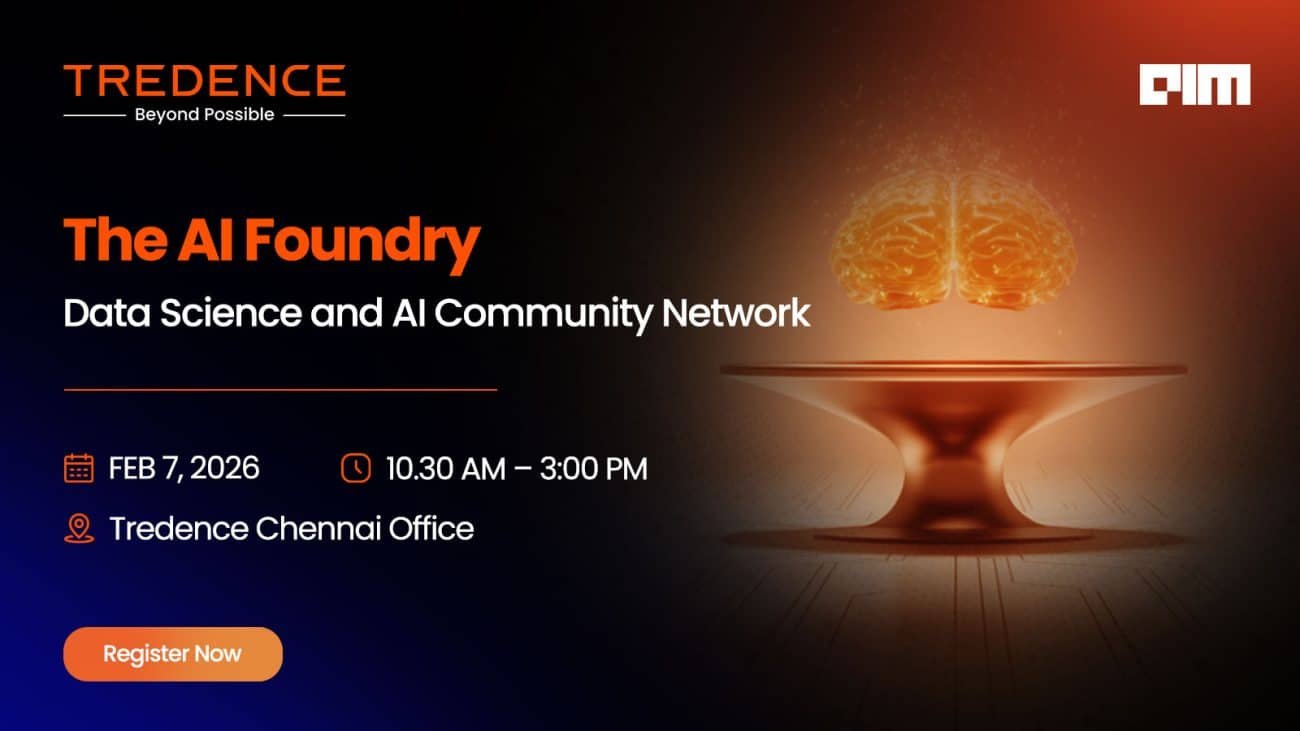
After a strong response in Bengaluru last year, The AI Foundry hosted by Tredence in association with AIM is heading to Chennai. On February 7, 2026, senior AI and data science professionals will gather for an invite-only developer workshop focused on one question that matters right now.

How do you move from experimenting with AI to actually building systems that work in the real world?

The AI Foundry is not designed as a conference or a talk-heavy meetup. It is a closed-door working session curated for people already building with generative and agentic AI. Hosted at Tredence’s office in Chennai, the workshop brings together a select group of practitioners to think through how modern AI systems are designed, orchestrated, deployed and monitored when the stakes are real.

Register Now!
Date: February 7, 2026
Time: 10.30 am – 3.00 pm
Location: Tredence Analytics Solutions Pvt, Global Infocity Park, Chennai

This edition brings together industry practitioners and a community that has closely tracked India’s journey in applied AI. The intent is simple: create a space where builders can go deeper than surface-level demos and marketing narratives.

Agenda Highlights

The theme of the session reflects Tredence’s internal philosophy of ‘Be The G.O.A.T. — The Greatest of AI at Tredence’. The focus is on fearless thinking, continuous learning and AI systems that deliver impact beyond hype.

Participants will explore how agentic architectures are changing the way teams design workflows, handle failures and scale intelligence across enterprise use cases.

Throughout the day, the workshop will focus on practical design questions. How do you structure agentic workflows for real-world scenarios? What does it take to architect and troubleshoot orchestration platforms when agents interact with data, tools and each other? How do teams think about scaling, deployment and monitoring once prototypes move into production environments?

Who Should Attend?

  • Data scientists
  • AI and ML engineers
  • Platform and cloud architects
  • LLM developers
  • AI product engineers
  • Technical leaders working hands-on with GenAI systems

This is an invite-only event. Registration does not guarantee confirmation. Final invitations will be shared after a screening process to ensure a focused and high-signal group.

The AI Foundry is positioned as a working room for people shaping the next phase of enterprise AI. For builders who have moved past curiosity and are now wrestling with execution, this Chennai edition promises a rare chance to learn, build and think alongside peers facing the same challenges.

Register Now!
Date: February 7, 2026
Time: 10.30 am – 3.00 pm
Location: Tredence Analytics Solutions Pvt, Global Infocity Park, Chennai

The post The AI Foundry by Tredence in Chennai: A Workshop for Builders of Real-World AI appeared first on Analytics India Magazine.