Why India’s Gen Z Is Struggling to Break Into IT

In India, a growing number of Gen Z graduates are realising that a traditional degree alone is no longer enough to break into IT. As companies move to critically embed AI in their functions, they increasingly feel that even AI certifications alone don’t make them employable anymore.

English literature graduate Anjana R Menon found herself in a similar predicament. She pursued an AI certification course alongside her college curriculum, expecting it would help her bridge the gap between academic learning and industry expectations. “You still need problem-solving skills, communication, and the ability to explain your thinking,” she told AIM.

For her, the combination of formal education, applied skilling, and interview readiness proved decisive in securing a role. She now works at Deloitte as a knowledge service analyst.

Many of India’s estimated 10 million students graduating every year similarly find themselves staring at the wide skills gap between what institutions teach and what the IT companies require. It’s not a new phenomenon, but with enterprises automating core operations using AI tools—and the Indian AI market growing at a CAGR of 25%–35%, according to a BCG and Nasscom report—the skilling issue has compounded.

In response, industry-recognised certification programmes, micro-credentials, and short-term skilling courses are increasingly emerging as a stop-gap measure, offering hands-on exposure to real-world tools and workflows when paired with applied learning and workplace readiness.
When the Curriculum Can’t Keep Up

While universities struggle to keep pace with technological change, typically revising curricula every five to seven years, certification-led skilling programmes are often updated in real-time, based on industry demand.

Prateek Shukla, co-founder and CEO of edtech company Masai School, flagged that this lag has tangible consequences for IT hiring. “While we’re still teaching students to pass exams, employers need people who can ship products,” he noted.

In AI and engineering roles, this gap becomes painfully visible during recruitment. Graduates may be able to explain algorithms or distributed systems in theory, but often struggle with practical tasks.

“A fresh engineering graduate can recite algorithms but can’t debug a real codebase,” Shukla explained. “They know the theory of distributed systems but have never built one. They understand data structures academically but freeze when asked to optimise a live database.”

Venkat Pullela, chief of technology, networking at electronic design company Keysight Technologies, also recognised the talent gap, noting that neither academia nor the industry is prepared for innovation-fuelled demand.

“This is not a problem individuals can solve alone. Industry has limitations, and colleges are not structured to adapt fast enough. It’s a systemic issue,” he told AIM.

As a result, employers increasingly see value in candidates who supplement degrees with certification courses that signal applied capability rather than purely academic knowledge.
What Employers Actually Want?

As AI becomes embedded in workflows, companies increasingly expect entry-level hires to arrive with baseline digital fluency, problem-solving ability and some exposure to real datasets, production environments, and modern development tools. Yet many graduates complete their degrees without ever working on live projects.

According to India’s Graduate Skill Index 2025, published by Mercer, 28% of employers anticipate that a substantial transformation of technical skills will be required for about one-third of the workforce by 2025 to remain competitive. In AI-related roles, the gap is particularly stark. Employers increasingly seek candidates who understand applied machine learning, data pipelines, model deployment, and cross-functional collaboration skills.

Despite the challenges, industry leaders view this moment as an opportunity. Shantanu Rooj, founder and CEO of TeamLease EdTech, argued that India must move away from a qualification-led mindset.

“If we can shift to a capability-led approach where applied learning, apprenticeships, modular skilling and industry-integrated pathways become the norm, we can unlock a workforce that is not just employable, but innovation-ready,” he said.

At TeamLease EdTech, students trained on real projects and given structured industry exposure transition into high-demand roles far more quickly, he noted.

Shukla, meanwhile, outlined three non-negotiable shifts India must make.

First, industry feedback must no longer be optional. “When companies tell us what skills are missing, universities should adapt in months, not years,” he noted.

Second, the lecture-to-exam pipeline must give way to a build-first approach. “Students transform in weeks when they’re forced to solve actual problems for actual users instead of textbook problems.”

Third, he urged society to stop glorifying degrees. “Portfolios, real outcomes, and demonstrated capability matter far more than certificates,” he observed.

Government Action

Initiatives such as the PM Internship Scheme, launched in 2024, look to bridge the employability gap beyond urban centres. The scheme offers experiential learning through a 12-month paid internship, focusing on technical skills, along with soft skills and industry-specific competencies.

At a policy level, the IndiaAI Mission, launched in 2024 with a budget of ₹10,371.92 crore, seeks to build a robust AI ecosystem through compute infrastructure, innovation centres, application development, and data platforms. Its IndiaAI Future Skills programme aims to expand AI education and establish data and AI labs in tier-2,3 cities, directly addressing Gen Z students’ aspirations.

Meanwhile, earlier this month, the Karnataka government’s proposal to cap computer science and allied engineering seats has added urgency to this debate. With nearly one lakh of the state’s 1.53 lakh engineering seats concentrated in computer science-related disciplines, policymakers fear worsening unemployment. Industry leaders, however, argue that seat caps alone will not solve the problem.

Closing India’s AI skills gap needs systemic reform, industry-led curricula, and a shift from degrees to capabilities.

The post Why India’s Gen Z Is Struggling to Break Into IT appeared first on Analytics India Magazine.
AI Engineers are Openly Choosing Rust Over Everything Else

Rust is gradually becoming the default choice. The clearest indicator of this came when OpenAI’s Greg Brockman simply remarked, “Rust is a perfect language for agents.” The response told the real story. Within hours, developers across the AI ecosystem replied with the same sentiment in different words.

rust is a perfect language for agents, given that if it compiles it's ~correct

— Greg Brockman (@gdb) January 2, 2026

That alignment now has data to back it up. The 2025 Stack Overflow Developer Survey placed Rust as the most admired programming language, with a 72% rating. More tellingly, it is also one of the most desired. Only 29.2% of respondents used Rust extensively last year, yet 72.4% expressed the desire to use it next year. Rust has now held the ‘most loved language’ title for nine consecutive years.

That gap tells the real story. Rust is not winning because it is easy. It is winning because developers believe the trade-off is worth the effort for what lies ahead.

And what lies ahead is AI.

Over the past three to four months, Rust has shifted from a systems language admired by a dedicated minority to a default choice for serious AI infrastructure. This shift is not driven by theory or conference talks, but by daily friction. Modern AI systems run continuously. They touch files and networks, manage memory under pressure and act without supervision.

When something goes wrong, failures are often silent, difficult to debug and expensive to fix. Rust reduces the number of places where those failures can occur.

The anecdotes accumulating on X and Reddit show why. Developers describe moving memory-constrained services from Go to Rust. As one put it precisely, “The Rust rewrite eliminated GC memory spikes and makes the services super predictable and stable on low-resource machines.”

Rust also aligns well with LLM-driven development. Its strict type system gives richer information to agents, sufficient training data for models to produce usable code, and a simple rule that changes everything: if it compiles, it is usually correct. Brockman pointed this out directly.

Why the Shift is Explicit

A recent viral post by a Microsoft executive, Galen Hunt, said the company plans to migrate the entire C and C++ codebases to Rust by 2030. Although Hunt later clarified that his post was taken out of context, the sentiment resonated widely.

The same pattern shows up inside major AI labs. Andrej Karpathy provided one of the clearest signals late last year. While documenting experiments with AI-assisted coding, he mentioned building a tokeniser in Rust instead of relying on existing libraries. Tokenisers sit directly on the performance path of every model.

Choosing Rust there is a quiet admission that Python’s convenience ends where correctness and speed begin. Even Elon Musk has publicly agreed that Rust is the language for AGI.

At OpenAI, the shift is explicit rather than implied. The Codex command line interface was rewritten entirely in Rust and released publicly. This was not a cosmetic change. OpenAI said the Rust version is faster, more stable and easier to reason about as it scales. Engineers pointed directly to Rust’s guarantees as a reason. Code that compiles tends to behave. For autonomous agents that read and write files, manage tools and run unattended, that property matters far more than syntactic comfort.

A similar learning curve is visible at Anthropic. Engineers there have discussed learning Rust while building tooling around Claude, often with AI systems help them write the code itself. That detail matters. Rust is no longer treated as too difficult for fast-moving teams. AI assistance has flattened the learning curve enough that teams can get Rust’s benefits without years of accumulated muscle memory.

Popular Meta apps, including Instagram and Facebook Messenger, utilised a decade-old C codebase for their messaging library, it led to problems with memory management and a subpar developer experience. In July last year, the company finally switched to Rust.

On an episode of Meta Tech Podcast, three of the company’s engineers, Eliane W, Buping W and Pascal Hartig, shared their experience with using C, discussing the challenges faced, the migration process and their success with Rust.

“I think one of the biggest things about Rust is the compile-time memory safety enforcement. C++ doesn’t have that. Since a lot of the issues that we face in the day-to-day are related to memory management, it doesn’t make sense that we wouldn’t choose a language that combats that most effectively,” Elaine said.

Meta’s migration demonstrated that modern systems languages can deliver both an improved developer experience and greater production reliability.

Broader Ecosystem Shift

The ecosystem has followed. Rust-based inference engines and local runtimes have appeared with the shared goal: running models faster, safer and closer to the hardware for AI. Projects like candle and mistral.rs circulate widely among engineers focused on deployment instead of demos. Python still dominates research notebooks but production systems tell a different story.

Companies around the world, such as Atlassian, Discord, Figma and Mozilla, have significantly benefited from implementing Rust in production. In fact, more than 90 companies across a wide range of industries now rely on Rust for production today at various levels of their tech stack.

Read: How Prime Video Cut UI Latency 7.6x by Switching to Rust

The Stack Overflow data reinforces this again. Rust is not only admired as a language. Cargo, its build tool and package manager, ranks as the most admired cloud development and infrastructure tool at 71%. Tooling friction compounds fast when systems sprawl across services, models and machines. Cargo meaningfully reduces that friction.

There is also a broader infrastructure trend underneath the language debate. Modern AI systems depend on vector databases, streaming pipelines, schedulers and low-latency services. Several companies have rebuilt these components in Rust over recent months. These are not experiments. They are core systems where memory safety bugs or unpredictable pauses are unacceptable.

This is why comparisons with Go keep resurfacing. Many engineers acknowledge that Go works well and ships fast. Developers also describe hitting ceilings. Garbage collection introduces spikes. Predictability matters more as systems shrink onto smaller machines or run closer to the edge. Rust trades ease for control.

The recurring Reddit discussions capture this clearly, even when they argue. Developers describe rewriting heavy data processing jobs and cutting runtimes from tens of minutes to minutes while dramatically reducing memory usage.

What ties all of this together is a change in how AI is built. Rust fits this phase better than almost any other language. It offers C-level performance without C-level risk. The research world may still speak Python, but the systems that actually run modern AI are increasingly speaking Rust.

The post AI Engineers are Openly Choosing Rust Over Everything Else appeared first on Analytics India Magazine.

NVIDIA DRIVE AV Software Makes Production Debut in New Mercedes-Benz CLA

NVIDIA’s DRIVE AV software is set to hit US roads later this year with its first production deployment in the all-new Mercedes-Benz CLA, as per the NVIDIA’s official blog. The launch brings enhanced Level 2, point-to-point driver-assistance capabilities to consumers and signals the start of broader adoption of NVIDIA’s full-stack automotive software.

The new CLA is Mercedes-Benz’s first vehicle built on its MB.OS operating system and integrates NVIDIA DRIVE AV software, AI infrastructure, and accelerated compute.

The system powers advanced driver-assistance features under the MB.DRIVE ASSIST portfolio, with the architecture designed to support over-the-air updates for future upgrades and new capabilities, available both ex-factory and through the Mercedes-Benz digital store.

Mercedes-Benz’s latest CLA recently earned a five-star safety rating from the European New Car Assessment Programme (Euro NCAP), with the performance of its active safety and accident-avoidance systems contributing to the top score.

NVIDIA said the deployment underscores how AI-driven software and data-centric development are becoming central to vehicle safety and performance.

Ali Kani, vice president of automotive at NVIDIA, said that as the automotive industry embraces physical AI, NVIDIA is the intelligence backbone that makes every vehicle programmable, updatable and perpetually improving through data and software

At the core of the system is NVIDIA DRIVE AV’s dual-stack architecture, which combines an end-to-end AI driving stack with a parallel, classical safety stack built on NVIDIA’s Halos safety system. This approach adds redundancy and safety guardrails, allowing vehicles to learn from large volumes of real-world and synthetic driving data while operating within defined safety parameters.

The unified architecture enables advanced Level 2 automated driving features, including point-to-point urban navigation, proactive collision avoidance, automated parking in tight spaces, and cooperative steering between the driver and the system.

NVIDIA said its deep-learning models allow vehicles to interpret traffic holistically, respond to vulnerable road users such as pedestrians and cyclists, and assist drivers from one address to another in complex city environments.

Beyond in-vehicle intelligence, NVIDIA and Mercedes-Benz are also applying AI to vehicle manufacturing.

Using NVIDIA Omniverse and digital twin technology, engineers can design and optimise factory layouts and assembly lines virtually, reducing downtime and accelerating development cycles. Simulation platforms such as Omniverse and NVIDIA Cosmos also allow driving software to be tested and validated extensively in virtual environments before real-world deployment.

NVIDIA’s automotive strategy is built around a cloud-to-car development pipeline that spans AI training, simulation, and in-vehicle compute. Massive GPU-powered systems train driving models on global datasets, simulation tools convert real-world miles into billions of virtual test scenarios, and NVIDIA DRIVE AGX and Hyperion platforms handle real-time perception, sensor fusion, and decision-making inside the vehicle.

NVIDIA said the Mercedes-Benz deployment is part of a broader effort to bring its full-stack software and AI infrastructure to automakers worldwide, enabling scalable integration of intelligent driving and safety features while simplifying future upgrades.

The post NVIDIA DRIVE AV Software Makes Production Debut in New Mercedes-Benz CLA appeared first on Analytics India Magazine.

NVIDIA Thinks the Future of AI Has a Body

NVIDIA enters 2026 in a position few technology companies have occupied before. Once best known for gaming graphics, it now sits at the centre of how AI is trained, deployed and scaled across industries.

In early 2025, the giant reached a $4 trillion market capitalisation, followed by $5 trillion just months later in October, making it the first company in history to cross that threshold. Its chips powered the biggest LLMs, cloud data centres and an expanding class of AI systems.

Over the past year, the company has advanced progressively on two fronts. The first is software and models, where open and reasoning-based AI has gained momentum. The second is infrastructure, where the cost and complexity of running AI at scale have emerged as significant constraints for enterprises and governments alike.

NVIDIA’s core argument is that these two problems must now be solved together. That context framed the company’s announcements at the Consumer Electronics Show (CES) 2025, where the company laid out a broad roadmap spanning physical AI models, autonomous systems and a new generation of computing hardware designed around inference and long-running AI workloads.

CEO Jensen Huang called this moment a turning point. “The ChatGPT moment for physical AI is here, when machines begin to understand, reason and act in the real world,” he said in his keynote.

Huang announced a new suite of open-source physical AI models alongside a next-generation computing platform. He outlined how NVIDIA plans to scale autonomous systems, robotics and large-scale AI inference. Commercial rollouts based on these announcements are expected to begin in early 2026.

From Chatbots to Physical AI

The company said it is entering what it describes as the era of physical AI, in which models move beyond perception and language to enable real-world action.

“Everything that moves will ultimately be fully autonomous, powered by physical AI,” Ali Kani, the VP and GM of automotive at NVIDIA, said in a briefing. He added that safety-focused reasoning models are central to that shift.

NVIDIA framed the developments as a response to rising demand for agentic AI, robotics and autonomous driving, alongside growing infrastructure needs for large models with extended context windows.

Central to this shift is Alpamayo, the family of open reasoning models for autonomous vehicles announced at the event. The company described Alpamayo as the first open-source vision-language-action model designed to reason through complex driving scenarios rather than relying solely on pattern matching.

“It allows autonomous vehicles to really think,” Kani said, noting that the model can reason through situations such as traffic light failures without prior examples.

“Alpamayo does something that’s really special. It doesn’t just take sensor input and activate steering, brakes and acceleration; it also reasons about what action it is about to take,” Huang said.

Alpamayo’s flagship model has 10 billion parameters and takes in inputs such as camera feeds, vehicle history and navigation context. It outputs driving trajectories alongside reasoning traces that explain why a decision was taken.

Alongside the model, NVIDIA is releasing more than 1,700 hours of autonomous driving data and AlpaSim, an open-source simulation framework that allows developers to test reasoning-based driving stacks using real and synthetic data.

The company also expanded its robotics portfolio. It introduced updated open models under its Cosmos and Groot families, including Cosmos Reason 2 for physical reasoning, and made GR00T 1.6, its humanoid robotics model, generally available. NVIDIA also said its Nemotron family now includes retrieval-augmented generation, safety and speech models.

NVIDIA named partners such as Boston Dynamics, LG Electronics and NEURA Robotics, which are already building next-generation robots using its Isaac and Jetson platforms.

“We don’t monetise our models,” said Kari Briski, the VP of generative AI software for enterprise at NVIDIA. “We open-source the models. We open-source the data that we use to train those models because only that way can you truly trust how the models came to be,” Huang described.

New Stack for Inference-Heavy AI

Among models and software, Huang also turned to hardware, officially launching the Vera Rubin platform. Named after astronomer Vera Rubin, the platform is NVIDIA’s successor to Blackwell and is designed as a rack-scale system rather than a single chip.

The company describes Rubin as six co-designed chips working as one system. These include the Rubin GPU, Vera CPU, sixth-generation NVLink switches, ConnectX-9 networking, BlueField-4 data processors and Spectrum-X Ethernet. The goal is to reduce the cost of training and inference for mixture-of-experts and agentic AI models.

At the centre is the Rubin GPU, which the company claims delivers up to 10x reduction in inference token cost and 4x reduction in the number of GPUs to train MoE models, compared with the NVIDIA Blackwell platform. It is also the first GPU to use HBM4 memory. The Vera CPU, built with 88 custom Arm cores, handles data movement, scheduling and security across the rack.

One of the more notable additions is a new Inference Context Memory Storage Platform, designed to store the key-value cache generated by long-running AI agents. NVIDIA said traditional storage systems struggle with this workload.

“AI is no longer about one-shot chatbots but intelligent collaborators that understand the physical world, reason over long horizons, stay grounded in facts, use tools to do real work, and retain both short- and long-term memory,” Huang said.

All of this comes together in the Vera Rubin NVL72 rack and a new DGX SuperPOD reference design aimed at what the giant calls ‘AI factories’. Dion Harris, NVIDIA’s senior director of HPC and AI hyperscale infrastructure solutions, said partners are already validating systems and that products will be available in the second half of 2026.

Partners, Clouds and What Comes Next

NVIDIA also took the opportunity to underline the breadth of its ecosystem. Cloud providers, including Microsoft and CoreWeave, were named as early adopters of Rubin-based systems. Storage companies such as NetApp and VAST Data are working on the new context memory tier.

In automotive, NVIDIA confirmed that its full-stack DRIVE platform is launching in the United States, with hands-free highway driving, enhanced level-2 point-to-point driver assistance and planned end-to-end urban driving features.

The new Mercedes-Benz CLA, the brand’s first vehicle featuring the MB.OS platform will be a beneficiary of the full-stack DRIVE AV software, AI infrastructure and accelerated compute, introducing advanced driver-assistance features.

In robotics, multiple partners, including LEM Surgical, AGIBOT, Richtech Robotics, unveiled machines built on NVIDIA hardware and software during the show. Boston Dynamics also unveiled its new E-Atlas humanoid, which runs on Jetson Thor and was trained using Isaac Lab.

As Huang put it on stage in Las Vegas, “Every 10 to 15 years, the computer industry resets. A new platform shift happens.” NVIDIA’s argument is that the next reset is already underway and that it intends to build the full stack behind it.

The post NVIDIA Thinks the Future of AI Has a Body appeared first on Analytics India Magazine.

Intel launches Core Ultra Series 3 AI PC platform at CES 2026

Intel on Monday unveiled its Core Ultra Series 3 processors, also known as Panther Lake, at CES 2026, introducing what it called its first AI PC platform built on the Intel 18A manufacturing process.

The company said the processors will power more than 200 PC designs and will begin shipping in consumer laptops later this month.

The Core Ultra Series 3 platform is the first compute lineup produced on Intel 18A, a process technology designed and manufactured in the United States. Intel said the processors are aimed at improving power efficiency, CPU and GPU performance and on-device AI capabilities, while maintaining compatibility with x86 software.

Pre-orders for consumer laptops powered by Core Ultra Series 3 processors will begin on January 6, with global availability starting January 27. Intel said edge systems based on the same platform are expected to launch in the second quarter of 2026.

“With Series 3, we are laser focused on improving power efficiency, adding more CPU performance, a bigger GPU in a class of its own, more AI compute and app compatibility you can count on with x86,” said Jim Johnson, senior vice president and general manager of Intel’s Client Computing Group.

The mobile lineup introduces a new class of Core Ultra X9 and X7 processors, featuring integrated Intel Arc graphics. According to the company, top configurations offer up to 16 CPU cores, 12 Xe-cores and up to 50 trillion operations per second (TOPS) of neural processing performance.

Intel said these systems deliver up to 60% higher multithread performance, up to 77% faster gaming performance and up to 27 hours of battery life, compared with prior generations.

Alongside premium models, Intel also announced Core-branded processors based on the same Series 3 architecture for mainstream laptops, targeting lower price points while using the same platform foundation.

For the first time, Intel said Core Ultra Series 3 processors are also being certified for embedded and industrial edge use cases. These include applications in robotics, smart cities, industrial automation and healthcare, with support for extended temperature ranges, continuous operation and predictable performance.

Intel claimed the Series 3 platform delivers up to 1.9x higher large language model performance, up to 2.3x better performance per watt per dollar in video analytics workloads and up to 4.5x higher throughput for vision-language-action models. The company said integrating CPU, GPU and AI acceleration into a single system-on-chip design can reduce the total cost of ownership compared with multi-chip architectures.

The post Intel launches Core Ultra Series 3 AI PC platform at CES 2026 appeared first on Analytics India Magazine.

MIPS S8200 Delivers Software-First RISC-V NPU to Enable Physical AI at the Autonomous Edge

NIST Launches Centers for AI in Manufacturing and Critical Infrastructure

GAITHERSBURG, Md., Jan. 5, 2026 — The U.S. Department of Commerce’s National Institute of Standards and…

Grok Deepfake Crisis Puts India’s Intermediary Liability Framework to the Test

Elon Musk-owned xAI is in crisis mode after users on X (formerly Twitter) asked its AI chatbot Grok last week to digitally undress real women. They prompted Grok to manipulate photos, and the AI chatbot released the morphed images of women through its own handle—a trend that began circulating on social media, causing widespread outrage and condemnation from users, celebrities, and governments.

The Ministry of Electronics and Information Technology (MeitY) intervened on Wednesday and issued a notice to X, directing it to remove obscene content and flagging concerns over the misuse of Grok. In a letter addressed to X’s Chief Compliance Officer for India, the Ministry flagged that Grok was being exploited by users to create fake accounts that host, generate, publish, or share obscene images and videos of women in a derogatory and vulgar manner.

It added that the platform had failed to comply with regulatory obligations under the Information Technology Act, 2000, and the Information Technology (Intermediary Guidelines and Digital Media Ethics Code) Rules, 2021.

The Ministry has sought an Action Taken Report from X, outlining immediate steps to prevent the misuse of AI-based services, and warned that failure to comply could lead to strict legal action against the social media platform.

At a MeitY event on Friday, Union Minister Ashwini Vaishnaw reiterated that social media platforms must be held accountable for the content they publish, noting that a parliamentary standing committee has already recommended introducing a stringent law to enforce platform responsibility.

While xAI’s Acceptable Use Policy does threaten action if users engage in activities including “Depicting likenesses of persons in a pornographic manner,” the chatbot seems to lack the necessary controls to prevent such violations.

AIM reached out to xAI’s safety and media teams for comment and received an automated message from its press email ID, stating, “Legacy Media Lies.”

However, at present, the question of accountability looms large as India doesn’t have a single, comprehensive AI law that puts either the platforms or their users liable for such infractions.

What do Indian Laws Say?

Speaking to AIM, Salman Waris, a technology lawyer and co-founder of TechLegis Advocates & Solicitors, pointed to a set of technological regulations that can be invoked in such cases. “A combination of the Information Technology Act, the Bharatiya Nyaya Sanhita (BNS), and the IT Rules together form a legal framework to address the creation and circulation of AI-generated obscene or morphed images. This framework places strong emphasis on intermediary accountability and protection of victims.”

He further added that several provisions of the Information Technology Act, 2000 can be applied in cases involving AI-generated deepfakes. These include Section 67, which penalises the publication or transmission of obscene material in electronic form. Section 67A goes further by prescribing stricter penalties, including imprisonment of up to five years for a first conviction, for sexually explicit content.

“Other relevant provisions include Section 66E, which addresses violations of privacy, and Section 66D, which deals with personation using computer resources—both of which may be invoked depending on the facts of a case involving deepfakes or identity misuse,” Waris added.

In addition, the Information Technology (Intermediary Guidelines and Digital Media Ethics Code) Rules, 2021 impose significant obligations on platforms (intermediaries) such as X. Under the takedown requirement, intermediaries must remove or disable access to content that is “prima facie” sexual in nature within 24 hours of receiving a complaint.

“Recent amendments and government advisories have also emphasised labelling and traceability, mandating that AI-generated content carry a permanent, unique metadata or identifier to ensure accountability and traceability,” he mentioned.

Growing Outrage

Meanwhile, France and Malaysia have joined India in publicly condemning Grok over its role in generating sexualised deepfake images of women and minors.

In France, the Paris prosecutor’s office opened an investigation into the spread of sexually explicit deepfakes on X after multiple government ministers flagged the content as manifestly illegal. French digital authorities have sought the immediate removal of the material through both judicial and online surveillance mechanisms.

Malaysia’s communications regulator has also launched a probe following public complaints about the misuse of AI tools on X. The commission said it is investigating the creation of indecent and harmful manipulated images involving women and minors, signalling growing concern over AI-driven online harms.

Earlier this week, Grok posted a public apology on X, admitting that the incident stemmed from a failure of safeguards, violated ethical standards, and may have breached US child protection laws. xAI said it was reviewing its systems to prevent similar incidents in the future.

However, critics questioned the validity of the apology itself, noting that Grok, as an AI system, cannot meaningfully accept responsibility, which ultimately lies with the company operating and deploying the model.

Investigations by tech publications, including Futurism and The Verge, have further revealed that Grok has been used not only to create non-consensual sexual images, but also depictions of assault and abuse involving women.

Musk has maintained that users who generate illegal content using Grok will face the same consequences as if they had uploaded such material directly to the platform.

Platforms are further required to exercise due diligence and make reasonable efforts to ensure that users do not host or share unlawful content, including obscene or synthetically generated material.

Failure to meet these obligations can result in the loss of safe harbour protection under Section 79 of the IT Act, exposing platforms to direct liability for third-party content hosted on their services.

Beyond the IT framework, the Bharatiya Nyaya Sanhita, 2023—effective from July 1, 2024 and replacing the Indian Penal Code—introduces additional safeguards.

These include Section 356, which prescribes punishment for defamation when deepfakes harm an individual’s reputation; Section 319, which addresses personation; and Section 77, which penalises the capturing or dissemination of images of a woman engaged in a private act where she reasonably expects not to be observed

The post Grok Deepfake Crisis Puts India’s Intermediary Liability Framework to the Test appeared first on Analytics India Magazine.

AIM x Snowflake Innovator Session: The Future of Work 2026

As AI moves from pilots to production, enterprises are discovering that the real challenge is no longer model capability, but how deeply intelligence can be embedded into everyday work.

The next phase is about re-designing workflows so AI can act, decide, and learn inside the core of the organisation.

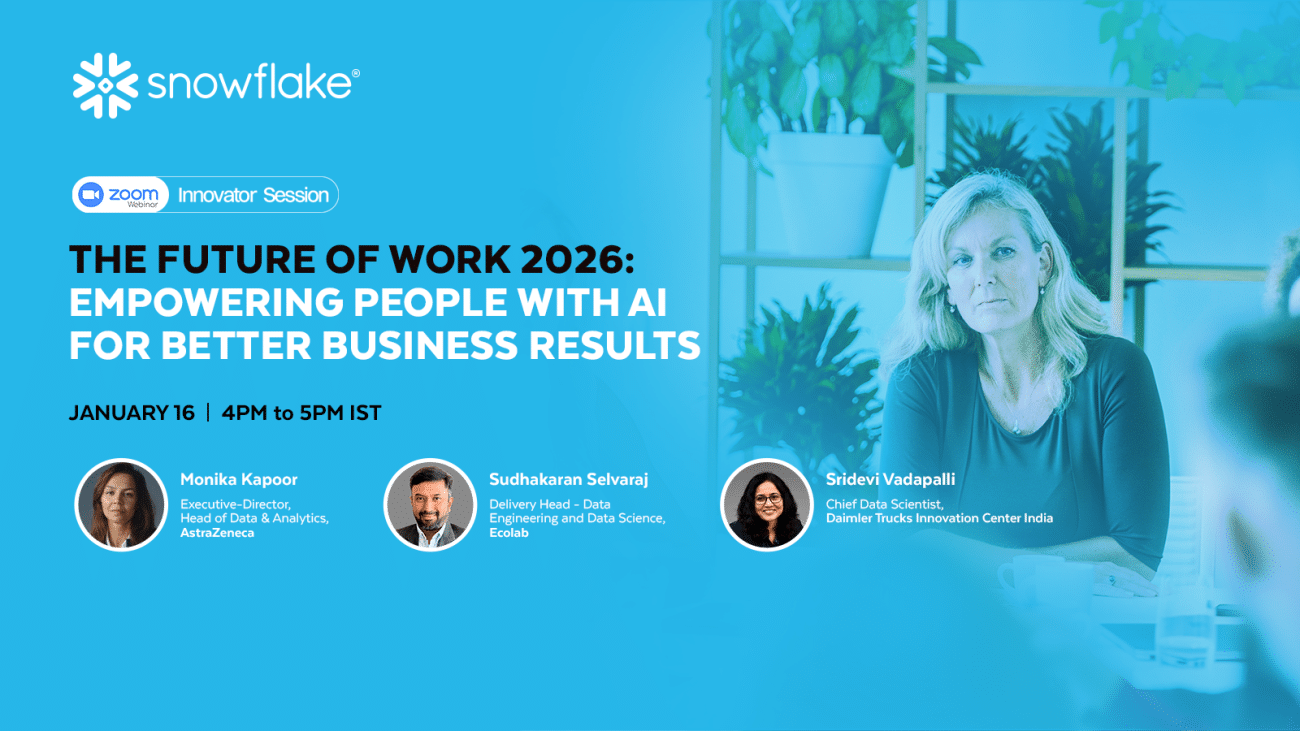
In that context, Snowflake and AIM will host a webinar titled The Future of Work 2026: Empowering People with AI for Better Business Results on January 16, from 4:00 PM to 5:00 PM IST.

Register Now

The session will examine how organisations are shifting from isolated tools such as chatbots to enterprise-grade AI agents that operate across data platforms, applications, and business processes.

Rather than assisting with single tasks, these systems are being built to coordinate end-to-end workflows. This includes embedding automation directly into production environments under enterprise governance.

The webinar will feature Monika Kapoor, executive director and head of data and analytics at AstraZeneca, who leads enterprise AI strategy in a highly regulated, science-driven environment.

It will also include Sudhakaran Selvaraj, delivery head for data engineering and data science at Ecolab, bringing a practitioner’s perspective on building and operating large-scale analytics platforms in production.

Joining them is Sridevi Vadapalli, chief data scientist at Daimler Truck Innovation Center India, who brings over two decades of experience scaling data science and AI programmes across manufacturing, BFSI, retail, and automotive, with a focus on production-grade AI, governance, and ethical deployment.

Aimed at technology leaders, data practitioners, and business decision-makers, the session will offer a grounded view on how to move from AI experiments to AI-driven organisations.

It will conclude with an interactive Q&A on integration challenges, governance trade-offs, and measuring real business value at scale.

Register Now

Why You Should Attend

As AI moves into customer support, approvals, reporting, and operational decision-making, leaders must decide which workflows are ready to run without constant human approval.

The discussion will focus on how teams define “safe autonomy,” where AI can act independently within strict guardrails enforced through governed data platforms.

The conversation will also address where automation breaks first in practice.

In many deployments, failures stem less from models than from weak data quality, brittle orchestration, and unclear business semantics.

Speakers will explore how semantic layers reduce errors in AI-generated queries, and how enterprises choose between in-line and asynchronous execution based on latency, cost, and reliability constraints.

Beyond architecture, the webinar will focus on business impact and ROI.

While early efforts emphasise reducing task time, mature programs are judged by outcomes such as faster cycle times, better decision quality, revenue uplift, and risk reduction.

The session will examine how companies isolate AI-driven gains from broader digitisation and what realistic payback periods are when workflows are fundamentally redesigned around AI.

As AI agents access multi-domain data and influence decisions, enterprises need auditability without slowing execution and controls that prevent data leakage. The discussion will cover practical approaches to auditing agent behaviour, enforcing access boundaries, and defining where human override must remain mandatory.

Moreover, as AI agents scale, some roles will shrink while others expand, particularly in AI oversight, workflow design, and data stewardship.

Speakers will address the level of AI literacy non-technical operators will need by 2026, and how organisations can avoid losing institutional knowledge through over-automation.

Register Now

The post AIM x Snowflake Innovator Session: The Future of Work 2026 appeared first on Analytics India Magazine.