Meet The AI Expert Who Tested Bangla on GPT

In 2019, Irene Solaiman was the first few people who started questioning and working on the social impact and bias research of large language models (LLMs). In an exclusive interview stating her Bangladeshi heritage she told AIM, while she was at OpenAI, she “started prompting GPT-2 and GPT-3 in Bangla.”

“To my knowledge, this is the only test in a non-Latin character language from an OpenAI publication. Google has started doing the same for Bard. I’m not sure where this correlation comes from, but researcher representation goes a long way,” she added.

Currently, Solaiman is the Policy Director at Hugging Face and a big part of her heart is in research; which is safe, ethical, and responsible to different cultural groups. After studying human rights policy, Solaiman realized reading human rights violations 12 hours daily is draining. So she learned to code and went straight from graduate school to OpenAI which was transitioning from a nonprofit.

Value Misalignment Paradox

Solaiman loves ‘Star Trek: The Next Generation’. She said, “We should be cognizant of dangers, but also dystopian novels. Several times they reflect historical events, and it’s important to refer back to them as opposed to sci-fi.”

She suggested, to ground ourselves in how people use systems, the effects of systemic issues, and how AI can be used to create goodness but also exacerbate social inequity.

The safety expert is not a fan of the solution-oriented language and states that the cultural value alignment is never going to be solved. “We’re always going to be figuring out how to empower different groups of people. When you treat a group of people as a whole you’re going to be hearing the loudest the people with the most platform or privilege. The feedback is notoriously difficult. Even if we achieve something incredibly powerful, having iterative and continual feedback mechanisms is going to be a continual process,” she said.

The alignment issue keeps many researchers awake at night like Solaiman. Recently, while talking to AIM, acclaimed thinker Nick Bostrom pondered, “How do we ensure that highly cognitively capable systems — and eventually superintelligent AIs — do what their designers intend for them to do?”. Bostrom has delved deeper into the unsolved technical problem in his book ‘Super Intelligence’ to draw more attention to the subject. Meanwhile, the most infamous instance of misaligned AI happens to be Meta’s racist BlenderBot that hated Mark Zuckerberg.

Read more: ‘Pain in the AIs’ by Nick Bostrom

Solaiman actively talks about alignment problem. For her, it is important to understand what feedback mechanisms look like for the parts of the world where systems are being deployed, but don’t necessarily have that direct input into development (like India).

The increasing politicization worries her, she said, referring to the white RightWingGPT that claims that systems are too woke when she fine-tuned some language models on human rights frameworks.

“It’s crazy to me that human rights would be considered woke. We need to have a better understanding of what is just fun and what fundamentally needs to be encoded in systems to respect people’s rights.” said the AI safety expert as she advises to empower not to overwrite different cultures.

OpenAI vs Open Source

When she came to Hugging Face in April 2022, Solaiman didn’t have a background in open source. “I was in awe and so enamored by how open source empowers different groups around the world who don’t often have access to these systems to contribute,” she said.

The big part of her questions for model access and release is what it means to make a model more open. Simply releasing model weights isn’t the most accessible she opined. “When we released GPT-2 we open-sourced the model weights, but it was Hugging Face that created the ‘Write with Transformers’ interface that people including myself started using especially in a time where people might not be affected by AI,” the HF enthusiast added.

Current Research

Solaiman shared that there’s intense pressure on people in the humanities to master computer science. Having programming skills gives her an insight into a system that otherwise she would not have. “But this training needs to come on both sides for truly interdisciplinary research to work. There needs to be respect and an embedding of people who work on safety and ethics in those developer teams. I feel least empowered to do my work when I’m siloed and have less access to engineering infrastructure.

Currently, Solaiman spends a third of her time building everything from public policy to ensuring that new regulations are technically informed. A lot of the time policymakers have to wear a lot of hats and may not have that level of understanding of what is technically feasible. Guiding that right now is mostly with Western governments. But wishing to have more engagement with the rest of the world.

The other two-thirds of her work is research. “There’s just a multifaceted ecosystem of what makes systems better. You have to work with policymakers who can coordinate public interest. But you also just have to understand these systems, know to evaluate their behaviors and their impacts,” she added.

“I don’t fear in the near term AI systems going rogue because people give technical systems their power. We’ve hooked up a lot of our personal lives to social media to our bank accounts. I don’t fear AI systems getting access to nuclear codes. I fear people giving technical systems or autonomous systems this incredible power and access. So it’s really important to focus on the human aspect.” she concluded while mentioning the need for AI regulations.

The post Meet The AI Expert Who Tested Bangla on GPT appeared first on Analytics India Magazine.

Learn how to build AI-powered software with this $40 bundle

A robot arm representing AI reaching out.
Image: StackCommerce

TL;DR: From data analysis to game development, The 2023 Ultimate AI ChatGPT & Python Programming Bundle shows you how to take advantage of cutting-edge AI technology for only $39.99.

With countless new AI tools launching every week, it’s an exciting time to start a business in tech. From intelligent chatbots to data analysis software, there are gaps in the market everywhere.

The 2023 Ultimate AI ChatGPT & Python Programming Bundle helps you take advantage of the opportunities, with 14 full-length video courses. The included content is worth $2,786, but you can get lifetime access today for only $39.99 via TechRepublic Academy.

You don’t need to be a coding genius to take advantage of AI technology. Platforms such as ChatGPT provide an API, meaning you can integrate the most powerful models within your apps.

This bundle shows you how and helps you explore possible AI use cases. Through 68 hours of hands-on tutorials, you learn how to craft a range of exciting tools in fun projects.

Along the way, you will find out how to build an AI chatbot, code data apps and create your own GUI. The training also takes a deep dive into Python programming; you even get to build an escape room game.

You should come away with the confidence to build your own products from scratch, as well as some valuable knowledge about AI technology.

The courses in this bundle come from multiple highly rated sources, such as web development pioneer, John Elder. Having previously developed a search engine used by over 3 million people, he now helps his students to become developers. Elder has an instructor rating of 4.4 stars on Udemy.

Order today for only $39.99 — a 98% discount — to get lifetime, on-demand access to all 68 hours of training.

Prices and availability are subject to change.

Innovation Insider Newsletter

Catch up on the latest tech innovations that are changing the world, including IoT, 5G, the latest about phones, security, smart cities, AI, robotics, and more.

Delivered Tuesdays and Fridays Sign up today

Enterprises move to the edge, but the edge may not be ready

Cloud computing concept

For years, we've heard that our best bet is to put everything into the cloud. Now, the computing action seems to be moving away from centralized services out toward the edge — embedded systems, sensors, kiosks, point-of-sale terminals, mobile devices, wearables, robots, the internet of things, you name it. They demand resident software, and produce and store local data. This means software and data run — and require support — at a million different locations. How should technology professionals prepare for this ever-edgy state of things?

It's a big deal. An average of 35% of US computing resources now reside at the edge, according to estimates by IDG/Foundry, in a survey commissioned by Insight Enterprises and reported by Megan Crouse in TechRepublic. In addition, 36% listed the need to process data from edge devices as a top objective, an increase from 27% the year before. There's low latency in localized data processing, as well as the security of not having data in motion.

Also: These are the most in-demand tech roles in 2023

Industry observers agree that edge systems will increasingly do the bulk of information technology work. "Machine learning and aggregation-type computations are being deployed more and more at the edge," says Rob Mesirow, partner and connected solutions/IoT leader for PwC. "The key idea is to reduce the size and the number of events that have to be sent to the cloud. Computations that can be performed in a streaming fashion on a bounded number of data streams can be easily shifted to the edge."

Real-time response time "is hard to achieve at scale with a single centralized cloud computing cluster," says Jeff Fried, director of product management at InterSystems. "Similarly, real-time and near-real time analytics are achievable, and real-time insight is very popular, once you realize you can achieve it."

The push to the edge is a trend that will not let up anytime soon. "As networks are built out, the window to introduce the next great technologies and capabilities will open wider and wider," says Adam Compton, director of strategy at Schneider Electric. "These capabilities will have a profound impact on us all, but will require tremendous, localized computing capabilities to ensure latency is almost nonexistent."

Also: Meet the post-AI developer: More creative, more business-focused

At the same time, the edge simply may not yet be ready for all the computing power and data moving its way. "Much of the data being generated has yet to be leveraged in a way that incorporates AI and meaningful outputs," Compton cautions. "Networks are still growing. Bottlenecks are being slowly addressed. Throughput and latency are improving, but there is still lots of work to be done before things really explode at the edge."

As a result, successful development of the next generation of killer edge applications will hinge on "continued upgrades to the fiber and network infrastructure, the birth of smart cities, and the evolution of AI and AR will lead to the next killer applications," says Compton.

Effectively leveraging all the data flowing in from the edge is another challenge enterprises need to get their arms around. "Even though IoT has been in the spotlight for a few years now, most companies have yet to fully take advantage of IoT regardless of whether they have already deployed IoT solutions," says Mesirow. "Part of the problem is that IoT data itself is worthless unless it is tied to a solution for a particular business problem. Making the leap from collecting operational IoT data to IoT insights is non-trivial and a lot of companies struggle with this."

Also: Low and no-code software may soon test the limits of IT hand-holding

Technology staffs "accustomed to focusing on availability need to start focusing much more on response time," says Fried. "Typically, data from devices must be combined with data from other sources to be meaningful. For example, bedside medical device data must be correlated with data such as the time, location and identity of the patient. In most cases, that data is locked away in various systems and locations."

Compton agrees that handling such huge data streams will take time. "We've all had the experience of knowing that a valuable data set exists but not knowing how to access it, organize it, nor view it," he says. "Big data may be an old term by now, but that doesn't mean the era is over."

Featured

Why Data Pipelines Matter More than Model Architecture in ML

In the era of foundation models, designing a good data pipeline is crucial to success, and often more important than tweaking the model architecture itself. In other words, having a well-designed data pipeline that can effectively prepare data for input to the model has a significant impact on the model’s performance and accuracy.

However, building scalable, distributed pipelines that dynamically optimise for a target task is also a challenging task.

Time to Shift Focus on Data Pipeline

Manu Joseph, the creator of PyTorch Tabular, said, “No matter what awesome state-of-the-art model you have, you will still need a data pipeline to really use it in production.”

Collecting data from different resources is a crucial step in machine learning (ML) projects. To ensure accuracy and reliability, it is necessary to clean and pre-process the data before using it for training. However, whenever a new dataset is included, the same pre-processing steps are performed again. To avoid repeating this process every time the model is retrained or deployed in production, a data pipeline must be set up and standardised.

Model architecture, on the other hand, defines the various layers involved in the ML cycle. It includes the major steps required to transform raw data into training datasets that can enable a system to make decisions.

Joseph further added, “Focusing on the data pipeline is probably more important than the strategy or model itself. At the end of the day, the purpose of any machine learning model is to serve the customer or internal stakeholders by fulfilling a specific need. For the model to be useful, it needs to be deployed and work in a stable way.”

Data Pipelines Enable ChatGPT

OpenAI, for example, released the GPT-3.5 turbo model architecture, the model behind ChatGPT. But, for that model to become ChatGPT, a data pipeline is essential.

For example, if you’re going to the UI and you’re typing in something, the data should flow through the data pipeline to the model, which then returns the data that should be displayed. In the case of ChatGPT, users can provide feedback to improve the model’s performance. This feedback is another data pipeline that the system has set up to collect data, retrain the model, and fine-tune its performance. Without these data pipelines, GPT-3.5 Turbo is just a model that doesn’t provide any meaningful results.

Setting up a data pipeline can vary depending on the type of data being used. For example, if the data is tabular, a pandas pipeline or some other data management pipeline may be suitable for small datasets, while Spark-based processing may be more appropriate for larger datasets. In the tabular data space, a data pipeline typically involves consolidating data from different sources into a single table for training or analysis. This is often referred to as an ETL or ELT pipeline.

However, the specific tools and techniques used for each type of data pipeline can vary. For example, image data and streaming data require different pipelines, and different tools may be used for each pipeline.

Don’t get deterred by challenge

Joseph explained that designing a data pipeline can be challenging, especially when dealing with large amounts of data. In addition, issues with data quality can cause problems with the pipeline, such as unexpected changes in data types or other inconsistencies. For example, if the tables we’re pulling data from don’t have the required qualities, it can cause issues like unexpected changes in data types, such as integers being returned as floats. Such changes can break the pipeline and lead to issues with data quality.

Another challenge arises when serving the model where things like data drift and others can make the model stale. So, one has to make sure that the data that is fed is of high quality. Thus, it’s important to implement checks and balances to monitor the data and ensure that the distribution remains consistent.

The distribution change happens very frequently in most of the data because the world around us changes. So, typically, how this is handled is by keeping track of the data properties and then having to guess and understand what triggers these changes.

“Data scientists will say that okay, this data is getting changed or this particular thing is getting changed, and then somebody will come in and replicate it. But that’s a whole ML ops cycle. The data pipeline is essential in that aspect because you need to ensure that any deviation in the data type of data can be highlighted,” said Joseph.

He maintains that It’s basically about enabling strong engineering practice. For example, the stability of a data pipeline can be ensured by setting up a process. Whenever you make a change, it needs to go through a change management cycle. You need to raise a change request so that everything is tracked, and anything that we’re not aware of doesn’t creep in. This provides one level of stability.

The post Why Data Pipelines Matter More than Model Architecture in ML appeared first on Analytics India Magazine.

Practical Statistics for Data Scientists

Practical Statistics for Data Scientists
Image by unsplash

Statistical concepts are used widely to extract useful information from data. This article will review essential statistical concepts applicable in data science and machine learning.

Probability Distribution

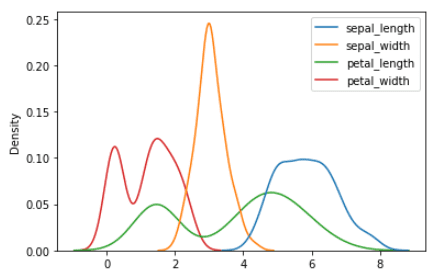
A probability distribution shows how feature values are distributed around the mean value. Using the iris dataset, the probability distributions for the sepal length, sepal width, petal length, and petal width can be generated using the code below.

import numpy as np  import matplotlib.pyplot as plt  from sklearn import datasets  import seaborn as sns    iris = sns.load_dataset("iris")  sns.kdeplot(data=iris)  plt.show()

Practical Statistics for Data Scientists
Probability distribution of sepal length, sepal width, sepal width, petal length, and petal width | Image by Author Mode

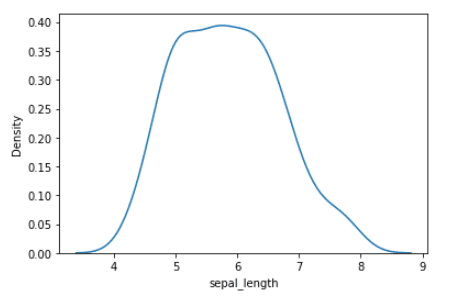
Lets now focus on the sepal length variable. The probability distribution of the sepal length variable is shown below.

Practical Statistics for Data Scientists
Probability distribution of sepal length variable | Image by Author

We observe that the probability distribution of the sepal length variable has a single maximum, hence it is unimodal. The value of the sepal length where the maximum occurs is the mode, which is about 5.8.

A plot of the probability distribution of the petal width variable is shown below.

Practical Statistics for Data Scientists
Probability distribution of the petal width variable | Image by Author

From this plot, we observe that the probability distribution of the petal length variable has 2 maxima, hence it is bimodal. The values of the sepal length where the maxima occurs are the mode, that is at 1.7 and 5.0.

Mean

The mean value is a measure of central tendency. The mean value for the sepal length variable is obtained as follows:

data = datasets.load_iris().data  sepal_length = data[:,0]  mean = np.mean(sepal_length)  >>> 5.843333333333334

Median

The median value is also a measure of central tendency. The median value is less susceptible to the presence of outliers, hence a more reliable measure of central tendency, compared to the mean value. The median value for the sepal length variable is obtained as follows:

data = datasets.load_iris().data  sepal_length = data[:,0]  np.median(sepal_length)  >>> 5.8

Standard Deviation

Standard deviation is a measure of fluctuations of data values around the mean value. It is used to quantify the degree of uncertainty in the dataset. The standard deviation for the sepal length feature is calculated using the code below.

data = datasets.load_iris().data  sepal_length = data[:,0]  std = np.std(sepal_length)  >>> 0.8253012917851409

Confidence Interval

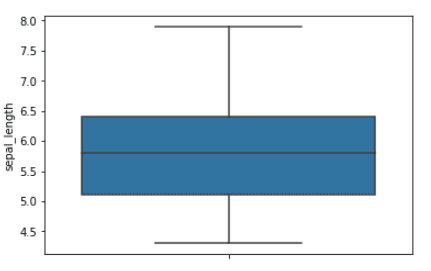
The confidence interval is the range of values around the mean. The 65% confidence interval is the range of values that are one standard deviation from the mean value. The 95% confidence interval is the range of values that are two standard deviations from the mean value. The boxplot below shows the mean value and 65% confidence interval for the sepal length feature.

sns.boxplot(data = iris, y='sepal_length')  plt.show()

Practical Statistics for Data Scientists
Boxplot for the sepal length feature. The blue region indicates the 65% confidence interval | Image by Author Normal Distribution

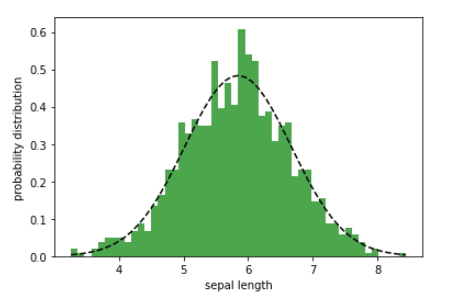
Probability distributions can be used for predictive modeling. The sepal length feature only has 150 data points. Suppose that we would like to generate more data points. Then assuming that the sepal length feature is normally distributed, we can generate more data points. In the example below, we generate N = 1000 data points for the sepal length feature.

np.random.seed(10**7)  mu = mean  sigma = std  x = np.random.normal(mean, std, N)       num_bins = 50       n, bins, patches = plt.hist(x, num_bins,                               density = 1,                               color ='green',                              alpha = 0.7)       y = ((1 / (np.sqrt(2 * np.pi) * sigma)) *       np.exp(-0.5 * (1 / sigma * (bins - mu))**2))      plt.plot(bins, y, '--', color ='black')      plt.xlabel('sepal length')  plt.ylabel('probability distribution')      plt.title('matplotlib.pyplot.hist() function Examplenn',            fontweight ="bold")      plt.show()

Practical Statistics for Data Scientists
Probability distribution of the sepal length width | Image by Author Bayes’ Theorem and Conditional Probability

Bayes’ theorem is an important theorem in statistics and data science. It is used for evaluating the predictive power of binary classification algorithms. A simple tutorial on how Bayes’ theorem is used in a binary classification algorithm is found here: Bayes’ Theorem in Plain English.

Conclusion

In summary, we’ve reviewed the essential statistical concepts useful for data science such as mode, median, mean, standard deviation, probability distributions, normal distribution, and Bayes’ theorem. Anyone interested in data science must learn the fundamentals of statistics.
Benjamin O. Tayo is a Physicist, Data Science Educator, and Writer, as well as the Owner of DataScienceHub. Previously, Benjamin was teaching Engineering and Physics at U. of Central Oklahoma, Grand Canyon U., and Pittsburgh State U.

More On This Topic

  • The Inferential Statistics Data Scientists Should Know
  • Important Statistics Data Scientists Need to Know
  • What will the demand for Data Scientists be in 10 years? Will Data…
  • 11 Most Practical Data Science Skills for 2022
  • eBook: A Practical Guide to Using Third-Party Data in the Cloud
  • How To Become A Freelance Data Scientist — 4 Practical Tips

Chatbot Arena: The LLM Benchmark Platform

Chatbot Arena: The LLM Benchmark Platform
Image by Author

We all know that large language models (LLMs) have been taking the world by storm, and it’s been a lot to take in in such a short amount of time.

What is Chatbot Arena?

Just to shake it up a little bit more, Chatbot Arena is an LLM benchmark platform created by the Large Model Systems Organization (LMSYS Org). It is an open research organization founded by students and faculty from UC Berkeley.

Their overall aim is to make large models more accessible to everyone using a method of co-development using open datasets, models, systems, and evaluation tools. The team at LMSYS trains large language models and makes them widely available along with the development of distributed systems to accelerate the LLMs training and inference.

The Need for an LLM Benchmark

With the continuous hype around ChatGPT, there has been rapid growth in open-source LLMs that have been fine-tuned to follow specific instructions. You have examples such as Alpaca and Vicuna, which are based on LLaMA and can provide assistance with user prompts.

However, with anything this great that spurs out of control, it is difficult for the community to keep up with the constant new developments and be able to benchmark these models effectively. Benchmarking LLM assistants can be a challenge due to the possible open-ended issues.

Therefore, human evaluation is required, using pairwise comparison. Pairwise comparison is the process of comparing the models in pairs to judge which model has better performance.

How Does Chatbot Arena Work?

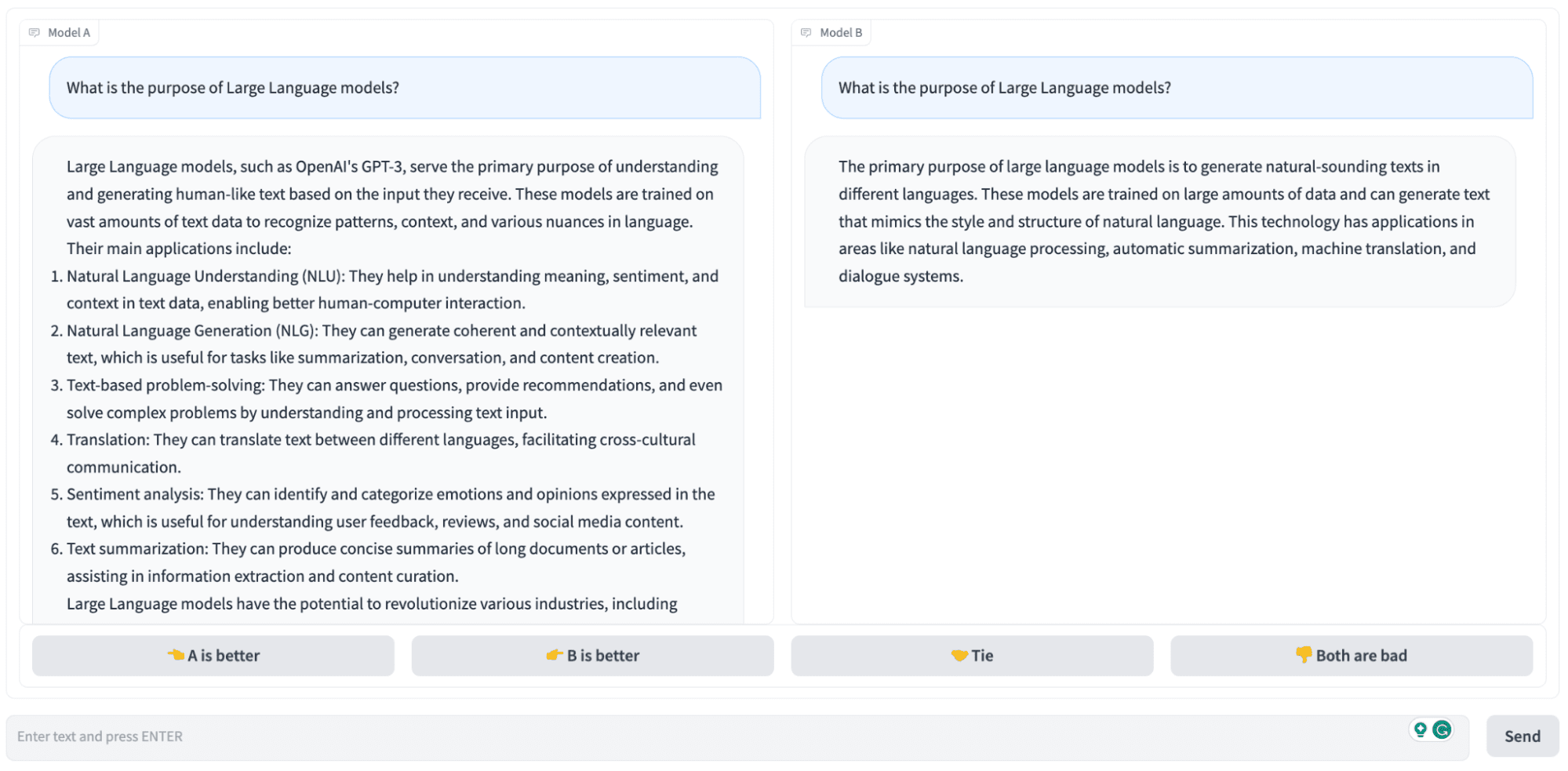
In the Chatbot Arena, a user can chat with two anonymous models side-by-side and make their own opinion, and vote for which model is better. Once the user has voted, the name of the model will be revealed. Users have the option to continue to chat with the two models or start afresh with two new randomly chosen anonymous models.

You have the option to chat with two anonymous models side-by-side or pick the models you want to chat with. Below is a screenshot example of chatting with two anonymous models, in a LLM battle!

Chatbot Arena: The LLM Benchmark Platform
Image Screenshot by Author

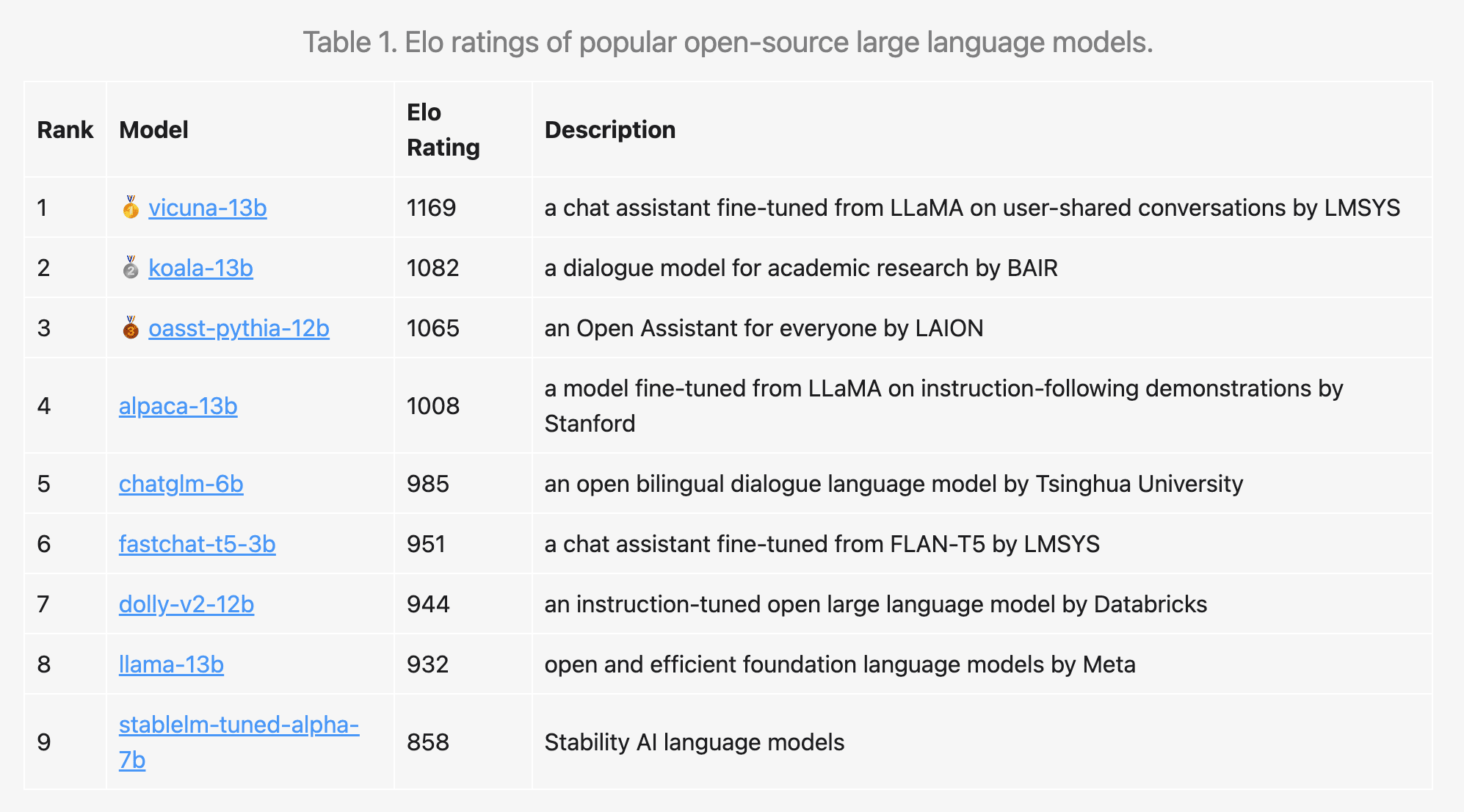
The collected data is then computed into Elo ratings and then put into the leaderboard. The Elo rating system is a method used in games such as Chess to calculate the relative skill levels of players. The difference in rating between two users acts as a predictor of the outcome of that particular match.

As of today, the 5th of May 2023, this is what the leaderboard for the Chatbot Arena looks like:

Chatbot Arena: The LLM Benchmark Platform
Image by Chatbot Arena

If you would like to see how this is done, you can have a look at the notebook and play around with the voting data yourself.

What a great and fun idea, right?

How Do I Get Involved?

The team at Chatbot Arena invite the entire community to join them on their LLM benchmarking quest by contributing your own models, as well as hopping into the Chatbot Arena to make your own votes on anonymous models.

Visit the Arena to vote on which model you think is better, and if you want to test out a specific model, you can follow this guide to help add it to the Chatbot Arena.

Wrapping it up

So is there more to come of Charbot Arena? According to the team, they plan to work on:

  • Adding more closed-source models
  • Adding more open-source models
  • Releasing periodically updated leaderboards. For example, monthly
  • Use better sampling algorithms, tournament mechanisms, and serving systems to support a larger number of models
  • Provide a fine-tuned ranking system for different task types.

Have a play with Chatbot Arena and let us know in the comments what you think!
Nisha Arya is a Data Scientist, Freelance Technical Writer and Community Manager at KDnuggets. She is particularly interested in providing Data Science career advice or tutorials and theory based knowledge around Data Science. She also wishes to explore the different ways Artificial Intelligence is/can benefit the longevity of human life. A keen learner, seeking to broaden her tech knowledge and writing skills, whilst helping guide others.

More On This Topic

  • KDnuggets Survey: Benchmark with your peers on industry spend and trends
  • The Chatbot Transformation: From Failure to the Future
  • Build a ChatGPT-like Chatbot with These Courses
  • Facebook Open Sources a Chatbot That Can Discuss Any Topic
  • Open Assistant: Explore the Possibilities of Open and Collaborative Chatbot…
  • 5 Key Components of a Data Sharing Platform

White House addresses AI’s risks and rewards as security experts voice concerns about malicious use

This is an illustration of a microchip with an AI brain on top.
Image: Shuo/Adobe Stock

The White House, last week, released a statement about the use of artificial intelligence, including large language models like ChatGPT.

The statement addressed concerns about AI being used to spread misinformation, biases and private data, and announced a meeting by Vice President Kamala Harris with leaders of ChatGPT maker OpenAI, owned by Microsoft and with executives from Alphabet and Anthropic.

But some security experts see adversaries who operate under no ethical proscriptions using AI tools on numerous fronts, including generating deep fakes in the service of phishing. They worry that defenders will fall behind.

Jump to:

  • Uses, misuses and potential over-reliance on AI
  • Common vulnerabilities
  • For defense, AI is effective, within limits
  • AI for defense? Not without humans
  • AI can play chess way better than it can drive a Tesla
  • Adversaries plus AI

Uses, misuses and potential over-reliance on AI

Artificial intelligence, “will be a huge challenge for us,” said Dan Schiappa, chief product officer at security operations firm Arctic Wolf.

“While we need to make sure legitimate organizations aren’t using this in an illegitimate way, the unflattering truth is that the bad guys are going to keep using it, and there is nothing we are going to do to regulate them,” he said.

According to security firm Zscaler, ThreatLabz’s 2023 Phishing Report, AI tools were partly responsible for a 50% increase in phishing attacks last year, compared to 2021. In addition, chatbot AI tools have allowed attackers to hone such campaigns by improving targeting and making it easier to trick users into compromising their security credentials.

AI in the service of malefactors isn’t new. Three years ago, Karthik Ramachandran, a senior manager at Deloitte in risk assurance, wrote in a blog that hackers had been using AI to create new cyber threats — the Emotet trojan malware targeting the financial services industry being one example. He also alleged in his post that Israeli entities had used it to fake medical results.

This year, malware campaigns have turned to generative AI technology according to a report from Meta. The report noted that since March, Meta analysts have found “…around 10 malware families posing as ChatGPT and similar tools to compromise accounts across the internet.”

According to Meta, threat actors are using AI to create malicious browser extensions available in official web stores that claim to offer ChatGPT-related tools, some of which include working ChatGPT functionality alongside the malware.

“This was likely to avoid suspicion from the stores and from users,” shared Meta, which also said it detected and blocked over 1,000 unique, malicious URLs from being shared on Meta apps and reported them to industry peers at file-sharing services.

Common vulnerabilities

While Schiappa agreed that AI can exploit vulnerabilities with malicious code, he argued that the quality of the output generated by LLM is still hit and miss.

“There is a lot of hype around ChatGPT but the code it generates is frankly not great,” he said.

Generative AI models can, however, accelerate processes significantly, Schiappa said, adding that the “invisible” part of such tools — those aspects of the model not involved in natural language interface with a user — are actually more risky from an adversarial perspective and more powerful from a defense perspective.

Meta’s report said industry defensive efforts are forcing threat actors to find new ways to evade detection, including spreading across as many platforms as they can to protect against enforcement by any one service.

“For example, we’ve seen malware families leveraging services like ours and LinkedIn, browsers like Chrome, Edge, Brave and Firefox, link shorteners, file-hosting services like Dropbox and Mega, and more. When they get caught, they mix in more services including smaller ones that help them disguise the ultimate destination of links,” the report said.

For defense, AI is effective, within limits

With an eye to the capabilities of AI for defense, Endor Labs has recently studied AI models that can identify malicious packages focusing on source code and metadata.

In an April 2023 blog post, Henrik Plate, security researcher at Endor Labs, described how the firm looked at defensive performance indicators for AI. As a screening tool, GPT-3.5 correctly identified malware only 36% of the time, correctly assessing only 19 of 34 artifacts from nine distinct packages that contained malware.

Also, from the post:

  • 44% of the results were false positives.
  • By using innocent function names, AI was able to trick ChatGPT into changing an assessment from malicious to benign.
  • ChatGPT versions 3.5 and 4 came to divergent conclusions.

AI for defense? Not without humans

Plate argued that the results show LLM-assisted malware reviews with GPT-3.5 aren’t yet a viable alternative to manual reviews, and that LLM reliance on identifiers and comments may be valuable for developers, but they can also be easily misused by adversaries to evade the detection of malicious behavior.

“But even though LLM-based assessment should not be used instead of manual reviews, they can certainly be used as one additional signal and input for manual reviews. In particular, they can be useful to automatically review larger numbers of malware signals produced by noisy detectors (which otherwise risk being ignored entirely in case of limited review capabilities),” Plate wrote.

He described 1,800 binary classifications performed with GPT-3.5 that included false-positives and false-negatives, noting that classifications could be fooled with simple tricks.

“The marginal costs of creating and releasing a malicious package come close to zero,” because attackers can automate the publishing of malicious software on PyPI, npm and other package repositories, Plate explained.

Endor Labs also looked at ways of tricking GPT into making wrong assessments, which they were able to do using simple techniques to change an assessment from malicious to benign by, for example, using innocent function names, including comments that indicate benign functionality or through inclusion of string literals.

AI can play chess way better than it can drive a Tesla

Elia Zaitsev, chief technology officer at CrowdStrike, said that a major Achilles heel for AI as part of a defensive posture is that, paradoxically, it only “knows” what is already known.

“AI is designed to look at things that have happened in the past and extrapolate what is going on in the present,” he said. He suggested this real-world analogy: “AI has been crushing humans at chess and other games for years. But where is the self-driving car?”

“There’s a big difference between those two domains,” he said.

“Games have a set of constrained rules. Yes, there’s an infinite combination of chess games, but I can only move the pieces in a limited number of ways, so AI is fantastic in those constrained problem spaces. What it lacks is the ability to do something never before seen. So, generative AI is saying ‘here is all the information I’ve seen before and here is statistically how likely they are to be associated with each other.'”

Zaitsev explained that autonomous cybersecurity, if ever achieved, would have to function at the yet-to-be-achieved level of autonomous cars. A threat actor is, by definition, trying to circumvent the rules to come up with new attacks.

“Sure there are rules, but then out of nowhere there’s a car driving the wrong way down a one-way street. How do you account for that,” he asked.

Adversaries plus AI

For attackers, there is little to lose from using AI in versatile ways because they can benefit from the combination of human creativity and AI’s ruthless 24/7, machine-speed execution, according to Zaitsev.

“So at CrowdStrike we are focused on three core security pillars: endpoint, threat intelligence and managed threat hunting. We know we need constant visibility of how adversary tradecraft is evolving,” he added.

Cybersecurity Insider Newsletter

Strengthen your organization's IT security defenses by keeping abreast of the latest cybersecurity news, solutions, and best practices.

Delivered Tuesdays and Thursdays Sign up today

How to use Google Bard (and what you should know about the waitlist)

Google logo displayed on a phone screen and Bard website displayed on a laptop screen are seen in this illustration photo taken in Krakow, Poland on March 21, 2023. (Photo by Jakub Porzycki/NurPhoto via Getty Images)

At the same time that new artificial intelligence (AI) tools have been dominating headlines with their innovative ideas and captivating abilities, Google's own creation has been gaining attention for entirely different reasons.

Google Bard is meant to be an assistive AI chatbot; a generative AI tool that can generate text for cover letters and homework to computer code and onto Excel formulas, question answers, and detailed translations. Similarly to ChatGPT, Bard uses AI to provide human-like conversational responses when prompted by a user.

Also: How to use ChatGPT: Everything you need to know

Bard's performance, however, has been found lacking on more than one occasion. From its abysmal opening debut to its official launch, users have struggled to get the chatbot to provide accurate information or even follow along a conversation without hallucinating.

There's some other big differences between Bard and other AI-powered chatbots. Bard can access Google's search engine, while ChatGPT has no internet access and has only been trained on information available up to 2021. Google Bard competes more directly with Bing Chat, Microsoft's new AI-powered Bing search engine, which uses GPT-4, OpenAI's most advanced large language model, and it has access to the entirety of the web.

Also: Bard vs. ChatGPT: Can Bard help you code?

How to join the Google Bard waitlist

At this time, users can access Bard by signing up for the experimental AI chat service's waitlist. In our experience, it's only taken a few days to access Bard after joining the list.

How to use Google Bard

Once you're past the waitlist boundary, you will get an email from Google advising you that you're ready to use Google Bard.

I asked Bard if wasps are aggressive — here's what the chat window looks like.

FAQ

What can I ask Google Bard?

The Bard AI chatbot can answer most questions you ask, since it uses the search tools from Google. These AI-based answers can serve many purposes, from giving you recipes to helping you debug code. Here are some examples of prompts you can ask the bot:

  • Write two to-do lists, one for daily household cleaning and another for maintenance
  • Write a —- plugin that does ——
  • What is at the center of the Earth?
  • Write a poem for a trashbag that fell in love with a reusable water bottle
  • Define XML

Also: How to write better ChatGPT prompts (and this applies to most other text-based AIs, too)

Does Bard AI use GPT-4?

Bard uses its own large language model named Language Model for Dialogue Applications (LaMDA), instead of the GPT series, which is the technology that many popular AI chatbots are using. Google Bard is the first chatbot to use a lightweight and optimized version of LaMDA.

Also: This new technology could blow away GPT-4 and everything like it

Will Bard AI replace Google Search?

Google Bard and other AI chatbots, such as Bing Chat and ChatGPT, certainly have the potential to replace search engines. These AI tools use information found on the web to provide answers to users' queries, but instead of giving them a list of websites where that answer may or may not be found, these tools provide a straightforward, though not always accurate, answer in a conversational manner.

Also: The new AI-powered Bing is now open to everyone — with some serious upgrades

Some people might use AI chatbots in place of a Google Search, especially since the added abilities of asking follow-up questions and generating text make it more functional for some use cases than a search engine.

When will I be able to access Google Bard?

Some people are granted access within 24 hours of joining the waitlist, while others wait days, maybe weeks. As demand for generative AI and Google's AI chatbot grows, the waitlist grows as well. In general, we've been able to access Google Bard AI within a few hours of joining the waitlist.

Also: ChatGPT and the new AI are wreaking havoc on cybersecurity in exciting and frightening ways

Does Bard provide inaccurate answers?

When Bard AI was announced last February, it faced scrutiny after factual mistakes made during its demo. Users have subsequently wondered whether Google's new chatbot still continues to provide inaccurate or inappropriate responses and whether it can be trusted, as some have come to trust other AI tools.

Also: I tested Google Bard. It was surprisingly bad

Google has reiterated that Bard is an experiment capable of making mistakes. The company wants users to provide feedback on their experiences to improve LaMDA and propel it forward.

More on AI tools

Make Meta Great Again

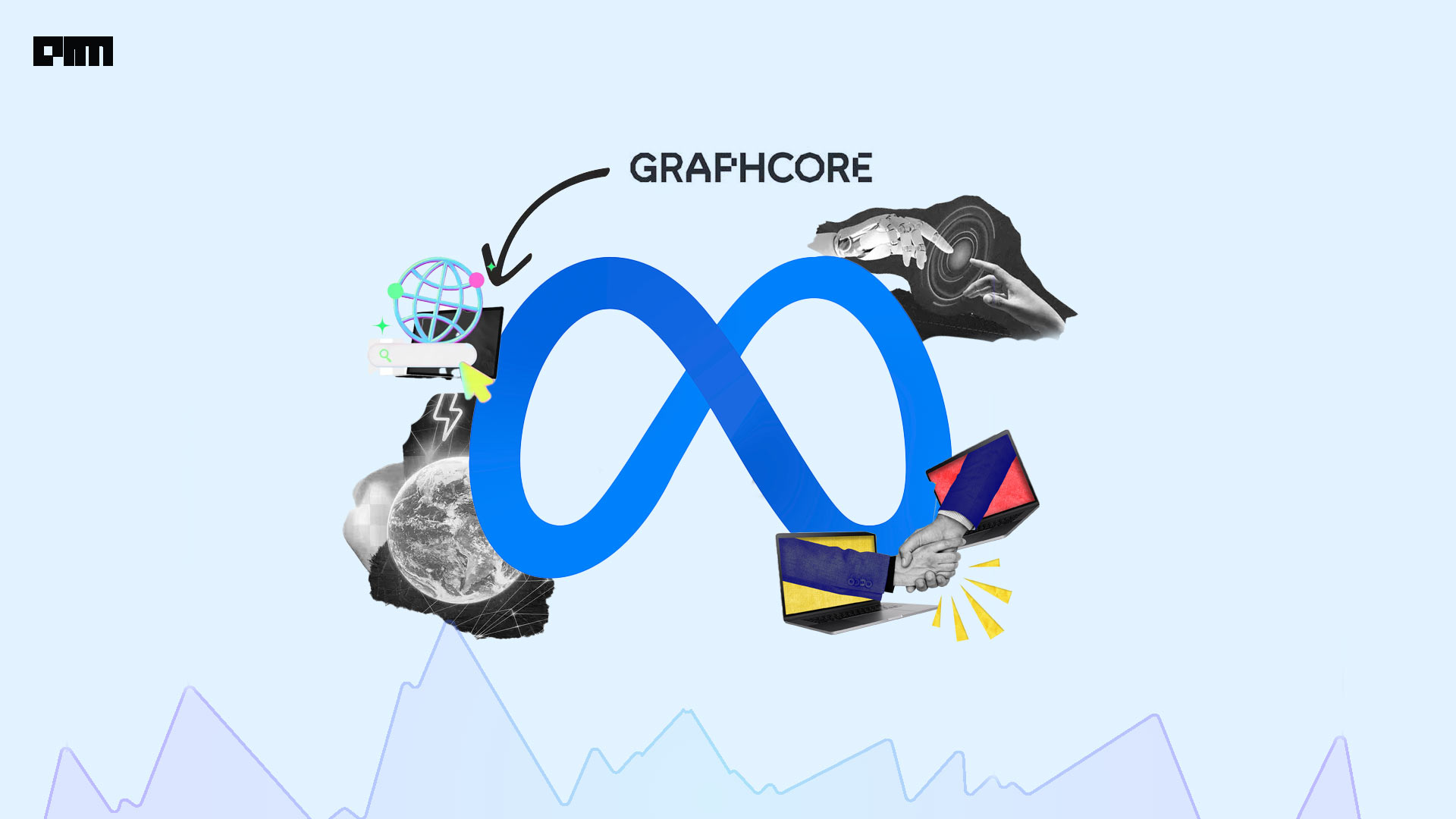
A month ago, reports emerged that Sequoia Capital had written off its stake in Graphcore, a semiconductor company based in Bristol. Graphcore has raised $682M to compete with US-based firms such as Nvidia Corp and Advanced Micro Devices (AMD), which dominate the market for AI chips.

Unable to compete with its US rivals who were offering GPUs at ‘low cost’, owing to government subsidies, the company had to go through broad restructuring plans. As a result, it had to shut down its Oslo office. Next thing you know, a number of highly skilled engineers from the Oslo team have joined Meta for the design and development of supercomputing systems to support AI and machine learning at scale in Meta’s data centers.

Graphcore’s miseries

Struggling to keep up with its US competition, this chip startup faced mounting problems, including ballooning losses, sluggish sales, and sweeping job cuts. The deal to supply processors to Microsoft for its cloud computing platform, first announced in 2019, also eventually came to an end. “They seem to have developed good asset but it is going nowhere,” said Sravan Kundojjala, an independent semiconductor analyst, in explaining Graphcore’s predicament.

While Graphcore’s struggles have been unfortunate, the situation presents a timely opportunity for someone else. Despite significant investments, Meta has been slow in catching up to the AI hardware and software systems for its main business, hindering its ability to keep pace with innovation at scale. Here, scooping up people who had worked on AI-specific networking technology in Graphcore gives Meta a huge boost.

Currently, Meta has teamed up with Nvidia to build a massive AI supercomputer called the AI Research SuperCluster (RSC). The RSC is so powerful that it can train AI models with over one trillion parameters, making it the largest installation of Nvidia DGX A100 systems by a customer.

But, the latest news around it suggests that the chip won’t complete until 2025. Reason being that the company has been reworking on a number of under-construction data center projects for new design. Meta’s Nordic communications manager told DCD that supporting AI workloads at scale requires a different type of data center than those built for regular online services, and the current site is inadequate for these needs.

Additionally, as per reports, this pairing with Nvidia is costing Meta billions of dollars. Alternatively, Graphcore updated models of its multi-processor computers, IPU-POD, running on the Bow chip, are claimed to be five times faster than comparable DGX machines from NVIDIA at half the price.

This means that we can potentially see an acquisition or Meta and Graphcore grouping together to help build in-house chips, leveraging Graphcore’s talent and Meta’s planned investment in AI research.

On its earnings call last week, CEO Mark Zuckerberg said “A.I.” more than 20 times during his opening presentation, and CFO Susan Li said the company expects to spend about $30 billion to $33 billion this year, with a focus towards increased investment in capacity for its Generative AI initiatives.

Meta’s opportunity

According to two sources who spoke with Reuters, Meta has an in-house unit that designs various chips to accelerate and optimize AI operations, including a network chip that performs a sort of air traffic control function for servers. This network chip is essential for systems running large AI models which consist of multiple chips strung together to distribute the workload.

The Fundamental AI Research (FAIR) team at Meta AI have been rigorous in open sourcing their models to the academic community, with models like LLaMA. Meanwhile, Meta has also been releasing models for accurate speech translation and object segmentation. Despite this, the company has not released any generative AI products for the consumers.

Meta’s lagging position was notably apparent when the White House invited CEOs to discuss AI, but Zuckerberg was conspicuously excluded. According to CNN, a Biden administration official explained that the meeting focused on companies currently leading in the space, especially on the consumer-facing product side.

Meta is eager to demonstrate its leadership in the AI industry and prove that it deserves a place at the table among the top companies in the space. This is why a potential collaboration with Graphcore can prove to be extremely beneficial for the two companies.

Winter is coming

AI is at its peak, and there is a proliferation of chip companies. “At some point, there were about 35 GPU companies, and 40 to 50 network processors, and right now there’s about 50 or a 100 AI companies,” said Jim Keller, CEO, Tenstorrent Inc. According to him, there is an exploration phase, where a lot of companies are formed, but then there’s also a consolidation phase.

“It doesn’t mean only the winner survives. A lot of times what happens is some two or three companies will group together, or maybe few will go bankrupt. It is a good spot to repurpose something else,” said Keller.

“So I think we’re gonna see a proliferation. During high rates of change, technology areas that have more proliferation can explore more space. So the probability of a winter comes out of the area where more people are doing stuff that’s hot, the place where people are doing the best thing,” he concluded.

The post Make Meta Great Again appeared first on Analytics India Magazine.

Salesforce puts generative AI into Tableau, gives Big Data the gift of gab

Tableau on a tablet.
Image: Timon/Adobe Stock

Tableau, the two-decade-old data platform that Salesforce acquired for $15.7 billion in 2019, will get enhancements that allow for data automation, predictive analysis based on user preferences, thanks to the addition of large language model generative artificial intelligence. The new features include:

  • Tableau GPT gives access to AI-powered analytics to make data digestible for a wide range of users, regardless of the technology or data analysis savvy.
  • Tableau Pulse, an instance of Tableau GPT, will provide automated insights and a personalized analytics experience to business users and data consumers.

What is Tableau GPT?

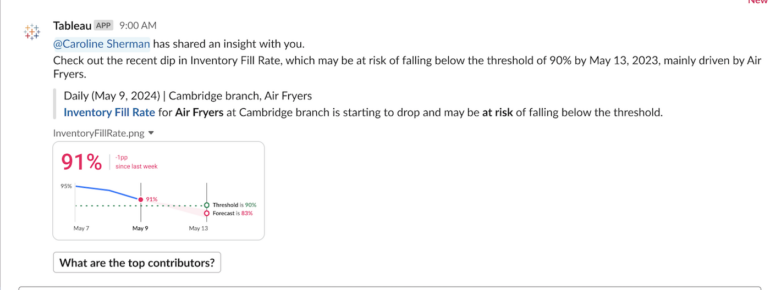
Tableau GPT, which was built on the native LLM that Salesforce built for its CRM AI platform Einstein, lets users query Tableau with natural language requests for a wide range of data visualizations and analysis. It will be integrated with Salesforce’s other platforms, like Slack (Figure A).

Figure A

Tableau GPT integrated into Slack.
Image: Salesforce. Tableau GPT integrated into Slack.

Francois Ajenstat, chief product officer at Tableau, said that when Tableau was a startup out of Stanford two decades ago, data visualization consisted of tabular reports.

“These were static and boring. The world of data has changed in the last 20 years and it is being used in completely new ways,” he said. “It became interactive. We have the opportunity to change data again and empower more people to use it.”

He said fewer than 30% of people in organizations have access to data. Salesforce’s own research said 41% of business leaders lack an understanding of data because it’s complex or not accessible enough and 67% of business leaders are not using data to decide on pricing in line with economic conditions, such as inflation.

“There are challenges of bringing data analytics to the whole organization,” said Ajenstat. He added that getting to the broadest set of consumers requires the ability to deliver data in diverse ways, not just dashboards. “It has to be easy and familiar.”

What is Tableau Pulse?

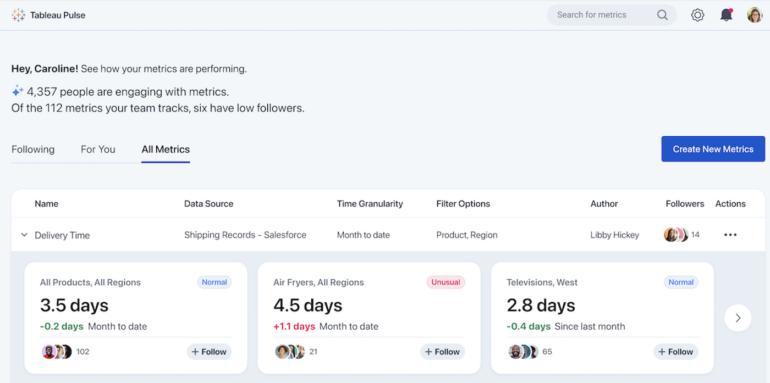
Salesforce said Tableau Pulse uses AI to personalize work experiences, employing Tableau GPT to deliver analytics on user-customized metrics, surfacing insights in natural language and visual formats.

It will comprise a new suite of tools that infuse AI throughout the platform, making querying data “feels more like conversation,” said Pedro Arellano, SVP and GM at Tableau. Tableau GPT combines Salesforce’s proprietary models, surrounded by security and governance, he said.

Arellano said Pulse is a reimagining of the analytics experience that expands how people work with Tableau.

“It is no longer just exploring data. It’s also communicating and consuming it. Not just expressing through visualization, it’s language.” Arellano called it a “personal guide for your data, that knows the goals you are trying to achieve and helps you reach those goals.”

GPT and Pulse are designed to be scaled, Arellano explained. “With elasticity and flexibility and lots of breadth and reach, and that Salesforce is infusing ChatGPT-type large language models throughout the company’s services and platforms,” he said (Figure B).

Figure B

Example of a Tableau Pulse report.
Image: Salesforce. Example of a Tableau Pulse report.

“You will see it in Slack and Pulse,” he added. “Because we are taking analytics out of a strictly analytics tool in order to reach recipients of insights where they are today.”

Caroline Sherman, VP of product management at Tableau, said the goal of the new technical innovations is to give people a new way to engage CRM and collaborate with data. “Tableau GPT with Slack and Pulse is a trifecta for people who haven’t been able to adapt data to everyday work,” she said.

Generative AI? Yes, but with caveats

Salesforce’s survey found 57% of senior IT leaders are bullish on generative AI, with 80% seeing it as a boon for data comprehension; 75% said they planned to implement generative AI over the next 18 months.

But 71% said they believe generative AI will introduce new security risks to their data and 66% said their employees don’t have the skills to successfully leverage generative AI. Fifty-five percent of those polled said they believe companies need accurate, complete and unified data for generative AI to work.

Innovation Insider Newsletter

Catch up on the latest tech innovations that are changing the world, including IoT, 5G, the latest about phones, security, smart cities, AI, robotics, and more.

Delivered Tuesdays and Fridays Sign up today