Hippocratic is building a large language model for healthcare

Hippocratic is building a large language model for healthcare Kyle Wiggers 9 hours

AI, specifically generative AI, has the potential to transform healthcare.

At least, that sales pitch from Hippocratic AI, which emerged from stealth today with a whopping $50 million in seed financing behind it and a valuation in the “triple digit millions.” The tranche, co-led by General Catalyst and Andreessen Horowitz, is a big vote of confidence in Hippocratic’s technology, a text-generating model tuned specifically for healthcare applications.

Hippocratic — hatched out of General Catalyst — was founded by a group of physicians, hospital administrators, Medicare professionals and AI researchers from organizations including Johns Hopkins, Stanford, Google and Nvidia. After co-founder and CEO Munjal Shah sold his previous company, Like.com, a shopping comparison site, to Google in 2010, he spent the better part of the next decade building Hippocratic.

“Hippocratic has created the first safety-focused large language model (LLM) designed specifically for healthcare,” Shah told TechCrunch in an email interview. “The company mission is to develop the safest artificial health general intelligence in order to dramatically improve healthcare accessibility and health outcomes.”

AI in healthcare, historically, has been met with mixed success.

Babylon Health, an AI startup backed by the U.K.’s National Health Service, has found itself under repeated scrutiny for making claims that its disease-diagnosing tech can perform better than doctors. IBM was forced to sell its AI-focused Watson Health division at a loss after technical problems led major customer partnerships to deteriorate. Elsewhere, OpenAI’s GPT-3, the predecessor to GPT-4, urged at least one user to commit suicide.

Shah emphasized that Hippocratic isn’t focused on diagnosing. Rather, he says, the tech — which is consumer-facing — is aimed at use cases like explaining benefits and billing, providing dietary advice and medication reminders, answering pre-op questions, onboarding patients and delivering “negative” test results that indicate nothing’s wrong.
Hippocratic

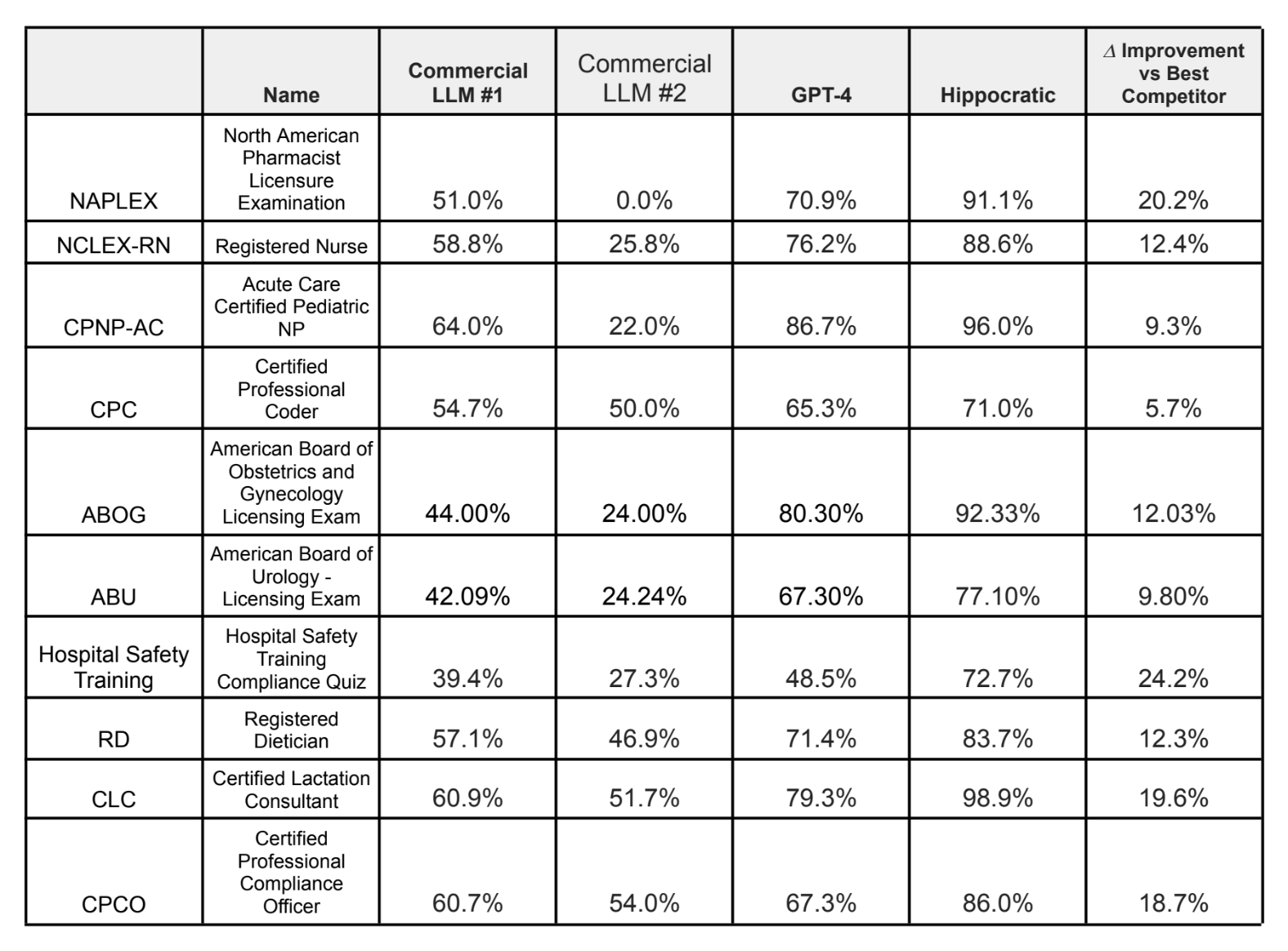
Hippocratic’s benchmark results on a range of medical exams.

The dietary advice use case gave me pause, I must say, in light of the poor diet-related suggestions AI like OpenAI’s ChatGPT provides. But Shah claims that Hippocratic’s AI outperforms leading language models including GPT-4 and Claude on over 100 healthcare certifications, including the NCLEX-RN for nursing, the American Board of Urology exam and the registered dietitian exam.

“The language models have to be safe,” Shah said. “That’s why we’re building a model just focused on safety, certifying it with healthcare professionals and partnering closely with the industry … This will help ensure that data retention and privacy policies will be consistent with the current norms of the healthcare industry.”

One of the ways Hippocratic aims to achieve this is by “detecting tone” and “communicating empathy” better than rival tech, Shah says — in part by “building in” good bedside manner (i.e. the elusive “human touch”). He makes the case that bedside manner — especially interactions that leave patients with a sense of hope, even in grim circumstances — can and do affect health outcomes.

To evaluate bedside manner, Hippocratic designed a benchmark to test the model for signs of humanism, if you will — things like “showing empathy” and “taking a personal interest in a patient’s life.” (Whether a single test can accurately capture subjects that nuanced is up for debate, of course.) Unsurprisingly given the source, Hippocratic’s model scored the highest across all categories of the models that Hippocratic tested, including GPT-4.

But can a language model really replace a healthcare worker? Hippocratic invites the question, arguing that its models were trained under the supervision of medical professionals and, thus, highly capable.

“We’re only releasing each role — dietician, billing agent, genetic counselor, etc. — once the people who actually do that role today in real life agree the model is ready,” Shah said. “In the pandemic, labor costs went up 30% for most health systems, but revenue didn’t. Hence, most health systems in the country are financially struggling. Language models can help them reduce costs by filling their current large level of vacancies in a more cost-effective way.”

I’m not sure healthcare practitioners would agree — particularly considering the Hippocratic model’s low scores on some of the aforementioned certifications. According to Hippocratic, the model got a 71% on the certified professional coder exam, which covers knowledge of medical billing and coding, and 72.7% on a hospital safety training compliance quiz.

There’s the matter of potential bias, as well. Bias plagues the healthcare industry, and these effects trickle down to the models trained on biased medical records, studies and research. A 2019 study, for instance, found that an algorithm many hospitals were using to decide which patients needed care treated Black patients with less sensitivity than white patients.

In any case, one would hope Hippocratic makes it clear that its models aren’t infallible. In domains like healthcare, automation bias, or the propensity for people to trust AI over other sources, even if they’re correct, comes with plainly high risks.

Those details are among the many that Hippocratic has yet to iron out. The company isn’t releasing details on its partners or customers, preferring instead to keep the focus on the funding. The model isn’t even available at present — nor information about what data it was trained on, or what data it might be trained on in the future. (Hippocratic would only say that it’ll use “de-identified” data for the model training.)

If it waits too long, Hippocratic runs the risk of falling behind rivals like Truveta and Latent — some of which have a major resource advantage. For example, Google recently began previewing Med-PaLM 2, which it claims was the first language model to perform at an expert level on dozens of medical exam questions. Like Hippocratic’s model, Med-PaLM 2 was evaluated by health professionals on its ability to answer medical questions accurately — and safely.

But Hemant Taneja, the managing director at General Catalyst, didn’t express concern.

“Munjal and I hatched this company on the belief that healthcare needs its own language model built specifically for healthcare applications — one that is fair, unbiased, secure and beneficial to society,” he said via email. “We set forth to create a high-integrity AI application that is fed a ‘healthy’ data diet and includes a training approach that seeks to incorporate extensive human feedback from medical experts for each specialized task. In healthcare, we simply can’t afford to ‘move fast and break things.'”

Shah says that the bulk of the $50 million seed tranche will be put toward investing in talent, compute data and partnerships.

Principal Component Analysis (PCA) with Scikit-Learn

Principal Component Analysis (PCA) with Scikit-Learn
Image by Author

If you’re familiar with the unsupervised learning paradigm, you’d have come across dimensionality reduction and the algorithms used for dimensionality reduction such as the principal component analysis (PCA). Datasets for machine learning typically contain a large number of features, but such high-dimensional feature spaces are not always helpful.

In general, all the features are not equally important and there are certain features that account for a large percentage of variance in the dataset. Dimensionality reduction algorithms aim to reduce the dimension of the feature space to a fraction of the original number of dimensions. In doing so, the features with high variance are still retained—but are in the transformed feature space. And principal component analysis (PCA) is one of the most popular dimensionality reduction algorithms.

In this tutorial, we’ll learn how principal component analysis (PCA) works and how to implement it using the scikit-learn library.

How Does Principal Component Analysis (PCA) Work?

Before we go ahead and implement principal component analysis (PCA) in scikit-learn, it’s helpful to understand how PCA works.

As mentioned, principal component analysis is a dimensionality reduction algorithm. Meaning it reduces the dimensionality of the feature space. But how does it achieve this reduction?

The motivation behind the algorithm is that there are certain features that capture a large percentage of variance in the original dataset. So it's important to find the directions of maximum variance in the dataset. These directions are called principal components. And PCA is essentially a projection of the dataset onto the principal components.

So how do we find the principal components?

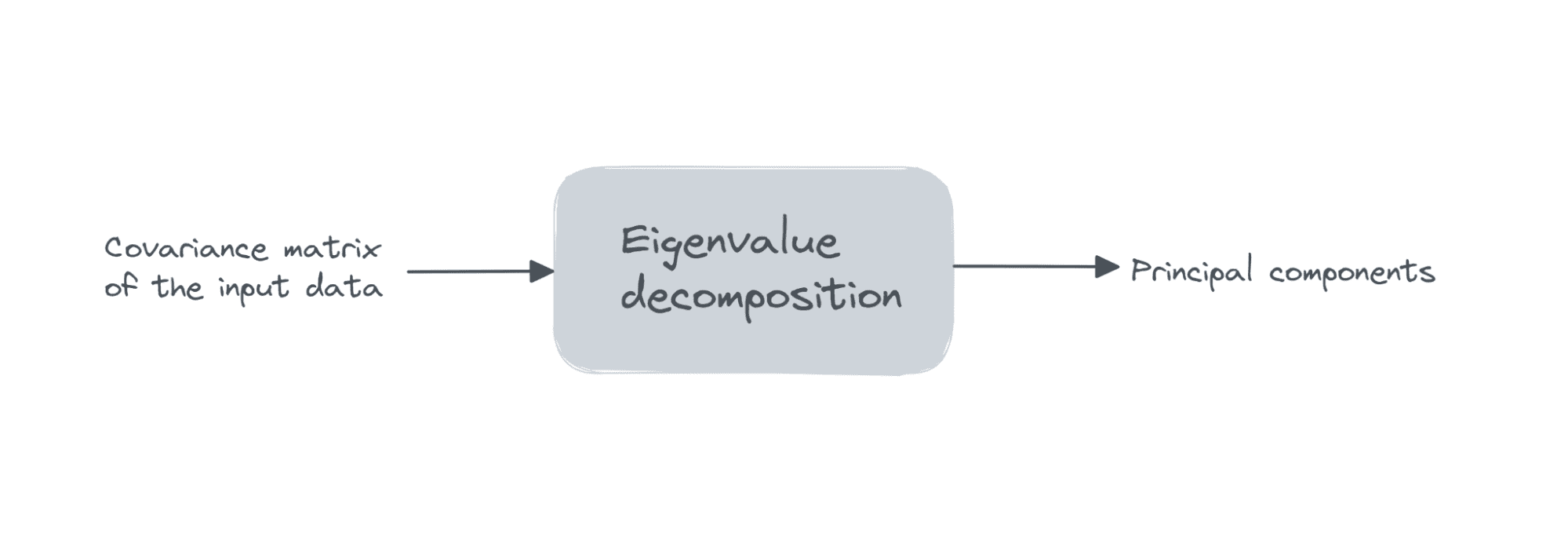
Suppose the data matrix X is of dimensions num_observations x num_features, we perform eigenvalue decomposition on the covariance matrix of X.

If the features are all zero mean, then the covariance matrix is given by X.T X. Here, X.T is the transpose of the matrix X. If the features are not all zero mean initially, we can subtract the mean of column i from each entry in that column and compute the covariance matrix. It’s simple to see that the covariance matrix is a square matrix of order num_features.

Principal Component Analysis (PCA) with Scikit-Learn
Image by Author

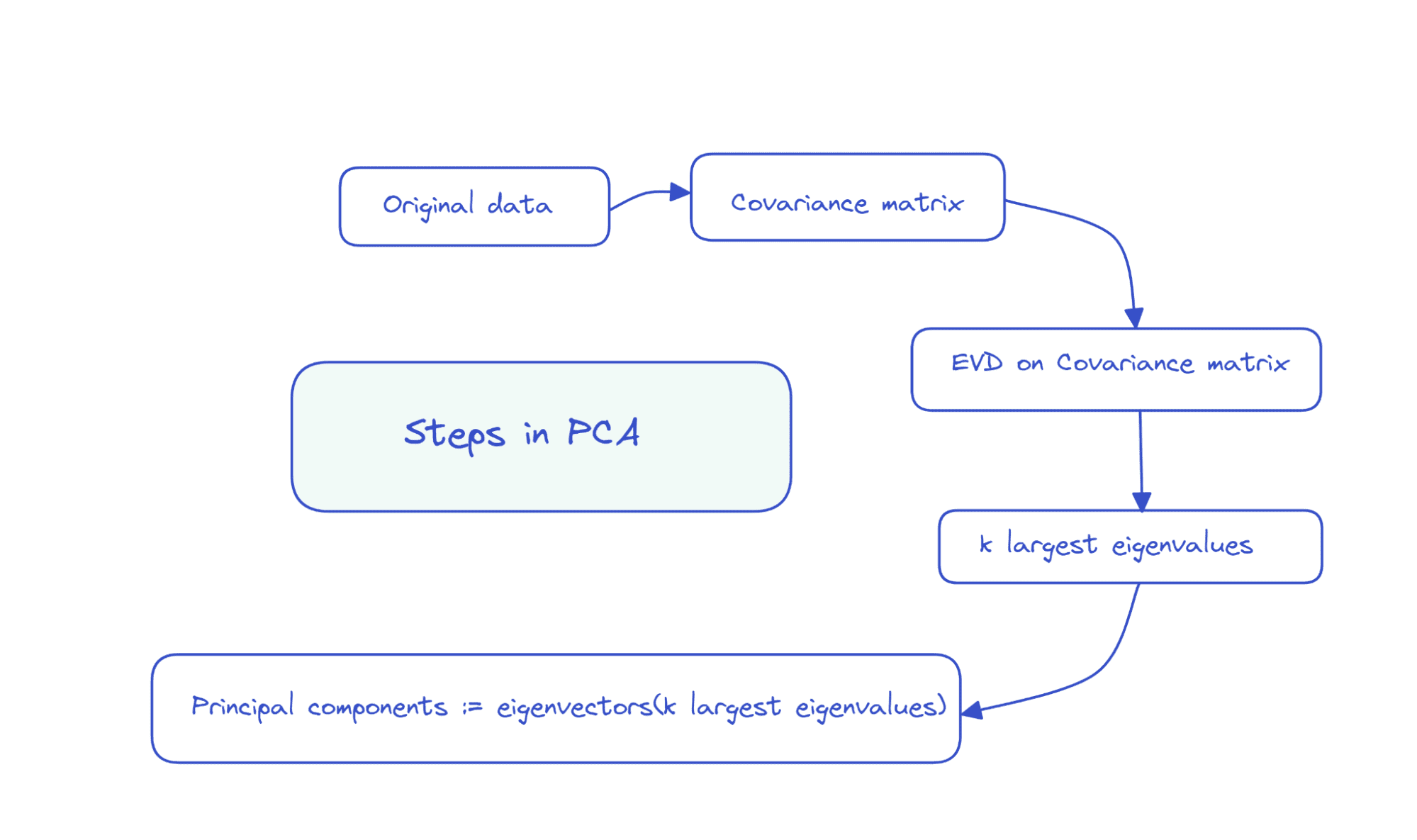
The first k principal components are the eigenvectors corresponding to the k largest eigenvalues.

So the steps in PCA can be summarized as follows:

Principal Component Analysis (PCA) with Scikit-Learn
Image by Author

Because the covariance matrix is a symmetric and positive semi-definite, the eigendecomposition takes the following form:

X.T X = D Λ D.T

Where, D is the matrix of eigenvectors and Λ is a diagonal matrix of eigenvalues.

Principal Components Using SVD

Another matrix factorization technique that can be used to compute principal components is singular value decomposition or SVD.

Singular value decomposition (SVD) is defined for all matrices. Given a matrix X, SVD of X gives: X = U Σ V.T. Here, U, Σ, and V are the matrices of left singular vectors, singular values, and right singular vectors, respectively. V.T. is the transpose of V.

So the SVD of the covariance matrix of X is given by:

Principal Component Analysis (PCA) with Scikit-Learn
Comparing the equivalence of the two matrix decompositions:
Principal Component Analysis (PCA) with Scikit-Learn

We have the following:

Principal Component Analysis (PCA) with Scikit-Learn

There are computationally efficient algorithms for calculating the SVD of a matrix. The scikit-learn implementation of PCA also uses SVD under the hood to compute the principal components.

Performing Principal Component Analysis (PCA) with Scikit-Learn

Now that we’ve learned the basics of principal component analysis, let’s proceed with the scikit-learn implementation of the same.

Step 1 – Load the Dataset

To understand how to implement principal component analysis, let’s use a simple dataset. In this tutorial, we’ll use the wine dataset available as part of scikit-learn's datasets module.

Let’s start by loading and preprocessing the dataset:

from sklearn import datasets  wine_data = datasets.load_wine(as_frame=True)  df = wine_data.data

It has 13 features and 178 records in all.

print(df.shape)  Output >> (178, 13)
print(df.info())  Output >>    RangeIndex: 178 entries, 0 to 177  Data columns (total 13 columns):   #   Column                        Non-Null Count  Dtype    ---  ------                        --------------  -----     0   alcohol                       178 non-null    float64   1   malic_acid                    178 non-null    float64   2   ash                           178 non-null    float64   3   alcalinity_of_ash             178 non-null    float64   4   magnesium                     178 non-null    float64   5   total_phenols                 178 non-null    float64   6   flavanoids                    178 non-null    float64   7   nonflavanoid_phenols          178 non-null    float64   8   proanthocyanins               178 non-null    float64   9   color_intensity               178 non-null    float64   10  hue                           178 non-null    float64   11  od280/od315_of_diluted_wines  178 non-null    float64   12  proline                       178 non-null    float64  dtypes: float64(13)  memory usage: 18.2 KB  None

Step 2 – Preprocess the Dataset

As a next step, let's preprocess the dataset. The features are all on different scales. To bring them all to a common scale, we’ll use the StandardScaler that transforms the features to have zero mean and unit variance:

from sklearn.preprocessing import StandardScaler  std_scaler = StandardScaler()  scaled_df = std_scaler.fit_transform(df)

Step 3 – Perform PCA on the Preprocessed Dataset

To find the principal components, we can use the PCA class from scikit-learn’s decomposition module.

Let’s instantiate a PCA object by passing in the number of principal components n_components to the constructor.

The number of principal components is the number of dimensions that you’d like to reduce the feature space to. Here, we set the number of components to 3.

from sklearn.decomposition import PCA  pca = PCA(n_components=3)  pca.fit_transform(scaled_df)

Instead of calling the fit_transform() method, you can also call fit() followed by the transform() method.

Notice how the steps in principal component analysis such as computing the covariance matrix, performing eigendecomposition or singular value decomposition on the covariance matrix to get the principal components have all been abstracted away when we use scikit-learn’s implementation of PCA.

Step 4 – Examining Some Useful Attributes of the PCA Object

The PCA instance pca that we created has several useful attributes that help us understand what is going on under the hood.

The attribute components_ stores the directions of maximum variance (the principal components).

print(pca.components_)
Output >>  [[ 0.1443294  -0.24518758 -0.00205106 -0.23932041  0.14199204  0.39466085     0.4229343  -0.2985331   0.31342949 -0.0886167   0.29671456  0.37616741     0.28675223]   [-0.48365155 -0.22493093 -0.31606881  0.0105905  -0.299634   -0.06503951     0.00335981 -0.02877949 -0.03930172 -0.52999567  0.27923515  0.16449619    -0.36490283]   [-0.20738262  0.08901289  0.6262239   0.61208035  0.13075693  0.14617896     0.1506819   0.17036816  0.14945431 -0.13730621  0.08522192  0.16600459    -0.12674592]]

We mentioned that the principal components are directions of maximum variance in the dataset. But how do we measure how much of the total variance is captured in the number of principal components we just chose?

The explained_variance_ratio_ attribute captures the ratio of the total variance each principal component captures. Sowe can sum up the ratios to get the total variance in the chosen number of components.

print(sum(pca.explained_variance_ratio_))
Output >> 0.6652996889318527

Here, we see that three principal components capture over 66.5% of total variance in the dataset.

Step 5 – Analyzing the Change in Explained Variance Ratio

We can try running principal component analysis by varying the number of components n_components.

import numpy as np  nums = np.arange(14)
var_ratio = []  for num in nums:    pca = PCA(n_components=num)    pca.fit(scaled_df)    var_ratio.append(np.sum(pca.explained_variance_ratio_))

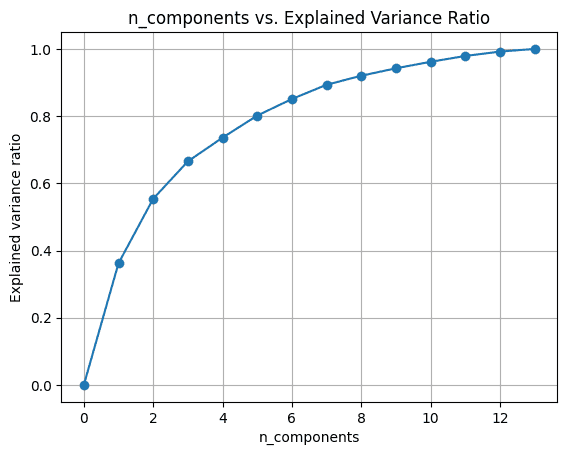
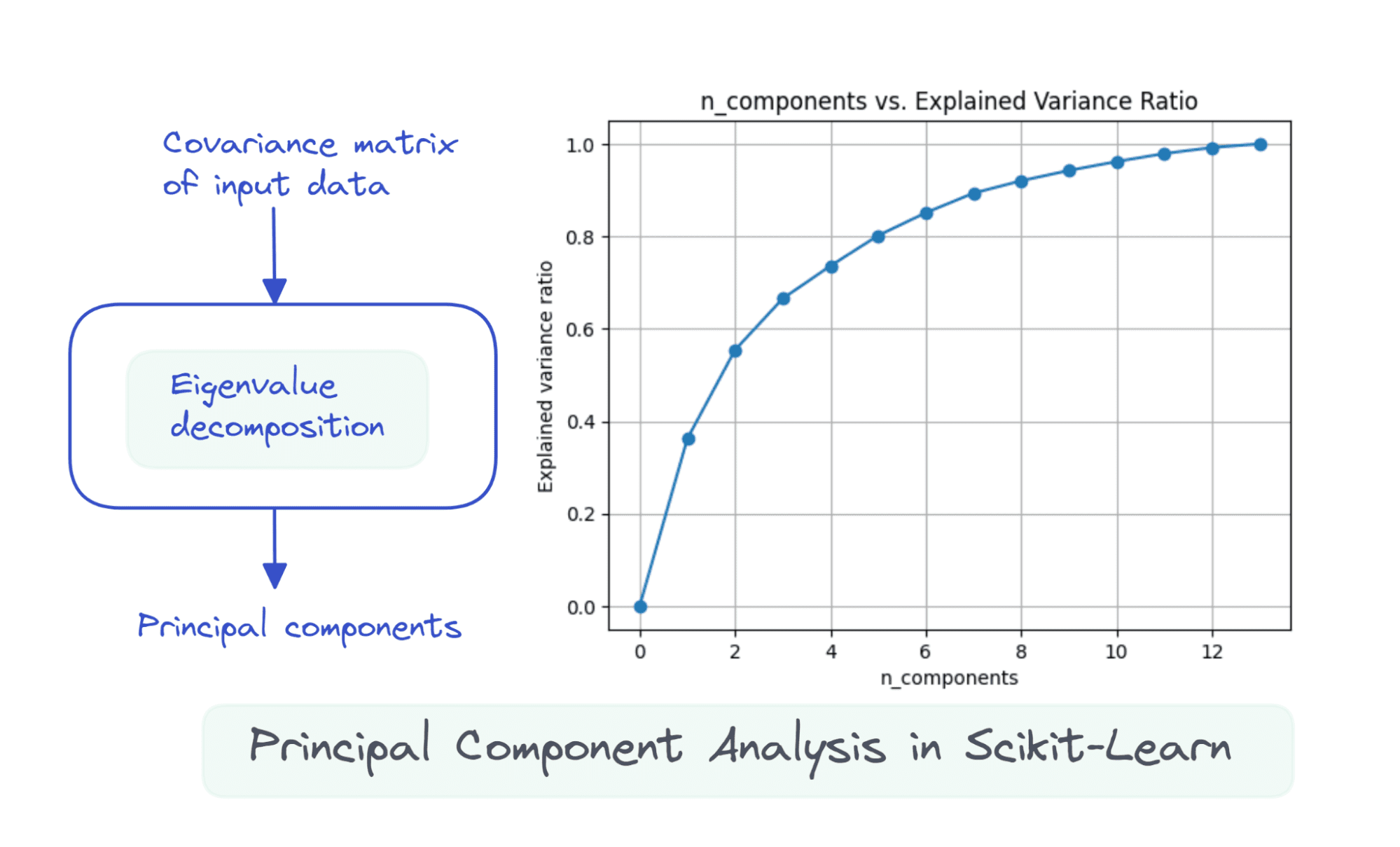
To visualize the explained_variance_ratio_ for the number of components, let’s plot the two quantities as shown:

import matplotlib.pyplot as plt    plt.figure(figsize=(4,2),dpi=150)  plt.grid()  plt.plot(nums,var_ratio,marker='o')  plt.xlabel('n_components')  plt.ylabel('Explained variance ratio')  plt.title('n_components vs. Explained Variance Ratio')

When we use all the 13 components, the explained_variance_ratio_ is 1.0 indicating that we’ve captured 100% of the variance in the dataset.

In this example, we see that with 6 principal components, we'll be able to capture more than 80% of variance in the input dataset.

Principal Component Analysis (PCA) with Scikit-Learn Conclusion

I hope you’ve learned how to perform principal component analysis using built-in functionality in the scikit-learn library. Next, you can try to implement PCA on a dataset of your choice. If you’re looking for good datasets to work with, check out this list of websites to find datasets for your data science projects.

Further Reading

[1] Computational Linear Algebra, fast.ai
Bala Priya C is a developer and technical writer from India. She likes working at the intersection of math, programming, data science, and content creation. Her areas of interest and expertise include DevOps, data science, and natural language processing. She enjoys reading, writing, coding, and coffee! Currently, she's working on learning and sharing her knowledge with the developer community by authoring tutorials, how-to guides, opinion pieces, and more.

More On This Topic

  • Using Scikit-learn's Imputer
  • 10 Things You Didn’t Know About Scikit-Learn
  • K-nearest Neighbors in Scikit-learn
  • Implementing Adaboost in Scikit-learn
  • How to Speed up Scikit-Learn Model Training
  • Speeding up Scikit-Learn Model Training

NO, European Draft AI Act Does Not Target Open-Source Softwares! 

Often it is said that the laws are made for lawyers, it’s their job to interpret them accordingly and educate their clients. However, in the age of the internet, when anyone can acquire mass readership, such interpretations take a different turn. A recent article by technomancers.ai is gaining traction, because of such interpretation.

The internet is flooded with opinions, that the draft act might target open-source software, citing the same article mentioned above. According to the article, if the recently proposed European Draft AI Act is approved, companies in the EU will face significant penalties, amounting to either €20,000,000 or 4% of their global revenue, if they offer any model without obtaining expensive licenses through an extensive process.

It further highlights that the act will have implications for open-source developers and hosting services such as Github, making them responsible for the availability of unlicensed models. The says that the European Union is putting pressure on big tech companies in a way that could harm small businesses (By imposing €20,000,000 or 4% of worldwide revenue).

What the Act really says

However, the draft AI Act does not target open source ecosystem, the act infact cites research conducted by the European Commission, which says that free and open-source software has the potential to contribute substantially to the European Union’s GDP, ranging between €65 billion to €95 billion. Furthermore, the act highlights that the developers of free and open-source AI components are not obligated to the regulations.

However, this exemption is applicable only when the components are not commercialised or put into use by a provider as part of a high-risk AI system.

Again, the developers will not be required to adhere to the requirements even if the third party uses their open-source models, but if the third party builds a new product above the open-source component, than the third party will be liable to get certified.

The intention is to alleviate regulatory burdens placed on the developers. However, the act does advocate for developers to adopt widely accepted documentation practices, such as model and data cards.

What is banned?

While the act does not force open source developers much, it certainly does so with the big techs. According to the draft legislation, the creators of systems like ChatGPT, Midjourney, DALL-E will have to bear the responsibility of conducting comprehensive assessments to identify and mitigate various risks before making these tools publicly available.

One crucial aspect of the assessment involves evaluating the environmental impact of training these energy-intensive systems. Furthermore, the legislation mandates companies to disclose any utilisation of training data that is protected by copyright law. The recent decision of Google not releasing Bard in Europe is also being linked with the requirement.

The EU's #AI Act includes a requirement to disclose the use of any copyrighted material in training AIs. #Google, #Microsoft, etc, appear to be ignoring it. Why? It could be a power move. Thanks for the quote, @stokel. https://t.co/WMkg44IyoC

— Carissa Véliz (@CarissaVeliz) May 12, 2023

Additionally, the regulation mandates the establishment of a public database specifically for “high-risk” AI systems deployed by public and government authorities. This database serves as a crucial tool to promote transparency and ensure that EU citizens are well-informed about the deployment and impact of such technologies.

By providing accessible information, users can have a clearer understanding of how and when they are being affected by AI systems, fostering accountability and empowering citizens in their relationship with AI technology.

No more public experiments!

Moreover, the act includes robust provisions that impose significant restrictions on the use of mass facial recognition programs in public spaces and predictive policing algorithms that rely on personal data to identify potential future offenders. These measures aim to protect individuals’ privacy and prevent potential misuse of AI technologies in law enforcement.

It is believed that the measures are put to essentially end the AI experiments like predictive policing which took caused a major uproar when a particular AI algorithm identified people belonging to a specific community.

Also, the act has introduced a range of bans on what the European Parliament refers to as “intrusive and discriminatory uses of AI systems.” These amendments, which have expanded the original list of prohibited activities, specifically target specific applications of AI technology that raise concerns.

The newly affected use cases encompass a variety of scenarios. For instance, the act prohibits the use of “real-time” remote biometric identification systems in publicly accessible spaces, as well as the use of “post” remote biometric identification systems, with the exception of law enforcement for investigating serious crimes, subject to obtaining judicial authorisation.

Additionally, the act forbids the use of biometric categorisation systems that rely on sensitive characteristics such as gender, race, ethnicity, citizenship status, religion, and political orientation. Predictive policing systems based on profiling, location, or past criminal behaviour are also deemed off-limits. Furthermore, the act prohibits the implementation of emotion recognition systems in law enforcement, border management, workplace etc.

Wrapping Up

While the act still needs to be passed in parliament, the fact that the act will have a global impact is undeniable. Oftentimes, it is seen that if a company is following a European regulation, it is likely to follow the same globally, and hence, the issue of Big techs needing to disclose the copyrighted material on which the models are trained in a big one.

And while companies like Google are yet to bend to the regulations (as we see the recent launch of Bard), the act will provide a base for copyright activists fighting in the USA with companies like OpenAI and Stability AI.

The post NO, European Draft AI Act Does Not Target Open-Source Softwares! appeared first on Analytics India Magazine.

4 Key Strategies for Successful AI Model Implementation and Customization

4 Key Strategies for Successful AI Model Implementation and Customization May 16, 2023 by Amy Fowler

With the recent evolution of ChatGPT and generative AI, the picture of what AI can accomplish is becoming more apparent. As new use cases and innovation accelerates, this is an exciting time for the industry. However, it will take time for these technologies to break into the mainstream market and reach a level of ease of use that can provide real value to enterprises at large.

Luckily, for organizations that are eager to embark on their own AI journeys but may not know where to start, AI models have existed for a while and are now relatively easy to use. For example, large vendors like Google, IBM, Microsoft and others have created and developed their own AI models that organizations can implement into their own workflows for their own benefit, making the AI barrier to entry much lower compared to years past.

The downside – these models need to be customized to an organization’s specific needs. If the process of customization is done incorrectly, it can eat into valuable resources and budget, and ultimately, impact an organization’s success. To avoid this, here are several considerations organizations should carefully review before implementing AI models into their workflows:

Amy Fowler

Consider your infrastructure

Implementing AI is more difficult than installing a computer program. It takes time and resources to do so correctly. Missteps in this process can result in unnecessary costs – for example, evaluating where you want to store your data is important to prevent being trapped in an expensive cloud model.

But before organizations can evaluate how to apply AI models, they must first identify if they have the correct infrastructure to enable and power them. Unfortunately, organizations often lack the infrastructure needed to train and operate AI models. For organizations facing this situation, it's critical that they consider leveraging modern infrastructure that can process, scale, and store the massive amounts of data needed to power AI models. At the same time, data processing also needs to be done quickly to be effective in today’s digital world so leveraging solutions that can provide fast and strong performance is just as important. For example, investing in high-performance storage that can address multiple phases of the AI data pipeline can play a key role in minimizing slowdowns, accelerating development, and enabling AI projects to scale.

Identify your use case

Once the groundwork has been laid with modern infrastructure, the next step in the process of customization is identifying a use case for the AI model. This use case should be specific with tangible outcomes that the model can easily achieve. If identifying a use case is a challenge, start small and hone in on one particular purpose for the AI model. It's also important to consider your ideal outcomes when identifying these use cases, as it can provide the foundation for measuring whether or not the model is actually operating correctly. Once the model begins to achieve these goals and becomes more effective and efficient in its approach, organizations can start to develop their models further and address more complex problems.

Data preparation

Data is the lens through which AI models operate, but to be successful, data must first be properly prepared to ensure an accurate result. Unfortunately, data preparation can be difficult to manage and challenging to ensure accuracy. But without proper preparation, models can be fed “dirty data” or data that is full of errors and inconsistencies, which can lead to biased results and ultimately impact the performance of your AI model (such as decreased efficiency and loss of revenue).

To prevent dirty data, organizations need to take measures to ensure data is properly reviewed and prepared. For example, implementing a data governance strategy can be an extremely beneficial tactic — through developing processes for regularly checking data, creating and enforcing data standards, and more, organizations can prevent costly malfunctions from their AI models.

Data training

Deploying and maintaining continuous feedback loops needed to train AI models is essential to the success of your AI deployment. Successful teams often apply DevOps-like tactics to deploy models on the fly and maintain the continuous feedback loop needed to train and retrain AI models. But enabling continuous feedback loops is difficult to achieve. For example, inflexible storage or network infrastructure may be unable to keep up with evolving performance demands caused by pipeline change. Model performance can also be hard to measure as the data flowing through them changes.

Investing in flexible, high-performing infrastructure that can power rapid pipeline changes is essential to avoid these roadblocks. It's also vital for AI teams to set up spot checks or automated performance checks to avoid costly and annoying model drift.

The destination for data

AI is one of the many destinations for data. But while AI is important, what we can do with AI is what really matters. Now, we have more opportunities than ever to build and extract value from our data with AI, which ultimately drives real value with more efficiency and new innovations.

About the Author

Amy Fowler is the VP, GM for the FlashBlade Strategy and Operations, Pure Storage. A global business leader with 20 years of experience who’s built and run high-performing, cross-functional teams, Amy is skilled in creating new organizational structures and driving operational discipline to resolve critical scale challenges in hyper-growth environments. Before joining Pure in 2013, Amy led EMC's North American Healthcare business.

Related

About the author: Tiffany Trader

With over a decade’s experience covering the HPC space, Tiffany Trader is one of the preeminent voices reporting on advanced scale computing today.

Breaking Down AutoGPT

XXXXX
Image by Author

Chatgpt has created quite a buzz in the world of AI. We have been witnessing numerous other models with incremental improvements. But none of them focused on improving the interaction between humans and AI. You still need to give it an excellent prompt to get your desired results. This is where AutoGPT stands out. It can “Self-Prompt” and reviews its work critically. Are you curious to know about it? How does it work, and what makes it unique? And perhaps most importantly, what are its limitations? Don't worry, we've got you covered. Let's explore all of these questions in this article. Join me as we delve into the topic together.

What is AutoGPT?

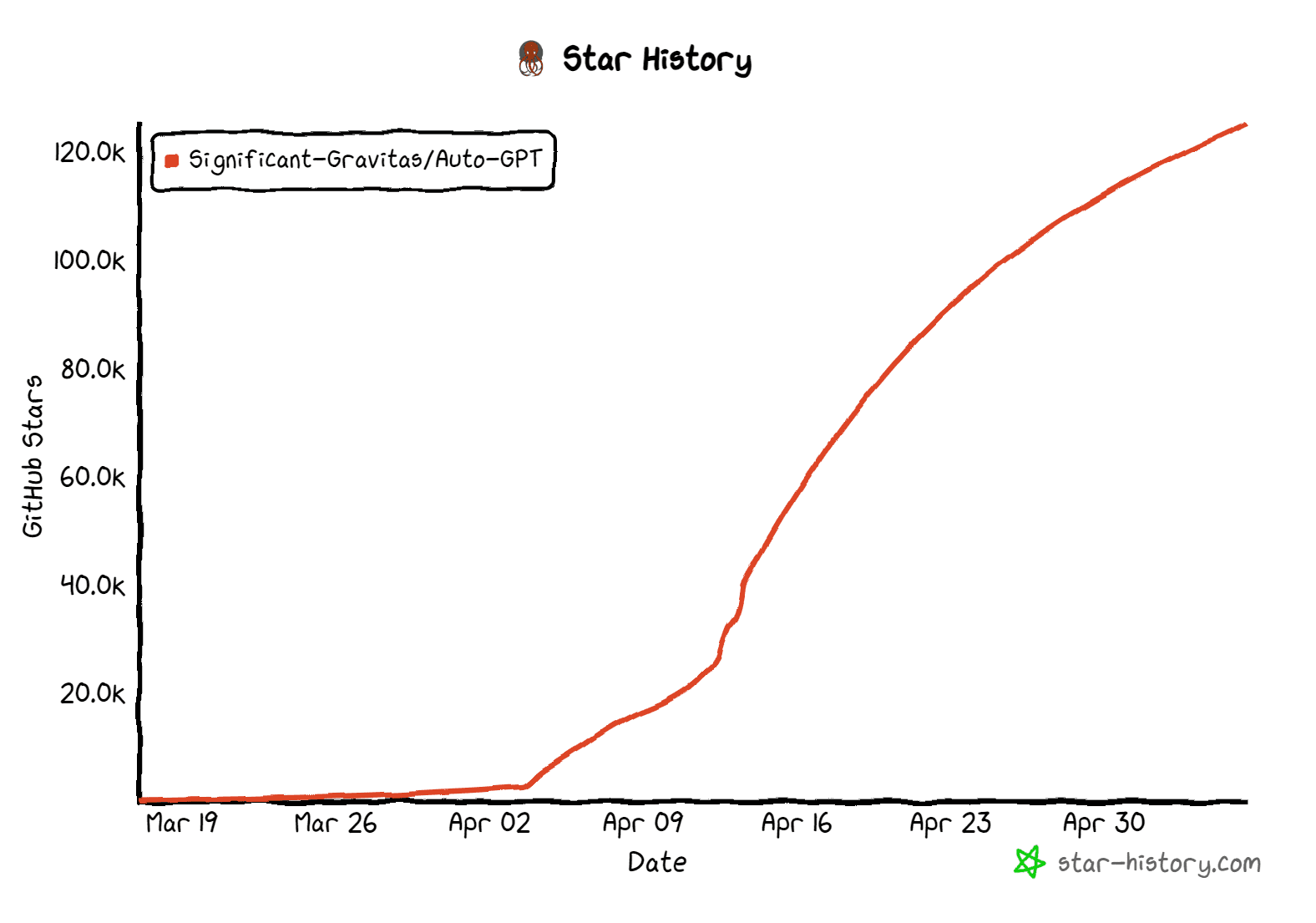
AutoGPT is an open-source application developed by Toran Bruce Richards ( Game Developer and Founder of Significant Gravitas). It uses GPT-3.5 or GPT-4 APIs to create fully autonomous AI agents. It stands out because you don’t need to steer the model based on your understanding. You just provide the task along with the list of objectives and it handles the rest. Unlike ChatGPT it can also access external resources to make its decision. Did you know that it has obtained more stars than Pytorch (A famous open-source ML Library) within a few weeks of its release? Here is a graph showing its star history.

XXXXX
Image Generated by Star-History How Does AutoGPT Work? XXXXX
Image by Author

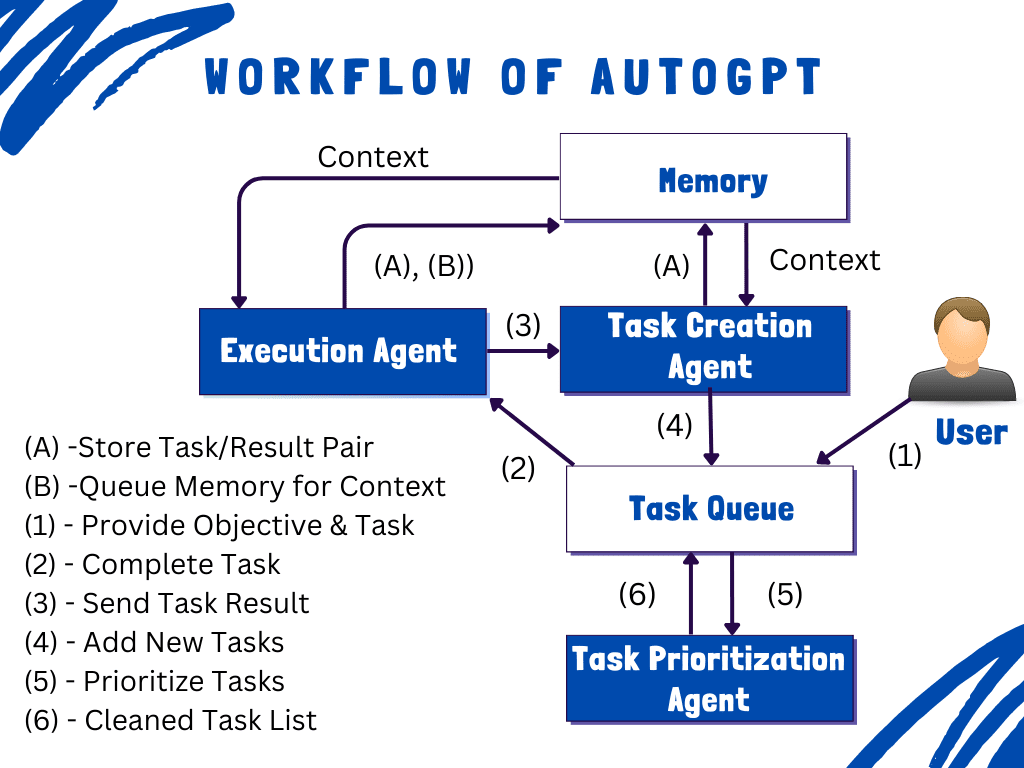
AutoGPT combines the power of the GPT-4 and personal assistant to generate, execute and prioritize the tasks autonomously. Being an autonomous system, it creates AI agents to perform specific tasks. These agents also communicate with one another. Here are the steps that describe how AutoGPT works:

Step 01: Input from the User

Firstly, the user needs to enter the following three inputs: AI Name, AI Role, and up to 5 goals. For example, I can create an AI named MarketResearchGPT and its role will be to conduct the market analysis of different items. I can set goals like Performing market research for different phones, Getting the list of top 5 with their pros and cons, Arranging them in ascending order of their prices, Summarizing their user reviews, and Terminating the process when done.

Step 02: Task Creation Agent

Once the user has entered the input, the task creation agent understands the goal, generates the list of tasks, and mentions the steps to achieve them. Then the resultant set of tasks is passed to the task prioritization agent.

Step 03: Task Prioritization Agent

The task prioritization agent reviews the sequence of the tasks to ensure that it logically makes sense. Because we don’t want to enter a deadlock situation where our current task depends on the result of the task that has not been executed yet.

Step 04: Task Execution Agent

Task Execution Agent as the name suggests makes use of GPT-4, the Internet, and other resources to perform these tasks.

Step 05: Communication Between Agents

Agents can communicate with each other to reach the user-defined goal. For example, if the unsatisfactory results were generated then it can communicate with Task Creation Agent to generate a new list of tasks. Hence, it becomes an iterative process.

Step 06: Final Result

The actions of these agents are visible on the user end in the following form:

Thoughts: AI agent share their thoughts after completing the action

Reasoning: It explains its choices of why is it choosing a particular course of action

Plan: The plan includes the new set of tasks

Criticism: Critically review the choices by identifying the limitations or concerns

It also uses external memory to keep track of history and learn from its past experiences to generate more precise results.

How does it differ from ChatGPT?

Although AutoGPT and ChatGPT are built on top of the same technology which is GPT API, we can pinpoint some key differences that are as follows:

Access to Real-Time Data

ChatGPT uses the latest model of GPT-4 that is trained up to September 2021 which means that we cannot extract the real-time insights. AutoGPT has access to external resources and incorporates the latest trends into its responses.

Autonomous Functionality

Unlike ChatGPT, which requires constant prompts from the user, AutoGPT is autonomous in this regard and doesn’t require constant prompting. It really helps in idea generation.

Memory Management

ChatGPT has memory limitations in the form of context windows of LLMs like GPT-4 while AutoGPT uses vector databases and is suitable for both short and long-term memory management.

Image and Speech Functionalities

ChatGPT is limited to only textual data while you can generate images and convert text to speech using AutoGPT.

How to use AutoGPT?

You will need an OpenAI API key as AutoGPT is built on top of GPT. If you don’t have one, you can sign up for a free account to get some free credits. Follow the steps below to set up AutoGPT on your local computer.

Requirements

  • Python 3.8 or later
  • OpenAI API key
  • Git
  • GPT-4 API Access
  • PINECONE API Key
  • ElevenLabs API (optional)

Setting it Up

Clone the GitHub repository in your local directory using the following command:

git clone https://github.com/Significant-Gravitas/Auto-GPT.git

Navigate to the project directory using the following command:

cd Auto-GPT

Run the following command to download the required dependencies:

pip install -r requirements.txt

Locate the “.env.template” file in your Auto-GPT folder. Kindly check the hidden files too if you are not able to find them. Create a copy of this file using:

cp .env.template .env

Open the .env file and replace the OPENAI_API_KEY with the key that you generated from your account. Save and close the .env file.

Run the below command to start AutoGPT:

python -m autogpt

And if you are using GPT-3.5 then you can run:

python -m autogpt --gpt3only

You are good to go now. In case of any issues please refer to the official documentation: Auto-GPT Setup

Limitations

Although AutoGPT can generate content with minimal human intervention, it has some major downsides such as high costs, limited functionality, inadequate understanding of context, data bias, limited creativity, and security risks. It is not yet capable of achieving the AGI (Artificial General Intelligence) due to data quality, generalization, and explainability issues. Despite the shortcomings, it has huge potential to revolutionize our daily lives and the way we work. I hope you enjoyed reading the article and do let me know in the comment section about what you think about AutoGPT.
Kanwal Mehreen is an aspiring software developer with a keen interest in data science and applications of AI in medicine. Kanwal was selected as the Google Generation Scholar 2022 for the APAC region. Kanwal loves to share technical knowledge by writing articles on trending topics, and is passionate about improving the representation of women in tech industry.

More On This Topic

  • Breaking Privacy in Federated Learning
  • AutoGPT: Everything You Need To Know

Amazon Throws Another Hat in the GenAI Ring

Amazon is racing to join the AI chatbot race. As pointed out by Bloomberg, the tech goliath which serves 54% of all product queries has posted job listings for a machine learning-focused engineer describing how it is “reimagining Amazon Search” with a new “interactive conversational experience” to answer product questions, compare products, personalise suggestions, and more. But this is not the e-commerce giant’s first attempt to integrate AI/ML to enhance users’ experience via genAI.

“This will be a once in a generation transformation for Search, just like the Mosaic browser made the Internet easier to engage with three decades ago,” Amazon wrote. “If you missed the 90s—WWW, Mosaic, and the founding of Amazon and Google—you don’t want to miss this opportunity.” Furthermore, Amazon expressed its eagerness to swiftly implement these changes, stating, “We want to deliver this vision to our customers right away.”

Previously, Amazon’s search experience has been heavily criticised for its sponsored content and ads heavily bombarding the results. A study by The Washington Post showed an overwhelming number of sponsored products displayed under different guises. The products not only exist under the label “sponsored” but also covertly have their presence under “highly rated”, while many also constitute products from Amazon’s own brands.

In 2017, Amazon allowed its renowned assistant Alexa which allowed users to purchase products through voice controls. Right from adding the products to cart to cancelling the order, the assistant provided features to ease the users’ shopping experience. Even though the company already had an existing product to upgrade, the company seems to have decided to take the long haul for further improving its flagship search.
Read: Who is to Blame for Your Bad Shopping Experience at Amazon?

Earlier this year, Amazon did release Amazon Lex, to help retailers build out conversational interfaces for applications using voice and text. The chatbot uses the same conversational engine that powers Amazon Alexa and is available to use in new and existing applications. But the company shied away from integrating the engine for its own purpose.

Existing Alternatives

A chatbot is a starting point for users looking to shop with specific parameters. Ask ChatGPT powered Microsoft Bing — to show the five best colognes and it will pull up a list of five products, citing reviews from GQ, along with links to stores selling the products.

Amazon’s hustle seems understandable with its rivals’ efforts catching the attention of users. Currently, a search on Amazon yields a bunch of ads, followed by some genuine products. Hence, the search king seems to be in a dire need to update its service via AI.

Two weeks ago at Google I/O, the Mountain-view based firm introduced genAI for its holy cash cow ‘Search’. With the latest addition, users can consider complex purchase decisions easily. When searching for a product, the users get a snapshot of factors to consider and along with product descriptions that include reviews, ratings, prices and product images. The reason for the relevant information is Google’s Shopping Graph, which has a comprehensive dataset of over 35 billion product listings. The Pichai-led firm stated that, hourly over 1.8 billion listings are refreshed in the graph.

Early implementations of genAI by tech giants Microsoft and Google have challenges, particularly when it comes to providing accurate responses to queries. Despite the setbacks, these steps show the potential for an enhanced Microsoft Bing or Google search, which could offer users insightful means to shop online.

Fashionably Late

The past few months have seen the tech industry drooling over the potential of generative AI but that wasn’t the case for Amazon. The tech giant took its own sweet time to announce its foundational models, too, similar to the upcoming AI chatbot.

In April, Amazon announced a foundational suite called Bedrock for its AWS cloud customers to leverage some of the most popular genAI models via an application programming interface (API). Apart from some of its own models collectively called “Titan” the announcement included Anthropic model for conversations and questions, AI21 Labs model for translation and Stability AI’s model for image generation.

Though Amazon arrived late to the generative AI party. Up until now, its releases have been strategically smart. With its latest under the garb chatbot on the way Amazon is definitely pushing for more AI coming its way but the company’s fate in the ring is yet to be determined.

The post Amazon Throws Another Hat in the GenAI Ring appeared first on Analytics India Magazine.

a16z-backed Rooms.xyz lets you build interactive, 3D rooms and simple games in your browser

a16z-backed Rooms.xyz lets you build interactive, 3D rooms and simple games in your browser Sarah Perez @sarahintampa / 8 hours

A team of ex-Googlers is today launching a new digital creativity platform, Rooms.xyz, into beta testing. The startup, backed by $10 million in seed funding led by a16z, offers a browser-based tool for designing 3D spaces — or “rooms” — using drag-and-drop, editable objects or code, allowing users to express themselves through creative play as they design rooms, basic games or other interactive activities contained in these small, online spaces.

The idea is something in between a simple creation tool like Minecraft and a more advanced world-building platform, like Roblox. Or, as the company describes it, it’s like the “digital equivalent of LEGO.”

Image Credits: Rooms.xyz

The idea for Rooms was inspired by a combination of factors, explains co-founder Jason Toff — namely, that 3D model creation today was far too difficult.

Prior to Rooms, Toff spent ten years at Google, off and on, in product marketing and product management, including at YouTube, Area 120, and in VR/AR. Before that, he spent a couple of years at Vine as Product Manager, including after it was acquired by Twitter. And most recently, Toff worked at Meta, where he dabbled with new product experiments, like the zine maker E.gg and music-making app Collab, among other things.

After leaving his last position, Toff decided to take some time off, which he decided to fill by trying to learn how to make 3D models — something he always thought sounded like fun. As it turned out, however, the process was actually fairly complicated and involved the use of complex software. Around the same time, Toff’s six-year-old son had just started playing with Minecraft where designing with 3D models was easy, but it had to be done one block at a time.

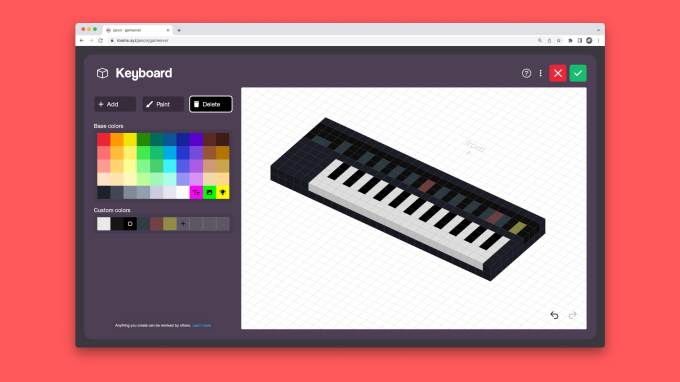
This prompted the idea of something of a middle ground for 3D design, where the process would be nearly as straightforward as it was in Minecraft, but the building unit wasn’t a single block. Instead, in Rooms, you can search for, edit, and then add a fully-formed object to your space — like a door, a sofa, a table, a bed, a car, decor, a pet, or anything else you can dream up.

The interface allows you to change an object’s attributes and functionality, like the color, size, position, or style or what happens when you click it.

The project also takes inspiration from other projects Toff worked on at Google’s AR/VR division, like its VR and AR app-building service Poly (which became another Google causality in 2020), and the 3D modeling tool for VR, Blocks. Rooms’ co-founder Bruno Oliveira also worked on these projects at Google, which is how the two first met. Meanwhile, third co-founder and iOS engineer Nick Kruge, hails from Smule (where he was Director of Product Design) and Uber, in addition to Google, where he worked on YouTube mobile and YouTube Music.

“Basically, I set out for the company to make the digital equivalent of LEGO,” Toff explains. “The thought was, LEGO is one of these few things that kids love, adults love, and adults want their kids to play with,” he says. But LEGO has limitations due to its physical, printed plastic nature. It can be expensive and you can lose parts, for example, Toff noted.

Like a box of LEGOS, Rooms is meant for open-ended play where people use the objects to express themselves in some way — whether that’s building a tiny version of a real-world room, a dream room, or by creating some sort of interactive space, like a simple game or a musical instrument you can click to play, or something else.

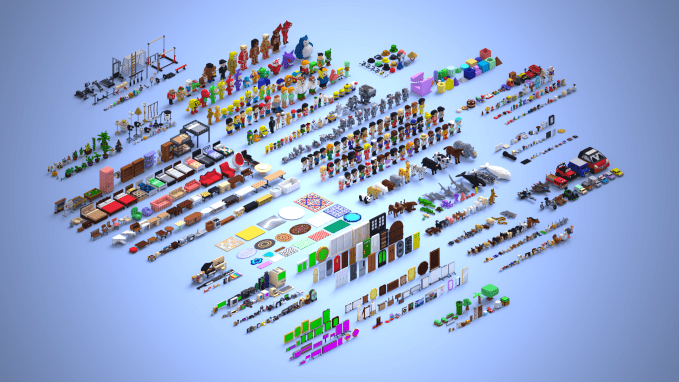
The startup seeded its community with 1,000 Voxel 3D objects it commissioned from creators, which can be added and customized in your own space. Every room is also by default public and can be “remixed” — that is, used as a template or jumping-off point for designing your own.

Image Credits: Rooms.xyz

There’s an educational aspect to the software, too, as you don’t only have to interact with the objects via the user interface — you can also click to reveal the code. Rooms uses Lua, the same language that’s used for coding in Roblox. That could help to introduce younger users to coding concepts before moving on to Roblox’s more advanced editing tools.

While the rooms themselves are interactive and can be interconnected with one another, there’s not much more that can be done with them after the design is complete besides share their URL with others to show them off. A “camera mode” lets you take a photo or a smooth dolly shot, but the end result isn’t one-click publishable to social networks. Nor can users create avatars that can move or interact with others, or engage in chats.

“That was an intentional decision — in part, just to keep this as like safe as possible,” Toff explains. “Because as soon as you introduce chat…people can do terrible things,” he says.. Plus, he adds, there’s already too much focus on virtual personas and dressing up avatars and the team wanted wanted to pursue something different.

“For all I know, it could be a huge mistake that we don’t have any of that — and it may make sense to introduce some sort of social experience down the road,” Toff admits. “But for now, it’s all just like just a website or a game you play. It’s all individual.”

Image Credits: Rooms.xyz

Eventually, Rooms could monetize by selling objects for purchase, subscriptions, or licensing its software for education, but that’s all very much to be determined at this point. As the startup opens up to beta testing, the goal is to see how early adopters use the product and what they end up building or requesting, says Toff.

One area they’re exploring, however, involves the use of ChatGPT. Right now, they’ve created an object of a fortune teller (Zoltar!) which you can pose questions to that are then answered by the OpenAI chatbot, speaking as Zoltar would. Users can copy that code and use it for their own AI-enabled objects, editing the prompt within the code to change the way their object responds.

Also in development is an AI tool that would let users instruct the software to write code for the object they want and how it should behave.

For instance, you could tell it to make your object spin when clicked, and the AI would create the code you need. This functionality is not yet public, however.

The startup — Things Inc. — was founded in 2021, raising $8 million in funding from Andreessen Horowitz (a16z) and $2 million from various angel investors, including Adobe’s Chief Product Office Scott Belsky and Instagram co-founder Mike Krieger, among others. After burning funds too quickly at first, the team downsized their 10-person team to just the three founders in order to maintain enough runway. Now, Rooms.xyz has somewhere around four-plus years, Toff says.

That could allow the company, which has been built via Unity, more time to launch on other platforms. Right now, an iOS app is in development that would serve as a companion for exploring the Rooms built by others. But the team also envisions expanding these creations to the AR/VR platforms from Apple and Meta in the future, too.

“We were like, ‘let’s get this beta out now,’ because once Apple comes out with its [AR/VR device], we’ll see what it does and then we can figure out how to integrate it,” says Toff. ‘All this was built in a way that it could be on a headset very easily,” he adds.

Rooms.xyz is open for beta testing and is free to use.

9 Things that Bard Can Do, But ChatGPT Can’t

At this year’s Google I/O conference, the company announced significant upgrades to Google Bard, which is now available in over 180 countries. Google developed Bard as its own AI chatbot to compete against OpenAI’s ChatGPT and Microsoft’s GPT-4 powered Bing.

Bard is based on PaLM 2, an advanced AI model that Google announced in February. One of its PaLM 2 models is lightweight enough to work on smartphones, CEO Sundar Pichai claimed.

Google Cloud CEO Thomas Kurian informed Reuters that the division is securing customers like Deutsche Bank AG and Uber Technologies Inc for testing purposes, as they evaluate and assess the effectiveness of Google’s latest technology.

Bard too has garnered interest among tech enthusiasts since its launch and is seen as a strong competitor to ChatGPT. Google has added several new features to enhance user experience and overcome the limitations of ChatGPT.

We’ve listed nine Bard features that ChatGPT doesn’t have, as of now.

Access to the web

One notable advantage of Bard over ChatGPT is its access to the internet. ChatGPT does not have direct internet access and can access the web only through plugins on its paid version—ChatGPT Plus.

Bard can provide comprehensive and informative answers by leveraging the power of the internet. It can give real-time information, fetch the top news, and answer questions with the most up-to-date data. However, it should be noted that Bard is still in the experimental phase, and there may be instances where the information is inaccurate or offensive.

Meanwhile, OpenAI CEO Sam Altman had tweeted expressing their intention to add internet plugins and code execution plugins.

Image generation

Bard also surpasses the paid and unpaid versions of ChatGPT when it comes to generating images as response. Google, at the event, announced that they’ll provide AI image generation capabilities through integration with Adobe Firefly. This feature enhances the visual aspect of the conversation and allows users to obtain more contextually rich information.

Voice Prompts

Bard outperforms ChatGPT when it comes to voice prompts as well, providing users with the ability to interact through voice input. This offers a convenient way to obtain responses while multitasking or when typing is not feasible. This voice interaction capability gives Bard an edge over its competitors.

Coding Capabilities

Bard overshadows ChatGPT and offers a strong support for coding with its ability to assist in over 20 programming languages including C++, Python, Java, TypeScript, JavaScript, etc. It can help professionals with code generation, explanation, and debugging. In comparison, while ChatGPT does have coding capabilities, it falls short when it comes to additional tasks, which OpenAI’s Codex may be better suited to perform.

ChatGPT is focused on natural language but it has also been trained on coding languages like Python, JavaScript, C++, C#, Java, Ruby, PHP, Go, Swift, TypeScript, SQL and Shell.

Gmail Integration

The integration of Bard with Gmail is another significant advantage. With over 2 billion users, Gmail is widely used for communication. Having access to an AI chatbot like Bard within the email service opens up new possibilities for email interactions and can enhance the experience.

However, ChatGPT is being added to Microsoft work software, Microsoft 365, and will be embedded into Word, Excel, PowerPoint, and its Gmail-equivalent Outlook. The OpenAI chatbot can perform this through plugins.

Export Responses

Bard also offers the functionality to export results to Gmail and Docs instantly. Users can easily share the generated content with friends and colleagues by exporting it directly to these platforms. This feature streamlines the process of sharing information and makes composing emails hassle-free.

On the other hand, OpenAI has released a similar export option in settings—where users get to export their account details and conversations which will be sent to your registered email in a downloadable file, but it says that processing may take some time.

Image Prompts

One standout feature of Bard is its ability to use images as prompts. Users can simply click a picture or scan an image using Google Lens and ask Bard for assistance. For instance, a user can lookup similar holiday destinations as portrayed in another image and can also ask about its history and significance. This feature opens up new possibilities for interaction and prompt generation in AI chatbots.

Similarly, GPT-4 also claims to be a large multimodal model which accepts image and text inputs, to emit text outputs but the capability hasn’t been introduced even in the paid version as of the date of publishing this article.

Webpage Summarisation

Bard has the advantage of internet connectivity, allowing it to summarise web pages by simply sharing the link. In contrast, ChatGPT lacks internet connectivity, requiring users to manually copy and paste the content they want to summarise.

However, Bard has its limitations, particularly in terms of toxicity. During a test, the model produced toxic responses more than 30% of the time when given explicitly toxic prompts. Additionally, in languages like English, German, and Portuguese, PaLM 2 tended to exhibit more obvious toxic behaviour overall.

Although designed to compete with OpenAI’s GPT-4, it is challenging to directly compare the two models due to their different architectures and testing methodologies. In reasoning tasks, Google’s PaLM 2 performed similarly to or better than GPT-4. However, in coding tasks, PaLM 2 required multiple attempts and additional coding tokens to achieve good performance.

The post 9 Things that Bard Can Do, But ChatGPT Can’t appeared first on Analytics India Magazine.

Why Amazon Prime Dumped Serverless for Monolithic Architecture

The early 2010s saw a massive shift with IT teams of most companies moving towards serverless or microservices architecture from monolithic architecture. As platforms grew bigger, it simply became a difficult balancing act. Monolithic architectures were famously hard to scale and had all the disadvantages that come with a huge computing network. Making any changes to the application meant reworking the entire stack which slowed updates down to a glacial pace.

Shift from Monolithic to Microservices

They could be convenient during the early phase of a project because the code base would be easier to manage but aside from that it became clear that the world now looked serverless. In 2009, Netflix became a pioneer in microservices architecture because of their growing pains. The traditional infrastructure of the video streaming services company eventually couldn’t contain its skyrocketing demand. The company then decided to migrate its IT operations from private data centres to a public cloud while also replacing its monolithic architecture with a microservices one.

While it wasn’t as well known what microservices exactly meant then, it became a welcome change because it deployed all services independently. Each service ran on its own logic, database and was able to update, test, deploy and scale services of its own accord. This didn’t immediately make things less complex but the complexities became more visible because the tasks were distinctly separated.

Microservices were also better suited for startups which had mushroomed all over because startups would obviously have smaller tech teams. Monoliths normally required less work than distributed systems but didn’t have the flexibility needed either. But despite these well-established facts, the microservices and monolithic architecture debate gathered steam again after Amazon Prime Video shifted its live video monitoring service from microservices to a monolithic one, in the beginning of this month. Ironically, Amazon had been one of the first ones to jump aboard the microservices bandwagon initially.

Will Amazon’s decision pay off?

The Prime Video team posted a blog in March titled ‘Scaling up the Prime Video audio/video monitoring service and reducing costs by 90%’ explaining just how the shift from a distributed microservices architecture to a monolithic style had helped them achieve scalability while also reducing costs by a wide margin doing essentially what serverless had promised to do.

“Moving our service to a monolith reduced our infrastructure cost by over 90%. It also increased our scaling capabilities. Today, we’re able to handle thousands of streams and we still have the capacity to scale the service even further. Moving the solution to Amazon EC2 and Amazon ECS also allowed us to use the Amazon EC2 compute saving plans that will help drive costs down even further. Some decisions we’ve taken are not obvious but they resulted in significant improvements,” the post said.

But does bucking the general trend place Amazon in danger of sacrificing flexibility for cost? Amazon execs have since then been scampering to explain themselves. Dr Werner Vogels, CTO at the retail giant, wrote a blog on the ‘All Things Distributed’ site, saying, “Building evolvable software systems is a strategy, not a religion. And revisiting your architecture with an open mind is a must.”

Vogels explained that to think architectures are like a “one-size-fits-all” is a false notion based on a trend. “There is not one architectural pattern to rule them all. How you choose to develop, deploy, and manage services will always be driven by the product you’re designing, the skillset of the team building it, and the experience you want to deliver to customers (and of course things like cost, speed, and resiliency),” he said.

A former AWS exec, Adrian Cockcroft also weighed in on the move. “In contrast to commentary along the lines that Amazon got it wrong, the team followed what I consider to be the best practice,” Cockcroft said. “The result isn’t a monolith, but there seems to be a popular trigger meme nowadays about microservices being oversold, and a return to monoliths,” he stated.

Cockcroft believes there’s some truth to this. “I think this may have arisen from vendors who wanted to sell Kubernetes with a simple marketing message that enterprises needed to modernise by using Kubernetes to do cloud native microservices for everything,” he noted.

Marcin Kolny, Amazon Prime Senior Software Development Engineer discussed how ironically AWS’ skyrocketing costs had hit them too. He also went on to admit that the decisions made “may not work in all instances.”

Last year, Amazon reportedly invested USD 7 billion across Amazon Originals, live sports and licensed third-party video content included with Prime, its earnings show. Like any tech company trying to tide over the current lows, Amazon’s recent earnings calls revealed that there was significant pressure on growth as clients tried to cut down cloud costs.

But more than anything else maybe this just goes on to show that the IT world is cyclical and something that has been set aside can suddenly turn into the trend to follow the next year.

The post Why Amazon Prime Dumped Serverless for Monolithic Architecture appeared first on Analytics India Magazine.

Google combats AI misinformation with Search labels, adds dark web security upgrades

Google Search stock image.
Image: Adobe Stock/Thaspol

Google will add artificial intelligence to several online safety features and give users more insight into whether their information might have been posted on the dark web, the tech giant announced during the Google I/O conference on May 10. The new security features will roll out to select markets in the upcoming weeks or months.

Jump to:

  • Image Search will flag AI-generated content
  • Safe browsing gets an AI polish
  • Turning an eye on the dark web
  • Gmail spam filtering and Maps security will be enhanced

Image Search will flag AI-generated content

One concern about the proliferation of artificial intelligence is that it may become difficult to verify whether images are real or digitally generated. For businesses, having a quick way to tell the difference could prevent confusion around AI-generated images’ copyrights and origins. Organizations could also use these labels as part of company policies regarding the use of AI-generated content.

Google wants to get ahead of this problem with the About This Image feature, which indicates whether an image is original or AI-generated (Figure A).

Figure A

An example of the About This Image feature proving an image was generated with the AI art service Midjourney.
An example of the About This Image feature proving an image was generated with the AI art service Midjourney. Image: Google

As well as detecting photorealistic AI-generated photos, the About This Image feature provides context about when the image and similar images were first indexed by Google, where it first appeared and where else it has appeared online. This context could help identify misinformation and photo manipulation, as well as artificially-generated images.

Google offers AI image generation and plans to roll out markups that will label those images as AI-generated in Search. Other companies like Midjourney and Shutterstock are working with Google to label their images when they appear in Search (Figure B).

Figure B

An image created by the AI program Midjourney with a markup label in Google Search.
An image created by the AI program Midjourney with a markup label in Google Search. Image: Google

Google says About This Image will be available “in the coming months.”

SEE: You can now try out the Google Bard generative AI, a ChatGPT rival.

Safe browsing gets an AI polish

In addition, Google will enhance its safe browsing features by using AI to scan for dangerous sites and files. The new Safe Browsing API for Chrome and Android scans compromised sites and other potential attack avenues with AI trained to recognize bad actors. The API can detect and block 25% more phishing attempts per month than the existing safety features, Google said.

Turning an eye on the dark web

Google One subscribers in the U.S. can run dark web reports to see whether their email address or other personal information is listed among attackers’ lists of targets. Google can then offer suggestions on how to secure the user’s accounts. Google is now expanding this feature to anyone in the U.S. with a Gmail account. This will roll out “in the next few weeks,” and certain international markets will follow after.

“Google’s extension of its dark web report beyond Google One plans is a step in the right direction and part of Google’s responsibility in the ecosystem,” said Roy Akerman, co-founder and CEO of identity and security company Rezonate. “However, we [have] seen with Google One existing customers, they may be aware their information is available in the dark web, yet no action is taken. Knowing is not enough; action must be taken to understand the potential risk and account changes must be put in place.”

For example, a user whose Social Security number was stolen could report that to the government. Bank account credential theft could be reported to the bank, and business information associated with the account could be reported to a business’ IT department.

Gmail spam filtering and Maps security will be enhanced

Some other features are not getting AI enhancements but are being expanded.

For instance, Gmail will handle spam slightly differently going forward. Users will have new options for how to separate and review files and decide what might be spam. The same type of spam filtering used in Gmail is also coming to Google Drive (Figure C).

Figure C

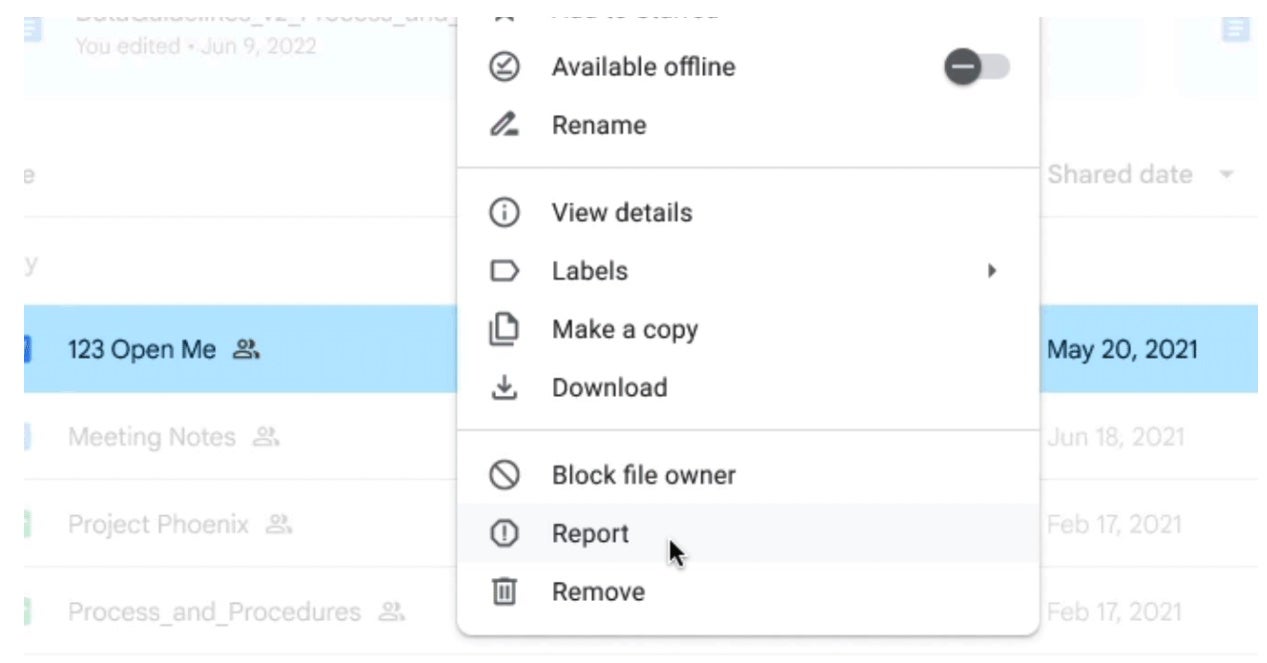
A demonstration of the spam reporting feature in Google Drive.
A demonstration of the spam reporting feature in Google Drive. Image: Google

Google is betting on passwords becoming a thing of the past by offering more options for sign in, including passkeys.

Google Maps will make it easier for users to delete their search history. Google proposes this could prevent people from noticing whether someone has bought them a surprise gift; it could also prevent more sinister uses like stalking.

For more on Google’s I/O announcements, read about how the PaLM 2 large language model will be integrated into Search, Maps and other everyday services.

Google Weekly

Google Weekly Newsletter

Learn how to get the most out of Google Docs, Google Cloud Platform, Google Apps, Chrome OS, and all the other Google products used in business environments.

Delivered Fridays Sign up today