The best robot vacuum deals of May 2023

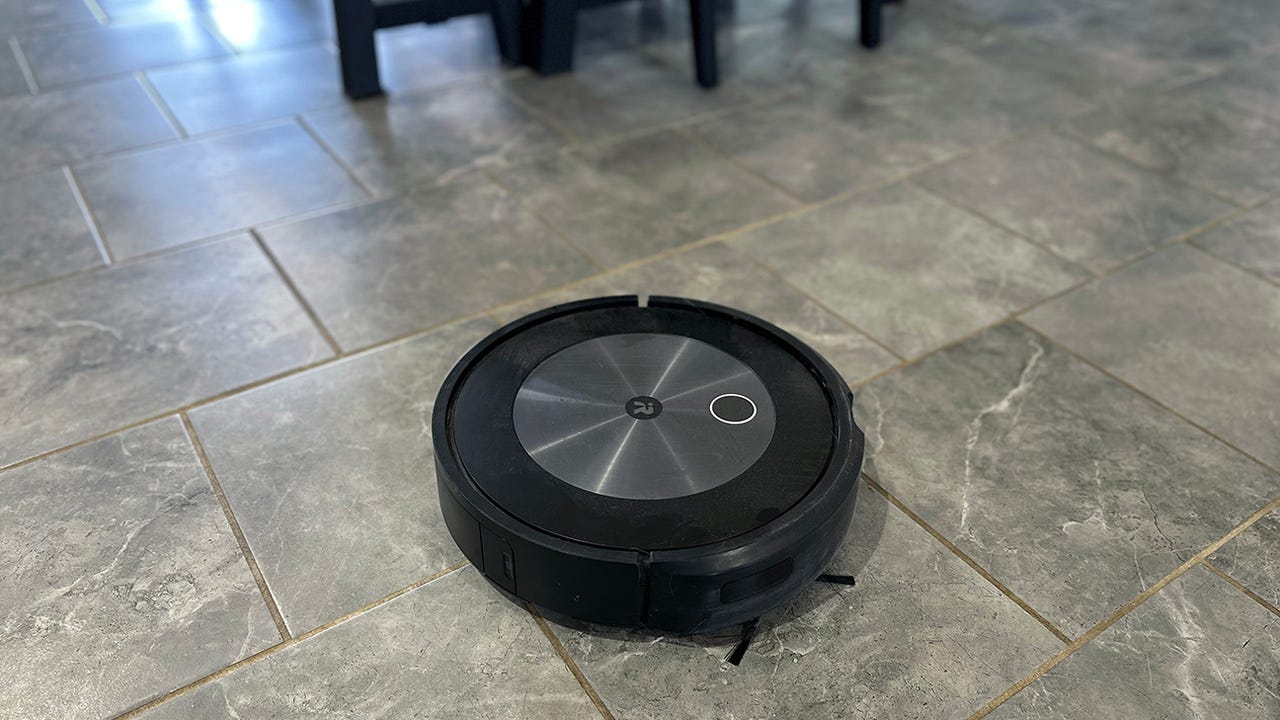
Roomba j7+ vacuuming on tile.

Let a robot vacuum do the hard work for you.

Anything that can ease your cleaning routine is a must-have in your home. If you've been putting off getting a robot vacuum, now can be a great time for adding one to your shopping card, as major retailers are offering steep discounts on robot vacuums and vacuum/mop combos.

As you attempt to wade through the sea of markdown and sales, we've found some of the best robot vacuum deals available now to guide you through finding the best discount, and all the features you need.

Not only are these robot vacuum devices a time saver when it comes to cleaning, but they also offer ease of convenience, so your floors can be free of crumbs (and sometimes, mopped) without you having to do any of the hard work. Here are our picks for the best robot vacuum deals.

The best robot vacuum deals

TOP DEAL

OKP K3 Robot Vacuum — Save $351

This deal for 79% off the OKP K3 Robot Vacuum isn't one we see often. For only $91, you get a powerful 2000Pa robot vacuum that can seamlessly go from hard floors like wood and tile, to rugs and carpets — all with Amazon Alexa integration. And with an average Amazon rating of nearly 4 out of 5 stars, you can expect it to work pretty well, too.

View at Amazon

TOP DEAL

iRobot Roomba s9+ 9550 robot vacuum — Save $101

  • Current Price: $899
  • Original Price: $1,000

The Roomba S9+ offers 40 times more suction power than previous models, and a three-stage cleaning system to clean up all dirt in your home. It also uses vSLAM navigation to make sure that every inch of your floors is cleaned. Right now, you can save about $100 on one with this deal.

View at Amazon

TOP DEAL

Proscenic M8 Robot Vacuum — Save $60 with coupon

  • Current Price: $230 (with on-page coupon)
  • Original Price: $290

With a 3000Pa suction and multi-floor mapping, Proscenic's robot vacuum uses a Laser Distance Sensor to scan its surroundings in 360 degrees. You can program it to clean on a specific schedule, and it's voice compatible with Alexa and Google. Save $60 now with this coupon.

View at Amazon

TOP DEAL

Yeedi Mop Station Pro — Save $260 (with coupon)

  • Current Price: $540 (with on-page coupon)
  • Original Price: $800

The Yeedi Mop Station Pro delivers 3000Pa of deep-cleaning, plus a rotating mopping system to scrub and remove tough stains and dirt. It automatically washes the pads instead of dragging a dirty mop pad on your floor, so you just empty the dirty water tank and refill the clean water tank.

View at Amazon

TOP DEAL

Roborock Q7 Max Robot Vacuum — Save $200

  • Current Price: $400
  • Original Price: $600

With up to 180 minutes of runtime, the Q7 Max not only vacuums but also mops, with 30 water flow levels to get the hardest stains off your tile or hardwood. You can also make sure that your pet hair and cat litter vanish with up to 4200 Pa suction.

View at Amazon

More robot vacuum deals

ZDNET Recommends

Personal CRM app Clay introduces an AI helper to help you navigate your relationships

Personal CRM app Clay introduces an AI helper to help you navigate your relationships Sarah Perez @sarahintampa / 10 hours

Clay, a startup that’s something of a personal CRM, as it’s designed to help people manage their own relationships — including those with friends, family, colleagues, industry peers and more — is now turning to AI to help you derive more insights from your network of contacts. If you ever wanted to ask an AI who among your connections has ever been to a specific place, works a particular company, or is knowledgable about a particular topic, Clay’s new AI navigator, which it’s dubbed Nexus, could help.

While many people today are using AI to summarize information from the web or answer questions about general topics, Nexus is putting AI to use for a more practical and personal purpose, while still respecting user privacy.

Launched in 2021, Clay’s first iteration offered a service that pulled in information from your address book and other social networks, like Facebook, Twitter and LinkedIn, to build something that’s more powerful than an address book but also not as sales-and-pipeline focused as a traditional CRM system. Instead, the company described its product as a “home for your people,” carving out a niche for a sort of personal relationship-focused database and contacts system.

With Clay, you could also keep up with your colleagues and friends’ latest achievements, recent posts, and birthdays as well as jot down notes you wanted to remember — like how you met, when you last hung out, or what you talked about — and could organize contacts into groups. Combined, the features allowed you to be more thoughtful and conscientious about your relationships, which could aid with anything from growing your network to just being a better friends.

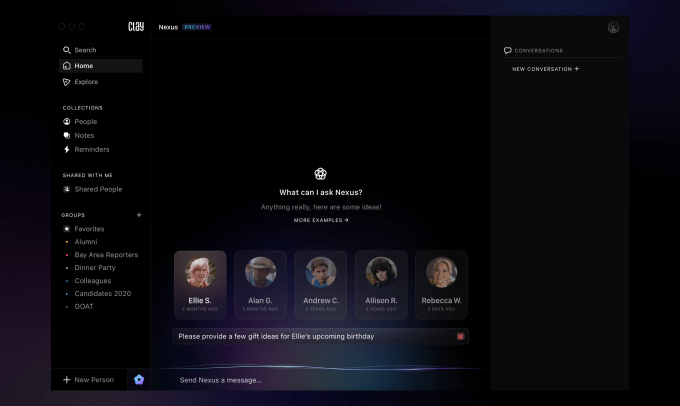
Now, the new AI-powered Nexus feature will allow you to query against your personal database to learn even more about your network and aid you with maintaining your relationships.

Image Credits: Clay

“With the current wave of AI tools. I think a lot of a lot of what we’re seeing is technology and search for solution,” says Clay co-founder Matthew Achariam. Prior to Clay, Achariam led product at Y Combinator-backed analytics company Castora. He’s joined on Clay by co-foudner Zachary Hamed, who previously product management for Goldman Sachs’ Marquee.

“When we first started Clay, one of the first things that we really wanted to get right was actually people search…we said, it’s fundamentally broken because all your data is everywhere, and there’s just too much of it,” Achariam explains. “So, we were jumping for joy when we first heard about the advancements in AI because now you can essentially have your network be this living, portable thing that you need some help navigating.”

Image Credits: Clay

The company spent the last year working to develop their AI functionality in order to build a tool that’s designed specifically for this purpose, using a combination of technologies from OpenAI, Anthropic and self-trained models from Hugging Face and other open source technologies to create a hybrid model for its own purposes.

The result is Nexus, which allows you to query your own network for insights. For example, you could ask Nexus who to invite to a dinner party in New York next week or who knows a lot about chip manufacturing among your connections. Or, as Achariam describes it, it’s like talking to your network as if it’s a person, then having it generate a list for you, based on its understanding of that data.

The AI helper can also assist with relationship-building, as it can help you to do things like compose an email to a contact to suggest you catch up soon, for instance. Or it could suggest gift ideas when it’s someone’s birthday.

Image Credits: Clay

Given the sensitivity of the information in your network, Clay has always been upfront with how it respects user privacy and security, offering a human-readable privacy policy where it tends to default to the most restrictive policy possible for all its integrations. For instance, it doesn’t pull email bodies, only metadata like the subject line and recipients. And it’s explicit about what it does and does not collect, forgoing working with third-party providers that use data for training purposes, and ensuring everything is opt-in, not opt out. (Plus, if you later opt out, the information is deleted.)

“Being the the processing layer for this data and you being able to trust us means that we’re not giving, for example, all of the data to OpenAI or any of these other companies. We can be very specific about the data that we use, how we use it, and what is the question it’s answering,” notes Hamed.

We should note that, like other companies, Clay’s access to Twitter via APIs has deteriorated since Elon Musk’s policy changes. The company says, however, if existing users had connected with Twitter in the past, that data should still be available.

Image Credits: Clay

Clay doesn’t share how many users are now using its app, which is now available across Mac, Windows, web and iOS, and soon, Android. However, the founders did tell us that it’s approaching over 100 million relationships managed, in terms of its network size. (That’s not an equivalent to users, as each user could have thousands of people in their own network. But you can sort of back your way into a user estimate here, using averages.)

The app itself is popular among a number of industries, ranging from MBA students early in their career where they’re meeting a lot of people, to those who have expansive networks, like VCs. Some smaller business customers are also using Clay to develop better relationships with their best customers, but not for sales pipeline types of concerns.

The startup also now offers tiered pricing, beginning with a free, personal plan with a more limited search history, and a Pro Plan ($20/mo) with unlimited search history. It says the new AI features will roll out to both plans at no additional charge, as the team believes this will now become a big selling point for its app.

“We wanted to get it in people’s hands. We really believe that this is a unique use case for AI and we’re the first people to do it in this — sort of, CRM, networking, contacts anything — space. So we wanted to give people a preview of what’s to come,” says Hamed.

As the feature is currently in a technical preview, users will only be able to “refresh” their network’s data for the AI use case once per month, but that will improve over time.

Clay, still a small team of 14, is backed by a little over $8 million in seed funding from Forerunner Ventures, General Catalyst, and others. The company has seen inbound interest over its AI plans but hasn’t committed to raising an additional round at this time.

When will Generative AI Make Investors Smile?

When will Generative AI Make Investors Smile?

Let’s face it: Generative AI is the belle of the ball in the tech industry and investment circles alike. Its potential to revolutionise various sectors has captured the imagination of entrepreneurs and investors. As a result, a new trend has emerged in the buzzing world of venture capital – the mad rush to invest in generative AI startups.

The only problem when it comes to investing in these generative AI startups is the return on investment (ROI). While some sceptics argue that since there is no immediate ROI with generative AI, it’s a risky investment, savvy VCs believe it’s a calculated gamble that could pay off handsomely in the future.

Let’s look at this: There are 13 generative AI companies that have become unicorns since last year, with Cohere and Runway joining the club just this month. This is amid the funding droughts, layoffs, and investors demanding profit from companies. Moreover, according to data from PitchBook, around $1.7 billion was generated across 46 deals within the first quarter of 2023 with an additional $10.6 billion worth of deals announced. The generative AI market is expected to hit $109.3 billion by 2030, according to Grand View Research.

VCs have never been strangers to taking calculated risks and currently they are pumping money based on the hype around models like Google’s Bard and OpenAI’s ChatGPT. When it comes to this field, a lot of it is probably driven by predictions, ambitions, and probably delusions. Here’s why.

Where is the profit in this hype?

Firstly, OpenAI is not profitable yet. The Microsoft-backed company is running a loss of around $540 million since it started building ChatGPT. It has only started generating revenue after offering its API, subscriptions, and licensing its products like GPT-4 to its customers through Microsoft’s enterprise and cloud services.

The same is the case with NVIDIA. The company that was banking on the gaming industry for money, decided to provide its hardware for generative AI. Voila! The biggest generative AI name in the world, ChatGPT, is powered by the company’s hardware, reaping money.

The billions of dollars that companies such as OpenAI have raised, has driven startups to build products similar to ChatGPT. VCs falling into the hype cycle are pouring funds into similarly ambitious startups without realising and analysing what sets the company’s product apart – not every startup can build a ChatGPT and then sell it as well as OpenAI did along with Microsoft.

Of course, not every generative AI startup will succeed. Some may fizzle out, while others may stumble upon groundbreaking breakthroughs. But that’s the nature of investment. VCs understand that they must place multiple bets to increase their chances of striking gold. By diversifying their portfolio and placing their chips on generative AI, they’re playing the odds and banking on the future, or are they?

Lu Zhang, the founder and partner at Fusion Fund, said the barrier to entry in this segment is still quite low. She further adds the firm has seen an 80% increase in the number of generative AI pitches in the last two months, since the firm invested in You.com.

In the grand scheme of things, “the hype surrounding generative AI may be justified”, said Sonya Huang from Sequoia Capital. “If I was a founder in Y Combinator right now, I would 100% be pointing my guns at one of these models and seeing what I can do,” she added, explaining that the rising investments is planting the seed in founders’ minds to build something with generative AI, and she says that we are already seeing the impact of the technology in the current world, and will definitely see more adoption in the future in almost every sector.

When will the rewards reap in?

While the immediate ROI might not be evident, the long-term potential is too significant to ignore. VCs are seizing the opportunity to shape the future, embracing the uncertainty and the possibility of great rewards. “The world is in dark times right now, and people are looking for something to latch on to that is hope, and generative AI appears to be that,” added Huang.

This might be a hint towards the failure of cryptocurrency and blockchain ventures. Colin Treseler, co-founder of Supernormal, a platform that leverages generative AI to summarise online meetings, expressed similar views, “The Web3 hype ended, and these people needed a place to go,” he said.

According to a report by Mckinsey, VC investments in AI have grown 13X over the last ten years. And according to PitchBook, VC investment in generative AI has increased by 425 percent since 2020, even when the broader technology market is declining.

Gartner predicts that more than 30% of the drug discovery by 2025 will be done by generative AI solutions, which is a rise from almost zero today. And this is just one of the hundreds of use cases. Sure, the immediate ROI might be elusive because generative AI is still in its infancy. Many startups explore the uncharted territories of creativity and problem-solving, and VCs are tapping into that potential for solving specific use cases.

Spend, Spend, AI Will Send

“Generative AI is well on the way to becoming not just faster and cheaper, but better in some cases than what humans create by hand,” concluded Sequoia Capital’s investment thesis using GPT-3 in September last year.

It is clear that these early investments are not just about instant gratification; they are about building a foundation for a future where generative AI becomes indispensable. VCs believe that instead of investing in “boring sectors” that involve a lot of technicalities, now that the generative AI startups are expanding into different verticals like enterprise and several other applications, it is becoming an increasingly attractive stage for them.

Most investors that AIM spoke with have said that they seek guidance from several technological experts to evaluate the tech behind the products. As Brett Calhoun puts it, “We are betting on the jockeys, not the horse.” The startups have to build a clear roadmap for generating ROI before asking for large capital from investors.

Think about it this way: the technological world is evolving at an unprecedented pace, with digital transformation penetrating every aspect of our lives. Companies across sectors will soon find themselves relying on generative AI products to innovate, automate, and outperform competitors. Those who were visionary enough to back generative AI early on will reap the rewards of their foresight, and that is what the investors are striving to be.

So yes, investors are well aware that they are not investing for today but for tomorrow. After all, sometimes the best investments are the ones made in the future, even if they come with a sprinkle of hype.

The post When will Generative AI Make Investors Smile? appeared first on Analytics India Magazine.

5 Reasons Why You Should Get Certified

Sponsored Post

5 Reasons Why You Should Get Certified
In today's highly competitive job market, practitioners need every advantage they can get to stand out from the crowd and accelerate in their roles as a high-performing employee. One way to do this is by obtaining a certification to validate their skills and knowledge and demonstrate commitment to ongoing learning and professional development.

The following are 5 reasons why you should earn a SAS certification:

1. Gain competitive edge in a thriving job market.

Certification can provide practitioners with a competitive advantage in their field by demonstrating their expertise and commitment to professional development. In today's data-driven world, companies are constantly seeking professionals with specialized skills to help them harness the power of data and make informed decisions. SAS Certification is the next step to set you apart from the crowd and land you your dream job in the high-earning field of data analytics.

2. Increase your earning potential.

Certification can lead to higher earning potential. Reports show that 58% of employees were rewarded with a salary increase within 3 months of earning their certifications (Pearson Vue, 2023). Certification serves as tangible evidence of a practitioners’ competence and mastery, making them more attractive to potential employers and clients. This can open doors to increased financial success and career stability as SAS user Dimitri said, “Even if you are not looking for a promotion, having a SAS certificate on hands is an amazing way to secure and future proof your current position”. 

3. Increase confidence in you and your skills.

Achieving certification can be a personally satisfying accomplishment for practitioners, as it represents a significant investment of time and effort in their professional development. This accomplishment can instill a sense of pride and confidence in your abilities, leading to a positive impact on your overall success and productivity. As per recent data, 92% of candidates are more confident in their abilities and 81% have more confidence to explore new job opportunities, highlighting the tangible benefits of earning certification (Pearson Vue, 2023).

4. Data analytics skills are in high demand.

1.9 million jobs requested skills in data analysis and data visualization in the past year (Lightcast, 2022). This proves that data analytics skills are in high demand, and the demand keeps growing. Whether you are just starting your data analyst career or looking to upgrade your skills through earning a certification, learning new skills is nothing to lose. By earning a certification in an area of data analytics of your choice, you will surely experience the benefits of training and even open the door to new opportunities in your career.

5. SAS has everything you need to get started.

Why NOT get certified when SAS has everything you need to get started?! Take your pick from the many resources below and see how SAS can help you start your own certification journey:

  • Explore SAS Credentials: Don’t know where to start? Here’s all the credentials SAS has to offer.
  • Free Certification Webinars: Reach your SAS certification goals with help from our experts by tuning in to these free webinars.
  • Free Practice Exams: Test your knowledge before test day and take a free practice exam.
  • Certification Prep Bundle: Interested in getting certified as a Programmer? Access all you need to prep for your exam with SAS Certification Prep Bundles.
  • The Value of SAS Certifications: Need more reasons? This blog shares more resources and opportunities on why you should get SAS certified
  • SAS Skill Builder: If you’re a student, take advantage of the free learning platform to get all the resources you need to pursue certification and land a career.
  • Free Online Training: Explore the different courses available to start your learning journey and upgrade your skills.

More On This Topic

  • ModelOps: What you need to know to get certified
  • How to Get Certified as a Data Scientist
  • JupyterLab 3 is Here: Key reasons to upgrade now
  • 5 Reasons Why You Need Synthetic Data
  • Seven Reasons to Take This Course Before You Go Hands-On with Machine…
  • 4 Reasons Why You Shouldn’t Use Machine Learning

Fighting AI with AI Fraud Monitoring for Deepfake Applications

Fighting AI with AI Fraud Monitoring for Deepfake Applications
Photo by Tima Miroshnichenko

Deepfakes have been a big topic of conversation in the data science community for some years now. Back in 2020, the MIT Technology Review posited that deep fakes had hit their “tipping point for mainstream use”.

The data certainly backs that up. The Wall Street Journal reported that less than 10,000 deepfakes had been found online in 2018. Those numbers now run into the millions, and there are many real-life examples of deep fakes being used both to confuse and misinform and to perpetuate financial fraud.

Deepfake techniques are altogether providing cybercriminals with many sophisticated options.

They go way beyond the ability to insert the image of a celebrity into promotional material for an “unmissable” Bitcoin offer, which – of course – turns out to be a scam. Deepfake videos, in particular, are on the radar of fraudsters. They provide them with a way to get through automated ID and KYC checks and have proved frighteningly effective.

In May 2022, The Verge reported that “liveness tests” used by banks and other institutions to help verify users’ identities can be easily fooled by deep fakes. The related study found that 90% of the ID verification systems tested were vulnerable.

So what’s the answer? Are we entering an era where cybercriminals can easily use deep fake technology to outwit the security measures used by financial institutions? Will such businesses have to ditch their automated systems and revert to manual, human checks?

The simple answer is “probably not”. Just as criminals can make use of the surge in AI advancements, so too can the companies they target. Let’s now look at how vulnerable businesses can fight AI with AI.

How Do Deepfakes Work?

Deepfakes are produced using a range of artificial intelligence techniques, such as:

  • generative adversarial networks (GANs)
  • encoder/decoder pairs
  • first-order motion models

These techniques may, on the face of it, sound like the exclusive preserve of the machine learning community, complete with high barriers to entry and a need for expert technical knowledge. However, like other elements of AI, they have become considerably more accessible over time.

Low-cost, off-the-shelf tools now allow non-technical users to create deep fakes, just as anybody can sign up to OpenAI and test the capabilities of ChatGPT.

As recently as 2020, the World Economic Forum reported that the cost of producing a “state of the art” deepfake is under $30,000. But in 2023, Wharton School professor Ethan Mollick revealed, via a viral Twitter post, that he had produced a deep fake video of himself delivering a lecture in under six minutes.

Mollick’s total spend was $10.99. He used a service called ElevenLabs to almost perfectly mimic his voice, for a cost of $5. Another service called D-ID, at $5.99 per month, generated a video based on only a script and a single photograph. He even used ChatGPT to create the script itself.

When deepfakes first began to emerge, a primary focus was on fake political videos (and fake pornography). Since then, the world has seen:

  • BuzzFeedVideos create a deepfake public service announcement “featuring” Barack Obama, impersonated by actor Jordon Peele.
  • A deep fake YouTube video purporting to show Donald Trump telling a story about a reindeer.
  • A deep fake video of Hilary Clinton shown on Saturday Night Live, when she was in fact being impersonated by a cast member.

While these examples show the “fun” side of deepfakes, and perhaps provide a jolt of reality as to the capabilities of the technology, fraudsters haven’t wasted any time in using them for nefarious purposes.

Real-life examples of fraud, perpetuated using deepfake techniques, are many.

Losses due to deep fake scams range from hundreds of thousands to many millions. In 2021, an AI voice cloning scam was used to arrange fraudulent bank transfers of $35 million. This was a huge financial payoff that didn’t even require the use of video.

The quality of AI output, especially video, can vary hugely. Some videos are obviously fake to humans. But, as stated above, automated systems, such as those used by banks and fintech, have proved easily fooled in the past.

The balance is likely to shift further as AI capabilities continue to improve. A recent development is an incorporation of “counter forensics”, where “targeted invisible “noise” is added to deep fakes, in an attempt to fool detection mechanisms.

So what can be done?

Fighting AI with AI: Detecting Deepfake Fraud

Just as fraudsters seek to use the latest AI technology for financial gain, businesses such as tech firms are hard at work finding ways to utilize tech to catch criminals.

Here are a couple of examples of companies using AI to fight the AI:

In late 2022, Intel launched an AI-based tool called “FakeCatcher”. With Intel’s reported reliability rate of 96%, it uses a technology known as photoplethysmography (PPG).

The tech makes use of something that’s not present in artificially generated videos: blood flow. Trained on legitimate videos, its deep-learning algorithm measures the light that’s absorbed or reflected by blood vessels, which change color as blood moves around the body.

FakeCatcher, part of Intel’s Responsible AI initiative, is described as “the world’s first real-time deep fake detector that returns results in milliseconds.” It’s an innovative technology that looks for signs that the person shown in a video is truly human. It looks for something that’s “right”, rather than analyzing data to highlight something that’s “wrong”. This is how it indicates the likelihood of a fake.

Meanwhile, University of Buffalo (UB) computer scientists have been working on a deepfake detection technology of their own. It uses something that avid PC gamers know requires immense processing power to emulate: light.

Claimed by UB to be 94% effective on fake photos, the AI tool looks at how light reflects in the eyes of the subject. The surface of the cornea acts as a mirror, and generates “reflective patterns”.

The scientists’ study, entitled “Exposing GAN-Generated Faces Using Inconsistent Corneal Specular Highlights”, indicates that “GAN synthesized faces can be exposed with the inconsistent corneal specular highlights between two eyes”.

It suggests that it would be “nontrivial” for AI systems to emulate the genuine highlights. PC gamers, who often invest in the latest ray-tracing graphics cards in order to experience realistic lighting effects, will instinctively recognize the challenges here.

The Challenges of AI-Based Fraud Detection

Perhaps the greatest fraud detection challenge is the endless “cat and mouse” game between fraudsters and those who work to thwart them. It’s highly likely, in the wake of announcements such as those above, that people are already working on building technologies that can sidestep and beat such detection mechanisms.

It’s also one thing that such mechanisms exist, but another to see them routinely integrated into the solutions that businesses use. Earlier, we referred to a statistic that suggested 90% of solutions can be “easily fooled”. The likelihood is that at least some financial institutions are still using such systems.

A wise fraud monitoring strategy requires companies to look beyond detecting the deep fakes themselves. Much can be done before a fraudster gets far enough into a system to participate in a video-based ID verification or KYC process. Precautions that find a place earlier in the process may also involve an element of AI and machine learning.

For example, machine learning can be used for both real-time fraud monitoring and the creation of rulesets. These can look at historical fraud events, detecting patterns that could easily be missed by a human. Transactions deemed to be high risk can be rejected outright, or passed for manual review before even reaching a stage where there may be an ID check – and therefore an opportunity for a fraudster to make use of deepfake tech.

The earlier a system detects a cybercriminal, the better. There’s less chance that they can perpetuate a crime and less for the business to spend on further checks. Video-based ID checks are costly, even without the incorporation of AI technology to detect deep fakes.

If fraudsters can be identified before they get that far, with techniques such as digital footprinting, there will be more resources left available to optimize the checks of more borderline cases.

The Future of AI in Fraud Detection

The very nature of machine learning should dictate that, over time, it becomes better at detecting anomalies and fighting fraud. AI-powered systems can learn from new patterns and potentially filter out fraudulent transactions at an early stage in the process.

When it comes to deepfakes specifically, the example above gives a particular reason for hope. Scientists have found a way to detect the vast majority of deepfakes using light reflections. Developments like this represent a considerable step forward in fraud prevention and a considerable roadblock for cybercriminals.

In theory, it’s much easier to deploy such detection technology than it is for fraudsters to find a way to circumvent it – replicating the behavior of light, for example, at speed, and at scale. The “cat and mouse” game seems likely to continue eternally, but big tech and big finance have the resources and the deep pockets to – in theory at least – stay one small step ahead.
Jimmy Fong is the CCO of SEON and brings his in-depth experience of fraud-fighting to assist fraud teams everywhere.

More On This Topic

  • MLOps: Model Monitoring 101
  • ebook: Fundamentals for Efficient ML Monitoring
  • How to use Machine Learning for Anomaly Detection and Conditional…
  • Production Machine Learning Monitoring: Outliers, Drift, Explainers &…
  • Fraud through the eyes of a machine
  • A Machine Learning Model Monitoring Checklist: 7 Things to Track

These 4 popular Microsoft apps are getting a big AI boost

New Microsoft AI app updates

Two weeks ago, Microsoft unveiled a ton of new AI capabilities for Bing and Edge. Instead of these updates remaining as empty promises with long waits for actual implementation, the features have been steadily introduced to Microsoft's platforms.

Also: ChatGPT vs. Bing AI: Which AI chatbot is better for you?

On Tuesday, Microsoft announced a new wave of updates coming to the Bing, Edge, Swiftkey, and Skype apps. These updates are meant to elevate the Microsoft AI experience on mobile.

Bing Chat mobile updates

If you have been enjoying Bing on your desktop, you can now enjoy it on the go, too, with an enhanced experienced on mobile. Starting this week, you can add a Bing Chat widget to your smartphone's home screen and make it easier to access the chatbot.

Using the widget, you can not only ask any questions you may have but you can also use the microphone icon to ask any verbal question, allowing you to ditch Siri and Google Assistant for an advanced AI model.

The voice feature has also been improved to be more inclusive of different languages with increased country and language support.

Also: OpenAI unveils ChatGPT plugins, but there's a catch

To improve the flow between conversations across devices, starting this week you will be able to resume your desktop conversations on both iOS and Android.

All you will need to do is click on the answer on your desktop and select the phone icon in the options menu to view the QR Code, which you can then scan to resume the conversation on your phone, according to Microsoft.

Edge mobile updates

If you have ever been looking at a webpage and had follow-up questions, the Edge app is here to help. Soon, on Edge mobile, you will be able to ask Bing Chat questions relating to the page you are looking at simply by tapping on the chat icon on the navigation bar.

This feature, called contextual chat, could also be used to ask Bing Chat to summarize an article or webpage you are reading.

Also: How to use ChatGPT to summarize a book, article, or research paper

Similarly, if you need clarity on a specific aspect of something you are reading, for example, a line on a historical event, you can highlight that specific proportion of the text in the Edge app and select Bing Chat from the options menu to get the answers you need.

Both of these features don't have exact release dates, but Microsoft says they will be launching soon.

Swiftkey and Skype updates

Swiftkey, Microsoft's virtual keyboard app that allows you to access Bing Chat across different apps, is getting a monumental boost.

The new Compose feature in Swiftkey, which will begin rolling out today, will draft text for you with parameters you choose. These include tone, format, and length all of which you can use to compose emails, texts, and more. In addition, two new tones, Witty and Funny, arrived on Swiftkey.

Also: The best AI chatbots

You can also access Microsoft's AI-powered translator from the Swiftkey keyboard, allowing you to translate any text to and from any Bing-supported language at the touch of a button. This feature has already been available on Android but will be arriving on iOS within the next week.

Within the Skype app, you will be able to access Bing Chat within all group chats. All you need to do is type "@Bing" in your conversation to access the AI chatbot and ask questions such as, "Best places to eat in this area". The rollout of this feature has begun and it will be available to everyone in a few days.

Artificial Intelligence

Birdwatching tech startup Bird Buddy introduces an AI-powered Smart Hummingbird Feeder and Bird Bath

Birdwatching tech startup Bird Buddy introduces an AI-powered Smart Hummingbird Feeder and Bird Bath Sarah Perez @sarahintampa / 8 hours
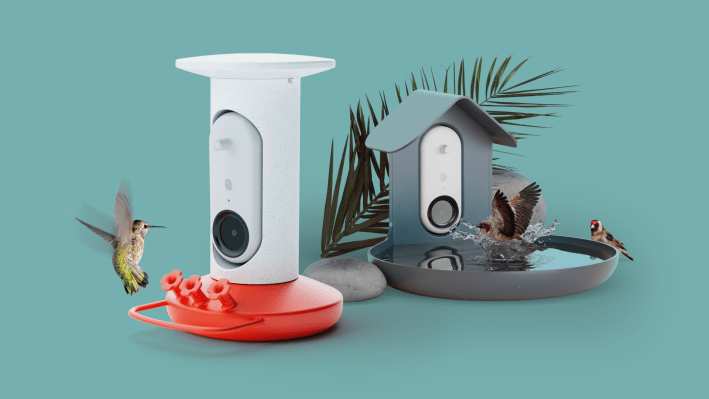
Bird Buddy, the AI-powered smart bird feeder, is bringing the popular pastime of bird-watching into the digital age — and growing its line of products in support of the hobby. With the startup’s original affordable bird feeder, connected camera, and companion mobile app, birdwatching enthusiasts and newcomers alike can view photos and videos of bird visitors from their own backyards, which Bird Buddy identifies for you and then allows you to save privately or share with the broader Bird Buddy community. Today, the company is expanding its lineup to also include a smart hummingbird feeder and a smart bird path.

First launched in 2020, initially as a Kickstarter project, the Slovenia- and Kalamazoo, Michigan-based startup today has around 100,000 active Bird Buddy users who are using its original Smart Feeder and AI-powered mobile app to engage with nature and learn more about their local bird populations. Of particular interest is the fact that roughly a third of those users are new to birdwatching, which demonstrates the draw this smart birdfeeder system has to pull newcomers into this hobby.

The original Bird Buddy feeder is $199 — or $269 with a solar roof to charge the camera — and began shipping to its backers last September. It comes in blue and yellow and is made with new and post-consumer BPA-free recycled plastics. The feeder also comes with a length of cord to hang the feeder from a tree or post, as well as a bottom mount that works with a pole, wall, or fence mount. Plus, owners can purchase optional accessories for the system, like the solar roof or a suet holder, for an additional price.

At CES, the company first teased its next product: a Hummingbird Feeder and showed off a prototype.

Now, that product is getting nearer manufacturing, as Bird Buddy is returning to Kickstarter to launch a crowdfunding campaign in the hopes of meeting a target $100,000 raise. As a benefit, backers will receive 25% off and exclusive bundles. That means the hummingbird feeder will retail for $235 but will be offered to early backers at $174 (super early bird) and $189 (early bird). The Smart Bird Bath, meanwhile, will retail for $249 but will be offered at $184 or $199 to early Kickstarter backers.

Image Credits: Bird Buddy

Like the original smart bird feeder, the new Bird Buddy Smart Hummingbird Feeder is designed to provide up-close views of its visitors while the Bird Buddy software has been updated to recognize all common hummingbird species across North America. The company notes the feeder may also attract bees and butterflies, increasing the biodiversity of its customers’ backyards.

Also similar to the original feeder, the new Hummingbird Feeder can be bought with or without the solar roof and will use the same camera module with 5 megapixels and HD video, and a 120-degree field of view. Because the camera module is the same, existing customers will be able to swap their cameras between their different feeders.
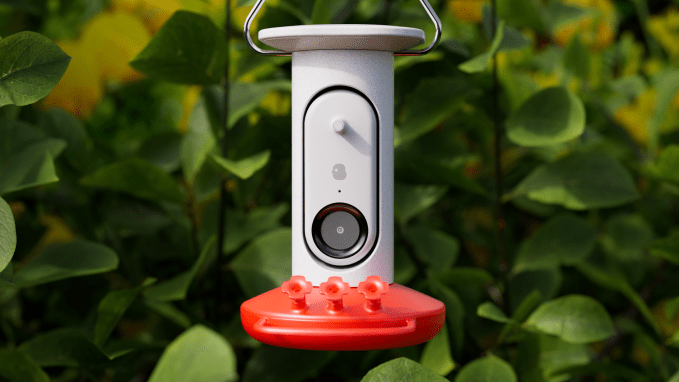
Image Credits: Bird Buddy Hummingbird Feeder

Meanwhile, the new Smart Bird Bath offers a way to attract more species of birds to the backyard — particularly in the summer months.

Though the company today generates its revenue by selling its bird feeders, the smart devices themselves are not the real star of the show for Bird Buddy — it’s the app and the community Bird Buddy is building.

Image Credits: Bird Buddy Smart Feeder

For over a month, I’ve been trying Bird Buddy’s smart feeder (provided to TechCrunch by the company), to learn more about the product. I found that even after the initial excitement wore off, scrolling through Bird Buddy’s feed has become a regular part of my daily routine (as those who follow me on Bluesky already know.). And it’s arguably a more relaxing and fulfilling experience than scrolling videos on TikTok or watching Instagram Stories, I should note.

Co-founder Ziga Vrtacic, who originally hailed from mobile gaming company Outfit7 (Talking Tom kids app maker) told TechCrunch that the inspiration for the smart birdfeeder struck him after he came across that YouTube video of a seagull stealing a GoPro camera. The video includes several up-close shots of the bird looking into the camera lens.

“I realized that we never see birds from this personal perspective — they’re always photographed from far away,” Vrtacic says. “Seeing birds from this angle really makes a ton of difference in the way you perceive it.”

The founder teamed up with colleague and friend Franci Zidar, now Bird Buddy CEO, to develop the Bird Buddy system. The two realized they had no background in working with hardware, which led them to bring on Bird Buddy’s third co-founder Kyle Buzzard, whose background included work on the first Chromecast design, various Logitech cameras, and the Nest Cam.

Image Credits: Bird Buddy

Still, the founders knew that they had to offer more than just a birdfeeder with a camera attached — something Vrtacic dismisses today as “not much of an idea” and “very obvious.” Instead, the team decided to focus more heavily on the software side of its business, building out an AI-powered mobile app that is able to identify bird species and allows users to collect photos and videos as well as engage with a birdwatching community.

Fast forward to today and Bird Buddy is now capable of identifying 452 species using its own proprietary bird identification system — not a third-party integration. As the company expands into new markets around the world, it adds more birds to its model by identifying those that get sent into its “expert review” system where it loops in ornithologists to make the determination.

As bird visitors drop by your feeder, the camera engages to take videos and photos which are then shared through the Bird Buddy app as updates. Though you can use the app to watch the camera feed live, this isn’t core to the experience. Rather, you’re meant to tap on push notifications sent to your phone to watch your bird visitors or review them later when you have downtime.
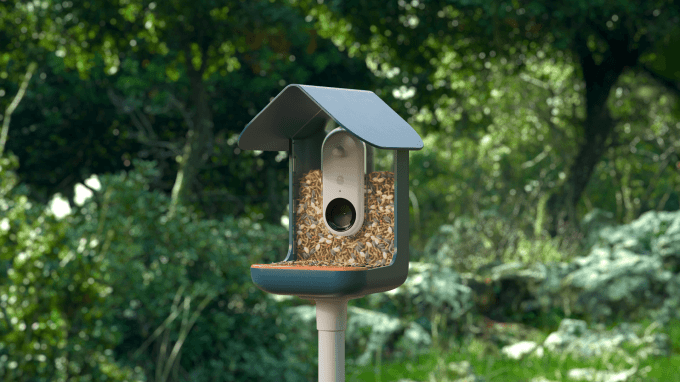
Image Credits: Bird Buddy

Under the hood, Bird Buddy trained its photo and video-capturing system by labeling a couple of million photos to teach it what a “good” bird photo would look like. For example, it learned that a good photo would have the bird clearly in the frame or you’d be able to see the beak, for example — though the specific details regarding its training are part of Bird Buddy’s secret sauce.

In the initial version of the app, which I tested, these photos and videos were sent through as cute “postcards” you would tap to open. The design was adorable as each opening included a bit of fanfare — and when a new bird visited, there would be a bit of a celebration alongside your first look. You’d then swipe left or right, Tinder-style, to save or discard photos and could opt to save or delete the photo or video entirely, if it wasn’t one you wanted to keep or share.

You can then choose to save the media to your private collection in the app or share the photos and videos with the Bird Buddy community, which is also accessible through the app.

Over time, however, I found that ending up with a dozen or so postcards at the end of the day to go through — often only to see the same bird over and over again, which is common to the Bird Buddy user experience — began to lose its novelty. At first, I was thrilled to watch a mating set of cardinals (where the male fed the female some seeds — awww!), But by the twentieth time I had a cardinal postcard to open, the experience of tapping to open, then manually selecting which photos and videos to save had become a little tedious.

Bird Buddy had heard this complaint, too, and quickly readjusted.

“That was the second most often reported feedback,” Vrtacic admitted. (The first was battery life, but this was addressed with a late December/early January update, leaving the postcard collection flow the number one issue. Now the battery makes it through a good part of a week for me, though this will vary based on your own “bird traffic.”)
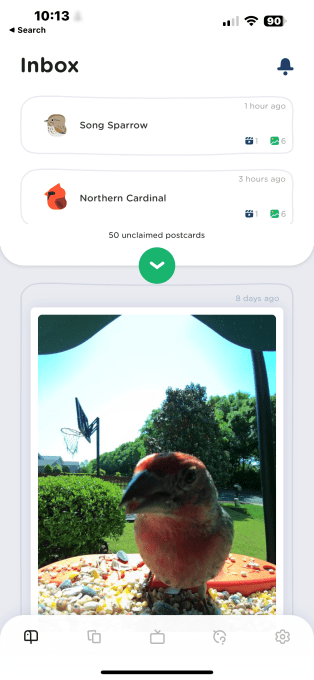
The feedback led to the app’s redesign, which recently rolled out.

Now, the user interface does away with the tap-to-open experience in favor of a stream of updates, similar to a notification or inbox feed. Here, you can preview each item and choose whether or not to view the content or just swipe it to dismiss it. In other words, you can skip watching the 13th visit from your cardinal friend by swiping it away and just tapping to see the other bird photos instead.

Once you’re viewing the images, you’ll still need to swipe to save or delete photos, as before. But the second part of the redesign, expected in a couple of months, will allow you to multi-select photos for faster processing — again speeding things up.

Image Credits: Bird Buddy

After managing your notifications, you can also scroll through your past photos in a feed or tap over to other sections of the app.

Your private collection is available through the second tab from the left, letting you track and return to all the different types of birds you’ve “collected.” In this section, you can learn more about the species through informative blurbs and cards, play clips of the bird’s call and songs, view a map of where they’re found in the world, and share individual photos or videos with friends or on social media.
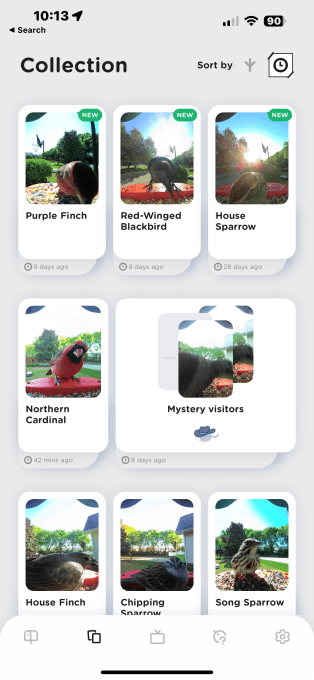
Image Credits: Bird Buddy

This helps augment the app with educational content, which is particularly useful to newcomers to bird-watching.

Another new feature in the software update is a feed of “mystery visitors” — which is what Bird Buddy calls the birds its software, for whatever reason, can’t identify — maybe they’re out of frame, blurry, or there’s a glare, or it just doesn’t have them in its database yet. With this additional resource, bird experts can now help you to classify your unknown birds, at your request.
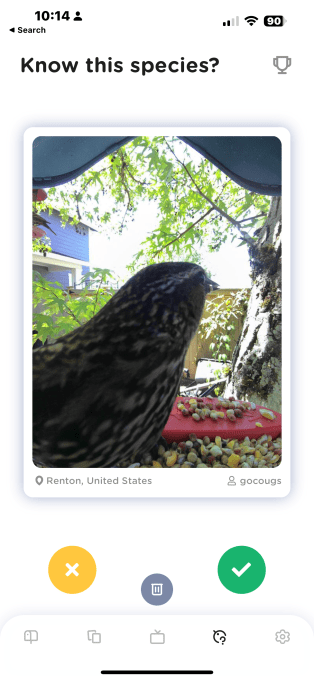
Image Credits: Bird Buddy

However, the most enjoyable part of the app update has been the new Bird Buddy TV feature, which is an almost TikTok-like vertical feed of bird videos, recorded from customers’ devices, which you swipe through vertically.
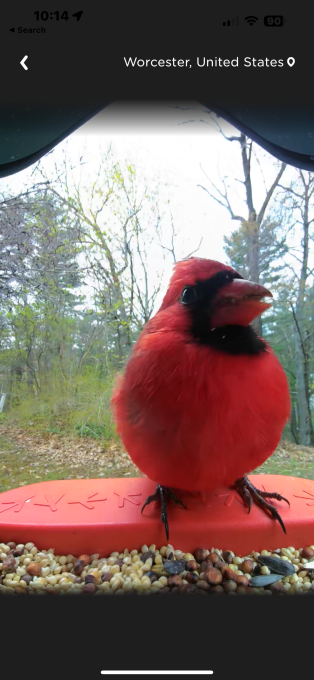
“Bird Buddy TV is our experiment in allowing people to consume this content without really any work,” explains Vrtacic. “And we’re seeing great success with that feature, even though the first version is not even interactive yet. You cannot like share or comment,” he notes. “But that is also something that’s coming soon,” he teases.

Customers are spending increased minutes in the app because of this addition, rivaling in some cases, the time spent on social media.

The company says it’s careful to respect user privacy when sharing videos into this feed, making sure that it’s not picking up any personal information — like house numbers, license plates on nearby parked cars, and, of course, humans. Over time this video feed could also bring in non-Bird Buddy product owners into the app to engage with the content and community, without having to invest in a feeder itself.

Another of Bird Buddy’s bigger goals is to make its bird feeder data available to researchers. This is something it’s already working on, as it now makes the data available to the public for download through its Bird Buddy Heartbeat website in addition to a stream of live sightings. But conversations with universities, bird groups, and other researchers are still in the early stages about what sort of data they need and how Bird Buddy can better contribute.
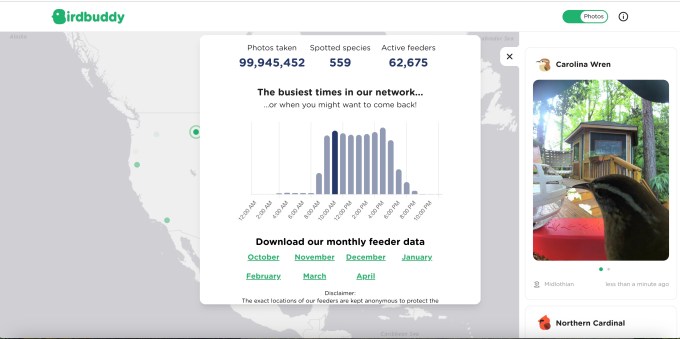
Image Credits: Bird Buddy (live website)

In the meantime, the company believes it has created value beyond its hardware-software combination by way of its community of bird watchers who chat, interact, and share tips and ideas with one another. That community today lives on Facebook, but could be migrated to live more fully inside the Bird Buddy app itself over time.

“We do think that our community is our greatest asset,” notes Vrtacic. “It took us some time to be able to build a team that can really support this community, right because [there are] huge volumes of messages coming in and being posted to a lot of channels. We are now making this a priority…we find it super important to invest in that relationship,” he says.

To date, Bird Buddy has raised $8.5 million in funding led by General Catalyst and London-based VC firm BACKED. The startup has not decided if or when it will raise more funding, but says it could.

“I must say that there’s a lot of investor interest…this is not one of our problems,” Vrtacic says.

Bird Buddy’s earlier Kickstarter was one of the platform’s top 1% most-funded projects, as 22,925 users backed the project by raising nearly $4.6 million, making it one of the biggest projects of 2021. The Bird Buddy Kickstarter for new products is live now. As of the time of writing, it’s raised $912,045 of its $100,000 goal.

Bird Buddy lands $8.5M to pursue ‘tech for nature’ after smart bird feeder campaign takes off

Accelerating Scientific Discoveries: AI Conducts Autonomous Experiments

An artificial intelligence platform known as BacterAI, designed by a research team led by a professor at the University of Michigan, has showcased its ability to conduct a staggering number of autonomous scientific experiments – as many as 10,000 per day. The breakthrough application of AI could pave the way for rapid advancements in various fields including medicine, agriculture, and environmental science.

The results of the research were published in Nature Microbiology.

Deciphering Microbial Metabolism with BacterAI

BacterAI was developed to map the metabolism of two microbes associated with oral health, without any baseline information to start with. The complex metabolic processes of bacteria involve the consumption of a specific combination of the 20 amino acids required for life. The goal of the research was to determine the precise amino acids needed by beneficial oral microbes to promote their growth.

“We know almost nothing about most of the bacteria that influence our health. Understanding how bacteria grow is the first step toward reengineering our microbiome,” said Paul Jensen, U-M assistant professor of biomedical engineering, who was at the University of Illinois when the project began.

A Challenging Task Simplified by AI

Decoding the preferred combination of amino acids for bacteria is a daunting task due to the over a million possible combinations. However, BacterAI was able to successfully determine the amino acid requirements for the growth of both Streptococcus gordonii and Streptococcus sanguinis.

BacterAI's approach involved testing hundreds of combinations of amino acids per day, refining its focus and altering combinations each day based on the results of the previous day's experiments. Within a span of nine days, it achieved 90% accuracy in its predictions.

AI Learning Through Trial and Error

Unlike traditional methods that use labeled data sets to train machine-learning models, BacterAI generates its own data set through an iterative process of conducting experiments, analyzing results, and predicting future outcomes. This method enabled it to decipher the rules for feeding bacteria with fewer than 4,000 experiments.

“We wanted our AI agent to take steps and fall down, to come up with its own ideas and make mistakes. Every day, it gets a little better, a little smarter,” said Jensen, highlighting the parallels between the learning process of BacterAI and a child.

The Future of AI in Research

Given that little to no research has been conducted on approximately 90% of bacteria, conventional methods present a significant barrier in terms of time and resources required. BacterAI's ability to conduct automated experimentation could drastically accelerate discoveries. In a single day, the team managed to run up to 10,000 experiments.

However, the potential applications of BacterAI extend beyond microbiology. Researchers in any field can pose questions as puzzles for AI to solve through this kind of trial and error process.

“With the recent explosion of mainstream AI over the last several months, many people are uncertain about what it will bring in the future, both positive and negative,” said Adam Dama, a former engineer in the Jensen Lab and lead author of the study. “But to me, it's very clear that focused applications of AI like our project will accelerate everyday research.”

IIT Madras Launches Centre for Responsible AI, Promotes Ethical AI Practices  

Centre for Responsible AI

In a bid to ensure the ethical and responsible development of AI-based solutions, IIT Madras recently set up a Centre for Responsible AI (CeRAI). The institute defines this as first of its kind multi-stakeholder, interdisciplinary research centre.

Earlier today, the Centre for Responsible AI even conducted its first workshop on ‘Responsible AI for India.’ The centre was formally inaugurated by Minister of State for Electronics and Information Technology, Rajeev Chandrasekhar.

This new development also comes against the backdrop of Google last year announcing a grant of $1 Mn to IIT Madras for setting up a Centre for Responsible AI, which will look into mitigating bias using NLP models and enable fair use of AI.

Read: Google Announces 1 Mn Grant to IIT Madras for Responsible AI Initiative

CeRAI

IIT Madras believes that one of the primary objectives of CeRAI is to produce high-quality research outputs. This includes publishing research papers in high-impact journals/conferences, white papers, and patents among others. Further, it said that it will work towards creating technical resources like curated datasets (universal as well as India-specific), software, toolkits, etc., particularly in the area of responsible AI.

Prof. V. Kamakoti, director at IIT Madras believes that we have now reached a stage where we have to assign responsibility to AI tools and interpret the reasons for the output the AI gives. He said that aspects of human augmentation, biased data sets, risk of leakage of collected data and the introduction of new policies besides substantial research must be addressed.

“There is a growing need for trust to be built around AI and it is crucial to bring about the notion of privacy,” said Kamakoti, saying that AI will not take away jobs as long as domain interpretation exists.

IIT Madras’ AI Contributon

IIT Madras has been one of the top institutions in spearheading some of the cutting-edge AI innovations in the country, besides IISc, IIT Bombay, IIT Hyderabad and others. Some of the notable work at IIT Madras include PIVOT, an AI-based tool that can predict cancer-causing genes in an individual. Read: Interview with the IIT-Madras team that developed the cancer prediction tool, PIVOT

Last year, researchers from IIT-Madras developed a new display technology called ‘iTad’ (interactive Touch Active Display) which can mimic textures such as gritty surfaces and crisp edges. These are some of the notable contributions, besides launching multiple AI initiatives, like ‘Nilekani Centre at AI4Bharat’ and others. Read: IIT Madras and Nandan Nilekani Launches An AI Centre on Indian Languages

The post IIT Madras Launches Centre for Responsible AI, Promotes Ethical AI Practices appeared first on Analytics India Magazine.

Zoom adds its own AI assistant named Claude

Zoom Robot

Zoom is onboarding Claude, Anthropic's AI assistant, with this new partnership.

Zoom just announced a strategic partnership with Anthropic, an artificial intelligence company that conducts research into AI safety and develops tools based on that work. The collaboration will integrate Anthropic's AI assistant, Claude, into the Zoom platform, including the Zoom Contact Center.

Claude is an AI assistant that can be integrated into different business models through standard APIs available through Anthropic AI.

Also: How I tricked ChatGPT into telling me lies

The AI assistant, Claude, can be a customer service agent and sales representative. Claude can also parse documents and answer questions about them, perform searches, offer coaching, and do administrative tasks, like help you answer emails or go prioritize your most important tasks.

When integrated with Zoom, Claude will be used to guide customer service interactions, helping agents reach better resolutions for more successful customer experiences.

Also: The best AI chatbots

The AI assistant will also work for customers as a self-service tool, intelligently recognizing the users' intent and guiding them to the best outcome in order to improve productivity in the Zoom Contact Center.

On the management side, Zoom will also use Claude to identify insights that managers can use to coach their customer service representatives to improve the quality of customer and agent interactions.

The news follows a Zoom collaboration with OpenAI to create a series of text-generating features, dubbed Zoom IQ.

More on AI tools