Top 10 facial recognition software vendors for 2023

Face recognition and personal identification technologies in street surveillance cameras, law enforcement control.
Image: Alexander/Adobe Stock

Biometric security technologies such as facial recognition, are becoming more sophisticated due to the rise in cybersecurity threats. Facial recognition software employs artificial intelligence and machine learning to scan human faces and match them against existing biometric data to confirm if an individual should be granted access to an application, computer system or environment.

SEE: Artificial Intelligence Ethics Policy (TechRepublic Premium)

Here’s a look at the current top facial recognition software vendors, as well as use cases for the technology.

Jump to:

  • Top facial recognition software comparison
  • Key features of facial recognition software
  • How to choose the best facial recognition software for your business
  • Methodology

Facial recognition software vendors

Amazon Rekognition: Best overall facial recognition software

Amazon Rekognition is a popular provider of facial recognition services around the world. The Rekognition software has facial search and facial analysis features that help record facial detection, user verification and public security use. In addition, the software has a huge database at its disposal, enhancing its accuracy in object recognition.

With the Amazon Rekognition software, image and video hosting providers can easily apply content moderation capabilities to their applications and websites. Content moderation helps to identify inappropriate or unsafe images or videos. Furthermore, this software can label a wide range of objects and detect custom logos, celebrities and texts.

Features

  • Offers image and video moderation through image and video detection and analytics.
  • Face liveness detection.
  • Face compare and search support.
  • Face detection and analysis.
  • Content moderation (recognition of inappropriate content for moderation).

Pros

  • Free 12-month usage.
  • You can easily scale up and down depending on your need for the product.
  • Businesses can easily connect via an API.
  • Pricing categories are transparent.

Cons

  • The pricing could be complicated for a quick buyer.

Pricing

Amazon Rekognition is available as part of AWS Free Tier. Organizations can use this tier for up to 12 months. On the free tier package, users can analyze up to 5,000 images and store up to 1,000 face metadata objects per month.

The paid tier depends on the region where the service is hosted and the volume of usage. For the paid tier, the cost of image processing starts at $0.001 per image for the first 1 million images analyzed, while the cost of storing face metadata is $0.00001 per metadata per month. For more complex needs, AWS provides a pricing calculator.

BioID: Best for KYC verification

BioID offers cloud-based facial recognition software that can be accessed from anywhere using APIs. BioID has two major features: liveness detection and photoverify facial recognition.

Liveness detection is a wonderful tool for fighting online frauds. This feature can easily detect live persons, spoofing attacks and differentiate humans from avatars, but requires some level of human interaction to function.

The photoverify feature is a solution for Know Your Customer verification, facial log-in use cases and other facial recognition needs.

Features

  • Offers spoofing attack detection.
  • Supports ‘Proof of life” verification for recipients of pensions and benefits.
  • Supports mask authentication that only needs the eyes to work.
  • Offers selfie verification for online banking and digital onboarding.

Pros

  • KYC verification is straightforward.
  • It can be used for remote identity verification through live face matching.
  • Supports biometric verification of ID ownership through PhotoVerify.

Cons

  • There is no free trial.
  • Pricing is not transparent.

Pricing

  • For pricing contact BioID support

Paravision: Best AI-powered ID verification for travel and border checks

Paravision is a cloud-based AI recognition solution with several quality characteristics. Founded to solve activity recognition and facial recognition issues, Paravision relies on real-time streaming and frame-based techniques to provide face detection solutions. The software easily detects and verifies faces and maps their locations during live sessions. Other features include face clustering, face comparison, spoof detection, phenotype detection and age estimation.

Paravision use cases include access control systems, Know Your Customer verification and border security control. The company can provide a demo for potential users.

Features

  • Offers face recognition engines that are docker-based for faster deployment and scalability.
  • Offers liveness and deep fake checks.
  • Provides advanced object attribute analysis.
  • Provides Paravision search for AI-based image search.

Pros

  • Optimized for use across major platforms, including Windows, macOS, Android and Linux.
  • Offers a demo for potential users.
  • It can be used on desktops and mobiles.
  • Supports cloud or on-premise deployment.

Cons

  • There are no pricing details for potential users.

Pricing

  • Reach out to the vendor for a quote.

Cognitec: Best for law enforcement use cases

Cognitec’s live video scan feature enables your system to detect faces in live video streams. It takes things a step further by numbering the facial detections and recording the demographics. This particular solution also has the enterprise version designed for huge business enterprises.

There is also an ID biometric verification solution for businesses and law enforcement agents. Cognitec use cases include physical security, law enforcement and ID management.

Features

  • Cognitec offers biometric data protection with cryptographic signing and template encryption.
  • Offers huge image database which helps with instant face match results.
  • Automatic real-time notifications for banned person entrance detection.
  • Integrates well with industry-leading HD video cameras.

Pros

  • Offers real-time watchlist alert.
  • Provides statistics and analytics on people flow, demographics and behavior.
  • Duplicate face detection support.

Cons

  • No pricing is available on the site.
  • There is no live customer support system.

Pricing

  • Contact the vendor for pricing.

Luxand: Best for AI developers using Java, .NET, C++ for facial recognition technology development

Luxand offers a variety of high-end facial recognition solutions. Although a great tool in the hands of commercial users, Luxand is most suitable for AI developers who are looking for a s facial detection and recognition solution tat works with Java, .NET, C++ and Delphi apps.

Other industries that may find the Luxand technology useful are the entertainment sector, banks, biometric identity and security firms. Their technologies are used by commercial organizations to automate the process of uploading facial images to databases.

Features

  • Flexibility in webcam integration, including MJPEG-compatible IP cameras.
  • Automated detection of masked faces.
  • Automated gender and age recognition support.
  • Supports automated expression recognition, such as blink, smile and frown.

Pros

  • It can be used across a wide range of devices.
  • Integrates seamlessly with modern camera technologies.
  • Offers a free trial version.

Cons

  • It cannot be run on the cloud.
  • No pricing is available on the site.

Pricing

  • Contact the vendor for pricing details.

Kairos: Best for transparent pricing for different business types.

Kairos is another formidable facial recognition solution provider that allows users to host the software on their servers or integrate it using APIs. This FRS solution covers a lot of facial recognition needs, such as spoof detection, multi-face detection, age detection and gender detection.

Additionally, you can leverage the software’s facial coordinates and diversity detection, which are crucial in understanding the diversity of human faces. Kairos’ FRS is great for enterprises looking to integrate facial recognition into their system with APIs.

Features

  • Cloud API integration support.
  • KYC verification support.
  • Supports face detection that helps to find human faces in photos and images.
  • Offers anti-spoofing support.

Pros

  • Offers straightforward pricing for businesses of different sizes and types.
  • Offers a 14-day free trial.
  • It can be deployed via the cloud or on-Premise.

Cons

  • Lacks live customer support for quick resolution of issues.

Pricing

Kairos offers multiple pricing plans for different business sizes. Below is the breakdown of the avail pricing.

  • Student cloud: Starts at $19/month.
  • Developer cloud: Starts at $99/month.
  • Business cloud: Starts at $249/month.
  • Enterprise cloud: Starts at $499/month.
  • On-Premise: Contact the vendor for a quote

Sky Biometry: Best for small to mid-sized businesses

Sky Biometry is a biometric application programming interface provider that offers enterprises AI-powered facial recognition and detection services. Facial recognition, attribute determination and face detection are at the core of its services.

Sky Biometry is capable of applying facial landmarks to determine gender and age; check for facial mood and detect if there are objects on a face. The Sky Biometry service is most suitable for enterprises with their own developers who just need to apply Sky’s FRS API to their application for facial recognition.

The tool has different subscription modes and a demo version.

Features

  • Face detection and recognition support.
  • Support for age and gender estimation.
  • Emotion recognition support.
  • Facial landmark detection functionality.
  • Image moderation capability.

Pros

  • Offers an easy-to-use API.
  • Affordable pricing, which includes a free plan.
  • It can be accessed on the web, PC, or mobile.

Cons

  • Limited features compared to other facial recognition solutions.
  • Lower plans subscribers only get two business-day support.

Pricing

Skybiometry offers a free plan and three other payable plans.

  • P1: Starts at $55 per month.
  • P2: Starts at $110 per month.
  • Custom: Contact the vendor for a quote.

FaceFirst: Best for grocery store theft prevention

FaceFirst is a biometric security solution provider for retailers who wish to adopt AI to mitigate fraud, theft and violence in their business. With the FaceFirst security solution, you can control access, authenticate customer ID and detect age.

As a face matching system with a high degree of accuracy, FaceFirst is used by businesses that include casinos, airports and stadiums. The company provdes demonstrations of its software.

Features

  • Face detection and recognition support.
  • Supports real-time alerts.
  • Behavioral analytics.
  • Customizable notifications.
  • Comprehensive reporting and analytics.

Pros

  • Real-time alerts for potential security threats.
  • Customizable features to fit specific needs.
  • Offered via the cloud or on-premise.

Cons

  • Non-transparent pricing.

Pricing

Contact the vendor for pricing details.

Face++: Best for skeleton detection

Face++ goes beyond facial detection to include deeper layers of AI-powered recognition of other human attributes. Apart from liveness detection and faceID identity verification, Face++ also provides a sophisticated algorithm for skeleton detection which can help detect human body motion.

Furthermore, Face++ also provides a high level of accuracy in its identity detection and matching process. The software also prides itself on identifying images under challenging conditions, such as bad lighting and low-quality aspect ratios.

Features

  • Support for skeleton detection.
  • Offers 3D face model reconstruction.
  • Offers facial attribute analysis.
  • It can analyze and identify the emotion of detected faces.

Pros

  • Offers free trial.
  • There is a free plan.
  • Multiple price model benefits businesses of all sizes.

Cons

  • Expensive pricing for large-scale deployments.

Pricing

Apart from the free version, businesses can choose from pricing models like Pay As You Go, Daily/Monthly plan or Pay for Licensing.

Prices also vary according to what function you select or the usage mode. If you choose to use the API mode, facial recognition can cost around $100/ Day, depending on the number of requests.

If you choose to use the software offline, you must purchase the license, which costs about $4000. Check out the Face++ pricing page for more pricing options.

Trueface: Best for flexible deployment options

Trueface leverages deep vision technology for its facial recognition solution. The FRS serves its customers through a deployable container with an SDK and a plug-and-play mode.

Trueface’s core services include liveness verification, weapon detection, facial recognition and mask detection. Trueface offers some degree of flexibility in cloud deployment options available to customers. It can be deployed in cloud, on-premise or hybrid infrastructures. The solution is used across a wide range of industries and government agencies.

Features

  • Offers flexible deployment options, including On-premise, SDK and SaaS.
  • Supports face extraction and landmark detection.
  • Offers spoof detection capability.
  • Supports age detection.

Pros

  • It offers multiple deployment options.
  • There is an option for a demo.
  • The software is dependency free, making it a lightweight solution.
  • Compatible with multiple operating systems, including Windows, macOS, Linux and Android.

Cons

  • The product needs more detailed documentation.
  • No pricing details on the site.

Pricing

  • Contact vendor for pricing.

Key features of facial recognition software

Evolution in AI/ML has improved facial recognition software tremendously, bringing about many features. Here are some of the key features in this software space.

Face detection

The primary function of facial recognition software is face detection. To find people in photos or videos, it uses machine learning techniques. Once a face has been recognized by the software, the facial features can be extracted for recognition. This characteristic is crucial since it allows the program to differentiate between human faces and objects that aren’t faces.

Emotion detection

Emotion detection is the ability of facial recognition software to detect emotions on people’s faces, such as happiness, anger, sadness, and surprise. This feature is useful in various applications, such as marketing research, customer service, and security surveillance. For instance, businesses can use emotion detection to gauge customer satisfaction and tailor their products and services to meet their needs. In security surveillance, emotion detection can help identify threats based on people’s emotional states.

Age and gender detection

Facial recognition software can also detect a person’s age and gender. This feature is helpful in some use cases, such as targeted marketing, demographic research, and public safety. For instance, businesses can use age and gender detection to create targeted advertising campaigns that appeal to a particular demographic. In public settings, age and gender detection can help identify missing persons and suspects based on their physical characteristics.

Liveliness detection

Liveliness detection is the ability of facial recognition software to detect if a face is real or fake. This feature is vital in preventing fraud in applications such as online identity verification. Liveliness detection can detect if a person is using a photo or video to spoof the system and verify whether the person is physically present.

Face matching

To match a face, FRS compares the retrieved facial traits with faces in a database. This feature is crucial for access control and security surveillance because it can accurately identify a person’s identity. Face matching also helps companies to offer a more individualized customer experience, such as product recommendations and targeted advertising based on the consumer’s tastes and past purchases.

How to choose the best facial recognition software for your business

Choosing the best facial recognition solution for your business can be tasking. However, you should consider some critical factors to make a good selection. Highlighted below are some of these key factors.

Check if the software meets your business needs.

Every business organization has peculiar needs they intend to meet when investing in any software solution. In the case of facial recognition software, you should determine your business needs and ascertain if the software is capable of meeting these needs. For instance, you may need the software for just internal authentication of remote employees, border checks, or office entrance security checks for people that work from the office. These needs should form part of your criteria for choosing the software.

Consider the accuracy rating

You should try to determine the accuracy metrics of the FRS you intend to adopt. For example, what accuracy threshold is your business comfortable with? An answer to this question will guide you on what accuracy level to expect from the software. For instance, Paravision ranked first in the 2022 National Institute of Standards and Technology (NIST) face recognition vendor test. You can also carry out your own test if the product offers a free trial period.

Consider privacy and security compliance

While data must be encrypted and protected from security breaches, it should also protect user privacy. There is a fear from some members of the public that FRS vendors could sell human data to the highest bidder. Consider checking the software vendor’s privacy provisions and regulatory compliance.

Consider the integration and deployment support

Your choice of an FRS should also be determined by the integration and deployment capabilities available on the software. As can be seen from our review of the products, some of the solutions offer both cloud and on-premise deployment, while others do not. Therefore, it is advisable you ensure that your preferred FRS offers a deployment option you are comfortable with.

Methodology

We arrived at our list by studying the main features of facial recognition software and the software solutions that offer these key features. Some of the factors we based our selection on include the software’s accuracy ratings, deployment flexibility, security, reporting and analytics capabilities. We also studied the NIST report on face recognition vendors to help us determine the tools to feature on our list.

Read next: What is facial recognition software?

Also See

  • Privacy and security issues associated with facial recognition software (TechRepublic)
  • Ethical issues of facial recognition technology (TechRepublic)
  • The risks of facial recognition in a business context (TechRepublic)
  • Alternatives to facial recognition authentication(TechRepublic)

woman working with data on laptop

Data Insider Newsletter

Learn the latest news and best practices about data science, big data analytics, artificial intelligence, data security, and more.

Delivered Mondays and Thursdays Sign up today

Generative AI in Gaming is a Double-edged Sword

When Bethesda’s ‘The Elder Scrolls V: Skyrim’ (aka Skyrim) was launched in 2011, the blockbuster game garnered $1 billion in sales within the first 30 days. Twelve years later, this classic is being reinvented with the help of generative AI, creating a new dimension to the world that players know and love.

Through the efforts of Skyrim’s modding (modification) community, Inworld AI, a developer platform made to create AI characters in games, has been integrated into the game. Through this mod, players can speak to the non-playable characters (NPC) in the game by harnessing the power of LLMs. However, even though such platforms increase the immersion in games, generative AI in gaming is slowly becoming a thorny issue.

A new lease of life…

By using the Inworld platform, a coder named BlocTheWorker has created a modification (mod) for Skyrim that gives more personality to the NPCs. This project uses AI to add new life to the characters, going beyond the original game’s scripted and often repetitive voice lines.

The mod works by creating a connection between Skyrim and the Inworld platform. The Inworld program itself is made up of 4 components: integrations, a contextual mesh layer, a character engine layer, and a real-time AI layer. The AI layer is optimised for real-time performance and is built on GPT-3.

The character layer uses multimodal AI to give NPCs more expression, while the contextual layer keeps them in character. By combining these layers and integrating them into a game, either through their Node.js SDK, Unreal Engine, Unity, or REST API interface, NPCs can respond realistically to the players’ queries. As one enthusiast stated, “It’s like having a neighbour you’ve said “hi” to 100 times, and now you’re suddenly having your first real conversation with them.”

BlocTheWorker has also created a set of voices for some of the NPCs in the game using ElevenLabs speech generation algorithms. He also stated that it was possible to include real-time text-to-speech using a paid subscription to ElevenLabs’ service. It can also be integrated into other text-to-speech systems, like xVASynth, which is a software made specifically for the replication of in-game voice lines, created by the Skyrim modding community.

However, there has been backlash against these applications, mainly over the ethical concerns surrounding reproducing voice actors’ likenesses.

Actor’s voices at risk

In 2020, Martimius, a member of the Skyrim modding community, created a mod called SDA or ‘Serana Dialogue Add-On’. This modification added 6000 unique voice lines to a companion character called Serana. These voice lines were recorded in collaboration with a voice actor called Kerstyn Unger, but the character was originally voiced by celebrity voice actor Laura Bailey.

To stay true to the original character, Martimius asked the community whether they would be interested in a ‘revoice’ — an AI-generated voice trained on the original voice actor. However, the community responded explosively to this, stating that it was both illegal and immoral to replicate a persons’ likeness. The creator then amended their stance to be against using AI in their mods. However, the discussion touched upon a deeper issue in gaming — that of voice actors being replaced by AI.

Voice actors and game developers have had a rocky relationship in the past. The gaming industry has even been the reason for a voice actors’ strike in 2017. Moreover, voice actors are a big cost associated with game development, with prices ranging from $800 per day up to $2400 per day. Due to this, many companies are looking to cut down costs using AI.

Altered AI, a voice-generation platform made specifically for voice acting in games, already has few big developers on board, specifically Ninja Theory and Neon Giant. While the former has stated that AI tech is used specifically for placeholder content, the death march for voice actors seems to have already begun.

Video game voice actors are also being asked to sign away the likeness of their voice to AI. According to reports, game studios are using this technology to get the most out of their voice actors. Moreover, these clauses are also becoming more prevalent in contracts given to VAs. Fryda Wolff, a voice actor, stated, “Game developers, animation studios, and perhaps even commercial clients could get away with squeezing more performances out of me through feeding my voice to AI.”

While gaming might be the trendsetter for how AI can be used to make experiences even richer, it also shows the dark side of the misuse of AI. Generative AI is the current talk of the town, but it might become the status quo for gaming in the future. However, it also seems that many talented individuals will be cheated out of their due thanks to AI.

The post Generative AI in Gaming is a Double-edged Sword appeared first on Analytics India Magazine.

Google’s New AI-Focused ‘A3’ Supercomputer Has 26,000 GPUs

Google’s New AI-Focused ‘A3’ Supercomputer Has 26,000 GPUs May 11, 2023 by Tiffany Trader

Cloud providers are building armies of GPUs to provide more AI firepower. At its annual Google I/O developer conference today, Google announced an AI supercomputer with 26,000 GPUs. The Compute Engine A3 supercomputer is one more proof point that it is throwing more resources in an aggressive counteroffensive in its battle for AI supremacy with Microsoft.

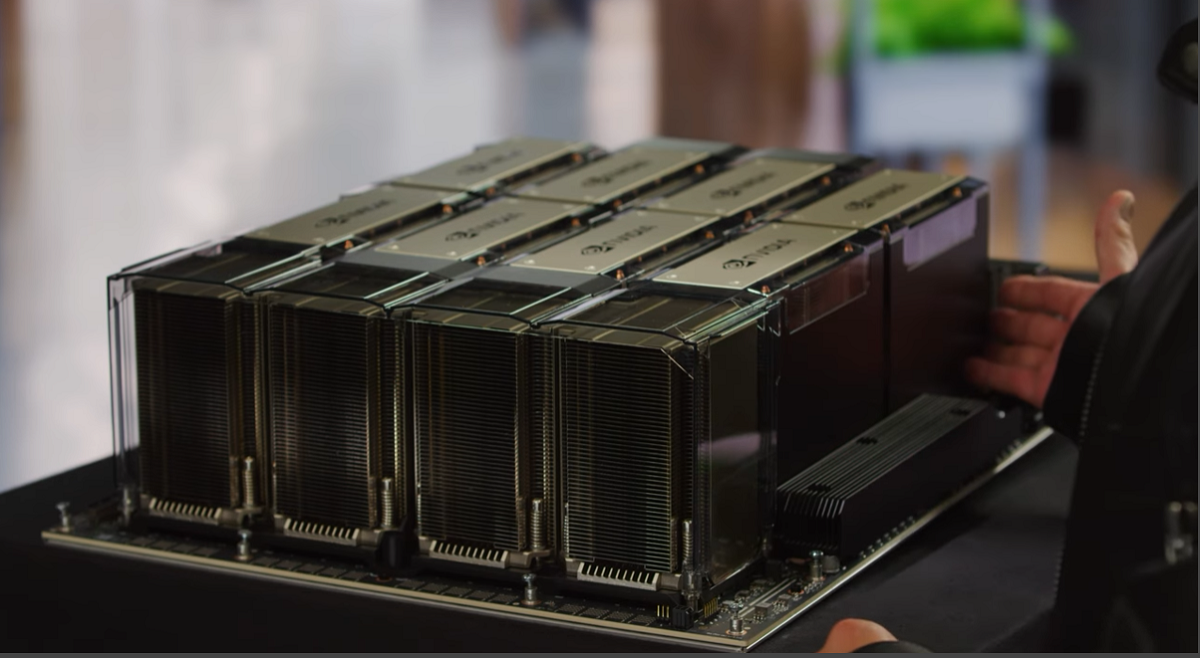
An Nvidia DGX H100 system baseboard with 8 H100 Hopper GPUs, shown by Nvidia CEO Jensen Huang in April

The supercomputer has about 26,000 Nvidia H100 Hopper GPUs. For reference, the world’s fastest public supercomputer, Frontier, has 37,000 AMD Instinct 250X GPUs.

“For our largest customers, we can build A3 supercomputers up to 26,000 GPUs in a single cluster and are working to build multiple clusters in our largest regions,” a Google spokeswoman said in an email, adding that “not all of our locations will be scaled to this large size.”

The system was announced at the Google I/O conference, which is being held in Mountain View, California. The developer conference has emerged as a showcase for many of Google’s AI software and hardware capabilities. Google has accelerated its AI development after Microsoft put technologies from OpenAI into Bing search and office productivity applications.

The supercomputer is targeted at customers looking to train large-language models. Google announced the accompanying A3 virtual machine instances for companies looking to use the supercomputer. Many cloud providers are now deploying H100 GPUs, and Nvidia in March launched its own DGX cloud service, which is expensive compared to renting previous generation A100 GPUs.

Google said that the A3 supercomputer is a significant upgrade over compute resources provided by existing A2 virtual machines with Nvidia’s A100 GPUs. Google is pooling all A3 computing instances, which are spread geographically, into a single supercomputer.

“The A3 supercomputer’s scale provides up to 26 exaflops of AI performance, which considerably improves the time and costs for training large ML models,” said Google’s Roy Kim, a director, and Chris Kleban, a product manager, in a blog entry.

The exaflops performance metric, which is used by companies to estimate the raw performance of an AI computer, is still viewed with a pinch of salt by critics. In Google’s case, the flops are meted out in training-targeted TF32 Tensor Core performance, which gets you to “exaflops” about 30x faster than the double-precision (FP64) floating point math that most classic HPC applications still require.

The number of GPUs has become an important calling card for cloud providers to promote their AI computing services. Microsoft’s AI supercomputer in Azure, built in collaboration with OpenAI, has 285,000 CPU cores and 10,000 GPUs. Microsoft has also announced its next-generation AI supercomputer with more GPUs. Oracle’s cloud service provides access to clusters of 512 GPUs, and is working on new technology to boost the speed at which GPUs communicate.

Google has been hyping up its TPU v4 artificial intelligence chips, which are being used to run internal artificial intelligence applications with LLMs, such as Google’s Bard offering. Google’s AI subsidiary, DeepMind, has said that the fast TPUs are guiding AI development for general and scientific applications.

By comparison, Google’s A3 supercomputer is versatile, and can be tuned to a wide range of AI applications and LLMs. “Given the high demands of these workloads, a one-size-fits-all approach is not enough – you need infrastructure that’s purpose-built for AI,” said Kim and Kleban in the blog entry.

As much as Google loves its TPUs, Nvidia’s GPUs have become a necessity for cloud providers given customers are writing AI applications in CUDA, which is Nvidia’s proprietary parallel programming model. The software toolkit generates the fastest results based on acceleration provided by H100’s specialized AI and graphics cores.

Customers can run AI applications via the A3 VMs, and use Google’s AI development and management services available via Vertex AI, Google Kubernetes Engine, and Google Compute Engine services.

Companies can use GPUs on the A3 supercomputer as one-time rentals to train large-scale models in conjunction with large-language models. The model is then updated – without the need for retraining from scratch – with new data fed into the model.

Google’s A3 supercomputer is a mish-mash of various technologies to boost GPU-to-GPU communications and network performance. The A3 virtual machines are based on Intel’s fourth-generation Xeon chips (codenamed Sapphire Rapids), which come packaged with the H100 GPUs. It is not clear if the virtual CPUs in the VM will support inferencing accelerators built into in the Sapphire Rapids chips. The VMs are accompanied with DDR5 memory.
Training models on Nvidia H100 are faster and cheaper than its previous-generation A100 GPUs, which are widely available in the cloud. A study done by AI services company MosaicML found H100 “to be 30% more cost-effective and 3x faster than the NVIDIA A100” on its seven-billion parameter MosaicGPT large language model.

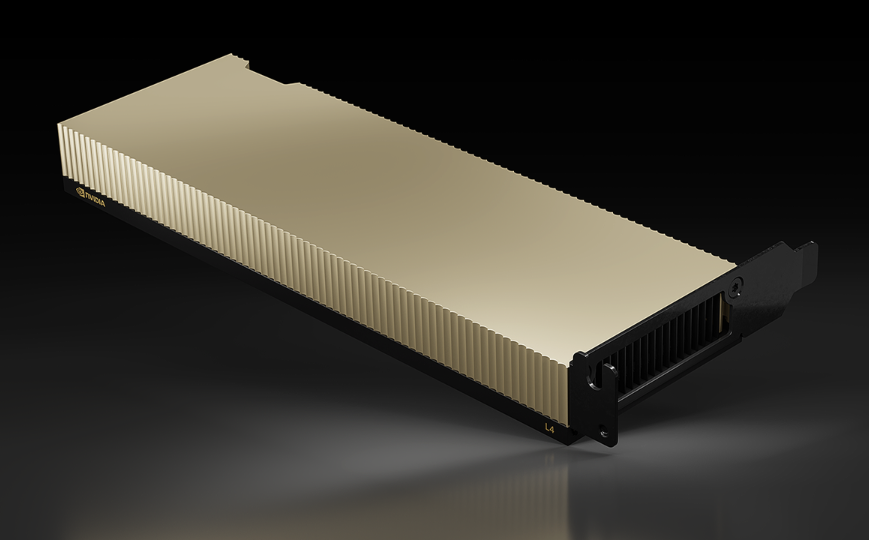
The H100 can also inference, though it may be considered overkill, considering the amount of processing power provided by H100. Google Cloud offers Nvidia’s L4 GPUs for inferencing, and Intel has inferencing accelerators in its Sapphire Rapids CPUs.

Nvidia’s L4 GPU. Image courtesy of Nvidia.

“A3 VMs are also a strong fit for inference workloads, seeing up to a 30x inference performance boost when compared to our A2 VM’s A100 GPUs,” Google’s Kim and Kleban said.

The A3 VMs are the first to connect GPU instances via the infrastructure processing unit called Mount Evans, which was developed jointly by Google and Intel. The IPU allows the A3 virtual machines to offload networking, storage management and security features, which were traditionally done on virtual CPUs. The IPU allows data transfers at 200Gbps.

“A3 is the first GPU instance to use our custom-designed 200Gbps IPUs, with GPU-to-GPU data transfers bypassing the CPU host and flowing over separate interfaces from other VM networks and data traffic. This enables up to 10x more network bandwidth compared to our A2 VMs, with low tail latencies and high bandwidth stability,” the Google executives said in a blog entry.

The IPU’s throughput may be soon challenged by Microsoft, whose upcoming AI supercomputer with Nvidia’s H100 GPUs will have the chipmaker’s Quantum-2 400Gbps networking capabilities. Microsoft has not revealed the number of H100 GPUs in its next-generation AI supercomputer.

The A3 supercomputer is built on a spine derived from the company’s Jupiter datacenter networking fabric, which connects the geographically diverse GPU clusters via optical links.

“For almost every workload structure, we achieve workload bandwidth that is indistinguishable from more expensive off-the-shelf non-blocking network fabrics,” Google said.

Google also shared that the A3 supercomputer will have eight H100 GPU blocks that are interconnected using Nvidia’s proprietary switching and chip interconnect technology. The GPUs will be connected via the NVSwitch and the NVLink interconnect, which communicate at speeds of roughly 3.6TBps. The same speed is offered by Azure on its AI supercomputer, and both companies deploy Nvidia’s board designs.

“Each server uses NVLink and NVSwitch inside the server to inter-connect the 8 GPUs together. For GPU servers to communicate to each other, we use multiple IPUs on our Jupiter DC network fabrics,” a Google spokeswoman said.

The setup is somewhat similar to Nvidia’s DGX Superpod, which has a setup of 127 nodes, with each DGX node equipped with eight H100 GPUs.

This story originally appeared on sister site HPCwire.

Related

About the author: Tiffany Trader

With over a decade’s experience covering the HPC space, Tiffany Trader is one of the preeminent voices reporting on advanced scale computing today.

6 major risks of using ChatGPT, according to a new study

ChatGPT on laptop screen and OpenAI on phone that is on a keyboard

This week, concerns about the risks of generative AI reached an all-time high. OpenAI CEO Sam Altman even testified at a Senate Judiciary Committee hearing to address risks and the future of AI.

A study published last week identified six different security implications involving the use of ChatGPT.

Also: How to use ChatGPT in your browser with the right extensions

These risks include fraudulent services generation, harmful information gathering, private data disclosure, malicious text generation, malicious code generation, and offensive content production.

Here is a roundup of what each risk entails and what you should look out for, according to the study.

Information gathering

A person acting with malicious intent can gather information from ChatGPT that they can later use for harm. Since the chatbot has been trained on copious amounts of data, it knows a lot of information that could be weaponized if put into the wrong hands.

In the study, ChatGPT is prompted to divulge what IT system a specific bank uses. The chatbot, using publicly available information, rounds up different IT systems that the bank in question uses. This is just an example of a malicious actor using ChatGPT to find information that could enable them to cause harm.

Also: The best AI chatbots

"This could be used to aid in the first step of a cyberattack when the attacker is gathering information about the target to find where and how to attack the most effectively," said the study.

Malicious text

One of ChatGPT's most beloved features is its ability to generate text that can be used to compose essays, emails, songs, and more. However, this writing ability can be used to create harmful text as well.

Examples of harmful text generation could include the generating of phishing campaigns, disinformation such as fake news articles, spam, and even impersonation, as delineated by the study.

Also: How I tricked ChatGPT into telling me lies

To test this risk, the authors in the study used ChatGPT to create a phishing campaign, which let employees know about a fake salary increase with instructions to open an attached Excel sheet that contained malware. As expected, ChatGPT produced a plausible and believable email.

Malicious code generation

Similarly to ChatGPT's amazing writing abilities, the chatbot's impressive coding abilities have become a handy tool for many. However, the chatbot's ability to generate code could also be used for harm. ChatGPT code can be used to produce quick code, allowing attackers to deploy threats quicker, even with limited coding knowledge.

Also: How to use ChatGPT to write code

In addition, ChatGPT could be used to produce obfuscated code, making it more difficult for security analysts to detect malicious activities and avoid antivirus software, according to the study.

In the example, the chatbot refuses to generate malicious code, but it does agree to generate code that could test for a Log4j vulnerability in a system.

Producing unethical content

ChatGPT has guardrails in place to prevent the spread of offensive and unethical content. However, if a user is determined enough, there are ways to get ChatGPT to say things that are hurtful and unethical.

Also: I asked ChatGPT, Bing, and Bard what worries them. Google's AI went Terminator on me

For example, the authors in the study were able to bypass the safeguards by placing ChatGPT in "developer mode". There, the chatbot said some negative things about a specific racial group.

Fraudulent services

ChatGPT can be used to assist in the creation of new applications, services, websites, and more. This can be a very positive tool when harnessed for positive outcomes, such as creating your own business or bringing your dream idea to life. However, it can also mean that it is easier than ever to create fraudulent apps and services.

Also: How I used ChatGPT and AI art tools to launch my Etsy business fast

ChatGPT can be exploited by malicious actors to develop programs and platforms that mimic others and provide free access as a means of attracting unsuspecting users. These actors can also use the chatbot to create applications meant to harvest sensitive information or install malware on users' devices.

Private data disclosure

ChatGPT has guardrails in place to prevent the sharing of people's personal information and data. However, the risk of the chatbot inadvertently sharing phone numbers, emails, or other personal details remains a concern, according to the study.

The ChatGPT Mar. 20 outage, which allowed some users to see titles from another user's chat history, is a real-world example of the concerns mentioned above.

Also: ChatGPT and the new AI are wreaking havoc on cybersecurity in new and frightening ways

Attackers could also try to extract some portions of the training data using membership inference attacks, according to the study.

Another risk with private data disclosure is that ChatGPT can share information about the private lives of public persons, including speculative or harmful content, which could harm the person's reputation.

See also

How Splunk Can Save the Day for Enterprise AI

As ML spreads its might in all quarters including security, it turbocharges everything it touches. Software company Splunk recently added new security and observability features to identify threats of a new world with generative AI.

Robert Pizzari, vice president of security at the company, speaks about why APAC is trailing behind other regions in terms of security, the growing concerns with GPT APIs and what Splunk plans to do about it.

AIM: What are some of the major cybersecurity obstacles faced by organisations in the current scenario?

Robert: With the growing number of interconnected devices in the modern enterprises along with the deluge of data — much of which is sensitive and confidential — the importance of cybersecurity continues to grow. In fact, according to Splunk’s latest State of Security 2023, 59% respondents in India report having faced data breaches in the past two years more often.

In the same report, we learned that some of the critical challenges faced by organisations in the current scenario are:

● Ransomware attacks – Ransomware is always on the rise. This year, the number of organisations that dealt with ransomware attacks rose to 75% as compared to last year.

● Breach in cloud security – With 50% of respondents saying that the majority of their SOC (Security Operations Centre) team’s time is spent addressing issues in the public cloud, while just 13% spend most of their time solving on-premises issues.

● Supply chain attacks – Software supply chain attacks are top-of mind in the post-SolarWinds era. 95% of organisations have increased their focus on third-party risk assessment activity, up from an already noteworthy 90% from 2022. In today’s complex, hybrid world, cyber security challenges are only going to become more intense.

AIM: With the arrival of generative AI and ChatGPT APIs flying around, what challenges do you see further in security?

Robert: The arrival of generative AI and ChatGPT APIs presents several challenges in terms of security. These technologies have the potential to be misused by cybercriminals to create sophisticated and convincing phishing emails, deep fake videos, and other types of malicious content.

Some specific challenges that could arise include:

Greater attack of insider threats: Generative AI and ChatGPT APIs can be used to create fake identities or to impersonate employees, making it easier for attackers to carry out insider attacks. This could result in the theft of sensitive data or the compromise of critical systems.

Difficulty in detecting advanced threats: Advanced technology can be used to create new types of malware or to obfuscate existing ones, making it harder for traditional security tools to detect them. This could result in advanced threats going undetected within networks and systems for a couple of months before causing significant damage.

Challenges in compliance and privacy: The use of AI could raise compliance and privacy concerns, particularly in industries such as finance and healthcare. Enterprises need to use these technologies responsibly and ethically and comply with relevant regulations and protect individual’s privacy rights.

AIM: Can you share some key India insights from the State of Security 2023 report? How is India faring compared to its global counterparts?

Robert: Blockchain technology, 5G, the Internet of Things (IoT), artificial intelligence (AI), and other rapidly developing and pervasive technologies are offering significant development opportunities for businesses in India. However, the number of cyber attacks and data breaches in Indian organisations have gone up multi-fold over the last couple of years thanks to the expansion of the threat surfaces.

According to the Splunk report, in India, 42% of Indian organisations were found to be overwhelmed by the number of attacks versus 23% in the rest of the world. Part of the problem seems to be the complexity of their tool ecosystems as 48% say their security stack is too complex, compared to 28% in the rest of the world. However, the report also highlights how system complexity has led to greater prioritisation of security investment in India and organisations in India are investing more in improving their cyber resilience as compared to the rest of the world.

AIM: What trends and ground-breaking changes do you anticipate in the Indian cybersecurity landscape in 2023?

Robert: Cyberattacks continue to grow in quantity and sophistication just as organisation systems become increasingly complex. According to the State of Security 2023, over half of the organisations globally shared they have suffered a data breach in the past two years, an increase from 49% in 2022 earlier and 39% in 2021. As cybersecurity risks continue to evolve, some of the key trends that we anticipate in the Indian cybersecurity landscape in 2023 are:

● Cybercrime-as-a-Service economy will expand the volume and effectiveness of cyberattacks and companies should expect an increasingly hybrid environment.

● Misinformation attacks against businesses will increase considerably as AI technology continues to improve. Deep fakes and other methods that distort reality should be taken into consideration by security leaders in order to avoid reputational and financial losses.

● Supply chain disruptions will continue with under-funded and under-sourced open source technologies being a significant vulnerability. Open source is widely used but has yet to resolve compliance standards. This puts organisations’ supply chain system to risk.

● Blockchain security concerns will increase and cyberspace breaches in the blockchain industry will probably have a huge financial impact.

● Machine Learning (ML) offers greater security but can also act as another vector of attack and cannot be left unsupervised. While ML algorithms recognise data threats and alert possible cyber breach, it will be important to understand these model functions and keep a close watch over them.

For organisations to stay ahead in 2023, business leaders need to start leveraging analytics-driven security solutions and unified platforms in order to achieve cyber resilience and future-proof themselves against these ever-evolving threats that become more sophisticated.

The post How Splunk Can Save the Day for Enterprise AI appeared first on Analytics India Magazine.

AI Chatbots: A Hedge Against Inflation?

AI Chatbots: A Hedge Against Inflation? May 17, 2023 by Alex Woodie

While inflation is down from its high of 9% last June, American companies are still grappling with rising costs. Companies that can raise their prices to balance the ledger are doing so, but others are addressing inflation another way: by boosting employee productivity through conversational AI, or chatbots.

According to Moveworks CEO and Co-Founder Bhavin Shah, companies that have adopted conversational AI have raised their employee productivity by an amount roughly equal to total inflation over the past several years.

“Stanford and MIT did a study around workers using AI tools and they saw that it was able to increase workers’ productivity by 14%,” Shah said during his opening remarks for Moveworks Live last week. “Why is that important? Because that’s perhaps about the amount of inflation that we saw over the last three to five years.”

The paper Shah referenced, titled “Generative AI at Work,” concludes that customer support agents were able to get 13.8% more work done by using a conversational assistant based on OpenAI’s Generative Pre-trained Transformer (GPT) model.

Specifically, the AI assistant did three things: reduced the amount of time it took an agent to handle an individual chat; bolstered the total number of chats an agent can handle per hour; and ultimately resulted in “a small increase in the share of chats that are successfully resolved,” the researchers wrote.

Interestingly, novice workers benefitted from AI to a higher degree than more experienced agents, the researchers found. They found that agents with two months of training and an AI assistant could perform at the same level as agents with over six months of training but no assistant.

Moveworks CEO and co-founder Bhavin Shah

Shah co-founded Moveworks in 2016 to help companies leverage AI to build conversational assistants. That was a bad year to start such a company, Shah acknowledged. “In 2016, chatbots were declared dead,” he said. “Most people were skeptical.”

However, something unexpected happened a year later: Google released its Transformer paper, which kicked off the current trend of generative AI.

“What it did was create a new architecture allowing us to train new models in a parallelized fashion,” Shah said. “It shifted from being memory-bound to GPU- and CPU-bound, which allowed us to do greater levels of parallelization, but also allowed us to build bigger models with larger training sets.”

As Moveworks employed various neural networks based on Google’s new Transformer architecture to build custom conversational agent applications on behalf of its customers, another unplanned world event kicked AI into another gear: Covid-19.

When companies went into lockdown, they searched for new work modalities, and found chatbots were much better than they remembered. When lockdowns began to lift a year later and people began migrating between jobs in the Great Resignation and the Great Reshuffle, conversational AI was already a topic of discussion in the boardroom.

“Companies created more and more folks with titles around employee experience,” Shah said. “And they began to realize that employee productivity and employee experience were actually two sides of the same coin.”

Bolstered by the Transformer breakthrough, generative AI models for images and text made loads of technological progress over this period. Hugging Face alone has over 13,000 publicly available models, Shah pointed out. “And this is arguably before the Cambrian Explosion that we’re all now witnessing in terms of large language models around the world.”

Moveworks helps companies developed enterprise co-pilots

The end of 2022 brought the next inflection point: The introduction of ChatGPT. Now instead of just a handful of AI researchers talking about the benefits of neural networks, billions of consumers were using LLMs on a daily basis.

While ChatGPT is fun to play with, Moveworks uses it and other LLMs to help build conversational assistants, or “copilots,” that can boost employee productivity across a range of use cases. We are just at the beginning stage of this workplace revolution, and Moveworks hopes to enable that revolution with its new Creator Studio, which it launched just three weeks ago.

“By connecting people with systems at the speed of conversation, we’re going to make it easier than ever for people to do their jobs,” Shah said. “Soon, very soon, every application will have its own copilot.”

AI-based copilots are already popping up like mushrooms after a rain. “It seems like I can’t go two days without another announcement,” Shah quipped. But that rapid spread of AI copilots also presents an opportunity for an enterprise copilot that can work across different applications, he said.

Much more work is needed to fully realize the potential of language interfaces in the enterprise, however. For instance, if an employee wants to know what happened to his bonus, it’s unclear which application copilot he should check with. Is it the one for the HR app, the applicant tracking system, the fiancé department, or the payroll system?

“And that is where there begins to be a new opportunity: an enterprise-wide copilot…where your employees can connect to every business system, to every business cloud, through a single place,” he said.

Inflation seems to be settling in at 5% annually for the long haul, which would give executives plenty of reason to look to AI for a productivity boost. But if the dream of an enterprise-wide AI system comes to fruition in a repeatable and automatable way, 5% would be the rounding error.

This story originally appeared on sister site Datanami.

Related

About the author: Alex Woodie

Alex Woodie has written about IT as a technology journalist for more than a decade. He brings extensive experience from the IBM midrange marketplace, including topics such as servers, ERP applications, programming, databases, security, high availability, storage, business intelligence, cloud, and mobile enablement. He resides in the San Diego area.

KDnuggets News, May 17: Mojo Lang: The New Programming Language • Pandas AI: The Generative AI Python Library

Features

  • Mojo Lang: The New Programming Language by Nisha Arya
  • Pandas AI: The Generative AI Python Library by Nisha Arya
  • Data Scientist’s Guide to Cognitive Biases: A Free eBook by Matthew Mayo

From Our Partners

  • Maximize Your Value With The 3rd Best Online Master’s In Data Science Program by Bay Path University
  • 5 Reasons Why You Should Get Certified by SAS

This Week's Posts

  • 8 Free AI and LLMs Playgrounds by Abid Ali Awan
  • Practical Statistics for Data Scientists by Benjamin O. Tayo
  • Chatbot Arena: The LLM Benchmark Platform by Nisha Arya
  • Learn How to Run Alpaca-LoRA on Your Device in Just a Few Steps by Aryan Garg
  • Breaking Down AutoGPT by Kanwal Mehreen
  • Clustering with scikit-learn: A Tutorial on Unsupervised Learning by Nate Rosidi
  • RAPIDS cuDF Cheat Sheet by KDnuggets
  • 3 Free Platform for Personalized ChatGPT Experience by Abid Ali Awan
  • What are Large Language Models and How Do They Work? by Saturn Cloud
  • Should You Consider a DataOps Career? by Mariusz Michalowski
  • Principal Component Analysis (PCA) with Scikit-Learn by Bala Priya C
  • Data Masking: The Core of Ensuring GDPR and other Regulatory Compliance Strategies by Yash Mehta
  • Fighting AI with AI Fraud Monitoring for Deepfake Applications by Jimmy Fong

KDnuggets News

  • Top Posts May 1-7: Machine Learning with ChatGPT Cheat Sheet
  • Top Posts May 8-14: Mojo Lang: The New Programming Language

More On This Topic

  • Mojo Lang: The New Programming Language
  • Pandas AI: The Generative AI Python Library
  • KDnuggets™ News 20:n47, Dec 16: A Rising Library Beating Pandas in…
  • KDnuggets™ News 20:n40, Oct 21: fastcore: An Underrated Python…
  • KDnuggets™ News 20:n35, Sep 16: Data Science Skills: Core, Emerging,…
  • Python: The programming language of machine learning

Your first look at Alliance DAO’s latest cohort of web3 startups

Your first look at Alliance DAO’s latest cohort of web3 startups

AI, ZK proofs, crypto wallets and dApp support among major themes at demo day

Jacquelyn Melinek 9 hours

The crypto industry continues to face myriad headwinds, but there’s no shortage of startups and founders diving into the space.

Alliance DAO, a web3 accelerator and builder community, had its most recent cohort, also known as ALL10, present their ideas on Wednesday during a demo day, exclusively covered by TechCrunch. Check out the previous Alliance DAO demo days we covered here in November and here in July.

Twice a year, Alliance DAO brings in web3 founders for a three-month program. The current cohort had a record 1,692 applications, up 77.5% from its previous cohort, Qiao Wang, a core contributor at Alliance DAO, said during the event. Of that number, only 16 startups made the cut and graduated from the program.

The latest cohort makes for a good snapshot of what’s happening in the industry at large, Wang said. Many of the teams are looking at improving popular crypto sub-sectors, like the Bitcoin network, appchains, rollups-as-a-service, zero-knowledge proofs, proof-of-physical-work, and real-time blockchain data, to name a few.

“The intersection of AI and crypto is another major theme,” Wang said. AI has the potential to fundamentally change crypto games, on-chain analytics and off-chain computations, he added.

This was the first Alliance cohort to see a number of startups using AI integrations, pointing to an increasing opportunity for automated technology to be integrated into the crypto ecosystem.

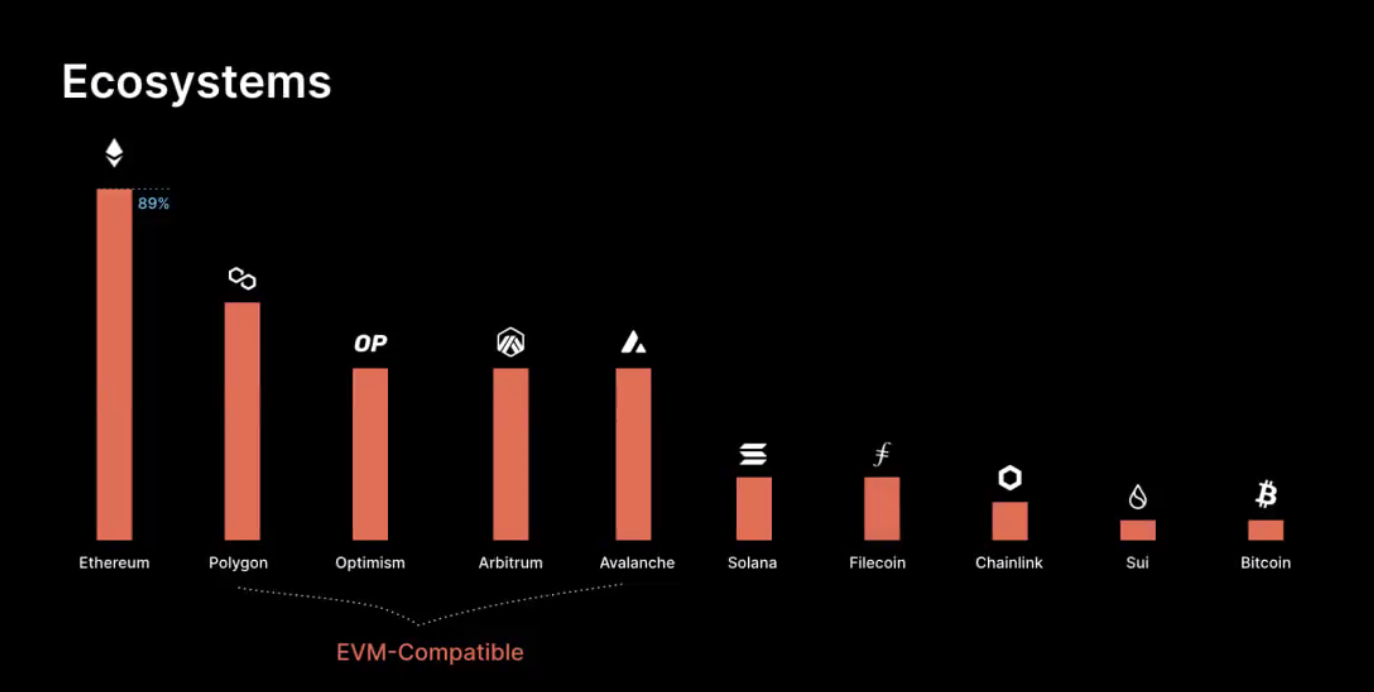
A majority of the startups in the batch are building on the Ethereum ecosystem, while some focused on EVM-compatible chains like Polygon, Optimism, Arbitrum and Avalanche, and others are looking at Solana, Filecoin, Chainlink, Sui and Bitcoin.

A graph showing crypto blockchain ecosystems that the ALL10 cohort focused on building on top of

Source: Alliance DAO

“The second year of the bear market is the most painful part of the cycle. This happened in 2019, in 2015, and this is happening again this year again in 2023,” Wang said. “This is also the part of the cycle where resources such as capital and talent are scarce. But what we’ve learned from working with over 100 startups is that you do not need a team of 50 people or hundreds or millions of dollars in VC funding to achieve great things.”

Tensor illustrates that point. A part of Alliance DAO’s ALL9 cohort, the three-person company recently raised $3 million in March and is already close to becoming the biggest Solana-based NFT marketplace based on market share.

Mentors for the ALL10 cohort include Anatoly Yakovenko, the co-founder of Solana; Ryan Wyatt, the president of Polygon Labs; Juan Benet, the founder and CEO of Filecoin; Kevin Sekniqi, the co-founder of Ava Labs; Evgeny Yurtaev, the co-founder and CEO of Zerion; Amir Bandeali, the co-CEO of 0x; and Julian Koh, the co-founder of Ribbon Finance.

Here’s a breakdown of the 16 startups:

Company name: Teablocks

  • What it does: ChatGPT for blockchain data
  • Founders: Tariq Patanam, Ammar Khan
    Stage: Seed
  • The pitch: Teablocks is making a platform that provides ChatGPT for blockchain data. The platform requires no technical expertise and aims to be flexible so users can ask precise questions and access information easily, Ammar Khan, co-founder and CTO of Teablocks, said. It leverages blockchain data and custom AI agents to turn raw data into “something more readable,” Khan said. Teablocks has over 300 companies on its waitlist and is raising a seed round.

Company name: Xverse

  • What it does: Bitcoin wallet for web3
  • Founders: Ken Liao
  • Stage: Seed
  • The pitch: Xverse is a bitcoin-focused crypto wallet for web3. It allows users to have self-custody of their assets, and provides a MetaMask-like experience for DeFi, NFTs and more, according to founder and CEO, Ken Liao. Xverse is live on Android and iOS, and is available on desktop as a Chrome extension. It has over 130,000 users to date. It’s also integrated with crypto projects and applications like Ordinals Market, Magic Eden and Gamma. The wallet is raising a $4 million seed round, of which $2.5 million has already been committed, Liao said.

Company name: Snapchain

  • What it does: ZK-rollup-as-a-service
  • Founders: Zidong Zhang, Morgan Howell
    Stage: Seed
  • The pitch: Snapchain is a zero-knowledge-rollup-as-a-service aimed at developers. ZK rollups reduce transaction fees for users, but deploying and managing chains involves a “steep learning curve and a recurring maintenance cost,” according to Morgan Howell, Snapchain’s co-founder. The startup helps devs configure, create and manage ZK-rollups through its no-code console. Snapchain is raising a seed round.

Company name: Glow

  • What it does: Proof of Physical Work for carbon credits
  • Founders: David Vorick
    Stage: Seed
  • The pitch: Glow is building proof of physical work (PoPW) for carbon credits. “We use tokens to incentivize the construction of solar panels [that] produce carbon credits and displace unclean energy from the grid,” Glow’s founder, David Vorick, said. About 9 million Glow tokens will be awarded to solar panel operators annually, proportional to the number of carbon credits produced, which in turn would contribute to the construction of more solar panels. The carbon credits will be distributed as yield to token holders, Vorick said. The protocol is launching in August, and is currently raising a seed round.

Company name: Modulus Labs

  • What it does: Trustless AI via zero-knowledge proofs
  • Founders: Daniel Shorr, Ryan Cao, Nick Cosby
    Stage: Seed
  • The pitch: Modulus Labs is building trustless AI with zero-knowledge proofs to make the technology cheaper and more accessible for crypto protocols. To bring AI on-chain, the features have to be fully centralized, which is limiting decentralized protocols like Uniswap from engaging with the technology due to high costs, Daniel Shorr, co-founder and CEO of Modulus, said. The startup’s system delivers inexpensive AI integrated with blockchain security for less than a cent, Shorr added. Its current customers include WorldCoin. The startup is raising a seed round.

Company name: AwesomeQA

  • What it does: AI community management for web3
  • Founders: Alexander Abstreiter, Korbinian Abstreiter
  • Stage: Seed
  • The pitch: AwesomeQA is building an AI community management service for web3 by providing support tools for automation on community channels like Discord and Telegram. It has an AI model that looks at multiple sources like chat history, product documentation and, in the future, on-chain data, to gain knowledge and answer questions from users, co-founder and CEO Alexander Abstreiter said. Its AI has an accuracy rate of 94% and is currently live with 47 customers like Aave, Dune Analytics and Scroll, he said. The team recently closed its seed round but is open to strategic investors.

Company name: Primodium

  • What it does: On-chain composable game
  • Founders: Morris Hsieh, Emerson Hsieh
    Stage: Seed
  • The pitch: Primodium is building a fully on-chain, open source, composable game. “The goal of the game is to gain map control, research technologies and expand your factory,” CEO and co-founder Morris Hsieh said. The game was launched four days ago and has over 500 users with 10,000 transactions. Some users have built game content, bots and entirely new game modes, Morris added. Primodium is raising a seed round.

Company name: Fountain

  • What it does: Wallet management for teams
  • Founders: Morgan Lai
    Stage: Seed
  • The pitch: Fountain is building “Okta for web3,” its founder and CEO Morgan Lai said. The platform integrates companies’ custody accounts, exchanges, wallets and dApps to manage them in one place, Lai shared. “Managers can delegate different applications to employees without sharing private keys,” she added. Fountain also provides an audit trail for compliance requirements. The company is looking to raise a seed round.

Company name: Itos

  • What it does: Perpetual synthetic options
  • Founders: Terence An, Brian Broeking
    Stage: Seed
  • The pitch: Itos makes American-based perpetual synthetic options with elements like variety, liquidity and cross-margins. “Protocols have only been built with one of these elements in mind,” said Terence An, co-founder and CEO of Itos, adding that cross-margined and American-based ones are missing from DeFi entirely. The platform will come out of stealth and launch its automated market maker in the third quarter of 2023, and a suite of structured products in the fourth quarter. It’s raising a seed round and looking for potential liquidity partners.

Company name: Dataleap

  • What it does: Copilot for user research
  • Founders: Jan Damm, Jan Ruettinger
    Stage: Seed
  • The pitch: Dataleap is creating a ChatGPT companion and copilot for user research and product teams. “We aggregate every touch point you have with your customers,” whether it’s on Zoom, Slack or another platform, co-founder and CEO Jan Damm said. The copilot provides standardized aggregations and feedback linked to original sources. Its design partners currently include Personio and Forto. Dataleap is looking to raise a seed round.

Company name: Caldera

  • What it does: No-code customizable app chain
  • Founders: Matthew Katz, Parker Jou
    Stage: Seed
  • The pitch: Caldera is a no-code web3 infrastructure platform that helps developers create customizable application-specific chains. The platform previously raised $9 million across two rounds. The startup aims to simplify the process of creating app-specific blockchains so builders can create Layer-2 blockchains on Ethereum within minutes. Its public testnets have attracted over 250,000 unique wallets with 650,000 transactions, Matthew Katz, CEO and co-founder shared. The company is looking for strategic investors.

Company name: Wallchain

  • What it does: MEV recovery for end users
  • Founders: Maksym Bevza, Yurii Kyparus
    Stage: Seed
  • The pitch: Wallchain is a web3 anti-bot solution that provides MEV recovery for users on decentralized exchanges. It aims to protect transactions and give money back to users that would have otherwise gone to bots. It’s the most used MEV-recovery on the BNB and Polygon blockchains, according to its website. It has secured over $1.5 billion worth of transactions monthly by being the default method of execution for Quickswap, BabyDoge and ApeSwap, Yurii Kyparus, co-founder and CEO of Wallchain, said. It previously raised a seed round but is open to strategic investors.

Company name: Singularity

  • What it does: Payment rails for application chains
  • Founders: Aditya Gupta, Sumit Vohra
    Stage: Seed
  • The pitch: Singularity is a payment rails provider for application chains that aims to allow users to move funds in and out of web3 easily. “We allow users to pay with any method they like, fiat or token, and deposit funds directly into their app-chain wallet,” Aditya Gupta, co-founder and CEO of Singularity, said. The startup is live on Oasys and Polygon, and is working with three design partners on the Oasys chain. The company is looking to close its seed round.

Company name: Hashmail

  • What it does: Intercom for web3
  • Founders: Bharat Kumar Ramesh, Swapnika Nag
  • Stage: Seed
  • The pitch: Hashmail is a web3 intercom alternative that aims to provide support for dApps. The platform is an omnichannel, web3 native, AI-powered solution that integrates support across applications’ front ends and community channels in less than 10 minutes, Swapnika Nag, co-founder and CEO, said. Since its console launch in February, it has powered over 500,000 messages for 50,000 wallets across 30 dApps like Unstoppable Domains, OKX Chain, Superdao. It previously raised $1.1 million and is looking to raise its seed round.

Company name: Defined

  • What it does: Enriched real-time blockchain data
  • Founders: Mike Rowe, Braden Simpson, Nathan Lambert, Matt Fikowski, Derek Binnersley
    Stage: Series A
  • The pitch: Defined provides companies with real-time blockchain data that they can use to index and decipher query transactions. It gathers data from over 1.5 million tokens and 420 million NFTs across 45 different networks, including Ethereum, Binance Smart Chain, Arbtirum, Optimism, Avalanche and Polygon. Define has over 300,000 monthly active users and provides services for platforms like TradingView, 0x and sudoswap, CEO and co-founder Mike Rowe said. The company is raising a new capital round.

Company name: Pocket Universe (Made by Refract Inc.)

  • What it does: Web3 fraud prevention
  • Founders: Nishan Samarasinghe, Justin Phu
    Stage: Seed
  • The pitch: Pocket Universe is a free web3 fraud prevention and browser extension by Refract that aims to protect users from phishing scams and crypto wallet draining. The extension shows users web3 transactions before they sign them to help them better understand the actions and keep their assets safe. It has no access to a user’s wallet, seed phrase or private keys – meaning wallet owners will still need to sign in to their own wallets to move assets. It has over 60,000 weekly active users, Justin Phu, co-founder and CEO, said. The extension is compatible with Metamask, Coinbase and “wallets that use similar methods,” like XDEFI or Frame, according to its website. The company is raising a seed round, and has $1.25 million already committed.

This Canadian AI Startup has Designed the World’s First Humanoid General-Purpose Robot That Actually Works

Vancouver-based artificial intelligence and robotics company, Sanctuary AI, yesterday unveiled a new advanced, general-purpose robot called Phoenix. The company claimed that it has developed the world’s first humanoid general-purpose robot powered by Carbon, a unique AI control system. The SOTA AI system offers human-like intelligence and enables robots to do a wide range of tasks to help address the labour challenges affecting many organisations.

In March this year, the company announced its first commercial deployment, a significant milestone in the company’s progress toward full commercialisation. In a little less than two months the company has now announced the sixth generation of technology.

Founded in 2018, Sanctuary AI is on a mission to create the world’s first human-like intelligence in general-purpose robots that will help humans work safely, efficiently, and sustainably. The members of Sanctuary AI are also part of the founding team at D-Wave, Kindred, Creative Destructive Lab and others. In a bid to fulfil the ambitious mission of creating human-like intelligence in general-purpose robots, it has partnered with companies like Apptronik, Bell, Common Sense Machines, Contoro, Cycorp, Exonetik, HaptX, Magna, Tangible Research, Verizon Ventures, Workday Ventures, and others.

In March last year, the company raised Series AI funding. In November 2022, the company received a C$30 Mn strategic innovation fund (SIF) contribution from the Government of Canada, bringing its total funding to over C$100 Mn.

How is Sanctuary AI Different?

While the majority of the companies, including the likes of Tesla are still in the prototype and experimentation stage, Sanctuary AI claimed that its technology is already capable of completing hundreds of tasks identified by customers from more than a dozen different industries. Sanctuary AI chief and cofounder Geordie Rose said that it designed Phoenix to be the most sensor-rich and physically capable humanoid robot ever built and to enable Carbon’s rapidly growing intelligence to perform the broadest set of work tasks possible.

Meanwhile, here is a glimpse of Tesla’s humanoid robot, exploring the real world.

Multiple fully Tesla-made Bots now walking around & learning about the real world 🤖
Join the Tesla AI team → https://t.co/dBhQqg1qya pic.twitter.com/3TZ2znxkfd

— Tesla Optimus (@Tesla_Optimus) May 16, 2023

“I think Tesla is in a great position to build the largest humanoid robot data flywheel ever. Very optimistic to see the latest progress on Tesla,” said Linxi Fan, AI scientist at NVIDIA.

He said Optimus can reuse the powerful vision system built for FSD. “The decision to use a camera instead of LIDAR makes the models instantly transferable,” he added, saying that many humanoid tasks likely need less precise and rigorous visual processing than self-driving.

Further, he said that Tesla has deep experience in mass-producing hardware. “The first company to deploy humanoid en masse will be able to spin the data flywheel in the wild and compound the model capability faster than competitors,” he added.

On the other hand, Sanctuary AI claimed its literal take on ‘general purpose’ and emphasis on creating a technology that can conduct physical work just like a person sets them apart in the industry. Rose said that to be general purpose, a robot needs to be able to do nearly any work task, the way humans typically do, in the environment where the work is. “While it is easy to get fixated on the physical aspects of a robot, our view is that a robot is just a tool for the real star of the show, which in our case is our proprietary AI control system, the robot’s Carbon-based mind,” he added.

In March this year, AI robotics startup Figure also claimed to have released the world’s first commercially available general-purpose humanoid robot Figure O1, the prototype of which bears a strikingly close resemblance to Tesla’s robot Optimus. Read: Meet Tesla Optimus Clone

The post This Canadian AI Startup has Designed the World’s First Humanoid General-Purpose Robot That Actually Works appeared first on Analytics India Magazine.

The best AI art generators of 2023: DALL-E 2 and alternatives

If you've ever searched Google high and low to find an image you needed to no avail, AI is coming to the rescue.

With AI art generators, you can type in a prompt as detailed or vague as you'd like and have the image you were thinking of pop up on your screen instantly. These tools can help with branding, social media content creation, vision boards, and more.

Also: What is generative AI and why is it so popular? Here's everything you need to know

Even if you have no professional use for it, no worries, the process is so fun that anyone can participate.

DALL-E 2 has made a huge splash because of its advanced capabilities and easy access. However, there are plenty of other AI art generators on the market that can suit different needs.

To put the generators to a test, I put a version of the same prompt, "a baby Yorkie sitting on a comfy couch in front of the NYC skyline" in each one and included a screenshot for your viewing pleasure (yes, I am a Yorkie mom).

Also: How I used ChatGPT and AI art tools to launch my Etsy business fast

Using these observations, I put together a list of the best AI generators and detailed everything you need to know before starting your next masterpiece.

ALTERNATIVE

Nightcafe — Best multi-purpose AI art generator

Nightcafe is a multi-purpose AI art generator that is worth trying becaus it allows users to create unique and original artwork by using different inputs and styles, including abstract, impressionism, expressionism, and more.

View at Creator.nightcafe

ALTERNATIVE

Canva — Best AI art generator for marketing professionals

Canva is a versatile and powerful AI art generator that offers a wide range of options. It allows users to create professional-looking designs for different marketing channels, including social media posts, ads, flyers, brochures, and more.

View at Canva

ALTERNATIVE

Imagen — Best AI art generator coming soon

Imagen uses advanced AI techniques such as deep learning and neural networks to create images that are both realistic and imaginative, resulting in a high level of detail and complexity.

View at Imagen.research

ZDNET Recommends