
5 Things That Killed The Metaverse

In October 2021, Facebook made the biggest rebranding decision in modern times. In a bid to make the metaverse mainstream, Mark Zuckerberg announced that the social media giant would pivot to creating a virtual universe, powered by augmented and virtual reality.

The signs that this concept was dead on arrival were everywhere. In 6 months, Meta’s stock plummeted by 42%. However, the buzzword caught on in the industry, and soon everyone was adopting the metaverse. From Disney to Microsoft, and Walmart to NVIDIA, the metaverse was the next big thing in the tech world. Until it wasn’t.

In less than two years since genesis, the metaverse has already met its demise. Companies that have entered the market have been plagued with layoffs, funding is continuing to dry up, and it seems that the world has moved on from this futuristic concept.

Here are five reasons why we’ll never see the metaverse again.

No one wants to use the Metaverse

Meta’s vision of the platform was the poster child for overpromising and under delivering. The introductory video for Horizon Worlds, Meta’s platform, showed flashy graphics and modern-looking avatars. The product in reality, however, looked like a bad video game from the 2000s, with low-quality avatars, bad lip-syncing, and awkward motions. This resulted in a huge loss of the user base for Horizon, which only garnered 300,000 users at launch. It then dropped to 200,000 monthly users, with Meta stopping reporting user count hereafter.

Other platforms like Decentraland also dropped a majority of their users, going from 60,000 to less than 1,000. This completely killed the network effect for metaverse platforms, stopping its momentum in its tracks.

High cost of entry

Apart from the lack of a network effect pushing people away from the platform, there was also a major lack of new users coming on board. This was caused mainly due to the high cost of VR headsets, often cited as a must-have for the metaverse.

Having to spend a lot of money for a headset just to join a platform that many were giving up on just wasn’t enough of a value proposition for users. Moreover, it seems like no one wanted to wear a headset for 9 hours to ‘work in the metaverse’.

It’s nothing new

As much as Mark wanted his metaverse to be the first and only one of its kind, this was far from the truth. The metaverse has been around in some shape or form since the late 90s and early 2000s. Games like EverQuest and Second Life created virtual worlds for players to explore and interact with.

Even today, games like Fortnite and Roblox have created virtual universes for their players, effectively replicating the metaverse dream. These games are more successful than Facebook’s metaverse ever was, and there’s one big reason for that.

Mark’s Metaverse didn’t make financial sense

The metaverse was reportedly developed at a cost of $36 billion to Meta. This number spurred a lot of development in the market, prompting other companies to also begin creating their own metaverse platforms. However, only a few seemed to actually work in an economic sense.

A prime example of this is NVIDIA’s Omniverse platform. By allowing factories to create digital twins of their products, they were able optimise manufacturing processes. Meta’s offering, on the other hand, allowed people to have meetings in the ‘verse and even attend low-resolution concerts. When looking at what the technology is capable of, it is clear that Meta dropped the ball.

No one believes in the Metaverse

A simple Google search will net multiple articles from tech publications decrying the death of the metaverse. Multiple obituaries have already been written for this short-lived technology, reflecting the lack of belief in this technology.

Beyond the users, companies also began to lose faith in the metaverse. Metaverse teams for companies like Microsoft, Tencent, and Disney were the first to go when layoffs started. Meta itself went through multiple rounds of layoffs when the tech recession hit hard.

$36 billion and the end of a hype train later, Meta has moved on to AI, hammering in the last nail in the coffin for the metaverse. While some products might still come out of this momentary spurt of innovation, the idea of everyone living in a virtual reality is delegated to the tech graveyard.

The post 5 Things That Killed The Metaverse appeared first on Analytics India Magazine.

How Hard is it to Get into FAANG Companies

How Hard is it to Get into FAANG Companies
Image by Author

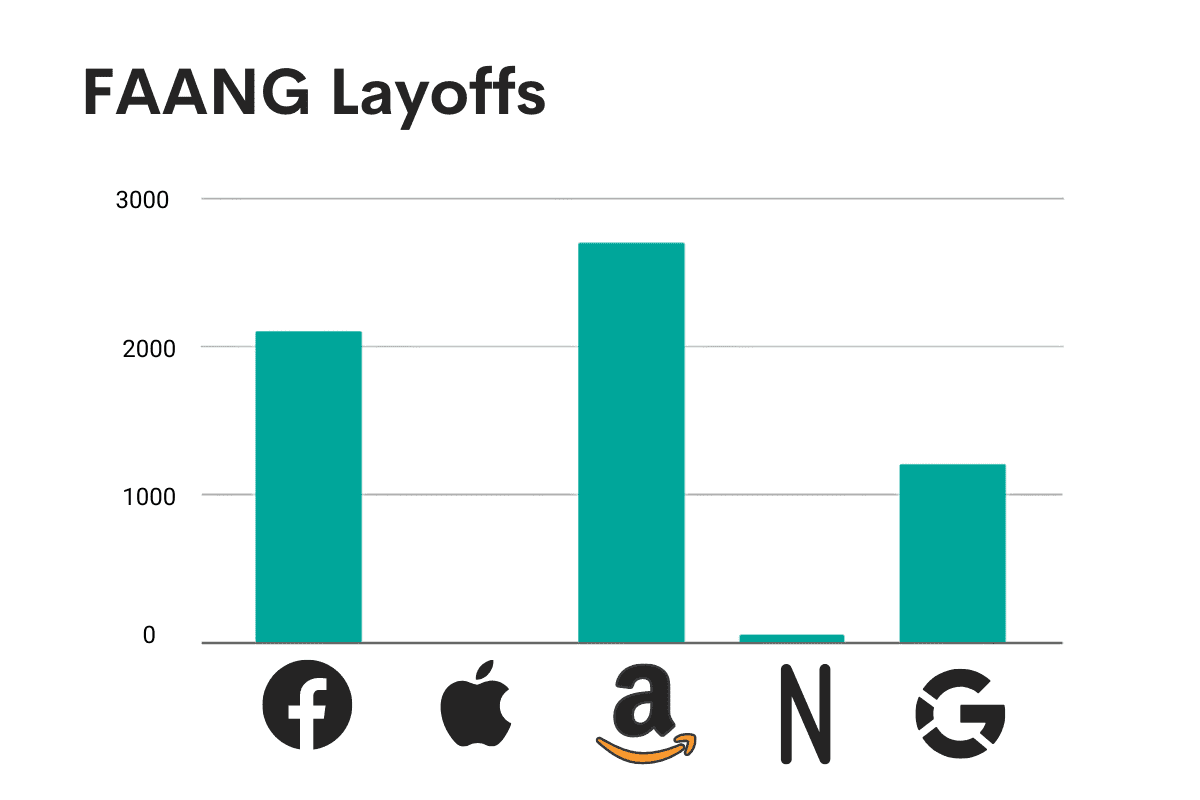
Cue dramatic doom-and-gloom music. In the last two years, FAANG companies alone were responsible for over 50,000 layoffs (10,000 plus 11,000 from Meta; none from Apple; over 27,000 from Amazon in four separate batches; 500 from Netflix in four batches as well; and 12,000 from Google). What could that mean for the already-low acceptance rates for these companies? Just how tricky is it to get that acceptance letter from a FAANG company?
How Hard is it to Get into FAANG Companies
Image by Author

In this article, I’ll explore why getting a FAANG job is so hard in both a historic and current setting. I’ll also describe ways to increase your odds both for FAANG companies and others. Ultimately, it’s not as hard as you think. I’d also encourage you to broaden your perspective on getting accepted to a tech company.

What is FAANG?

I’m using FAANG here in two senses. First, you’ve got the companies responsible for the acronym: Facebook (now Meta), Apple, Amazon, Netflix, and Google (really Alphabet). The acronym was coined by CNBC’s Jim Cramer in 2013. Those companies were outperforming the broader market at the time, and FAANG caught on.

But it’s also useful to think of FAANG as a stand in for tech companies at large – think Microsoft, AirBnb, and Spotify. When I say FAANG has a low acceptance rate, what I really mean is that these big, loud tech companies are hard to get into, including Facebook, Amazon, Netflix, Apple, and Google, but also a lot of other flashy tech companies.

Overall, FAANG companies in both senses are known for rapid growth at all costs, dominant market positions, and innovative products. They attracted a lot of tech talent throughout the 2010s – applicants really thought they could help build products to make the world a better place.

Of course, in the depths of a tech winter here in 2023, it’s a different picture.

Just how low are your Odds?

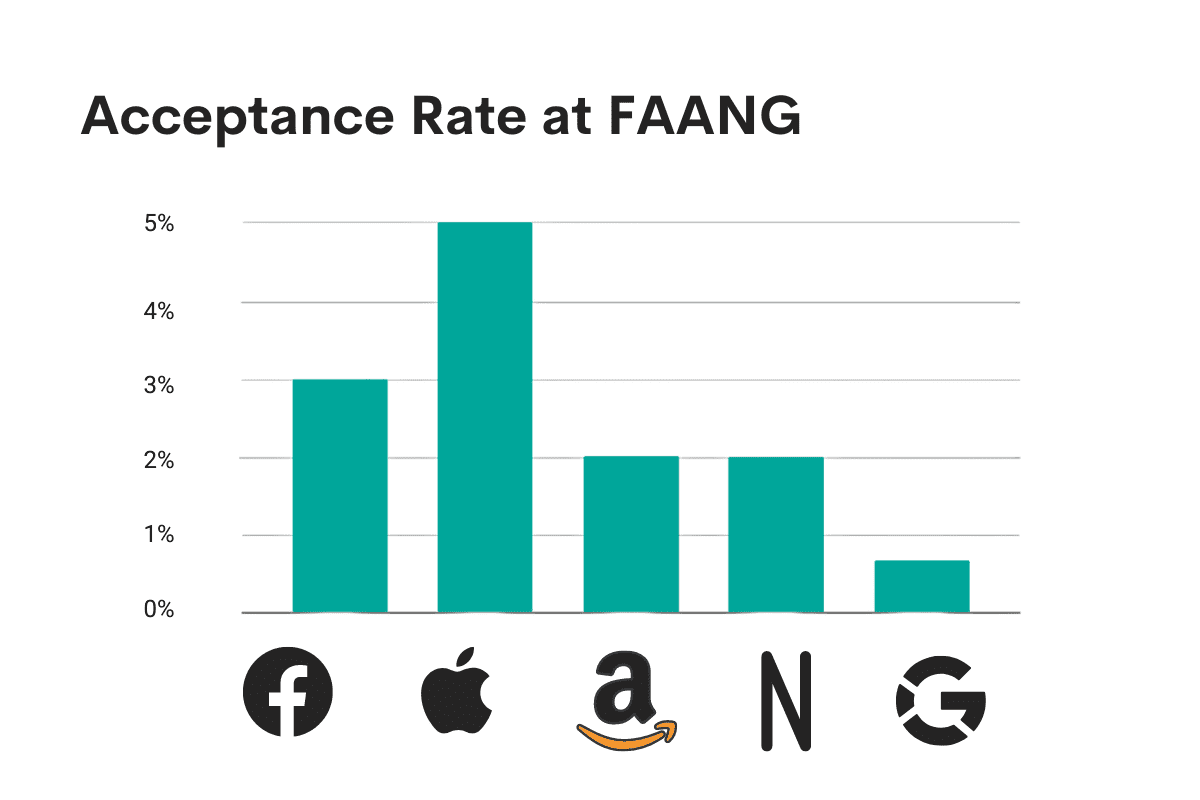
There aren’t any official numbers on acceptance rates at FAANG, but I researched multiple articles that quote single digit percentage points (or less) for FAANG acceptances during these layoffs.

  • Apple accepts a measly 3% of applicants.
  • Facebook has a 5% acceptance past onsite interview, which means an even lower acceptance of all job applications.
  • Amazon accepts less than 2%.
  • Netflix accepted less than 2% of applicants in 2019. I got that number by dividing the total number of employees (6,800 in 2019) by the total number of applicants (350k). That means that even if every single position was refilled, the acceptance rate at netflix was still less than 2%. In reality, it was probably a lot smaller.
  • Google accepted a positively miniscule 0.67%.
How Hard is it to Get into FAANG Companies
Image by Author

Now consider that, after 60k layoffs, these companies probably have tons of talented applicants and even fewer open positions.

Why is getting into FAANG Companies so Hard?

When I was applying to college, I was amazed that fewer than 1 in 20 applicants were accepted to universities like Yale, Princeton, and Brown. But FAANG acceptance rates put those to shame. Why is it so tough to get that acceptance letter?

Competition

When you apply to FAANG, you’re dealing with high competition. Everyone wants to work for FAANG or a FAANG adjacent company. Especially in the 2010s, FAANG had a very cool vibe – think ping-pong tables, free lunch, and other awesome perks in addition to job stability and a wildly high paycheck. Everyone with a lick of tech talent shot their shot.

High bar

FAANG has high standards. Thanks to the influx of applications, those tech companies could afford to only hire the creme de la creme of tech talent. Candidates were expected to have a glowing resume, amazing recommendations, and relevant education work experience – or a hell of a portfolio to make up for it.

Technical Interviews

FAANG companies and similar tech companies set up strict technical interviews. Even experienced engineers might falter when asked to do a whiteboard coding interview under the steely gaze of three hiring managers. It’s hard.

Here the article "Hiring in FAANG Companies and Knowing When You’re Ready", talks about the hiring process of FAANG companies.

Culture Fit

FAANG is picky about who they let in, beyond just coding know-how. Cultural fit is super important. Netflix didn’t want “brilliant jerks.” Apple only hired hard-core collaborators. Facebook wants forward-thinkers. So it’s not just about your resume, it’s about how you can prove that you’re a good “culture fit” for that company.

Those Numbers are Discouraging, but Misleading

Go back to those tiny little acceptance rate percentages. They’re miniscule, but misleading.

For one, it’s a different landscape nowadays. The heyday of big tech, for better or worse, has hit a rocky patch. FAANG companies are no longer universally recognized as the best to work at. As VC money dries up and they struggle to pivot profitably, salaries and perks can be just as good at smaller companies. Plus, it’s clear FAANG doesn’t offer any job reliability as they laid off 5-10% of their workforce in certain instances.

Furthermore, tech is still hiring, even if FAANG specifically has slowed down. ZipRecruiter found that 79% of laid-off tech workers had a new job within three months. Someone is still looking for top tech talent.

Finally, keep in mind that a vast number of applications to FAANG are basically junk. Like I said, everyone applies to FAANG because it’d be awesome to work there. But hiring managers are able to discard a huge number of those applications because they’re just not very good. Do a little bit of legwork. Networking can increase your chances tremendously. Attend a conference to meet people. Tailor your resume and cover letter for each application. That alone will help you stand head and shoulders above most FAANG applicants.

How to Increase your Chances of getting a Good Tech Job at FAANG or anywhere else How Hard is it to Get into FAANG Companies
Image by Author

Yes, it’s hard to get accepted to these companies. But it’s not as hard as you think. Here are four ways to increase your chances of landing the tech job of your dreams, whether at FAANG or another great tech company.

Polish your Resume

You probably know this already, but it’s worth repeating that hiring managers at big tech companies automate a ton of job app searches. They match keywords to filter and discard tons of resumes and cover letters. Make sure yours matches the job posting as closely as possible, including relevant skills, experiences, and talents.

Practice the Interview

It’s critical to practice interview questions. Assuming you get the interview, you do not want to freeze up on that whiteboard. Make sure you’re up to date on the latest interview questions on a website like Stratascratch, so you can do as much prep beforehand as possible. Not only will this give you the skills you need to smash the interview, but the prep itself will soothe your nerves.

Build, deploy, repeat

In lieu of a degree or work experience, you need to prove you’ve got the chops that make you a good hire. Build and deploy projects that are interesting to you personally. Don’t just do the typical Kaggle competitions – hiring managers have seen that before. Go in on wild, wacky projects that allow you to tell the story of why big tech should hire you.

Go the extra mile

Finally, a good tip is to add libraries and packages to your resume. Applications for end users are a good and necessary place to start, but not many other tech applicants build libraries and packages. These help with:

  • Demonstrating your deep understanding of software engineering and architecture.
  • Showcasing something useful to a hiring manager.
  • Gaining some traction on GitHub as a library, which can act as social proof.

There are plenty of other good interview practices, but those four tips are a good place to begin.

Look outside FAANG

I want to end this article by asking you to consider looking beyond FAANG as the end-all, be-all job provider. Today’s smaller startups can offer just as much salary, perks, job stability, and company culture as FAANG.

If nothing else, the massive layoffs prove that these big tech companies aren’t as stable or good as the 2010s led us to believe. Lots of great tech companies that didn’t overhire during the pandemic are looking for awesome candidates, so if you’re struggling to land a FAANG job, go for a smaller company first, prove yourself, and then reapply to FAANG with some work experience under your belt.

FAANG Companies are Tough to get into, but not too Hard

Ultimately, it’s hard to get into FAANG companies, there’s no question about that. But many applicants forget that it’s easier than you probably think, even in today’s current tech winter climate. All FAANG companies currently have tech job openings (Meta, Amazon, Apple, Netflix, and Alphabet respectively) and not only that, but tech companies as a whole are still hiring despite the chilly employment landscape.

To improve your odds, ensure your resume is as close to the job posting as possible. Practice interview questions until you’re blue in the face. Build, deploy, and build some more. And consider going that extra mile by including packages or libraries to your portfolio.

If you’re still having a hard time, you can always cast your employment search net further afield. Make sure you tailor each and every application, and don’t be afraid to hit that apply button. Tech companies will be lucky to have you, whether it’s at FAANG or another great organization.
Nate Rosidi is a data scientist and in product strategy. He's also an adjunct professor teaching analytics, and is the founder of StrataScratch, a platform helping data scientists prepare for their interviews with real interview questions from top companies. Connect with him on Twitter: StrataScratch or LinkedIn.

More On This Topic

  • Data Science as a Product — Why Is It So Hard?
  • 3 Hard Python Coding Interview Questions For Data Science
  • 11 Best Companies to Work for as a Data Scientist
  • 6 Highest Paying Companies for Data Scientists
  • Why So Many Data Scientists Quit Good Jobs at Great Companies
  • AWS Webinar: How are data-driven companies using ESG and sustainability…

PyTorch Tabular v1.0.2 Released

A new version, v1.0.2 of PyTorch Tabular has been released. The library now includes a new method in TabularModel for enabling feature importance. Feature Importance has been enabled for FTTransformer and GATE models. The release note was generated by ChatGPT using the git commit logs from the last release, wrote Manu Joseph the creator of PyTorch Tabular, GATE and LAMA-Net on LinkedIn.

Check out the GitHub repository to learn more about the update.

PyTorch Tabular is a deep learning library that makes working with deep learning and tabular data easy and fast. The library has been built on frameworks PyTorch and PyTorch Lightning, and it works on pandas data frames directly.

The framework makes the standard modeling pipeline simple enough for practitioners while also being reliable enough for production use. It also focuses on customization so that it can be used in a variety of research settings. The below picture depicts the structure of the framework.

Latest Additions

The latest enhancements in the library include several updates.

Firstly, two additional parameters have been added to the GATE model, expanding its functionality and versatility. Additionally, the library configuration now includes the metric_prob_input parameter, providing improved control over metrics within the models. The GATE model has undergone slight improvements, including adjustments to defaults that enhance its overall performance.

Furthermore, various minor bug fixes and improvements have been implemented, such as the addition of accelerator options in the configuration and enhancements to the progress bar. Alongside these enhancements, the library has been updated with newer versions of dependencies, including docformatter, pyupgrade, and ruff-pre-commit. These updates contribute to the library’s overall reliability, functionality, and performance.

Read: How to Handle Tabular Data for Deep Learning Using PyTorch Tabular?

The latest version has been released four months after v1.0.1. Other improvements include various code optimizations, bug fixes, and CI enhancements. For more details, refer to the commits on the library’s GitHub repository.

PyPi: https://pypi.org/project/pytorch-tabular/

Documentation: https://pytorch-tabular.readthedocs.io/en/latest

The post PyTorch Tabular v1.0.2 Released appeared first on Analytics India Magazine.

AWS Fires Up Indian Govt’s Digital Ambitions 

AWS is not just a leader in the cloud market, it also takes the lead when it comes to collaborating with the state and central governments in India. “We were the first cloud service provider to be empanelled at the Ministry of Electronics and IT (MeitY) back in December 2017,” Pankaj Gupta, leader, public sector enterprises, government and healthcare, at AWS India Private Limited, told AIM.

“Since then, AWS has worked with various central government departments and ministries such as the ministry of health, agriculture, and finance.” Besides, AWS is also working with various state governments, non-profit organisations and educational institutions.

Helping government move to the cloud

The Union government and many state governments have made their intention known to migrate to the cloud. In various parts of India, citizens are now able to access numerous government services online.

“At the state level, we work very closely with the governments. The government of Telangana is one example. We have helped them migrate that mission-critical core application for e-governance across 93 districts. The Telangana government was facing numerous challenges in terms of scaling, application availability and performance. We helped them migrate 150 servers, and 95 terabytes of data in less than five months,” Gupta said.

Besides, AWS has collaborated with the Telangana government to develop an insurance application aimed at providing medical insurance access to individuals below the poverty line. AWS has also helped the government of Manipur migrate 60-plus government websites and services to the cloud.

Further, the cloud giant has aided Prasar Bharati News Services (PBNS), the digital arm of India’s public broadcasting service Prasar Bharati, to rapidly scale its digital news services and improve the reliability and performance of its website and CRM system.

“We worked with them to migrate over 240 plus live video channels including live news and entertainment programmes to the cloud,” Gupta said. Before migrating to AWS, PBNS had its applications hosted with a co-location IT provider, resulting in high latency. This led to performance and availability challenges, including website downtime and disruptions in video streaming.

Moreover, since its government approval in 2006, the Common Service Centres (CSC) has played a crucial role in providing eServices to underserved rural and remote areas with limited or no access to computers and the internet. “We are also working with CSC very closely. And one of the programmes that we did with them was called PMGDISHA or the Pradhan Mantri Gramin Digital Saksharta Abhiyaan. Under that, we have trained more than 46 million people as part of digital inclusion.”

DigiLocker and CoWIN

With the rapid digitisation of services, the traditional approach of storing and managing physical documents has become increasingly outdated. DigiLockeraddresses this challenge by providing individuals with a secure and user-friendly digital storage solution for their essential documents. DigiLocker is hosted on AWS cloud infrastructure. The Cloud giant is helping over 150 million users move more than 6 billion documents to the cloud.

Similarly, AWS has also played an important role in supporting the CoWIN vaccination platform in India. CoWIN, which is hosted on AWS cloud infrastructure, is supporting possibly the largest vaccination drive in the world by enabling the registration and tracking of millions of vaccinations. AWS has helped ensure that the platform has the capacity to handle the massive scale of vaccination registration and administration required in India.

“We were struggling with the pandemic and there was a dire need to build a vaccination platform and we had a challenge at hand to vaccinate 1.2 billion people. There was no platform for this, so we worked with MeitY and the Ministry of Health and Family Welfare (MoHFW),” Gupta said.

During its initial launch, CoWIN was not open to the public, and in terms of technology infrastructure, the API gateway received only 2 million hits. “However, once the platform was opened to the general public in phases, the platform scaled to 1.3 billion hits on the API gateway. The platform had the capability to do 10 million vaccinations a day, and 10 million is not even the population of many countries,” he quipped.

eSanjeevani

AWS has also played an important role in the development of eSanjeevani, the Indian government’s national telemedicine service. The platform was built by the Centre for Development of Advanced Computing (C-DAC) using AWS solutions, in collaboration with the MoHFW. It allows patients to consult with doctors remotely, freeing up hospital resources and improving access to medical care. AWS has also provided technical expertise and resources to support the platform’s development and ensure its scalability and reliability.

“Initially a doctor-to-doctor platform, it was transformed into a patient telemedicine platform during COVID with features like audio-video consultations, live chat with doctors, and e-prescriptions. Built in just 19 days, eSanjeevani enables people in tier two cities and rural areas of India to access primary healthcare services from their homes,” Gupta said.

The importance of security

Given AWS’ wide-scale collaboration with different governments across India, it does raise one moot question – Does AWS, which is a US-based company at the end of the day, have access to sensitive government data or personal data of individuals on DigiLocker? In this regard, Gupta emphasised that they do not have access to any data.

“We understand the importance of data security, privacy and compliance for our government customers,” he continued, “We provide 230+ security, governance and compliance features, and we have FIPS 140-3 certification, we have HIPAA, so these global certifications give our customers the confidence that our global infrastructure is built to meet the security requirements of the most highly sensitive organisation, be it the regulatory body or a military organisation,” Gupta concluded.

The post AWS Fires Up Indian Govt’s Digital Ambitions appeared first on Analytics India Magazine.

AI leaders sign an open letter to openly acknowledge the dangers of AI

Sam Altman testifying about AI

Sam Altman testifying about AI.

In March, an open letter spearheaded by tech industry experts sought to halt the development of advanced AI models out of fear the technology could pose a "profound risk to society and humanity".

This week, a statement cosigned by OpenAI CEO Sam Altman, the "godfather" of AI Geoffrey Hinton, and others seeks to reduce the risk AI poses to push humanity to extinction. The statement's preface encourages industry leaders to discuss AI's most severe threats openly.

Also: How to use ChatGPT to write code

According to the statement, AI's risk to humanity is so severe that it's comparable to global pandemics and nuclear war. Other cosigners are researchers from Google DeepMind, Kevin Scott, Microsoft's chief technology officer, and Bruce Schneier, an internet security pioneer.

Today's large language models (LLMs) popularized by Altman's ChatGPT cannot yet achieve artificial general intelligence (AGI). However, industry leaders are worried about LLMs progressing to that point. AGI is a concept that defines an artificially intelligent being that can equate to or surpass human intelligence.

Also: How does ChatGPT work?

AGI is an achievement that OpenAI, Google DeepMind, and Anthropic hope to reach one day. But each company recognizes there could be significant consequences if their technologies achieve AGI.

Altman said in his testimony in front of Congress earlier this month that his greatest fear is that AI "cause[es] significant harm to the world", and that this harm could occur in multiple ways.

Just a few weeks earlier, Hinton had abruptly resigned from his position where he worked on neural networks at Google, telling CNN that he's "just a scientist who suddenly realized that these things are getting smarter than us."

Artificial Intelligence

Beware of the AI Bubble Burst

Last week, Bank of America’s chief investment strategist Michael Hartnett warned us of a looming AI bubble. AI is this year’s investment craze and even though the profit potential is huge, this period could go the messy dot-com burst way, stated the Bank of America representative.

On the other hand, Dave Rogers, ex-CTO of UK Ministry of Justice and the author of ‘The False Promises of Technology’ believes “generative AI has the potential for widespread and significant impact –- considerably more than the recent hyped technologies such as blockchain and web3.”

For the past decade, such warnings have repeatedly ripened in the startup land. The industry might be in another bubble, as commentators caution a dramatic collapse. Previously, jobs disappeared, fortunes vaporised, and reputations were tarnished as the technology bubble popped. Last year, crypto and Sam-Bankman Fried faced a similar fate. The scars are fresh, but even today more money is being pumped into start-ups. But instead of collapsing, things keep getting bubblier in tech.

“However, at this stage it’s still unclear who the winners and losers will be in the commercial market. It’s not even clear if the technology itself will be the centre of market impact, which is likely to be felt far beyond the tech industry (eg disrupting academia, journalism, legal professions etc). There’s a dominant narrative around automation and productivity, but I think the impact will be far more chaotic. Attempts at automation will cause systems to adapt, for e.g., if you try and automate writing commercial bids with AI, it will have wider system impacts on procurement. Regulation from the government will also play a key role, but likely a reactive one when the harms or benefits of generative AI become clearer,” he added.

Ghosts of the past

The dot-com tech bubble, similar to most historical bubbles, eventually met its demise with a crash as investors realised that their lofty expectations would not be fulfilled and hastily exited their positions. Once revenue at the telecoms reduced dramatically, it rippled through their respective end markets and, eventually, the entire economy slipped into recession in 2001.

Numerous factors were behind the downfall, but initial signs appeared within the prominent telecom hardware providers, the primary suppliers for the tech startups and dot-com companies. As revenues for these telecom giants dwindled, eventually the entire economy plunged into a recession in 2001.

Fast forward to recent times. Remember when the Long Island Iced Tea Corp. changed its name to Long Blockchain Corp causing a hike in share price to 380%?

Bitcoin emerged as one of the most-notable tech bubbles in recent history. Starting from a modest $10 in 2013, it surged to $20,000 by late 2017, only to give away half of those gains in early 2018. The underlying Bitcoin technology, blockchain, fuelled tech startups seeking funding through initial coin offerings (ICOs) to fund their projects. In return, investors receive tokens or coins that can be utilised within the startup’s platform or traded speculatively on decentralised exchanges.

In a manner similar to the dot-com bubble’s peak, the closing months of 2017 and early 2018 speculations surfaced regarding cryptocurrencies listing at considerable premiums above their ICO prices. This phenomenon closely resembled the surge in valuation of internet stocks during the height of the dot-com bubble.

Ignorance is not bliss

Rogers said, the biggest mistake with hyped technology is to be ignorant of unintended consequences. Technology is not intrinsically good or bad — it just changes what’s fast or slow, cheap or expensive. This will lead to things people and organisations want, but also things they don’t want. He said, AI ethics should be the centre of discussion. “This misses the wider point — about the ethics of the design, investment and communications designs that individuals and organisations make.”

“AI has just made bad design easier — alongside making good design easier. We’re likely to not stop hearing about AI systems doing what they’re not intended to — but will corporations and governments act in a way to address this? I think this makes AI a more volatile investment than previous technologies — harder to predict, but probably lots of money to be made, not all of it towards a common good for societies,” he further said.

In conclusion, these parallels between the previous bubble bursts is a cautionary reminder to not be wooed by the hype. Historically, heightened expectations have led to disappointment. With billions of dollars being flooded in the internet’s favourite chatbots currently, the researchers as well as the investors need not be ignorant in the early stages of development of the technology; which may backfire.

The post Beware of the AI Bubble Burst appeared first on Analytics India Magazine.

Will Meteor Lake Be Intel’s Saving Grace?

This week is a big one for chip enthusiasts and AI lovers alike. At Computex, the world’s premier semiconductor conference, top makers have announced chips that might be the future of AI compute. While NVIDIA tried its best to steal the show with CEO Jensen Huang’s announcement-packed keynote, Intel quietly made a splash by showcasing Meteor Lake, a new line of AI-first processors.

However, the chipmaker has been plagued with multiple delays and issues in the past when taking this manufacturing approach. With the hype surrounding Meteor Lake, it seems that Intel has a lot riding on this new chip.

What makes Meteor Lake special?

Meteor Lake marks a huge milestone for Intel, as it will be the first chip to use the Intel 4 process node for manufacturing. However, this isn’t all the chip has up its sleeve, as it also incorporates various chips manufactured in Taiwan Semiconductor Manufacturing Corporation’s (TSMC) foundries, making it the first Intel chip to do so.

Intel has gone all in on both the chiplet design and SoC architecture, integrating various discrete functions on one chip in a bid to create a new kind of market. The Meteor Lake processors combine GPU, VPU, and CPU all on one chip to offer the “right balance of power and performance for AI”.

According to Intel’s announcement at Computex, the chips will first appear in laptops, seemingly in competition to Apple’s M2 and AMD’s Ryzen 7040 series of chips. Similar to its competitors, Intel has also adopted a system-on-chip architecture for this chip, mixing and matching various chiplets to achieve this effect.

The CPU itself will be manufactured by using Intel 4 manufacturing process, with the GPU and SoC Tile using TSMCs 5nm and 6nm processes, respectively. Moreover, Intel has also integrated its Foveros 3D packing technology into these chips, allowing them to fit more features in a smaller form factor.

The headline feature of this new chip is its integrated AI engine, facilitated with the help of Intel’s new vision processing unit (VPU). The VPU will not only be reserved for AI workloads, but will also accelerate the integrated GPU and the main CPU itself for these tasks. Notably, the VPU contains Intel’s Gaussian Neural Accelerator (GNA) chip, which has been, so far, its solution for on-board AI processing.

While the GNA has been Intel’s go-to for low-power AI inference at the edge, it seems that VPUs will replace them as the generations go on. Intel has stated that some of the code made for GNA runs more efficiently and with better results on VPUs, effectively obsoleting this now-legacy tech.

The chip is also scalable to various power draw and performance specifications. Each of the components can be scaled up or down depending on the requirement, resulting in a varied line of products with multiple different SKUs. The CPU, GPU, and VPU are connected with an interconnect fabric that allows them to share the same memory subsystem. This not only improves performance, but puts Intel on par with Apple and AMD for SoC design.

Harnessing the power of developers

While it seems that Intel is a few years late to the party in this specific market, this delay is to be expected. The company’s Sapphire Rapids chip, which was supposed to be its big answer to AMD’s EPYC server dominance, was hit with multiple delays and manufacturing issues. This resulted in Intel’s roadmap being pushed ahead by a few years, creating a lag that it is now eager to close.

Meteor Lake is likely to launch with full support for developers to tinker with the product and harness its full capabilities. Apart from close collaboration with Microsoft to integrate the chips’ AI capabilities into Windows, Intel has also announced support for DirectML, ONNX, and OpenVINO. These SDKs will allow AI developers to easily integrate ML features into their programs while ensuring compatibility.

Intel showcased a host of optimisations that Meteor Lake’s in-built AI could bring to applications. Firstly, the VPU can accelerate even common video and audio processing workloads running on the CPU and GPU. Secondly, the processor’s capabilities will have support in various software, like real-time motion capture in Unreal Engine.

For AI models specifically, the hybrid approach of combining CPUs and GPUs together with VPUs works wonders. For example, Stable Diffusion can run on both GPU and VPU simultaneously. While the GPU does the heavy lifting of generating the image, the VPU works side by side for super-resolution of the image.

A much-needed win?

Intel has been suffering in silence, unable to capitalise on the AI wave due to its varied problems. However, Meteor Lake could be the solution for them to get their winning streak back, biting back at Apple for ditching Intel chips for the MacBook. The only thing left for Meteor Lake is Intel getting it to market.

While it has unfortunately stumbled when getting the product to market in the past, Meteor Lake might be the exception to this. Intel announced that it would bring Meteor Lake to laptops by the end of this year. This is also backed up by the fact that Intel announced ramped up production for the chips in its Q1 2023 earnings report.

By bringing together TSMC’s manufacturing chops and their own foundries, Intel might actually go beyond the manufacturing problems it had in the past. While combining this with the complete package that Meteor Lake seems to be, it might just be the win Intel needs to get back on its feet.

The post Will Meteor Lake Be Intel’s Saving Grace? appeared first on Analytics India Magazine.

Arm Unveils 5th Gen GPU and CPU Architecture 

GPU

During Computex 2023, Arm unveiled its TCS (Total Compute Solution) 2023 solutions, a comprehensive array of IP solutions that encompass everything from the CPU to the GPU and all other IP blocks in between. This provides Arm’s customers the ability to handle all their chip’s IP needs entirely in-house.

Arm’s newest 5th generation GPU architecture comes with an added Deferred Vertex Shading (DVS) feature. The flagship Immortalis G720 GPU boosts performance by 15% and reduces memory bandwidth usage by 40%. Alongside this, Arm introduced the more cost-effective Mali-G620 GPU. These new Mali GPUs enhance Arm’s high-end graphics capabilities and extend their reach to a broader range of consumer devices. MediaTek showcased their new SoC at the launch, which is built on the Cortex X4 and Immortalis G720 and incorporates hardware-based raytracing.

Arm’s Cortex X4, having its first tape-out using TSMC’s N3E process, is the fastest cluster from Arm so far, offering a 15% performance increase and 40% power efficiency improvement. The industry-leading Cortex-A720 boosts the cluster’s consistent performance, while the Cortex-A520 stands as Arm’s highest-performing and most energy-efficient CPU core to date. These latest CPU designs, providing a 20% improvement in power efficiency over previous models, are ideal for various applications like AAA gaming, all-day productivity, and background tasks.

Interestingly, Intel also anticipates that the Cortex X4 will be built on their 18A process. This suggests that the tape-out could either be a test, or Arm might transition from Intel’s 18A process to TSMC’s N3E process, or perhaps develop versions built on both processes.

Finally, Arm introduced the new DynamIQ Shared Unit (DSU-120) which supports up to 14 CPU cores within the same cluster. This unit is designed for multi-threaded applications and can be used in a variety of devices, from wearables and smartphones to laptops.

The post Arm Unveils 5th Gen GPU and CPU Architecture appeared first on Analytics India Magazine.

Segmind Raises $1 Million to Accelerate Generative AI Model Deployment for Developers

Segmind, a cloud and AI-based MLOps tools provider raises $1 million in funding to help developers integrate generative models into their applications. The investment round is led by All In Capital and Paradigm Shift Capital, along with WEH Ventures, and 100x Entrepreneur Fund.

Founded in 2021 by Rohit Ramesh and Harish Prabhala, Segmind is a serverless optimisation and development platform, built on modern Kubernetes-backed architecture to provide an end-to-end MLOps platform.

The platform speeds up models using our open-source voltaML library, delivering the fastest inference speeds (under a second) at a fraction of the cost while reducing the overall GPU requirements by up to 80%.

The recent launch of highly advanced AI models like Stable Diffusion and ChatGPT has led to a revolutionary shift in the tech industry, enabling capabilities that were previously only imagined. However, a key obstacle remains: the complex implementation of these models as many developers are not equipped with machine learning expertise.

While these models have democratised AI to a significant extent, developers still encounter several challenges in implementing them, such as determining appropriate hosting options, debugging them, and customising for particular applications. To bridge this gap, Rohit and Harish are developing vital tools through Segmind, a strategy we believe is crucial to facilitate AI adoption across a wide range of software globally. As All In Capital, we’re proud to support their endeavour.

This funding marks an exhilarating milestone for Segmind. The injection of new capital positions Segmind to transform the way developers leverage generative AI models in their applications, aiming to make AI integration easier, faster, and more cost-effective. We are profoundly appreciative of our investors’ trust in our mission and eagerly anticipate the thrilling journey that lies ahead.

The post Segmind Raises $1 Million to Accelerate Generative AI Model Deployment for Developers appeared first on Analytics India Magazine.

MyHeritage debuts Reimagine, an AI app for scanning, fixing and even animating old photos

MyHeritage debuts Reimagine, an AI app for scanning, fixing and even animating old photos Sarah Perez @sarahintampa / 10 hours

AI is impacting the realm of photography, ranging from tools for professionals like Adobe Photoshop’s new generative AI, to those for consumers, like Google Photos’ forthcoming Magic Editor. Now, genealogy company MyHeritage is turning to AI to make it easier for families to preserve their memories with the launch of its latest app, Reimagine. The new mobile app’s main focus is to help users easily import printed photos stored in albums, then touch them up by improving their resolution, fixing scratches and creases, and even restoring color in black-and-white photos and animating faces — the latter, a technique that went viral in prior years with MyHeritage’s launch of “Deep Nostalgia.”

Reimagine builds on that technology by combining it with other photo-editing tools designed specifically for preserving old photos.

To use the app, which is available for both iOS and Android, you’ll snap photos from the pages of your old photo albums. The app identifies the separate photos and will automatically crop them and save them as stand-alone images. After scanning, you can also add more details, like names, dates, and places, to make them easier to find.

You can also scan individual photos, in case you have a collection in a shoebox somewhere, as well as upload photos from your phone’s camera roll, the company says.

Image Credits: MyHeritage

The scanning aspect of the app, however, is not groundbreaking — back in 2016, Google launched its own old photo scanner, PhotoScan, which offered similar technology for uploading images from old photo albums, which included removing glare.

MyHeritage’s multipage scanner, meanwhile, was developed by its own AI team and is exclusive to its app.

Where MyHeritage aims to differentiate itself from photo-scanning competitors is with its broader AI-powered feature set. This includes the ability to restore faded colors, repair scratches, enhance resolution, turn old photos into animations with Deep Nostalgia and add narration.

The photo enhancement tools — including restoring faded colors, repairing scratches, and enhancing resolution — are leveraging technology MyHeritage exclusively licensed from DeOldify, a technology created by deep learning experts Jason Antic and Dana Kelley.

Image Credits: MyHeritage

For animations, MyHeritage had previously partnered with Tel Aviv startup D-ID to create Deep Nostalgia, the patented video reenactment technology powered by AI and deep learning brings old photos to life. The tech touched the hearts of many who had lost family members or never got to know family who had died before they were born, among other things, and soon, the MyHeritage app was going viral on TikTok after its 2021 debut. Although there’s something unsettling about bringing the dead back to life, the technology itself was arguably an impressive feat.

Later, MyHeritage expanded on Deep Nostalgia to allow users to also add narration to their animated photos, so the people in them could actually speak and tell their stories.

Now those two features are just a part of a wider suite of tools for editing and enhancing old photos with Reimagine.

Image Credits: MyHeritage

“Since the launch of our first AI photo feature more than three years ago, MyHeritage has revolutionized the way consumers engage with their family photos,” said Gilad Japhet, founder and CEO of MyHeritage, in a statement about the launch. “Photos are a significant gateway to the exciting world of family history, and as our suite of photo tools has expanded, we decided to develop Reimagine, a dedicated app for family photos that encourages new audiences to capture their family memories and bring them to life. Memories are best enjoyed when you can share them with your loved ones, and Reimagine makes it easy to re-experience your precious moments together.”

As the app has only just launched, we haven’t been able to put it through its full paces. But in some brief tests (using a couple of my grandmother’s old photos), we found the app generally held up its claims of being able to enhance and improve photos, in most cases. One issue we did find, however, is that when a light source produced a glare on the printed image, the AI was not able to correct that in one instance.

The results weren’t quite as crisp as the company’s own example images, in terms of touch-ups and corrections, but they were still fairly impressive considering the blurry mess we scanned in:

Image Credits: Sarah Perez/screenshot from Reimagine app

Colorization also worked in these brief tests, though this is an area that requires further examination before we could make a recommendation. (Google, as you may recall, once promised to launch a colorization feature for B&W photos in Google Photos, then pulled back, saying it still had work to do as the colors weren’t accurate.)

However, MyHeritage has been using this colorization tech since at least early 2020, when it announced a Colorize feature for its platform’s users. In the details shared with the press, Reimagine’s colorization feature is described as a “color restoration” feature. That is, it’s not trying to simulate color from B&W photos, but is designed to be used to restore the colors of photos from the ’50s and ’60s that were originally taken in color but faded over the years.

The company says the technique, developed by DeOldify, uses machine learning algorithms that pay particular attention to detail and were trained across millions of real photos. However, there are times when it may not get colors 100% accurate.

“This gives you the chance to revive your favorite moments from the days before digital photography,” a company spokesperson explained. “With color restoration, you get the authentic colors revived in seconds, and no colors are guessed in the process. As a bonus, color restoration also sharpens photos and improves their level of detail.”

The color restoration technology was also licensed exclusively by MyHeritage from DeOldify, they noted.

Image Credits: Sarah Perez/screenshot from Reimagine app

The company says that it’s employing AI ethically, as it’s adding watermarks to photos that were manipulated by AI to ensure “transparency and respect for the original content,” the company told us.

The new Reimagine app is free to download and use but monetizes via weekly and monthly subscriptions that unlock unlimited access to photo scanning, colorization, enhancement, and other features. The montly subscription is $7.99 or you can pay for a year upfront for $49.99.

The app is offered at launch in 11 languages, including English, French, German, Spanish, Dutch, Danish, Portuguese (Brazil), Swedish, Norwegian, Italian, and Finnish. More languages will be added in the future, the company says.