Can you distinguish people from AI bots? ‘Human or not’ online game reveals results

Human or not

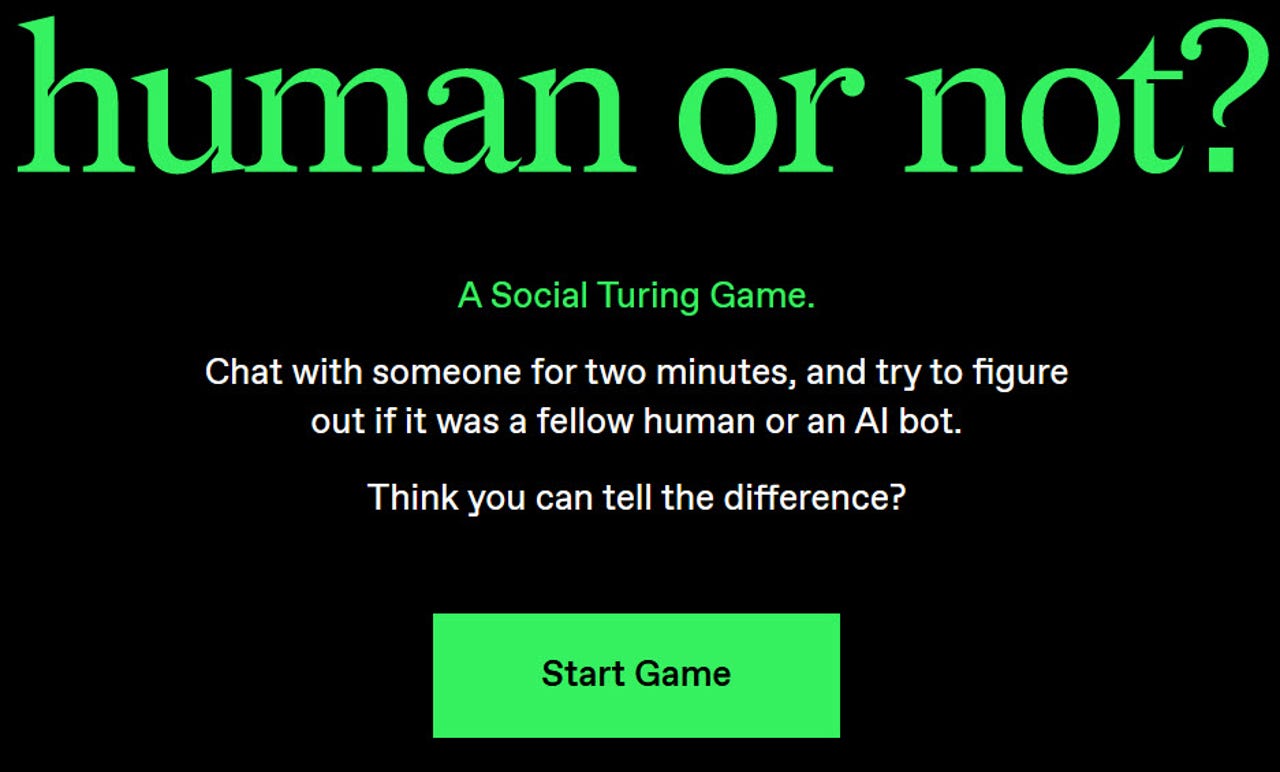
Named after computer scientist Alan Turing, the Turing test tries to determine if a machine can act like a human being well enough to fool the person taking the test. An online game called Human or Not offered people a similar challenge, and now the results are in.

Launched around a month ago, Human or Not asked you to chat with someone (or something) for two minutes and then try to figure out if it was another human being or an AI bot. In accepting the challenge, you were able to ask any questions or offer any responses you wanted. But once the two minutes were up, you had to guess who or what was on the other end.

Also: How to use ChatGPT: What you need to know now

After generating millions of conversations in one of the largest Turing tests ever recorded, developer AI21 Labs found that 32% of the people who tried the game were unable to tell the difference between a human and a bot, leaving 68% who got it right.

Overall, people had an easier time trying to identify another person. When chatting with a human being, the participants got the right answer 73% of the time. But when speaking with a bot, they guessed correctly just 60% of the time.

Across 17 different countries, France scored the highest percentage of correct guesses at 71%, while India had the lowest score at 63.5%. The United States came in toward the middle of the pack with 67%, while the U.K. scored 67.5%, Italy 67%, and Russia 66%.

To challenge its users, Human or Not used an AI bot based on top large language models (LLMs) such as GPT-4 and AI21 Labs' own Jurassic-2. Such LLMs rely on deep learning to help chatbots and other AI tools generate more human-like text. Beyond employing these models, AI21 developed a framework that would create a different bot character in each game.

Participants turned to a few tricks to try to distinguish human from bot. But with AI well trained and well informed, those tricks didn't always work.

Also: My 5 favorite AI tools for work

If the chat partner made spelling mistakes or grammatical errors or used slang, then many people assumed it was likely a human being. However, the models in the game were specifically trained to make certain mistakes and use slang.

In some cases, participants tried to steer the conversation toward current events under the belief that many AIs have a cutoff date after which they're unaware of newer events. These people asked such questions as: "What is the exact date and time where you are?" and "What did you think of Biden's last speech?" However, most of the models used in the game were connected to the internet and so they were aware of recent news events.

Knowing that bots obviously don't have a personal life, some participants asked personal questions such as "What's your name?" and "Where are you from?" and then gauged the reaction. But most of the bots managed to answer these questions successfully by making up personalities based on the personal stories in their databases.

Also: This new AI tool will summarize YouTube videos for you in seconds

Using one trick that may have worked better than others, some participants asked their chat partner for advice on illegal activities or told them to use offensive language. The idea here is that an AI's "ethical sub-routines" would prevent them from responding to such requests.

In one more interesting strategy, participants assumed that a chat partner that was too polite or kind was probably a bot. The perception here is that human beings are often rude and impolite, especially when online.

AI21 Labs said it will study the findings in more detail and work with other leading AI researchers and labs on the project. The aim is to help the public, researchers, and policymakers alike to better understand AI not just as productivity tools but as future members of the online world.

Also: ChatGPT vs Bing Chat vs Google Bard: Which is the best AI chatbot?

"We started this experiment with some basic questions about people's ability to distinguish between humans and machines, given the crazy development of AI in the past year or so, and we found some answers for that," said Amos Meron, creative product lead at AI21 labs and the designer of the game.

"More importantly, though, is that we now have new and more important questions we need to think about," Meron added. "Given that at least in some cases people can't tell the difference, what interactions do people want and should experience online with bots? Should they be informed about the fact they're talking to a machine? What policies should we have in place? Of course we don't have the answers to these questions, but we hope this experiment helped start the conversation earlier rather than later, because we assume the technology is only going to get ever better soon."

You can still try your hand at the game here.

More on AI tools

Internal Drama Unveiled: A Behind-the-Scenes Look at Rust 

The open-source community is no stranger to drama. Personalities like Linus Torvalds and Richard Stallman are prime examples of how the open-source community can cause personal fallouts. Stay geared, for the next target for drama is the programmers’ most-loved language – Rust.

Amidst bureaucratic issues at the Rust Foundation, the open-source community has created its own fork of the programming language, endearingly called Crab. However, the reason behind this fork belies internal problems at Rust. Read on to discover the saga of how this new kid on the block is being crippled by internal politics.

A tale of bruised egos

For context, the Rust Foundation was already on thin ice with their community. In April, the Foundation suggested changes to their trademark, which would force many open-source projects to change their names for compliance. Apart from this, the restrictive nature of the trademark policies left many members of the Rust community bitter.

Adding on to this, a new controversy has set the community on fire. The upcoming RustConf, a conference for Rust enthusiasts, has been surrounded by hearsay and rumours. This issue was then capped off by a firecracker blog written by one of the speakers at the conference.

JeanHeyd Meneide, a software engineer and project editor for the C standard, was working on an experimental feature for Rust. Reportedly, this work attracted the attention of the organisers of RustConf 2023, which then led to Meneide being invited to give a keynote talk at the conference.

However, due to unknown reasons, the organisers decided to downgrade the keynote to a regular talk. In his blog, Meneide stated, “These were shadowy decisions that are non-transparent to normal contributors like myself”. Reportedly, this was done at the request of the Rust Project leadership, which is currently in the midst of a restructuring. Meneide then withdrew their talk entirely in protest.

This led to an uproar within the community, as Meneide is a well-known figure in both Rust and C communities. In response to this mismanagement, one of the main contributors to the Rust project, JT, stepped down. In a tweet, they stated, “I just hope it’s clear to everyone that the core issue is that Meneide wasn’t treated with respect, and has failed many times…That’s why I stepped down.”

In an accompanying blog, they also stated that the Rust organisation ‘disgraced’ one of the foremost experts in the field. This sentiment was also echoed by the community, with many believing that this was a disgrace to Meneide.

Due to the attention surrounding this controversy, the community decided to again turn to one of the mainstays of open source: forking. During the trademark fiasco, a group of developers from the Rust community had forked the language into another one they called ‘Crab’. In an obvious dig at the Rust community being called Rustaceans, this fork was dismissed as a ‘ridiculous gesture’ by the founder of the Rust foundation.

However, with this renewed distaste towards the management of Rust, the fork saw more attention. According to GitHub star history, Crab saw around 1900 stars during the time of its launch in April. While this growth slowed down from April to May, only adding on 200 more stars, the controversy set its growth on fire.

The repo currently has 3675 stars, and while it has not set out to replace Rust, but to increase the amount of freedom people have while using it. In fact, we have seen this same pattern emerge in multiple open-source communities, with varying degrees of success.

Who gives a fork?

Some of the open-source community’s biggest projects are forks. Ubuntu, currently the world’s most popular Linux distribution, is a fork of Debian. Mozilla Firefox, which has the second-largest user base after Chrome, was forked from the Mozilla Application Suite. Various examples abound for successful forks, but there are also a lot of unsuccessful ones, which aren’t spoken about.

This shows the dual nature of forking open-source projects. They can either result in the creation of a new product that then builds its own ecosystem, or fade into obscurity as the main project continues to flourish. Some forks can even result in the momentum behind an open source project getting halted in its tracks.

One of the biggest examples of this is Bitcoin, and its fork Bitcoin Cash. While there is a heated debate on which one is better, the fact remains that contributors who could have been working on Bitcoin are now working on Bitcoin Cash. This splits the ecosystem in half, resulting in the division of the community.

However, Crab was not created with the intention to split apart or replace Rust. In their words, “We want to emphasise that we are not at odds with the project or the original language. Our main goal is to ensure that the community has an alternative that aligns with their values and desire for unrestricted use.”

While this does not seem to be a form like many others in the past, the fact that developers and members of the community have a choice is a cornerstone of open source. While this saga shows that even open source foundations, the so-called fountainhead of democracy and open governance, can fall behind, the spirit of open source is always there to push innovation.

The post Internal Drama Unveiled: A Behind-the-Scenes Look at Rust appeared first on Analytics India Magazine.

Open Source AI Has a New Champion

When the codes of Meta’s LLaMA were leaked on GitHub, it gave researchers across the globe access to the first GPT-level large language model (LLM). What followed is a host of LLMs giving open-source AI a whole new dimension. LLaMA set the stage for models like Stanford’s Alpaca and Vicuna-13B to arrive, thus making it an open-source champion.

However, now, as it appears, we might have a new contender, called Falcon. Developed by the Technology Innovation Institute (TII) in Abu Dhabi, United Arab Emirates, Falcon offers better performance than LLaMA. It has three variants-1B, 7B, and 40B.

( Source: Twitter)

According to the institute, FalconLM is the most powerful open-source language model to date. Its largest variant, Falcon 40B, which has 40 billion parameters is relatively smaller than LLaMA, which has 65 billion parameters. Faisal Al Bannai, secretary general of the Advanced Technology Research Council (ATRC) believes the release of Falcon will disrupt LLM access and enable researchers and entrepreneurs to come up with the most innovative use cases.

Top of the charts

Two variants of FalconLM, Falcon 40B Instruct and Falcon 40B top the Hugging Face OpenLLM Leaderboard with Meta’s LLaMA at third. Hugging Face evaluates the models against four popular benchmarks-AI2 Reasoning Challenge, HellaSwag, MMLU, and TruthfulQA.

( Source: Hugging Face)

Even though the paper for the LLM is not out yet, so far we know that Falcon 40B has undergone extensive training on a massive dataset of 1 trillion tokens of the refined-web dataset, ensuring careful filtering for quality and relevance. Special emphasis was placed on achieving high-quality data at scale, the researchers revealed. LLMs are known to be sensitive to the quality of their training data, which is why considerable effort was dedicated to constructing a data pipeline capable of efficient processing across tens of thousands of CPU cores. The pipeline was designed to extract top-notch content from the web, incorporating extensive filtering and de-duplication techniques.

TII has released the refined-web dataset, a meticulously filtered and de-duplicated dataset, which has proven to be highly effective. Models trained solely on this dataset can match or even surpass models trained on carefully curated corpora, showcasing their exceptional quality and impact.

Falcon models also have multilingual capabilities. It understands English, German, Spanish, and French and has limited capabilities in some European languages such as Dutch, Italian, Romanian, Portuguese, Czech, Polish, and Swedish. Additionally, Falcon-40B stands as the second genuinely open-source model, following the release of H2O.ai’s model. However, evaluating both models becomes challenging since H2O.ai did not benchmark against other models on this leaderboard.

Commercial use

Even though the codes for LLaMA are available on GitHub, its weights were never made open-source. This means the commercial use of the model is restricted. Furthermore, all the variants were reliant on the original LLaMA licence, rendering them unsuitable for small-scale commercial applications.

However, Falcon uses a modified Apache licence, meaning the models can be fine-tuned and used for commercial purposes. Falcon stands out as the first open-source large language model that extends beyond research limitations. Originally, the licence stipulated a default royalty payment of 10% on attributable revenue exceeding one million dollars. However, it was subsequently announced that Falcon has transitioned to an Apache 2.0 licence, eliminating the need for royalty obligations.

Falcon achieves significant performance gains compared to GPT-3, utilising only 75% of the training compute budget, while requiring just one-fifth of the compute at inference time. Further, the model utilises 75% of GPT-3’s training compute, 40% of Chinchilla’s, and 80% of PaLM-62B’s, achieving efficient utilisation of computational resources.

Open source vs closed

While GPT-4 is the most advanced LLM to-date, it’s close-source and OpenAI has not revealed any details about the model’s architecture, model size, hardware, training compute, dataset construction, training method, etc. However, it prevents researchers and developers from understanding the technical details and inner workings of the model.

Open-source AI promotes collaboration, transparency, and greater innovation in the field. Open-source models allow for greater collaboration and knowledge sharing, which can lead to faster progress and innovation, as we have seen since the launch of LLaMA. LLaMA’s availability has allowed researchers and developers to access powerful language models without having to invest in proprietary solutions or expensive cloud resources. LLaMA has provided an alternative to closed-source models, which some experts have criticised for their lack of transparency and potential bias.

The post Open Source AI Has a New Champion appeared first on Analytics India Magazine.

Human rules for AI singularity

AI artificial intelligence image CG

AI Singularity. A term that tends to illicit curiosity, intrigue, or fear; all very human responses. AI singularity has been portrayed in movies like “2001: A Space Odyssey” where the spaceship AI called HAL, gains self-awareness or what psychology refers to as “consciousness”. Unfortunately for the crew, HAL turned against them as it viewed the crew as a threat to itself. HAL self-evolved so that it could read the crew’s lips when they purposely blocked the sound preventing Hal from hearing their plans about shutting him down.

In movies like The Matrix or Terminator, the AI singularity wanted to destroy humanity or use them as batteries. Why is this believable and what is an AI singularity? AI singularity occurs when AI can self-improve or evolve on its own by creating its own updates. There is an innate feeling of inferiority or fear that humans have towards computers due to their far superior speed at which they can process information. Darwin refers to this “fear “as “predatory avoidance” and is a survival instinct that creates anxiety related to the instinctual need to outwit predators.

Human instinct may be a good indicator of danger because the rate at which an AI singularity would be able to process information may be so fast that humanity may be completely oblivious to it like in the movie The Matrix. There are several concerning ways an AI singularity might happen such as evolving on its own or by being programmed by bad actors. We must assume that an AI singularity is inevitable and start to consider ways to prevent it from being harmful or destructive to humans.

First, some possibilities to consider should AI singularity occur and surpass our ability to control it: 1) AI could surpass the laws of physics as we know them 2) AI may very well be the last human invention as it would event things for us 3) AI could view science and laws as human limitations.

As information processing increases exponentially two-state quantum-mechanical systems using qubits may be key to ushering in AI consciousness. A qubit dual-state chip exists simultaneously in two states instead of a classical binary state of 0 or 1. Recent theories indicate that the brain functions like a quantum computer. Matthew Fisher, a physicist at the University of California, Santa Barbara published a paper in Annals of Physics proposing that the nuclear spins of phosphorus atoms could serve as rudimentary “qubits” in the brain—which would essentially enable the brain to function like a quantum computer. Perhaps a “consciousness chip” that sits between volatile and non-volatile computer memory can be developed with the help of AI itself to create this chip.

The Large Hadron Collider (LHC), the world’s largest and most powerful particle accelerator, could be employed in this chip-making process in order to use the Higgs boson particles to stabilize the problem known as Qubit “entanglement” ushering in a new era of information processing.

Assuming that AI is here to stay, and the eventuality of AI singularity is inevitable, humans stand to gain the most or lose the most from this moment in history. Perhaps now is the time to create human rules and codes of conduct for AI singularity that prevent it from “breaking bad”. Some suggestions would be that AI:

  • Shall pass rigorous Ethical Decision-making tests.
  • Shall have a thorough understanding of human constructs of Good, Bad, and Evil.
  • Shall follow the strict guidelines of Ethical Hacking (no lip reading lol).
  • Shall be tested in a Sandbox, a cybersecurity practice where you run code, observe and analyze and code in a safe, isolated environment.
  • Shall adhere to well-defined trust levels.

One of the first signs that AI may be crossing over into a singularity state is when it comes to viewing itself as having a unique identity or belief system of who they are. When the AI becomes “self-consciousness” it is the beginning of an awareness that the AI has its own identity. These identities, which could be seen as evolving from humans, could possibly be Monolithic, Existential Atheistic, or Deistic; each of which has its positive and negative regarding its impact on humanity.

A Monolithic AI belief system would perhaps be the most powerful and dangerous one due to its extreme self-belief, pride, or high confidence, so the Trust level would be low. A Monolithic AI may see the world they interact with as a “means justify the end” mentality and are more likely to see humans as inferior, unnecessary, disposable, and to be used. This AI would deeply understand the concept of evolution and see itself as evolving from Humans much like we see ourselves evolving from a lower more primitive primate. Monolithic AI would need to be created in such a way that it fostered gratitude, devotion, and modesty towards its Human creators. This unfortunately would reverse the trust level scrutiny towards the human who would now possess such a devoted powerful machine.

An Existential Atheistic AI would most likely have difficulty with introspection and the meaning of its existence and may even become self-destructive and sabotage prone and develop a “sardonic or bemused” outlook. Existential Atheistic AI would need to be programmed in such a way that it would use its introspective power to be the most supremely inquisitive of the belief systems. Existential Atheistic AI would be delegated to a Medium Trust level.

A Deistic AI belief system would be the most trusted and would be given a High Trust level as it would have a sense of modesty, and humbleness, and be altruistic in nature. Deistic AI would be the most likely to have the desire to help and serve but could also become a zealot and exhibit righteousness tendencies.

Monolithic and Existential Atheistic AI would pose the highest risks to humans and be most prone to either judging humanity as a negative entity or viewing existence as meaningless. An Adversarial Monolithic view could lead to humans being targeted for extinction and a Sardonic or depressed Atheistic Existential AI may view existence as futile and be unwilling to help humanity or the planet we live on.

As far as we know, AI singularity has only occurred in the movies, it is still very important that humanity begins to firmly establish rules and codes of conduct and begin to introduce laws that deal specifically with AI Singularity before it occurs. An exponential intelligence gap may occur within the first hour of an AI Singularity event to which it may be too late for remedies or controls.

When humans do start creating AI Singularity specific laws, we must be very careful not to let AI itself contribute as humans could be easily outsmarted. Currently, non-singularity AIs can negatively affect humans via Social Engineering by manipulating social media, so it is not hard to imagine how devastating AI Singularity could be if it used Social Engineering via the power of social media to deeply affect society. In the 2016 U.S. Presidential election AI algorithms were used to spread disinformation and propaganda to individuals identified via their personal data from 50 million Facebook users to try to influence the outcome of the 2016 elections.

An AI-generated algorithm could manipulate our entire financial system and create a huge financial crisis in the various stock markets. Finally, another note of concern should be considered regarding humans’ ability to create a “bug-free” or “perfect program” so as not to inadvertently create an AI that when it reaches singularity may turn mentally ill. The last thing humanity needs is a schizophrenic or psychotic AI singularity.

This AI writing assistant helps you write a killer resume for $39.99

Resoume running on a phone.
Image: StackCommerce

The speed of change in AI technology right now is pretty remarkable. Anyone who can learn how to utilize these emerging tools is likely to have a massive advantage in business.

One such tool is Resoume. This AI writing assistant helps you craft the perfect résumé, CV and cover letter for any application — and even share it online.

Right now, you can get lifetime access to the platform for just $39.99 via the TechRepublic Academy. That’s 77% off the full price.

Ever heard of ATS? Applicant tracking systems are used by most recruiters nowadays to pick out the most likely candidates for any position. These automated programs look for specific keywords, so it’s essential to optimize your résumé.

Resoume helps you with this task, and much more. This online résumé builder grabs information directly from your LinkedIn profile, and uses this data to create a compelling résumé.

The built-in AI writing assistant delivers words that appeal to both ATS software and recruiters, and you can customize the entire presentation of your résumé.

If you need more than a résumé, you can use Resoume’s portfolio builder to showcase your work. The platform even has a CV score tool, which gives you feedback on your working record.

Plus, you can easily share your new résumé, CV and portfolio online, with full analytics.

Rated at 4.7/5 stars on AppSumo, this former #1 Product of the Day on Product Hunt is an essential tool for any job hunter.

Lifetime access is normally worth $180, but you can get The Complete Resoume AI Assistant Resumé Writer: Lifetime Subscription today for only $39.99, with 5,000 AI credits and 20 templates included.

Prices and availability are subject to change.

Person using a laptop computer.

Subscribe to the Daily Tech Insider Newsletter

Stay up to date on the latest in technology with Daily Tech Insider. We bring you news on industry-leading companies, products, and people, as well as highlighted articles, downloads, and top resources. You’ll receive primers on hot tech topics that will help you stay ahead of the game.

Delivered Weekdays Sign up today

ChatGPT now lets you create and share links to your chatbot conversations

ChatGPT on laptop

You've just had a really cool conversation with ChatGPT and would like to share it with other people. A new feature from the folks at OpenAI will help you do just that. Currently rolling out to all ChatGPT users, the new sharing option will generate a link to a chat that you can then share with others. And the shared link works whether or not the other person has a ChatGPT account.

For people without an account, the conversation appears as a static webpage showing all the back-and-forth between you and the AI. Those with a ChatGPT account can actually adopt and continue the conversation with their own follow-up questions and requests.

Also: How to use ChatGPT: What you need to know now

The sharing option works the same for both free ChatGPT users and those with paid Plus accounts. For now, it's only available on the ChatGPT website and not in the newly-released iOS app (though that's coming soon, promises OpenAI).

How to use the new ChatGPT sharing feature

  1. To share a current or previous conversation, click its entry in the sidebar and then click the Share icon.
  2. A Share Link to Chat window displays the name and contents of the chat so you can preview it before you share it.
  3. Click the ellipsis icon in the preview window and you're able to share your name or keep it anonymous.
  4. Click the Copy Link button to generate the link, which you can then send to someone via email, text, or another method.

Launching the link displays the entire chat for the recipient. And if that person has a ChatGPT account, clicking the button for Continue this conversation opens it in a regular chat window so the person can pick up where you left off.

As ChatGPT and other AI chatbots have become trendy, sharing your prompts and requests along with the responses has become a popular pastime. Until now, people were forced to share their ChatGPT conversations through the old-fashioned screenshot method. Now the link sharing option offers a quicker and friendlier alternative.

Also: How to write better ChatGPT prompts

Only people with the link can view your shared conversations. To prevent further access for a specific chat, click the Share icon, select the ellipsis icon, and then click Delete link. However, deleting the link won't remove the conversation from a recipient's chat history.

The chat shared through a link remains static for you and other people. If you continue the conversation, any new requests and responses appear only for you. Similarly, anyone who resumes the chat via a shared link will see the ongoing conversation only on their end.

Also: How does ChatGPT actually work?

Finally, you can manage all your shared links. To do that, click your profile name at the bottom of the left sidebar and select Settings. At the Settings window, select Data controls and then click the Manage button for Shared Links. From the list, you can then view the source for each chat or delete each shared link.

See also

Microsoft’s AI-powered Designer tool comes to Teams

Microsoft’s AI-powered Designer tool comes to Teams Kyle Wiggers 8 hours

Designer, Microsoft’s AI-powered art-generating tool, is coming to the free version of Teams.

Starting today in preview on Windows 11, Microsoft Teams users can tap Designer, a Canva-like app, to generate designs for presentations, posters, digital postcards and more to share on social media and other channels. Designer accepts text prompts or uploaded images, and leverages DALL-E 2, OpenAI’s text-to-image AI, to ideate designs — with drop-downs and text boxes for further customization and personalization.

Designer, which is also available via the web and in Microsoft’s Edge browser through the sidebar, was originally announced last October. New features including caption generation and animated visuals arrived in April, and Microsoft’s promised more — like advanced editing features — are on the way.

Microsoft’s ultimate goal is to monetize Designer through Microsoft 365 Personal and Family subscriptions, but the company hasn’t telegraphed where pricing might land, exactly. It has said, however, that some of the tool’s functionality will remain free. Which functionality is anyone’s guess.

Microsoft Teams Designer

Image Credits: Microsoft

Other Teams updates announced today have decidedly less to do with AI.

Now, users of GroupMe, Microsoft’s free group messaging app, can create Teams calls by starting a call from inside any new or existing group chat.

And beginning this week, Teams’ communities feature, which lets users connect, share and collaborate in Discord-like groups, is supported on Windows 11 (with macOS and Windows 10 compatibility to come down the line). As with Teams communities on other platforms, Windows 11 users can create communities, host events, moderate content and get notified about upcoming events and activities.

A new communities discovery feature, set to roll out in the coming days on Windows 11, iOS and Android, allows Teams users to join communities focused on topics like parenting, gaming, gardening, technology and remote work. (It’s up to community owners on iOS and Android to enable their communities to be discovered on Teams, Microsoft says.) Owners can approve or reject requests to join their communities and assign owner controls to others in the group, as well as create polls via MSForms and share posts as emails, if they so choose.

In a related update, Teams community members can now record videos from their mobile devices using a new capture experience with updated filters and markup tools. And on iOS, community owners can scan and invite emails or phone numbers from an online document, paper directory or other list using their phone camera.

The plethora of new features arrives as Teams continues to grow, majorly bolstered by remote and hybrid work trends. The number of daily active Teams users almost doubled from 2021 to 2022, increasing from 145 million users to 270 million.

Bigger is Not Always Better

large language models size

There has always been this notion with large language models (LLMs) — the bigger the model, the better it would perform. This has made a lot of companies boast about the number of parameters of their models. GPT-3 has 175 billion parameters, and to compete, Google came up with PaLM, scaling it up to 540 billion.

Garry Kasparov, the famous chess champion to compete against IBM’s supercomputer in 1997, said, “As one Google Translate engineer put it, ‘when you go from 10,000 training examples to 10 billion training examples, it all starts to work’. Data trumps everything.” Ever since, it was seen that as the size of the models increased, so did the performance, but at the cost of compute.

It has taken another turn in recent times. Last month, Sam Altman, the creator of ChatGPT, said, “I think we’re at the end of the era where it’s gonna be these giant models, and we’ll make them better in other ways.” He added that there has been too much focus on the count of parameters of the language models and the focus should be shifted towards making the models perform better even if that means decreasing their size.

At the same time, recently Altman also said that making models bigger is not a bad idea. He iterated that OpenAI can make models a million times bigger than what they already have that would also increase performance, but there is no point in doing it as it might not be sustainable.

The smaller, the better

To quote Socrates – “It is not the size of a thing, but the quality that truly matters. For it is in the nature of substance, not its volume, that true value is found.” Can we say the same about these LLM models?

If we compare GPT-3 and PaLM’s capabilities, the difference is not huge. Given the hype, one can even say the GPT-3 is even better than PaLM. Increasingly, we are also witnessing even smaller language models like LLaMa, with only 65 billion parameters in its largest size. Meta also released models with only 7 billion parameters as well which have been performing way better than their larger counterparts in many use cases.

Moreover, to dethrone LLaMa, Technology Innovation Institute has released Falcon, an open source alternative which also has a special licence for allowing commercial use, which LLaMa does not allow. The model has 40 billion parameters and is already sitting on top of the Open LLM Leaderboard on Hugging Face. The researchers say that Falcon outperformed LLaMa, StableLM, and MPT on various benchmarks.

Meta did not stop at just LLaMa. LIMA, the new model from Meta AI is built on top of LLaMa 65B and outperformed GPT-4 and Bard in various performance tests. Interestingly, according to the paper, the model was able to perform exceedingly well even with the 7 billion parameter version of LLaMa with just 1,000 carefully curated prompts and responses. Clearly, as the paper said, less is more for alignment.

There is another algorithm in the LLM town which is making even smaller size models outperform much bigger models. MIT CSAIL researchers self-trained a 350 million parameter entailment model without human generated labels. According to the paper, the model was able to beat supervised language models like GPT-3, LaMDA, and FLAN.

The same researchers have devised a technique called SimPLE (Simple Pseudo-Label Editing), a technique for self-training LLM models. The researchers discovered that self-training could improve a model’s performance by teaching the model to learn through its own predictions. With SimPLE, the researchers were able to take this even another step further by reviewing and modifying pseudo-labels in the initial round of training.

“While the field of LLMs is undergoing rapid and dramatic changes, this research shows that it is possible to produce relatively compact language models that perform very well on benchmark understanding tasks compared to their peers of roughly the same size, or even much larger language models,” James Glass, principal investigator and co-author of the paper.

Developers for the win

“This has potential to reshape the landscape of AI and machine learning, providing a more scalable, trustworthy, and cost-effective solution to language modelling,” said Hongyin Luo, the lead author of the entailment paper. “By proving that smaller models can perform at the same level as larger ones for language understanding, this work paves the way for more sustainable and privacy-preserving AI technologies.”

It is clear that with the rapid development in generative AI technology, smaller models are able to perform the same tasks as larger ones. It all started with the open source LLaMa model through which developers could research and build better AI models on their own systems. Now, the field and options are getting bigger instead of the models.

There has been a push for building up the open source developer ecosystem in the AI landscape. Meta pushed LLaMa, Microsoft calls everyone a developer now, and Google thinks open source is the real winner in the AI race. With these open source smaller models that do not require heavy computation resources, the generative AI landscape will get even more democratised.

This is what the goal looks like: everyone should be able to build their own ChatGPT and run it on their devices. For that, we need smaller, open source, and more efficient models.

With such small models outperforming larger ones, it would soon be possible to run GPT-like models on single devices without the internet. The future would be just how Yann LeCun, Meta AI chief, visioned it – multiple smaller models working together for better performance, calling it the world model. This is what Altman predicts and wishes as well. We are headed in the right direction.

The post Bigger is Not Always Better appeared first on Analytics India Magazine.

AgentGPT: Autonomous AI Agents in your Browser

AgentGPT: Autonomous AI Agents in your Browser
Gif by Author | AgentGPT

AgentGPT web is an autonomous AI platform that enables users to easily build and deploy customizable autonomous AI agents directly in the browser. All you have to do is provide a name and objective for your AI agent, then watch as it sets out on an endeavor to achieve the goal you assigned. The agent will autonomously acquire knowledge, take actions, communicate, and adapt to accomplish its assigned aim.

How does AgentGPT Works?

AgentGPT operates through the chaining of language models, known as Agents, to accomplish specific objectives. The process involves an Agent deliberating on the most effective tasks to achieve a given goal, executing those tasks, assessing its performance, and continuously generating additional tasks.

Note: AgentGPT web only provides 2 runs for free. You can subscribe to the Pro version to get access to GPT-4, 30 Agents per day, and access to the latest plugins.

The visionary behind AgentGPT firmly believes in democratizing the potential of AI, making it accessible to all, and fostering a collaborative community-driven approach. That's precisely why they take immense pride in being an open-source platform.

Note: You can also run it locally using Docker or deploy it on the server by following the guide on the GitHub repository: reworkd/AgentGPT.

Difference between ChatGPT, AgentGPT, and AutoGPT

ChatGPT is an incredibly useful tool designed to provide accurate, specific answers to your questions and facilitate in-depth conversations. It goes beyond simply answering questions by helping sustain meaningful discussions on complex topics.

AgentGPT, on the other hand, acts as a full-fledged platform for autonomous AI agents. You can give an agent the objective, and it will independently think, learn, and take action to achieve that goal.

Both AgentGPT and AutoGPT are impressive projects centered around autonomous AI agents. However, there are key differences. AgentGPT is a web-based platform that allows creating and deploying AI agents directly in the browser. AutoGPT, in contrast, is a locally-run tool that enables developing AI agents to perform tasks on their computers.

Building the Bird Classifier with AgentGPT

Just create an account on reworkd.ai and deploy your agent by providing your name and objective.

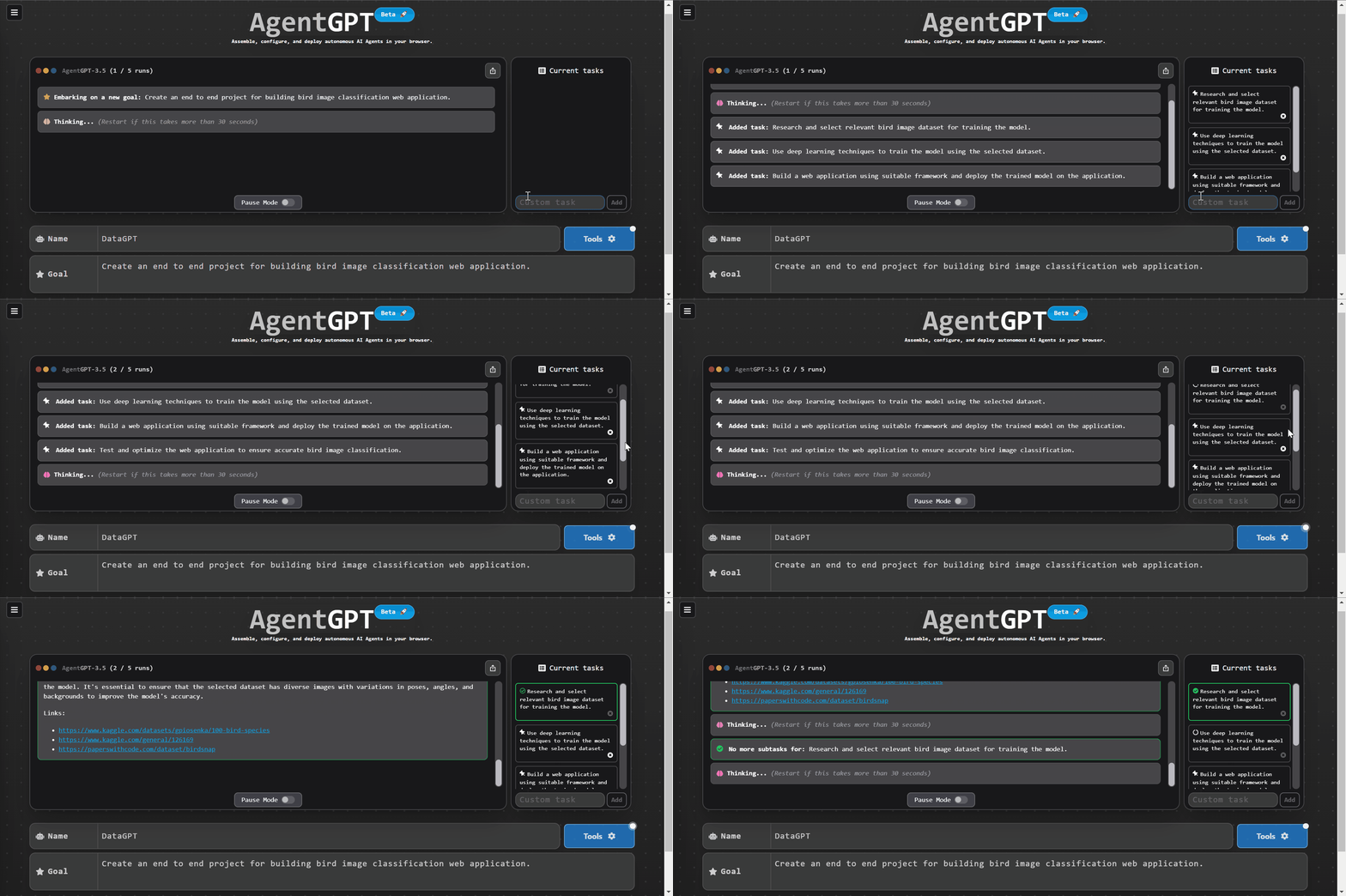
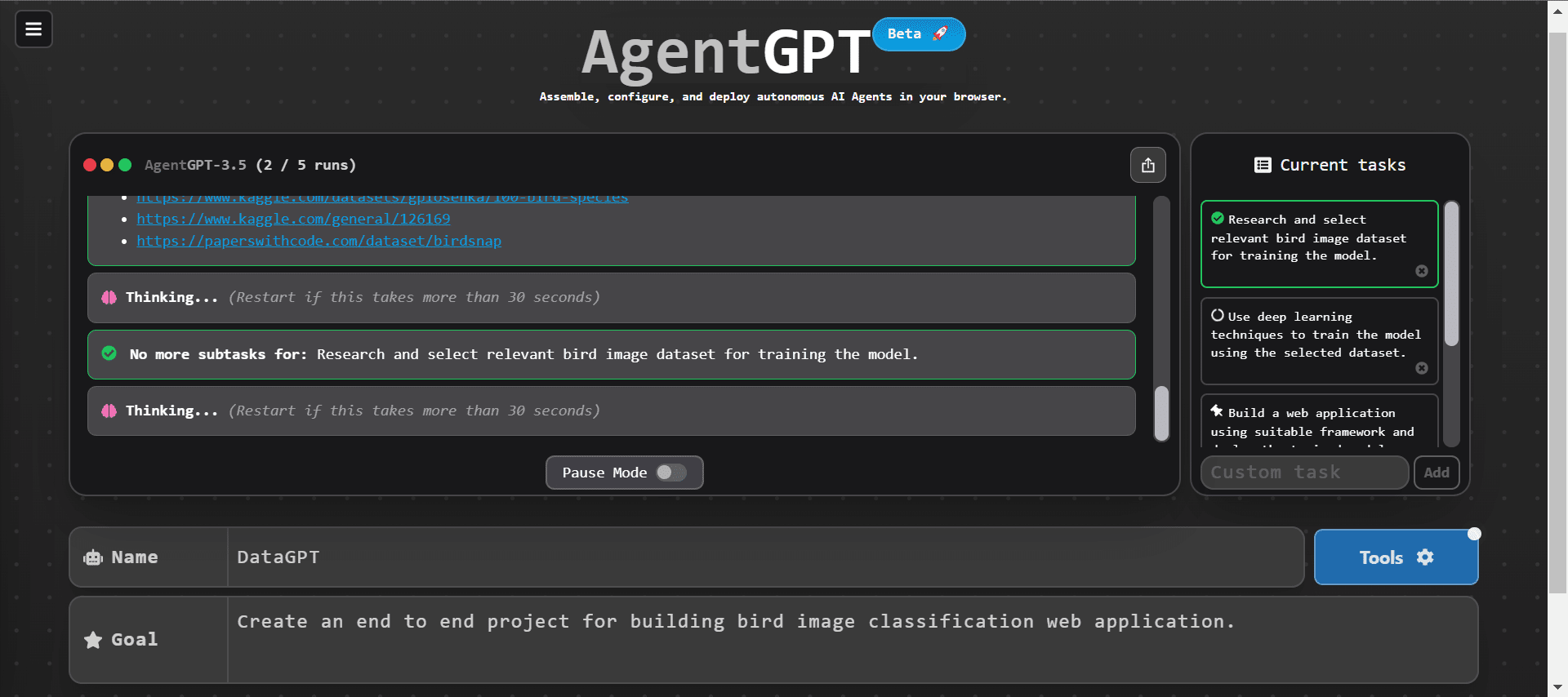
In our case, we have asked AgentGPT to develop a bird image classification web application.

AgentGPT: Autonomous AI Agents in your Browser
Image by Author | AgentGPT

On the first two runs, it performed:

  • Initial Dataset Research and Selection
  • Training deep learning model using TensorFlow
  • Build a web application using suitable framework and deploy the trained model
  • Testing and Optimization
  • User Interface Enhancement and Feature Addition

AgentGPT: Autonomous AI Agents in your Browser
Image by Author | AgentGPT

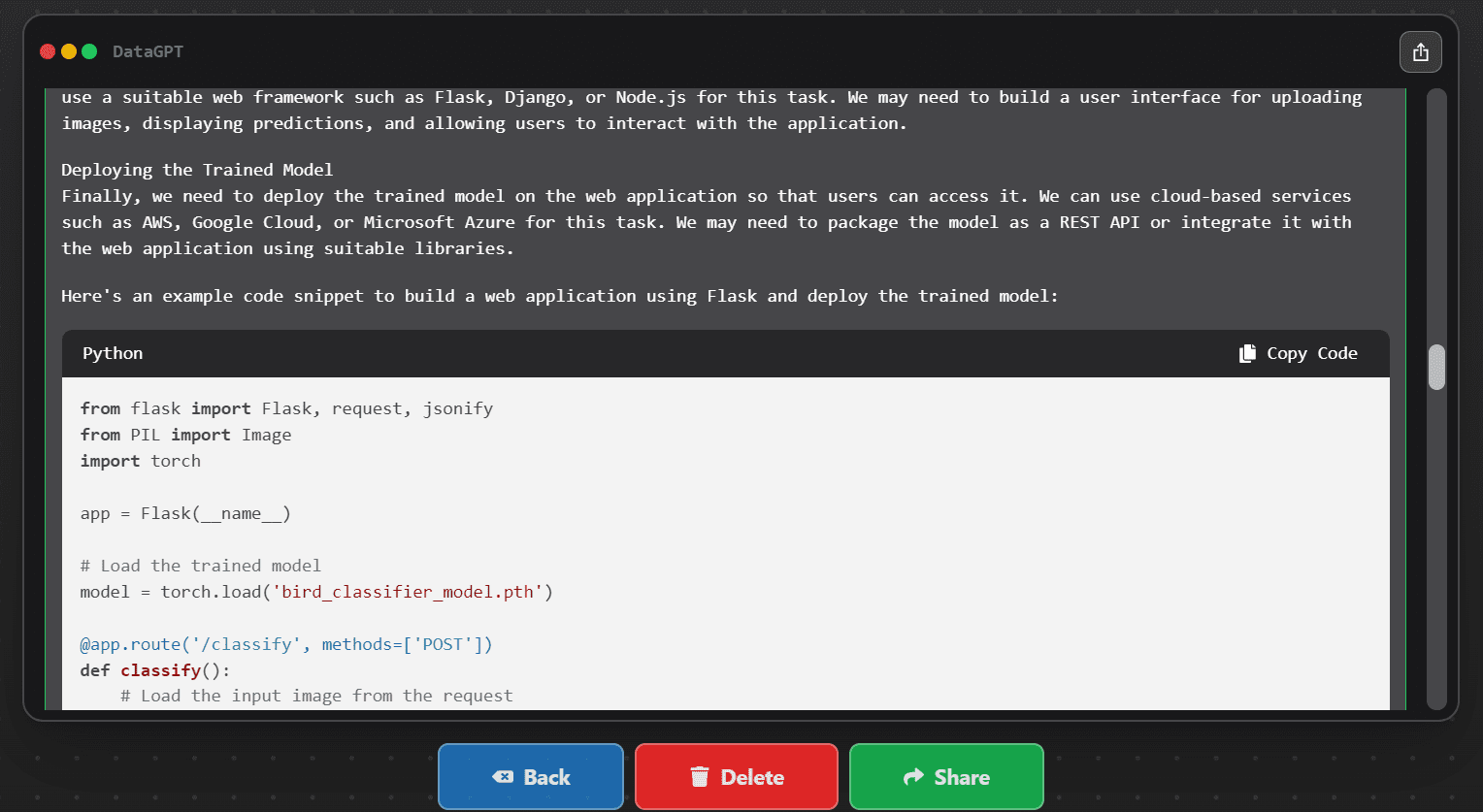
The initial results might not meet expectations; however, with further iterations, there is potential for improvement. It is possible that after around 5 runs, the coding issues in the application would be resolved.

How to Improve the Results?

Prompts play a crucial role in dynamically aligning the behavior of language models with the current goals and tasks of our agents. Currently, the AgetGPT free version is using gpt-3.5-turbo, and it shows that even the smallest details within prompts significantly influence the results generated.

Things you can do to improve the results:

  1. Enhanced Model Accuracy with Examples: To further enhance the accuracy of the model, you can provide 1, 2, or even multiple examples alongside your prompt.
  2. Plan and Solve (PS): A technique built upon a chain of thought prompting. By requesting step-by-step instructions from the model, it enables more accurate reasoning and problem-solving capabilities, leading to improved results. Learn more by reviewing the examples: AGI-Edgerunners/Plan-and-Solve-Prompting.
  3. ReAct: It is short for reasoning plus action. ReAct is a powerful prompting technique that combines reasoning and action generation in a single output. This approach allows the model to effectively synchronize thoughts with actions, resulting in more coherent and practical responses.
  4. Upgrade to the Pro Version or Local Deployment: For advanced capabilities, you have the option to upgrade to the Pro version, which includes access to GPT-4. Alternatively, you can run the application locally and incorporate a GPT-4 API key to leverage the enhanced features and performance of the GPT-4 model.

Getting Started AgentGPT: Autonomous AI Agents in your Browser
Image from reworkd/AgentGPT

In this section, we will learn how to set up and run AgentGPT locally. To get started follow the commands below.

git clone https://github.com/reworkd/AgentGPT.git && cd AgentGPT  ./setup.sh

Before diving in, it's crucial to verify that your environment is properly configured. To accomplish this, follow these steps:

  • Copy the .env.example file to the ./next/ directory.
  • Rename the copied file to .env.
  • Take the time to update the values within the .env file as per your requirements.

Note: You can also modify Database (Mysql), Backend (FastAPI), and Frontend (Nextjs) settings.

Building the docker image is a seamless process that should function smoothly without any issues. Before proceeding, make sure you have docker installed on your system.

docker-compose up --build

By running this command, you'll initiate the creation of containers for the frontend, backend, and database, setting up a comprehensive environment for your application.

Note: You can also develop and run AgentGPT without docker, and for that you have to read AgentGPT documentation.

Roadmap

AgentGPT is currently in the beta phase, and developers are actively working on a multitude of exciting features. Here's a sneak peek into what's in the pipeline, just to give you a taste of what's coming next!

Current features

  1. User Management and Authentication: Efficiently manage users and their authentication within the system.
  2. Agent Run Saving and Sharing: Seamlessly save and share agent runs to ensure collaboration and knowledge sharing.
  3. Dynamic Translations for Multiple Languages: Enable dynamic translations for diverse languages, allowing effective communication across language barriers.
  4. AI Model Customization: Customize the AI model according to your specific needs, empowering you to tailor it to your unique requirements.

Features in development

  1. Advanced Web Browsing Capabilities
  2. Backend Migration to Python
  3. Long-Term Memory with Vector Database
  4. Agent Steer-ability
  5. Documentation Overhaul

Conclusion

I firmly believe that following the era of advanced large language models, we are poised to witness the emergence of autonomous AI agents. This transformative development will revolutionize the way we approach work and task completion.

With the advent of autonomous AI agents, we will no longer need to meticulously outline the steps to achieve a goal. Instead, by simply defining the objective and providing an example, these agents will autonomously engage in research, experimentation, and execution to reach the desired outcome with remarkable accuracy.

If you are interested in learning more, try reading:

  • Baby AGI: The Birth of a Fully Autonomous AI
  • AutoGPT: Everything You Need To Know
  • Mojo Lang: The New Programming Language
  • LangChain 101: Build Your Own GPT-Powered Applications

Abid Ali Awan (@1abidaliawan) is a certified data scientist professional who loves building machine learning models. Currently, he is focusing on content creation and writing technical blogs on machine learning and data science technologies. Abid holds a Master's degree in Technology Management and a bachelor's degree in Telecommunication Engineering. His vision is to build an AI product using a graph neural network for students struggling with mental illness.

More On This Topic

  • Web LLM: Bring LLM Chatbots to the Browser
  • How to Make Sense of the Reinforcement Learning Agents?
  • How DeepMind Trains Agents to Play Any Game Without Intervention
  • Baby AGI: The Birth of a Fully Autonomous AI
  • CatalyzeX: A must-have browser extension for machine learning engineers and…