In a recent announcement, Australia revealed its plans to regulate AI, with a focus on addressing concerns related to deep fakes and deceptive content. The government is considering the implementation of measures, including a potential ban, to prevent the misuse of AI technology that can generate realistic yet false content.
“There is clearly, in the community, a concern about whether or not the technology is getting ahead of itself,” Industry and Science Minister Ed Husic told ABC television.
Similarly, according to reports, top leaders in China including Xi Jinping, the paramount leader of China, have called for greater state oversight of the technology. The Chinese believe AI could pose a significant threat to national security.Top officials in China met recently to discuss improving the security governance of internet data and AI.
Last month, US President Joe Biden met with the CEOs of some of the biggest companies working in AI to discuss the threat posed by the technology. Biden met with Sundar Pichai, CEO of Google, Satya Nadella, CEO at Microsoft, Sam Altman, CEO at OpenAI and Anthropic’s Dario Amodei.
At the same time, legislators in Europe urged US President Joe Biden to convene a global summit aimed at addressing the need for control and regulation of AI development.
In India too, the government has confirmed that the upcoming Digital India Act (DIA) will have provisions to deal with AI generated disinformation. “We are not going to regulate AI but we will create guardrails. There will be no separate legislation but a part of DIA will address threats related to high-risk AI,” Union Minister Rajeev Chandrasekhar said.
AI threats
AI does pose significant risks, both in the short and long run. Deep fakes are getting better and better and AI text-to-image models like DALL-E2, Midjourney, and Stable Diffusion can now create hyper-realistic images.
Earlier this year, photos of Former US President Donald Trump being arrested went viral on Twitter.
Making pictures of Trump getting arrested while waiting for Trump's arrest. pic.twitter.com/4D2QQfUpLZ
— Eliot Higgins (@EliotHiggins) March 20, 2023
While with the advent of LLMs, there is also a growing risk of automation and job losses. Further, AI could become a tool for disinformation. However, will AI lead to human extinction?
Recently, top AI experts have sounded the alarm claiming AI could potentially lead to human extinction. “Mitigating the risk of extinction from AI should be a global priority alongside other societal-scale risks such as pandemics and nuclear war,” a statement by them reads.
Notable signatories include Turing Award recipients Geoffrey Hinton and Yoshua Bengio, as well as Sam Altman of OpenAI and Demis Hassabis of Google DeepMind.
However, not everyone agrees to such statements. Few experts in the field believe AI in its current stage does not pose such capabilities. Additionally, a few also believe it’s a form of fear mongering which is actually detrimental for society.
The post Governments Across the Globe Mulls AI Regulation appeared first on Analytics India Magazine.
Image by Author (Generated via Stable Diffusion 2.1)
In recent times, Large Language Models or LLM have dominated the world. With the introduction of ChatGPT, everyone could now benefit from the text generation model. But, many powerful models are only available commercially, leaving much great research and customization behind.
There are, of course, many projects now trying to open-source many of the LLMs fully. Projects such as Pythia, Dolly, DLite, and many others are some of examples. But why try to make LLMs open-source? It’s a sentiment of the community that moved all these projects to bridge the limitation that the closed model brings. However, are the open-source models inferior compared to the closed ones? Of course not. Many models could rival commercial models and show promising results in many areas.
To follow up with this movement, one of the open-source projects to democratize LLM is the RedPajama. What is this project, and how could it benefit the community? Let’s explore this further.
RedPajama
RedPajama is a collaboration project between Ontocord.ai, ETH DS3Lab, Stanford CRFM, and Hazy Research to develop reproducible open-source LLMs. The RedPajama project contains three milestones, including:
Pre-training data
Base models
Instruction tuning data and models
When this article was written, the RedPajama project had developed the pre-training data and the models, including the base, instructed, and chat versions.
RedPajama Pre-Trained Data
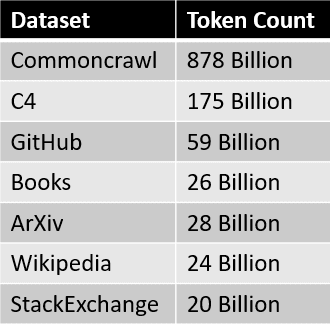
In the first step, RedPajama tries replicating the semi-open model's LLaMa dataset. This means RedPajama tries to build pre-trained data with 1.2 trillion tokens and fully open-source it for the community. Currently, the full data and the sample data can be downloaded on the HuggingFace.
The data sources for the RedPajama dataset are summarized in the table below.
Where each data slice is pre-processed and filtered carefully, the number of tokens also roughly matches the number reported in the LLaMa paper.
The next step after the dataset creation is to development of the base models.
RedPajama Models
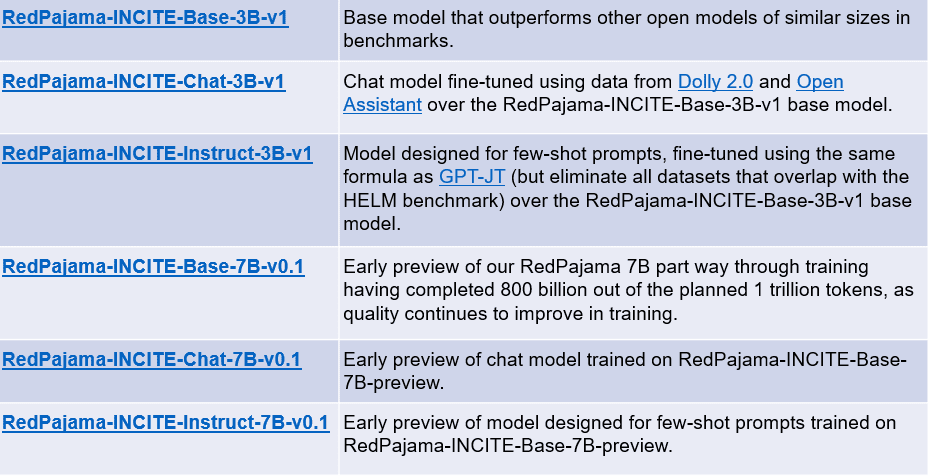
In the following weeks after the creation of the RedPajama dataset, the first model trained on the dataset was released. The base models have two versions: a 3 billion and a 7 Billion parameters model. The RedPajama project also releases two variations of each base model: instruction-tuned and chat models.
The summary of each model can be seen in the table below.
Image by Author (Adapted from together.xyz)
You can access the models above using the following links:
RedPajama-INCITE-Base-3B-v1
RedPajama-INCITE-Chat-3B-v1
RedPajama-INCITE-Instruct-3B-v1
RedPajama-INCITE-Base-7B-v0.1
RedPajama-INCITE-Chat-7B-v0.1
RedPajama-INCITE-Instruct-7B-v0.1
Let’s try out the RedPajama Base model. For example, we will try the RedPajama 3B base model with the code adapted from HuggingFace.
a Catholic saint and is known for her work with the poor and dying in Calcutta, India. Born in Skopje, Macedonia, in 1910, she was the youngest of thirteen children. Her parents died when she was only eight years old, and she was raised by her older brother, who was a priest. In 1928, she entered the Order of the Sisters of Loreto in Ireland. She became a teacher and then a nun, and she devoted herself to caring for the poor and sick. She was known for her work with the poor and dying in Calcutta, India.
The 3B Base model's result is promising, and it might be better if we use the 7B Base model. As the development is still ongoing, the project might have an even better model in the future.
Conclusion
Generative AI is rising, but sadly many great models are still locked under the company's archive. RedPajama is one of the leading projects that try to replicate the semi-open LLaMA model to democratize the LLMs. By developing a similar dataset to the LLama, RedPajama manages to create an open-source 1.2 trillion tokens dataset that many open-source projects have used.
RedPajama also releases two kinds of models; 3B and 7B parameter base models, where each base model contains instruction-tuned and chat models. Cornellius Yudha Wijaya is a data science assistant manager and data writer. While working full-time at Allianz Indonesia, he loves to share Python and Data tips via social media and writing media.
More On This Topic
Introducing MPT-7B: A New Open-Source LLM
The 7 Best Open Source AI Libraries You May Not Have Heard Of
Recently, the minister of state for MeitY Rajeev Chandrasekhar, said that this is the perfect opportunity and time to enter into the semiconductor chips design ecosystem. He was speaking at the third futureDESIGN Roadshow held under Semicon Design Linked Incentive (DLI) Scheme held at IIT Delhi.
The participants at the conference included global semiconductor startups and deep-tech VCs looking to invest in the space. At the conference, Chandrasekhar awarded two semicon companies – Morphing Machines, a fabless design company, and Netrasemi, for AI chipmaking. In February, Chandrasekhar announced the launch of ChipIn, a centralised centre for chip designers across the country. This was along with the open-source hardware system RISC-V, which is being used by most of the startups currently in the space.
India has broad expertise
“RISC-V is driving the creation of new startups,” Gani Subramaniam, senior partner at Celeste Capital told AIM. “In fact, we are seeing RISC-V startups getting funded in India. But India is far more versatile than just limiting it to RISC-V or AI. India has the ability to build world-class analog and RF chips, communications ICs, and more,” he added.
Even though we are seeing a lot of investments in the semiconductor space with open source technologies like RISC-V, India has the industry shaped up for much more offering than designing chips for AI. Subraminam explains, “Much of this [chip design] talent is currently residing within large global corporations and building world-class chips on their behalf, but I expect many entrepreneurs will enter this space as more investment capital is becoming available.”
Most recently, Incore, a fabless-semiconductor startup, building RISC-V-based processors raised $3 million in seed funding from Sequoia Capital India. In February, the investors poured funds into MindGrove Technologies as well. This Chennai-based startup secured $2.3 million in seed funding, with Speciale Invest and Whiteboard Capital also pouring funds for building systems-on-chips (SOCS) in India.
India might go global
We are already witnessing a lot of startups raising funding that are mostly being born out of the startup incubator at IIT-Madras. The trend to invest in semiconductor startups has just started. Subramaniam said that India is poised to be a hub for innovative chip companies to serve both the global market and the massive Indian domestic market as well.
India has numerous inherent advantages as it looks to become a hub for chip innovation, including its deep talent pool, thriving startup ecosystem, rapidly rising technology adoption, and strengthening infrastructure. “India now has over 25 years of deep semiconductor design experience and is the second-largest global pool of engineers and scientists,” added Subramaniam.
He explains how Indian startups will fall into two categories: One that will produce new solutions for the existing India market. The innovation here will focus on driving down costs, while delivering equal or better performance quality. The second category will be globally focused, leading-edge products in AI and other applications. “In the next 10 years, India will see breakout companies in both these categories. While we talk a lot about processors, many opportunities will also be in power management, battery management, motor drivers, smart cards, and other applications,” explained Subramaniam.
More than just a talent pool
Interestingly, India’s reputation as a talent pool for chip design is evident in the presence of R&D centres established by more than 90% of major fab and fabless players worldwide, including Intel, Samsung Semiconductors, NVIDIA, Qualcomm, Micron Technology, and NXP Semiconductors. The concentration of these companies highlights the significance of India’s role in the chip industry.
India has become a sought-after destination for global chip companies to hire exceptional design talent, even though it is not a major hub for silicon manufacturing. Industry insiders estimate that Indian engineers now represent approximately 20% of the world’s semiconductor designers, totalling over 120,000 design engineers. These engineers are predominantly employed by global chip manufacturers, and domestic design companies, or work independently.
Raising funds has been hard
However, not all start-ups have been as fortunate in raising funds, such as Ecvinox, an edge AI SoC venture, and NeuBionix, a medical implant start-up, which faced challenges due to insufficient funding.
Saankhya Labs, a start-up in the chip industry, secured funding from Intel Capital, General Motors, and Sinclair Broadcast Group, among others, accumulating a total of $30 million in funding over 15 years. But according to the founder of the company, these investors were attracted to Saankhya’s technology rather than being traditional venture capitalists.
Raising capital for chip start-ups in India is particularly challenging, despite their strong potential and competent teams, Muthukrishnan C, CEO of Semiconductor Fabless Acceleration Lab (SFAL), told Business Today.
On the flip side, Subramaniam also said that, “Within India, we see significant potential for the building of fabless semiconductor companies. The government’s chips to startup and design-linked initiative schemes will encourage more startup activity in this space.” Celesta Capital, this US-based VC firm is now keen on investing in semiconductor startups in India.
Arjun Rao from Speciale Invest told AIM in an interaction about how the company sees more opportunities in the semiconductor industry. The firm plans to confirm at least 8-10 deals in the space by 2024. It is clear that with the push from the government, and the rise of open source fabs in India, the industry is expected to expand even globally, and attract VCs.
The post Open Source Opens Funds for Semiconductor in India appeared first on Analytics India Magazine.
MLOps, short for Machine Learning Operations, is a practice for collaboration and communication between data scientists and operations professionals to help manage production ML lifecycle. It blends machine learning, DevOps, and data engineering to standardize and streamline the deployment, testing, and monitoring of AI models in production.
MLOps is crucial because it addresses the challenges of deploying ML models at scale. It aids in managing the complexity, diversity, and volume of ML models while ensuring robust, repeatable, and scalable processes. Machine learning models are only as valuable as their real-world performance, and MLOps allows businesses to monitor and improve models continually over time.
Moreover, MLOps enforces automation, reproducibility, and continuous integration and deployment, which are all necessary to meet the fast-paced demands of modern businesses. These practices help in reducing time-to-market and ensuring model accuracy and reliability. Without MLOps, organizations may face difficulties in deploying and maintaining machine learning models, which could result in missed opportunities or ineffective AI applications. Thus, MLOps plays a pivotal role in operationalizing AI, bringing more accuracy, efficiency, and predictability to the process.
There are a wide variety of resources to learn about the foundations of MLOps, and now there is another to add to the mix. Data Science Horizons has recently published a free ebook on the essentials of MLOps, titled Essential MLOps: What You Need to Know for Successful Implementation.
Essential MLOps: What You Need to Know for Successful Implementation covers a wide range of topics, from the foundational concepts of MLOps and the role of data scientists and engineers in this discipline, to essential skills such as data management, model training and evaluation, and continuous integration and deployment. Additionally, we dive into the tools and technologies that facilitate MLOps implementation, including data version control systems, CI/CD tools, and monitoring solutions. Finally, through a series of case studies, we demonstrate the real-world impact of MLOps across various industries, highlighting how it can lead to improved efficiency, more informed decision-making, and better overall performance.
The ebook covers a lot of ground in a relatively low number of pages, concisely introducing readers to important topics in the world of MLOps.
If interested in a beginner's introduction to machine learning operations, have a look at Essential MLOps: What You Need to Know for Successful Implementation.
Matthew Mayo (@mattmayo13) is a Data Scientist and the Editor-in-Chief of KDnuggets, the seminal online Data Science and Machine Learning resource. His interests lie in natural language processing, algorithm design and optimization, unsupervised learning, neural networks, and automated approaches to machine learning. Matthew holds a Master's degree in computer science and a graduate diploma in data mining. He can be reached at editor1 at kdnuggets[dot]com.
More On This Topic
Learn MLOps with This Free Course
Free MLOps Crash Course for Beginners
Causal Inference: The Free eBook
Mathematics for Machine Learning: The Free eBook
Graph Representation Learning: The Free eBook
SQL Notes for Professionals: The Free eBook Review
Some hot topics were barely discussed, at last publicly
Catherine Shu @catherineshu / 10 hours
This year’s Computex, the first since Taiwan eased pandemic-related travel restrictions, was a celebration of the world’s computing and chip industries. But amid the exhibitions, speeches and product announcements, like Jensen Huang’s packed Nvidia keynote (just a day before the company hit a trillion dollar valuation), several topics were barely hinted at, at least publicly. The fact of the matter is, that amid issues like geopolitical tensions and AI-induced chip shortages, the semiconductor industry is in a lot of turmoil. Here are some of the things left mostly unsaid at Computex.
1. Geopolitics making life more complicated for chipmakers
As relationships between the U.S. and Chinese governments continue to get frostier, things are getting messy in the semiconductor industry. The two countries’ ongoing war over the chip industry will have an increasing impact on how semiconductor supply chains are managed, especially for superchips required in generative AI and other high-powered computing tasks.
Last October, the U.S. passed new exports laws requiring U.S. chip makers to get a license from the Commerce Department before exporting advanced chips, including ones used in AI, and chip-making equipment to China. The U.S., Japan and the Netherlands also reached an agreement to stop exports of chip manufacturing tools to China. Companies caught up in the new restrictions included Nvidia, which was restricted from selling A100 and H100 GPUs to China, costing it up to $400 million. Both chips are used for training large language models like OpenAI’s GPT-4. In response, Nvidia made a slower chip for sale to China.
In its turn, China opened a probe into American memory chip maker Micron over cybersecurity concerns before banning sales of some chips. The ban could have benefited Micron competitors in China like Samsung Electronics and SK Hynix, but the U.S. reportedly asked South Korea not to fill China’s market gap if Micron got banned. That’s all happened over the past half year, and it’s not over-the-top to expect the U.S.-China tit-for-tat will have a dramatic, worldwide impact on the semiconductor industry in the coming months.
The world’s biggest chipmaker with 59% global market share, TSMC, is based in Taiwan and while it might not have to contend with the same sanctions that American companies do, many of its biggest customers are in China. As a result, TSMC has reportedly been hedging its bets. According to a Bloomberg report published shortly after the U.S. issued its sanctions, TSMC suspended production of advanced chips for Chinese startup Biren to make sure it complies with U.S. regulations.
TSMC, like all other Taiwanese semiconductor companies, are also dealing with Taiwan-China relations. TSMC has built foundries in the U.S. and Japan, but most of its production is still in Taiwan, which leaves open questions about what will happen to its chips, which much of the world’s tech companies rely on, if Taiwan-China relations continue to escalate.
2. How TSMC’s work culture will translate
TSMC plans to spend $40 billion on its two Arizona fabs, which make advanced chips. TSMC founder Morris Chang has stated that Taiwan’s work culture is one of the reasons it boosts the world’s top semiconductor companies. As an example, he said TSMC’s around-the-clock on-call practices mean if a piece of equipment breaks down at 1AM, it will be fixed within an hour, as opposed to 9AM in the U.S. But the intensity of TSMC’s labor practices have come under examination, including in a report earlier this month by the New York Times that found it and other companies with a similar work culture face high turnover, despite the prestige of working for them.
With the opening of TSMC’s first foundry in Arizona, it may also be finding its way into a cultural clash. The EE Times interviewed a principal engineer in the U.S. who said, “more or less, the culture needs to changed, but the overall work environment and requirements have been established in Taiwan for a long time. So this will be transplanted to TSMC Arizona. Some small modifications should make it more acceptable, but the American engineers will need to adapt to the work environment and this kind of culture.”
3. Talent shortages
Employee attrition and lack of talent in general has the potential to be a big headache for semiconductor companies around the world as the industry’s growth is expected to outstrip the increase in skilled workers. In a recent report, Deloitte estimated that more than one million additional workers will be needed globally by 2030, or more than 100,000 annually. In the U.S., there are less than 100,000 graduate students enrolled in electrical engineering and computer science, and the U.S. semiconductor industry could face a shortage of about 70,000 to 90,000 workers soon. Unless something changes, this means the CHIPS Act’s attempt to turn the U.S. into a semiconductor powerhouse might simply lack the necessary manpower.
4. AI chip shortages
Human talent isn’t the only thing in short supply. Generative AI computing runs on chips, mostly GPUs made by Nvidia, but those are getting increasingly scarce. Microsoft is reportedly facing an internal shortage of the server hardware it needs to run its AI, and according to the WSJ, OpenAI CEO Sam Altman said during a May 16 Congressional hearing that it would be better if less people used ChatGPT because of the processor bottleneck. Some servers manufacturers and direct customers told the WSJ that they are waiting more than 6 months to get Nvidia’s latest GPUs. DigiTimes reported earlier this month that Nvidia has placed more orders for chips that need TSMC’s chip on wafer on substrate (CoWoS) packaging in a bid to ease the bottleneck. The chip shortage may be causing huge amounts of stress for generative AI companies and startups, but it’s one of the reasons Nvidia stock has soared to a trillion dollar valuation.
Meanwhile, startups and large companies like Intel and NTT are working on alternatives like photonic chips. As my colleague Kyle Wiggers reports, photonic chips use light to send signals instead of electricity like conventional processors. In theory, this means higher training performance because light produces less heat than electricity, can travel faster and is less susceptible to changes in temperature and electromagnetic fields. But there are several catches. For one thing, photonic chips are larger and difficult to mass produce, and their architectures still rely on electronic control bottlenecks, which can create bottlenecks. Secondly, they require a lot of power to convert data into a format the chips can work with. And finally, signal regeneration, or the process of regenerating optical signals degraded during transmission through photonic chips, means signals can become distorted over time. As a result, it maybe years before photonic tech becomes mainstream (even with photonic AI startups like Lightmatter getting big chunks of funding), and in the meantime, generative AI companies will continue to hustle for GPUs.
It’s important to note, however, that there is talk that the AI bubble may burst at some point, especially if regulators become more cautious and start to take action. The chip industry over-produced during the pandemic in response to shortages, and as a result there is now a surplus of memory chips.
5. The Taiwan drought’s impact on chip supplies
With the rainy weather in Taipei this past week, it might be hard for Computex visitors from out of town to believe, but Taiwan is undergoing yet another drought. The previous one in 2021 had a negative impact on the country’s semiconductor manufacturing because producing chips takes a huge amount of water. TSMC, for example, uses more than 150,000 tons per day. During the last drought, it relied on truckloads of water to continue making chips.
This time around, TSMC is prepared, not only with rented water tanks but also new wells. It told Nikkei Asia that it “has contingency plans for different water restriction stages and works with the government and private organizations to save water and develop water resources.” It has also enacted water conservation measures at its facilities in the Southern Taiwan Science Park, including reducing water consumption and recycling wastewater.
After sucking at math forever, OpenAI today announced that it has come up with a new technique called ‘process supervision,’ which improves mathematical reasoning.
This new method involves rewarding each step of reasoning as opposed to rewarding the correct final answer as that happens in ‘outcome supervision.’ Process supervision is said to boost performance, and also bring in alignment by training the model to produce a ‘chain-of-thought’ model closer to human thinking.
Reduces Hallucinations
With process supervision, OpenAI believes that hallucinations would be minimised to an extent. It said that each step in the process receives precise supervision which will lead to better outcomes.
Further, OpenAI said that the approach of rewarding aligned processes will lead to more ‘interpretable reasoning’ as the model is encouraged to follow a human-approved process. Simply put, interpretable reasoning, focuses on creating transparent models with clear explanations for their outputs.
As opposed to outcome supervision which may reward unaligned processes that are hard to detect, process supervision will not face such problems. The company has also said that addressing hallucinations is a critical step towards building aligned AGI.
ChatGPT is the closest model we have that looks like AGI, but still suffers from hallucination and tends to write plausible-looking bs with uncanny confidence. It could be misleading and even dangerous. Can we fix it? There is a simple & intuitive remedy: pic.twitter.com/LtzgxLbnGf
— Jim Fan (@DrJimFan) December 5, 2022
Improves Math Results
Source: OpenAI
OpenAI, in its blog post said that it used the MATH test set to evaluate process-supervised and outcome-supervised reward models. Further, it said that multiple solutions for each problem were generated and the solution ranked highest by each reward model was picked. It was observed that not only did process-supervised reward models outperform outcome-supervised ones, but the performance gap widened as more solutions to a problem were considered indicating the reliability of the model.
By reducing hallucinations and bringing more alignment in their models, OpenAI is striving to inch closer to near perfection of chatbots with this method. However, the scope of these results for applying to other domains beyond math is still unknown. OpenAI believes that if process supervision is applied to other domains as well, we may get a method that is superior and more aligned than outcome supervision.
The post OpenAI Finally Cracks the Math Code appeared first on Analytics India Magazine.
Baidu’s $145M AI fund signals China’s push for AI self-reliance Rita Liao 7 hours
The U.S.-China decoupling is giving rise to a divided tech landscape between the two major economies, shaping the development of the red-hot area of generative AI, which turns text into various forms of content like prose, images, and videos.
China, in order to reduce dependence on the U.S. technological foundation, has been pursuing its own large language models that match OpenAI’s GPT models. But unlike the U.S., some of its most advanced AI endeavors are happening at established internet juggernauts, such as Baidu.
The search engine and autonomous driving giant rolled out its counterpart to ChatGPT in March. Now the 23-year-old firm wants to have a stake in other AI startups, too. The company aims to have a stake in other AI startups. During a JPMorgan summit in China this week, Baidu’s co-founder and CEO Robin Li announced the launch of a billion yuan ($145 million) fund to back generative AI companies.
The fund can be compared to the OpenAI Startup Fund, which started at $100 million and eventually grew to $175 million, as my colleague Connie noted. The fund will invest up to 10 million yuan, approximately $1.4 million, in a project. Given the check size, the fund is clearly targeting early-stage AI applications, which isn’t surprising, given that Chinese generative AI startups haven’t experienced widespread adoption and most investments are concentrated in the seed and early stages.
Furthermore, Baidu intends to use the fund to grow the adoption of its own large language model Ernie Bot. “American developers are building new applications based on ChatGPT or other language models. In China, there will be an increasing number of developers building AI applications using Ernie as their foundation,” Li said.
In that sense, the fund seems to be calling for applications of AI rather than developers of its foundational layer. The fund won’t be short of pitches. Over the years, Chinese startups have gained recognition for their ingenuity in devising novel business models, ranging from live streaming, live commerce to short videos. Li predicted that, in the generative AI age, Chinese companies will once again lead the way in discovering commercial applications for AI.
“I’m very bullish on China’s AI development. Over the past few decades, China has warmly embraced new technologies. Even though we didn’t invent Android, iOS or Windows, we developed a host of very innovative applications like WeChat, Douyin and Didi. Many of them are popular and useful. The same trend is playing out in the AI age. Technology ushers in a myriad of possibilities and we are good at capturing them to build applications.”
However, a pertinent question lies in whether the foundational level — China’s homegrown large language models — will be robust enough to support the range of real-life scenarios expected of them. China wants its homegrown LLMs so it won’t be prone to U.S. sanctions that cut off key technological supply, as seen in the semiconductor industry. Aside from Baidu, Chinese tech giants like Alibaba and Tencent are also developing their own large language models.
China’s ChatGPT rival Baidu Ernie is off to a rough start
The big data marketplace is rapidly growing, leading to intense competition. Open-source technologies like Presto, Hadoop, Spark, are prominent players in this field that provide innovative solutions and differentiate themselves from competitors.
Apache Spark and Presto are powerful open-source analytics engines designed to handle unstructured and semi-structured data across various applications. They provide a straightforward and expressive programming model, accommodating use cases such as machine learning and stream processing. Spark and Presto excel in executing interactive queries on datasets of any size and seamlessly combining data from multiple sources, making them ideal for querying data lakes that store structured and unstructured data like images, videos, and social media posts.
These frameworks operate efficiently with distributed, parallel, and in-memory processing, enabling fast data processing. Renowned companies have extensively tested and implemented Spark and Presto for handling massive volumes of data. These frameworks offer flexibility, supporting on-premises or cloud deployment, with containerization enabling adaptable and scalable deployments.
Although both of them have similar offerings, they come with their own share of differences.
Read more: India’s Semiconductor Dreams Plunge into Chaos and Uncertainty
Apache Spark Vs Presto
Processing Model
Spark is a powerful framework for big data processing, supporting batch processing and iterative computations. It leverages Resilient Distributed Datasets (RDDs) for distributed data processing, offering APIs for tasks such as batch processing, SQL queries, machine learning, and graph processing. In contrast, Presto focuses on interactive and ad-hoc querying. It employs a distributed SQL query engine model, aiming to deliver quick query responses through distributed query optimization and execution.
Data Processing Paradigm
Spark is an in-memory processing framework that enhances performance for iterative computations and repetitive data access by caching intermediate data in memory. It offers options to store data on disk or in distributed file systems like HDFS.
Presto streams data directly from sources, bypassing memory storage. It employs a pipelined execution approach that reduces data shuffling and optimizes memory utilization, enabling efficient processing of massive datasets.
Query Optimisation
Spark and Presto have powerful query optimizers. While Spark focuses on optimizing RDD-based transformations and SQL queries, Presto’s optimizer is highly advanced. It generates efficient execution plans by considering factors such as statistics, data distribution, and data partitioning. Moreover, Presto performs dynamic optimization during query execution, enabling it to adapt to evolving data and query patterns.
Read more: Will Meteor Lake Be Intel’s Saving Grace?
Data Sources and Connectors
Spark and Presto offer diverse connectivity to data sources like HDFS, Hive, relational databases, and cloud storage. Spark boasts a vast ecosystem, including support for HDFS, Hive, HBase, databases, and cloud storage services such as Amazon S3 and Azure Blob Storage. While Presto’s connector ecosystem may not match Spark’s breadth, it still enables connectivity with HDFS, Hive, databases, cloud storage, and more.
Scalability
Spark and Presto are both scalable frameworks for distributed data processing. They distribute data and computations across machine clusters, enabling parallel processing and efficient resource utilization. They can handle large-scale workloads and support horizontal scaling by adding more worker nodes.
Why Big Techs Love Spark
Big companies are adopting Apache Spark for various reasons. Yahoo, for example, uses Spark to enhance its web search engine by providing personalised content to visitors based on their individual interests. Spark’s real-time processing capabilities and high-speed performance enable Yahoo to cater precisely to each user’s preferences. In the finance industry, banks are turning to Spark as an alternative to Hadoop for accessing and analysing diverse data such as social media profiles, call recordings, and emails. This empowers them to make informed decisions regarding targeted advertising, customer segmentation, and credit risk assessment.
Spark excels in iterative computations and comprehensive data processing, while Presto is optimized for interactive queries and ad-hoc analysis. When choosing between Spark and Presto, it is crucial to consider the specific requirements, workload patterns, and data characteristics of the given use case to make an informed decision.
Read more: Beware of the AI Bubble Burst
The post Spark vs. Presto: Unleashing the Power of Data appeared first on Analytics India Magazine.
OpenAI recently announced a program to fund experiments to democratise AI rules, which promises to allocate grants worth $1 million to whoever contributes best to solve its safety mishaps. While this might be the biggest offering made by any tech company to ‘fix’ an ongoing crisis, one might wonder if this is the next tactic by closed-door OpenAI to come across as a company that is giving more power to the people, in a possible bid to ‘comply’ what’s best for everyone. Or in other words, you are to be blamed if something goes wrong with ChatGPT or its flaws.
Thanks to ChatGPT, AI is now being shrouded with the need for regulation policies, and the whole affair is going as far as equating it to a nuclear war threat with tech leads rushing to sign a collaborative statement to show that everyone agrees to the AI threat. With the government stepping in to find ways to regulate AI through discussions and Senate hearings, and troubled parent Sam Altman agreeing to having an agency for regulating AI, the next step is obviously to come up with the whole plan for it. From releasing an elaborate blog on governance of superintelligence a few days after the Senate hearing to setting up democratisation plans for AI regulations, OpenAI is moving way ahead, probably even surpassing the government, to build a plan that would ultimately give the company unsurpassable power.
ChatGPT is being portrayed as this ideal child, leaving other AI kids in a state of despair and driving their creators/parents to trail OpenAI’s path, for the greater good of humanity and AI-kind. This brings us to question, if this is the right path to take in the first place?
United, we rule
Couple of weeks ago, OpenAI co-founder Greg Brockman, at an AI Forward event in San Francisco, had spoken about how the company is working on a democratic approach to formulate AI regulations. He compared this approach to a Wikipedia-like model where people with various perspectives work together to reach a consensus on any entry. He also mentioned that the company does not want to write rules for everyone, instead will consider a ‘democratic decision-making’ process involving different kinds of people to shape the future of AI.
Unsurprisingly, within 3 days of the event, OpenAI officially announced the plan for ‘democratic inputs to AI.’
OpenAI has cleverly passed the work of AI regulation to people thereby allowing the company time to focus on their next expansion plans and maybe more advanced GPT models. By getting appropriate feedback from a wide community, the companies’ ‘open-source’ approach is another way to gather user feedback and help improve their system. Considering how ChatGPT is now allowing users to block their data from being used for training the GPT model, the current democratisation plan will help with gaining user feedback. The company had also mentioned in their announcement that the company would want to ‘learn from these experiments’ and use them for a more ‘global and ambitious process going forward.’
Distraction is the best medicine
Looks like by democratising the process for formulating AI rules, the company is creating more chaos and distraction, and slowly washing their hands off future repercussions. By preempting any future restrictions that may not be in the interests of the company, OpenAI announced this grant to proactively come up with a plan which in future may be even suggested to government or other bodies to use as framework. With certain countries and organisations banning the chatbot, a framework made by the people and a larger community is in a way transferring ownership of risks from the company to the larger audience. Either way, OpenAI will be unaffected by this and emerge as a winner at the end of this.
Obsessed with Humans
Looks like RLHF was not enough human interaction for OpenAI’s ChatGPT, and now the company craves for more. With limited or no access to user data after releasing the option to not save ‘chat history’, OpenAI continues to find ways to work without forgoing user feedback to further train and better their model.
The post OpenAI’s ChatGPT, An Annoying Kid that Craves More Human Attention appeared first on Analytics India Magazine.
Generative AI has changed SaaS businesses completely. Everyone, including the likes of Zoho, Salesforce, and Freshworks, is getting into the generative AI gamble – and so is Whatfix. With the help of a 12-member team split into two groups, the company is endlessly working towards AI implementation across its products and functions with a focus on responsible AI.
“We are reimagining the future of digital adoption platform with Whatfix AI,” said Vara Kumar, co-founder and chief tech and product officer, in an interview with AIM.
Kumar said that Whatfix employs generative AI to boost user productivity through application-agnostic use cases, supporting web, desktop, and mobile applications for customers and employees. “It auto-completes text fields, provides detailed explanations for user notes, and offers summarised answers in self-help searches, saving time and effort,” added Kumar.
Interestingly, team Whatfix looks to prioritise a “human-in-the-middle” approach, ensuring human control over AI and contextual relevance. Whatfix is developing a computer vision model for human-like comprehension of applications and processes, enabling task completion without relying on technology or knowledge availability.
Founded by Khadim Batti and Kumar in 2014, the California-headquartered company introduced three new tools in 2022: Product Analytics, Nudgealong, and Comments. Product Analytics allows organisations to track and analyse user engagement and behaviour data effortlessly. Nudgealong democratises knowledge sharing, while Comments enable real-time collaboration. Whatfix obtained two patents for automatic segmentation and element detection.
Read more: What is Microsoft Without OpenAI?
From Data to Performance: A Holistic Approach to AI Deployment
According to Gartner’s report, only 54% of AI projects make it from pilot to production. The deployment of ML models is a global challenge for many enterprises due to common challenges like the collection and preparation of data, development of the model, deployment to production, and monitoring of its performance. Lack of resources and expertise, as well as a non-innovative culture, can further hinder the deployment process.
However, Whatfix has found a solution to this problem. “At Whatfix, we speed up AI/ML project deployment by integrating AI engineers into R&D teams, aligning everyone on the benefits and metrics of new features, and providing transparency into algorithms and ML processes,” Kumar explained.
To make this possible, Whatfix leverages cutting-edge technology. It uses Azure Machine Learning services throughout the entire machine learning lifecycle, including development, deployment, inference, and MLOps. When dealing with compute-intensive and inference-heavy deep learning models, they make use of GPU resources. Additionally, Whatfix employs Looker dashboards to monitor model performance and track key metrics.
Furthermore, Whatfix uses Transformer and GPT-based architectures for various functionalities. One notable example is their ability to generate concise answers for end-user queries by extracting information from vast repositories of content and guidance materials.
Read more: Is Indian Govt’s Battle Against AI Disinformation Flawed?
Navigating the Ethical AI Maze
The tech industry has always been unstable in its opinion to regulate AI. In the past three years, Microsoft fired its entire ethics and society team, following Google’s dismissal of its ethical AI team leader Tinmit Gebru. Even Meta disbanded its Responsible Innovation (RI) team.
Earlier this month, OpenAI CEO Sam Altman testified before the US Congress regarding AI regulation. While Altman supported the development of robust AI regulations by the international community, he also expressed concern about the potential consequences of actual regulatory implementation.
So in a scenario like this, it is important for companies to take the necessary steps.
Echoing similar lines, Kumar said, “We heavily use GenAI-based models, some of which have hallucination capabilities. However, we prioritise user service by ensuring zero hallucination, guaranteeing accurate information delivery.”
Whatfix does not share customer data with third-party services to improve their models or services. The quality of predictions can vary based on input data. We continuously monitor model performance in production and provide active feedback to maintain prediction quality and accuracy.
Whatfix Growth Story
India’s SaaS industry is poised to boost the country’s position as a leading service provider and simplify global business processes. It is expected to drive transformation and maximise the potential of the IT industry.
By 2030, India aims to generate $50 to $70 billion in SaaS revenues and capture 4-6% of the global market, creating up to $1 trillion in value.
Currently, India has 1,000 SaaS startups, including 10 unicorns, with a combined annual revenue of $2-3 billion and employing 40,000 people. The number of unicorns is predicted to increase tenfold by 2030. With an anticipated $10 billion SaaS industry and an eight percent global market share, India’s SaaS sector is growing at a compounded rate of 18%, with a projected 36% growth in the small and medium business sectors.
One of the key players in this market is Whatfix. In terms of revenue, last year, Whatfix achieved an impressive year-on-year (YoY) Annual Recurring Revenue (ARR) growth rate of 65%, making it one of the standout performers in its field.
Additionally, the company maintained an outstanding net revenue retention rate of 127% for its enterprise customers, demonstrating substantial growth within its existing customer base throughout the year. The average revenue generated per account experienced a noteworthy rise of 32%, with an impressive 40% of accounts experiencing expansion.
The California headquartered company also expanded its worldwide reach in the Asia-Pacific (APAC) region by establishing a new office in Sydney, Australia.
Whatfix is backed by the likes of SoftBank, Sequoia Capital, Cisco Investments and more. In 2021, it raised a whopping $90 million through its Series D funding round, led by SoftBank Vision Fund 2. This funding round also witnessed active participation from notable investors such as Eight Roads Ventures, Sequoia Capital India, Dragoneer Investment Group, F-Prime Capital, and Cisco Investments. Earlier, the company had secured $32 million in Series C funding, with Sequoia Capital India leading the charge and receiving support from existing investors like Eight Roads Ventures, a renowned proprietary investment firm supported by Fidelity, F-Prime Capital, and Cisco Investments. Currently, Whatfix is valued at an impressive $139.8 million.
Considering the impeccable reputation Whatfix has established and its substantial investments in generative AI, it appears evident that this “emerging unicorn” is on the brink of achieving the coveted status of a billion-dollar unicorn.
Read more: Uncensored Models Outperform Aligned Language Models
The post How Whatfix is Revolutionising SaaS with GenAI Integration appeared first on Analytics India Magazine.






 pic.twitter.com/LtzgxLbnGf


