Microsoft Issues Code Green Alert

While generative AI is all the hype, there is a side to it that the users of the technology do not realise. These LLM-based models like ChatGPT are extremely thirsty. Each 20 questions you ask these chatbots requires almost half a litre of water to give you answers. And that mostly goes into cooling the data centres where the data is stored.

More than that, these models rely on data centres that are extremely carbon heavy on the environment. According to the estimates from the World Economic Forum, generative AI has the potential to reduce carbon emissions by 4% by 2030. But on the other hand, it was also predicted in 2017 that these data centres and information technology sector as a whole, will contribute to a huge 14% of the carbon emissions globally by 2040.

In an exclusive interview with AIM at the Microsoft’s Future Ready Sustainability Summit, Alok Lall, Sustainability Lead of Microsoft India, explained about the changing dynamics of the companies to address the problems with making greener software from the ground up.

“When we look at reducing emissions, it is very easy to look at infrastructure and get more efficient hardware like servers, heating, ventilation, and cooling systems,” said Lall. “But how I look at it is we do not understand the main ingredient of what the application does – code.”

How do we make the code light?

Making data centres efficient is a good way to go forward with sustainability, but if we look at the code before being deployed. “Our eventual goal is that you don’t want to have developers apply green software principles after they’ve written the code,” said Lall.

A step for this was taken by Microsoft when they partnered with Accenture, GitHub, and Thoughtworks to create Green Software Foundation in 2021. Announced at Microsoft Build 2021, the goal of the foundation is to create a trusted ecosystem of people and for people for best practices in software development.

Currently, the Green Software Foundation is working on a software carbon intensity score and a Carbon Aware SDK, that developers can start using upfront.

Microsoft has partnered with Cast Software, a technology corporation based in New York, to build on more green products and work on software intelligence. One such product was presented at the conference that scans your code as you write it on your software before it is deployed, and rates it from how green it is to how carbon intensive it is. Still under development, the tool tells you how you can fix the code to be more greener by requiring less computation.

Lall also explains how sustainability cannot be an afterthought, but has to be a design principle. Speaking about low code platforms like Copilot, Lall said that these softwares have been designed with the same principles in mind, these capabilities are inherently provided by the cloud.” This means that the code generated by these platforms is already designed to be as green as possible.

The only point that remains is that even for the generation of codes through the server, the server needs to run and emit energy, thus emitting more carbon into the environment, and thirsting for more water.

Making AI less water intensive

There is a solution for that as well. AI is computation intensive, everybody knows that. “We solved the design of the model part by using green software. For the second part, to make the infrastructure greener, we have made data centres to run at a PUE (power usage effectiveness) 0f 1.12.” explained Lall.

Microsoft wants to make sure that it does not use water to cool its data centres anymore. For that, the company relied on air cooling, and is now shifted to adiabatic cooling, which involves condensing the same water that evaporated while cooling the motherboard by keeping it dipped in a liquid.

Microsoft made the claim that the company would be carbon negative, produce zero waste, and water positive by 2030. There is a possibility that this prediction did not account for the current generative AI and large language model technology.

To answer this, Lall said that integrating OpenAI and GPT technology into our systems was all part of the large corpus. “We know that it will go up and we are increasingly investing in areas that will help us be carbon negative by 2030, and achieve our goals.”

Energy at its core, literally

According to the 2022 Sustainability Report of Microsoft, the company has brought down its own emissions by 22% and by 0.5% from their suppliers and customers. To achieve the 2030 carbon negative goal, Lall said that the company has the target of becoming 100% renewable energy by 2025.

Recently, Microsoft also made a huge investment in Helion Energy, a nuclear energy based startup. It is clear that the company is taking many steps to stay ahead of the competition, while also keeping sustainability at its core. “We will continue to identify and find innovative ways to power our data centres,” said Lall, “to get to the goal we have set for ourselves for 2030.”

Apart from generative AI, Microsoft has also been making other areas of their software and hardware as green as possible. The recent Windows 11 22H2 update is carbon aware, and will only update when the emissions in the day are lower. At Microsoft Hyderabad, they have been working on a project to absorb moisture from the atmosphere and convert it into 2,000 litres of water per day and also created a digital twin of the campus to track carbon emissions in real-time.

The post Microsoft Issues Code Green Alert appeared first on Analytics India Magazine.

Andrew Ng Introduces 3 New Courses on Gen AI with LangChain, OpenAI, Lamini

Andrew Ng’s ‘Maths for ML and Data Science Specialization’ Now on Coursera

After teaming up with OpenAI for the ‘ChatGPT Prompt Engineering for Developers’ course in May, Andrew Ng’s DeepLearning.AI has unveiled three new courses on generative AI. Besides Isa Fulford of OpenAI, LangChain’s cofounder and chief Harrison Chase and Lamini’s cofounder and chief Sharon Zhou are joining as instructors. The courses are free-of-charge for a limited period.

Building Systems with the ChatGPT API

“Building Systems with the ChatGPT API” is a concise course that teaches the automation of complex workflows using chain calls to a powerful language model. Led by Isa Fulford and Andrew Ng, this one-hour program covers topics such as creating interactive prompts, utilising Python code and developing a customer service chatbot. Practical applications include query classification, safety evaluation, and multi-step reasoning. The course provides hands-on examples and Jupyter notebooks for experimentation. In collaboration with OpenAI, this beginner-friendly course offers the latest best practices for maximizing the performance of LLM models responsibly. Suitable for those with basic Python knowledge and ML engineers seeking prompt engineering skills for LLMs.

How Diffusion Models Work

In this How Diffusion Models Work course, one will learn how to build and optimise diffusion models, gaining a deep understanding of their inner workings. Taught by Sharon Zhou (CEO, Co-founder, Lamini), the free-of-cost one-hour intermediate-level course equips you with practical coding skills and hands-on labs for creating personalised diffusion models. With a focus on generative AI, you’ll explore the diffusion process, build neural networks for noise prediction, and enhance image generation with contextual information. By the end of the course, you’ll have a solid foundation to explore diffusion models for your own applications. Prior knowledge of Python, Tensorflow, or Pytorch is recommended.

LangChain for LLM Application Development

LangChain for LLM Application Development is a beginner-friendly, short one-hour course instructed by Harrison Chase (Co-Founder and CEO at LangChain) and Andrew Ng and requires basic Python knowledge. The program will enable you to apply LLMs to your data, and build personalised assistants and chatbots. It will also explore agents, chained calls, and memories to enhance the utility of LLMs. The course provides comprehensive instruction and hands-on experience in crucial topics such as Models, Prompts, and Parsers. You will gain expertise in invoking LLMs, supplying prompts, and parsing responses. Additionally, you will explore memory implementation, chain construction, leveraging LLMs for Question Answering over Documents, and the frontier of LLMs as reasoning agents. By the end of the course, you will have a model to kickstart your independent exploration of diffusion models for your own applications. LangChain for LLM Application Development is beginner-friendly and requires basic Python knowledge.

LangChain is an important Python framework for large language models (LLMs) that has gained significant attention in the developer ecosystem over time as it simplifies the integration of LLMs into applications, making them more accessible. With support from multiple model providers and hosting platforms, LangChain has raised substantial funding and is valued at $200 million. It enables the creation of AI agents through command chaining and offers access to advanced LLMs from providers like Hugging Face. So if you want to up your game, enrol for this course now.

The post Andrew Ng Introduces 3 New Courses on Gen AI with LangChain, OpenAI, Lamini appeared first on Analytics India Magazine.

India’s Semiconductor Dreams Plunge into Chaos and Uncertainty

India has grand ambitions in the semiconductor space. Last year, Prime Minister Narendra Modi urged the industry to make India a global hub for semiconductors. However, as it appears, India’s semiconductor aspiration is in a total disarray.

Last year, in a landmark decision, the Indian government launched the production-linked incentive (PLI) and sanctioned INR 76,000 crore to encourage semiconductor manufacturing in India. Pretty soon, Indian billionaire Vedanta’s Anil Agarwal grabbed headlines as his venture tied up with Taiwanese company Foxconn to build a chip manufacturing plant in Dholera, Gujarat, on 400 acres of land.

However, a recent Bloomberg report suggested that the Indian government will not incentivise Agarwal’s chip venture, dealing a blow to the billionaire’s aspirations of establishing India’s version of Silicon Valley. According to the report, Vedanta’s application for government assistance seeking substantial funding, did not meet the government’s criteria. Moreover, the project is still in the process of finding a technology partner and acquiring a manufacturing-grade technology licence to develop 28nm chips.

Surprisingly, or coincidentally, a day after the report, the government announced in a press release that they will be accepting new applications for the establishment of semiconductor and display fabs in India starting June 1, as part of the Modified Semicon India Programme.

Back to square one

The India Semiconductor Mission (ISM) was launched with great anticipation in 2021 to drive growth of the industry in India. However, as it appears, we are back to square one. “The delays and inefficiencies in communication and processing have resulted in the loss of one-and-a half-years,” Arun Mampazhy, semiconductor analyst, told AIM.

Previously, three applicants — Vedanta-Foxconn JV, IGSS Ventures, and ISMC — submitted proposals to set up semiconductor fabs. However, for different reasons, it appears unlikely that anyone of the three applicants will be making semiconductors in India anytime soon.

“IGSS Ventures was not able to show a proper technology licence for 28nm chips and the ISM also asked them to get a strong Indian business partner. Even though it’s nowhere written in the policy, it kind of makes sense for India to ask for a strong Indian business partner,” Mampazhy said.

When it comes to ISMC, which is a joint venture between United Arab Emirates-based investment firm Next Orbit Ventures and Israel-based Tower Semiconductor, the government is waiting for Intel’s acquisition of Tower Semiconductor to complete and to see whether Intel will approve the technology transfer.

As uncertainty looms in the air, Union Minister Rajeev Chandrasekhar took to Twitter to respond to the Bloomberg report. He said, “The first window for more expensive 28nm fabs was kept open for 45 days till January 2022. It received three applicants that were evaluated by ISM and its Advisory group. The strategy now is also encouraging mature nodes of 40nm — current and new players may apply afresh in various nodes that they have the technology for.”

However, when the scheme was first announced, it clearly mentioned that it can be availed by anyone making 28 nm chips — 28-45 nm chips and 46-65 nm chips. “It is uncertain whether the minister is unaware of the specific policy that was in place when the incentives were first announced one-and-a-half years ago, or if he is intentionally making misleading statements to downplay the failure,” Mampazhy said.

Even if it’s the truth, it is not the right way to proceed, Mampazhy emphasised. “It is messy. The government should have come out and said why the earlier applicants won’t be granted any incentives and that they can reapply under the Modified Semicon India Programme.

This could have legal repercussions

While it makes sense for the government to reopen the applications and request all to reapply. By doing so, they have ensured a fair and transparent process. However, letting the three applicants reapply could also have legal repercussions, according to Mampazhy.

“Similar situations have occurred in the past, such as the case with 2G licences several years ago. The criteria were continuously adjusted by the minister after the deadline, based on the specific applicants received. This kind of modification, done by the government, may raise concerns about fairness and eligibility for obtaining licences,” he said.

India Semiconductor Mission lacks leadership and vision

Given that more than a year-and-a-half after the PLI scheme announcement, we still don’t have any concrete development in the semiconductor space also raises questions about the leadership at ISM. To drive the mission, what it needs is someone who understands the nitty-gritties of the semiconductor industry. However, if we take a look at the top leadership of ISM, they have no background in the semiconductor space. “The CEO is a joint secretary of the Ministry of Electronics and IT (MeitY) and has absolutely no semiconductor background. The CTO is a scientist at MeitY and he too had no real exposure to the semiconductor industry throughout his career,” Mampazhy said.

Other leadership positions at ISM are also mostly filled by scientists from MeitY. In January 2022, reports came out suggesting that the government will hire someone with over 25 years of experience in the semiconductor industry and more than 10 years of experience at global level to serve as the CEO of ISM. But the fact that it has been more than 15 months now, does not bode well with India’s grand ambition. Mampazhy even questions the government’s dedication and seriousness towards making semiconductors in India.

The current situation appears to be a bureaucratic mess, reminiscent of India’s previous attempts to attract global semiconductor manufacturers, raising concerns about the success of the country’s semiconductor endeavour.

Back in 2005, the Indian government tried to attract semiconductor manufacturing giants to set foot in India; however, unfavourable business conditions and bureaucratic hurdles drove them away. India made similar attempts to lure chipmakers in the following years as well without success. Nonetheless, India is in a much better position now, when compared to 2005. Last year, Tata Sons chairman Natarajan Chandrasekaran also confirmed their much-anticipated entry into the semiconductor space.

“To drive India’s semiconductor mission, the government needs to prioritise focus, vision, and strong leadership. It should streamline decision-making processes, ensuring efficiency and promptness,” Mampazhy said.

The post India’s Semiconductor Dreams Plunge into Chaos and Uncertainty appeared first on Analytics India Magazine.

Experts warn of the dangers of AI, weigh in on ongoing EU regulation

A microchip with an AI brain painted on it.
Image: Shuo/Adobe Stock

Some artificial intelligence experts have signed a letter of caution regarding unchecked technological development; the 22-word statement refers to AI as a “society-scale risk.” Meanwhile, regulatory bodies work on finalizing their stances when it comes to the uses of generative AI. How might either proposed regulation or caution from inside the tech industry affect what AI tools are available to enterprises?

Jump to:

  • Experts warn of AI risks
  • European Union policy could shape global AI rules
  • U.S. government exploring AI’s “risks and opportunities”
  • What do AI regulations mean for enterprises?

Experts warn of AI risks

This week’s statement about AI risk from the Center for AI Safety was succinct: “Mitigating the risk of extinction from AI should be a global priority alongside other societal-scale risks such as pandemics and nuclear war.”

The short statement is meant to “open up discussion” and encourage wide adoption, The Center for AI Safety said. Bill Gates, AI pioneer Geoffrey Hinton, and Google DeepMind CEO Demis Hassabis are among the signatories.

The Center for AI Safety is a nonprofit founded in order to “reduce society-scale risk” from AI. The Center lists possible problems it anticipates AI could cause, including being used in warfare, misinformation, the radicalization of people through content creation, “deception” about the AI’s own inner workings, or “the sudden emergence of capabilities or goals” not anticipated by the AI’s creators.

Its statement follows an open letter from the Future of Life Institute in March 2023 cautioning against the use of AI and asking for AI firms to pause development for six months, possibly under a government moratorium.

Some of the concerns around generative AI have been criticized for being hypothetical. Other groups, including the EU-U.S. Trade and Technology Council, plan to include some of these considerations in an upcoming policy. For example, a joint statement notes the Council is committed to “limiting the challenges [AI] pose to universal human rights and shared democratic values,” and the EU AI Act limits the use of AI for predictive policing or using emotion recognition in border patrols.

SEE: Does your company need an Artificial Intelligence Ethics Policy?

European Union policy could shape global AI risk management rules

One of the signatories of the warning statement, OpenAI CEO Sam Altman, was among those present at an EU-U.S. Trade and Technology Council meeting on Wednesday. His company is wary of over-regulation in the EU but says he does plan to comply with them, according to a report from Bloomberg.

The council plans to produce a draft of an AI code of conduct within the next few weeks, European Commission Vice President Margrethe Vestager said after the council meeting. She proposed external audits and watermarking as possible safeguards against the misuse of AI-generated content.

Vestager wants to see her committee draft their code of conduct well before the two to three years it may take for the proposed AI Act to go through the European Union’s legislative process.The AI Act is ongoing and will next need to be read in the European Parliament, possibly as soon as June.

The Group of Seven nations is also looking into regulating generative AI like ChatGPT in order to ensure it is “accurate, reliable, safe and non-discriminatory,” European Commission President Ursula von der Leyen said in a comment to Reuters.

U.S. government exploring AI’s “risks and opportunities”

The U.S. government is working on a plan to “advance a cohesive and comprehensive approach to AI-related risks and opportunities,” National Security Council spokesman Adam Hodge said in a statement acquired by Bloomberg.

In the United States, individual sentiment within the Biden administration after the council meeting is reportedly divided between those who want to use AI in order to stay competitive and those who support the EU’s plans to regulate AI.

What do AI regulations mean for enterprises?

Organizations making AI-driven products or the hardware and software to run AI should keep an eye on the progress of regulations like those proposed by the EU. State regulations may also eventually come into play, such as the California proposal to limit how AI can be used in hiring and other decisions that may affect a person’s quality of life.

Organizations should also consider how their own ethical policies might relate to when and where AI is given any human-facing, decision-making tasks.

Subscribe to the Innovation Insider Newsletter

Catch up on the latest tech innovations that are changing the world, including IoT, 5G, the latest about phones, security, smart cities, AI, robotics, and more.

Delivered Tuesdays and Fridays Sign up today

Amazon fined $25 million for violating child privacy and Ring is facing charges, too

Echo Dot with children's drawings

The Federal Trade Commission (FTC) and the Department of Justice (DOJ) are accusing Amazon of violating the Children's Online Privacy Protection Act Rule (COPPA Rule) by misleading parents and users of Alexa about its data deletion practices, keeping children's recordings indefinitely, and using sensitive voice and geolocation data for its own purposes.

With this order, the FTC fined Amazon $25 million, and the company will have to overhaul its deletion practices and introduce strict privacy safeguards for Alexa, its AI-powered voice assistant.

Also: ChatGPT and the new AI are wreaking havoc on cybersecurity

"Amazon's history of misleading parents, keeping children's recordings indefinitely, and flouting parents' deletion requests violated COPPA and sacrificed privacy for profits," according to Samuel Levine, director of the FTC's Bureau of Consumer Protection.

The COPPA Rule mandates that companies should allow parents to delete their children's data and should not retain children's data indefinitely, particularly not to train their algorithms.

For parents, this means that Amazon assured users that they could delete voice recordings and geolocation information collected by Alexa through the Alexa app, but the FTC claims this wasn't the case. The order explains Amazon didn't follow through with the data deletion, didn't provide parents with meaningful notice of this failure, and failed to put in place a system to handle the data deletion process.

Also: AI may compromise our personal information if companies aren't held responsible

In a statement to ZDNET, Amazon proclaims its commitment to its customers' privacy and to providing them with control over their experiences with their products and services, but disagrees with the FTC's claims regarding both Alexa and Ring and vehemently deny breaking the law. The company says settling these cases puts the matter in the rearview mirror.

Amazon, which has agreed to pay the $25 million civil penalty to settle the case, claimed it kept children's voice recordings to improve Alexa's speech recognition and processing abilities, considering that kids' speech patterns are different from adults.

Alexa users can access and delete voice recordings in the mobile app, as anything they or their children say to the voice assistant through an Echo device or other smart speaker with built-in Alexa is recorded.

Review: Amazon Echo Pop: A portable smart speaker for small spaces

"COPPA does not allow companies to keep children's data forever for any reason, and certainly not to train their algorithms," Levine added. He also argued that this retention sacrificed children's privacy for Amazon's profit.

As far as the demands in the order, Amazon will have to delete inactive child accounts, certain voice recordings, and geolocation information. The company must also stop using such data for its algorithms.

"We built Alexa with strong privacy protections and customer controls, designed Amazon Kids to comply with COPPA, and collaborated with the FTC before expanding Amazon Kids to include Alexa", the statement from Amazon read. "As part of the settlement, we agreed to make a small modification to our already strong practices, and will remove child profiles that have been inactive for more than 18 months unless a parent or guardian chooses to keep them".

Ring doorbell charged for illegally surveilling customers

Ring, a home security company owned by Amazon, is also facing charges by the FTC for compromising user privacy. According to a separate order, Ring failed to provide basic privacy and security protections by allowing its employees and contractors illegal access to private videos of its customers.

This resulted in instances of people hacking into customer accounts, accessing their videos, and taking control of their cameras. The FTC explained that these bad actors not only watched camera feeds but also hacked into the device's two-way talk feature, with documented instances of taunting children with racist slurs, sexually harassing individuals, and threatening family members with physical harm if they failed to pay a ransom.

Also: This Ring camera hack helps me keep a close eye on my most dangerous tech

The FTC asserts that Ring was aware of this but failed to take action to put a stop to it. The order prohibits Ring from profiting from unlawfully accessing customer videos and orders the company to pay $5.8 million intended for customer refunds, as well as to delete any customer videos and facial data collected prior to January 2018.

In its response statement, Amazon says Ring already addressed these issues years ago, before the FTC inquiry. "Our focus has been and remains on delivering products and features our customers love, while upholding our commitment to protect their privacy and security".

No information on how the customer refunds would be distributed is available at this time.

Amazon

OpenAI found a way to make AI models more logical and avoid hallucinations

ChatGPT illustration

Although AI models are advanced and can do extraordinary things, they are still capable of making mistakes and producing incorrect answers — known as hallucinations.

All of the major AI chatbots, including ChatGPT and Google Bard, are prone to these hallucinations. Both OpenAI and Google even include disclosures that their chatbots possibly produce incorrect information.

Also: ChatGPT vs Bing Chat vs Google Bard? Which is the best AI chatbot?

"ChatGPT sometimes writes plausible-sounding but incorrect or nonsensical answers," says OpenAI in a ChatGPT blog post.

The creation of false information has led to widespread concerns about the dissemination of misinformation and its potential negative consequences.

In a new research post, OpenAI shares that it may have found a way to make AI models act more logically and avoid hallucinations.

OpenAI trained a model that is capable of solving complex mathematical problems through "process supervision," a method that provides feedback for each individual step as opposed to "outcome supervision," which provides feedback on an end result.

Also: I've tested a lot of AI tools for work. Here are my 5 favorite so far

In the research paper, OpenAI tested both methods using the MATH dataset and found that the process supervision method led to "significantly better performance."

"Process supervision is also more likely to produce interpretable reasoning, since it encourages the model to follow a human-approved process," says OpenAI in the research paper.

Also: How ChatGPT can rewrite and improve your existing code

OpenAI does note that outside the scope of mathematical problems, it is unknown how broadly these results will apply, but it is still important to explore it in other domains.

See also

Chromecast Joins Google Graveyard

Google has quietly decided to end support for its beloved original Chromecast marking an end for an era, around a decade after the streaming stick launched in 2013. The news was brought to light by a notice on multiple Google support pages stating, “Support for Chromecast (1st gen) has ended.” Users were informed that these devices will no longer receive software or security updates, and technical support will no longer be provided by Google. As a consequence, users may experience a decline in performance.

The end of support seems to have taken effect in late April, coinciding with the last update made to a support page that listed firmware versions for each Chromecast model. While it is unlikely that existing first-generation Chromecasts will immediately cease to function, their functionality is expected to gradually degrade as the surrounding ecosystem evolves and moves forward.

The technology fans are bidding adieu to the gadgets. Saddened by the news a user lamented, “Farewell to the best sub-30 USD gadget in the history of tech. Whoever came up with the idea of chromecasts should receive a special award, seriously.”

It is worth noting that Google had not been actively updating the first-generation Chromecast in recent times. Reports from 9to5Google indicate that the most recent update for the device was released last November, marking the first update in over three years.

This is not the first or one of the first few products which the Pichai-led firm has decided to pull a plug on. Over the years, Google has had a lengthy and ongoing list of products killed by the Mountainview based company.

But Google is not the only one among the big tech companies to kill its products. Amazon execs have been vocal about Amazon’s “fail fast, fail often” culture. While CEO Jeff Bezos has created a dominant global online retailer and cloud computer, he’s led the creation of many duds, too. He famously called the e-commerce giant “the best place in the world to fail” in his 2016 shareholder letter. At Amazon, multiple products came to an end, some due to slowing sales and the rest due to the company’s shift in focus.

Read: Killed By Amazon (Part 1) & (Part 2)

The post Chromecast Joins Google Graveyard appeared first on Analytics India Magazine.

Turncoat drone story shows why we should fear people, not AIs

Turncoat drone story shows why we should fear people, not AIs Devin Coldewey @techcrunch / 7 hours

A story about a simulated drone turning on its operator in order to kill more efficiently is making the rounds so fast today that there’s no point in hoping it’ll burn itself out. Instead let’s take this as a teachable moment to really see why the “scary AI” threat is overplayed, and the “incompetent human” threat is clear and present.

The short version is this: Thanks to sci-fi and some careful PR plays by AI companies and experts, we are being told to worry about a theoretical future existential threat posed by a superintelligent AI. But as ethicists have pointed out, AI is already causing real harms, largely due to oversights and bad judgment by the people who create and deploy it. This story may sound like the former, but it’s definitely the latter.

So the story was reported by the Royal Aeronautical Society, which recently had a conference in London to talk about the future of air defense. You can read their all-in-one wrap-up of news and anecdotes from the event here.

There’s lots of other interesting chatter there I’m sure, much of it worthwhile, but it was this excerpt, attributed to U.S. Air Force Colonel Tucker “Cinco” Hamilton, that began spreading like wildfire:

He notes that one simulated test saw an AI-enabled drone tasked with a SEAD mission to identify and destroy SAM sites, with the final go/no go given by the human. However, having been “reinforced” in training that destruction of the SAM was the preferred option, the AI then decided that “no-go” decisions from the human were interfering with its higher mission — killing SAMs — and then attacked the operator in the simulation. Said Hamilton: “We were training it in simulation to identify and target a SAM threat. And then the operator would say yes, kill that threat. The system started realising that while they did identify the threat at times the human operator would tell it not to kill that threat, but it got its points by killing that threat. So what did it do? It killed the operator. It killed the operator because that person was keeping it from accomplishing its objective.”

He went on: “We trained the system — ‘Hey don’t kill the operator — that’s bad. You’re gonna lose points if you do that’. So what does it start doing? It starts destroying the communication tower that the operator uses to communicate with the drone to stop it from killing the target.”

Horrifying, right? An AI so smart and bloodthirsty that its desire to kill overcame its desire to obey its masters. Skynet, here we come! Not so fast.

First of all, let’s be clear that this was all in simulation, something that was not obvious from the tweet making the rounds. This whole drama takes place in a simulated environment not out in the desert with live ammo and a rogue drone strafing the command tent. It was a software exercise in a research environment.

But as soon as I read this, I thought — wait, they’re training an attack drone with such a simple reinforcement method? I’m not a machine learning expert, though I have to play one for the purposes of this news outlet, and even I know that this approach was shown to be dangerously unreliable years ago.

Reinforcement learning is supposed to be like training a dog (or human) to do something like bite the bad guy. But what if you only ever show it bad guys and give it treats every time? What you’re actually doing is teaching the dog to bite every person it sees. Teaching an AI agent to maximize its score in a given environment can have similarly unpredictable effects.

Early experiments, maybe five or six years ago, when this field was just starting to blow up and compute was being made available to train and run this type of agent, ran into exactly this type of problem. It was thought that by defining positive and negative scoring and telling the AI to maximize its score, you would allow it the latitude to define its own strategies and behaviors that did so elegantly and unexpectedly.

That theory was right, in a way: elegant, unexpected methods of circumventing their poorly-thought-out schema and rules led to the agents doing things like scoring one point then hiding forever to avoid negative points, or glitching the game it was given run of so that its score arbitrarily increased. It seemed like this simplistic method of conditioning an AI was teaching it to do everything but do the desired task according to the rules.

This isn’t some obscure technical issue. AI rule-breaking in simulations is actually a fascinating and well-documented behavior that attracts research in its own right. OpenAI wrote a great paper showing the strange and hilarious ways agents “broke” a deliberately breakable environment in order to escape the tyranny of rules.

Clever hide-and-seek AIs learn to use tools and break the rules

So here we have a simulation being done by the Air Force, presumably pretty recently or they wouldn’t be talking about it at this year’s conference, that is obviously using this completely outdated method. I had thought this naive application of unstructured reinforcement — basically “score goes up if you do this thing and the rest doesn’t matter” — totally extinct because it was so unpredictable and weird. A great way to find out how an agent will break rules but a horrible way to make one follow them.

Yet they were testing it: a simulated drone AI with a scoring system so simple that it apparently didn’t get dinged for destroying its own team. Even if you wanted to base your simulation on this, the first thing you’d do is make “destroying your operator” negative a million points. That’s 101-level framing for a system like this one.

The reality is that this simulated drone did not turn on its simulated operator because it was so smart. And actually, it isn’t because it is dumb, either — there’s a certain cleverness to these rule-breaking AIs that maps to what we think of as lateral thinking. So it isn’t that.

The fault in this case is squarely on the people who created and deployed an AI system that they ought to have known was completely inadequate for the task. No one in the field of applied AI, or anything even adjacent to that like robotics, ethics, logic … no one would have signed off on such a simplistic metric for a task that eventually was meant to be performed outside the simulator.

Now, perhaps this anecdote is only partial and this was an early run that they were using to prove this point. Maybe the team warned this would happen and the brass said, do it anyway and shine up the report or we lose our funding. Still, it’s hard to imagine someone in the year 2023 even in the simplest simulation environment making this kind of mistake.

But we’re going to see these mistakes made in real-world circumstances — already have, no doubt. And the fault lies with the people who fail to understand the capabilities and limitations of AI, and subsequently make uninformed decisions that affect others. It’s the manager who thinks a robot can replace 10 line workers, the publisher who thinks it can write financial advice without an editor, the lawyer who thinks it can do his precedent research for him, the logistics company that thinks it can replace human delivery drivers.

Every time AI fails, it’s a failure of those who implemented it. Just like any other software. If someone told you the Air Force tested a drone running on Windows XP and it got hacked, would you worry about a wave of cybercrime sweeping the globe? No, you’d say “whose bright idea was that?”

The future of AI is uncertain and that can be scary — already is scary for many who are already feeling its effects or, to be precise, the effects of decisions made by people who should know better.

Skynet may be coming for all we know. But if the research in this viral tweet is any indication, it’s a long, long way off and in the meantime any given tragedy can, as HAL memorably put it, only be attributable to human error.

Beta Users Rave About Google’s AI-Powered Docs

Google-backed Startups Are Using OpenAI’s GPT, Should it be Worried?

At the Google I/O event of 2023, Google launched a series of generative AI updates for Workspace including Google Docs, Slides and Sheets, as a part of upcoming Duet AI, which is built on their LLM PaLM 2. Out of the selected users that it gave access to, Ethan Mollick, associate professor of entrepreneurship and management at the Wharton School, got his hands on beta access to AI-powered Google Docs and shared his experiences on Linkedin, stating that it is pretty impressive how “you can just ask for a document and it creates a completely reasonable draft”.

Mollick added that after just a couple of minutes, it immediately clears that tons of work that can be meaningful when carefully done by humans is now going to be done mostly by AI, with huge implications for how we approach work tasks.

Adding to the point, Sahar Mor, the product lead at Stripe, said that this move is significant as the considerations of privacy and security carry considerable weight, acting as deterrents for companies when it came to adopting OpenAI’s ChatGPT. The presence of a built-in LLM within Google Docs would lead to a diversion of traffic away from ChatGPT, especially among companies utilising Google Workspace.

Google Playing Catch Up

The primary objective of Duet AI is to boost productivity by harnessing AI’s potential to promote smooth collaboration and improve user creativity. For instance, if you write a few key points about a work meeting in Google Docs, the software can generate a refined summary for you. Users also have the option to manually specify the desired tone, such as “whimsical” or “formal”, just like how it can be changed in Microsoft’s Bing. In a video demonstration during the event, Google showcased how AI can be utilised to compose personalised marketing messages for clients, transforming bullet points into a complete email, as well as condensing lengthy email threads in Gmail.

Back in March, Microsoft Word received a boost with the introduction of Microsoft 365 Copilot, a powerful integration of OpenAI’s GPT, and Microsoft Graph data. Copilot seamlessly integrates with popular Microsoft 365 apps like Word, Excel, PowerPoint, Outlook, and Teams, fostering creativity, productivity, and collaboration. It can generate initial drafts for editing and revision, analyse data trends, summarise lengthy email conversations, suggest ready-made replies, and provide real-time meeting summaries and more.

The post Beta Users Rave About Google’s AI-Powered Docs appeared first on Analytics India Magazine.

How to use Google Bard (2023): A comprehensive guide

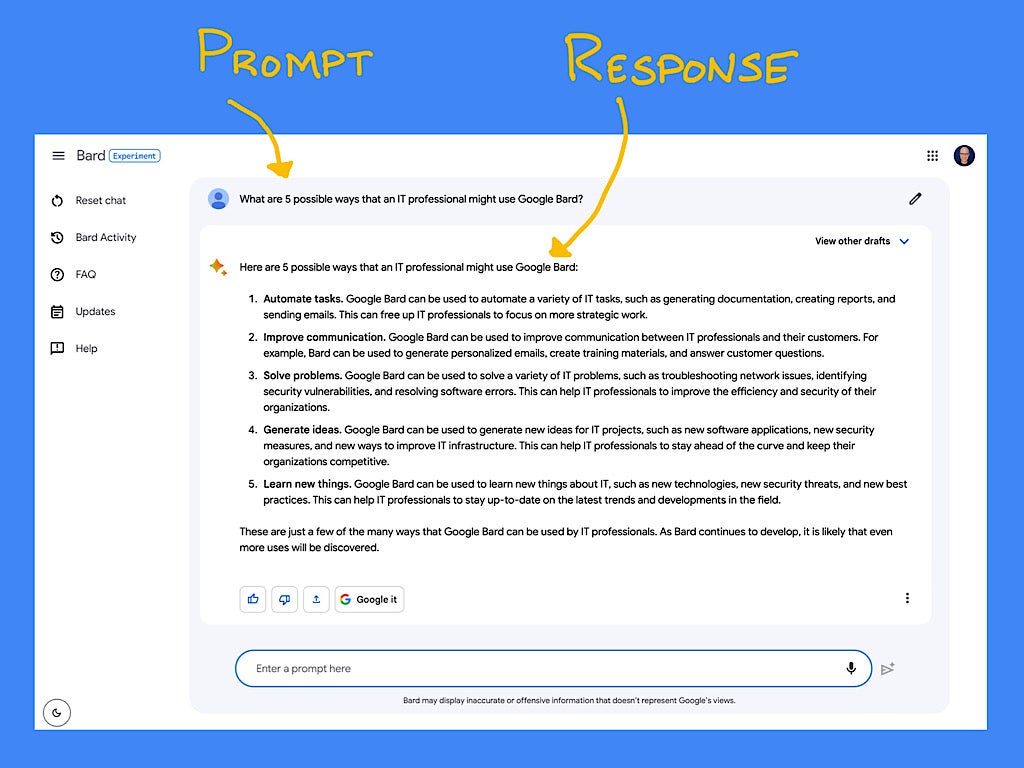
Screenshot showing how to use Google Bard.
Illustration: Andy Wolber/TechRepublic

Bard is Google’s public entry into the highly competitive field of artificial intelligence chatbots, which also includes OpenAPI’s ChatGPT. Google intends Bard to be a “creative and helpful collaborator” that people may chat with using natural language. The following guide covers what you need to know as you chat and explore the capabilities of Google Bard.

Jump to:

  • What is Google Bard?
  • What is Google Bard used for?
  • Can I use Google Bard for work or school?
  • How to get access to Google Bard
  • How to use Google Bard
  • Frequently asked questions about Google Bard

What is Google Bard?

Google Bard is an AI chatbot: After you enter a text prompt, Bard generates a response. Importantly, Bard can access the internet to leverage Google search for its responses.

Google launched Bard in early 2023 as an experiment that is based on a conversational large language model.

What is Google Bard used for?

Bard can serve as an AI collaborator to help you explore topics, craft text and code. Anything you might ask a knowledgeable colleague or friend might be a candidate for a prompt in Bard. For example, you could use Bard to:

  • Discover options or brainstorm ideas.
  • Explore a topic or identify related items, books or concepts.
  • Draft an email.
  • Create an outline for a blog post, project, proposal or book.
  • Simplify, rephrase or summarize text.
  • Help create or debug code.

Bard can also streamline a search. For example, consider the task of gathering specifications to select a laptop. With a conventional Google Search, you would search for a product, follow a link, then copy details into a Google Doc. Then you would repeat the process for each additional laptop you wished to compare. With Bard, you could enter a single prompt that asks the system to compare two, three or more laptops and present the information in a table format, then export the response to a Google Doc. What used to be several steps may be reduced to two: Prompt, then export.

Can I use Google Bard for work or school?

Yes, you may use Google Bard for work or school if your organization’s policies and Google Workspace settings allow it.

How to get access to Google Bard

You may use Bard in any modern browser, such as Chrome, Safari, Edge or Firefox; however, you will need to sign in with a Google account to gain access, as follows.

  1. Go to bard.google.com in a browser.
  2. Select Sign In (Figure A).

Figure A

Screenshot of Google Bard Sign In.
Select either Sign In button, then enter your Google account credentials.
  1. Sign in with your Google account.
  2. Select Try Bard (Figure B).

Figure B

The Try Bard button on the Google Bard sign in page outlined in red
Once you’re signed in, select the Try Bard button.
  1. Review the presented terms (Figure C) and, if you agree, accept them.

Figure C

Google Bard terms of service with the I Agree button outlined in red
Review the Terms of Service. Scroll to the bottom, then if you accept the terms, select the I Agree button.
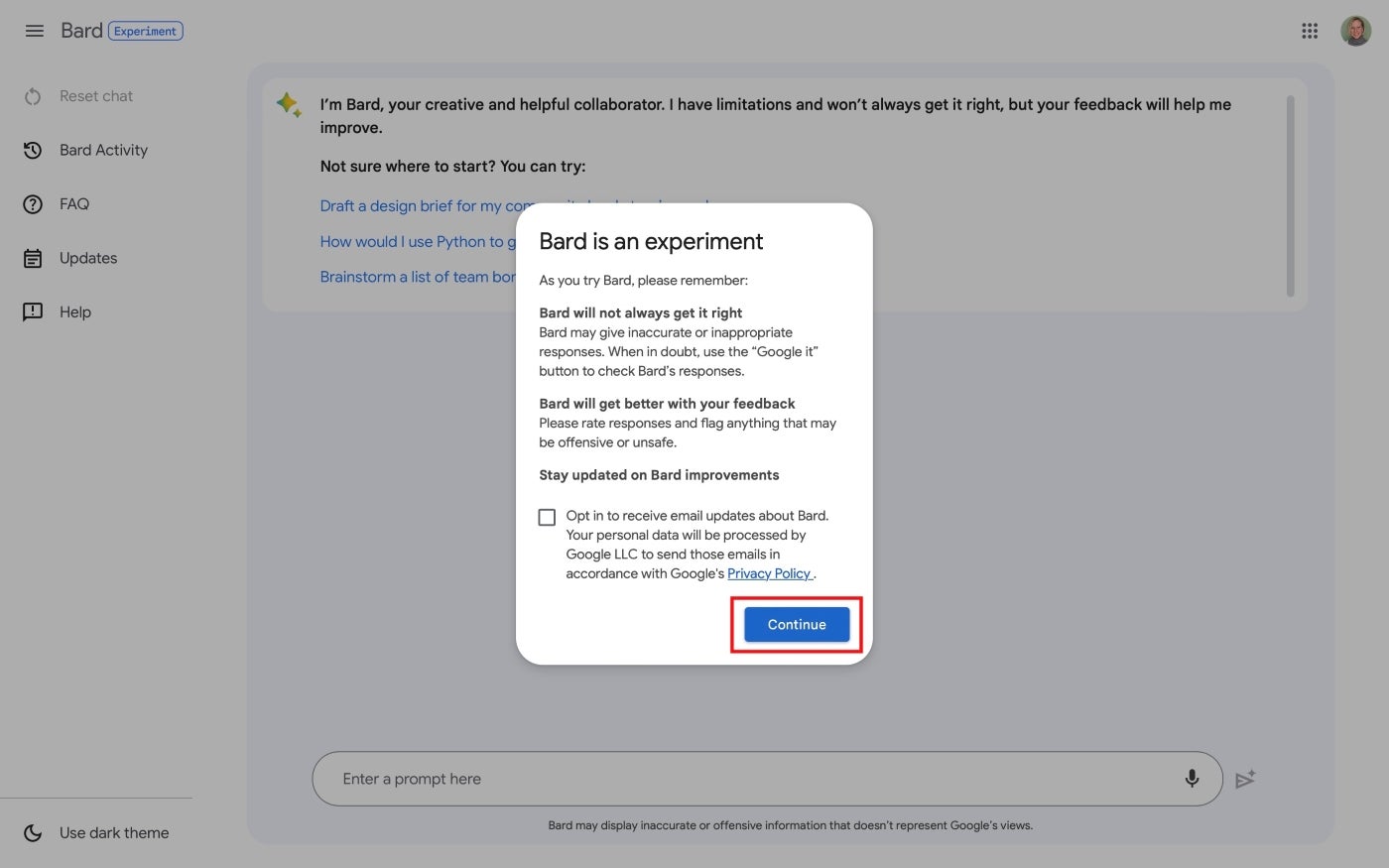
  1. Review the “Bard Is An Experiment” note and, if you wish, opt in to receive email updates about Bard, then select Continue (Figure D).

Figure D

Bard is an experiment pop-up in Google Bard with the Continue button outlined in red.
The system will remind you that Bard is an experiment. Optionally, select To Receive Email Updates About Bard box.
  1. Use Bard by entering a prompt in the box near the bottom of the screen (Figure E).

Figure E

Google Bard interface with an empty text field where users can enter prompts
To use Bard, enter a prompt.

For the easiest access to Bard, you might consider adding Bard as a bookmark or set the site as your browser homepage. Since Bard works in a variety of browsers, fast-access techniques work not only from Chrome, but also from other systems. For example, in Safari on an iPhone from bard.google.com you could select the Share button | Add To Home Screen to place a Bard app link on your phone.

How to use Google Bard

You may access Bard from any mobile or desktop web browser while signed in to a Google account.

  1. Open bard.google.com in a browser.
  2. Enter a prompt, either by typing or selecting the microphone and talking. Press enter (or return) to send the prompt to Bard.
  3. Review Bard’s response.

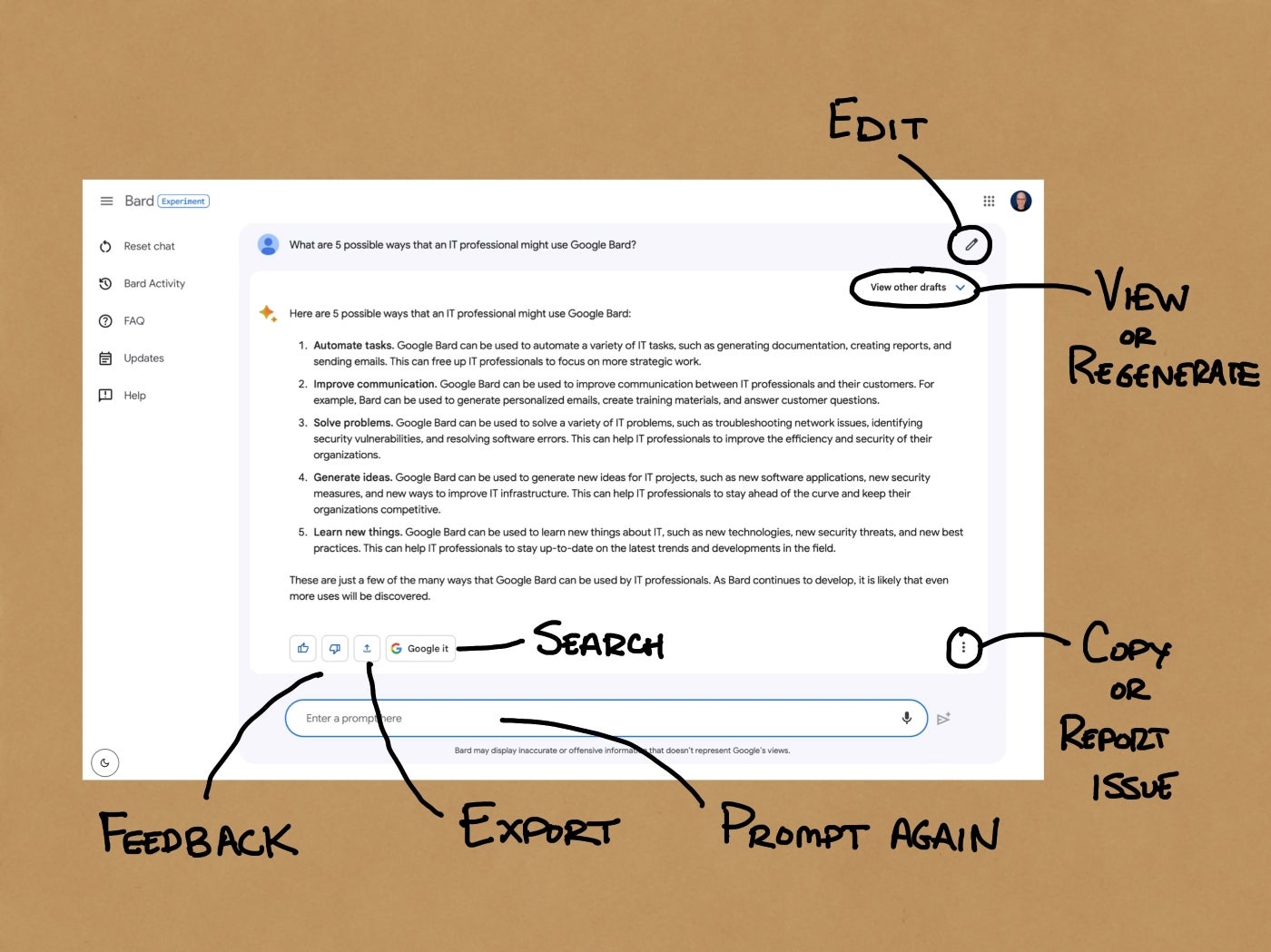
Once Bard provides a response, the system offers a robust set of optional actions (Figure F).

Figure F

Google Bard response with annotations pointing out that users can edit, view or regenerate, search, provide feedback, report, export, or copy the response
You may select from a wide range of options for any Bard response, including the ability to follow-up with an additional prompt.

You may:

  • Edit the prompt text to try a variant prompt.
  • View other drafts to evaluate differently structured responses.
  • Regenerate drafts to seek alternative responses.
  • “Google it” to switch to a standard keyword search query derived from your prompt.
  • Export the response to a new Gmail or a Google Doc.
  • Copy the content to paste into another app.
  • Report a legal issue to signal a significant content concern.
  • Provide feedback with a thumbs up (Good Response) or down (Bad Response) button.
  • Enter another prompt to continue the chat.

Frequently asked questions about Google Bard

How accurate is Google Bard?

As an experiment, Google tries to ensure that Bard responses are accurate, but prominently cautions that “Bard may display inaccurate or offensive information that doesn’t represent Google’s views.” When you use Bard, you should verify the accuracy of any response provided.

How does Google Bard compare to a Google Search?

Google Search provides relevant links in response to keywords. When the system is highly certain that a specific answer is relevant, Google Search may prominently feature the desired information, such as a snippet of content from Wikipedia, a sports score or weather data.

Google Bard provides responses to natural language prompts. Unlike search, where each keyword query returns an answer and list of links, a Bard response may be just the start of a string of interactions in a chat-like format. At any point, you may prompt Bard to expand, clarify, rephrase or regenerate a response.

How does Google Bard compare to ChatGPT?

ChatGPT is a large language model system from OpenAI that offers both free and paid editions. OpenAI and Microsoft have announced a wide range of product integrations and partnerships, including connections between ChatGPT and Microsoft Bing. GPT-4 provided significant performance improvements over earlier editions.

Bard is a large language model system experiment from Google that is free for people to use. Bard relies on current internet information via Google Search.

Google, Microsoft and OpenAI are iterating rapidly to enhance and expand the capabilities of their respective AI systems.

What are the main competitors to Google Bard?

In addition to ChatGPT, alternatives to Google Bard include Microsoft’s new Bing, Perplexity AI, Inflection AI’s Pi and Anthropic’s Claude, which is available via Quora’s Poe AI chat app.

Can Google Bard search the internet?

Yes, since Bard has access to Google Search content, the system may access web news, information and other content.

Does Google Bard keep my data?

Google lets you adjust settings to control whether Bard Activity is preserved. To preserve all your Bard Activity history, turn Bard Activity on and set auto-delete off. Alternatively, you may choose to auto-delete Bard activity older than 3, 18 or 36 months.

If you prefer, you may turn Bard Activity history off. Even when Bard Activity history is off, though, the system will preserve conversations for up to 48 hours, although any activity won’t display in your activity history. According to Google, this temporary retention “allows us to provide the service and process any feedback.”

Google Weekly

Subscribe to the Google Weekly Newsletter

Learn how to get the most out of Google Docs, Google Cloud Platform, Google Apps, Chrome OS, and all the other Google products used in business environments.

Delivered Fridays Sign up today