Genpact, in collaboration with Google for Developers, has launched a global hackathon focused on sustainability and leveraging AI/ML technology to model the impact of climate change and make a meaningful contribution to sustainability.
The hackathon combines Genpact’s longstanding commitment to sustainability, deep expertise in cutting-edge ML techniques, and strategic partnership with Google Cloud to bring data scientists together from across the world to use technology for the good of our planet.
About the Hackathon
Given the disruption of production conditions and the rising variability in yield caused by climate change, we firmly believe that technology will play a vital role in providing essential insights to stay ahead of the curve. By proactively anticipating the influence of climate change on commodity yields, we can gain a deeper understanding of its effects on raw material prices, thereby ensuring sustainability and mitigating risks throughout the supply chains. Utilizing these models enables us to optimize procurement processes and implement effective pricing strategies for different commodities.
To address these challenges, the hackathon requires participants to focus on developing ML models that can forecast the effects of climate change on commodity prices.
Registrations open from 2nd Jun 2023
Challenge live from 9th Jun 2023
Challenge ends on 21st July 2023
Register Now
Participants Journey:
• Register for the Hackathon “Genpact – Google Sustainability Hackathon”
• Participate in the Hackathon and join the competition.
• *Apply for the $300 credits redemption on Google Cloud Vertex AI platform.
•Attend the 2nd-week workshop session to learn how to use Vertex AI for the competition.
•Engage in the 4th-week workshop session for a deep dive into problem-solving techniques.
•The leaderboard will be frozen on 21st July, marking the end of the competition.
** (workshop dates will be revealed to the participants)
Note:
– Submissions at the end of the hackathon will be evaluated on 21st July and winners will be announced on 14 August, 2023.
– In addition, all participants can apply for a trial account to redeem USD 300 in credits on the Google Cloud Vertex AI platform.
Prize Details:
1st prize:
• Google Pixel 7 Pro (Obsidian, 128 GB) (12 GB RAM)
• Google Nest Cam Outdoor or Indoor, Battery – 2nd Generation – 1 Pack
2nd prize:
• Google Pixel 7 5G (Snow, 8GB Ram 128GB Storage)
• Google Nest Pixel Buds A-Series – In-Ear Wireless Earbuds – Headphones with Bluetooth with Mic – Dark Olive
3rd prize:
• Google Pixel 6 Pro (Sorta Sunny, 12GB RAM, 128GB Storage)
** Additionally, there are more prizes and goodies to be won throughout the hackathon. The challenges will be live every two weeks.
Registrations open from 2nd Jun 2023
Challenge live from 9th Jun 2023
Challenge ends on 21st July 2023
Register Now
Things to keep in mind:
– Just one account per participant will be allowed in the hackathon.
– Submissions from multiple accounts will be disqualified.
– Sharing code privately between participants is also disallowed but participants can share code openly with everyone on MachineHack forums.
For more details on the prerequisites and evaluation criteria, please visit The MachineHack platform.
Hurry up before registrations close!
Click here to register
The post MachineHack announces Sustainability Hackathon with Genpact & Google For Developers: Win Prizes & More appeared first on Analytics India Magazine.
When you’re interested in getting into the world of data, it can be difficult to know which programming language you need to cater for your specific interest or skill. Many people waste a lot of time becoming proficient in a specific programming language because they have heard it's very popular or they don’t have enough knowledge.
A lot of data science roles are being used and sometimes advertised interchangeably. You might see some people referring to a Data Analyst and a Data Scientist as having the same role, or a Data Scientist and a Machine Learning Engineer.
Again, this may be due to the recruiter/employee having a lack of knowledge on the distinction between the different roles, to catch interest or be able to hire someone who can kill two birds with one stone.
This blog aims to give you a quick and simple understanding of what programming languages are required or essential for specific data roles.
Popular Data Roles
Let’s start by defining the popular data roles.
Data Analyst — look through data and provide reports and visualisations which explain the data.
Data Scientist — collects, cleans, analyses data, provides reports, visualisations and manipulates data to perform advanced data analysis.
Data Engineer — responsible for setting up and maintaining the organization's data infrastructure, whilst ensuring that the data can undergo critical analysis and can perform and produce reports.
Machine Learning Engineer — responsible for building AI systems that consume large amounts of data and be able to generate and develop algorithms capable of learning and making future predictions.
Research Scientist — in relation to data, they are responsible for researching, designing, and analysing information from investigations, experiments and trials.
Top programming languages
If you were to Google, what are the top programming languages — you will see a mixture of these, and probably a few more:
Javascript
Python
Go
Java
Kotlin
PHP
C#
Swift
R
Ruby
C and C++
Matlab
SQL
So after seeing this online, you’re probably thinking — where do I go from here? Which one do I actually need for the role I’m interested in?
Top Languages for Specific Data Roles
Data Analyst
As a Data Analyst, you will be responsible for scanning through the data, finding valuable information and providing reports or visualisations. With this being said, the best programming languages for a Data Analyst would be Python and/or SQL.
Python — will allow you to analyse, manipulate, clean, and visualise data.
SQL — will allow you to communicate with the databases easily.
Data Scientist
As a Data Scientist, you have a choice between various programming languages. The most popular languages used by Data Scientists are Python, and SQL, with R, C++ and Java after.
R, C++, and Java are still popular, however, Python and SQL are very popular due to their simpler coding abilities whilst producing the same results.
Python has a larger developer community, with extensive libraries, very concise syntax, and portability. This is everything a Data Scientist wants and needs.
SQL has the ability to store, retrieve, manage and manipulate data, as well as extract performance metrics to guide Data Scientists in their processes.
Data Engineer
As a Data Engineer, the most popular programming languages are:
Java — It is the oldest and most appropriate language for a Data Engineer. Data Engineers spend a lot of time working with the java-based open-source framework, Hadoop.
Python — helps Data Engineers build efficient data pipelines, write ETL scripts, set up statistical models, and perform analysis.
SQL — allows them to model data, extract performance metrics, and develop reusable data structures.
Machine Learning Engineer
As a Machine Learning Engineer, the most popular programming languages are:
Python — good library ecosystem, better readability, flexibility, creates good visualisations, community support, etc. Simple syntax and construction are highly favourable in a Machine Learning Engineer's life.
C++ — this is also a valuable programming language for machine learning engineers as it is fast and reliable, which is necessary for machine learning, as well as having a good library source.
Java — if you want to work in web development, big data, cloud development, and app development, Java is imperative to your skillset. It also has a better performance than Python.
Research Scientist
As a research scientist, you will not be dealing with backend issues, but more on understanding what the data and the team's findings can tell you. Similar to Data Analyst, the programming languages that will benefit you are:
Python is a general-purpose programming language, that allows you to write fewer lines of code but perform the same operations
R is a statistical programming language, allowing you to build statistical models and create data visualisations
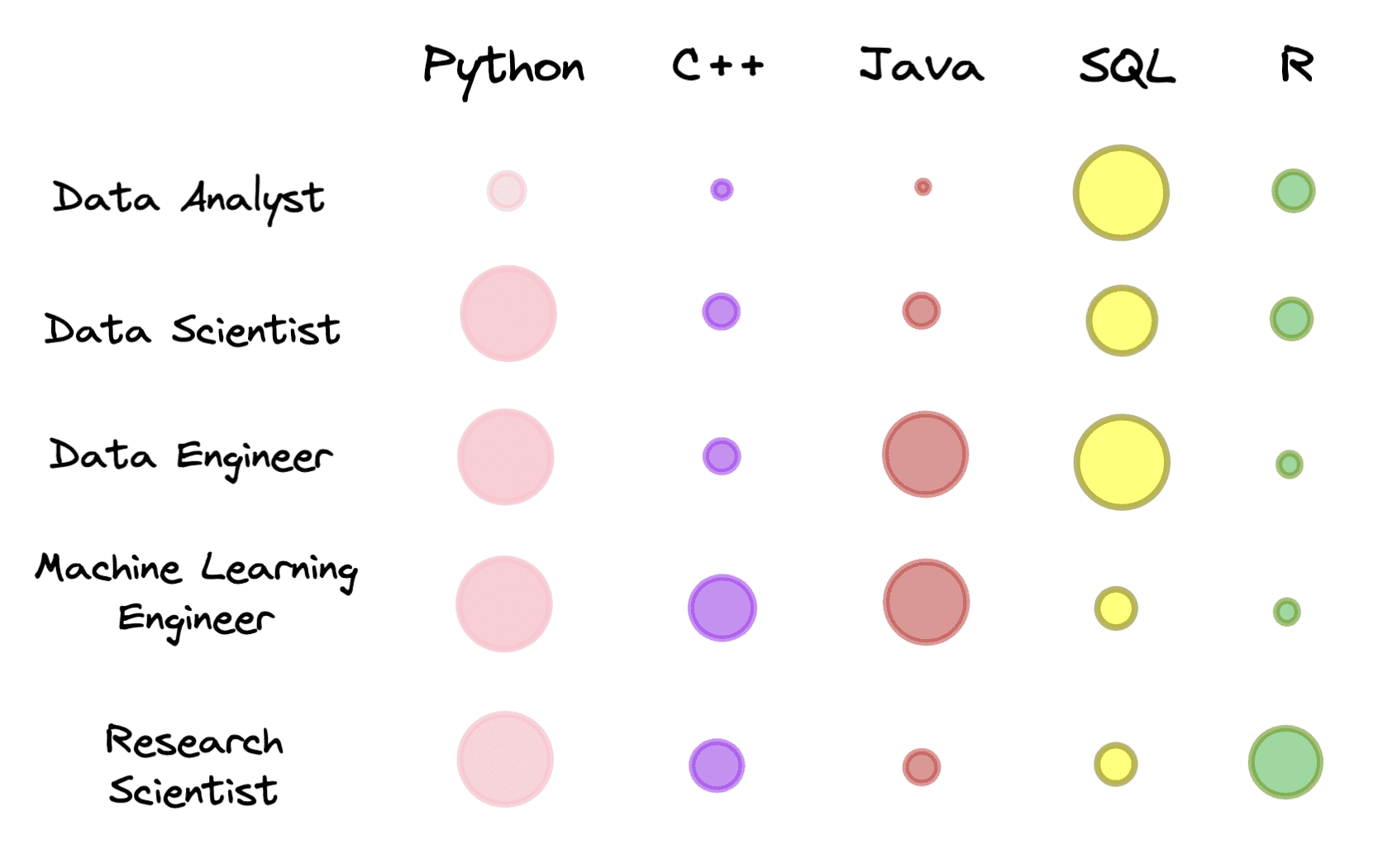
To make it easy and simple, I have created the above image to give you a visual understanding of what you should be looking out for dependent on your area of interest.
Referring to the image above, it shows you what kind of programming language you need for a specific data role and to which extent. The bigger the circle, the more essential it is to that specific data role.
According to Stack Overflow's 2022 Developer's Survey, JavaScript is the most used programming language, and they have been for ten years. However, if we speak about programming languages being used to learn how to code, HTML/CSS, Javascript and Python are at the top and are all very close to tying.
Conclusion
As data roles are forever developing, it can be overwhelming to keep up with all the changes. Learn a programming language at a proficient level before you move on to the next or learn a new skill. It’s better to take one step at a time than be overwhelmed with trying to learn 10 skills at a time.
Once you have decided on your programming language based on your area of interest, the next step is to become proficient in it.
There are readily available resources to help with your study, you just need to know the right ones. Below are a variety of links that you can benefit from
Top Data Analyst Certification Courses for 2022
The Complete Data Science Study Roadmap
The Complete Machine Learning Study Roadmap
The Complete Data Engineering Study Roadmap
Nisha Arya is a Data Scientist, Freelance Technical Writer and Community Manager at KDnuggets. She is particularly interested in providing Data Science career advice or tutorials and theory based knowledge around Data Science. She also wishes to explore the different ways Artificial Intelligence is/can benefit the longevity of human life. A keen learner, seeking to broaden her tech knowledge and writing skills, whilst helping guide others.
More On This Topic
Data Science Programming Languages and When To Use Them
Top Programming Languages and Their Uses
KDnuggets™ News 22:n04, Jan 26: The High Paying Side Hustles for Data…
KDnuggets™ News 22:n06, Feb 9: Data Science Programming Languages and…
A Deep Look Into 13 Data Scientist Roles and Their Responsibilities
KDnuggets™ News 22:n03, Jan 19: A Deep Look Into 13 Data Scientist…
Singapore has carved out dedicated cloud resources so its government agencies can deploy artificial intelligence (AI) applications more efficiently and securely.
The cloud cluster has been established with the aim of driving up AI adoption in the public sector and supporting research into how AI can be applied, said the Smart Nation and Digital Government Office (SNDGO). It will also support local AI startups, according to the government agency.
Also: How to use ChatGPT: Everything you need to know
Called the AI Government Cloud Cluster, the platform runs within a dedicated environment on Google Cloud, where the U.S. vendor's AI technology stack and partner applications are available for deployment. These resources include A2 supercomputers running on Nvidia's A100 GPUs and a repository of AI models, running first- and second-party as well as open source platforms, which government agencies can customize for their specific requirements. The AI models span multi-language text translation, audio-to-text conversion, and software coding.
The AI government cloud cluster also offers builder tools for generative AI applications, which developers with varying coding skillsets and limited technical knowledge can use to build chatbots and search platforms.
Also:Nvidia unveils new kind of Ethernet for AI
In addition, toolkits are provided to guide government agencies on deploying AI applications responsibly, based on explainable AI and data governance principles. These toolkits include mechanisms to incorporate human feedback to improve the performance of AI models, access control and content moderation, and auditing sources that power AI models, so potential bias can be identified and resolved. These mechanisms will also ensure AI models run in compliance with regulations.
The AI cluster can be accessed via the Government on Commercial Cloud (GCC) platform, which provides a central infrastructure for local government agencies to deploy commercial cloud services. Running on Amazon Web Services (AWS), Google Cloud, and Microsoft Azure, the GCC is part of a five-year roadmap to move the public sector's on-premise IT systems to commercial cloud platforms.
GCC is managed by Government Technology Agency (GovTech). With SG$1 billion ($742.6 million) earmarked for cloud applications in the government's current fiscal year, GovTech said it is en route to hit its target of moving 70% of its systems to the commercial cloud. Currently, 66% of eligible government systems run on the architecture.
Also: Today's AI boom will amplify social problems if we don't act now, says AI ethicist
The new AI cluster runs on the second iteration of the government's platform, GCC 2.0, which is integrated with cloud-native capabilities and enhanced cloud security practices.
GovTech is among the first agencies in the sector to use the AI cloud cluster, where it is tapping Google's machine-learning development management platform Vertex AI. The agency is also looking to use large language AI models in Google Pair to improve productivity, while maintaining data confidentiality of government information.
GovTech and Google will further work together to run training programs to help all government agencies build up their data science and AI skills, establish AI strategies, and adopt data government best practices. This approach is an extension of an existing collaboration to bolster AI skillsets within Singapore's public sector, encompassing 150,000 officers across 16 ministries and 50 statutory boards.
The Ministry of Communications and Information has also said it will work with Google Cloud to drive the country's AI strategy, including plans to develop relevant skillsets and cultivate local AI technologies through an AI model marketplace hosted on the cloud platform, where local companies can tap Google's AI models and tools to develop their applications.
Also: AI could automate 25% of all jobs. Here's which are most (and least) at risk
In addition, the Monetary Authority of Singapore (MAS) is working with Google to identify use cases and jointly create and test generative AI applications, based on responsible AI guidelines. The local central bank will also be looking to boost its technical capabilities in generative AI.
The way that MAS uses data has been an important differentiator for Singapore as a global financial hub, said Vincent Loy, MAS assistant managing director for technology, who spoke at Google Cloud Singapore Summit this week. Data insights have helped the government agency achieve IT operations efficiencies, with significant savings in manpower resources, while data analytics and visualization are used to support investigation of networked and financial crime, Loy said.
Noting that competition remained tough and the global landscape is constantly evolving, he added that AI will play a key role for Singapore moving forward.
He said MAS will use the collaboration with Google to identify generative AI use cases that will allow it to work more efficiently and provide foundational models that prioritise data security and AI governance. "Through this, we hope to inspire greater adoption of responsible generative AI in the financial sector," Loy said.
Doing things differently with AI
Several global "shifts" have underscored the need for a new approach to technology, with AI and cloud playing key roles, according to Chan Cheow Hoe, SNDGO's government CTO and senior advisor for the Singapore Economic Development Board.
Speaking at the Google summit, Chan pointed to environment and technology changes and said people now want to know the impact digitalization has on the environment and on their personal security. More people are exposed to cybersecurity risks and investors want to see results, with businesses having to work harder for every dollar.
Also: These experts are racing to protect AI from hackers
There are more significant trust and safety concerns compared to a couple of years ago, where fewer people cared about these issues, he said. There is also zero tolerance for downtime, where online services and apps that go down for an hour will make headlines.
With technology now omnipresent and touching every facet of daily life, Chan stressed the need to safeguard customers and citizens and ensure systems and services are trusted — otherwise no one will want to use the technology.
There have also been big technological shifts and he pointed to cloud, alongside SaaS (software-as-a-service), and generative AI as the key ones that hold significance.
Also: Generative AI is changing your technology career path. What to know
Heralding the Singapore government's cloud journey, which began seven years ago, Chan said the move was important not just for cost efficiencies, but also to provide access to a global ecosystem of the best technology resources. Organizations that do not open up to the cloud also risk running bespoke applications that might not be able to scale quickly and support faster times to market, he added.
However, many organizations remain straddled with legacy systems, including Singapore's public sector, according to Chan. There is also a dearth of relevant IT capabilities, without which the journey toward digital transformation will be difficult.
In addition, policies need to catch up to an environment that is increasingly powered by the cloud, he said. Unless Singapore adopts a progressive attitude toward policies, brings in the best talent, and gets rid of legacy systems, any step forward could mean another two steps back.
Also: 6 harmful ways ChatGPT can be used
This situation creates a compelling case to do something new, Chan said, pointing to the government's efforts to boost AI and cloud adoption. He said a new iteration of GCC will be equipped with higher security measures to enable more confidential and critical workloads to be moved to the cloud infrastructure.
Agritech company Jiva is also taking these kinds of precautions in its adoption of AI, including generative AI. Its mobile app recently introduced a new feature, called Crop Doctor, which lets farmers load images of crops to diagnose diseases and recommend relevant treatments that can be tailored to their requirements.
Asked if the company had concerns about tapping generative AI amid the reported security issues, Jiva's head of business strategy and partnership Aditya Thareja acknowledged there were worries about the potential risks. "We want to ensure things like hallucinations [occurring] are reduced to a small percentage. The last thing you want is to provide the wrong advice to farmers," Thareja said during a media briefing on the sidelines of the summit.
Also:My 5 favorite AI tools for work
Jiva, which has operations in Singapore, Indonesia, and India, built Crop Doctor on Google Vertex AI, tapping computer vision and image processing to identify crop diseases and causes, such as potassium deficiency. It recommends treatments based on an in-house data library
To mitigate potential risks, Thareja said the large language AI model is trained on only data that is sourced and vetted by Jiva. The generative AI model does not scour public data from the internet, he stressed, adding that the company continuously finetunes the prompt-engineering capability to ensure the right answers are provided.
Crop Doctor was tested on WhatsApp with 25,000 farmers before the feature was launched on Android in Indonesia, where the mobile OS has the highest penetration. Jiva currently has 125,000 farmers on its registry in the Asian market.
Also:How ChatGPT can rewrite and improve your existing code
An earlier iteration, called Crop Care, also provides treatment recommendations based on crop images, but does not customize these results based on a farmer's specific access to the required components.
Sherie Ng, Google Cloud's Singapore country director, said AI, in particular generative AI, was taking centerstage and "rewriting" the cloud industry, leading to new ways of transformation.
Commenting on the vendor's collaboration with the Singapore government, Ng said: "AI can shape the public sector's digital service delivery in profound and meaningful ways, from automating data entry, to detecting fraud, accelerating cancer research, strengthening emergency response, and informing water resource management.
"We look forward to working with GovTech to build a vibrant pool of homegrown talent across a range of AI-related roles in public service [and] help advance Singapore's national strategy for deploying scalable and responsible AI innovations."
AI growth and advancements have been exponential over the past few years. Statista reports that by 2024, the global AI market will generate a staggering revenue of around $3000 billion, compared to $126 billion in 2015. However, tech leaders are now warning us about the various risks of AI.
Especially, the recent wave of generative AI models like ChatGPT has introduced new capabilities in various data-sensitive sectors, such as healthcare, education, finance, etc. These AI-backed developments are vulnerable due to many AI shortcomings that malicious agents can expose.
Let’s discuss what AI experts are saying about the recent developments and highlight the potential risks of AI. We’ll also briefly touch on how these risks can be managed.
Tech Leaders & Their Concerns Related to the Risks of AI
Geoffrey Hinton
Geoffrey Hinton – a famous AI tech leader (and godfather of this field), who recently quit Google, has voiced his concerns about rapid development in AI and its potential dangers. Hinton believes that AI chatbots can become “quite scary” if they surpass human intelligence.
Hinton says:
“Right now, what we're seeing is things like GPT-4 eclipses a person in the amount of general knowledge it has, and it eclipses them by a long way. In terms of reasoning, it's not as good, but it does already do simple reasoning. And given the rate of progress, we expect things to get better quite fast. So we need to worry about that.”
Moreover, he believes that “bad actors” can use AI for “bad things,” such as allowing robots to have their sub-goals. Despite his concerns, Hinton believes that AI can bring short-term benefits, but we should also heavily invest in AI safety and control.
Elon Musk
Elon Musk's involvement in AI began with his early investment in DeepMind in 2010, to co-founding OpenAI and incorporating AI into Tesla's autonomous vehicles.
Although he is enthusiastic about AI, he frequently raises concerns about the risks of AI. Musk says that powerful AI systems can be more dangerous to civilization than nuclear weapons. In an interview at Fox News in April 2023, he said:
“AI is more dangerous than, say, mismanaged aircraft design or production maintenance or bad car production. In the sense that it has the potential — however, small one may regard that probability — but it is non-trivial and has the potential of civilization destruction.”
Moreover, Musk supports government regulations on AI to ensure safety from potential risks, although “it’s not so fun.”
Pause Giant AI Experiments: An Open Letter Backed by 1000s of AI Experts
Future of Life Institute published an open letter on 22nd March 2023. The letter calls for a temporary six months halt on AI systems development more advanced than GPT-4. The authors express their concerns about the pace with which AI systems are being developed poses severe socioeconomic challenges.
Moreover, the letter states that AI developers should work with policymakers to document AI governance systems. As of June 2023, the letter has been signed by more than 31,000 AI developers, experts, and tech leaders. Notable signatories include Elon Musk, Steve Wozniak (Co-founder of Apple), Emad Mostaque (CEO, Stability AI), Yoshua Bengio (Turing Prize winner), and many more.
Counter Arguments on Halting AI Development
Two prominent AI leaders, Andrew Ng, and Yann LeCun, have opposed the six-month ban on developing advanced AI systems and considered the pause a bad idea.
Ng says that although AI has some risks, such as bias, the concentration of power, etc. But the value created by AI in fields such as education, healthcare, and responsive coaching is tremendous.
Yann LeCun says that research and development shouldn’t be stopped, although the AI products that reach the end-user can be regulated.
What Are the Potential Dangers & Immediate Risks of AI?
1. Job Displacement
AI experts believe that intelligent AI systems can replace cognitive and creative tasks. Investment bank Goldman Sachs estimates that around 300 million jobs will be automated by generative AI.
Hence, there should be regulations on the development of AI so that it doesn’t cause a severe economic downturn. There should be educational programs for upskilling and reskilling employees to deal with this challenge.
2. Biased AI Systems
Biases prevalent among human beings about gender, race, or color can inadvertently permeate the data used for training AI systems, subsequently making AI systems biased.
For instance, in the context of job recruitment, a biased AI system can discard resumes of individuals from specific ethnic backgrounds, creating discrimination in the job market. In law enforcement, biased predictive policing could disproportionately target specific neighborhoods or demographic groups.
Hence, it is essential to have a comprehensive data strategy that addresses AI risks, particularly bias. AI systems must be frequently evaluated and audited to keep them fair.
3. Safety-Critical AI Applications
Autonomous vehicles, medical diagnosis & treatment, aviation systems, nuclear power plant control, etc., are all examples of safety-critical AI applications. These AI systems should be developed cautiously because even minor errors could have severe consequences for human life or the environment.
For instance, the malfunctioning of the AI software called Maneuvering Characteristics Augmentation System (MCAS) is attributed in part to the crash of the two Boeing 737 MAX, first in October 2018 and then in March 2019. Sadly, the two crashes killed 346 people.
How Can We Overcome the Risks of AI Systems? – Responsible AI Development & Regulatory Compliance
Responsible AI (RAI) means developing and deploying fair, accountable, transparent, and secure AI systems that ensure privacy and follow legal regulations and societal norms. Implementing RAI can be complex given AI systems’ broad and rapid development.
However, big tech companies have developed RAI frameworks, such as:
Microsoft’s Responsible AI
Google’s AI Principles
IBM’S Trusted AI
AI labs across the globe can take inspiration from these principles or develop their own responsible AI frameworks to make trustworthy AI systems.
AI Regulatory Compliance
Since, data is an integral component of AI systems, AI-based organizations and labs must comply with the following regulations to ensure data security, privacy, and safety.
GDPR (General Data Protection Regulation) – a data protection framework by the EU.
CCPA (California Consumer Privacy Act) – a California state statute for privacy rights and consumer protection.
HIPAA (Health Insurance Portability and Accountability Act) – a U.S. legislation that safeguards patients’ medical data.
EU AI Act, and Ethics guidelines for trustworthy AI – a European Commission AI regulation.
There are various regional and local laws enacted by different countries to protect their citizens. Organizations that fail to ensure regulatory compliance around data can result in severe penalties. For instance, GDPR has set a fine of €20 million or 4% of annual profit for serious infringements such as unlawful data processing, unproven data consent, violation of data subjects’ rights, or non-protected data transfer to an international entity.
AI Development & Regulations – Present & Future
With every passing month, AI advancements are reaching unprecedented heights. But, the accompanying AI regulations and governance frameworks are lagging. They need to be more robust and specific.
Tech leaders and AI developers have been ringing alarms about the risks of AI if not adequately regulated. Research and development in AI can further bring value in many sectors, but it’s clear that careful regulation is now imperative.
NVIDIA Research has developed Neuralangelo, an AI model for 3D reconstruction that utilises neural networks to transform 2D video clips into detailed 3D structures. This innovative model generates lifelike virtual replicas of real-world objects, including buildings, sculptures, and more. Similar to how Michelangelo sculpted intricate visions from blocks of marble, Neuralangelo creates 3D structures with remarkable details and textures. Creative professionals can import these 3D objects into design applications, further editing them for use in various fields such as art, video game development, robotics, and industrial digital twins.
What sets Neuralangelo apart is its ability to accurately translate complex textures from 2D videos to 3D assets, surpassing previous methods. This high fidelity makes it easier for developers and creative professionals to rapidly create usable virtual objects for their projects, utilising footage captured by smartphones. The 3D reconstruction capabilities offered by Neuralangelo will greatly benefit creators by enabling them to recreate the real world in the digital realm. Ming-Yu Liu, senior director of research and co-author of the paper, emphasised that this tool will eventually allow developers to import detailed objects, from small statues to massive buildings, into virtual environments for video games or industrial digital twins.
During a demonstration, NVIDIA researchers showcased Neuralangelo’s ability to recreate a variety of objects, ranging from iconic sculptures like Michelangelo’s David to everyday objects like a flatbed truck. The model also demonstrated its capability to reconstruct building interiors and exteriors, as evidenced by a detailed 3D model of the park at NVIDIA’s Bay Area campus.
Neuralangelo employs instant neural graphics primitives, the technology behind NVIDIA Instant NeRF, to capture fine details that previous AI models struggled with, including repetitive texture patterns, homogenous colors, and strong color variations. The model utilises a 2D video of an object or scene filmed from multiple angles, selecting several frames that provide different viewpoints. This approach mimics an artist considering a subject from various sides to grasp its depth, size, and shape. Neuralangelo’s AI then creates a rough 3D representation of the scene, similar to a sculptor chiseling the shape of the subject. The model optimises the render to enhance details, much like a sculptor carefully hewing stone to mimic fabric texture or human figures. The final output is a high-quality 3D object or large-scale scene suitable for virtual reality applications, digital twins, or robotics development.
Neuralangelo is among the nearly 30 projects by NVIDIA Research that will be presented at the Conference on Computer Vision and Pattern Recognition (CVPR), taking place from June 18-22 in Vancouver. These projects cover a wide range of topics, including pose estimation, 3D reconstruction, and video generation. One notable project, DiffCollage, utilises a diffusion method to create large-scale content such as landscape images, 360-degree panoramas, and looped-motion visuals. By treating smaller images as sections of a larger visual, like pieces of a collage, DiffCollage enables diffusion models to generate cohesive-looking content without being trained on images of the same scale. The technique can also transform text prompts into video sequences, as demonstrated by a pretrained diffusion model capturing human motion.
The post NVIDIA launches ‘Neuralangelo’ to Transforming 2D Videos Into Detailed 3D Structures Using AI appeared first on Analytics India Magazine.
.NET and Java, both languages, are widely used in the field of development. Both are used in businesses for creating web pages, and websites. If you want to work on both server-side and desktop applications then, these two languages allow you to work on both. It seems to be very challenging in selecting one language between .NET and Java. But we will here provide some key points related to both .NET and Java language which makes it easier for you to decide which is best among .NET and Java for the full stack web development.
What is Java?
Before learning the difference between these languages, we must know about these languages separately. If we talk about Java, then Java is an object-oriented programming language and it is widely used in the development field. Whether it is a mobile phone, notebook, computer, or even gaming console, medical device, and many more, all the devices are implementing Java software. Billions of devices worldwide are implementing Java. Its high popularity is due to the fact that it is secure, efficient, and fast. It has become very easy for programmers to quickly run Java applications in a hassle-free environment with the Java platform. The basic principles of Java are similar to C++ and C programming languages.
Why Java Programming Language?
Even though the Java programming language was inspected in 1995, Java is now also the best programming language used globally for the development of modern software. And following are some reasons why the Java programming language has been so popular among developers for so long.
Easy to learn: Java principles are so similar to C++, C, and javascript. So the expertise or experience in the above-mentioned languages does not face many problems in learning the syntax of Java. There are so many videos of introduction or training available on YouTube or StackOverflow which can be accessed easily and help a lot in learning Java.
It has a rich set of APIs, and its API is extensive. It proves to be very beneficial for developers that want to create error-free and strong applications.
What is .Net?
.NET is one of the most popular open-source development frameworks. For the creation of different applications, it is widely implemented. It is a cross-platform framework. So it allows you to use it on a number of platforms such as macOS, Windows, or Linux. If you are using .NET then it becomes very easy to create different web, Mobile applications, or desktops in different editors, libraries, and languages.
Why .Net?
Some of the reasons are given below that give evidence why .NET became so popular in this technology-driven world.
Open-source development- Its popularity is increasing day by day but after becoming an open-source platform, its popularity touches a high peak. So many innovations are created in this platform over the years and it got the support of a very huge community.
Faster: This platform allows the developers to complete their particular task in a very consistent, quick, and easy manner.
Extremely Versatile: Its versatile nature is one of the major reasons that make it popular.
Java Vs .NET: Performance
If we compare both languages in terms of performance then if we talk about Java programming language the syntax of Java is derived from C and C++ programming languages. And apart from that java is a platform independent which means we can run the code written in Java anywhere.
.NET is considered a simple language that supports uninitialized variable checking, garbage collection, type checking, and checking array bounds features. By which we can achieve efficiency, robustness, and durability.
Comparison between .NET and Java
Features
Java
.NET
Fundamentals
Java is a programming language and computing platform
.NET is a free, cross-platform, open-source framework
Languages
Other languages are supported by Java Virtual machines like ruby, rexx, r, and Python.
We can write .NET applications in Visual Basic, F#, or C#.
Operating system
Java can be run on any operating system such as Linux, Microsoft Windows, Mac OS, Windows, and Solaris.
But .NET can only be operated on the Windows operating system, Windows 98 or its new versions, and Windows NT 4.0.
IDEs
JCreator, NetBeans, jGRASP, BlueJ, IntelliJ IDEA, Eclipse, and NetBeans are some of the IDEs that can be used for Java.
Visual Studio, Emacs, Vim, Sublime Text, Brackets, and Atom are some of the IDEs that can be used for the .NET.
Libraries
The Java Class Library (JCL) is a dynamically loadable library collection that is used during program execution by the Java Virtual Machine.
The .NET Framework Class Library is a collection of value types, interfaces, namespaces, and classes that are utilized in developing the .NET applications.
Performance
Many tools have been developed by Java for performance scaling but then also it is not as fast as .NET.
In comparison to the Java language, .NET is faster.
Licensing
For personal development and use, all the Java versions and updates are free. But commercial license purchase is required for any other use.
.NET does not take any licensing charge and provides free development tools, so .NET is a free developer platform. And it does not take any licensing charge for commercial use also.
The average salary in India
In India, ₹460,759 is the average salary for a Java developer.
In India, ₹414,324 is the average salary for a .NET Software developer.
The average salary in the US
In the US, $76,349 is the average salary for a Java Software developer as per Glassdoor.
In the US, $99,225 is the average salary for a .NET Software developer as per Glassdoor.
Where to Use .NET and Java?
Now let us look at some of the applications and see which language is best suited for that application.
For designing web, desktop, games, mobile, and IoT, we generally use .NET.
In enterprise development, client applications, and web applications, we use .NET
Web services and Windows APIs have also been taken over by the .NET framework.
But in the development of GUI applications, Big Data, and web projects, java is preferred.
For backend development, java can also be used for server-side programming.
For full stack development, both .NET and Java can be used. Hence, if you are getting started with full-stack development, both Java and .NET can be mastered.
Java is also implemented in the development of web applications, Android applications, and embedded systems.
.NET Full Stack Web Development Vs. Java Full Stack Web Development – Which is Better?
.NET is described as an open-source, free, and cross-platform for the development of varieties of applications. And we can consider it as a general-purpose platform for the development purpose. Different libraries, editors, and languages can be used with .NET for the development of native applications for IoT, gaming, desktop, mobile, and web. On the other hand, if we look at the Java programming language it is an object-oriented, class-based programming language. Java is a computing platform and programming language which was released in 1995 by Sun Microsystems. And there are many websites and applications whose requirement is to install Java, without Java installation they will not work. Java is a secure and reliable object-oriented programming language. Java is now a day used in every field from cell phones to the internet, from console-based games to scientific supercomputers, and from being utilized in laptops to data centers.
.NET is considered under the Framework but Java is considered under the languages. And both are used for full-stack development.
.NET is considered by the developers because of its features code stability, huge community, and perfect integration with the visual code studio. Even when .NET is compared with Python, .NET seems to be superior because of its scalable features. While the features provided by Java like perfect tooling, huge libraries support, and wide usage provide the reasons for the developers for selecting Java.
Java is mostly used in the development of web, desktop GUI, gaming, mobile, and enterprise applications while .NET is used in the development of the IoT application, desktops, and games.
Java is used by some of the popular applications like MIT, Lyft, Minecraft, asphalt 6, Slack, NetFlix, Twitter, and Spotify while .NET is also used by some of the popular applications such as GoDaddy, American Cancer Society, Docplanner, Starbucks and Stack Exchange, and Froza Horizon (racing video game).
Conclusion
Java is an object-oriented programming language and it is widely used in the development of mobile, web, desktop applications, etc.
.NET is one of the most popular open-source development frameworks. And it is a faster and more versatile language.
For designing web, desktop, games, mobile, and IoT, we generally use .NET and used In enterprise development, client applications, and web applications.
But in the development of GUI applications, Big Data, and web projects, java is preferred.
Whatever generative AI technology we talk about, when we discuss the datasets that go in building it, we stumble upon the question of copyright. While the governments across the world discuss what needs to be done to solve this problem, Japan has come to a conclusion already – copyright does not apply to AI training.
The policy grants AI unrestricted access to all data, regardless of its purpose (non-profit or commercial), the nature of the act (other than reproduction), or the source (including illegal sites). Keiko Nagaoka, the Japanese Minister of Education, Culture, Sports, Science, and Technology, reaffirmed this position during a local meeting, stating that Japan’s laws do not offer protection to copyrighted materials incorporated into AI datasets.
While this can be very concerning for everyone who has been discussing the issue, Yann LeCun, the chief of Meta AI, now calls Japan a ‘machine learning paradise’. He explains how the very essence of intellectual property is defined by individual governments. “The driving principle is to maximise the public good, not to maximise the power of content owners,” he adds.
Japan has become a machine learning paradise. https://t.co/uUWMvRmULX
— Yann LeCun (@ylecun) June 1, 2023
This is perfectly in line with the Japanese government’s push towards generative AI, and more specifically, building something similar to OpenAI’s ChatGPT. Prime Minister Fumio Kishida has been actively talking to experts to discuss the potential and risks of such technology and build frameworks for the development of such a chatbot as soon as possible.
This was in line with Sam Altman visiting Japan to meet Kishida to expand and start expanding OpenAI’s office in Japan.
In recent news, Japan’s privacy watchdog has issued a warning to OpenAI, cautioning them against collecting sensitive data without individuals’ consent. The Personal Information Protection Commission has advised OpenAI to limit the amount of sensitive data it gathers for machine learning purposes. In their statement, they also mentioned the possibility of taking additional measures if further concerns arise.
Japan vs the world
Though Altman visited Japan and spoke to the government about how he wants to build something for the people of Japan and focus on the Japanese language, he has also been in talks with the White House and the U.S. Senate about enforcing regulations on AI.
In one of the points, he spoke about how copyright is an important part and attributing the original creators is something the company is actively researching about. “I think people totally deserve control over how their content and likenesses are used in this technology,” he spoke in the U.S. Senate.
The Japanese government’s move towards AI copyright and regulation might be risky, but can be ethical for AI developers at the same time. If the government is granted the authority to regulate AI development under the guise of “protecting” copyright owners, it would effectively halt the rapid advancements in AI models. This is possibly the case when it comes to the U.S. trying to impose a social media like bill on AI.
Japan passed a law saying that AI training doesn’t violate copyright! “Learning is not stealing” YAY!!
— Bindu Reddy (@bindureddy) June 1, 2023
Senator Hawley’s statement in the U.S. Senate suggests that the government intends to enforce a complete copyright prohibition on generative AI models. This approach is problematic as it fails to address the underlying concerns and instead establishes governmental control over AI. Is this truly the outcome we desire?
David Holz, the founder of Midjourney, doesn’t really care about copyright infringement. In an interview with Forbes, Holz said that he is using images without seeking permission from the owners. He explains that it is impossible to do so with the huge dataset. That is what probably the Japanese government wishes to pursue and ponder on.
What to expect?
When it comes to Japan and its own big-tech, SoftBank Corporation, the investor and the tech-giant has started its pursuit towards AI. It recently announced its partnership with NVIDIA to build generative AI applications in Japan. The company is planning to build data centres built on NVIDIA’s GH200 Grace Hopper Superchip.
An argument for removing copyright rules for AI is that Japan wants to go all-in and opt out of the copyright approach and stay ahead of the competition. With NVIDIA and Softbank’s partnership, the country might soon be able to develop its own technology which might serve the country or go global.
As I predicted, once one country does this the others will need to go all in on it too, or risk becoming an AI backwater.https://t.co/F1PssWRFll
— Daniel Jeffries (@Dan_Jeffries1) May 31, 2023
But on the flip side, not everyone is on the government’s side. Anime and graphic art creators are concerned about the decision and worry that this might lower the value of their work. On the contrary, academic and business leaders are happy that the government is leveraging its relaxed data laws to lead to global AI dominance.
On the global scale, Japan might either become a rogue nation or set itself as the precedent for how the world sees AI copyright in the future. Until now, the other side was China, hopefully it does not become Japan.
The post Japan Sets the Precedent for AI Copyright appeared first on Analytics India Magazine.
Did you accumulate a lot of recordings, but you don’t have any energy to start to listen and transcribe them? When I was still a student, I remember that I had to struggle every day with listening hours and hours of recorded lessons and most of my time was taken away from transcription. Furthermore, it wasn’t my native language and I had to drag every sentence into google translate to convert it into Italian.
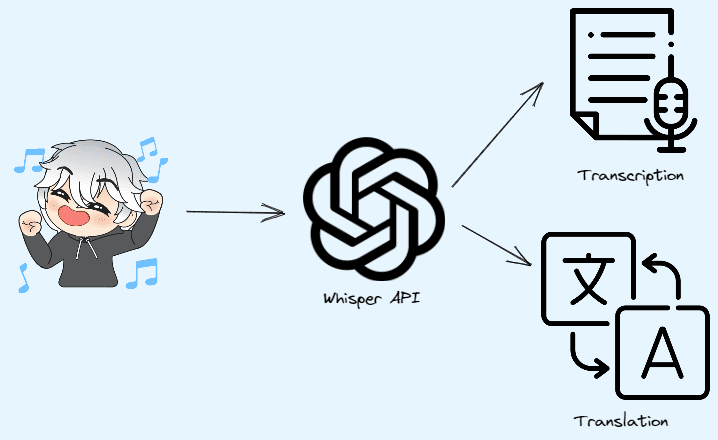
Now, manual transcription and translation are only a memory. The famous research company for ChatGPT, OpenAI, launched Whisper API for speech-to-text conversation! With a few lines of Python code, you can call this powerful speech recognition model, get the thought off of your mind and focus on other activities, like making practice with data science projects and improving your portfolio. Let’s get started!
What is Whisper?
Whisper is a model based on neural networks developed by OpenAI to solve speech-to-text tasks. It belongs to the GPT-3 family and has become very popular for its ability to transcribe audio into text with very high accuracy.
It doesn’t limit handling English, but its ability is extended to more than 50 languages. If you are interested to understand if your language is included, check here. Furthermore, it can translate any language audio into English.
Like other OpenAI products, there is an API to get access to these speech recognition services, allowing developers and data scientists to integrate Whisper into their platforms and apps.
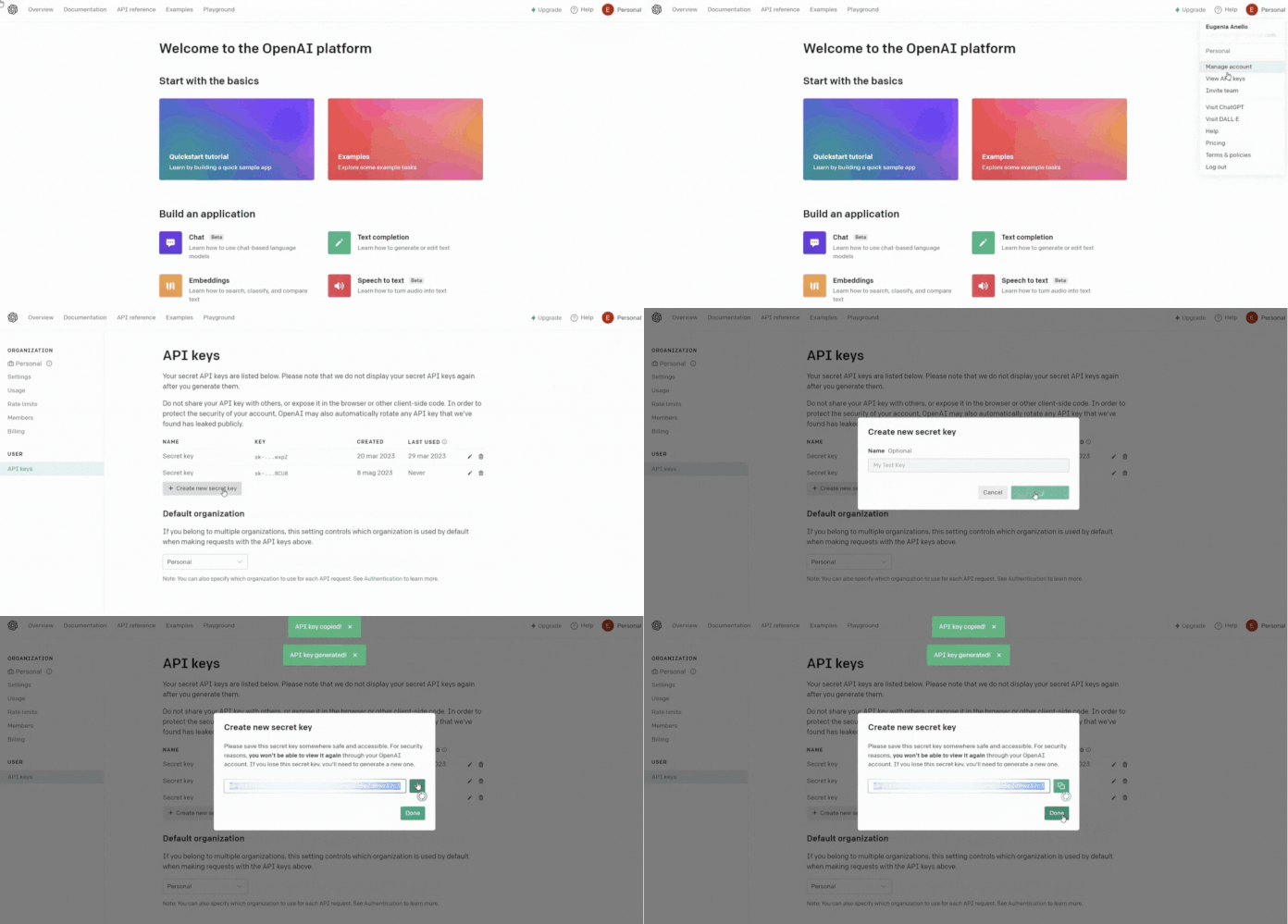
How to access Whisper API? GIF by Author
Before going further, you need a few steps to get access to Whisper API. First, go and log in to the OpenAI API website. If you still don’t have the account, you need to create it. After you entered, click on your username and press the option “View API keys”. Then, click the button “Create new API key” and copy the new create API key on your Python code.
Transcribe with Whisper API
First, let’s download a youtube video of Kevin Stratvert, a very popular YouTuber that helps students from all over the world to master technology and improve skills by learning tools, like Power BI, video editing and AI products. For example, let’s suppose that we would like to transcribe the video “3 Mind-blowing AI Tools”.
We can directly download this video using pytube library. To install it, you need the following command line:
pip install pytube3 pip install openai
We also install the openai library, since it will be used later in the tutorial. Once there are all the python libraries installed, we just need to pass the URL of the video to the Youtube object. After, we get the highest resolution video stream and, then, download the video.
Hi everyone, Kevin here. Today, we're going to look at five different tools that leverage artificial intelligence in some truly incredible ways. Here for instance, I can change my voice in real time. I can also highlight an area of a photo and I can make that just automatically disappear. Uh, where'd my son go? I can also give the computer instructions, like, I don't know, write a song for the Kevin cookie company....
As it was expected, the output is very accurate. Even the punctuation is so precise, I am very impressed!
Translate with Whisper API
This time, we’ll translate the audio from Italian to the English language. As before, we download the audio file. In my example, I am using this youtube video of a popular Italian YouTuber Piero Savastano that teaches machine learning in a very simple and funny way. You just need to copy the previous code and change only the URL. Once it’s downloaded, we open the audio file as before:
We also see some graphs in a statistical style, so we should also understand how to read them. One is the box plot, which allows to see the distribution in terms of median, first quarter and third quarter. Now I'm going to tell you what it means. We always take the data from the data frame. X is the season. On Y we put the count of the bikes that are rented. And then I want to distinguish these box plots based on whether it is a holiday day or not. This graph comes out. How do you read this? Here on the X there is the season, coded in numerical terms. In blue we have the non-holiday days, in orange the holidays. And here is the count of the bikes. What are these rectangles? Take this box here. I'm turning it around with the mouse....
Final thoughts
That’s it! I hope that this tutorial has helped you on getting started with Whisper API. In this case study, it was applied with youtube videos, but you can also try podcasts, zoom calls and conferences. I found the outputs obtained after the transcription and the translation very impressive! This AI tool is surely helping a lot of people right now. The only limit is the fact that it’s only possible to translate to English text and not vice versa, but I am sure that OpenAI will provide it soon. Thanks for reading! Have a nice day!
Resources
Speech-to-text Guide of Whisper API
Getting Started with OpenAI Whisper API in Python | Youtube video
Eugenia Anello is currently a research fellow at the Department of Information Engineering of the University of Padova, Italy. Her research project is focused on Continual Learning combined with Anomaly Detection.
More On This Topic
New ChatGPT and Whisper APIs from OpenAI
Machine Translation in a Nutshell
How to fast-track machine translation projects
How Data Scientists Can Avoid 'Lost in Translation' Syndrome When…
GPT-2 vs GPT-3: The OpenAI Showdown
Free ChatGPT Course: Use The OpenAI API to Code 5 Projects
Bengaluru is synonymous with traffic. If you happened to be stuck in your car or bike in places like Silk Board, K.R. Puram, Marathalli or Outer Ring Road, you are surely to blame BMTC and KSRTC buses for occupying the entire road and blocking your way.
Source: Bangalore Insider
“Public transport occupies a much lesser space compared to any personal mobility vehicle, car, two-wheeler. Plus public transport emits a much lesser tailpipe emission per passenger they carry,” said Dr Ashish Verma, Convenor, IISc Sustainable Transportation Lab, in a conversation with AIM.
Read more: ChatGPT Craves Human Expertise
Well, this is true when calculated with a full bus, usually public transportation, especially eco-oriented buses that have lesser emissions than two-wheelers or cars. In the same respect, a bus which occupies the space of 2 cars can carry up to 10 cars worth of people. It is noted that these are the calculations done with a full bus, which is not always the case.
There have been so many instances where buses with one or two passengers making the rounds in the city, occupy more space, leading to more traffic.
Source: YouTube
So, how is BMTC addressing this concern, alongside optimising its buses and routes?
BMTC recently introduced Namma BMTC, a passenger information app for phones, under the Government of India’s Nirbhaya scheme. Developed by MCT Cards & Technology and Amnex Infotechnologies, the app can be used in both Kannada and English and offers comprehensive details about bus schedules, routes, stops, and other relevant details for public transportation.
Buses: The Unsung Lifeline Transportation System
“We have a footfall of around 30 lakh passengers on a daily basis in buses which is almost six times than the metros, and we can proudly say that it is the lifeline of Bangalore where people, mostly low-income household bank on buses for the daily commute,” said A.V. Surya Sen, Director, IT, BMTC.
In Bangalore, there are currently more than one crore private vehicles on the road, but they are hardly able to transport another 30 lakh passengers. In comparison, there are only 6800 buses operating in Bangalore, making the bus population nowhere near the vehicle population in terms of providing transportation services. So according to Sen, blaming the volume of traffic solely on the number of buses is unfair.
Nonetheless, even with the availability of various modes of transportation, buses retain a crucial function. They are not only vital for connectivity and convenience but also serve as a means of providing essential services to the public. Buses can complement the higher-level public transport system while also offering distinct advantages.
“Additionally, buses are a cost-effective and affordable option, especially for individuals from low-income households. Hence, buses contribute to equitable transportation accessibility,” added Verma.
Read more: Open Source Opens Funds for Semiconductor in India
AI is Solving Traffic
The Namma BMTC app is an ode to the successful implementation of AI and ML algorithms. “The use of ML and AI is instrumental in providing effective solutions. The availability of extensive historical and legacy data allows us to make accurate predictions about bus arrival times and create algorithms for determining bus schedules and locations,” added Sen.
Having a comprehensive mobile application that offers a range of functions, including real-time tracking, trip planning, identifying nearby bus stops, and suggesting optimal travel routes, is an important aspect of an information system. However, it is essential to understand that the app itself does not provide a complete solution. It is just one part of a larger set of actions and initiatives that need to be taken.
According to Verma, the app in the future will also function as an Automated Fare Collection (AFC) system, enabling mobile ticketing, mobile passes, and digital wallets, revamping the process of purchasing tickets and travelling on buses by introducing digital payment methods.
Compared to other metropolitan cities like Mumbai, Chennai, and Delhi, BMTC is extremely expensive.
However, the government is taking steps to address the issue of affordability, and it is expected that improvements will be made in this regard.
“It is important to note that service quality and affordability are two separate aspects. Urban public transportation should be viewed as a service rather than a profit-oriented business, and efforts should be made to enhance service conditions while making it more affordable,” commented Verma.
Read more: Don’t Call Us Back to the Office
Moving Towards a Greener City
According to the NASSCOM report of 2021, Bangalore is the top destination for IT professionals in India with over 1 million people moving to the city each year in search of work. Now, with employees returning to the office as remote work is ending, buses are now in higher demand along with places to rent.
Public transportation promotes sustainability by reducing emissions, improving air quality, alleviating traffic congestion, and fostering social equity. It efficiently carries more passengers, lowers greenhouse gas emissions, reduces pollutants, saves time and money, and provides access to opportunities for those without cars. Furthermore, in terms of carrying a single passenger, public transport emits significantly lower levels of tailpipe emissions per passenger.
“Public transportation is a viable solution to combat global warming and carbon emissions. Prioritising public transportation and reducing reliance on private vehicles leads to a cleaner environment and improved quality of life,” concluded Verma.
Read more: Microsoft Issues Code Green Alert
The post Stuck in Traffic? Blame it on BMTC appeared first on Analytics India Magazine.
A Math teacher’s keen interest in checking the steps to solve a problem rather than the result loosely forms the basis for OpenAI’s new training approach. The company announced a new technique on training the model through process supervision by rewarding each step of correct reasoning as opposed to rewarding the correct final result via outcome supervision.
Here the output would probably be a model with reduced hallucinations and higher alignment as claimed by the company. OpenAI specifically calls out mitigating hallucinations as a crucial step towards ‘building aligned AGI’, but would any of these new training methods inch them closer to an AGI status?
Source: Twitter
Hallucinations At Bay
OpenAI talks about how you can train models to detect hallucinations either by process supervision, a method to provide feedback for each individual step, or outcome supervision, where the feedback is based on a final result. The company claims to have improved mathematical reasoning with the former method. By rewarding the model at each correct step, the model is said to mimic ‘human reasoning’ while solving a mathematical problem.
With an emphasis on hallucinations, the company’s move towards ‘claiming’ to make the models more robust continues. Companies are actively working on reducing hallucinations. Recently, NVIDIA released NeMo Guardrails, an open-source toolkit that will help LLM-based applications become accurate, appropriate, and secure. With hallucinations considered a persisting problem with chatbots that often make them behave illogically by generating misinformation or biases, OpenAI is working on making their models become better.
With the new training method, the company is hoping to keep a check on hallucinations as they believe a process-oriented method that involves feedback at each step, will control the irrational outputs generated by the chatbots.
Alignment — Closer to AGI?
really exciting process supervision result from our mathgen team. positive sign for alignment. https://t.co/KS8JEtHVAt
— Sam Altman (@sama) May 31, 2023
OpenAI’s reference to ‘building an aligned AGI’ is hinting at the company’s long-term plans for achieving it. Looking back, Sam Altman has made multiple mentions of AGI and how the future will look with it. A few months ago, he laid out an elaborate AGI roadmap for OpenAI where its dangers were called out. The company believed that AGI can be misused and lead to grave consequences in society. However, despite these risks, the potential and benefits of it are far-reaching therefore, the company will develop it in a ‘responsible way’. AI expert Gary Marcus predicts that AGI will not be coming soon.
It is interesting to note that Altman’s stance on AGI and its development is not clear-cut. In yesterday’s tweet, Altman seemingly downplayed the risk of AGI by predicting how ‘a much faster rate of change’ is what AGI will bring in. He believes that with AGI the future will unfold similarly to that without it, and the difference will be the speed with which things unfold – “everything happens much faster”.
Ironically, Sam Altman along with AI scientists, Geoffrey Hinton, Yoshua Bengio, and many others, signed a statement a few days ago, which stands for safeguarding against the threat of extinction posed by AI, and considers it on par with nuclear war. If any action is to be taken on this, then the question that would arise is: how far will OpenAI go to make more advanced models reach AGI?
The recent statement is in continuation with the open letter that was signed by over 31k people two months ago, including Elon Musk, Gary Marcus and other tech experts, who were urging for a pause on advanced AI models, which, interestingly, was not signed by Sam Altman. Though Altman had confirmed a month ago that the company will not work on building their next superior model GPT-5, and instead focus on the safety features of their existing models, his constant sway in matters pertaining to AGI threats and downplaying its scope makes it difficult to gauge where the company is headed.
The company, often criticised for data security threats and privacy concerns, is fighting hard to prove ChatGPT as a foolproof chatbot. The company is now working on democratising AI by offering grants to those who can propose the best method for creating an AI regulatory framework — again with the hope of improving the system and seeming compliant with the world.
The post OpenAI Inches Closer to AGI, Reduces Hallucinations appeared first on Analytics India Magazine.