Should AI come to your doctor’s office? OpenAI’s co-founder thinks so

Human shaking hands with robot with stethoscope underneath them

There's a big fear in many members of the workforce of the potential for artificial intelligence tools to take over their jobs, rendering their positions futile. However, there's one place where AI has been successfully innovating for years and, as a result, saving lives: The medical field.

Beyond reading minds, AI has been used to interpret medical imaging to find potentially cancerous tumors that could be easily missed by the human eye, for example. And now, OpenAI co-founder and President Greg Brockman, tweeted about a new way generative AI tools can be implemented at doctor's offices across the world.

Also: Want a compassionate response from a doctor? You may want to ask ChatGPT instead

Carbon Health, a healthcare provider with offices in 12 states across the U.S., announced it is implementing AI-powered charting for its patient visits. The company announced it's using GPT-4 built into its electronic health records system (EHR) to automatically generate visit summaries that providers can then review and edit for "hands-free charting."

The healthcare company found that its AI-generated charts are 2.5x more detailed than manual entry, giving medical providers a more complete overview of the patient.

Also: AI bots have been acing medical school exams, but should they become your doctor?

Manual charting is tedious for clinicians and can be one of the contributing factors of burnout among physicians. But documentation is a key part of medicine, so the practice cannot be eliminated. It can, however, be automated.

Brockman shared the innovation in a tweet, saying "GPT-4 in Carbon Health — cuts the time to create a medical record to four mins (sic), saving doctors 10 minutes."

Since implementing GPT-4 to create charts, Carbon Health has found its providers spend about 75% less time creating a chart compared to manual charting. As Brockman mentioned, this saves each clinician over ten minutes on average per visit.

Also: Can AI step up to offer help where humans cannot?

The GPT-4-based charting system will work as follows:

  1. Clinicians will gain consent from the patient to record the audio during their visit for charting and documentation purposes.
  2. The provider will press 'Record' within the EHR system.
  3. Once the recording is complete, the audio is transcribed through AWS Transcribe Medical and combined with data from the EHR, including the patient's medical history, medications, lab results, diagnosis, and manually-entered notes.
  4. The transcript and combined data use OpenAI's GPT-4 hosted on Microsoft Azure to automatically generate a visit summary.
  5. The provider can then review, edit, and approve the summary within the EHR.

Also: Is ChatGPT an effective therapy alternative? 80% of this study's participants thought so

The process is already available for the 600 providers across the Carbon Health network and can greatly reduce the time doctors spend charting and writing notes, as well as provide a more organic, screen-free interaction with patients.

Artificial Intelligence

TechCrunch+ roundup: 10 questions to ask a VC, AI and antitrust, Japan investor survey

TechCrunch+ roundup: 10 questions to ask a VC, AI and antitrust, Japan investor survey Walter Thompson @yourprotagonist / 8 hours

The nature of my work isn’t cyclical: VC activity has slowed down dramatically this year, but I still keep pretty busy.

According to the National Venture Capital Association, deal count for seed-stage startups decreased 52% year over year in Q1 2023. When I saw that number, I couldn’t help but wonder: what are VCs doing with all their spare time these days?

For a seed-stage investor, this might be a great opportunity to learn a new language or do some traveling. For a seed-stage startup, however, this is a time to find out how much value your investors actually provide.

Full TechCrunch+ articles are only available to members
Use discount code TCPLUSROUNDUP to save 20% off a one- or two-year subscription

Despite the obvious power imbalance, founders need to know whether the people they’re getting into business with understand how to operate during a downturn, says Navin Chaddha, managing partner at Mayfield Fund.

In this article, he looks at different ways inception-stage investors and board members can support early-stage teams and includes a ten-question checklist that can help founders assess whether the VCs they’re talking to are a good fit.

“While it might seem daunting for founders to question potential investors in today’s climate, remember that you need to build a mutual zone of trust for the long journey,” he writes.

Thanks very much for reading,

Walter Thompson
Editorial Manager, TechCrunch+
@yourprotagonist

10 questions early-stage founders should be asking investors

How to prepare a hardware startup for raising a Series A

Dollar origami spanner wrench isolated on white background. Moneygami.

Image Credits: Martina L (opens in a new window) / Getty Images

In recent months, two tech-friendly banks failed, the Fed raised interest rates, and SaaS startups started focusing on long-term profitability instead of short-term growth.

“The world we used to live in — the one that revolved around using cheap money to pump up ARR — is gone,” writes Champ Suthipongchai, co-founder and GP at Creative Ventures.

“So how can a hardware company raise a Series A amidst yet another ‘new normal’ in this post-low-interest-rate era?”

How to prepare a hardware startup for raising a Series A

Competition concerns in the age of AI

Toy Dinosaurs Confliction, Rex Dinosaur Standing Out From the Crowd on Pink Background.

Image Credits: MirageC (opens in a new window) / Getty Images

There’s a lot of excitement about current and future use cases for AI-enabled technology, but are the companies boldly charging forth into this new world creating legal problems for themselves down the road?

According to attorneys Henry Hauser, Shylah Alfonso and Chris Williams from law firm Perkins Coie, using AI to develop pricing algorithms, make purchasing decisions, or set compensation could run afoul of federal and state laws regarding consumer protection and antitrust.

“By implementing policies and processes that preserve human control and accountability, organizations can minimize legal exposure and avoid unintended consequences,” they write.

Competition concerns in the age of AI

Get the TechCrunch+ Roundup newsletter in your inbox

To receive the TechCrunch+ Roundup as an email each Tuesday and Friday, scroll down to find the “sign up for newsletters” section on this page, select “TechCrunch+ Roundup,” enter your email, and click “subscribe.”

Click here to subscribe

FedNow instant payments are about to unlock fintech investment opportunities

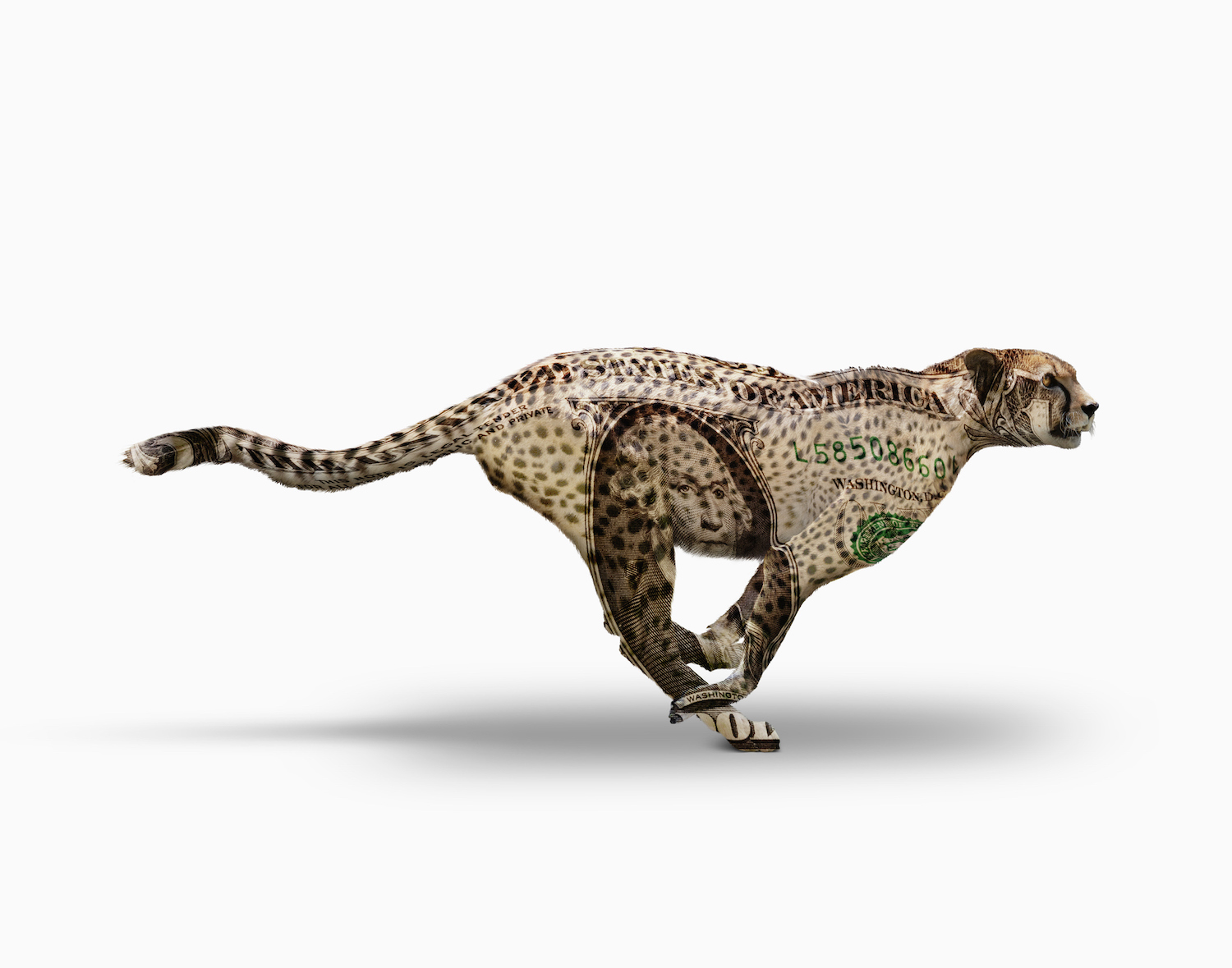
A cheetah is superimposed over a U. S. dollar bill in an image about ROI, successful investment, and investment strategy.

Image Credits: John Lund (opens in a new window) / Getty Images

Launching this summer, FedNow is a new initiative by the U.S. Federal Reserve that will enable instant payments 24/7/365.

Because the platform will offer lower transaction costs and real-time settlement, Fika Ventures Managing Partner TX Zhuo predicts that it will create new avenues for fintech companies of every size, “the effects of which could be realized as early as next year.”

FedNow instant payments are about to unlock fintech investment opportunities

6 investors explain why they are bullish about Japan’s startup scene despite an uncertain economy

Image Credits: Bryce Durbin / TechCrunch

Global investment activity has cooled, but “2022 was a record year for the Japanese VC market,” reports Kate Park.

She interviewed six investors who are active in Japan’s startup ecosystem to learn why “the money managers are optimistic despite uncertain macroeconomics” and asked about the advice they’re offering their portfolio companies:

  • Gen Isayama, co-founder and CEO, World Innovation Lab (WiL)
  • Tsuyoshi Ito, CEO and founding partner, Beyond Next Ventures
  • Katsuya Hashizume, executive officer/partner, Beyond Next Ventures
  • Gen Tsuchikawa, CEO, Sony Ventures Corporation
  • James Riney, CEO and founding partner, Coral Capital
  • Anis Uzzaman, founder and CEO, Pegasus Tech Ventures

6 investors explain why they are bullish about Japan’s startup scene despite an uncertain economy

Course5 Raises $250M, Targets Two Acquisitions

Ashwin Mittal, CEO at Course5i

Course5 Intelligence, a data analytics startup, announced the successful closure of its inaugural external funding round, securing $53 million (approximately Rs 437 crore). The funding was divided into two tranches, with an initial investment of $28 million from 360 One Asset Management Ltd (formerly IIFL Asset Management Limited) Tech Fund, followed by an additional $25 million led by Nuvama Crossover Series of funds, in collaboration with Carnelian Asset Advisors Pvt Ltd.

According to a source familiar with the matter, Course5 Intelligence achieved a valuation of $250 million through this funding round. The company intends to utilise the newly acquired funds to drive its growth through mergers and acquisitions, while also allocating resources to its artificial intelligence labs for the development of AI-driven intellectual property.

Ashwin Mittal, Course5’s Chairman and CEO, said, “We are seeking for two-three types of acquisitions. First, we are looking at companies that bring us either access to IP, access to capabilities or access to customers, or some combination of these three. In terms of size, we’re looking mostly at companies that are in the $10 to 20 million revenue size that have established a good solid business or growing. We are also going to look for some deep tech AI startups”

Course5 Intelligence has allocated approximately $80 million from its own cash reserves and cash accruals for future M&A activities. The company is currently in discussions with five potential prospects and plans to complete two acquisitions within the next year. With a focus on leveraging AI to address market and supply chain challenges, Course5 serves an extensive client portfolio including Fortune 500 companies in sectors such as retail, technology, media, and entertainment.

Last year they partnered with BITS Pilani and Woxsen University for AI-based research in Multimodal Deep Learning and Sentiment Analysis respectively.

The post Course5 Raises $250M, Targets Two Acquisitions appeared first on Analytics India Magazine.

Ten Years of AI in Review

Ten Years of AI in Review
Image by the Author.

The last decade has been a thrilling and eventful ride for the field of artificial intelligence (AI). Modest explorations of the potential of deep learning turned into an explosive proliferation of a field that now includes everything from recommender systems in e-commerce to object detection for autonomous vehicles and generative models that can create everything from realistic images to coherent text.

In this article, we’ll take a walk down memory lane and revisit some of the key breakthroughs that got us to where we are today. Whether you are a seasoned AI practitioner or simply interested in the latest developments in the field, this article will provide you with a comprehensive overview of the remarkable progress that led AI to become a household name.

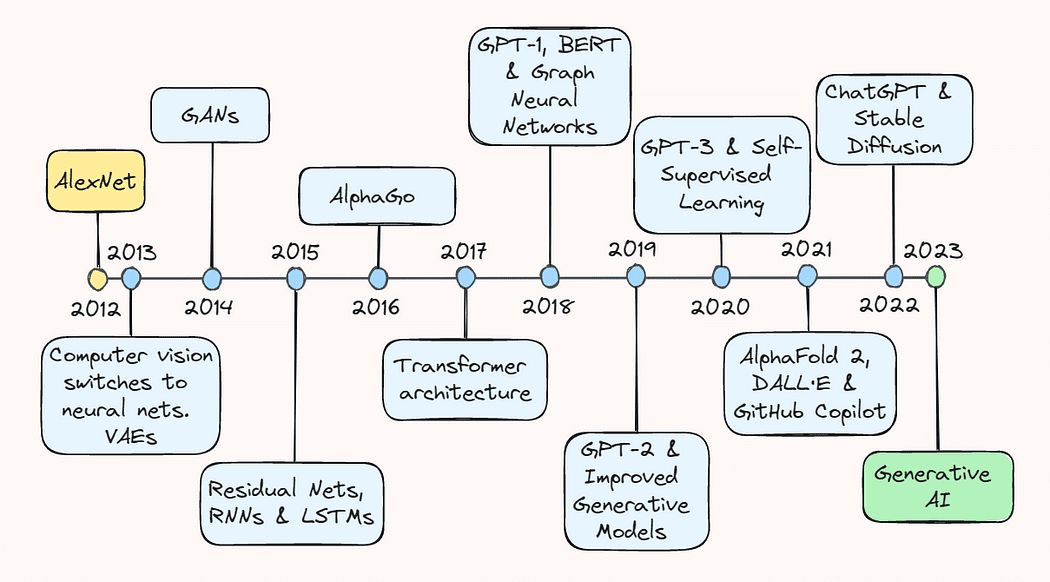
2013: AlexNet and Variational Autoencoders

The year 2013 is widely regarded as the “coming-of-age” of deep learning, initiated by major advances in computer vision. According to a recent interview of Geoffrey Hinton, by 2013 “pretty much all the computer vision research had switched to neural nets”. This boom was primarily fueled by a rather surprising breakthrough in image recognition one year earlier.

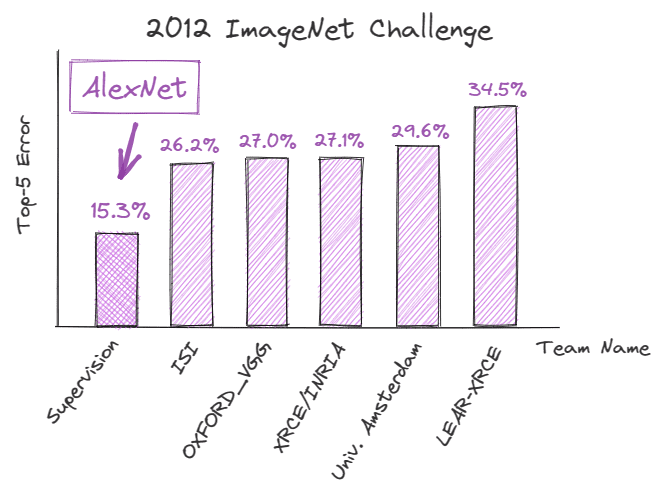
In September 2012, AlexNet, a deep convolutional neural network (CNN), pulled off a record-breaking performance in the ImageNet Large Scale Visual Recognition Challenge (ILSVRC), demonstrating the potential of deep learning for image recognition tasks. It achieved a top-5 error of 15.3%, which was 10.9% lower than that of its nearest competitor.
Ten Years of AI in Review
Image by the Author.

The technical improvements behind this success were instrumental for the future trajectory of AI and dramatically changed the way deep learning was perceived.

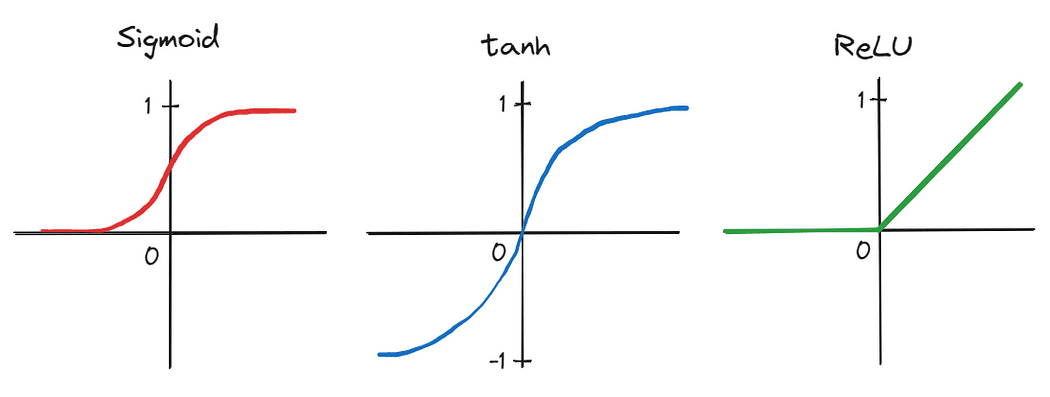
First, the authors applied a deep CNN consisting of five convolutional layers and three fully-connected linear layers — an architectural design dismissed by many as impractical at the time. Moreover, due to the large number of parameters produced by the network’s depth, training was done in parallel on two graphics processing units (GPUs), demonstrating the ability to significantly accelerate training on large datasets. Training time was further reduced by swapping traditional activation functions, such as sigmoid and tanh, for the more efficient rectified linear unit (ReLU).
Ten Years of AI in Review
Image by the Author.

These advances that collectively led to the success of AlexNet marked a turning point in the history of AI and sparked a surge of interest in deep learning among both academics and the tech community. As a result, 2013 is considered by many as the inflection point after which deep learning truly began to take off.

Also happening in 2013, albeit a little drowned out by the noise of AlexNet, was the development of variational autoencoders, or VAEs — generative models that can learn to represent and generate data such as images and sounds. They work by learning a compressed representation of the input data in a lower-dimensional space, known as latent space. This allows them to generate new data by sampling from this learned latent space. VAEs, later on, turned out to open up new avenues for generative modeling and data generation, with applications in fields like art, design, and gaming.

2014: Generative Adversarial Networks

The following year, in June 2014, the field of deep learning witnessed another serious advance with the introduction of generative adversarial networks, or GANs, by Ian Goodfellow and colleagues.

GANs are a type of neural network capable of generating new data samples that are similar to a training set. Essentially, two networks are trained simultaneously: (1) a generator network generates fake, or synthetic, samples, and (2) a discriminator network evaluates their authenticity. This training is performed in a game-like setup, with the generator trying to create samples that fool the discriminator, and the discriminator trying to correctly call out the fake samples.

At that time, GANs represented a powerful and novel tool for data generation, being used not only for generating images and videos, but also music and art. They also contributed to the advance of unsupervised learning, a domain largely regarded as underdeveloped and challenging, by demonstrating the possibility to generate high-quality data samples without relying on explicit labels.

2015: ResNets and NLP Breakthroughs

In 2015, the field of AI made considerable advances in both computer vision and natural language processing, or NLP.

Kaiming He and colleagues published a paper titled “Deep Residual Learning for Image Recognition”, in which they introduced the concept of residual neural networks, or ResNets — architectures that allow information to flow more easily through the network by adding shortcuts. Unlike in a regular neural network, where each layer takes the output of the previous layer as input, in a ResNet, additional residual connections are added that skip one or more layers and directly connect to deeper layers in the network.

As a result, ResNets were able to solve the problem of vanishing gradients, which enabled the training of much deeper neural networks beyond what was thought to be possible at the time. This, in turn, led to significant improvements in image classification and object recognition tasks.

At around the same time, researchers made considerable progress with the development of recurrent neural networks (RNNs) and long short-term memory (LSTM) models. Despite having been around since the 1990s, these models only started to generate some buzz around 2015, mainly due to factors such as (1) the availability of larger and more diverse datasets for training, (2) improvements in computational power and hardware, which enabled the training of deeper and more complex models, and (3) modifications made along the way, such as more sophisticated gating mechanisms.

As a result, these architectures made it possible for language models to better understand the context and meaning of text, leading to vast improvements in tasks such as language translation, text generation, and sentiment analysis. The success of RNNs and LSTMs around that time paved the way for the development of large language models (LLMs) we see today.

2016: AlphaGo

After Garry Kasparov’s defeat by IBM’s Deep Blue in 1997, another human vs. machine battle sent shockwaves through the gaming world in 2016: Google’s AlphaGo defeated the world champion of Go, Lee Sedol.

Ten Years of AI in Review
Photo by Elena Popova on Unsplash.

Sedol’s defeat marked another major milestone in the trajectory of AI advancement: it demonstrated that machines could outsmart even the most skilled human players in a game that was once considered too complex for computers to handle. Using a combination of deep reinforcement learning and Monte Carlo tree search, AlphaGo analyzes millions of positions from previous games and evaluates the best possible moves — a strategy that far surpasses human decision making in this context.

2017: Transformer Architecture and Language Models

Arguably, 2017 was the most pivotal year that laid the foundation for the breakthroughs in generative AI that we are witnessing today.

In December 2017, Vaswani and colleagues released the foundational paper “Attention is all you need”, which introduced the transformer architecture that leverages the concept of self-attention to process sequential input data. This allowed for more efficient processing of long-range dependencies, which had previously been a challenge for traditional RNN architectures.

Ten Years of AI in Review
Photo by Jeffery Ho on Unsplash.

Transformers are comprised of two essential components: encoders and decoders. The encoder is responsible for encoding the input data, which, for example, can be a sequence of words. It then takes the input sequence and applies multiple layers of self-attention and feed-forward neural nets to capture the relationships and features within the sentence and learn meaningful representations.

Essentially, self-attention allows the model to understand relationships between different words in a sentence. Unlike traditional models, which would process words in a fixed order, transformers actually examine all the words at once. They assign something called attention scores to each word based on its relevance to other words in the sentence.

The decoder, on the other hand, takes the encoded representation from the encoder and produces an output sequence. In tasks such as machine translation or text generation, the decoder generates the translated sequence based on the input received from the encoder. Similar to the encoder, the decoder also consists of multiple layers of self-attention and feed-forward neural nets. However, it includes an additional attention mechanism that enables it to focus on the encoder’s output. This then allows the decoder to take into account relevant information from the input sequence while generating the output.

The transformer architecture has since become a key component in the development of LLMs and has led to significant improvements across the domain of NLP, such as machine translation, language modeling, and question answering.

2018: GPT-1, BERT and Graph Neural Networks

A few months after Vaswani et al. published their foundational paper, the Generative Pretrained Transformer, or GPT-1, was introduced by OpenAI in June 2018, which utilized the transformer architecture to effectively capture long-range dependencies in text. GPT-1 was one of the first models to demonstrate the effectiveness of unsupervised pre-training followed by fine-tuning on specific NLP tasks.

Also taking advantage of the still quite novel transformer architecture was Google, who, in late 2018, released and open-sourced their own pre-training method called Bidirectional Encoder Representations from Transformers, or BERT. Unlike previous models that process text in a unidirectional manner (including GPT-1), BERT considers the context of each word in both directions simultaneously. To illustrate this, the authors provide a very intuitive example:

… in the sentence “I accessed the bank account”, a unidirectional contextual model would represent “bank” based on “I accessed the” but not “account”. However, BERT represents “bank” using both its previous and next context — “I accessed the … account” — starting from the very bottom of a deep neural network, making it deeply bidirectional.

The concept of bidirectionality was so powerful that it led BERT to outperform state-of-the-art NLP systems on a variety of benchmark tasks.

Apart from GPT-1 and BERT, graph neural networks, or GNNs, also made some noise that year. They belong to a category of neural networks that are specifically designed to work with graph data. GNNs utilize a message passing algorithm to propagate information across the nodes and edges of a graph. This enables the network to learn the structure and relationships of the data in a much more intuitive way.

This work allowed for the extraction of much deeper insights from data and, consequently, broadened the range of problems that deep learning could be applied to. With GNNs, major advances were made possible in areas like social network analysis, recommendation systems, and drug discovery.

2019: GPT-2 and Improved Generative Models

The year 2019 marked several notable advancements in generative models, particularly the introduction of GPT-2. This model really left its peers in the dust by achieving state-of-the-art performance in many NLP tasks and, in addition, was capable to generate highly realistic text, which, in hindsight, gave us a teaser of what was about to come in this arena.

Other improvements in this domain included DeepMind’s BigGAN, which generated high-quality images that were almost indistinguishable from real images, and NVIDIA’s StyleGAN, which allowed for better control over the appearance of those generated images.

Collectively, these advancements in what’s now known as generative AI pushed the boundaries of this domain even further, and…

2020: GPT-3 and Self-Supervised Learning

… not soon thereafter, another model was born, which has become a household name even outside of the tech community: GPT-3. This model represented a major leap forward in the scale and capabilities of LLMs. To put things into context, GPT-1 sported a measly 117 million parameters. That number went up to 1.5 billion for GPT-2, and 175 billion for GPT-3.

This vast amount of parameter space enables GPT-3 to generate remarkably coherent text across a wide range of prompts and tasks. It also demonstrated impressive performance in a variety of NLP tasks, such as text completion, question answering, and even creative writing.

Moreover, GPT-3 highlighted again the potential of using self-supervised learning, which allows models to be trained on large amounts of unlabeled data. This has the advantage that these models can acquire a broad understanding of language without the need for extensive task-specific training, which makes it far more economical.

Yann LeCun tweets about an NYT article on self-supervised learning.

2021: AlphaFold 2, DALL·E and GitHub Copilot

From protein folding to image generation and automated coding assistance, the year of 2021 was an eventful one thanks to the releases of AlphaFold 2, DALL·E, and GitHub Copilot.

AlphaFold 2 was hailed as a long-awaited solution to the decades-old protein folding problem. DeepMind’s researchers extended the transformer architecture to create evoformer blocks — architectures that leverage evolutionary strategies for model optimization — to build a model capable of predicting a protein’s 3D structure based on its 1D amino acid sequence. This breakthrough has enormous potential to revolutionize areas like drug discovery, bioengineering, as well as our understanding of biological systems.

OpenAI also made it in the news again this year with their release of DALL·E. Essentially, this model combines the concepts of GPT-style language models and image generation to enable the creation of high-quality images from textual descriptions.

To illustrate how powerful this model is, consider the image below, which was generated with the prompt “Oil painting of a futuristic world with flying cars”.

Ten Years of AI in Review
Image produced by DALL·E.

Lastly, GitHub released what would later become every developers best friend: Copilot. This was achieved in collaboration with OpenAI, which provided the underlying language model, Codex, that was trained on a large corpus of publicly available code and, in turn, learned to understand and generate code in various programming languages. Developers can use Copilot by simply providing a code comment stating the problem they are trying to solve, and the model would then suggest code to implement the solution. Other features include the ability to describe input code in natural language and translate code between programming languages.

2022: ChatGPT and Stable Diffusion

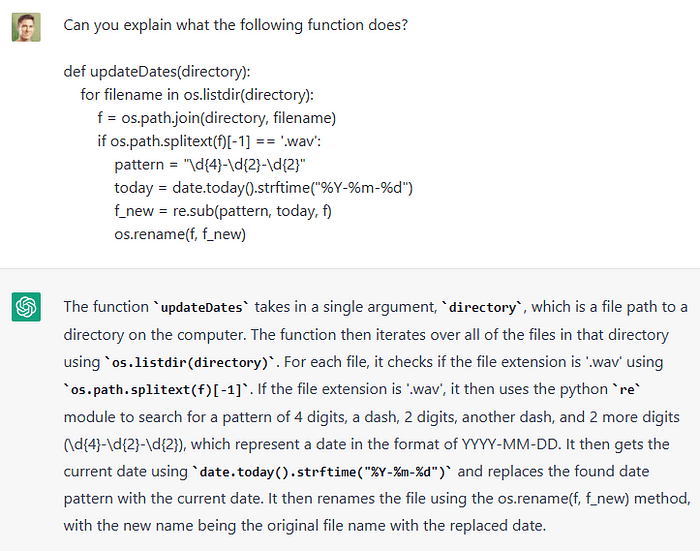
The rapid development of AI over the past decade has culminated in a groundbreaking advancement: OpenAI’s ChatGPT, a chatbot that was released into the wild in November 2022. The tool represents a cutting-edge achievement in NLP, capable of generating coherent and contextually relevant responses to a wide range of queries and prompts. Furthermore, it can engage in conversations, provide explanations, offer creative suggestions, assist with problem-solving, write and explain code, and even simulate different personalities or writing styles.
Ten Years of AI in Review
Image by the Author.

The simple and intuitive interface through which one can interact with the bot also stimulated a sharp rise in usability. Previously, it was mostly the tech community that would play around with the latest AI-based inventions. However, these days, AI tools have penetrated almost every professional domain, from software engineers to writers, musicians, and advertisers. Many companies are also using the model to automate services such as customer support, language translation, or answering FAQs. In fact, the wave of automation we’re seeing has rekindled some worries and stimulated discussions on which jobs might be at risk of being automated.

Even though ChatGPT was taking up much of the limelight in 2022, there was also a significant advancement made in image generation. Stable diffusion, a latent text-to-image diffusion model capable of generating photo-realistic images from text descriptions, was released by Stability AI.

Stable diffusion is an extension of the traditional diffusion models, which work by iteratively adding noise to images and then reversing the process to recover the data. It was designed to speed up this process by operating not directly on the input images, but instead on a lower-dimensional representation, or latent space, of them. In addition, the diffusion process is modified by adding the transformer-embedded text prompt from the user to the network, allowing it to guide the image generation process throughout each iteration.

Overall, the release of both ChatGPT and Stable Diffusion in 2022 highlighted the potential of multimodal, generative AI and sparked a massive boost of further development and investment in this area.

2023: LLMs and Bots

The current year has undoubtedly emerged as the year of LLMs and chatbots. More and more models are being developed and released at a rapidly increasing pace.
Ten Years of AI in Review
Image by the Author.

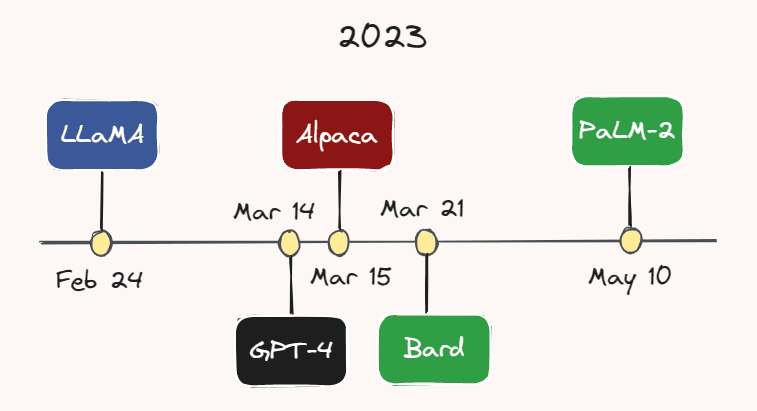
For instance, on February 24th, Meta AI released LLaMA — an LLM that outperforms GPT-3 on most benchmarks, despite having a considerably smaller number of parameters. Less than a month later, on March 14th, OpenAI released GPT-4 — a bigger, more capable, and multimodal version of GPT-3. While the exact number of parameters of GPT-4 is unknown, it is speculated to be in the trillions.

On March 15, researchers at Stanford University released Alpaca, a light-weight language model that was fine-tuned from LLaMA on instruction-following demonstrations. A couple days later, on March 21st, Google launched its ChatGPT rival: Bard. Google also just released its latest LLM, PaLM-2, earlier this month on May 10th. With the relentless pace of development in this area, it is highly likely that yet another model will have emerged by the time you’re reading this.

We are also seeing more and more companies incorporating these models into their products. For example, Duolingo announced its GPT-4-powered Duolingo Max, a new subscription tier with the aim of providing tailored language lessons to each individual. Slack has also rolled out an AI-powered assistant called Slack GPT, which can do things like draft replies or summarize threads. Furthermore, Shopify introduced a ChatGPT-powered assistant to the company’s Shop app, which can help customers identify desired products using a variety of prompts.

Shopify announcing its ChatGPT-powered assistant on Twitter.

Interestingly, AI chatbots are nowadays even considered as an alternative to human therapists. For example, Replika, a US chatbot app, is offering users an “AI companion who cares, always here to listen and talk, always on your side”. Its founder, Eugenia Kuyda, says that the app has a wide variety of customers, ranging from autistic children, who turn to it as a way to “warm up before human interactions”, to lonely adults who simply are in the need of a friend.

Before we conclude, I’d like to highlight what may well be the climax of the last decade of AI development: people are actually using Bing! Earlier this year, Microsoft introduced its GPT-4-powered “copilot for the web” that has been customized for search and, for the first time in… forever (?), has emerged as a serious contender to Google’s long-standing dominance in the search business.

Looking back and looking forward

As we reflect on the last ten years of AI development, it becomes evident that we have been witnessing a transformation that has had profound impact on how we work, do business, and interact with one another. Most of the considerable progress that has lately been achieved with generative models, particularly LLMs, seems to be adhering to the common belief that “bigger is better”, referring to the parameter space of the models. This has been especially noticeable with the GPT series, which started out with 117 million parameters (GPT-1) and, after each successive model increasing by approximately an order of magnitude, culminated in GPT-4 with potentially trillions of parameters.

However, based on a recent interview, OpenAI CEO Sam Altman believes that we have reached the end of the “bigger is better” era. Going forward, he still thinks that the parameter count will trend up, but the main focus of future model improvements will be on increasing the model’s capability, utility, and safety.

The latter is of particular importance. Considering that these powerful AI tools are now in the hands of the general public and no longer confined to the controlled environment of research labs, it is now more critical than ever that we tread with caution and ensure that these tools are safe and align with humanity’s best interests. Hopefully we’ll see as much development and investment in AI safety as we’ve seen in other areas.

PS: In case I’ve missed a core AI concept or breakthrough that you think should have been included in this article, please let me know in the comments below!

Thomas A Dorfer is a Data & Applied Scientist at Microsoft. Prior to his current role, he worked as a data scientist in the biotech industry and as a researcher in the domain of neurofeedback. He holds a Master's degree in Integrative Neuroscience and, in his spare time, also writes technical blog posts on Medium on the subjects of data science, machine learning, and AI.

Original. Reposted with permission.

More On This Topic

  • Missing Value Imputation — A Review
  • AI in Healthcare: A review of innovative startups
  • Python For Machine Learning: eBook Review
  • SQL Notes for Professionals: The Free eBook Review
  • Data Science is Not Becoming Extinct in 10 Years, Your Skills Might
  • What 2 years of self-teaching data science taught me

Want quick access to Bing Chat on your phone? Add this handy widget

Bing Chat AI on phone

Microsoft offers a Bing AI chat app through which you can ask questions, submit requests, and carry on conversations via your mobile device. But rather than go through the app, you can quickly and easily use a widget.

Also: What is Bing Chat? Everything you need to know

Available for iPhones, iPads, and Android phones, the Bing AI widget lets you ask questions, conduct a regular search, or run a private search. You can even choose between different styles and layouts for the widget. Here's how to set it up.

How to set up the Bing AI chat widget on iPhone or iPad

How to set up the Bing AI chat widget on Android

To set up the widget on your Android phone, download and install the Bing AI app for Android if you haven't already. Move to the screen on which you wish to put the widget and press down on any empty area. From the popup menu, select Widgets. Tap the entry for Bing on the Widgets screen.

Also: My 5 favorite AI tools for work

Here, you can choose among 13 different styles, from simple to complex. To grab the AI option, though, make sure you choose one of the styles that incorporates the AI icon, such as Search & Chat or Wallpaper. Press and hold down your preferred style and then drag and drop it onto the screen.

To remove the widget on your Android phone, press down on it until you see a Remove icon above it. Drag and drop the widget onto that icon, and it will vanish.

More on AI tools

Curing physician burnout with Eli Ben-Joseph from Regard

Curing physician burnout with Eli Ben-Joseph from Regard Rebecca Szkutak Dominic-Madori Davis 8 hours

Welcome back to Found, where we get the stories behind the startups.

This week Becca and Dom are joined by Eli Ben-Joseph, the co-founder and CEO of Regard, a startup that uses AI to streamline the clinical side of medicine in an effort to reduce physician burnout. Eli talked about his journey from deciding to forgo attending medical school because of the very issue to building a company to fix it years later. He also talked about why it was important for them to build an AI model that requires a human touch and what it is like to sell to hospitals.

Subscribe to Found to hear more stories from founders each week.

Connect with us:

  1. On Twitter
  2. On Instagram
  3. Via email: found@techcrunch.com

Graph Databases are Having a Moment in the Database Market

Graph databases initially emerged to help us understand relationships and store these data entities. Swiftly, they popped up in instances of social networking, recommendation engines and fraud detection since they fit the bill perfectly.

With twelve years of experience in data engineering, Arvind Ramachandran has been instrumental in revamping the existing platform by re-engineering various processes. Analytics India Magazine had a quick chat with Arvind to understand more about the use cases and the future of graph databases.

AIM: What are graph databases and how do they differ from the traditional database systems?

Arvind: In order for us to understand how graph databases differ from traditional databases, we first need to understand what these are. Graph databases are a type of database management system designed to store and process data in the form of graphs. These graphs typically contain nodes and edges. For instance, in the retail world, nodes can represent entities such as customers, warehouses and products. Edges, on the other hand, represent the relationships between the nodes.

So, unlike traditional databases that store data in the row and column format, graph databases are more flexible, enabling users to easily analyse the data and the relationships between entities. This would otherwise involve complex queries in traditional databases.

AIM: Will graph databases really play an important role in the future?

Arvind: Graph databases are already playing an important role in various industries such as e-commerce, supply chain and banking, and are expected to become even more prevalent in the near future. They have started gaining more popularity in the healthcare industry for managing patient data and analysing symptoms. For example, with COVID cases, graph databases were able to chart out people affected by the disease and also everyone who was in their proximity so that they could be quarantined.

Graph databases are also being used in the transportation industry for optimising routes and logistics. As data continues to grow, it is imperative to keep up with the ever-increasing demands of effective data management and governance.

Graph databases not only establish effective data management systems but they’re also helpful in identifying patterns and anomalies and can help with high-speed traversal of complex relationships, which is a powerful tool for data analysis.

AIM: What are some of the real-world use cases and applications of graph databases?

Arvind: Graph databases have numerous real-time applications. For example, e-commerce platforms use graph databases extensively to build recommendation engines based on user behaviour and purchase history. This enables them to offer personalised product suggestions to the customers.

Social networking platforms like Facebook use a graph database, called TAO, to understand the connections between users, which helps them deliver personalised marketing campaigns. Similarly, LinkedIn uses an in-house graph database, called Llquid. It extensively maps its second-degree networks which are humongous.

So, essentially, we are tracking the lineage and provenance of data for audit, compliance and governance purposes. By modelling data entities in the form of graphs, it becomes easier to visualise and manage complex connections.

AIM: How will graph databases revolutionise data analytics and business intelligence?

Arvind: Graph databases are gaining popularity in modern businesses because they can represent very complicated relationships thereby facilitating diverse analytical capabilities such as market basket analysis, social network analysis, product recommendations, inventory management, and more.

They can also identify key influencers in an organisation and analyse communication patterns to improve team performance and collaboration.

With the power of ML in BI, businesses can uncover insights to gain a competitive edge. Graph databases can also be combined with BI tools like Power BI and Tableau, allowing users to create visualisations of data on their dashboards.

AIM: How do graph databases handle complex relationships between data points?

Arvind: Querying languages are designed specifically to handle such complex relationships. For instance, Cypher, used by Neo4j, is specifically used for querying graph databases. Graph databases that support Cypher have built-in algorithms that can be directly used to calculate shortest paths and perform other analytic tasks.

Graph databases also offer an easy way to create new relationships and update data models without the need for denormalisation. This feature significantly improves query performances for navigating data relationships, which is particularly valuable for businesses that need to make informed decisions based on large amounts of data.

AIM: How can graph databases be integrated with other data storage and processing technologies such as Hadoop and Spark?

Arvind: There is an open-source statistical processing called GraphX that is specifically designed for large-scale graphs and graph-structured data. It efficiently processes large-scale graphs that can be used in transactions with graph databases to perform various graph analytic tasks.

Graph databases also give you the provision to export graph data in various formats such as JSON and CSV, which can then be loaded onto platforms like Hadoop. You can also leverage connectors to facilitate spark – graph database integrations.

AIM: What are the benefits and advantages for a company in adopting graph databases ?

Arvind: The integration of graph databases is a remarkable advancement in how companies can effectively utilise and leverage data. When an organisation embarks on their journey to adopt graph databases, it embraces a forward-thinking approach to data architecture.

Graph databases offer valuable attributes such as flexibility, scalability, and agility, which empowers companies to adapt to evolving business requirements and maintain a competitive edge in a rapidly changing market. By leveraging the potential of interconnected data, companies can gain invaluable insights, enhance customer experiences, and optimise operations. Whether it involves integrating new data sources, accommodating dynamic schemas, or enabling real-time analytics, graph databases provide the foundational elements necessary for companies to establish a data-driven organisation poised for success.

The post Graph Databases are Having a Moment in the Database Market appeared first on Analytics India Magazine.

ChatGPT for Data Science Interview Cheat Sheet

Preparation is Key

Mastering data science interviews are a skill all their own, and preparing for them is the key to success. Just as I was once told that learning how to write university examinations is a skill all of its own, beyond learning the material on which you are being tested, specialized technical job interviews are very similar.

ChatGPT can help candidates understand and clarify complex concepts, algorithms, and methodologies commonly encountered in data science interviews. Whether it's discussing machine learning algorithms, statistical techniques, or data preprocessing methods, ChatGPT can provide detailed explanations and examples to enhance understanding.

To help out, KDnuggets has put together a cheat sheet on the topic, ChatGPT for Data Science Interview Cheat Sheet.

ChatGPT for Data Science Interview Cheat Sheet

In this handy reference, you will find the following helpful info:

  • Statistics
  • Coding
  • Data management
  • Model development
  • Issues specific to FAANG companies
  • …and more!

Be sure to grab yourself a copy to keep handy while you prep for your data science interviews. Check it out now, and check back soon for more.

More On This Topic

  • ChatGPT for Data Science Cheat Sheet
  • The ChatGPT Cheat Sheet
  • Machine Learning with ChatGPT Cheat Sheet
  • GitHub CLI for Data Science Cheat Sheet
  • Docker for Data Science Cheat Sheet
  • Bard for Data Science Cheat Sheet

How to save or copy your Bing Chat responses

Person using Bing Chat on phone

The Bing Chat website and app both keep a record of your conversations so you can refer back to a previous or recent chat. But maybe you want to save a copy of a specific response from the chatbot to use it somewhere else. You can do that with the website and the app.

Also: My 5 favorite AI tools for work

At the site, you're able to copy and paste the contents of a response as well as export it as a PDF, text file, or Word document. With the app, you can copy and paste the text of the response. Beyond saving the text, certain formats will also copy hyperlinks.

How to save or copy your Bing Chat transcripts

screenshot by Lance Whitney/ZDNET

More on AI tools

6 Hidden Features of Apple Vision Pro That Will Blow Your Mind

Apple Vision Pro, the most exciting product launched at this year’s WWDC event, has taken the internet by storm. This new product from a tech giant has unlocked new possibilities like never seen before.

With Vision Pro, you can see, hear, and interact with digital content in a way that feels natural and immersive. You can use it to play games, watch movies, create art, and more. Interestingly, the company describes its device as the most advanced device ever and claims it filed 5,000 patents to make it all happen. Read: Apple Vision Pro vs Meta Quest 3

In this article, we will look into some of the hidden features that were overlooked by many, which will surely blow your mind.

Double Chip

The chip, designed specifically for the mixed reality headset, is tasked with running all the sensors embedded into the headset to create precise head and hand tracking, along with real-time 3D mapping and eye-tracking. A total of 12 cameras, 5 sensors, 6 microphones (including a lidar sensor) This super-speedy sensor processes the data within 12 milliseconds, or one wing-flap of the hummingbird or eight times faster than the blink of an eye.

The combination of an M2 chip to pack a ton of computing power and an R1 chip to deal with inputs. This executes the actions with any lag and reduces the possibility of motion sickness, nausea or disorientation.

Apart from the R1 chip, the M2 chip, built on the second-generation 5nm architecture, offers an 18% increase in CPU performance compared to the previous M1 processor. The Vision Pro’s operating system software, called VisionOS, runs on the same M2 processor that Apple uses in its Macs.

Despite using the same 5nm node as the M1, the M2 chip packs 20 billion transistors, 4 billion more than its predecessor, resulting in improved performance without the need for more cores.

Overall, the M2 chip provides a more powerful performance than the M1 but falls short of the high-end capabilities needed for tasks like 3D modelling and advanced video editing.

Display

The Apple Vision Pro utilises micro-OLED technology to deliver its display capabilities. Apple claims that each eye’s display packs more than a 4K resolution and a total of 23 million pixels. This translates to a wide field of view (FOV), thereby eliminating the need for integrating extra devices to control virtual environments, where you can just navigate via hand and finger gestures.

Another interesting update was, Apple also introduced the Mac Virtual Display feature, allowing users to wirelessly bring their Mac content into the Vision Pro headset.

Face recognition

Vision Pro headset also showcased the innovative Persona feature, which relies on machine learning (ML). The built-in cameras scan the user’s face, creating a lifelike digital doppelgänger. During video calls, the digital twin replaces the user, mimicking their expressions and gestures in real time. FaceTime, Teams, Webex and Zoom will support these 3D avatars.

This is like nothing seen before.

To better show the user’s face when using the headset also includes an exterior display, on an OLED screen on the exterior that shows the user’s eyes. The EyeSight system allows users to either obscure or reveal their digital eyes to others in the room, indicating their readiness for face-to-face conversation.

Optic ID

Optic ID, Apple’s third biometric system apart from face and fingerprint recognition, was introduced specifically for the Vision Pro headset. It will be used for unlocking the device and for features like Apple Pay within the headset’s interface.

It works by analysing a user’s iris through LED light exposure and comparing it with an enrolled Optic ID stored on the device’s Secure Enclave. According to Apple’s VP of technology development group, Mike Rockwell, the system can detect iris differences, even among identical twins.

Custom lenses

Apple’s VR/AR headset can now be customised with prescription lenses, thanks to easy installation using magnetic lens holders.

The slim design of the headset is impressive, but its compact size may pose a challenge for those who wear glasses. However, Apple has found a solution. To ensure that all users can have a clear view in these applications, Apple has partnered with Zeiss to create optical inserts tailored to individual vision.

Unlike other VR headsets, there is no need to replace lenses. The Zeiss lenses can simply be placed over the Apple Vision Pro lenses using a magnetic holder, which automatically snaps them into place. While there is no information yet on pricing or whether the lenses will be available directly with the Apple Vision Pro, they will be sold separately.

Lastly, Privacy

As with all Apple security features, Optic ID is claimed to remain solely on the device and the information is fully encrypted. Optic ID is just one of the privacy protections implemented in the Vision Pro headset. Eye tracking data will not be accessible by Apple or any other party, and camera and sensor data will be processed at the system level to prevent unauthorised access. Visual indicators will also be present when capturing photos and videos to respect the privacy of those around the user.

The post 6 Hidden Features of Apple Vision Pro That Will Blow Your Mind appeared first on Analytics India Magazine.