LlamaIndex adds private data to large language models

LlamaIndex adds private data to large language models Kyle Wiggers 19 hours

Last fall, after playing around with OpenAI’s GPT-3 text-generating AI model — the predecessor to GPT-4 — former Uber research scientist Jerry Liu discovered what he describes as “limitations” around the model’s ability to work with private data (e.g., personal files). To solve for this, he launched an open source project, LlamaIndex, designed to unlock the capabilities and use cases of large language models (LLMs) like GPT-3 and GPT-4.

“LLMs offer incredible capabilities for knowledge extraction and reasoning — they can perform question-answering, summarization and insight extraction and even sequential decision making with an external environment,” Liu told TechCrunch in an email interview. “But LLMs have limits.”

As the project grew in popularity (to the tune of 200,000 monthly downloads), Liu joined forces with Simon Suo, one of his old colleagues at Uber, to turn LlamaIndex into a fully fledged company. Today, LlamaIndex (the company) offers a framework to assist developers in leveraging the capabilities of LLMs on top of their personal or organizational data.

“LlamaIndex [helps] developers manage their data for LLM applications,” Liu said. “Our toolkit contains the most depth in this aspect, and we make it easy to integrate with other tools the developer is using.”
LlamaIndex

Image Credits: LlamaIndex

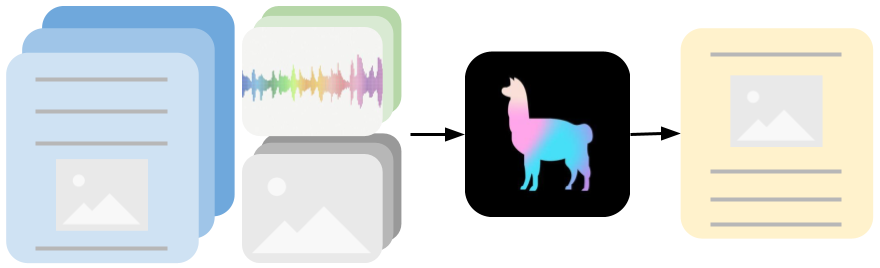
The LlamaIndex framework allows developers to connect data from files like PDFs, PowerPoints, apps such as Notion and Slack and databases like Postgres and MongoDB to LLMs. The framework includes connectors to ingest data sources and data formats, as well as ways to structure data so that it can be easily used with LLMs.

In addition, LlamaIndex features a data retrieval and query interface that lets developers feed in any LLM input prompt to get back — as Liu describes it — “context and knowledge-augmented” output.

“There are other LLM application frameworks out there that offer basic building blocks for LLM applications and agents,” Liu said. “What’s specific to LlamaIndex is that we focus on connecting your data sources with LLMs, and we have extensive tools around data ingestion, data management and indexing and data retrieval with respect to LLM applications.”

The prospect of augmenting LLMs in this way wooed investors, which pledged $8.5 million toward LlamaIndex in a recently closed seed funding round. Greylock led with participation from angel investors, including Jack Altman, Lenny Rachitsky and Charles Xie.

So what will LlamaIndex spend the money on? Liu says that it’ll be used to build an “enterprise solution” atop the open source LlamaIndex project, set to launch later this year. One capability will allow customers to use “protection-grade” data connectors to parse and transport large volumes of data, while another, related capability will let them index “domain-specific” data.

“LlamaIndex is not tied to a specific piece of technology, so that we can continue to be used with LLMs as the technology evolves,” Liu said. “The AI industry is moving so quickly that any initial stacks that are emerging will likely change in the course of the next few months.”

Carpe Diem, The Data Science Moment in India is Now

Data science has gained significant traction in India, emerging as a rapidly growing field with immense potential. With a blend of technological advancements and a vast pool of talented professionals, India has become a prominent hub for data science. However, there is still a critical need for upskilling in this domain. Analytics India Magazine spoke to Shivam Dutta, CEO and Co-Founder at AlmaBetter on the challenges facing the data science industry, the key skills needed and how AlmaBetter is bridging the gap.

  • What are some of the key challenges that the data science industry in India is currently facing?

    To say that data science as an industry is rapidly evolving would be an understatement. If we look at the amount of data being created every day, which by the way, stands at 3.5 quintillion bytes, it seems unfathomable how this data is being processed. That said, we need to, as a country of entrepreneurs and businesses, derive insights from this data and leverage it to move innovation forward. Currently, the skill gap is insurmountable, more so because aspirants are not equipped with the right technical smarts required to excel in the field. Furthermore, companies are also facing a crunch, contributed by a lack of talent and the amount of time and resources spent on filling just one vacancy. This is a playing field that ed-tech players can shine in, helping serve both stratas of the business world.
  • How do you see the industry evolve in the next few years, and what are the factors that will drive this growth?
    If we compare the demand for data scientists 10 years ago versus now, we can see a stark difference. A decade ago, data science had just popped its head above the water. Today, companies risk becoming obsolete if they don’t have a data science and analytics strategy in place. This alone speaks volumes about how the data science industry is evolving. As I said, the amount of data being generated today is exponential. Players like OpenAI have introduced large language models such as ChatGPT, and several others are building products that have human-like intelligence. With the gradual increase in users who are leveraging automation and the general interest in automating error-prone manual tasks, it is safe to say that the hype around data science and AI is not temporary. This will not only help remove redundancy, but also move the economy towards the tailwind powered by AI.
  • How have the hiring needs in DS evolved over the years?

    The constant to and fro between the demand for experienced professionals and the lack of hiring trends for freshers has given rise to a Catch-22 situation. In my opinion, to counter this, the right approach would be for educators to rise to the occasion and provide training that not only prepares students in theory but also in practice. Long-form training programs that offer training equivalent to work experience and exposure to project-based learning can help mitigate this issue and solve the talent crunch. This is exactly what AlmaBetter’s Full Stack Data Science Course aims to do. It is necessary to break the vicious cycle of freshers not getting experience, and experienced professionals not getting the right opportunities.
  • What are some of the key skills and qualifications necessary to succeed in the industry and how can aspiring data scientists acquire these skills?
    The product life cycle in data science is extensive and requires deep understanding. Anyone aspiring to succeed in the field will have to dive into the deep end of the entire life cycle, starting from business acumen to core tech skills like data engineering and modelling. While they must be experts in understanding data modelling and transformation, choosing the right machine learning and deep learning models, and productionising those models, they must also be adept in understanding and converting a business challenge into a data science problem statement.
    That said, communication and cross collaboration skills are also paramount, especially since it strengthens the output for projects. We identified this gap in the current educational approach and, hence, have created a holistic learning model at AlmaBetter, which offers intensive training on all three fronts.
  • How is the education system in India preparing students for careers in DS, and what changes could be incorporated to better align with the needs of the industry?

    If you look at the current offerings that colleges are putting forth, it is easy to identify a sore thumb sticking out, which is, UGC has its limitations. While colleges are adopting data science in their curriculum, they are unable to offer end-to-end training in the field. Data science has been reduced to a mere specialisation coupled with a traditional degree, with the education imparted being incomplete and not fit for real-world application. Limited training that captures only a fraction of the entire data science scope has further led to a lack of skilled data science talent. Unfortunately, these pseudo-data science degrees offer a fake sense of knowing these new-age technologies when in reality they gain expertise only at a minimal level. We, as educators and torch bearers of advanced education, must ensure that students are offered with the right material, exposure, and understanding of the full scope of data science. A change in the approach and curriculum is long pending.
  • There are concerns that the rapid development of AI technologies may lead to mass job displacement, rendering some data science and AI skills obsolete. How does AlmaBetter address these concerns and prepare its students for an uncertain job market future?
    The growing popularity of AI technologies has given rise to a lot of uncomfortable conversations. However, we need to better understand the scope it offers. To be honest, the only jobs at the risk of becoming irrelevant are those that are also at the risk of being inefficient. Several fields today, including research, content, and design are adapting to this new revolution and leveraging AI technologies to build robust efficiencies. As we become a technologically advanced civilization, knowing how to leverage new-age technologies, like ChatGPT and large language models, will give professionals a competitive advantage over their contemporaries. This is also being catered to within our Full Stack Data Science curriculum through prompt engineering, where we prepare students for such roles.
  • What role can government policies and initiatives play in supporting the growth of the Data Science industry in India, and what steps should be taken to encourage innovation and entrepreneurship in this field?
    Currently, while there is some government support, I wouldn’t term it as adequate. As more new technologies are entering the market, India as a developing country should have the policies and infrastructure to modify the curriculum and train students on relevant industry requirements. I also believe that establishing more incubator funding programs will give ed-tech players a platform to further the agenda of high-impact technical training and, subsequently, build a workforce that can take the country to new heights.
  • What approach should companies take to identify, train, and groom data scientists?
    As important as it is to train the workforce of the future, it is also vital that skilled talent is identified, groomed, and rewarded for their adeptness and abilities. In order to do that, there are a few strategies that companies can adopt. The first thing that comes to my mind, and can definitely become a stepping stone, is that organisations can roll out mini projects as externships to ed-tech players who have training capabilities in the domain.
    This will not only help the talent of tomorrow to become deft in current industry demands but also help them gain much-needed practical experience. Companies can also explore options to offer corporate training for their existing employees, which will boost productivity and employee satisfaction, and contribute to bridging the skill gap. Thirdly, one of the most bothersome issues in talent acquisition has been vague job descriptions. Companies must be transparent with regard to what they expect from a particular role. Inflated titles need to be shown the door and clearer roles need to be chalked out.
  • What advice do you have for individuals considering a career in Data Science in India?
    To overcome any challenge, it’s essential to understand what causes them. My first and foremost advice would be for professionals and aspirants to do their research and identify the gaps and talent crunch. Having an astute understanding of this will help them leverage the skill gap to their advantage and carve out their careers where they are indispensable. Next comes preparing for the right roles; following an unstructured path often leads to blockers. Hence, it’s important to set proper goals and excel at time management. Lastly, staying abreast of new technologies and their trends can put professionals at the summit of the talent pool.
  • What do you see as the most significant opportunities for the data science industry as a whole in the coming years?
    Hiring in data science is going to see an upward trend in the coming years. Despite the current economic situation and layoffs being the talk of the town, data science and AI professionals have been thriving. This can be attributed to the constantly evolving technologies and the exponential demand for quick-witted and business-smart professionals who can derive stories worth telling and revenue worth earning from data. The country as a whole should get on the ride to experience some really cool things that data science and AI will bring forth.

The post Carpe Diem, The Data Science Moment in India is Now appeared first on Analytics India Magazine.

Edtech giant Byju’s launches transformer models in AI push

Edtech giant Byju’s launches transformer models in AI push Manish Singh 7 hours

Byju’s unveiled three transformer models intended to enhance the quality of its services as well as streamline learning and personalization experience for its students as the edtech giant places large bets on AI to transform many aspects of its business.

Badri, a predictive AI model, is engineered to identify when learners may begin to falter in understanding specific concepts. This model proactively offers recommendations to address any identified knowledge gaps, thus supporting continual learning.

MathGPT is another specialized model capable of resolving any math problems while guiding students using understandable analogies and visual aids. The third model, TeacherGPT, functions as an AI-powered assistant, providing personalised guidance to learners and also grading their responses.

These transformer models — part of Byju’s “Wiz” suite — have been meticulously trained on the millions of queries posed daily by Byju’s student base. The models, whose accuracy is about 87%, have been carefully calibrated to ensure that they operate within the boundaries of the respective curriculum, said Dev Roy, Chief Innovation and Learning Officer at Byju’s, in an interview with TechCrunch.

Byju’s, which is also using OpenAI’s ChatGPT to facilitate generating content, has tweaked the models to optimize for costs and establish guardrails, he said.

The transformers will touch nearly all aspects of a student’s journey on Byju’s, he said. The platform has deployed Badri across the marquee service to keep assessing the learning of a student based on their consumption habit. Each student is going to get recommendation and tests that are uniquely suited to them, he said.

Roy showed in a demo how MathGPT was using data from GeoAlgebra, a startup the edtech firm acquired in late 2021, to solve equations and offer visual aids. He said every edtech service Byju’s offers will be leveraging AI in the coming quarters.

The company is also internally using AI to bring efficiency at many of its verticals, Divya Gokulnath, co-founder of Byju’s, said in an interview. One such area is reviewing the quality of a class – whether the teacher used the most effective analogies to teach a concept.

But Gokulnath asserted that Byju’s doesn’t plan to use these AI suites, which it has been building internally for over a year and a half, to eliminate moderators, content creators and teachers.

More to follow.

Don’t Trust a Programmer Who Knows C++

You Are Not a Programmer if You Don’t Know C++

Now that we have your attention, let’s clear the air. Yes, most programmers today work on Python, Rust, or other new programming languages. You don’t need to master C++, or for that matter any programming language to be a programmer anymore. On the other hand, a person who claims to have the “knowledge of C++” is probably making tall claims.

The discussion began with a 2010 blog by Louis Brandy titled, Never trust a programmer who says they know C++. Brandy explains that programmers who shifted from C to C++ would believe they know the language because they can quickly get proficient with it. “They are lying. As a programmer continues in C++, they go through this valley of frustration where they come to terms with the full complexity of the language,” he claimed.

“Just mention that C++ is an extremely large and complex language, and the post-valley people will give you 127 different tiny frustrations they have with the language. The pre-valley people will say ‘Yes, I guess. I mean, it’s just C with classes’.”

Hold on, let’s discuss

First, it’s an internal joke. Second, still, there are a lot of arguments about it.

In a Reddit thread, programmers discussed the validity of this claim. “Just ask for their skills in C++ on a scale of 1-10,” and if the answer is higher than 6, we need to talk about the details. The user advises to not use numbers when defining your skill level, but just communicate with the other person what specifically you are proficient with. These days not many people ask for such skills anyway.

In the current machine learning world, it seems like the only people learning C++ today are for the lore and for selling books. “The rest of us just tread water and get work done,” said a Reddit user.

It holds true. Several people narrate their stories about putting up C++ on their resume, and then when asked a specific question about it, fail to answer it. This is probably because C++ is a vast language. Knowing every detail of it is not required to get the job done. Most developers choose it over Python or any other language today just for its speed.

People who have been using the language for decades still don’t claim to know the language 100%. “There are so many hidden intricate pitfalls.”

Even Bjarne Stroustrup, the author of the book C++ Programming Language, does not claim to know C++ completely and there are probably only four people in the world who know it. He has said previously that a majority of the people who use C++ can’t write a simple class without leaks or errors.

To C or not to C

The truth about the current programming world is you can choose any language that works for you. Anything other than that is just “language bullying”. Programming languages are, after all, just tools that a programmer should learn if he needs to. If Python works for you, why go the C++ route?

A lot of developers already believe that C++ is a dying language. But that is definitely not the case. If a developer needs to build something from scratch like operating systems, game development, and several other foundational cases, C++ is still believed to be the go-to language for that. It can just be a pain to use it in several modern developments.

“In the current world, all you need is the knowledge of object-oriented programming or functional programming. Anyone saying anything else is just nonsense,” explain a user on HackerNews.

Obviously very few people, or possibly none, know 100% of any programming language. With the complexities and constantly changing paradigms of the language, C++ just takes it a step further. “Nobody claiming to know C++ is claiming to know 100% of it,” said a user on HackerNews.

More importantly, the discussion clearly points out the high standard that C++ programmers are seen at. No one would question a programmer’s capabilities in any other language.

Most C++ programmers have this mindset — “If I follow these rules, avoid XYZ, and don’t get overly fancy, I can avoid aiming the gun at my foot”. It is clear, the best answer to give when asked if you know C++ is to say, “I know enough to know I don’t know”.

The post Don’t Trust a Programmer Who Knows C++ appeared first on Analytics India Magazine.

Instabase lands $45M investment to help companies automate document processing

Instabase lands $45M investment to help companies automate document processing Kyle Wiggers 9 hours

Instabase, a startup providing an apps platform that can be used to understand and analyze “unstructured” data, today announced that it raised $45 million in a Series C round led by Tribe Capital, with participation from Andreessen Horowitz (a16z), New Enterprise Associates and Spark Capital.

The round values Instabase at $2 billion — double its previous valuation — and comes as the company looks to increase its investment in generative AI.

“At Instabase, we’ve built a platform that’s trusted by some of the most demanding global enterprises in some of the most highly regulated industries,” Anant Bhardwaj told TechCrunch in an email interview. “Instabase is a platform that enables organizations to apply the latest AI innovations to understand their unstructured data and build applications.”

Bhardwaj founded Instabase in 2015 while working on his PhD at MIT. The inspiration came from the gap he saw in the market for a platform where enterprise apps and data could be quickly built and deployed, he says.

At a high level, Instabase offers tools to help with content understanding. The platform processes documents and data companies can use for their operations, querying large corpora of files — e.g. academic papers, legal paperwork, financial data, etc. — at once.

Beyond this, Instabase delivers tools companies can use to deploy workflows for analyzing similar types of documents. For example, using Instabase, a customer could build an app to automate things like income and identify verification processes, invoice processing and receipt verification.

Companies can alternatively opt for pre-built apps from Instabase’s marketplace. There are apps for verifying a passport or driver’s license, cross-checking a person’s income, prefilling tax forms and more.

“Instabase continually identifies and evaluates emerging AI models and technologies for content understanding,” Bhardwaj said. “With the innovation in this space and multiple players entering the [generative AI] race, it will be critical for customers to leverage modular technologies that can quickly take advantage of the latest innovation.”

San Francisco-based Instabase, which has a workforce of close to 350 people, competes with both startups and incumbents like Google Cloud, Amazon Web Services and Azure, all three of which offer cloud-based, AI-powered document processing and workflow automation tooling. Bhardwaj, for his part, asserts that Instabase’s advantage is its ability to minimize the need for time-intensive — and often costly and labor-intensive — data science work.

For example, Bhardwaj says, companies using Instabase’s platform don’t have to fine-tune or train an AI model themselves to automate certain kinds of workflows or build apps. And they don’t have to annotate documents to get a model to learn to extract the sorts of data they might want.

One might argue that many of Instabase’s rivals are on a par, there. But that hasn’t prevented Instabase from attracting paying customers. Bhardwaj claims that four out of the top five U.S. banks use Instabase, as well as firms in the financial, insurance and consumer packaged goods industries.

Martin Casado, a general partner at a16z, had this to say via email:

“The market is going through a massive transformation and I believe companies that can build deeply integrated applied AI solutions will win. Instabase has consistently applied the latest innovation in AI to very difficult enterprise content understanding problems. We’re excited to continue to partner with Instabase as they take this technology and make it accessible to all segments of the market.”

NoBrokerHood & Google Redefine Resident Experience through New Smartwatch App

Community-centric housing management platform NoBrokerHood, developed by prop tech unicorn NoBroker, has partnered with Google to create a watch app specifically designed for Android users. This comes soon after the latter made a strategic investment of $5 million in the company. Tiger Global, General Atlantic, and Moore Strategic Ventures also back the company.

Read more: Data Science Hiring Process at NoBroker

“With Google (onboard), it’s like a validation of what we are doing. Through this partnership with Google, we aim to leverage their technical expertise to create unique solutions for the real estate industry, with a special focus on NoBrokerhood,” co-founder and chief tech and product officer Akhil Gupta told AIM earlier in an exclusive interview.

The smartwatch app is set to enhance the convenience of residents in society. The app allows users to manage and track entries of guests, house helps, and deliveries without relying on their smartphones. Additionally, the smartwatch app provides a seamless way for residents to access secure amenities by simply tapping on the app, eliminating the need for passcodes.

The smartwatch app simplifies society living, prioritises safety and security, and caters to scenarios where residents can approve visitors and access amenities without carrying their phones or remembering passcodes. By leveraging wearable OS technology, the integration process becomes effortless for residents. They can conveniently approve or reject visitors from anywhere using their smartwatches and effortlessly access amenities without the burden of remembering passcodes.

Besides NoBrokerHood, the other product lines of NoBroker include NoBroker Pay – a platform for rent payments, NoBroker Home Services – offering services for household needs like cleaning and plumbing, NoBroker Assist – a personalised service to help find and finalise properties based on preferences and budget, and NoBroker Bazaar – an online marketplace for property transactions.

NoBroker’s Focus on Data Science

NoBroker relies on data science for success. With a team of 35+ data scientists, they use AI techniques like vision and NLP to build automated solutions. Their SaaS platform, ‘Callzen.AI,’ transcribes and validates 7,000+ hours of call center conversations daily. NLP helps identify positive and negative customer moments. They also have ‘Rentometer’ and ‘NB Estimate’ for rent and price predictions, offering personalised recommendations based on preferences and factors like location. Vision analytics handle property images, creating immersive videos. ‘IRIS Internal’ verifies image authenticity. They use user behaviour analytics and AI to detect and ban fraudulent listings. Their data lake, ‘Starship,’ consolidates call, analytics, and business operations data for informed decision-making.

Read more: Stuck in Traffic? Don’t Blame BMTC

The post NoBrokerHood & Google Redefine Resident Experience through New Smartwatch App appeared first on Analytics India Magazine.

Instagram might be working on an AI chatbot

Instagram might be working on an AI chatbot Amanda Silberling 9 hours

Instagram may be working on an AI chatbot, according to images leaked by app researcher Alessandro Paluzzi.

According to the leaks, which reflect in-progress app developments that may or may not ship, these AI agents can answer questions or give advice. Users can pick from 30 different AI personalities, who can also help users write messages.

#Instagram is working on bringing AI Agents (Bots 🤖) to your chats for a more fun and engaging experience 👀

ℹ️ AI Agents will be able to answer questions and give advice.
You'll be able to choose from 30 different personalities. pic.twitter.com/4eWLBbvs8w

— Alessandro Paluzzi (@alex193a) June 5, 2023

Other social platforms have launched AI chatbots to mixed results. When Snapchat first launched its My AI chatbot, powered by Open AI’s GPT technology, the product lacked appropriate age-gating features. So, it ended up telling a reporter, who was using an account registered as a teenager, how to cover up the smell of alcohol and weed and set the mood for sex. Snapchat also recently released its paywalled My AI Snaps feature, which allows the AI to send you generated AI images. At launch, the product doesn’t work very well.

It’s not clear what AI tools Instagram would use to power its chatbots. But as generative AI booms, Instagram’s parent company Meta has been using these tools in many established facets of its business, like ad sales. In May, Meta announced AI Sandbox, which helps advertisers create alternate versions of ads, as well as background images and image cropping. The company also unveiled its own AI coding tool called CodeCompose, but it’s not available publicly.

Instagram did not respond to request for comment before publication.

While riding the AI hype train, Instagram is also rumored to be working on a Twitter competitor. According to leaked information about the text-based app, codenamed Barcelona, this will be a stand-alone app that integrates with Instagram. Instagram declined to comment on the accuracy of the rumors at the time but did not deny them. If the rumors are true, Instagram’s Twitter clone should be coming this summer.

Everything we know about Instagram’s Twitter clone, due this summer

Snapchat’s AI bot isn’t very smart, but at least it won’t send nudes

Everyone’s a Winner in the AI Race

Rajiv Jain, chairman and chief investment officer of GQG Partners, one of the biggest buyers of Nvidia Corp in the first quarter (8.2 million shares worth over $2.3 billion), recently said that the AI race is going to create ‘more losers than winners’ as it disrupts several business models across industries. With everyone jumping onto the AI bandwagon, the fate of them all is a mystery for now.

Rajiv believes that apart from NVIDIA, the winners in the AI race would be large tech companies. However, it is not necessary that everyone emerges a winner, especially big tech. Similar to the buzz that occurs with any disruptive technology, most companies are eager to try their hand to hopefully reap benefits from it. However, several fail to sustain in the competitive market owing mainly to the cost dynamics. Here, one can’t help but draw parallels to the dot-com boom of the early 2000s when a number of companies failed owing to reasons such as market overconfidence, investors’ fear of missing out, abundance of venture capital funding, and companies failing to make a profit. Yes, the AI euphoria does give you that déjà vu.

Tracing the AI Winners

Looking at NVIDIA’s success story, and the recent valuation of close to $1 trillion, it is clear that to be the forerunner of a race, you should either be a disruptor by being the first one to innovate and stay ahead, or simply be an essential enabler to fuel the existing race. NVIDIA has been in the forefront for fuelling AI companies. Big techs such as OpenAI, Meta, Amazon, Oracle are utilising NVIDIA’s H100 GPUs for powering their AI models. It was reported that OpenAI had in fact reached out to Microsoft five years ago to build AI infrastructure on thousands of NVIDIA GPUs.

While OpenAI is taking home all the trophies, Microsoft is gaining big from it. The company has been riding high on the success of ChatGPT and related applications that are now an integral part of Microsoft products. Investing $13 billion on OpenAI and releasing major announcements in the recent Build conference, none of it would have been possible for Microsoft without OpenAI.

Not Everyone’s Game

While a few companies are surely flying high, not everyone is reaping from it. Google, one of the major players in the game, has been struggling to strike a dominance in the AI race. Reeling from the infamous Google debacle at the Paris event that cost the company a jaw-dropping $100 billion, the company came up with major AI announcements at the recent Google I/O event endorsing Bard and PaLM2. Though its chatbot, Bard, received updates and is substantially popular, it is still not able to catch up with ChatGPT that is now available as an app on iOS.

In trying to cash-in on the chatbot wave, China’s Baidu launched its ChatGPT rival Ernie. However, post the announcement, the company’s shares dropped to an 8-week low. Baidu’s stocks continued to show no improvement and dipped further. However, the company has not given up and continues to be optimistic. It recently announced a $145-million venture capital AI fund to back-up companies that focus on AI generated content applications.

Online community Stack Overflow has been witnessing a slump ever since ChatGPT came into existence. Instead of spending time on Stack Overflow to browse for answers, users have been inclining towards ChatGPT. To protect their content, the company announced its plan to charge AI developers to access its programming-driven questions. Recently, the company also faced a 10% layoff of its workforce owing to focus on profitability and strategy change.

Building LLMs comes with its fair share of challenges. AI advisor Vin Vashishta recently compared LLMs to a boat. “It’s fun until it’s your boat and you have to take care of it.” The problems of cost and fine tuning datasets will be a deterrent in addition to finding people with experience that can deploy LLMs, hence one should be wary of the RoI which should be significant before starting a project.

The Benefiting Intermediaries

Though not all can shine in the AI race, considering how not everyone can build their LLM models, there are companies that benefit from utilising generative AI. Companies that use AI as a support function will benefit. This includes examples like Zoho that have integrated ChatGPT into their in-house applications.

Consumer search startup Neeva, founded by former Google executives, had launched their AI-powered search earlier this year, but last month the company had to shut down its operations. Within days, cloud-based data company Snowflake acquires Neeva to enable users to have a conversational experience.

It was noted that the usage of ChatGPT in companies led to a positive influence on the company stocks, as it reflected a jump in labour-force productivity. In addition to integrating ChatGPT-like conversational chatbot SlackGPT on their platform, cloud-based company Salesforce also announced their plans to collaborate with Accenture to bring in generative AI for CRM. To further ride the AI wave, some companies are leveraging ChatGPT by offering their services in the form of plugins on the portal.

With the accelerated pace of AI development, it is evident that AI is inevitable and companies will be involved in one way or another. But how they leverage AI is what matters. Jensen Huang from NVIDIA recently mentioned that more than worrying about AI taking away jobs, someone who is an expert at AI will take it. To quote, “Either you are running for food, or you are running from becoming food.”

The post Everyone’s a Winner in the AI Race appeared first on Analytics India Magazine.

DSC Weekly 6 June 2023 – The Missing Part in LLMs and GPT-like Systems

Announcements

  • Attackers have many opportunities to strike on-site and cloud-based enterprise applications from early in the development process. But many solutions and tools — such as the emerging DevSecOps framework – are available to better secure applications and ensure security is prioritized within DevOps and application security testing tools. Tune into Effective Application Security summit to hear leading experts discuss how to secure applications in your enterprise infrastructure with strategies like DevSecOps along with the right combination of tools and testing.
  • Financial services firms are undergoing complete makeovers as they rework their vision, resources and leadership strategy to stay competitive in the digital world. Join the Digital Transformation for Financial Services summit to learn to transform strategically, creating a digital-first strategy that combines emerging technologies such as AI, analytics, blockchain and more with the right talent and ways of working to optimize efficiencies, bolster resilience and drive long-term success.
High Confidence Level Rating Score Speedometer 3d Illustration

The Missing Part in LLMs and GPT-like Systems

These days, all the AI talk is about GPT (Generative Pre-Trained Transformer), LLMs (Large Language Models), generative AI, prompt engineering, and related technologies. You must live alone on a small island if you have never heard these words.

LLM originated from NLP (natural language processing) which gave rise to NLG (natural language generation) before becoming what it is today. Deep neural networks such as GAN (generative adversarial network) are one of the components. Another one is collecting vast amounts of unstructured text data and categorizing it. This is achieved by crawling websites such as Wikipedia, ArXiv (preprints and scientific research), Stack Exchange forum communities, GitHub, LinkedIn content, online news, other large repositories, and even Facebook conversations or Google search result pages. Starting with 1,000 seed keywords, looking at what Google returns, and recursively crawling all the links found, will in a couple of months create a database with billions of webpages, covering 95% of the Internet traffic.

There are techniques to categorize this unstructured data: I have developed my own and implemented such smart crawlers, some discussed in my books. In the end, you can easily create a search engine better than the most popular on the market. Because of their monopoly, their incentive to innovate is small, and they are manipulated by spammers and other actors that find ways to get their content at the top.

The next step was to develop a more friendly interface. Instead of returning links with a small summary, it composes complete answers to your questions. This is what tools like ChatGPT do. It will also be manipulated the same way Google is, in the end.

There is one technique that could make these systems a lot better: scoring the input sources. Whether a publisher, a specific channel, a website, a Facebook user, a journalist, or an author. The score attached to a source – more specifically a set of scores each one measuring a specific attribute – tells you how trustworthy a piece of information is. A brand-new LinkedIn account with few connections, with a picture showing an attractive, lightly dressed young woman that only has old wealthy males as connections, is likely to trigger a low score, compared to someone who consistently receives good feedback and reviews (unless the good feedback is created by a ring of fake accounts, which is easy to detect).

It is not just classifying info as trustworthy or not. It can assign labels such as “exaggerated”, “politically biased” (conservative, liberal, and so on), “unverified”, and the list goes on. Each source could be assigned to multiple labels, each with a probability determined by the scoring algorithm. For instance, a source could be classified as both exaggerated and real. And these scores would be updated daily.

One benefit, besides warning the user, is to avoid incoherence when GPT answers a question. If an answer is based on a mix of sources – some liberal, some conservative – it may say one thing in one paragraph, and the opposite in the next paragraph. Using the scores, the answer could include the two contradictory arguments, and easily explain why it is so. Users could also choose to receive the answer that they want to hear (regardless of veracity), by choosing parameters associated with the scoring engine. The scoring system could be quite sophisticated, and not automatically categorizing statements as “misinformation” just because the average Joe and even reputable scientists say so, but as “controversial” instead. Sometimes, it is because the information in question has not yet passed the test of time.

Finally, you can also score the output (the answers), not just the input sources. This is an area where I am currently actively involved, with patents already granted and technology that I started to develop years ago.

Vincent Granville, Contributor

Contact The DSC Team if you are interested in contributing.

DSC Featured Articles

  • 10 ways to simplify data quality and sharing efforts
    June 5, 2023
    by Alan Morrison
  • Can those with AI expertise be left behind?
    June 5, 2023
    by ajitjaokar
  • AI As A Catalyst For Financial Success In ASCs: Unlocking Revenue Potential
    June 5, 2023
    by John Lee
  • The Future of ChatGPT in Healthcare: Potential Applications
    June 5, 2023
    by Alexandra Whitt
  • Artificial Intelligence: A Board of Directors Challenge – Part I
    June 5, 2023
    by Bill Schmarzo
  • .NET Full Stack Web Development Vs. Java Full Stack Web Development – Which is Better?
    June 2, 2023
    by Ankit Dixit
  • Human rules for AI singularity
    June 1, 2023
    by Dan Allen
  • How Media Leverage Innumeracy to Create Click-bait
    June 1, 2023
    by Vincent Granville
  • The reasons to pursue data center decommissioning
    May 31, 2023
    by Karen Anthony
  • Modern data quality approach
    May 31, 2023
    by Vanitha
  • Top 4 cybersecurity certifications that will get you hired
    May 31, 2023
    by Aileen Scott
  • Automated Grading Systems: How AI is Revolutionizing Exam Evaluation
    May 31, 2023
    by Erika Balla

Picture of the Week

DSC Weekly 6 June 2023 – The Missing Part in LLMs and GPT-like Systems

Instagram may be getting its own AI chatbot soon. Here’s what we know

Person using Instagram on phone

Meta rapidly adopted generative AI technology and incorporated it into various features across its platforms, including ads. Now, the company is testing a new feature on Instagram.

Also: 7 ways you didn't know you can use Bing Chat and other AI chatbots

A Tweet revealed that Instagram is testing an AI chat option for its platform. With the new feature, users would be able to chat with an AI chatbot to ask questions and get advice in their direct messages.

The chatbot would also have 30 different personalities users could pick from to best meet their needs.

When having conversations with others, users will be able to invite the AI chatbot to join the conversation by @-ing its name in the chat.

Also: Instagram's algorithms explained: Why you see certain content and how to change that

Instagram's chatbot is very similar in purpose and design to Snapchat's My AI. Since Snapchat's feature has not been well received, it's interesting to see that Instagram is following in its footsteps. Whether this will become a useful feature or be quickly forgotten remains to be seen.

Artificial Intelligence