Goa Schools Introduce AI For Class 9 and Above

Goa Schools Introduce AI

The Indian education system might be witnessing one of the first adoption of AI in their curriculum amid criticism in the sector. The Goa Board of Secondary and Higher Secondary Education (GBSHSE) has announced that from the start of academic years 2023-24, it will introduce AI as an additional subject. This will be started from Class 9.

The official notification stated, “With reference to the above-cited subject, the new subject Artificial Intelligence (AI) has been introduced as an additional Subject in line with National Skills Qualifications Framework (NSQF) scheme as 7 per cent subject for Class 9 from the Academic year 2023-2024.”

The subject would be compulsory for schools that are not offering NSQF subjects such as fine arts, astronomy, physical education, music, among others.

“In partial Modification to circular No.33, dated 28™ June 2022, the syllabus of Artificial Intelligence (AI) / ICT of Class IX and Class XI will be the same for the Academic year 2023-24 under school Assessment,” the notification stated. “Those Schools/Students opting for Artificial Intelligence (AT) as 7th subject at Class IX, the existing School Assessment Subject, ICT will be exempted.”

Students of class 9 opting for the AI subject will have 40 marks worth of theory paper divided in two terms and 60 marks practical divided in two terms. GBSHSE recommends schools to have three sessions of AI for 33 minutes each per week for Class 9 and Class 11.

On an interesting note, Bhagirath Shetye, the chairperson of GBSHSE said that instead of appointed professionals and experts from the field of AI, the teachers already in the school who are interested in the field will have to teach the new subject to the students. The new course will be taught to mostly the computer teachers of the school.

The new course will be accompanied with a new AI textbook under the Goa Board circular. This would include AI ethics, Python programming, neural networks, and the use of AI for the better world.

The post Goa Schools Introduce AI For Class 9 and Above appeared first on Analytics India Magazine.

Former Aadhar CTO Warns Generative AI is a Threat to Digital Identity Verification

The rapid advancement we are seeing in the field of AI, especially Generative AI presents a clear and present danger to digital identity verification, according to Srikanth Nadhamuni, who previously served as the chief technology officer (CTO) of Aadhar between 2009-2012. He is the CEO of Bangalore-based incubator Khosla Labs, which he co-founded with Vinod Khosla.

“Deep fakes—synthetic media that convincingly imitate real human speech, behavior, and appearance—pose a significant threat to the trust mechanisms carefully constructed within identity systems over time. In this increasingly likely future scenario, where AI-generated impersonations create chaos and erode trust in the system, the need for a “proof-of-personhood” verification capability likely using a person’s biometrics becomes paramount,” the tech guru said in a LinkedIn post titled ‘The Future of Digital Identity Verification: In the era of AI Deep Fakes.’

Generative AI is also giving disinformation a whole new dimension. Text-to-image AI models like Stable Diffusion, Midjourney and DALL-E2 can generate hyper realistic images that can easily be mistaken for genuine ones. This technology has opened up possibilities for generating deceptive visual content, further blurring the line between reality and falsehood.

Even though the Indian government has said they won’t regulate AI, they have confirmed that the upcoming Digital India Act (DIA) will have provisions to deal with AI generated disinformation. “We are not going to regulate AI but we will create guardrails. There will be no separate legislation but a part of DIA will address threats related to high-risk AI,” Union Minister Rajeev Chandrasekhar said.

However, since the draft is still not out yet, it is not known how it will handle Generative AI being a threat to digital identity verification.

The post Former Aadhar CTO Warns Generative AI is a Threat to Digital Identity Verification appeared first on Analytics India Magazine.

No Need to Study Maths Anymore

Do You Really Need to Study Math to Crack AI?

Some say mathematics and AI are two branches of the same tree. Others believe that mathematics forms the backbone of AI. But what if we took mathematics itself out of the equation? That’s right. Ever since we have built softwares that can assist programmers without involving even a tiny bit of mathematics, AI/ML is becoming a field widely accessible to everyone as the mathematical barrier to entry is being done away with.

Register for Future Ready Summit >>

Meanwhile, Boaz Barak, an Israeli-American professor of computer science at Harvard University, said last year, “I Teach Computer Science, and I Apologise Lesser Now About Having So Much Maths.” Same is the case with Conrad Wolfram, the author of ‘The Math(s) fix’. Wolfram said that with the era of ChatGPT, being bad at maths is as big a problem of the student, as it is of the subject itself — it has become stagnant.

Where do we stand now?

Before discussing the need for mathematics in the era of machine learning, we have to admit that amid the current trends in the field, researchers have pushed themselves towards application-based research instead of theoretical one. “Pure maths research is not typically published at top ML conferences,” a Reddit user pointed out.

“I have spent way more time installing CUDA drivers than proving theorems,” said another Reddit user in a thread talking about how much maths is involved on a daily basis in ML engineering.

As a research engineer, you rarely have to “do maths” these days as you spend 30% of your time reading papers, 60% implementing the papers, and the other 10% writing reports. The only part where knowledge of maths is required is when you translate the paper to code.

But on the flip side, a lot of researchers have been increasingly developing a sentiment that a lot of low-hanging fruits in ML research are going to dry up pretty soon, leaving behind those who have expert domain knowledge, which includes maths. For example, a growing area of research is ‘deep learning theory’, which utilises mathematically advanced concepts such as geometric deep learning, RG-flow, information geometry, and many such concepts. As the field progresses, it would become essential to be deeply rooted in maths.

Andrew Ng, the deep learning guru, recently introduced a new course which focuses on understanding mathematical concepts. Mathematics for ML and data science is a beginner-level course for understanding the maths behind AI with concepts such as linear algebra, probability, statistics, and calculus. It is clear that there is a need for at least “basic” mathematics to get into the field of AI.

2/I’ve often said “don’t worry about it” when it comes to math, because math shouldn’t hold anyone back from making progress in ML. And, understanding some key topics in linear algebra, calculus, and prob & stats will help you better get learning algorithms to work.

— Andrew Ng (@AndrewYNg) January 25, 2023

Would you regret not studying maths?

Sure, the barrier to entry for a computer newbie to enter into the ML field has drastically decreased. A lot of ML fields are just about deploying models, and a lot of new models like ChatGPT or Codex are even writing the code for you. Knowing the maths behind all this is something we don’t even think about anymore.

Following the conversation on Reddit, an experienced ML engineer expounds his thoughts on the need for studying maths. “There’s not a day that goes by that I don’t regret not having a deeper maths background,” he rued. Most of the current paradigm of AI/ML requires inventing things and pushing things into production-level quality.

But on the other hand, it is immensely helpful for an individual to have enough knowledge of maths to imagine new solutions.

Moreover, AI is getting better at maths. Recently, ChatGPT with the Wolfram plug-in scored 96% in UK Maths A-level paper, a paper which is an essential qualification to get prepared to get into the AI field.

What this tells us is that if AI is able to crack an exam that is meant to get into AI, there needs to be a major change in the educational systems across the world to adjust to the shifting paradigm of mathematical teaching.

The bottom line is that a normal day-to-day life of an ML engineer does not require much understanding of maths. But it is always wiser to make your foundation strong before diving into the field. With prompt engineering courses aplenty, everyone wants to be a programmer and developer, but the truth is you need to know maths to build better AI. For building on top of ChatGPT is not machine learning.

The post No Need to Study Maths Anymore appeared first on Analytics India Magazine.

Indian Leaders Prompt Sam Altman with Rhetorical Questions

If given a chance to ask Sam Altman anything, what would it be? AGI risks? Its a comparison to nuclear bombs? Misuse of data by OpenAI? Security threat? Privacy? Nah, how about ‘love’? Of the questions that were posed by industry experts, government officials, and entrepreneurs in an ET interview with Sam Altman in Delhi, only a few of them made OpenAI CEO ponder, but the rest of it was a missed opportunity of sorts.

Wasted Opportunity?

In his current agenda of World Tour where OpenAI is seeking to spread the word of ChatGPT as the company continues to expand and create its presence everywhere, the event was a chance to explore OpenAI and probe on questions surrounding the multiple announcements that were released by the company over the last few weeks. However, the majority of the questions were strewn on generic AI information, such as risks of AI, existential crisis, work culture, and creative fulfillment – where ChatGPT couldn’t fit in.

Some of the questions were so rhetorical that one might wonder why even bother. Cred Founder Kunal Shah’s question on what Sam learned about humans after ‘doing’ AI, was not only ridiculous but the answer it garnered was a meandering explanation of how Sam thinks “something strange” and “very important” is going on with humans which he hopes to preserve. There was another ill-fitting question by Prasoon Joshi on ‘creativity’ and how an individual can lose creative satisfaction with these systems, which again had nothing to do with OpenAI or Sam Altman.

Source: Youtube

Déjà Vu

Probably ringing bells were the responses of Sam Altman at various points which were all too familiar with the AI Senate hearing that happened a few weeks ago. It was either the questions that steered him to respond in a similar manner, or that the answers were too familiar. Claims of him not having equity, wanting regulations to build and deploy responsible AGI, and the very famous “future systems can cure all diseases or help us address climate change” was like a well-scripted deal.

With announcing 1 million grant offers each for democratising AI and forming cybersecurity programs, the company is now inclining towards being a responsible company and is working for the people, and caring about the world by deflecting any AGI risk.

On the question of what’s next for OpenAI, Sam was pretty nonchalant in responding with the same saga of how the model will get smarter, and multimodal with reduced hallucinations, something the company is already claiming with their last update on process supervision training.

A Few Bouncers

While not all went the dud way, there were a few questions that touched upon the pressing issues of AI regulations and the evaluation of AGI. Srivatsa Krishna, IAS, asked about the company’s strategic move to ask the government for regulation knowing how hard it is to bring collective action among nations. The question was obviously the one that crossed all our minds when Sam first mentioned about wanting an AI regulation in the Congress hearing. The response was sort of sour with Sam calling the question a ‘cynical take’ on things and defending the ‘existential risk’ as a need and saying that if governments are not able to act together, then it will be left to companies to cooperate.

A topic on AGI on determining the proximity to it was something Srikant from Fractal brought up. He asked about the tests to know how close we are getting to AGI?’ To which Altman replied that GPT-4 ‘is not close to AGI’ and some of the evaluation parameters will be around the ability of the model to figure things on its own and to discover and learn to solve problems that it’s never seen before. While Altman believes they are nowhere close to AGI, one of the first few things he said at the start of the interview was that “OpenAI is all about the quest for AGI.”

When the tech experts watching would have probably wished for questions that would have nudged on the obscure side of OpenAI, nothing would top the bizarre one posed by a relentless VC’s obsession with the possibility of forming a relationship with a robot – “With AI, can you remove what you find irksome about your lover and program a robot in order to get the perfect lover?” Altman was not only baffled, he sheepishly responded, “I hope we don’t fall in love with robots – that will be deeply depressing!”

The post Indian Leaders Prompt Sam Altman with Rhetorical Questions appeared first on Analytics India Magazine.

Is Bard Abetting ChatGPT’s Suicide?

How difficult is it to spell the word ‘lollipop’ backwards? For a human, it’s a cakewalk. But for our omniscient ChatGPT, it’s an impossible task. Ha!

The reason why ChatGPT is unable to spell words backwards is because it is trained on a token basis. While plugins can help it overcome this shortcoming, OpenAI’s plate is currently full. Plagued by scaling issues, rate limiting, and complaints from users all over the internet, it seems ChatGPT is slowly getting worse.

Register for Future Ready Conference >>

However, Google’s Bard, which was mocked for its late entry and perceived incompetence, has successfully solved this third-grade English problem here. Google has recently updated it with a technique called ‘implicit code execution’. With this upgrade, Bard can detect when users are giving it computational prompts and run code in the background to accurately answer the question. While Google is hard at work improving Bard’s capabilities, OpenAI seems to be falling behind.

Upgrades to Bard

Bard’s implicit code execution is just a fancy way of saying that the chatbot can intelligently understand when to use a Python backend to answer complex questions. Instead of being prompted by the user to solve the problem using code, Bard will pick a relevant Python library and answer the users’ query. This method allows Google to buff up Bard’s logic and reasoning skills, putting it on par with the LLM’s natural aptitude for language and creative tasks. Google states that this approach is inspired by Nobel laureate Daniel Kahneman’s approach to split human thinking into two systems.

This theory, described in the book ‘Thinking, Fast and Slow’, separates human thought processes into System 1 and System 2 methods. System 1 is fast thinking, such as a talented musician improvising a song on the spot. System 2 is slow and deliberate thinking, such as the process of learning a musical instrument. Kahneman posits that the human brain uses both these methods to process information.

Google has adopted this method to make Bard more capable, expanding its capabilities from only System 1 thinking to a combination of the both. By introducing code into the equation, a classic example of System 2 thinking, Google aims to bring together the best of both worlds.

This concept is nothing new to LLMs. Stephen Wolfram, one of the creators of Wolfram Alpha, has spoken extensively in the past about the benefits of combining the Wolfram language with ChatGPT. He also has a strong belief that LLMs need to have a backend. In an exclusive interview with AIM, he stated, “It’s interesting when people say ‘We’ll just get the LLM to do everything’ but that isn’t going to work because natural language is not precise.”

While Wolfram has worked closely with OpenAI to get the ChatGPT Wolfram plugin up and running, OpenAI has dropped the ball. ChatGPT Plugins are available only to ChatGPT Plus subscribers, with OpenAI slowly neglecting its non-paying customers tier and neutering free ChatGPT’s capabilities.

Downgrades to ChatGPT

Since February, ChatGPT power users have been complaining that the chatbot is slower than usual and does not give comprehensive answers like before. User ‘lolcol1’ on Reddit was one of the first to report this phenomenon, stating, “So here I am, using ChatGPT every day since December. The more it goes on the more ChatGPT seems like getting dumber and dumber…and dumber. And I’m not talking about the replies it provides but even the way it tries to keep up with the dialogue.”

Other users also expressed the similar concerns. Many stated that it is slower, with most getting frustrated with how slowly the chatbot gave them answers. This slowdown can be traced back to ChatGPT’s February 13th update, wherein the company stated that they had “updated performance” to “serve more users”. Interestingly, this downgrade, disguised as an update, was only for free users, with the Plus users getting an even faster version of ChatGPT.

This is part of OpenAI’s bigger strategy to drive down ‘the cost of intelligence’. According to Sam Altman in a recent interview (which has since been removed ‘at the request of OpenAI’), the company’s top priority is to make GPT-4 cheaper and faster, reducing the cost of the APIs over time.

The pressure behind this push is understandable, considering OpenAI’s current shortage of compute resources. Even though Microsoft built an exclusive supercomputer for OpenAI in 2020 and extended its capabilities with a bigger AI supercomputer last year, OpenAI is still struggling from a GPU crunch. It maybe because of ChatGPT’s 100 million users, or because the algorithms are not optimised to run at scale.

Whatever the reason, OpenAI is being handicapped by a lack of GPU processing using power. According to Altman, who acknowledged customer complaints about the reliability and speed of the APIs, OpenAI’s GPU crunch is delaying a lot of its short-term plans. Additional products and features, like the much awaited GPT-5, have also taken a backseat in favour of making GPT-4 more efficient to run.

However, in the process of doing so, it seems that OpenAI has alienated some of its most dedicated users. By cutting down the quality of ChatGPT’s responses, OpenAI might have gotten some breathing room for compute, but are bleeding users. What’s more, the algorithm even has a cap of 25 messages every 3 hours, according to this user on the OpenAI subreddit.

On the other hand, Google is sitting pretty with Bard. Not only did the company release it on a waitlist basis to gauge the user interest towards the product, they have also scaled it effectively with their slow and measured approach. Even if users balloon like they did for ChatGPT, Bard can effectively scale with the TPUv4 supercomputer created by Google.

With the steady upgrades being offered for Bard and plans to integrate into Google Search, OpenAI’s first-mover advantage may be slowly eroding away. With the current exodus of users, if OpenAI does not solve their GPU issues soon, they might not need to.

The post Is Bard Abetting ChatGPT’s Suicide? appeared first on Analytics India Magazine.

Reddit’s $12,000 API Pricing Smothers Third-Party Apps 

In April, Reddit announced new terms for developer tools and services, paid access to the Reddit Data API, and more native moderation tools. They did not disclose the details about the new price until two months later which was revealed to be $0.24 per 1,000 API calls (<$1.00 per user monthly), which they claim to be a reasonable price.

Christian Selig, the developer of Apollo, a third-party Reddit app, however, revealed that they made seven billion API calls last month, which cost up to $1.7 million per month or around $20 million a year while another popular third-party app RIF (Reddit is fun) estimates a similar ballpark. This sparked a an outrage on Reddit and more than 2,470 subreddits have confirmed their participation in a scheduled 48-hour blackout on June 12. A few subreddits have taken a more drastic stance, suggesting that they might cease to exist permanently unless Reddit reconsiders their new policy.

Where it all began

This decision by Reddit comes as the platform seeks ways to monetise its vast collection of user-generated content. Their content has increasingly been utilised to train high-profile text-generating machine learning models like OpenAI’s ChatGPT and GPT-4 for which they are now seeking compensation. As of 2022, Reddit had 430 million active users every month, 1.7 billion global monthly visitors, and 100K active communities.

The company is preparing for a potential initial public offering later this year, and this explains the motivation of their shareholders and investors looking for growth or new revenue streams.

According to The New York Times, Reddit’s API will not undergo a complete policy change. It will continue to be available for free to developers creating free apps and bots that enhance the Reddit experience, as well as for researchers engaged in academic or noncommercial studies on the platform.

However, Reddit’s co-founder and CEO, Steve Huffman, stated in the interview that companies that extract data from Reddit without providing any value to users will now be required to pay. “It’s a good time for us to tighten things up,” Huffman said. “We think that’s fair.”

“The Reddit corpus of data is really valuable,” he reiterated. “More than any other place on the internet, Reddit is a home for authentic conversation. There’s a lot of stuff on the site that you’d only ever say in therapy, or AA, or never at all … But we don’t need to give all of that value to some of the largest companies in the world for free.”

In terms of revenue, Reddit’s valuation was approximately $10 billion in August 2021. However, two years ago, its ad revenue amounted to only $350 million, a significantly smaller figure compared to Meta and Twitter. Meta generated $113 billion in 2022, while Twitter, despite its controversies, earned nearly $7 billion from advertising.

Struggles of Third-Party Apps

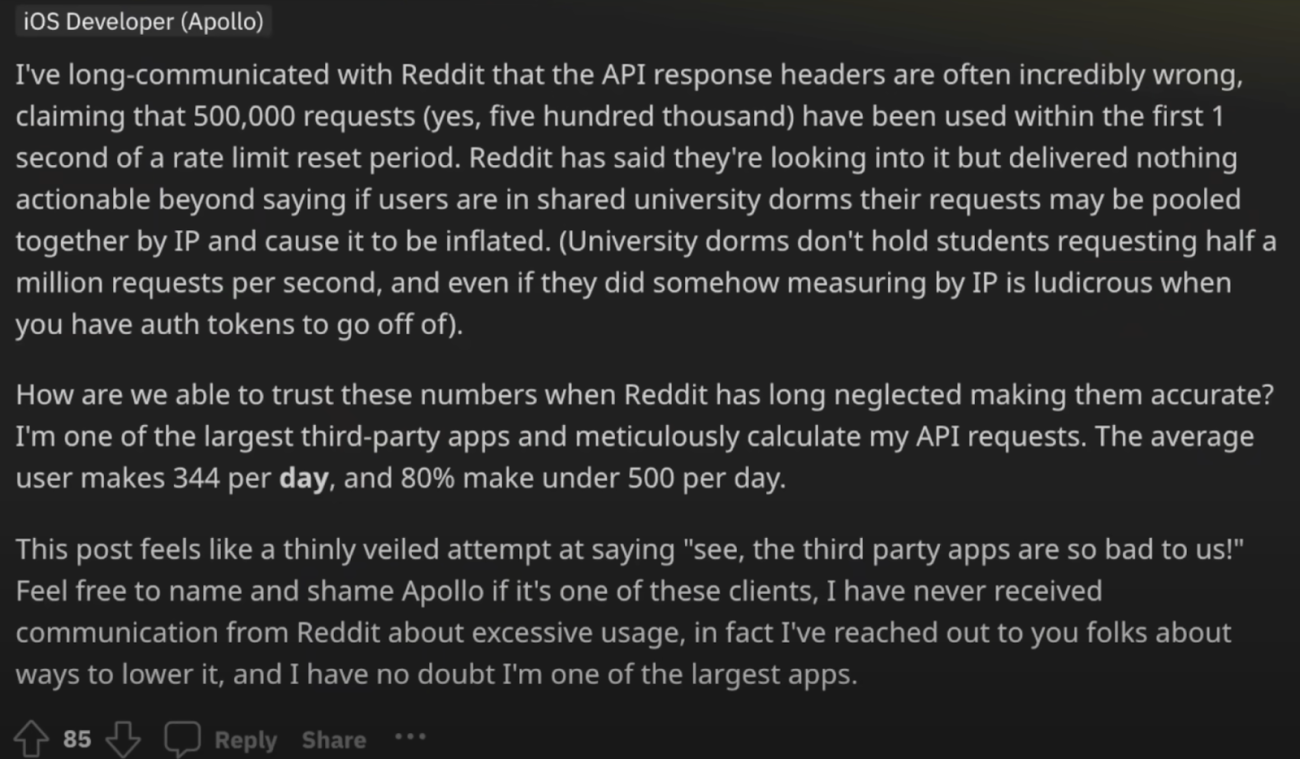
Reddit accused Apollo for being unscrupulous with their API requests and that charging for them would make it more efficient. Christian Selig, the developer of the app spoke in a recent interview addressing these charges.

He explained how these requests work and said, “Every unit of action you can think about is an API request. For example, what I do in Apollo to make it feel a little faster is I request the first 25 posts on a subreddit and then as soon as those load I ask for the next hundred, so you get those first 25 four times quicker giving the users a better experience.” Christian clarified that though it is fair to charge for the API’s, it’s the exorbitant prices that’s causing the outrage.

Though this is still completely within the API rate limits (60 a minute per user) and he uses two, he says, it doesn’t seem wasteful to him but wonders if Reddit deems that as inefficient though it is completely within limits.

Another sore point for most developers is the inconsiderate timeline. The new policy is to be rolled out on July 1, which gives the developers no time to change their own pricing policy having to take on the extra cost on themselves or shut down the app itself. Reddit said they’re unwilling to negotiate the pricing but are willing to consider a pause in the initiation of the pricing plan.

Earlier this year, Twitter faced significant criticism after implementing a comparable policy that excluded developers and researchers from accessing its valuable data. This move led to the demise of several third-party apps, receiving widespread disapproval.

Removal of sexually implicit content from the third party apps are subject to restrictions making such content unavailable. Christian Selig and others agree that doing so would wipe out a large chunk of users from visiting the app. In other cases, medical questions with ‘gory’ images marked NSFW would also be unavailable to users. The reasons given for this limitation is unclear but are in line with legal obligations.

While the protest sends a message to Reddit, it looks unlikely that the company would make any changes to the API pricing. If a significant number of users are willing to put up with a partial absence of Reddit for two days, then the company has to think about what percentage of those will leave forever if they don’t relent.

The post Reddit’s $12,000 API Pricing Smothers Third-Party Apps appeared first on Analytics India Magazine.

Apple’s Homegrown Silicon Emerging in Company’s AI/ML Strategy

Apple’s Homegrown Silicon Emerging in Company’s AI/ML Strategy June 8, 2023 by Agam Shah

Apple's closed environment and in-house hardware and software strategy ensures the company does not have to worry as much as Microsoft or Facebook about building AI factories with a giant battalion of GPUs.

Apple did not talk about its machine learning strategy at last week’s Worldwide Developer Conference where the company revealed a new mixed-reality headset.

Instead, the company talked about how it was building real-world AI features into its devices. The references to AI homed in on one fact: the company is packing more on-device processing capabilities and transformer models to run ML applications.

Apple's control over its software and on-device silicon gives it an advantage in ML and AI delivery. The company is fine-tuning its AI software to its hardware capabilities, which reduces the strain on its data centers to process raw input sent from devices.

"Considering Apple's investment in ML acceleration in Apple Silicon, the strategy appears to prioritize on-device processing, to minimize the amount of data Apple needs to process and store in cloud services," said James Sanders, principal analyst for cloud, infrastructure, and quantum at CCS Insights.

Journal uses on-device machine learning to create personalized suggestions to inspire a user’s journal entry, Apple says. (Source: Apple)

Compare that to Microsoft, which is arming its data centers with GPUs to deliver ML services to client devices, which are largely powered by off-the-shelf hardware.

Apple is using a new transformer model and on-device ML in iOS 17 for features like autocorrect. Apple predicted autocorrect as "state of the art for word prediction, making autocorrect more accurate than ever."

There were also other examples of how Apple is building ML directly into applications.

A new iPhone feature called Suggestions, when enabled, provides suggestions on what memories to include in the Journal application. The on-device feature sounds similar to autocorrect features on mobile devices, but with real-time text input being fed into the on-device ML, which will then provide recommendations.

Apple's scene-stealing Vision Pro headset also uses on-device ML for videoconferencing features. Users can create an animated, but realistic "digital persona" that can represent a user during videoconferences via the mixed reality headset. It is one way to avoid the otherwise real-world appearance of a person wearing a headset, which could be ugly.

The technology uses advanced machine learning techniques to create the digital persona and simulate movement.

"The system uses an advanced encoder-decoder neural network to create your digital persona. This network was trained on a diverse group of thousands of individuals. It delivers a natural representation, which dynamically matches your facial and hand movement," said Mike Rockwell, vice president at Apple, during the speech at WWDC to explain the headset.

Apple also talked about how the homegrown M2 Ultra chip – which is in the outrageously expensive Mac Pro – can "train massive ML workloads, like large transformer models that the most powerful discrete GPU can't even process because it runs out of memory."

To be sure, AI capabilities are already widespread on mobile devices, many of which have neural chips for inferencing. But Apple is not treating AI/ML as a gestalt feature or product, and it is a means by which existing functionality is made better or new functionality is added to existing apps, Sanders said.

Apple's M2 Ultra Chip. (Source: Apple)

Google is also trying to exploit on-device functionality to accelerate AI on client devices. The company has hardware capabilities in its Pixel devices that work with cloud-based AI and ML features. Google in April also announced that it was enabling a protocol called WebGPU – which is the successor to WebGL – to take advantage of hardware resources on client devices for faster AI.

Apple last week detailed a new multimodal transformer model called ByteFormer, which can take in and contextualize audio, video, and other inputs. It transforms audio, visual, or text input into bytes, which enables the development of models which can operate on multiple input modalities. The model was trained on Nvidia A100 GPUs, though it wasn’t clear if the GPUs were in Apple’s data centers.

Sanders said that Apple is exploring generative AI, though it has not been productized yet.  Apple maintains a port of Stable Diffusion compatible with the GPU and ML cores of its M-series chips on Mac and iPad. While not feature-complete, it is rather far along, including support for ControlNet and image inpainting, he said.

Related

Adobe Express gets generative AI tools to level up your design experience

Adobe Express

Adobe has been making headlines for its integration of generative AI into its most popular tools, such as Photoshop. Features like Generative Fill have taken photo editing to the next level, making it possible to add realistic-looking elements to a photo with the click of a button.

Also: The best AI art generators: DALL-E 2 and other fun alternatives to try

On Thursday, Adobe announced that Express, its design application, is getting its own share of generative AI tools to make it easier to create flyers, posters, social media posts, PDFs, and more.

Adobe is integrating its massively successful beta, the Adobe Firefly AI image generator, into Express.

When creating your next design in Express, you can easily generate the exact image you'd like to use for your project. You can also use prompts to tweak other aspects of your project, such as text effects. For example, "Make this font look like balloon text".

Also: How I used ChatGPT and other AI art tools to launch my Etsy business fast

Express was updated with an expanded collection of over 200 million assets, including templates, images, video and audio assets, fonts, icons, backgrounds, and shapes.

To make it easier to find the best assets for you, AI will give personalized template recommendations that fit your exact needs.

"The new release of Adobe Express brings together technology from Photoshop, Illustrator, Premiere, and Acrobat with our Firefly generative AI models into a fun and easy web application experience allowing everyone, from individuals to large organizations to create content that stands out," said David Wadhwani, president, digital media business at Adobe.

Other features include enhanced PDF capabilities, which make it easier to import and edit PDFs in Express, and new animations to help bring elements of your design more character.

Also: This AI chatbot can sum up any PDF and answer any question you have about it

To facilitate collaboration, Express also has real-time review and commenting capabilities.

This release of Adobe Express is available in beta and is free for all users on desktops. The mobile version is coming soon.

All of these new features make Express a direct competitor to Canva, a popular design tool. However, to access Canva's advanced AI features, there is a subscription fee, giving Express a slight advantage.

Adobe also announced that Express is available for enterprise starting today, and Firefly will be available for enterprise in the second half of 2023.

See also

LinkedIn is adding AI-powered tools to help marketing professionals

LinkedIn Copy Suggestions tool mock up

LinkedIn has been quick to adopt generative AI tools on its platform, such as AI-generated Recruiter messages and profile sections, to help both businesses and professionals reach their goals.

On Thursday, LinkedIn introduced AI-generated Copy Suggestions, powered by advanced OpenAI GPT models.

Also: The best AI chatbots: ChatGPT and other noteworthy alternatives

The tool uses data from your LinkedIn Page and Campaign Manager settings to provide five headlines and copy recommendations that you can select from and tweak to your liking.

The actual tool will live in LinkedIn's Campaign Manager, where marketing professionals access marketing tools for launching all sorts of ads throughout the site.

As ZDNET previously reported, a recent study showed that generative AI could save marketing professionals over five hours per week, the equivalent of over a month a year.

Also: Leadership alert: The dust will never settle and generative AI can help

LinkedIn's new feature is a prime example of a tool that reduces a marketer's daily workload, allowing them to improve their performance and focus on more significant tasks.

The feature is being tested in English with a small group of customers in North America. However, LinkedIn shares that it plans on increasing functionality, languages, and availability in upcoming months.

Artificial Intelligence

Google Cloud and Salesforce partner to help improve customer experience with AI

abstract AI data concept

AI seems to be revolutionizing nearly every industry, and now two major players in the advertising world are coming together to utilize AI even more.

In a new partnership announced this week between Google Cloud and Salesforce, the two companies promise to harness the power of AI to help businesses more fully understand their customers, in turn letting these businesses provide a better advertising experience.

Also: Generative AI can save marketing pros 5 hours per week, according to research

Most businesses today try to use customer data when making decisions, but for a lot of companies, that data is either too complex to understand or in too many different sources to be easily accessed.

That's where this partnership comes in.

The agreement brings two main initiatives. In the first part, Salesforce and Google Cloud will take customer data that already exists across multiple platforms and streamline it into a central location, a single unified customer profile of sorts. This would allow companies to run more effective (and cheaper) advertising campaigns.

Also: Leadership alert: The dust will never settle and generative AI can help

Instead of moving data between platforms — something that takes time and money, as well as poses security risks — companies will be able to locate data in a single space.

The second part of the initiative, the companies say, involves generative AI. Using AI, data will be converted into digestible information, but then that information will be used to predict what a customer might want or need next.

With these new tools, a company could more accurately predict new products you may find interesting or even estimate how likely you are to continue doing business with them.

In short, existing data is analyzed to create ads you probably want to see — and companies will have an easier time figuring that out.

Also: AI is coming to a business near you. But let's sort these problems first

The partnership offers a variety of tools and services, including Salesforce's Data Cloud, along with Google's Vertex AI and its BigQuery.

The integration is expected to begin a pilot stage in mid-2023 and be fully functional by the end of 2023.

Artificial Intelligence