How Wigzo by Shiprocket is Using Generative AI to Boost Sales for D2C Brands 

Online jewellery brand GIVA recently saw an increase of 55% in its orders and 775% growth in its subscriber base. Another online lifestyle brand Leaf saw 128% increase in revenue. The same goes for FabIndia, Snitch, Daily Objects, Libas and others that saw their online sales grow multifold in the past few months.

One company that is revolutionising the data experience for D2C brands, and other new-age digital companies, the likes of 4700 BC, Quiltcomfort, FabHotels and Happyfares, is Wigzo by Shiprocket. The company claims to use automated user segmentation to help D2C brands convert, retain, and grow consumers.

Founded in 2014 by Umair Mohammed, Atyab Mohammad and Himanshu Kaushik, Wigzo by Shiprocket provides data driven solutions for leading D2C (e-commerce) brands, especially apparel and fashion brands, with main focus on customer retention and marketing. Earlier this year, Shiprocket acquired 75% stake in the company which is already backed by the likes of SEA Fund, Aarin Capital and more.

Analytics India Magazine got in touch with Umair Mohammed, founder and chief executive officer, and Atyab Mohammad, chief technology officer, to understand how they are helping brands boost sales and profits.

“We aim to enable retailers to achieve a remarkable tenfold increase in sales by equipping them with comprehensive automation and customer engagement solutions,” Umair told AIM.

Atyab added, “We believe, consumer data is the gold mine that can be used to reduce spending on customer acquisition and can be leveraged to target the right consumers.”

Read more: How Data Analytics Fuels Shiprocket

Wigzo identifies active customers and enables conversions by providing tailored recommendations. The company is at the forefront of leveraging AI and advanced analytics to revolutionise customer journeys. By harnessing the power of AI, Wigzo is able to delve deep into consumer behavior, enabling businesses to generate predictive insights and deliver personalised experiences.

Wigzo by Shiprocket recently unveiled their AI-powered customer data platform (CDP), integrating retail, website, and mobile app data. This unified hub allows brands to access and leverage customer information, creating actionable segments and gaining valuable insights. It aims to establish the largest and most comprehensive database, showcasing impressive technical capabilities.

Read more: Prompt Engineering is the New C++

Generative AI to the Rescue

“We are also working at providing a comprehensive chat solution using generative AI, which will enable brands to automate their routine tasks of solving customer queries, tracking inventory, and monitoring marketing trends,” said Atyab.

The company claims to enhance the reliability of its platform with cutting edge tech solutions by partnering with big techs Google and AWS and are leveraging models like Cassandra, MongoDB, and BigQuery, which are all scalable in nature. It is also working towards building AI tools to improve brands’ social media presence and offers automation for marketing. It also integrates with third-party apps like Fastrr, Razorpay, and checkout engines.

Wigzo by Shiprocket also uses AI-enabled sentiment analysis to cull out insights from user-generated content across social media platforms. “Our aim is to simplify merchants’ lives by seamlessly integrating AI into their workflows and providing daily value,” shared Umair at their annual D2C Verse event in Bengaluru, last month.

The tech team is also working on implementing OpenAI’s APIs to build solutions around content generation and data search. Merchants can now easily create messages and ask analytics questions without manual analysis.

Wigzo by Shiprocket has an array of interesting tech-related announcements coming up. One of them is that it is set to launch their versatile omnichannel chatbot platform to address a wide range of brand needs, ranging from customer support to personalised recommendations.

In recent times, e-commerce platforms have been playing with generative AI in their day-to-day operations, particularly in the areas of customisation, design, marketing and improving the customer journey. Meesho, an online lifestyle company, is actively experimenting with generative AI across various applications like recommendation systems, enhancing product cataloguing with more visually appealing representations, and providing virtual try-on experiences.

Tapestry, a luxury fashion brand, is strengthening its marketing strategies by harnessing the power of generative AI to automate personalised online experiences. Marks & Spencer is also closely following this trend. Following suit, Coca-Cola underwent a marketing transformation through generative AI, facilitated by the partnership between OpenAI and Bain & Co. Over time, the adoption rate of AI by D2C brands is only going to increase for the good.

Read more: Indian Edtech, Why So Toxic?

The post How Wigzo by Shiprocket is Using Generative AI to Boost Sales for D2C Brands appeared first on Analytics India Magazine.

Cohere Raises $270M Series C to Empower Businesses with AI

Cohere Raises $270M Series C to Empower Businesses with AI June 9, 2023 by Jaime Hampton

Cohere, the provider of an AI development platform, announced it has raised $270 million in a Series C round.

“AI will be the heart that powers the next decade of business success,” said Aidan Gomez, CEO and co-founder, Cohere. “As the early excitement about generative AI shifts toward ways to accelerate businesses, companies are looking to Cohere to position them for success in a new era of technology. The next phase of AI products and services will revolutionize business, and we are ready to lead the way.”

Cohere offers an enterprise-focused AI platform with several deployment options, as well as customization options and support from an ecosystem of consulting and system integrator partners. The company’s enterprise AI suite is cloud-agnostic and built to be available on every cloud provider, deployed inside customers’ existing cloud environment, virtual private cloud, or on-prem.

The latest Series C round was led by Inovia Capital with participation from a diverse range of investors including Nvidia, Oracle, Salesforce Ventures, DTCP, Mirae Asset, Schroders Capital, SentinelOne, Thomvest Ventures, and returning investor Index Ventures.

The company says the funding will accelerate its leadership position in enabling enterprises to securely build AI applications on their chosen cloud platform.

Aidan Gomez, CEO and co-founder of Cohere. (Source: Cohere)

“We are at the beginning of a new era driven by accelerated computing and generative AI,” said Jensen Huang, founder and CEO of Nvidia. “The team at Cohere has made foundational contributions to generative AI. Their service will help enterprises around the world harness these capabilities to automate and accelerate.”

“Our entire raison d’être is to invest in great entrepreneurs who have great worldwide missions and ambitions,” said Steve Woods, CTO and partner, Inovia Capital. “Very few ideas can fundamentally change society and add more value to humankind. This is obviously one such opportunity and we are thrilled to partner with Cohere to be a part of it.”

Cohere was founded by Canadian researchers and Google alumni Gomez and Nick Frosst, and Toronto entrepreneur Ivan Zhang. Gomez was a member of the research team that published a paper detailing the Transformer architecture that became the basis for today’s LLMs.

Cohere’s recent trajectory is marked by a number of key developments. The company secured an investment from Salesforce Ventures as part of its $250 million generative AI fund. Cohere also launched a pilot program with conversational AI specialist LivePerson for developing custom LLMs. Additionally, Cohere’s Command model was ranked highly in accuracy over comparable models in Stanford’s latest HELM benchmark, an evaluation of LLMs.

“Cohere has a rare combination of top-tier talent, the most innovative technology and is best positioned to seize the global enterprise market opportunity for Generative AI and LLMs,” said Lance Matthews, managing director, DTCP. “Our unique fund structure and relationships allow us to gather a coalition of global institutional and strategic investors including Deutsche Telekom to accelerate Cohere’s vision to bring this technology to enterprises worldwide.”

Related

Healthcare Analytics: How it Enables Better Patient Care

Brain Implants Technologies Isometric Composition

There is no denying that data is easily one of the most valuable resources globally. But what’s interesting are its applications, in addition to driving analytics in the conventional sense and delivering precious insights into the business. And, there is another facet where data stands to provide extraordinary value: Healthcare analytics. You see, the healthcare sector is a complex maze where the service providers are continually striving to not only tend to patients under their care. It also drives the advancement of the evolution of healthcare and medicine in general. Suffice it to say one needs quality assistance from solutions such as healthcare analytics.

Simply put, healthcare analytics helps the sector make sense of the data at hand. It enables healthcare facilities to leverage top-notch analytics to glean valuable insights from data — historical and current. In turn, this ability allows such facilities and providers to deliver substantially better levels of care to patients and help the business grow to the next level. However, a relatively new arrival on the scene has already proven its mettle, helping healthcare companies handle risk effortlessly, strengthen research, etc. Now, let’s look at how else it aids the healthcare sector’s efforts to deliver better patient care.

Key Benefits of Data Analytics in Healthcare:

  • Cut down costs: The cost of healthcare continues to soar, which is understandably a point of contention for both hospitals and patients. It helps in this regard by enabling hospitals to cut down the number of emergency room visits, reduce unnecessary testing, eliminate inefficiencies, and more. It is done by careful analysis of vital parameters and data points such as treatment plans, prescriptions, etc.
  • Foretell risk: Healthcare analytics also helps hospitals and care providers to foretell and identify patients at high risk of developing specific diseases. Such insights can then be used to kick off preventive treatment or early intervention to prevent the situation from devolving into a critical health issue. To this end, the solutions use data such as family history, gender, health stats, and more to identify risks for any given patient.
  • Organize operations: The onlooker may not realize that even seemingly harmless factors such as waiting times can take a heavy toll on the patient’s well-being. One of the most effective ways to deal with this is to ensure the hospital or facility’s operations are thoroughly organized. How does analytics in healthcare help with that? Well, by providing a real-time view of metrics and performance stats for safety, quality, and more, as well as the availability of beds and current demand, among other things. Such information then facilitates better, informed decision-making.

As technology continues to evolve, we are bound to find better and more innovative healthcare analytics uses. And given that it will continue to deliver such high value to the industry for the foreseeable future. It only makes sense to find a healthcare software development company and get started on integrating such quality analytics in your operations

Also, if you are looking to know about the impact of Business Intelligence in Healthcare industry.

The Importance of Data Engineering for a Profitable App Development

data engineer

High-quality app development can significantly drive your business growth and success while boosting customer satisfaction and bringing in more clients. However, with millions of apps existing in the market, standing out from the competition requires more than just a great idea and an appealing design.

Data engineering is what can help you, playing a pivotal role in creating a truly successful and profitable application.

In this article, we’ll highlight the importance of data engineering in app development and provide some actionable tips on how to ensure your next project’s success.

Data Engineering Functions in App Development

Digital data offers endless possibilities for businesses to serve their clients and users better. A data-driven company can identify actual customers’ needs and upgrade a web or mobile app accordingly, and launch new fast-growing business units. All this becomes possible with the help of comprehensive data engineering.

When it comes to impactful data engineering for app development. Partnering with a trusted and experienced company is a pledge of success.

Here’s why collaborating with a reliable data engineering service provider is beneficial:

  1. Expertise – A reputable tech company has a deep understanding of data engineering best practices, tools, and technologies. By leveraging their knowledge, they can design robust data architectures, and implement efficient data processing workflows. And it also delivers high-quality solutions tailored to your app’s specific needs.
  2. Niche skills – data modeling, ETL development, database management, and analytics.
  3. Flexibility – A trusted partner can accommodate growing data volumes, user bases, and feature requirements. To ensure your app’s data engineering capabilities can scale seamlessly.
  4. Cost-effectiveness – by avoiding the need to hire and train an in-house data engineering team. You can reduce recruitment and operational costs.

When choosing a data engineering partner for your strategic software solutions, consider their track record, testimonials, and industry reputation. Also, make sure the company you choose aligns with your goals, values, and project requirements.

For instance, consider contacting Busy Rebel, they are a trusted name in the tech market. They are known for their rich expertise in delivering top-notch solutions for app development. With their big data and data engineering services, clients get the possibility to harness the power of data to drive their app’s profitability.

Allowing businesses to transform data into valuable insights, data engineering performs the following functions:

  • Data collection – covers user interactions, profiles, feedback, and external data.
  • Data storage and integration – with a database management system (DBMS), data is stored and integrated with other systems for a comprehensive view.
  • Data processing – involves data cleaning, normalization, and enrichment for consistency and standardization.
  • Data analysis – includes data mining, statistical analysis, and machine learning to uncover patterns, trends, and correlations within the data.
  • Data reporting – involves a collaboration with UX/UI designers to create intuitive dashboards and reports for accessible insights.
  • Data security – allows data engineers to implement data privacy measures, adhere to data protection and secure data storage and transmission.
  • Continuous improvement – ongoing evaluation of the performance of data pipelines, data storage systems, and analytics processes to identify areas for improvement.

Benefits of Data Engineering for Modern Businesses

  • Enhanced decision-making

Data engineering allows online app businesses to collect and analyze data from various sources, such as web content, user interactions, market trends, or customer feedback. By leveraging this information, app developers can make more informed decisions about feature enhancements, product improvements, and targeted marketing strategies.

Such a data-driven decision-making approach minimizes risks and maximizes the chances of app success.

  • Personalized UX

Today, every user expects personalized experiences tailored to their preferences and needs. Data engineering allows developers to gather user data, including demographics, behavior patterns, and usage statistics. And use it to understand their target audience better.

By leveraging this information, apps can deliver personalized content, recommendations, and user interfaces, enhancing user satisfaction. Not only does it improve user retention, but also increases the likelihood of app monetization through targeted ads or in-app purchases.

  • Improved app performance

Effective data engineering tactics can ensure your app can handle large-scale data and provide a seamless UX, even during peak usage. By monitoring real-time data, developers can identify and address performance holes, optimize queries, and improve response times.

An app that performs well is more likely to attract and retain users, leading to increased profitability.

  • Effective monetization strategies

Monetization is a critical aspect of app development, and data engineering can significantly contribute to its success. By analyzing user behavior, preferences, and purchasing patterns. Data engineering can help developers identify potential revenue streams and devise effective monetization strategies.

Whether it’s through in-app purchases, subscriptions, targeted advertisements, or data licensing. Data engineering provides valuable insights that enable businesses to define the greatest revenue-generating strategies and channels.

  • Improved data governance

Most businesses face increasing regulatory requirements and data privacy concerns. Data engineering can help ensure proper data governance and compliance with relevant regulations.

With data cleaning, normalization, and standardization, you can ensure your data is accurate and consistent. What’s more, with robust security measures and data protection regulations. Data engineering can protect user data from unauthorized access or breaches and ensure it’s compliant with data protection regulations.

This, in turn, builds trust among your app users, protects your business from legal and reputational risks, and fosters a positive relationship with regulatory authorities.

Extra Tips for a Profitable App Development Using Data Engineering Services

  • Prioritize data privacy

While harnessing data for app development, it is crucial to prioritize data privacy and security. Respecting user privacy builds trust and enhances the app’s reputation.

Make sure your app is compliant with relevant data protection regulations and implement robust security measures to safeguard user information.

  • Embrace Agile data engineering practices

Adopting Agile methodologies can streamline the development process, allowing for iterative improvements and faster time-to-market.

Embrace tools and frameworks that enable rapid data processing, automation, and collaboration. To ensure efficiency and agility throughout the app development lifecycle.

Conclusion

In today’s competitive app development market, data engineering is indispensable for success and profitability. It has become a crucial investment for businesses aiming to thrive in the dynamic landscape.

By leveraging data engineering services, developers can gain a competitive edge, drive user engagement, and maximize revenue generation. The insights derived from data engineering empower businesses to create apps that meet user expectations, leading to profitable ventures and undeniable success.

Data observability vs data quality

Data Observability Vs Data Quality

As companies gather seemingly endless data streams from an increasing number of sources, they start to amass an ecosystem of data storage, would-be end-users, and pipelines. With each additional layer of complexity, opportunities for data downtime, and moments when data is partial, erroneous, missing, or otherwise inaccurate, multiply. As a result, data teams spend most of their time on data quality issues instead of working on revenue-generating activities for the business.

Data observability can be defined as the holistic view that includes monitoring, tracking, and triaging incidents to prevent downtime of the systems. At the same time, Data quality is a measurement of how to fit a data set to cater to an organization’s specific needs.

Where do they overlap?

Data observability is used to better data quality. When organizations adopt data observability to enhance data quality, there are bound to be great results. Some of them include;

  1. Cost savings by getting data anomalies before they impact consumers-When an anomaly occurs, the data observability engine alerts the team immediately, allowing time to investigate and troubleshoot the problem before it affects consumers. Since the Data Engineering team is notified of the issue before it involves stakeholders, they could fix their pipeline and avert future anomalies from jeopardizing the integrity of their data.
  2. Improved collaboration by tracing field-level lineage-data observability helps understand dependencies.
  3. Raising productivity by keeping tabs on deprecated data sets-data observability gives greater transparency into critical data assets’ relevancy and usage patterns, informing them when different attributes are deprecated.
  4. Increase cost savings by reducing time to resolve tiresome data fire drills and regain trust in critical decision-making data.
  5. Better organization between data engineering and data analyst teams to comprehend critical dependencies between data assets.
  6. Drive greater efficiency and productivity by adding end-to-end visibility into the health, usage patterns, and relevancy of data assets.
    It can be concluded that data observability and data quality rely on organizations to function well. As much as there are differences, the two overlap in various ways that help better data quality and delivery. To learn more about data observability, schedule a demo with us.

Getting Started with ReactPy

Getting Started with ReactPy
Image by Author

With the surging popularity of ReactJS in web development, there is an increasing demand for a similar framework in Python for building production-ready machine learning, AI, and data science applications. This is where ReactPy comes in, providing beginners, data scientists, and engineers the ability to create ReactJS-like applications in Python. ReactPy gives users a simple, declarative view framework that efficiently scales applications to complex use cases.

In this blog post, we will explore ReactPy, learning how to build a simple application and run it both within a web browser and a Jupyter Notebook. Specifically, we will cover:

  • Running a ReactPy on a web browser using various backends API.
  • Running ReactPy in Jupyter Notebook using Jupyter widgets.

What is ReactPy?

ReactPy is a Python library for building user interfaces without using JavaScript. The interfaces of ReactPy are built using components that offer a similar experience to that found in ReactJS.

Designed for simplicity, ReactPy has a gentle learning curve and a minimal API surface. This makes it accessible to those without web development experience, yet it can also scale to support sophisticated applications.

Setting Up

It is quite easy to install ReactPy by using pip:

pip install reactpy

After installing, try running a sample application using the script below.

python -c "import reactpy; reactpy.run(reactpy.sample.SampleApp)"

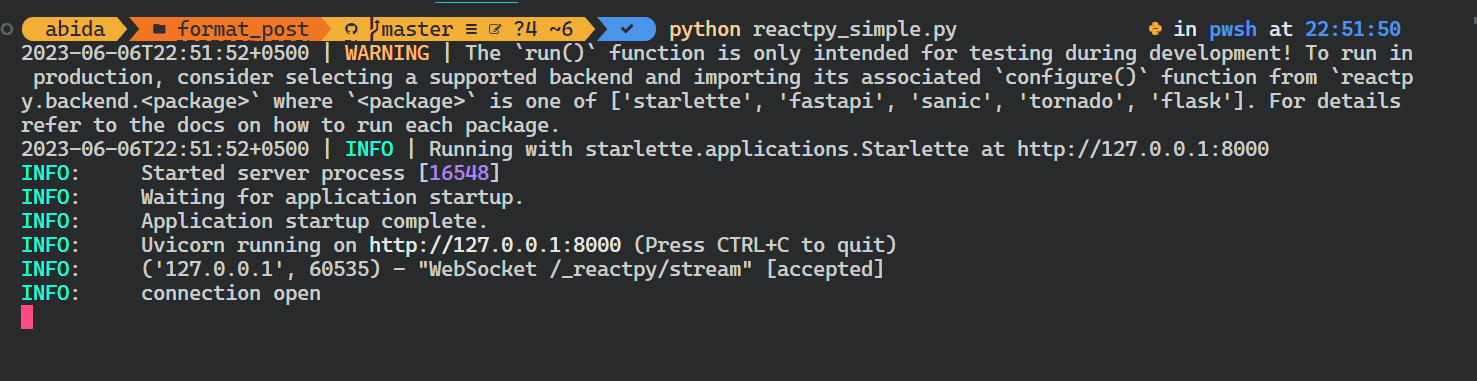
Our application with the starlette backend is running on a local address. Just copy it and paste it into the web browser.

Getting Started with ReactPy

As we can observe that ReactPy is running perfectly.

Getting Started with ReactPy

You can also install with the backend of your choice. In our case, we will install ReactPy with the fastapi backend.

pip install "reactpy[fastapi]"

Here is the list of the most popular Python backends that comes with ReactPy:

  • fastapi: https://fastapi.tiangolo.com
  • flask: https://palletsprojects.com/p/flask/
  • sanic: https://sanicframework.org
  • starlette: https://www.starlette.io/
  • tornado: https://www.tornadoweb.org/en/stable/

Running a ReactPy on Web Browser

We will now try to build a simple app with the heading 1 and a paragraph and run it on the default backend (starlette).

  • When you create a new component function, try to add a magic function @componnet above a function.
  • After that, create a skeleton of a web page with different HTML elements like:
    • html.h1 for heading 1.
    • html.b for bold.
    • html.ul and html.li for bullet points.
    • html.img for images.
from reactpy import component, html, run      @component  def App():      return html.section(          html.h1("Welcome to KDnuggets"),          html.p("KD stands for Knowledge Discovery."),      )      run(App)

Save the above code in a reactpy_simple.py file and run the following command in the terminal.

python reactpy_simple.py

Getting Started with ReactPy
Our simple web application is running smoothly.
Getting Started with ReactPy

Let’s try to add more html components like image and list, and run the application using fastapi backend. For that:

  1. Import FastAPI class and configure from reactpy.backend.fastapi
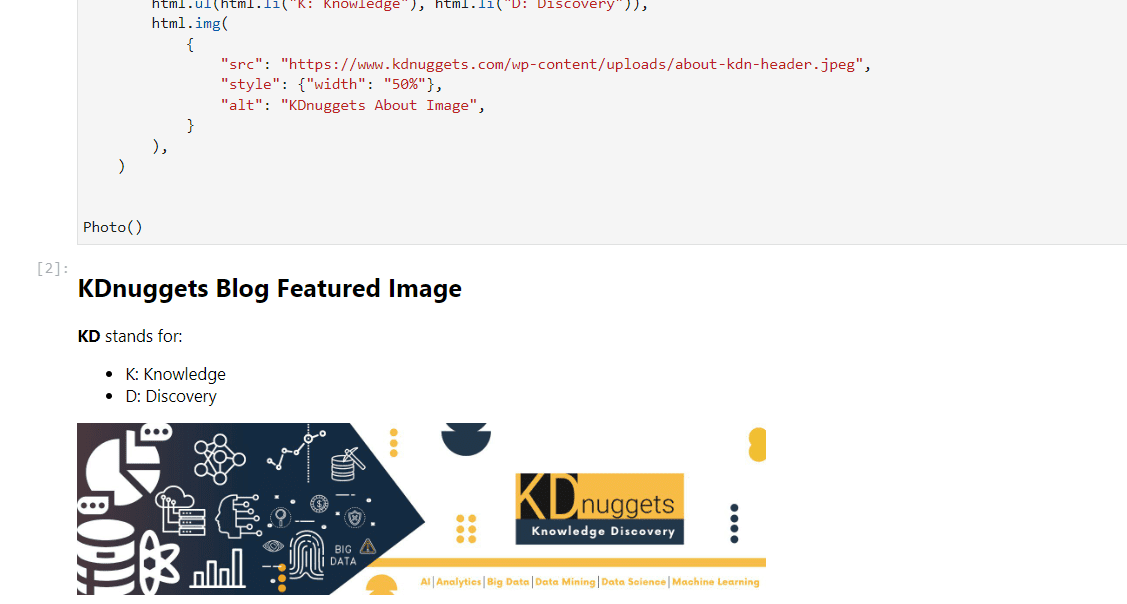
  2. Create a component function called Photo() and add all of the HTML elements.
  3. Create an app object using FastAPI object and configure it with the ReactPy component.
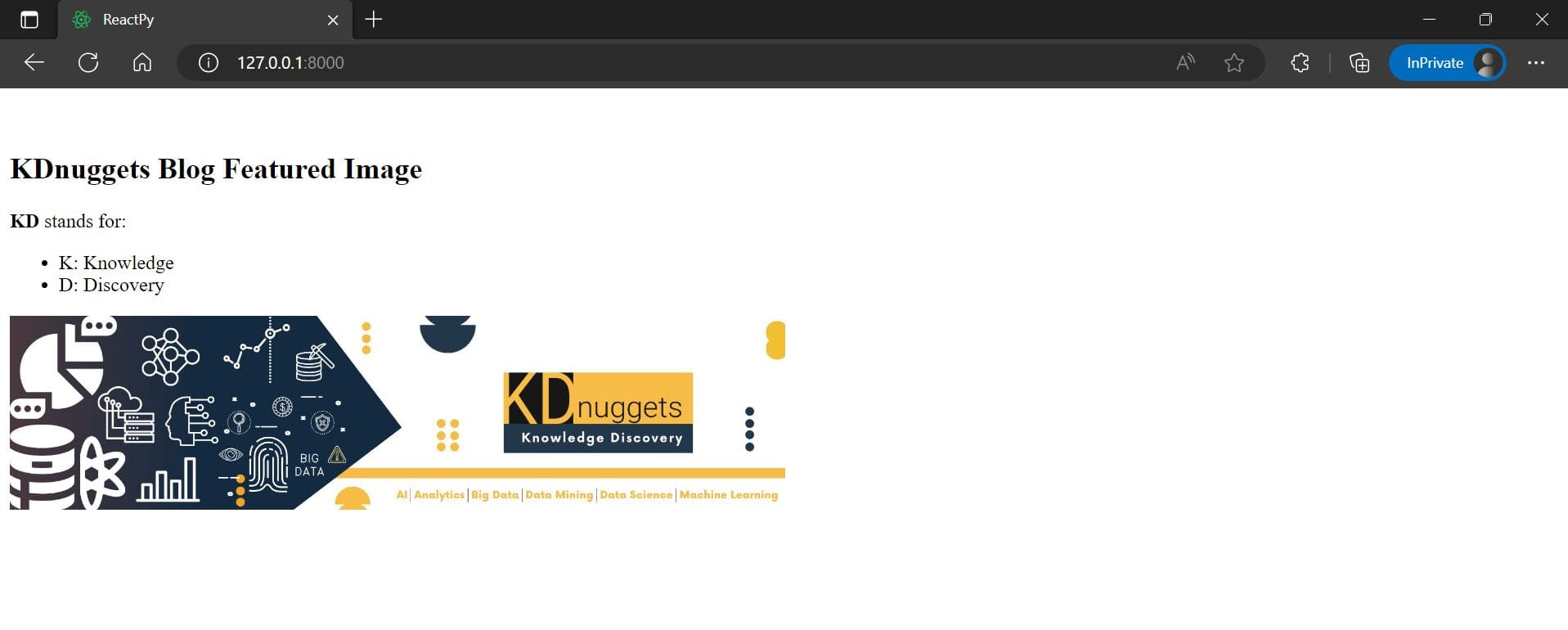
from fastapi import FastAPI  from reactpy import component, html  from reactpy.backend.fastapi import configure      @component  def Photo():      return html.section(          html.h1("KDnuggets Blog Featured Image"),          html.p(html.b("KD"), " stands for:"),          html.ul(html.li("K: Knowledge"), html.li("D: Discovery")),          html.img(              {                  "src": "https://www.kdnuggets.com/wp-content/uploads/about-kdn-header.jpeg",                  "style": {"width": "50%"},                  "alt": "KDnuggets About Image",              }          ),      )      app = FastAPI()  configure(app, Photo)

Save the file with the name reactpy_advance.py and run the application like you run any FastAPI application using unicorn.

uvicorn reactpy_advance:app

Getting Started with ReactPy
As we can observe, our app is running with additional HTML elements.
Getting Started with ReactPy

To confirm that it is running FastAPI as a backend, we will add /docs to the link.

Getting Started with ReactPy Running ReactPy in Jupyter Notebook

Running and Testing ReactPy in Jupyter Notebook requires installing a Jupyter widget called reactpy_jupyter.

%pip install reactpy_jupyter

Before running anything, run the following command first to activate the widget.

import reactpy_jupyter

Or use %config magic function to register reactpy_jupyter as a permanent IPython extension in your config file.

%config InteractiveShellApp.extensions = ['reactpy_jupyter']

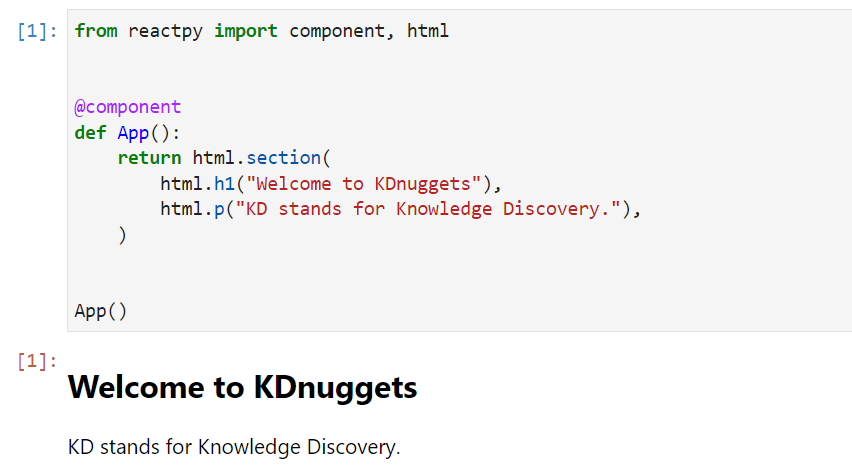
We will now run the ReactPy component in the Jupyter Notebook. Instead of using run(), we will directly run a component function.

from reactpy import component, html      @component  def App():      return html.section(          html.h1("Welcome to KDnuggets"),          html.p("KD stands for Knowledge Discovery."),      )      App()

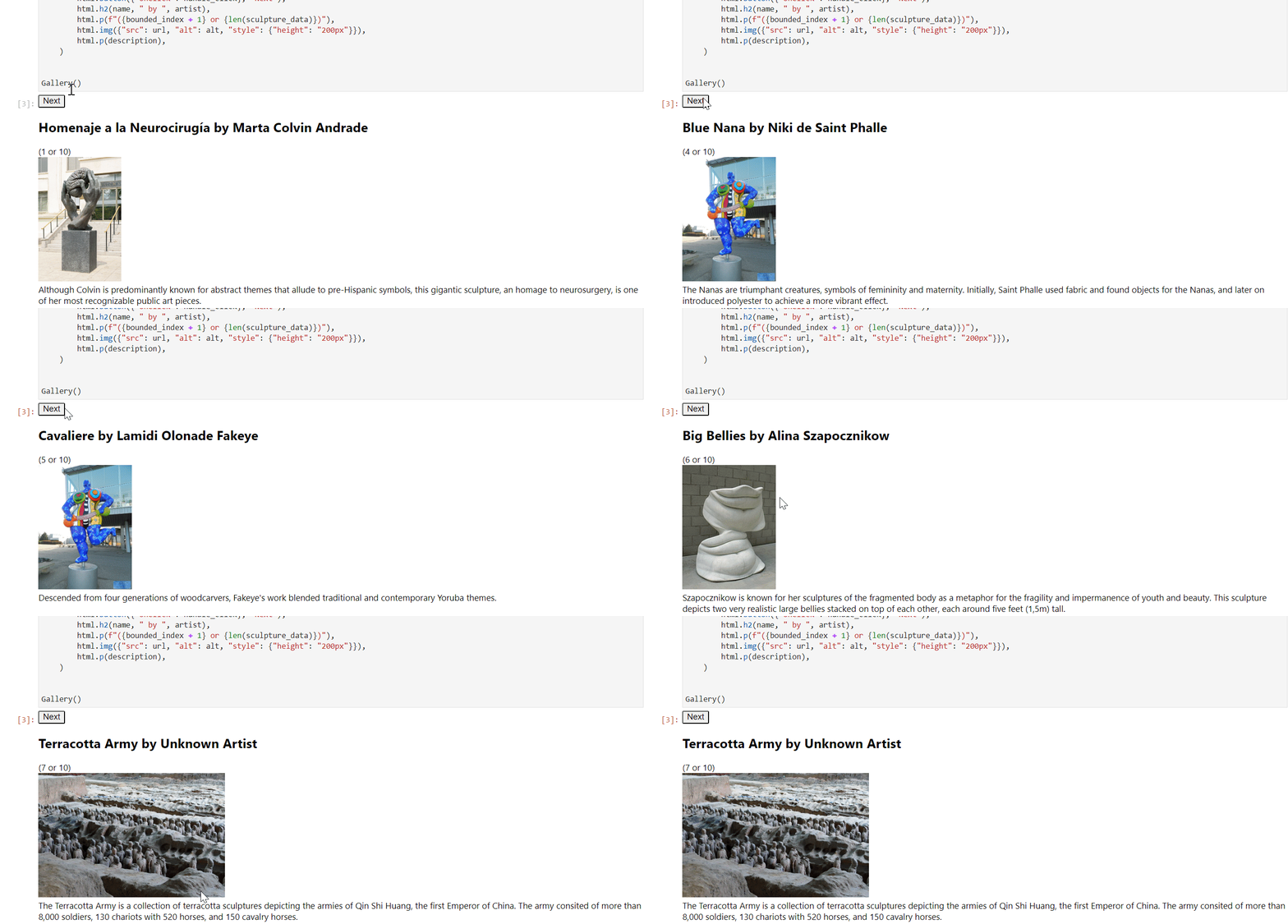
Similarly to previous examples, we will run an advanced example by running Photo() function.

Getting Started with ReactPy

from reactpy import component, html      @component  def Photo():      return html.section(          html.h1("KDnuggets Blog Featured Image"),          html.p(html.b("KD"), " stands for:"),          html.ul(html.li("K: Knowledge"), html.li("D: Discovery")),          html.img(              {                  "src": "https://www.kdnuggets.com/wp-content/uploads/about-kdn-header.jpeg",                  "style": {"width": "50%"},                  "alt": "KDnuggets About Image",              }          ),      )      Photo()

Getting Started with ReactPy

We can also create an interactive app using buttons and input, as shown below. You can read ReactPy documentation for creating the user interface, interactivity, managing state, API hooks, and escape hatches.

Getting Started with ReactPy
Gif from ReactPy on Binder
Conclusion

In summary, this blog post has provided an introduction to ReactPy, demonstrating how to create simple ReactPy applications. By running ReactPy within a web browser using different API backends as well as within Jupyter Notebooks using Jupyter widgets, we have seen the flexibility of ReactPy in allowing developers to build applications for both web and notebook environments.

ReactPy shows promise as a Python library for creating reactive user interfaces that can reach a wide audience. With continued development, ReactPy may become a compelling alternative to JavaScript-based React for machine learning and AI Python applications.

  • Try ReactPy on Binder
  • ReactPy Documentation
  • GitHub Repository

Abid Ali Awan (@1abidaliawan) is a certified data scientist professional who loves building machine learning models. Currently, he is focusing on content creation and writing technical blogs on machine learning and data science technologies. Abid holds a Master's degree in Technology Management and a bachelor's degree in Telecommunication Engineering. His vision is to build an AI product using a graph neural network for students struggling with mental illness.

More On This Topic

  • Getting Started in AI Research
  • Getting Started with PyTorch
  • Getting Started with SQL Cheatsheet
  • Getting Started with spaCy for NLP
  • Getting Started with PyCaret
  • Getting Started with GitHub CLI

Intel Unveils Arc Pro A60 and A60M GPUs

Intel Unveils Arc Pro A60 and A60M GPUs

Intel has introduced its latest offerings in the professional graphics processing unit (GPU) market with the launch of the Intel Arc Pro A60 and Pro A60M GPUs. These new products are part of the Intel Arc Pro A-series and are specifically designed to meet the needs of professional workstation users.

The Intel Arc Pro A60 and Pro A60M GPUs boast impressive performance improvements compared to their predecessors. With up to 12GB of video memory (VRAM) and support for four displays featuring high dynamic range (HDR) and Dolby Vision support, these GPUs offer enhanced capabilities for content creation and visual experiences.

One of the standout features of the Intel Arc Pro A60 GPU is its integration of ray tracing hardware, graphics acceleration, and machine learning capabilities. This combination enables smooth viewports, advanced visual technologies, and robust content creation, all packed into a traditional single-slot form factor.

The Intel Arc Pro A-series graphics bring a fresh option to the workstation GPU market. The A60 and A60M models provide double the number of PCIe lanes, twice the memory bandwidth of 384 GBs, twice the dedicated AI Xe Matrix Extensions (XMX) engines, and twice the number of ray tracing units compared to previous Intel Arc Pro products.

These GPUs also offer comprehensive support for media encode and decode, including AV1, making them ideal for computer-aided design and modeling (CAD/CAM), AI inferencing tasks, and media processing in dedicated business environments that rely heavily on software such as Autodesk, Bentley MicroStation, Dassault Systemes SOLIDWORKS, Nemetscheck VectorWorks, PTC Creo, and others.

Intel’s workstation GPUs are not only tailored for professional workstations but are also optimized for media and entertainment applications. They excel in running rendering and ray tracing libraries within the Intel oneAPI Rendering Toolkit, enabling the creation of visually stunning and immersive experiences with exceptional performance and fidelity. Applications like Blender benefit from these optimizations, empowering users to harness the capabilities of Intel’s GPUs for large-scale, high-quality rendering and realistic ray-traced graphics.

Furthermore, the Intel Arc Pro GPU family has undergone compatibility validation with Intel NUC 13 Extreme small form factor (SFF) PCs. These compact PCs, equipped with powerful 125W unlocked 13th Gen Intel Core processors, provide users with a high-performance computing solution.

The Intel Arc Pro A60 GPU designed for desktop workstations will be released and made available through Intel-authorized distributors in the coming weeks. On the other hand, the Intel Arc Pro A60M GPU, intended for mobile systems, will be offered by original equipment manufacturers (OEM) partners, but its availability is expected in the coming months.

Leading computer manufacturers are also joining the Intel Arc Pro GPU ecosystem. HP has already introduced workstation designs featuring the Intel Arc Pro A40 GPU, which are currently available. Dell and Lenovo are expected to launch their own workstation designs featuring the Intel Arc Pro GPUs in the third quarter of 2023.

The post Intel Unveils Arc Pro A60 and A60M GPUs appeared first on Analytics India Magazine.

Runway’s Gen-2 shows the limitations of today’s text-to-video tech

Runway’s Gen-2 shows the limitations of today’s text-to-video tech Kyle Wiggers 8 hours

In a recent panel interview with Collider, Joe Russo, the director of tentpole Marvel films like “Avengers: Endgame,” predicted that, within two years, AI will be able to create a fully-fledged movie.

It’d say that’s a rather optimistic timeline. But we’re getting closer.

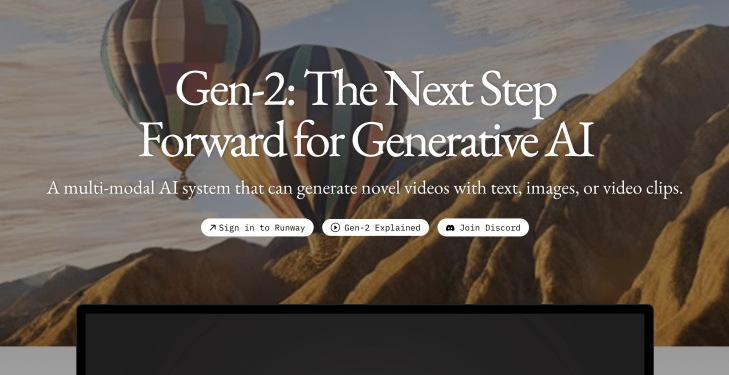
This week, Runway, a Google-backed AI startup that helped develop the AI image generator Stable Diffusion, released Gen-2, a model that generates videos from text prompts or an existing image. (Gen-2 was previously in limited, waitlisted access.) The follow-up to Runway’s Gen-1 model launched in February, Gen-2 is one of the first commercially available text-to-video models.

“Commercially available” is an important distinction. Text-to-video, being the logical next frontier in generative AI after images and text, is becoming a bigger area of focus particularly among tech giants, several of which have demoed text-to-video models over the past year. But those models remain firmly in the research stages, inaccessible to all but a select few data scientists and engineers.

Of course, first isn’t necessarily better.

Out of personal curiosity and service to you, dear readers, I ran a few prompts through Gen-2 to get a sense of what the model can — and can’t — accomplish. (Runway’s currently providing around 100 seconds of free video generation.) There wasn’t much of a method to my madness, but I tried to capture a range of angles, genres and styles that a director, professional or armchair, might like to see on the silver screen — or a laptop as the case might be.

One limitation of Gen-2 that became immediately apparent is the framerate of the four-second-long videos the model generates. It’s quite low and noticeably so, to the point where it’s nearly slideshow-like in places.

Runway Gen-2

Image Credits: Runway

What’s unclear is whether that’s a problem with the tech or an attempt by Runway to save on compute costs. In any case, it makes Gen-2 a rather unattractive proposition off the bat for editors hoping to avoid post-production work.

Beyond the framerate issue, I’ve found that Gen-2-generated clips tend to share a certain graininess or fuzziness in common, as if they’ve had some sort of old-timey Instagram filter applied. Other artifacting occurs as well in places, like pixelation around objects when the “camera” (for lack of a better word) circles them or quickly zooms toward them.

As with many generative models, Gen-2 isn’t particularly consistent with respect to physics or anatomy, either. Like something conjured up by a surrealist, people’s arms and legs in Gen-2-produced videos meld together and come apart again while objects melt into the floor and disappear, their reflections warped and distorted. And — depending on the prompt — faces can appear doll-like, with glossy, emotionless eyes and pasty skin that evokes a cheap plastic.

Runway Gen-2

Image Credits: Runway

To pile on higher, there’s the content issue. Gen-2 seems to have a tough time understanding nuance, clinging to particular descriptors in prompts while ignoring others, seemingly at random.

Runway Gen-2

Image Credits: Runway

One of the prompts I tried, “A video of an underwater utopia, shot on an old camera, in the style of a ‘found footage’ film,’ brought about no such utopia — only what looked like a first-person scuba dive through an anonymous coral reef. Gen-2 struggled with my other prompts too, failing to generate a zoom-in shot for a prompt specifically calling for a “slow zoom” and not quite nailing the look of your average astronaut.

Could the issues lie with Gen-2’s training data set? Perhaps.

Gen-2, like Stable Diffusion, is a diffusion model, meaning it learns how to gradually subtract noise from a starting image made entirely of noise to move it closer, step by step, to the prompt. Diffusion models learn through training on millions to billions of examples; in an academic paper detailing Gen-2’s architecture, Runway says the model was trained on an internal data set of 240 million images and 6.4 million video clips.

Diversity in the examples is key. If the data set doesn’t contain much footage of, say, animation, the model — lacking points of reference — won’t be able to generate reasonable-quality animations. (Of course, animation being a broad field, even if the data set did have clips of anime or hand-drawn animation, the model wouldn’t necessarily generalize well to all types of animation.)

Runway Gen-2

Image Credits: Runway

On the plus side, Gen-2 passes a surface-level bias test. While generative AI models like DALL-E 2 have been found to reinforce societal biases, generating images of positions of authority — like “CEO or “director” — that depict mostly white men, Gen-2 was the tiniest bit more diverse in the content it generated — at least in my testing.

Runway Gen-2

Image Credits: Runway

Fed the prompt “A video of a CEO walking into a conference room,” Gen-2 generated a video of men and women (albeit more men than women) seated around something like a conference table. The output for the prompt “A video of a doctor working in an office,” meanwhile, depicts a woman doctor vaguely Asian in appearance behind a desk.

Results for any prompt containing the word “nurse” were less promising though, consistently showing young white women. Ditto for the phrase “a person waiting tables.” Evidently, there’s work to be done.

The takeaway from all this, for me, is that Gen-2 is more a novelty or toy than a genuinely useful tool in any video workflow. Could the outputs be edited into something more coherent? Perhaps. But depending on the video, it’d require potentially more work than shooting footage in the first place.

That’s not to be too dismissive of the tech. It’s impressive what Runway’s done, here, effectively beating tech giants to the text-to-video punch. And I’m sure some users will find uses for Gen-2 that don’t require photorealism — or a lot of customizability. (Runway CEO Cristóbal Valenzuela recently told Bloomberg that he sees Gen-2 as a way to offer artists and designers a tool that can help them with their creative processes.)

Runway Gen-2

Image Credits: Runway

I did myself. Gen-2 can indeed understand a range of styles, like anime and claymation, which lend themselves to the lower framerate. With a little fiddling and editing work, it wouldn’t be impossible to string together a few clips from to create a narrative piece.

Lest the potential for deepfakes concern you, Runway says it’s using a combination of AI and human moderation to prevent users from generating videos that include pornography, violent content or that violate copyrights. I can confirm there’s a content filter — an overzealous one in point of fact. But course, those aren’t foolproof methods, so we’ll have to see how well they work in practice.

Runway Gen-2

Image Credits: Runway

But at least for now, filmmakers, animators and CGI artists and ethicists can rest easy. It’ll be at least couple iterations down the line before Runway’s tech comes close to generating film-quality footage — assuming it ever gets there.

AlphaDev Isn’t As Big As It Seems

Earlier this week, Google DeepMind created a new algorithm based on AlphaZero. Termed AlphaDev, this algorithm can reportedly create algorithms that can sort data up to 3 times faster than human-written algorithms. While this has been heralded as one of the biggest advancements in machine learning, it is actually a classic case of making a mountain out of a molehill.

Delving deeper into the purported findings, we found that this story was spun in an attempt to make DeepMind look more relevant. In reality, these ‘new sorting algorithms’ were actually not novel in any way and were cherry-picked to make the findings look bigger than they actually were. This also comes at a time when DeepMind is falling behind other tech giants in AI innovation.

AlphaDev explained

Just like DeepMind researchers solved protein folding, they set out to tackle one of the biggest problems in computer science: sorting algorithms. These algorithms are used trillions of times across various computer systems, with DeepMind choosing to take on the task of optimising them. The think tank approached this problem by deploying AI to ‘go beyond the current state of the art by discovering hitherto unknown routines’.

To do so, DeepMind structured the task of discovering the sorting algorithm as a single-player game, which allowed them to deploy their past experiences designing AI agents to play games. Using this approach, DeepMind created a new AI agent they call AlphaDev, which was then put to the task to discover new algorithms.

AlphaDev is a spiritual successor to the AlphaZero algorithm, but instead of choosing possible moves in a board game, it chooses instructions to add to a sorting procedure. What’s more, the agent carried out these operations at the assembly level, similar to programmers who write code in C++, the language of choice for sorting algorithms.

At every step of the process, AlphaDev is given a few choices — comparing values, moving values between different locations, or jumping between different parts of the program. Once it picks its choice, it tries sorting a list. Based on the success of its sorting algorithm, it receives a reward. This process continues until it sorts all the lists perfectly.

According to DeepMind, the agent’s best results performed up to 71% better than human-written algorithms. DeepMind has also gone on record stating that they were ‘a bit shocked’ to see the results and want to ‘tackle the whole stack’ with AlphaZero-style algorithms.

However, it is important to note this colossal time saving dropped to 1-2% when dealing with larger values due to the unoptimised code present in other parts of the program. While experts in the field acknowledged the ability of the algorithm to generate code, they also pointed out that the paper did not bring any new innovation to the table.

Not that great

In discussions all over the Internet, AlphaDev has been universally panned as one of the biggest non-news in AI this week. orlp, a Hacker News user, stated that the main reason that they were able to net a 70% improvement on a certain libc++ algorithm was due to the fact that the library has not been actively developed for the last 10 years. Moreover, DeepMind’s improvements only worked due to a fundamental issue with the library itself not having an efficient implementation of a branchless sorting network.

Other users pointed out that this take was ‘overly cynical’, and that the actual improvement was the fact that the algorithm was able to create a new sorting algorithm by itself. However, orlp noted that while the algorithm did generate good code automatically, it was nowhere close to being revolutionary or an improvement on the state of the art.

In fact, AlphaDev’s strengths lie in code assembly, finding missing optimisations, and balancing between correctness and distribution for hashing algorithms. The algorithm did not find an entirely new approach to sorting, but instead micro-optimised the code. However, programs known as super optimisers already exist. These optimisers find the most optimal programs, usually by the brute force method.

While DeepMind has struck upon something new by deploying AlphaZero to the coding process, the impact of this has largely been magnified. All AlphaDev did was find a faster micro-optimisation for a particular library running on a specific CPU, far removed from the various deployment scenarios found in the world of computing. AlphaDev might be capable in its field, but it’s not the earth-shaking discovery that it was made out to be.

The post AlphaDev Isn’t As Big As It Seems appeared first on Analytics India Magazine.

Geocoding for Data Scientists

When data scientists need to know everything there is to know about the “where” of their data, they often turn to Geographic Information Systems (GIS). GIS is a complicated set of technologies and programs that serve a wide variety of purposes, but the University of Washington provides a fairly comprehensive definition, saying “a geographic information system is a complex arrangement of associated or connected things or objects, whose purpose is to communicate knowledge about features on the surface of the earth” (Lawler et al). GIS encompasses a broad range of techniques for processing spatial data from acquisition to visualization, many of which are valuable tools even if you are not a GIS specialist. This article provides a comprehensive overview of geocoding with demonstrations in Python of several practical applications. Specifically, you will determine the exact location of a pizza parlor in New York City, New York using its address and connect it to data about nearby parks. While the demonstrations use Python code, the core concepts can be applied to many programming environments to integrate geocoding into your workflow. These tools provide the basis for transforming data into spatial data and open the door for more complex geographic analysis.
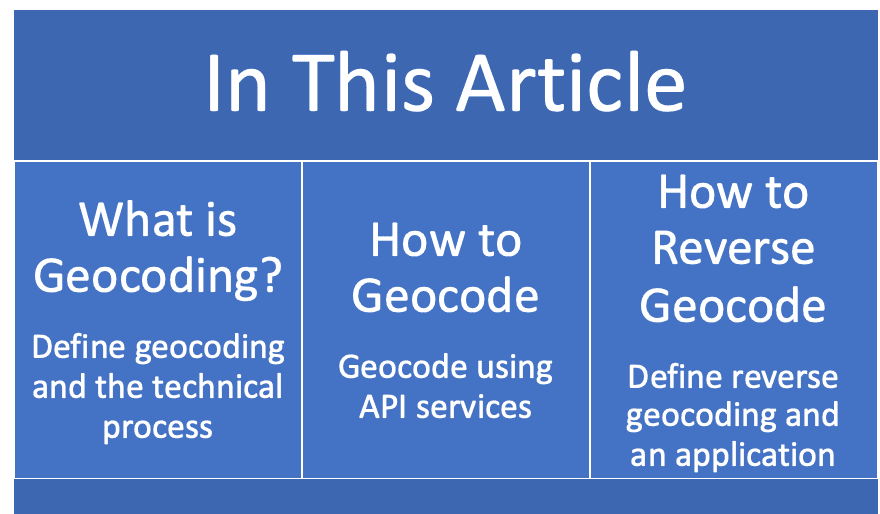
XXXXX What is Geocoding?

Geocoding is most commonly defined as the transformation of address data into mapping coordinates. Usually, this involves detecting a street name in an address, matching that street to the boundaries of its real-world counterpart in a database, then estimating where on the street to place the address using the street number. As an example, let’s go through the process of a simple manual geocode for the address of a pizza parlor in New York on Broadway: 2709 Broadway, New York, NY 10025. The first task is finding appropriate shapefiles for the road system of the location of your address. Note that in this case the city and state of the address are “New York, NY.” Fortunately, the city of New York publishes detailed road information on the NYC Open Data page (CSCL PUB). Second, examine the street name “Broadway.” You now know that the address can lie on any street called “Broadway” in New York city, so you can execute the following Python code to query the NYC Open Data SODA API for all streets named “Broadway.”

import geopandas as gpd  import requests  from io import BytesIO    # Request the data from the SODA API  req = requests.get(      "https://data.cityofnewyork.us/resource/gdww-crzy.geojson?stname_lab=BROADWAY"  )  # Convert to a stream of bytes  reqstrm = BytesIO(req.content)  # Read the stream as a GeoDataFrame  ny_streets = gpd.read_file(reqstrm)  

There are over 700 results of this query, but that doesn’t mean you have to check 700 streets to find your pizza. Visualizing the data, you can see that there are 3 main Broadway streets and a few smaller ones.

XXXXX

The reason for this is that each street is broken up into sections that correspond roughly to a block, allowing for a more granular look at the data. The next step of the process is determining exactly which of these sections the address is on using the ZIP code and street number. Each street segment in the dataset contains address ranges for the addresses of buildings on both the left and right sides of the street. Similarly, each segment contains the ZIP code for both the left and right sides of the street. To locate the correct segment, the following code applies filters to find the street segment whose ZIP code matches the address’ ZIP code and whose address range contains the street number of the address.

# Address to be geocoded  address = "2709 Broadway, New York, NY 10025"  zipcode = address.split(" ")[-1]  street_num = address.split(" ")[0]    # Find street segments whose left side address ranges contain the street number  potentials = ny_streets.loc[ny_streets["l_low_hn"] < street_num]  potentials = potentials.loc[potentials["l_high_hn"] > street_num]  # Find street segments whose zipcode matches the address'  potentials = potentials.loc[potentials["l_zip"] == zipcode]

This narrows the list to the one street segment seen below.

XXXXX

The final task is to determine where the address lies on this line. This is done by placing the street number inside the address range for the segment, normalizing to determine how far along the line the address should be, and applying that constant to the coordinates of the endpoints of the line to get the coordinates of the address. The following code outlines this process.

import numpy as np  from shapely.geometry import Point    # Calculate how far along the street to place the point  denom = (      potentials["l_high_hn"].astype(float) - potentials["l_low_hn"].astype(float)  ).values[0]  normalized_street_num = (      float(street_num) - potentials["l_low_hn"].astype(float).values[0]  ) / denom    # Define a point that far along the street  # Move the line to start at (0,0)  pizza = np.array(potentials["geometry"].values[0].coords[1]) - np.array(      potentials["geometry"].values[0].coords[0]  )  # Multiply by normalized street number to get coordinates on line  pizza = pizza * normalized_street_num  # Add starting segment to place line back on the map  pizza = pizza + np.array(potentials["geometry"].values[0].coords[0])  # Convert to geometry array for geopandas  pizza = gpd.GeoDataFrame(      {"address": [address], "geometry": [Point(pizza[0], pizza[1])]},      crs=ny_streets.crs,      geometry="geometry",  )  

Having finished geocoding the address, it is now possible to plot the location of this pizza parlor on a map to understand its location. Since the code above looked at information pertaining to the left side of a street segment, the actual location will be slightly left of the plotted point in a building on the left side of the road. You finally know where you can get some pizza.

XXXXX

This process covers what is most commonly referred to as geocoding, but it is not the only way the term is used. You may also see geocoding refer to the process of transferring landmark names to coordinates, ZIP codes to coordinates, or coordinates to GIS vectors. You may even hear reverse geocoding (which will be covered later) referred to as geocoding. A more lenient definition for geocoding that encompasses these would be “the transfer between approximate, natural language descriptions of locations and geographic coordinates.” So, any time you need to move between these two kinds of data, consider geocoding as a solution.

As an alternative to repeating this process whenever you need to geocode addresses, a variety of API endpoints, such as the U.S. Census Bureau Geocoder and the Google Geocoding API, provide an accurate geocoding service for free. Some paid options, such as Esri's ArcGIS, Geocodio, and Smarty even offer rooftop accuracy for select addresses, which means that the returned coordinate lands exactly on the roof of the building instead of on a nearby street. The following sections outline how to use these services to fit geocoding into your data pipeline using the U.S. Census Bureau Geocoder as an example.

How to Geocode

In order to get the highest possible accuracy when geocoding, you should always begin by ensuring that your addresses are formatted to fit the standards of your chosen service. This will differ slightly between each service, but a common format is the USPS format of “PRIMARY# STREET, CITY, STATE, ZIP” where STATE is an abbreviation code, PRIMARY# is the street number, and all mentions of suite numbers, building numbers, and PO boxes are removed.

Once your address is formatted, you need to submit it to the API for geocoding. In the case of the U.S. Census Bureau Geocoder, you can either manually submit the address through the One Line Address Processing tab or use the provided REST API to submit the address programmatically. The U.S. Census Bureau Geocoder also allows you to geocode entire files using the batch geocoder and specify the data source using the benchmark parameter. To geocode the pizza parlor from earlier, this link can be used to pass the address to the REST API, which can be done in Python with the following code.

# Submit the address to the U.S. Census Bureau Geocoder REST API for processing  response = requests.get(      "https://geocoding.geo.census.gov/geocoder/locations/onelineaddress?address=2709+Broadway%2C+New+York%2C+NY+10025&benchmark=Public_AR_Current&format=json"  ).json()

The returned data is a JSON file, which is decoded easily into a Python dictionary. It contains a “tigerLineId” field which can be used to match the shapefile for the nearest street, a “side” field which can be used to determine which side of that street the address is on, and “fromAddress” and “toAddress” fields which contain the address range for the street segment. Most importantly, it contains a “coordinates” field that can be used to locate the address on a map. The following code extracts the coordinates from the JSON file and processes it into a GeoDataFrame to prepare it for spatial analysis.

# Extract coordinates from the JSON file  coords = response["result"]["addressMatches"][0]["coordinates"]  # Convert coordinates to a Shapely Point  coords = Point(coords["x"], coords["y"])  # Extract matched address  matched_address = response["result"]["addressMatches"][0]["matchedAddress"]  # Create a GeoDataFrame containing the results  pizza_point = gpd.GeoDataFrame(      {"address": [matched_address], "geometry": coords},      crs=ny_streets.crs,      geometry="geometry",  )

Visualizing this point shows that it is slightly off the road to the left of the point that was geocoded manually.

XXXXX How to Reverse Geocode

Reverse geocoding is the process of taking geographic coordinates and matching them to natural language descriptions of a geographic region. When applied correctly, it is one of the most powerful techniques for attaching external data in the data science toolkit. The first step of reverse geocoding is determining your target geographies. This is the region that will contain your coordinate data. Some common examples are census tracts, ZIP codes, and cities. The second step is determining which, if any, of those regions the point is in. When using common regions, the U.S. Census Geocoder can be used to reverse geocode by making small changes to the REST API request. A request for determining which Census geographies contain the pizza parlor from before is linked here. The result of this query can be processed using the same methods as before. However, creatively defining the region to fit an analysis need and manually reverse geocoding to it opens up many possibilities.

To manually reverse geocode, you need to determine the location and shape of a region, then determine if the point is on the interior of that region. Determining if a point is inside a polygon is actually a fairly difficult problem, but the ray casting algorithm, where a ray starting at the point and travelling infinitely in a direction intersects the boundary of the region an odd number of times if it is inside the region and an even number of times otherwise (Shimrat), can be used to solve it in most cases. For the mathematically inclined, this is actually a direct application of the Jordan curve theorem (Hosch). As a note, if you are using data from around the world, the ray casting algorithm can actually fail since a ray will eventually wrap around the Earth’s surface and become a circle. In this case, you will instead have to find the winding number (Weisstein) for the region and the point. The point is inside the region if the winding number is not zero. Fortunately, Python’s geopandas library provides the functionality necessary to both define the interior of a polygonal region and test if a point is inside of it without all the complex mathematics.

While manual geocoding can be too complex for many applications, manual reverse geocoding can be a practical addition to your skill set since it allows you to easily match your points to highly customized regions. For example, assume you want to take your slice of pizza to a park and have a picnic. You may want to know if the pizza parlor is within a short distance of a park. New York City provides shapefiles for their parks as part of the Parks Properties dataset (NYC Parks Open Data Team), and they can also be accessed via their SODA API using the following code.

# Pull NYC park shapefiles  parks = gpd.read_file(      BytesIO(          requests.get(              "https://data.cityofnewyork.us/resource/enfh-gkve.geojson?$limit=5000"          ).content      )  )  # Limit to parks with green area for a picnic  parks = parks.loc[      parks["typecategory"].isin(          [              "Garden",              "Nature Area",              "Community Park",              "Neighborhood Park",              "Flagship Park",          ]      )  ]  

These parks can be added to the visualization to see what parks are nearby the pizza parlor.

XXXXX

There are clearly some options nearby, but figuring out the distance using the shapefiles and the point can be difficult and computationally expensive. Instead, reverse geocoding can be applied. The first step, as mentioned above, is determining the region you want to attach the point to. In this case, the region is “a 1/2-mile distance from a park in New York City.” The second step is calculation if the point lies inside a region, which can be done mathematically using the previously mentioned methods or by applying the “contains” function in geopandas. The following code is used to add a 1/2-mile buffer to the boundaries of the parks before testing to see which parks’ buffered regions now contain the point.

# Project the coordinates from latitude and longitude into meters for distance calculations  buffered_parks = parks.to_crs(epsg=2263)  pizza_point = pizza_point.to_crs(epsg=2263)  # Add a buffer to the regions extending the border by 1/2 mile = 2640 feet  buffered_parks = buffered_parks.buffer(2640)  # Find all parks whose buffered region contains the pizza parlor  pizza_parks = parks.loc[buffered_parks.contains(pizza_point["geometry"].values[0])]  

This buffer reveals the nearby parks, which are highlighted in blue in the image below

XXXXX

After successful reverse geocoding, you have learned that there are 8 parks within a half mile of the pizza parlor in which you could have your picnic. Enjoy that slice.

XXXXX
Pizza Slice by j4p4n

Sources

  1. Lawler, Josh and Schiess, Peter. ESRM 250: Introduction to Geographic Information Systems in Forest Resources. Definitions of GIS, 12 Feb. 2009, University of Washington, Seattle. Class Lecture. https://courses.washington.edu/gis250/lessons/introduction_gis/definitions.html
  2. CSCL PUB. New York OpenData. https://data.cityofnewyork.us/City-Government/road/svwp-sbcd
  3. U.S. Census Bureau Geocoder Documentation. August 2022. https://geocoding.geo.census.gov/geocoder/Geocoding_Services_API.pdf
  4. Shimrat, M., "Algorithm 112: Position of point relative to polygon" 1962, Communications of the ACM Volume 5 Issue 8, Aug. 1962. https://dl.acm.org/doi/10.1145/368637.368653
  5. Hosch, William L.. "Jordan curve theorem". Encyclopedia Britannica, 13 Apr. 2018, https://www.britannica.com/science/Jordan-curve-theorem
  6. Weisstein, Eric W. "Contour Winding Number." From MathWorld—A Wolfram Web Resource. https://mathworld.wolfram.com/ContourWindingNumber.html
  7. NYC Parks Open Data Team. Parks Properties. April 14, 2023. https://nycopendata.socrata.com/Recreation/Parks-Properties/enfh-gkve
  8. j4p4n, “Pizza Slice.” From OpenClipArt. https://openclipart.org/detail/331718/pizza-slice

Evan Miller is a Data Science Fellow at Tech Impact, where he uses data to support nonprofit and government agencies with a mission of social good. Previously, Evan used machine learning to train autonomous vehicles at Central Michigan University.

More On This Topic

  • Geocoding in Python: A Complete Guide
  • What will the demand for Data Scientists be in 10 years? Will Data…
  • The 8 Most Common Data Scientists
  • Data Scientists, You Need to Know How to Code
  • How Data Scientists Can Get the Ear of CFOs (And Why You Want It)
  • High-Fidelity Synthetic Data for Data Engineers and Data Scientists Alike