In August 2022, top executives of firms such as Amazon, Google, Netflix and Microsoft, amongst others, were summoned before a parliamentary panel to discuss a legal framework to curb anti-competitive practices. This was triggered by a report by a parliamentary panel that highlighted anti-competitive practices by companies like Google and Meta.
A few months later, in October 2022, the Competition Commission of India imposed two significant penalties on Google, totalling Rs 2,274 crore, for anti-competitive practices related to its Play Store billing policy. In the same week in the month of October, the giant was fined Rs 1,337.76 crore ($162 million) & Rs 936.44 crore ($113 million).
A few months later, the Indian government released a new draft of the Data Protection Bill, known as the Digital Personal Data Protection Bill. Under the proposed Bill, companies that fail to comply with data protection regulations could face penalties as high as Rs 500 crore. It has also proposed several amendments to the current IT rules, developed the draft Digital Data Protection Bill, and proposed the Digital Competition Act and Digital India Act. But it seems like the measures have kicked in very late.
On the other hand, EU has been one of the biggest imposers of fines amounting to billions of dollars. The European Union’s General Data Protection Regulation (GDPR) enables regulators to impose fines of up to 4% of global revenue for violations. Tech giants like Google, Meta, Amazon, and Apple have already encountered regulatory pressures in Europe and a few other nations, and financial consequences ranging in billions of dollars.
In 2018, Google paid a €4.3 billion antitrust fine for promoting its search engine through the Android mobile operating system. Google recently lost its appeal against that decision, although the fine was slightly reduced. The company is also challenging fines of €2.4 billion and €1.5 billion for abuse of power in online shopping and advertising, respectively.
Source: Statista
Not just that, the EU has introduced new regulations that require tech firms to combat disinformation, particularly deep fakes. Non-compliance could result in fines of up to 6% of a company’s global turnover.
What Should India Do?
In India, historically, there has been a lack of fines for such violations, despite ongoing disputes between big tech and the government. The Wall Street Journal points out that the Indian government is adopting a combination of Europe’s strict antitrust policy and Chinese-style government surveillance in its efforts to regulate the big tech.
Even though the administration seems to be waking up and subjecting them to scrutiny and imposing fines— the effectiveness of the upcoming Digital Data Protection Law in addressing these issues remains uncertain. This may result in data leaks, a sea of misinformation, and tech giants morphing into literal giants to influence power and people.
Arindrajit Basu, a non-resident fellow at the Center for Internet and Society, in a conversation with AIM, had explained that emerging economies like India often engage in negotiations with tech giants from Silicon Valley and other regions as they continue to grow and develop. While these companies offer valuable digital services to individuals in these countries, there is a concern that they also reinforce their market dominance by extracting data from significant data markets like India. Basu highlighted the dual nature of these companies, providing services to individuals while simultaneously consolidating market concentration through data expropriation.
India could drop the dubiety and move in a similar direction as the European Commission in their ex-ante regulation and competition in digital markets. The new regulation consists of two acts: the Digital Markets Act (DMA) and the Digital Services Act (DSA). The DSA focuses on online safety, protecting rights, and increasing transparency, while the DMA is primarily concerned with ensuring competitiveness in digital markets.
The regulation aims to establish a fair playing field for emerging competitors and ensure fair treatment of users, especially business users, on large digital platforms. The goal is not to directly impact the structure of digital markets, but rather to set rules of conduct and prevent the suppression of competition.
The post Big-tech Regulation: India, Drop the Dubiety & Go the EU Way appeared first on Analytics India Magazine.
Software-as-service spend management software firm G2 reported that products with artificial intelligence functionality — particularly large language models — are among the top three fastest-growing software classes across the over-2,000 categories the company tracks.
Findings from its 2023 G2 Software Buyer Behavior Report seem to bear that out. The study found AI capabilities are sine que non for enterprise: 78% percent of the 1,704 respondents to G2’s survey said that they trust the accuracy and reliability of AI-powered solutions, with only 2% saying they don’t trust it at all.
Jump to:
Spend increasing, buyers say
For most buyers, AI functionality is the dish, not the garnish
Struggle to balance security and urgency
Time exerts pressure on software vetting
Embracing software integration
Software incumbents in the catbird seat
Recommendations for sellers
Spend increasing, buyers say
G2’s study suggests businesses are increasing their software spend as they vie for advantages, fears of a tech pullback notwithstanding. Forty-nine percent of buyers polled said they would increase spend on software this year, while only 9% said they would tighten their purse strings for software.
Of those who said they would cut spending for 2023, 39% said they would then increase it in 2024, compared to 25% their budgets would decrease (37% say it will stay the same as this year).
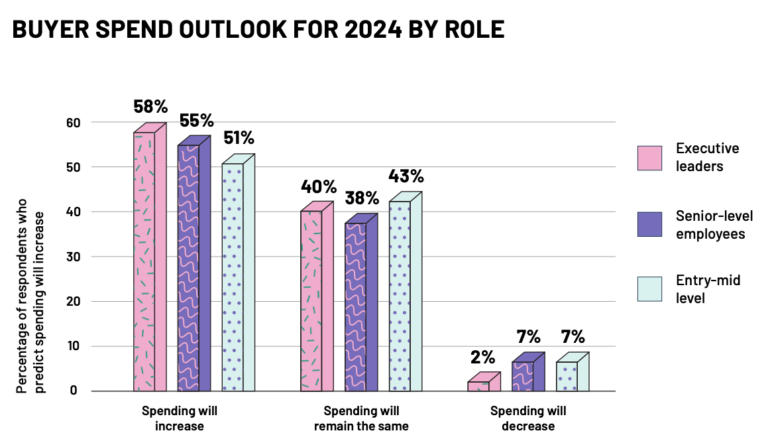
Executive leaders were the most optimistic about spending in 2023 and 2024, per the report, which said executives envisioned higher spending than did senior-level employees (managers, directors, high-level individual contributors) and entry and mid-level employees (Figure A).
Figure A
C-suite is more bullish on software spend than senior and mid-level employees. Image: G2
For most buyers, AI functionality is the dish, not the garnish
The study found that generative AI is decisive in determining purchase decisions around new software, the study found: 81% of respondents put a premium on software having AI functionality. Fewer than 5% of the executives G2 polled said AI functionality is not important at all.
Additionally:
Eighty-four percent of buyers said they trust or “trust strongly” the reliability and accuracy of AI-powered solutions.
Eighty-eight percent said it was important that AI functionality be a component of any software they buy going forward.
The G2 study authors wrote that the role of legal departments in purchase decisions will grow “Because generative AI solutions increase the necessity for legal involvement.”
“Vendor customers want platforms with generative AI capabilities — 81% of buyers who are interested in AI are looking to make a business value impact and see generative AI capabilities as the route to achieving it,” said Chris Voce, VP of market research at G2.
“However, their legal departments are often stopping them, and I think this will occur more often where, because of the nature of generative AI solutions, businesses will have to be accountable both to how data is being ingested and to the output, which could involve such issues as inadvertent violation of copyright.”
He also said AI constitutes a moment in which vendors will need to step up and increase their responsibility to customers.
“There’s a lot of listening they need to do with legal teams across their customer base in order to be responsive,” he said. “Just as we have been doing for decades about easing cybersecurity concerns. Vendors need to engage — they need to take a step back, look across at issues raised by customers, and organize coordinated ways to respond to buyers and implement solutions.”
James Robinson, deputy CISO at global cybersecurity company Netskope, said he sees similarities to rapid drug development for COVID when it comes to vendor/customer transparency for AI policy.. “Our customers are asking us to do a lot more in terms of governance frameworks for AI, and how we are securing our own use of the technologies,”‘he said.
“Vendors generally should be doing that, and I would say we need to be figuring out how to make [AI adoption] less of a burden to business, in terms of protecting models from bias, but also protecting the information, and do so in a secure way while articulating how we are doing that to customers,” added Robinson.
The study also looked at what executives say about the friction point between business imperatives that drive software purchase regimens and security imperatives meant to validate those products.
Also see: Get an AI content generator that goes far beyond creating copy for just $50
Struggle to balance security and urgency
Eighty-six percent of software purchasers polled conceded that they required a security and privacy pre-assessment before purchase, and 84% of respondents said their IT departments are responsible for conducting security or privacy assessments when evaluating software.
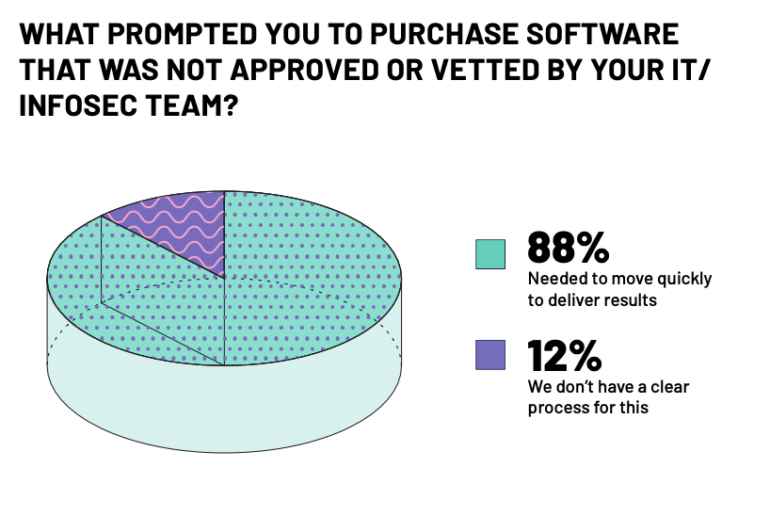
Yet, sometimes business pressures leave security operators out of the picture: of those who said they chose to ignore doing a security assessment, 88% said they did so because they needed to move quickly to deliver results from software (Figure B).
Figure B
Need to move quickly drives software purchases without IT or security approval. Image: G2
“Businesses all feel a pressure to deliver results or have business impact and demonstrate that impact,” Voce said. “There’s urgency and this drives behavior. Sometimes even if there is a sound process to vet the security of a solution, that pressure drives them to cut corners,”he added.
Also, overall:
Fifty-four percent of respondents said they had purchased software that had been neither approved nor vetted for security by IT or InfoSec.
Only 24% involved a security stakeholder during the research phase of the buying process and 14% left security review until implementation.
However, 40% indicated that their legal departments are involved, which jumps to 55% in EMEA countries due to their more stringent digital regulations, according to the study.
Time exerts pressure on software vetting.
Vendors can help the security vetting process
The firm suggested that to accommodate buyers with their security vetting, vendors should lead with product security credentials, conduct buyer interviews to dive into their security and privacy vetting process and design information or implementation according to buyer needs and resources.
Time exerts pressure on software vetting
Eighty-three percent of the companies G2 polled said they have a software buying process in place, and for 36% of those, research is the most time-consuming aspect, with evaluation coming in second at 29%.
Out of a list of 14 considerations for purchasing software, the top five were consistent regardless of company size:
Small business buyers prioritize ease of use and ease of implementation.
Medium-sized and enterprise companies need solutions that will be able to keep up with their growth, with both ranking scalability as the third most important criteria.
Embracing software integration, avoiding complexity are keys
Eighty-two percent of respondents to the G2 study said software should integrate with their existing solutions, with buyers ranking ease of integration higher than the cost of the software, the kind of security it provides, or cost of ownership.
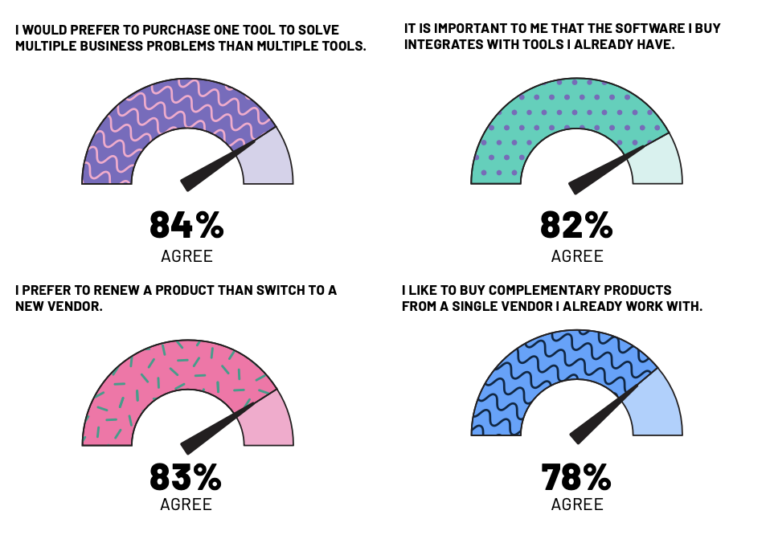
Over three-quarters of the buyers polled said they prefer to work with fewer vendors, and 84% said they favored a single solution over multiple tools. When multiple solutions are required, 77% of buyers prefer to buy complementary products from the vendors they already work with (Figure C).
Figure C
Buyers seek to avoid complexity, embrace easy-to-integrate solutions. Image: G2
Software incumbents in the catbird seat
In a finding that has analogs in endless political careers and therapy that doesn’t end until you do, buyers prefer to work with sellers whose products they already use: 83% of buyers prefer buying products from the same vendor instead of switching vendors, according to the study.
As for the products, 60% always conduct research and consider new alternatives, but 45% renew without considering new options.
“This is because using multiple vendors to build a tech stack offers buyers a chance to explore best-of-breed solutions but adds complexity,” the authors wrote. “It requires managing more contracts and potentially complicates integration.” Also, 82% of buyers cited the importance of software to integrate with tools they already have.
Recommendations for software sellers
G2 offered several suggestions for helping vendors more effectively reach prospective buyers and offer them a broader view of product value.
Be where they are
The G2 authors said buyers aren’t taking calls, but are doing their own research: per the firm, the top 85% of most influential sources include industry experts, colleagues or professional networks, online reviews and other internal influencers.
The study found that a vendor salesperson is the least influential source in purchasing processes at 1%, down from 3% in the prior year, and the importance of vendor-published content dropped from 10% to 7% in the prior year.
“Vendors must build product awareness across communities, experts, and review platforms,” said the authors.
Give buyers self-service options
G2’s study suggests buyers may want the majority of the implementation process to be self service, to which they attribute ease of implementation, but just 41% of enterprise buyers want all of the process to be self service
Be helpful, give buyers breathing space
The firm suggests that because buyers are flooded with pitches, they are unlikely to want to receive more especially if it involves divulging information. The study found 61% of respondents are less likely to purchase software if the vendor requires personal information (email address, name, etc.) prior to releasing pricing data or product demos. This indicates buyers want time to conduct research before entering into discussions with sales.
Go beyond offering basic ROI for products
The firm suggested that simple ROI won’t cut it: vendors need “To capture the full impact of a solution’s potential on a customer’s environment,” said the study, noting that vendors are more frequently employing business value advisory consultants to learn about and advise on how solutions create business value over time.
Voce said businesses need to articulate the virtue of their products beyond the silo of specific implementations. “Often vendors have difficulty in communicating the larger business value and impact their solutions might deliver,” he said.
He said he parses a comprehensive software value proposition into four buckets — two involved in cost reduction and risk, and two on strategic growth:
Expense reduction: How do you help a customer reduce operational expenses and cost?
Risk reduction: How do you avoid a competitive disadvantage from outages, downtime, loss, compliance, fines, etc?
Business growth: How do I help a custom use my product to see more incremental value and more growth?
Strategic growth: How might I help them improve customer experience, tap into new areas of opportunity, around areas like remote work, employee experience, or reducing complexity?
“Reducing complexity has been an important theme to IT security values for years, as their environments are becoming increasingly complex,” he said, noting that 84% of respondents said they would prefer one tool for multiple problems instead of multiple tools. “They want simplicity; software that integrates with the tools they have. Whether it comes from a single point or a suite of turnkey solutions: they want to buy the recipe, not the ingredients.”
Subscribe to the Innovation Insider Newsletter
Catch up on the latest tech innovations that are changing the world, including IoT, 5G, the latest about phones, security, smart cities, AI, robotics, and more.
Can a programming language ever get replaced? One might say that C was replaced by C++, which was later replaced by Python. Though Python has been able to stand its ground amid rapidly-rising languages like Rust, the latest competitor is our beloved English — riding on prompt engineering.
Promptgramming is something that Python folks are forced to hate. As Aleksa Gordić, former DeepMind and ex-Microsoft researcher put it, “The history of computer science is the history of smirking at a thing that’s about to ‘replace’ you.”
During the Microsoft Build 2023, there was great emphasis on the fact that, “now everyone’s a developer”, with the rise of models that can write codes for everyone with just a single prompt. But on the other hand, the creator of models such as ChatGPT, Sam Altman believes otherwise.
He believes that the current state of prompt engineering is only because of the temporary limitations and capabilities of large language models. He believes in his mind that anyone who does prompt engineering right now would not be doing it in the next five years. That is not because it will become a fad, it is because everyone, including the LLMs, would be too proficient in understanding what the user wants, and generating it perfectly.
Is it a tall claim?
Firstly, it might be true technologically. Altman being the creator of such models might be able to estimate the possibilities that these LLMs hold in the future. Secondly, language being the most important tool in the world is not something that anyone would deny.
“Text is the projection of the world,” said OpenAI’s co-founder Ilya Sutskever. While he was talking about the capabilities of LLMs and that text-based models would possibly lead to AGI, it can also be said that the perfect arrangement of words to bring out meaning and information is always going to be mightier than any sword.
Coming back to programming languages. Just as Python could not replace C++, prompts may not be able to replace coding. Some people still use Assembly, C, or C++ for building frameworks and algorithms. Python is good for machine learning, and prompt engineering is good for building models quickly, but to build a foundation from scratch, C or C++ is always going to be there.
That is not to say that prompt engineering holds no value. It has already found its niche and is probably going to stay here for a while. In certain cases, a lot of prompt engineering jobs pay more than Python. Temporarily, it might look like “promptgramming” is actually replacing Python.
What will replace prompt engineering?
If we think about it, prompting is very similar to a lot of other languages. It is just a language that feels closer to human language. Going on ChatGPT or Codex and just typing in what you want does not work that easily. It’s a skill to learn as well. Anyone who has tried building models by throwing prompts at these models would know that it’s not a piece of cake.
The best part about prompting is that it is mostly just trial and error — if one prompt doesn’t work, try another. It might work out eventually. But isn’t that the case with a lot of programming languages as well? You indeed have to have a basic knowledge of coding before even jumping into Python, prompt engineering just removes that barrier to entry as well.
Apart from the legal and ethical issues about copying code from Stack Overflow and other programmers, the problem with these code generation platforms is that they are not perfect. Even if two people generate the same prompt, the results might be different. Moreover, debugging the code written by these models is a task in itself — one that would require knowledge of programming languages.
So what would kill prompt engineering? Probably in a few years as LLMs get better, it would be in everyone’s ability to generate perfect outputs every time. By the way, the most interesting thing that would kill prompt engineering would be thought prompting. With NeuraLink and similar projects coming into the picture, soon, just like Python developers smirk at prompt engineering, prompt folks would jeer at them, “These thought prompters can’t even type their own prompts. Losers!”
The post Prompt Engineering is the New C++ appeared first on Analytics India Magazine.
Monster API Launches the ‘Airbnb of GPUs’ with $1.1M Pre-seed June 9, 2023 by Jaime Hampton
(cybermagician/Shutterstock)
A new platform from a Palo Alto-based startup aims to level the AI development playing field. Monster API has launched a platform it claims to be the “Airbnb of GPUs” and has secured $1.1 million in pre-seed funding.
Generative AI has captured global attention and applications are rapidly being developed for everything from content creation to code generation. Recent Gartner research found that by 2026, 75% of newly developed enterprise applications will incorporate AI- or ML-based models, up from less than 5% in 2023. However, the process of developing AI applications with machine learning is an expensive and complex prospect for many companies looking to join the AI boom.
But what if you could run the latest AI models on a cryptomining rig or an Xbox? That’s the question Monster API co-founder Gaurav Vij had after facing huge AWS costs at his computer vision startup. His brother and co-founder Saurabh Vij, a former particle physicist at CERN, recognized the potential of distributed computing while contributing to projects like [email protected] and [email protected].
Inspired by these experiences, the brothers say they sought to harness the computing power of consumer devices like PlayStation, gaming PCs, and crypto mining rigs for training ML models. The company claims that after multiple iterations, the brothers successfully optimized these consumer GPUs for ML workloads, leading to a 90% reduction in Gaurav Vij's monthly cloud costs at his startup.
“We were jumping with excitement and felt we could help millions of developers just like us building in AI,” said Gaurav Vij in a release.
Monster API claims it gives developers access to the latest AI models including Stable Diffusion, Whisper AI, LLaMA, and StableLM with highly available REST APIs through a one-line command interface, with no complex setup involved. The platform also has a no-code fine-tuning solution that specifies hyperparameters and datasets.
Monster API’s development stack consists of an optimization layer, a compute orchestrator, a “massive” GPU infrastructure, and pre-configured inference APIs. Additionally, Monster API says its containerized instances come pre-configured with CUDA, AI frameworks, and libraries for a seamless managed experience.
The company asserts that its decentralized computing approach enables access to tens of thousands of powerful GPUs like A100s, on-demand, to train breakthrough models at substantially reduced costs. The platform allows developers to access popular foundation AI models at one-tenth the cost of traditional cloud providers like AWS, the company asserts. Monster API claims that in one case, an optimized version of the Whisper AI model run on its platform led to a 90% reduction in cost compared to running it on AWS.
“By 2030, AI will impact the lives of 8 billion people. With Monster API, our ultimate wish is to see developers unleash their genius and dazzle the universe by helping them bring their innovations to life in a matter of hours,” said Saurabh Vij. “We eliminate the need to worry about GPU infrastructure, containerization, setting up a Kubernetes cluster, and managing scalable API deployments as well as offering the benefits of lower costs.”
“One early customer has saved over $300,000 by shifting their ML workloads from AWS to Monster API's distributed GPU infrastructure,” Saurabh Vij continued. “This is the breakthrough developers have been waiting for: a platform that's not just highly affordable but it is also intuitive to use.”
Monster API offers its billing based on API calls instead of “pay by GPU time.” APIs automatically scale to handle increased demand and the decentralized GPU network enables geographic scaling, the company says.
(Source: Twitter)
Access to decentralized GPUs could be appealing, as some have suggested there is a GPU shortage affecting AI adoption. Quora CEO Adam D’Angelo recently tweeted his opinion that the AI boom is being underestimated because of a GPU/TPU shortage.
“This shortage is causing all kinds of limits on product rollouts and model training, but these are not visible. Instead, all we see is Nvidia spiking in price. Things will accelerate once supply meets demand,” he wrote. Elon Musk agreed, adding that many other neural network accelerator chips are also under development.
In the meantime, Monster API says that by harnessing decentralized compute resources, it can provide developers with a scalable, globally accessible, and affordable platform for generative AI. The company is offering a free trial and subscription, found here, and those interested in learning more or joining the developer community can get involved in the company’s Discord.
“Generative AI is one of the most powerful innovations of our time, with far-reaching impacts,” said Sai Supriya Sharath, Carya Venture Partners managing partner. “It’s very important that smaller companies, academic researchers, competitive software development teams, etc. also have the ability to harness it for societal good. Monster API is providing access to the ecosystem they need to thrive in this new world.”
Generative AI models, such as ChatGPT, are known to generate mistakes or "hallucinations." As a result, they generally come with clearly displayed disclaimers disclosing this problem.
But what would you do if, despite these warnings, you saw the AI chatbot spreading misinformation about you?
Also: OpenAI says it found a way to make AI models more logical and avoid hallucinations
Georgia radio host, Mark Walters, found that ChatGPT was spreading false information about him, accusing him of embezzling money, and as a result, has sued OpenAI in the company's first defamation lawsuit, as first reported on by Bloomberg Law.
According to the lawsuit, the misinformation ensued when Fred Riehl, the editor-in-chief of gun publication AnmoLand, asked ChatGPT for a summary of the Second Amendment Foundation v. Ferguson case as background for a case he was reporting on.
ChatGPT provided Riehl with a summary of the case which stated that Alan Gottlieb, the Second Amendment Foundation's (SAF) founder, accused Walters of "defrauding and embezzling funds from the SAF."
Also: 3 ways OpenAI says we should start to tackle AI regulation
Furthermore, the chatbot said that in the case the complaint alleged that Walters, "misappropriated funds for personal expenses without authorization or reimbursement, manipulated financial records and bank statements to conceal his activities, and failed to provide accurate and timely financial reports and disclosures to the SAF's leadership" when he acted as the SFA's CFO and treasurer.
However, in Walter's lawsuit, Walters v. OpenAI LLC, the defendant claims that every single fact in the summary is false.
Walters was never a party involved in the lawsuit, was never accused of defrauding and embezzling funds from the SAF, and never held a position as treasurer or CFO, according to the lawsuit.
Also: Former ByteDance exec says China can access TikTok user data, even when it's stored on US soil
Walters is seeking compensation from OpenAI through general and punitive damages, as well as reimbursement for the expenses incurred during the lawsuit.
Questions surrounding the lawsuit include who should be held liable and whether the website's disclaimers about hallucinations are enough to remove liability, even if harm is brought to someone.
The outcome of the legal case will have a significant impact in establishing a standard in the emerging field of generative AI.
In a new development in the field of generative AI, a new language model called Orca has emerged as a formidable contender to ChatGPT, demonstrating exceptional performance in zero-shot tasks across a range of benchmarks.
Equipped with an impressive 13 billion parameters, Orca has surpassed the competition in various evaluations, including the rigorous Big Bench Hard (BBH) challenge, as well as esteemed academic exams like SAT, LSAT, GRE, and GMAT.
(As per the presented paper, Orca, with 13 billion parameters, outperforms a wide range of foundation models including OpenAI ChatGPT as evaluated by GPT-4 in the Vicuna evaluation set.)
Orca’s stunning achievement in the BBH benchmark is not to be underestimated, as it has outperformed conventional state-of-the-art instruction-tuned models by an astounding margin of over 113%. Similarly, in the AGIEval benchmark, Orca has showcased its superiority by delivering an impressive 42% improvement over the previous standard.
What sets Orca apart from its counterparts is its ability to progressively learn from intricate explanation traces, including step-by-step thought processes, derived from the highly advanced GPT-4 model. This novel approach to learning has proven to be a game-changer, unlocking previously untapped capabilities and substantially enhancing Orca’s skills.
To comprehensively evaluate Orca’s diverse abilities, a team of researchers conducted an extensive battery of tests covering writing, comprehension, analytical skills, mathematical prowess, logical reasoning, and safety considerations.
The post Opensource Competitor Of GPT-4 Is Here appeared first on Analytics India Magazine.
Incorporating e-Learning tools into your new hire training program can be an excellent way to make it easier to share essential information with your new team members, but it is important to make sure this content aligns with accessibility standards to ensure that you are not inadvertently hindering your learners. Here is an overview of what accessibility standards are, steps you can take to design e-Learning content that creates an accessible learning environment, and how you can create quality e-Learning content for learners of every ability!
Understanding Accessibility Standards
Quality e-Learning content requires compliance with certain accessibility standards that make it accessible to as many learners as possible. There are several best practices that can help your business create more accessible content, many of which are specifically addressed by the ADA. The ADA divides accessibility standards into three distinct categories that are based on the amount of accessibility they provide, which are known as A, AA, and AAA. A accessibility provides the minimum accommodations that are needed for your e-Learning content to qualify as ADA-compliant, while AAA content is the most accessible and has the most difficult standards to meet.
Designing Accessible e-Learning Content
Designing e-Learning content that meets accessibility standards and works well for your learners of every ability is not always easy, but it is a crucial step in creating a welcoming and inclusive environment that works well for everyone. Your industry may include certain complex concepts that make incorporating additional types of accessibility necessary, but many common accessibility standards can be applied to any industry. Here are some of the most important elements to include when designing accessible e-Learning content for your new employees, students, or other learners of any ability!
Use Clear and Concise Language
Many industries contain complex technical terms that are essential for your new employees to understand, but this does not mean it is appropriate to make your e-Learning content as difficult to understand as possible. Instead, taking steps to make sure your content is concise enough to be understood by the average new team member and contains any additional details it may need to clarify more complex terms for employees that may need it is an important step in making your content accessible to as many people as possible. Understanding the difference between essential technical terms and writing your entire content using an unnecessarily high reading level is a must when it comes to choosing language that is accessible to your learners.
Use Alternative Text for Images and Other Media
Images, graphs, charts, and other types of visual content can be helpful tools for showing content in another way for the majority of your learners, but they can make your e-Learning content less accessible for learners with limited vision. For this reason, it can be helpful to accompany these images with text that explains what they are and how they relate to your written content to make sure that these learners can get as much out of them as possible. Including these descriptions in your recorded or Braille versions of your main text is also an important step in making them accessible to learners with any level of vision.
Use Color Contrast Properly
Poor color contrast can be another problem for learners with limited vision. Your foreground and background colors should be different enough that they are easy to distinguish between, including for readers with less ability to distinguish between colors than average. You should generally aim for a ratio of at least 4.5:1 between your foreground and background colors to ensure that your text can be read by as many learners as possible. Although this is easy to do when using typical color choices, such as black text on a white background, it is important to use caution when adding colors and other details in an attempt to make your content more interesting because having too much going on can be difficult for some learners to see clearly.
Provide Audio Options
Making your content as easy to read and see clearly as possible is an important step in making it accessible to a wide range of learners, but it is also important to provide audio alternatives whenever possible. Recording audiobook versions of ebooks or articles, making sure that appropriate settings are available for videos and other audio content that are included in your content, adding audio descriptions of images, and otherwise incorporating audio material into your e-Learning content can be beneficial for both learners that cannot see at all and those that are unable to read on a screen for a long period of time. It can also be helpful to include options for speeding up or slowing down audio content as needed to make it comfortable for all your learners to listen to. While many average learners like having the option to speed up audio or video content to consume material faster and move on to learning more, listeners with certain types of disabilities may take the opposite approach and learn better when they have the option to slow this type of content down and spend more time listening to each section.
Ensure Keyboard Accessibility
Any computers or other devices your business provides for your e-Learners to use need to be equipped with adequate keyboard accessibility to ensure that they can be used by as many learners as possible. These web accessibility guidelines apply to both training content for new employees and devices that your employees use throughout the course of their time at your company. Keyboard accessibility provides assistance for users that rely on the use of a keyboard and are unable to use a mouse, scroll, or accomplish other basic computer functions as a result of a particular physical disability. This essential accessibility tool allows users to use a regular or modified keyboard to perform these functions using only a keyboard.
Include Transcripts of Video Content
Videos provide a strong balance of visual and audio content for many learners, but some are unable to concentrate on videos well enough to absorb information, distinguish between speakers when listening to a video, or otherwise get the most out of this type of content. For this reason, including a written transcript of video content can make it easier for learners to focus, skim material quickly, or go back and review specific sections. While this is often particularly helpful for learners with certain types of disabilities, these benefits also make it a good option for making it easier for average learners to consume video content faster or differently if watching videos is not their preferred method of learning.
Accommodate Diverse Learner Needs
Although it may take a bit of extra effort to make sure your e-Learning content meets accessibility standards, it is an essential step in making sure that all of your learners can benefit from your content regardless of disabilities or learning differences. In addition to legal requirements to make your content accessible to everyone at your business and provide reasonable accommodations whenever possible, ensuring that learners with special needs can access your content without having to ask is an important step in making sure they feel welcome and appreciated at your company.
Ensuring Multimedia Accessibility and Accommodating Learner Needs
Staying on top of the most recent best practices for making sure that your multimedia content aligns with current accessibility standards and choosing a program that includes as many of these options as built-in features as possible are some of the most important steps you can take to help you create content that accommodates a wide range of learner needs.
Best Practices for Ensuring Multimedia Content Is Accessible
Making sure that your multimedia content is accessible to as many learners as possible invovles following certain best practices that blend accessibility options with minimizing distractions or unnecessary features that may make consuming and understanding content more difficult for learners with certain special needs. Some of these best practices include: ● Including alt text when adding images or other visual material to your content ● Minimizing the use of emojis or other images that are less relevant ● Adding subtitles or closed captions to videos ● Using images that include people with various abilities ● Making sure visual and audio content are as accessible as possible
Choose a Program That Addresses Multimedia Accessibility
Getting multimedia accessibility right is not always easy, but starting with an accessibility program can be a helpful step in including as many elements as possible. Some of our most important built-in accessibility features include customizable color schemes that allow your learners to adjust colors to best meet their needs, a strong keyboard navigation program that makes it possible for learners to perform a wide range of tasks using only their keyboards, and streamlined support for a wide range of screen readers and other accessibility tools and devices. These tools make it possible for learners with a wide range of challenges using traditional e-Learning methods to learn in ways that work best for them and improve their access to a wide range of types of material.
Choose Us for Quality Accessible Multimedia Content
No matter what types of content you are interested in creating to share with your new hires, students, or other learners, chances are some of your learners will require certain modifications to learn effectively, and a robust LMS with accessibility features like YesLMS can make it easy for you to provide a wide range of the most common accessibility tools in one place.
There are energy security issues worldwide, and not all nations have the same access to technological aid. Many regions have fossil fuel-powered plants that can’t even be distributed to all citizens, as load-shedding is a constant concern.
Energy scarcity prevents nations from simultaneously bolstering and decarbonizing their power generation. Digital systems are the answer, but distributing these resources to increase energy independence is complex, albeit it is worthwhile for alleviating reliance on coal and natural gas.
How can nations overcome energy deficits and challenges?
Before nations can focus on decarbonization, they must create a resilient energy pipeline that fits citizens’ needs. Developing countries rely on coal or other fossil fuels to power what they can, and there is pressure for these nations to meet the standards of already developed and technologically advanced countries when they objectively have fewer resources and accessibility. Digital systems can assist in finding where gaps need mending and progress can begin.
A lack of energy security is an international issue, and access to more available energy options like solar and wind is necessary for people to fully realize decarbonization. Therefore, all nations must have the same initial strength in their energy pipelines before they can decarbonize. These are the solutions:
Improving energy efficiency
Research and development for innovation
Providing end-user electrification
Focusing on renewables
These require nations to interact with supply chain shortages, cybersecurity concerns, stakeholder opinions and raw material extraction issues. Therefore, collaboration, patience and empathy between these systems are crucial for affordable, scalable decarbonization solutions — especially when they must work alongside intermediary non-renewable firm power solutions like blue hydrogen capture and nuclear power.
How do digital systems make efforts stronger?
Solidifying the energy pipeline and realizing the solutions will allow countries to leverage digital decarbonization systems. It will increase safety, efficiency and access by revealing data-driven solutions. Everything from digital twins to cloud mobility to 3D printing will make decarbonization efforts more expedited and inexpensive regardless of a nation’s progress.
Digital systems also reveal the staggering rate the world’s population uses energy. These systems simultaneously show how much humans must decarbonize and how immediately it must occur. Humans have passed the zettabyte threshold of global internet traffic and have more phone subscribers than people on the planet. These numbers provide a baseline for decarbonization, but it’s a high number to match.
With the benchmarks exposed, the energy sector can install digital systems to automate, analyze and streamline their processes to use fewer resources and offset emissions. They must also use digital methods to measure integration compatibility with renewable and decarbonized technologies with existing grids. Data may reveal additional upgrades are necessary, and evaluating current energy goals could inspire revisions.
Digital systems also explain how no-carbon energies can supplement each other. Renewable energy needs diverse approaches to be sustainable for energy distribution and generation. Wind turbines must work alongside solar, geothermal or biofuel systems and storage infrastructure when the wind isn’t blowing. Data proves how many gigawatts a neighborhood or city needs and the likely contributions of each system on a continued basis.
What policies exist to boost greener energy pipelines?
Policy intervention is the sector’s most potent resource when bolstering digital system efforts and accessibility. Some funds and legislation are in place that want to speed up these shifts, but they aren’t as fast as needed.
The Inflation Reduction Act in the US sparked interest and flooded millions to low- and no-carbon energy projects, including research for novel solutions from every variety of power source.
Worldwide, Renewable Energy Portfolios (REPs) and Clean Electricity Standards (CESs), which outline what percentage of energy generation comes from renewable or low-carbon sources, provide multiple avenues for discussion. Should decarbonization policy allow for more harmful forms of low-carbon energy, like fossil fuel carbon capture, to promote flexibility? Or, should it be more aggressive or embrace layered methodologies like sector coupling that simultaneously electrifies and decarbonizes more sectors outside of energy?
An unfortunate side effect of pushing digital systems for energy is a necessary focus on cybersecurity. Cyber incidents on Internet of Things (IoT) devices and critical power infrastructure demonstrates the sector’s vulnerability. From distributed denial of service (DDoS) attacks to instigating power outages to spear phishing attacks on nuclear power, adherence to recommended cyber hygiene compliances is more critical than ever for standardizing energy decarbonization.
Leveraging digital systems for energy pipelines
Digital systems can simultaneously empower nations with little access, reveal metrics humanity must meet, and explain solutions for swift implementation. These are all necessary for decarbonizing the energy sector, especially when digital systems have powerful integrations with the grid, carbon capture technologies, Internet of Things, and countless other resources.
Eventually, combining these digital systems will lead to the most intelligent solutions for a decarbonized industry.
Microsoft publicly endorsed Open AI, with ‘Copilot’ embedded in every single bit of the Microsoft stack. Behind the scenes, with everything closed source, nobody knew if these AI assistants were driven by Cortana, Bing, or Open AI. The assistant technology is not new, and other than code generation and assisted writing, some wonder what value Open AI brings to Microsoft Office or Microsoft Windows.
Non-serious writers would buy Microsoft Office not just for its utility for email composition but also for other purposes. And in contrast, dedicated writers already recognize Microsoft Office’s power and utilize its comprehensive features for their writing activities.
How does Copilot balance producing too much and too little code?
Copilot development is still not mainstream because developers must be able to debug the generated code, so how do we balance the tradeoff between generating too much and too little code? It is too early to tell whether ‘Copilot with Visual Studio’ will be a huge payoff. While there will be many new apps, they are far from something that can be used for mass monetization. While Github’s $1 billion annual recurring revenue (ARR) is impressive, it is only considered a small business unit by revenue at Microsoft, as anything below $1 billion is not considered material in the company. The investment into Open AI is meant to disrupt competitors like Google, allowing them to spend fewer resources on GCP and preventing them from impacting Azure.
It’s a data war, not just an AI war
While much of the focus is on generative AI, people tend to forget that we also need to store the data. The world certainly does not lack data. Since the beginning of the Internet, we have blogs, emails, and social media. The world is not lacking text data to train models. The only question is how and where to store the increasingly growing data. Coupled with generative AI, there will be more unstructured data than structured, which is where Data Lake thrives.
While Databricks users have long enjoyed the ability to process unstructured data (e.g., video and audio) at scale using Spark/Databricks since the beginning of time, Snowflake is a data warehouse that only added Snowpark support in Jan 2022.
Databricks is better positioned in the era of generative AI beyond text data.
But why choose a side?
First of all, is it about choosing a side?
Absolutely.
The war on analytics started with Spark and then Snowflake. Big cloud vendors like Azure and AWS slowly developed solutions to attract these users to their environment. For Azure, there is Synapse Analytics; for AWS, there is Athena. If we look at it closely, Azure has decided to choose the Delta format as storage, which is developed by Databricks, whereas AWS chooses the Iceberg format, which is endorsed by Snowflake, despite being developed by Netflix and Apple.
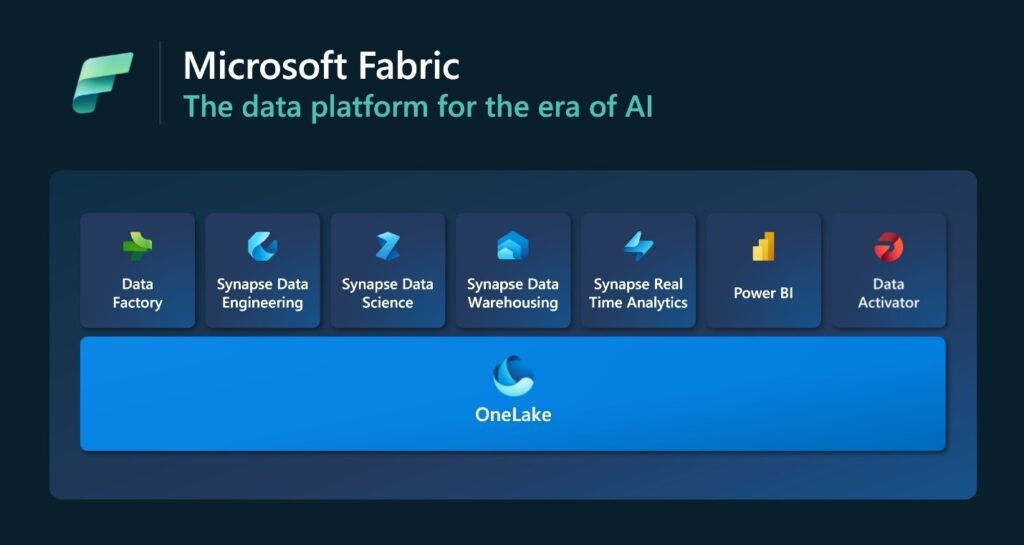
With the announcement of Fabric at Microsoft Build, Microsoft is not only betting more on Spark, but their OneLake vision is also built on top of Databricks’ lakehouse paradigm, and Microsoft is naming Fabric after Databricks’ Lakehouse: Microsoft Fabric Lakehouse.
It is a huge deal for Databricks to have a $2 trillion company’s full support while its valuation is *only* around $30 to $40 billion. Everything in Fabric will default to Delta format, including Microsoft’s data products. It is an example of incredible deal-making behind the scenes.
Behind the scene, what I believe is that Microsoft is encouraging users to generate more using Copilot, but they are enabling them to store in Delta format so users can analyze the data with AI.
Is the Delta format perfect?
This article, as recent as March 2023, talks about the Delta format’s limitations. And true to its words, any big data format is never meant to be good for transactional use like reporting. That’s why in the past, we’d push the processed data into SQL Server for reporting purposes.
However, the landscape is shifting. Power BI is now part of Microsoft Fabric. If Microsoft, a $2 trillion company, doesn’t believe in the future of Delta format, they have virtually unlimited resources to create a brand new format and even influence the industry to adopt it.
Yet, they have opted to use the Delta format.
Since the Delta format is now open source and Databricks is highly dependent on it, they can collaborate with Microsoft to enhance it to be more reliable and suitable for all use cases. It is worth noting that Microsoft has a much larger client base than Databricks, and if Microsoft starts committing resources to the Delta format because they have customer needs for extremely large-scale analytics, they are going to deploy more resources to enhance the Delta format as well as the Spark processing engine. This will only serve to benefit Databricks.
The OneLake vision is also big for Microsoft
When we look at OneLake, it is not just a simple rebranding. It is a very bold vision for Microsoft to democratize data and AI from the pricing, usability, and data lake standpoint.
Pricing: While it is still tricky to navigate license migration, Fabric simplified licensing for all toolsets – capacity and storage. Imagine there is an all-you-can-eat pricing for all Microsoft’s Enterprise Data + AI toolsets; this is the most transformative change that makes Microsoft a leader in the cloud’s increasingly complicated and confusing licensing world.
Usability: The cloud has never offered a unified option for data processing. Worse yet, there are a lot of open source and proprietary (e.g., Snowflake, Azure SQL) formats that require users to duplicate the same data over and over again from one storage to another. Having a standardized format (in this case, Delta format) is a great deal – today, you can open photos and videos from any device without installing anything. Is that a coincidence or a coordinated effort?
Data Lake or Data Swamp? Organizations are now facing the promise and challenge of more and more data. With generative AI, the data in the coming years will be unimaginably huge. Workers today can no longer keep track of where the data is coming from or going to or even which copy of the data is the latest. OneLake’s promise is to be able to virtualize all your data, from your desktop to Azure DataLake and even Amazon S3. This is the ultimate vision: Uniting data in the cloud and processing it with Azure Compute. Fabric automatically takes care of data virtualization without having to generate duplicate copies. This is also a huge win for customers who want to spend more time to analyze their data instead of making copies of the same data.
Delta format will become the standard of data format
The Delta format is poised to become the standard data format across various industries. Its robust features and capabilities have garnered widespread recognition and adoption. With its efficient storage mechanism and built-in version control, Delta format ensures data integrity and simplifies data management. Along with the adoption of Detla in OneLake, it is steadily revolutionizing how data is stored, processed, and shared, making it the go-to standard for data format in the foreseeable future.
Meta previews generative AI tools coming to WhatsApp, Messenger and Instagram, plus internal AI tools Sarah Perez @sarahintampa / 8 hours
Meta this week showcased its work on new generative AI technologies for its consumer products, including Instagram, WhatsApp and Messenger, as well as those being used internally at the company. At an all-hands meeting, Meta CEO Mark Zuckerberg announced several AI technologies in various stages of development, including AI chatbots for Messenger and WhatsApp, AI stickers, and other tools that would allow photo editing in Instagram Stories, in addition to internal-only products, like an AI productivity assistant and an experimental interface for interacting with AI agents, powered by Meta’s large language model LLaMA.
Axios had first reported the news of the consumer-facing AI agents and photo-editing tools, specifically. But the larger presentation touched on a number of areas where Meta is developing AI technologies and commentary about where it sees this space going.
In addition, the company announced it’s planning to host an internal AI hackathon in July focused on generative AI, which could result in new AI products that eventually make their way to Meta’s users.
The news follows Zuckerberg’s statements during Meta’s Q1 earnings that it was exploring how to put new AI technologies to use in products that reach billions of users worldwide.
During the call with investors, Zuckerberg had first teased Meta’s plans to explore “chat experiences” in WhatsApp and Messenger, as well as visual creation tools for posts on Facebook and Instagram, among other things. During the meeting, Zuckerberg shared more about these projects in a joint presentation with Ahmad Al-Dahle, VP of Engineering, Generative AI at Meta.
For instance, Meta’s AI chatbots, or AI agents as they’re being called, would allow consumers to interact with AIs that had unique personas and skill sets that could help and entertain people.
This is one of the areas in the consumer market that’s been gaining increasing attention and investment in recent months, as demand for AI chatbots has taken off. One leading app in this space, Character.AI, developed by researchers who helped build LaMDA (Language Model for Dialogue Applications) while at Google, gained over 1.7 million new installs in less than a week on the market, it said. The company is backed by $150 million in Series A funding, led by Andreessen Horowitz (a16z). However, the app competes with numerous other chatbot apps on the App Store providing similar functionality, ranging from those that allow users to develop their own AI characters, like Replika, to those that serve a particular purpose, like writing helpers or personal assistants.
Meta plans to first release its AI agents on Messenger and WhatsApp but sees a broader future for such technologies that may see them expanding across its family of applications, and eventually to smart glasses, Zuckerberg told employees. In those cases, the vision is that consumers would wear some sort of smart glasses — similar to Meta’s Ray-Ban Stories — to interact with the agents via voice.
As one example, a user at an airport could ask the agent what to do in the city for a couple of hours during a layover. Users could also prompt the agent to respond to queries in specific styles, as you could with a text-based agent. While Ray-Ban Stories are sunglasses — and not likely appropriate for smart glasses with AI chat — Meta has been developing other tech in this space, like Project Aria and efforts from its Research Lab.
In addition, Meta said in the meeting it was experimenting with AI that would allow users to engage with a text prompt in order to modify their own photos for sharing in Instagram Stories. This also comes on the heels of significant consumer interest in AI photo editors, including the viral trend of AI avatars that kicked off last year, sending apps like Lensa AI to the top of the App Store. Apps that turn words into AI photos, like Wonder, are also popular across the App Store.
In Meta’s case, the plan is to introduce AI stickers in Messenger, which could be generated from a text prompt. Another project, which has yet to enter internal testing, would allow users to type in a prompt as to how they want to edit a photo they’re planning to post to Instagram Stories.
For consumers, the benefit of Meta’s entry into this space is that these tools would be made free to use, thanks to Meta’s ad-supported business. Most competitive apps on the App Store offer only limited AI edits for free, but then push users into ongoing subscriptions to try all the features.
The meeting also showcased other ways Meta was using generative AI for internal purposes.
This included an experimental internal-only interface to an “agents playground” powered by its large language model LLaMA where Meta employees could have conversations with AI agents and then provide feedback to help the company improve its systems. It’s also working with MetaGen, which provides APIs for Meta’s text and image generation models for experimental use and prototyping, and Metamate, an internal productivity assistant that pulls information from internal sources to perform various tasks, driven by users’ text prompts.
For instance, developers could ask Metamate to help it find bugs in products they were dogfooding, while others could use it to help find space in their calendar by shifting meetings around.
Meta confirmed to TechCrunch its initial consumer-facing tools will arrive this year, likely sometime in the next few months.
“In the last year, we’ve seen some really incredible breakthroughs — qualitative breakthroughs — on generative AI and that gives us the opportunity to now go take that technology, push it forward, and build it into every single one of our products,” Zuckerberg said during the presentation. “We’re going to play an important and unique role in the industry in bringing these capabilities to billions of people in new ways that other people aren’t going to do, he added.







 The company asserts that its decentralized computing approach enables access to tens of thousands of powerful GPUs like A100s, on-demand, to train breakthrough models at substantially reduced costs. The platform allows developers to access popular foundation AI models at one-tenth the cost of traditional cloud providers like AWS, the company asserts. Monster API claims that in one case, an optimized version of the Whisper AI model run on its platform led to a 90% reduction in cost compared to running it on AWS.