Accenture to Invest USD 3 Billion in AI

Accenture has announced that it will invest USD3 billion over three years in its Data & AI practice to help clients across all industries rapidly and responsibly advance and use AI to achieve greater growth, efficiency and resilience.

The investments will be made in Generative AI, industry solutions, ventures, acquisitions, talent and ecosystem partnerships. The Data & AI practice will double its AI talent to 80,000 professionals through a mix of hiring, acquisitions and training.
“There is unprecedented interest in all areas of AI, and the substantial investment we are making in our Data & AI practice will help our clients move from interest to action to value, and in a responsible way with clear business cases.”

“Companies that build a strong foundation of AI by adopting and scaling it now, where the technology is mature and delivers clear value, will be better positioned to reinvent, compete and achieve new levels of performance. Our clients have complex environments, and at a time when the technology is changing rapidly, our deep understanding of ecosystem solutions allows us to help them navigate quickly and cost effectively to make smart decisions,” Julie Sweet, chair and CEO, Accenture, said.

Besides, Accenture has also launched AI Navigator for Enterprise platform to guide AI strategy, use cases, rigorous business cases, decision-making and responsible policies; and Center for Advanced AI to help maximise value of generative and other AI. It will also create accelerators for data and AI readiness across 19 distinct industries as well as pre-built industry and functional models that take advantage of new generative AI capabilities.

The post Accenture to Invest USD 3 Billion in AI appeared first on Analytics India Magazine.

The Effects of ChatGPT in Schools and Why It’s Getting Banned

The Effects of ChatGPT in Schools and Why It’s Getting Banned
Image by Editor

ChatGPT has generated excitement and concern in equal measure across many use cases. One of its most prominent — and controversial — is its use in schools. As ChatGPT’s popularity continues to skyrocket, many school districts are banning it, but its potential positives for education are growing, too.

Why Schools Are Banning ChatGPT

It’s important to understand both sides of this issue. To start, here are some of the most significant reasons behind school bans on ChatGPT.

Plagiarism Concerns

The most prevalent concern over ChatGPT in schools is its tendency towards plagiarism. Like all AI models, ChatGPT doesn’t necessarily create new content but rather compiles, summarizes and rephrases existing work. Students can easily use it to finish their work for them, to the same effect as stealing someone else’s paper and turning it in.

Many tools can detect ChatGPT-generated content, so catching students trying to cheat is relatively easy. However, even if students only use it as a research tool, they may be unable to find the original sources for the information they get from ChatGPT, leading to accidental plagiarism. The lack of consent from the people behind the model’s training data introduces further plagiarism concerns.

Questionable Accuracy

Using ChatGPT in schools may also hinder the quality of students’ education. The answers ChatGPT provides are not always accurate, even if they’re convincing, which could lead students to believe misleading or outright false information.

These factual inaccuracies may be harder to detect than plagiarism, especially if they’re about topics teachers are less familiar with. As a result, using it in research or as a teaching tool could spread misinformation.

Privacy Issues

ChatGPT also carries some privacy concerns. The platform collects a considerable amount of user data, and its privacy controls are minimal and not immediately evident. Considering the education sector was the most likely to suffer ransomware attacks last year, that’s a significant issue.

Students may not know how much personal information they’re giving away or how the site uses it when using ChatGPT. That puts a lot of highly sensitive data at risk.

Uses for ChatGPT Outside of Cheating

Despite these concerns, there are several positives to ChatGPT in schools. Here’s how the education system can use the chatbot to benefit students and teachers alike.

Streamlining Administration

Teachers and other staff members can use ChatGPT to automate some administrative tasks like scheduling and data entry. This automation would give them more time to spend with students, improving educational outcomes.

Nearly 50% of independent schools use five or more online solutions to manage administrative duties. That creates a lot of disconnect, inefficiency and unnecessary costs. Streamlining these behind-the-scenes workflows with tools like ChatGPT would help minimize that time and expense.

Boosting Engagement

Educators could also use ChatGPT to make lessons more engaging for students. Studies have found that students are more engaged and comfortable when technology plays a role in their learning, and tech as new and exciting as ChatGPT could be particularly useful.

Students could use ChatGPT to form the outlines for research papers they flesh out themselves, helping them learn what makes a quality essay. Alternatively, teachers could use ChatGPT as a way to show how AI works or to highlight the importance of watching for bias and misinformation in online resources.

Preparing Students for an AI Future

Schools may also consider teaching students how to use ChatGPT and similar tools. Generative AI will doubtlessly play a role in many future businesses, so learning how to use AI responsibly is an essential skill for the upcoming generation.

Some experts predict 58% of the current workforce will need upskilling to work effectively as new technologies change their roles and responsibilities. Education systems can get ahead of that trend by equipping students with AI literacy before they enter the workforce. ChatGPT’s ease of use makes it an ideal tool to that end.

Generative AI Could Forever Change Education

Generative AI platforms like ChatGPT will change how many industries operate. The same is likely true for education, whether that means adopting new policies to restrict the technology or embracing it.

Using ChatGPT in schools has many advantages, but significant obstacles remain. If school systems can approach it with care and consider these downsides, they can capitalize on the positives to improve future education.
April Miller is managing editor of consumer technology at ReHack Magazine. She have a track record of creating quality content that drives traffic to the publications I work with.

More On This Topic

  • Visual ChatGPT: Microsoft Combine ChatGPT and VFMs
  • ChatGPT: Everything You Need to Know
  • Using ChatGPT to Learn SQL
  • ChatGPT for Beginners
  • What Is ChatGPT Doing and Why Does It Work?
  • The ChatGPT Cheat Sheet

BAM Digital Realty to Build a New SOTA Data Centre in Mumbai

BAM Digital Realty, a joint venture between Brookfield Infrastructure and Digital Realty, today announced the acquisition of 2.15 acres of land in Chandivali, Mumbai, to build a new state-of-the-art data centre, it’s second in India.

With a total expected investment of more than INR 2000 crore (USD 250 million), the facility will deliver 35 megawatts (MW) of IT load upon completion, bringing the company’s total planned capacity in India to 135 megawatts (MW).

BAM Digital Realty’s new site was selected for its proximity to customers and central location in metro Mumbai, essential characteristics of a well-connected facility capable of supporting the growing demand for critical digital infrastructure in this region.

This strategic investment in Mumbai builds upon BAM Digital Realty’s initial foray into the India market. The company’s first 20 MW greenfield data center (MAA10), on a 100 MW campus in Chennai, is on track for launch at the end of 2023. Together, the two state-of-the-art data centers in Mumbai and Chennai will deliver rich ecosystem access to both west- and east-bound customers, leveraging Digital Realty’s global data center platform, PlatformDIGITAL®.

“Mumbai continues to be a prominent data center hub reinforced by the ongoing rapid expansion of the Indian data center industry that is fuelling the country’s significant digital transformation. As we expand our presence in India and enter the Mumbai market, we are strengthening our mission to offer the highest level of innovation and expertise to our local and global customers,” Arpit Agrawal, Managing Director, Head of Infrastructure, India & Middle East, Brookfield Infrastructure Group, said.

The post BAM Digital Realty to Build a New SOTA Data Centre in Mumbai appeared first on Analytics India Magazine.

Artificial Intelligence: A Board of Directors Challenge – Part II

Slide6

This three-part series outlines the challenges and actions that the Board of Directors for organizations must address as they guide their organization’s responsible and ethical deployment of Artificial Intelligence (AI). Part one covered mitigating the impacts of AI Confirmation Bias. In part two, we discuss the potential unintended consequences of AI deployment and how to identify these potential unintended consequences.

Leaders across various business, technology, social, educational, and government institutions are deeply concerned about the potential negative impacts of the untethered deployment of Artificial Intelligence (AI). Efforts are underway to create policies, regulations, education, and tools that stave off dire actions from nefarious actors and rogue nations who might leverage AI for misinformation, malicious use, cyberattacks, and weaponization. But there are other equally dangerous risks from the careless application of AI, including:

  • Confirmation Bias from poorly-constructed AI models that deliver irrelevant, biased, unethical outcomes and impact longer-term operational viability.
  • Unintended Consequences from decision-makers making decisions without consideration of the second and third (and fourth and fifth…) order ramifications of what “might” go wrong.

In this blog, we will discuss what the Board of Directors can do to prevent unintended consequences from AI’s inappropriate or careless application.

Addressing Unintended Consequences

Unintended Consequences are the unforeseen or unintended outcomes or effects that arise from a particular decision.

As a Board of Directors, one of the biggest challenges in implementing AI is proactively ensuring that the AI models drive ethical and responsible decisions and outcomes. Conducting after-the-fact audits will not suffice, as it can be detrimental to the business if AI models make decisions that harm its business viability or expose the organization to compliance and regulatory risks.

If we had relied on after-the-fact auditing to regulate nuclear power, there’s a good chance we would all be either dead or brightly glowing.

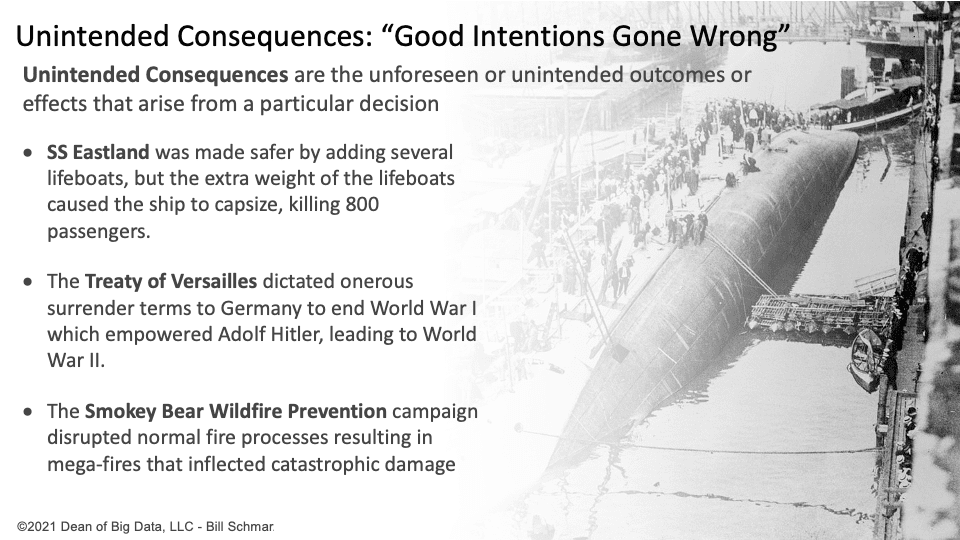
History is full of examples of “the road to hell is paved with good intentions” unintended consequences, such as (Figure 1):

  • SS Eastland was made safer by adding several lifeboats, but the extra weight caused the ship to capsize, killing 800 passengers.
  • The Treaty of Versailles dictated onerous surrender terms to Germany to end World War I, which empowered Adolf Hitler, leading to World War II.
  • The Smokey Bear Wildfire Prevention campaign disrupted normal fire processes resulting in mega-fires that inflected catastrophic damage.
Slide7

Figure 1: Unintended Consequences: “Good Intentions Gone Wrong”

It is essential for organizations to dedicate time and effort to consider the potential unintended consequences or “unknown unknowns” of AI deployments. This will prevent adverse outcomes that may arise if AI is deployed without proper consideration. To achieve this, it is necessary to understand the Rumsfeld Knowledge Matrix.

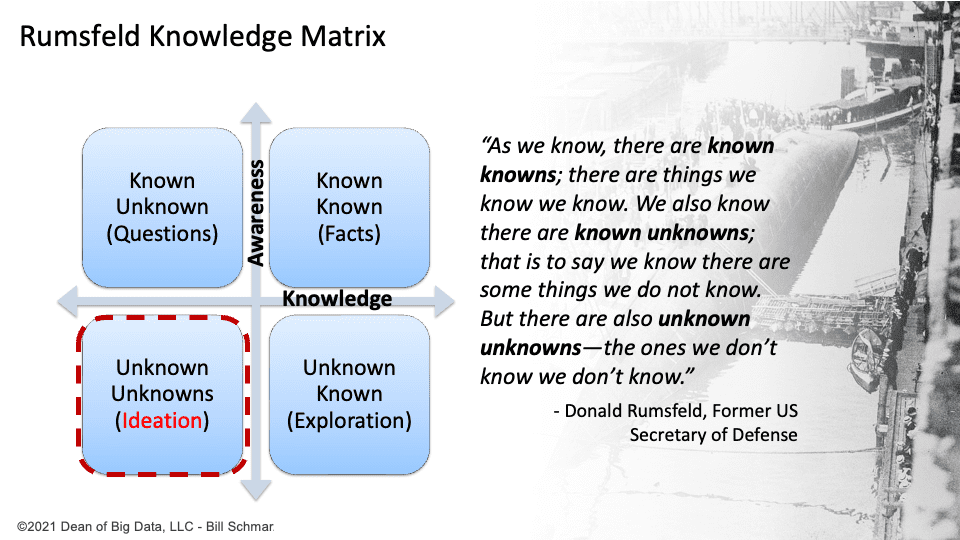
The Rumsfeld Knowledge Matrix is a conceptual framework introduced by Donald Rumsfeld, the former United States Secretary of Defense, to categorize and analyze knowledge and information based on different levels of certainty and awareness. The matrix consists of four quadrants (Figure 2):

  • Known knowns: These are things that we know and are aware of. They represent information that is well understood and can be easily articulated. I call these “Facts.”
  • Known unknowns: These are things that we know we don’t know. In other words, there are gaps in our knowledge or information which we are aware of and recognize as areas where further research or investigation is needed. We need to ask These ” Questions “ (see my blog about the importance of mastering the Socratic Method of asking questions).
  • Unknown knowns: These are things that we don’t realize we know. It refers to the current information or knowledge we are unaware of or have yet to recognize. These could include overlooked facts, hidden patterns, or insights that have not been considered. This is an area requiring guided “Exploration.”
  • Unknown unknowns: These are scenarios or outcomes completely unknown to us, or the potential unintended consequences. They represent potential surprises or unforeseen circumstances that could arise from a poorly vetted decision or initiative.
Slide8

Figure 2: Rumsfeld Knowledge Matrix

To help guide the brainstorming required to identify potential unknown unknowns, assemble a diverse set of internal and external stakeholders and constituents to explore, brainstorm, and ideate the potential unintended consequences of a decision or initiative against the following scenarios:

  • Unforeseen adverse outcomes: Sometimes, actions intended to bring about a positive change can inadvertently lead to negative consequences. An example is California’s “Ban the Box” (BTB) policy, which aimed to reduce racial disparities in employment by preventing employers from asking job applicants about their criminal records. However, a study found that this policy actually decreased young, low-skilled black men’s employment rate by 5.1%.
  • Unexpected positive outcomes: On the other hand, unintended consequences can also result in positive outcomes. Specific actions or decisions may have unintended benefits that were not initially anticipated. For instance, a new policy to reduce pollution might inadvertently spur innovation and the development of cleaner technologies.
  • Ripple effects: Unintended consequences can cascade, triggering a series of additional, often unanticipated, outcomes. These secondary or tertiary consequences can impact different areas or aspects of a system or society.
  • Counterproductive results: In some cases, actions to solve a problem can exacerbate it or create new issues altogether. This occurs when the chosen solution needs to account for the situation’s complexity or unintended side effects.

Remember to embrace your expanding Design Thinking skills as you ideate the unknown unknowns. That means that,

  • All ideas are worthy of consideration.
  • If you don’t have enough “might” moments, you’ll never have any breakthrough moments.”

You never know from whom the best ideas might come. So, empower everyone in the identification and exploration of potential unintended consequences.

Summary: Board of Directors AI Confirmation Unintended Consequences Challenge

In part two of this three-part series, we discussed what the Board of Directors needs to know to identify and explore the potential impacts of unintended consequences.

In part three, we will conclude the series with an updated Unintended Consequences Assessment worksheet plus a checklist that the Board of Directors can leverage when advising senior management on mitigating the impacts of AI confirmation bias and the potential unintended consequences of AI deployment.

Big Data Analytics: Why Is It So Crucial For Business Intelligence?

Big Data Analytics: Why Is It So Crucial For Business Intelligence?
Image by Editor

People often misunderstand the relationship between big data and business intelligence. In most instances, your business intelligence solution already uses big data analytics in some capacity. If it’s not, then that’s a huge blindspot you must address.

But why is big data analytics so crucial for modern businesses? Why should you utilize it as part of your business intelligence processes or stacks? This guide will answer these two questions and more. But first, let’s look at what these terms mean so you can better understand how and where they fit together.

What Is Big Data Analytics?

As more companies and industries have begun to embrace technology, digital transformation spending is set to reach $3.4 trillion by 2026. We’ve seen a growing reliance on technology, and no industry is exempt from this change. For example, according to a recent study conducted by GetWeave, 98% of healthcare providers agree that technology plays a crucial role in providing a superior experience for customers.

All this technological and digital transformation has opened new avenues for data gathering. As of 2023, at least 3,5 quintillion bytes of daily data are generated globally. This large storage of raw collected data is referred to as big data.

Not all this data is useful to businesses, and often, it is too voluminous to be handled by traditional data processing software. Before most big data can be used in meaningful ways, it must be sorted, filtered and even labeled. These processes make up an important part of big data analytics.

Some of the most used types of technology and tools for big data include:

  • Data storage and processing (Hadoop)
  • Data provisioning and distribution (Cassandra)
  • Stream analytics tools
  • Predictive analytics software
  • Data lakes
  • Knowledge discovery
  • Data mining tools
  • In-memory data fabric solutions
  • Data virtualization
  • Data cleansing
  • Cluster computing frameworks

As you’ll see, many of these tools are utilized in business intelligence too.

What Is Business Intelligence?

Business intelligence (BI) describes the process of using technology to extract actionable insights from business data. These insights are then visualized and presented to company executives, allowing them to make informed decisions based on empirical data.

Business intelligence is often confused with business analytics and may also be why big data analytics is conflated and mistaken with BI. But while business intelligence seeks to gain present-day success by using old and new data, business analytics looks at the links between present and past data to predict future data (the future of the business).

Both approaches can use big data analytics to achieve their goals, but let’s focus on business intelligence. It revolves around a litany of analytics processes and solutions such as (but not limited to):

  • Data mining
  • Predictive analysis
  • Statistical analysis
  • Big data analysis
  • Data visualization software
  • Key performance indicators (KPI)
  • Performance benchmarking software
  • Querying software
  • Real-time analytics software

By implementing an effective BI strategy, companies can enhance their abilities to access and use key data. Ultimately, BI can increase your company’s overall profitability by ensuring that all business decisions are enriched with factual data. It can also help companies improve their internal processes, which allows them to run more optimally.

You can use business intelligence to uncover market trends, discover new revenue streams, and identify overlooked business problems. Big data analytics can be a fundamental part of your organization’s BI strategies.

Big Data Analytics: Why Is It So Crucial For Business Intelligence?
Photo by Pexels Big Data Analytics Use Cases for Business Intelligence

Big data analytics can be used as part of your business intelligence strategy in the following ways:

Product Development and Improvement

New product development describes the life cycle of a product, from its inception to marketing. How you approach product development will depend on the model you use. For instance, data analysis is the first step in Roozenburg & Eekels’ simple 3-phase New Product Design (NPD) model.

Regardless of your chosen model, the foundational steps will require you to perform stringent research. This applies to making product improvements or introducing existing product variations.

Today, most corporations have global aspirations, as it presents them with more financial opportunities and incentives. However, it requires more intense market research, including data acquired from surveys, website tracking data (cookies), credit report statistics, etc.

Consumer attitudes and needs are ever-evolving, and some needs may be seasonal. Thus, your data pools will grow and be updated constantly, essentially becoming big data. You need a big data analytics system that can sort, process and find patterns at nearly the same velocity that the data is being generated.

Business intelligence software can be used to deliver all patterns and statistics in a more manageable way. Organizations can then use this data to develop proposals, blueprints and plans for new product designs and improvements. They can also use this information to determine their operations and material requirements and make more precise development cost estimations.

Price Optimization

Companies can price their products more accurately if they can calculate the development cost in the early stages; this goes for established products too.

Your big data should contain patterns indicating the connection between the current global economic climate and shopping trends. For instance, to remain competitive during 2022 and 2023, companies began to reduce the total units and mass they included in a packaged product. For example, a 500g bag of potato chips would be reduced to 450g and sold for the same price. This is called shrinkflation.

Big Data Analytics: Why Is It So Crucial For Business Intelligence?
Photo by Brett Jordan

Big data analytics paired with business intelligence can help companies determine whether it would be more fruitful to increase prices or make up for growing costs in other ways. Furthermore, it will also help you determine if a current line of products is worth shelving.

Streaming and TV production can benefit from big data analytics as well. By combining information from the current zeitgeist, streaming behaviors, and polls, these companies can make more effective decisions in deciding which shows to cancel and which to keep.

For instance, we’ve seen entire swaths of Netflix subscribers drop the streaming giant because a certain show was canceled. A study conducted by Parrot Analytics found that Young Justice was one of the most in-demand series of 2023. Yet, HBO Max canceled it in late 2022.

What this tells us is that many of these decisions weren’t fully informed. Big data analytics and business intelligence can stop your company from making the same mistake.

Supply Chain Management

Big Data Analytics: Why Is It So Crucial For Business Intelligence?
Created by fatmawatilauda70555

2021 and 2022 saw huge supply chain interruptions, and it’s one of the many factors fueling current inflation. Many retailers use a just-in-time inventory management solution, but while it can be efficient, it has little protection against supply chain interruptions.

Big data analytics and business intelligence can help companies deploy more agile inventory and supply chain management. They can provide real-time data that can then be interpreted by a machine learning-driven BI solution to deliver predictive analytics.

This can help companies protect themselves from supply chain interruptions, as this supply chain data isn’t limited to available raw materials or manufacturing capacity. It also considers the weather, shipping delays caused by natural disasters, shopping trends, pricing, the economic climate, etc.

You can also use this information to reduce stock and avoid wastage when demand decreases. Thus, it can make your JIT inventory management system more optimal.

Channel Analytics

We’ve covered how big data analytics and BI can combine information from various channels to help enterprises improve their new product design and development, price optimization, and supply chain management.

But how do you determine the quality of each channel and the integrity of its information? There are various channels, and they’re not all restricted to web channels. Other channels may include customer support calls, postage mail, store or branch locations, etc.

Enterprises can use big data analytics and business intelligence for channel discovery. They can also reveal the integrity, quality, and efficiency of channels and how well they integrate into their systems. Ultimately, you can think of it as big metadata as it’s data about your big data. By affirming the channels you gather your data from, you’re essentially affirming the quality of your big data.

Conclusion

The big data analytics market is estimated to reach over $650 billion by 2029. This is hardly a surprise, as this guide has shown the many ways big data analytics can be used to enrich business intelligence. More firms should aspire to become data-first enterprises, and with companies such as Datapine providing business intelligence solutions with big data analytics, it should be easier than ever.
Nahla Davies is a software developer and tech writer. Before devoting her work full time to technical writing, she managed — among other intriguing things — to serve as a lead programmer at an Inc. 5,000 experiential branding organization whose clients include Samsung, Time Warner, Netflix, and Sony.

More On This Topic

  • Data Science vs Business Intelligence, Explained
  • Knowledge Graphs: Connecting Your Data to Solve Real-World Problems in R&D,…
  • Comparing the Top Business Intelligence Tools: Power BI vs Tableau vs Qlik…
  • Applications of Data Science and Business Analytics
  • How to Use Analytics to Accelerate Business Growth?
  • New Online MS in Business Analytics for Managers from University of…

Meta is Where OpenAI was Four Years Ago

Meta thinks it is leading the open-source LLM race. In reality, Meta is where OpenAI was four years ago with its open source GPT-2. Now with LLaMa, Meta wants to be altruistic by giving its technology to the open source, but the truth is, it is only because LLaMa isn’t where GPT-4 or PaLM are right now.

In the recent podcast with Lex Fridman, Mark Zuckerberg said, “The stage we are in right now, the equities balance strongly in my view towards doing this more openly.” He believes that if companies think that they have gotten close to what they believe is “superintelligence”, it makes sense for them to discuss and think through a lot more.

Zuckerberg knows that even with the current capabilities of LLaMa, their open source large language model, it is still “an order of magnitude smaller than what OpenAI and Google are doing”. This explains why Meta wasn’t invited to the White House meeting with the President. The reason stated was that the meeting was “focused on companies currently leading in the space“. Zuckerberg’s statement in the podcast confirms that he is aware of this.

Meta-morphosis

“The biggest OpenAI (GPT-4) or Google (PaLM-2) models do not reveal what the exact specs of these models are. They can be ten times bigger than their previous versions. The whole debate is if it is good for everyone in the world to access these frontier AI models,” said Zuckerberg. Interestingly, he admitted that Meta’s LLaMa is not a frontier AI model right now.

Looks like all the Jiu-Jitsu training is finally rubbing off on him. “I think it’s a big gift [Jiu-Jitsu] of somehow being humbled, especially physically, opens your mind to the full process of learning, what it means to learn, which is being willing to suck,” narrated Fridman, describing Zuckerberg’s personal transformation.

However, Zuckerberg claimed that LLaMa, with its biggest 65 billion parameters is proving to be as performing as any other larger model. “We can do it for very few computers and it’s just way more efficient, saves a lot of money for everyone who uses this,” said Zuckerberg. He acknowledged that the relatively earlier releases of LLaMa isn’t quite as the frontier of models like OpenAI or Google’s, and is nowhere near superintelligence.

While Zuckerberg did not confirm if the second, more capable version of LLaMa is expected to release any time soon, he believes that even the current capabilities of the model is the testament of what Meta wants to pursue. But when asked if the next version is as great OpenAI or Google, would Zuckerberg open source it, he said that there are a lot of technologies that Meta hasn’t open sourced.

Meta is bound to follow OpenAI’s path, eventually

With just 1.5 billion parameters, GPT-2 was ahead of everyone else in the space, which was kind of empty anyway. But now, Meta has found its answer – open source and keeping it only for research. But it will probably not be this way once the capabilities of LLaMa increase, eventually becoming like the closed-door OpenAI, as was evident in the podcast.

“We want a lot more researchers working on it and for a lot of these reasons open source has a lot of advantages.” He explained how open source software is more secure because there are a lot of people criticising it, finding holes in it, and thus in the end making it safe. “I think this is how we will achieve more aligned models, by making it open source and letting people work on it,” said Zuckerberg.

Meta has been shying away from getting into the LLM space. A lot of it was because of past failures, and the risk of open sourcing software, as these views were expressed by Yann LeCun, the AI head of the company. But now, as Zuckerberg explained, it is making sense for the company to shift their focus on open sourcing technologies, but not for commercial, but only research purposes.

According to Zuckerberg, Meta’s bet is on the open source community as they believe instead of hopping onto the wagon of claiming superintelligent AI, it would be beneficial to let the community use it for research purposes, and building more efficient and aligned AI.

Meta is following its true nature of being one of the biggest proponents of open source, but it might not stay this way too long, just how OpenAI changed in four years, and kept its “superintelligent” GPT-4 for itself.

The post Meta is Where OpenAI was Four Years Ago appeared first on Analytics India Magazine.

Generative AI is Already Finding Multiple Use Cases in Agriculture 

ChatGPT, driven by powerful GPT models, has found application across various sectors. OpenAI CEO Sam Altman, during his recent visit to India, mentioned that he was amazed to witness an Indian farmer using a ChatGPT-powered chatbot to access information on agricultural welfare schemes.

Indeed, platforms like Kissan AI ( previously known as KissanGPT) have showcased the prowess of generative AI in agriculture. The platform leverages the power of GPT3.5 and Whisper models by OpenAI and receives 30,000-40,000 queries every month.

The Indian government too acknowledges how useful generative AI can be. Reports earlier this year suggested that the Ministry of IT and Electronics ( MeitY) is working on a WhatsApp chatbot by integrating ChatGPT (which is powered by GPT3.5 and GPT-4 large language models). “LLMs combined with the natural language understanding of Indic languages can significantly enhance the ability of farmers to make informed decisions, potentially boosting yield, reducing wastage, and enhancing overall farm profitability,” Pratik Desai, who developed KissanAI, told AIM.

In India, the agricultural sector remains one of the biggest contributors to India’s GDP and employs nearly 50% of the population of India, directly or indirectly.

Leveraging Generative AI

Today, there are numerous government schemes and benefits available for farmers, however, many of these farmers are unaware of these schemes. Navigating through the multitude of government schemes and welfare programmes in India can be challenging, especially for those who are illiterate or unfamiliar with English.

Jugalbandi, an AI-chatbot powered by OpenAI’s GPT models via Azure OpenAI Service, is helping farmers as well as villagers in rural India find out about different government schemes which are beneficial for them. The chatbot, which can also be accessed through WhatsApp, retrieves pertinent programme details, typically documented in English, and delivers them in the native language of the user. Currently, the chatbot is available in 10 of the 22 official Indian languages.

Similarly, Wadhwani AI, an independent, non-profit institute dedicated to developing AI solutions for social good is exploring leveraging generative AI to power Kissan call centres. Alpan Raval, chief scientist, AI/ML, Wadhwani AI, told AIM that they are building a Kissan call centre support system using generative AI to assist farmers with their queries.

“Our approach involves augmenting the expertise of the human experts by utilising models that provide automated responses based on a knowledge base. We create these knowledge bases using current government reports and documents, and our speech interface enables a conversational AI system for seamless interactions,” he said.

Generative AI capabilities are being tapped into by other players in the sector as well. Digital Green, a global development organisation has joined forces with generative AI startup Gooey.AI to introduce Farmer.CHAT, an innovative solution aimed at addressing the challenges faced by farmers who are at the forefront of climate change and water security issues. Odisha’s Department for Agriculture and Farmer’s Empowerment also launched Ama KrushAI, an interactive chatbot, to provide farmers with valuable guidance on optimal agronomic practices, government schemes, and loan products offered by over 40 commercial and cooperative banks.

Desai also revealed that he has been approached by over 20 companies operating within diverse agricultural sectors, both in India and internationally. “These range from early-stage agritech startups to established agri input enterprises. Currently, in our pilot phase, we’re working in close collaboration with a selected cohort of these companies.”

Generative AI could do a lot more

The current technological transformations and digital penetration in rural areas have made farmers aware of their crops. “However, there is still a need to acquaint them with tailor-made solutions to improve their conventional farming practices and adopt the latest methods and techniques to increase their productivity,” Sateesh Nukala, CEO & co-founder at BigHaat, told AIM.

Generative AI could potentially do a lot more, given the technology is still in its nascent phase. As the technology matures, its potential use cases in agriculture will also increase. “It will become useful in numerous areas like quick detection of diseases and pest control, nutritional deficiencies that are not currently screened by existing tools,” he said.

Determining soil health to know the possible deficiencies in the current age is difficult as it requires expensive tools to generate such soil health reports. “Further, the history of crops sown on a particular land and capability to predict the upcoming quantum of harvest and plan for the coming year are some of the crucial parameters where generative AI can assist farmers in their native language,” Nukala said.

The post Generative AI is Already Finding Multiple Use Cases in Agriculture appeared first on Analytics India Magazine.

Meta is Working on a Twitter Alternative

Meta is Working on a Twitter Alternative

During the Lex Fridman podcast, Mark Zuckerberg expressed his interest in working on a social-media platform that is completely text-based, similar to Twitter.

The competitor to Twitter with a condename P92, as mentioned by Fridman, is a project that Zuckerberg said would be a platform for sharing the information which is important to the society.

“I think Twitter has not lived up to what I would have thought its full potential should be,” said Zuckerberg. He said that maybe Elon Musk, the current owner of Twitter also felt the same way and is one of the reasons why he bought the platform.

Zuckerberg further said that the open and federated approach for such a platform is potentially interesting, comparing the social media with the likes of Mastodon and Bluesky, which are decentralised social media platforms, built as an alternative to Twitter.

“Something that melds some of those ideas [Mastodon and Bluesky] with the graph and identity system that people have already cultivated on Instagram could be a kind of very welcome contribution to that space,” he added.

Zuckerberg said that Twitter should have a billion people on its platform now, or whatever the alternative is brought to the market. He believes that, “text is very accessible for people to transmit ideas,” and is a very good format for discussion.

He explains that platforms like TikTok, which has video as the primary content on the platform, text and comments do not be the first class of the conversation, as they get dominated by the videos.

The Meta head said that the company has been working on a lot of projects simultaneously and this is also something that an entire team is focusing on. It is possible that we might see a text-based social media platform from Meta, when it already has Instagram and WhatsApp under its belt right now. This might even be decentralised, as Zuckerberg has clearly shown interest in the space.

Chris Cox, the head of product at Meta told The Verge a few days back that the company is building Project 92, as a direct alternative to Twitter, as a lot of people have been unhappy with the platform.

The post Meta is Working on a Twitter Alternative appeared first on Analytics India Magazine.

Salesforce Launches AI Cloud with Einstein Trust Layer

Salesforce Launches AI Cloud with Einstein Trust Layer

Salesforce has announced the launch of its AI Cloud, a suite of products built for CRM in enterprises where they can boost their productivity through all the Salesforce AI applications.

Set to launch this year, the AI Cloud platform offers hosting and delivery services for various AI models, particularly those focused on generating text. It collaborates with multiple partners such as Amazon Web Services, Anthropic, Cohere, and OpenAI, utilising Salesforce’s cloud infrastructure.

Marc Benioff, co-founder and CEO of Salesforce said, “Generative AI…may be the most important technology of any lifetime,” during the announcement in New York City.

In addition to the partner models, customers can access first-party models developed by Salesforce’s AI research division, which enable features like code generation and business process automation. Alternatively, customers have the option to bring their own custom-trained model to the platform while keeping their data stored on their own infrastructure.

All the AI models

Salesforce’s flagship products, including Data Cloud, Tableau, Flow, and MuleSoft, benefit from the advanced capabilities provided by the AI models built within AI Cloud. These models include Sales GPT, Service GPT, Marketing GPT, Commerce GPT, Slack GPT, Tableau GPT, Flow GPT, and Apex GPT, making a total of nine models.

However, one notable omission in AI Cloud is an image-generation model similar to DALL-E 2 and Stable Diffusion. Salesforce is actively working on developing such a model. They aim to overcome various barriers, including copyright and toxicity concerns, before releasing it to the public.

Sales GPT enables the quick creation of personalised emails, while Service GPT assists in generating service briefings, case summaries, and work orders based on case data and customer history. Marketing GPT and Commerce GPT generate audience segments for targeted marketing and tailor product descriptions to individual buyers using their customer data, providing recommendations on increasing average order value.

The remaining models, Slack GPT, Tableau GPT, Flow GPT, and Apex GPT, have more specialised applications. Slack GPT and Flow GPT allow users to build no-code workflows that incorporate AI actions within Slack or Flow. Tableau GPT generates visualisations based on natural language queries and reveals data insights. Apex GPT scans for code vulnerabilities and suggests inline code for Salesforce’s proprietary programming language, Apex.

Currently, several models are already operational, such as Slack GPT, Commerce GPT, Sales GPT, and Service GPT. The rest, excluding Flow GPT, which will be available in October, are scheduled to be launched as early as this month.

This is a very similar move to Amazon launching Bedrock, which provides a family of models which are trained by AWS in-house, along with pre-trained models for startup partners.

Recently, Salesforce also partnered with Google Cloud to expand strategic partnership for helping businesses utilise AI and data for delivering more personalised experiences for their customers.

Einstein GPT Trust Layer

Similar to NeMo Guardrails, for ensuring the privacy and security of these models, Salesforce is making an attempt to ensure the moderation of the content by retaining the privacy of user’s sensitive data. AI Cloud includes a brand new Einstein Trust Layer, which makes it open, extensible, while providing privacy and security.

This will allow customers to use third-party LLMs, Bring Your Own Model (BYOM) on the Salesforce platform. The Einstein GPT Trust Layer will be available from this month generally.

Moreover, to distinguish AI Cloud from other managed AI service providers, Salesforce is introducing a range of prompt “templates” and tools for building prompt templates. These templates, according to Salesforce, utilise “optimised” AI prompts that leverage “harmonised” data to ensure that the generated content aligns with a company’s specific requirements. By grounding the model-generated outputs in context, these prompts significantly enhance the quality and relevance of the generated content.

The post Salesforce Launches AI Cloud with Einstein Trust Layer appeared first on Analytics India Magazine.

Intel Unveils Open-Source Font Design One Mono to Reduce Eyestrain & Developer Fatigue

Tech giant Intel has unveiled a new monospaced font collection called Intel One Mono, crafted with a focus on clarity, readability, and the specific requirements of developers, especially low vision or visually impaired developers.

Accessible for free, under an open-source font license, type design company Frere-Jones Type collaborated with the Intel Brand Team and global marketing agency VMLY&R to create the Intel One Mono typeface. The primary objective was to enhance legibility, alleviate eye strain, combat developer fatigue, and minimise coding errors. Throughout the design process, a panel of low-vision and legally blind developers actively contributed their valuable insights and feedback.

Moreover, Intel One Mono offers comprehensive language support for more than 200 languages that employ the Latin script. This versatile font family comprises four weights—Light, Regular, Medium, and Bold—each accompanied by corresponding italics.

Check out the GitHub repository here.

Read more: Will Meteor Lake Be Intel’s Saving Grace?

How to Activate the Fonts

As per the announcement, users can obtain the font builds from the Releases section. The fonts should be activated according to the documentation of the software being used.

Code editors such as VSCode and Sublime Text have specific steps for activating the fonts. For VSCode, users need to search for “Font Family” in the settings and specify “IntelOne Mono.” In Sublime Text, the font_face setting should be changed to “IntelOne Mono” in the Preferences menu.

Different font formats are recommended for various purposes. The .otf and .ttf formats are suitable for desktop use, while .ttf files are also well-suited for mobile apps. The .woff and .woff2 formats are optimized for web use.

The recommended font sizes for print and screen display are 7 points and 9 pixels, respectively. The provided fonts have been optimized for screen clarity and legibility, especially on Windows platforms.

Additional features, such as raised colon, language support, superior/superscript and inferior/subscript figures, and fraction numerals, can be accessed through specific options and CSS.

The sources directory contains editable font sources in .ufo format. These sources can be used in font editors to modify the fonts. The postscript and truetype subfolders provide separate source files for .otf and .ttf/.woff/.woff2 formats.

To generate installable fonts, the font editor’s “Generate Font” functionality can be used. Recommendations for settings are provided for different formats.

Masters are available for making edits across multiple weights, and interpolation can be used to generate individual weights and styles. The hinting sources, stored separately, provide manual hinting instructions for TrueType-based formats.

Why Developer Fonts Are Important

IDEs and developer tools often come with subpar fonts, such as monospaced system fonts, which can lead to eye strain and poor readability for some users. Despite the ability to switch fonts, many programmers fail to realise the benefits until they try community-backed alternatives, which can minimise headaches, improve code scanning, and improve their productivity. Some of the top fonts recommended for programming include Fira Code, Consolas, Input, DejaVu Sans Mono, JetBrains Mono, and MonoLisa.

Read more: Intel Aurora: A Last Ditch Effort for Supercomputer Dominance

The post Intel Unveils Open-Source Font Design One Mono to Reduce Eyestrain & Developer Fatigue appeared first on Analytics India Magazine.