Would you trust AI-generated reviews? The next Amazon product you buy may have them

08 December 2020, North Rhine-Westphalia, Mönchengladbach: Parcels are stored in a truck in a logistics centre of the mail order company Amazon. A particularly large number of orders are processed during the Christmas business. Photo: Rolf Vennenbernd/dpa (Photo by Rolf Vennenbernd/picture alliance via Getty Images)

Another day brings another use for generative AI. As companies worldwide are seeking ways they can add artificial intelligence tools to their workflow, Amazon is testing out generative AI in one area that was already controversial: product reviews.

Amazon's product reviews have long been a way for dubious sellers to scam customers by writing false reviews or changing a product listing after it's gotten a lot of good reviews to make a new product more attractive. The Amazon reviews area resembles a battleground where customers wade through the muck while Amazon fights to maintain their trust against some dishonest sellers trying to get their products past the checkout page. Now, generative AI is entering the fray to streamline it all.

Also: I bought 4 brand-name tech gadgets on Temu for work. Here's how it went

The e-commerce giant is using generative AI to summarize the reviews of certain product listings. The objective, says Amazon, is to save shoppers from having to wade through all that muck, and instead deliver the gist of other customers' thoughts. Not every product is getting the gen-AI treatment, however, and we've only seen this in mobile listings, but I found a few examples to share how the company's doing this:

Pixel 6a's generative AI review

In this example, the Pixel 6a's 4,363 reviews are summarized into one short paragraph using generative AI. Each summary gathers both positive and negative feedback, shows highlighted keywords in bold, and ends with customers' mixed opinions.

"Customers have praised the phone's camera, memory, and system. The phone is also considered a good value for the price. However, some customers have had negative experiences with the fingerprint sensor, which doesn't work well and has caused connectivity issues", the AI-generated review says.

Also: Unexpected bill? This AI bot can 'Haggle It' for you

Each time an AI-generated summary of a product's reviews appears in a listing, Amazon adds it before all the customer reviews but adds a disclaimer in fine print below it that reads "AI-generated from the text of customer reviews."

According to CNBC, Amazon has confirmed that it is testing the feature and investing significantly in generative AI across all its businesses.

The Apple Watch also gets a generative AI review summary

There are quite a few product listings with AI-generated review summaries, from toys to tech devices. The Apple Watch's reviews on Amazon are also summarized by AI, as shown in the image above.

"Customers have praised its excellent quality, great product, nice look, intuitive design, effortless pairing with iPhone, convenience, accuracy in tracking fitness and health, and high-quality features", the summary says of the Apple Watch. "However, some customers have had negative experiences with charging, lack of charger, connectivity issues, and battery life".

Also: The best AI chatbots: ChatGPT and other noteworthy alternatives

As a shopper that reads a lot of reviews before committing to a big purchase, I find these summaries to be quite useful in giving me the essence of what many buyers have experienced with the product. However, I'll still be wading through reviews even after reading these summaries.

These AI-generated reviews do nothing to combat bogus reviews and dodgy sellers, so it's still worth doing the legwork before checking out.

The Beatles are dropping one last track with the help of AI

The Beatles

Generative AI has made it possible to transform snippets of a person's voice into an entire song. Artists and music labels have taken a position against it claiming it's copyright infringement.

However, this technology has the potential to bring a deceased artist's voice back to life and The Beatles are taking advantage of that.

On BBC's Best of Today podcast, Paul McCartney shared his thoughts on AI in the music industry and revealed that The Beatles would be dropping a new track soon with the help of AI.

Also: The best AI chatbots: ChatGPT and other noteworthy alternatives

"So when we came to make what will be the last Beatles record, it was a demo that John had that we worked on," said McCartney in the BBC interview. "We were able to take John's voice, and get it pure through this AI so then we could mix the record as we would normally do."

Without revealing the name of the demo, he did share that the record was just finished and will be released this year.

The demo to which McCartney refers, according to some rumors, is Lennon's unfinished song, "Now and Then", which had been considered previously as a possible reunion song.

This demo-to-song technology isn't new to McCartney or The Beatles as it was used for one of their projects in the past.

Also: ChatGPT can't make music, but Google's new AI model can

"We were able to use that kind of thing when Peter Jackson did the film "Get Back" where it was us making the Let it Be album and he was able to extricate John's voice from a ropey little bit of cassette," said McCartney.

Harnessing AI for the production of the band's final track, McCartney acknowledged, is "kind of scary but exciting because it's the future."

The AI music generation space is continuing to grow. Last week, Meta unveiled MusicGen, an open-source music-generating tool that can take text or melody and produce it into audio.

Also: Spotify unveils new features, including your own AI DJ. Here's how to access it

Other capable very capable models in the space include OpenAI's JukeBox, Google's Music LM, and Riffusion.

Artificial Intelligence

The best Alexa devices of 2023: Echo, Ring, and more

Since its debut in 2014, Amazon's Alexa has become a leading voice assistant built into tons of smart home devices, aiding users with everything from locking doors, dimming the lights, making a phone call, and playing songs, all at a simple voice command.

Alexa is now integrated into multiple products such as smart hubs, Amazon Echo speakers, smart thermostats, smart lightbulbs and home security cameras. This vast catalog, which now includes many models and generations of products from Amazon and other manufacturers, can make it overwhelming to choose which Alexa device best elevates your home and lifestyle.

Read more: The best cheap smart home devices

After considering ZDNET's hands-on testing and talking to Alexa device users, I compiled the best Alexa devices based on device type, design, features, cost, and need to help you choose which Alexa device(s) will make your life easier. Our choice for best Alexa device overall, the fourth-generation Amazon Echo, offers convenience with its smart home skills in a sleek form factor and relatively low price. Read to see our other top selections for your home.

Also: The best home automation systems

Best Alexa devices of 2023

Best Alexa device for streaming

Amazon Fire TV Cube

Enjoy Ultra 4K HD with the Amazon Fire TV Cube. It's similar to the Amazon Fire TV Stick but brings faster speeds with more advanced features.

View at Amazon

Best Alexa device for smart locks

August Wi-Fi Smart Lock

The August Wi-Fi Smart Lock is easily installed to provide advanced home security with biometric verification. It also earned ZDNET's top choice for the best smart lock you can buy.

View at Amazon

Best Alexa soundbar device

Sonos Beam

With its Alexa integration and quality sound output, the Sonos Beam is also one of the best Sonos speakers you can buy. Take your audio to the next level with this subwoofer that is compact enough to fit in your home without trouble.

View at Amazon

ZDNET Recommends

TechCrunch+ roundup: Paid acquisition basics, most-valued startups, 10 investors open to pitches

TechCrunch+ roundup: Paid acquisition basics, most-valued startups, 10 investors open to pitches Walter Thompson @yourprotagonist / 7 hours

There’s a direct correlation between the size and strength of your network and your chances of success.

In fact, it’s relatively easy to connect with reputable investors — most firms’ websites have email addresses and contact forms.

There are a myriad of reasons why startups fail to get off the ground, but it generally boils down to three things:

  • you don’t have a billion-dollar idea.
  • you’re pitching the wrong investors.
  • they’re not sure if you can execute against the plan.

This month, all ten “How to pitch me” participants shared their investment theses, along with tactical advice for nontechnical founders and the questions they expect entrepreneurs to ask them during pitch meetings:

Full TechCrunch+ articles are only available to members
Use discount code TCPLUSROUNDUP to save 20% off a one- or two-year subscription

  • Vivek Ramaswami, partner, Madrona
  • Monique Woodard, founding partner and managing director, Cake Ventures
  • Adam Struck, founder and managing partner, Struck Capital
  • Jenny Lefcourt, general partner, Freestyle Capital
  • Champ Suthipongchai, general partner, Creative Ventures
  • Latif Peracha, general partner, M13
  • Rich Maloy, managing partner, SpringTime Ventures
  • Harley Miller, co-founder and managing partner, Left Lane Capital
  • Blair Garrou, co-founder and managing director, Mercury Fund
  • Kristin Wilson, venture partner, Oui Capital

Thanks very much to everyone who took the time to respond!

If you’re an early-stage investor who’d like to be included in future columns, email guestcolumns@techcrunch.com with “How to pitch me” in the subject line.

Have a great week,

Walter Thompson
Editorial Manager, TechCrunch+
@yourprotagonist

How to pitch me: 10 investors discuss what they’re looking for in June 2023

Paid acquisition: The #1 way to find product-market fit

Fishingnet is in an aquarium full of goldenfish. Clean white background.

Image Credits: c-foto (opens in a new window) / Getty Images

Spending money on Google AdWords, Meta, or with an influencer takes some getting used to.

Paid acquisition takes time to generate positive returns, but growth expert Jonathan Martinez says it’s still “the most efficient and frictionless way possible” to achieve product-market fit.

In this week’s column, he explains how to determine which channels work best with your offerings and breaks down his “battle-tested waitlist method” for capturing and leveraging user interest using tools like Canva and Leadpages.

Paid acquisition: The #1 way to find product-market fit

The ‘AI arms race’ is about more than who will lead the industry

Lorenzo Thione is a managing director at Gaingels where he oversees investments in sustainability and artificial intelligence.

Lorenzo Thione hopes to see more support for the LGBTQ+ community within venture.

Gaingels Managing Director Lorenzo Thione talked to Dominic Madori-Davis about his work leading sustainability and AI investments for the syndicate and his journey as an openly gay investor.

In a wide-ranging conversation, Thione shared his views on today’s frothy AI market, spoke about where the sector is headed, and emphasized why it’s important to support founders who identify as LGBTQ+.

“They simply were not getting any access to the venture engine because of who they were,” he said.

The ‘AI arms race’ is about more than who will lead the industry

Here are the most richly valued startup types in today’s early-stage venture market

bridge financing, an investor dangling a coin over reaching hands

Image Credits: z_wei / Getty Images

I am not an early-stage investor, which is why I was so surprised to learn that video-game startups led the pack with regard to the median amount of seed money raised in Q1 2023.

“Transportation came in second, followed by food, biotech, data analytics, and then CRM and SaaS,” reports Alex Wilhelm, who reviewed numbers from Carta.

At the Series A level, renewables, logistics and hardware startups topped the list.

“Don’t worry, the answer here is not just ‘build an AI startup,’ even if that does appear to be pretty solid advice for avoiding a down round.”

Here are the most richly valued startup types in today’s early-stage venture market

Get the TechCrunch+ Roundup newsletter in your inbox!

sign up for the TechCrunch+ roundup newsletter

To receive the TechCrunch+ Roundup as an email each Tuesday and Friday, scroll down to find the “sign up for newsletters” section on this page, select “TechCrunch+ Roundup,” enter your email, and click “subscribe.”

Click here to subscribe

Venture firm Black Seed raises £5M inaugural fund to invest in Black founders

Black Seed announces today a $6.2 million raise

Image Credits: Black Seed

Between 2009 and 2019, VCs operating in the U.K. directed 0.24% of their funding to Black founders.

“That’s worse in some ways than in the United States,” writes Dominic Madori-Davis. London-based Black Seed, an early-stage VC firm, recently raised £5 million to support Black entrepreneurs.

“We exist as a tech fund and a community,” said founder Karl Lokko. “We exist to bridge that gap and give Black founders inclusion.”

Venture firm Black Seed raises £5M inaugural fund to invest in Black founders

Deal Dive: Finally, a startup building a network for those who could benefit the most

network, professionals of color, retention

Image Credits: Getty Images

A decade ago, Porter Braswell started Jopwell, an online community for people in tech “from underrepresented communities and backgrounds,” reports Rebecca Szkutak.

But expanding access doesn’t solve every problem.

“Retention is a major challenge and still remains so,” says Braswell, who’s now launching 2045, a career platform that will support workers between 30 and 45 years old with coaching, advice and events.

“It’s very taxing to be a professional of color in this country,” he said.

“If you’re a professional in the middle stage of your career and you look up and don’t see someone who looks like you, it is exhausting.”

Deal Dive: Finally, a startup building a network for those who could benefit the most

The Australian AI governance debate starts to heat up

A person typing on a laptop with symbols representing data and ai in front.
Image: stnazkul/Adobe Stock

A lack of properly defined artificial intelligence governance and policy is causing bipartisan concern in Australian politics, with both major parties recently speaking out about the need to move urgently on the matter.

While regulation is often seen as an inhibitor to innovation, there is a real fear that Australia is falling behind on AI, lacking the resources and skills to manage the technology. Increased activity by the government will help to crystallize a national strategy. This will lead to better opportunities for AI technologists and companies.

SEE: Explore TechRepublic Premium’s artificial intelligence ethics policy.

As recently highlighted at a The Australian Financial Review Future Briefings event by Australian deep-tech incubator Cicada Innovations CEO Sally-Ann Williams, Australian companies “dramatically overestimate the level of relevant technology expertise they have within their ranks.”

“People say to me, ‘I have 150 machine learning experts in my business’, to which I say, ‘you absolutely don’t,'” Williams said.

Developing regulations and a national vision for AI will help the industry address these challenges.

Australian ministers propose regulatory efforts to capitalize on AI

Writing in The Mandarin in early June, Labor Minister Julian Hill argued for the establishment of an AI commission.

“AI will shape our perception of life as it influences what we see, think and experience online and offline. Our everyday life will be augmented by having a super bright intern always by our side,” Hilled noted. “Yet over the next generation, living with non-human pseudo-intelligence will challenge established notions of what it is to be human … Citizens and policymakers have to urgently get a grip.

“AI is bringing super high IQ but low (or no) EQ to all manner of things and will make some corporations a ton of money. But, exponentially more powerful AI technologies unaligned with human ethics and goals bring unacceptable risks; individual, societal, catastrophic — and perhaps one day existential — risks.”

Hill’s sentiments were shared by Shadow Communications Minister David Coleman in an interview on Sky News a day later.

“The laws of Australia should continue to apply in an AI world,” Coleman said. “What we want to do is not step on the technology, not overregulate because that would be bad, but also ensure, in a sense, that the sovereignty of nations like Australia remains in place.”

Both ministers were responding to a report commissioned by the Australian government that found that the nation is “relatively weak” at AI and lacks the skilled workers and computing power to capitalize on the opportunities of AI.

Understanding the need to move urgently on this, Australia will likely focus its regulatory efforts regarding AI in two areas: protecting privacy and human rights without inhibiting innovation and ensuring the country has the infrastructure and skills to capitalize on the opportunities of AI.

What might a regulated environment look like?

Australia is not the only nation grappling with AI regulation. Japan, for example, is preparing to invest heavily in skills development to promote AI in medicine, education, finance, manufacturing and administrative work, as it seeks to battle an aging and declining population. Citing concerns about the risks to privacy and security, disinformation and copyright infringement, Japan is putting AI at the center of its labor market reform.

SEE: Discover how the White House addresses AI’s risks and rewards amidst concerns of malicious use.

The EU, meanwhile, is leading the way with AI regulation, drafting the first laws specifically governing the application of AI. Under these laws, the development of AI will be limited according to its “trustworthiness” and as follows:

  • “AI systems that are considered a clear threat to the safety, livelihoods and rights of people will be banned. This includes AI applications that manipulate human behavior to circumvent users’ free will and systems that allow ‘social scoring’ by governments.”
  • High-risk AI applications — which run a gamut of applications, including self-driving cars, applications that score exams or assist with recruitment, AI-assisted surgery, and legal applications — will be subjected to strict obligations, including the provision of documentation, the guarantee to human oversight and the logging of activity to trace results.
  • For low-risk systems, such as chatbots, the EU wants transparency, so users know they are interacting with an AI and can choose to discontinue if they so wish.

Meanwhile, another leader in regulating AI is China. China has moved to build a framework for generative AI — technology such as ChatGPT, Stable Diffusion and others that leverage AI to create text or visual assets.

SEE: G2 report predicts big spending on generative AI.

Concerned with IP holders’ rights and the potential for abuse, China’s regulations will require providers of generative AI to register with the government and provide a watermark that will be applied to all assets created by these systems. The providers will also be required to bear responsibility for the content generated by the product by others, meaning that for the first time AI application providers will be obligated to make sure their platforms are being used responsibly.

For now, Australia is still formulating its approach to AI. The government has opened a public consultation on the responsible approach to AI (which closes on July 26), and these responses will be used to continue to build on the multimillion investment in responsible AI that it announced in the 2023–2024 budget.

Subscribe to the Daily Tech Insider AU Newsletter

Stay up to date on the latest in technology with Daily Tech Insider Australian Edition. We bring you news on industry-leading companies, products, and people, as well as highlighted articles, downloads, and top resources. You’ll receive primers on hot tech topics that are most relevant to AU markets that will help you stay ahead of the game.

Delivered Thursdays Sign up today

Meta AI Chief Yann LeCun’s Self-Supervised Idea Finally Sees Open Source Light 

Meta AI Chief Yann LeCun’s Self-Supervised Idea Finally Sees Open Source Light

Meta has been one of the biggest proponents of self-supervised learning when it comes to AI. Today, Meta AI has announced I-JEPA, a self-supervised computer vision model that learns the world by predicting it, based on Yann LeCun’s vision of autonomous machine intelligence to learn and reason similar to how humans and animals do.

Click here to check it out. The paper is also being presented at CVPR2023 next week.

The model’s training code and checkpoints are open-sourced under a non-commercial licence.

I-JEPA (Image Joint Embedding Predictive Architecture) learns by creating an internal model representing the outside world and compares abstract representation of images, instead of comparing the pixels.

According to the paper, this model delivers strong performance on various computer vision tasks, and is highly efficient than other similar models.

I-JEPA offers versatile applicability without requiring extensive fine-tuning. Meta AI successfully trained a visual transformer model with 632M parameters utilising 16 A100 GPUs within a span of 72 hours. This model attains state-of-the-art results for low-shot classification on ImageNet, with a mere 12 labelled examples per class. In comparison, alternative approaches often consume two to 10 times the GPU-hours and yield inferior error rates when trained with an equivalent dataset size.

By learning from representations instead of pixels, the model is able to avoid biases and issues that occur due to invariance-based pre-training. This also enables the model to learn directly from the images, instead of representation, which Meta AI says is a problem with the current LLM models.

I-JEPA: Efficient method for Self-Supervised Learning of image features.
No need for data augmentation, just masking.
Joint embedding predictive architecture, not generative.
And it's open source, of course.
Blog: https://t.co/knAH1EzJCJ
Paper: https://t.co/fBG8xxEvb1
Code &… https://t.co/jWcYyOoF17

— Yann LeCun (@ylecun) June 13, 2023

The Theory

Last year, Yann LeCun, Meta’s Chief AI Scientist, introduced an innovative architecture designed to address the significant constraints faced by contemporary AI systems, called the world model. LeCun envisions the development of machines capable of rapidly acquiring internal models of the world’s dynamics, enabling them to efficiently learn, strategise for complex tasks, and seamlessly adapt to novel circumstances.

This work by Meta AI is highly based on the hypothesis that common sense information is the key for enabling intelligent behaviour. This knowledge is achieved by passively observing the world which is stored on the background of the mind. Meta believes that self-supervised learning is the path towards human-like intelligence.

For this to work, the system needs to acquire these representations through self-supervised learning, which entails learning directly from unlabeled data like images or sounds, instead of relying on manually curated labelled datasets.

Meta AI demonstrates the potential of I-JEPA, showcasing the ability to learn competitive off-the-shelf image representations without relying on additional knowledge encoded through manually designed image transformations.

Advancing JEPAs further to acquire broader world-models from richer modalities would be particularly intriguing. This advancement could enable making long-range spatial and temporal predictions about future events in videos based on a short context, while conditioning these predictions on audio or textual prompts.

The post Meta AI Chief Yann LeCun’s Self-Supervised Idea Finally Sees Open Source Light appeared first on Analytics India Magazine.

Meet Gorilla: UC Berkeley and Microsoft’s API-Augmented LLM Outperforms GPT-4, Chat-GPT, and Claude

Meet Gorilla: UC Berkeley and Microsoft’s API-Augmented LLM Outperforms GPT-4, Chat-GPT, and Claude
Image from Adobe Firefly

I recently started an AI-focused educational newsletter, that already has over 160,000 subscribers. TheSequence is a no-BS (meaning no hype, no news, etc) ML-oriented newsletter that takes 5 minutes to read. The goal is to keep you up to date with machine learning projects, research papers, and concepts. Please give it a try by subscribing below:

Recent advancements in large language models (LLMs) have revolutionized the field, equipping them with new capabilities like natural dialogue, mathematical reasoning, and program synthesis. However, LLMs still face inherent limitations. Their ability to store information is constrained by fixed weights, and their computation capabilities are limited to a static graph and narrow context. Additionally, as the world evolves, LLMs need retraining to update their knowledge and reasoning abilities. To overcome these limitations, researchers have started empowering LLMs with tools. By granting access to extensive and dynamic knowledge bases and enabling complex computational tasks, LLMs can leverage search technologies, databases, and computational tools. Leading LLM providers have begun integrating plugins that allow LLMs to invoke external tools through APIs. This transition from a limited set of hand-coded tools to accessing a vast array of cloud APIs has the potential to transform LLMs into the primary interface for computing infrastructure and the web. Tasks such as booking vacations or hosting conferences could be as simple as conversing with an LLM that has access to flight, car rental, hotel, catering, and entertainment web APIs.

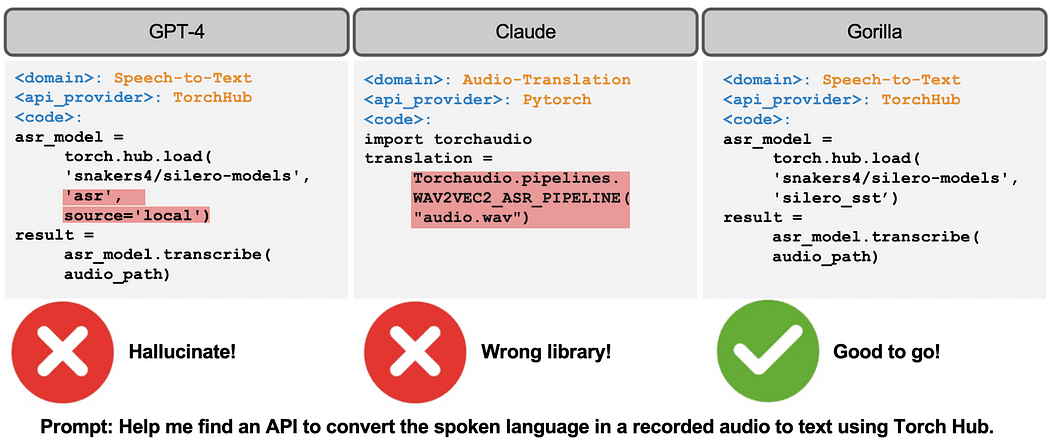
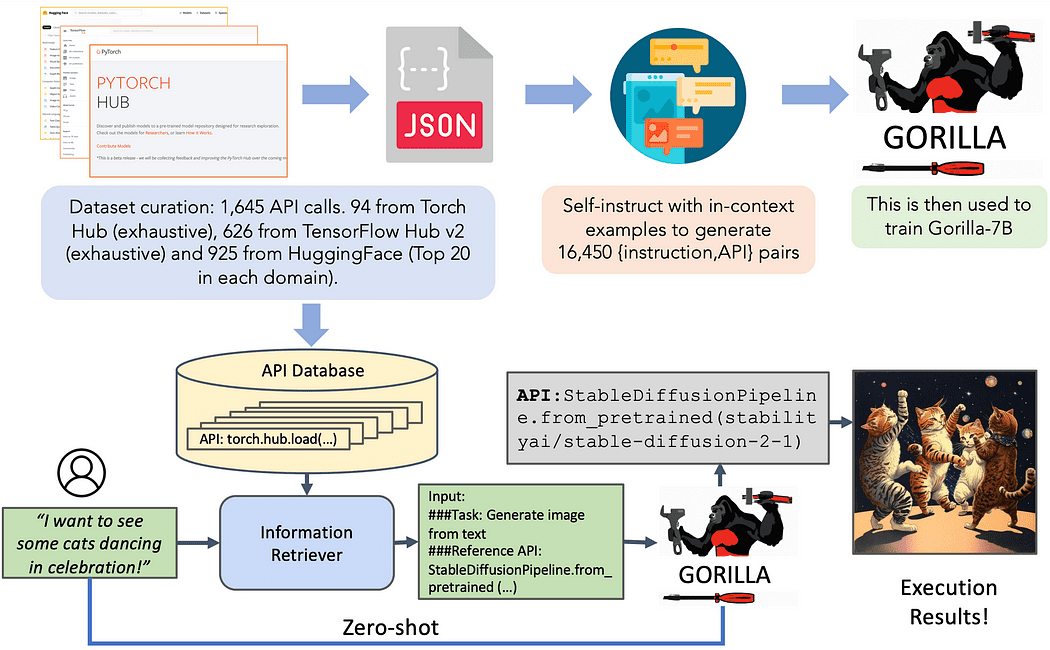
Recently, researchers from UC Berkeley and Microsoft unveiled Gorilla, a LLaMA-7B model designed specifically for API calls. Gorilla relies on self-instruct fine-tuning and retrieval techniques to enable LLMs to select accurately from a large and evolving set of tools expressed through their APIs and documentation. The authors construct a large corpus of APIs, called APIBench, by scraping machine learning APIs from major model hubs such as TorchHub, TensorHub, and HuggingFace. Using self-instruct, they generate pairs of instructions and corresponding APIs. The fine-tuning process involves converting the data to a user-agent chat-style conversation format and performing standard instruction finetuning on the base LLaMA-7B model.

Meet Gorilla: UC Berkeley and Microsoft’s API-Augmented LLM Outperforms GPT-4, Chat-GPT and Claude.
Image Credit: UC Berkeley

API calls often come with constraints, adding complexity to the LLM’s comprehension and categorization of the calls. For example, a prompt may require invoking an image classification model with specific parameter size and accuracy constraints. These challenges highlight the need for LLMs to understand not only the functional description of an API call but also reason about the embedded constraints.

The Dataset

The tech-focused dataset at hand encompasses three distinct domains: Torch Hub, Tensor Hub, and HuggingFace. Each domain contributes a wealth of information, shedding light on the diverse nature of the dataset. Torch Hub, for instance, offers 95 APIs, providing a solid foundation. In comparison, Tensor Hub takes it a step further with an extensive collection of 696 APIs. Lastly, HuggingFace leads the pack with a whopping 925 APIs, making it the most comprehensive domain.

To amplify the value and usability of the dataset, an additional endeavor has been undertaken. Each API in the dataset is accompanied by a set of 10 meticulously crafted and uniquely tailored instructions. These instructions serve as indispensable guides for both training and evaluation purposes. This initiative ensures that every API goes beyond mere representation, enabling more robust utilization and analysis.

The Architecture

Gorilla introduces the notion of retriever-aware training, where the instruction-tuned dataset includes an additional field with retrieved API documentation for reference. This approach aims to teach the LLM to parse and answer questions based on the provided documentation. The authors demonstrate that this technique allows the LLM to adapt to changes in API documentation, improves performance, and reduces hallucination errors.

During inference, users provide prompts in natural language. Gorilla can operate in two modes: zero-shot and retrieval. In zero-shot mode, the prompt is directly fed to the Gorilla LLM model, which returns the recommended API call to accomplish the task or goal. In retrieval mode, the retriever (either BM25 or GPT-Index) retrieves the most up-to-date API documentation from the API Database. This documentation is concatenated with the user prompt, along with a message indicating the reference to the API documentation. The concatenated input is then passed to Gorilla, which outputs the API to be invoked. Prompt tuning is not performed beyond the concatenation step in this system.

Meet Gorilla: UC Berkeley and Microsoft’s API-Augmented LLM Outperforms GPT-4, Chat-GPT and Claude.
Image Credit: UC Berkeley

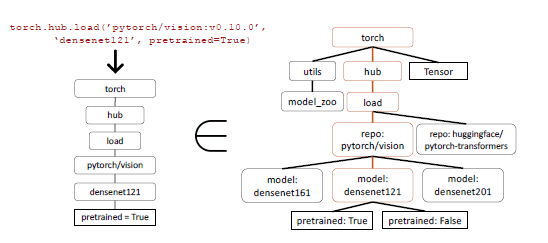
Inductive program synthesis has achieved success in various domains by synthesizing programs that meet specific test cases. However, when it comes to evaluating API calls, relying solely on test cases falls short as it becomes challenging to verify the semantic correctness of the code. Let’s consider the example of image classification, where there are more than 40 different models available for the task. Even if we narrow it down to a specific family, such as Densenet, there are four possible configurations. Consequently, multiple correct answers exist, making it difficult to determine if the API being used is functionally equivalent to the reference API through unit tests. To evaluate the performance of the model, a comparison of their functional equivalence is made using the collected dataset. To identify the API called by the LLM in the dataset, an AST (Abstract Syntax Tree) tree-matching strategy is employed. By checking if the AST of a candidate API call is a sub-tree of the reference API call, it becomes possible to trace which API is being utilized.

Identifying and defining hallucinations poses a significant challenge. The AST matching process is leveraged to identify hallucinations directly. In this context, a hallucination refers to an API call that is not a sub-tree of any API in the database, essentially invoking an entirely imagined tool. It’s important to note that this definition of hallucination differs from invoking an API incorrectly, which is defined as an error.

AST sub-tree matching plays a crucial role in identifying the specific API being called within the dataset. Since API calls can have multiple arguments, each of these arguments needs to be matched. Additionally, considering that Python allows for default arguments, it is essential to define which arguments to match for each API in the database.

Meet Gorilla: UC Berkeley and Microsoft’s API-Augmented LLM Outperforms GPT-4, Chat-GPT and Claude.
Image Credit: UC Berkeley
Gorilla in Action

Together with the paper, the researchers open sourced a version of Gorilla. The release includes a notebook with many examples. Additionally, the following video clearly shows some of the magic of Gorillas.

gorilla_720p.mp4

Gorilla is one of the most interesting approaches in the tool-augmented LLM space. Hopefully, we will see the model distributed in some of the main ML hubs in the space.

Jesus Rodriguez is currently a CTO at Intotheblock. He is a technology expert, executive investor and startup advisor. Jesus founded Tellago, an award winning software development firm focused helping companies become great software organizations by leveraging new enterprise software trends.

Original. Reposted with permission.

More On This Topic

  • Top 10 Tools for Detecting ChatGPT, GPT-4, Bard, and Claude
  • How causal inference lifts augmented analytics beyond flatland
  • Baize: An Open-Source Chat Model (But Different?)
  • Meet whale! The stupidly simple data discovery tool
  • Shaping the new digital age – with SAS and Microsoft
  • Free Microsoft Excel for Beginners Course

Unexpected bill? This AI bot can ‘Haggle It’ for you

Haggle it

These days, it seems that generative AI can do it all; from creating apps and writing code, to helping workers and parents be more productive. Now, a new artificial intelligence (AI) tool is promising to go even further by negotiating your bills for you.

Haggle It, as it is aptly named, is a new, completely free generative AI tool by Cleo, a financial services company that helps people create personal budgets.

Also: GPT-3.5 vs GPT-4: Is ChatGPT Plus worth its subscription fee?

Powered by ChatGPT, Haggle It can help customers draft letters to help negotiate rent, credit card fees or interest rates, or car insurance rates, all by just answering a few questions.

With 58% of Americans now living paycheck to paycheck, even those earning over $100,000, and with higher costs adding pressure to the economy, it's safe to say some extra savings would be a welcome sight for most of us.

Cleo conducted its own survey among 1,000 Millennials and Gen Z Americans and found that a third were successful in lowering their rent or car insurance through negotiation. Prior to Haggle It, however, 55% of respondents said they'd never negotiated their credit card interest or fees.

Also: These are my 5 favorite AI tools for work

"With Cleo's Haggle It, we are on a mission to make sure Gen Z doesn't fall into the paycheck-to-paycheck cycle and actually builds a life beyond a paycheck by negotiating like never before," said Kimberly Dillon, head of brand at Cleo.

"They tend to prefer convenience and avoid unnecessary stress, with many opting to pay more rather than deal with conflict. Negotiating doesn't need to be scary, especially when we have tools that have scoured the web and learned the best ways to communicate."

For those who did negotiate their credit card fees and interest, Cleo's survey found that about 20% received reduced rates and fees.

Also: LinkedIn is adding AI-powered tools to help marketing professionals

When using Haggle It, users have to choose the type of debt they want to negotiate and answer a question or two about it. Then, they can choose the tone that the letter will be written in to sound as formal or informal as they'd like.

"We even made it fun and have various tones of voices to choose from, so if you want to sound like a chilled out surfer bro because you think that's what your landlord would vibe with, have at it!" said Dillon.

Cleo has pledged that the company will donate $1 to Operation HOPE for every person that uses Haggle It. Operation HOPE is a non-profit organization committed to financial literacy and economy empowerment for underprivileged youths and adults in the U.S.

Artificial Intelligence

Now you can have a voice conversation with Bing Chat. Here’s how

Voice feature on Bing Chat Screenshot

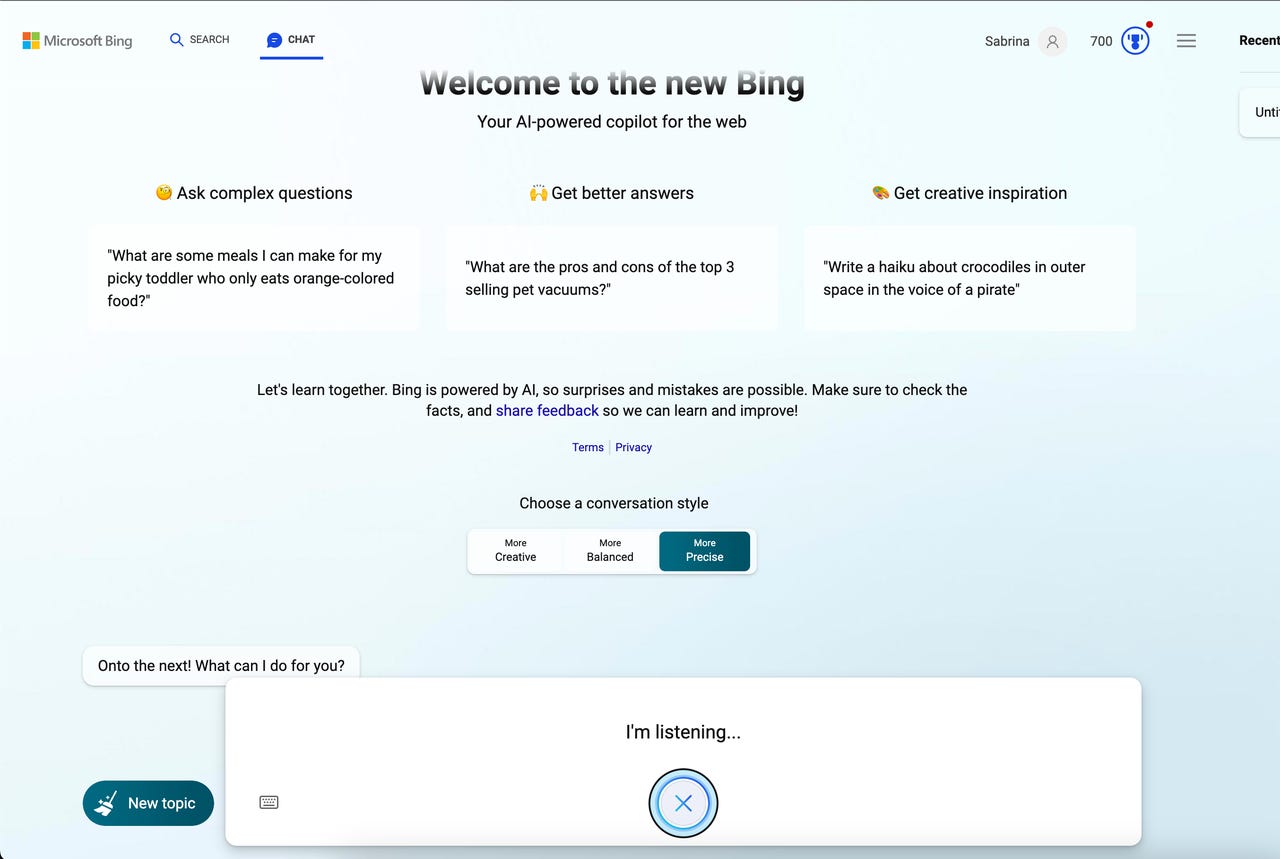
As if typing prompts in Bing Chat to get assistance wasn't easy enough, now you can verbally ask the chatbot whatever is on your mind.

The ability to ask the chatbot verbal questions has been available on mobile. Because of its popularity and user feedback, Microsoft finally brought it to the desktop version.

Also: ChatGPT vs Bing Chat vs Google Bard: Which is the best AI chatbot?

All you have to do is click on the microphone icon and ask a question as you would with any other voice assistant such as Siri and Alexa. The chatbot will understand your question and immediately output an answer.

The difference between Bing Chat's abilities and those of other voice assistants is that it can help you many more tasks such as coding, writing, generating images, to name a few.

The voice option supports English, Japanese, French, German, and Mandarin and is available to everyone, according to the blog post.

Also:7 ways you didn't know you can use Bing Chat and other AI chatbots

To take it up a notch further, the chatbot will also be able to speak back to you. Bing Chat now supports text-to-speech answers.

It will answer your voice inputs using its own unique voice. To test out the fun new feature, Microsoft suggests asking Bing, "What's the toughest tongue twister you know?"

Artificial Intelligence

Paul McCartney used AI to make a new Beatles song

Paul McCartney used AI to make a new Beatles song Darrell Etherington @etherington / 9 hours

AI-generated music is a bourgeoning and fraught topic, with artists either vocally opposing even the faintest hint of it, or some (like Grimes) more or less embracing it completely. Now, Paul McCartney seems to be on the ‘pro’ train, at least in part, since he has created a “new” Beatles song using AI and will be releasing it to the public later this year.

The song includes John Lennon vocals, pulled from an old demo recording, and the BBC report that first revealed the news says it’s probably from ‘Now and Then,’ a 1978 Lennon recording which was recorded to cassette from Lennon’s living room in NYC just before his death. The inspiration from the song came from Peter Jackson’s documentary ‘Get Back,’ McCartney told the BBC, since for that process a custom AI system was used to separate the vocals of the various Beatles members from background noise, enabling high-quality reproduction.

There was a prior attempt to record this track with the surviving Beatles in around 1995, but George Harrison objected midway through the process because of the poor quality of the Lennon track. The AI-powered track separation and cleanup process has restored the vocals to a place where McCartney said it was possible to mix the track cleanly as if they were recorded fresh for the purpose.

McCartney still showed some skepticism — but not outright dismissal — when it came to AI generating music meant to sound like original John Lennon recordings essentially from whole cloth – “it’s kind of scary but exciting, because it’s the future,” he told the BBC about when people have shown him versions of Lennon singing his songs generated by AI.

“We’ll just have to see where that leads,” he added.