Vectara lands $28.5M to supercharge enterprise search

Vectara lands $28.5M to supercharge enterprise search Kyle Wiggers 14 hours

Some years ago, three former Googlers — Amr Awadallah (who previously founded Cloudera), Amin Ahmad and Tallat Shafaat — set out to build what they describe as a “conversational search” platform for the enterprise. Their goal was to help organizations unlock data from their text-based files, chiefly by empowering developers to build conversational AI apps that can retrieve and summarize text from vast corporate data stores.

The fruit of their labor, Vectara, launched in late May. Backed by $28.5 million in seed funding led by Race Capital with participation from Emad Mostaque, the founder of Stability AI (the AI startup behind the text-to-image system Stable Diffusion), Vectara provides AI-powered, API-based search tech that it claims can handle queries of an arbitrary length, level of ambiguity and language across troves of multilingual documents.

“Vectara empowers developers to rapidly and easily build conversational AI products with world-class retrieval, summarization and data privacy directly on top of the data that matters to their business,” Awadallah told TechCrunch in an email interview. “Our industry faces a few key challenges that we are actively trying to overcome.”

Vectara brings to mind “cognitive search” engines such as Amazon Kendra and Microsoft SharePoint Syntex that draw on enterprise knowledge bases to cobble together answers to employees’ questions. Growth in the demand for such search tech mirrors the growth in the amount of data that companies have to wrangle in the course of their business.

One source estimates that the average firm stores hundreds of terabytes of data, the vast majority of which goes underused for insights. According to a Forrester survey, between 60% and 73% of all data within corporations is never analyzed for larger trends.

That’s where a search engine like Vectara could help, asserts Awadallah.

At a high level, Vectara lets users ask questions about their company’s data and returns a summary with citations to the source data set. The platform ingests new documents in real time, providing “client-configurable” data retention, which enables organizations to discard the original documents and text after they’ve been indexed so that no residual data from the company remains in Vectara’s search index.

Ahmad explained via email:

“We train [our AI] on a wide variety of publicly licensed sources of data taken from the internet (e.g. Wikipedia) and other sources, [and] we mitigate inaccuracy and bias by constraining our AI models to retrieve the most relevant content from data sets that our customers have chosen to index. This content, in turn, is used to ground the summarization that our platform provides.”

Admins can control and monitor the usage of Vectara-indexed data and revoke a user’s access at any time. This affords a level of governance that’s oftentimes lacking in cognitive search platforms, Awadallah says.

Vectara

Image Credits: Vectara

“We’re opening up this application of AI for the millions of apps and websites out there that rely on search for core navigation,” he continued. “This technology enables teams to better use time that’s being wasted, capture money that’s being left on the table and begin unlocking further insights that become available once search intent is understood.”

So what are customers using Vectara’s tech for, exactly? Awadallah says that brands like Conversica, Apex Chat, Metus and Oncotelic Therapeutics have been applying it to use cases like legal discovery, ecommerce search, news monitoring and financial analysis.

“With Vectara, companies can add neural-net powered semantic search to research workflows,” he added. “We truly believe the ability to express our needs verbally represents a major evolution in how user interfaces will be designed in the future, similar to how the iPhone led to all apps being redesigned to allow us to use our fingers for clicking, zooming, pinching and swiping.”

Cupertino, California-based Vectara, which has 24 employees, plans to use its seed funding to expand its engineering and go-to-market teams with an emphasis on European, Middle Eastern and Asia Pacific regions.

Expansion will be key if Vectara hopes to stay ahead of rivals in the enterprise search space. Forethought, like Vectara, offers an AI-driven information retrieval system built for corporate environments. There’s also Coveo, a Canadian startup that builds enterprise-focused search and personalization services powered by AI.

Fortunately for Vectara, the cognitive search market is exploding — it’s anticipated to be worth $15.28 billion by 2023, up from $2.59 billion in 2018, according to Markets and Markets. If Vectara plays its cards right, it might just carve out a slice of the increasingly lucrative pie.

Breakthrough in EUV Lithography Reduces Hydrogen Wastage by 80%

Extreme ultraviolet (EUV) lithography is an integral part of modern semiconductor manufacturing, and scientists just found a way to make it more environmentally friendly. This process consumes a large amount of hydrogen, almost 600 liters per minute. However, thanks to a new process, around 70-80% of this hydrogen can be recovered.

Engineers from Edwards, an England-based vacuum systems firm, have found a way to reduce the hydrogen wastage associated with EUV lithography. Hydrogen is used in the system to sweep away any contaminants in the process, and all of it is burned away to create water at the end of the process.

Due to the amount of contaminants in the gas, it cannot be reused. With the Edwards hydrogen recovery system, which is “similar to a fuel cell in reverse”, manufacturers can now clean the hydrogen, allowing it to be reused. The system works by pushing a mixture of the dirty hydrogen, moisture, and nitrogen and ionising it, then pushing the mixture through a proton-exchange membrane.

After the mixture passes through the membrane, the hydrogen recombines, and is then cleaned to remove residual water. The contaminants remain in the system, which can be cleared for later use. This will curtail some of the environmental impact of semiconductor manufacturing.

This undertaking comes at a time where many chip fabrication units have expressed a desire to cut down on their carbon footprint. Late last year, Intel, GlobalFoundries, Micron, Samsung, TSMC, and more founded a consortium called the Semiconductor Climate Consortium. This undertaking aims to reduce emissions throughout the supply chain, with many companies working together to do so.

The semiconductor industry is estimated to cause around 3% of global emissions, making it a prime target for companies wishing to reach their net zero goals. With the rise of technology to make the process greener, it seems like Edwards’ hydrogen recovery will result in a step forward for the ecosystem as a whole.

The post Breakthrough in EUV Lithography Reduces Hydrogen Wastage by 80% appeared first on Analytics India Magazine.

TikTok’s new Script Generator tool uses AI to write ad scripts for you in seconds

Influencer with ring light

TikTok joins many social media platforms, including Meta and LinkedIn, which have adopted generative AI to make marketing easier for businesses.

TikTok's new Script Generator tool uses AI to generate ad scripts within seconds. All that the user has to do is select an industry and enter a product name and description to get a custom script for videos.

Also: Generative AI can save marketing pros 5 hours per week, according to research

I decided to test out the feature. Inspired by the Diet Coke I was sipping on, I selected "Food and Beverage" as the industry, made the product name "straws," and made the product description "meant for drinking."

Once I hit generate, the Script Generator output three different script options within seconds. The options also had specific directions for the scenes, including the voiceover, on-screen visuals, and text overlays you could use.

At the top of the tool's page, TikTok includes a banner that warns users to use the AI-generated scripts at their own risk, as TikTok does not make any "promises or guarantees" about the content that is generated.

Also: Instagram may be getting its own AI chatbot soon. Here's what we know

TikTok likely includes this banner as a way to warn against the hallucinations that AI models are prone to and the negative consequences these hallucinations could have.

This feature is free to use and available to all TikTok for Business Accounts, and it can be found in TikTok's Creative Center on the desktop.

Artificial Intelligence

AMD unveils MI300x AI chip as ‘generative AI accelerator’

amd-dc-ai-technology-premiere-keynote-deck-for-press-and-analysts-slide-61

AMD's Instinct MI300X GPU features multiple GPU "chiplets" plus 192 gigabytes of HBM3 DRAM memory, and 5.2 terabytes per second of memory bandwidth. The company said it is the only chip that can handle large language models of up to 80 billion parameters in memory.

Advanced Micro Devices CEO Lisa Su on Tuesday in San Francisco unveiled a chip that is a centerpiece in the company's strategy for artificial intelligence computing, boasting its enormous memory and data throughput for so-called generative AI tasks such as large language models.

The Instinct MI300X, as the part is known, is a follow-on to the previously announced MI300A. The chip is really a combination of multiple "chiplets," individual chips that are joined together in a single package by shared memory and networking links.

Su, onstage for an invite-only audience at the Fairmont Hotel in downtown San Francisco, referred to the part as a "generative AI accelerator," and said the GPU chiplets contained in it, a family known as CDNA 3, are "designed specifically for AI and HPC [high-performance computing] workloads."

The MI300X is a "GPU-only" version of the part. The MI300A is a combination of three Zen4 CPU chiplets with multiple GPU chiplets. But in the MI300X, the CPUs are swapped out for two additional CDNA 3 chiplets.

Also: Nvidia unveils new kind of Ethernet for AI, Grace Hopper 'Superchip' in full production

The MI300X increases the transistor count from 146 billion transistors to 153 billion, and the shared DRAM memory is boosted from 128 gigabytes in the MI300A to 192 gigabytes.

The memory bandwidth is boosted from 800 gigabytes per second to 5.2 terabytes per second.

"Our use of chiplets in this product is very, very strategic," said Su, because of the ability to mix and match different kinds of compute, swapping out CPU or GPU.

Su said the MI300X will offer 2.4 times the memory density of Nvidia's H100 "Hopper" GPU, and 1.6 times the memory bandwidth.

"The generative AI, large language models have changed the landscape," said Su. "The need for more compute is growing exponentially, whether you're talking about training or about inference."

To demonstrate the need for powerful computing, Sue showed the part working on what she said is the most popular large language model at the moment, the open source Falcon-40B. Language models require more compute as they are built with greater and greater numbers of what are called neural network "parameters." The Falcon-40B consists of 40 billion parameters.

The MI300X, she said, is the first chip that is powerful enough to run a neural network of that size, entirely in memory, rather than having to move data, back-and-forth to and from external memory.

Su demonstrated the MI300X creating a poem about San Francisco using Falcon-40B.

"A single MI300X can run models up to approximately 80 billion parameters" in memory, she said.

"When you compare MI300X to the competition, MI300X offers 2.4 times more memory, and 1.6 times more memory bandwidth, and with all of that additional memory capacity, we actually have an advantage for large language models because we can run larger models directly in memory."

To be able to run the entire model in memory, said Su, means that, "for the largest models, that actually reduces the number of GPUs you need, significantly speeding up the performance, especially for inference, as well as reducing the total cost of ownership."

"I love this chip, by the way," enthused Su. "We love this chip."

"With MI300X, you can reduce the number of GPUs, and as model sizes keep growing, this will become even more important."

"With more memory, more memory bandwidth, and fewer GPUs needed, we can run more inference jobs per GPU than you could before," said Su. That will reduce the total cost of ownership for large language models, she said, making the technology more accessible.

Also: For AI's 'iPhone moment', Nvidia unveils a large language model chip

To compete with Nvidia's DGX systems, Su unveiled a family of AI computers, the "AMD Instinct Platform." The first instance of that will combine eight of the MI300X with 1.5 terabytes of HMB3 memory. The server conforms to the industry standard Open Compute Platform spec.

"For customers, they can use all this AI compute capability in memory in an industry-standard platform that drops right into their existing infrastructure," said Su.

Unlike MI300X, which is only a GPU, the existing MI300A is going up against Nvidia's Grace Hopper combo chip, which uses Nvidia's Grace CPU and its Hopper GPU, which the company announced last month is in full production.

MI300A is being built into the El Capitan supercomputer under construction at the Department of Energy's Lawrence Livermore National Laboratories, noted Su.

The MI300A is being shown as a sample currently to AMD customers, and the MI300X will begin sampling to customers in the third quarter of this year, said Su. Both will be in volume production in the fourth quarter, she said.

You can watch a replay of the presentation on the Website set up by AMD for the news.

Artificial Intelligence

Itoka wants to license AI-generated music via the blockchain

Itoka wants to license AI-generated music via the blockchain Kyle Wiggers 12 hours

AI-generated music is fast becoming a reality. Thanks to tools like Meta’s MusicGen, it’s now possible to create halfway decent songs in a range of styles without ever having to play an instrument, read sheet music or learn to use a DAW.

But while the creative potential of generative AI music tools is nothing less than extraordinary, the tools also threaten to upend the music industry’s copyright status quo. That’s because, in order to “learn” to create new songs, the tools must be “trained” on vast databases of existing songs — not always with the artists’ blessings.

It’s pitting musicians against labels. Universal Music Group has labeled all AI-generated music using existing artists’ voices as “fraud.” On the other hand, art-pop musician Grimes vowed to allow her voice to be used in AI music without penalty.

The rules around AI-generated music are murky at present. Several lawsuits making their way through the courts will likely have a bearing on music-generating AI, including one pertaining to the rights of artists whose work is used to train AI systems without their knowledge or consent. But it’ll be months before the first decisions are made public and months more, potentially, if the cases are appealed.

In the meantime, some startups, attempting to get ahead of regulators, are proposing standards of their own around generative music IP. One is Itoka, which was recently accepted into the Allen Institute for AI’s startup incubation program.

Itoka, co-founded by Malcolm Yang and Yihao Chen, seeks to “tokenize” music content, specifically AI-generated content, on the blockchain so that creators can independently license that content and receive compensation every time it’s used. Itoka plans to temporarily hold the ownership of songs and give creators full licenses for their commercial use, while at the same time preventing plagiarization and “unlawful monetization” on its platform.

“Itoka is a decentralized music platform we developed to enable data self-sovereignty, the permanence of music storage, digital rights management, global music accessibility and creator governance,” Yang and Chen told TechCrunch in an email interview. “We establish a new paradigm for copyright protection that doesn’t rely on the physical copyright office to enforce the legal status but rather on code-operated smart contracts.”

Itoka

Image Credits: Itoka

If the idea of tying licensing to the blockchain — a shared, immutable ledger to track assets — sounds familiar, that’s because Itoka’s not the first startup to attempt to do so.

Just a few months ago, web3 project Dequency launched a decentralized portal for music rights holders and creators that allows for ostensibly easier licensing and payments for content. Around the same time, music producer Justin Blau, also known as 3LAU, launched a song licensing service called Royal, which collaborated with the popular rapper Nas to allow fans to acquire nonfungible tokens (NFTs) that gave them ownership rights over some of the artist’s songs.

But alongside its blockchain-based licensing scheme, Itoka offers music creation tools powered by music-generating AI models. And it plans to partner with musicians who contribute their work for AI training purposes on a compensation plan.

“In the future, everyone will have the power to produce music, and there will be a massive amount of quality music produced every day for various purposes,” Yang and Chen said. “As music production becomes democratized, the establishment of the current music industry and its monopoly will be significantly undermined. This will urge people to rethink creativity and artistry in content creation.”

Itoka’s music generation tools, at least as they exist today, are simpler than those lofty words might suggest.

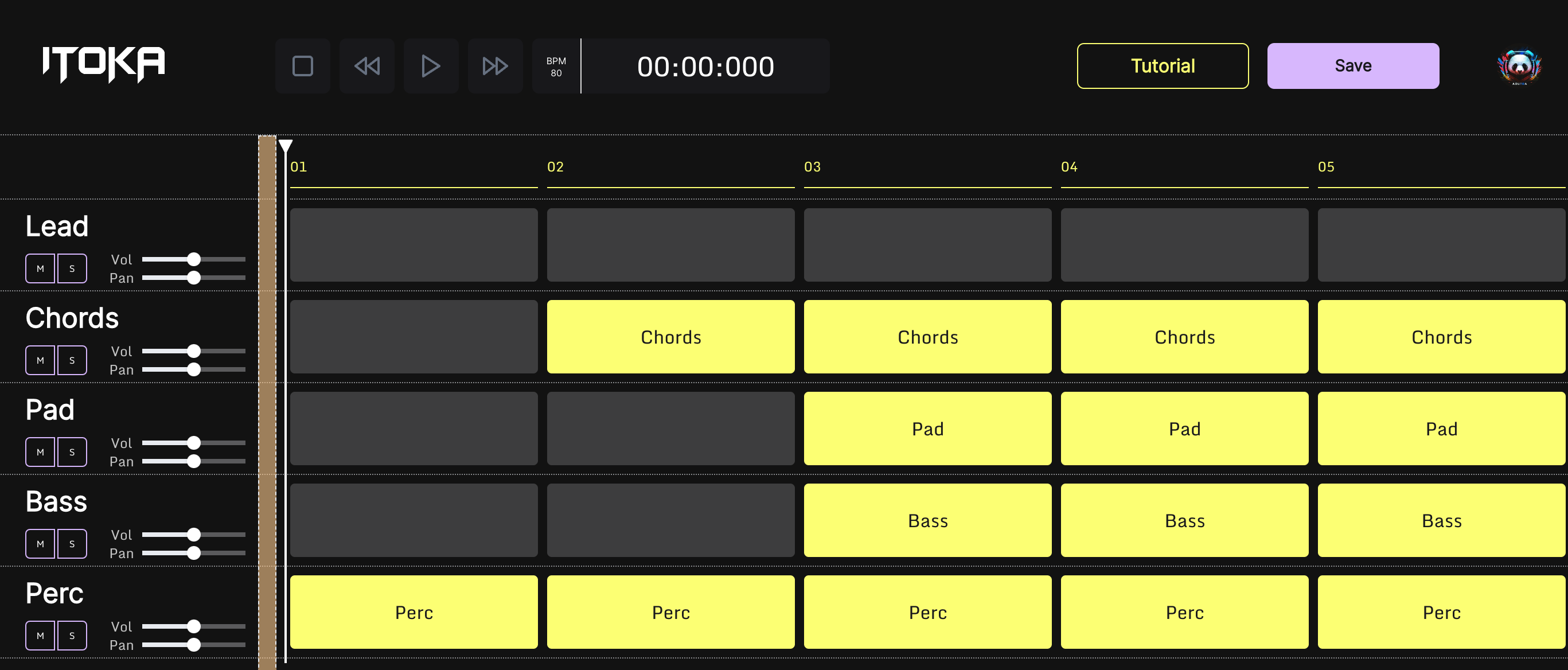
After creating an account, users can choose from one of several genres and sentiments — including “EDM,” “Hip Hop,” “Lofi” and “Emotional” — to have Itoka’s engine generate a five-track song automatically, in the background. After choosing album art for the new song, Itoka throws users into a block-based composing interface, where they can edit aspects such as the song’s tempo, bass and chords.

Itoka

Image Credits: Itoka

The AI’s nowhere near as robust or capable as text-to-music systems like the aforementioned MusicGen. But Itoka places an emphasis on ease of use over customizability.

Once a song’s been created, it can be listed on the Itoka marketplace for licensing. Yang and Chen claim that there have been over 1,900 songs generated via the platform to date and that those songs have been listened to for over 3 million minutes collectively.

That’s off to a respectable start. But my question is, who’s going to license a library of AI-generated songs — particularly songs that sound relatively generic compared to the average royalty-free music library?

Yang and Chen say that they’re going after game developers as one of their top customer segments — developers who’d normally license from one of the larger content libraries. To this end, Itoka has a partnership with Canva and “multiple game studios” — Yang and Chen wouldn’t say which — for content licensing.

“In the future, we will be more than happy to move on to other customer sectors and provide the most-fitting features and solutions,” Yang and Chen said. “There are some AI-friendly musicians who’d like to help us push the boundaries of technology and music creativity, and we sincerely hope that we can achieve greatness with them together.”

Time will tell.

Tech Giants Lose Sustainability War Against AI

Tech giants are no stranger to making big claims, and their climate goals are no different. Amazon, Microsoft, and Google have all committed to net zero carbon goals, but the same thing that is keeping them relevant today, is pulling them back from their goal: AI.

It’s no secret that modern state-of-the-art algorithms take a vast amount of compute resources to train and deploy, but there is a hidden carbon cost that many neglect to mention — electricity. The server farms that train AI models will only grow larger in the future with the AI boom, but will companies be able to balance it with their net zero goals?

AI makes carbon footprints bigger

Tech giants rarely release information about the cost of training AI algorithms, and it seems there is a reason for withholding this data. Hugging Face, an open-source AI community, has shed some light on the approximate carbon footprint of training BLOOM, their LLM. According to its researchers, the training emitted approximately 24.7 tonnes of carbon for power consumption alone. This number ballooned to 50 tonnes when accounting for an end-to-end carbon footprint, including equipment manufacturing.

A paper published in 2021 estimated GPT-3’s training cost to be around 1.287 gigawatt hours, which is enough energy to power 618 Indian homes for a year. This comes up to 502 tonnes of carbon emissions, and these are just estimates for GPT-3. GPT-4 could have cost the planet more, but we have no way of knowing, and that’s not even considering the operating cost of ChatGPT and its 100 million users. Thanks to the Microsoft-OpenAI partnership, this was done on the Microsoft Azure cloud supercomputer. Coincidentally, in 2021, Microsoft paid for the removal of 1.3 million tonnes of CO2 from the atmosphere.

Buying carbon credits to cover up the environmental cost of training AI models seems to be the trend of the hour. To this end, Google also recently purchased 300,000 carbon offsets, and Meta bought 7 million carbon credits earlier this week. While the complete data of carbon offset purchases are not available in the public domain, the timing of these purchases seem to reflect a renewed enthusiasm for sustainability from companies who already seem well on their way there.

One possible explanation is that training and deploying AI models have thrown a spanner in the works for companies, offsetting their carbon deployment goals. While the narrative around AI training by the media focuses on the negative environmental impact of the process, tech giants usually provide positive comments.

A paper published by Google predicts that the carbon footprint of AI training will plateau, then go down owing to eventual adoption of best practices. These practices include using efficient models, optimised compute, and cloud computing. According to the researchers, this can bring down energy costs by up to 100x and emissions by up to 1000x.

Indeed, there is research to prove that optimising ML models results in a lower carbon footprint. Systems have emerged that intelligently cut down the power draw of GPUs, resulting in a cost-cutting of up to 75%. While the AI world is moving closer to Google’s best practices by creating specialised chips for AI compute, it seems that AI models are getting bigger and more difficult to train.

Sustainability for CSR’s sake?

Sustainability has become more than just a buzzword for tech giants, with many companies aiming to appease their shareholders and audience with their green goals. This has resulted in top tech giants like Amazon, Microsoft, and Google pledging to go net zero carbon by a certain time frame. While Microsoft and Google have set net zero goals at 2030, Amazon has given itself a longer timeframe, instead claiming its goal as 2040. Meta, on the other hand, has already reached carbon neutrality, and is now pursuing a negative carbon footprint.

Whatever the case may be, the companies that are moving towards a zero carbon goal are doing so quickly. There is a race going on behind the curtain, especially when it comes to pursuing new technology for carbon-free energy generation and carbon storage technologies.

Google, for example, has even initiated a movement called the 24/7 carbon-free energy compact that aims to decarbonise electricity systems worldwide. Microsoft has invested $1 billion into the Climate Innovation Fund to accelerate the creation of technologies to reduce climate impact. Amazon has a bigger fish to fry, as it needs to cut down on carbon for its logistics chain, and has multiple corporate social responsibility (CSR) plans to cut down its climate impact.

However, away from the surface-level, sustainability misrepresentation runs rampant. Amazon has been shown to drastically undercount its carbon footprint, while Microsoft has slowly fallen behind its 2030 goal despite pressure from regulators. To add to this, AI seems to be a big pain point for tech giants.

It seems that big techs don’t have a sustainability solution to deal with the current upsurge in AI demand, instead relying on carbon credits to stay on track for their sustainability goals. As we inch closer to 2030, big techs can only hope that optimisations and specialised compute will push AI’s carbon footprint down to stay in line with their climate pledges.

The post Tech Giants Lose Sustainability War Against AI appeared first on Analytics India Magazine.

DSC Weekly 13 June 2023 – Can Boards of Directors’ steer AI business ethics?

Announcements

  • Financial services firms are undergoing complete makeovers as they rework their vision, resources and leadership strategy to stay competitive in the digital world. Join the Digital Transformation for Financial Services summit to learn to transform strategically, creating a digital-first strategy that combines emerging technologies such as AI, analytics, blockchain and more with the right talent and ways of working to optimize efficiencies, bolster resilience and drive long-term success.
  • Generative AI is rapidly transforming the life sciences and healthcare industries, offering new possibilities for drug discovery, manufacturing and sales engagement, disease diagnosis, and personalized treatment. In the upcoming Generative AI in Life Sciences and Healthcare: Current and Future Trends webinar, Dataiku & Deloitte leaders Ben Taylor and Ayan Bhattacharya will explore the latest trends in generative AI and their potential applications in the life sciences and healthcare space. Join us to learn how cutting-edge Generative AI applications can improve patient care and help develop new products to drive wellness.
Hand of businessman touching hand artificial intelligence meaning technology connection go to future

Can Boards of Directors’ steer AI business ethics?

As enterprises implement complex AI capabilities as part of business strategy, corporate boards face an increasingly common moral quandary: Do the business (and of course monetary) benefits of AI outweigh the societal risks?

In his three-part series that continues this week, Bill Schmarzo examines the board’s role in organizations’ responsible and ethical AI deployment. In part one, Bill covered how to mitigate the impacts of AI Confirmation Bias. In part two, he examines how to identify and avoid potential unintended consequences of AI deployment. As Bill notes, it’s vital for boards to stay proactive when it comes to AI ethics and risk avoidance.

Stay tuned for next week, when Bill concludes the series with Part 3. He promises to provide an Unintended Consequences Assessment worksheet plus a checklist that the Board of Directors can leverage when advising senior management on mitigating the impacts of AI confirmation bias.

This advice should help board members who are hesitant about their role in AI risk avoidance. However, the SEC is considering rules requiring companies to disclose their cybersecurity governance capabilities, including the board’s oversight of cyber risk. It’s not a stretch to think AI will be next on the SEC’s list, especially if artificial intelligence use in business proves a risk to investors and consumers. Boards at any company with AI-driven products and services must start considering how to implement efforts to offset the risks presented by artificial intelligence’s many benefits.

The Editors of Data Science Central

Contact The DSC Team if you are interested in contributing.

DSC Featured Articles

  • Artificial Intelligence: A Board of Directors Challenge – Part II
    June 13, 2023
    by Bill Schmarzo
  • Best practices for designing accessible e-learning content
    June 9, 2023
    by Nikita KV
  • The unannounced next-level partnership between Microsoft and Databricks
    June 9, 2023
    by Jason Yip
  • Digital systems essential for decarbonizing the energy pipeline
    June 9, 2023
    by Jane Marsh
  • Data observability vs data quality
    June 9, 2023
    by Vanitha
  • The Importance of Data Engineering for a Profitable App Development
    June 9, 2023
    by Evan Rogen
  • Healthcare Analytics: How it Enables Better Patient Care
    June 9, 2023
    by Ryan Williamson
  • The impact of conversational AI on healthcare outcomes and patient satisfaction
    June 7, 2023
    by John Lee
  • Data science as a lucrative career option for the youth
    June 7, 2023
    by Erika Balla
  • Why are progressive web apps becoming the future of web development?
    June 7, 2023
    by TarunNagar
  • How does a beginner become a data analyst?
    June 7, 2023
    by Evan Rogen
  • DSC Weekly 6 June 2023 – The Missing Part in LLMs and GPT-like Systems
    June 6, 2023
    by Scott Thompson

Picture of the Week

DSC Weekly 13 June 2023 – Can Boards of Directors’ steer AI business ethics?

Fan fiction writers are trolling AIs with Omegaverse stories

Fan fiction writers are trolling AIs with Omegaverse stories Amanda Silberling 9 hours

Fan fiction writers know that their work is being used to train generative AIs, and they’re not happy about it. Now, “Omegaverse” writers are participating in a week-long writing marathon called Knot in my Name to encourage the fan community to publish as much of their fan fiction as possible. It’s a long-shot attempt to mess with AI generators, but why not try?

As generative AI becomes more mainstream, numerous communities of writers and artists have spoken out against the technology’s appropriation of original creative works, from striking TV writers to record labels. Fanfic writers had their own moment of reckoning when Sudowrite, an AI-powered fiction writing tool, was found to be trained on Omegaverse fan fiction.

“Can we get [Amazon] fixating on knotting toys? Can we make slickmats a [Google] keyword?” asked fanfic writer MotherKat, who organized the event. “No idea.”

If phrases like “knotting toys” and “slickmats” sound incomprehensible, that’s because they’re not supposed to sound like real things if you haven’t read Omegaverse fic. And that’s also why it’s so obvious to fic writers when AIs have been trained on their work.

…I have just heard of the Knot In My Name campaign.

You know how AI scrapes sites like AO3 for machine training? The idea is to flood AO3 with omegaverse to the point that all AI text generators everywhere will default to fated mates, breeding, and of course knotting.

— KJ Charles (@kj_charles) June 9, 2023

The Omegaverse is a subculture within a subculture. Writer Rose Eveleth describes it best as “an act of collective sexual worldbuilding.” The Omegaverse, which spans multiple fandoms, imagines a sexual dynamic in which society is divided into Alphas, Betas and Omegas (another way to refer to the Omegaverse is Alpha/Beta/Omega, or A/B/O). Alphas are more dominant, Omegas are more submissive, and Betas are neutral; it’s a variation on supposed wolf pack dynamics. The Omegaverse is most visible on platforms like Tumblr, where users reacted to Governor Ron DeSantis’ presidential bid by making memes about how he wishes he was an Alpha, but he is, in fact, an Omega.

There’s an entire lexicon of Omegaverse-specific language, which would never appear organically outside of fandom spaces. Some generators, like Open AI’s ChatGPT, are trained on variations of datasets like Common Crawl, which scrape the web to make massive archives of the internet. With more than 3 billion webpages in the Common Crawl dataset alone, it’s inevitable that creative works would be swept up in the archives, unbeknownst to writers and artists. So when platforms like ChatGPT-powered Sudowrite start waxing poetic about the power dynamics in Alpha-Omega relationships, it’s not hard to guess where the AI is being trained.

While fan fiction stories are derivative works themselves, these hobbyist writers aren’t trying to profit off of their legal creative outlet. This makes it all the more insulting to fan writers and IP holders alike, who watch as their work becomes fodder for synthetic texts. According to MotherKat, morale has been low among fanfic writers, especially as readers boast about getting ChatGPT to write hyper-specific fanfic for them.

Apparently, AyeEye is polluted by Omegaverse tropes, be a shame if a bunch of us made it way worse in fun create ways right? pic.twitter.com/NTXKJYKALH

— MotherKatAo3 🦋🐀 (@Ao3MotherKat) May 24, 2023

“I have a few fandoms I’m involved in, and everyone was really low. No one was writing, a lot of people were taking their work down,” MotherKat told TechCrunch. “Most of us aren’t aspiring writers. This is our hobby, the space we go to escape the misery of our jobs being automated away.”

When she’s not hanging out in online fandom spaces, MotherKat is a professional voice actor; she says she’s feeling the threat of AI on all fronts, both at work and in her free time. That’s why she wanted to create “a movement designed to make scraping our content for sale as unpalatable as possible.”

“We have found that a lot of people had no idea that they were training the machine by putting in incomplete stories, so in a way we have helped with that,” MotherKat said.

Two days into the Knot in my Name campaign, fandom writers have published 64 stories across 51 different fandoms. This amounts to roughly 450,000 words of fan fiction; that’s about the size of Stephen King’s “It,” or “Moby Dick,” “To Kill a Mockingbird” and “Jane Eyre” combined.

“We can’t fix what they have already done,” MotherKat told TechCrunch. “But if we can have this irreverent little moment, maybe we can make scraping in the future less palatable to the venture capital guys if they know we, well, we got slick all over it.”

AI can’t replace human writers

Netflix’s lawsuit against the ‘Bridgerton Musical’ could change online fandom

OpenAI Releases New API Updates: Lowers Prices, Introduces Steerable GPT-3.5-Turbo, GPT-4 and More

OpenAI Update

OpenAI today announced a slew of API updates. This includes steerable GPT-3.5-Turbo and GPT-4, alongside adding support for function calling in the Chat Completions API and lowering prices.

According to the updates, these models have been fine-tuned to detect and call a function, responding with the JSON adhering to the function.

A new function calling capability in the Chat Completions API allows for even more dynamic and interactive conversations.

These new versions offer improved performance and flexibility. Moreover, the updates include the availability of a new 16k context version of gpt-3.5-turbo, providing increased context length compared to the standard 4k version.

OpenAI has also implemented a 75% cost reduction on its state-of-the-art embeddings model, making it more accessible than ever, alongside a 25% cost reduction on input tokens specifically for gpt-3.5-turbo, allowing users to achieve more within their budget.

lots of good updates including function calling and 16k context 3.5-turbo: https://t.co/CD8TTSE4LP

— Sam Altman (@sama) June 13, 2023

OpenAI ensures that all these updates on the models continue to prioritise data privacy and security, with the guarantee that customers retain ownership of the outputs generated from their requests, and their API data will not be utilised for training purposes.

Last month, OpenAI secretly released the GPT-4-32k API, as confirmed by several developers who have signed up for the waitlist.

The post OpenAI Releases New API Updates: Lowers Prices, Introduces Steerable GPT-3.5-Turbo, GPT-4 and More appeared first on Analytics India Magazine.

It’s alive! Build your first robots with Python and some cheap, basic components

Sponsored Post

It's alive! Build your first robots with Python and some cheap, basic components

There’s nothing quite like watching your code come alive in the real world. Robotics is a fun, fascinating discipline that lets you do just that. In this guide, you’ll build some fun robotic toys that will teach you serious robotics engineering skills like computer vision, networking, and computation.

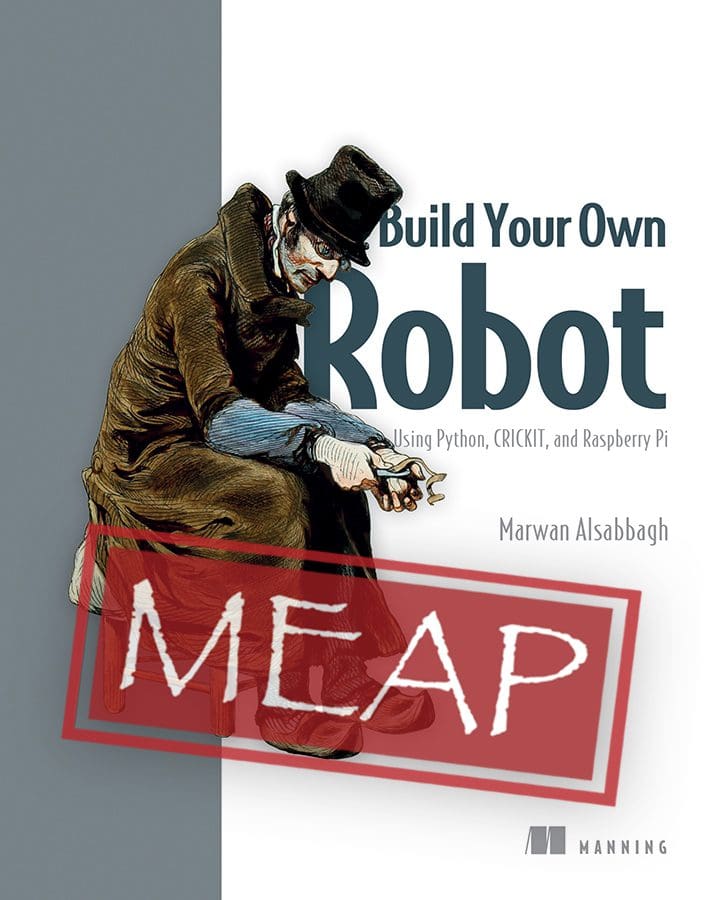
Build Your Own Robot by Marwan Alsabbagh is a DIY guide for bringing your first Python-based robots to life. Start with the basics, teaching your new friend how to spin, move around, and find its way.

The book gives accessible advice on available hardware and free open source software that makes creating a robot fun and affordable. You’ll soon be playing with a machine that can take photos, fetch items, search for a QR code, and more!

Build Your Own Robot is available from its publisher Manning Publications.

Our 35% discount code (good for all our products in all formats): nlkdnuggets21

One free eBook code for Build Your Own Robot: bldrbt-24DB

More On This Topic

  • Build a Web Scraper with Python in 5 Minutes
  • 5 Key Components of a Data Sharing Platform
  • Build a Text-to-Speech Converter with Python in 5 Minutes
  • How To Build A Database Using Python
  • Can Robots and Humans Combat Extinction Together? Find Out April 17
  • The 8 Basic Statistics Concepts for Data Science