Top 10 Generative AI Courses in 2023

Top 10 Generative AI Courses in 2023

From creating images that look like real life to helping with creative writing, Generative AI is transforming what machines are capable of achieving. There is increasing demand for skilled individuals in this field, making it especially important to keep up-to-date on the latest knowledge and abilities related to generative AI.

This is why we have gathered together some carefully selected courses focused on updating you on everything you need to know about generative AI. Our comprehensive selection caters to both beginner-level participants and experienced practitioners who want to explore artistic possibilities or practical applications using generative AI technology.

Let’s delve into the realm of generative AI and embark on a thought-provoking educational experience that will equip you with the ability to create, innovate, and influence what lies ahead.|

Generative AI Crash Course with Hands-on Implementations

Made available by The Association of Data Scientists, the premier global body in the field of AI and Data Science, this comprehensive course is ideal for individuals seeking to learn Generative AI from foundational concepts to advanced techniques. Beginning with an exploration of the fundamentals of Generative AI, the course progresses to hands-on implementation of popular models like GPT, Stable Diffusion, and DALL.E. Enriched with informative reading materials, video tutorials, and practical Python implementation, this course offers a holistic learning experience, equipping learners with the necessary knowledge and skills to develop a strong foundation in Generative AI.

Generative AI in Action: Solving Complex Business Problems

This is another very useful course published by The Association of Data Scientists that focuses more on utilizing the power of Generative AI in different business problems. Starting with covering the most important and highly relevant business use cases, this course also covered how to build generative AI-powered applications by integrating the OpenAI APIs.

Building Systems with the ChatGPT API

This 1-hour course is featured by deeplearning.ai and delivered by Isa Fulford and Andrew Ng. It covers how to automate workflows using chain calls to a language model. You will learn to enhance development capabilities, create prompt chains, build systems with Python code, and construct a customer service chatbot. Apply these skills to real-world scenarios in this course.

How Diffusion Models Work

In this another useful course by deeplearning.ai, you will delve into the world of diffusion-based generative AI and learn to build your own diffusion model from scratch. You will gain an understanding of the diffusion process and the underlying models. This course will help you develop practical coding skills through hands-on labs on sampling, training diffusion models, and building neural networks for noise prediction. Taught by Sharon Zhou, this one-hour course expands your generative AI capabilities, equipping you with the knowledge to build, train, and optimize diffusion models.

Generative AI learning path by Google

Google Cloud has released this learning path that consists of a package of 10 courses. This learning path leads you on an expertly selected pathway of resources exploring generative AI products and technologies. It covers everything from the basics of Large Language Models to the practical aspects of developing and implementing generative AI solutions on the Google Cloud platform. Professionals who have limitations or restrictions in utilizing Google Cloud might discover certain constraints with the course.

Large Language Models: Application through Production

Focused on Large Language Models and published by Databricks, this course is available on edX. This course is specifically designed for practitioners seeking to build LLM-centric applications using cutting-edge frameworks. You will find Hugging Face for NLP problem-solving, LangChain for complex tasks, prompt engineering, data embeddings, and vector databases in this course. Enhance LLM pipelines, fine-tune models with domain-specific data, evaluate societal and ethical implications, and deploy at scale using LLMOps.

OpenAI, GPT, ChatGPT and DALL-E Masterclass

This comprehensive Masterclass on GPT, DALL-E, and ChatGPT is taught by Raymond Davey and is available on Coursera. This course equips developers, data scientists, and enthusiasts to harness OpenAI’s accessible AI capabilities. You can explore prompt engineering, API integration, CodeX, DALL-E, fine-tuning, embeddings, and chatbot creation in this course. This course also provides practical skills with detailed explanations, code examples, and prompts. Become a master of GPT and OpenAI’s transformative technologies.

Generative AI – From Big Picture to Idea, to Implementation

This course explores the advancements of Generative Artificial Intelligence and its potential. From various application fields to effective implementation, it delves into project ideation and practical starting points. It helps in discovering existing Generative AI models, relevant coding aspects, and architectural concepts. Additionally, this course also addresses ethical considerations and preventive measures by companies and governments.

Getting Started with Generative AI API Specialization

You will find a specialized journey exploring the world of generative AI through Python in this package of courses. It covers text, image, and code generation, highlighting OpenAI’s powerful API. Each course in this package helps learners with building practical skills and culminates in a real-world, portfolio-ready project. It covers building captivating recommendation systems, intelligent GPT-powered chatbots, and mastering image generation and manipulation with Dall-E and PIL (Python Imaging Library).

Build AI Apps with ChatGPT, Dall-E, and GPT-4

This comprehensive course empowers you to integrate mind-blowing AI features into your applications using the OpenAI API. Gain proficiency in utilizing the Dall-E, GPT-4, and ChatGPT APIs, and master the art of fine-tuning models with your own data. Through hands-on projects like MoviePitch and KnowItAll, explore idea generation, image creation, and chatbot development. Elevate your AI skills and unlock the potential of OpenAI’s cutting-edge technology.

The top 10 generative AI courses offered above provide individuals of all backgrounds the opportunity to acquire skills and knowledge for utilizing this groundbreaking technology. Whether exploring art or practical applications, these courses offer tailored learning experiences. Embrace generative AI, unlock new avenues, and shape the future.

The post Top 10 Generative AI Courses in 2023 appeared first on Analytics India Magazine.

Free Full Stack LLM Bootcamp

Free Full Stack LLM Bootcamp
Image by Author

Large Language Models (LLMs) and LLM applications are the talk of the town! Whether you're interested in exploring them for personal projects, using them at work to maximize productivity, or quickly summarize search results and research papers—LLMs offer something for everyone across the spectrum.

This is great! But, if you want to get better at using LLMs and go beyond just using these apps and start building your own, the free LLM Bootcamp from the Full Stack team is for you.

From prompt engineering for effectively using LLMs to building your own applications and designing optimal user interfaces for LLM apps, this bootcamp covers it all. Let's learn more about what the bootcamp offers.

What Is the Full Stack LLM Bootcamp?

The Full Stack LLM Bootcamp was originally taught as an in-person event at San Francisco in April 2023. And now, the materials from the bootcamp—lectures, slides, source code for projects—are all accessible for free.

Free Full Stack LLM Bootcamp
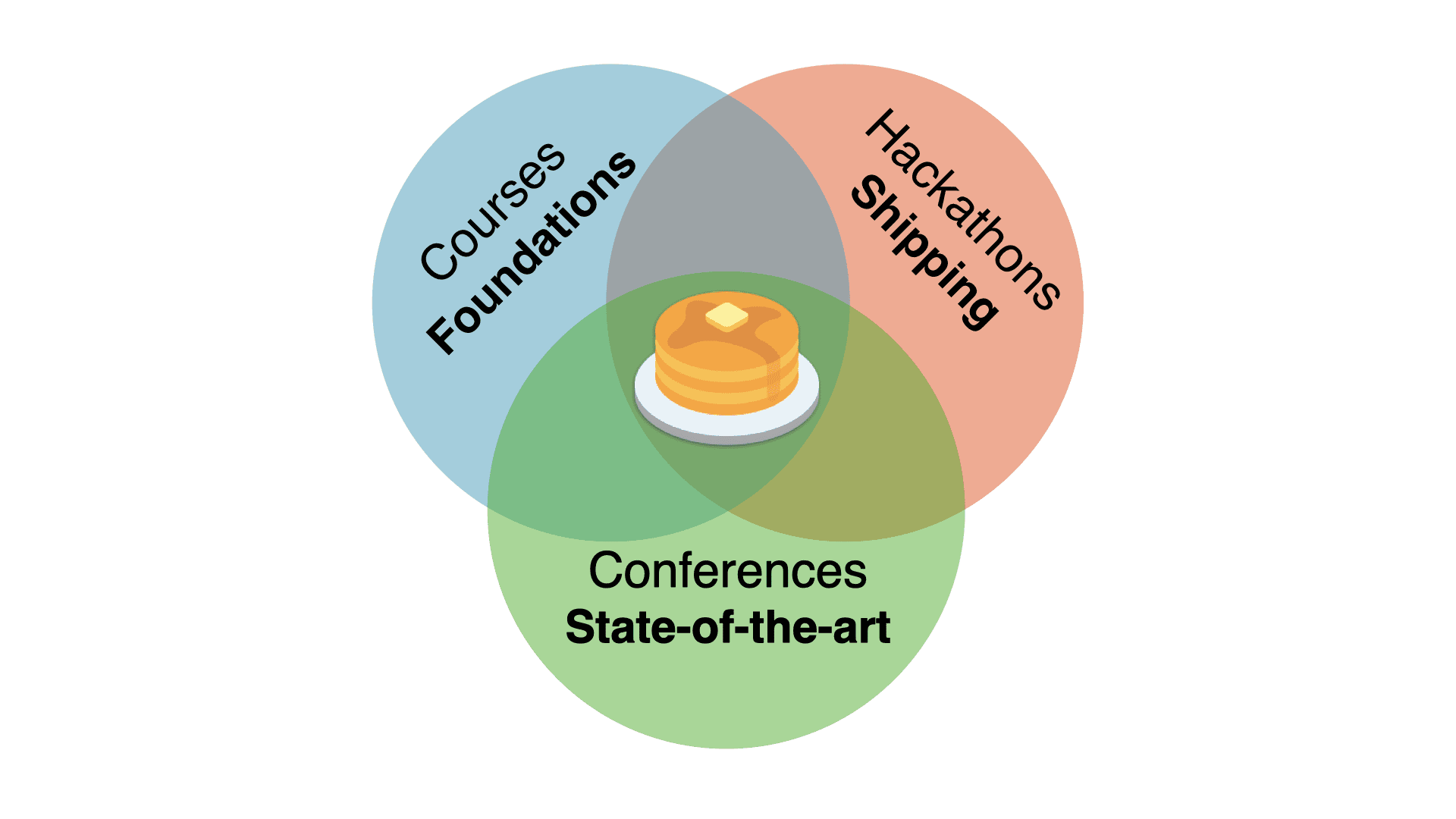
LLM Bootcamp | Image Source

The LLM bootcamp aims at providing a well-rounded approach. It covers prompt engineering techniques, fundamentals of LLMs, to building and shipping LLM apps to production.

This bootcamp is taught by instructors: Charles Frye, Josh Torbin, and Sergey Karayev—who are all UC Berkeley alumni. And their goal is getting everyone up to speed on the recent advances in LLM:

“Our goal is to get you 100% caught up to state-of-the-art and ready to build and deploy LLM apps, no matter what your level of experience with machine learning is.” – The Full Stack Team

A Closer Look at the Full Stack LLM Bootcamp

Now that we know what the LLM bootcamp is about, let’s delve deeper into the course contents.

Prerequisites

Though there are no mandatory prerequisites—except for a genuine interest in learning about LLMs, some relevant programming experience can make your journey simpler. Here are a couple of such prerequisites:

  • Experience with programming in Python
  • Familiarity with machine learning, front-end, or back-end development will be helpful

Learning to Spell: Prompt Engineering

For language models to produce desirable results it's important to get better at prompting.

The Learning to Spell: Prompt Engineering module covers the following:

  • Thinking probabilistically about LLM outputs
  • The basics of prompting in pretrained models like GPT-3 and LLaMa, instruction-tuned models like ChatGPT, and agents that mimic personas
  • Prompt engineering techniques and best practices such as decomposition, ensembling outputs from different LLMs, using randomness, and more

LLMOps

Let alone LLM apps, even for simple machine learning applications, building the model is just the tip of the iceberg. The real challenge lies in deploying the model to production and monitoring and maintaining its performance over time.

The LLMOps module of the bootcamp covers:

  • Choosing the best LLM for your application by factoring in the speed, cost, customizability, and the availability of open-source and restricted licenses
  • Managing prompts better by integrating prompt tracking into the workflow (using Git or other version control systems)
  • Testing LLMs
  • The challenges of implementing test-driven development (TDD) in LLM apps
  • Evaluation metrics for LLM
  • Monitoring performance metrics, collecting user feedback and making requisite updates

UX For Language User Interfaces

In addition to accounting for the infrastructure and focusing on model choice, the success of the application depends on the user experience.

The module on UX for Language User Interfaces covers:

  • Design principles for humans-centric and empathetic design of that and product interfaces
  • Accounting for convenience factors like autocomplete, low latency, and more
  • Case studies to delve deeper into what works (and what doesn’t)
  • Importance of UX research

Augmented Language Models

Augmented language models are at the core of all LLM-powered applications. Often, we’d need language models to have better reasoning capabilities, work with custom datasets, and use up-to-date information to answer queries.

The module on Augmented Language Models covers the concepts:

  • AI-powered information retrieval
  • All about embeddings
  • Chaining LLM calls to multiple language models
  • Effective use of tools like LangChain

Launch an LLM App in One Hour

This module teaches you how to quickly build LLM apps including:

  • Going about the processes of prototyping, iteration, and deployment to build an MVP application
  • Using different tech stacks to build a useful product: from OpenAI’s language models to leveraging serverless infrastructure

LLM Foundations

If you are interested in understanding the foundations of large language models along with breakthroughs over the years, the LLM foundations module will help you understand the following:

  • Foundations of machine learning
  • Transformers and attentions
  • Important LLMs such as GPT-3 family of LLMs and LLaMA important breakthrough elements

Project Walkthrough: askFSDL

The bootcamp also has a dedicated section that walks you through project askFSDL, an LLM-powered application that is built over the corpus from Full Stack Deep Learning course.

The Full Stack Deep Learning course by the team is another excellent resource to learn the best practices to build and ship deep learning models to production.

From data collection and cleaning, ETL and data processing steps, up to building the front and back ends, deploying and setting up model monitoring—this is a full stack project that you can try to replicate and learn a ton along the way.

Here’s an (inexhaustive) overview of what the project uses:

  • OpenAI’s LLMs
  • MongoDB to store the cleaned document corpus
  • FAISS index for faster search through the corpus
  • LangChain for chaining LLM calls and prompt management
  • Hosting the application’s backend on Modal
  • Model monitoring with Gantry

Wrapping Up

Hope you’re excited to learn more about LLMs by working through the LLM bootcamp. Happy learning!

You can also interact with other learners and members of the community by joining this Discord server. There are invited talks from industry experts (from the likes of OpenAI and Repl.it) and creators of tools in the LLM space. These talks will also be uploaded shortly to the bootcamp’s website.

Interested in checking out other courses on LLMs? Here’s a list of top free courses on LLMs.
Bala Priya C is a developer and technical writer from India. She likes working at the intersection of math, programming, data science, and content creation. Her areas of interest and expertise include DevOps, data science, and natural language processing. She enjoys reading, writing, coding, and coffee! Currently, she's working on learning and sharing her knowledge with the developer community by authoring tutorials, how-to guides, opinion pieces, and more.

More On This Topic

  • Full Stack Everything? Organizational Intersections Between Data Science,…
  • 5 Most Useful Machine Learning Tools every lazy full-stack data scientist…
  • Roadmaps to becoming a Full-Stack AI Developer, Data Scientist, Machine…
  • Path to Full Stack Data Science
  • 2020: A Year Full of Amazing AI Papers — A Review
  • 2021: A Year Full of Amazing AI papers — A Review

Apple’s Vision Pro Might Be The World’s First Brain Chip Interface (BCI)

Apple took the world by storm when it announced its first ever ‘spatial computer’ with the Vision Pro. While most marvelled about the technical specifications and the sleek engineering of the device, one key aspect went unnoticed: the control interface of the device.

During the demo of the product, many of its users were shown controlling the device using just their hands, thanks to the depth sensors mounted on the bottom of the device. However, Apple then revealed that the primary way of interfacing with the device would be through the eyes.

The internal camera array mounted around the inside of the headset would be able to accurately gauge what input the user wants by detecting the movement of their eyes. However, to get the system to work consistently and accurately, Apple employed some machine learning magic. These algorithms might lay the foundation for future brain computer interfaces (BCI), and make the Apple Vision Pro a proto-BCI.

5000 patents for a reason

Brain computer interfaces have long been a sci-fi pipe dream, with the most well-known example being Elon Musk’s Neuralink. This BCI aims to work through surgical implantation of a chip into the human brain, allowing it to convert thoughts to software commands. However, it now seems that Apple has found a way to non-invasively detect human thought, through the combination of neurotechnological solutions with machine learning algorithms.

Delving into patents filed by Apple for the Vision Pro headset, we can see that the company has filed a patent called ‘eye-gaze based biofeedback‘. This patent, filed in Europe, aims to determine a user’s attentive state when they are viewing a certain type of content. Apple has stated that this can be used for tracking user biofeedback for XR experiences, which in turn can be used to make the experiences richer.

An example provided in the patent shows that it is possible to predict the users’ required interaction based on the dilation of their pupils. Also, the colour of the UI element can change depending on which colour triggers a better pupillary response, ensuring a higher degree of success for the system. Similarly, patents have also been filed for a system that can determine the user’s state by sensing the effect of luminary changes on the pupils of the user. Through this, the system can determine if the user is inattentive, and if they are, increase the luminance of a particular UI element or part of the content to retain user attention.

Pupils are just one of the ways Apple researchers found to determine the users’ mental state. A patent was also filed for ‘sound-based attentive state assessment‘, which can assess the users’ response to a sound to determine their mental state. The sensors can also use other measurements like heart beats, muscle activity, blood pressure, and electrical brain activity, to provide more information.

Through the piecemeal picture painted through the patents, we can assess the shape of the Vision Pro’s UI. For example, these biofeedback assessment systems could work in tandem, passing back information about the user’s mental state back to the headset in tandem. This will allow the computer to form a more comprehensive picture of what the user is ‘thinking’ or ‘feeling’, allowing it to adjust the content accordingly.

The lead inventor on these patents is Sterling Crispin, a software engineer working on neurotechnology for the Apple Vision Pro. In a tweet, he delved deeper into this interface, stating,

“Other tricks to infer cognitive state involved quickly flashing visuals or sounds to a user in ways they may not perceive, and then measuring their reaction to it…It’s a crude brain computer interface via the eyes, but very cool.”

The way forward for BCI?

As Crispin stated, this is a preferred way of interfacing with computers rather than undergoing an invasive brain surgery. Indeed, the problems that Musk has been facing with Neuralink, such as the large number of killed animals and difficulty getting to human trials just show the amount of work that still needs to be done for a true BCI.

The Vision Pro’s solution is not only a distinctly Apple solution, but it is also the forerunner for the way we will interact with computers in the future. AI and ML is the biggest contributing factor to bridge the gap between organic brains and inorganic processors.

Take voice inputs for example. What was once a hard problem to solve requiring multiple powerful computing resources is now possible even on edge devices like mobile phones thanks to their on-device processing capabilities. This advancement was also made possible thanks to light-weight speech-to-text algorithms, which continue to get better with time.

By bringing together machine learning algorithms with highly advanced sensors and scanners, the Vision Pro is able to read the mental state of the users, qualifying it as a brain computer interface. Similar to how STT algorithms revolutionised voice interfaces, it seems that Crispin and Apple’s research holds the potential to revolutionise visual interfaces. What’s more, the future of this technology might become the go-to way to interact with computers, leaving keyboards and mice in the dust.

The post Apple’s Vision Pro Might Be The World’s First Brain Chip Interface (BCI) appeared first on Analytics India Magazine.

This AI Startup From Paris Raises Highest Seed Funding Ever 

This AI Startup From Paris Raises Highest Seed Funding Ever

Guess what? A company just one month old, without a product, with employees still getting hired, has already received a valuation of around $260 million, and raised a seed funding of $113 million. This is probably one of the biggest seed fundings in the history of AI ever, more than OpenAI as well.

For instance, OpenAI was started in 2015 with $10 million in funding. Meanwhile, other AI startups like Anthropic and Cohere raised $124 million and $40 million in Series A, respectively, and Stability AI raised $101 million in seed round.

The company has not yet revealed the utilisation of its funding so far. However, the founders’ approach towards open source makes it clear that they would want to build models through publicly available data to avoid legal issues, as other companies have been facing a lot of backlash for training on users’ data.

Currently the company is backed by Lightspeed Ventures, alongside Xavier Niel, JCDecaux Holding, Rodolphe Saadé, and Motier Ventures in France. La Famiglia and Headline from Germany; Exor Ventures from Italy; Sofina from Belgium; and First Minute Capital and LocalGlobe also participated in the seed round.

Paul Murphy, another investor from Lightspeed Ventures Partners, said that one of the biggest reasons to invest in the company was the most impressive founding team. The company is also backed by former Google CEO Eric Schmidt.

Mistral is one of the most impressive founding teams in the world we've come across in AI and @lightspeedvp is proud to lead their €105m seed round to build the world's most best open source models.

— Paul Murphy (@paulbz) June 13, 2023

“Then we thought, who is the most credible here? Then we met with the Mistral founders. We think there are only 70-100 people in the world right now with their expertise for language models and optimising them,” said the Lightspeed partners.

The team from Europe

Based in Paris, Europe, Mistral AI has blown the AI startup race funds of bounds. Founded by Arthus Mensch from DeepMind, Guillaume Lample and Timothée Lacroix, from Meta AI. Lample is one of the core members of the team behind Meta AI’s LLaMa model, which has been leading the way in open-source.

When Lightspeed Ventures approached them, the founders were studying at École Polytechnique and École Normale Supérieure, and the trio have known each other since childhood.

Interestingly, this is also the first time a startup outside Silicon Valley is gaining all the spotlight. This means that apart from the giants like Meta, Apple, Google, and Amazon, the baton for AI is slowly being taken away from the big-tech and now is with developers.

But, one question haunts, will this European startup survive the harsh regulatory hurdles like the GDPR and EU AI Act? Conversely, OpenAI’s success in the field links us to it being based out of the US, where laws are less stringent. These laws are also one of the reasons why OpenAI’s France (Europe) user base is the smallest – i.e. 3.98% of the users globally. In other words, for Mistral AI to make an impact and surpass OpenAI, it might have to consider moving out of Europe.

Sign of insane AI bubble or brilliant example of how European startups are getting more ambitious?
Four-week-old Mistral AI has raised €105m in Europe’s biggest ever seed round – tip @Techmeme https://t.co/q2FgVKkUNg

— Tim Bradshaw (@tim) June 13, 2023

Open Source Mantra

According to TechCrunch, the founders are focused on building open source solutions for enterprises, and not building something consumer centric. The chief Mensch believes that making AI useful is one of the biggest challenges in the current generative AI field, and thus wants to release their products to the market in 2024. The research focused approach of the founders is visible even in their vision.

The problem was that the company believes that OpenAI are not adhering to the word “open” in their name. Moreover, OpenAI’s proprietary approach has made large companies building models for themselves to be the norm. While Mensch and team believe that, “open source is a core part of our DNA.”

Since the release of OpenAI models, the trio said that GPT felt like a shot in the arm for a lot of people in the AI world. “We could see the technology really start to accelerate last year,” said Mensch.

Hopefully the company sticks to its words. Initially, OpenAI also started out as an open source company and now we know where they are headed. Now, Meta believes it is leading the way for open source, but as Mark Zuckerberg said that it is only because their technology is not on par with GPT-4 or PaLM 2.

OpenAI Killer?

OpenAI’s Sam Altman has been raising concerns about the problem with open sourcing models as it can create harmful models by bad actors for the world. But the developer community has been loving what Meta and Stability AI have been contributing to the open source community with LLaMa and StableLM models.

Now with Mistral AI in the picture, with a focus solely on building open source models and datasets, the resentment that people have been building towards OpenAI might get amplified.

It might be very hard for the startup to acquire customers that have already adopted OpenAI’s GPT technology into their enterprises and companies. For this, Mensch said that the company wants to make it easy for companies to build their own AI products, instead of just relying on theirs. We want to give them tools that are easy to use to create their own products,” he said.

What about India?

Antonie Moyroud, the lead investor from Lightspeed Ventures, said that, “We had a chance to see a few strong tech teams looking to raise funding to build LLM across India, the U.S. and Europe. But what was lacking was that while they were strong technically they hadn’t thought about the second order effects of LLM.”

This might be the best time for India to recover from Sam Altman’s India visit trauma, alongside many VCs sentiments, and start their own AI company, as it is clear that everyone’s a winner in the AI race.

The post This AI Startup From Paris Raises Highest Seed Funding Ever appeared first on Analytics India Magazine.

AMD Launches MI300X AI Accelerator, Takes On NVIDIA H100

AMD, going for a slice of the AI pie, has added another AI chip to its arsenal. This GPU, titled the MI300X, aims to tap a part of the AI accelerator market that NVIDIA is enjoying dominance over. The chip is purpose-built for AI tasks, and comes with up to 192GB of memory, perfect for big models like LLMs.

Due to its large amount of memory, large models can easily be deployed on the chip. The chip is also built from the ground up to enable generative AI workloads. Most state-of-the-art models today will fit into the MI300X’s 192GB of HBM3 (high-bandwidth memory), with AMD CEO Lisa Su stating,

“With all of that additional memory capacity, we actually have an advantage for large language models because we can run larger models directly in memory. What that does is…it actually reduces the number of GPUs you need, significantly speeding up the performance, especially for inference.”

While this announcement comes off the back of NVIDIA’s market capitalisation reaching $1 trillion, it is an important step for AMD to get a handle on the growing AI market. AMD also showed off the capabilities of the chip by running Falcon 40B on the chip at the reveal, with Su stating that this is the “first time an LLM of this size can be run entirely in memory”.

During the keynote, AMD also released an update to RocM, a competing platform to NVIDIA’s CUDA language. This is an important step forward for AMD, as CUDA has been one of NVIDIA’s biggest moats, especially in AI-accelerated workloads. Moreover, the large amount of memory bandwidth available on the chip will allow companies to buy lesser GPUs, making AMD an interesting value proposition for smaller companies with light to medium AI workloads.

While a price has not yet been revealed, AMD has positioned the MI300X to directly compete with NVIDIA’s H100 chips for a bigger slice of the AI compute market. However, NVIDIA has a more comprehensive lineup of products for the AI age, including its latest chips made specifically for generative AI tasks. With a lack of big customers on its platform, AMD has an uphill battle to fight against NVIDIA but has fired the first volley.

The post AMD Launches MI300X AI Accelerator, Takes On NVIDIA H100 appeared first on Analytics India Magazine.

Council Post: Leadership Amidst Adversity – “When the going gets tough, the tough gets going”

Building and leading teams are largely fun and exciting. Leadership during the “tech-boom” in the market was all about growth – be it the compensation, role, responsibilities they were all in abundance. The beginning of last year with the crazy hiring that was going on, what was needed from a leader was speed & impatience. Hockey stick growth everywhere, valuations soaring through the roofs and we were riding high on the bull run. Cut to 2023 – It’s a different story. You have got ported from a fairytale to a war zone. Leaders are at the centre of all the battles and the blood-shed. Worse for few their team has not moved with them from the fairy land. Welcome to the world of technology, these cycles are here to say. Leadership in this world is about keeping the cool whether you are riding the high tide or withstanding the rough waves. For many in leadership, this may be the first time they are seeing the tough weather. They need to brace themselves for this change and take their people through these times

There is a lot to be learnt during these adverse times. And there are lessons to be taught to the wider team by demonstrating extreme focus, resilience and courage. The market needs those leaders who could thrive in good and bad times. Leadership amidst adversity is less spoken about but that’s what is needed at these moments of crisis.

The Need:

Leadership during adverse times is a much needed skill and it has to be practiced and learnt. I am listing few reasons, why it is an important skill to learn

  • Tech Cycles are here to stay: Even if we map tech recessions from dot com days of the 90’s, there are 3-4 cycles so far we have experienced. Any economic recession impacts technology the fastest. The current one has hit technology the deepest. The layoffs and the pay-cuts have been the maximum in technology than other industries. We will come out of this cycle and there will be another one post that. It is going to be cyclical and hence being prepared for these cycles is the right thing to do than wishing them away
  • Fair Weather Leaders (FWT): Pretty much like “Fair weather friends”, those leaders who enjoy building only during good times are quickly eliminated. The FWT are good leaders, they can get the team together achieve during a period of abundance when resources are unlimited.However they easily get frustrated when constraints prop up. Suddenly when there are limitations in people and resources, they are not able to think freely and feel suffocated. They let the organization, their team and themselves down too fast. A great leader during these times, reflects, pauses and guides the team in the right direction. She can alter the strategy and switch to a leadership mode that gets the best from the constraints
  • Opportunity to Innovate: Constraints are the best time to innovate. When there are less people available or we have constrained infrastructure (cloud cost for instance) there are plenty of opportunities to discover new ways of doing things. Be it through automation or optimizing architecture there is a necessity to do more with less and then build an innovative culture in the teams. These are also the best times that bring out the best in the team. You would see some true “heroes” rising to the occasion and supporting at the critical time
  • Professional Learning Curves: Times of crises are time to invest in learning. Many organizations (even those doing layoffs) increase their L&D budget precisely for the same reason. These are times to invest in individual growth. Using these times to build & develop skill sets will help the individual, the team and the organization greatly. Spend time with the team to understand the career needs and as a leader chart out the plans for their growth
  • Personal growth : “Smooth seas do not make skillful sailors; it is the withering storms that test their mettle.” – African proverb . It is during tough times that we get an opportunity to become stronger and emotionally more mature. These tough times are also great times of learning personally as well. Most companies are facing turbulence – there are changes everywhere from org structure to goals to way of operation. Going through this phase, will teach you patience & emotional stability and you emerge with a better version of yourself

Behaviors that help during adversity:

  • Immense Empathy: Lot of times in organizations we are dealing with individuals with different priorities. Each person has their sense of priorities and most conflicts arise because of the lack of clarity on each other’s priorities. It’s rarely to do with the person itself. During adverse times, these conflicts surface many notches higher. If we exercise empathy during these times, leaders could solve the situation way differently than they would have if they just go by process. Empathy is about being intelligent and trying to understand the situation and the person more than what is getting presented. Empathy helps you to “get” the person despite disagreements. A much needed trait in today’s leaders and it will help simply cut through all issues and build better bonds. No amount of process and protocols will help as much as empathy helps. One thing to remember is exercise Empathy in all directions – Downwards, Upwards & Sidewards
  • Resilience: One of the instant reactions when things are not as favorable to you as it was, is to quit. We need to remember during tough times anywhere – there are going to be plenty of bad days and too little good days. People are going to be less accessible, there are going to be more demands, the expectations are going to be more and the rewards less. These sudden changes can cause frustrations and thought on the top of mind – would be to leave and find a better environment. But if you take a step back and reflect – the path gets clear. You would know where to focus. You would rather “navigate” certain issues and spend time to solve only deeper problems. Even if the problems are overwhelming to start with, just staying at it and actively thinking about it will help you win over the problems. Most early-stage entrepreneurs and founders have resilience as “muscle memory”. At early stages, they are generally hearing disproportionate negatives than positives about their company across the board and the only thing that keeps them going is immense trust in what they do and the hope that they can do it.
  • Be Grateful: Possibly the rarely invoked emotion in a career is of gratefulness. With so many things going as not expected and dynamics of different people, we often only see the negatives. However behind all these issues are opportunities to build something, to serve people, to define new processes and to crack new problems. Purpose is often underestimated and when that comes alive, we will do better if we are thankful for the same. Gratitude also feeds into humility, grounds you to reality helps you reflect and solve a problem rather than complaining about it
  • Inspire People: When adversity strikes, there is instant refusal of the reality and then a fury of why this happens and a blame of slew of people around.. However once the acceptance kicks in, it’s time to pull up the socks and guide the team to navigate the situation. Adversity is a time where inspirational leadership is needed the most. Like how teaching also helps in learning for the teacher, inspiring people helps you motivate yourself. Find that purpose that can inspire people – it is not just words, but the gap & the new problems that leaders can identify to inspire the team to new heights of professional learning. Connecting with the aforesaid point of gratitude, is indeed an opportunity to be of service to others and hence use that to the best of your ability to help your team see the bigger picture.

Life is not meant to be happy always, but it’s meant to be lived to the fullest. Expect adversity and don’t run away from it, navigate and conquer for yourself and for those who lookup to you. Life will have a new meaning then.

This article is written by a member of the AIM Leaders Council. AIM Leaders Council is an invitation-only forum of senior executives in the Data Science and Analytics industry. To check if you are eligible for a membership, please fill out the form here.

The post Council Post: Leadership Amidst Adversity – “When the going gets tough, the tough gets going” appeared first on Analytics India Magazine.

Intersect360: ‘Grand Unification’ Spending Totals $251.9B in 2022

Intersect360: ‘Grand Unification’ Spending Totals $251.9B in 2022 June 1, 2023 by Oliver Peckham

The folks at Intersect360 Research released their latest report and market update just ahead of ISC 2023, which was held in Hamburg, Germany, last week. The headline: “We’re returning to stable growth,” per Addison Snell, Intersect360 CEO.

In the “grand unification” view of the market – which includes Intersect360’s analysis of both on-prem and hyperscale datacenters – total spending was $251.9 billion in 2022, representing 7.2% growth year-over-year. Of that, $30.4 billion (~12%) was for on-prem HPC and AI systems ($28.8 billion of that specifically to HPC budgets); $95.4 billion (~38%) was for on-prem enterprises systems; and just over 50% was for hyperscale, which – for the first time, per Intersect360 – represents more than half of datacenter spending.

“That’s 9.7% growth year-over-year from 2021, but that is slowing,” Snell said. “This had been over a 25% compound annual growth rate in hyperscale over the previous five years, and we saw – particularly in the second half of 2022 – that really tailing off, and you saw some of the hyperscale companies themselves starting to react to the reduction in growth rate with layoffs or slows in growth across hyperscale.”

This segued to a running theme in the presentation: cloud’s meteoric rise continued in 2022, but the Intersect360 team believes that the atmosphere is getting too thin for that rise to continue. Snell explained that cloud had boomed during the pandemic, but that “2023 should really be the final year of the double-digit growth for cloud in HPC/AI. It’s had eight straight years of double-digit growth.” Intersect360 believes that cloud should peak at about 15% of traditional HPC spending, or 23% of the combined HPC/AI market.

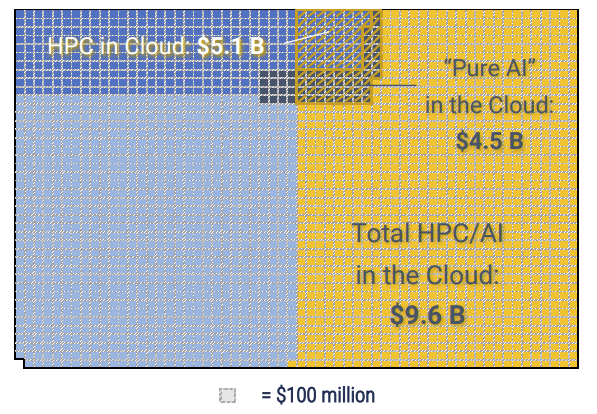
Speaking of cloud, this was the second year that Intersect360 tracked “pure AI” as its own spending category – this year, it’s at $1.6 billion. The cloud part comes in because Intersect360’s report shows that “pure AI” is represented more heavily in the hyperscale market (which is not covered in most of the numbers discussed in this article) than traditional HPC: include the cloud numbers, and HPC spending goes up by $5.1 billion (+17%) to $33.9 billion; pure AI, meanwhile, goes up by $4.5 billion (+281%) to $6.1 billion. That said, Snell hedged that on-prem deployments of AI hardware were increasing: “It’s not strictly a cloud market any more.”

The overall area is total datacenter spending in 2022. Medium blue represents HPC spending; dark blue represents AI spending. The orange slashes represent the areas of those markets managed by hyperscalers. Image courtesy of Intersect360.

Moving back to the non-hyperscale analysis of the HPC/AI markets: Snell said that the market was “back into a stable growth mode” for 2022 following the “deleterious” effects of the Covid pandemic in 2020 and 2021. (“We really lost two years of growth,” he said.)

But now, the aforementioned stable growth. The traditional HPC market grew 8.1% year-over-year to $38.1 billion; the combined HPC/AI market grew 11.3% year-over-year to $44.4 billion. Servers were the largest component of the traditional HPC spending and grew by 7.5%, but the fastest-growing segments were the services and cloud segments (+29.5% and +25.3%, respectively); these trends held true in the expanded HPC/AI view.

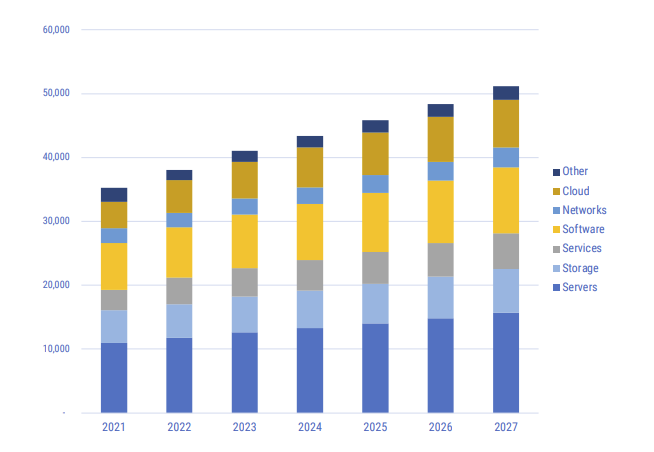
Looking ahead to the next five years – 2023 to 2027 – Intersect360 is projecting a 6.1% compound annual growth rate (CAGR) for the traditional HPC market, hitting $51.2 billion by the end of those five years. With the AI market in the mix, that goes up to a 6.3% CAGR, hitting $60.4 billion. (Again, as Snell cautioned throughout the briefing, all of this excludes hyperscale spending.)

Intersect360’s forecast for the traditional HPC market (products and services) in millions of dollars.

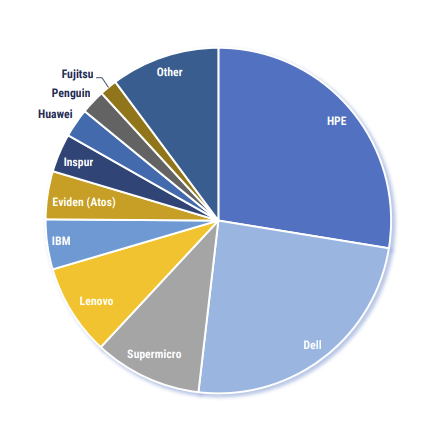
Server revenue share by vendor. Image courtesy of Intersect360.

In terms of vendor trends: HPE and Dell again had strong showings as the dominant forces in the HPC vendor space, growing at what Snell described as market rates. Supermicro overtook Lenovo to become the third-place vendor, and IBM showed surprisingly strong growth from its Z Series systems. Further, Snell said that while they were not yet tracking Nvidia as a vendor, “we’re confident saying that if we put them on the chart, they would be the number-five vendor with about $700-800 million in sales.”

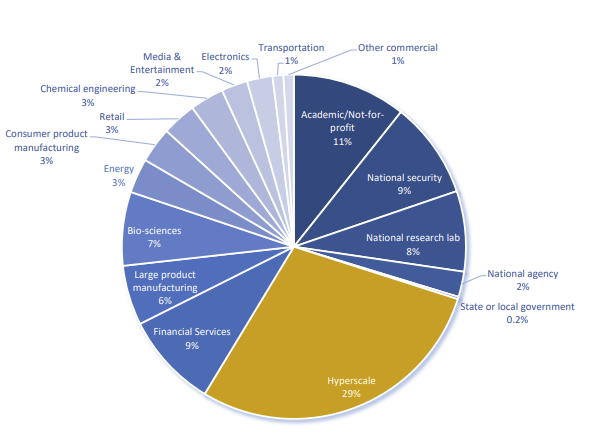
In the vertical markets, Snell said, there was “not a lot of change.” The biggest growth was seen in the manufacturing and energy segments, which were “some of the bigger affected ones” in terms of pandemic fallout. Just for fun, Snell added “hyperscale” as a vertical in one graph, where – at 29% of the market – it dwarfed the competition. Intersect360 expects that the government sector will lead growth over the next five years.

Share of revenue by vertical, with hyperscale added for comparison. Image courtesy of Intersect360.

Following a couple of years led by the Asia-Pacific market, Intersect360 saw that flip around this year, with North America and EMEA leading spending at +12.8% and +11.9%, respectively. “EMEA is really going to lead the growth over the next five years,” Snell projected.

To learn more about Intersect360’s market analysis, click here.

Related

The ‘AI arms race’ is about more than who will lead the industry

The ‘AI arms race’ is about more than who will lead the industry Dominic-Madori Davis 19 hours

The conversations around AI and sustainability have centered around two fronts, according to Lorenzo Thione, a managing director at Gaingels.

On the one hand, AI’s capabilities have grown rapidly, giving rise to new products and technologies that require enormous amounts of computational power and resources. That’s not quite sustainable.

But on the other hand, these advancements in AI and machine learning tech have widened the avenue for creating more architectures to sustain AI development. That, per Thione, is going to herald innovation.

Thione, like everyone these days, has lots of things to say about AI. However, he’s been in the game much longer than most people, having sold his AI-web company, Powerset, to Microsoft in 2009. Then he became an investor and has since become known for his work with Gaingels, a venture capital syndicate where he leads the AI and sustainability investments.

The syndicate, which has nearly $750 million deployed, focuses on backing founders who identify as part of the LGBTQ+ community. As a gay man, Thione remembers a time when founders used to be nervous about being open and out with investors, or worried about how they presented themselves. “They simply were not getting any access to the venture engine because of who they were,” he told TechCrunch+.

Thione and others have worked hard to change that narrative, and the venture industry is finally showing signs of entering a new era. Earlier this month, Crunchbase said it would begin tracking the number of venture dollars allocated to LGBTQ+ founders, which is estimated to stand at 1%.

Thione hailed Crunchbase’s move as a step towards tangible equity. “We cannot begin to fix what we do not measure,” he told TechCrunch+. “This could be the catalyst we need, fostering more diverse and successful LGBTQIA+ startups, thereby enriching our entrepreneurial ecosystem in its entirety.”

AI is certainly an area that could use more enrichment. Thione predicts there will be a slew of companies using AI to tackle energy consumption and distribution of power resources. “There are going to be a number of AI companies positioning themselves as ‘Hey, we are an AI company, but we’re actually using it here to solve a problem that’s going to have a positive impact on the climate.’”

TechCrunch+ recently caught up with Thione to talk about his journey in venture, the future of AI, artificial intelligence, and how Gaingels has dealt with the investor pullback.

(This interview has been edited for length and clarity.)

TechCrunch: Regarding AI, there are two schools of thought: That it will save us all or destroy us. Where do you stand and why?

Lorenzo Thione: It’s incredibly unlikely that AI will destroy humankind. I’m much more in the optimistic camp. Technology certainly has exacerbated some issues when it comes to certain types of inequalities within modern societies, but it has largely made things better. People aren’t wrong to point out the ways things can go wrong with AI.

Clearly understanding the capability of AI systems as we build them will make those issues less relevant. We are going to see problems emerge, not so much even by “AI going rogue,” but rather just the side-effects of the positive uses of AI. Those are going to have some externalities that are not positive. There will be misuse as we see AI systems go out and open source growing as a movement.

It’s inevitable that people are going to have different intentions, and some of them are going to be bad actors trying to use AI for nefarious impact. There are all of these problems, like misinformation, deep fakes, the ability to create hundreds of millions of bots, creating a distributed denial of services attack that is harder to detect, copyright, plagiarism and lack of attributions. All of these are problems that we’re going to need to contend with as a society.

AI itself is going to be the weapon to use against all this. I’m very interested in investing in companies that are effectively using AI to build adversarial systems that detect and combat the sort of misuse or side-effects of the proliferation of negative externalities of AI. Anything from deep-fake detection and bot detection to being able to create sourcing and attribution for copyrighted material. It’s a bit of an arms race, but I believe we will continue to find ways to use these technologies to make things better, not create doomsday for humanity.

Generative AI Use Cases Crop Up Bountifully in Agriculture

ChatGPT, driven by powerful GPT models, has found application across various sectors. OpenAI CEO Sam Altman, during his recent visit to India, mentioned that he was amazed to witness an Indian farmer using a ChatGPT-powered chatbot to access information on agricultural welfare schemes.

Indeed, platforms like Kissan AI ( previously known as KissanGPT) have showcased the prowess of generative AI in agriculture. The platform leverages the power of GPT3.5 and Whisper models by OpenAI and receives 30,000-40,000 queries every month.

The Indian government too acknowledges how useful generative AI can be. Reports earlier this year suggested that the Ministry of IT and Electronics(MeitY) is working on a WhatsApp chatbot by integrating ChatGPT. “LLMs combined with the natural language understanding of Indic languages can significantly enhance the ability of farmers to make informed decisions, potentially boosting yield, reducing wastage, and enhancing overall farm profitability,” Pratik Desai, who developed KissanAI, told AIM.

Leveraging Generative AI

In India, the agricultural sector remains one of the biggest contributors to India’s GDP and employs nearly 50% of the population of India, directly or indirectly. Today, there are numerous government schemes and benefits available for farmers, however, many of our farmers are unaware of these schemes. Navigating through the multitude of government welfare programmes in India can be challenging, especially for those who are illiterate or unfamiliar with English.

Jugalbandi, an AI-chatbot powered by OpenAI’s GPT models via Azure OpenAI Service, is helping farmers as well as villagers in rural India find out about different government schemes which are beneficial for them. The chatbot, which can also be accessed through WhatsApp, retrieves pertinent programme details, typically documented in English, and delivers them in the native language of the user. Currently, the chatbot is available in 10 of the 22 official Indian languages.

Similarly, Wadhwani AI, an independent, non-profit institute dedicated to developing AI solutions for social good is exploring leveraging generative AI to power Kissan call centres. Alpan Raval, chief scientist, AI/ML, Wadhwani AI, told AIM that they are building a Kissan call centre support system using generative AI to assist farmers with their queries.

“Our approach involves augmenting the expertise of the human experts by utilising models that provide automated responses based on a knowledge base. We create these knowledge bases using current government reports and documents, and our speech interface enables a conversational AI system for seamless interactions,” he said.

Generative AI capabilities are being tapped into by other players in the sector as well. Digital Green, a global development organisation has joined forces with generative AI startup Gooey.AI to introduce Farmer.CHAT, an innovative solution aimed at addressing the challenges faced by farmers who are at the forefront of climate change and water security issues. Odisha’s Department for Agriculture and Farmer’s Empowerment also launched Ama KrushAI, an interactive chatbot, to provide farmers with valuable guidance on optimal agronomic practices, government schemes, and loan products offered by over 40 commercial and cooperative banks.

Desai also revealed that he has been approached by over 20 companies operating within diverse agricultural sectors, both in India and internationally. “These range from early-stage agritech startups to established agri input enterprises. Currently, in our pilot phase, we’re working in close collaboration with a selected cohort of these companies.”

Generative AI could do a lot more

The current technological transformations and digital penetration in rural areas have made farmers aware of their crops. “However, there is still a need to acquaint them with tailor-made solutions to improve their conventional farming practices and adopt the latest methods and techniques to increase their productivity,” Sateesh Nukala, CEO & co-founder at BigHaat, told AIM.

Generative AI could potentially do a lot more, given the technology is still in its nascent phase. As the technology matures, its potential use cases in agriculture will also increase. “It will become useful in numerous areas like quick detection of diseases and pest control, nutritional deficiencies that are not currently screened by existing tools.”

Determining soil health to know the possible deficiencies in the current age is difficult as it requires expensive tools to generate such soil health reports. “Further, the history of crops sown on a particular land and capability to predict the upcoming quantum of harvest and plan for the coming year are some of the crucial parameters where generative AI can assist farmers in their native language,” Nukala said.

The post Generative AI Use Cases Crop Up Bountifully in Agriculture appeared first on Analytics India Magazine.

AI Career Notes: June 2023 Edition

AI Career Notes: June 2023 Edition June 12, 2023 by Mariana Iriarte

In this monthly feature, we bring you up to date on the latest career developments in the enterprise AI community – promotions, new hires and accolades. Here's the place to read about the movers and shakers, your colleagues, your friends, and maybe yourself.

Niels Anderskouv and Tim Stone

Semiconductor manufacturer GlobalFoundries (GF) appointed Niels Anderskouv as its chief business officer. Anderskouv will be responsible for driving GF’s business strategy, including product and technology roadmap, sales, and go-to-market execution. He joined GF after serving as senior vice president and executive officer at Texas Instruments.

In addition, GlobalFoundries appointed Tim Stone as the company’s chief financial officer. Stone will focus on accelerating GlobalFoundries’ financial performance. He brings over 20 years of experience to the company, including serving as CFO for Amazon's AWS and Devices businesses.

Vivian Blanchard

SiPearl appointed Vivian Blanchard as its vice president of hardware research and development. Blanchard’s career to date has been in research and development working for Bull and Atos in the computing domain and especially HPC.

He started his career as a physical design engineer, then held several positions in logical design, servers and ASIC architecture. In 2010, he took up the responsibility of Atos’ ASIC Research and Development department. In this capacity, Blanchard worked with Philippe Notton, CEO and founder of SiPearl, and Ying Chih-Yang, CTO, toward the launch of the European Processor Initiative consortium project which incubated SiPearl.

Steve Burke

Snowflake, the data cloud company, appointed Steve Burke to its board of directors. Burke most recently served as chief executive officer of NBCUniversal. He currently serves on the boards of directors of J.P. Morgan Chase and Berkshire Hathaway.

“Snowflake has established itself as a transformative force for businesses across industries and around the world,” said Burke. “I am honored to join the Snowflake Board of Directors and look forward to leveraging my experience and insights to help guide the company as it continues to innovate and deliver for its customers.”

Torborg Chetkovich

atNorth, the Nordic colocation, high-performance computing, and artificial intelligence service provider, appointed Torborg Chetkovich to its board of directors. Torborg currently holds the position of managing director at Private Infrastructure Europe at Partners Group, a global private markets firm and majority owner of atNorth, on behalf of its clients.

“I am delighted to join the atNorth Board of Directors at this time of significant growth for the business and the industry as a whole,” said Chetkovich. “As the demand for high performance data center solutions continues to grow, it is essential that businesses are met with scalable offerings that are truly sustainable and future proof. I look forward to collaborating with atNorth’s leadership team and my board colleagues to guide the success of the business at this pivotal time”.

Karen Dykstra

VMware, a provider of enterprise software solutions, appointed Karen Dykstra as its chief financial officer and executive vice president in addition to her current role as a member of the VMware board of directors.

“Having been a member of the VMware Board since 2016, I am pleased to now take on the CFO role and work even more closely with the executive team and company,” said Dykstra. “VMware’s focus on helping its customers navigate this multi-cloud era, its tremendous innovation engine and its unique culture are all reasons for me to join as CFO and help lead the company.”

Dean Geribo

Alcatraz AI, provider of autonomous access control solutions, appointed Dean Geribo, vice president of corporate security at Moderna, to its advisory board. Geribo has decades of experience in leadership and corporate security, and also serves as an advisory board member for Base Operations, the Board of Executive Protection Professionals, HiveWatch, and RaySecur.

“With the rise of bad actors and evolving physical security risks, solutions like Alcatraz AI can be a game changer in how organizations look to harden their defenses and improve security,” said Geribo. “Both the ease in which the Rock can be deployed and the sensitivity of the devices make it best-in-class, which is why I wanted to join Alcatraz AI as an advisor. The team is phenomenal, and understands the needs and opportunities within the access control segment and are creating a platform to scale with the industry.”

Maheen Hamid and Michael Lercel

SEMI appointed Maheen Hamid and Michael Lercel to the SEMI North America Advisory Board. Hamid, co-founder, chief financial officer and chief operating officer of Breker Verification Systems, oversees the company’s operational growth as it moves from startup to established software supplier. She drives the company’s strategic direction, corporate communications and branding.

Michael Lercel, senior director of global strategic marketing at ASML, guides corporate strategy. He joined ASML in 2015 and brings a background in semiconductor manufacturing. He helped develop a number of next-generation lithography techniques and was involved in pioneering EUV work in 1998.

Pete Harteveld

Aryaka, a fully managed SD-WAN and Unified SASE solutions provider, appointed Pete Harteveld as its chief revenue officer. Harteveld comes to Aryaka from Veracode, where he was also CRO. Harteveld previously held positions at companies including Compuware, CA Technologies, and Deloitte Consulting.

“I look forward to working closely with Matt and the incredible Aryaka team to continue growing Aryaka’s business and exceeding customer expectations,” said Harteveld. “Aryaka presented the perfect opportunity to leverage my expertise in helping security businesses successfully take on industry giants. I’m eager to find new ways to help Aryaka disrupt this exciting market and, most importantly, to help provide our customers with the unmatched networking and security solutions and experience they love us for.”

David Joseph

Cornelis Networks, the provider of intelligent, high-performance networking solutions, appointed David Joseph as its chief financial officer. Joseph will be responsible for expanding the global financial, administrative, and operational functions to support this phase of growth. He will also oversee the company’s HR and legal functions.

“AI is a technology disruptor akin to the Internet that can’t scale without the performance, reduced latency, and processing power that Cornelis Networks interconnects bring to the market,” said Joseph. “Further driving the company’s success is a visionary leadership team that I am honored to join as we continue to support our customers in achieving their objectives.”

Dave Kielpinski

Q-CTRL, a developer of quantum technologies through quantum control infrastructure software, appointed Dave Kielpinski as its principal quantum control scientist. Kielpinski’s background and expertise will help expand the range of hardware platforms supported by Q-CTRL’s software, building on the company’s track record of validation on real quantum computers.

“I am excited to join the Q-CTRL team because the future is bright for the company and the entire quantum tech industry. We are going to see a major change in how quantum is perceived by the wider community as quantum hardware takes over certain key computing tasks,” said Kielpinski. “Exactly when that happens will be down to both hardware improvements and, just as importantly, the ability to extract useful performance from that hardware through software. The second part is where Q-CTRL comes in.”

Lea Kissner

Lacework, the data-driven cloud security company, appointed Lea Kissner as its chief information security officer. As CISO, Kissner will be responsible for leading the development and implementation of Lacework’s overall security strategy and programs.

“I am thrilled to join the team at Lacework and our mission to secure the cloud at a time when enterprises are increasingly expanding their cloud environments” said Kissner. “My whole career I’ve been passionate about helping people build respectful, secure products that just work for their users. Lacework’s unique, data-driven approach to cloud security allows customers to do just that while taking advantage of all the inherent benefits of the cloud.”

Michael Knowles

One Stop Systems, Inc. (OSS), a provider of AI transportable compute and storage solutions, appointed Michael Knowles as its new president and chief executive officer. Knowles has held executive leadership positions at several defense contractors, including Cubic Corp.

Knowles said, “I’m excited to build on the inspiring AI product suite, driving growth in both defense and commercial markets and creating a powerful business model. OSS has the foundations for a team, products, and innovation mindset to succeed in the global marketplace and accelerate greater pipeline and business growth.”

Mary Krakauer

Cadence Design Systems, Inc. appointed Mary Louise Krakauer as the chair of the board of directors. Krakauer also serves as a director of Mercury Systems, Inc. and Proterra Inc. Krakauer retired as executive vice president, chief information officer of Dell Corp. in January 2017. Prior to that, she served in various executive positions at EMC Corp.

“Cadence’s growth has been phenomenal over the past several years, and I’m ready to explore new market opportunities and drive strategic initiatives to further advance the company’s position in the computational software industry,” said Krakauer. “I share Anirudh’s passion for innovation and customer success, and I look forward to collaborating with Anirudh and the executive team to build upon Cadence’s strong foundation and take the company to new heights.”

Daren Mancini

Submer, immersion cooling solutions provider, appointed Daren Mancini as its senior vice president of sales. Mancini brings decades of experience in marketing, sales management, and technology having held leadership positions at BT, Ericsson, Microsoft, HPE, and Lumen.

“The opportunity ahead for Submer is vast, but to seize it, we must focus clearly, move faster, and continue to transform and evolve our relevance in the future of datacenters, that simply make sense,” Mancini said. “A big part of my job is to accelerate our ability to bring the innovation of Submer to our customers more clearly and quickly.”

Megan Maslanka

Starburst, the data lake analytics platform, appointed Megan Maslanka as its chief people officer. Maslanka joined Starburst from Five9, where she held hte role of vice president of people. Before Starburst, she was head of talent operations at DocuSign.

“We are building a sustainable organization that is very focused on building growth the right way,” Maslanka said in a blog announcement. “The challenge to do it the right way is really appealing to me. Justin and the exec team have such strong values that are rare to find; I thought it was really important to be partnered with an executive team and CEO that knew what it took and had a value system that was different from a lot of startups.

Kelley Mullick

Iceotope Technologies Limited (Iceotope), a provider of precision liquid cooling technology solutions, appointed Kelley Mullick as its vice president for technology advancement and alliances. Mullick joins the company from Intel Corp., where she worked in product management and strategy for the datacenter and AI group

Mullick said, “Today, existing challenges to mitigate against the climate emergency are joined by the technological expedients of AI applications such as ChatGPT. These compute-intensive operations need the support of compute-intensive infrastructure. The limitations and inefficiencies of air cooling are well known… When I appraised Iceotope’s technology, I saw complete differentiation from anything else in the market. In addition to all the benefits of liquid cooling, it offers high levels of heat reuse, almost completely eliminates the use of water, and offers greater compute density and scalability than other solutions like cold-plate and tank immersion. It is the technology of the future that I want to invest my calories in.”

Neil Murphy

ABBYY, a provider of intelligent automation solutions, appointed Neil Murphy as its chief sales officer. Murphy will be focused on extending the company’s efforts in helping global enterprises put their information to work and accelerate business value from their digital transformation initiatives.

"I look forward to continuing our focus on customers’ needs and driving their successes,” Murphy said. “ABBYY is the only intelligent automation company that has decades of experience in innovating AI for documents and perfecting it with more than 10,000 customers. Its why customers can rely on us to transform any document in any format, any language into actionable outcomes with industry-leading accuracy. It is this differentiation that makes ABBYY and our customers win."

Christine Nurnberger

OutSystems, a high-performance application development solutions provider, appointed Christine Nurnberger as its chief marketing officer. Most recently, Nurnberger served as CMO at ExtraHop, a cybersecurity company. Prior to that, she served as CMO at Bottomline for eight years.

“I’m thrilled to join OutSystems. OutSystems global and growing customer base is the most passionate I’ve seen, as the value of the OutSystems platform shows clear and direct impact on their business,” said Nurnberger. “This is a smart, dedicated, visionary group of people around the world all pulling for their customers’ success. OutSystems is poised to have an even greater impact on the low-code market and the future of application development. I’m excited to contribute to the team as we embark on the company’s next phase of growth and innovation.”

Ryan Packer

BambooHR, a cloud-hosted software provider, appointed Ryan Packer as its chief technology officer. Prior to joining BambooHR, Packer spent 12 years at Adobe leading various engineering organizations, including serving as vice president of engineering in Adobe's Experience Cloud business unit.

“I’m thrilled to join BambooHR, a company that’s at a unique inflection point, with the opportunity to impact tens of thousands of companies and millions of people with tools that allow them to do great work,” said Packer. “As CTO, I hope to help the organization balance delivery and execution with long term strategy and vision, building on the existing foundation with new technologies that will give HR and people leaders even more powerful tools to put their people strategy front and center.”

Kye Prigg

Lumen Technologies appointed Kye Prigg as its executive vice president of enterprise operations. Kye most recently served as SVP of Access Networks and Operations for Rogers Communications. He brings to the company an extensive telecommunications and operations background, with 30 years of experience at companies including Vodafone, Softbank, and Ericsson.

"I am honored to join the Lumen leadership team at such a pivotal time for Lumen and its customers," said Prigg. "I have a deep appreciation for communications technology, working with exceptional teams, and the profound impact our performance has on the experience of our customers. Our world-class teams will connect customers around the world to high performing, reliable, and resilient networks, leveraging the strength of Lumen's unmatched network capabilities."

Gurvinder Sahni

Persistent Systems appointed Gurvinder Sahni as its chief marketing officer. In this role, Sahni will be responsible for leading and setting the strategic vision for Persistent’s global marketing team.

“I am truly honored to join this exceptional team as the Chief Marketing Officer,” Sahni said. “As someone who is passionate about achieving excellence in marketing, I look forward to leveraging my experience and diverse skill set to drive growth and enhance the brand value. Together with the team, I am committed to delivering exceptional results and creating lasting value for our clients, team members, and stakeholders.”

Roger Schnüriger

Stäubli, a leader in industrial and mechatronic solutions, has appointed Roger Schnüriger as its new group chief financial officer and member of the group executive committee. He holds an Executive MBA from London Business School and advanced diplomas in Treasury, Risk and Corporate Finance.

“We are fortunate to have found in Roger Schnüriger such a valuable contributor to the further implementation of our business strategy, and we look forward to fostering the expansion of the entire Stäubli Group together,” said Gerald Vogt, CEO.

Andrew Sotiropoulos

NetApp, a cloud-led, data-centric software company, appointed Andrew Sotiropoulos as its senior vice president and general manager for the Asia Pacific region. Sotiropoulos's priorities include growing NetApp’s enterprise storage and cloud business, strengthening its partner ecosystem, and extending its leadership in regional markets.

“NetApp is resolute in helping APAC organizations mitigate complexities to accelerate their digital transformation journeys, across on-premises and hybrid multi-cloud environments,” said Sotiropoulos. “I am excited to build on the 30-year foundation that NetApp has laid down, letting customers further boost their innovation speed, lower costs, and improve agility.”

Wing To

Digital.ai, the enterprise platform for AI-driven software development, promoted Wing To to the role of general manager of its Intelligent DevOps business. To joined the company in 2020 and most recently served as vice president of R&D of Intelligent DevOps at Digital.ai. He joined Digital.ai after serving 14 years at IBM, in VP roles across strategy, product management and development.

“I am excited to take on the general manager role at this time in Digital.ai’s development,” said Wing. “Organizations are navigating complex business environments and need data and insights that truly help them understand software delivery and digital transformation's impact on the entire business. Digital.ai customers depend on our products to help build and manage the software that runs their businesses and enables them to access the data companywide to make timely, accurate decisions.”

To read last month's edition of Career Notes, click here.

Do you know someone that should be included in next month's list? If so, send us an email at [email protected]. We look forward to hearing from you.

Related