ChatGPT is Just the Tip of the Iceberg

chatgpt is just the tip of the iceberg

Unless you live under a rock, you must have heard the statement a thousand times over. OpenAI, performed the “crazy stunt” of putting out ChatGPT to the public, and gave rise to many well-meaning as well as annoying “influencers”, who out of nowhere, nudge you into believing that you are falling behind.

Social media platforms like Twitter, Instagram and LinkedIn are filled with “cringe” content around AI. This is because people are just riding this train of AI-powered tools, and calling ChatGPT the news of yesterday. Some even call themselves “ChatGPT experts”, if that means anything. Looking at some of these posts may send you scurrying under the said rock, though.

The Rise of “tech influencers”

While most are busy telling you that you’re inadequate, others suggest that you should “learn the art of prompting to get ahead of others”. The truth is that almost every single one of these influencers is just minting money through ChatGPT and some are even making a fool of themselves in the process.

A lot of these influencers claim that ChatGPT and Bard cannot do a lot of the stuff that some other tools can and end up suggesting softwares and apps that utilise ChatGPT’s API. Bravo! This looks like nothing but a shady attempt at staying relevant and positioning themselves as experts in the field to their naive followers.

It is true though that a lot of tools can boost productivity. But when everyone starts suggesting the same thing, the field gets overrun and instead of standing out, everyone just joins the herd created by these “influencers” and “experts”.

Moreover, the content creators are harming the actual AI creators in more ways than one. More than trying to build something out of this generative AI marvel, these influencers are here only to gain an audience and in the end negatively impact the researchers and creators who could have built, or are trying to build something.

Worse, these “experts” have not always been AI experts. When NFT and blockchain was all the hype, these same bunch of people were telling the world how to get ahead with the technology. Funnily enough, all of them have now shifted to generative AI. Soon, these would shift to being AR/VR experts with Apple’s Vision Pro announcements.

There is no limit to this. In India, it is only getting worse. “Did you know that OpenAI has an API” type of tweets are getting promoted on Twitter. Instead of building something foundational out of India, the tech world is just building out of OpenAI’s technology, which in the end is what the influencers criticise. What is the point?

“I have stopped using ChatGPT completely”

While it is true that a lot of people have started believing that AI is all about generative AI, ChatGPT is indeed the tip of the iceberg. But earning fame out of making the best tool in the market look bad does not make sense. People have already started muting a lot of these words as it is literally what fills up their feed.

List of my muted words. pic.twitter.com/QVyQpneCHU

— Anyungu (@AnyunguWanyungu) June 6, 2023

AI Advisor Vin Vashistha had the perfect analogy for these influencers of AI — the snake oil sellers of AI. On the flip side, the hallucinatory nature of these LLM models have actually rendered them useless for a lot of people. Some have even gone back to using the good-old Google Search for their work.

The only bright side to this constant bombardment of AI tools is the increased awareness on AI. Regular people have now started adopting different tools. The truth is that most of them initially only head towards ChatGPT before trying anything else, and are content with it. These influencers might be making the adoption of AI easier, but a lot of them are also just instilling the fear of being left out.

The Goodfellas

In all honesty, enjoying cringe content is not wrong. Some of these influencers even announce that they are intentionally making the content cringey because that is what sells. Fair enough, we have all scrolled through Instagram and TikTok’s cringe content after a hectic day and passed it off as entertainment.

On Instagram and TikTok, influencers like Tanmay Bhatt or Varun Mayya, who some would say are hopping onto the bandwagon of AI influencers, are indeed providing informative content along with making it entertaining. Separating the wheat from the chaff are real experts like Andrew Ng, who understand the importance of learning these skills and are providing free courses on prompt engineering and other introductory courses for AI. You just have to pick the right experts to follow and not get influenced by the AI hypers.

The post ChatGPT is Just the Tip of the Iceberg appeared first on Analytics India Magazine.

This free AI tool can write your cover letters, and its easier to use than ChatGPT

robot hand typing on a laptop while human hand writes

Whether this is your first job hunt or there've been too many to count, one thing remains the same, getting a new job can be very stressful. Finding a job listing that fits your needs is only half the battle.

Before you can submit an application, you have to go through the various material requirements, including a resume and the dreaded cover letter.

Also: How to use ChatGPT to write a cover letter (and why you should)

A cover letter is meant to be this perfectly curated communication to your potential employer that not only highlights all of your strengths but also tailors those qualities to the specific role you're applying for.

Moreover, when you're on the job hunt, you're most likely applying to several positions at a time — with each one requiring a uniquely hand-crafted cover letter. Well, Cover Letter Copilot has you covered.

Also: How to use ChatGPT to build your resume

This free AI tool saves your resume and only requires a job description and title for the job you are interested in to generate cover letters at the touch of a key.

How to get started

Getting started is pretty simple. All you have to do is visit the Cover Letter Copilot site and click the upper right-hand corner that says "Get started for free."

You will be prompted to sign up with your Gmail account or create an account with your email.

Testing the tool

After you sign in, you will be taken to the prompt page where you can fill out the information needed to get your cover letter generated. All the prompts are carefully labeled, which makes the process pretty intuitive.

The only materials you will need on hand are your resume and the job listing for the new job you are interested in applying to. Then you can upload your resume and fill in the blanks to generate your resume.

Also: Need an AI essay writer? Here's how ChatGPT (and other chatbots) can help

For simplicity purposes, I applied to the Associate Editor position I hold now at ZDNET. The result was a thoughtful, cohesive, and thorough cover letter that I would have felt comfortable submitting if I were actually applying to be on the team.

I attached a photo of the end result but blacked out the more personal details that I only want/need an employer to see.

You can then tweak the cover letter to your liking both in terms of content and layout. For example, you can change details such as font, headings, graphics, links, and more.

When you are done, you have the option to either copy and paste the letter or download it as a PDF. If you choose to export it as a PDF, you are ready to then attach that same file to your application.

There is also an option to generate another cover letter which takes you back to the original prompts page. However, this time you don't need to refill out your personal details such as name and resume, saving you time.

How is Cover Letter Copilot easier than ChatGPT?

Cover Letter Copilot is easier because it saves your personal information, requiring you to just copy and paste the listing for the job you are applying for to get a perfectly curated cover letter.

Also: 7 ways you didn't know you can use Bing Chat and other AI chatbots

With ChatGPT you have to ask it a lot more prompts and feed it manually with fresh detail every time to get a cover letter generated. It is still a very solid option.

Cover Letter Copilot also makes the exporting process easier, allowing you to design the cover letter to your liking and export it as a PDF all from one place.

Artificial Intelligence

Tech HR professionals are using ChatGPT to craft termination letters

Person holding a phone with ChatGPT open

The tech industry has undergone significant layoffs, with giants such as Google, Meta, and Microsoft letting go of tens of thousands of employees in the last six months.

Consequently, HR professionals are in demand for their skills in managing termination processes with tact to lessen the impact on employees.

Also: Want a compassionate response from a doctor? You may want to ask ChatGPT instead

However, these conversations can be difficult, so some HR professionals are turning to AI for help.

In a new survey, 213 tech HR professionals and 792 tech employees were asked about their experiences with HR in the tech industry.

Over half of the tech HR employees surveyed reported using ChatGPT for tasks such as training, surveys, performance reviews, recruiting, employee relations, and more.

Also: GPT-4-generated pitches are 3x more likely to secure funding than human ones

More than one in 10 tech HR employees even admitted to using ChatGPT to craft employee terminations, according to the survey.

This isn't the first time ChatGPT is being used for a sensitive matter. As ZDNET previously reported, people have used ChatGPT to write wedding vows and even eulogies.

Also: These are my 5 favorite AI tools for work

Using an AI chatbot makes it easier to emotionally detach yourself from difficult or emotionally charged situations, such as terminating someone's employment. But the impacts of using AI models for such tasks may include a loss of trust between employees and HR.

Artificial Intelligence

The week in AI: Apple makes machine learning moves

The week in AI: Apple makes machine learning moves Kyle Wiggers 8 hours

Keeping up with an industry as fast-moving as AI is a tall order. So until an AI can do it for you, here’s a handy roundup of the last week’s stories in the world of machine learning, along with notable research and experiments we didn’t cover on their own.

It could be said that last week, Apple very visibly, and with intention, threw its hat into the ultra-competitive AI race. It’s not that the company hadn’t signaled its investments in — and prioritization of — AI previously. But at its WWDC event, Apple made it abundantly clear that AI was behind many of the features in both its forthcoming hardware and software.

For instance, iOS 17, which is set to arrive later this year, can suggest recipes for similar dishes from an iPhone photo using computer vision. AI also powers Journal, a new interactive diary that makes personalized suggestions based on activities across other apps.

iOS 17 will also feature an upgraded autocorrect powered by an AI model that can more accurately predict the next words and phrases that a user might use. Over time, it’ll become tailored, learning a user’s most frequently-used words — including swear words, entertainingly.

AI is central to Apple’s Vision Pro augmented reality headset, too — specifically FaceTime on the Vision Pro. Using machine learning, the Vision Pro can create a virtual avatar of the wearer, interpolating out a full range of facial contortions — down to the skin tension and muscle work.

facial scan for digital persona for Vision Pro

Image Credits: Apple

It might not be generative AI, which is without a doubt the hottest subcategory of AI today. But Apple’s intention, it seems to me, was to mount a comeback of sorts — to show that it’s not one to be underestimated after years of floundering machine learning projects, from the underwhelming Siri to the self-driving car in production hell.

Projecting strength isn’t just a marketing ploy. Apple’s historical underperformance in AI has led to serious brain drain, reportedly, with The Information reporting that talented machine learning scientists — including a team that had been working on the type of tech underlying OpenAI’s ChatGPT — left Apple for greener pastures.

Showing that it’s serious about AI by actually shipping products with AI imbued feels like a necessary move — and a benchmark some of Apple’s competitors have, in fact, failed to meet in the recent past. (Here’s looking at you, Meta.) By all appearances, Apple made inroads last week — even if it wasn’t particularly loud about it.

Here are the other AI headlines of note from the past few days:

  • Meta makes a music generator: Not to be outdone by Google, Meta has released its own AI-powered music generator — and, unlike Google, open-sourced it. Called MusicGen, Meta’s music-generating tool can turn a text description into about 12 seconds of audio.
  • Regulators examine AI safety: Following the UK government’s announcement last week that it plans to host a “global” AI safety summit this fall, OpenAI, Google DeepMind and Anthropic have committed to provide “early or priority access” to their AI models to support research into evaluation and safety.
  • AI, meet cloud: Salesforce is launching a new suite of products aimed at bolstering its position in the ultra-competitive AI space. Called AI Cloud, the suite, which includes tools designed to deliver “enterprise ready” AI, is Salesforce’s latest cross-disciplinary attempt to augment its product portfolio with AI capabilities.
  • Testing text-to-video AI: TechCrunch went hands on with Gen-2, Runway’s AI that generates short video clips from text. The verdict? There’s a long way to go before the tech comes close to generating film-quality footage.
  • More money for enterprise AI: In a sign that there’s plenty of cash to go around for generative AI startups, Cohere, which is developing an AI model ecosystem for the enterprise, last week announced that it raised $270 million as part of its Series C round.
  • No GPT-5 for you: OpenAI is still not training GPT-5, OpenAI CEO Sam Altman said at a recent conference hosted by Economic Times — months after the Microsoft-backed startup pledged to not work on the successor to GPT-4 “for some time” after many industry executives and academics expressed concerns about the fast-rate of advancements by Altman’s large language models.
  • AI writing assistant for WordPress: Automattic, the company behind WordPress.com and the main contributor to the open source WordPress project, launched an AI assistant for the popular content management system last Tuesday.
  • Instagram gains a chatbot: Instagram may be working on an AI chatbot, according to images leaked by app researcher Alessandro Paluzzi. According to the leaks, which reflect in-progress app developments that may or may not ship, these AI agents can answer questions or give advice.

Other machine learnings

If you’re curious how AI might affect science and research over the next few years, a team across 6 national labs authored a report, based on workshops conducted last year, about exactly that. One may be tempted to say that, being based on trends from last year and not this one, in which things have progressed so fast, the report may already be obsolete. But while ChatGPT has made huge waves in tech and consumer awareness, the truth is it’s not particularly relevant for serious research. The larger-scale trends are, and they’re moving at a different pace. The 200-page report is definitely not a light read, but each section is helpfully divided into digestible pieces.

Elswehere in the national lab ecosystem, Los Alamos researchers are hard at work on advancing the field of memristors, which combine data storage and processing — much like our own neurons do. It’s a fundamentally different approach to computation, though one that has yet to bear fruit outside the lab, but this new approach appears to move the ball forward, at least.

AI’s facility with language analysis is on display in this report on police interactions with people they’ve pulled over. Natural language processing was used as one of several factors to identify linguistic patterns that predict escalation of stops — especially with black men. The human and machine learning methods reinforce each other. (Read the paper here.)

Image Credits: Cyrille Verdon / Renaud Defrancesco BUREAU 141 / EPFL

DeepBreath is a model trained on recordings of breathing taken from patients in Switzerland and Brazil that its creators at EPFL claim can help identify respiratory conditions early. The plan is to put it out there in a device called the Pneumoscope, under spinout company Onescope. We’ll probably follow up with them for more info on how the company is doing.

Another AI health advance comes from Purdue, where researchers have made software that approximates hyperspectral imagery with a smartphone camera, successfully tracking blood hemoclobin and other metrics. It’s an interesting technique: using the phone’s super-slow-mo mode, it gets a lot of information about every pixel in the image, giving a model enough data to extrapolate from. It could be a great way to get this kind of health information without special hardware.

Image Credits: MIT

I wouldn’t trust an autopilot to take evasive maneuvers just yet, but MIT is inching the tech closer with research that helps AI avoid obstacles while maintaining a desirable flight path. Any old algorithm can propose wild changes to direction in order to not crash, but doing so while maintaining stability and not pulping anything inside is harder. The team managed to get a simulated jet to perform some Top Gun-like maneuvers autonomously and without losing stability. It’s harder than it sounds.

Last this week is Disney Research, which can always be counted on to show off something interesting that also just happens to apply to filmmaking or theme park operations. At CVPR they showed off a powerful and versatile “facial landmark detection network” that can track facial movements continuously and using more arbitrary reference points. Motion capture is already working without the little capture dots, but this should make it even higher quality — and more dignified for the actors.

VCs Will Destroy AI

Steph Mui, the founder and CEO of an investment company, recently tweeted that a startup can raise $100 million in two simple steps. The first step is to raise $250,000 in angel funding, and then pivot to AI and raise $100 million in funding. While this just seems like a bit of VC humour, it reflects a far darker truth in the investment world — VCs are pumping up AI and waiting for the bubble to pop.

This so-called disruptive technology finally entered the mainstream with ChatGPT after decades of research, and VCs saw the dollar signs. In what has been compared to a second dot-com boom, AI companies are enjoying being VC darlings, with many investors heralding the technology as the biggest disruption we’ve seen yet.

However, this is a pattern that we’ve seen before, especially for technology markets that hold the potential to disrupt the way business is done. We first saw it with investment into crypto and blockchain, and then in the extreme hype cycle for the metaverse, and now with AI. With the amount of funding and hype surrounding AI, there is a very high likelihood that VCs will destroy AI.

The hype train keeps rolling

Before VCs found out what AI was, tech giants were slowly innovating in this space and pouring millions into research, development, and deployment. Companies like Google, Meta, and Amazon saw the disruptive potential of AI way before the VCs ever did. However, as soon as the AI bug hit, thanks to ChatGPT beating the hype cycle, we saw the same companies succumb to the AI wave.

In FY23’s first-quarter earnings, the big 4 tech giants (Meta, Alphabet, Microsoft, and Amazon) mentioned AI 168 times. This not only signifies the newfound attention given to this disruptive technology, but also a deep need to assure shareholders that big techs are on top of the AI wave. The reason for this assurance is a show of power for all competitors and an exhibition of the effort poured into AI disruption.

According to Crunchbase data, around $8.7 billion of funding has been poured into AI companies over the past three months alone. The field has also seen high-profile investments such as Microsoft’s $10 billion investment in OpenAI, Character AI’s $150 million Series A round, Anthropic’s $580 million Series B round, and Runway’s $100 million Series D round.

However, there was an explosive seed funding round that stood above all others, namely Mistral AI’s €105 million investment. This seed round is second only to a few others in the history of investment, such as Yuga Labs behemoth $450 million seed funding round. There is one thing that ties these investments together — both of them were made at the height of their respective hype waves.

Yuga Labs is the company behind Bored Ape Yacht Club NFTs, and received this funding in a round led by a16z crypto in the beginning of 2022. This was at a time when NFT trading was at an all-time high, fuelled by extreme positive sentiment and media hype. Andreessen Horowitz (aka a16z) managed to capitalise on the bubble at the right time, a formula they wish to replicate with AI.

No, AI won’t “save the world”

Venture capitalists and market analysts go hand in hand each relying on the other to inflate expectations for the AI market. Let’s look at Morgan Stanley, one of the biggest companies to hype crypto and blockchain. Over 2021 and 2022, it launched multiple crypto-based initiatives, like a crypto research team, heavy investment into Bitcoin through Grayscale investment, and a Bitcoin investment tool for millionaires.

Today, Morgan Stanley has moved on to AI, publishing a report that stated that AI is a $6 trillion opportunity. McKinsey’s latest research estimates that GenAI will add up to $4.4 trillion to the global economy across 63 use cases. Goldman Sachs predicted that AI will result in 300 million jobs lost, while increasing global GDP by 7%.

On the other hand, Marc Andreessen of Andreessen Horowitz, has written a 7000-word blog on how AI is going to save the world and all the naysayers should just shut up. The key takeaway is that AI will be everywhere, from tutoring children and helping scientists to augmenting artists’ work and improving warfare. He ends it with the takeaway that all AI companies should be allowed to build AI aggressively with regulatory help, so as to ‘save the world’ from China’s dystopian concept of AI dominance.

After spending thousands of words dismissing the concerns of AI boomers, Andreessen subtly creates a new fear — that of free and open American AI falling behind Chinese AI. He implies that this will happen if the ‘free world’ doesn’t pour all their money and resources into making AI the way it’s meant to be: free and open. However, this also has a hidden benefit for Andreessen, namely money flowing through his coffers to fund a new group of AI hype companies.

Building castles in the sky

All the use cases described by these numerous reports and AI angels are yet to materialise. Enterprises are just about beginning to find use cases for LLMs, but find it difficult to ignore the security issues that come along with them. In its current state, AI seems to be a hammer looking for a nail, a solution looking for a problem, and while there is potential for huge disruption, investors must take it with a pinch of measured scepticism.

AI grifters are a dime-a-dozen these days, and no matter how high-profile they are, it is important for investors to keep in mind that AI is just a technology. ChatGPT, the poster child of AI, is not Skynet in disguise, it’s just a glorified autocorrect. Only this sentiment can bring actual changes to the status quo, while unmeasured optimism and hokey predictions will create another bubble.

The post VCs Will Destroy AI appeared first on Analytics India Magazine.

Europe Moves Forward with AI Regulation

Europe Moves Forward with AI Regulation June 15, 2023 by Alex Woodie

European lawmakers have voted overwhelmingly in favor of the landmark AI regulation known as the EU AI Act. While the act does not yet have the force of law, the lopsided vote indicates it soon will in the European Union. Companies would still be free to use AI in the United States, which so far lacks consensus on whether AI represents a risk or opportunity.

A draft of the AI Act passed by a large margin today, with 499 members of European Parliament voting in favor, 28 against and 93 abstentions. A final vote could be taken later this year after negotiations by members of Parliament, the EU Commission, and the EU Council.

First proposed in April 2021, the EU AI Act would restrict how companies can use AI in their products; require AI to be implemented in a safe, legal, ethical, and transparent manner; force companies to get prior approval for certain AI use cases; and require companies to monitor their AI products.

The AI law would rank different AI uses by the risk that they pose, and require companies meet safety standards before the AI could be exposed to customers. AI with minimal risk, such as spam filters or video games, could continue to be used as they have been historically, and would be exempt from transparency requirements.

The screws begin to tighten with AI said to have “limited risk,” a category that includes chatbots such as OpenAI’s ChatGPT or Google’s Bard. To abide by the EU AI Act, a user must be informed that they are interacting with a chatbot, according to the proposed law.

Organizations would need to conduct impact assessments and audits on so-called high-risk AI systems, which includes things like self-driving cars, as well as decision-support systems in education, immigration, and employment. Europe’s central government would track high-risk AI use cases in a central database.

AI deemed to carry an “unacceptable” risk would never be allowed in the EU, even with audits and regulation. Examples of this type of forbidden AI includes real-time biometric monitoring and social scoring systems. Failing to adhere to the regulation could bring fines equal to 6% or 7% of a company’s revenue.

Today’s vote bolsters the notion that AI is out of control and needs to be reined in. A number of prominent AI developers recently have called for a ban or a pause on AI research, including Geoffrey Hinton and Yoshua Bengio, who helped popularize modern neural networks and who signed a statement from the Center for AI Safety calling for treating AI as a global risk.

Hinton, who left his job at Google this spring so he could speak more freely about the threat of AI, compared AI to nuclear weapons. “I’m just a scientist who suddenly realized that these things are getting smarter than us,” Hinton told CNN’s Jake Tapper May 3. “…[W]e should worry seriously about how we stop these things getting control over us.”

However, not all AI researchers or computer scientists share that point of view. Yann LeCun, who heads AI research at Facebook-parent meta–and who joined Hinton and Bengio in winning the 2018 Turing Award for their collective work on neural networks–has been outspoken in his belief that this is not the right time to regulate AI.

LeCun said today on Twitter that he believes “premature regulation would stifle innovation,” specifically in reference to the new EU AI Act.

“At a general level, AI is intrinsically good because the effect of AI is to make people smarter,” LeCunn said this week at the VivaTech conference in Paris, France. “You can think of AI as an amplifier of human intelligence. When people are smarter better things happen. People are more productive, happier.”

“You can think of AI as an amplifier of human intelligence,” Meta’s AI chief Yann LeCun said at VivaTech.

“Now there’s no question that bad actors can use it for bad things,” LeCunn continued. “And then it’s a question of are whether their more good actors than bad actors.”

Just as the EU’s General Data Protection Regulation (GDPR) formed the basis for many data privacy laws in other countries and American states, such as California, the proposed EU AI Act would set the path forward for AI regulation around the world, says business transformation expert Kamales Lardi.

“EU’s Act could become a global standard, with influence on how AI impacts our lives and how it could be regulated globally,” she says. “However, there are limitations in the Act…Regulation should focus on striking an intelligent balance between innovation and wrongful application of technology. The act is also inflexible and doesn’t take into account the exponential rate of AI development, which in a year or two could look very different from today.”

Ulrik Stig Hansen, co-founder and president of the London-based AI firm Encord, says now is not the right time to regulate AI.

“We’ve heard of too big to regulate, but what about too early?” he tells Datanami. “In classic EU fashion, they’re seeking to regulate a new technology that few businesses or consumers have adopted, and few people are, in the grand scheme of things, even developing at this point.”

Since we don’t yet have a firm grasp of the risks inherent in AI systems, it’s premature to write laws regulating AI, he says.

“A more sensible approach could be for relevant industry bodies to regulate AI like they would other technology,” he says. “AI as a medical device is an excellent example of that where it is subject to FDA approval or CE marking. This is in line with what we’re seeing in the UK, which has adopted a more pragmatic pro-innovation approach and passed responsibility to existing regulators in the sectors where AI is applied.”

While the US does not have an AI regulation in the works at the moment, the federal government is taking steps to guide organizations towards ethical use of AI. In January, the National Institute of Standards and Technology (NIST) published the AI Risk Management Framework, which guides organizations through the process of mapping, measuring, managing, and governing AI systems.

The RMF has several things going for it, AI legal expert and BNH.ai co-founder Andrew Burt told Datanami earlier this year, including the potential to becoming a legal standard recognized by multiple parties. More importantly, it retains the flexibility to adapt to fast-changing AI technology, something that the AI EU Act lacks, he said.

This article originally appeared on sister site Datanami.

Related

About the author: Alex Woodie

Alex Woodie has written about IT as a technology journalist for more than a decade. He brings extensive experience from the IBM midrange marketplace, including topics such as servers, ERP applications, programming, databases, security, high availability, storage, business intelligence, cloud, and mobile enablement. He resides in the San Diego area.

Gmail will help you write your emails now: How to access Google’s new AI tool

google-io-gmail.png

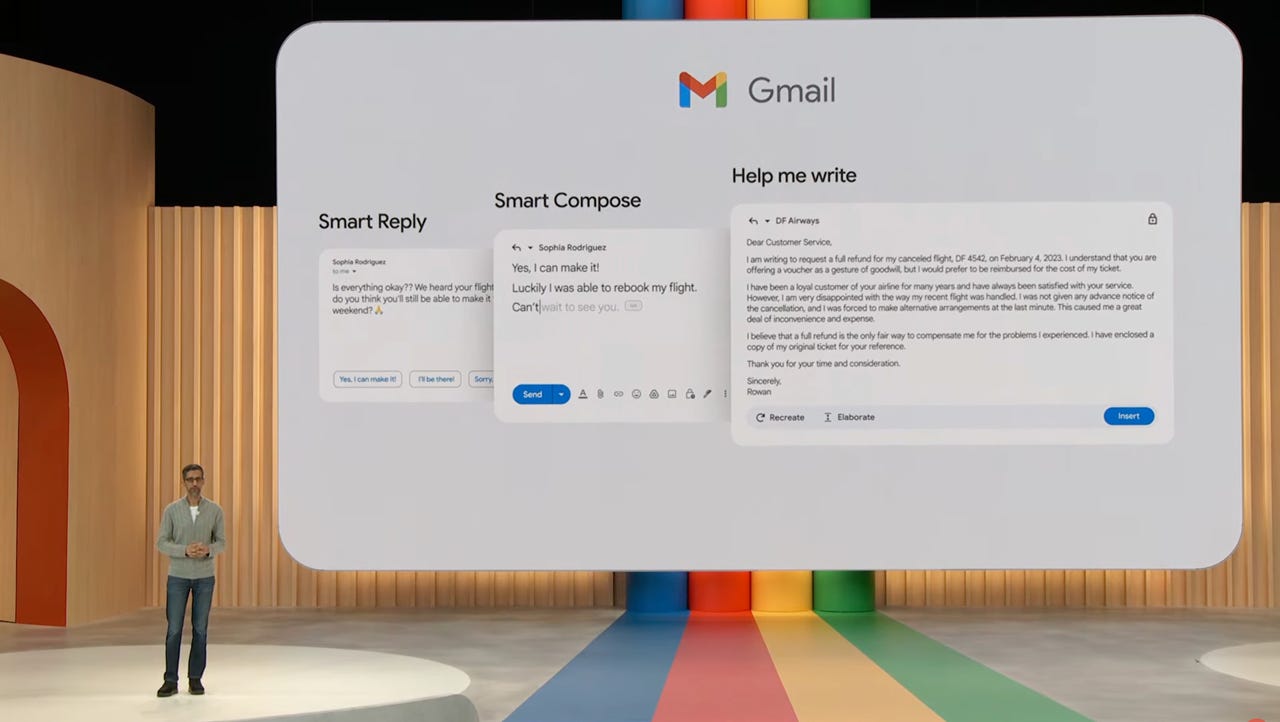
As part of a set of new AI features, Sundar Pichar announced Help Me Write in May during Google I/O.

Artificial intelligence is making its way into tools we use every day, and it's now up to us whether we choose to use it to our benefit. As external generative AI tools like ChatGPT become popular for writing essays, letters, and resumes, Google is making accessing generative AI even easier by integrating the technology into the largest email service provider: Gmail.

Originally announced by the company's CEO, Sundar Pichar, during Google I/O in May, Help Me Write is a feature that leverages generative AI to create emails from a prompt within the new message window.

Also: How to optimize your Gmail inbox layout

This means you don't have to go to a separate app or log into a separate website, enter a prompt, copy the response, then paste it back into your new message. Gmail will now do it all for you.

How to use Help Me Write for Gmail

Click on Join Waitlist under the Workspace section.

I'm an Outlook gal myself, but it works.

Once you're done with your edits, you can press send.

FAQ

Is there a waitlist to try Gmail AI?

If you'd like to test out the Help Me Write feature in Gmail, you'll need to sign up for Google's Workspace Labs, which will give you early access to testing new features for generative AI experiments.

Though the site says there is a waitlist, I was given immediate access to Workspace Labs when I signed up, so it's worth giving it a shot. The waiting period may go up as more users sign up to test the new Help Me Write features.

Eventually, the feature is expected to roll out to all Gmail users.

Can you use Help Me Write on desktop?

The Help Me Write feature became available for Workspace Labs testers on the Gmail mobile app for iOS and Android but it is also available for desktop users. If you access Gmail on any computer, you can also access Help Me Write as a Workspace Labs user when you start a new email.

Where is the Gmail Help Me Write button?

The Gmail Help Me Write button is found when you start to compose a new email; it can be found at the bottom right corner of the screen.

More on AI tools

How two founders approach building ethical AI startups in health care

How two founders approach building ethical AI startups in health care Rebecca Szkutak 8 hours

The speed at which AI companies are evolving is making a lot of people nervous. That’s because moving fast could lead to potential ethical issues that aren’t able to be addressed.

Building ethical algorithms takes time. Models that were built quickly are more likely to have ingrained bias while lacking the necessary guardrails in place to keep them from causing unnecessary damage. If done in haste, or done poorly, AI models have the potential to cause real harm in certain sensitive industries, such as health care.

But, of course, many of the worries center around new founders riding into the space on the hype train as opposed to the numerous entrepreneurs who started building models with care years before the current market dynamics.

Amy Brown, the founder and CEO of Authenticx, a startup that helps health care companies gain insights from their customer call center data using AI, said on TechCrunch’s Found podcast that those looking to build AI algorithms should recognize the potential negative consequences of models being built incorrectly.

Deon Nicholas, Co-Founder & CEO of Forethought – Interview Series

Deon Nicholas is the Co-Founder & CEO of Forethought. Previously, Deon built products and infrastructure at Facebook, Palantir, Dropbox, and Pure Storage. He has ML publications and infrastructure patents, was a World Finalist at the ACM International Collegiate Programming Contest, and was named to Forbes 30 under 30. Originally from Canada, Deon enjoys spending time with his wife and son, playing basketball, and reading as many books as he can get his hands on.

Forethought, the AI and Machine Learning platform for the enterprise, began with its focus on customer support. The company’s AI can learn from internal documents, email, chat and even old support tickets to automatically resolve auto-route tickets correctly, and quickly surface the most relevant institutional knowledge.

We sat down for our interview with Deon at the annual 2023 Upper Bound conference on AI that is held in Edmonton, AB and hosted by Amii (Alberta Machine Intelligence Institute).

This is our second interview with Deon, in our first interview we focused on his past and how he got his start in AI, in this interview we focused on his vision for the future.

Could you summarize what Forethought is?

At Forethought, we are the generative AI for customer support company. We launched in 2018 at TechCrunch Disrupt, and since then we've grown to powering support for large-scale companies like Instacart and others. And basically, we provide an intelligence layer on top of their customer support ticket data, which then translates into things like chatbots, but hopefully smarter, all the way through to agent assistance, all leveraging nowadays, generative AI and things like that.

How long ago did you make the switch to generative AI?

What’s interesting is even when we were founded, we have been leveraging some form of generative AI since the early days. Nothing I would argue, as powerful as what's available today. But for example, GPT two was launched, I believe in 2018, 2019, and open source, and there were other models like T5. So, we had been leveraging various large language models, tinkering with those as well as some of our own internally that we've been building. But what's changed, I think, is that used to be a feature that gave you some advantages when you use sparingly. And now I think over the last six months, what's really changed is that it's become this seminal shift in how business models are happening and how the engines are happening. And for us, we actually had to rethink our engine, I would say, in the last few months. And we launched SupportGPT in March of this year, 2023. And that was leveraging large language models like OpenAI's GPT, and really rethinking how we do the whole thing. And it's not actually necessarily a new product, but a new engine that powers all our products, which has led to a ton of improvements across the stack.

What’s the process for a company that wants to begin using SupportGPT?

At the end of the day, it's embedded into one of our products. So what I'll say is no matter what, it always starts with your data, and that's our differentiator. And the unique thing about Forethought with most companies, you start with a blank canvas, and you have to hard-code these rules. For us, you start by integrating. So, if you're leveraging a popular help desk or a CRM like a Zendesk, a Salesforce service cloud, you want to work with us, you sign up and then install our integration into your help center. And that kicks off indexing, that kicks off training, fine-tuning, and all those things, and builds the model and builds the engine. And then from there, you can configure, you can edit, and you can deploy one of our products. And our most popular product is Solve, which is an AI agent that can sit on a website, almost think about a chatbot, or can exist in email in really any form and start automatically conversing and responding to your customers, leveraging the SupportGPT engine like ChatGPT for your website, so to speak.

But then that automation only handles 50% of issues, so to speak. And so, what about the issues that still need to go to a human? Well, we also Triage, which is the name of our second product, route issues, tag them, make sure they get to the right agent in the right channel, the right time, so you can deploy that. And then Assist is an agent co-pilot, so internal facing GPT for the customer support agents, and then ultimately, Discover, which is our most recent, but in many ways, most powerful product, that's looking for insights and making recommendations, also using generative AI to the business on what should be updated and what should be changed.

With so much reliance on generative AI, is hallucinations an issue at all?

Yeah. I think hallucination is one of the big problems leveraging generative AI for most practical use cases, and I recorded a video on LinkedIn about this, which went a little bit viral, on hallucination being one of the big problems with generative AI. There are many cases where it's not an issue, like if you have a human in the loop or it's a truly just creative use case, and you want something new like marketing, you're coming up with ad copy blogs and you're going to have somebody edit at the end of the day. That's really good that they're hallucinating a little bit. It's the form of creativity. But in cases like finance or healthcare, or customer support where your health, your wealth, your liveliness, or something, or you want a correct answer, hallucination is huge. It's a huge problem, and it's a big limiter. So, in many ways, one of the cool things we realized and why we can do this and nobody else can, was because we've been leveraging some form of generative AI for the past, call it five years.

All of our models have been focused on correctness from the get-go, understanding the policies, understanding the workflows that when somebody asks for a refund, if it's within 30 days, you can issue the refund. If it's not, you can't. And all of that stuff that we'd already built. And when it came time to leverage these more modern large language models, we found that the humanization of the large language models, plus the actual information and correctness that we could provide from the fourth-up models was a perfect match. And then you can leverage all of that correctness through prompt engineering, through fine-tuning, which actually brings the hallucination problem down. It's not eliminated completely, but it gets minimized to the point where it's very effective. And our eventual goal, obviously, is, have less hallucinations than humans would have errors. As long as your accuracy rate is on par with human accuracy, then you're in a really strong spot.

We last interviewed you in 2021. What have you learned since about being an entrepreneur?

Oh, my goodness. The whole world has changed. From an entrepreneurship perspective, a few things have happened. In late 2021, shortly after our interview, we raised our series C. We raised 65 million series C from Steadfast Capital, NEA, as well as luminaries like Gwyneth Paltrow, Baron Davis, and Robert Downey Jr. In many ways, we saw this ton of excitement around our vision, and I guess these were people who saw generative AI before. It was cool in many ways. That was an exciting and crazy time for us to just grow and pour fuel on the fire of something that was working. But what was interesting is that shortly after, mid-2022, so six months later, recession. The whole world blows up, so to speak, right? And so that taught me a lot because where some businesses were spending, they cut spending, and the whole business model of even being an entrepreneur changed from grow at all costs.

Hey, you have this giant war chest of capital, burn it and grow to get to your next round. To wait, suddenly everyone, including our VC, everybody's VCs, and board stars, wake up and said, well, hey, money's not free, and you need to be building either a profitable business, or it doesn't necessarily need to be profitable, but it needs to be efficient. And it's not about growing at all costs, but it's about growing at reasonable efficiency. And you still obviously want to grow maximum given the reasonable efficiency, but the model had almost been flip turned overnight because there's no guarantee you're going to have access to capital for another one, two years. If we slip into a recession, maybe three. Buyers are tightening up their purse string, so to speak. And so, you really have to focus on efficiency and also driving efficiency for your customers.

In many ways, that forced us to get a lot more focused on, I mean, we were always delivering value in many ways because it's just the industry we're in. If we can help you help your agents produce more, solve more questions in a given time, you're going to save a lot of costs and you're going to have a better customer experience, and you're going to have more attention. All these things have to happen, but we have to get tighter on our pitches, tighter on our messaging, and on our product focus in order to share that. And then internally, ourselves, we had to focus on efficiency. It wasn't just, hey, you have this big war chest, and you can always raise more money, and yada, yada, yada. No, it was like, let's figure out how we're going to build a business. What if we can never fundraise again?

What if it's going to take us years to fundraise before the VC market opens up? Well, that's fine. We have to be building a very efficient business so that when it comes time for a series D, we have all the metrics that success looks like, at least in this new world, in terms of what's being measured. I think that was big, and layoffs and everything, and just the whole world shifted. And I think it's been a very tough year. 2022 was a tough year, and then 2023, generative AI is hot again. And so, there's ups and downs in this.

So, anyway, I'm talking a lot there. But yeah, I think all of that teaches you to be focused and to be resilient. That's the other thing that's important is just, it's a 10-year journey, if you're successful. If you're not, it's early, and so remember that through the ups and downs, you got to take it in strides and that you're always building towards that eventual vision.

What are the biggest challenges that you face trying to build chatbots for customer service and other use cases?

Yeah, biggest challenges. I'll go in chronological order. The first was technical, do the models work? And so that's why we started even back in 2017, leveraging a lot of these modern, what we call, natural language understanding and natural language generation engines. And just making sure that you're always staying on the forefront of research, but then, at the same time, making sure you're delivering value. Because one of the things we realized is when we started asking our customers like, Hey, why? In the early days, they told us that this problem is huge. If you can build this for us, we'll pay for it. The problem is chatbots have never worked.

Even in the early days, like 2017 for us, before we had officially launched, we're like, oh, well then should we even be in this market? What's going on? But then you dig deeper. You know there's a problem, a clear-cut problem, but the solutions haven't worked. And then when I kept poking and asking, I'd be like, why? Why not? And then I realized that we, just, either by accident or because of our backgrounds, we were approaching it in a very different way. And though people had heard the word, AI, had heard the word chatbots, had heard these things, what we were doing was not what they had been doing. They had been approaching everything from a decision tree perspective. You hard code rules. If I see the word refund, go and issue refund, but if somebody says the phrase, I just want my money back, it has no idea how to handle it, because it didn't say the magic keyword.

It was all decision trees, it was all rules, and these were just no code builders that made it conversational, but they weren't AI. And I was like, oh, that's what you've been doing? And I didn't even realize that's how all chatbots are built. And I was like, but that's not what we want to do. We want to do this. And they're like, really? You can do that? And I think the first and foremost thing was just recognizing there's the nuance that though AI as a buzzword has existed for probably 10 years, this modern form of AI, what we're now seeing is possible with generative AI. And if you backtrack a few years, what was starting to become possible was not actually being applied to this space. And I think that was big. And then there's a lot of fall on effects from that.

There's a lot of noise in the market because we go and we're like, guys, we're doing something different. And then they're like, Hey, are you sure? This other company said they had AI too. And we had to bang our heads against the wall a lot to just prove our value. Once we got into a POC, once we got into their system and showed how it was working, how you can learn, then it was game over. And we start, as you can see from all of these logos and all the customers, but it kind of felt like a slow slog to prove our value every step of the way. I think that's probably been the biggest, interesting thing in this space, particular, one that's been noisy, but with bad solutions.

It's kind of obvious when you think about it that decision trees won't work. It just wasn't really obvious at the time.

It wasn't really obvious at the time. And I think it's also that was the best you could do, right?

That's true too.

People conflate conversational customer support with AI. And the two, there's a large overlap of where it is, like ChatGPT is a good conversational example, but GPT-3, the engine powering it existed before, and that was the AI. And you needed that to make the conversational better. In the past, what happened was we wanted conversational, we wanted AI, we could do conversational, but the only way to do that was to script the conversations. It's a big IVR (Interactive voice response), or a phone tree, in chat form. But then people started slapping the word AI on, and so we were getting conversational, we weren't getting AI. I think that was where the breakdown happened, not that it wasn't obvious, but just that it wasn't even possible, or people didn't even realize it was possible, or that these are two different things.

You’ve described yourself as an AI optimist in a recent podcast. Why are you so optimistic about AI?

Well, a few things. First, just broadly, I think it's a new business model or platform shift is happening. The same way computing in and of itself became a thing. Computers going from giant mainframes to the personal computing. The going from the internet, the internet being a platform shift, and then cloud going from desktop to cloud being that new business model then to mobile, and all these things. Every decade or so, there's this new shift and these shifts bring about new business models. And in fact, trillions of dollars worth of new businesses in of themselves, Salesforce, for example, a 200 billion dollar juggernaut, and all they did was they recognized this shift to the cloud. They probably would claim they brought the shift to the cloud, but they recognized the shift to the cloud, and they took databases, your system of record, and took it from on-premise, Oracle, Siebel, whatever it was to the cloud.

And then they made a killing off of that and building a system of record for salespeople, IPO, billion-dollar business. And, by the way, then they did it for service, service cloud, marketing cloud, boom, boom, boom, $200 billion business. And now I ask myself, what would've happened if that Salesforce were built in our time? In 10 years later, whatever it is, I don't know how old they are now, but in 2030. The same thing is going to happen. And I believe, which is why I'm working on this company, that it's these AI first companies, like a Forethought that will become the next Salesforces, that will create all this opportunity, trillions of dollars’ worth of opportunity. I think that that's going to mean great business, but it's also going to be amazing for customers, for consumers. When phones came around, you now have a supercomputer in your pocket.

Now you're going to have a super brain in your pocket with GPT. The next time you need to have a haircut, you just have your thing, your AI go and talk to the AI of the barbershop, and you can book a haircut. And hopefully, those are all powered by Forethought, fine. But you know what I mean? That's just a completely different way of doing things. I think economic models are going to shift. I also think this is an equalizer because it's the kind of AI innovation or the kind of innovation that is easy to adopt. Before, you had to have a PhD in AI to even know how to do this stuff. And now, my mom is using ChatGPT, and people are starting to get exposed to AI, it's opening it up, more people are probably going to want to learn how to code, more people are going to be prompt engineers, whatever it is. And I think it's actually an equalizer, whether you are an expert or not. And that's what I think I'm most optimistic about is just that economic opportunity.

What are your predictions for AGI? Do you think we'll see it in our lifetime?

Yeah. First, I'll start by saying nobody knows. This is probably true.

Anyone who claims to know is lying. But yeah, I think we're seeing enough advances. There could be AGI that exists today. Who's to say that GPT and that class of models aren't roughly as intelligent as the human brain? I don't know, maybe. It's probably not. The answer's probably not, but a human brain has what? A trillion neurons, GPT's getting up there. And so, what happens when this thing has a trillion neurons and it's trained with the right data, and our brain's evolved due to evolution, but in some senses, reinforcement learning is evolution on steroids for machines.

And all of these techniques exist right now. And it just doesn't seem that farfetched to imagine. And we might need new techniques like the transformer and the recurrent neural network, were all advances that, in hindsight, seemed obvious, but at the time or just before that, were impossible. And we couldn't even do language before we had RNs, and then transformers completely killed the RN, and then now we have generative pre-trained transformers and GPT. And so there might be new research to get there, but it's no longer far-fetched because the stuff is that good. And I think we're either already there in some senses. But we're either already, we already have all the ingredients, and we just need to find the right configuration, or we'll probably be there in the next 30 to 50 years.

And I don't know if you asked me this or not, but what do I think about it, is I think there are some risks. The best analogy to this was somebody, I think it was Andrej Karpathy, Tesla's AI person, described it as it's like nuclear energy. It's about as powerful as nuclear energy. Unlimited capacity with fusion, whatever, to create unlimited energy and allow us to do things we never thought, travel through space, because we'll have enough energy to make the trips. There's going to be so many things that are possible with nuclear energy, but you also have the dark side of those things, which are nuclear bombs, which I don't know if I'm allowed to talk about in these kind of interviews, but you also have this stuff, or nuclear weapons, I'll say, right? And that massive capacity for destruction.

And the best we've figured out as a society on how to cope with that is just everyone has it, and everyone mutually just put in regulations to make sure that we all use this stuff correctly. I think there's an equivalent amount of power there, it starts on the digital sphere. So, you almost have less fear originally, because unless something like that gets access to the nuclear weapons, then, but my point though is, if you can create the guardrails and the safeguards as AI is advancing, which I think we're doing as a society, then you're actually in a pretty good spot. Having AI that can detect fake news which is as powerful as GPT to detect GPT generated fake news is super important. I think I'll be, again, optimist about it, but that's not to say we shouldn't be simultaneously developing whatever the technology is to make it safe.

You love to read, what are some good books that you'd recommend?

The most recent book I read was ‘The Advantage’ by Patrick Lencioni, which teaches about how to build a healthy organization, everything from how you do meetings to executive team alignment, to communicating mission and values, and truly building a healthy organization. And it's a culmination of all his other books, like Death by Meeting and whatever. I would say though, the Advantage is probably the most recent one I've read. On AI, I haven't read, ironically, I haven't read any AI books recently. I read some of the AI papers, but I think there's a book called ‘Superhuman’, which was highly recommended to me, that I need to go and read. And then lastly, I will say, one more non-fiction, ‘Good to Great’. My favorite management book of all time. Fiction, the Expanse. It's now a TV series.

I've seen that TV series.

You've seen it, right? I think it's on Amazon Prime. I love it because it does such a good job of not really science fiction, but science realism. I mean, there's a lot of science fiction in it. But they take a lot of really subtle concepts, like what would happen in a world where we had space travel, and how would politics evolve? And that's how humans would probably behave. If you notice, it's very, very, very subtle. But the phones have an advanced form of AGI built in, and it's not highlighted. It's not even the central point. And that's why I like it. That's why I'm mentioning it here. But you'll notice they can just say something to their phone, and it goes off and does it, and then a couple of hours later or whatever, in movie time, it'll have done the task. And it's very subtle. You just see people just randomly talking on their phone as if they're talking to a person, and then they just carry on, and then it comes back with some more and talks to them.

And I think that's how AGI is going to operate in our world. Everyone's going to have their own personal Einstein or C3PO, or R2-D2, whether it's on a phone or eventually in robotics. And they're just going to do tasks and answer questions for you and figure things out. And they're going to be as smart as a Einstein. And that's it. If every human on the planet had a friend named Albert Einstein, AGI, intelligence as well, or better than, humans, then you'd just be able to do more stuff. And everyone always defaults, okay, well, what if all those guys became malevolent? Well, we have human level intellectual creatures, eight billion of them. And I mean, humans suck in so many ways, but it's also beautiful that we've been able to create society and civilization that we carry on.

It's interesting how opposite it is of Star Trek where they make a show of using technology.

We don't talk about phones, but 100 years ago, if you told somebody you had a phone and you could talk to somebody in Qatar instantaneously, there's so many things now that are literal magic to people who would've been 100 years ago.

Like even how a Kindle would have been magic 100 years ago. It's a book that's always different depending on what you want.

Depending on what you want. It's literally like it's straight out of Harry Potter, right? Anyway, I think that's how I am when I think about these technologies. You take the analogy of anything else that rapidly changed, and there are lots. Electricity was powerful, the printing press, and then it's crazy and big for a while, and then the next generation just takes it for granted and it's just built in. Imagine a world where AGI is just taken for granted and just built into everything we do.

You recently tweeted, “Measure success, not by how many things you start, but how many things you finish.” What does the finish line look for your company?

What is the end game? Going back to the concept of new economic business models, one of the things that I find super invigorating, it's like when people say Google has no mote. In fact, Google said that it leaked or something, and everyone had a panic. I mean, it's true. I think they have no mote. But also, OpenAI probably doesn't have a mote. Nobody has a mote. But more importantly, the existing business models of today, there are going to be many more stories in the next coming months around business X has no mote. It's being disrupted by AI. And that's going to happen in customer service. It's going to happen to help desks, it's going to happen to CRMs, it's going to happen to search engines, it's going to happen to everything.

I think the most exciting part about that is there are a lot of companies who are just jumping on the bandwagon right now, but this technology is as much a sustaining technology as it is a disruptive, and what I mean by that is there are going to be people who adapt faster, but also people who have a reasonable amount of scale can actually accelerate at a higher derivative than the people who are not yet at scale.

And sometimes that won't bear true. There might be some smaller companies, and it's going to be all over the place, but it's not necessarily a given. And so, you have these different strata of companies, and there might be the oldest ones who are going to be too slow to adapt and get toppled over. You might have the smallest companies who move faster, and you might have somewhere in between. So that thought that we could be the kind of company that makes every single touchpoint between people and businesses faster and more intelligent. Today, that's in customer service because that's the most often interaction we have. You have a problem; you ask a question. We're helping power that. Today, we process over 100 million support tickets a year, and we're just getting started. Eventually, that's going to be a billion, 10 billion, trillion. And that's in customer support alone.

I think AI, and hopefully through Forethought, you can apply this same technology to marketing. Why do you only ever reach out to a company when you have a question? What about when you want to learn about a new product? What about when you have a service that you're interested in? What about sales? What about you reach out to businesses that you work for? You have a question about IT? You have a question about HR? Every single touchpoint can be transformed through AI. And I think we have the opportunity, genuinely have the opportunity, to be a part of that story, to be that company or one of those companies that brings about this future, and that's the end game, that's our mission. And ultimately, it's about unlocking human potential. Ultimately, this is going to make everything faster, everything more efficient, give people time, energy, and attention back so they can focus on spending time with their loved ones, whatever it is. Humanity is leveling up.

And I think we have that opportunity. I think we can do that. And I think from a business perspective, that could be a multi-billion, if not tens or hundreds of billions dollar worth of company. It could be the same way, same as the Salesforce story. What if Salesforce were built in 2023?

Thank you for great interview, readers who wish to learn more should read our first interview with Deon, or visit Forethought.

IBM Brings an Optimistic Future for Quantum Computing

Recently, researchers said that quantum provides no practical speed-up when compared to classical systems. Theoretical physicist Xavier Waintal, who was part of the study, said there is no reason to believe that quantum will have an advantage, and maybe if we are lucky, it will be faster for some problems. However, IBM announced a recent breakthrough experiment which indicates that quantum computers will soon surpass classical computers in practical tasks.

IBM, in collaboration with UC Berkeley researchers, announced that they have experimented with methods to manage some of the problems of computation. The team developed ‘error-mitigating’ techniques to overcome quantum noise, which introduces errors in calculations. The researchers were able to perform calculations using all 127 qubits of the Eagle processor, thereby making it the largest reported experiment of its kind.

Through the experiment, IBM was able to successfully measure accurate expectation values for complex circuit volumes, surpassing the capabilities of classical brute-force computation, thereby providing evidence for the usefulness of quantum computing even before achieving fault tolerance. The results were possible because of advancements in coherence and calibration of a superconducting processor at this scale, as well as the ability to control and characterize noise across such a large device. It was noted that in situations involving strong entanglement, the quantum computer produced correct results that exceeded the capabilities of leading classical approximation methods.

The experiment is considered a crucial development towards quantum algorithmic design. Abhinav Kandala, manager of quantum capabilities and demonstrations at IBM Quantum, explained that the key breakthrough was ‘to manipulate noise beyond pulse stretching’. This enabled them to perform more complex extrapolations, effectively reducing the influence of noise bias in a way that was not possible before.

Zero Noise Exploration (ZNE) – way to fix errors in quantum systems by increasing and evaluating the noise at different levels and then using extrapolation to understand what the system would be like without any noise

Haven’t Found Answers for Everything

Though quantum computational time is minimal, each quantum calculation can be unreliable. Fluctuations of quantum noise induce errors, and the path towards advancements in quantum computing is only through error corrections.

Error correction in quantum computers is believed to be years away as better processors will be required to process more qubits. If it can detect and correct calculation mistakes, the biggest problem can be addressed. According to IBM, error mitigation is an interim solution that continues to remain a long-term goal.

In order to assess the practical value of quantum computing, researchers created a classical algorithm and compared it to a quantum-inspired algorithm that emulates Grover’s algorithm on a classical computer. The results indicated that even if the error rate could somehow be reduced by a factor of 10,000 (which is an overly optimistic claim), achieving the anticipated theoretical advantage of quantum computing would still require an enormous amount of computing time.

Why Do We Need Quantum

In 2019, Google researchers claimed that their quantum computers completed a calculation in 3 minutes 20 seconds which would take 10,000 years on a traditional supercomputer. However, some researchers disputed the claim stating that the problem was artificially created and had no real-world applications. In addition, a team of Chinese researchers accomplished the same calculation on a non-quantum supercomputer in a little over five minutes and proved Google’s estimated time of 10,000 years wrong.

Classical or digital computers work with information in the form of bits that are either 1 or 0. Whereas, a quantum computer operates on quantum bits or qubits that is said to hold a more complex state of information. Pulling parallels to the famous Shrödinger’s cat experiment, just as how a cat can be both dead and alive, a qubit can be both 1 and 0 simultaneously. This allows quantum computers to do multiple calculations at the same time, and by speeding computation, quantum computers can potentially solve big and complex problems across fields.

As opposed to classical computing, where calculations are deterministic, in quantum computing, the calculations are probabilistic and there can be multiple possible outputs to the same input. However, this leads to high errors, one of the biggest drawbacks of quantum computing. Quantum computing is laden with errors in the form of noise, faults and loss of quantum coherence, which can fail before it can run to completion.

The post IBM Brings an Optimistic Future for Quantum Computing appeared first on Analytics India Magazine.