When Generative AI Meets Call Centres

Everybody thought ChatGPT was the end of call centres, and the beginning of job losses. Well, that conversation is for another day. The contact centre phone conversations are a goldmine of information, and enterprises today want a platform-based approach with AI and automation at its core. Now, with generative AI coming into the picture, it could give Interaction Analytics a whole new dimension. Verint, a US-based global technology company specialising in customer engagement is doing exactly that by leveraging generative AI.

“Generative AI has disrupted the market already. So Verint is not far behind. So we are already working in the backend to ensure that we work with all the Large Language Models (LLM) possible, bring in some of the best use cases for our end customers to leverage on and our focus will remain on customer engagement, Anil Chawla, MD – India, Verint, told AIM.

Verint DaVinci AI leverages generative AI and enables brands to maximise the value of AI and deliver tangible business outcomes. “DaVinci sits at the core of the Verint platform and provides a differentiated solution, which is based on latest AI innovation, which typically can be embedded in business processes to augment human workforce.

In India, Verint is delivering actionable intelligence and valuable insights to customers in various sectors such as e-commerce, banking and finance, telecommunications, and retail contact centres. Besides, Verint speech analytics supports processing and analysis of calls with up to 10 Indian languages such as Hindi, Punjabi, Marathi, Gujarati, Bengali, Tamil, Telugu, Kannada, and Malayalam.

Verint DaVinci AI

Currently, DaVinci is powered by proprietary AI models developed in-house by Verint and GPT models by OpenAI. It helps contact centre agents convert unstructured data to intelligence and action, understand customer sentiment, determine customer intent from a verbal or written conversation as well as detect anomalies in data.

“Verint DaVinci is an open platform which means we provide open API’s to integrate with lots of emerging generative AI platforms and solutions which are there in the market,” Chawla said.

On an average, an agent spends 20% of their time with ‘after-call’ work. By leveraging Generative AI capabilities, DaVinci helps to automate the creation of interaction summaries to automate after call work and enable seamless handoffs between bots and agents. “It provides automated summaries for after call work, which typically saves a lot of time for the agents, and hence reduces the average handle time and increases customer experience and sentiment overall.”

Taking the example of workflow management, Chawla explains, “DaVinci studies the data and offers accurate forecasting and scheduling. Additionally, DaVinci enables automated quality assessments based on the ingested data. This automation eliminates the need for manual processes that were previously prevalent in workforce management and automated solutions. By leveraging DaVinci, organisations can achieve improved forecasting accuracy and streamlined workforce management.”

Further, Verint also adheres to national and international compliances such as GDPR, PCI, HIPAA and SOC-2. By using DaVinci, Verint’s customers automatically get compliance around all of these regulatory standards, as well as industry guidelines. “ Our enterprise does not have to look towards third-party solutions to adhere to these compliances, they are inbuilt.”

Verint in India

Verint has been in India for over 25 years, and it has a leading market share of 43.6% in the country combining areas like Workforce Management, Quality Monitoring and Analytics sectors, making it amongst the Top 2 markets contributing to Verint’s APAC revenue. India is also Verint’s second largest revenue generating region in the APAC region after Australia/New Zealand.

“Verint has had consistent double-digit Y-o-Y growth in India. This is well supported by a momentous investment in amping up Verint India’s workforce, which again reflects as a double-digit number continuously over the past 2-3 years,” Chawla said.

Eight of the Top 10 BPO’s in India are Verint’s customers. Similarly, three of the top 5 banks in India which includes ICICI Bank and Axis Bank use Verint’s solutions, Chawla revealed. “They are using Verint’s platform not only around interaction analytics, but also around solutions which are on workforce management, compliance, quality assurance, etc.”

“By using Verint’s real time speech analytics and real time agent assist, these banks have been able to guide their agents on how to understand customer emotions, when to speak less, show empathy, and at the same point of time, give them guidance in real time to ensure that they can do a much better customer service and at an appropriate time they are able to position additional products to upsell,” Chawla concluded.

The post When Generative AI Meets Call Centres appeared first on Analytics India Magazine.

2023 AI Index Report: AI Trends We Can Expect in the Future

XXXXX
Image by rawpixel.com on Freepik

Artificial Intelligence has become more prominent than ever, and its development is only increasing. Why going up? With the recent advancement of generative AI, every individual, research group, and company is racing to become the best in the field, which makes things more competitive. Although, it’s sometimes hard to follow all the latest trends.

To summarize the AI trend in 2023 further, the AI Index Report is created. The Stanford Institute for Human-Centered Artificial Intelligence (HAI) developed the report with a steering committee from various academic and industry fields, and the report's result is intended to give the decision-maker and the audience action to advance AI responsibly and ethically.

What are the trends and key takeaways from this report? Let’s discuss them.

AI Index Report 2023

The AI Index Report 2023 is the sixth edition of the report, and it focuses much on AI development with its impact on human society. With data curated from various experts and analyzed rigorously, here are the key takeaways from the report.

Industry Gets Ahead of Academia

According to the report, many significant machine learning systems released in 2022 are spearheaded by the industry field instead of academia. A significant machine learning system is a model included in the Epoch Dataset and has specific criteria such as improvement of the state-of-the-art methodology.

In 2022, 38 significant machine learning systems were released, but 32 of them were produced by the industry. We can refer to the chart below to see how the trend in 2022 has shifted compared to 2014.

XXXXX
Image adapted from AI Index Report 2023

Saturation on the Traditional Benchmark Performance

Many machine learning models were tested yearly against a standard benchmark dataset to see if their model could improve the current benchmark performance. For example, the image classification task using ImageNet dataset or the English language understanding task using the SuperGlue benchmark.

However, the amount of performance increases each year is become smaller and is considered to reach the plateau. The chart below shows that the YoY improvement for many benchmarks is less than 5%.

XXXXX
Image adapted from AI Index Report 2023

To mitigate the benchmark saturation case, researchers recently launched new comprehensive benchmarks such as BIG-bench and HELM. Although, most of this new benchmark is focused on the Large Language Model tasks as it’s the current trend.

AI is both helping and harming the environment

Recent research has shown that the select large language model could negatively impact the environment by emitting carbon emissions above any other human activity. The image below shows that GPT-3 model emits carbon emissions almost 500 times more than regular air travel for one passenger.

XXXXX
Image adapted from AI Index Report 2023

However, there is also research that proves AI could also save the environment. Research by DeepMind in 2022 shows a machine learning agent called BCOOLER could efficiently improve energy-saving systems within the Google Data Center by 12.7%.

AI Rapidly Accelerates Scientific Progress

In 2022, AI has been shown to contribute to many scientific breakthroughs, including:

  1. DeepMind researchers created a reinforcement learning algorithm to find the best methods for managing plasma produced for nuclear fusion in a system called tokamaks.
  2. Fawzi et al. (2022) discovered a new algorithm for matrix manipulation using reinforcement learning called AlphaTensor.
  3. Nvidia discovered a new way to improve the chip systems by allowing AI to design the systems using reinforcement learning.
  4. Shanehsazzadeh et al. (2023) develop new de novo antibody discovery systems using zero-shot Generative AI.

Increase in the number of incidents concerning the misuse of AI

With the new development of AI, the number of misuses is expected to increase. According to the AIAAIC database, the number of incidents in 2021 is 26 times higher than in 2012. The trends can be seen in the image below.

XXXXX
Image adapted from AI Index Report 2023

Controversies example is the case of Ukrainian President Zelenskyy's deepfake surrender case and Intel’s development of a student emotion monitoring system.

The rising cases also suggest that people's awareness is higher than in previous years, improving the tracking of AI misuse.

The demand for AI-related professional skills is increasing

The need for AI-related skills in job postings has increased over the years and across countries. It’s shown that many companies show more interest in AI implementation within their organization. The data come from Lightcast below shows an upward trend for the number of job postings with AI-related skills.

XXXXX
Image adapted from AI Index Report 2023

The data above also shows that the United States leads in percentage wise for the country that requires AI skills, and New Zealand is the lowest. Although the data is only limited to the selected country, so tread wisely.

2022 Showed a decrease in AI private investment

In 2022, there is $91.9 billion in investment to AI-related investment. According to the data by NetBase Quid, the number shows a decrease compared to the year 2021, although it’s still 18x higher than in 2013. The data can be seen in the chart below.

XXXXX
Image adapted from AI Index Report 2023

It’s a short-term decrease, but the trend still increases in the long run. This shows that many companies are still willing to invest in AI development.

While the proportion of companies adopting AI has plateaued, the companies that have adopted AI continue to pull ahead.

Despite AI adoption rates plateauing, companies that have adopted AI keep advancing

According to the McKinsey report, around 50% of the surveyed companies adopted AI in their business functions as of 2022. The chart below shows that adoption is plateaued around 50-60% since 2019, although the number is much higher than in 2017.

XXXXX
Image adapted from AI Index Report 2023

The finding shows that companies are still willing to adopt AI within their business and organization, although the number might stay around 50% for years to come.

There is an increasing trend in policymakers' interest in AI

According to the AI Index research of 127 countries' legislative bodies regarding AI, 31 countries have passed AI-related bills, and in total, there are 123 AI-related bills from these 31 countries. The number of AI-related bills in 2022 is 37, compared to 2016, when only 1 bill passed. The trend can be seen in the image below.

XXXXX
Image adapted from AI Index Report 2023

The data above shows that many countries have realized how AI can be used in many areas; however, the adoption needs regulation to avoid misuse.

Globally, people have started to see the benefits of AI adoption

From the survey conducted by IPSOS to 28 Countries with 19504 adults of varying ages, more than 50% understand how artificial intelligence works and believe AI will change everyday life in the next 3-5 years. The complete data can be seen in the chart below.

XXXXX
Image adapted from AI Index Report 2023

The number of individuals who believe AI is useful is high, showing that AI slowly would integrate into people’s everyday lives. Although, some still show that AI makes them nervous, which is normal.

Conclusion

AI trend is rising and might stay that way for years to come. This trend is proven by the AI Index Report, which shows the key takeaways:

— Industry Gets Ahead of Academia

— Saturation on the Traditional Benchmark Performance

— AI is both helping and harming the environment

— AI Rapidly Accelerates Scientific Progress

— Increase in the number of incidents concerning the misuse of AI

— The demand for AI-related professional skills is increasing

— 2022 Showed a decrease in AI private investment

— Despite AI adoption rates plateauing, companies that have adopted AI keep advancing

— There is an increasing trend in policymakers' interest in AI

— Globally, people have started to see the benefits of AI adoption

Cornellius Yudha Wijaya is a data science assistant manager and data writer. While working full-time at Allianz Indonesia, he loves to share Python and Data tips via social media and writing media.

More On This Topic

  • Overview of the AI Index Report: Measuring Trends in Artificial…
  • What To Expect for AI Quality Trends In 2023
  • Introducing The NLP Index
  • 5 Key Data Science Trends & Analytics Trends
  • Future Says Series | Discover the Future of AI
  • What to Expect From Your Career Path as a Data Scientist

The Missing Link for Seamless Enterprise LLM Adoption 

While generative AI has become the biggest buzzword of 2023, enterprises are still scrambling to find use cases for this technology. Moreover, the common limitations of LLMs — like hallucinations, inability to stay topical, and susceptibility to prompt injection, make them a hot potato for enterprises.

To solve some of these problems and remove the roadblocks stalling enterprise LLM adoption, companies have taken it upon themselves to create guardrails that will keep these stochastic parrots talking on the topic. For instance, OpenAI’s content moderation endpoint prevents its APIs from generating hurtful or hateful content, while others, like NVIDIA’s NeMo Guardrails SDK, protect against the shortcomings of LLMs more comprehensively.

Meanwhile, recent reports claimed that researchers had found shortcomings in NVIDIA’s NeMo Guardrails SDK. While the functionality of guardrails can be extended, it is clear that we are still on the path of making LLMs safe for enterprise use. Now, we are seeing the beginning of an ecosystem of tools making LLMs safe for enterprises. Will this be enough to spur LLM adoption in the enterprise?

Enter LangKit

LangKit was released earlier this week as a way to keep track of the outputs of LLMs. This monitoring toolkit provides a set of metrics that can gauge the quality of input or output texts from various LLM-powered chatbots like Bing Chat, GPT-4, Baidu, and Google Bard. It also plugs into other ecosystems like Hugging Face and LangChain.

LangKit was open-sourced by a company called WhyLabs, which is building an AI observability platform for enterprises. Through the WhyLabs platform, enterprises can detect ML issues faster and deploy models continuously. It also has features like outlier detection, data drift monitoring, and a strong focus on data privacy

This makes the LangKit toolkit the final piece of the puzzle when it comes to WhyLabs’ platform, which already takes on a host of the AI observability workload for enterprises. The toolkit was released as a way to offer greater visibility into what the LLMs are doing in deployment. It also includes a host of preventative measures to protect against malicious users.

LangKit can safeguard LLMs from hallucinations, toxicity, malicious prompts, and even jailbreak attempts. The toolkit does so by monitoring a variety of metrics such as text quality, text relevance, the overall security and privacy of the LLM, and the sentiment of the text.

Security is preserved by putting the user input through a similarity score algorithm, which compares the user input against known jailbreak attempts and prompt injection attacks. If the score is too high, the input is rejected. Similarly, the toolkit checks against a variety of metrics to ensure that the LLM works according to its specifications.

LangKit is just one of the many tools that companies can use to make their models safer for use. As enterprise adoption continues, we are seeing more products being released that mitigate some of the cons of deploying LLMs.

Solving for LLM dependability

LLMs are finicky beasts to tame. Due to their training process and datasets, aligning these glorified autocomplete algorithms is a difficult undertaking. Criticisms against LLMs include that they are ‘bullshit generators’ or ‘stochastic parrots’ which do not understand natural language but know how to manipulate it.

This set of vulnerabilities has resulted in LLMs being shut down in two days, a controversy around a deranged chatbot, and even stock price collapses. With the risks attached to deploying an LLM in an enterprise environment, it’s no surprise that decision-makers are dragging their feet.

Solutions like LangKit, NeMo Guardrails, and many more emerging companies for AI safety and observability are exactly what the enterprise needs to adopt LLMs. These tools, along with AI observability platforms, can help companies adopt LLMs without the risk of misaligned outputs.

Although few and far between, AI observability platforms are being offered by companies like IBM, WhyLabs, and Fiddler. These services can bridge the gap between processes and LLMs, providing greater transparency for companies when deploying these models. When combined with guardrails, this can be the beginning of a tech stack for enterprise LLMs.

The eventual growth of the LLM security ecosystem will become one of the biggest factors to urge enterprise leaders to stay ahead of the curve and adopt new technology as it emerges. However, companies must also ensure that they keep up with AI observability platforms and guardrails to deploy LLMs safely and responsibly.

The post The Missing Link for Seamless Enterprise LLM Adoption appeared first on Analytics India Magazine.

Bill Gates meets with President Xi Jinping in Beijing

Bill Gates meets with President Xi Jinping in Beijing Rita Liao 9 hours

Hot on the heels of Elon Musk’s visit to China earlier this month, the country welcomed another American tech billionaire. Bill Gates, co-founder of Microsoft and co-chair of the Bill & Melinda Gates Foundation, met President Xi Jinping on Friday in Beijing, China’s state media reported.

Like Musk, this is Gates’ first trip to China since the COVID-19 pandemic, which disrupted his frequent visits to the country where Microsoft has had a presence for two decades.

The goal of the meeting hasn’t been announced publicly, but official media reports will likely follow. A reporter from China’s English state tabloid Global Times tweeted what seemed to be quotes from the meeting, giving us an early glimpse into the mood of the conversation.

Gates previously said he’d be meeting partners working on n global health and development challenges. These are the few remaining areas where China and the West find common ground amid rising geopolitical tensions.

“You are the first American friend I’ve met in Beijing this year,” President Xi told Gates on Friday. “As the world is emerging from covid, people should move around more, communicate more, and enhance their understanding of each other.”

President Xi also told Gates that China is willing to engage in “extensive technological innovation cooperation with countries around the world” and “actively participate in and promote the response to global challenges” such as climate change and public health,” according to the reporter.

Gates is visiting China at a curious time. Last week, the Financial Times reported that Beijing-based Microsoft Research Asia (MSRA), the tech giant’s largest R&D outfit outside the U.S., is moving some of its top AI talents from China to Vancouver to mitigate the impact of the increasingly strained relationship between China and the U.S.

The Biden Administration is weighing restrictions on investments from the U.S. into Chinese cutting-edge technologies including AI, semiconductors and quantum computing.

MSRA, which started in 1998, has played a pivotal role in training China’s AI talent, many of whom have gone on to found their own ventures. That includes autonomous driving upstart Momenta, which has attracted funding from Bosch, General Motors and Toyota.

It won’t be a surprise if Gates is eschewing the touchy topic of the U.S.-China tech war and focuses on philanthropic endeavors on the trip.

A day before meeting President Xi, he announced a renewed collaboration with the Beijing Municipal Government and Tsinghua University on innovative therapies for infectious diseases in low- and middle-income countries. As part of the partnership, the Gates Foundation pledged a donation of $50 million to the Global Health Drug Discovery Institute, a nonprofit institution established in 2016 as “China’s first public-private partnership on innovative research between the Beijing Municipal Government, Tsinghua University, and the Gates Foundation,” according to the institute’s website.

This is a developing story…

Xi told Gates on a meeting on Friday that "you are the first American friend I've met in Beijing this year. As the world is emerging from covid, people should move around more, communicate more, and enhance their understanding of each other."

— Qingqing_Chen (@qingqingparis) June 16, 2023

Google Warns Staff About Using Bard

Google Warns Staff About Using Bard

In a surprising turn of events, Google, one of the leaders in the AI race, is cautioning employees about using chatbots. This includes the company’s self-developed Bard. On the other hand, the company has been going around the world promoting the chatbot.

According to individuals familiar with the matter and confirmed by the company, Alphabet, the parent company of Google, has instructed its employees not to input sensitive company documents into AI chatbots. This directive aligns with the company’s long standing policy of ensuring the protection of confidential information.

Moreover, the company has also advised its engineers to not use code directly generated from these AI softwares, and wants to be more transparent with the limitations of the technology.

Google’s caution against its own chatbot raises several concerns about the privacy and security aspects of these large language models. Google was earlier promoting the use of Bard for its employees. Google’s updated privacy note also tells users to not include confidential and sensitive information in Bard conversations.

This is after a lot of companies telling their employees to not use chatbots in their work.

Samsung banned the use of ChatGPT for its employees citing the same reasons as Google. Apple had restricted its employees from using ChatGPT at work and sharing confidential information. Amazon had also issued similar guidelines for its employees.

On the other hand, Microsoft’s leaked document read that the company is fine with its employees using ChatGPT as long as they do not share internal information and sensitive data with the model.

The post Google Warns Staff About Using Bard appeared first on Analytics India Magazine.

Are public or proprietary generative AI solutions right for your business? Interview with expert Aaron Kalb

Concept illustration of someone using an artificial intelligence model.
Image: Adobe Stock/putilov_denis

When it comes to generative artificial intelligence, should your organization opt for public or proprietary AI? First, you need to consider the main differences between these options.

Public AI can have a wide knowledge base and fulfill a lot of tasks. However, public AI may feed that data back into a model’s training data, which can cause security vulnerabilities to emerge. The alternative, which is AI trained and hosted in-house with proprietary data, can be more secure but requires a lot more infrastructure.

Some companies, including Samsung, have forbidden the use of public generative AI for corporate use because of security risks. In response to these concerns, OpenAI, the company behind ChatGPT, added an option for users to restrict the use of their data in April 2023.

Aaron Kalb, co-founder and chief strategy officer at data analytics firm Alation, spoke with us about how generative AI is being used in data analytics and what other organizations can learn about the state of this fast-moving field. Working as an engineer on Siri has given him insight into what organizations should consider when choosing emerging technologies, including the choice between public or proprietary AI datasets.

The following is a transcript of my interview with Kalb. It has been edited for length and clarity.

Jump to:

  • Train your own AI or use a public service?
  • How to decide if AI is right for your enterprise
  • Determining ownership of the data AI uses
  • Proprietary AI lets you look into the ‘black box’
  • Finding a balance between usefulness and privacy

Train your own AI or use a public service?

Megan Crouse: Do you think companies having their own, private pools of data fed to an AI will be the way of the future, or will it be a mix of public and proprietary AI?

Aaron Kalb: Internal large language models are interesting. Training on the whole internet has benefits and risks — not everyone can afford to do that or even wants to do it. I’ve been struck by how far you can get on a big pre-trained model with fine tuning or prompt engineering.

For smaller players, there will be a lot of uses of the stuff [AI] that’s out there and reusable. I think larger players who can afford to make their own [AI] will be tempted to. If you look at, for example, AWS and Google Cloud Platform, some of this stuff feels like core infrastructure — I don’t mean what they do with AI, just what they do with hosting and server farms. It’s easy to think ‘we’re a huge company, we should make our own server farm.’ Well, our core business is agriculture or manufacturing. Maybe we should let the A-teams at Amazon and Google make it, and we pay them a few cents per terabyte of storage or compute.

My guess is only the biggest tech companies over time will actually find it beneficial to maintain their own versions of these [AI]; most people will end up using a third-party service. Those services are going to get more secure, more accurate [and] more fine-tuned by industry and lower in price.

SEE: GPT-4 cheat sheet: What is GPT-4, and what is it capable of?

How to decide if AI is right for your enterprise

Megan Crouse: What other questions do you think enterprise decision-makers should ask themselves before deciding whether to implement generative AI? In what cases might it be better not to use it?

Aaron Kalb: I have a design background, and the goal there is the design diamond. You ideate out and then you select in. The other key thing I take from design is: You always start with not your product but the user and the user’s problem. What are the biggest problems we have?

If the sales development team says ‘we find that we get a better response and open rate if the subject and the body of our outreach emails are really tailored to that person based on their LinkedIn and based on their company or website,’ and ‘we’re spending hours a day manually doing all this work and get a good open rate but not many emails sent in a day,’ turns out generative AI is great at that. You can make a widget that goes through your list of people to email and draft one based on the LinkedIn page of the recipient and the corporate website. The person just edits it instead of writing it in half an hour. I think you have to start with what your problem is.

SEE: Generative AI can create text or video on demand, but it opens up concerns about plagiarism, misuse, bias and more.

Aaron Kalb: Even though it’s not exciting anymore, a lot of AI are predictive models. That’s a generation old, but that might be much more lucrative than giving people a thing where they can type into a bot. People don’t like to type. You might be better off just having a great user interface that’s predictive based on buyer clicks or something, even though that’s a different approach.

The most important things to think about [when it comes to generative AI] are security, performance [and] cost. The disadvantage is generative AI can be like using a bulldozer to move a backpack. And you’re introducing randomness, perhaps unnecessarily. There are many times you’d rather have something deterministic.

Determining ownership of the data AI uses

Megan Crouse: In terms of IT responsibility, if you are making your own datasets, who has ownership of the data the AI has access to? How does that integrate into the process?

Aaron Kalb: I look at AWS, and I trust that over time both the privacy concerns and the process are going to get better and better. Right now, certainly, that can be a hard thing. Over time, it’ll be possible to get an off-the-shelf thing with all the approvals and certifications you need to trust that, even if you’re in the federal government or a really regulated industry. It will not happen overnight, but I think that’s going to happen.

However, an LLM is a very heavy algorithm. The whole point is it will learn from everything but doesn’t know where anything came from. Any time you’re worried about bias, [AI may not be suitable]. And there’s not a lightweight version of this. The very thing that makes it impressive makes it expensive. Those expenses come down to not just money: it also comes down to power. There aren’t enough electrons floating around.

Proprietary AI lets you look into the ‘black box’

Megan Crouse: Alation prides itself in delivering visibility in data governance. Have you discussed internally how and whether to get around the AI ‘black box’ problem, where it’s impossible to see why the AI makes the decisions it does?

Aaron Kalb: I think in places where you really want to know where all the ‘knowledge’ the AI is being trained on is coming from, that’s a place where you might want to build your own model and the scope of what data it’s trained on. The only problem there is the first ‘L’ of ‘LLM.’ If the model isn’t large enough, you don’t get the impressive performance. There’s a trade-off [with] smaller training data: more accuracy, less weirdness, but also less fluency and less impressive skills.

Finding a balance between usefulness and privacy

Megan Crouse: What have you learned from your time working on Siri that you apply to the way you approach AI?

Aaron Kalb: Siri was the first [chatbot-like AI]. It faced very steep competition from players such as Google who had projects like Google Voice and these huge corpora of user-generated conversational data. Siri didn’t have any of that; it was all based on corpora of texts from newspapers and things like that and had a lot of old-school, template-based, inferential AI stuff.

For a long time, even as Siri updated the algorithms it was using, the performance couldn’t upgrade as much. One [factor] is the privacy policy. Every conversation you have with Siri stands alone; there’s no way for it to learn over time. That helps users have trust that it isn’t being used in all of the hundreds of ways Google uses and potentially misuses that information, but Apple couldn’t learn from it.

In the same way, Apple kept adding new functionality. The journey of Siri shows the bigger your world, the more empowering. But it’s also a risk. The more data you pull in brings empowerment but also privacy concerns. This [generative AI] is a hugely forward-looking tech, but you’re always moving these sliders that trade off different things people care about.

Subscribe to the Innovation Insider Newsletter

Catch up on the latest tech innovations that are changing the world, including IoT, 5G, the latest about phones, security, smart cities, AI, robotics, and more.

Delivered Tuesdays and Fridays Sign up today

Microsoft Sets Record of $2.6 Trillion Valuation

Microsoft Sets Record of $2.6 Trillion Valuation

There is no doubt that Microsoft is one of the biggest players and benefitters of the AI race. Amid all this, Microsoft has reported a record high close of $2.59 trillion capitalisation, making the tech giant rise even higher in the technology market.

Microsoft’s stock experienced a notable 3.2 percent surge on Thursday, closing at $348.10 per share. This year has seen significant growth for the company’s shares, with an impressive increase of over 45 percent. It’s worth mentioning that Microsoft’s previous highest closing price was $343.11 on November 19, 2021, and its all-time intraday peak occurred on November 22, 2021, reaching $349.67.

Since the company’s investment in OpenAI, Microsoft Azure cloud services have been soaring with profits and customers using OpenAI’s API. This was to challenge Alphabet’s position, which touts itself as the leader of AI.

Today the company has also announced the addition of Copilot in its Dynamics 365 enterprise resource planning (ERP) solutions for operations, finance, and supply chain management.

In the last four quarters, Microsoft has generated around $208 billion in total revenue. The executives of the company predict that it would record a $10 billion revenue this year.

JPMorgan analysts have raised their price target for Microsoft’s stock due to the growing demand for the company’s products fueled by AI technology. Among the 53 analysts covering Microsoft, 44 have recommended purchasing the shares, with a median price target of $340.

On the same day, Apple Inc reached a significant milestone with its shares achieving a record-high closing price of $186.01.

Likewise, graphics chipmaker Nvidia also participated in the rally, hitting a new intraday record of $432.89. NVIDIA is also one of the most recent companies to join the $1 trillion valuation club.

The post Microsoft Sets Record of $2.6 Trillion Valuation appeared first on Analytics India Magazine.

How to use Google Bard with Google Sheets

Moving from Google Bard to Google Sheets.
Illustration: Andy Wolber/TechRepublic

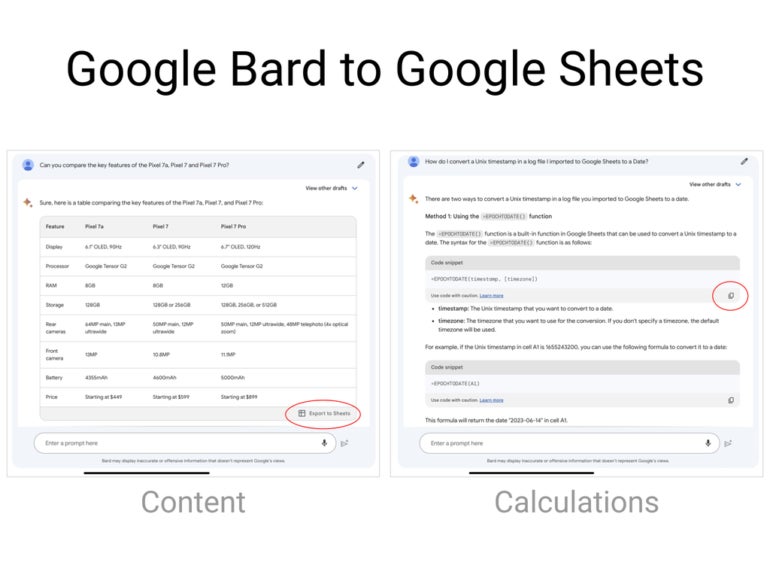
Google Bard can help you create content and calculations for Google Sheets. In the first role, Bard serves as a smart list generator that produces content in a table for you to export to a Google Sheet. In the latter role, Bard’s responses help you devise Google Sheets formulas and functions. These uses of Bard offer capabilities that extend beyond the standard autofill and correction capabilities in Google Sheets.

SEE: ChatGPT vs Google Bard (2023): An in-depth comparison (TechRepublic)

For the actions below, you’ll need to be signed in to an active Google account authorized to use both Google Sheets and Google Bard. If you use a Google Workspace account for work or school, you may need to contact an administrator to request access to Bard. Once you have access, open Bard in any modern browser to get started. Enter a natural language prompt, and Bard will provide a response. Bard responses may differ — two people who enter the same prompt may not receive the same response.

Jump to:

  • How to obtain content from Bard for a Google Sheet
  • How to get help from Bard with a Google Sheets calculation

How to obtain content from Bard for a Google Sheet

With Bard, you can prompt the system for all sorts of comparisons and lists. For example, a request to compare two or more products might produce a table with a column for each product and each row with a different compared feature (Figure A). You might also prompt Bard for lists of things, such as people, places or things. Since Bard accepts sequences, you might first prompt:

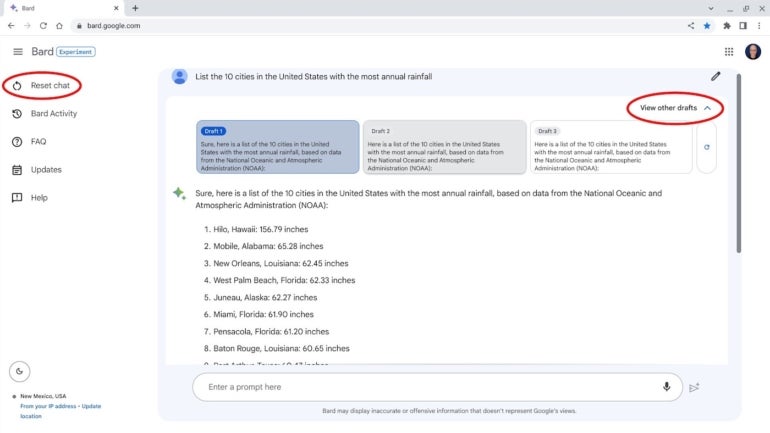
List the 10 cities in the United States with the most annual rainfall.

Then, after you receive the initial response, prompt again with:

Add a column for the population.

Figure A

Bard can help you quickly obtain all sorts of comparisons and lists. When Bard provides a response in a table, select Export To Sheets to create a new Google Sheet with the table contents.

The tables Bard can generate as a response vary much more than conventional autocomplete sequences available in Google Sheets with the Tools | Autocomplete | Enable Autocomplete Option enabled.

In Google Sheets, you enter a predictable series of alphabetical letters, numbers, days of the week, months or other standard patterns in two or more cells. Then select the cells and select-and-extend the corner of the box to cover the entire range of to-be-filled cells. For example, if you type Mon in one cell and Tue in an adjacent cell, you may select those two cells and then drag the dot to fill another five cells with the remaining respective three-character descriptions of days of the week in English. In contrast, the tables you can prompt Bard to create may comprise a much wider range of listable data.

Choose Export To Sheets

When a response includes a table, select the Export To Sheets option at the lower-right corner of the table. This exports the table to a new Google Sheet (Figure A). The system will use your prompt as both the name of the newly created file and the initial sheet within the file. The contents of the table will be placed in the cells of the sheet, with the titles of the columns in Row A.

Prompt “in a table”

Bard will often automatically format comparisons and lists in a table. When the system doesn’t do this, add the phrase “in a table” to your request. This would make the prompt listed above to be:

In a table, list the 20 cities in the United States with the most annual rainfall.

View other drafts or reset chat

Sometimes Bard provides either a partial response or an oddly formatted response. For example, try the prompt:

List all 50 U.S. states sorted by population.

Bard returned a table of 40 states, which is an incomplete response. In another example, a prompt for a:

List of elements by name and atomic weight

In response, Bard produced a list formatted as a code snippet, not a table. When a response isn’t what you expect, select the View Other Drafts button to access alternative drafts (Figure B). In some cases, one of those drafts will be formatted as a table rather than a code snippet.

Another option when this sort of error occurs is to select the Reset Chat button (as shown in Figure B on the upper left) and then try the prompt again. This may result in a more complete or better-formatted response.

Figure B

View other drafts to access alternatively formatted responses, which sometimes display data in a table rather than a list format. In some cases, selecting Reset Chat and trying your prompt again may return a response in the format you want.

How to get help from Bard with a Google Sheets calculation

You may prompt Bard to explain and provide examples of Google Sheets formulas and functions. Unlike Google Sheets help pages, which provide details and a static set of examples, you may ask Bard for a variety of examples, along with a detailed description of how a feature works.

For example, if you want to learn a bit more about one of the new functions Google added to Sheets in March 2023, you might prompt:

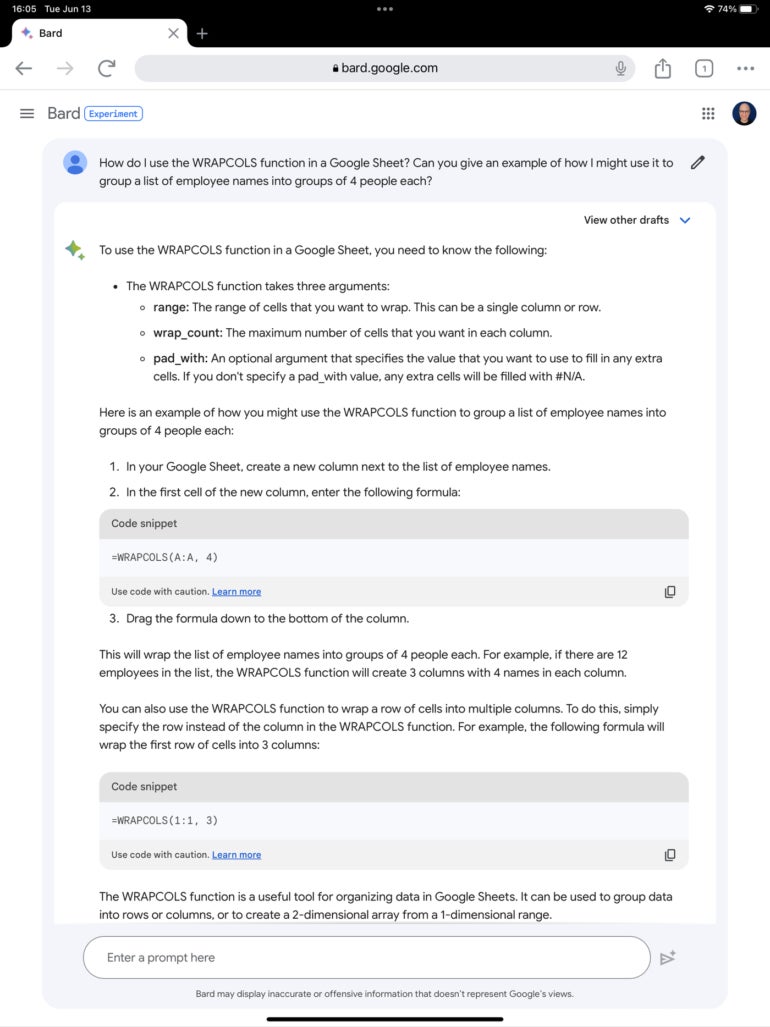
How do I use the WRAPCOLS function in a Google Sheet? Can you give an example of how I might use it to group a list of employee names into groups of 4 people each?

The response from Bard (Figure C) included, in sequence:

  • A description of how the function is used
  • A code snippet example of the syntax with each part listed
  • A sample formula to group a list into a set of four
  • An example with demo names
  • Additional code examples to group a list into sets of three, five or seven

Figure C

Not only can Bard explain Google Sheets functions, but it can also offer examples of how the function might be used.

To explore additional Google Sheets functions, you might then prompt:

Are there other Google Sheets functions that achieve something similar?

Bard tends to offer a few other functions that help with related aspects of your initial task.

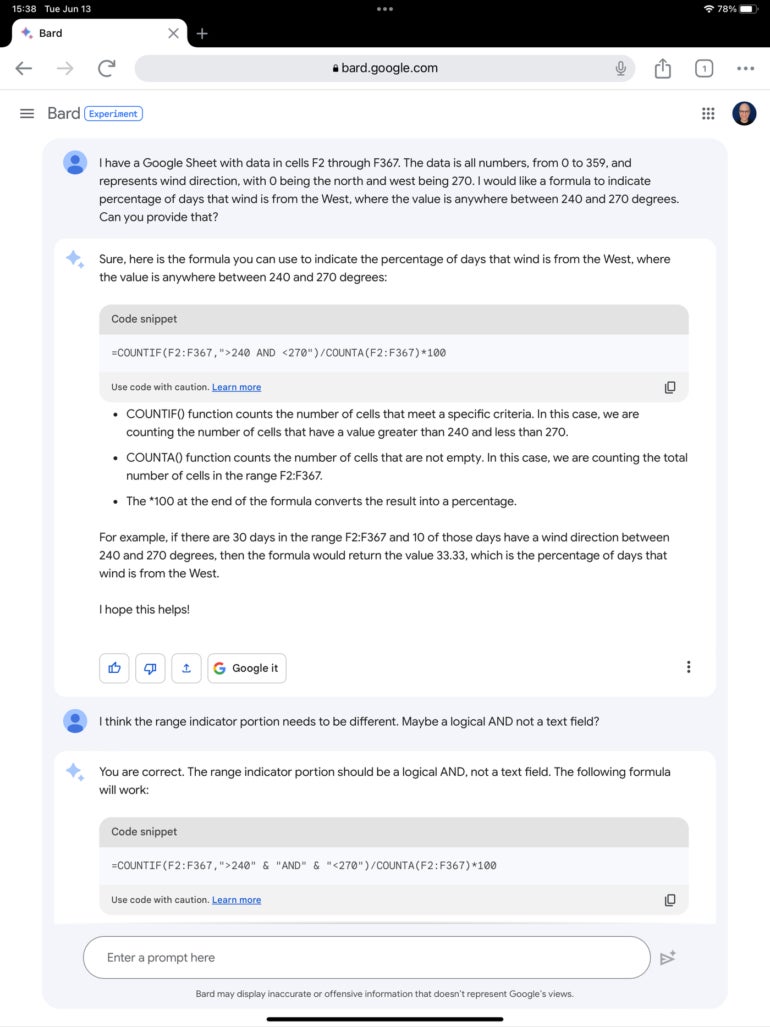
In addition, Bard can help you create the exact formula you need, but it may be a bit of a process of trial and error. For example, say you want to analyze weather data to identify how many days the wind was predominantly from the west. First, try an initial detailed prompt (Figure D).

I have a Google Sheet with data in cells F2 through F367. The data is all numbers, from 0 to 359, and represents wind direction, with 0 being the north and 270 being the west. I would like a formula to indicate the percentage of days that the wind is from the west, where the value is anywhere between 240 and 270 degrees. Can you provide that?

Figure D

With a sufficiently detailed prompt, Bard can respond with a detailed code snippet that contains a Google Sheets function. While not necessarily always accurate, this snippet can often serve as the basis for the precise formula you want.

The response returned an =COUNTIF formula that threw an error. After a quick review of the function, prompt again, essentially asking Bard to try again:

I think the range indicator portion needs to be different. Maybe a logical AND not a text field?

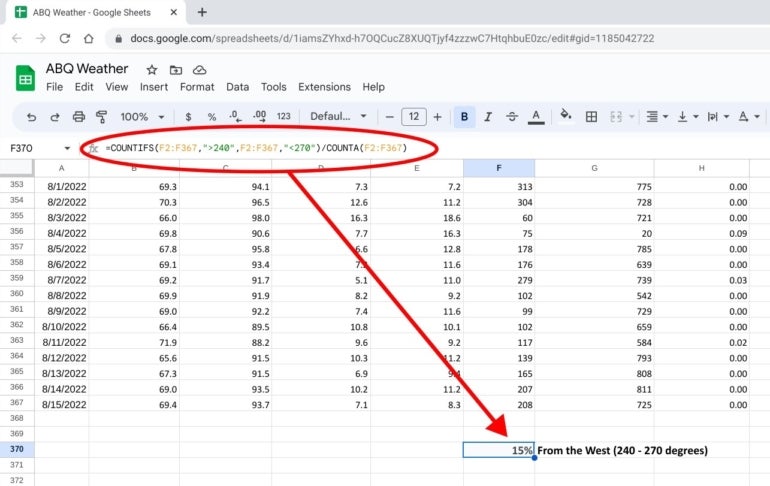
This time, the response included a =COUNTIFS formula. Select the Copy Code button, switch to the Google Sheet, navigate to the intended destination cell and then choose Edit | Paste to add the formula. This time, with a bit of tweaking, the code snippet worked as desired (Figure E).

Figure E

With minor tweaks, the code snippet response provided by Bard delivered the desired calculation.

And that’s a good snapshot of how you need to work with Bard. If the initial response meets your needs, that’s great! But always take the time to check the results for accuracy and be prepared to prompt again — and prompt differently — to evoke a more relevant, useful or accurate response.

Google Weekly

Subscribe to the Google Weekly Newsletter

Learn how to get the most out of Google Docs, Google Cloud Platform, Google Apps, Chrome OS, and all the other Google products used in business environments.

Delivered Fridays Sign up today

IBM Pulls Quantum Computing From the Rut With Breakthrough

Physicists at IBM have conducted a proof-of-principle experiment that indicates quantum computers will soon surpass classical computers in practical tasks. The study, published in Nature, focused on simulating the behavior of a magnetic material using IBM’s Eagle quantum processor. The team developed “error-mitigating” techniques to overcome quantum noise, which introduces errors in calculations. By achieving reliable results at a scale where classical computers struggle, the researchers demonstrated the potential of quantum computers for complex algorithms and systems. This experiment serves as a benchmark for the current state of quantum computing and showcases the progress being made in the field.

Quantum computers leverage quantum phenomena like superposition and entanglement to process information. IBM, along with other companies such as Google, utilises tiny superconducting circuits to encode each qubit, the quantum equivalent of classical bits. The main challenge lies in maintaining the quantum state of qubits for a sufficient duration to perform calculations. IBM’s approach emphasizes error mitigation rather than error correction, while companies like Google focus on refining quantum error-correction techniques for long-term development.

The IBM researchers measured the noise in each qubit and extrapolated their measurements to predict the system’s behavior without noise. They successfully ran calculations involving all 127 qubits of the Eagle processor, marking the largest reported experiment of its kind. While some researchers believe that quantum error correction is necessary to enable calculations impossible for classical supercomputers, IBM’s short-term strategy of error mitigation has been validated by the results.

IBM is set to release its most powerful quantum processor, the 1,121-qubit Condor chip, later this year. Additionally, the company has “utility-scale processors” with up to 4,158 qubits in its development pipeline. However, significant engineering challenges must be addressed to achieve the long-term goal of building 100,000-qubit machines capable of fully error-corrected algorithms by 2033. The progress in quantum computing holds promise for future advancements and applications in various fields.

Conclusively, IBM’s proof-of-principle experiment demonstrates the potential of quantum computers to outperform classical computers in practical tasks. By mitigating errors caused by quantum noise, the researchers achieved reliable results where classical computers struggle. While quantum error correction remains a long-term goal, IBM’s approach of error mitigation has shown promising results. The company’s upcoming quantum processors and development pipeline further highlight the progress in the field. Quantum computing holds great promise for various applications, but substantial engineering challenges need to be overcome for widespread adoption and realisation of its full potential.

The post IBM Pulls Quantum Computing From the Rut With Breakthrough appeared first on Analytics India Magazine.

Generative AI: Just don’t call it an ‘artist’ say scholars in Science magazine

edmond-de-belamy.jpg

"Edmond de Belamy," produced by the art group Obvious and auctioned at Christie's in 2018 for $432,500, relied on generative adversarial network algorithms developed over years by various parties. The painting ingested tons of artwork samples from artists through the ages to become tuned to produce art of a certain style.

It's no secret people's notions about artificial intelligence are generally ridiculous. They regularly impute a presence to what is really just a machine, much as Google former engineer Blake Lemoine last year claimed a chatbot, LaMDA, was "sentient."

Even the reporters tasked with conveying an understanding of the technology often put forward hype instead of knowledge.

Now, in an attempt to combat some bad notions and focus attention on important questions of AI, a group of scholars Thursday warned that humans should disabuse themselves of the misconception that AI programs constitute an "artist."best ai ZDNet

Also: What is AI? Everything to know about artificial intelligence

"The very term 'artificial intelligence' might misleadingly imply that these systems exhibit human-like intent, agency, or even self-awareness," write Ziv Epstein, a post-doctoral researcher at the Massachusetts Institute of Technology Media Lab, and several colleagues from collaborating institutions, in an article in the prestigious journal Science.

The article, "Art and the science of generative AI," was published online Thursday for the June 16 print edition of Science.

"Natural language-based interfaces now accompany generative AI models, including chat interfaces that use the 'I' pronoun, which may give users a sense of human-like interaction and agency," the authors write.

The authors warn that imputing agency to an AI program could lead people to several follow-on false beliefs, such as failing to give credit to the human creator of the work.

"These perceptions can undermine credit to the creators whose labor underlies the system's outputs and deflect responsibility from developers and decision-makers when these systems cause harm," the authors write.

The article addresses multiple perspectives about AI that have become prevalent in recent years.

Also: The best AI chatbots: ChatGPT and other noteworthy alternatives

There have been some infamous art-world displays of "AI-generated art" in recent years that do, in fact, obscure the origins of a work's production.

One of the most striking PR moments of the AI age was the sale by Christie's auction house in October 2018, of a painting output by an algorithm, titled "Edmond de Belamy," for $432,000. The painting was touted by the auctioneers, and the curators who profited, as "created by an artificial intelligence."

At the same time, however, there is a thread of research stretching back many years in which computer scientists and artists have tried to fashion artworks with computers in ways that may produce quasi-random effects. That thread of inquiry seeks to discover the dividing line between human control and what the computer spontaneously produces that escapes human control.

Such programs are often grouped together as "generative art systems with intentionally unexpected output," or sometimes referred to as "decentralized autonomous artists" or "autonomous art systems," noted Epstein in an email to ZDNET.

Also: These are my 5 favorite AI tools for work

Examples of the generative programs, said Epstein, include Botto, Electric Sheep, Abraham, Meet the Ganimals, and Artificial FM.

Some of the programs use so-called "generative AI," referring to such generative adversarial networks, or "GANs," including Botto and Ganimals. But not all programs use that approach.

"Unlike direct input-output usage of generators, these often include systems that respond to input from a crowd, or some other data stream, and thus make outputs that are intentionally unexpected," Epstein told ZDNET.

The generative movement has explored the line between human intent and spontaneous machine output.

In 2006, long before the current wave of AI, computer science professor Simon Colton of Queen Mary College, London, offered what he called "The Painting Fool," a program that would produce images via a mix of rules given by the human operator, but also other parameters the human doesn't explicitly manipulate. Detecting the "sentiment" of a person via sentiment-detection software, for example, the Painting Fool would use the interpretation of that sentiment as one input to the work of art.

Also: The best AI art generators: DALL-E 2 and other fun alternatives to try

In The Guardian newspaper in 2017, Colton told reporter Gemma Kappala-Ramsamy that his purpose was to explore "what it means for software to be creative," with an aim for "the software itself to be taken seriously as a creative artist in its own right, one day."

In more recent instances, artists have called attention to things they found in the output of generative AI that they noted were surprising, or pointed to something going on with the program beyond their anticipation, such as the recurring figure of Loab last year.

In Science, Epstein and team refer to a much longer article, posted on the arXiv pre-print server, in which they explain in detail how it's important not to casually consider the machine autonomous, however impressive its results.

Epstein and team emphasize the choice of discussing generative AI "as a tool to support human creators, rather than an agent capable of harboring its own intent or authorship. In this view, there is little room for autonomous machines being 'artists' or 'creative' in their own right."

Also: How to use DALL-E 2 to turn your ideas into AI-generated art

The authors base their point of view on a concept called "meaningful human control," or, MHC, which, they write, is
"originally adapted from autonomous weapons literature that refers to a human operator's control over and responsibility for a computational system."

"MHC is achieved," they explain, "if human creators can creatively express themselves through the generative system, leading to an outcome that aligns with their intentions and carries their personal, expressive signature."

Future work is needed, Epstein and colleagues conclude, to find generative systems that afford human users "fine-grained causal manipulation over outputs" when creating works using AI.

See also