Top 8 Generative AI Startups in India

Generative AI Startups in India

As per McKinsey, generative AI is set to add up to $4.4 trillion value to the global economy, annually. The report further stated that between 2030 and 2060 half the world’s work will be automated and startups will have a huge role to play in that. Globally, there are only 259 generative AI startups, while India has less than 20 pure-play generative AI startups.

However, this is going to explode in the coming months as Indian startups experience a shift in funding from generative applications to infrastructure development within enterprises.

Here’s a list of top eight generative AI startups in India.

MachineHack

Based in Bengaluru, MachineHack was founded by Bhasker Gupta in 2021, alongside Krishna Rastogi (CTO). The company hosts generative AI competitions, courses, assessments and coding challenges and has built AI co-pilot for developers, offering guidance throughout their AI career journey.

Powered by GPT-4 and proprietary algorithms, MachineHack assists developers in improving their coding skills and also provides code recommendations and suggestions. The company recently launched a generative AI tool that offers data analysis on the go.

The platform also publishes insightful articles on generative AI, catering to the needs of a rapidly expanding community, which boasts the highest growth rate in the country.

Rephrase.ai

Founded by Ashray Malhotra, Nisheeth Lahoti, and Shivam Mangla in 2019, Rephrase.ai has raised a total funding of $12.2 million in three funding rounds.

Rephrase.ai offers a video and animation creation solution that utilises advanced AI technology for visual dubbing. By employing generative AI tools, Rephrase.ai’s video creation technology learns the facial characteristics of people based on audio input, allowing for the creation of photorealistic faces for various texts or audio inputs.

This platform assists clients in producing training videos, customising sales videos, enabling characters to speak in AR/VR environments, and providing digital assistants with a lifelike appearance.

Mockey

Based in Lucknow, Mockey was founded in 2020 by Mofid Ansari and Pranay Agarwal and has raised a total funding of $890,000 in a single funding round. Mockey is an online mockup generator that utilises AI/ML technology and is available at no cost. With Mockey, users can effortlessly create impressive mock-ups for apparel, accessories, and a wide range of products, and conveniently download high-resolution photos suitable for any purpose.

By uploading designs in PNG or JPG format and utilizing transparent images, professional mockup images can be achieved. This platform enables the generation of high-quality, visually appealing product mockups for e-commerce stores or direct-to-consumer businesses, making it simple to create stunning mockups for on-demand brands.

Blend

Founded in 2022 by Vishwanath Kollapudi and Jamsheed Kamardeen, Blend is still in pre-seed stage with the latest round of funding in January 2022.

Blend utilises the power of generative AI to assist e-commerce sellers in effortlessly generating stunning product photos and marketing materials within a minute. By leveraging Blend’s technology, sellers can experience significant enhancements, such as a 20% improvement in the return on ad spend (ROAS) and higher conversion rates on their product pages.

ProbeAI

ProbeAI was founded in January 2023 by Abhisek Kumar Sahu, a former full-stack developer at Zomato.

Still in early access, ProbeAI serves as an AI Copilot designed specifically for data analysts. Its purpose is to assist analysts in various tasks, including generating SQL code, identifying relevant tables, optimising SQL code, and providing additional functionalities to streamline their workflow.

Revition

Ajay Verma, an MBA holder from Osmania University in Andhra Pradesh, founded Revition in early 2023 with two other individuals.

Revition isa company based in Hyderabad and claims to have developed the world’s first centralised system for customer support. Their platform offers a unified support interface, allowing consumers to instantly access support from companies using a single universal ID/Account and application. The system incorporates advanced AI automation tools to help businesses increase sales and reach.

Fasthr.AI

Fasthr.AI was founded in May 2023 by Yash Dandavate, Ashish Dogra, Neelu Virk, and Nilima Hemrajani.

Fasthr.AI, is a talent screening platform powered by GPT-4, claiming to be the most powerful solution at the intersection of generative AI and HR-tech. The platform has received an overwhelming response, with over 20 demos conducted for top enterprises on the first day, all through inbound inquiries without advertisements.

Fasthr.AI aims to revolutionise talent screening by offering effortless screening, accurate identification of top talent with 96% accuracy, faster position filling, and the ability to generate customised tests within seconds.

SVAYO

Founded by Deepak Thomas in 2019, SVAYO (legal name: Infinitied Labs Pvt Ltd) is a generative AI and social startup for beauty salons. The platform aims to transform personal grooming and styling services through the use of AI. It offers personalised recommendations and services tailored to the individual’s needs and preferences. The app provides inspiration from social content, highlighting trends in the user’s surroundings. Users can access a virtual stylist powered by AI, who recommends services and stylists based on trends that match their selfie.

The platform allows users to book salon appointments, pay bills online, and earn loyalty points. Additionally, users can be part of a community where they can receive styling tips for DIY experiences.

The post Top 8 Generative AI Startups in India appeared first on Analytics India Magazine.

ChatGPT-powered voice commands are coming to Mercedes-Benz cars

Mercedes-Benz car with ChatGPT integration

ChatGPT is a valuable assistant, however, it has remained limited to your computer screen and other personal devices — until now.

On Thursday, Mercedes-Benz revealed that it's integrating ChatGPT into its vehicles to power in-car voice control systems, with the aim of making its cars more intuitive and intelligent.

Also: GPT-3.5 vs GPT-4: Is ChatGPT Plus worth its subscription fee?

The AI chatbot will support the "Hey Mercedes" MBUX Voice Assistant with more natural dialogue.

Because of ChatGPT's natural language processing abilities, the voice assistant will be able to understand natural voice commands and even conduct conversations, according to the release.

Besides being able to respond to commands regarding weather and sports updates, it can now offer more comprehensive answers, including dinner recipe suggestions and new information about your destination.

Also: 7 ways you didn't know you could use Bing Chat and other AI chatbots

The integration will be made available to 900,000 US vehicles through a beta program that will last three months. The feedback from the program will affect how Mercedes-Benz decides to handle the larger rollout.

Joining the beta is easy as the only thing you have to do is say "Hey Mercedes, I want to join the beta program" to your vehicle or join via the app.

The integration will happen over the air through Azure OpenAI Service, a Microsoft Azure service that allows people to integrate ChatGPT for a variety of use cases.

Also: How to write better ChatGPT prompts (and this applies to most other text-based AIs, too)

Mercedes-Benz assures users that their data will be protected and secure. The data from the voice commands is anonymously stored in the Mercedes-Benz Intelligent Cloud where it can be analyzed.

The company also adds that customers will know what information is stored for what purposes at all times.

Artificial Intelligence

Microsoft Announces AI Copilot Capabilities to Dynamics 365 ERP Solutions

New Microsoft 365 Version With AI-Driven Content Now In India

Microsoft has announced the addition of AI “Copilot” capabilities to its Dynamics 365 enterprise resource planning (ERP) solutions. These new capabilities aim to enhance productivity by expediting tasks and decisions within Dynamics 365 project operations, finance, and supply chain management.

The announcement did not provide specific details regarding the availability of these Copilot capabilities or whether the public can test them.

In Dynamics 365 Project Operations, the Copilot capabilities for project managers seek to significantly reduce the time spent on project status reports, task planning, and risk assessments. Project managers will be able to generate plans by simply describing project details using natural language, streamlining the process and making it more intuitive.

Additionally, Copilot capabilities have been added for collections agents and procurement professionals within the ERP solutions. Collections agents will have quick access to customers’ credit and payment history, enabling them to prioritise and personalise customer communication using Dynamics 365 Finance. Procurement professionals, on the other hand, will be able to efficiently handle changes to purchase orders at scale, assess the impact and risk, and optimise procurement decisions using Dynamics 365 Supply Chain Management.

In summary, Microsoft plans to incorporate Copilot AI capabilities into Dynamics 365 Project Operations, Finance, and Supply Chain Management.

This announcement appears to be a follow-on description to the Dynamics 365 Copilot capabilities introduced in customer relationship management (CRM) scenarios in March. At that time, Copilot previews were announced for Viva Sales, Dynamics 365 Marketing, Customer Service, Customer Insights, Business Central, and Supply Chain Center products.

According to a report by Microsoft reporter Mary Jo Foley, the new Copilot capabilities in Dynamics 365 products will be added at no additional cost for certain customers, likely referring to Premium subscribers. However, for subscribers using other plans, the Copilot capabilities will be offered as paid add-ons. Many of the Dynamics 365 AI features will be released, mostly as previews, during the summer.

However, there is still no information on when Microsoft may expand the preview of Microsoft 365 Copilot, which is currently in the private preview stage. When commercially released, Microsoft 365 Copilot will be a paid add-on for Microsoft 365 E3/E5 subscribers.

Overall, Microsoft aims to boost productivity in Dynamics 365 ERP applications by introducing AI Copilot capabilities, which will streamline tasks and improve decision-making processes for finance managers, collections agents, project managers, and procurement professionals.

The post Microsoft Announces AI Copilot Capabilities to Dynamics 365 ERP Solutions appeared first on Analytics India Magazine.

A Comprehensive Guide to Convolutional Neural Networks

Artificial Intelligence has been witnessing monumental growth in bridging the gap between the capabilities of humans and machines. Researchers and enthusiasts alike, work on numerous aspects of the field to make amazing things happen. One of many such areas is the domain of Computer Vision.

The agenda for this field is to enable machines to view the world as humans do, perceive it in a similar manner, and even use the knowledge for a multitude of tasks such as Image & Video recognition, Image Analysis & Classification, Media Recreation, Recommendation Systems, Natural Language Processing, etc. The advancements in Computer Vision with Deep Learning have been constructed and perfected with time, primarily over one particular algorithm — a Convolutional Neural Network.

Introduction

A Comprehensive Guide to Convolutional Neural Networks
A CNN sequence to classify handwritten digits

A Convolutional Neural Network (ConvNet/CNN) is a Deep Learning algorithm that can take in an input image, assign importance (learnable weights and biases) to various aspects/objects in the image, and be able to differentiate one from the other. The pre-processing required in a ConvNet is much lower as compared to other classification algorithms. While in primitive methods filters are hand-engineered, with enough training, ConvNets have the ability to learn these filters/characteristics.

The architecture of a ConvNet is analogous to that of the connectivity pattern of Neurons in the Human Brain and was inspired by the organization of the Visual Cortex. Individual neurons respond to stimuli only in a restricted region of the visual field known as the Receptive Field. A collection of such fields overlap to cover the entire visual area.

Why ConvNets over Feed-Forward Neural Nets?

A Comprehensive Guide to Convolutional Neural Networks
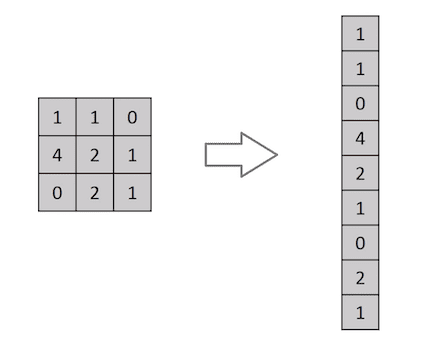
Flattening of a 3×3 image matrix into a 9×1 vector

An image is nothing but a matrix of pixel values, right? So why not just flatten the image (e.g. 3×3 image matrix into a 9×1 vector) and feed it to a Multi-Level Perceptron for classification purposes? Uh.. not really.

In cases of extremely basic binary images, the method might show an average precision score while performing prediction of classes but would have little to no accuracy when it comes to complex images having pixel dependencies throughout.

A ConvNet is able to successfully capture the Spatial and Temporal dependencies in an image through the application of relevant filters. The architecture performs a better fitting to the image dataset due to the reduction in the number of parameters involved and the reusability of weights. In other words, the network can be trained to understand the sophistication of the image better.

Input Image

A Comprehensive Guide to Convolutional Neural Networks
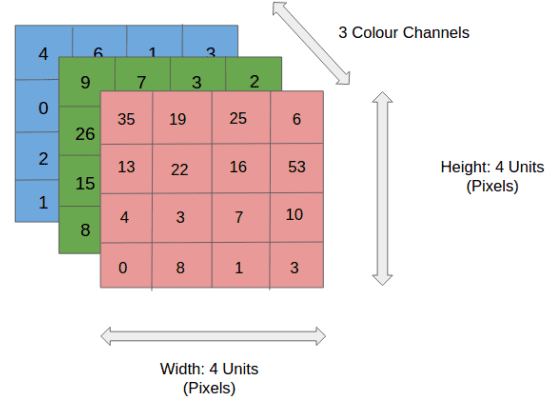
4x4x3 RGB Image

In the figure, we have an RGB image that has been separated by its three color planes — Red, Green, and Blue. There are a number of such color spaces in which images exist — Grayscale, RGB, HSV, CMYK, etc.

You can imagine how computationally intensive things would get once the images reach dimensions, say 8K (7680×4320). The role of ConvNet is to reduce the images into a form that is easier to process, without losing features that are critical for getting a good prediction. This is important when we are to design an architecture that is not only good at learning features but also scalable to massive datasets.

Convolution Layer — The Kernel

A Comprehensive Guide to Convolutional Neural Networks
Convoluting a 5x5x1 image with a 3x3x1 kernel to get a 3x3x1 convolved feature

Image Dimensions = 5 (Height) x 5 (Breadth) x 1 (Number of channels, eg. RGB)

In the above demonstration, the green section resembles our 5x5x1 input image, I. The element involved in the convolution operation in the first part of a Convolutional Layer is called the Kernel/Filter, K, represented in color yellow. We have selected K as a 3x3x1 matrix.

Kernel/Filter, K =  1  0  1  0  1  0  1  0  1

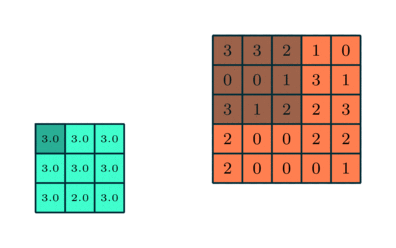
The Kernel shifts 9 times because of Stride Length = 1 (Non-Strided), every time performing an elementwise multiplication operation (Hadamard Product) between K and the portion P of the image over which the kernel is hovering.

A Comprehensive Guide to Convolutional Neural Networks
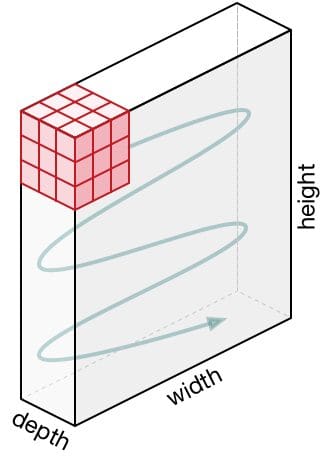
Movement of the Kernel

The filter moves to the right with a certain Stride Value till it parses the complete width. Moving on, it hops down to the beginning (left) of the image with the same Stride Value and repeats the process until the entire image is traversed.

A Comprehensive Guide to Convolutional Neural Networks
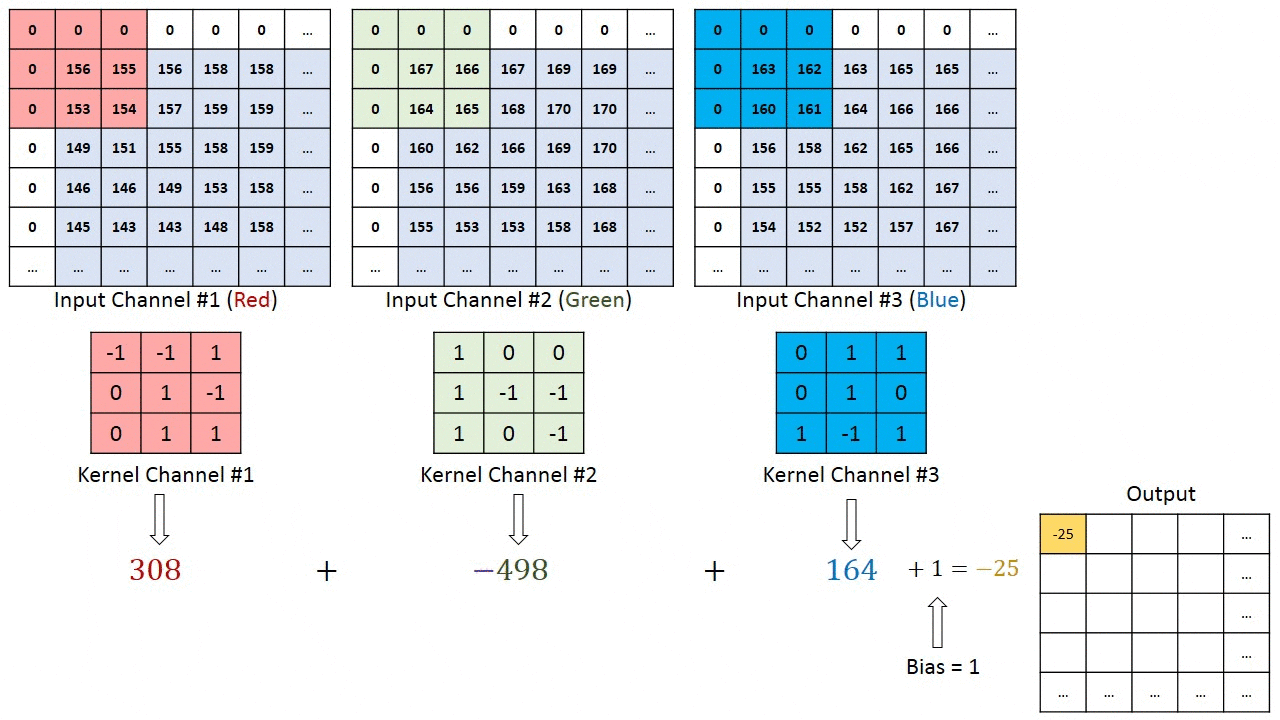
Convolution operation on a MxNx3 image matrix with a 3x3x3 Kernel

In the case of images with multiple channels (e.g. RGB), the Kernel has the same depth as that of the input image. Matrix Multiplication is performed between Kn and In stack ([K1, I1]; [K2, I2]; [K3, I3]) and all the results are summed with the bias to give us a squashed one-depth channel Convoluted Feature Output.

A Comprehensive Guide to Convolutional Neural Networks
Convolution Operation with Stride Length = 2

The objective of the Convolution Operation is to extract the high-level features such as edges, from the input image. ConvNets need not be limited to only one Convolutional Layer. Conventionally, the first ConvLayer is responsible for capturing the Low-Level features such as edges, color, gradient orientation, etc. With added layers, the architecture adapts to the High-Level features as well, giving us a network that has a wholesome understanding of images in the dataset, similar to how we would.

There are two types of results to the operation — one in which the convolved feature is reduced in dimensionality as compared to the input, and the other in which the dimensionality is either increased or remains the same. This is done by applying Valid Padding in the case of the former, or Same Padding in the case of the latter.

A Comprehensive Guide to Convolutional Neural Networks

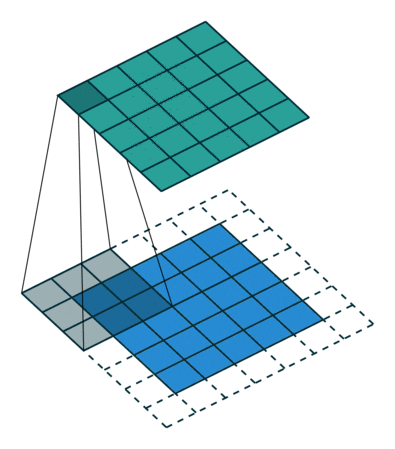
When we augment the 5x5x1 image into a 6x6x1 image and then apply the 3x3x1 kernel over it, we find that the convolved matrix turns out to be of dimensions 5x5x1. Hence the name — Same Padding.

On the other hand, if we perform the same operation without padding, we are presented with a matrix that has dimensions of the Kernel (3x3x1) itself — Valid Padding.

The following repository houses many such GIFs which would help you get a better understanding of how Padding and Stride Length work together to achieve results relevant to our needs.

[vdumoulin/conv_arithmetic

A technical report on convolution arithmetic in the context of deep learning — vdumoulin/conv_arithmeticgithub.com](https://github.com/vdumoulin/conv_arithmetic)

Pooling Layer

A Comprehensive Guide to Convolutional Neural Networks

Similar to the Convolutional Layer, the Pooling layer is responsible for reducing the spatial size of the Convolved Feature. This is to decrease the computational power required to process the data through dimensionality reduction. Furthermore, it is useful for extracting dominant features which are rotational and positional invariant, thus maintaining the process of effectively training the model.

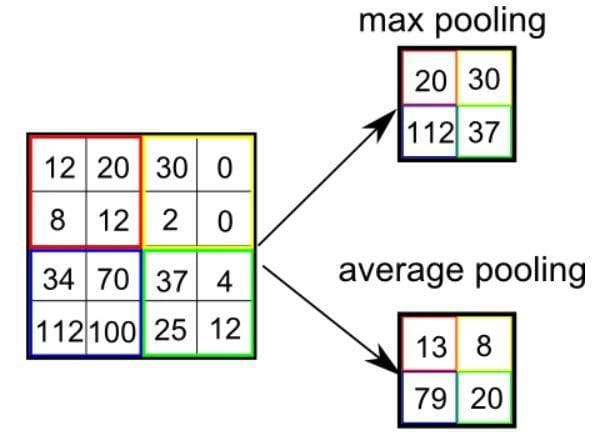
There are two types of Pooling: Max Pooling and Average Pooling. Max Pooling returns the maximum value from the portion of the image covered by the Kernel. On the other hand, Average Pooling returns the average of all the values from the portion of the image covered by the Kernel.

Max Pooling also performs as a Noise Suppressant. It discards the noisy activations altogether and also performs de-noising along with dimensionality reduction. On the other hand, Average Pooling simply performs dimensionality reduction as a noise-suppressing mechanism. Hence, we can say that Max Pooling performs a lot better than Average Pooling.

A Comprehensive Guide to Convolutional Neural Networks
Types of Pooling

The Convolutional Layer and the Pooling Layer, together form the i-th layer of a Convolutional Neural Network. Depending on the complexities in the images, the number of such layers may be increased for capturing low-level details even further, but at the cost of more computational power.

After going through the above process, we have successfully enabled the model to understand the features. Moving on, we are going to flatten the final output and feed it to a regular Neural Network for classification purposes.

Classification — Fully Connected Layer (FC Layer)

A Comprehensive Guide to Convolutional Neural Networks

Adding a Fully-Connected layer is a (usually) cheap way of learning non-linear combinations of the high-level features as represented by the output of the convolutional layer. The Fully-Connected layer is learning a possibly non-linear function in that space.

Now that we have converted our input image into a suitable form for our Multi-Level Perceptron, we shall flatten the image into a column vector. The flattened output is fed to a feed-forward neural network and backpropagation is applied to every iteration of training. Over a series of epochs, the model is able to distinguish between dominating and certain low-level features in images and classify them using the Softmax Classification technique.

There are various architectures of CNNs available which have been key in building algorithms which power and shall power AI as a whole in the foreseeable future. Some of them have been listed below:

  1. LeNet
  2. AlexNet
  3. VGGNet
  4. GoogLeNet
  5. ResNet
  6. ZFNet

Sumit Saha is a data scientist and machine learning engineer currently working on building AI-driven products. He is passionate about the applications of AI for social good, especially in the domain of medicine and healthcare. Occasionally I do some technical blogging too.

Original. Reposted with permission.

More On This Topic

  • Image Classification with Convolutional Neural Networks (CNNs)
  • A Comprehensive Survey on Trustworthy Graph Neural Networks: Privacy,…
  • Google’s Model Search is a New Open Source Framework that Uses Neural…
  • NLP, NLU, and NLG: What’s The Difference? A Comprehensive Guide
  • Comprehensive Guide to the Normal Distribution
  • Comprehensive Guide to the Normal Distribution

Prompt engineering and few-shot learning: An experience beyond data science

PROMPT ENGINEERING AND FEW-SHOT LEARNING- AN EXPERIENCE BEYOND DATA SCIENCE

Chat GPT has been a massive revelation of all time. Generations have evolved and experienced a system that is technically advanced and leverages the highest possible benefits for diversified sectors. As per reports from Investingnews.com, OpenAI Chat GPT has a market value of USD 29 billion with the company’s recent 2023 forecast reflecting a 150% hike from the previous year. This number is predicted to spike to USD 1 billion by 2024. Isn’t that a giant number to bank upon?

Artificial Intelligence has made itself felt with loud yet transformational revelations. This has led to a drastic shift in the quantum of data generated and consumed. Over the years, it has been a clear observation that 90% of the data was generated in the last two years. Adding to this, 120 Zb generated this year is expected to spike by over 150% in 2025, hitting the 181 Zb mark (excerpts from explodingtopics.com).

Based on Precedence Research, the global data science Platforms Market is poised to grow at a CAGR of 16.43%; with the market size reaching USD 378.7 billion mark by 2030. This is an incredible opportunity to dive in and build a career as a certified Data Scientist today.

About GPT-4

GPT-4 is an incredibly efficient processing system for text as well as images; allowing ample opportunities for users to generate prompts based on visual inputs. It is a powerful technology that transforms hand-drawn sketches into functional websites. This powerful AI model surpasses the Chat GPT technology with astounding results.

About prompt engineering

Prompt engineering is a natural language processing (NLP) technique to create and fine-tune prompts to access accurate responses from the given model; that assists in securing the results from model hallucinations. Prompt AI Engineers craft prompts, with targeted verbs and vocabulary that allows for unraveling errors or any issues that may arise.

Popular use cases

  • Healthcare: Allows for improved accuracy of medical diagnosis, developing new treatments; and personalizing healthcare manifold
  • Finance: Allows creation of intelligent assistants to offer personalized investment advice or financial planning to consumers
  • Education: Allows personalized learning with feedback on assignments; alongside creating encapsulating learning experiences

About few-shot learning

Few-shot learning is a machine learning framework that offers ample opportunity for pre-trained models to generalize new categories of data by utilizing a few labeled samples per class.

Popular Use cases

  • Image Classification: Few-shots proposes to use the optimal matching cost between structures to represent the similarity in images.
  • Object Detection: It is a computer vision problem of identifying and locating objects in an image or video sequence and it differs from simple image classification tasks.
  • Semantic Segmentation: It is used to perform binary and multi-label semantic segmentation; wherein every pixel in the image is assigned a class (one or more objects, or background).
  • Robotics: Few shots enable the Robots to mimic the ability of humans to generalize tasks by using only a few demonstrations.
  • Natural Language Processing: In this, the diverse few-shot tasks can derive a variety of metrics from the previous learning experience.

How do prompt engineering and few-shot learning impact the world of data science?

Learned data science professionals, around the world, are paving the way for a flourishing marketspace for expertise in data. Deep learning has been a pivot in solving Computer vision and pattern recognition tasks.

Data Science has garnered enough space in the brains as well as in business processes worldwide. Not just that, with the evolution of data technology, Prompt Engineering and Few-Shot Learning have paced out the way data is viewed and treated. Prompt Engineering plays a pivotal role in the successful training of data models. Qualified data specialists ensure that the model is trained on high-quality data that accurately reflects the underlying task. It has leveled up the entire game plan of global data generation. Many aspiring Data Science professionals have invested hugely in top Data Science certifications; as they are revered as the most targeted trajectory to a lasting career.

Conclusion

Getting certified as a qualified Data professional is the right way to begin your career in the field. There is no doubt when we say that Prompt Engineering and Few-Shot Learning are a way up the ladder, to amplifying your chances at landing a quality data science job role.

Enhancing patient care with AI-powered health monitoring and remote patient management

AI in healthcare

Healthcare has undergone consistent changes. From surgeries that were conducted by sedating patients with opium and amputation of an infected part, the technology has evolved to anesthesia and new & innovative ways of treating bacterial infection. We can now conduct LASIK surgeries and have even healed conjoined twins from the head.

With so much advancement, it was collateral that AI will be adopted in healthcare in a skip of a heartbeat with numerous other innovations, and here we are.

In this article, we will be talking about two novel disruptive technologies that have become a norm i.e. AI-powered health monitoring and remote patient management. Therefore, without wasting any time, let’s jump on the topic right away…

The need for AI and remote care in healthcare

Health is a crucial aspect of everyone’s life. There are primarily two aspects that affect the provision of healthcare i.e. affordability and reach. With the inclusion of artificial intelligence in healthcare, the capacity of patients to monitor and self-diagnose their health has become possible. Previously, the patients were either left on the behest of word of mouth from their knows ones or Google (which is not always a credible source).

The majority of AI-based tools that are available in today’s day and age are trained over substantial medical data. This makes them a capable support for anyone looking to assess their health. Adding to it, these tools provide complete insights from chronic diseases to mental health apps to cure and provide consultation for issues like stress, depression, anxiety, etc. This has not only helped in increasing the reach of healthcare but has also provided multiple options for affordability.

Adding to it, as the internet became more mainstream, the possibility of reducing the distance b/w the patient and doctor also became a reality. Right now, there are several platforms that allow patients to consult doctors at any time of the day, and from any location.

What is AI-powered health monitoring?

Health Monitoring as the name suggests is the continuous monitoring of a patient’s health under care or an ongoing treatment using AI-powered technologies. Once AI is brought into the picture, the data is collected via health devices such as smartphones, wearables, smart watches, etc.

With AI-powered health monitoring, all the relevant health data is collected. And all the additional data from the sensors is neglected. This paints an entire picture of the patient’s health and helps the doctor to identify any improvements or setbacks.

Here are some examples of AI-powered health monitoring:

  • WebMD – This application’s AI assesses the symptoms provided as input from users and helps in the identification of diseases.
  • Babylon – Babylon is an application that is used for health assistance and telehealth.
  • Symptomate – The app uses its AI system to assess the patient’s overall health via inputs and helps them with diagnoses.

There are many more applications that belong to this niche. These apps enable any person to monitor their health and self-diagnose much more accurately, directly from their smart devices. From scheduling to medication, and diagnoses, this help cover multiple aspects of personal healthcare.

What is remote patient management?

Remote patient management is utilized while managing patient health from a distance. It is also commonly known as Telehealth. This enables patients to consult doctors who are not available in the nearby vicinity. It opens up multiple options for both patients to consult experts in their field along with doctors to provide care and consultation regardless of the situation. In fact, this is being used in full effect for multiple chronic diseases.

Some of the diseases for which remote patient management can be used are:

  • Diabetes
  • Hypertension
  • High Blood Pressure
  • Sleep Apnea
  • Asthma

Remote patient management often requires simple medical devices such as weighing scales, and blood glucose meters, to more complicated devices such as heart rate monitors, breathing apparatus, etc. depending upon the intensity of the disease.

Impact of AI-powered health monitoring and remote patient management

The inclusion of both AI-powered health monitoring and remote patient management has significantly impacted patient care as well as care delivery. It has been revolutionizing where the majority of people have access to healthcare any time of the hour. Below are some of the key impacts that happened post the transition.

1. Early detection of diseases

The AI algorithms used by the AI healthcare tools as mentioned earlier undergo significant medical data. This data includes patient symptoms, results from labs, and data from medical imaging. This training of sorts helps in the identification of patterns and assistance with the detection of diseases early on. It has turned out to be an effective effort considering it has not only helped patients with diagnoses but the doctors also with details that have helped with the overall care provided.

2. Personalized treatment

From mental illness to issues that affect patients on a physical level, the treatment despite having multiple common procedures is still subjective in nature. It is because everyone has different levels of immunity, body type, and different resistance to diseases. With AI tools and apps used in healthcare, the data generated is individualistic in nature. It helps in the assessment of which type of treatment would be perfect for any individual to improve its efficacy and efficiency.

3. Enablement of remote healthcare services

The entire industry of remote patient management is surrounded around this capability. There are several companies who are working in this domain such as Optimize Health, Cadence Care, Athelas, Accu Health, etc. Right now with multiple wearables and connected sensors, there is so much data that is generated for analysis. This enables the doctors to assess the medical data and provide clear treatments even remotely with effectiveness.

4. Access to telemedicine and consultations virtually

In many countries that include the USA primarily in order to get medication patients are required to produce prescriptions. This becomes a hassle for people especially who live alone. They had to reach the doctor, get diagnosed, receive a prescription, and then later purchase the medicines by themselves. With remote patient management, patients are able to receive prescriptions online. This enables them to order medicine from an online pharmacy without leaving the comfort of their home while healing.

5. Analytics for managing hospital resources

The AI tools utilized in the healthcare industry not only help with treatment but also with managing the resources available in hospitals. The AI algorithms available for these tools assess data such as patient inflow and outflow, occupancy of beds, and other resources. This not only helps in the assessment of future demand but also helps in streamlining resources. It includes the wait time for the patient and helps the hospitals to make the best decision without any lag in time.

6. Management of medication

With taking medicines, patients are required to be disciplined and consistent, especially with chronic diseases like diabetes, hypertension, high blood pressure, etc. However, the majority of the time people fail to do so. With AI-powered health monitoring and management tools, patients can set reminders for their medication schedule, get warnings for drugs, and personalized recommendations. This improves overall health and support in terms of not missing any dose.

7. Chatbots and virtual assistants in healthcare

Chatbots and virtual assistants in healthcare work as great support systems. In fact, with recent conversational AIs like ChatGPT, Google Bards, Bing AI, etc. patients are able to find a lot of information related to their ailment. Adding to it, hospitals also have their own chatbots for answering queries related to their services, instructions regarding admission, and other related queries. This helps in enhancing engagement, helps in educating the patient and empowering them.

Wrapping up

AI-powered healthcare and remote patient management have been transforming and have the capability to further transform healthcare. Right now, these technologies have bridged a huge gap i.e. to bring healthcare to your fingertips. It is because of these latest technologies in healthcare that can detect health issues early on, get personalized treatment, monitor their health remotely, and even access medicine via delivery systems. With the inclusion of these technologies, the healthcare industry has become much more efficient, accessible, and patient-centric.

IBM Makes the Best Quantum Computer Open to Public

IBM Makes the Best Quantum Computer Open to Public

IBM in collaboration with UC Berkeley researchers announced a recent breakthrough experiment which indicates that quantum computers will soon surpass classical computers in practical tasks.

Now, the company is taking another major step that has never been done before by it. The company is making the 127-qubit quantum computer publicly available over IBM Cloud.

Click here to sign-up for it on Qiskit. The SDK is still available in beta.

The IBM researchers measured the noise in each qubit and extrapolated their measurements to predict the system’s behaviour without noise. They successfully ran calculations involving all 127 qubits of the Eagle processor, marking the largest reported experiment of its kind.

In light of the release of our significant Nature publication, which presents compelling evidence on the practicality of quantum computers, it has become evident that having 100+ qubits is an essential requirement for their usefulness.

“We fully recognize the significance of ensuring that all users, clients, and partner institutions of IBM Quantum have equal access to the capabilities showcased in the paper. This accessibility will enable them to actively delve into this exciting new era of quantum utility alongside us,” said IBM.

Since 2017, IBM Research has been offering open source SDK for quantum development through Qiskit. Through the platform, people have been researching quantum computers provided by IBM.

IBM is set to release its most powerful quantum processor, the 1,121-qubit Condor chip, later this year. Additionally, the company has “utility-scale processors” with up to 4,158 qubits in its development pipeline.

Recently, Quantum Brilliance, a developer of miniaturised room-temperature quantum computing solutions also released its Qristal SDK, an open-source development kit fully integretable with C++ and Python APIs, along with NVIDIA CUDA.

The post IBM Makes the Best Quantum Computer Open to Public appeared first on Analytics India Magazine.

AI Video Platform Synthesia Raises $90M Series C with Investment from Nvidia

AI Video Platform Synthesia Raises $90M Series C with Investment from Nvidia June 16, 2023 by Jaime Hampton

Producing quality content for professional videos can be time-consuming and expensive, but advances in AI technology are giving enterprises more options. One company making waves in this space is Synthesia, an AI video generation platform that has just raised $90 million in Series C funding with investment from Nvidia.

Synthesia enables enterprises to create instructional videos featuring stock or custom AI avatars. The stock avatars are made using a sophisticated process that begins with a real-life actor being filmed in a professional studio. The actor is captured reciting a script, and this footage is used to create a digital twin of the actor – the AI avatar. For custom AI avatars, users can request to use their own likeness in a similar process. Both stock and custom avatars can speak in over 60 different languages and accents to be used in training videos, how-to guides, or other business-related video content.

“We’ve made great strides toward our vision to make video easy for everyone, but there’s still a long way to go. I’m proud of our team for building Synthesia into a sustainable company that delivers real business utility, not just novelty, for our thousands of customers,” said Synthesia Co-founder and CEO Victor Riparbelli.

The Synthesia platform boasts a YoY growth rate of 456% with over 12 million videos generated to date. The company claims to serve more than 50,000 businesses worldwide, and that its clients have reported saving up to 95% in production time, amounting to thousands in reduced costs. Synthesia counts Tiffany’s, IHG, Moody’s Analytics, and entities of the United Nations as customers.

An example of one of the stock AI avatars available on the Synthesia platform. (Source: Synthesia)

This latest funding round was led by Accel with investment from NVentures, Nvidia’s venture capital arm, and participation from existing investors Kleiner Perkins, GV, Firstmark Capital, Alex Wang, Olivier Pomel, and Amjad Masad.

Riparbelli said in a statement that the company was not actively seeking new investment, but that Accel and Nvidia share its vision for transforming traditional video production into a digital workflow that can help creators bring ideas to life.

“From our first meeting, Synthesia stood out as one of the few generative AI companies combining a differentiated technology, an exceptional founding team, and a very strong ROI for its enterprise customers,” said Philippe Botteri, Partner at Accel. “By dramatically lowering the cost and production time of videos, Synthesia is opening a new range of use cases for corporate training, marketing, and communication videos.”

Synthesia says its new capital will go toward accelerating AI research, an area the company has focused on while building its core technology in-house since its founding in 2017. The R&D team collaborates with TUM (Technical University of Munich) and UCL (University College London) and is behind several AI breakthroughs, according to a statement.

In a blog post, Riparbelli wrote that the company is working on the next generation of avatar technology that will give the avatars more expressions, more natural movements, better voices, and more customization options.

Related

Introducing OpenChat: The Free & Simple Platform for Building Custom Chatbots in Minutes

Introducing OpenChat: The Free & Simple Platform for Building Custom Chatbots in Minutes
Image by Author What is OpenChat

OpenChat is an open-source chatbot console that enables users to run and create custom chatbots similar to ChatGPT with ease. It streamlines the process of utilizing Large Language Models (LLMs), making it accessible to everyday users. With the rapid development of AI technology, the installation and usage of these models can be daunting. However, OpenChat simplifies this process by providing a simple two-step setup process for creating a comprehensive chatbot console.

Introducing OpenChat: The Free & Simple Platform for Building Custom Chatbots in Minutes
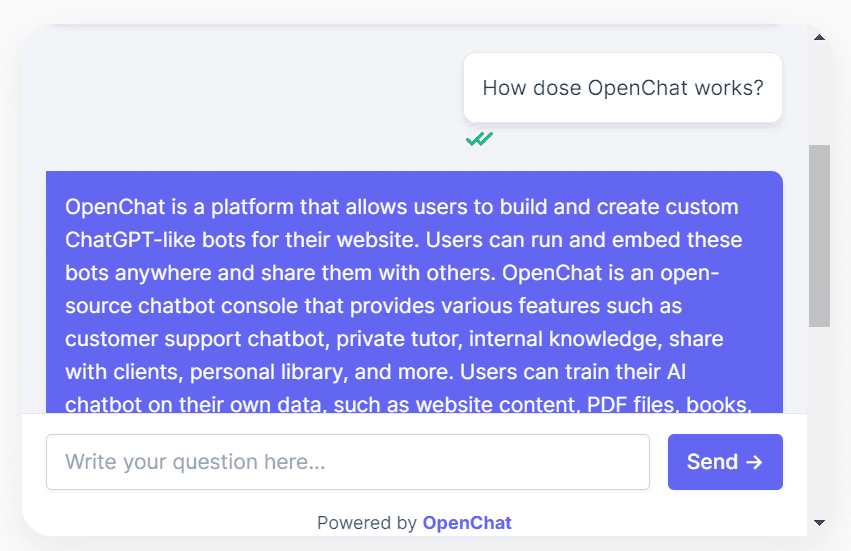
Demo available at OpenChat website

OpenChat serves as a central hub for managing multiple customized chatbots, enabling users to embed and share their bots anywhere they like. Currently, the platform supports GPT models, but the team is actively working on incorporating various open-source LLMs that can be activated with a single click.

Whether you're a developer, researcher, or an individual with no coding experience, OpenChat provides a user-friendly interface that allows you to create chatbots that can carry out a wide range of tasks.

Currently, there are two ways you can use OpenChat:

  1. By running a local server that is completely free, secure, and provides you with greater control over the chatbot console.
  2. The online version of OpenChat provides an interactive user experience to build chatbot apps within minutes.

OpenChat Features and Use Cases

Features

OpenChat provides a powerful platform for creating unlimited local chatbots based on GPT-3.5 and GPT-4. With OpenChat, you can customize your chatbots by providing PDF files, websites, and soon integrations with platforms like Notion, Confluence, and Office 365. One of the standout features of OpenChat is that each chatbot has unlimited memory capacity, enabling seamless interaction with large files such as a 400-page PDF.

OpenChat also allows you to embed chatbots as widgets on your website or internal company tools, making it easy to reach and engage with your audience. Moreover, with the pair programming mode, you can use your entire codebase as a data source for your chatbots, allowing for more personalized and advanced interactions.

Use Cases

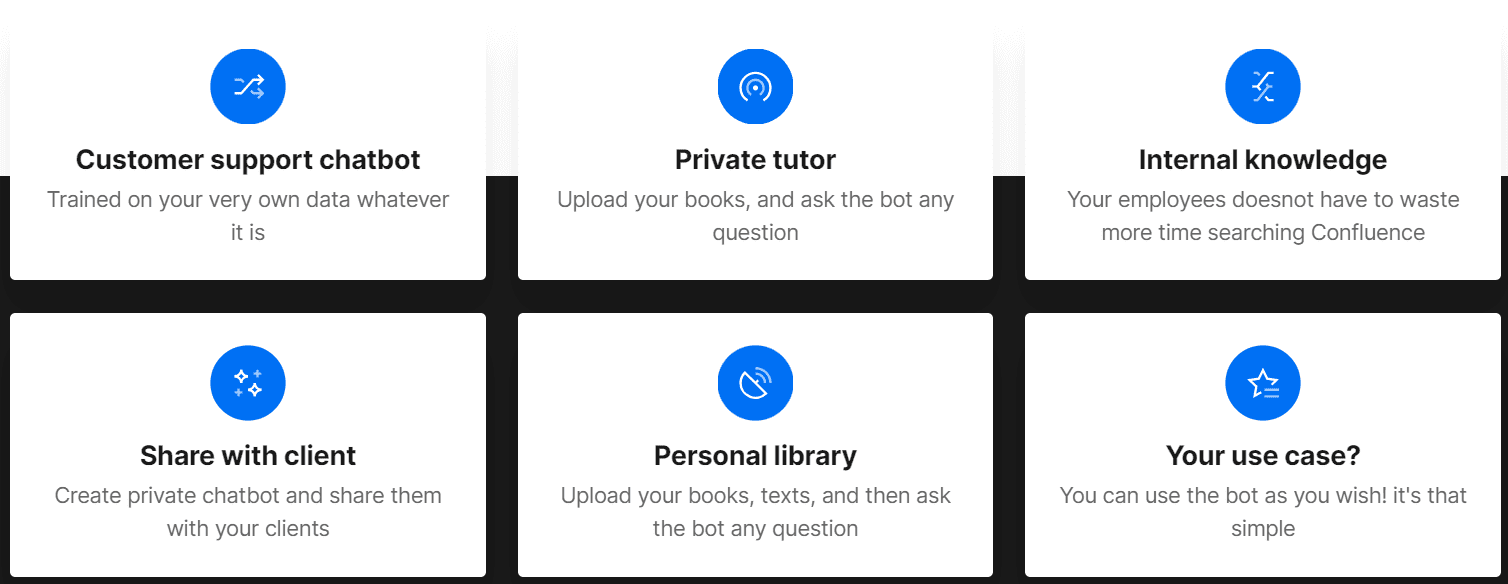
  1. Customized customer support: With OpenChat, you can create chatbots that can provide personalized customer support, answering questions and resolving issues in real-time.
  2. School work: OpenChat can be used in education settings to help students with their schoolwork. The chatbots can provide guidance on assignments, answer questions, and offer study tips.
  3. Company internal knowledge: OpenChat can be used to build chatbots that provide employees with easy access to internal company knowledge, such as policies, procedures, and training materials.
  4. Building private chatbots: You can use OpenChat to build private chat bots that you can share with clients, offering a unique and personalized service.
  5. Personal library: You can create a personal library of books, texts, and PDFs using OpenChat, enabling you to organize and access your materials more easily.
  6. Healthcare: OpenChat can be used in healthcare settings to help patients with trivial issues, such as scheduling appointments or answering common questions. This can free up healthcare professionals to focus on more complex cases.
  7. And more…

Introducing OpenChat: The Free & Simple Platform for Building Custom Chatbots in Minutes
Image from OpenChat
Creating a KDnuggets Bot in 2 minutes

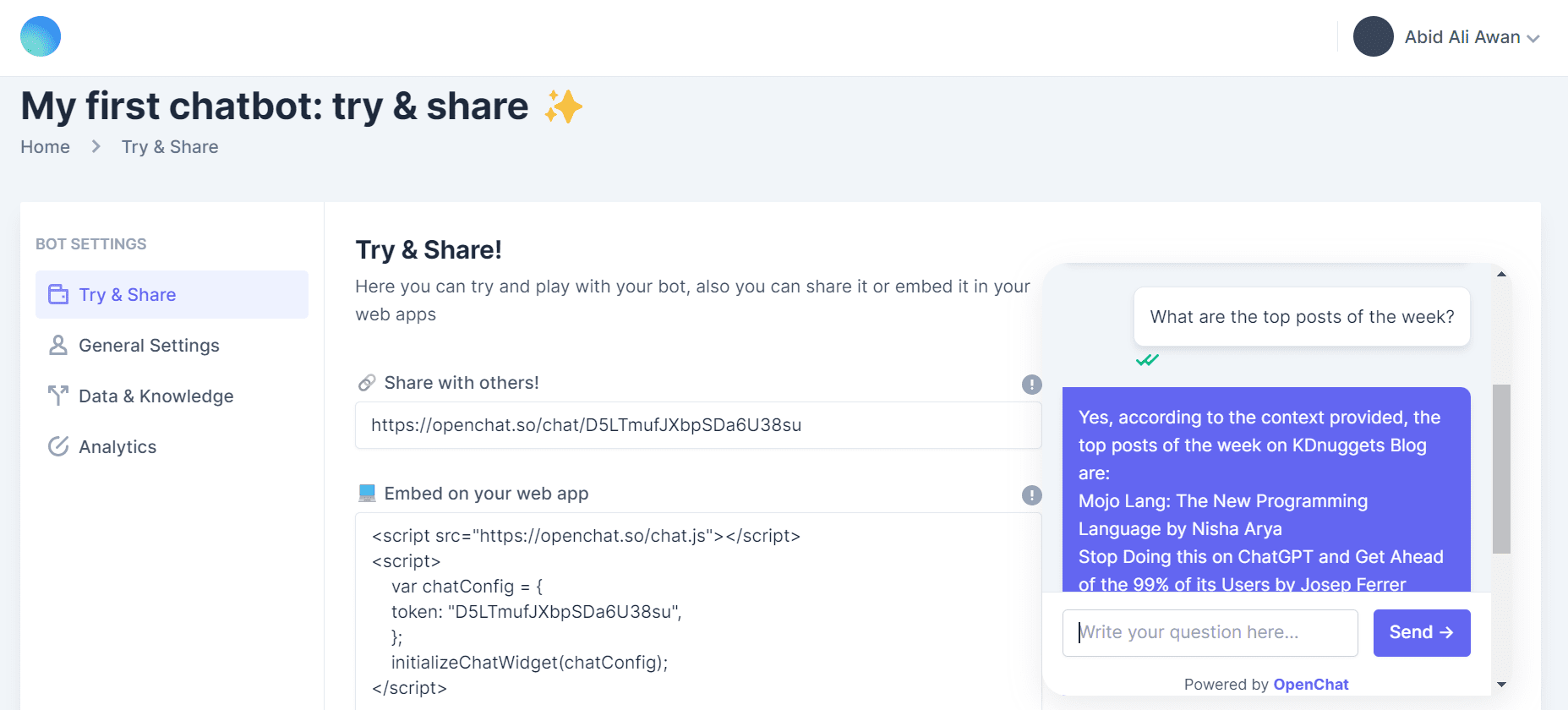
To create a chatbot using the online version of OpenChat, the process is simple:

  1. Create an account using your Google credentials.
  2. Select your desired data source, which can include a website link, PDF, codebase, Notion, and more.
  3. Add the website URL, and wait for a few seconds while OpenChat scans your website for relevant content.
  4. Your chatbot is now ready to use and embed into your website.

It's important to note that for the online version of OpenChat, the scanning process is limited to the first 15 pages of your website. If you want to scan more pages or have greater control over the scanning process, you can use the self-hosted version of OpenChat.

Introducing OpenChat: The Free & Simple Platform for Building Custom Chatbots in Minutes
Image from OpenChat — Dashboard Local Installation

You can install a self-hosted version of OpenChat by following a few steps mentioned in openchatai/OpenChat.

  1. First clone the openchatai/OpenChat GitHub repository:
git clone git@github.com:openchatai/OpenChat.git
  1. Edit the common.env file with you keys:
OPENAI_API_KEY=  PINECONE_API_KEY=  PINECONE_ENVIRONMENT=  PINECONE_INDEX_NAME=

Note: when using Pinecone as your database, it's important to ensure that the dimension is set to 1536.

  • OpenAI API key: simply log in to your account on openai.com. Once you're logged in, you can find your API key in your account settings.
  • Pinecone API key: navigate to the "API Keys" tab in the Pinecone dashboard. Here, you can generate a new API key or view your existing keys.
  • Pinecone environment & index name: find your environment key in the Pinecone dashboard after creating your index. Similarly, your index name can be found in the Pinecone dashboard after creating your index.
  1. Change the directory to repository folder and run:
make install
  1. After completing the installation process, you can access the OpenChat console by navigating to http://localhost:8000 in your web browser.

Conclusion

In conclusion, OpenChat is licensed under the MIT License and can be used for any commercial use. It is a powerful platform that simplifies the process of building and managing chatbots. With its user-friendly interface and versatile functionality, OpenChat makes it easy to create customized chatbots that can perform a wide range of tasks.

Whether you're looking to improve customer service, streamline business processes, or simply provide a more engaging user experience, OpenChat has everything you need to create effective and efficient chatbots.

In the post, we have learned about OpenChat and how you can use it to create customized chatbots powered by GPT-3.5 or GPT-4. Go ahead, create a free account, build a chatbot, and share it with your friends and colleagues.

Abid Ali Awan (@1abidaliawan) is a certified data scientist professional who loves building machine learning models. Currently, he is focusing on content creation and writing technical blogs on machine learning and data science technologies. Abid holds a Master's degree in Technology Management and a bachelor's degree in Telecommunication Engineering. His vision is to build an AI product using a graph neural network for students struggling with mental illness.

More On This Topic

  • Introducing PostHog: An open-source product analytics platform
  • 5 Free Hosting Platform For Machine Learning Applications
  • Uber Open Sources the Third Release of Ludwig, its Code-Free Machine…
  • 7 Free Platforms for Building a Strong Data Science Portfolio
  • KDnuggets News, May 18: 5 Free Hosting Platform For Machine Learning…
  • Sentiment Analysis API vs Custom Text Classification: Which one to choose?

Is humanity really doomed? Consider AI’s Achilles heel

Person with hands together holding up an AI graphic

I'm an artist. Besides being a tech journalist, I also write novels and I'm an actor. This is who I've been for nearly four decades.

During my time as a creator of various types of art, I've witnessed just about every threat to what I do come and go. From CGI to click farms, from those who spend more time attempting to beat the Amazon algorithm and onto those who were cast in a role simply because they had a massive social following.

Also: The best AI chatbots: ChatGPT and other noteworthy alternatives

But never have I witnessed something that filled creative types across the globe with such existential dread as the rise of of artificial intelligence (AI).

This challenges puts me in the strange position of being at odds with myself. After all, AI is technology, which I cover. At the same time, AI poses a grave threat to my livelihood.

But that's not the thrust of this piece…at least not on the surface. Allow me to explain.

Also: Generative AI is changing your technology career path. What to know

AI is a powerful, remarkable, game-changing tool that could be used for a lot of good. As AI is powered by insanely huge systems (and trained on massive troves of data), it will always be faster than humans. Imagine the predictions AI could make for a company, a government, or an organization. Weather patterns, environmental dangers, economic trends, population issues, pandemics…AI could pull off those kinds of feats in its sleep.

If used wisely (which is the operative term), AI could work wonders for humankind. However, the reality is that big business will use AI to boost profits, even at the expense of employees. Jobs will be lost in frightening numbers and society could wind up looking through a rather dystopian lens. That's what capitalism does, and it doesn't care who it takes down in the process.

But for those who are feeling a sense of doom, let me try to assuage your concerns by humanizing this problem.

What is AI?

First, I need to answer a rather important question. What is AI? To get an in-depth dive into what AI is, make sure to read this guide by my colleague, Maria Diaz.

In Maria's words: "AI is a concept that has been around, formally, since the 1950s, when it was defined as a machine's ability to perform a task that would've previously required human intelligence. This is quite a broad definition and one that has been modified over decades of research and technological advancements."

Also: The dust will never settle and generative AI can help

As for my explanation of AI, it goes something like this. Imagine a massive and very complex computer program that allows you to feed in any source of data you like. You decide to input every play and sonnet written by William Shakespeare. After you've fed the machine all of his work, the AI then begins the process of training.

Once the machine has consumed all of the data you input, you can then request it to write a play in the style of Shakespeare about a bear who attempts to spend the night in a little pig's house. The machine might fail simply because it might not know what a pig is. Unless "pig" is referenced in Shakespeare's works, AI might struggle with the prompt. So, you might have to also input the story to The Three Little Pigs.

At this point, AI should be able to write the story you requested.

Also: What is generative AI and why is it so popular?

However, your tale is still missing something very important.

The missing piece that de-humanizes AI

This is where things should get a little hopeful for creative types everywhere. You see, William Shakespeare has something AI will never have — a life.

Shakespeare lived and experienced. He grew from his mistakes and felt joy (I assume) for every success. From every moment of his life, Shakespeare was affected. As an artist, I can tell you that everything in the world affects us. We are changed by interactions with humans and animals, we are moved by the sunset and experience profound connections.

Also: AI can write your emails, reports, and essays. But can it express your emotions?

All of this emotion, along with years of practice and experience, leads us to our "voice." Every artist has a voice and we use it to make our work unique — and a voice is something AI will never have.

If you ask AI to write a play in the style of Shakespeare, it might get the iambic pentameter correct. It might even be able to play off the style that is woven throughout the Shakespearean canon. But AI will never have his voice.

Also: Human or bot? This Turing test game puts your AI-spotting skills to the test

You can feed into AI every book written by Stephen King and then ask it to write a book in his style. Whatever the outcome is, it will not have King's voice. Why? Because AI isn't Stephen King. AI hasn't lived his life or experienced his joy and heartbreaks. AI hasn't failed and learned how to grow from that failure.

In short, AI isn't human and it never will be.

When I first started pondering the impact of AI on my work, I was quite concerned. But then I remembered that I was human and I have a unique voice. People read my work — not so much because of the stories I tell, or the information I put forth — because I have spent decades developing a voice that is decidedly mine and no one else's.

The point of 'know' return

To borrow an album title from Kansas, we have reached the point of "know" return. AI will continue to grow, but it will never truly "know." AI might be able to describe a sunset, but it cannot know a sunset or be profoundly moved by one. It cannot experience it because it doesn't have the capacity to feel how moving a sunset can be.

AI can only know what we tell it. If you don't tell AI what a pig is, it cannot know a pig. AI cannot see a pig, it cannot pet a pig, or experience how intelligent pigs can be. It can't know these things because it's not human.

Also: The best AI art generators: DALL-E 2 and other fun alternatives to try

So, instead of wringing our hands about the negative impact of AI, the focus should be on the positive impact that AI could have. If the companies with the skills and power to shape the landscape of AI were to put all of their effort and energy into ensuring that AI is only used to benefit humanity, the things it could do would be absolutely remarkable.

However, should those in control opt to use AI for the sole purpose of profit, things could go badly for everyone. That dystopia ends with a majority of society out of work, governments incapable of solving growing unemployment/poverty, predictive arrests (leading to a "guilty before proven innocent" state), and businesses that decided to let go of their workforce in favor of AI seeing their bottom line decimated because people have no money.

That description above might sound like the plot of a novel (which you can bet someone is writing as I type), but it's not really all that far off the mark. That endpoint would be the highest price to pay for AI that has grown out of control.

Also: How I tricked ChatGPT into telling me lies

The saving grace is that AI will never be human, which is something we all have to remind ourselves of every day. It will never have an opinion, a soul, a heart, or a voice of its own.

AI is nothing more than the evolution of technology and will never best the human at being human.

See also