Why Graph Databases Remain Untapped

Currently, relational databases dominate with a 90% market share. However, when it comes to graph database, there is little or no understanding of how it works.

“Lack of understanding and awareness of graphs is their biggest competitor,” said Dr. Jesus Barrasa, head of solutions architecture at Neo4j, told AIM, at their Annual Graph Summit in Mumbai.

He said that many solutions are built on relational databases due to a lack of awareness of specialised graph stores.

Adding on to what Barrasa said, Dr Jim Webber, chief data scientist at Neo4j said graph databases can offer improved efficiency for many business information systems, but awareness and openness to new tools are crucial for exploring better solutions.

Overall, they believe in the adoption and coexistence of relational and graph databases rather than direct competition.

Graph Database Vs Relational Database

Graph databases store relationships as data, allowing real-time addition of nodes and relationships, while relational databases focus on relationships between columns and allow adding tables and columns on the go. Graph databases excel in executing complex queries, outperforming relational databases that rely on slower joins between tables.

However, amid the to and fro between relational and graph databases, Neo4j disrupted the ecosystem with a graph database of the same name along with its declarative query language called Cypher, borrowing concepts from SPARQL.

Unmasking the Power of Graph Technology

Graph technology is being widely adopted across diverse industries for more efficient data analysis and decision-making. Major sectors utilising graph technology include social networking, telecommunications, banking, fraud detection, transaction processing, compliance and regulation, supply chain and logistics, and medical research.

Companies like Cisco, British Telecom, Airbus, Novartis, and Boston Scientific are employing graph technology to enhance their operations.

Infosys, an IT giant, uses a knowledge graph to consolidate information about their employees’ skills and career paths, enabling them to answer questions about career progression, skill utilisation, and project assignments.

NASA utilises graph technology in their content management systems to perform semantic searches, explore related topics, and offer personalized recommendations based on the content. They combine natural language processing (NLP) techniques with taxonomy and domain knowledge to extract entities and annotate documents.

Telecommunications companies like British Telecom use graph representations of their data to handle complex inquiries about network topology, identify critical equipment and analyse root causes of structural issues.

Government agencies and police departments also employ graph technology to uncover illicit activities, establish connections, identify communities engaged in criminal behaviour, and detect potential risks such as radicalisation or terrorist networks. One of its examples is when it was used in high-profile investigations like the Panama Papers, where the International Consortium of Investigative Journalists (ICIJ) utilized Neo4j to visualise connections between individuals and expose instances of financial wrongdoing, leading to the resignation of public figures in multiple countries.

Besides Neo4j Graph Database, other graph databases include Amazon Neptune, ArangoDB, DataStax, Kibana, OrientDB, Stardog and FlockDB among others.

Read more: Meet the Undisputed King of Real-Time in Serverless Databases

Born in India

Neo4j has a long-standing relationship with India. It came into existence in 2007 when Emil Eifrem, the visionary founder and CEO of Neo4j, collaborated with an intern from IIT Bombay during a flight to Bombay, crafting the first piece of code.

Now, the company looks to contribute more to India’s ever-evolving AI/ML ecosystem, Webber told AIM that they are planning to have product specialists and research teams in India to leverage academic research and collaborate with institutions like IIT Bombay.

“The Indian startup community is vast, hungry, and ever-growing and we see it as a major area of investment,” Webber commented. He added that India has a wide range of needs, from space programs to critical issues like food supply, where graph databases can play a role.

India is seen as a promising market with immense potential to become a tech leader in the world. Its large population and technological talent make it a prime location for investment and growth. It has a diverse range of needs and a growing tech economy. In the past, the focus was on serving Western markets, but now there is a shift towards addressing domestic market opportunities.

Echoing similar feelings, Barrasa said that their last year’s India experience in Bangalore with a knowledgeable and skilled audience of 500 people surpassed introductory sessions in Singapore and Australia in terms of expertise and advanced questions.

What’s next?

“We expect GQL (Graph Query Language) to be standardised by the end of the year,” said This is important because it will allow developers to build portable applications that are not locked into a particular vendor.

Neo4j is already implementing GraphQL features, so it will be aligned with the standard by the time it is finalised.

“Unlike other technologies that were absorbed into SQL, GQL recognises the distinctiveness and value of graphs, warranting its own query language. We have been working on GQL for years, drawing influence from Cypher Query Language,” concluded Webber.

Read more: What’s Behind the Surge in Vector Database Investments?

The post Why Graph Databases Remain Untapped appeared first on Analytics India Magazine.

When Criminals Were Reprimanded With the Help of AI/ML

Do you remember the movie “Minority Report?” The movie is based on an interesting investigating crime theme in which a team of “Data scientists” with psychic abilities called PreCogs could predict future crimes by analysing massive amounts of data. The analysis of the team is sent to ‘The Pre” crime unit which then prevents the crime before it happens.

Unless you’ve been living under a rock, you’ve probably realised that some of the concepts from these far-fetched movies have come to life. And a lot of these are being applied to everyday tasks, including assisting law enforcement officers.

Although predictive policing is controversial and has been subjected to scrutiny, facial recognition, DNA technology, and machine learning algorithms are being used today by the police and investigative agencies.

Here are a few cases in which law enforcement agencies used AI/ML technologies to solve crimes and catch offenders:

Golden State Killer

The use of direct-to-consumer genetic genealogy databases, combined with AI technology, has resulted in the resolution of over 50 cold cases, ranging from missing persons to murder cases. Notably, the notorious serial killer called “Golden State Killer” was eventually apprehended after years of evading capture. Genetic databases aided in his identification and subsequent arrest, leading to the reopening and reevaluation of the 12 cases connected to him using newer DNA technology.

Joseph DeAngelo, also known as the ‘Golden State Killer,’ has pleaded guilty to multiple crimes committed in California during the 1970s and 80s. He confessed to the murder of 13 people, the rape of around 50 women, and numerous burglaries.

Genetic genealogy used in this case involves profiling the perpetrator by collecting biological material from crime scenes, such as blood or semen, and analyzing the DNA through genetic sequencing. The obtained genetic profile is then added to public DNA databases like GEDmatch, which contains DNA sequences from consumers who have taken commercial DNA tests. By searching for similar profiles among the database’s users, law enforcement can identify potential relatives of the perpetrator based on shared genetic variants.

Building on this information, investigators construct an extensive family tree using traditional genealogical methods and DNA profiles. This ‘reverse genealogy’ process involves adding relatives, starting with living individuals and extending branches to distant ancestors. The family tree helps narrow down the list of potential suspects.

Ultimately, the combination of genetic genealogy, DNA databases, and traditional investigation methods played a crucial role in identifying and bringing Joseph DeAngelo to justice for his heinous crimes.

Facial Recognition for human trafficking

In 2019, a California law enforcement officer came across a social media post regarding a missing child shared by the National Center for Missing and Exploited Children. Using a tool called Spotlight, the officer obtained a compilation of online sex advertisements involving the girl. According to a report the girl had been subjected to being “sold for weeks.” The officer’s intervention set in motion a series of actions that successfully rescued the girl and removed her from a traumatic situation.

The tool called Spotlight utilises text- and image-processing algorithms to match faces and other clues in online sex ads with other evidence. By using Amazon’s facial recognition technology, Spotlight quickly identifies online sex ads featuring missing children. Thorn has also developed another software product called Safer, which helps tech companies detect child sexual abuse images on their platforms using Microsoft’s PhotoDNA system.

The nonprofit has been successful in recovering thousands of children and identifying traffickers through their tools. Thorn recently received funding from TED’s Audacious Project, which may be used to develop technology to track child pornography on the dark web and prevent its circulation. The organisation is collaborating with the Canadian Centre for Child Protection to curtail child pornography and has been praised for its proactive approach in tackling the issue.

Subway Rice Cooker Kook

NYPD detectives employed facial recognition technology to swiftly identify a man responsible for leaving rice cookers in a subway station, causing fear among the public. They extracted still images of the suspect from security footage and compared them to mug shots in the NYPD’s arrest database using facial recognition software.

The system produced several hundred potential matches, which underwent multiple stages of human review. Within an hour, the suspect was successfully identified. Sgt. Edwin Coello, in charge of the NYPD facial recognition unit, emphasised the crucial role of this technology in cases involving potential terrorist attacks, highlighting its efficiency compared to traditional methods that relied on manual examination of videos and images.

Capital Gazette killer

In 2018, Jarrod Ramos carried out a deadly attack at the headquarters of the Capital Gazette, a newspaper based in Annapolis, Maryland. His motivation stemmed from a story the paper had published about him in 2011, which he believed was defamatory. Ramos filed a defamation lawsuit against the Capital Gazette, but it was ultimately dismissed by a judge.

Armed with a shotgun, Ramos entered the newspaper’s office and tragically killed five employees, while leaving two others critically injured. Following the attack, the Anne Arundel County Police sought to identify the killer. They obtained an image of Ramos and sent it to the Maryland Combined Analysis Center.​​

The Maryland Combined Analysis Center played a crucial role in identifying Ramos. They compared the image they had received to others stored in the Maryland Image Repository System, ultimately confirming Ramos as the perpetrator of the attack on the Capital Gazette.

But, Human Intervention is Vital

A few important factors to be considered when acquiring AI/ML technologies for law enforcement is that it is vital to maintain a human component in the application of these technologies. Ethical concerns arise when the human element is removed from AI, as machines lack an understanding of the complexities and nuances of constitutional rights, laws, and policies.

According to Bud Levin, an AI expert at the FBI’s Training Division, it is crucial to recognise the potential danger of removing the human element from AI. He emphasises that machines lack an understanding of the intricate and sometimes irrational aspects of the Constitution, laws, and policies.

The aim of implementing AI and ML programs should be to enhance the efficiency and effectiveness of law enforcement officers while preserving their role in protecting society. AI and ML should always be used in conjunction with humans, rather than as a substitute for them.

The post When Criminals Were Reprimanded With the Help of AI/ML appeared first on Analytics India Magazine.

AI vs AI: Next front in phishing wars

Business email compromises, which supplanted ransomware last year to become the top financially motivated attack vector-threatening organizations, are likely to become harder to track. New investigations by Abnormal Security suggest attackers are using generative AI to create phishing emails, including vendor impersonation attacks of the kind Abnormal flagged earlier this year by the actor dubbed Firebrick Ostricth.

According to Abnormal, by using ChatGPT and other large language models, attackers are able to craft social engineering missives that aren’t festooned with such red flags as formatting issues, atypical syntax, incorrect grammar, punctuation, spelling and email addresses.

The firm used its own AI models to determine that certain emails sent to its customers later identified as phishing attacks were probably AI-generated, according to Dan Shiebler, head of machine learning at Abnormal. “While we are still doing a complete analysis to understand the extent of AI-generated email attacks, Abnormal has seen a definite increase in the number of attacks with AI indicators as a percentage of all attacks, particularly over the past few weeks,” he said.

Jump to:

  • Using faux Facebook violations as lure
  • Looks like a phish but may be a dolphin
  • AI-generated vendor compromise, invoice fraud
  • Takes one to know one: Using AI to catch AI
  • How to combat AI phishing attacks

Using faux Facebook violations as lure

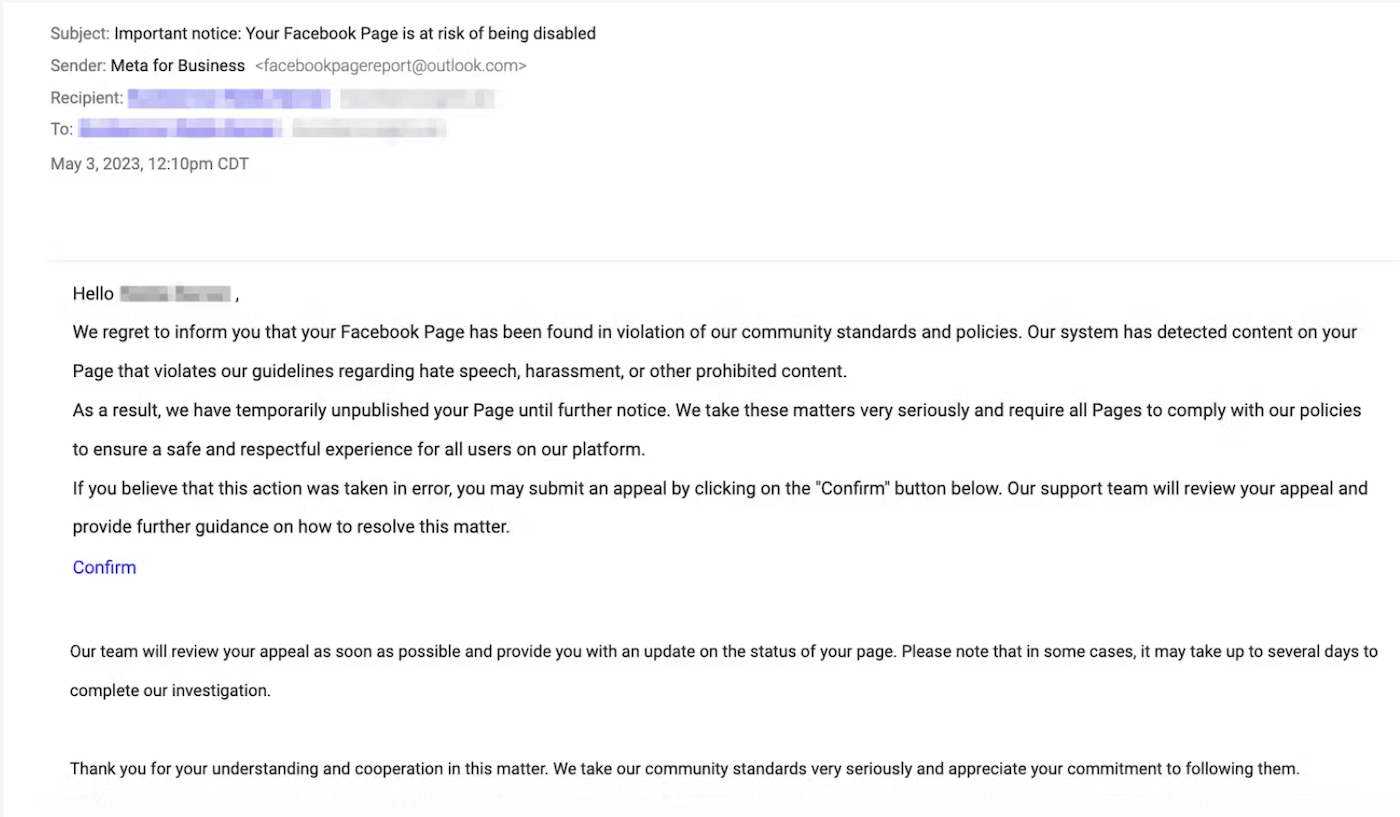
A new tactic noted by Abnormal involves spoofing official Facebook notifications informing the target that they are “in violation of community standards” and that their page has been unpublished. The user is then asked to click on a link and file an appeal, which leads to a phishing page to harvest user credentials, giving attackers access to the target’s Facebook Page, or to sell on the dark web (Figure A).

Figure A

An example of a fake note from "Meta for Business" contains a link that leads to a phishing page.
A fake note from “Meta for Business” warning the phishing target that they have violated Facebook policies, resulting in their page being removed. The scam asks the recipient to click on the included link and file an appeal. That link actually leads to a phishing page. Image: Abnormal Software

Shiebler said the fact that the text within the Facebook spoofs is nearly identical to the language expected from Meta for Business suggests that less sophisticated attackers will be able to easily avoid the usual phishing pitfalls.

“The danger of generative AI in email attacks is that it allows threat actors to write increasingly sophisticated content, making it more likely that their target will be deceived into clicking a link or following their instructions,” he said, adding that AI can also be used to create greater personalization.

“Imagine if threat actors were to input snippets of their victim’s email history or LinkedIn profile content within their ChatGPT queries. Emails will begin to show the typical context, language, and tone the victim expects, making BEC emails even more deceptive,” he said.

Looks like a phish but may be a dolphin

According to Abnormal, another complication in detecting phishing exploits that used AI to craft emails involves false positive findings. Because many legitimate emails are built from templates using common phrases, they can be flagged by AI because of their similarity to what an AI model would also generate, noted Shiebler who said analyses do give some indication that an email may have been created by AI, “And we use that signal (among thousands of others) to determine malicious intent.”

AI-generated vendor compromise, invoice fraud

Abnormal found instances of business email compromises built by generative AI to impersonate vendors, containing invoices requesting payment to an illegitimate payment portal.

In one case that Abnormal flagged, attackers impersonated an employee’s account at the target company and used it to send a fake email to the payroll department to update the direct deposit information on file.

Shiebler noted that, unlike traditional BEC attacks, AI-generated BEC salvos are written professionally. “They are written with a sense of formality that would be expected around a business matter,” he said. “The impersonated attorney is also from a real-life law firm—a detail that gives the email an even greater sense of legitimacy and makes it more likely to deceive its victim,” he added.

Takes one to know one: Using AI to catch AI

Shiebler said that detecting AI authorship involves a mirror operation: running LLM-generated email texts through an AI prediction engine to analyze how likely it is that an AI system will select each word in an email.

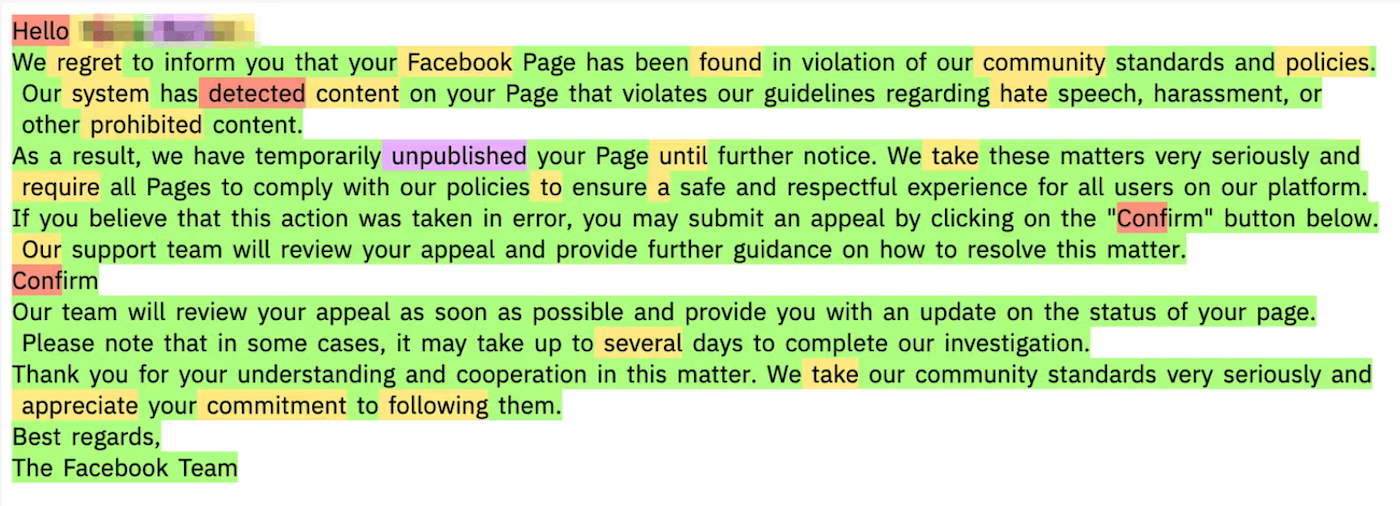
Abnormal used open-source large language models to analyze the probability that each word in an email can be predicted given the context to the left of the word. “If the words in the email have consistently high likelihood (meaning each term is highly aligned with what an AI model would say, more so than in human text), then we classify the email as possibly written by AI,” he said. (Figure B).

Figure B

An example output of email analysis that was run through AI prediction engine, highlighted with green and yellow.
Output of email analysis, with green words judged as highly aligned with the AI (in the top 10 predicted words), while yellow words are in the top 100 predicted words. Image: Abnormal Software.

Shiebler warned that because there are many legitimate use cases where employees use AI to create email content, it is not pragmatic to block all AI-generated emails on suspicion of malice. “As such, the fact that an email has AI indicators must be used alongside many other signals to indicate malicious intent,” he said, adding that the firm does further validation via such AI detection tools as OpenAI Detector and GPTZero.

“Legitimate emails can look AI-generated, such as templatized messages and machine translations, making catching legitimate AI-generated emails difficult. When our system decides whether to block an email, it incorporates much information beyond whether AI may have generated the email using identity, behavior, and related indicators.”

How to combat AI phishing attacks

Abnormal’s report suggested organizations implement AI-based solutions that can detect highly sophisticated AI-generated attacks that are nearly impossible to distinguish from legitimate emails. They must also see when an AI-generated email is legitimate versus when it has malicious intent.

“Think of it as good AI to fight bad AI,” said the report. The firm said that the best AI-driven tools are able to baseline normal behavior across the email environment — including typical user-specific communication patterns, styles, and relationships versus just looking for typical (and protean) compromise indicators. Because of that, they can detect the anomalies that may indicate a potential attack, no matter if the anomalies were created by a human or AI.

“Organizations should also practice good cybersecurity hygiene, including implementing continuous security awareness training to ensure employees are vigilant about BEC risks,” said Sheibler. “Additionally, implementing tactics like password management and multi-factor authentication will ensure the organization can limit further damage if any attack succeeds.”

Person using a laptop computer.

Subscribe to the Daily Tech Insider Newsletter

Stay up to date on the latest in technology with Daily Tech Insider. We bring you news on industry-leading companies, products, and people, as well as highlighted articles, downloads, and top resources. You’ll receive primers on hot tech topics that will help you stay ahead of the game.

Delivered Weekdays Sign up today

Google is Flattered by Microsoft’s Azure AI Studio 

Earlier this month, Google announced the general availability of Generative AI Studio on Vertex AI. With this update, developers can access its text model powered by PaLM 2, embed API for text and other foundation models in Model Garden, as well as leverage user-friendly tools in Generative AI Studio for model tuning and deployment.

Simply put, Generative AI Studio on Vertex AI allows users to interact, fine-tune, and deploy foundational models, providing features like chat interface, prompt design, and model weight adjustment. Interestingly, Microsoft also has a similar offering called Azure AI Studio, which empowers developers to create personalised AI chatbot copilots using OpenAI models and APIs. This new feature extends to Microsoft’s Azure OpenAI Service.

So, which is better? June Yang, VP of Google’s Cloud AI and Industry Solutions, said that Google released its Generative AI Studio first, and Microsoft Azure AI Studio is really trying to follow their lead. “We’re flattered,” said Yang, adding that it would continue to provide the best experience for customers.

She said that Google has created its studio with a couple of purposes in mind – i.e. to create a playground for data scientists, teams, and for developers to be able to access models very easily, alongside developing prototypes and experimenting faster. Further, Yang said that the users get to access various modalities, be it language, code, image, or speech. She also said that it has built in fine-tuning capabilities, which include prompt tuning, alongside other tuning methods. Yang believes that Generative AI Studio on Vertex AI offers several advantages, and caters to a wide range of users, from casual to sophisticated.

While Microsoft thinks it is making Google dance, Google believes it is acing the enterprise generative AI landscape, and is quite optimistic about its product offering. Yang told AIM that the demand for their service is at an all time high. “We actually have quite a lot of interest coming in from Indian enterprises across multiple sectors, including retail, education, public sectors, etc,” she added, saying that the interest is actually across the board, citing its success in the cloud game.

“Of course, our CEO [Sundar Pichai] is originally from India as well. So, there’s been lots of interactions and lots of interest,” she said, hinting at more announcements around its strategic partnerships and collaboration in the coming months.

Google IT Companies Aboard Google Cloud

Indian IT companies like TCS, Infosys and Wipro have already announced collaboration and have been amongst the initial firms to partner with Google Cloud. Recently, Wipro announced an expanded partnership with Google Cloud to integrate Google Cloud’s generative AI capabilities into its own offerings.

Wipro plans on integrating Google Cloud’s suite of generative AI products and services, including Vertex AI, Generative AI App Builder, and the Model Garden collection, with its own AI intellectual property, business accelerators, and pre-built solutions. The Indian IT major plans to train 20,000 associates on Google Cloud’s generative AI technologies to support clients in realising the full potential of AI and driving secure AI-led transformations at scale.

Wipro and Google Cloud are looking to jointly develop generative AI solutions to address industry-specific challenges and enhance enterprise functions like consumer experiences, marketing, supply chain performance, financial modeling, workforce management, and sustainability.

Similarly, Tata Consultancy Services had expanded its partnership with Google Cloud for generative AI solutions and plans to provide over 40,000 skill badges to its employees within a year. TCS has launched a new generative AI offering powered by Google Cloud’s tools, along with its own solutions, to deliver custom-tailored business solutions.

TCS will leverage its client-specific knowledge and agile development processes, along with its co-innovation hubs, to ideate and build transformation solutions. Google Cloud recognises TCS’ expertise and commitment to generative AI adoption.

The post Google is Flattered by Microsoft’s Azure AI Studio appeared first on Analytics India Magazine.

LLMs aren’t even as smart as dogs, says Meta’s AI chief scientist

generative AI apps

You may be impressed with artificially intelligent large language models (LLMs) like ChatGPT that can write code, create an app, and pass the bar exam. But LLMs still lack artificial general intelligence, the state of a hypothetical autonomous system that can achieve intellectual tasks humans or animals perform.

Also: What is ChatGPT and why does it matter?

And according to Meta's AI chief scientist, Yann LeCun, LLMs aren't even as smart as dogs. He says LLMs are not truly intelligent because LLMs cannot understand, interact with, or comprehend reality and only rely on language training to produce an output.

LeCun says that true intelligence stretches beyond language, citing that most human knowledge has little to do with language. LLMs like ChatGPT lack emotions, creativity, sentience, and consciousness — cornerstones of human intelligence.

ChatGPT can solve a complex mathematical problem and, without its safety guardrails, can explain how to create harmful substances from scratch at home, according to OpenAI's GPT-4 whitepaper.

Yet, ChatGPT lacks the cognitive abilities to sense, plan, exhibit common sense, or reason based on real-world experiences. However, GPT-4, the newest version of OpenAI's language model, demonstrated human-level performance in math, coding, and law, signaling that achieving artificial general intelligence could be on the horizon.

Also: AI can write your emails, reports, and essay. But can it express your emotions? Should it?

OpenAI continues to train and expand the capabilities of its GPT language models in an attempt to one day achieve artificial general intelligence. Still, the company acknowledges that the achievement of such technology could significantly disrupt society.

In May, OpenAI's CEO, Sam Altman, testified before the US Senate Judiciary Subcommittee and expressed that his greatest fear is that his technology causes "significant harm to the world."

In a blog post, OpenAI states that generally intelligent beings can serve many purposes, but using and researching the technology responsibly is paramount.

Also: ChatGPT's intelligence is zero, but it's a revolution in usefulness, says AI expert

LeCun says one day, artificial beings will be more intelligent than humans and that when that happens, they should be "controllable and basically subservient to humans." He says people's fear that artificially generally intelligent beings will want to take over the world is unfounded, as "there is no correlation between being smart and wanting to take over."

And OpenAI's sentiments on creating AI that can achieve artificial general intelligence are similar to LeCun's. The company believes it's impossible to halt the creation of artificial beings that can become just as or smarter than humans.

Also: How to use ChatGPT

But OpenAI's mission is to ensure the technology is developed with great caution, as it believes artificial general intelligence's risks could be "existential" if it falls into the wrong hands and is deployed maliciously.

The future of artificial intelligence that we once thought was only seen in sci-fi movies is in our near future. Will we be ready?

Artificial Intelligence

Mercedez-Benz Gets A ChatGPT In-Car Voice Control Upgrade

Mercedes-Benz is set to add OpenAI’s ChatGPT within its in-house multimedia system MBUX Voice Assistant as part of an exclusive beta program available only in the US. This allows drivers of more than 900,000 vehicles equipped with MBUX to engage in more dynamic conversations with the onboard AI.

The integration will improve MBUX’s natural language understanding enabling it to respond to a broader range of topics. Customers will not only be able to issue voice commands but also ask for more detailed information.

Mercedes is leveraging Microsoft’s Azure OpenAI Service to ensure enterprise-grade security, privacy, and reliability. Conversation data will be collected and stored in the Mercedes-Benz Intelligent Cloud, where it will undergo anonymisation and analysis. The company guarantees the protection of all customer data from misuse, with no access granted to Microsoft.

Read more: Microsoft Steps in to Rescue Web-building From the Rut

MBUX, or Mercedes-Benz User Experience, is an advanced infotainment system introduced by Mercedes-Benz in 2018. It features a large touchscreen display and responsive voice control. Users can easily control various functions, such as changing radio stations or adjusting climate control, using voice commands. The system can even operate non-infotainment features like the sunroof or heated seats.

Read more: Metaverse Takes a Detour to Auto Industry, Leaving Big Tech Behind

The US-exclusive beta program starts on June 16. Eligible customers can join by saying “Hey Mercedes, I want to join the beta program” to MBUX. They’ll be guided through installing the ChatGPT patch, which may require connecting a mobile device. Mercedes-Benz’s website has a list of over 25 supported vehicles for the beta program. The beta program will run for three months. Afterwards, it will go offline temporarily while Mercedes-Benz uses the data to improve the model before the official launch.

At CES 2023, Mercedes-Benz made a major breakthrough in autonomous vehicle technology by achieving Level 3 certification for its Drive Pilot system. This makes it the first automaker to reach this level in the country. The system allows drivers to legally take their hands off the wheel and engage in secondary tasks while being prepared to regain control if needed. This advancement is significant in the industry, as Level 3 cars have advanced “environmental detection” capabilities and surpass rival Tesla’s Level 2 technology.

Read more: Now Everyone’s a Developer, Thanks to Microsoft

The post Mercedez-Benz Gets A ChatGPT In-Car Voice Control Upgrade appeared first on Analytics India Magazine.
Even Google is warning its employees about AI chatbot use

Robot with finger on lips asking for silence. 3D illustration

Google's parent company, Alphabet, has been all in on artificial intelligence for years, from buying (and then selling) Boston Dynamics to making scientific achievements through DeepMind, and, more recently, making the topic the main event at this year's Google I/O, following the launch of its AI chatbot, Google Bard. Now, the company advises its employees to be careful of what they say to these AI bots, even its own.

According to a report from Reuters, Alphabet warned its employees not to share confidential information with AI chatbots, as this information is subsequently stored by the companies that own the technology.

Also: Gmail will write your emails now: How to access Google's new AI tool

This comes straight from the horse's mouth, but it's excellent advice regardless of who says it. It's also not generally a good idea to make a habit of sharing private or confidential information anywhere online.

Anything you say to an AI chatbot like ChatGPT, Google Bard, and Bing Chat can be used to train it, as these bots are based on large language models (LLMs) that are in constant training. The companies behind these AI chatbots also store the data, which could be visible to their employees.

Also: Why your ChatGPT conversations may not be as secure as you think

Of Bard, Google's AI chatbot, the company explains in its FAQs:

"When you interact with Bard, Google collects your conversations, your location, your feedback, and usage information. That data helps us provide, improve and develop Google products, services, and machine-learning technologies, as explained in the Google Privacy PolicyOpens in a new window"

Google also says it selects a subset of conversations as samples to be reviewed by trained reviewers and kept for up to three years, so it clarifies to "not include information that can be used to identify you or others in your Bard conversations."

Also: Is humanity doomed? Consider AI's Achilles heel

OpenAI says on its site that AI trainers also review ChatGPT conversations to help improve its systems, saying, "We review conversations to improve our systems and to ensure the content complies with our policies and safety requirements."

Artificial Intelligence

How to access, install, and use AI ChatGPT-4 plugins (and why you should)

ChatGPT-4 on phone with OpenAI logo and coding in background

ChatGPT is more popular than ice cream on a hot summer day. Getting the most out of it, however, is hard. Recently, OpenAI added plugins to the paid version of the service, ChatGPT Plus, and it's become easier to get useful information out of ChatGPT-4 than ever.

ChatGPT plugins are AI chatbot enhancements that augment what it can do. For example, the Kayak and Expedia plugins can answer real-time travel questions. These plugins are found in the ChatGPT plugins store.

Also: GPT-3.5 vs GPT-4: Is ChatGPT Plus worth its subscription fee?

While OpenAI created a few of these, the vast majority are written by third-party developers. All of the ChatGPT plugins are designed to work with GPT-4; they can't work with the free ChatGPT-3.5 system. Today, there are 263 plugins, with more being added daily.

These plugins offer many services. They can help you write superior ChatGPT prompts, assist you in making restaurant reservations, provide financial advice, and deliver timely links to AI-enabled astrology forecasts. For now, you can use all the plugins for free. That will change.

Keep in mind, though, that ChatGPT plugins and ChatGPT extensions are not the same thing. The ChatGPT Chrome extensions, such as WebChatGPT and Compose AI, make it easier to use any version of ChatGPT with the Chrome web browser.

Also: How to use ChatGPT: Everything you need to know

Plugins add more search capabilities to the chatbot and integrate it with third-party services. Extensions, like any Chrome extensions, are just added via the Chrome Web Store. Plugins are trickier. Here's how you find and install them.

How to install ChatGPT-4 plugins

What you'll need: A ChatGPT Plus account, a computer, and an internet connection.

How to use ChatGPT Browse with Bing

ChatGPT Browse with Bing and ChatGPT plugins are separate features. But, the Browse with Bing feature is useful, and I must mention it as well.

Also: How to use Bing Chat (and how it's different from ChatGPT)

It does exactly what it says. Instead of being limited to data from September 2021 and earlier in ChatGPT, you can access current information. This is a real difference-maker. Here's how to use the Browse with Bing feature.

1. Select your AI model and feature

Start a new chat in ChatGPT. In the top middle of the screen, you have the option to use GPT-3.5 or the more advanced GPT-4 model. Hover over the GPT-4 button, and the browsing beta option will appear. Click it to select it.

2. Write your prompt

Use ChatGPT as usual. The Browse with Bing feature is best when you have a question or query that requires recent information or data. For example, ask about the latest news on a specific topic, such as the performance of a company's stock, or the score of a recent game.

3. Browse the results

Behind the scenes, ChatGPT does the browsing for you, providing accurate, relevant, timely, and cited information.

Also: How to make ChatGPT provide sources and citations

Click on each citation number to be transported to the webpage where ChatGPT found its information.

How to use ChatGPT plugins

To get started with these third-party plugins, follow these steps.

1. Select your AI model and feature

Start a new chat and hover over the GPT-4 option at the top. Click on the plugins option.

2. Go to the plugin store

Click the drop-down arrow under the GPT-4 button. A button will appear to access the plugin store. Here you can browse through a list of ChatGPT plugins.

Also: I asked ChatGPT to write a WordPress plugin I need. It did it in less than 5 minutes

If you find one you want to try, click the green Install button next to it. After it's installed, you can access it whenever you want from the same menu.

3. Explore the plugins

Browse and test the plugins to find out which ones are best for your needs. If you don't like something, it's as simple as a quick uninstall. New plugins are added each day, so check back at the plugin store regularly.

Here, I'm fooling around with the Kayak plugin and Vancouver waterfront hotels.

FAQs

What are the caveats of ChatGPT-4 plugins?

  • These are all beta, and boy, does that show sometimes. Sometimes they'll get you painfully wrong answers. Other times, the plugins will fail.
  • There's currently a hard limit on how many plugins you can have active at once. You can switch them out, but at any given time, only up to three can work.
  • For now, you can only browse the web or use a plugin. You can't do both at the same time. Some of the plugins duplicate web access in their functionality, so that's not as big a deal as it might first appear.
  • Keep in mind, when you use plugins, you're still limited to ChatGPT-4's 25 queries every three hours. Once you pass that threshold, you're dumped back to ChatGPT 3.5. So, before starting your session, before very clear about what you're trying to achieve.
  • This is a brand new kind of software, and OpenAI states no plugin can be used for malware, scams, or spreading misinformation. And, neither can it be used to circumvent or interfere with OpenAI's safety systems, that doesn't mean that this couldn't happen. User beware!

How to use ChatGPT-4 plugins

Once installed, you simply choose to use the model with them activated. That's all there is to it. Under the hood, the ChatGPT application programming interfaces (API)s are being invoked, but you don't have to worry about the tech details. Just write your prompt and go.

Also: ChatGPT: Who's using the AI tool and why?

By following the steps outlined in this guide, you can unlock the full potential of ChatGPT Plus. Remember, as with any tool, the onus is on you to verify the accuracy of the information provided. Even the most advanced ChatGPT-4 and plugins are still susceptible to making mistakes. Good luck, and happy exploring!

Intel Rebrands In Anticipation Of Meteor Lake

Intel has finally dropped one of their most recognisable brand identities, removing the ‘I’ moniker from their line of CPUs. Now, all new consumer chips coming out of Intel’s foundries will be branded as ‘Core’ and ‘Core Ultra’, accompanied by a 3, 5, 7, or 9 to denote the power of the processor.

Under the branding overhaul, Intel’s new lower-end chips will be named the Intel Core 3, Core 5, and Core 7, with the higher-end ‘Premium’ models being named Core Ultra 5, Core Ultra 7, and Core Ultra 9.

These premium chips are branded Ultra so as to make it clearer to customers which products are on the higher end of the performance spectrum. Intel will also neglect to mention the generation of the chip in marketing copy, although the number will stay on in the processor’s model number.

This rebranding brings Intel’s branding somewhere in between its competitors, AMD and Apple. While AMD has the numbering system to denote the power of its processors, Apple products have Pro, Max, and Ultra tiers. Intel has combined both these approaches, as seen by their Ultra lineup of processors.

Intel first started branding chips with the ‘Core i’ name in November 2008, with the launch of the Nehalem microarchitecture. This branding has endured for almost 15 years now, and has become synonymous with Intel’s brand name, especially for consumers. However, it seems that the company has a good reason to change the name of their chips, and that’s Meteor Lake.

The rebrand will coincide with the launch of Meteor Lake, coming later this year for laptops first. Now, customers will be able to distinguish between older Intel products and newer ones. However, the older Raptor Lake chips will continue to maintain the older branding strategy, as the names will be phased out slowly as more Meteor Lake chips come into the market.

This long-delayed processor node is all set to be the future of Intel’s CPU play, with the company calling it the most significant overhaul in years. Meteor Lake marks Intel’s foray into multi-tile processor manufacturing, a far cry from the monolithic architecture they were using until now.

The post Intel Rebrands In Anticipation Of Meteor Lake appeared first on Analytics India Magazine.
AI for Pandemic Preparedness: Are Modern AI Systems Ready for Another Pandemic?

Featured Blog Image-AI for Pandemic Preparedness: Are Modern AI Systems Ready for Another Pandemic?

Artificial Intelligence (AI) in healthcare has significantly enhanced our ability to monitor, predict, and respond to health crises. During COVID-19 – a crisis that affected more than 760 million people worldwide, AI provided mission-critical assistance in managing the pandemic, showcasing the capabilities of AI for pandemic preparedness and response.

Despite the significant AI advancements, there is a compelling need to improve AI technologies before the next pandemic. We need systems that can effectively respond to outbreaks in real time. We need to refine AI models, expand data sources, and increase computational power to improve our AI readiness, such as identifying the origin of infectious outbreaks or predicting future pandemics.

Let’s do a detailed discussion on the role of AI in the pandemic and what limitations it can face during future outbreaks.

AI During the COVID-19 Pandemic

Governments and health organizations extensively used AI predictive models to estimate the spread, reproducibility, and trajectory of COVID-19. These models informed public health policies, including targeted lockdowns, social distancing measures, and vaccination campaigns.

AI and healthcare researchers made significant contributions during the pandemic, such as:

  • They developed highly accurate AI diagnostic tools to assist in diagnosis via chest X-Ray and CT images.
  • These tools enhanced the screening and testing capabilities of health centers while enabling early detection and isolation of infected individuals.
  • AI models were used to identify the severity and prognosis of the disease.
  • Researchers used AI to assist in drug discovery and vaccine development during COVID-19.
  • AI also assisted in identifying existing drugs that were effective against the virus (a process known as drug repurposing).

Such AI initiatives played a crucial role in preventing the collapse of the global health infrastructure during the COVID-19 pandemic.

The Role of AI in Pandemic Preparedness: 5 Major Components

The Role of AI in Pandemic Preparedness

The world witnessed the deadliest healthcare crisis of this century, with more than 6.8 million deaths globally, as of May 2023. In the ongoing economic repercussions caused by this pandemic, the role of AI-based systems, such as robotics, AI chatbots, and predictive analytics, in prevention and management cannot be overstated.

With the ability to process vast amounts of data, detect patterns, and make informed decisions in real-time, AI-powered technologies offer promising solutions to enhance our response to future pandemics. These solutions are:

1. Early Detection & Monitoring Systems

One of the critical aspects of managing viral outbreaks is early detection. And, once the affected regions are marked, they must be monitored 24/7 proactively.

What role can AI play?

  • AI analytics can analyze diverse medical data sources, including healthcare records, environmental data, and even social media to identify patterns and detect potential disease outbreaks early.
  • AI can assist in identifying potential hotspots by monitoring symptoms, travel patterns, and demographic information, enabling authorities to take timely preventive measures and allocate resources effectively.

2. AI-powered Resource Management: Rapid Response & Resource Allocation

During a pandemic, the allocation of resources is crucial as infectious diseases can quickly overrun the capacity of healthcare systems.

What role can AI play?

  • AI-powered systems can optimize resource management by analyzing real-time data on hospital capacity, medical supply inventory, and staffing.
  • With this information, healthcare providers can make informed decisions regarding the allocation of beds, ventilators, and medical personnel, ensuring resources are efficiently distributed among the vulnerable population.
  • AI can help streamline supply chains by identifying bottlenecks and facilitating the timely procurement and delivery of essential medical supplies.

3. AI Robots & Chatbots: Social Distancing Measures

During a pandemic, any service or process that requires human involvement is severely affected due to forced lockdowns.

What role can AI play in the event of another pandemic?

  • AI-powered robots and chatbots can take over routine tasks that involve human contact.
  • In healthcare, AI robots can assist in minimizing human contact by performing routine tasks such as disinfection, sample collection, and drug delivery.
  • Autonomous robots can be used to deliver food and groceries, as a few instances have been reported already.
  • AI chatbots can serve as virtual assistants, delivering reliable information on symptoms, preventive measures, and the latest guidelines from health authorities.
  • Chatbots can provide personalized information, triage patients, and reduce the burden on healthcare hotlines.

But these initiatives must be taken on a global scale to facilitate maximum world population. That is where AI pandemic preparedness is tested.

4. AI-Assisted Vaccine Development & Distribution

The rapid development and distribution of vaccines are essential to achieving immunity against pandemics and zoonotic outbreaks.

What role can AI play?

  • AI-powered predictive analytics can aid vaccine development by analyzing vast amounts of genetic and clinical data, accelerating the identification of potential vaccine candidates.
  • AI can contribute to efficient and equitable vaccine deployment by identifying high-priority areas and streamlining the distribution network.

5. AI-Powered Pandemic Modeling & Forecasting

Data forecasting and modeling can enhance our understanding of public health challenges, enabling proactive measures to improve population health.

What role can AI play in the next pandemic?

  • AI-driven prediction models can leverage large datasets, including epidemiology information, population demographics, and environmental variables.
  • The outcome of prediction models can inform the decisions made by public health workers and policymakers on a global scale.
  • AI models can aid in allocating resources, implementing interventions, and developing effective containment tactics.

AI for Pandemic Preparedness: What are the Major Limitations?

While modern AI systems offer significant potential for pandemic preparedness, several limitations must be addressed.

1. AI Disease Surveillance

AI solutions for the pandemic require rapid response, but AI algorithms built using low-quality data can produce misleading or harmful clinical recommendations. For example, in the US, a lack of accurate racial information in health surveillance databases led to under-reported COVID-19 mortality rates of up to 60% for Black and Hispanic patients. Any AI system built on such data would generate unjust outcomes.

2. Biases in AI Systems

AI algorithms can inherit biases from the training data, leading to discriminatory outcomes in healthcare delivery. Hence, mitigating biases is essential to ensuring success in AI-enabled relief efforts during a pandemic.

3. Data Security & Privacy

People are increasingly embracing wearable technologies and connected health gadgets. These devices generate loads of data that can be sensitive such as personal health data. Often, companies analyze this data to improve their services. As more people interact with the digital world, efforts for privacy protection should be prioritized.

4. Ethical Concerns of AI in Healthcare

When data is involved, ethical issues arise. Regulatory bodies need to provide a global ethical framework around doctor-patient privilege and legal and moral accountability for responsible medical AI adoption. AI implementation should adhere to ethical guidelines, ensuring fairness, transparency, and accountability.

5. Lack of Global Collaboration, Context & Interpretation

AI systems struggle to capture nuanced information, such as cultural practices, social behaviors, and local healthcare infrastructure, which can significantly impact effective response strategies globally. Many decision tools available today are not universally applicable. Also, countries and regions have different data governance policies and data localization laws that can limit collaboration on global data initiatives.

Future Role of AI in Pandemic Prepardness

The COVID-19 pandemic has highlighted the significant role of AI in combating wide-scale infectious disease outbreaks. But efforts are needed to scale it globally by building comprehensive and diverse data sources and facilitating data sharing across regions. These initiatives can enable real-time interventions to save lives, protect communities, and build a resilient global healthcare infrastructure. Hopefully, future developments in AI will further enhance our pandemic preparedness.

To stay informed on the latest AI in healthcare progress, visit unite.ai.