How Indian IT Giants are Bringing GenAI to Their Clients

When OpenAI CEO Sam Altman said it was “hopeless” for India to build a general purpose LLM like the GPT models, Tech Mahindra CEO CP Gurnani tweeted: “Challenge Accepted.” Even though Altman’s comment was taken out of context and blown out of proportion, we will have to wait and see whether Tech Mahindra is building a ChatGPT alternative. Meanwhile, top IT companies in India such as Infosys, TCS, Wipro, HCL as well as Tech Mahindra have already announced generative AI capabilities to benefit their customers.

Tech Mahindra’s Generative AI studio

Tech Mahindra had been working on generative AI long before OpenAI released ChatGPT. The IT giant developed the Storicool platform, an auto content creation tool, which was beyond its years, according to chief executive CP Gurnani.

In April this year, Tech Mahindra launched its Generative AI Studio under its amplifAI0->∞ suite of AI offerings and solutions. TechM amplifAI0->∞ helps the IT giant democratise and scale the deployment of AI technology for enterprises globally. Now, the studio aims to bring six aspects of content generation under one umbrella which include: Code, Document/Text, Image, Video, Audio and Data, the IT giant said.

Infosys leverages open-source large language models

Interestingly Infosys, along with a few other parties including Elon Musk, AWS and others donated USD 1 billion to OpenAI, the company leading the generative AI revolution. The donation was made when Vishal Sikka was still at the helm of the IT giant.

Last month, Infosys announced Topaz — an AI-first set of services, solutions and platforms using generative AI technologies. Topaz leverages generative AI technologies and comes with 12,000 use cases, Infosys said. Its aim is to provide readily available industry-specific solutions that enable the integration of generative AI into functions such as intelligent automation, AI-driven customer service, and enhanced security solutions.

“Topaz has helped businesses accelerate growth and create value through its AI-first approach by helping them adopt open-source LLMs to build narrow transformers which will solve a particular problem in the enterprise,” Balakrishna D R, EVP and head of AI and automation at Infosys, told VentureBeat.

TCS to leverage Google’s foundational AI models

Tata Consultancy Services (TCS) also announced generative AI capabilities in partnership with Google Cloud. The IT giant’s generative AI offering is powered by Google Cloud’s generative AI products and services such as Vertex AI, generative AI Application Builder and Model Garden, and TCS’ own solutions. This means TCS will leverage Google’s LLM PaLM for text and chat, Imagen for text-to-image, Codey for code completion and chirp for speech-to-text.

Kevin Ichhpurani, CVP, global partner ecosystems and channels, Google Cloud, said that the partnership with TCS will help address industry-specific challenges and opportunities with generative AI capabilities and solutions, with a focus on addressing real-world use cases and adding business value. “Building on its deep domain knowledge across multiple industry verticals and investments in research and innovation, TCS has developed a large portfolio of AI-powered solutions and intellectual property in the areas of AIOps, Algo Retail™, smart manufacturing, digital twins and robotics,” TCS said.

According to the company, they are actively engaging with clients in multiple industries to explore how generative AI can be leveraged to deliver value in their specific business contexts.

Wipro leverages Google’s PaLM

Like TCS, Wipro has also partnered with Google to leverage its generative AI tools through Google Cloud. According to the company, Wipro will integrate them with its own AI models, business accelerators, and pre-built industry solutions. The company plans to integrate generative AI as a central offering across its comprehensive range of consulting services. This includes areas such as digital marketing, customer experience, design thinking, financial services, and its global innovation labs, known as Lab45.

By incorporating generative AI into its suite of services, Wipro aims to provide enhanced value and innovative solutions to its clients in various industries. The Bengaluru-based IT giant will also train around 20,000 associates on Google’s generative AI technologies to accelerate AI-driven transformation. “Through our expanded partnership, Wipro and Google Cloud will use generative AI to solve some of the biggest challenges businesses are facing today, safely and securely,” Thomas Kurian, chief executive at Google Cloud, said.

HCL partners with Microsoft for generative AI adoption

HCL has partnered with Microsoft to bring in generative AI capabilities to its customers. Microsoft’s OpenAI Azure services will give HCL access to leverage OpenAI’s GPT models, Codex and Embeddings model series.

“By leveraging the latest Microsoft innovations in AI and machine learning, businesses can gain valuable insights into their operations, improve decision-making processes and achieve greater success. Whether enhancing customer experiences, streamlining supply chain operations or optimising business processes, this powerful collaboration provides the tools and expertise companies need to succeed in this fast-paced digital landscape,” Kalyan Kumar, chief technology officer and head, Ecosystems, HCLTech said.

The post How Indian IT Giants are Bringing GenAI to Their Clients appeared first on Analytics India Magazine.


Your next job interview could be with AI instead of a person

Job interview with futuristic cyborg. This is entirely 3D generated image.

It may sound like a strange Turing test — wondering if the recruiter you're interacting with about a potential job position is a person or a bot. But a recent survey found that 43% of companies will use artificial intelligence (AI) to run their hiring interviews by 2024, with some having already adopted the practice.

If you're familiar with the power of ChatGPT and other AI chatbots, you're likely aware that they can generate text for cover letters and resumes, and do so with ease. Simple prompts entered by the user result in consistently high-quality results within seconds, and users can even ask follow-up questions to edit or customize them to fit their needs.

Also: Gmail will help you write your emails now: How to access Google's new AI tool

A survey conducted by Resume Builder affirmed this by pointing out that 46% of job seekers reported using ChatGPT to write their resumes and cover letters. Also, 78% said they got a higher response from companies and an interview when they used job application materials created using ChatGPT.

Corporate recruiters aren't generally displeased with this decision, as reported by Resume Builder's Chief Career Advisor, Stacie Haller. She says hiring managers have become so familiar with these documents that they can likely tell when ChatGPT writes a cover letter or resume.

Also: GPT-3.5 vs GPT-4: Is ChatGPT Plus worth its subscription fee?

"Job seekers who use ChatGPT for their cover letters and resumes are no different than those going to a resume-writing service or using readily available templates and online tools," Haller explained.

Not only do hiring managers seem to be accepting this practice, but some are embracing it, which can create new challenges for job seekers.

Experts estimate as many as 40% of corporate recruiters will use AI to run job interviews by 2024, with 15% relying solely on AI for all hiring decisions, from start to finish.

Also: 5 ways to explore the use of generative AI at work

The use of AI will look different from one company to the next. AI-assisted interviews can be text questions or video interactions that are later assessed by a company staffer or reviewed by an AI algorithm. AIs can also evaluate a pool of candidates to pick out the strongest one after being trained on a library of qualifications.

AI-led interviews can feel stoic and automated, making it impossible for candidates to read facial cues for feedback, which can be challenging for job seekers. Experts recommend that candidates who interview with an AI conversational bot, whether through text or video, pretend they're talking to a human and practice extensively beforehand.

Artificial Intelligence

Top 9 Papers Presented at Google CVPR 2023

The 2023 edition of CVPR, the prestigious annual conference for computer vision and pattern recognition is taking place from June 19 to 22 in Vancouver, Canada. Google Research is one of the major sponsors, presenting 90 papers on various topics like image recognition, 3D vision, and machine learning. Besides Google, several other premier institutes like MIT and UCLA are also participating this time. CVPR saw an influx of 9,155 entries, out of which only 2,360, that is, 25.78% were accepted. Let’s take a look at the top papers presented this time.

MobileNeRF: Exploiting the Polygon Rasterisation Pipeline for Efficient Neural Field Rendering on Mobile Architectures

Authored by a team of researchers from Google Research, Simon Fraser University and the University of Toronto, the paper introduces a new NeRF representation using textured polygons for efficient image synthesis. Traditional rendering techniques, combined with a view-dependent MLP, process the polygon features obtained through a z-buffer, resulting in fast rendering on diverse platforms, including mobile phones.

DynIBaR: Neural Dynamic Image-Based Rendering

The paper presents a new method for generating realistic views from monocular videos of dynamic scenes. Existing techniques based on dynamic Neural Radiance Fields (NeRFs) struggle with long videos and complex camera movements, resulting in blurry or inaccurate outputs. Developed by Cornell Tech and Google Research, the new approach overcomes these limitations by using a volumetric image-based rendering framework that incorporates nearby views and motion information. The system achieves superior results on dynamic scene datasets and excels in real-world scenarios with challenging camera and object motion where previous methods fall short.

Read more: Neo4j’s Role in Fueling Generative AI with Graph Technology

DreamBooth: Fine Tuning Text-to-Image Diffusion Models for Subject-Driven Generation

Large text-to-image models have limitations in mimicking subjects from a reference set and generating diverse renditions. To address this, Google Research and Boston University present a personalised approach. By fine-tuning the model with a few subject images, it learns to associate a unique identifier with the subject, enabling the synthesis of photorealistic images in different contexts. The technique preserves key features while exploring tasks like recontextualization, view synthesis, and artistic rendering. A new dataset and evaluation protocol are provided for a subject-driven generation. Check out their GitHub repository here.

MaskSketch: Unpaired Structure-Guided Masked Image Generation

Adding to the list of exciting innovations is a new image generation method called MaskSketch that allows spatial conditioning of the generation result using a guiding sketch as an extra signal was also proposed at the event. MaskSketch leverages a pre-trained masked generative transformer and works with sketches of different abstraction levels.

By leveraging intermediate self-attention maps, MaskSketch encodes important structural information and enables structure-guided generation. The method achieves high image realism and fidelity, surpassing state-of-the-art methods for sketch-to-image translation and unpaired image-to-image translation approaches on benchmark datasets.

MAGVIT: Masked Generative Video Transformer

Carnegie Mellon University, Google Research, and Georgia Institute of Technology introduced MAGVIT, a single model designed to handle various video synthesis tasks. It uses a 3D tokenizer to convert videos into spatial-temporal visual tokens and employs masked video token modeling for efficient multi-task learning. Results demonstrate that MAGVIT outperforms state-of-the-art approaches, achieving the best-published FVD on three video generation benchmarks, including Kinetics-600. It also surpasses existing methods in inference time by a significant margin and supports ten diverse generation tasks while generalizing across different visual domains.

Imagen Editor and EditBench: Advancing and Evaluating Text-Guided Image Inpainting

Google presented Imagen Editor, a cascaded diffusion model, addressing the challenge of text-guided image editing. By fine-tuning Imagen on text-guided image inpainting and using object detectors for proposing inpainting masks, it ensures edits align with text prompts. It also maintains fine details by conditioning on the high-resolution image.

Evaluation using EditBench, a benchmark for text-guided image inpainting, shows that object-masking during training improves text-image alignment. Imagen Editor outperforms DALL-E 2 and Stable Diffusion and excels at object-rendering and material/color/size attributes over count/shape attributes.

RUST: Latent Neural Scene Representations from Unposed Imagery

Another paper presented by the Google team introduces RUST (Really Unposed Scene Representation Transformer), a pose-free approach using RGB images only. By training a Pose Encoder and Decoder, RUST enables novel view synthesis with meaningful camera transformations and accurate pose readouts. Surprisingly, RUST achieves similar quality to methods with perfect camera pose, allowing large-scale training of neural scene representations.

REVEAL: Retrieval-Augmented Visual-Language Pre-Training with Multi-Source Multimodal Knowledge Memory

The paper presents REVEAL, an end-to-end Retrieval-Augmented Visual Language Model. REVEAL encodes world knowledge into a large-scale memory and retrieves from it to answer knowledge-intensive queries. It consists of a memory, encoder, retriever, and generator. The memory encodes various multimodal knowledge sources, and the retriever finds relevant entries.

The generator combines retrieved knowledge with input queries to generate outputs. REVEAL achieves state-of-the-art performance in visual question answering and image captioning, utilizing diverse multimodal knowledge sources. The paper is submitted by members from the University of California, Los Angeles and Google Research.

On Distillation of Guided Diffusion Models

Classifier-free guided diffusion models, widely used in image generation, suffer from computational inefficiency. Google, Stability AI and LMU Munich propose distilling these models into faster sampling models. The distilled model matches the output of combined conditional and unconditional models, achieving comparable image quality with fewer sampling steps. The approach is up to 256 times faster for pixel-space models and at least 10 times faster for latent-space models. It also proves effective in text-guided image editing and inpainting, requiring only 2-4 denoising steps for high-quality results.

Read more: What the World Can Learn From France’s AI Ecosystem

The post Top 9 Papers Presented at Google CVPR 2023 appeared first on Analytics India Magazine.

AI Is Catching Tax Evaders Now

Is AI Copyright Really Necessary?

The Indian government is looking at AI with renewed fervour after this year’s Budget, and it seems that the Income Tax department has taken it to heart. The government department has already deployed AI solutions to find tax evaders, detecting fake donations to reassess tax returns filed in the financial year 2019.

Under Section 80G of the Income Tax law, a citizen can claim deductions of up to 100% for donations to political parties and charitable trusts. Unfortunately, this is used as a tax evasion vehicle. To combat this, the income tax department checked income against donations to detect skewed donation-income ratios, focusing on tax deductions gained by making donations to charitable trusts.

The department sent ‘hundreds’ of notices to various salaried individuals informing them of the same. According to a chartered accountant with knowledge of insider information, most of these notices were sent to residents of Gujarat who had donated to political parties. “Using artificial intelligence, the Income Tax Department has identified people whose ratio of donation against income earned is skewed for the financial year 2018-19,” said Paras Savla, a partner at KPB & Associates, a chartered accountancy firm.

According to law, the income tax department can reassess tax returns within 10 years of filing. This means that the FY19 records can be reassessed until March 2029, giving the IT department plenty of leeway as well as a strong data bank to feed their AI algorithms with.

Using AI in governance is something that the Indian government has been going big on. With the tagline Make AI In India and Make AI Work for India, regulators have been pushing for the greater adoption of AI among both public and private sectors. Under the Union Budget 2023-24, Finance Minister Nirmala Sitaraman announced the government’s renewed push towards AI localisation. Towards this end, she announced the creation of three centres of excellence for AI and a national data governance policy for better access to anonymised data.

The post AI Is Catching Tax Evaders Now appeared first on Analytics India Magazine.

IBM Expands Partnership with Adobe for Generative AI in Supply Chain

IBM Expands Partnership with Adobe for Generative AI in Supply Chain

IBM has announced its plans to continue its long standing partnership with Adobe for helping brands to accelerate content on supply chain through Adobe Sensei GenAI services, along with Adobe Firefly.

IBM Consulting experts, comprising a vast team of 21,000 experienced consultants in the fields of data, AI, and user experience, will be available to Adobe’s enterprise clients. These experts will offer valuable assistance in the successful integration of generative AI models into the design and creative procedures.

Notably, they will focus on leveraging Firefly, a tool primarily designed for image and text effect generation, which was recently implemented in Photoshop and Illustrator. Additionally, Adobe’s enterprise applications will incorporate Sensei GenAI services, acting as a helpful companion for marketers. This integration aims to streamline marketing workflows and enhance productivity levels for businesses.

“By expanding our strategic partnership with Adobe, we can help marketers more effectively design AI-powered experiences while establishing appropriate guardrails, so the AI is built on trust and transparency principles to promote brand consistency and integrity,” said Matt Candy, global managing partner of IBM iX Customer & experience transformation.

IBM and Adobe have a 20 year collaboration history. Adobe’s adoption of Red Hat Open Shift, IBM AI and Sterling software is already in place with IBM also helping Adobe improve its marketing team management capabilities.

IBM Consulting had recently also unveiled its Center of Excellence dedicated to generative AI. With a specialized team of over 1,000 consultants possessing expertise in generative AI, the center aims to accelerate clients’ business transformations using enterprise-grade AI technology provided by Adobe, IBM, and other partners in the ecosystem.

This new Center of Excellence complements IBM Consulting’s existing global AI and Automation practice, which has successfully engaged with over 40,000 enterprise clients. The centre utilises established methodologies such as the IBM Garage for Generative AI, where consultants adopt a comprehensive and collaborative approach to expedite innovation in foundation models for generative AI.

The post IBM Expands Partnership with Adobe for Generative AI in Supply Chain appeared first on Analytics India Magazine.

Artificial Intelligence: A Board of Directors Challenge – Part III

Slide9

This three-part series outlines the challenges and actions that the Board of Directors for organizations must address as they guide their organization’s responsible and ethical deployment of Artificial Intelligence (AI). Part one covered mitigating the impacts of AI Confirmation Bias. Part two explained unintended consequences and how to identify them. Part three will conclude with introducing the “Unintended Consequences Assessment” design template and the Board of Directors Responsible AI checklist.

In the previous two blogs, we explored the ramifications and risks associated with poorly constructed and vetted AI deployments, including:

  • Confirmation Bias from poorly-constructed AI models that deliver irrelevant, biased, unethical outcomes and impact longer-term operational viability.
  • Unintended Consequences from decision-makers making decisions without consideration of the second and third (and fourth and fifth…) order ramifications of what “might” go wrong.

Let’s introduce a design canvas that can help us identify, cognize, and codify the risks (as variables and metrics to include in the AI Utility Function) associated with the potential unintended consequences of poorly contemplated AI initiatives.

Updated Unintended Consequences Design Template

In my blog post titled “Economics of Ethics: Is Ethics Ultimately an Economics Conversation? Part III,” I introduced the “Economics of Ethics” design template. However, after testing the design canvas in classrooms and workshops, I realized it was clumsy in identifying and assessing the potential unintended consequences of AI initiatives.

Consequently, I modified the design template to focus on assessing one “unintended consequences” scenario per template in support of an organization’s broader AI initiative. This approach facilitates identifying and evaluating a wider variety of potential scenarios, which is vital in identifying and exploring the “unknown unknown” scenarios that might result from the application of AI.

Figure 1 shows a completed template for the grade school “Head Start” initiative and explores the scenario where the targeted constituents are offended by the initiatives, which could sow community distrust and political grandstanding.

Slide10

Figure 1: Unintended Consequences Assessment Design Template

Note: The Unintended Consequences Assessment design template is relevant for any organization or government agency in identifying and contemplating the potential unintended consequences of any vital initiative or legislation. For example, the article “11 years into Oklahoma’s affirmative action ban, the state has seen some unintended consequences” provides another example of government legislation intended to accomplish one set of objectives but unfortunately delivered unintended negative results.

But for organizations that are looking to employ AI, the Unintended Consequences Assessment design template is particularly useful in guiding the organization in identifying and comprehending the possible unforeseen outcomes of implementing AI. The design template forces the organization to understand, ideate, and assess the following:

  • Initiative: A detailed description of the business or operational initiative against which one plans to apply AI, the initiative’s objectives and desired outcomes, the impacted stakeholders, and the KPIs and metrics against which initiative progress and success will be measured.
  • Scenario: Identify or brainstorm a scenario or outcome that might arise from the execution of the initiative. It is critical to engage a diverse set of internal and external stakeholders – those who either impact or are impacted by the initiative – in brainstorming the different ways the initiative or legislation could go wrong. You will create a separate template per scenario, so the more scenarios, the better. Besides, we have plenty of paper!
  • Potential Outcomes: For each scenario, identify the factors or outcomes that might impact that scenario as viewed across financial, operational, stakeholder (customer, employee, partner), societal, environmental, and ethical perspectives.
  • Variables and Metrics: For each outcome, identify the short-term and long-term variables and metrics we might want to employ to monitor, manage, and optimize those outcomes.

The goal of this exercise is to identify and explore the “unknown unknown” scenarios that might result from the application of AI. And remember, during this process, all ideas are worthy of consideration (one of the Schmarzo fundamental tenets).

Board of Directors AI Challenge Checklist

Board of Directors Challenge: What Role Does the Board of Directors Play in Guiding Senior Management in Balancing AI-based Business Opportunities vs. Societal Risks?

Solution: Ensure the Board asks senior management the right questions about the company’s AI and data strategy from the broader economic frame, considering the costs and risks associated with AI model confirmation bias and potential unintended consequences.

Here is a starter checklist that a Board of Directors should contemplate to ensure AI’s ethical and responsible deployment. No doubt that this list will grow with experience, so please share what you are learning about the questions that the Board of Directors should be asking senior management.

AI Operational Effectiveness Checklist

  • Have you clearly defined, triaged, vetted, and socialized the targeted business initiative you are addressing, including the desired outcomes and the KPIs and metrics against which the desired outcomes will be measured?
  • Have you identified and gained input from a diverse set of internal and external stakeholders – those stakeholders who either impact or are impacted by the initiative – concerning their desired outcomes and the KPIs and metrics against which they will measure outcomes’ effectiveness?
  • Have you identified a comprehensive and diverse range of variables and metrics for measuring the outcomes’ relevance and effectiveness? These should include a diverse set of financial, operational, customer, employee, partner, societal, community, environmental, and ethical metrics.
  • Have you identified conflicting variables and metrics to force the AI models to make the needed trade-off decisions as they seek to deliver relevant, meaningful, responsible, and ethical outcomes within a dynamic operating environment?
  • Have you focused on identifying, measuring, and analyzing leading indicators instead of lagging indicators? Have you triaged the key lagging indicators to determine their casual leading indicators?
  • Have you integrated the organization’s extensive economic charter and associated variables and metrics into your AI Utility Function? Such variables might include social growth and prosperity, educational equality, affordable healthcare, affordable housing, employment growth, economic growth, and environmental sustainability.

AI Risk Mitigation Checklist

  • Have you asked and explored the second and third-order questions and potential consequences to understand the possible economic ramifications of AI-based initiatives?
  • Have you empowered the broader organization, especially the front lines of the organization, to voice any concerns they might have with the second and third-order ramifications of the AI-based initiative?
  • Have you empowered the broader organization to share any potential variables and metrics that might be appropriate in monitoring and measuring the associated economic impact of the AI-based initiative?
  • Have you explored and clarified the potential ramifications of initiative failure from the perspectives of financial, operational, customer, employee, partner, societal, community, environmental, and ethical factors?
  • Have you identified and integrated the KPIs and metrics to monitor and mitigate the impact of business initiative failure into your management and operational systems?
  • Have you formalized identifying and quantifying the costs and risks associated with AI model confirmation bias?
  • Have you instrumented and audited the AI models to continuously learn from the AI model’s False Positives and False Negatives?
  • Have you identified and accounted for proxy measures for protected classes to minimize model biases in designing and developing AI models?
  • Have you operationalized the identification and exploration of the potential unintended consequences from the AI model’s decisions from the perspectives of finance, operational, customer, employee, partner, community, social, environmental, and ethical?
  • Have you integrated measures to flag and monitor these potential unintended consequences into your management and operational systems?

And while I called this a checklist, it is more than just checking the list. The Board of Directors and senior management will be held accountable for ensuring that these questions are being asked, voices are being heard, and plans and actions are being put into place to remove the dangers associated with AI’s careless and unethical application. So think of this list as an engagement framework versus a simple checklist.

Also, I am confident that this checklist will evolve as we learn more about the good, the bad, and the ugly of AI.

AI Board of Directors Mandate Summary

“You are What You Measure, And You Measure What You Reward”

We know that ensuring the responsible and ethical deployment of AI will require organizations to more carefully and holistically define the variables and metrics against which they want the AI model to deliver relevant, meaningful, responsible, and ethical outcomes. Yep, we need to hold the AI models to an extreme level of responsibility.

But what would happen if we held our corporate, social, and government leaders to that same level of responsibility? Maybe that alone would help to minimize the unintended consequences of short-sited decisions and legislation. Just saying…

Crazy Fitness Routines of Tech Billionaires

Gone are the days when tech magnates only wanted to get rich and famous. Now, along with toiling in the tech field, the leaders are also working towards keeping themselves fit. While nutrition is one aspect of it, tech leaders swear by their workout routines to stay healthy. We’ve compiled a list and here you’ll find leaders who stick to normal workouts for muscle gain or fat burn and those who opt for death-defying action sports as a way to achieve fitness. Crazy or not, here are some of the workout routines that tech leaders follow.

Mark Zuckerberg

Meta CEO Mark Zuckerberg is all out experimenting with extreme sports that pushes one’s physical limits. He recently completed the Murph challenge, which consists of a mile run, a 100 pull-ups, 200 push-ups, 300 squats, ending with another mile run, all while wearing a 20-pound vest. He took under 40 minutes to complete it. Zuckerberg has been aggressively practising the Brazilian jiu jitsu, a martial arts combat sport which he started during the pandemic. He recently competed in his first Brazilian jiu jitsu event where he beat his opponent and won two medals.

Sam Altman

Making news with his world tours and AI regulations, lean-mean Sam Altman is everywhere. To stay in shape though, Altman has experimented with different kinds of exercise programs in order to arrive at something that not only works well physically but also makes him feel good. Altman once shared in a blog that he lifts weights thrice a week for an hour and occasionally practises HIIT (high intensity interval training).

Jeff Bezos

The physical transformation that the Amazon founder underwent is like no other. From being a lean and pale tech magnate, Bezos shook the world when he appeared all bulked up in 2017. Along with a muscle-gaining diet, Bezos does extensive weight training and also indulges in outdoor activities that combine cardio and resistance exercises. Activities such as kayaking, rowing, paddleboarding, running uphill and downhill are some of his favourite workouts.

Jack Dorsey

Source: NY Post

Entrepreneur and former CEO of Twitter, Jack Dorsey follows a holistic workout routine that combines mental and physical exercises. He has been practising meditation for over 20 years and aims to get two hours of meditation daily. On the physical front, he prefers long walks and some jogging. On days he doesn’t walk, he takes up high-intensity interval workouts on an exercise bike or does the seven-minute workout.

Elon Musk

Source: Forbes

The 51-year old Tesla King, Elon Musk, is known for his on-again, off-again fitness routine. Though not a fan of it, Musk lifts weights and uses the treadmill to achieve a combination of weights and cardio. He prefers to watch something ‘compelling’ to help him work on the treadmill. Musk has also tried his hand at various forms of martial arts such as karate, Brazilian jiu-jitsu, Taekwondo and Judo.

The post Crazy Fitness Routines of Tech Billionaires appeared first on Analytics India Magazine.

Meta Unveils Speech Generation Model Voicebox

Meta recently made a significant stride in the domain of generative artificial intelligence for speech, unveiling a cutting-edge AI model named Voicebox. This development represents a substantial step forward in generative AI research, demonstrating potential future applications in a multitude of areas.

Voicebox, Meta's novel AI model, represents a breakthrough in speech generation tasks. The remarkable feature of Voicebox is its ability to perform tasks it was not explicitly trained to do, leveraging the power of in-context learning. This enables Voicebox to produce high-quality audio clips and edit pre-recorded audio, such as removing unwanted sounds like car horns or dog barking, all while preserving the content and style of the audio. The model is also multilingual, capable of generating speech in six different languages.

The emergence of multipurpose generative AI models like Voicebox points towards an exciting future. They could serve to give natural-sounding voices to virtual assistants and non-player characters in the metaverse, enable visually impaired people to hear written messages from friends read by AI in their voices, and provide creators with innovative tools to create and edit audio tracks for videos, among numerous other possibilities.

Voicebox's Versatile Capabilities

Voicebox's versatility encompasses a variety of tasks, presenting itself as an innovative tool in the audio and AI space:

  • In-context text-to-speech synthesis: Voicebox can use a brief audio sample, as short as two seconds, to match the audio style for text-to-speech generation.
  • Speech editing and noise reduction: Voicebox can reproduce interrupted portions of speech or replace misspoken words without needing to re-record the entire speech. In essence, it acts like an eraser for audio editing, offering a unique solution to common audio challenges.
  • Cross-lingual style transfer: Voicebox can generate a reading of a text in any of six languages, even if the sample speech and the text are in different languages. This capability could be instrumental in helping people communicate authentically, even if they don't share a common language.
  • Diverse speech sampling: Due to its diverse data learning, Voicebox can generate speech representative of the variety in real-world talk, across six languages.

A Promising Future for Generative AI

The introduction of Voicebox is a critical milestone in generative AI research. Its development signifies how AI is evolving, getting closer to understanding and replicating the nuances of human communication. The potential uses for Voicebox are vast, from enhancing virtual communication to empowering creators with more sophisticated audio editing tools, all the way to breaking down language barriers.

Yet, while the opportunities are thrilling, it's also necessary to consider the ethical implications of such technology. The ability of AI models like Voicebox to mimic individual voices raises questions about consent and privacy. How will these technologies be regulated to ensure they are used responsibly? How will we protect individuals' voices from being exploited or misused? These are challenges that companies like Meta will have to address as generative AI continues to progress.

Voicebox is only the beginning. As other researchers build on Meta's work, the future of audio space and generative AI research holds much promise and potential. We are on the precipice of a new age in artificial intelligence, one that continues to blur the lines between the digital and the physical.

MachineHack Generative AI Unveils DataLyze, a Cutting-Edge Data Analysis Tool

MachineHack Generative AI, one of the few pure-play generative AI startups in India, has launched DataLyze, a generative AI data analysis tool, making data analytics accessible to everyone.

DataLyze aims to simplify the process of delving into datasets, making it as effortless as engaging in a conversation.

All you got to do is upload your dataset, followed by asking about any information about the data through a chat interface. Whether you seek to gain comprehension of the median value within a specific column, find the distribution of a variable, or grasp the correlation between two data points, just ask your question, and DataLyze generates comprehensive responses.

So, for anyone who is working in commerce, academia, research, or anyone involved with data analysis but desires to bypass the complexities of data manipulation, DataLyze fits their bill.

Read more: Top 8 Generative AI Startups in India

Stay Ahead with MachineHack Generative AI

The Bengaluru-based startup hosts generative AI competitions, courses, and coding challenges. They also offer an AI co-pilot for developers and publish insightful articles on generative AI for a rapidly growing community.

MachineHack Generative AI was founded in 2021 by Bhaskar Gupta and Krishna Rastogi who serves as the chief technology officer. The company has been consistently focused on developer advocacy and the democratisation of data science.

Microsoft Excel Has a New Competitor

Despite being around for 40 years, Microsoft Excel remains relevant and favored by data analysts. Microsoft‘s partnership with OpenAI enables the integration of AI capabilities, including GPT models, into Excel and other applications. The addition of GPT models aims to improve autocompletion and search functions. There are also plans to integrate ChatGPT into Excel. Experts believe these developments could benefit Microsoft and potentially disrupt the BI market. Excel’s self-sufficiency, flexibility, and ease of use make it popular among data analysts. It serves as a supplement to other BI tools and aids in data preprocessing. With its advantages and AI integration, Microsoft is poised for success in the BI market.

However now with DataLyze’s entry into the market, a new contender emerges, challenging the long-standing reign of Microsoft Excel. MachineHack Generative AI’s innovative data analysis tool provides a seamless experience, effortlessly unlocking insights through interactive conversations.

Read more: The Business Intelligence Market Is Consolidating, And Here’s Why

The post MachineHack Generative AI Unveils DataLyze, a Cutting-Edge Data Analysis Tool appeared first on Analytics India Magazine.

Why You Need To Know About Autonomous AI Agents

Why You Need To Know About Autonomous AI Agents
Image by Adobe Firefly

Let’s start with the obvious — AI. Artificial Intelligence is the ability of a computer to perform tasks that are usually done by humans, using data, machine learning, and more. You can use AI to create content, answer questions, and generate life-like art.

But with a lot of these AI systems, you will need to instruct them on what to do. But what if you don’t want to come up with instructions, and you want your AI system to essentially be able to think for itself?

Well you can, with Autonomous AI Agents.

What are Autonomous AI Agents?

Autonomous Agents are powered by AI, and when given an objective they can create, prioritize and complete tasks by themselves. It is achieved by self-directed instructions which run on a loop to produce actions at each iteration.

You can use autonomous AI agents to manage your social media account, create a to-do list for work, or even write a book. They are currently the hottest topic, and people want to know more about it. They are growing at a fast rate, and we should expect more to be released soon.

Sounds crazy right? But with just giving one objective, the autonomous AI agent can do the rest for you. It’s another employee, teammate or even a friend.

We have already seen some autonomous AI agents, such as AutoGPT and BabyAGI.

Is this the beginning of Artificial General Intelligence (AGI), when a computer program can perform any intellectual task at the same ability as a human?

What Can Autonomous AI Agents Do?

As long as they are given an objective, autonomous AI agents can complete any digital task, such as:

  • Content creation
  • Personal assistant
  • Personal finance management
  • Research and data analysis
  • Access to Large language models (LLM) tools such as GPT
  • Accessing the web,
  • and more.

How Do Autonomous AI Agents Work?

Autonomous AI agents are continuing to get more popular, and more people have a growing interest in understanding the framework of how these AI agents are built. So what are the main elements that are required for a successful autonomous AI agent?

Knowledge

An AI systems knowledge base is very important. Not only will they have to have gold-standard knowledge of their training data, but also be able to gather and interpret data from a variety of sources.

Memory

Like us humans, it’s good to have the resources and learn about them — but can you remember it? An autonomous AI agent will need the capability to not only learn about new data, but they will also need to be able to recall past experiences.

Learning

So you have the knowledge and memory, but are you really learning what you need to learn?

Autonomous AI agents use techniques such as reinforcement learning — a type of machine learning concerning the training of models and their ability to produce a sequence of decisions, to maximize the notion of cumulative reward. Using reinforcement learning allows models to improve by providing feedback, refining strategies, and producing successful outputs through trial and error.

Another way to improve the learning of autonomous AI agents is by communicating with other systems, and users to provide an exchange of information and collaboration. Browsing external sources such as databases also enhances the learning process by providing knowledge resources to help the autonomous AI agent in the decision-making process.

Decision Making

When you have a good knowledge base and memory, it helps in your decision-making process. For autonomous AI agents, decision-making requires the system to analyze data, go through their memory, weigh out the different options and select the most suitable action for the user's goal.

Another element to take into consideration is that autonomous AI agents may be prompted to develop detailed action plans which require a lot of planning — which is vital before they execute their decision-making process.

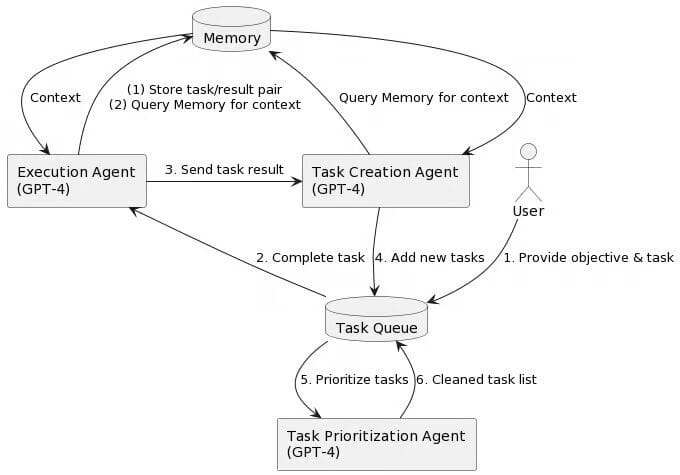
To better understand the framework of autonomous AI agents, let’s break down the image below:

Why You Need To Know About Autonomous AI Agents
Image by Yohei (Creator of Baby AGI)

The system image above is broken into 6 steps, which run on an infinite loop:

  1. The use provides an objective/task.
  2. This then goes to the task queue which then moves over to the ‘Execution Agent’ to be stored in the ‘Memory’. The objective/task is now stored in the memory.
  3. The objective/task then adds context (recalls past experiences and knowledge base) before it is sent to the ‘Execution Agent’ which sends the task result to the ‘Task Creation Agent’.
  4. The task has now been created and added to the ‘Task Queue’.
  5. The task will then have to go through the ‘Task Prioritization Agent’ to get prioritized amongst other tasks.
  6. The last step is the agent cleaning up the task list during the ‘Task Prioritization Agent’ phase.

Why Are Autonomous Agents Important?

A few months ago, ChatGPT was released and we’re seeing a lot of people take to it. Companies are adopting it and looking at new ways to integrate it into their operations. Developers are going crazy with the plugins. It is showing that AI systems are becoming an integral part of the ecosystem.

For some, this may seem like a momentary thing. However, the technology world is receiving high investment and is growing at a rapid rate to keep the momentum going. The advancements and implementations of artificial intelligence in our everyday lives are much closer than we think.

We live in a fast-paced digital landscape, where autonomous AI agents have the potential to improve productivity and operations across different industries. This will allow businesses to operate more efficiently, whilst still being able to remain competitive.

Autonomous AI agents aren’t like humans. They don’t need sleep, a lunch break, etc. They can program 24/7 to ensure effective production, faster results, and reduce tedious task workloads of current employees.

Companies will start to see a cut in labour costs, a boost of productivity in both employees and efficient strategies. However, we understand that an increase in autonomous AI agents will create job displacements in industries that involve heavy repetitive tasks such as manufacturing.

You will naturally see jobs that involve creativity, advanced problem-solving, and innovative thinking increase in demand. As well as roles such as data analysis, data ethics, and AI system monitoring which will be required to monitor AI-based systems.

Wrapping it up

It is no longer a question of whether autonomous AI agents will be adopted into organizations, it is happening. It's a matter of understanding when it will happen in full effect.

So what will you be doing?

  1. Looking into creating autonomous agents which others can hire?
  2. Or hiring autonomous agents to improve productivity and personal life?

I hope this article has taught you a thing or two about what you expect from autonomous AI agents and how they will shape our future. If you have found any interesting news about autonomous AI agents, drop a comment below!

Nisha Arya is a Data Scientist, Freelance Technical Writer and Community Manager at KDnuggets. She is particularly interested in providing Data Science career advice or tutorials and theory based knowledge around Data Science. She also wishes to explore the different ways Artificial Intelligence is/can benefit the longevity of human life. A keen learner, seeking to broaden her tech knowledge and writing skills, whilst helping guide others.

More On This Topic

  • AgentGPT: Autonomous AI Agents in your Browser
  • How to Make Sense of the Reinforcement Learning Agents?
  • How DeepMind Trains Agents to Play Any Game Without Intervention
  • Baby AGI: The Birth of a Fully Autonomous AI