Vimeo intros a trio of AI-powered editing features Kyle Wiggers 8 hours
Vimeo, the video hosting and sharing platform, is embracing AI in a major way.
This week, Vimeo announced a suite of AI-powered tools designed to help users create scripts, record footage using a built-in teleprompter and remove long pauses and unwanted disfluencies like “ahs” and “ums” from the recordings. They’ll be available starting July 17 as a part of Vimeo’s Standard plan, which costs $20 per month (billed annually).
Ashraf Alkarmi, Vimeo’s chief product officer, says that the new capabilities are aimed at entry-level video creators — like CEOs, employees and social media managers — who lack the skills, time and resources to achieve the effects that they want to achieve.
According to Vimeo’s internal research, 50% of its customers do multiple takes while creating a video, and — of those who reshoot — 25% do over five takes.
“Despite being the most effective way to communicate powerful messages, video production inherently creates a barrier to this preferred communication channel,” Alkarmi told TechCrunch via email. “Our latest AI-powered workflow reduces those barriers, giving any creator the confidence to actually create videos in one take.”
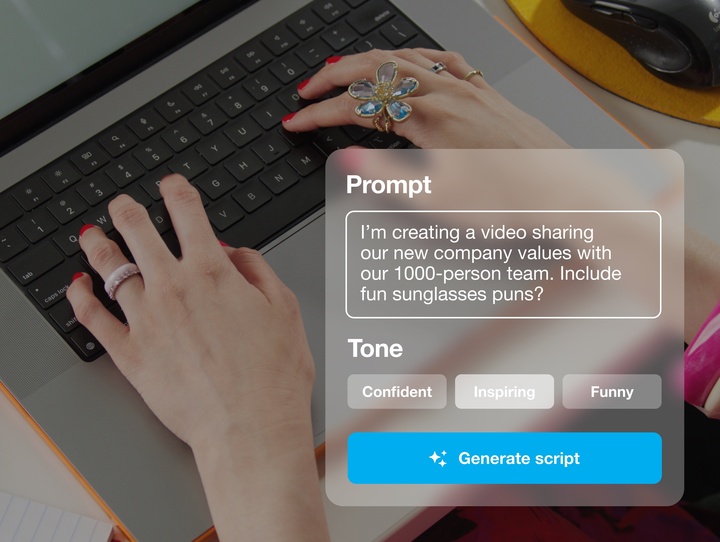
Generating a script using AI, with Vimeo’s new tool.
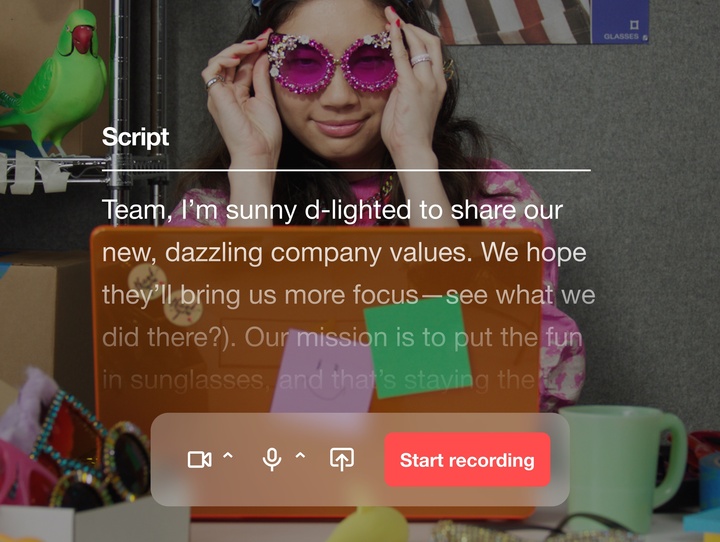
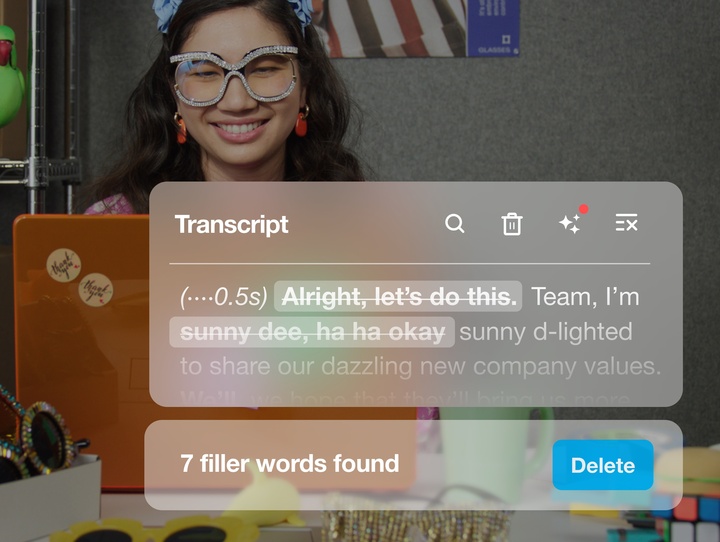
To that end, Vimeo’s new script generator uses generative AI — specifically the OpenAI API — to create a video script based on a brief description and key inputs, such as tone (e.g. “confident,” “inspiring” or “casual”) and length. The teleprompter tool offers a script display that can be customized with different font sizes and pacing, meanwhile, while the text-based video editor automatically identifies and deletes filler words and awkward pauses.
Alkarmi sees the tools being used to quickly create highlight reels, host virtual events or company meetings and export quote clips for short marketing videos.
Vimeo’s teleprompter.
“One of Vimeo’s biggest misconceptions is that we’re an entertainment hub, but we’ve come a long way over the years,” Alkarmi said. “Our goal is to help any business use video the same way that they use text or image as a powerful way to communicate to both internal and external audiences.”
Leveraging AI to achieve those ends is trendy, of course. But Alkarmi notes that Vimeo has been investing in AI for some while. In 2019, the company acquired Magisto, which was developing AI tech for video editing. Vimeo built its Create tool on top of the Magisto infrastructure, which lets users create video by piecing together stock photos and videos as well as personal archives.
Vimeo’s AI-powered editor.
Alkarmi expects AI to remain a core focus for Vimeo moving forward. That’s probably wise from a competitive standpoint. A growing number of startups, including Capsule, Descript and Dumme, offer AI-powered video editing tools. So too do incumbents like Adobe, which — like Vimeo — see AI as a key ingredient to video editing workflows of the future.
“We’re clearly only scratching the surface of what AI can accomplish for organizations and the people within them, and I envision a future in which AI knowledge is a prerequisite, not a luxury, to video production,” Alkarmi said. “AI is a priority for me and my product team because it solves our customer issues, not because it’s the latest technological trend. You can expect more products like this from our team, as we work to make AI seamless in our product suite and in a way that simplifies video and differentiates end-to-end user journeys.”
Publicly-traded Vimeo, which has around 260 million users, had a rough start to the year, laying off around 11% of its workforce. But things appear to be turning around — perhaps thanks in part to the platform’s renewed AI investments. In its latest earning report in May, the company beat expectations, reporting around $103.58 million in revenue versus the consensus estimate of $103.07 million.
When Larry Page said “Google will fulfil its mission only when its search engine is AI-complete,” in 2002, he really meant it.
Google has dominated the search space for years with more than 93% share whereas its biggest competitor Microsoft has a mere 3%. However, amid the power struggle between the big techs, Google seemed to have slowly loosing its mojo, especially after the Microsoft-backed OpenAI’s Chagpt spread like wildfire.
But now taking charge, seems like Google has found its moat – by unveiling a new AI-powered Search Generative Experience at Google I/O 2023. Although not yet available to the public, several beta users in US have taken to social media to rave about the new upgrades.
Killing Online Search
Built on LLM PaLM 2, Search incorporates generative AI capabilities, enabling users to quickly grasp complex subjects through comprehensive answers. To facilitate further exploration, related topics are conveniently presented alongside search results. The new Search also has a ChatGPT-style interface that allows users to ask follow-up questions and maintain context while delving deeper into a topic.
Compared to ChatGPT, Bard is also better at research. Bard is also better at understanding Python backend to tackle complex inquiries without explicit prompts from the user to prevent it from hallucinating. Google has incorporated this approach to enhance Bard’s capabilities, expanding beyond System 1 thinking to incorporate elements of System 2 thinking. By integrating code into the equation, which is a characteristic of System 2 thinking, Google aims to combine the strengths of both approaches for optimal performance.
According to beta user Linas Buenas, enhancements to Google’s search engine now offer the ability to refine search queries within the search results page, eliminating the need to start anew if the initial results are not satisfactory. Additionally, users can perform various tasks without leaving the search page, streamlining their online experience and increasing efficiency.
A noteworthy feature is an option to easily address specific issues by copying and pasting code for Google’s assistance.
As expected, Google intends to integrate ChatGPT-like “written answers” into its new AI search engine, featuring prominent domains alongside these answers. This underscores the significance of high-quality content in improving a website’s visibility in search results.
Taken as a whole, Google’s focus is shifting from solely gathering information to actively editing and curating it.
Reading more: The Secret Weapon for the Survival of Indian Edtech Firms
Seamless Online Shopping is Here
Google has introduced two new AI features for virtual try-on of clothes, making it more diverse and inclusive. Built on a new diffusion based architecture, ‘TryOnDiffusion: A Tale of Two UNets’, it displays clothes on a diverse range of real models, including different sizes, complexions, races, and more. This update aims to make the virtual try-on experience more inclusive and representative as it features real life models from XXS to 4XL. The AI model accurately depicts the draping, folding, stretching, and formation of wrinkles and shadows on the virtual models. However, the features are now available only in US.
The second feature refines products using machine learning and visual matching. It helps shoppers find the perfect piece by fine-tuning search criteria for color, style, and pattern. Unlike in-store shopping, it offers a wide range of options from different online stores. Currently available for tops, it improves online shopping by allowing users to evaluate clothes before buying and providing personalized search options. With Google’s Shopping Graph, it can potentially expand to more brands and items in the future.
Now this easy breezy shopping experience comes to you being is supported by Google’s Shopping Graph – an extensive collection of more than 35 billion product entries, vendors, trademarks, and available stock while Amazon has barely over 350 million products. Moreover, Lens helps you with shopping, allowing you to find and purchase products that catch your eye by simply taking a screenshot and exploring shoppable options.
Besides this, Google Lens can now be used to identify skin conditions by capturing or uploading a photo. This feature extends to other body concerns, such as lip bumps, nail lines, or hair loss, making it easier to find relevant information.
When traveling, Lens becomes a valuable language translator, capable of converting street signs, menus, and other texts into over 100 languages. For students, Lens offers step-by-step help with homework problems in math, history, and science, supporting multiple languages for search results.
Betting Big on Ads
As per the latest information, search ads emerged as Google’s primary income generator in 2022. Out of the substantial sum of $279.81 billion that the company accumulated, an astounding $162.45 billion was derived from search ads alone.
So, Google’s aim to milk money from AI-backed search is nothing surprising.
Google and YouTube have launched two AI-powered ad solutions: Demand Gen and Video View. Demand Gen integrates high-performing videos and images into platforms like YouTube, YouTube Shorts, Discover, and Gmail. It offers an easy construction flow for advertisers to import successful assets into Google Ads and preview ad appearance. Advertisers can improve campaigns with customized creatives and audience segments. Video View campaigns maximise views across in-stream, in-feed, and YouTube Shorts, outperforming traditional cost-per-view campaigns.
Following the path of Amazon, Google, highlights the sponsored products. It shows AI-written content at the top of search results, followed by sponsored and organic posts.
Previously, Google believed in ranking content based on expertise, but it has now shifted towards using AI-generated answers. This change suggests that Google might be exploring ways to generate additional revenue, potentially by allowing websites to pay Google when their content is selected to generate an answer.
So, welcome to Google 2.0. It is only going to get bigger and better.
Read more: Why Graph Databases Remain Untapped
The post Google’s Search Supremacy Reinforced with Generative AI appeared first on Analytics India Magazine.
Beyond looking for general information, you can search for images, videos, news, maps, and more.
Looking for a website that combines a regular search engine and an AI chatbot? YouChat fits that bill. Offered by You.com, YouChat provides a prompt where you can submit a request, question, or search query. In return, it displays an AI-generated response along with website links for you to investigate the results.
Also: The best AI chatbots: ChatGPT and other noteworthy alternatives
Beyond looking for general information, you can search for images, videos, news, maps, and more. Plus, you're able to ask it to generate artwork, computer code, and other content. Besides the website, You.com is available as an extension for Chrome, Firefox, and Microsoft Edge, as well as a mobile app for iOS and Android. Let's see how this all plays out.
Also: These are my 5 favorite AI tools for work
Also: How I used ChatGPT and AI art tools to launch my Etsy business fast
Also: 6 things ChatGPT can't do (and another 20 it refuses to do)
Also: How to use Wordtune AI to rewrite texts on your iPhone
Also: ChatGPT's 'accomplishment engine' is beating Google's search engine, says AI ethicist
Also: Best secure browsers to protect your privacy online
GenZ and Millennials are most likely to view their senior leadership as not valuing adopting emerging technology.
Emerging technologies such as generative AI have the potential to transform the workplace in a way that improves productivity and optimizes workflows, which many workers want. However, for that to happen, senior leaders first have to enable these technologies.
A new study by Ernst & Young (EY) surveyed more than 1,000 US employees regarding 12 emerging technologies, including AI, machine learning (ML), and augmented and virtual reality (AR/VR) among others.
Also:Your next job interview could be with AI instead of a person
A whopping 89% of the workers polled disclosed that they believed adopting emerging technologies would be beneficial to their company. However, 59% of them said their senior leadership was slow to embrace these technologies, according to the survey.
Furthermore, 52% of the polled employees say that the technologies are outdated by the time the respondents' companies decide to implement them.
"Though leaders acknowledge how new technologies can transform their business, they need to also be aware of employee perceptions around the slow pace of adoption, and the barriers and risks that could undermine efforts," said Faisal Alam, EY Americas Consulting Emerging Technology Leader.
Privacy and cybersecurity are among the concerns that prevent leadership from adopting newer, advanced technologies more quickly.
Also: Generative AI can save marketing pros 5 hours per week, according to research
For example, major companies — including Apple, Verizon, JPMorgan Chase, and Amazon — have restricted one of the most popular emerging technologies, ChatGPT, from their internal networks due to data privacy concerns.
The differing views on emerging technologies can also be attributed to generational gaps. The survey showed that GenZ and Millennial employees are more likely than previous generations to use generative AI to draft emails.
GenZ and Millennials are also the two generational groups most likely to view their senior leadership as not valuing adopting emerging technology.
Also: Tech HR professionals are using ChatGPT to craft termination letters
As AI chatbots and art generators seem to gain more popularity by the minute, some of the most prominent players in the business are trying to stay in the game with their own tools. Meta just presented Voicebox, a text-guided, artificially-intelligent speech generator so powerful that the company claims to outperform all existing models.
Voicebox is powerful enough to generate voices as easily as ChatGPT can generate text and Bing or Dall-E 2 can create images. Though the system isn't yet widely available for public use, Meta has made demos accessible to anyone interested in learning more about Voicebox.
Also: Your next job interview could be with AI instead of a person
The system could be used in audio editing by content creators and editors, for example, as its voice generation makes for natural-sounding audio clips. But it's versatile enough to intelligently edit noise out of voice clips, like dogs barking, and regenerate the voice without missing a beat.
One of the abilities Voicebox presents is that it can match the audio style of a sample and generate text-to-speech clips. Essentially, visually-impaired users could give Voicebox an audio clip of a friend as short as two seconds, and it'd be able to read that friend's written messages in their voice using AI.
The new generative AI tool can solve tasks via in-context learning, so it can process text it's never been given before and correctly generate context and inflections much like a person would read it by using existing knowledge to learn and tackle new challenges.
Also: Generative AI should be more inclusive as it evolves, according to OpenAI's CEO
The ethical and legal implications of this groundbreaking tool are not easily dismissible. Anyone could generate audio clips using recordings of a person's voice without permission and claim to have them say anything they want.
In the published paper, Meta claims that a binary classification model can distinguish between real-world speech and that which Voicebox generates. Either way, since the system is not publicly available, Meta's metaphorical feet are yet to be held to the fire.
Also: LLMs aren't even as smart as dogs, says Meta's AI chief scientist
Meta trained Voicebox on 60,000 hours of English audiobooks and 50,000 hours of multilingual audiobooks in six languages for optimal performance. Its training enables it to perform multilingual text-to-speech with no training, speech denoising, styling, editing, and generating diverse speech samples.
In a paper published by Meta AI, the company claims it can generate diverse audio samples 20 times faster than Microsoft's VALL-E and more intelligible.
Also: Even Google is warning its employees about AI chatbot use
Aside from being faster and making fewer errors than competitors, Meta claims Voicebox can convert written text into spoken words in one or multiple languages without being specifically trained for each language separately.
Compared to the previous state-of-the-art model, YourTTS, Voicebox was found to reduce the average word error rate from 10.9% to 5.2%, as well as increase the audio similarity from 0.335 to 0.481.
Databases or data structure servers form the backbone of generative AI, powering its capabilities. From real-time champion Redis helping LLM-powered chatbots like ChatGPT to keep the conversation going, to enterprises building chatbots integrating NoSQL hero MongoDB Atlas and Google Cloud Vertex AI PaLM API, database companies are at the forefront of the generative AI revolution, driving its progress.
Amidst this revolution, graph database pioneer Neo4j takes a strategic approach, playing the long game – i.e. building trust in generative AI. “We provide fuel for generative AI companies in the form of high-quality, structured graph data,” said Dr Jim Webber, chief data scientist, Neo4j, in an exclusive interview with AIM at their Annual Graph Summit, held last week in Mumbai .
Neo4j said that it provides the graph data for large language models to be trained on. Over time, knowledge graphs have become vital for organising and accessing enterprise data across industries. Today, Neo4j is playing a pivotal role in helping enterprises integrate LLMs to enhance data handling. They’re focusing on two use cases: developing a natural language interface for knowledge graphs and creating knowledge graphs from unstructured data.
Neo4j’s Graph Data Science framework offers advanced graph analytics and data science capabilities, including a flexible toolkit, a scalable graph database, and a visualisation tool. This enables businesses to make predictions, solve intricate problems, and extract valuable insights. By leveraging graph algorithms and predictive features, organisations demonstrate the value of graphs in advanced analytics, machine learning, and AI. Neo4j’s Cypher is a graph query language resembling SQL to simplify data retrieval from graphs, allowing users to focus on the desired information.
Webber said that the aim is to make data more accessible, understandable, and credible. The integration of LLMs and Neo4j’s graph database technology improves efficiency and accuracy. The project progresses with an open mindset, adapting to new data and technological advancements in this rapidly evolving field. “The convergence of knowledge representation and machine learning is crucial for advancing AI,” said Webber.
Read more: Why Graph Databases Remain Untapped
Dr Jesus Barrasa, head of solutions architecture, Neo4j, told AIM that Neo4j represents the knowledge about a domain, providing curated and explainable answers. On the other hand, machine learning models learn from large datasets and provide plausible but unexplainable answers.
“The combination of these approaches is advantageous,” said Barrasa. He said that machine learning models can distil vast amounts of knowledge, but lack curation and trust. By integrating curated knowledge from Neo4j with machine learning models, we can ask questions about anything with validation and trust. He said that LLMs act as productivity enhancers, allowing quick code generation and data analysis for the knowledge graph population. They also enable non-technical users to interact with technology through generating structured questions from natural language.
The post Neo4j’s Role in Fueling Generative AI with Graph Technology appeared first on Analytics India Magazine.
It's likely that the code written by an AI can't be owned or copyrighted in a way that provides legal protections.
Last month, I wrote an article about how ChatGPT can rewrite and improve your existing code. One of the commenters, @pbug5612, had an interesting question:
Who owns the resultant code? What if it contains business secrets — have you shared it all with Google or MS, etc.?
It's a good question and one that doesn't have an easy answer. Over the past two weeks, I've reached out to attorneys and experts to try to get a definitive answer.
Also: The best AI chatbots: ChatGPT and other noteworthy alternatives
There's a lot to unpack here, but a good starting point is the overall theme of this discussion. As attorney Collen Clark of law firm Schmidt & Clark states:
Ultimately, until more definitive legal precedents are established, the legal implications of using AI-generated code remain complex and uncertain.
But that's not to say there is a shortage of opinions. Today, I'll discuss the copyright implications of using ChatGPT to write your code. Tomorrow, I'll discuss issues of liability related to AI-generated code.
Also: How to use ChatGPT to write code
Who owns the code?
Here's a probable scenario. You're working on an application. Most of that application is your direct work. You've defined the UI, crafted the business logic, and written most of the code. But you've used ChatGPT to write a few modules, and linked that resulting code into your app.
Who owns the code written by ChatGPT? And does the inclusion of that code invalidate any ownership claims you have on the overall application?
Attorney Richard Santalesa, a founding member of the SmartEdgeLaw Group based in Westport, Conn., focuses on technology transactions, data security, and intellectual property matters. He points out that there are issues of contract law as well as copyright law — and they're treated differently.
From a contractual point of view, Santalesa contends that most companies producing AI-generated code will, "as with all of their other IP, deem their provided materials — including AI-generated code — as their property."
OpenAI (the company behind ChatGPT) does not claim ownership of generated content. According to their terms of service, "OpenAI hereby assigns to you all its right, title and interest in and to Output."
Also: AI is coming to a business near you. But let's sort these problems first
Clearly, though, if you're creating an application that uses code written by an AI, you'll need to carefully investigate who owns (or who claims to own) what.
For a view of code ownership outside the US, ZDNET turned to Robert Piasentin, a Vancouver-based partner in the Technology Group at McMillan LLP, a Canadian business law firm. He says that ownership, as it pertains to AI-generated works, is still an "unsettled area of the law."
That said, there has been work done to try to clarify the issue. In 2021, the Canadian agency ISED (Innovation, Science and Economic Development Canada) recommended three approaches to the question:
Ownership belongs to the person who arranged for the work to be created;
Ownership and copyright are only applicable to works produced by humans, and thus, the resultant code would not be eligible for copyright protection; or
A new "authorless" set of rights should be created for AI-generated works.
Also: 92% of programmers are using AI tools, says GitHub developer survey
Piasentin, who was also called to the bar in England and Wales, says, "Much like Canada, there is no English legislation that directly regulates the design, development, and use of AI systems. However, the UK is among the first countries in the world to expressly define who can be the author of a computer-generated work."
According to Piasentin, "Under the UK Copyright Designs and Patents Act, with respect to computer-generated work, the author of the work is the person who undertook the arrangements necessary to create the work and is the first owner of any copyright in it."
Piasenten says there may already be some UK case law precedent, based not on AI but on video game litigation. A case before the High Court (roughly analogous to the US Supreme Court) determined that images produced in a video game were the property of the game developer, not the player — even though the player manipulated the game to produce a unique arrangement of game assets on the screen.
Because the player had not "undertaken the necessary arrangements for the creation of those images," the court ruled in favor of the developer.
Also: These are my 5 favorite AI tools for work
Ownership of AI-generated code may be similar, in that, Piasenten notes, "The person who undertook the necessary arrangements for the AI-generated work — that is, the developer of the generative AI — may be the author of the work." That doesn't necessarily rule out the prompt-writer as the author.
Notably, it also doesn't rule out the unspecified (and possibly unknowable) author who sourced the training data as an author of AI-generated code.
Fundamentally, until there's a lot more case law, the issue is murky.
Also: Everyone loves low-code/no-code development, but not all are ready for it
What about copyright?
Let's touch on the difference between ownership and copyright. Ownership is a practical power that determines who has control over the source code of a program and who has the authority to modify, distribute, and control the codebase. Copyright is a broader legal right granted to creators of original works, and is essential to controlling who can use or copy the work.
If you look at litigation as something of a battle, Santalesa describes copyright as "one arrow in the legal quiver." The idea is that copyright claims provide an additional claim, "above and beyond any other claims — such as breach of contract, breach of confidentiality, misappropriation of IP rights, etc." He also says that the strength of the claim hinges on willful infringement, which can be a challenge even to define when it comes to AI-based code.
Then there's the issue of what can qualify as a work of authorship, in other words, something that can be copyrighted. According to the Compendium of the U.S. Copyright Office Practices, Third Edition, "To qualify as a work of 'authorship' a work must be created by a human being…Works that do not satisfy this requirement are not copyrightable."
Also: How Nvidia uses GPT-4 to make AI better at Minecraft
Additionally, the Compendium notes, "The U.S. Copyright Office will not register works produced by nature, animals, or plants. Likewise, the Office cannot register a work purportedly created by divine or supernatural beings." While the Copyright Office doesn't specifically say whether AI-created work is copyrightable or not, it's probable that that block of code you had ChatGPT write for you isn't copyrightable.
Piasenten says this applies in Canada, too. Provisions that point to "the life of the author" and the requirement that the author be a resident of a certain country imply a living human. Piasenten tells us that the Supreme Court of Canada found in CCH Canada Ltd. v Law Society of Upper Canada that original work is derived from "an exercise of skill and judgment," and it cannot be "purely mechanical exercise."
Messy for coders
Let's wrap up this part of our discussion with some thoughts from Sean O'Brien, lecturer in cybersecurity at Yale Law School and founder of the Yale Privacy Lab. Taking us from analogies and speculation to actual rulings, O'Brien points to some US Copyright Office actions on AI-generation.
According to O'Brien, "The U.S. Copyright Office concluded this year that a graphic novel with images generated by the AI software Midjourney constituted a copyrightable work because the work as a whole contained significant contributions by a human author, such as human-authored text and layout. However, the isolated images themselves are not subject to copyright."
If this ruling were applied to software, the overall application would be copyrighted, but the routines generated by the AI would not be subject to copyright. Among other things, this requires programmers to label what code is generated by an AI to be able to copyright the rest of the work.
Also: Top programming languages and topics: Here's what developers want to learn about
There are also some messy licensing issues. O'Brian points out that ChatGPT "can't properly provide the copyright information, specifically refusing to place free and open source licenses like the GNU General Public License on code."
Yet, he says, "It's already been proven that GPL'd code can be verbatim repeated by ChatGPT, creating a license infringement mess. Microsoft and GitHub continue to integrate such OpenAI-based systems into code authoring platforms used by millions, and that could muddy the waters beyond recognition."
What does it all mean?
We haven't even touched on liability and other legal issues, so stay tuned for part two tomorrow. There are some clear conclusions here, though.
First: This is somewhat uncharted territory. Even the attorneys are saying there's not enough precedent to be sure what's what. I should point out that in my discussions with the various attorneys, they all strongly recommended seeking an attorney for advice on these matters, but in the same breath acknowledged that there wasn't enough case law for anyone to have more than a rough clue how it was all going to shake out.
Second: It's likely that the code written by an AI can't be owned or copyrighted in a way that provides legal protections.
Also: Generative AI brings new risks to everyone. Here's how you can stay safe
This opens a huge can of worms because unless code is rigorously documented, it will be very difficult to defend what is subject to copyright and what's not.
Let's wrap this up with some more thoughts from Yale's O'Brien, who believes that ChatGPT and similar software is leaning on the concept of fair use. However, he says:
There have been no conclusive decisions around this affirmation of fair use, and a 2022 class action called it "pure speculation" because no court has yet considered whether usage of AI training sets arising from public data constitutes fair use.
Pure speculation. When considering whether you own and can copyright your code, you don't want a legal analysis to end with the words "pure speculation." And yet here we are.
You can follow my day-to-day project updates on social media. Be sure to follow me on Twitter at @DavidGewirtz, on Facebook at Facebook.com/DavidGewirtz, on Instagram at Instagram.com/DavidGewirtz, and on YouTube at YouTube.com/DavidGewirtzTV.
Microsoft continues its hot streak of Bing Chat new features with its latest updates, which include a handy iOS addition — a widget.
To make accessing Bing Chat on your iPhone even easier than using an app, Microsoft brought its Android Bing Chat widget to iOS.
Also: Now you can have a voice conversation with Bing Chat. Here's how
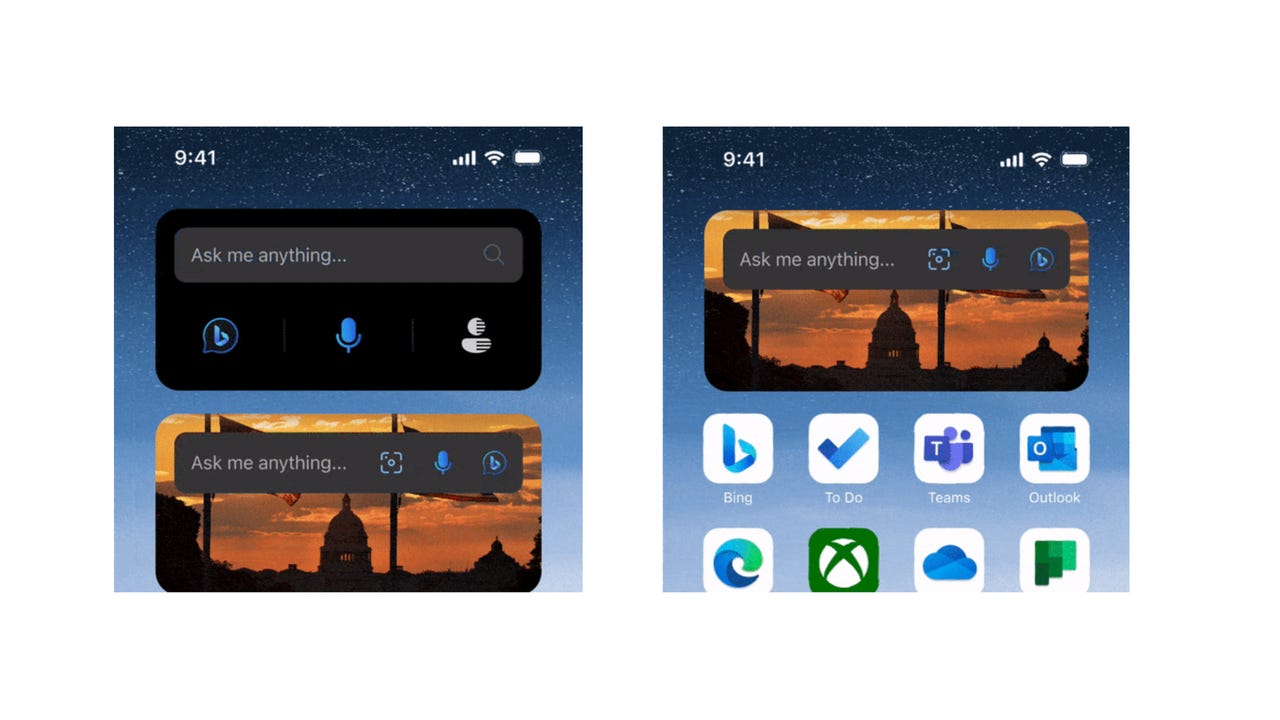
Like other widgets, the Bing Chat widget lives on your home screen, allowing you to initiate a chat right when you open your phone.
The widget will include a search bar users can use to type in any prompt, as well as a microphone icon users can use to dictate their queries. It also includes a camera icon that can be used to do visual searches from an image.
To download the widget, you first have to download the Bing Chat app. Then, all iOS users have to do is press down on an empty area of the home screen until all the apps jiggle.
Also: 7 ways you didn't know you can use Bing Chat and other AI chatbots
Click on the + symbol in the upper left-hand corner, and then you can search or select the Bing AI chat widget. Lastly, you can pick where on your screen you would like the widget to live.
This update also included an improved performance for the voice feature, such as text-to-speech support for even more languages.
Meta has been killing it in the generative AI field lately. In the latest announcement, Meta AI revealed a major breakthrough in the field of generative AI for speech, Voicebox, a multilingual model capable of performing various speech generation tasks through in-context learning, even tasks it was not explicitly trained for.
Check out the paper here.
Amid concerns around deepfake, the company claims that Voicebox is so competent that it has decided to not make it open to the public yet.
Voicebox represents a significant leap forward as it can generate high-quality audio clips and seamlessly edit pre-recorded audio. Notably, it can remove unwanted background noise, such as car horns or barking dogs, while preserving the original content and style of the audio.
Additionally, this versatile AI model is capable of producing speech in six different languages, making it a valuable tool for multilingual applications.
JUST IN: Meta just introduced Voicebox! This is the first generative AI model that can synthesize speech across six languages, perform noise removal, edit content, transfer audio style & more. Highlights ▸ Generalizes speech generation across tasks with impressive results and… pic.twitter.com/cWABZWQvDK
— Lior (@AlphaSignalAI) June 16, 2023
Meta says that this could lend natural-sounding voices to virtual assistants and non-player characters in the emerging metaverse. Furthermore, visually impaired individuals could benefit from AI-generated voices that read written messages in their familiar voices, while content creators gain new and efficient tools for audio track creation and editing in videos, among other exciting possibilities.
In-context text-to-speech synthesis: By using a mere two-second audio sample, Voicebox can match the style and reproduce it for text-to-speech generation.
Speech editing and noise reduction: Voicebox can seamlessly recreate interrupted speech segments caused by external noise or replace misspoken words without requiring a complete re-recording. For instance, it becomes akin to an “eraser” for audio editing, enabling users to identify and regenerate specific interrupted portions of speech, such as when a dog barks during a recording.
Cross-lingual style transfer: Armed with a speech sample and a text passage in English, French, German, Spanish, Polish, or Portuguese, Voicebox can deliver a reading of the text in any of these languages, even if the sample speech and the text are in different languages. This breakthrough feature paves the way for natural and authentic communication between individuals who speak different languages.
Diverse speech sampling: Voicebox has been trained on a wide range of data, resulting in the generation of speech that more accurately reflects how people naturally communicate in the real world and across the six supported languages.
Meta has been dedicated to preserving the languages across the world. For this, the company had also released Massively Multilingual Speech AI research models consisting of 4,000 spoken languages for text-to-speech and speech-to-text capabilities. This comes after Meta releasing MusicGen, a transformer based music generation platform through text inputs which outperform Riffusion, Mousai, and MusicLM on various performance metrics.
Moreover, Meta AI recently also announced I-JEPA, a self-supervised computer vision model for learning the world by predicting, which is based on Yann LeCun’s vision of autonomous machine intelligence.
The post Meta Releases Voicebox, a Multilingual Speech Generation Model appeared first on Analytics India Magazine.
Exploring Government 2.0. Government 2.0 embodies an era where governments leverage AI and data-driven solutions to address local, national, and international problems.
How AI and data transformation influence government processes. Find out how AI and data transformation can impact government processes in making data-driven decisions, enhancing citizen participation, utilizing public services, and ensuring transparency and accountability.
Learn the challenges and considerations for implementing AI and data in government.
Integrating artificial intelligence (AI) and data transformations has emerged as a powerful catalyst for change in the ever-evolving governance landscape.
Referred to as Government 2.0, this innovative approach can revolutionize how governments operate, make decisions, engage with citizens, and deliver public services.
By harnessing the power of data, governments can enhance their efficiency, transparency, and accountability while creating a more inclusive and participatory environment.
This article explores the concept of Government 2.0 and the overall impact of this evolutionary approach.
Exploring Government 2.0
Government 2.0 represents a paradigm shift in governance, fueled by technology and the ever-increasing data availability. It embodies an era where governments leverage AI and data-driven solutions to address local, national, and international problems.
Government 2.0 enhances its capabilities to serve its citizens, foster innovation, and address societal challenges. This approach promotes collaboration, openness, and citizen-centricity, paving the way for more efficient and meaningful governance systems.
How AI and data transformation influence government processes
Like businesses, big data is expected to impact the public sector, particularly in policymaking. It has now been applied and used in several forms, from ID systems to internal workflows in government agencies.
Surely, AI and data transformation can impact government processes in the following ways.
Data-driven decisions
One of the key benefits of Government 2.0 is its ability to harness data to make informed decisions. By collecting, analyzing, and interpreting vast amounts of data, governments can gain valuable insights into various aspects of public administration.
Processed data enables policymakers to see the trends and statistics that matter to their citizens. An example is the balance of the cost of living in a certain area to each employee’s salary.
From here, they can design evidence-based policies and strategies that more accurately address their citizens’ needs.
Enhancing citizen engagement
AI and data transformations offer unprecedented opportunities to engage citizens in decision-making.
Through online surveys and social media, governments can gather real-time feedback, opinions, and suggestions. This inclusive approach promotes transparency, trust, and active participation on the citizens’ part.
Utilizing public services
Government 2.0 revolutionizes the way public services are delivered.
By integrating AI-powered solutions, governments can streamline administrative processes, automate routine tasks, and enhance service quality.
A good example of this involves establishing an individual’s digital identity. Citizens can sign up and kickstart their verification processes online to get IDs from their local or national agencies. Meanwhile, the latter can issue physical and digital copies of their ID cards.
Additionally, predictive analytics can optimize resource allocation, leading to more efficient service delivery and improved outcomes for the public.
Ensuring transparency and accountability
Transparency and accountability are vital pillars of effective governance. With Government 2.0, these principles are further reinforced through stored data.
Governments now leverage cloud technologies to create immutable and transparent records of their activities. Further, AI-based auditing systems can identify anomalies and patterns of irregularities, strengthening accountability mechanisms and minimizing corruption risks.
Considerations for implementing AI and data in government
While integrating AI and data transformations presents immense opportunities, it also comes with inherent challenges and considerations that governments must address.
Data privacy and security
The increased reliance on data raises concerns about privacy and security. In the cloud, an agency’s data is vulnerable to breaches, hacks, and other suspicious activities that may arise.
Governments must prioritize protecting citizens’ personal information and ensure robust cybersecurity measures are in place.
Implementing stringent data protection regulations and frameworks is crucial to maintaining public trust and safeguarding sensitive data from unauthorized access or misuse.
Algorithmic biases
AI systems are only as unbiased as the data they are trained on. In many cases, different biases are seen, with people getting barred from having access to public services due to their race, gender, and other aspects.
Governments must be vigilant in addressing algorithmic biases that may perpetuate discrimination or unfairness.
Rigorous testing, ongoing monitoring, and diversifying datasets are essential to ensure AI technologies promote inclusivity, equality, and unbiased decision-making.
Ethical considerations
The ethical implications of AI and data-driven governance demand careful consideration. While many people won’t mind providing their data to the government, some might think handing over their information can subject them to surveillance and weaponization.
Governments must establish clear guidelines and ethical frameworks that guide the responsible use of AI and data.
This includes ensuring transparency in algorithmic decision-making, addressing concerns related to job displacement, and upholding principles of fairness and accountability throughout the implementation process.
Government 2.0: Helping governments evolve
Government 2.0 represents a significant leap forward in the evolution of governance. By embracing AI and data transformations, governments can unlock unprecedented potential in efficiency, transparency, and citizen engagement potential.
This transformative approach promises more responsive and accountable governments that actively involve citizens in shaping the policies and services that impact their lives.
Integrating technologies in the public sector empowers governments to make data-driven decisions, enhance citizen engagement, optimize public services, and ensure transparency and accountability.
However, careful consideration must be given to some aspects that could erode the trust its citizens give. By navigating these challenges, governments can fully embrace Government 2.0 and create a future where innovation and citizen-centricity thrive.












 (@AlphaSignalAI) June 16, 2023