PM Modi Calls for Global Collaboration for AI in Education at G20 Meeting

PM Modi Calls for Global Collaboration for AI in Education at G20 Meeting

In a significant address delivered during the G20 education ministers’ meeting in Pune, Prime Minister Narendra Modi emphasised the vital role of AI in the field of education. He highlighted the immense possibilities offered by AI in learning and skills development, while acknowledging the challenges that accompany. Modi stressed the importance of striking the right balance in utilising AI for educational purposes.

The G20 ministers convened to officially accept the outcome documents, marking the culmination of extensive deliberations conducted within the education working group track over the past several months. These outcome documents will serve as a roadmap for coordinated global actions, aiming to ensure inclusive and high-quality education for all learners.

The education working group, which gathered in Chennai, Amritsar, Bhubaneshwar, and Pune, focused on formulating inclusive solutions and collective actions to address global educational challenges. Their priorities encompassed foundational literacy and numeracy, inclusive and qualitative tech-enabled learning, capacity building for future work requirements, as well as fostering research and innovation through collaboration and partnerships.

During the meeting, a recorded message from Prime Minister Modi urged the G20 to play a pivotal role in leveraging technology to enhance global education. He emphasised the role of digital technology as an “equaliser” and a means to promote inclusivity, highlighting its potential to expand access to education and adapt to future needs. Additionally, Modi underscored the integration of technology with learning to enhance the e-learning experience.

Read: India Backs Off on AI Regulation. But Why?

He commended the Study Webs of Active-learning for Young Aspiring Minds (SWAYAM), an esteemed e-learning portal providing remote access to courses from renowned institutions. SWAYAM has achieved remarkable enrollment numbers, offering a wide range of 9,000 courses from the 9th grade to the postgraduate level.

Furthermore, Prime Minister Modi proposed that G20 countries undertake international skill mapping to identify and address gaps in workforce capabilities. He stressed the necessity of continuous skilling, re-skilling, and up-skilling of the youth to equip them for the future and align their competencies with evolving work profiles and practices.

India has already initiated skill mapping efforts, and Modi encouraged other G20 nations to follow suit, fostering a collective approach to workforce development.

The post PM Modi Calls for Global Collaboration for AI in Education at G20 Meeting appeared first on Analytics India Magazine.

What Can We Expect From GPT-5?

What Can We Expect From GPT-5?
Image by Editor

It may seem very difficult to keep up with the fast movement in AI and technology. Every week or month, something new drops and now you’re here learning something new, again!

This time it is GPT-5.

GPT-4 was released in March 2023, and since then everybody has been waiting for the release of GPT-5. Siqi Chen tweeted on March 27th saying that “gpt5 is scheduled to complete training this December.” However, this statement has been clarified by OpenAI CEO Sam Altman at an MIT event in April when asked about GPT-5 stating “We are not and won’t for some time,”.

So that clarifies that. However, some experts have suggested that OpenAI release a GPT-4.5, an intermediate release between GPT-4 and GPT-5 by Q3/Q4 of 2023. Improvements are always being made to current models and this could be a potential release of GPT-4.5. Many are saying that GPT-4.5 has multimodal capability potential, which has already been demonstrated in GPT-4 developer livestream in March 2023.

Although there are high expectations for GPT-5, GPT-4 still needs to iron out some of its creases. For example, GPT-4’s inference time is very high along with it being computationally expensive to run. There are other challenges such as accessing the GPT-4 APIs.

Although there is work to do, what we can say is that each of the GPT releases has pushed the boundaries of AI technology and what it is capable of. AI enthusiasts are excited to explore GPT-5's groundbreaking features.

So what features can we expect from GPT-5? Let’s find out.

Reduced Hallucination

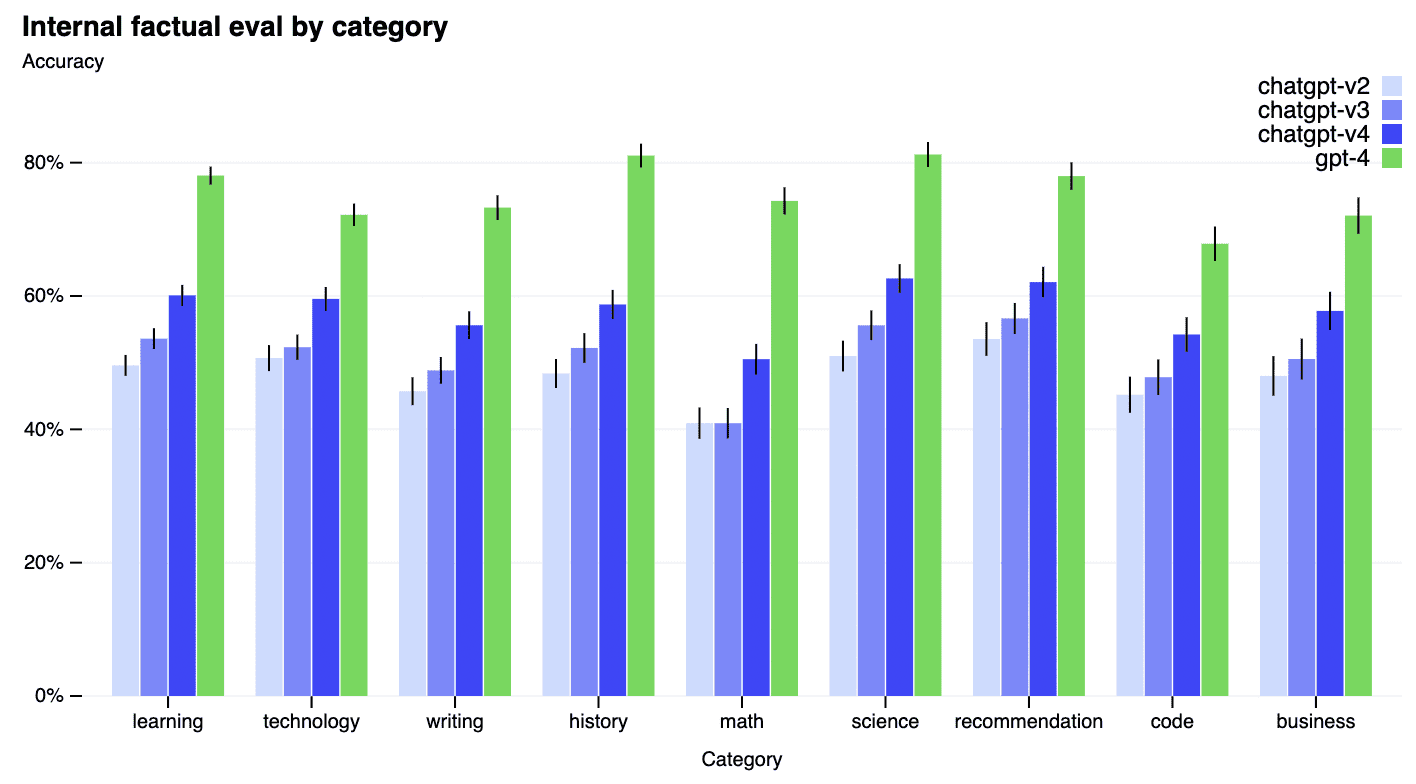
This is all about trust, the main reason why most users do not believe in AI models. For example, GPT-4 scored 40% higher than GPT-3.5 in internal factual evaluations under all nine categories, as shown in the image below. This means that GPT-4 is less likely to respond to disallowed content, and 40% more likely to produce factual reponses, in comparison to GPT-3.5.

As new releases will continue to improve on current challenges, it is said that GPT-5 will reduce hallucination to less than 10%, making LLMs more trustworthy.

What Can We Expect From GPT-5?
Image by OpenAI Compute Efficiency

As stated earlier on, GPT-4 is very computationally expensive, at $0.03 per token. This is in comparison to GPT-3.5’s cost of $0.0002. That is a big difference. GPT-4 being trained on a one trillion parameter dataset and infrastructure reflects the cost.

Whereas Google’s PaLM 2 model is only trained on 340 billion parameters and has efficient performance. If OpenAI plans to compete with Google's PaLM 2, they will need to look into ways of reducing the cost, and the size of GPT-4 parameters — all whilst being able to maintain performance.

Another aspect to look into is a better inference time, for the time it takes a deep learning model to predict new data. The more features and plugins within GPT-4, the more compute efficiency becomes. Developers are already complaining to OpenAI that GPT-4 APIs frequently stop responding, which forces them to use GPT-3.5.

Taking all of that into consideration, we can expect OpenAI to overcome these challenges with a GPT-5 release that is smaller, cheaper and more efficient.

Multi-Sensory

In the come-up to GPT-4’s release, a lot of people were going crazy over its multimodal capabilities. Although it has not been added to GPT-4 yet, this is where GPT-5 may come and be the star of the show and truly make it multimodal.

Not only can we expect it to deal with images and text, but also audio, videos, temperature, and more. Sam Altman stated in an interview “I’m very excited to see what happens when we can do video, there’s a lot of video content in the world. There are a lot of things that are much easier to learn with a video than text.”

Increasing the type of data that can be used to make conversations more dynamic and interactive. Multimodal capabilities will be the fastest link to Artificial general intelligence (AGI).

Long-Term Memory

GPT-4’s maximum token length is 32 thousand tokens, which was impressive. But with the world releasing model after model, we have models such as Story Writer that can output 65 thousand tokens.

To keep up with the current competition, we can expect GPT-5 to introduce a longer context length, allowing users to have AI friends that can remember their persona and history for years.

Improved Contextual Understanding

Being a large language model (LLM), the first thing we can expect is an improvement and enhanced ability in understanding context. If we merge this with the point above about long-term memory, GPT-5 could have the potential to maintain context over long conversations. As a user, you will have more catered and meaningful responses that are consistent with your requirements.

With this comes a more advanced understanding of language, with the main component of natural language being emotion. Potential capabilities of contextual understanding in GPT-5 can allow it to be more empathetic and produce appropriate replies to continue to engage in the conversation.

Wrapping it up

There is more to find out about the potential capabilities of GPT-5, and we won't be able to find out any more information till closer to the release. This article is based on the current challenges that GPT-4 and GPT-3.5 face, and how OpenAI can use these hurdles to overcome and produce a high performant release of GPT-5.
Nisha Arya is a Data Scientist, Freelance Technical Writer and Community Manager at KDnuggets. She is particularly interested in providing Data Science career advice or tutorials and theory based knowledge around Data Science. She also wishes to explore the different ways Artificial Intelligence is/can benefit the longevity of human life. A keen learner, seeking to broaden her tech knowledge and writing skills, whilst helping guide others.

More On This Topic

  • What To Expect for AI Quality Trends In 2023
  • What to Expect From Your Career Path as a Data Scientist
  • 2023 AI Index Report: AI Trends We Can Expect in the Future
  • When good data analyses fail to deliver the results you expect
  • Why Data Scientists Expect Flawed Advice From Google Bard

Soon Human Generated Content is Going to Sell At A Big Premium

Soon Human Generated Content is Going to Sell At A Big Premium

As the concerns around AI’s potential to replace jobs and the proliferation of AI-generated content across the internet continues, a new realisation is emerging, people are beginning to recognise the value of “original” content – the actual work generated by humans.

“Within a few years, artisanal “certified human-made” content is going to sell at a big premium to AI-generated content,” expressed Stanford professor Erik Brynjolfsson.

An example is the weaving industry of India. A lot of design and creation work is now being automated by machines, and even AI. This is posing a threat to a lot of artisanal and traditional weavers. But even though AI is getting better at this field as well, a lot of people still prefer traditional weaving over automated ones, due to the sheer lack of intricacy.

Read: The Silence of the Looms

Yann LeCun, the godfather of AI, says “exactly”, and explains this with the perfect example of how automated manufacturing has made handcrafted goods more valuable. Clearly, apart from geopolitical reasons, Indians also choose to not go for ‘Made in China’ products, as automation makes the products mundane, offering no new intrinsic value to each product.

Sure, you can create awesome images and texts and print them on T-shirts and mugs, it is only a matter of time when someone would be able to copy it ditto with the help of the same AI tools you used. Moreover, if you can make a business out of prompting Midjourney or ChatGPT, someone else can as well. What can never be replaced is the artisanal nature of the original hand-made products.

That’s right, within a few short years, we’ll witness a seismic shift where genuine human creativity will sell at a premium, leaving AI-generated content in the digital dust.

Why settle for AI-generated content, when you can have the imperfect perfection of human creation? Let’s face it, folks, AI can be predictable, robotic, and sometimes downright nonsensical. Sure, it may be capable of producing vast quantities of content at lightning speed, but it lacks the intangible qualities that make us laugh, cry, and ponder.

What if AI makes us stupid?

Just a few weeks back, the Writer’s Guild of America was protesting against the use of AI for writing scripts. Similarly, artists were furious against an artist who won a prize in an art competition using Midjourney.

Clearly, humans with the help of AI have been performing better at certain areas that include artistic domains. Sam Altman envisioned exactly this when he spoke about AI humans, “I am excited about a world where AI is an extension of human will, and an amplifier of our abilities.”

Furthermore, Altman during his visit to India was balled with a philosophical question about what has learnt about humans while working on AI. After taking some time to ponder upon it, he concluded saying, “There’s something strange and very important going on with humans and I really deeply hope that we preserve that.”

Now, with machines doing all our work, our minds would become numb and dumber each day, rendering us literally thoughtless of original ideas. For example, if a coder can build apps using OpenAI’s API and auto-code using Copilot that is able to make money for him, why would they want to build something from scratch? This eventually would lead to most of the apps in the future with the same features with AI doing half the work.

What can be the reason that AI is so good at what it does? The AI that these people are using to write and draw better than the artists is trained on the original artists’ works. That is where the creativity in art comes from.

On the other hand, Adam Yormark argues that this would just remove the low-to-medium quality products from the market that can be easily replicated with AI, while high-quality, in this case handcrafted, products will still be sold on the market as high-value.

What even is original?

1929 book argued: "People living in constant contact with machines are apt to worship precision, to regard human effort with contempt because of the factor of error, & to admire the machine because it is infallible"
BUT between 1910 and 1930 use of term “handmade” increased 64%! pic.twitter.com/aebfWRBDjx

— Pessimists Archive (@PessimistsArc) January 30, 2023

Mark Twain famously said, “There is no such thing as a new idea.” This begs the question – isn’t the case with AI the same as with every technological revolution? People used to write using pen and paper, then print books. Then with computers, the need for pen and paper for authors completely vanished. Would we call everything digital today as original?

Probably yes. No one would deny the capabilities of AI and how it can assist people to do a job that would take a hundred people to do. But the creativity of the person is restricted till the person enters the prompt, the rest is handled by AI. Nothing artisanal about it. It is not called ‘art prompting’, but ‘prompt engineering’ anyway.

So while we look at the current AI built products as amazing, the future is very near when the customers would ask the sellers, “are you sure this is not built by AI?”

The post Soon Human Generated Content is Going to Sell At A Big Premium appeared first on Analytics India Magazine.

Fast Path to Becoming a Generative AI Technical Expert

Training programs on generative AI are now popping up everywhere. One of my connections called it “a joke” after enrolling in such a program. Many are expensive, time consuming and offer low value. Participants proudly display the certification and even praise the instructors. They don’t know that in the end, it won’t lead to any job offer. Many programs simply exploit the ignorance of the general public. Sometimes because the operators and instructors genuinely believe that they are expert in generative AI.

But how would you expect to learn even the foundations of generative AI if you can enroll without real coding or machine learning experience? In this article, I discuss serious technical training. I rule out general courses comparable to cooking lessons for amateurs. Thus I focus on training advertised as technical, and sometimes described as advanced.

The Academic Model

Academia typically offers some of the most expensive programs. There are two reasons for this. First, higher education capitalizes on large loans that students can get to pay for the tuition. Then, the fact that many universities are still respected by employers. Typically, out-of-state students must pay more. However, much of the money collected — in US at least — goes to administrators and sport-related investments. Instructors get little money. Indeed, in many cases, the majority are part-time adjuncts paid very little, not having a PhD, or are inexperienced PhD students.

Also, due to the tenure system, many of the courses are outdated. Some feature old methods such as linear regression and rename them as statistical machine learning. Or focus on poor concepts and old jargon such as p-value. But the content hasn’t changed for decades. Reading the textbook is like an excursion back in time. Yet, in many curricula, it constitutes the bulk of the training. Sometimes the program contains a session or two to modernize the presentation. For instance, students may run a deep neural network (much simpler than GAN), or play with bags of words. The latter is described as NLP or even LLM in the advertising material. In reality, projects, even when involving web crawling, are of limited scope. You are unlikely to learn smart techniques for crawling and organizing unstructured tex.

Your best bet is to look for programs where external practitioners from top companies actually teach most of the classes. Universities that produced many successful entrepreneurs or attract private funding, usually do that.

Strange Selection Process

As if this was not enough, you may have to deal with a lot of paperwork. It starts with filling up long questionnaires and pay a non-refundable fee. You may have to take tests that are irrelevant to the target certification. And typically, provide GPA scores and answer questions about your race, gender, disabilities or even sexual orientation or vaccinations, and possibly send recommendation letters. I am not sure how this relates to your qualifications for learning generative AI. In my case, I don’t have any GPA and if I had a score, it would be from 30 years ago. Which state you live in is an important issue that may require official documentation. Surprisingly though, you don’t need to show your GitHub portfolio, as if this was irrelevant.

The Data Camp and MOOC Models

MOOC — massive open online courses such as Coursera — and intensive data camps range from cheap to very expensive. The quality is not always correlated with the value that you get. We can exclude those that won’t even name the instructors: avoid them. Even then, the common drawbacks are similar. In many cases, they treat participants as if they know very little. Possibly because they try to attract as many people as possible, to boost revenue. The admission bar may be lower than stated in the marketing material.

The end result is as follows. You spend long hours learning the basics that you already master. Videos are progressing painfully slowly. Frequently, for several minutes, the instructor enters Python code on a Jupyter notebook, one character at a time. This would put me to sleep. Then, the exams consist of multiple-choice questions. It does not measure your ability to work in a professional environment. Sometimes it involves judgmental questions and the “correct” answer is questionable. However, you can typically preview free material and judge by yourself whether it is worth your time and money. Beware of programs that guarantee job placement or refund. You may not end up getting the job you were hoping for. Unfortunately, if you are a novice, you might not be able to judge the value of the program.

One way to assess the value is to contact people featuring the certification in question on their LinkedIn profile page, and ask them what they think about it.

How People Learn

People learn very differently. There is no “one size fits all”. If after your due diligence, you found a program that meets your needs and budget, go for it. Beware of time commitment. Is spending weeks on a program really worth it (even if free), compared to using your time for other purposes?

In my case, I learn by practicing on my own, finding answers to my questions on Stack Exchange and other discussion forums, even asking my own questions. I find data sets on Kaggle and other places. I learned TensorFlow and GAN (generative adversarial networks) by testing and improving Python code that I found on Machine Learning Mastery and Medium. Now you can find much better versions on my own platform! On occasion, I pay someone to develop and deploy some applications. Most recently, to design a Web API with Python back-end for one of my GenAI apps. The next project on my list will be about designing a SDK. Little by little, I am becoming more of an engineer. Interacting with the people that I hired was very fruitful, less expensive than most courses, and a lot faster. And of course, highly targeted to my “job”. But that’s just me.

Alternative Model

Since I could not find any training that suits me, I eventually decided to offer my own. I realized that I was not the only one. Many professionals with limited time, who know already more than the basics, are in the same situation. Like myself, they can learn a lot on their own and only need limited guidance, essentially to get jump-started. I created my program for them. Participants typically have a minimum technical background and know Python. For instance, engineers and product people in various industries.

If you are curious, you can check out the certifications from my AI/ML research lab, here. The one on generative AI is based on my book now accepted by Elsevier. The cost is lower than the admission fee for any academic program. The value is superior, especially due to the depth and novelty of the material offered, as well as customization. And time commitment is smaller by several orders of magnitude, thanks to focusing on the most valuable aspects, going straight to the goal, without boring videos.

About the Author

vgr2-1

Vincent Granville is a pioneering data scientist and machine learning expert, founder of MLTechniques.com and co-founder of Data Science Central (acquired by TechTarget in 2020), former VC-funded executive, author and patent owner. Vincent’s past corporate experience includes Visa, Wells Fargo, eBay, NBC, Microsoft, CNET, InfoSpace. Vincent is also a former post-doc at Cambridge University, and the National Institute of Statistical Sciences (NISS).

Vincent published in Journal of Number Theory, Journal of the Royal Statistical Society (Series B), and IEEE Transactions on Pattern Analysis and Machine Intelligence. He is also the author of “Intuitive Machine Learning and Explainable AI”, available here. He lives in Washington state, and enjoys doing research on stochastic processes, dynamical systems, experimental math and probabilistic number theory.

Widespread adoption of generative AI tools is derailing responsible AI efforts

Colorful abstract AI data

New artificial intelligence (AI) platforms and tools are emerging every day to assist developers, data scientists, and business analysts. However, this rapid growth in emerging technology is also increasing the complexity of AI constellations well beyond the capacity for responsibility and accountability in AI systems.

That's the conclusion from a recent survey of 1,240 executives published by MIT Sloan Management Review and Boston Consulting Group (MIT SMR and BCG), which looked at the progress of responsible AI initiatives, and the adoption of both internally built and externally sourced AI tools — what the researchers call "shadow AI".

Also: Meet the post-AI developer: More creative, more business-focused

The promise of AI comes with consequences, suggest the study's authors, Elizabeth Renieris (Oxford's Institute for Ethics in AI), David Kiron (MIT SMR), and Steven Mills (BCG): "For instance, generative AI has proven unwieldy, posing unpredictable risks to organizations unprepared for its wide range of use cases."

Many companies "were caught off guard by the spread of shadow AI use across the enterprise," Renieris and her co-authors observe. What's more, the rapid pace of AI advancements "is making it harder to use AI responsibly and is putting pressure on responsible AI programs to keep up."

They warn the risks that come from ever-rising shadow AI are increasing, too. For example, companies' growing dependence on a burgeoning supply of third-party AI tools, along with the rapid adoption of generative AI — algorithms (such as ChatGPT, Dall-E 2, and Midjourney) that use training data to generate realistic or seemingly factual text, images, or audio — exposes them to new commercial, legal, and reputational risks that are difficult to track.

The researchers refer to the importance of responsible AI, which they define as "a framework with principles, policies, tools, and processes to ensure that AI systems are developed and operated in the service of good for individuals and society while still achieving transformative business impact."

Another difficulty stems from the fact that a number of companies "appear to be scaling back internal resources devoted to responsible AI as part of a broader trend in industry layoffs," the researchers caution. "These reductions in responsible AI investments are happening, arguably, when they are most needed."

Also: How to use ChatGPT: Everything you need to know

For example, widespread employee use of the ChatGPT chatbot has caught many organizations by surprise, and could have security implications. The researchers say responsible AI frameworks have not been written to "deal with the sudden, unimaginable number of risks that generative AI tools are introducing".

The research suggests 78% of organizations report accessing, buying, licensing, or otherwise using third-party AI tools, including commercial APIs, pretrained models, and data. More than half (53%) rely exclusively on third-party AI tools and have no internally designed or developed AI technologies of their own.

Responsible AI programs "should cover both internally built and third-party AI tools," Renieris and her co-authors urge. "The same ethical principles must apply, no matter where the AI system comes from. Ultimately, if something were to go wrong, it wouldn't matter to the person being negatively affected if the tool was built or bought."

The co-authors caution that while "there is no silver bullet for mitigating third-party AI risks, or any type of AI risk for that matter," they urge a multi-prong approach to ensuring responsible AI in today's wide-open environment.

Also: ChatGPT and the new AI are wreaking havoc

Such approaches could include the following:

  • Evaluation of a vendor's responsible AI practices
  • Contractual language mandating adherence to responsible AI principles
  • Vendor pre-certification and audits (where available)
  • Internal product-level reviews (where a third-party tool is integrated into a product or service)
  • Adherence to relevant regulatory requirements or industry standards
  • Inclusion of a comprehensive set of policies and procedures, such as guidelines for ethical AI development, risk assessment frameworks, and monitoring and auditing protocols

The specter of legislation and government mandates might make such actions a necessity as AI systems are introduced, the co-authors warn.

Artificial Intelligence

AI-Driven Medical Breakthrough: Leveraging Artificial Intelligence for Novel Drug Discovery

Featured Blog Image-AI-Driven Medical Breakthrough: Leveraging Artificial Intelligence for Novel Drug Discovery

Drug discovery is known as “from bench to bedside” because of its long duration and high costs. It takes around 11 to 16 years and between $1 billion to $2 billion to bring a drug to market. But now AI is revolutionizing drug development, providing better pace and profitability.

AI in drug development has transformed our approach and strategy towards biomedical research and innovation. It has helped researchers reduce the complexities of a disease pathway and identify biological targets.

Let’s look deeper into what potential AI in drug discovery holds for the future.

Understanding the Role of AI: How It’s Being Used for Drug Discovery?

Understanding the Role of AI: How It’s Being Used for Drug Discovery

AI has enhanced different stages of the drug discovery process with its ability to analyze vast amounts of data and make complex predictions. Here's how:

1. Target identification

Target identification is the first process of drug discovery which involves identifying possible molecular entities like proteins, enzymes, and receptors present in the body that can combine with drugs to produce therapeutic effects against diseases.

AI can leverage large clinical databases that include key information about the target identification. These data sources can include biomedical research, biomolecular information, clinical trial data, protein structures, etc.

Trained AI models along with biomedical techniques like gene expression can understand complex biological diseases and identify the biological targets for the drug candidates. For instance, researchers have developed various AI techniques for the identification of novel anticancer targets.

2. Target Selection

AI in drug discovery can help researchers select promising targets based on their illness correlations and predicted therapeutic utility. With strong pattern recognition, AI can make this selection based not just on declared medical literature but select completely new targets with no prior reference in published patents.

3. Drug Prioritization

In this stage, AI evaluates and rates lead drug compounds, prioritizing them for further assessment and research to advance their development. Compared to previous ranking techniques, AI-based approaches are more effective at identifying the most promising candidates. For instance, researchers have developed a Deep Learning-based computational framework to identify and prioritize novel drugs for Alzheimer’s disease.

4. Compound Screening

AI models can predict compounds' chemical properties and bioactivity and provide insights into adverse effects. They can analyze data from various sources, including previous studies and databases, to identify any potential risks or side effects associated with a particular compound. For instance, researchers have developed a deep learning tool to screen chemical libraries with billions of molecules to significantly accelerate large-scale compound exploration.

5. De Novo drug design

Manual screening of large collections of compounds has been a traditional practice in drug discovery. With AI, researchers can screen novel compounds with or without prior information and also predict the final 3D structure of the discovered drugs. For instance, AlphaFold, developed by DeepMind, is an AI system that can predict protein structures. It maintains a database of over 200 million protein structure predictions that can accelerate the drug design process.

5 Successful AI-based Drug Discovery Examples

5 Successful AI-based Drug Discovery Examples

1) Abaucin

Antibiotics kill bacteria. But due to the deficiency of new drugs and the rapid evolution of bacterial resistance against older drugs, bacteria are becoming hard to treat. Abaucin, an AI-developed strong experimental antibiotic, is designed to kill Acinetobacter baumannii, one of the most dangerous superbug bacteria.

Using AI, the researchers first tested thousands of medicines to see how well they work against the bacterium, Acinetobacter baumannii. Then this information was used to train AI to come up with a drug that can efficiently treat it.

2) Target X by Insilico Medicine

Insilico Medicine used its Generative AI platform and created a drug called Target X, now in Phase 1 clinical trials. Target X is designed to treat Idiopathic Pulmonary Fibrosis, a disease that can cause lung stiffness in elderly individuals if left untreated. Phase 1 will involve 80 participants, and half will receive higher doses gradually. This will help evaluate how the drug molecule interacts with the human body.

3) VRG50635 by Verge Genomic

Verge Genomics, an AI drug discovery company, used its AI platform CONVERGE to discover a novel compound, VRG-50635, for the treatment of ALS by analyzing human data points. The data points included information about the brain and spine tissues of patients with neurodegenerative diseases like Parkinson’s, ALS, and Alzheimer’s.

The platform first found PIKfyve enzyme as a possible target for ALS and then suggested VRG50635 as a promising inhibitor of PIKfyve, which became a potential drug candidate for treating ALS. The process took around four years, and now the candidate is in phase 1 of the human trials.

4) Exscientia-A2a Receptor

Exscientia, an AI MedTech company, is responsible for the first AI-designed molecule for immuno-oncology treatment – a form of cancer treatment that uses the body’s immune system to fight cancer cells. Their AI drug has entered the human clinical trials phase. Its potential lies in its ability to target the A2a receptor to promote anti-tumor activity while ensuring fewer side effects on the body and the brain.

Using Generative AI, they have created some other compounds for targeting various diseases like

  • Transcriptionally Addicted Cancers by targeting CDK7 inhibitors
  • Inflammatory diseases by targeting PKC-theta enzyme
  • Hematology and Oncology diseases by targeting LSD1 regulator

5) Absci-de Novo Antibodies With Zero-Shot Generative AI

Absci, a Generative AI drug discovery company, has demonstrated its use of zero-shot generative AI to create de novo antibodies via computer simulation. Zero-shot learning means that the AI model has not been explicitly tested on the current input information during the training phase. Hence, this process can come up with novel antibody designs on its own.

De novo therapeutic antibodies powered by AI cut the time it takes to develop new drug leads from up to six years to just 18 to 24 months, increasing their probability of success in the clinic. The company’s technology can test and validate 3 million AI-generated designs every week. This new development could instantly deliver novel therapeutics to every patient, marking a significant industrial change.

What Does the Future of AI & Drug Discovery Hold?

Besides many other healthcare applications, AI is making the drug discovery process faster and more intelligent by analyzing vast data sets and predicting promising drug targets and candidates. Using generative AI, biotech companies can identify patient response markers and develop personalized treatment plans quickly.

A report suggests that soon, more MedTech companies will incorporate AI and ML into early-stage drug discovery, which will help create a $50 billion market within the next ten years, creating the significant growth potential of AI in pharmaceuticals. AI will potentially reduce overall drug discovery costs, making more novel drugs available to patients faster.

If you want to know more about AI and how it’ll shape our future, visit unite.ai.

Adobe Wants to Replicate The Firefly Formula with Figma

AI-powered website builders have taken the internet by storm ever since OpenAI showed GPT-4 building a website using a paper napkin sketch as reference. While many standalone services have launched, popular website builders like Figma seem to have fallen behind in the AI trend. However, its acquisition of AI company Diagram might change website building forever for Figma.

Just as Adobe waited and launched its Firefly GenAI service at the right time, it is waiting for the right time to add AI to Figma.

The Firefly formula explained

When Adobe Firefly was launched, many criticised it for being far behind Midjourney and Stable Diffusion, its competitors at the time. In addition to this, the Firefly launch was far behind the curve when it came to timing, with Adobe completely missing the text-to-image hype wave .

However, Adobe completely changed the game by integrating Firefly’s capabilities into its widely-used suite of designing software. Through this integration, creative professionals could intuitively use generative AI features within the software. This addition to Adobe went beyond the novelty of using AI, with designers finding a real use-case for generative AI.

As an added benefit, the internet went gaga over generative fill in Photoshop, creating over 150 million generations using the new feature. Adobe also announced plans to bring Firefly to other software like After Effects, Premiere Pro, and Adobe XD. Now, generative AI has become another tool in the hands of designers, and will soon become a mainstay in the design process.

When looking at the current state of Figma, it is clear that the team behind it has only now started making moves into AI. Facing tough competition from its peers like WebFlow and AI-powered upstarts like Durable, Hostinger, and more, the Firefly formula will prove to be sink or swim for Figma.

Competing in a hot market

AI generated website builders have caught the imagination of web devs the world over. Many players in the website building space have already integrated AI into their offerings, leaving Figma to catch up.

Hostinger, a hosting platform for WordPress, is now offering website building with just a prompt. Wix, another popular website builder, recently introduced Wix ADI, an AI assistant for website building. Even without AI website builders, Figma is in hot competition. Another giant in the no-code website building market, Webflow, is slowly growing its user base of 3.5 million users, catching up to Figma’s approximately 4 million users.

When looking at Figma’s recent moves, it seems that the company is taking a much more measured approach to AI. Yesterday, Figma acquired Design, an AI-powered design tool company. This echoes Adobe’s move of partnering with NVIDIA for Firefly, allowing Figma to procure a set of well-built AI tools without having to build it themselves.

These AI tools are a far cry from the seemingly-unfinished offerings from Figma’s competition. The toolkit is made up of four plugins, namely Magician, Genius, Automator, and UI-AI. Magician takes care of the design aspect of Figma, bringing in AI features like icon, asset, and text generation.

Genius can create designs from prompts, automatically suggest improvements, iterate on existing designs, and even chat with designers to become a ‘personal design assistant’. Automator, as the name suggests, automates various design tasks. UI-AI directly brings AI models into the user interface, with no requirement for any code.

When looking at the competition, no other company has created similar offerings. At a cursory glance, it seems that the Firefly strategy has worked for Figma, allowing them to integrate a fully-integrated and feature-filled AI toolkit. However, this is just the first step for Figma’s AI strategy. Noah Levin, the vice president of Product Design at Figma, said in a blog, “Over the past year, we’ve built and grown a team dedicated to machine learning and accelerated investments in early development of Figma’s AI platform… the possibilities are endless, not just for design but across the entire product development process.”

Reading between the lines, it is clear that Figma is taking a calm and measured approach to AI, similar to what Adobe did with Firefly. Its acquisition of Diagram will not only strengthen this strategy by adding talent and pre-built AI products, but also ensure the creation of a fully-integrated project. Figma’s AI features will solidify its position as a market leader, cementing the success of the Firefly formula.

The post Adobe Wants to Replicate The Firefly Formula with Figma appeared first on Analytics India Magazine.

Skyroot Aerospace Raman-1 Engine Test Successful

Skyroot Aerospace Raman-1 Engine Test Successful

Hyderabad-based Skyroot Aerospace, the private India space company, announced that it has accomplished the flight qualification trial of the Raman-I engine, intended for roll attitude control in their forthcoming Vikram-I rocket.

The engine underwent a test firing at the Indian Space Research Organisation’s (ISRO) Liquid Propulsion Systems Centre, marking Skyroot as the inaugural private company to employ this facility. This is the first ever test done at ISRO’s LPSC by a private company.

The series of tests resulted in perfect completion with 280 engine pulses with a total burn time of 104 seconds.

The company said in its Linkedin post, “Thrilled to announce the successful flight qualification testing of our Raman-I engine used for roll attitude control of the Vikram-I rocket. As the first ever test done at the Liquid Propulsion Systems Centre (LPSC) of ISRO by a private company, this test is special. Many thanks to LPSC and IN-SPACe teams for their incredible support all through.”

The Raman-I engine will be utilized to facilitate roll attitude control, enabling the rocket to effectively manage its rotation and orientation. Ensuring a stable roll attitude is crucial to maintain the rocket’s stability during its ascent. Uncontrolled rotation can lead to instability, making it difficult to accurately manage the rocket’s trajectory.

The roll attitude control system plays a vital role in modifying the rocket’s aerodynamic characteristics throughout the flight. By adjusting the rocket’s orientation along the roll axis, it can optimize its aerodynamic profile, reducing drag, and improving overall efficiency.

Skyroot achieved a historic milestone by becoming the pioneering private company to initiate a rocket launch from India with the Vikram-S. The indigenous Vikram-S was successfully launched from the Satish Dhawan Space Center in Sriharikota, signifying India’s significant entry into the realm of commercial space exploration.

The post Skyroot Aerospace Raman-1 Engine Test Successful appeared first on Analytics India Magazine.

Will Ali Farhadi Make Allen Institute Great Again?

Computer vision expert Ali Farhadi is set to return to Allen Institute for AI (AI2) as the second chief executive officer in the Seattle-based non-profit research organisation’s history, after leading Apple’s AI and ML initiatives since January 2020. He is also the man behind discovering YOLO Object detection and was a senior research manager at AI2 from 2014 before joining Apple. He will start working on July 31st.

Looking Back

Farhadi is a stalwart in the AI community. He completed his doctorate in computer science at the University of Illinois at Urbana–Champaign, specialising in Computer Vision and working under the supervision of South-African-born American computer scientist David Forsyth. Following that, he worked as a post-doctoral fellow at Carnegie Mellon University’s Robotics Institute, under the guidance of Russian-American computer scientists Alexei A. Efros and Martial Hebert. Currently, Hebert holds the position of director at the Robotics Institute.

Read more: What is Microsoft Without OpenAI?

Farhadi is also a professor at Paul G. Allen School of Computer Science and Engineering, University of Washington where he leads the Reasoning, AI and VisioN (RAIVN) lab along with professor Ranjay Krishna.

He also co-founded the first on-device deep learning company, XNor.ai with Mohammad Rastegari which was acquired in 2020 by Apple at $200, aiming at their increasing interest in investing in AI capabilities.

When Apple acquired Xnor.ai, it aimed to leverage its expertise in AI on the edge, which allows ML and image recognition to be executed on low-power devices rather than relying on the cloud, aligning with their focus on privacy and preserving data on mobile devices.

The AI2 backed Xnor.ai also saw investments from Madrona Venture Group and the University of Washington.

Farhadi’s research have garnered worldwide acclaim. His profound contributions have been distinguished with esteemed accolades such as the best paper awards at esteemed conferences including CVPR, NeruIPS, AAAI, and NSF. In 2014, he was honoured as an Allen Distinguished Investigator.

The illustrious Sloan Research Fellowship was bestowed upon him in 2017, further cementing his reputation as an exemplary scholar. In recognition of his early career achievements, he received the prestigious Early Career Academic Achievement Alumni Award from UIUC in 2019. Furthermore, Farhadi was among the esteemed scholars selected as the inaugural recipients of the Google Fellowship.

A Deserving Successor

Farhadi takes over from Oren Etzioni, who was chosen by Microsoft co-founder Paul Allen to establish AI2 about ten years ago. Etzioni revealed his intention to resign as CEO last year, stating that he would remain on the board, provide guidance, and serve as the technical director of the AI2 Incubator. Researcher Peter Clark has been the interim CEO.

“As we face unprecedented changes in the development and usage of AI, I could not think of a better time to return to AI2 as CEO,” said Farhadi in a statement.

He further added that today more than ever, the world needs truly open and transparent AI research that is grounded in science and serves as a platform where data, algorithms, and models are open and available to all and renowned researchers and engineers at AI2 find themselves in a unique position to spearhead this innovative and trustworthy approach to AI development.

In 2010, Etzioni joined AI2 and became a significant figure in the AI field. He was an accomplished entrepreneur and also taught at the University of Washington’s Department of Computer Science and Engineering. With over 15 PhDs, Oren specialised in areas such as machine reading, data mining, web search, and software agents.

Etzioni and Allen established the Allen Institute for AI in early 2014.

Outstanding! The sky's the limit with Ali Farhadi! https://t.co/ZWzi3TkcxS

— Oren Etzioni (@etzioni) June 20, 2023

What Next?

A month ago, AI2 announced the building of AI2 OLMo, an open generative language model with over 70 billion parameters that is expected to launch in early 2024. Unlike other models, OLMo is designed by scientists for scientists, with a focus on advancing language model research. The initiative aims to provide access, education, and collaboration opportunities to the research community and the public. The project is being developed in partnership with AMD and CSC, using the environmentally friendly LUMI supercomputer.

Earlier, former chief scientist of Tesla Andrej Karpathy returned to OpenAI. Several other Google and Meta researchers joined OpenAI recently. Similarly, Ian Goodfellow left Apple to join Google DeepMind. So now with Farhadi, we only hope that AI2 will also report some breakthroughs in the near future, just like DeepMind and OpenAI.

Read more: Paul Allen liked the fact that I wasn’t an academic: Dr Oren Etzioni, CEO, AI2

The post Will Ali Farhadi Make Allen Institute Great Again? appeared first on Analytics India Magazine.

DSC Webinar Series – AI for Marketers Optimize – personalization across the funnel

Maybe you’ve heard: AI is the next phase of digital transformation and a train that no marketer can afford to miss. But how do you adopt AI into your team’s tools and workflows efficiently, without hiring a whole new team of technical experts? Join Sean Ryan, Technical Writer at mParticle, and Michael Firn, Product Manager at mParticle, as they discuss how marketers are able to take your personalization campaigns to the next level by leveraging AI.

After the session, you’ll be able to:
– Understand the benefits of utilizing AI across your entire marketing stack
– Tackle common challenges that arise when trying to implement AI
– Recognize specific use cases for predictive analytics and intelligence recommendations

Presented by:
Sean Ryan, Technical Writer – mParticle
Michael Firn, Product Manager – mParticle