An SAP S/4HANA deployment can be a demanding, complex, and time-consuming project. SAP modernization, SAP database adoption, and SAP cloud migration together pose a challenge with too many variables for most businesses. Even with the wealth of support options available to businesses making the move to SAP S/4HANA not all succeed. Seeing these unsettling trends Hitachi Vantara has put together their best practices for an SAP modernization initiative. Join us to learn how Hitachi Vantara can assist in SAP transformation design, deployment, management, and migration to help you modernize your SAP environments quickly and effectively.
David Branson is a Global Partner Alliance Manager with Hitachi Vantara working closely with SAP to help customers achieve success with their SAP transformation initiatives. David has assisted numerous customers, consultants, and product teams to deliver digital innovation that unlocks SAP business value through the power of technology and partnership. Hitachi Vantara is a strategic partner with SAP that can maximize the return on your SAP S4/HANA investment. Make sure that you benefit from all SAP has to offer by partnering with a leading SAP solution provider like Hitachi Vantara.
Presented by: David Branson, Global Partner Alliance Manager – Hitachi Vantara
Increasing the effectiveness of your AI efforts is not about more sophisticated algorithms – it’s the data that makes the difference. While teams have been focusing on using advanced learning techniques and algorithms to build better models, the real value can be found in focusing on data. Taking a data-centric AI perspective has a more significant impact on model performance than a technique-centric approach. Effective machine learning practices will result in better performing models, but it takes a multifaceted approach: understanding the data you have, acquiring additional data and organizationally making your exploratory data analysis (EDA) efforts systematic and procedural. The result will be efficient and effective data pipelines leading to predictive, reliable models that deliver business value.
Presented by: Anindya Datta, Ph.D. Mobilewalla, Founder & CEO
Want to leverage Cloud data technology without sacrificing your existing expertise on Desktop tools? This webinar is for you.
Cloud tools, like Designer Cloud Powered by Trifacta, allow data professionals to take advantage of new powerful capabilities such as machine-learning powered data transformation suggestions, unlimited scalability, browser-based manageability, and strong governance. But Desktop tools, like Alteryx Designer, remain equally as strong with powerful on-premise capabilities, unique tools, deeply experienced teams, and years of pre-existing data preparation workflows.
For teams that want to leverage the Cloud without losing their current edge on existing Desktop tools, what’s the best path forward? In this webinar, we’ll provide the answer, and show how desktop users can leverage Snowflake to combine their preexisting workflows and expertise in with the uniquely powerful capabilities of the cloud. Don’t miss this free opportunity to upskill and evolve!
Presented by: Joshua Burkhow – Alteryx Alexander Gross – Alteryx
There’s no stopping NVIDIA especially after hitting $1 trillion in market capitalisation. Building on the back of its recent partnership with WPP, the CEO of the chipmaking giant, Jensen Huang, recently remarked on how generative AI will ‘supercharge’ creators.
In a chat with Mark Read, the CEO of WPP, at the Cannes Lion Festival, Huang delved deeper into how exactly generative AI can change the way people work today. While AI models won’t replace human creativity, Huang said, they will augment the skills of creative professionals, allowing them to field more demand from their clients.
NVIDIA’s recent deal with WPP, the world’s largest marketing and communication services company, showcases this strategy perfectly.
Through this partnership, the companies will develop a generative AI content engine, which would cut down the friction in various creative processes at WPP. Utilising GenAI and NVIDIA’s Omniverse offering, the engine will even allow WPP to create digital twins of their target products, scaling ad production to new heights. Huang stated, “WPP is going to unquestionably become an AI company. You’ll create an AI factory where the input is creativity, thoughts and prompts, and what comes out of it is content.”
Even when speaking about the capabilities of AI, it seems that Huang doesn’t want humans to forget that they are the most important part of the puzzle. AI will bring a new level of scalability for content generation. Huang foresees a feature where ads aren’t created, they are generated as per the individual’s requirement while being aligned with a brand’s identity and legally safe.
While other companies like Stable Diffusion and Midjourney have come under fire for the questionable legality of their generations, NVIDIA has come out on the safer side. NVIDIA Picasso, its set of foundational generative AI models, have been completely trained on licensed data. This makes the offering safe for any companies to use, absolving both NVIDIA and its customers of any legal issues.
The post NVIDIA CEO Wants To Make Creative Jobs Into ‘AI Factories’ appeared first on Analytics India Magazine.
In this webinar, we’ll chat with SearchKings, a digital advertising agency that built a self-service data culture on the Google Cloud ecosystem by leveraging powerful Google native tools, such as Google Cloud Dataprep (the Google native version of Alteryx Designer Cloud). Learn how SearchKings made it easier for users to build self-service reports, improved the timeliness and trustworthiness of reporting for managers, and created a culture where anyone can work with data, starting from day one, even if they don’t know how to code.
Speakers: Nir Kushnir, Chief Revenue Officer, SearchKings Teddy Hector, Data Analyst, SearchKings Paul Warburg, Sr. Professional, Product Marketing, Alteryx
Countries facing the worst impacts of the climate crisis are missing out on the best data technologies to inform their responses. As a result, communities are suffering needlessly.
Data and technology offer significant potential for rapid action to improve health and education outcomes and planetary health- to protect lives and livelihoods. Yet, across the globe, decision-makers in lower-income countries are excluded from using available data and digital technologies to improve the quality of information for making decisions. This is due to limited awareness of available data-driven solutions to development challenges, poor technological infrastructure and connectivity and gaps in skills to apply these solutions.
The United AI Alliance is a public-private partnership which aims to reduce the Digital Divide in underserved communities and enhance data research and reporting for key initiatives, such as Census Data, Climate Science, and Healthcare. By supporting governments, non-profits and local developer communities with data science training and technology, the Alliance is helping countries to improve resource allocation and support more informed policy making across the continent
Join us for this DSC Webinar as Geoff Levene of NVIDIA, and Bob Venero, CEO, Future Tech Enterprise, Inc. discuss the launch of this exciting new alliance and how, together, with the United Nations Economic Commission for Africa (UNECA), the United AI Alliance is equipping governments and developer communities in 10 nations with data science training and technology to support more informed policymaking decisions.
Presented by: Geoff Levene of NVIDIA Bob Venero, CEO, Future Tech Enterprise, Inc.
The AI boom has proven lucrative for tech founders and investors alike in 2023, adding billions of dollars to the fortunes of the already affluent Big Tech executives. The rise of generative AI technology, including Large Language models, vision models amongst others have attracted significant interest from investors who seek to capitalize on its potential.
Major technology giants such as Meta Platforms and Nvidia have experienced substantial gains in their stock prices due to the AI boom. Companies like Microsoft, Google’s parent company Alphabet, and Oracle have also witnessed significant surges.
As a result of these developments, the founders of these tech companies, who were already among the wealthiest individuals in the world at the beginning of 2023, have seen their fortunes further increase.
Mark Zuckerberg, the founder of Meta Platforms, has benefited greatly from the rise of AI and his cost-cutting measures referred to as the “year of efficiency.” Meta shares have rallied by 134% year-to-date, contributing to a wealth increase of over $57 billion for Zuckerberg, according to the Bloomberg Billionaires Index. Zuckerberg’s focus on efficiency and prioritizing AI within the company has contributed to this growth.
Oracle’s co-founder and former CEO Larry Ellison surpassed Bill Gates on the rich list for the first time ever. Oracle’s plans for accelerating AI deployment have propelled its stock price. This resulted into Ellison’s personal fortune rising by $47 billion in 2023 due to a 55% gain in Oracle’s stock.
Bill Gates himself has gained $24 billion in wealth this year, primarily driven by the appreciation of his Microsoft shares. Microsoft has emerged as a preferred AI investment for billionaires like Stanley Druckenmiller. Bill Gates also experienced a $2 billion boost to his wealth after an AI-themed earnings call in April, which drove the company’s share price upward.
Jensen Huang, the founder of Nvidia, has also experienced a significant increase in personal fortune. With Nvidia’s shares surging by 198% and the company achieving a market capitalisation of $1 trillion, Huang’s wealth has grown by $24 billion.
Overall, the combined wealth of the rich list members has surged by over $150 billion in 2023, largely attributed to the AI boom.
The post The Uber Rich Get $150 Billion Richer, Thanks to The AI Boom appeared first on Analytics India Magazine.
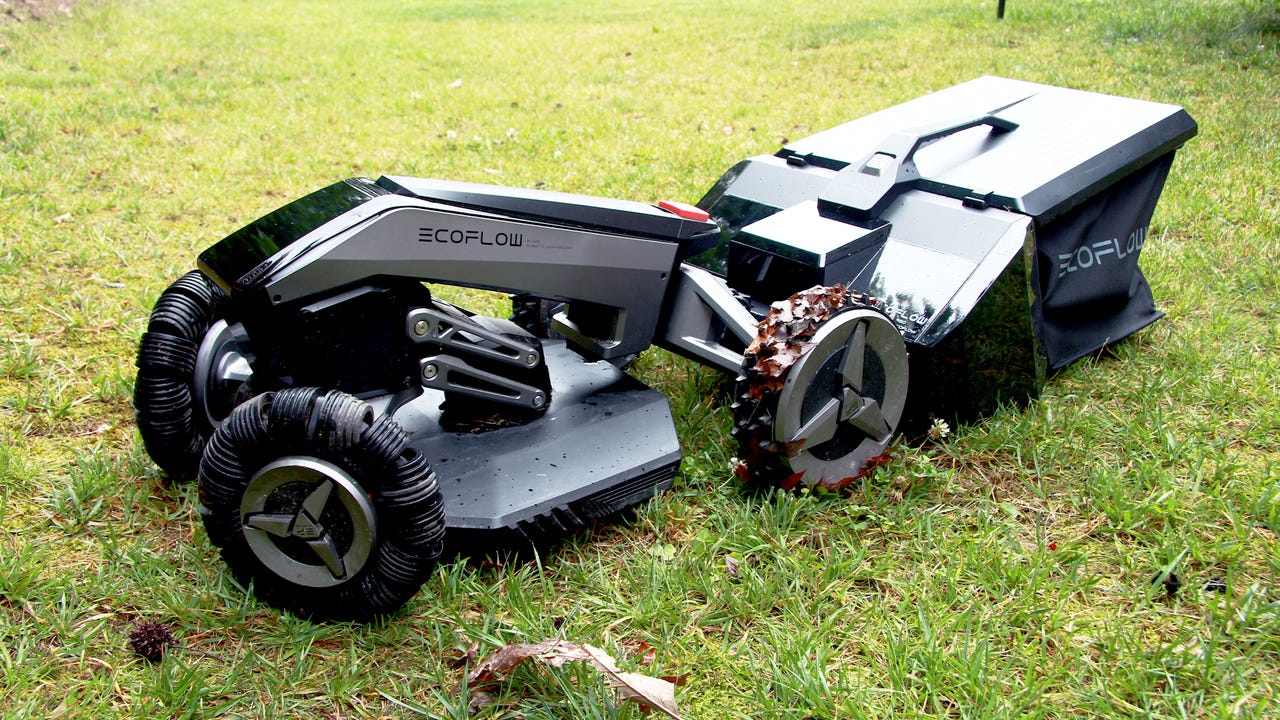
The EcoFlow Blade with Sweeper Kit is a sight to behold.
Mowing the lawn isn't a chore in my house; it's a privilege. I've always loved mowing, but my husband never has. But with three kids under six, he's come to crave that hour or two of mowing the lawn with his AirPods in and no one else around. I enjoy all aspects of gardening — even cutting the grass — so his more recent hobby has been an "always" one for me.
So, committing to testing out the new EcoFlow Blade was bittersweet. I was hesitant to have a robot replace one of our weekend relaxation methods, but I was more curious to see what the technology could do, especially with how groundbreaking its design is.
Also: Best robot lawn mowers: Husqvarna, Greenworks, and more
The $3,599 EcoFlow Blade is a robot mower that stands out from all others. It has all the basics: a lithium battery and charging dock, three blades to cut the grass, four heavy-duty wheels, and more. But it's unique in two ways: it's the first robot mower with a sweeper kit and one of the few on the market that doesn't require a boundary wire.
ZDNET RECOMMENDS
EcoFlow Blade
The EcoFlow Blade robotic lawn mower can be purchased independently or with a lawn sweeper kit that picks up leaves and grass blades as it mows.
View at Us.ecoflow
While there are no boundary wires to install, setting up the EcoFlow Blade took some work and the better part of an afternoon. The mower works with GPS technology, and it comes with a Global Navigation Satellite System (GNSS) antenna that must be positioned just right for the robot to clean effectively — and this task is much more challenging to do than it is to say.
It took about two hours of playing around with different areas of my yard to get the antenna to receive radio signals and position the mower where it could communicate.
This process was notably exasperating, I can't lie, mainly because you don't get to decide where you want the antenna or charging station to go in your yard, and I was a little paranoid about theft. Still, EcoFlow claims the Blade is protected with anti-theft technology powered by 4G, GPS, and an integrated eSim.
I had to move the antenna (taller than me, though not heavy) several times, walk around with my phone checking for a signal, and do it all over again. After giving my neighbors the impression that I was about to make tinfoil hats for the whole block, I found a spot that worked. And to be fair, this niggly process was more manageable than burying wires along my property line.
Also: This $2,500 robot lawn mower is so impressive my neighbors come to watch it mow
The EcoFlow Blade is not a heavy robot — it weighs just over 30lbs — but it's not a device you'll be carrying around. It looks light and sleek, and it's made to be held by the chassis and dragged on its wheels if you need to move it.
The EcoFlow Blade as seen with the Sweeper Kit installed.
It also features three adjustable grass-cutting heights, from 0.8 to three inches, which you can adjust through the app. Once you have the Blade set up, it's mapping time.
To create a map, you have to follow the EcoFlow Blade along the perimeter of the area you want it to cover and you do this with the app in mapping mode, while you guide the mower in front of you like a remote control car (which was very fun).
Also: Best electric grills for easy grilling all summer long
The fenced-in area of my yard has about 3,000 square feet of grass, but there's a deck right in the middle of that, so the backyard is two halves connected by a path along the edge of the deck. Because the Blade would have to travel the four-foot-wide gap to the other side after it's done with one side, I initially decided to set it up to do only half the yard. I didn't want it to get lost or have issues on its way to the other side.
For weeks, the EcoFlow Blade maintained half of our yard so well that it became a nuisance to mow the rest. Admittedly, there were some inconsistencies with mapping, as it consistently missed a few feet of area on the edge every time it mowed. Still, it was one corner by the fence and no more than a couple of feet. And was something that was corrected when we remapped the yard.
Also: The best portable jump starters for year-round car maintenance
The EcoFlow Blade is exceptional at maintaining grassy areas. It never missed spots in the middle of its coverage area and it consistently ran several times a week automatically, keeping our one-half of the yard mowed (lawn stripes and all) without us having to lift a finger.
The EcoFlow Blade is equipped with sensors and LiDAR to avoid obstacles.
Of course, we still had to cut the edges along the fence with an edge trimmer, but that's something that you have to do when you have a standard lawnmower, so that wasn't unexpected.
The robot has a rain sensor that detects showers or lousy weather and either stays docked or returns to the dock to avoid getting stuck in the mud. We were able to experience the rain sensor first-hand since we had it running on an automatic schedule.
Also: Best riding mowers: Troy-Bilt, Toro, and more compared
And with curious little kids obsessed with the little autonomous car running around the lawn, we also got to see how well the LiDAR and visual sensor worked together to intelligently avoid obstacles. You can see how it did below.
The EcoFlow Blade expertly avoids a daydreaming toddler.
As I tested the mower in the spring, I haven't given the sweeper kit as much use as possible. But with a backyard that backs up to the woods, I'm looking forward to seeing what it can do come September.
EcoFlow Blade with the Sweeper Kit from the top.
To test the robot's limits, my husband and I followed the Blade with bated breath as it began to mow an uncharted path, the easternmost side of my yard that connects to the woods. Surprisingly, it reached the other side and got to work immediately, mowing around flowerbeds as I had mapped it to do so.
This process lasted until it was about 75% of the way done when it started going over one strip of land back and forth consistently — I stopped counting by the eighth time. I'm unsure if the robot mower got confused about where it was, but then it went around a patch of land and returned to the charging dock, proudly declaring in a confident male voice that it was done with its work.
It wasn't, as evidenced by the triangular-shaped mohawk of long grass in the middle of my yard.
The EcoFlow Blade's three replaceable blades at the bottom.
Alex Murphy, as I named the Blade in the EcoFlow app — because of that aforementioned Robocop-like voice — didn't do as well as I hoped with the expanded map, not even in the second, third, or fourth pass, when it got stranded under the deck.
Also: My 5 off-grid essentials: How to work from virtually anywhere
I can't fault the Blade for its efforts because my lawn is a challenging layout for even humans to mow. And I had much more luck setting up both halves of the yard as separate zones to cover, rather than as an entire area.
EcoFlow Blade does a decent job of adding lawn stripes with minimal effort on your end.
Since then, I've found it's much more relaxing to watch a robot mow your lawn than doing it myself. The most rewarding part of it all is coming out to the yard and always having it perfectly mowed with no effort on my part. I can only assume that's how my children feel when they see their folded laundry and clean bathrooms.
Also: The best outdoor projectors for epic summer movie nights
Setting up the antenna and getting everything aligned to communicate effectively required the most effort. However, if an alternative is as labor-intensive and invasive as burying boundary wires, I prefer a few hours of satellite searching.
EcoFlow Blade on the charging dock.
The EcoFlow Blade is not the greatest at sticking to the initial map you create. This was one of the consistent issues I found with this robot mower and perhaps the only one that bothered me.
As a new product, I loved seeing how the different firmware upgrades detailed the bug fixes that the EcoFlow team made to the robot mower to improve the user experience. I can appreciate that many of these bugs I encountered will likely be addressed in time with software improvements, as the hardware itself is already very outstanding.
One of ChatGPT's biggest claims to fame was the chatbot's ability to code. Shortly after being released, people quickly noticed ChatGPT could perform advanced coding tasks such as debugging code.
As a result, developers, whose job heavily relies on coding, have adopted the technology.
Also: Who owns the code? If ChatGPT's AI helps write your app, does it still belong to you?
Stack Overflow's 2023 Developer Survey polled over 90,000 developers to gather industry insights, including developer sentiments towards AI.
Out of the 90,000 respondents, 70% of all respondents use AI tools in their development process or plan to use AI tools this year. Only 29.4% of the respondents said they don't use it and they don't plan to.
The insights from the previous survey question also showed that developers learning to code are more likely to use AI tools than professional developers (82% compared to 70%). This highlights that ChatGPT's value includes coding but is not limited to it, since professional developers are still using it.
Also:How to use ChatGPT to write code
In terms of personal sentiments towards AI, 77% of all respondents expressed that they have either a favorable or very favorable stance on using AI tools as part of their development workflow.
The developers delineated that the top use cases for using AI tools in their workflow include writing code (83%), debugging and getting help (49%), documenting code (35%), learning about a codebase (30%), and testing code (24%).
Despite the positive sentiments and widespread implementation, many of the developers show hesitancy regarding the accuracy of these AI tools.
Only 42% of the polled respondents trust the accuracy of the output while 31% are on the fence and 27% either somewhat distrust or highly distrust it.
Also: If you use AI-generated code, what's your liability exposure?
This distrust regarding results is likely rooted in the hallucinations that AI models are prone to. These hallucinations refer to the incorrect output or misinformation that AI models can generate at times.
The consequences of these hallucinations can be as small as outputting an incorrect answer or significant enough to get OpenAI sued. To get the most out of AI assistance while still maintaining accuracy, it is best to have a human work in tangent with the AI.
Generative AI models, such as ChatGPT, have advanced capabilities that make them a clear fit for some industries such as programming, marketing, and even recruiting.
However, the technology can help other not-so-obvious fields as well, including legal, tax, and accounting firms.
Also:More developers are coding with AI than you think, Stack Overflow survey finds
A new Thomson Reuters research study surveyed 1,801 professionals across legal, tax, and accounting firms in the United States, United Kingdom, and Canada to get their insights about generative AI. The results were surprising.
A majority of respondents (78%) said that they believed that generative AI tools such as ChatGPT can enhance legal or accounting work and about half of the respondents (52%) believed that the technology should be used for legal and tax work.
It may be difficult to imagine how AI assistants can help professionals who went through rigorous education programs to work within their technically demanding professions; however, AI can help curtail tedious work.
Also:A thorny question: Who owns code, images, and narratives generated by AI?
Most respondents across both fields, about two-thirds of corporate legal and 80% of tax professionals, cited research as the most compelling use case for AI.
Research is a major component of any profession, even if you are just a student. AI can help curtail this work by scanning PDFs for you, scouring the web to provide you with the best sources, or even just answering a quick question you may have about a topic.
Despite the optimistic look toward AI, only 4% of the respondents are currently using AI, and 5% are planning to do so.
Also: Who owns the code? If ChatGPT's AI helps write your app, does it still belong to you?
The hesitation to implement AI relates to risk perception with 69% of respondents expressing risk concerns.
These concerns are justified as AI pioneers, experts, and key players in the space are vocalizing their own concerns with the technology and the need for guardrails to protect user safety.