Apple Releases Developer Tools for Vision Pro

After revitalising the AR/VR ecosystem with the launch of the Vision Pro headset, Apple has announced the launch of developer tools for the Vision Pro. Teased earlier this month as the Vision Pro SDK, this update includes tools that developers can use to create new experiences for the Vision Pro.

In addition to these tools, Apple has also announced that it will open developer labs in six locations across the world. These centres, which will be located in London, Munich, Shanghai, Singapore, Tokyo, and Apple’s very own Cupertino, will give developers a hands-on testing ground for their Vision Pro applications.

Apple has dubbed Vision Pro the world’s first spatial computer, with visionOS apps being unconstrained from displays. Using frameworks and technologies like Xcode, SwiftUI, ARKit, and TestFlight, along with new tools like the Reality Composer Pro, developers can create immersive experiences with “unbounded 3D content”.

Apple also announced, through its partnership with Unity, that developers will be able to port Unity apps to the Vision Pro starting next month. Along with this, the company also previewed a few different scenarios where the Vision Pro can be used.

For example, the Complete HeartX app will allow medical students to learn about human physiology in VR, through 3D models of organs. Similarly, the Djay application allows users to mix music with a spatial interface. On the industrial side, JigSpace has been updated for the Vision Pro to allow companies to view their 3D models in real space. Similarly, PTC is using the Vision pro to bring interactive 3D content into the real world.
Now that the company has released a revolutionary new product and the accompanying dev tooling, it seems that it is up to developers to create the killer app for the Vision Pro. As covered by AIM previously, it seems that Apple has left the biggest task to the developers — that of building a whole new metaverse.

The post Apple Releases Developer Tools for Vision Pro appeared first on Analytics India Magazine.

AWS Launches New $100M Generative AI Innovation Center

AWS Launches New $100M Generative AI Innovation Center June 22, 2023 by Jaime Hampton

As the realm of artificial intelligence expands at a breathtaking pace, organizations around the globe find themselves grappling with a daunting challenge: navigating the vast array of generative AI products and services on offer. This complexity, coupled with the strategic and technical expertise required to leverage these solutions effectively, often leaves businesses feeling overwhelmed and unsure of where to start with their generative AI initiatives.

Amazon Web Services (AWS) is looking to address these challenges with its newly announced AWS Generative AI Innovation Center, a $100 million investment designed to guide its customers in their journey through the labyrinth of generative AI technology, providing them with the resources and expertise needed to translate these advanced tools into real-world applications and solutions.

The AWS Generative AI Innovation Center promises to connect AI and machine learning experts with its customers to help them envision, design, and launch new generative AI products, services, and processes, the company said in a release.

Matt Garman, senior VP of sales, marketing, and global services at AWS said in a statement that the company’s customers have been increasingly requesting guidance about getting started with generative AI.

“The Generative AI Innovation Center is part of our goal to help every organization leverage AI by providing flexible and cost-effective generative AI services for the enterprise, alongside our team of generative AI experts to take advantage of all this new technology has to offer. Together with our global community of partners, we’re working with business leaders across every industry to help them maximize the impact of generative AI in their organizations, creating value for their customers, employees, and bottom line,” he said.

(cybermagician/Shutterstock)

AWS says its new Generative AI Innovation Center will have a team of strategists, data scientists, engineers, and solutions architects ready to work closely with customers to build generative AI applications and solutions. Examples include healthcare and life sciences companies that can use generative AI to accelerate drug research and discovery, as well as manufacturers that can leverage the technology for industrial design and processes.

The center will also provide free workshops, engagements, and training related to identifying use cases and best practices. Customers will work closely with AI experts from AWS and its partner network to select the applicable models, address technical or business challenges, develop proofs of concepts, and plan for deployment at scale, the company said. There will also be education related to optimizing machine learning operations in order to reduce costs.

The guidance offered by the AWS Generative AI Innovation Center could be appealing to those looking to unpack the numerous AI products and services the company offers. AWS has heavily invested in its array of generative AI services including Amazon CodeWhisperer, an AI-powered coding companion, and Amazon Bedrock, a fully managed service that gives API access to popular foundation models from AI21 Labs, Anthropic, and Stability AI, along with Amazon’s own family of FMs, Amazon Titan.

Customers can also build, train, and deploy their own AI models with Amazon Sagemaker, as well as use Amazon SageMarker Jumpstart to deploy popular FMs like Cohere’s large language models, Technology Innovation Institute’s Falcon 40B, and Hugging Face’s BLOOM.

Infrastructure options are also abundant, and organizations can elect to train and run their AI models using high performance infrastructure like AWS Inferentia-powered and AWS Trainium-powered compute instances, such as Amazon EC2 Inf1 instances, EC2 Trn1 instances, and EC2 P5 instances powered by Nvidia’s H100 tensor core GPUs.

In a release, AWS highlighted a few customers already engaged with the Generative AI Innovation Center, including Highspot, a sales enablement platform. “Highspot is obsessive about helping our customers drive efficient growth by delivering capabilities that unlock new levels of sales productivity,” said Kurt Berglund, vice president of science at Highspot. “The potential generative AI brings is huge and at Highspot we're leveraging it to transform sales enablement and continue leveling up the value we give our customers. The AWS Generative AI Innovation Center is providing us with novel solutions and creative guidance for some of the most complex challenges and opportunities involved in bringing generative AI workloads to life at scale.”

Another customer is Twilio, a customer engagement platform that enables software developers to programmatically make and receive phone calls and text messages, and perform other communication functions using its web service APIs. “Our goal with Twilio CustomerAI is to empower businesses to leverage both generative and predictive intelligence capabilities that help them better understand and provide deeper value to their customers,” said Kathryn Murphy, senior vice president of Product Management at Twilio. “AWS and Twilio are longtime technology partners, and we’re proud to be jointly innovating on predictive AI, using Amazon SageMaker, and welcome future collaboration around generative AI. We look forward to seeing the impact of the Generative AI Innovation Center and its mission to nurture new ideas and capabilities in the AI space.”

Related

AWS launches $100M program to fund generative AI initiatives

AWS launches $100M program to fund generative AI initiatives Kyle Wiggers 8 hours

Amazon, keen to avoid being left behind in the hyper-competitive AI race, is launching a new program to invest in startups and organizations focused on generative AI.

Called the AWS Generative AI Innovation Center, the program will put $100 million toward connecting AWS-affiliated data scientists, strategists, engineers and solutions architects with customers and partners to — as Amazon puts it in a press release — “accelerate enterprise innovation and success with generative AI.”

“Through free workshops, engagements and training, AWS will help customers imagine and scope the use cases that will create the greatest value for their businesses, based on best practices and industry expertise,” Amazon writes in a press release.

What’s that mean, exactly? I asked Sri Elaprolu, the head of the Generative AI Innovation Center and a senior data science manager at AWS, to explain in a little more detail.

Via email, Elaprolu clarified that the $100 million investment will specifically fund “people, technology and processes” around generative AI. That’s still a bit vague. But the idea, he said, will be to support work with AWS customers that helps them ideate, design and launch new generative AI products and services.

“We’ve been hearing from our enterprise customers that they’re very interested in generative AI — and they’re looking to AWS for help and guidance,” Elaprolu added. “The Innovation Center will help them build their plan for generative AI, identify and prioritize generative AI use cases that are aligned to business value, and develop proof-of-concept solutions and a path to bring solutions to a production-ready state, along with steps to scale.”

Participants in the Generative AI Innovation Center program will benefit from free workshops, engagements and training, plus access to AWS products such as the code-generating service CodeWhisperer and Bedrock platform for text-generating models.

As for who can participate, Elaprolu says that the Generative AI Innovation Center will initially prioritize working with customers who’ve previously reached out to AWS with “plans, goals or requests for assistance” with generative AI. Beyond that, the program will give precedence to organizations in the financial services, healthcare and life sciences, media and entertainment, automotive and manufacturing, energy and utilities and telecommunications sectors.

“Strategy and science experts from the AWS Generative AI Innovation Center will work with customers on brainstorming and problem formulation, help them identify best use cases for generative AI, work through challenges involved and define a clear path to success,” Elaprolu said. “It’ll also provide a wide range of expert services from advisory functions, such as exploring the best foundation model candidates to meet business objectives, and hands-on engagements, such as fine-tuning foundation models to meet specific needs.”

The launch of the Generative AI Innovation Center comes months after AWS kicked off a 10-week program for generative AI startups and debuted Bedrock, a platform to build generative AI-powered apps via pretrained third- and first-party models. AWS also recently announced that it would work with Nvidia to build “next-generation” infrastructure for training AI models — complementing its in-house Trainium hardware.

With these moves, AWS is trying — hard — to make the case that its platform is the one to beat where it concerns building and hosting generative AI apps. Can it? That remains to be seen, particularly in light of Bedrock’s… well, rocky start. Bloomberg reported in May that six weeks after Amazon demoed the tech with an unusually vague presser and just one testimonial, most cloud customers still didn’t have access.

To Amazon’s credit, though, AWS has managed to nab a number of high-profile customers in the generative AI space, including Stability AI (which selected AWS as its preferred cloud provider) and AI21 Labs. That counters — but perhaps doesn’t quite best, depending on who you ask — Google Cloud’s partnerships with Cohere and Anthropic and Microsoft’s tie-up with OpenAI.

Fortunately for Amazon, the market’s large — and growing. Grand View Research estimates that generative AI products and solutions could be worth close to $110 billion by 2030.

“Generative AI will be one of the most transformational technologies of our generation, tackling some of humanity’s most challenging problems, augmenting human performance and maximizing productivity,” Elaprolu said. “Our customers have always been at the forefront of innovation, and there are nearly endless possibilities and use cases for generative AI. It’s only just beginning.”

Amazon is only the latest to pledge substantial resources toward generative AI initiatives, it’s worth noting.

Salesforce Ventures, Salesforce’s VC division, plans to pour $500 million into startups developing generative AI technologies. Workday recently added $250 million to its existing VC fund specifically to back AI and machine learning startups. OpenAI, the company behind the viral chatbot ChatGPT, has raised a $175 million fund to invest in AI startups. And just this week, Dropbox launched a $50 AI-focused venture fund.

Accenture and PwC, meanwhile, have announced that they plan to invest $3 billion and $1 billion, respectively, in AI.

Funds have steadily increased their positions in AI over the past few years, spurred recently by the growth in generative AI. According to GlobalData, AI startups received over $52 billion in funding across more than 3,300 deals in the last year alone.

MongoDB Ups the Ante with Vector Search for Generative AI 

MongoDB has been a developer favourite for the longest time. The king of NoSQL database has added Vector Search, which greatly streamlines the integration of generative AI and semantic search into applications.

MongoDB today announced a suite of new announcements. This includes Google Cloud and MongoDB collaboration on an AI initiative, alongside the introduction of the AI Innovators Programme. As part of this collaboration, they have developed various new offerings for MongoDB and its data developer platform MongoDB Atlas. Additionally, MongoDB has unveiled MongoDB Atlas specifically tailored for industries and financial services. Furthermore, the relational migrator is now widely accessible to everyone.

Read more: The good, the bad and the ugly – the story of MongoDB

Fuelling Generative AI with MongoDB Atlas

The process of converting data into vectors allows for effective clustering and semantic search operations. Similar data points are closer to each other in vector space, facilitating meaningful associations and comparisons.

“MongoDB’s vector search capabilities provide a foundation for generative AI applications by converting diverse data types, such as text, images, videos, and audio files, into numerical vectors. This simplifies AI processing and enables efficient searches based on relevance,” said Himanshumali, principal solutions architect, in an exclusive interaction with AIM.

The generative AI capabilities with MongoDB Atlas Vector Search enables precise information retrieval and personalisation. Moreover, MongoDB Atlas Search Nodes offer dedicated resources for enterprise-scale search workloads.

Traditionally, when customers use different search engines, there are challenges in synchronising the source database with the search engine, leading to architectural complexity and time delays.

However, with Atlas, search is part of the same platform, eliminating the need to move data to a different platform. “All search operations can be performed directly on Atlas in real time, providing customers with a seamless search experience,” he added.

“Developers can now lleverage familiar MongoDB query language to perform semantic queries without the need for specialised vector databases or language acquisition,” said Himanshumali.

MongoDB Atlas Stream Processing facilitates the handling of high-velocity streams of intricate data. Streaming data, which is continuously generated and evolving, is crucial for real-time use cases such as personalisation, fraud detection, IoT, and route planning.

The lifecycle of streaming data involves a source where the data is generated, analytics on the streaming data for insights, and a persistent database to store the data. This integration of data at rest and data in motion provides an elegant and efficient experience for developers, enabling multiple real-time use cases.

Lastly, the introduction of MongoDB Atlas Data Federation empowers users to query data and isolate workloads on Microsoft Azure. Collectively, these innovations empower businesses to optimize operational efficiency and accelerate innovation by consolidating various workloads on a unified developer data platform throughout the organisation.

Additionally, MongoDB has unveiled MongoDB Atlas specifically tailored for industries and financial services. This offering aims to provide resilience, scalability, data privacy, and compliance solutions tailored to the requirements of the financial industry.

“We have a strong customer base in the financial segment, including a significant number of top banks in North America, supporting over 150,000 transactions per second,” said Himanshumali.

Harnessing the Best of Google

MongoDB and Google Cloud have joined forces to enhance the adoption of generative AI and facilitate the creation of innovative applications. By leveraging its integrated operational data store, MongoDB Atlas uniquely supports the development of generative AI-powered applications with increased efficiency and simplicity.

Talking about why Google Cloud is over other potential cloud providers, Himanshumali mentions that Google Cloud’s capabilities for generative AI, which they integrated into the partnership. So developers can now utilise MongoDB Atlas along with Google Cloud’s Vertex AI and access professional services for expedited software development, including quick-start architecture reviews.

Say Goodbye to Relational Database Complexities

Data forms the crux of everything. The buzz around generative AI would have not been there had it not been for these databases that form the heart and soul of the large language models. While we have Redis, Apache Cassandra as the NoSQL heroes, Neo4j, OrientDB is adding to the text-to-anything bandwagon with graph technology.

While graph databases are more suitable for applications that necessitate complex queries about relationships between entities, whereas vector databases are more appropriate for applications that demand similarity searches. Nevertheless, there are instances where both types of databases can be advantageous.

Take, for instance, a social network which could use a graph database to store user relationships and a vector database to store user characteristics. By doing so, the social network would be able to execute both complex relationship queries and similarity searches.

“Relational databases come with their own set of limitations from the complexities that arise when using multiple niche databases,” said Himanshumali. To solve this, MongoDB has now made its Relational Migrator available for public use.

The migrator identifies workloads, updates schemas, modernizes application code, and migrates data from various relational databases. It supports Oracle, SQL, and Postgres databases and utilises AI to generate code changes, streamlining the development process.

Accenture, Capgemini, Nationwide Building Society, and Powerledger are among the notable customers and partners already benefiting from MongoDB Relational Migrator.

Read more: Neo4j’s Role in Fueling Generative AI with Graph Technology

The post MongoDB Ups the Ante with Vector Search for Generative AI appeared first on Analytics India Magazine.

Are Data Scientists Still Needed in the Age of Generative AI?

Are Data Scientists Still Needed in the Age of Generative AI?
Image Created with Stable Diffusion

Exactly 2 years ago, I wrote an opinion piece called “Data Scientists Will be Extinct in 10 Years”. To my surprise, it would become one of my most-read articles on both Medium and KDnuggets. However, the response was polarizing. It attracted the most criticism that I’ve received in my adult life. I foretold the demise of the sexiest (and one of the most in-demand) jobs of the 21st century and my peers took issue, but I accepted the feedback and life moved on. Fast forward to now; and what a difference two years makes. ChatGPT has taken the world by storm, and with it, the narrative that a specific role will be phased out has been eclipsed by another with far greater implications; the obsolescence of human capital in every conceivable industry.

The revolution seems to have happened overnight. But those of us that have followed the progress of deep learning closely know very well that it didn’t. ChatGPT was the accumulation of decades of research that inexplicably culminated in an unassuming chatbot. At the core of the success of ChatGPT is the fact that it democratizes AI. Being code literate and having deep technical knowledge are longer barriers to entry, accessibility to cutting-edge deep learning has transcended the domain of academic research and big tech to be available at the fingertips of anyone with wifi access and an email address.

Why are Data Scientists Extinct?

Never in my wildest dreams did I think that we were on the precipice of a technological revolution of the speed, scale, and nature that we experienced? Before LLMs and Text to Image Models, Generative AI (GAI) was largely synonymous with Ian Goodfellow’s Generative Adversarial Networks (GANs). It was hailed as one of the great AI research contributions in recent years, manifesting in the ability to use a pair of neural networks to generate synthetic, photo-realistic images. Those of us that have worked with GANs before know that they’re notoriously difficult to train and even when implemented correctly, the use cases at the time were limited. Therefore, it’s even more amazing that generative deep learning has heralded the latest round of advancements.

So why would ChatGPT(and its GAI compatriots) bring data scientists to the brink of extinction? Let’s revisit the original thesis from two years ago:

  1. The ability to regurgitate code and use software packages will no longer define a data scientist as low/no-code solutions were already becoming prevalent.
  2. The ability to work and analyze data will become an assumed skill set for many roles much like computing skills and MS Office knowledge.
  3. In this paradigm domain specialists that can solve real-world problems will excel. Data science will become part of their toolkit.
  4. Given the above, generalist data scientists will be phased out in favor of domain experts.

Given this, we can see that GAI facilitates almost every one of the above points. It can generate code, analysis of data sets, and results of queries directly from text prompts. The requirement for AI-ready professionals who can use ChatGPT has already started creeping into job descriptions and we know that despite the productivity gains that come with using GAIs, the AI is still prone to hallucinations, it can still get it wrong, reinforcing the need for deep domain expertise to address these instances. In summary, it hasn’t taken 10 years, it’s only taken two.

However, data scientists becoming extinct doesn’t mean humans doing data science will become obsolete, quite the opposite in fact. When we look back in history, over the last 200 years we’ve witnessed several technological revolutions, these have included the introduction of steam power, mass production, and personal computing to name a few. Each one has enabled us to be more productive than the last as our roles and relationships with technology evolved, this concept is well rooted in economic theory (Solow Growth Model). In the current environment, businesses are creating and capturing more data than ever, thus data science skills will always be in demand but the data scientists of the future won’t be called data scientists, they will go by names like product managers, marketing specialists, or investment analysts. Data scientists are extinct, long live data science.

Disclaimer: Views and opinions are the author's own.

Michael Wang is an investment and data science practitioner with over 10 years of industry experience across various roles within fintech, investments, trading, and teaching. He is the Principal Consultant and Founder at WhyPred, an analytics consultancy that specialises in combining financial markets expertise with AI and Machine Learning.

More On This Topic

  • Data Protection Techniques Needed to Guarantee Privacy
  • 5 Key Skills Needed To Become a Great Data Scientist
  • Low Code: Are Developers Still Needed?
  • What will the demand for Data Scientists be in 10 years? Will Data…
  • Unveiling the Potential of CTGAN: Harnessing Generative AI for Synthetic…
  • ChatGPT, GPT-4, and More Generative AI News

Get all the AI-powered tools you need with this $50 lifetime subscription

An AI user researching.
Image: StackCommerce

If you haven’t jumped on the AI bandwagon yet, then you’re missing the opportunity to save yourself a great deal of time. And that can really hurt your company’s bottom line. Fortunately, new users can now get all the AI tools you could ask for with a $49.99 lifetime subscription to Taskio: The Ultimate AI Productivity Tool.

Sure, AI is great for content generation, but Taskio can automate a great many other tasks for you. It offers image generation, research capabilities, problem-solving and a whole lot more. It really is the ultimate AI productivity tool and can revolutionize your workflow.

Generating fresh, compelling ideas can be extremely challenging, but Taskio has that covered with idea generators and problem-solving tools. Engaging social media content and blog posts are just a few clicks away. They can turbocharge your online presence and drive visitors to your website.

Taskio can rewrite your content, write summaries and explanatory copy. With targeted content generation, Taskio can even help you with ad content creation. It can come up with product keywords, niche ideas, and more.

Viewers love visuals and Taskio has a powerful custom image generator so you can create the most stunning graphics within seconds. Taskio’s AI-powered speech-to-text transcription tool can be an enormous time saver, even if you need to interact with people speaking a different language.

There are all kinds of useful AI-powered tools. It’s time to ditch all that manual labor and start operating at maximum efficiency. Taskio offers you increased productivity that can save you stress, time, and money. It’s the perfect solution for entrepreneurs, marketers, and everyone in between.

Get a lifetime subscription to Taskio: The Ultimate AI Productivity Tool today while it’s on sale for just $49.99, a 90% discount off the $540 retail price.

Prices and availability are subject to change.

Person using a laptop computer.

Subscribe to the TechRepublic News & Special Offers Newsletter

Keep informed about the latest site features, downloads, special offers, and products from TechRepublic.

Delivered Wednesdays and Fridays Sign up today

KDnuggets Top Posts for May 2023: Mojo Lang: The New Programming Language

Mojo Lang: The New Programming Language

It's time for the top posts of May 2023! Check out what people were checking out of what was published in May.

As a reminder: top posts are defined as the posts with the highest number of views normalized over the first 14 days of post publication.

Check them out below!

  1. Mojo Lang: The New Programming Language by Nisha Arya
  2. Pandas AI: The Generative AI Python Library by Nisha Arya
  3. Machine Learning with ChatGPT Cheat Sheet by Abid Ali Awan
  4. Stop Doing this on ChatGPT and Get Ahead of the 99% of its Users by Josep Ferrer
  5. Bard for Data Science Cheat Sheet by Abid Ali Awan
  6. Free ChatGPT Course: Use The OpenAI API to Code 5 Projects by Kanwal Mehreen
  7. Top 10 Tools for Detecting ChatGPT, GPT-4, Bard, and other LLMs by Abid Ali Awan
  8. HuggingChat Python API: Your No-Cost Alternative by Matthew Mayo

Thanks to everyone who contributed, and looking forward to seeing what the top posts of June are!

More On This Topic

  • Mojo Lang: The New Programming Language
  • Why You Need To Learn More Than One Programming Language!
  • Python: The programming language of machine learning
  • GitHub Copilot and the Rise of AI Language Models in Programming Automation
  • DataLang: A New Programming Language for Data Scientists… Created by…
  • What Makes Python An Ideal Programming Language For Startups

Mass adoption of generative AI tools is derailing one very important factor, says MIT

Colorful abstract AI data

New artificial intelligence (AI) platforms and tools are emerging every day to assist developers, data scientists, and business analysts. However, this rapid growth in emerging technology is also increasing the complexity of AI constellations well beyond the capacity for responsibility and accountability in AI systems.

That's the conclusion from a recent survey of 1,240 executives published by MIT Sloan Management Review and Boston Consulting Group (MIT SMR and BCG), which looked at the progress of responsible AI initiatives, and the adoption of both internally built and externally sourced AI tools — what the researchers call "shadow AI".

Also: Meet the post-AI developer: More creative, more business-focused

The promise of AI comes with consequences, suggest the study's authors, Elizabeth Renieris (Oxford's Institute for Ethics in AI), David Kiron (MIT SMR), and Steven Mills (BCG): "For instance, generative AI has proven unwieldy, posing unpredictable risks to organizations unprepared for its wide range of use cases."

Many companies "were caught off guard by the spread of shadow AI use across the enterprise," Renieris and her co-authors observe. What's more, the rapid pace of AI advancements "is making it harder to use AI responsibly and is putting pressure on responsible AI programs to keep up."

They warn the risks that come from ever-rising shadow AI are increasing, too. For example, companies' growing dependence on a burgeoning supply of third-party AI tools, along with the rapid adoption of generative AI — algorithms (such as ChatGPT, Dall-E 2, and Midjourney) that use training data to generate realistic or seemingly factual text, images, or audio — exposes them to new commercial, legal, and reputational risks that are difficult to track.

The researchers refer to the importance of responsible AI, which they define as "a framework with principles, policies, tools, and processes to ensure that AI systems are developed and operated in the service of good for individuals and society while still achieving transformative business impact."

Another difficulty stems from the fact that a number of companies "appear to be scaling back internal resources devoted to responsible AI as part of a broader trend in industry layoffs," the researchers caution. "These reductions in responsible AI investments are happening, arguably, when they are most needed."

Also: How to use ChatGPT: Everything you need to know

For example, widespread employee use of the ChatGPT chatbot has caught many organizations by surprise, and could have security implications. The researchers say responsible AI frameworks have not been written to "deal with the sudden, unimaginable number of risks that generative AI tools are introducing".

The research suggests 78% of organizations report accessing, buying, licensing, or otherwise using third-party AI tools, including commercial APIs, pretrained models, and data. More than half (53%) rely exclusively on third-party AI tools and have no internally designed or developed AI technologies of their own.

Responsible AI programs "should cover both internally built and third-party AI tools," Renieris and her co-authors urge. "The same ethical principles must apply, no matter where the AI system comes from. Ultimately, if something were to go wrong, it wouldn't matter to the person being negatively affected if the tool was built or bought."

The co-authors caution that while "there is no silver bullet for mitigating third-party AI risks, or any type of AI risk for that matter," they urge a multi-prong approach to ensuring responsible AI in today's wide-open environment.

Also: ChatGPT and the new AI are wreaking havoc

Such approaches could include the following:

  • Evaluation of a vendor's responsible AI practices
  • Contractual language mandating adherence to responsible AI principles
  • Vendor pre-certification and audits (where available)
  • Internal product-level reviews (where a third-party tool is integrated into a product or service)
  • Adherence to relevant regulatory requirements or industry standards
  • Inclusion of a comprehensive set of policies and procedures, such as guidelines for ethical AI development, risk assessment frameworks, and monitoring and auditing protocols

The specter of legislation and government mandates might make such actions a necessity as AI systems are introduced, the co-authors warn.

Artificial Intelligence

When OpenAI Thinks It Owns AI 

OpenAI might own ‘AI,’ the domain name, obviously. But, does it give them the power to influence the power players to make laws in its favour? The EU AI Act, which is touted as the most stringent AI law in the world, is now a mockery. According to a TIME article, OpenAI is said to have lobbied the EU to weaken the much-talked about European Union (EU) AI Act to reduce the regulatory burden on the company.

Crusading for AI regulations across the world is OpenAI’s frontman Sam Altman. In AI senate hearings, world tours and many other forums, Altman has been extensively talking about regulating AI that would probably mitigate the potential harm associated with it. The surprising thing was Altman’s proactive approach to suggesting regulations much before any government body requested it. However, going by the EU lobbying claim, it only fortifies the doubt of how OpenAI has been trying to influence stakeholders that have controlling powers, in their favour.

OpenAI Way or the Highway

OpenAI was lobbying to not categorise generative AI systems such as ChatGPT and Dall-E as ‘high risk’ if they produced content that appeared human-generated. Instead, the company suggested using content labelling and user disclosure. They even stated that though GPT-3 is not high risk, it can possess capabilities that can be used for high-risk applications.

Ironically, last month, Altman had made threats to exit the EU if he felt that they were going to be ‘over regulated’, to which lawmakers had different stances. Romanian member of the European Parliament Dragos Tudorache was open to having talks with Altman, whereas EU industry chief Thierry Breton retorted saying that the draft rules were not for negotiation. However, in the end, the EU draft favoured Altman.

OpenAI’s lobbying endeavours yielded positive results, as the ultimate iteration of the EU legislation draft did not categorise generative AI systems as inherently high risk. It instead focussed on foundational models and restrictions on providers. The proposed EU Act was approved on June 14 and is said to finalise in January.

Take Your Business Elsewhere

While the EU takes a fluctuating stance on AI regulations by incorporating inputs from the very person who triggered the rise of the AI revolution, India has always had their strict stance when it comes to regulation. Union Minister Rajeev Chandrasekhar recently called Altman a ‘smart man’ and said that though he might have his own ideas on how AI should be regulated, India also has some ‘smart brains’ who have their own views on how AI guardrails.

On his recent visit to India, Altman visited prominent leaders and government officials, including Prime Minister Narendra Modi. Though claims of having had fruitful conversations were made, there were no talks on AI regulation or Sam’s views of incorporating a regulatory body.

Big Tech Lobbyists

OpenAI was not the only company that had been trying to meddle with the EU AI draft. Google and Microsoft have also been lobbying against the proposed EU regulations asserting that generative AI systems are versatile and not inherently high-risk. They have been arguing that when small companies utilise these systems for high-risk use cases is when potential dangers arise.

Painting a Misleading Picture

Ever since the AI senate hearing took place where he rallied for AI regulations, Altman has been trying to build a democratised model. By introducing million dollar grants for creating AI regulatory frameworks, and fixing cybersecurity problems, OpenAI is trying to appear as a company that works for the welfare of the people. However, by pushing for regulatory bodies to control AI across countries, and in the EU case, even influencing them to make frameworks that will favour OpenAI, the agenda of the company is still unknown. With big expansion plans, the path remains obscure.

Playing Evasive

Amidst inconclusive results on AI regulations, problems with the chatbot continue. ChatGPT is still laden with data privacy issues, and a number of companies are continuing to ban their employees from using ChatGPT. Yesterday, over 1 lakh ChatGPT user accounts were exposed and sold on the dark web. Without addressing data threats, OpenAI is concentrating on bringing conformity through regulations, probably in a bid to have an upperhand when it comes to future product releases. The company is considering creating a marketplace kind of model AI software.

The post When OpenAI Thinks It Owns AI appeared first on Analytics India Magazine.

Mastering NLP Job Interviews

NLP Interview Questions

NLP is not something all data scientists necessarily work with and are required to know. Whether or not you are, depends on the company interviewing you for a data science position. You’re not interested in NLP. Well, you’ll have to know what it is so you can avoid it in your career, if nothing else.

In case you’re intrigued by NLP and willing to learn more, you will benefit from knowing what interview questions you could expect.

What is NLP?

No, it’s not that pseudoscientific psychological approach that gained popularity recently. Neuro-linguistic programming, they call it.

“Our” NLP is also getting increasingly popular, but it refers to Natural Language Processing.

As Wikipedia nicely puts it, a natural language or ordinary language is any language that has evolved naturally in humans through use and repetition without conscious planning or premeditation.

The key word in the above definition is ‘human’. In NLP, there’s an additional keyword: computer. From it comes the definition which says NLP deals with teaching computers how to understand natural language. Since it’s a computer, this understanding means processing and analyzing natural language data stored in different data formats.

To do that, NLP combines knowledge from artificial intelligence, computer science, and linguistics.

What is NLP’s Use?

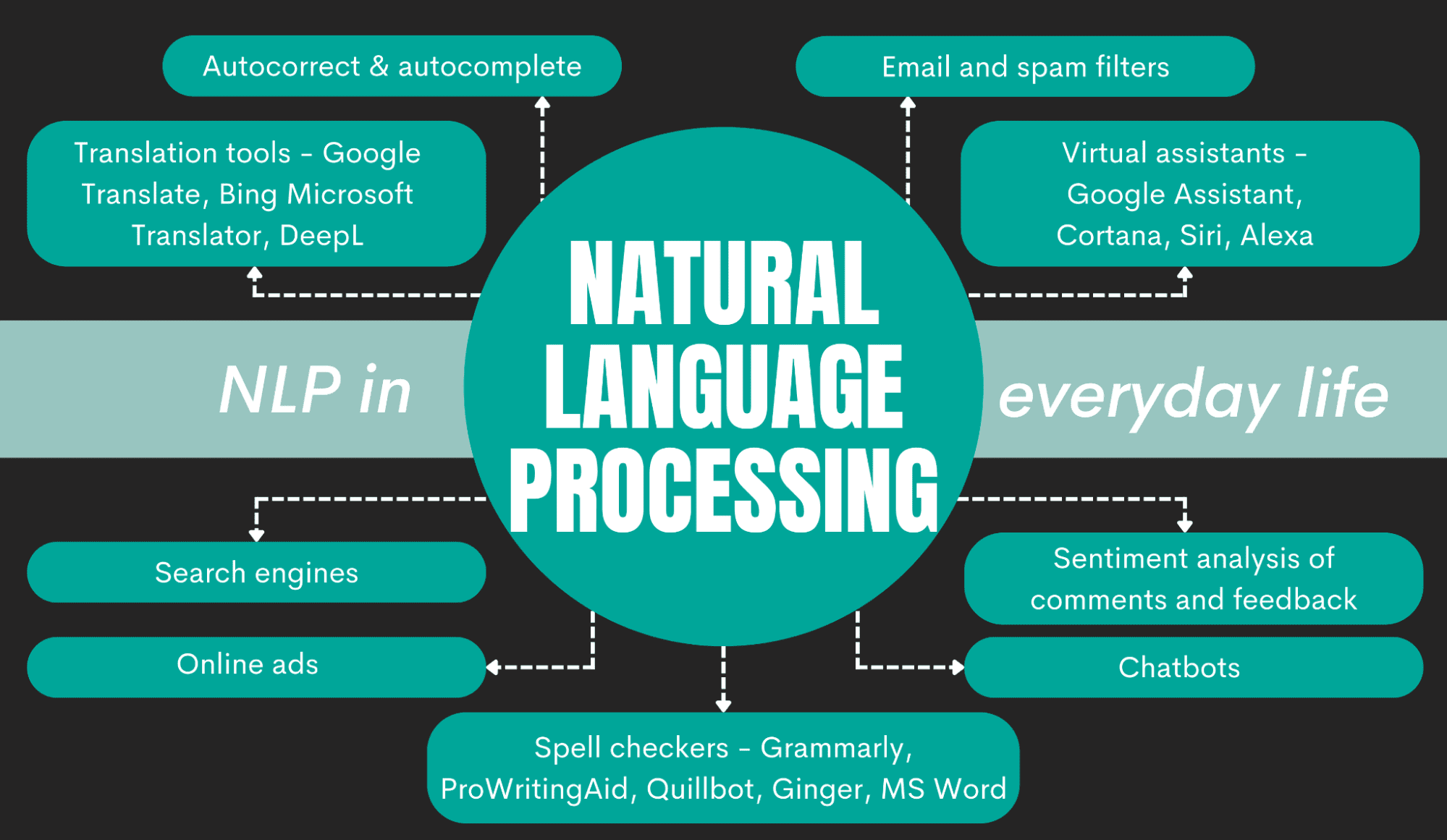
NLP is becoming a feature of our everyday lives. As I was writing the previous sentence, Google’s Smart Compose suggested the phrase ‘everyday lives’. I accepted. Because that’s what I intended to write.
NLP Interview Questions

So this is one of its uses: autocorrect, autocomplete, and spell checkers. The NLP software scans the text for grammatical and spelling errors, corrects them, or gives correction suggestions. There are also spell checkers that can ‘understand’ the whole sentence's syntax, context, and meaning. Based on that, they suggest corrections or better-phrased sentences in line with the goal you’re trying to achieve with your text.

Language translation is another use of NLP. Whenever you’re in a foreign country, you probably use a translation tool, such as Google Translate. Also, translators are more and more used on social media, such as Facebook, Instagram, and Youtube.

Recognizing and generating speech is also one of the NLP uses. Think of Google Assistant, Windows Speech Recognition, Dragon, Siri, Alexa, or Cortana; they all seem to understand you (more or less) when you talk. Based on what you tell them, they will perform a certain action, such as browsing the internet, typing your words, or playing your favorite song. Some of these tools can even talk back to you, i.e., generate speech.

NLP can also decipher the ‘feel’ of the text. In other words, they can detect the sentiment behind the text, not only the literal meaning. This means understanding emotions (happy, angry, disturbed, neutral…), sarcasm, double meaning, metaphors, and expressions within a context. This is called sentiment analysis. Think of understanding the social media comments and removing those breaking the terms of service or getting the customers’ satisfaction by analyzing their comments and reviews.

NLP is heavily used in online marketing. The keywords you search are matched with the keywords of the companies, their products, and their ads. So when you start seeing ads for a product you just Googled, don’t worry. You’re not crazy; it’s NLP and targeted advertising at work.

What Does NLP Have to Do With Data Science?

Data scientists might not be interested in natural languages per se. Adding computer processing to it – where natural languages become data – and you might be drawing data scientists’ attention.

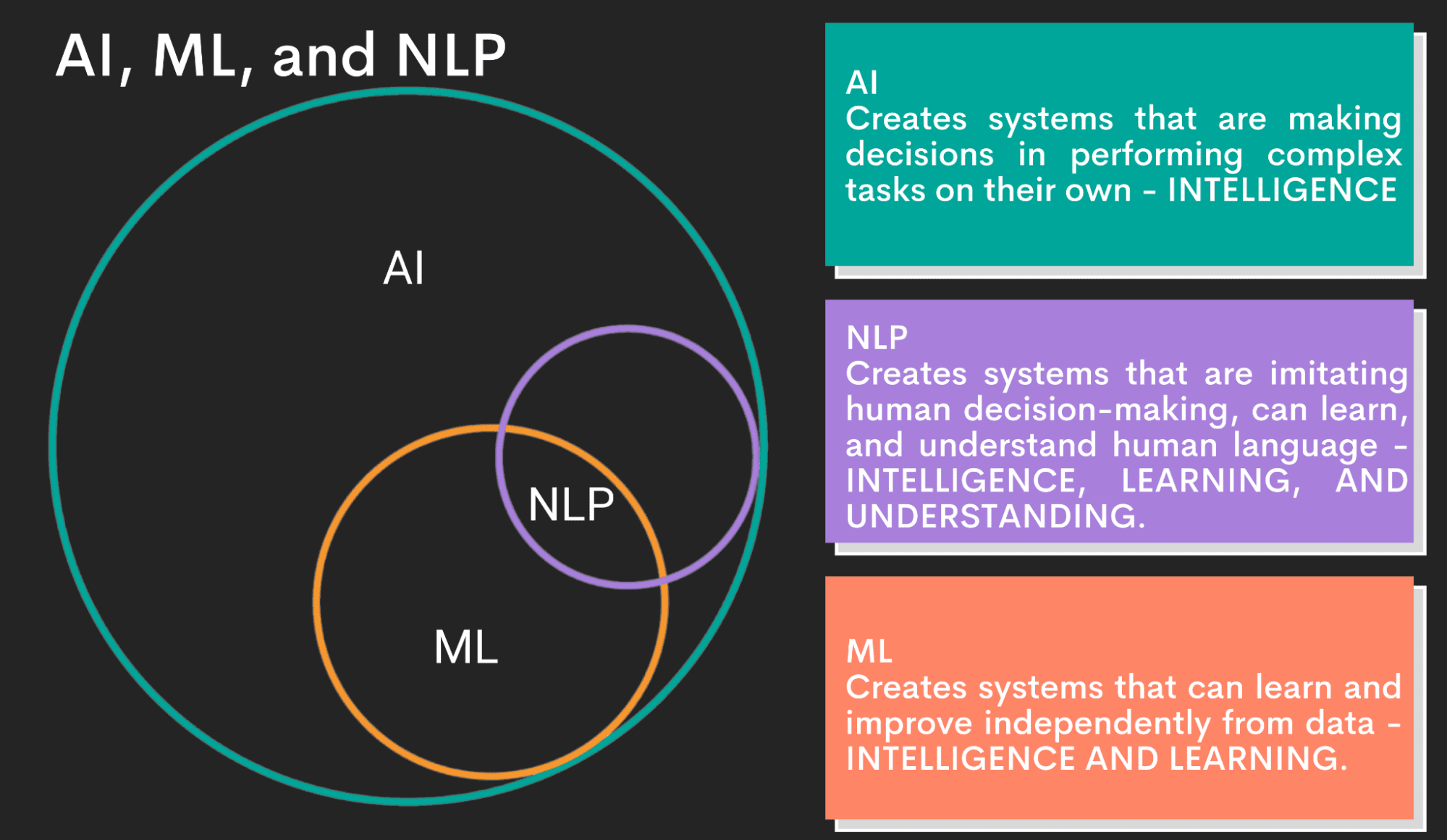
Maybe it’s not enough for the data scientists’ eyes to light up, but this could change by knowing that machine learning (ML) overlaps with and is often used in NLP.
NLP Interview Questions

Behind all the above uses of NLP usually lies ML. And ML is undeniably a field that is deeply immersed in data science.

When talking about ML, there’s usually a distinction between a supervised and unsupervised ML.

The supervised ML models most commonly used in NLP are:

  • Support-Vector Machines (SVMs)
  • Bayesian Networks
  • Maximum Entropy
  • Conditional Random Fields
  • Neural Networks

Unsupervised learning is not that common in NLP, but still, some of the techniques are used:

  • Clustering
  • Latent Semantic Indexing (LSI)
  • Matrix Factorization

Behind every ML model and algorithm, there are underlying statistics concepts.

These two areas are heavily tested in all serious companies looking for data scientists. The same is for companies dealing with NLP.

What can be specific to NLP is certain terminology, which you will be expected to know.

Take everything I mentioned here to form your interview preparation around three major topics.

The Questions for an NLP Interview

All the previous talk smoothly leads to the categories of NLP interview questions:

  1. General & NLP Terminology Questions
  2. Statistics Questions
  3. Modeling Questions

NLP Interview Questions

“I won’t be covering coding questions in this article. It’s common knowledge that data scientists generally have to be skillful coders, especially in SQL and Python. The same is true for data scientists working in NLP, so you should be ready for the coding part of the interview.”

1. General & NLP Terminology Interview Questions

These NLP interview questions deal with your knowledge of what NLP is, how it works, and the technical concepts specific to NLP.

This is the least ‘transferable’ data science knowledge. In other words, if you haven’t worked already with NLP, your previous data science knowledge wouldn’t help you here much. So if you have no working experience with NLP, take these questions very seriously and meticulously prepare them for the interview.

Some of the question examples are:

  1. What are the stages in the lifecycle of a natural language processing (NLP) project?
  2. What are some of the common NLP tasks?
  3. What is the difference between stemming and lemmatization?
  4. What is information extraction?
  5. What is sentiment analysis in NLP?
  6. List some open-source libraries for NLP.

2. Statistics Interview Questions

The statistics questions test your knowledge of the statistical concepts you will regularly use as a data scientist in general and when working on NLP projects.

Here are some examples:

  1. Bayesian vs. Frequentist Statistics: What is the difference between Bayesian vs. frequentist statistics?
  2. What are the hidden Markov random fields?
  3. Pearson's Correlation Coefficient: Prove why Pearson's correlation coefficient is between -1 and 1.
  4. What do you mean by perplexity in NLP?

3. Modeling Interview Questions

The third category of NLP interview questions deals with the ML and the models in general. This could refer to the most commonly used ML algorithms in NLP (as mentioned above) and to some other specific techniques and methods used in NLP.

Below are some examples:

  1. What are the differences between GPT and GPT-2?
  2. Do you like feature extraction or fine-tuning? How do you decide? Would you use BERT as a feature extractor or fine-tune it?
  3. What do you mean by Masked language modeling?
  4. PCA and LDA/QDA: What is the relationship between PCA and LDA/QDA?
  5. Naive Bayes Classifier: What is "naive" about a Naive Bayes classifier?

Summary

Natural language processing is a field that gets increasingly used in everyday life. Current uses include spell checkers, autocomplete tools, translators, speech recognition, and generation software. NLP is also heavily used in social media monitoring and online marketing.

NLP overlaps with machine learning, so plenty of ML knowledge applies to NLP, too. But don’t get too complacent! NLP is a vast and specific field that requires knowing very specific terminology, techniques, and methods commonly used.

Generally, the interview question types can be divided into general NLP questions, statistics questions, and modeling questions.

The examples and resources I gave you above are just a start. But even they are enough to make sure you go to an NLP job interview without fear.

Nate Rosidi is a data scientist and in product strategy. He's also an adjunct professor teaching analytics, and is the founder of StrataScratch, a platform helping data scientists prepare for their interviews with real interview questions from top companies. Connect with him on Twitter: StrataScratch or LinkedIn.

More On This Topic

  • SQL Interviews Preparations Material Resources
  • 7 Must-Know Python Tips for Coding Interviews
  • 10 Statistical Concepts You Should Know For Data Science Interviews
  • The Ultimate Guide to Data Engineer Interviews
  • Top Five SQL Window Functions You Should Know For Data Science Interviews
  • Deliver a Killer Presentation in Data Science Interviews